Segmentation Strategies for Streaming Speech Translation
Vivek Kumar Rangarajan Sridhar, John Chen, Srinivas Bangalore Andrej Ljolje, Rathinavelu Chengalvarayan
AT&T Labs - Research
180 Park Avenue, Florham Park, NJ 07932
vkumar,jchen,srini,alj,[email protected]
Abstract
The study presented in this work is a first ef-fort at real-time speech translation of TED talks, a compendium of public talks with dif-ferent speakers addressing a variety of top-ics. We address the goal of achieving a sys-tem that balances translation accuracy and la-tency. In order to improve ASR performance for our diverse data set, adaptation techniques such as constrained model adaptation and vo-cal tract length normalization are found to be useful. In order to improve machine transla-tion (MT) performance, techniques that could be employed in real-time such as monotonic and partial translation retention are found to be of use. We also experiment with inserting text segmenters of various types between ASR and MT in a series of real-time translation ex-periments. Among other results, our experi-ments demonstrate that a good segmentation is useful, and a novel conjunction-based seg-mentation strategy improves translation qual-ity nearly as much as other strategies such as comma-based segmentation. It was also found to be important to synchronize various pipeline components in order to minimize la-tency.
1 Introduction
The quality of automatic to-text and speech-to-speech (S2S) translation has improved so signifi-cantly over the last several decades that such systems are now widely deployed and used by an increasing number of consumers. Under the hood, the individ-ual components such as automatic speech recogni-tion (ASR), machine translarecogni-tion (MT) and text-to-speech synthesis (TTS) that constitute a S2S sys-tem are still loosely coupled and typically trained on disparate data and domains. Nevertheless, the
models as well as the pipeline have been optimized in several ways to achieve tasks such as high qual-ity offline speech translation (Cohen, 2007; Kings-bury et al., 2011; Federico et al., 2011), on-demand web based speech and text translation, low-latency real-time translation (Wahlster, 2000; Hamon et al., 2009; Bangalore et al., 2012), etc. The design of a S2S translation system is highly dependent on the nature of the audio stimuli. For example, talks, lec-tures and audio broadcasts are typically long and re-quire appropriate segmentation strategies to chunk the input signal to ensure high quality translation. In contrast, single utterance translation in several consumer applications (apps) are typically short and can be processed without the need for additional chunking. Another key parameter in designing a S2S translation system for any task is latency. In offline scenarios where high latencies are permit-ted, several adaptation strategies (speaker, language model, translation model), denser data structures (N-best lists, word sausages, lattices) and rescoring pro-cedures can be utilized to improve the quality of end-to-end translation. On the other hand, real-time speech-to-text or speech-to-speech translation demand the best possible accuracy at low latencies such that communication is not hindered due to po-tential delay in processing.
In this work, we focus on the speech translation of talks. We investigate the tradeoff between accu-racy and latency for both offline and real-time trans-lation of talks. In both these scenarios, appropriate segmentation of the audio signal as well as the ASR hypothesis that is fed into machine translation is crit-ical for maximizing the overall translation quality of the talk. Ideally, one would like to train the models on entire talks. However, such corpora are not avail-able in large amounts. Hence, it is necessary to
form to appropriately sized segments that are similar to the sentence units used in training the language and translation models. We propose several non-linguistic and non-linguistic segmentation strategies for the segmentation of text (reference or ASR hypothe-ses) for machine translation. We address the prob-lem of latency in real-time translation as a function of the segmentation strategy; i.e., we ask the ques-tion “what is the segmentaques-tion strategy that maxi-mizes the number of segments while still maximiz-ing translation accuracy?”.
2 Related Work
Speech translation of European Parliamentary speeches has been addressed as part of the TC-STAR project (Vilar et al., 2005; F¨ugen et al., 2006). The project focused primarily on offline translation of speeches. Simultaneous translation of lectures and speeches has been addressed in (Hamon et al., 2009; F¨ugen et al., 2007). However, the work fo-cused on a single speaker in a limited domain. Of-fline speech translation of TED1talks has been ad-dressed through the IWSLT 2011 and 2012 evalua-tion tracks. The talks are from a variety of speakers with varying dialects and cover a range of topics. The study presented in this work is the first effort on real-time speech translation of TED talks. In com-parison with previous work, we also present a sys-tematic study of the accuracy versus latency tradeoff for both offline and real-time translation on the same dataset.
Various utterance segmentation strategies for of-fline machine translation of text and ASR output have been presented in (Cettolo and Federico, 2006; Rao et al., 2007; Matusov et al., 2007). The work in (F¨ugen et al., 2007; F¨ugen and Kolss, 2007) also examines the impact of segmentation on of-fline speech translation of talks. However, the real-time analysis in that work is presented only for speech recognition. In contrast with previous work, we tackle the latency issue in simultaneous transla-tion of talks as a functransla-tion of segmentatransla-tion strategy and present some new linguistic and non-linguistic methodologies. We investigate the accuracy versus latency tradeoff across translation of reference text, utterance segmented speech recognition output and
1http://www.ted.com
partial speech recognition hypotheses.
3 Problem Formulation
The basic problem of text translation can be formu-lated as follows. Given a source (French) sentence f = f1J = f1,· · · , fJ, we aim to translate it into target (English) sentenceˆe= ˆeI
1 = ˆe1,· · · ,eˆI.
ˆe(f) = arg max
e
Pr(e|f) (1)
If, as in talks, the source text (reference or ASR hy-pothesis) is very long, i.e., J is large, we attempt to break down the source string into shorter se-quences,S=s1· · ·sk· · ·sQs, where each sequence
sk = [fjkfjk+1· · ·fj(k+1)−1], j1 = 1, jQs+1 =
J + 1. Let the translation of each foreign sequence
sk be denoted bytk= [eikeik+1· · ·ei(k+1)−1],i1 =
1, iQs+1 = I
0
+ 12. The segmented sequences can be translated using a variety of techniques such as independent chunk-wise translation or chunk-wise translation conditioned on history as shown in Eqs. 2 and 3, respectively. In Eq. 3, t∗i denotes the best translation for source sequencesi.
ˆ ˆ
e(f) = arg max t1
Pr(t1|s1)· · ·arg max
tk
Pr(tk|sk)
(2) ˆ
ˆ
e(f) = arg max t1
Pr(t1|s1) arg max
t2
Pr(t2|s2, s1, t∗1)
· · · arg max tk
Pr(tk|s1,· · · , sk, t∗1,· · ·, t
∗ k−1)
(3)
Typically, the hypothesisˆˆewill be more accurate than eˆfor long texts as the models approximating Pr(e|f)are conventionally trained on short text seg-ments. In Eqs. 2 and 3, the number of sequencesQs is inversely proportional to the time it takes to gen-erate partial target hypotheses. Our main focus in this work is to obtain a segmentationSsuch that the quality of translation is maximized with minimal la-tency. The above formulation for automatic speech recognition is very similar except that the foreign stringˇf = ˇf1J = ˇf1,· · · ,fˇJˇis obtained by decoding
the input speech signal.
Model Language Vocabulary #words #sents Corpora Acoustic Model en 46899 2611144 148460 1119 TED talks
ASR Language Model en 378915 3398460155 151923101 Europarl, WMT11 Gigaword, WMT11 News crawl
WMT11 News-commentary, WMT11 UN, IWSLT11 TED training Parallel text en 503765 76886659 7464857 IWSLT11 TED training talks, Europarl, JRC-ACQUIS
Opensubtitles, Web data
MT es 519354 83717810 7464857
[image:3.612.73.555.55.143.2]Language Model es 519354 83717810 7464857 Spanish side of parallel text
Table 1: Statistics of the data used for training the speech translation models.
4 Data
In this work, we focus on the speech translation of TED talks, a compendium of public talks from several speakers covering a variety of topics. Over the past couple of years, the International Work-shop on Spoken Language Translation (IWSLT) has been conducting the evaluation of speech translation on TED talks for English-French. We leverage the IWSLT TED campaign by using identical develop-ment (dev2010) and test data (tst2010). However, English-Spanish is our target language pair as our internal projects are cater mostly to this pair. As a result, we created parallel text for English-Spanish based on the reference English segments released as part of the evaluation (Cettolo et al., 2012).
We also harvested the audio data from the TED website for building an acoustic model. A total of 1308 talks in English were downloaded, out of which we used 1119 talks recorded prior to Decem-ber 2011. We split the stereo audio file and dupli-cated the data to account for any variations in the channels. The data for the language models was also restricted to that permitted in the IWSLT 2011 eval-uation. The parallel text for building the English-Spanish translation model was obtained from sev-eral corpora: Europarl (Koehn, 2005), JRC-Acquis corpus (Steinberger et al., 2006), Opensubtitle cor-pus (Tiedemann and Lars Nygaard, 2004), Web crawling (Rangarajan Sridhar et al., 2011) as well as human translation of proprietary data. Table 1 sum-marizes the data used in building the models. It is important to note that the IWSLT evaluation on TED talks is completely offline. In this work, we perform the first investigation into the real-time translation of these talks.
5 Speech Translation Models
In this section, we describe the acoustic, language and translation models used in our experiments.
5.1 Acoustic and Language Model
We use the AT&T WATSONSM speech recog-nizer (Goffin et al., 2004). The speech recogni-tion component consisted of a three-pass decoding approach utilizing two acoustic models. The mod-els used three-state left-to-right HMMs representing just over 100 phonemes. The phonemes represented general English, spelled letters and head-body-tail representation for the eleven digits (with ”zero” and ”oh”). The pronunciation dictionary used the appro-priate phoneme subset, depending on the type of the word. The models had 10.5k states and 27k HMMs, trained on just over 300k utterances, using both of the stereo channels. The baseline model training was initialized with several iterations of ML training, in-cluding two builds of context dependency trees, fol-lowed by three iterations of Minimum Phone Error (MPE) training.
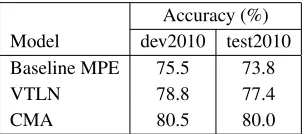
The English language model was built using the permissible data in the IWSLT 2011 evaluation. The texts were normalized using a variety of cleanup, number and spelling normalization techniques and filtered by restricting the vocabulary to the top 375000 types; i.e., any sentence containing a to-ken outside the vocabulary was discarded. First, we removed extraneous characters beyond the ASCII range followed by removal of punctuations. Sub-sequently, we normalized hyphenated words and moved words with more than 25 characters. The re-sultant text was normalized using a variety of num-ber conversion routines and each corpus was fil-tered by restricting the vocabulary to the top 150000 types; i.e., any sentence containing a token outside the vocabulary was discarded. The vocabulary from all the corpora was then consolidated and another round of filtering to the top 375000 most frequent types was performed. The OOV rate on the TED dev2010 set is 1.1%. We used the AT&T FSM toolkit (Mohri et al., 1997) to train a trigram lan-guage model (LM) for each component (corpus). Fi-nally, the component language models were interpo-lated by minimizing the perplexity on the dev2010 set. The results are shown in Table 2.
Accuracy (%)
Model dev2010 test2010
Baseline MPE 75.5 73.8
VTLN 78.8 77.4
[image:4.612.110.263.404.471.2]CMA 80.5 80.0
Table 2: ASR word accuracies on the IWSLT data sets.3
5.2 Translation Model
We used the Moses toolkit (Koehn et al., 2007) for performing statistical machine translation. Mini-mum error rate training (MERT) was performed on the development set (dev2010) to optimize the fea-ture weights of the log-linear model used in trans-lation. During decoding, the unknown words were preserved in the hypotheses. The data used to train the model is summarized in Table 1.
3We used the standard NIST scoring package as we did not have access to the IWSLT evaluation server that may normalize and score differently
We also used a finite-state implementation of translation without reordering. Reordering can pose a challenge in real-time S2S translation as the text-to-speech synthesis is monotonic and cannot retract already synthesized speech. While we do not ad-dress the text-to-speech synthesis of target text in this work, we perform this analysis as a precursor to future work. We represent the phrase transla-tion table as a weighted finite state transducer (FST) and the language model as a finite state acceptor (FSA). The weight on the arcs of the FST is the dot product of the MERT weights with the transla-tion scores. In additransla-tion, a word insertransla-tion penalty was also applied to each word to penalize short hy-potheses. The decoding process consists of compos-ing all possible segmentations of an input sentence with the phrase table FST and language model, fol-lowed by searching for the best path. Our FST-based translation is the equivalent of phrase-based transla-tion in Moses without reordering. We present re-sults using the independent chunk-wise strategy and chunk-wise translation conditioned on history in Ta-ble 3. The chunk-wise translation conditioned on history was performed using the
continue-partial-translationoption in Moses.
6 Segmentation Strategies
incremental ASR hypotheses from entire talks.
6.1 Non-linguistic segmentation
The simplest method is to segment the incoming text according to length in number of words. Such a pro-cedure can destroy semantic context but has little to no overhead in additional processing. We experi-ment with segexperi-menting the text according to word window sizes of length 4, 8, 11, and 15 (denoted as data setswin4, win8,win11,win15, respectively in Table 3). We also experiment with concatenating all of the text from one TED talk into a single chunk (complete talk).
A novel hold-output model was also developed in order to segment the input text. Given a pair of par-allel sentences, the model segments the source sen-tence into minimally sized chunks such that crossing links and links of one target word to many source words in an optimal GIZA++ alignment (Och and Ney, 2003) occur only within individual chunks. The motivation behind this model is that if a segment
s0 is input at timet0 to an incremental MT system,
it can be translated right away without waiting for a segmentsithat is input at a later timeti, ti>0. The hold-output model detects these kinds of segments given a sequence of English words that are input from left to right. A kernel-based SVM was used to develop this model. It tags a tokentin the input with either the label HOLD, meaning to chunk it with the next token, or the label OUTPUT, meaning to output the chunk constructed from the maximal consecutive sequence of tokens precedingtthat were all tagged as HOLD. The model considers a five word and POS window around the target tokent. Unigram, bigram, and trigram word and POS features based upon this window are used for classification. Training and de-velopment data for the model was derived from the English-Spanish TED data (see Table 1) after run-ning it through GIZA++. Accuracy of the model on the development set was 66.62% F-measure for the HOLD label and 82.75% for the OUTPUT label.
6.2 Linguistic segmentation
Since MT models are trained on parallel text sen-tences, we investigate segmenting the source text into sentences. We also investigate segmenting the text further by predicting comma separated chunks within sentences. These tasks are performed by
training a kernel-based SVM (Haffner et al., 2003) on a subset of English TED data. This dataset con-tained 1029 human-transcribed talks consisting of about 103,000 sentences containing about 1.6 mil-lion words. Punctuation in this dataset was normal-ized as follows. Different kinds of sentence ending punctuations were transformed into a uniform end of sentence marker. Double-hyphens were transformed into commas. Commas already existing in the input were kept while all other kinds of punctuation sym-bols were deleted. A part of speech (POS) tagger was applied to this input. For speed, a unigram POS tagger was implemented which was trained on the Penn Treebank (Marcus et al., 1993) and used or-thographic features to predict the POS of unknown words. The SVM-based punctuation classifier relies on a five word and POS window in order to classify the target word. Specifically, token t0 is classified
given as input the windowt−2t−1tot1t2. Unigram,
bigram, and trigram word and POS features based on this window were used for classification. Accuracy of the classifier on the development set was 60.51% F-measure for sentence end detection and 43.43% F-measure for comma detection. Subsequently, data
setspred-sent(sentences) andpred-punct
(comma-separated chunks) were obtained. Corresponding to these, two other data setsref-sentandref-punctwere obtained based upon gold-standard punctuations in the reference.
chunk-ref-Reference text ASR 1-best
BLEU Mean BLEU Mean
Segmentation Segmentation Independent chunk-wise chunk-wise #words Independent chunk-wise chunk-wise #words type strategy FST Moses with history per segment FST Moses with history per segment
win4 22.6 21.0 25.5 3.9±0.1 17.7 17.1 20.0 3.9±0.1 win8 26.6 26.2 28.2 7.9±0.3 20.6 20.9 22.3 7.9±0.2 Non-linguistic win11 27.2 27.4 29.2 10.9±0.3 21.5 21.8 23.1 10.9±0.4 win15 28.5 28.5 29.4 14.9±0.6 22.3 22.8 23.3 14.9±0.7 ref-hold 13.3 14.0 17.1 1.6±1.9 12.7 13.1 17.5 1.5±1.0 pred-hold 15.9 15.7 16.3 2.2±1.9 12.6 12.9 17.4 1.5±1.0
complete talk 23.8 23.9 – 2504 18.8 19.2 – 2515
ref-sent 30.6 31.5 30.5 16.7±11.8 24.3 25.1 24.4 17.0±11.6
[image:6.612.76.540.52.306.2]ref-punct 30.4 31.5 30.3 7.1±5.3 24.2 25.1 24.1 8.7±6.1 pred-punct 30.6 31.5 30.4 8.7±8.8 24.1 25.0 24.0 8.8±6.8 conj-ref-eos 30.5 31.5 30.2 11.2±7.5 24.1 24.9 24.0 11.5±7.7 conj-pred-eos 30.3 31.2 30.3 10.9±7.9 24.0 24.8 24.0 11.4±8.5 chunk-ref-punct 17.9 18.9 21.4 1.3±0.7 14.5 15.2 16.9 1.4±0.7 Linguistic lgchunk1-ref-punct 21.0 21.8 25.1 1.7±1.0 16.9 17.4 19.6 1.8±1.0 lgchunk2-ref-punct 22.4 23.1 26.0 2.1±1.1 17.9 18.4 20.4 2.1±1.1 lgchunk3-ref-punct 24.3 25.1 27.4 2.5±1.7 19.2 19.9 21.3 2.5±1.7 chunk-pred-punct 17.9 18.9 21.4 1.3±0.7 14.5 15.1 16.9 1.4±0.7 lgchunk1-pred-punct 21.2 21.9 25.2 1.8±1.0 16.7 17.2 19.7 1.8±1.0 lgchunk2-pred-punct 22.6 23.1 26.0 2.1±1.2 17.7 18.3 20.5 2.1±1.2 lgchunk3-pred-punct 24.5 25.3 27.4 2.6±1.8 19.1 20.0 21.3 2.5±1.7
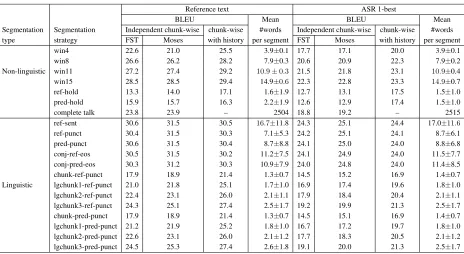
Table 3: BLEU scores at the talk level for reference text and ASR 1-best for various segmentation strategies. The ASR 1-best was performed on manually segmented audio chunks provided intst2010set.
punctandchunk-pred-punct. Chunk types included
NC (noun chunk), VC (verb chunk), PRT (particle), and ADVC (adverbial chunk).
Because these chunks may not provide sufficient context for translation, we also experimented with concatenating neighboring chunks of certain types to form larger chunks. Data setslgchunk1 concate-nate together neighboring chunk sequences of the form NC, VC or NC, ADVC, VC, intended to cap-ture as single chunks instances of subject and verb. In addition to this, data setslgchunk2capture chunks such as PC (prepositional phrase) and VC followed by VC (control and raising verbs). Finally, data sets
lgchunk3capture as single chunks VC followed by
NC and optionally followed by PRT (verb and its di-rect object).
Applying the conjunction segmenter after the aforementioned punctuation classifier in order to de-tect the ends of sentences yields the data set
conj-pred-eos. Applying it on sentences derived from the
gold-standard punctuations yields the data set
conj-ref-eos. Finally, applying the hold-output model to
sentences derived using the punctuation classifier produces the data setpred-hold. Obtaining English sentences tagged with HOLD and OUTPUT directly
from the output of GIZA++ on English-Spanish sen-tences in the reference produces the data setref-hold. The strategies containing the keywordref for ASR simply means that the ASR hypotheses are used in place of the gold reference text.
0 0.2 0.4 0.6 0.8 1 1.2 1.4 1.6 1.8
0 1000 2000 3000 4000 5000 6000
processing time per token (sec)
ASR timeout (ms)
ASR+MT (BLEU)
10.0
11.7 12.613.3 13.7
14.0 14.114.3 14.6
14.7 14.714.8
ASR+Punct Seg+MT (BLEU)
15.1 15.115.1 15.1
15.1
15.1 15.115.1
15.1
15.1 15.115.1
Figure 1: Latencies and BLEU scores for tst2010 set using incremental ASR decoding and translation
[image:6.612.314.538.440.621.2]the pruning during search, will not change in the future. Figure 1 shows the plot for two scenarios: one in which the partial hypotheses are sent directly to machine translation and another where the best segmentation strategypred-punctis used to segment the partial output before sending it to MT. The plot shows the BLEU scores as a function of ASR time-outs used to generate the partial hypotheses. Fig-ure 1 also shows the average latency involved in in-cremental speech translation.
7 Discussion
The BLEU scores for the segmentation strategies over ASR hypotheses was computed at the talk level. Since the ASR hypotheses do not align with the reference source text, it is not feasible to evalu-ate the translation performance using the gold refer-ence. While other studies have used an approximate edit distance algorithm for resegmentation of the hy-potheses (Matusov et al., 2005), we simply concate-nate all the segments and perform the evaluation at the talk level.
The hold segmentation strategy yields the poor-est translation performance. The significant drop in BLEU score can be attributed to relatively short seg-ments (2-4 words) that was generated by the model. The scheme oversegments the text and since the translation and language models are trained on sen-tence like chunks, the performance is poor. For ex-ample, the input text the sea should be translated
asel mar, but instead thehold segmenter chunks it
asthe·seawhich MT’s chunk translation renders as
el·el mar. It will be interesting to increase the span of theholdstrategy to subsume more contiguous se-quences and we plan to investigate this as part of future work.
Thechunksegmentation strategy yields quite poor
translation performance. In general, it does not make the same kinds of errors that the hold strat-egy makes; for example, the input textthe seawill be treated as one NC chunk by the chunk seg-mentation strategy, leading MT to translate it cor-rectly as el mar. The short chunk sizes of chunk
lead to other kinds of errors. For example, the in-put text we use will be chunked into the NC we
and the VC use, which will be translated incor-rectly as nosotros·usar; the infinitive usar is
se-lected rather than the properly conjugated form us-amos. However, there is a marked improvement in translation accuracy with increasingly larger chunk sizes (lgchunk1,lgchunk2, andlgchunk3). Notably,
lgchunk3yields performance that approaches that of
win8with a chunk size that is one third ofwin8’s.
Theconj-pred-eosandpred-punctstrategies work
the best, and it can be seen that the average seg-ment length (8-12 words) generated in both these schemes is very similar to that used for training the models. It is also about the average latency (4-5 seconds) that can be tolerated in cross-lingual com-munication, also known as ear-voice span (Lederer, 1978). The non-linguistic segmentation using fixed word length windows also performs well, especially for the longer length windows. However, longer windows (win15) increase the latency and any fixed length window typically destroys the semantic con-text. It can also be seen from Table 3 that translat-ing the complete talk is suboptimal in comparison with segmenting the text. This is primarily due to bias on sentence length distributions in the training data. Training models on complete talks is likely to resolve this issue. Contrasting the use of reference segments as input to MT (ref-sent, ref-punct,
conj-ref-eos) versus the use of predicted segments (
pred-sent, pred-punct, conj-pred-eos, respectively), it is interesting to note that the MT accuracies never dif-fered greatly between the two, despite the noise in the set of predicted segments.
The performance of the real-time speech transla-tion of TED talks is much lower than the offline sce-nario. First, we use only a VTLN model as perform-ing CMA adaptation in a real-time scenario typically increases latency. Second, the ASR language model is trained on sentence-like units and decoding the en-tire talk with this LM is not optimal. A language model trained on complete talks will be more appro-priate for such a framework and we are investigating this as part of current work.
Comparing the accuracies of different speech translation strategies, Table 3 shows thatpred-punct
sec-onds. In terms of latency, Figure 1 shows that the addition of thepred-punctsegmenter into the incre-mental system introduces a significant delay. About one third of the increase in delay can be attributed to merely maintaining the two word lookahead win-dow that the segmenter’s classifier needs to make decisions. This is significant because this kind of window has been used quite frequently in previous work on simultaneous translation (cf. (F¨ugen et al., 2007)), and yet to our knowledge this penalty asso-ciated with this configuration was never mentioned. The remaining delay can be attributed to the long chunk sizes that the segmenter produces. An inter-esting aspect of the latency curve associated with the segmenter in Figure 1 is that there are two peaks at ASR timeouts of 2,500 and 4,500 ms, and that the lowest latency is achieved at 3,000 ms rather than at a smaller value. This may be attributed to the fact that the system is a pipeline consisting of ASR, seg-menter, and MT, and that 3,000 ms is roughly the length of time to recite comma-separated chunks. Consequently, the two latency peaks appear to cor-respond with ASR producing segments that are most divergent with segments that the segmenter pro-duces, leading to the most pipeline “stalls.” Con-versely, the lowest latency occurs when the timeout is set so that ASR’s segments most resemble the seg-menter’s output to MT.
8 Conclusion
We investigated various approaches for incremen-tal speech translation of TED incremen-talks, with the aim of producing a system with high MT accuracy and low latency. For acoustic modeling, we found that VTLN and CMA adaptation were useful for increas-ing the accuracy of ASR, leadincreas-ing to a word accuracy of 80% on TED talks used in the IWSLT evalua-tion track. In our offline MT experiments retenevalua-tion of partial translations was found useful for increas-ing MT accuracy, with the latter beincreas-ing slightly more helpful. We experimented with several linguistic and non-linguistic strategies for text segmentation before translation. Our experiments indicate that a novel segmentation into conjunction-separated sen-tence chunks resulted in accuracies almost as high and latencies almost as short as comma-separated sentence chunks. They also indicated that
signifi-cant noise in the detection of sentences and punc-tuation did not seriously impact the resulting MT accuracy. Experiments on real-time simultaneous speech translation using partial recognition hypothe-ses demonstrate that introduction of a segmenter in-creases MT accuracy. They also showed that in or-der to reduce latency it is important for buffers in dif-ferent pipeline components to be synchronized so as to minimize pipeline stalls. As part of future work, we plan to extend the framework presented in this work for performing speech-to-speech translation. We also plan to address the challenges involved in S2S translation across languages with very different word order.
Acknowledgments
We would like to thank Simon Byers for his help with organizing the TED talks data.
References
S. Bangalore, V. K. Rangarajan Sridhar, P. Kolan, L. Golipour, and A. Jimenez. 2012. Real-time in-cremental speech-to-speech translation of dialogs. In Proceedings of NAACL:HLT, June.
M. Cettolo and M. Federico. 2006. Text segmentation criteria for statistical machine translation. In Proceed-ings of the 5th international conference on Advances in Natural Language Processing.
M. Cettolo, C. Girardi, and M. Federico. 2012. WIT3: Web Inventory of Transcribed and Translated Talks. In Proceedings of EAMT.
J. Cohen. 2007. The GALE project: A description and an update. InProceedings of ASRU Workshop. M. Federico, L. Bentivogli, M. Paul, and S. St¨uker. 2011.
Overview of the IWSLT 2011 evaluation campaign. In Proceedings of IWSLT.
C. F¨ugen and M. Kolss. 2007. The influence of utterance chunking on machine translation performance. In Pro-ceedings of Interspeech.
C. F¨ugen, M. Kolss, D. Bernreuther, M. Paulik, S. Stuker, S. Vogel, and A. Waibel. 2006. Open domain speech recognition & translation: Lectures and speeches. In Proceedings of ICASSP.
C. F¨ugen, A. Waibel, and M. Kolss. 2007. Simultaneous translation of lectures and speeches. Machine Trans-lation, 21:209–252.
P. Haffner, G. T¨ur, and J. Wright. 2003. Optimizing svms for complex call classification. InProceedings of ICASSP’03.
O. Hamon, C. F¨ugen, D. Mostefa, V. Arranz, M. Kolss, A. Waibel, and K. Choukri. 2009. End-to-end evalua-tion in simultaneous translaevalua-tion. InProceedings of the 12th Conference of the European Chapter of the ACL (EACL 2009), March.
B. Kingsbury, H. Soltau, G. Saon, S. Chu, Hong-Kwang Kuo, L. Mangu, S. Ravuri, N. Morgan, and A. Janin. 2011. The IBM 2009 GALE Arabic speech translation system. InProceedings of ICASSP.
P. Koehn, H. Hoang, A. Birch, C. Callison-Burch, M. Federico, N. Bertoldi, B. Cowan, Shen W., C. Moran, R. Zens, C. J. Dyer, O. Bojar, A. Constantin, and E. Herbst. 2007. Moses: Open source toolkit for statistical machine translation. InProceedings of ACL. P. Koehn. 2005. Europarl: A parallel corpus for
statisti-cal machine translation. InMT Summit.
M. Lederer. 1978. Simultaneous interpretation: units of meaning and other features. In D. Gerver and H. W. Sinaiko, editors,Language interpretation and commu-nication, pages 323–332. Plenum Press, New York. M. Marcus, B. Santorini, and M. A. Marcinkiewicz.
1993. Building a large annotated corpus of En-glish: the Penn treebank. Computational Linguistics, 19(2):313–330.
E. Matusov, G. Leusch, O. Bender, and H. Ney. 2005. Evaluating machine translation output with automatic sentence segmentation. InProceedings of IWSLT. E. Matusov, D. Hillard, M. Magimai-Doss, D.
Hakkani-T¨ur, M. Ostendorf, and H. Ney. 2007. Improving speech translation with automatic boundary predic-tion. InProceedings of Interspeech.
M. Mohri, F. Pereira, and M. Riley. 1997. At&t general-purpose finite-state machine software tools, http://www.research.att.com/sw/tools/fsm/.
F. J. Och and H. Ney. 2003. A systematic comparison of various statistical alignment models. Computational Linguistics, 29(1):19–51.
V. K. Rangarajan Sridhar, L. Barbosa, and S. Bangalore. 2011. A scalable approach to building a parallel cor-pus from the Web. InProceedings of Interspeech. S. Rao, I. Lane, and T. Schultz. 2007. Optimizing
sen-tence segmentation for spoken language translation. In Proceedings of Interspeech.
H. Schmid. 1994. Probabilistic part-of-speech tagging using decision trees. In Proceedings of the Interna-tional Conference on New Methods in Language Pro-cessing.
R. Steinberger, B. Pouliquen, A. Widiger, C. Ignat, T. Er-javec, and D. Tufis. 2006. The JRC-Acquis: A multi-lingual aligned parallel corpus with 20+ languages. In Proceedings of LREC.
J. Tiedemann and L. Lars Nygaard. 2004. The OPUS corpus - parallel & free. InProceedings of LREC. D. Vilar, E. Matusov, S. Hasan, R. Zens, and H. Ney.
2005. Statistical machine translation of European par-liamentary speeches. InProceedings of MT Summit. W. Wahlster, editor. 2000. Verbmobil: Foundations of