Open Information Extraction with Tree Kernels
Ying Xu, Mi-Young Kim, Kevin Quinn, Randy Goebel and Denilson Barbosa
Department of Computing Science University of Alberta
{yx2,miyoung2,kfjquinn,goebel,denilson}@cs.ualberta.ca
Abstract
Traditional relation extraction seeks to iden-tify pre-specified semantic relations within natural language text, while open Information Extraction (Open IE) takes a more general ap-proach, and looks for a variety of relations without restriction to a fixed relation set. With this generalization comes the question, what is a relation? For example, should the more general task be restricted to relations medi-ated by verbs, nouns, or both? To help answer this question, we propose two levels of sub-tasks for Open IE. One task is to determine if a sentence potentially contains a relation be-tween two entities? The other task looks to confirm explicit relation words for two enti-ties. We propose multiple SVM models with dependency tree kernels for both tasks. For explicit relation extraction, our system can ex-tract both noun and verb relations. Our results on three datasets show that our system is su-perior when compared to state-of-the-art sys-tems like REVERB and OLLIE for both tasks. For example, in some experiments our system achieves 33% improvement on nominal rela-tion extracrela-tion over OLLIE. In addirela-tion we propose an unsupervised rule-based approach which can serve as a strong baseline for Open IE systems.
1 Introduction
Relation Extraction (RE) systems are designed to discover various semantic relations (e.g. <Obama, president, the United States>) from natural lan-guage text. Traditional RE systems extract spe-cific relations for prespecified name-entity types (Bunescu and Mooney, 2005; Chan and Dan, 2011;
Zhou and Zhu, 2011). To train such systems, ev-ery relation needs manually annotated training ex-amples, which supports limited scope and is diffi-cult to extend. For this reason, Banko et al. (2007) proposed Open Information Extraction (Open IE), whose goal is to extract general relations for two en-tities. The idea is to avoid the need for specific train-ing examples, and to extract a diverse range of rela-tions. This generalized form has received significant attention, e.g., (Banko et al., 2007; Akbik, 2009; Wu and Weld, 2010; Fader et al., 2011; Mausam et al., 2012).
su-perior to WOEparse, a system proposed in Wu and Weld (2010); while in Mausam et al. (2012), it is reported the opposite.
To better answer the question, what counts as a relation? we propose two tasks for Open IE. The first task seeks to determine whether there is a re-lation between two entities (called “Binary task”). The other is to confirm whether the relation words extracted for the two entities are appropriate (the “Triple task”). The Binary task does not restrict re-lation word forms, whether they are mediated by nouns, verbs, prepositions, or even implicit rela-tions. The Triple task requires an abstract repre-sentation of relation word forms, which we develop here. We assume that relation words are nouns or verbs; in our data, these two types comprise 71% of explicit relations.
We adapt an SVM dependency tree kernel model (Moschitti, 2006) for both tasks. The input to our tasks is a dependency parse, created by Stanford Parser. Selecting relevant features from a parse tree for semantic tasks is difficult. SVM tree kernels avoid extracting explicit features from parse trees by calculating the inner product of the two trees. For the Binary task, our dependency path is the path between two entities. For the Triple task, the path is among entities and relation words (i.e. relation triples). Tree kernels have been used in traditional RE and have helped achieve state of the art perfor-mance (Culotta and Sorensen, 2004; Bunescu and Mooney, 2005; Wang, 2008; Nguyen et al., 2009; Zhou and Zhu, 2011). But one challenge of using tree kernels on Open IE is that the lexicon of re-lations is much larger than those of traditional RE, making it difficult to include the lexical information as features. Here we proposed an unlexicalized tree structure for Open IE. As far as we know, this is the first time an SVM tree kernel has been applied in Open IE. Experimental results on multiple datasets show our system outperforms state-of-the-art sys-tems REVERB and OLLIE. Typically an Open IE system is tested on one dataset. However, because the definition of relation is ambiguous, we believe that is necessary to test with multiple datasets.
In addition to the supervised model, we also pro-pose an unsupervised model which relies on several heuristic rules. Results with this approach show that this simple unsupervised model provides a robust
strong baseline for other approaches. In summary, our main contributions are:
• Use SVM tree kernels for Open IE. Our sys-tem is robust comparing with other Open IE systems, achieving superior scores in two test sets and comparative scores in another set.
• Extend beyond verbal relations, which are prevalent in current systems. Analyze implicit relation problem in Open IE, which is ignored by other work.
• Propose an unsupervised model for Open IE, which can be a strong baseline for other ap-proaches.
The rest of this paper is organized as follows. Sec-tion 2 provides the problem descripSec-tion and system structure, before summarizing previous work in Sec-tion 3. SecSec-tion 4 defines our representaSec-tion of rela-tion word patterns crucial to our task two, and Sec-tion 5 describes tree kernels for SVM. SecSec-tion 6 de-scribes the unsupervised model, and Section 7 ex-plains our experiment design and results. Section 8 concludes with a summary, and anticipation of fu-ture work.
2 Problem Definition and System Structure
! " " "
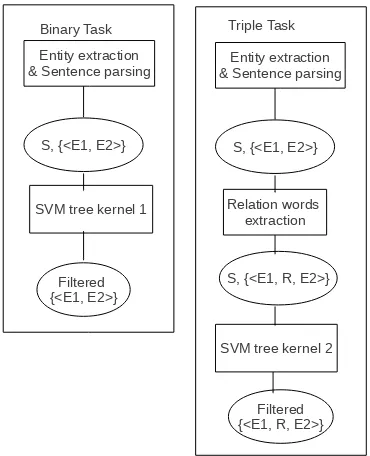
Figure 1: Our Open IE system structure.
Figure 1 presents our Open IE system structure. Both tasks need pre-processing with the Stanford NLP tools 1. Entities and pairs within a certain distance are extracted2, and sentences are parsed. We employ the typed collapsed dependency parse (De Marneffe et al., 2006), which is computed from the constituent parsing and has proved to be useful for semantic tasks (MacCartney et al., 2006). For the Binary task, an SVM model is employed to filter out the extracted entity pair candidates, and output pairs which have certain relations. For the Triple task, we identify relation word candidates of the pairs, based on regular expression patterns. Then another SVM model is employed to decide if the relation triples are correct or not.
3 Related Work
In traditional relation extraction, SVM tree kernel models are the basis for the current state of the art (Culotta and Sorensen, 2004; Bunescu and Mooney, 2005; Wang, 2008; Nguyen et al., 2009; Zhou and Zhu, 2011). But there is more recent work on Open IE (Banko et al., 2007; Akbik, 2009; Wu and Weld, 2010; Christensen et al., 2011; Fader et al., 2011; Mausam et al., 2012).
1
Other equivalent tools such as Open NLP could be used. 2
Here distance means number of tokens in between
Figure 2: Relation Pattern Form (RelW represents relation words, E1 and E2 are two entities.)
Fader et al. (2011) have developed REVERB, which solves the problem of incoherent extractions and uninformative extractions of two previous sys-tems. Instead of extracting entities first, they extract verbal relation sequences based on a set of POS pat-terns. Then entities are identified around the relation sequence, so their system only extracts relation to-kens between two entities toto-kens, e.g. relations such as<he, live in, city>in “Living in this city, he loves the city.” are ignored. Finally, relation triple candi-date noise is filtered by a supervised model which is based on lexical and POS features.
Mausam et al. (2012) present an improved tem called OLLIE, which relaxes the previous sys-tems’ constraints that relation words are mediated by verbs, or relation words that appear between two en-tities. OLLIE creates a training set which includes millions of relations extracted by REVERB with high confidence. Then OLLIE learns relation pat-terns composed of dependency path and lexicon in-formation. Relations matching the patterns can then be extracted.
Both REVERB and OLLIE output a confidence value for every relation triples, instead of classifying them as true or false.
4 Relation Candidate Extraction
pat-tern sets expands that of Fader et al. (2011). The patterns are composed of verb and noun phrases (see Figure 2). A relation candidate can consist of words before, between, or after the pair, or the combina-tion of two consecutive posicombina-tions. Instead of ex-tracting only verbal relations (e.g. give birth to), our patterns also extract relations specified through noun phrases. In the sentence “Obama, the president of the United States, made a speech” the relation “president” matches the relational form “RelW=N, N=noun”. Our method can also extract relation words interspersed between the two entities: e.g., ORGhasNUMemployees, which matches the pat-tern “E1 RelW E2 RelW”; the first RelW matches V, with V=verb, and the second RelW matches N, with N=noun. We choose not to use the dependency path for relation word extraction because of the reason mentioned in (Fader et al., 2011). The dependency method will create incoherent relations. For exam-ple, in the sentence “They recalled that Nungesser began his career as a precinct leader.” recall began will be extracted as a relation because the two words are linked. Although this pattern based method has limitations, finding further improvements remains future work.
5 Tree Kernels
Many methods recognize the value of leveraging parsing information in support of semantic tasks. But selecting relevant features from a parse tree is a difficult task. With kernel-based SVMs, both learn-ing and classification relies on the inner-product be-tween instances. SVM tree kernels avoid extract-ing explicit features from parse trees by calculatextract-ing the inner product of the two trees, so the tree kernel value depends on the common substructure of two trees. A tree kernel function over TreeT1andT1is
K(T1, T2) =
P
n1∈NT1
P
n2∈NT2∆(n1, n2), NT1andNT2 are the set of trees’ nodes (Collins and Duffy, 2001). The∆function provides the basis for identifying subtrees of nodes, which is the essential distinction between different tree kernel functions. Here we adapt the partial tree kernel (PTK) proposed by Moschitti (2006)3, which can be used with both
constituent and dependency parse trees. The
com-3
Thanks to Prof. Moschitti for his PTK package.
(a) SDTP (b) SDTP2
(c) GRCT
(d) unlexicalized GRCT
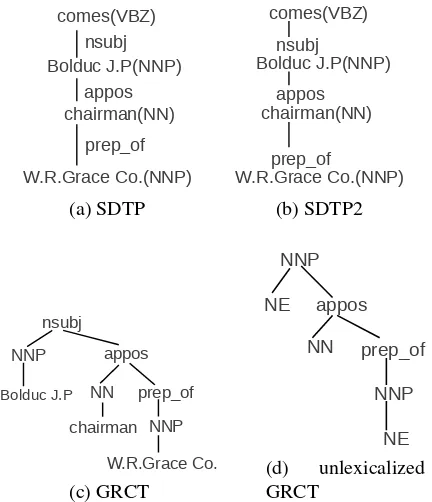
Figure 3: Example trees for shortest dependency path betweenJ.P. BolducandW.R.Grace Co.in sen-tence “J.P. Bolduc, vice chairman of W.R.Grace Co., comes here.” Figure (a) is the shortest dependency tree path (SDTP), (b) is the collapsed form, (c) is the GRCT, (d) is an unlexicalized GRCT with “NE”.
putation of∆function of PTK is
( X
J1,J2,l(J1)=l(J2)
λd(J1)+d(J2)
lY(J1)
i=1
∆(cn1(J1i), cn2(J2i))
+λ2)µ (1)
when the node labels of n1 and n2 are the same, ∆ = 0when they are different.cn1andcn2 are child sequences of nodesn1 andn2 respectively, J1 =< J11, J12, J13... >andJ2 =< J21, J22, J23... >are index sequences of the two child sequences,J1iand
J2i are thei-th children of the two sequences. l()
means the sequence length,d(J1) = J1l(J1)−J11 andd(J2) = J2l(J2)−J21. µandλare two decay factors for the height of the tree and the length of the child sequences respectively, which we choose the default setting in the experiments. For a more de-tailed description of PTK, please refer to (Moschitti, 2006).
[image:4.612.320.536.69.320.2]tree structures for the tree kernel. One question aris-ing in the conversion dependency structures (e.g., Figure 3a) for the tree kernel is how should we add POS tags and dependency link labels? The kernel cannot process labels on the arcs; they must be as-sociated with tree nodes. Our conversion is similar to the idea of a Grammatical Relation Centered Tree (GRCT) of Croce et al. (2011). First we order the nodes of dependency trees so that thedominant, i.e. the parent of the dependency link is on the top, the dependent, i.e. the child at the bottom. At this stage, the link label is with the corresponding dependent POS-tag and the word (Figure 3b). If a dominant has more than one child, the children will be ordered ac-cording to their position in the sentence, from left to right. Next, every node is expanded such that the de-pendentPOS-tags are the children of the link labels and parent of their words. For example, in Figure 3c, NN is the child ofappos, parent ofchairman. It is on the left ofprep of becausechairmanis on the left ofW.R.Grace Co. in the sentence. As customary in Open IE, we do not add content words, while func-tion words are opfunc-tional. The unlexicalized GRCT is shown in Figure 3d. Note that for the root node, the link label is replaced by the POS-tag of the fist node in the path.
Recall that we have two tasks: detecting whether there is a relation between two entities (the Binary task), and whether the relation triple<E1, relation, E2>is correct (the Triplet task). We define two ex-panded versions of unlexicalized GRCT for the two tasks. The two versions contain different fragments of a dependency tree of a sentence.
For the Binary task, the shortest path between two entities’ heads4is extracted and represented as a GRCT. The root node is the POS-tag of the fist node in the path. “NE” is used to represent the position of two entities while relation words are not specified. Figure 3d shows the example final outcome of our tree structure. It is used to decide if there is a rela-tion between the entitiesBolduc J.P.andW.R.Grace Co.
For the Triple task, we first extract relation words based on regular expression patterns as indicated in Section 4. If any relation word is between the
short-4The head words of phrases are words which do not depend
on any words in the phrases.
(a) Example 1.
(b) Example 2.
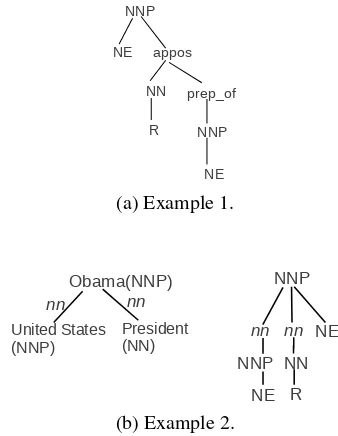
Figure 4: Tree structure with “R” added. Figure (a) is the example 1, which has R in the SDTP of the entity pair. Figure (b) is the example 2, with R not in the SDTP of the entity pair.
est path of the two entities, the path is chosen as the input for SVM. Otherwise, two shortest paths between two entities and relation words will be ex-tracted separately. The shortest one will be attached to the path between two entities. In our representa-tion, relation words are tagged by having “R” as the child. Figure 4a shows the path form of the previous example. Figure 4b shows another example where “R” is not in the shortest path of the pair. The triple is<United States, president, Obama>for the sen-tence “United States President Barack Obama says so.” The figure on the left is the dependency path. The figure on the right is the final tree for the triple task. The root is the POS-tag forObama.
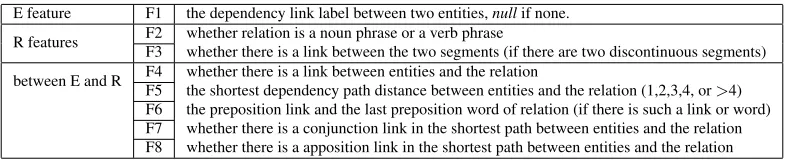
[image:5.612.339.508.69.287.2]Univer-sity”<Bob, teach at, University>is correct while <Bob, teach, University> is wrong. For nominal relations, inclusion of the head word is necessary. Prepositions can be ignored, but if they exist, they must match with the dependency link. We concen-trate on verb prepositions because prepositions are more attached to noun phrases than verb phrases. Verb relations have more preposition choices, and different choices have different semantic impact, for example, the subject or object. But noun relations’ preposition are more fixed, such as “president of”. The last two features F7 and F8 are added according to the observation of experiment results in a develop-ment set: we note that one problem is the apposition or conjunction structure between entities5.
6 Unsupervised Method
We also propose the use of an unsupervised method based on heuristic rules to produce a relation word noise filter, as an alternative to using SVM in the Triple task. The heuristic rules are also based on the Stanford collapsed dependency parsing. There are two parts in the noise filter: one is that the relation words should have necessary links with two entities and the other is that relation words should be consis-tent.
We first mention the heuristic rules for necessary dependency links. The intuition is from Chan and Dan (2011), they classified relations into 5 different syntactic structures; premodifier, possessive, prepo-sition, formulaic, and verbal. They proposed heuris-tic POS patterns covering the first four patterns with the exception of the verbal structure.
We present heuristic rules based on dependency paths instead of POS for the structures, except the category formulaic, which are implicit relations. In a premodifier structure one entity and the relation are modifiers of the other entity, (e.g., US. Presi-dent Obama). In a possessive structure one entity is in a possessive case (e.g., Microsoft’sCEOSteve Ballmer). In a preposition structure, relation words are related with one entity by a preposition (e.g., Steve Ballmer,CEOof Microsoft). In a verbal struc-ture relations are verb phrases.
The heuristic rules are presented in Figure 5. The
5But adding the two features seems does not solve the
[image:6.612.359.495.71.198.2]prob-lem.
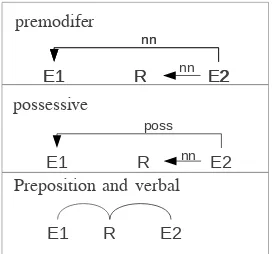
Figure 5: Dependent link heuristics for relation de-tection.
premodifier and possessive relation words are not in the Stanford collapsed form of the dependency path between two entities. When there is a direct depen-dency link between two entities that is labelled nn orposs, there should be annnlink between the sec-ond entity and the relation candidate (in Figure 5’s top two rows). Otherwise, there should be links be-tween the two entities and the relation, respectively (in Figure 5’s last row). In this case, link types and directions are not constrained. For example, both E1←(nsubj)R→(dobj)E2for the triple<Obama, visit, Canada>in “ObamavisitedCanada.” andE1 →(appos)R→(prep of)E2for the triple<Obama, president, United States>in “Obama, the president of theUnited States, visited Canada.” belong to that structure. To refine the verbal pattern, the link be-tween the relation words and entities cannot be a conjunction.
Next, we need to check the consistency of relation words. Two separated sequences of relation words should have a dependency link between each other to confirm that they are semantically related. Rela-tion sequences should include only necessary prepo-sitions.
7 Experiments
E feature F1 the dependency link label between two entities,nullif none. R features F2 whether relation is a noun phrase or a verb phrase
F3 whether there is a link between the two segments (if there are two discontinuous segments) between E and R F4 whether there is a link between entities and the relation
[image:7.612.110.503.70.154.2]F5 the shortest dependency path distance between entities and the relation (1,2,3,4, or>4) F6 the preposition link and the last preposition word of relation (if there is such a link or word) F7 whether there is a conjunction link in the shortest path between entities and the relation F8 whether there is a apposition link in the shortest path between entities and the relation
Table 1: Noise filter feature vector.
7.1 Treebank Set
7.1.1 Preparing Data
Within the research community, it is difficult to find Open IE test data which includes all kinds of relations. So we have created our own data from the Penn Treebank for evaluation6. We assess the drop in performance introduced by using a tool to parse sentences compared to using ”ideal” parse trees pro-vided in the Penn Treebank. Named entities are tagged for every sentence using the Stanford NLP tool. Candidate NE pairs are extracted within a cer-tain distance7. We randomly selected 756 sentences from WSJ Sections 2-21 as our training set, 100 each from Section 22 and Section 23-24 as the develop-ment and the test set, respectively. This is also the setting for most parsers.
We manually annotated whether there is a relation between two entities in a sentence (for evaluation of the Binary task). If there is a relation between two entities, the annotator needs to indicate which words are relation words (for evaluation of the Triple task). There is no restriction of relation forms for the annotator in this task.
We manually analyzed 417 relation instances from our training set. 28% are implicit relations, i.e., relations without words or with prepositions. Less than 1% are with adjectives, while 71% are noun or verb phrases. In the 71%, 60% are noun relations and 40% are verbal. The relation pattern in Section 4 can extract 80% of them. Our data contains more verbal relations than the ACE’s RDC, less than cor-pora in other Open IE papers.
We compare every system by recall, precision, and F-score. The evaluation of the Binary task is
6The data can be downloaded from http://cs.ualberta.ca/˜
yx2/
7Here we set the distance as 20, determined by empirical
evidence, a majority of the relations are within this distance.
based on entity pairs and is straightforward. The evaluation of the Triple task is based on relation triples. We need to manually compare the triples extracted by each system and the gold standard to avoid double-counting. For instance, if both vice president andpresident are extracted, it is counted as one8. Several entity pairs have multiple relations, such as “A is CEO and founder of B.” Any relation which can not be represented by a verb or noun is counted as one miss in the Triple task.
To compare with the REVERB system, NE pairs are labelled as two noun phrase chunks for the sys-tem input. It is difficult to compare with OLLIE, as the system is a black box with integrated entity extraction and parsing. We compared manually the pairs extracted by OLLIE and the tagged data. Only results of intersection entity pairs are considered. The threshold of OLLIE and REVERB confidence is set to achieve the best F-score in the development set.
7.1.2 Results
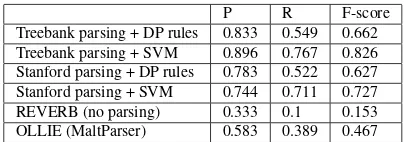
The Binary task results on the test set are shown in Table 2. Each system decides whether there is a relation between two entities. The heuristic rule (DP rules) method, REVERB, and OLLIE each tag pairs containing a relation if any relation candidates are identified. As indicated, the SVM method per-forms the best with DP rules ranking second. Note that OLLIE uses MaltParser, so it’s better to com-pare with the coupling of SVM with Stanford Parser, but that comparison doesn’t change the result.
The Triple task results are shown in Table 3. Each system extracts relation triples from sentences. The SVM features include both tree (Figure 4) and vector features (Table 1). All relationsin the table include nominal, verbal, and implicit relations. To scrutinize
8It is difficult to decide ifpresidentin this case is wrong.
P R F-score Treebank parsing + DP rules 0.833 0.549 0.662 Treebank parsing + SVM 0.896 0.767 0.826 Stanford parsing + DP rules 0.783 0.522 0.627 Stanford parsing + SVM 0.744 0.711 0.727 REVERB (no parsing) 0.333 0.1 0.153 OLLIE (MaltParser) 0.583 0.389 0.467
Table 2: Relation extraction results on Treebank set (Binary)
All relations P R F-score Treebank parsing + DP rules 0.741 0.467 0.573 Treebank parsing + SVM 0.824 0.462 0.592
Stanford parsing + SVM 0.75 0.433 0.549
Stanford parsing(also for pattern)+SVM 0.7 0.43 0.53
OLLIE (MaltParser) 0.583 0.389 0.467 Noun relations P R F-score Treebank parsing + DP rules 0.75 0.735 0.742 Treebank parsing + SVM 0.829 0.708 0.764
Stanford parsing + SVM 0.756 0. 689 0.721
[image:8.612.324.531.71.113.2]OLLIE (MaltParser) 0.8 0.408 0.54 Verb relations P R F-score Treebank parsing + DP rules 0.7 0.368 0.483 Treebank parsing + SVM 0.727 0.381 0.5 Stanford parsing + SVM 0.727 0.32 0.444 REVERB (no parsing) 0.286 0.381 0.327 OLLIE (MaltParser) 0.429 0.714 0.536
Table 3: Relation extraction results on Treebank set (Triple)
the result, we also show the results on noun and verb relations separately. The SVM model achieves best performance, 33% improvement on nominal relation extractions over OLLIE. (Revised: Later we found that the result 0.549 is when relation word extraction is based on the Treebank gold standard POS tagging. We reran our system with relation word extraction based on the Stanford POS tagging. The result is similar, with F-score as 0.53. )
The loss of recall for systems (except SVM) in the Binary task can be explained by the fact that nearly 20% of relations are implicit.
In both the Binary and Triple tasks, one source of failure arose from conjunction and apposition struc-tures. For example, in the sentence “...industry ex-ecutives analyzed the appointment of the new chief executive, Robert Louis-Dreyfus, who joins Saatchi ...” the method can detect the relation <chief ex-ecutive, joins, Saatchi>, but not <Robert Louis-Dreyfus,joins, Saatchi>. We attempted to address this problem by adding features into SVM linear ker-nel (Table 1), but this has not worked in our tests.
P R F-score Stanford parsing + DP rules 0.711 0.811 0.756 Stanford parsing + SVM 0.718 0.859 0.781
REVERB 0.577 0.95 0.716
Table 4: Relation extraction results on REVERB set (Triple).
One cause of recall loss in the Triple task for RE-VERB and our two approaches is that verbal rela-tion words can be non-consecutive. For instance, the preposition might be far away from the related verb in one sentence, in which case both our methods and REVERB can not confirm that extraction. OLLIE has better results on verb relations mainly because they use dependency link patterns to extract relation words, which alleviate the problem. On the other side, one drawback of OLLIE is that it failed to ex-tract a few premodifer structure relations, e.g. “U.S. President Obama.” That may happen because they do not have an independent step for named entity extraction, which is crucial for that type of relations.
7.2 REVERB Set
The authors of the REVERB method provide 1000 tagged training sentences and 500 test sentences. They also provide REVERB’s extracted relations and instances’ confidence for the 500 test sentences. The 500 test sentences are segmented into 5 folds for a significance t-test. At each iteration, the remaining 400 sentences are used as a development set to set the threshold of REVERB confidence.
To compare with REVERB, we use as input the sentences parsed by the Stanford parser and rela-tion triples extracted by REVERB for both train-ing and testtrain-ing. The output of our system is true or false for every triple by using the tree kernel9.
The SVM system is trained on the 1000 training sen-tences. The results are shown in Table 4. Only SVM is statistically significant better than REVERB (with α= 0.05)10.
9
The polynomial kernel is not used for REVERB and OL-LIE data as the their relation word form is simpler than ours.
10
P R F-score Stanford parsing + SVM 0.685 0.941 0.793
[image:9.612.90.284.70.103.2]OLLIE 0.667 0.961 0.787
Table 5: Relation extraction results on OLLIE set (Triple).
7.3 OLLIE set
The authors of the OLLIE system provide a test set which has 300 sentences and OLLIE extracted 900 triples. Experiment setting is similar to that of RE-VERB set. The SVM tree kernel model is trained on OLLIE’s leave one out dataset. The results in Table 5 show our method achieves slightly better perfor-mance, although not statistically significant.
Besides errors caused by parsing, one main cause of loss of precision is that our system is unable to detect entities that are wrong as we only concern the head of the entity. For instance, “Bogan ’s Birming-ham Busters , before moving to Los Angeles , Cal-ifornia” is one entity in one OLLIE relation, where only “Bogan ’s Birmingham Busters” is the correct entity.
8 Conclusion
We have described some of the limits of current Open IE systems, which concentrate on identifying explicit relations, i.e., relations which are mediated by open class words. This strategy ignores what we describe as implicit relations, e.g., locate relations in “Washington, U.S.” We propose two subtasks for Open IE: first confirming whether there is a tion between two entities, and then whether a rela-tion thus extracted is correct. The first task include both implicit and explicit relations; the second task is common in the previous Open IE which deals with explicit relations. In our case we have developed an Open IE system which uses SVM tree kernels ap-plied to dependency parses for both tasks. Our sys-tem achieves superior results on several datasets. We also propose an unsupervised method which is based on heuristic rules from dependency parse links, and compared that with our SVM tree kernel methods. Our experiments show it is a strong baseline for Open IE.
For further work, we intend to improve Open IE by tackling the conjunction and apposition structure problem. Another direction will be to extract
re-lation words for implicit rere-lations. Rere-lation words such aslocatefor “Washington, U.S.” will be con-sidered.
Acknowledgments
We would like to acknowledge Prof. Grzegorz Kon-drak ’s valuable advice. We also want to thank the anonymous reviewers for their helpful suggestions. This work was funded in part by the NSERC Busi-ness Intelligence Network, Alberta Innovates Center for Machine Learning (AICML) and Alberta Inno-vates Technology Futures (AITF).
References
Alan Akbik. 2009. Wanderlust : Extracting semantic relations from natural language text using dependency grammar patterns. In WWW 2009 Workshop on Se-mantic Search, volume 137, pages 279–290.
Michele Banko, Michael J Cafarella, Stephen Soderl, Matt Broadhead, and Oren Etzioni. 2007. Open information extraction from the web. In In Inter-national Joint Conference on Artificial Intelligence, pages 2670–2676.
Razvan C. Bunescu and Raymond J. Mooney. 2005. A shortest path dependency kernel for relation extrac-tion. In Proceedings of the conference on Human Language Technology and Empirical Methods in Nat-ural Language Processing, HLT ’05, pages 724–731, Stroudsburg, PA, USA. Association for Computational Linguistics.
Yee Seng Chan and Roth Dan. 2011. Exploiting syntactico-semantic structures for relation extraction. InProceedings of the 49th Annual Meeting of the As-sociation for Computational Linguistics: Human Lan-guage Technologies - Volume 1, HLT ’11, pages 551– 560, Stroudsburg, PA, USA. Association for Compu-tational Linguistics.
Janara Christensen, Mausam, Stephen Soderland, and Oren Etzioni. 2011. An analysis of open informa-tion extracinforma-tion based on semantic role labeling. In
Proceedings of the sixth international conference on Knowledge capture, K-CAP ’11, pages 113–120, New York, NY, USA. ACM.
Michael Collins and Nigel Duffy. 2001. Convolution kernels for natural language. InAdvances in Neural Information Processing Systems 14, pages 625–632. MIT Press.
Conference on Empirical Methods in Natural Lan-guage Processing, EMNLP ’11, pages 1034–1046, Stroudsburg, PA, USA. Association for Computational Linguistics.
Aron Culotta and Jeffrey Sorensen. 2004. Dependency tree kernels for relation extraction. InProceedings of the 42nd Annual Meeting on Association for Compu-tational Linguistics, ACL ’04, Stroudsburg, PA, USA. Association for Computational Linguistics.
M.C. De Marneffe, B. MacCartney, and C.D. Manning. 2006. Generating typed dependency parses from phrase structure parses. InProceedings of LREC, vol-ume 6, pages 449–454.
Anthony Fader, Stephen Soderland, and Oren Etzioni. 2011. Identifying relations for open information extraction. In Proceedings of the Conference on Empirical Methods in Natural Language Processing, EMNLP ’11, pages 1535–1545, Stroudsburg, PA, USA. Association for Computational Linguistics. Bill MacCartney, Trond Grenager, Marie-Catherine
de Marneffe, Daniel Cer, and Christopher D. Man-ning. 2006. Learning to recognize features of valid textual entailments. InProceedings of the main con-ference on Human Language Technology Concon-ference of the North American Chapter of the Association of Computational Linguistics, HLT-NAACL ’06, pages 41–48. Association for Computational Linguistics. Mausam, Michael Schmitz, Robert Bart, Stephen
Soder-land, and Oren Etzioni. 2012. Open language learn-ing for information extraction. InProceedings of the 2012 Joint Conference on Empirical Methods in Natu-ral Language Processing and Computational NatuNatu-ral Language Learning, pages 523–534. Association for Computational Linguistics.
Alessandro Moschitti. 2005. Automatic text catego-rization: from information retrieval to support vector learning. Aracne.
Alessandro Moschitti. 2006. Efficient convolution ker-nels for dependency and constituent syntactic trees. In Proceedings of the 17th European conference on Machine Learning, ECML’06, pages 318–329, Berlin, Heidelberg. Springer-Verlag.
Truc-Vien T. Nguyen, Alessandro Moschitti, and Giuseppe Riccardi. 2009. Convolution kernels on constituent, dependency and sequential structures for relation extraction. InProceedings of the 2009 Con-ference on Empirical Methods in Natural Language Processing: Volume 3 - Volume 3, EMNLP ’09, pages 1378–1387, Stroudsburg, PA, USA. Association for Computational Linguistics.
Mengqui Wang. 2008. A re-examination of dependency path kernels for relation extraction. InProceedings of the Third International Joint Conference on Natural
Language Processing, pages 841–846, Hyderabad, In-dia. Asian Federation of Natural Language Processing, Association for Computational Linguistics.
Fei Wu and Daniel S. Weld. 2010. Open information ex-traction using wikipedia. InProceedings of the 48th Annual Meeting of the Association for Computational Linguistics, ACL ’10, pages 118–127, Stroudsburg, PA, USA. Association for Computational Linguistics. Guo-Dong Zhou and Qiao-Ming Zhu. 2011.