Original Article
Effects of left ventricular ejection fraction on morbidity
and mortality in major abdominal surgery
Ebubekir Gündeş1, Ulaş Aday1, Hüseyin Çiyiltepe1, Durmuş Ali Çetin1, Aziz Serkan Senger1, Emre Bozdağ1,
Selçuk Gülmez1, Abdulkadir Uslu2, Kamuran Cumhur Değer1, Erdal Polat1, Mustafa Duman1
1Department of Gastroenterological Surgery, Kartal Koşuyolu High Speciality and Training Hospital, Kartal,
İstanbul, TURKEY; 2Department of Cardiology, Kartal Koşuyolu High Speciality and Training Hospital, Kartal,
İstanbul, TURKEY
Received April 13, 2017; Accepted November 14, 2017; Epub December 15, 2017; Published December 30, 2017
Abstract: Objective: Our aim in this study was to investigate the effects of Left Ventricular Ejection Fraction (LVEF) on the clinical results of patients who underwent major abdominal procedures due to the malignancies of the gastroin-testinal system (GIS). Methods: GIS malignancy procedures, which were electively performed in our clinic between 2013 and 2016, were included in the study. The patients were divided into 4 groups according to their LVEF and were classified as < 30% (Group 1), 30% to 44% (Group 2), 45% to 54% (Group 3) and > 55% (Group 4). Subgroup analysis was performed among the patients with and without peroperative events. In subgroup analysis, indepen-dent risk factors were determined using logistic regression analysis for peroperative events in patients undergoing surgery for GI malignancy. Results: A total of 220 patients were covered by the study, including 12 patients in Group 1, 13 patients in Group 2, 25 patients in Group 3, and 170 patients in Group 4. When Group 1 was evaluated, it was seen that 91.7% of the patients had a score of ASA 3 and 58.7% of the patients were on index 4 according to Lee’s Revised Cardiac Risk Index. No significant differences were observed among the groups with regards to preoperative laboratory results, BMI, and pulmonary function test values. No differences were found among the groups regarding diagnoses at the time of admission, surgical procedures performed, duration of operation, and blood transfusion during operation as well. Moreover, there were no significant differences between surgical or non-surgical postoperative complications and the mortality cases within 30 days after surgery. Mortality was seen in three patients and all these patients had an LVEF value higher than 44%. The subgroup multivariate analysis of perioperative complications revealed that diabetes mellitus (DM) (p: 0.017, OR: 2.457, CI: 0.194-0.853), duration of operation over 300 minutes (p: 0.001, OR: 2.68, CI: 0.204-0.682) and older than 65 years (p: 0.007, OR: 2.341, CI: 0.230-0.794) were independent risk factors. Conclusion: When assessed according to LVEF, there was no differ-ence between groups in terms of morbidity and mortality according to Clavian Dindo Classification. We believe that major abdominal procedures for GIS malignancies with low LVEF can be performed with acceptable morbidity and mortality rates at experienced centers.
Keywords: Non-cardiac surgery, low ejection fraction, mortality, morbidity, abdominal surgery
Introduction
Non-cardiac surgical procedures pose a signifi-cant risk for mortality and morbidity in patients with cardiovascular disease or cardiovascular disease risk factors. Cardiac complications can be seen in patients with documented or asymp-tomatic ischemic heart disease (IHD), left ven-tricular (LV) dysfunction, valvular heart disease (VHD) and arrhythmia, and prolonged hemody-namic and cardiac stress related procedures [1]. Moreover, the risk of developing complica-tions is closely related to the preoperative
med-ical condition of the patient, the presence of comorbidities, and other factors associated with surgical procedures [2].
indi-viduals with cardiovascular diseases have been more frequently on the agenda of clinicians. In this study, we aimed to investigate the effects of LVEF on postoperative morbidity and mortal-ity in patients undergoing major abdominal sur-gery due to GIS malignancy in our clinic. Left ventricular dysfunction is a significant fac-tor affecting hospital mortality and morbidity. Our aim in this study was to investigate the effects of LVEF on the clinical results of patients who underwent major abdominal procedures due to the malignancies of the GIS.
Methods
Study design
This is a retrospective observational study con-ducted at a tertiary training and research hos- pital. Following the approval of the Clinical Research Evaluation Board of Kartal Kosuyolu Higher Specialization Training and Research Hospital (Registration No: 2016.5/1-12), pa- tients who underwent surgery having been diagnosed with GIS malignancy in our clinic were included in the study. It was not neces-sary to have the patients’ informed consents because of the retrospective nature of the study.
Study population
Inclusion criteria: Cases of major abdominal surgery performed in our hospital because of GIS malignancy under elective conditions be- tween January 2013 and December 2016. Exclusion criteria: Patients who underwent sur-gery under emergency conditions with no onco-logic surgery and who had missing file records. LVEF evaluation and grouping
Transthoracic ecocardiographic evaluation was performed by Vingmed System Five GE ultraso-nography machine (Horten, Norway) with 2.5 MHz probe on left lateral position. LV end-dia-stolic diameter, LV end-syend-dia-stolic diameter, in- terventricular septum thickness, and posterior wall thickness on parasternal long axis images were measured. The ejection fraction was cal-culated from these values according to the modified Simpson method.
The patients were allocated to 4 groups based on their LVEF according to the reference limits
and values recommended by the American Society of Echocardiography (ASE) [4]. Those with LVEF < 30% were classified as severely abnormal (Group 1), those with 30% to 44% as moderately abnormal (Group 2), those with 45% to 54% as mildly abnormal (Group 3) and those with > 55% as normal (Group 4).
Data
The age, gender, comorbidities, admission di- agnosis, body mass index, LVEF, respiratory function parameters (FEV1, FVC), laboratory test results, Lee’s Revised Cardiac Risk Index, and the American Society of Anesthesiologi- sts (ASA) Clustering data of the patients in- cluded in the study were recorded pre-opera- tively.
Surgical procedures, intraoperative blood tr- ansfusion requirements, duration of operation and hospitalization, morbidity and mortality rates were recorded as well. Post-operative mortality cases during the first 30 days fol- low-up period were evaluated as operative mortality while surgical complications devel-oped during this period were considered to be morbidity.
All the data were saved in Excel tables without any identifying information to prevent patients’ names from being revealed.
The primary endpoint of the study: To investi-gate the effects of LVEF on morbidity and mor-tality in patients undergoing major abdominal surgery due to GIS malignancy.
The secondary endpoint of the study: To inves-tigate the risk factors for peroperative compli-cations in patients undergoing major abdomi-nal surgery due to GIS malignancy.
Statistical analysis
metric data were analyzed by the Kruskal-Wallis analysis in multiple group comparisons while the Mann-Whitney U test was utilized in binary group comparisons. Categorical groups were compared by the Chi-Square test. In the sub-group analysis of the postoperative complica-tion, univariate logistic regression analysis of each variable was performed as the first step in the establishment of the multivariable logis-tic regression model in order to determine the candidate variables to enter the model. If the probability value of the Wald test statistics was less than the determined error level of 0.25 (p < 0.25), the relevant variables were included in the multivariate model. The odds ratio, 95% confidence interval of the results were calculated and statistical significance was set at the p < 0.05 level.
Results
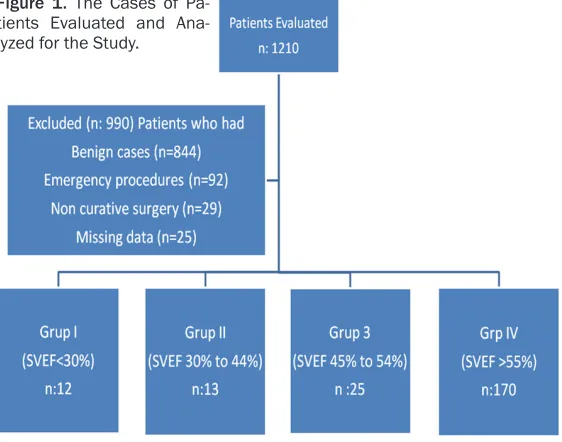
The cases of a total of 1210 patients who underwent surgery in our clinic between Ja- nuary 2013 and December 2016 were re- viewed. A total of 990 cases, which had em- ergency surgery (n = 92), surgery due to benign diseases (n = 844), malignant cases without curative surgery (n = 29), and those with miss-ing file data (n = 25), were excluded from the study (Figure 1). There were 12 patients in Group 1 with severe abnormality (< 30%) according to LVEF, 13 patients in Group 2 with moderate abnormality (30% to 44%), 25 pa- tients in Group 3 with mild abnormality (45%
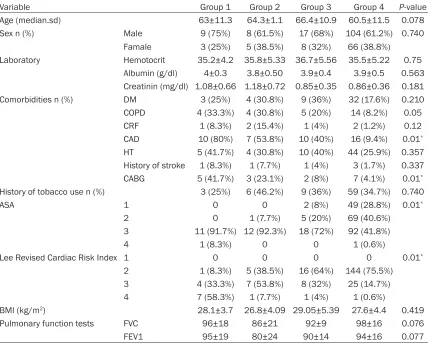
alyzed, it was observed that 91.7% of the patients were ASA 3 and 58.7% of the pati- ents’ Lee’s Revised Cardiac Risk Index was 4. There were no significant differences among the groups in terms of preoperative laboratory results, BMI, and respiratory function test val-ues. The clinical characteristics of the patients have been summarized in Table 1.
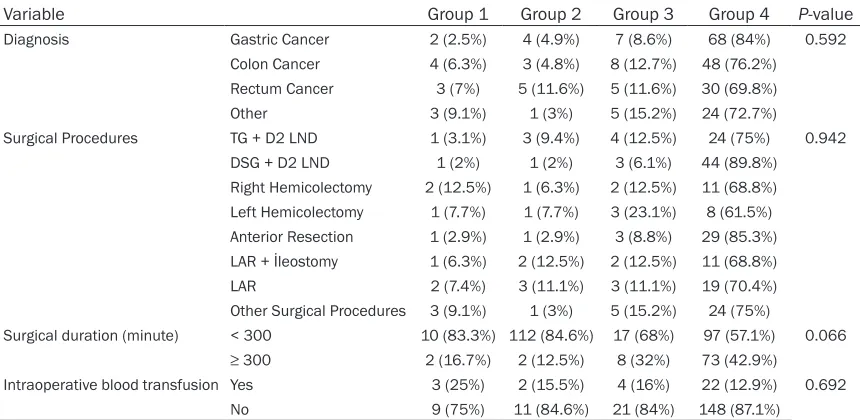
When the operation diagnoses were examined, it was seen that 81 patients had been diag-nosed with stomach cancer, 63 with colon can-cer, 43 with rectal cancan-cer, and 33 with other malignancies (esophagus, pancreas, primary or metastatic hepatic tumors). No statistically sig-nificant difference was found among the groups when the surgical procedures and the admis-sion diagnoses were explored. The duration of surgical procedures and the intraoperative blood transfusion showed no difference am- ong the groups. The diagnoses, surgical proce-dures performed, and intraoperative findings have been summarized in Table 2.
There was no statistically significant difference among the groups with regards to surgical or non-surgical postoperative complications and mortality rates within 30 days following surgery. Three patients had mortality and all of these patients had LVEF above 44%. These patients were secondarily lost because of multiorgan failure due to anastomotic leaks. Although the duration of hospitalization was found to be higher in Group 3 with 15.8±10.4 days than the Figure 1. The Cases of
Pa-tients Evaluated and Ana-lyzed for the Study.
to 54%), and 170 patients in Group 4 who were within nor-mal bounds (> 55%).
[image:3.612.92.373.74.295.2]other groups, there was no statistically significant difference among the groups. Com- parisons of postoperative complications acco- rding to the Clavian-Dindo Classification and follow-up findings have been summarized in
Table 3.
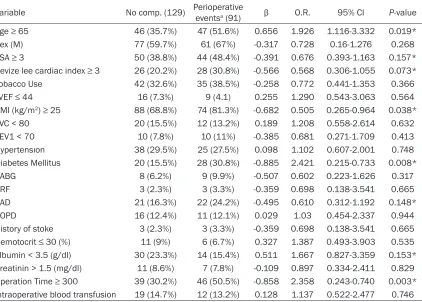
When the cases of patients, who developed perioperative morbidity and mortality and tho- se who were discharged without any compli- cations, were compared through univariate lo- gistic regression test, it was seen that differ-ences regarding DM, age (≥ 65), BMI (≥ 25), and duration of operation (≥ 300 min) between the two groups were significantly higher in the patient group with post-operative complica-tions (Table 4).
The results of the analysis, performed as a
con-analysis among the variables fit for multiva- riate logistic regression, revealed that age (≥ 65) (OR: 2.341, 95% CI 0.230 to 0.794 p = 0.07), DM (OR: 2.457, 95% CI 0.194 to 0.853, p = 0.017), and duration of operation (≥ 300 min) (OR: 2.68, 95% CI 0.204 to 0.682, p = 0.001) were statistically significant (Table 5). When model fit was examined by the Hosmer-Le- meshow test, it was concluded that the model was a sufficient one (Chi-square: 2.567 df: 8 and p = 0.959).
Discussion
[image:4.612.93.521.85.430.2]Various risk indices have been defined to deter-mine perioperative cardiac risk for about the last thirty years. Goldman et al. [5] defined, for the first time in 1977, a cardiac risk index for patients scheduled for orthopedic, urological,
Table 1. Baseline Characteristics of Patients Undergoing Major Abdominal Malign Surgery
Variable Group 1 Group 2 Group 3 Group 4 P-value
Age (median.sd) 63±11.3 64.3±1.1 66.4±10.9 60.5±11.5 0.078
Sex n (%) Male 9 (75%) 8 (61.5%) 17 (68%) 104 (61.2%) 0.740
Famale 3 (25%) 5 (38.5%) 8 (32%) 66 (38.8%) Laboratory Hemotocrit 35.2±4.2 35.8±5.33 36.7±5.56 35.5±5.22 0.75
Albumin (g/dl) 4±0.3 3.8±0.50 3.9±0.4 3.9±0.5 0.563 Creatinin (mg/dl) 1.08±0.66 1.18±0.72 0.85±0.35 0.86±0.36 0.181 Comorbidities n (%) DM 3 (25%) 4 (30.8%) 9 (36%) 32 (17.6%) 0.210 COPD 4 (33.3%) 4 (30.8%) 5 (20%) 14 (8.2%) 0.05
CRF 1 (8.3%) 2 (15.4%) 1 (4%) 2 (1.2%) 0.12
CAD 10 (80%) 7 (53.8%) 10 (40%) 16 (9.4%) 0.01* HT 5 (41.7%) 4 (30.8%) 10 (40%) 44 (25.9%) 0.357 History of stroke 1 (8.3%) 1 (7.7%) 1 (4%) 3 (1.7%) 0.337 CABG 5 (41.7%) 3 (23.1%) 2 (8%) 7 (4.1%) 0.01* History of tobacco use n (%) 3 (25%) 6 (46.2%) 9 (36%) 59 (34.7%) 0.740
ASA 1 0 0 2 (8%) 49 (28.8%) 0.01*
2 0 1 (7.7%) 5 (20%) 69 (40.6%)
3 11 (91.7%) 12 (92.3%) 18 (72%) 92 (41.8%)
4 1 (8.3%) 0 0 1 (0.6%)
Lee Revised Cardiac Risk Index 1 0 0 0 0 0.01*
2 1 (8.3%) 5 (38.5%) 16 (64%) 144 (75.5%)
3 4 (33.3%) 7 (53.8%) 8 (32%) 25 (14.7%)
4 7 (58.3%) 1 (7.7%) 1 (4%) 1 (0.6%)
BMI (kg/m2) 28.1±3.7 26.8±4.09 29.05±5.39 27.6±4.4 0.419
Pulmonary function tests FVC 96±18 86±21 92±9 98±16 0.076
FEV1 95±19 80±24 90±14 94±16 0.077
an adaptation of the Goldman index, was de- fined in 1999 [6]. In the study we conducted, the risks were explored using Lee’s revised index. Especially in the majority of the pati- ents in Group 1 (58.3%), the Lee’s revised ind- ex score was found to be 4. There was no sig-nificant difference in mortality between Group 1 and the other groups, although there was a significant difference regarding Lee’s revised index. This finding can be attributed to the lim-ited number of patients covered by our study. Surgery-related risk groups have less impor-tance than patient-related factors. Surgical pro-cedures are classified as low (< 1%), moderate (1-5%) and high (> 5%) risk procedures acco- rding to the frequency of cardiac events (cardi-ac death and MI) 30 days after the procedure.
According to this classification, major vascular surgical procedures are in the high-risk group [1]. All of our patients were in the moderate risk surgical procedure class according to this clas-sification. No cardiac death or MI was seen when we examined our postoperative patients. Our 3 patients were lost due to surgical complications.
[image:5.612.91.521.85.295.2]There is a limited number of studies showing the association of LVEF with early postopera-tive and late postoperapostopera-tive complications in non-cardiac surgical procedures. LVEF is an independent risk factor that determines long-term mortality risks and perioperative results in non-cardiac surgical patients with heart failu- re and with severely low LVEF (< 30%) [7]. Kantos et al. [8] reported in their prospective
Table 2. Surgıcal Procedure Type and Intraoperative Findings
Variable Group 1 Group 2 Group 3 Group 4 P-value
Diagnosis Gastric Cancer 2 (2.5%) 4 (4.9%) 7 (8.6%) 68 (84%) 0.592
Colon Cancer 4 (6.3%) 3 (4.8%) 8 (12.7%) 48 (76.2%)
Rectum Cancer 3 (7%) 5 (11.6%) 5 (11.6%) 30 (69.8%)
Other 3 (9.1%) 1 (3%) 5 (15.2%) 24 (72.7%)
Surgical Procedures TG + D2 LND 1 (3.1%) 3 (9.4%) 4 (12.5%) 24 (75%) 0.942
DSG + D2 LND 1 (2%) 1 (2%) 3 (6.1%) 44 (89.8%)
Right Hemicolectomy 2 (12.5%) 1 (6.3%) 2 (12.5%) 11 (68.8%) Left Hemicolectomy 1 (7.7%) 1 (7.7%) 3 (23.1%) 8 (61.5%) Anterior Resection 1 (2.9%) 1 (2.9%) 3 (8.8%) 29 (85.3%) LAR + İleostomy 1 (6.3%) 2 (12.5%) 2 (12.5%) 11 (68.8%)
LAR 2 (7.4%) 3 (11.1%) 3 (11.1%) 19 (70.4%)
Other Surgical Procedures 3 (9.1%) 1 (3%) 5 (15.2%) 24 (75%)
Surgical duration (minute) < 300 10 (83.3%) 112 (84.6%) 17 (68%) 97 (57.1%) 0.066
≥ 300 2 (16.7%) 2 (12.5%) 8 (32%) 73 (42.9%)
Intraoperative blood transfusion Yes 3 (25%) 2 (15.5%) 4 (16%) 22 (12.9%) 0.692
No 9 (75%) 11 (84.6%) 21 (84%) 148 (87.1%)
Group 1, EF < 30%; Group 2, EF 30% to 44%; Group 3, EF 45% to 54%; Group 4, EF > 55%; Other, eusophagus, pancreas, primary or metastatic liver tumors, TG, total gastrectomy; D2 LND, d2 lymph node dissection; LAR, low anterior resection.
Table 3. Postoperative follow-up and complications
Variable Group 1 Group 2 Group 3 Group 4 P-value
No complication 7 (58.3%) 9 (69.2%) 11 (44%) 102 (60%) 0.116
Clavian Dindo Classification I 5 (41.7%) 1 (7.7%) 3 (12%) 18 (10.6%) II 0 2 (15.4%) 10 (40%) 36 (21.2%)
III 0 1 (7.7%) 0 9 (5.3%)
IV 0 0 0 3 (1.8%)
V 0 0 1 (4%) 2 (1.2%)
Length of stay in hospital (day/mean ± sd) 13.58±6.8 13.69±7.8 15.88±10.4 13.63±12.2 0.533
Mortality 0 0 1 (4%) 2 (1.2%) 0.641
[image:5.612.91.526.350.473.2]Table 5. Multivariate Analysis with adverse perioperative events as dependent variable
Variable β P value Odds ratio 95% CI
Age (≥ 65) -0.851 0.007* 2.341 0.230-0.794
Diabetes Mellitus -0.899 0.017* 2.457 0.194-0.853 Coronary artery disease -0.234 0.628 0.791 0.307-2.04 Lee Revised Cardiac Risk index ≥ 3 -0.140 0.752 0.870 0.366-2.064
ASA ≥ 3 0.240 0.550 1.271 0.578-2.795
BMİ ≥ 25 (kg/m2) -0.532 0.131 0.587 0.294-1.172 Albumin < 3.5 (g/dl) 0.724 0.076 2.062 0.928-4.583 Operation Time ≥ 300 minute 0.986 0.001* 2.68 0.204-0.682
[image:6.612.92.384.507.637.2]ASA, American Society of Anesthesiologists; BMI, Body Mass İndex; CI, Confidence İn-terval. *Age ≥ 65, DM, and Operation Time ≥ 300 minute were statistically significant on multivariate analysis.
Table 4. Univariate logistic regression model analysis with adverse perioperative events as depen-dent variable
Variable No comp. (129) Perioperative eventsa (91) β O.R. 95% CI P-value
Age ≥ 65 46 (35.7%) 47 (51.6%) 0.656 1.926 1.116-3.332 0.019*
Sex (M) 77 (59.7%) 61 (67%) -0.317 0.728 0.16-1.276 0.268
ASA ≥ 3 50 (38.8%) 44 (48.4%) -0.391 0.676 0.393-1.163 0.157*
Revize lee cardiac index ≥ 3 26 (20.2%) 28 (30.8%) -0.566 0.568 0.306-1.055 0.073*
Tobacco Use 42 (32.6%) 35 (38.5%) -0.258 0.772 0.441-1.353 0.366
LVEF ≤ 44 16 (7.3%) 9 (4.1) 0.255 1.290 0.543-3.063 0.564
BMI (kg/m2) ≥ 25 88 (68.8%) 74 (81.3%) -0.682 0.505 0.265-0.964 0.038*
FVC < 80 20 (15.5%) 12 (13.2%) 0.189 1.208 0.558-2.614 0.632
FEV1 < 70 10 (7.8%) 10 (11%) -0.385 0.681 0.271-1.709 0.413
Hypertensıon 38 (29.5%) 25 (27.5%) 0.098 1.102 0.607-2.001 0.748
Diabetes Mellitus 20 (15.5%) 28 (30.8%) -0.885 2.421 0.215-0.733 0.008*
CABG 8 (6.2%) 9 (9.9%) -0.507 0.602 0.223-1.626 0.317
CRF 3 (2.3%) 3 (3.3%) -0.359 0.698 0.138-3.541 0.665
CAD 21 (16.3%) 22 (24.2%) -0.495 0.610 0.312-1.192 0.148*
COPD 16 (12.4%) 11 (12.1%) 0.029 1.03 0.454-2.337 0.944
History of stoke 3 (2.3%) 3 (3.3%) -0.359 0.698 0.138-3.541 0.665 Hemotocrit ≤ 30 (%) 11 (9%) 6 (6.7%) 0.327 1.387 0.493-3.903 0.535 Albumin < 3.5 (g/dl) 30 (23.3%) 14 (15.4%) 0.511 1.667 0.827-3.359 0.153* Creatinin > 1.5 (mg/dl) 11 (8.6%) 7 (7.8%) -0.109 0.897 0.334-2.411 0.829 Operation Time ≥ 300 39 (30.2%) 46 (50.5%) -0.858 2.358 0.243-0.740 0.003* İntraoperative blood transfusion 19 (14.7%) 12 (13.2%) 0.128 1.137 0.522-2.477 0.746
aPerioperatif events, peroperatif and postoperatif morbidite and 30 d mortalite; ASA, American Society of Anesthesiologists; LVEF, Leftventricul ejection fraction; BMI, Bady mass index; FVC, Forced expiratory vital capacity; FEV1, Forced Expiratory Volume in the first second; HT, Hypertensıon; DM, Diabetes Mellitus; CABG, Coronary Arter Bypass Greft; CRF, Chronic renal failure; CAD, Coronary artery disease; COPD, chronic obstructive pulmonary disease; CI, Confidence İnterval; *Age ≥ 65, ASA ≥ 3, DM, CAD, Revize lee cardiac index ≥ 3, BMI (kg/m2) ≥ 25, Albumin < 3.5 (g/dl), and Operation Time ≥ 300 minute were statistically significant on univariate analysis.
study that patients with an LVEF lower than 29% had a higher surgical mortality risk than those with an LVEF higher than 29%. Moreover,
in their prospective study Halm et al. [9] found that LVEF lower than 40% was an independent risk factor as was revealed by a revis- ed multivariate analysis of cardiac complications after non-cardiac surgical proce- dures.
sur-gery, concluded that the factors associated with negative perioperative results within the first 30 days following surgery were: older age (> 80 years), diabetes, and severely abnormal LVEF. In our study, we found that LVEF had no effect on perioperative complications in patients with major abdominal tumor surgery. Furthermore, the results of the subgroup analy-sis we performed revealed that age, DM, and prolonged operation duration were the factors related to perioperative complications.
The limitations of this study include the fact that it was designed as a retrospective study and the limited number of patients with low LVEF.
Conclusion
In our study, we determined the mortality rate as 1.4%. We did not find any relationship between mortality-morbidity, and LVEF. Old age (≥ 65), DM, and prolonged operation time (≥ 300 min) were identified as risk factors asso- ciated with morbidity. Mortality was found to be related to surgery-related complications. We believe that major abdominal procedures for GIS malignancies with low LVEF can be per-formed with acceptable morbidity and mortality rates at experienced centers.
Disclosure of conflict of interest
None.
Address correspondence to: Ebubekir Gündeş, Department of Gastroenterological Surgery, Kartal Koşuyolu High Speciality and Training Hospital, Cevizli Mah, Denizer Cad, Cevizli Kavşağı No: 2, Kartal, İstanbul, TURKEY. Tel: +90 [505] 8606740; Fax: +90 [216] 459 63 21; E-mail: [email protected]
Refecenses
[1] Fleischmann KE, Auerbach AD, Barnason SA,
Beckman JA, Bozkurt B, Davila-Roman VG,
Gerhard-Herman MD, Holly TA, Kane GC, Ma-rine JE, Nelson MT, Spencer CC, Thompson A,
Ting HH, Uretsky BF, Wijeysundera DN; Ameri-can College of Cardiology; American Heart As-sociation. 2014 ACC/AHA guideline on pe- rioperative cardiovascular evaluation and ma- nagement of patients undergoing noncardiac surgery: a report of the American college of cardiology/American heart association task force on practice guidelines. J Am Coll Cardiol 2014; 9; 64: 77-137.
[2] Poldermans D, Hoeks SE, Feringa HH. Pre-op-erative risk assessment and risk reduction be-fore surgery. J Am Coll Cardiol 2008; 51: 1913- 1924.
[3] Rohde LE, Polanczyk CA, Goldman L, Cook EF, Lee RT, Lee TH. Usefulness of transthoracic echocardiography as a tool for risk stratifica-tion of patients undergoing major noncardiac surgery. Am J Cardiol 2001; 87: 505-509.
[4] Lang RM, Bierig M, Devereux RB, Flachskampf FA, Foster E, Pellikka PA, Picard MH, Roman MJ, Seward J, Shanewise JS, Solomon SD,
Spencer KT, Sutton MS, Stewart WJ; Chamber Quantification Writing Group; American Society of Echocardiography’s Guidelines and Stan-dards Committee; European Association of Echocardiography. Recommendations for ch- amber quantification: a report from the Ameri-can society of Echocardiography’s guidelines and standards committee and the chamber quantification writing group, developed in con-junction with the European association of echocardiography, a branch of the European society of cardiology.J Am Soc Echocardiogr
2005; 18: 1440-1463.
[5] Goldman L, Caldera DL, Nussbaum SR, South-wick FS, Krogstad D, Murray B, Burke DS,
O’Malley TA, Goroll AH, Caplan CH, Nolan J,
Carabello B, Slater EE. Multifactorial index of cardiac risk in noncardiac surgical procedures. N Engl J Med 1977; 297: 845-850.
[6] Lee TH, Marcantonio ER, Mangione CM, Thom-as EJ, Polanczyk CA, Cook EF, Sugarbaker DJ,
Donaldson MC, Poss R, Ho KK, Ludwig LE,
Pedan A, Goldman L. Derivation and prospec-tive validation of a simple index for prediction of cardiac risk of major noncardiac surgery. Circulation 1999; 100: 1043-1049.
[7] van Klei WA, Bryson GL, Yang H, Kalkman CJ, Wells GA, Beattie WS. Thevalue of routine Pre-operative electrocardiography in predicting myocardial infarction after noncardiac surgery. Ann Surg 2007; 246: 165-170.
[8] Kontos MC, Brath LK, Akosah KO, Mohanty PK. Cardiac complications in noncardiac surgery: relative value of resting two dimensional echo-cardiography and dipyridamole thallium imag-ing. Am Heart J 1996; 132: 559-566. [9] Halm EA, Browner WS, Tubau JF, Tateo IM,