SemEval-2016 Task 12: Clinical TempEval
Steven BethardUniversity of Alabama at Birmingham Birmingham, AL 35294, USA
Guergana Savova Harvard Medical School Boston, MA 02115, USA
Wei-Te Chen
University of Colorado Boulder Boulder, CO 80309 [email protected]
Leon Derczynski University of Sheffield Sheffield, S1 4DP, UK
James Pustejovsky Brandeis University Waltham, MA 02453, USA [email protected]
Marc Verhagen Brandeis University Waltham, MA 02453, USA [email protected]
Abstract
Clinical TempEval 2016 evaluated temporal information extraction systems on the clinical domain. Nine sub-tasks were included, cover-ing problems in time expression identification, event expression identification and temporal re-lation identification. Participant systems were trained and evaluated on a corpus of clinical and pathology notes from the Mayo Clinic, an-notated with an extension of TimeML for the clinical domain. 14 teams submitted a total of 40 system runs, with the best systems achieving near-human performance on identifying events and times. On identifying temporal relations, there was a gap between the best systems and human performance, but the gap was less than half the gap of Clinical TempEval 2015.
1 Introduction
The TempEval shared tasks have, since 2007, pro-vided a focus for research on temporal information extraction (Verhagen et al., 2007; Verhagen et al., 2010; UzZaman et al., 2013). Participant systems compete to identify critical components of the time-line of a text, including time expressions, event ex-pressions and temporal relations. However, the Temp-Eval campaigns to date have focused primarily on in-document timelines derived from news articles. In recent years, the community has moved toward testing such information extraction systems on clin-ical data (Sun et al., 2013; Bethard et al., 2015) to
broaden our understanding of the language of time beyond newswire expressions and structure.
Clinical TempEval focuses on discrete, well-defined tasks which allow rapid, reliable and repeat-able evaluation. Participating systems are expected to take as input raw text, for example:
April 23, 2014: The patient did not have any postoperative bleeding so we’ll resume chemotherapy with a larger bolus on Friday even if there is slight nausea.
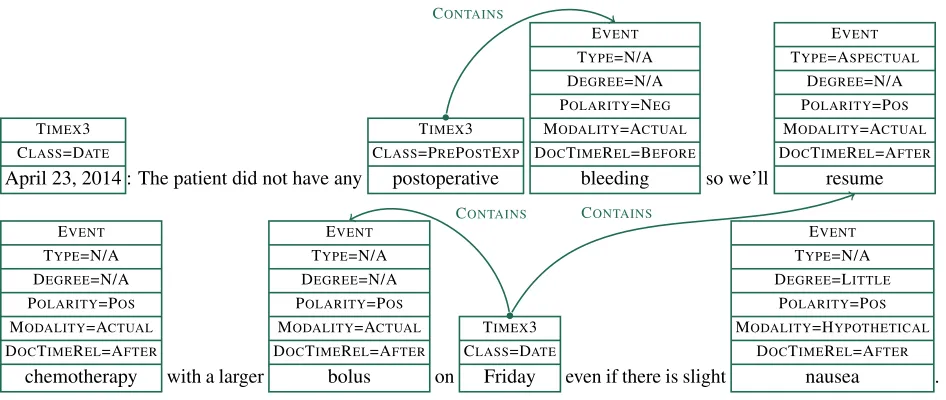
The systems are then expected to output annotations over the text, for example, those shown in Figure 1. That is, the systems should identify the time sions, event expressions, attributes of those expres-sions, and temporal relations between them.
TIMEX3 CLASS=DATE
April 23, 2014 : The patient did not have any
TIMEX3 CLASS=PREPOSTEXP
postoperative
EVENT TYPE=N/A DEGREE=N/A POLARITY=NEG MODALITY=ACTUAL DOCTIMEREL=BEFORE
bleeding so we’ll
EVENT TYPE=ASPECTUAL
DEGREE=N/A POLARITY=POS MODALITY=ACTUAL DOCTIMEREL=AFTER
resume
EVENT TYPE=N/A DEGREE=N/A POLARITY=POS MODALITY=ACTUAL DOCTIMEREL=AFTER
chemotherapy with a larger
EVENT TYPE=N/A DEGREE=N/A POLARITY=POS MODALITY=ACTUAL DOCTIMEREL=AFTER
bolus on
TIMEX3 CLASS=DATE
Friday even if there is slight
EVENT TYPE=N/A DEGREE=LITTLE
POLARITY=POS MODALITY=HYPOTHETICAL
DOCTIMEREL=AFTER
nausea .
CONTAINS
CONTAINS
[image:2.612.72.545.73.273.2]CONTAINS
Figure 1:Example Clinical TempEval annotations
2 Data
The Clinical TempEval corpus was based on a set of 600 clinical notes and pathology reports from cancer patients at the Mayo Clinic. These notes were man-ually de-identified by the Mayo Clinic to replace names, locations, etc. with generic placeholders, but time expressions were not altered. The notes were then manually annotated by the THYME project (thyme.healthnlp.org) using an extension of
ISO-TimeML for the annotation of times, events and tem-poral relations in clinical notes (Styler et al., 2014b). This extension includes additions such as new time expression types (e.g., PREPOSTEXPfor expressions likepostoperative), new EVENTattributes (e.g., DE
-GREE=LITTLE for expressions likeslight nausea), and an increased focus on temporal relations of type CONTAINS(a.k.a. INCLUDES).
The annotation procedure was as follows:
1. Annotators identified time and event expres-sions, along with their attributes
2. Adjudicators revised and finalized the time and event expressions and their attributes
3. Annotators identified temporal relations be-tween pairs of events and events and times 4. Adjudicators revised and finalized the temporal
relations
More details on the corpus annotation process are documented in a separate article (Styler et al., 2014a).
Because the data contained incompletely
de-identified clinical data (the time expressions were retained), participants were required to sign a data use agreement with the Mayo Clinic to obtain the raw text of the clinical notes and pathology reports.1 The event, time and temporal relation annotations were distributed separately from the text, in an open source repository2using the Anafora standoff format (Chen and Styler, 2013).
The corpus was split into three portions: Train (50%), Dev (25%) and Test (25%). Patients were sorted by patient number (an integer arbitrarily as-signed by the de-identification process) and strati-fied across these splits. The Train and Dev portions were released to participants for training and tun-ing their systems. The Test portion was reserved for evaluation of the systems. Table 1 shows the number of documents, event expressions (EVENT an-notations), time expressions (TIMEX3 annotations)
and narrative container relations (TLINKannotations with TYPE=CONTAINSattributes) in the Train, Dev, and Test portions of the corpus.
3 Tasks
Nine tasks were included (the same as those of Clini-cal TempEval 2015), grouped into three categories:
• Identifying time expressions (TIMEX3 annota-tions in the THYME corpus) consisting of the
1
Details on the process:http://thyme.healthnlp.org/
2
Train Dev Test
Documents 293 147 151
TIMEX3s 3833 2078 1952
EVENTs 38890 20974 18990
TYPE=CONTAINSTLINKs 11176 6173 5894
Table 1:Number of documents, event expressions, time
expres-sions and narrative container relations in Train, Dev, and Test portions of the THYME data. Both Train and Dev were released
as part of Clinical TempEval 2015.
following components:
– The span (character offsets) of the expres-sion in the text
– Class: DATE, TIME, DURATION, QUAN -TIFIER, PREPOSTEXPor SET
• Identifying event expressions (EVENT annota-tions in the THYME corpus) consisting of the following components:
– The span (character offsets) of the expres-sion in the text
– Contextual Modality: ACTUAL, HYPO
-THETICAL, HEDGEDor GENERIC – Degree: MOST, LITTLEor N/A – Polarity: POSor NEG
– Type: ASPECTUAL, EVIDENTIALor N/A • Identifying temporal relations between events
and times, focusing on the following types:
– Relations between events and the doc-ument creation time (BEFORE, OVER
-LAP, BEFORE-OVERLAPor AFTER), rep-resented by DOCTIMERELannotations.
– Narrative container relations (Pustejovsky and Stubbs, 2011), which indicate that an event or time is temporally contained in (i.e., occurred during) another event or time, represented by TLINK annotations with TYPE=CONTAINS.
The evaluation was run in two phases:
1. Systems were provided access only to the raw text, and were asked to identify time expres-sions, event expressions and temporal relations 2. Systems were provided access to the raw text and the manual event and time annotations, and were asked to identify only temporal relations
4 Evaluation Metrics
All of the tasks were evaluated using the standard metrics of precision (P), recall (R) andF1:
P = |S∩H|
|S| R=
|S∩H|
|H| F1=
2·P ·R P +R
whereS is the set of items predicted by the system andH is the set of items annotated by the humans. Applying these metrics only requires a definition of what is considered an “item” for each task.
• For evaluating the spans of event expressions or time expressions, items were tuples of (be-gin, end) character offsets. Thus, systems only received credit for identifying events and times with exactly the same character offsets as the manually annotated ones.
• For evaluating the attributes of event expres-sions or time expresexpres-sions – Class, Contextual Modality, Degree, Polarity and Type – items were tuples of (begin, end, value) where begin and end are character offsets and value is the value that was given to the relevant attribute. Thus, systems only received credit for an event (or time) attribute if they both found an event (or time) with the correct character offsets and then assigned the correct value for that attribute. • For relations between events and the document
creation time, items were tuples of (begin, end, value), just as if it were an event attribute. Thus, systems only received credit if they found a correct event and assigned the correct relation (BEFORE, OVERLAP, BEFORE-OVERLAP or
AFTER) between that event and the document creation time. In the second phase of the evalua-tion, when manual event annotations were pro-vided as input, only recall (which in this case is equivalent to standard classification accuracy) is reported.
• For narrative container relations, items were tu-ples of ((begin1, end1), (begin2, end2)), where
For event and time attributes, we also measure how accurately a system predicts the attribute values on just those events or times that the system predicted. The goal here is to allow a comparison across systems for assigning attribute values, even when different systems produce different numbers of events and times. This metric is calculated by dividing theF1
on the attribute by theF1on identifying the spans:
A= attributeF1
spanF1
For narrative container relations, theP andR defi-nitions were modified to take into accounttemporal closure, where additional relations are deterministi-cally inferred from other relations (e.g., A CONTAINS
B and B CONTAINSC, so A CONTAINSC):
P = |S∩closure(H)|
|S| R=
|closure(S)∩H| |H|
Similar measures were used in prior work (UzZaman and Allen, 2011) and TempEval 2013 (UzZaman et al., 2013), following the intuition that precision should measure the fraction of system-predicted rela-tions that can be verified from the human annotarela-tions (either the original human annotations or annotations inferred from those through closure), and that recall should measure the fraction of human-annotated re-lations that can be verified from the system output (either the original system predictions or predictions inferred from those through closure).
5 Baseline Systems
Two rule-based systems were used as baselines to compare the participating systems against.
memorize For all tasks but the narrative container task, a memorization baseline was used. To train the model, all phrases annotated as ei-ther events or times in the training data were collected. All exact character matches for these phrases in the training data were then examined, and only phrases that were annotated as events or times greater than 50% of the time were re-tained. For each phrase, the most frequently an-notated type (event or time) and attribute values for instances of that phrase were determined. To predict with the model, the raw text of the test data was searched for all exact character
matches of any of the memorized phrases, pre-ferring longer phrases when multiple matches overlapped. Wherever a phrase match was found, an event or time with the memorized (most frequent) attribute values was predicted.
closest For the narrative container task, a proximity baseline was used. Each time expression was predicted to be a narrative container, containing only the closest event expression to it in the text.
6 Participating Systems
14 research teams submitted a total of 40 runs:
brundlefly (Fries, 2016) submitted 1 run for phase 1 based on recurrent neural networks, word em-beddings, and logistic regression, and 1 run for phase 2 run based on the DeepDive framework (http://deepdive.stanford.edu).
CDE-IIITH (Chikka, 2016) submitted 2 runs for each phase, the first based on deep learning mod-els, and the second based on conditional random fields and support vector machines.
Cental (Hansart et al., 2016) submitted 1 run for phase 1, based on conditional random fields and lexical resources.
GUIR (Cohan et al., 2016) submitted 2 runs for phase 1 and 1 run for phase 2, based on con-ditional random fields and logistic regression with lexical, morphological, syntactic, depen-dency, and domain specific features, combined with pattern matching rules.
HITACHI (Sarath P R et al., 2016) submitted 2 runs for the time portion of phase 1, based on en-sembles of rule-based and machine learning sys-tems with lexical, syntactic and morphological features. The second run included 50% more training data than the first.
KULeuven-LIIR (Leeuwenberg and Moens, 2016) submitted 2 runs for phase 2, based on the cTAKES-temporal machine-learning model (Lin et al., 2015), with additional features.
LIMSI (Grouin and Moriceau, 2016) submitted 2 runs for each phase, based on conditional ran-dom fields with lexical, morphological, and word cluster features, and the rule-based Heidel-Time (Str¨otgen and Gertz, 2013).
ma-chines with lexical, syntactic, structural, and UMLS features, and the second based on replac-ing the lexical features with word embeddreplac-ings.
ULISBOA (Barros et al., 2016) submitted 2 runs for each phase, based on the IBEnt frame-work’s support vector machines with lexical and morphological features (https://github. com/AndreLamurias/IBEnt), and rule-based
extensions to Stanford CoreNLP (Manning et al., 2014). The runs differed on how rules were incorporated for each subtask.
UtahBMI (AAl Abdulsalam et al., 2016) submit-ted 2 runs for each phase, the first based on conditional random fields and the second based on support vector machines. Both runs used lexical, morphological, syntactic, shape, charac-ter patcharac-tern, characcharac-ter n-gram, section type, and gazetteer features.
UTA-MLNLP (Li and Huang, 2016) submitted 2 runs for each phase, based on a neural network with a different window size for each run.
UTHealth (Lee et al., 2016) submitted 2 runs for each phase, based on linear and structural (HMM) support vector machines using lexical, morphological, syntactic, discourse, and word representation features. The runs differed on the features included.
VUACLTL (Caselli and Morante, 2016) submitted 2 runs for each phase, based on conditional random fields with morpho-syntactic, lexical, UMLS, and DBpedia features. The first run was a two-step approach to temporal relations, the second, a one step approach.
7 Human Agreement
We also provide two types of human agreement on the task, measured with the same evaluation metrics as the systems:
ann-ann Inter-annotator agreement between the two independent human annotators who annotated each document. This is the most commonly re-ported type of agreement, and often considered to be an upper bound on system performance.
adj-ann Inter-annotator agreement between the ad-judicator and the two independent annotators. This is usually a better bound on system perfor-mance in adjudicated corpora, since the models
are trained on the adjudicated data, not on the individual annotator data.
Precision and recall are not reported in these scenar-ios since they depend on the arbitrary choice of one annotator as human (H) and the other as system (S). Note that since temporal relations between events and the document creation time were annotated at the same time as the events themselves, agreement for this task is only reported in phase 1 of the evalu-ation. Similarly, since narrative container relations were only annotated after events and times had been adjudicated, agreement for this task is only reported in phase 2 of the evaluation.
8 Evaluation Results 8.1 Time Expressions
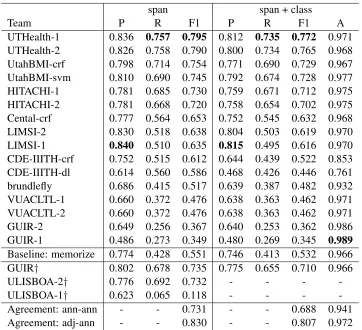
Table 2 shows results on the time expression tasks. The UTHealth systems achieved the best results on almost all time-related tasks. For finding times, while one system had comparable precision to UTHealth (0.836 UTHealth vs. 0.840 LIMSI), no system had competitive recall (0.757 UTHealth vs. 0.714 from the next best, UtahBMI), and thus the UTHealth sys-tem consistently outperformed the other syssys-tems in F1. The results were similar for jointly finding times
and assigning them a time class, though a couple systems (HITACHI, GUIR) did have more accurate predictions for the time class when scored only on the times that they were able to find (0.971 UTHealth vs. 0.975 HITACHI vs. 0.989 GUIR).
Compared to human agreement, the UTHealth and UtahBMI systems exceeded the inter-annotator agree-ment on times of 0.731, but even UTHealth’sF1of
0.795 did not reach the annotator-adjudicator agree-ment of 0.830, and the results were similar for jointly finding times and assigning their classes (0.772 vs. 0.807). Nonetheless, these 0.025 and 0.035 gaps be-tween the top system and the human agreement are smaller than the 0.051 and 0.038 gaps observed in Clinical TempEval 2015 (Bethard et al., 2015).
8.2 Event Expressions
span span + class
Team P R F1 P R F1 A
UTHealth-1 0.836 0.757 0.795 0.812 0.735 0.772 0.971 UTHealth-2 0.826 0.758 0.790 0.800 0.734 0.765 0.968 UtahBMI-crf 0.798 0.714 0.754 0.771 0.690 0.729 0.967 UtahBMI-svm 0.810 0.690 0.745 0.792 0.674 0.728 0.977 HITACHI-1 0.781 0.685 0.730 0.759 0.671 0.712 0.975 HITACHI-2 0.781 0.668 0.720 0.758 0.654 0.702 0.975 Cental-crf 0.777 0.564 0.653 0.752 0.545 0.632 0.968 LIMSI-2 0.830 0.518 0.638 0.804 0.503 0.619 0.970 LIMSI-1 0.840 0.510 0.635 0.815 0.495 0.616 0.970 CDE-IIITH-crf 0.752 0.515 0.612 0.644 0.439 0.522 0.853 CDE-IIITH-dl 0.614 0.560 0.586 0.468 0.426 0.446 0.761 brundlefly 0.686 0.415 0.517 0.639 0.387 0.482 0.932 VUACLTL-1 0.660 0.372 0.476 0.638 0.363 0.462 0.971 VUACLTL-2 0.660 0.372 0.476 0.638 0.363 0.462 0.971 GUIR-2 0.649 0.256 0.367 0.640 0.253 0.362 0.986 GUIR-1 0.486 0.273 0.349 0.480 0.269 0.345 0.989
Baseline: memorize 0.774 0.428 0.551 0.746 0.413 0.532 0.966 GUIR† 0.802 0.678 0.735 0.775 0.655 0.710 0.966
ULISBOA-2† 0.776 0.692 0.732 - - -
-ULISBOA-1† 0.623 0.065 0.118 - - -
[image:6.612.126.488.69.399.2]-Agreement: ann-ann - - 0.731 - - 0.688 0.941 Agreement: adj-ann - - 0.830 - - 0.807 0.972
Table 2:System performance and annotator agreement on TIMEX3 tasks: identifying the time expression’s span (character offsets)
and class (DATE, TIME, DURATION, QUANTIFIER, PREPOSTEXPor SET). The best system score from each column is in bold. Systems marked with†were submitted after the competition deadline and are not considered official.
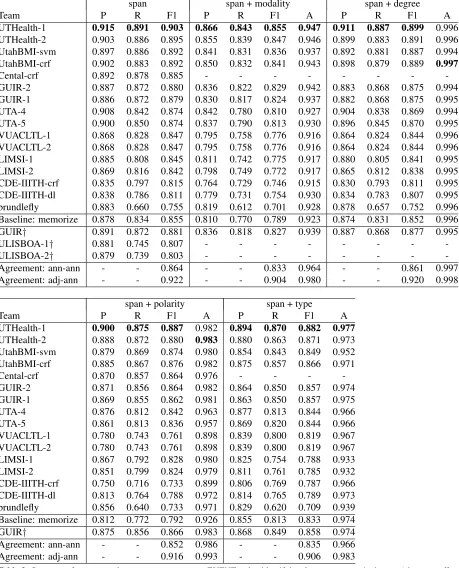
gap between UTHealth’s 0.903F1 and UtahBMI’s
0.892. The gap was even smaller if we look at pre-cision and recall separately: a 0.007 gap between UTHealth’s 0.915 precision and UTA’s 0.908, and a 0.005 gap between UTHealth’s 0.891 precision and UtahBMI’s 0.886. The results were similar for most of the attributes, though the precision gaps were larger (1.1-1.4) and the recall gaps were smaller (0.3-0.7).
Compared to human agreement, UTHealth, UtahBMI, Cental, GUIR, and UTA all exceeded inter-annotator agreement on identifying events, and UTHealth and UtahBMI exceeded inter-annotator agreement on all of the attributes. None of the sys-tems reached the level of annotator-adjudicator agree-ment: even UTHealth’sF1on events of 0.903 had a
gap of 0.019 from the annotator-adjudicator agree-ment of 0.922, and the results were similar for event attributes: 0.049 for modality, 0.021 for degree, 0.029
for polarity, 0.024 for type. These gaps are almost all bigger than the gaps observed in Clinical Temp-Eval 2015: 0.005 for event spans, 0.031 for modality, 0.007 for degree, 0.012 for polarity, 0.030 for type. However, Clinical TempEval 2016’s human agree-ment was substantially higher, with all annotator-adjudicator agreement above 0.90, while in Clini-cal TempEval 2015, annotator-adjudicator agreement ranged from 0.853 to 0.880.
8.3 Temporal Relations
span span + modality span + degree
Team P R F1 P R F1 A P R F1 A
UTHealth-1 0.915 0.891 0.903 0.866 0.843 0.855 0.947 0.911 0.887 0.899 0.996 UTHealth-2 0.903 0.886 0.895 0.855 0.839 0.847 0.946 0.899 0.883 0.891 0.996 UtahBMI-svm 0.897 0.886 0.892 0.841 0.831 0.836 0.937 0.892 0.881 0.887 0.994 UtahBMI-crf 0.902 0.883 0.892 0.850 0.832 0.841 0.943 0.898 0.879 0.889 0.997
Cental-crf 0.892 0.878 0.885 - - -
-GUIR-2 0.887 0.872 0.880 0.836 0.822 0.829 0.942 0.883 0.868 0.875 0.994 GUIR-1 0.886 0.872 0.879 0.830 0.817 0.824 0.937 0.882 0.868 0.875 0.995 UTA-4 0.908 0.842 0.874 0.842 0.780 0.810 0.927 0.904 0.838 0.869 0.994 UTA-5 0.900 0.850 0.874 0.837 0.790 0.813 0.930 0.896 0.845 0.870 0.995 VUACLTL-1 0.868 0.828 0.847 0.795 0.758 0.776 0.916 0.864 0.824 0.844 0.996 VUACLTL-2 0.868 0.828 0.847 0.795 0.758 0.776 0.916 0.864 0.824 0.844 0.996 LIMSI-1 0.885 0.808 0.845 0.811 0.742 0.775 0.917 0.880 0.805 0.841 0.995 LIMSI-2 0.869 0.816 0.842 0.798 0.749 0.772 0.917 0.865 0.812 0.838 0.995 CDE-IIITH-crf 0.835 0.797 0.815 0.764 0.729 0.746 0.915 0.830 0.793 0.811 0.995 CDE-IIITH-dl 0.838 0.786 0.811 0.779 0.731 0.754 0.930 0.834 0.783 0.807 0.995 brundlefly 0.883 0.660 0.755 0.819 0.612 0.701 0.928 0.878 0.657 0.752 0.996 Baseline: memorize 0.878 0.834 0.855 0.810 0.770 0.789 0.923 0.874 0.831 0.852 0.996 GUIR† 0.891 0.872 0.881 0.836 0.818 0.827 0.939 0.887 0.868 0.877 0.995
ULISBOA-1† 0.881 0.745 0.807 - - -
-ULISBOA-2† 0.879 0.739 0.803 - - -
-Agreement: ann-ann - - 0.864 - - 0.833 0.964 - - 0.861 0.997 Agreement: adj-ann - - 0.922 - - 0.904 0.980 - - 0.920 0.998
span + polarity span + type
Team P R F1 A P R F1 A
UTHealth-1 0.900 0.875 0.887 0.982 0.894 0.870 0.882 0.977
[image:7.612.74.533.89.657.2]UTHealth-2 0.888 0.872 0.880 0.983 0.880 0.863 0.871 0.973 UtahBMI-svm 0.879 0.869 0.874 0.980 0.854 0.843 0.849 0.952 UtahBMI-crf 0.885 0.867 0.876 0.982 0.875 0.857 0.866 0.971 Cental-crf 0.870 0.857 0.864 0.976 - - - -GUIR-2 0.871 0.856 0.864 0.982 0.864 0.850 0.857 0.974 GUIR-1 0.869 0.855 0.862 0.981 0.863 0.850 0.857 0.975 UTA-4 0.876 0.812 0.842 0.963 0.877 0.813 0.844 0.966 UTA-5 0.861 0.813 0.836 0.957 0.869 0.820 0.844 0.966 VUACLTL-1 0.780 0.743 0.761 0.898 0.839 0.800 0.819 0.967 VUACLTL-2 0.780 0.743 0.761 0.898 0.839 0.800 0.819 0.967 LIMSI-1 0.867 0.792 0.828 0.980 0.825 0.754 0.788 0.933 LIMSI-2 0.851 0.799 0.824 0.979 0.811 0.761 0.785 0.932 CDE-IIITH-crf 0.750 0.716 0.733 0.899 0.806 0.769 0.787 0.966 CDE-IIITH-dl 0.813 0.764 0.788 0.972 0.814 0.765 0.789 0.973 brundlefly 0.856 0.640 0.733 0.971 0.829 0.620 0.709 0.939 Baseline: memorize 0.812 0.772 0.792 0.926 0.855 0.813 0.833 0.974 GUIR† 0.875 0.856 0.866 0.983 0.868 0.849 0.858 0.974 Agreement: ann-ann - - 0.852 0.986 - - 0.835 0.966 Agreement: adj-ann - - 0.916 0.993 - - 0.906 0.983
Table 3:System performance and annotator agreement on EVENT tasks: identifying the event expression’s span (character offsets), contextual modality (ACTUAL, HYPOTHETICAL, HEDGEDor GENERIC), degree (MOST, LITTLEor N/A), polarity (POSor NEG) and type (ASPECTUAL, EVIDENTIALor N/A). The best system score from each column is in bold. Systems marked with†were
To document time Narrative containers
P R F1 P R F1
Phase 1: systems are provided only the raw text
UTHealth-1 0.766 0.746 0.756 0.488 0.471 0.479
UTHealth-2 0.757 0.743 0.750 0.479 0.466 0.472 UtahBMI-crf 0.753 0.737 0.745 0.502 0.215 0.301 UtahBMI-svm 0.741 0.732 0.736 0.498 0.215 0.300
GUIR-2 0.719 0.707 0.713 - -
-GUIR-1 0.712 0.701 0.706 - -
-VUACLTL-1 0.655 0.624 0.639 0.531 0.244 0.334 VUACLTL-2 0.655 0.624 0.639 0.493 0.268 0.347 CDE-IIITH-dl 0.643 0.604 0.623 0.285 0.225 0.252
LIMSI-1 0.635 0.580 0.607 - -
-LIMSI-2 0.624 0.585 0.604 - -
-CDE-IIITH-crf 0.481 0.460 0.470 0.431 0.167 0.241
brundlefly 0.389 0.290 0.332 - -
-UTA-4 0.340 0.315 0.327 - -
-UTA-5 0.336 0.317 0.326 - -
-Baseline: memorize / closest 0.620 0.589 0.604 0.403 0.067 0.115
GUIR† 0.719 0.704 0.711 - -
-ULISBOA-1† - - - 0.122 0.009 0.017
ULISBOA-2† - - - 0.108 0.009 0.017
Agreement: ann-ann - - 0.721 - -
-Agreement: adj-ann - - 0.844 - -
-Phase 2: systems are provided manually annotated EVENTs and TIMEX3s
UTHealth-1 - 0.835 - 0.588 0.559 0.573
UTHealth-2 - 0.833 - 0.568 0.564 0.566
LIMSI-COT-lexical - 0.769 - 0.704 0.436 0.538
GUIR-1 - 0.813 - 0.546 0.471 0.506
LIMSI-COT-embedding - 0.807 - 0.751 0.320 0.449 KULeuven-LIIR-1 - - - 0.714 0.428 0.536 KULeuven-LIIR-2 - - - 0.715 0.429 0.536
VUACLTL-2 - 0.701 - 0.589 0.368 0.453
VUACLTL-1 - 0.701 - 0.642 0.345 0.449
UtahBMI-crf+svm - 0.843 - 0.562 0.254 0.350 CDE-IIITH-dl - 0.705 - 0.348 0.284 0.313 UtahBMI-svm - 0.571 - 0.605 0.230 0.333
ULISBOA-1 - - - 0.273 0.255 0.264
brundlefly - 0.742 - - -
-uta-5 - 0.788 - - -
-uta-6 - 0.786 - - -
-LIMSI-1 - 0.687 - - -
-CDE-IIITH-crf - 0.588 - 0.493 0.185 0.269
LIMSI-2 - 0.679 - - -
-ULISBOA-2 - - - 0.823 0.056 0.105
Baseline: memorize / closest - 0.675 - 0.459 0.154 0.231 UtahBMI-crf+svm† - 0.843 - 0.693 0.425 0.527 UtahBMI-svm† - 0.571 - 0.711 0.372 0.489
Agreement: ann-ann - - - 0.651
Agreement: adj-ann - - - 0.817
Table 4:System performance and annotator agreement on temporal relation tasks: identifying relations between events and the
1, and the second best score (0.835 vs. UtahBMI’s 0.843) in phase 2. For finding narrative container relations, the UTHealth system had the best recall (0.471 in phase 1, 0.559 in phase 2), and though other systems (UtahBMI, VUACLTL, LIMSI-COT, and KULeuven-LIIR) had higher precisions, the re-call gap from UTHealth to the next system was large (0.203 in phase 1 and 0.088 in phase 2) and thus UTHealth had the bestF1 in both phases (0.479 in
phase 1, 0.573 in phase 2).
Compared to human agreement, UTHealth and UtahBMI exceeded inter-annotator agreement on re-lations to the document time (while still leaving a gap of 0.088 to the annotator-adjudicator agreement), but no participant system was near the human agree-ment for narrative containers (a gap of 0.078 from inter-annotator agreement and a gap of 0.244 from annotator-adjudicator agreement). For relations to the document time, the 0.088 gap between systems and annotator-adjudicator agreement is slightly larger than the 0.059 of Clinical TempEval 2015, but for narrative container relations the 0.244 gap is much smaller than the 0.412 of Clinical TempEval 2015. As with other tasks, human agreement is higher this year (0.844 and 0.817 in 2016 vs. 0.761 and 0.672 in 2015), which may explain the larger gap for doc-ument time relations. The smaller gap for narrative container relations despite the increased human agree-ment suggests that major improveagree-ments have been made to the systems for this task.
9 Discussion
The results of Clinical TempEval 2016 suggest that current state-of-the-art systems are close to solving most event and time related tasks. For all of these tasks, the gap between system performance and hu-man perforhu-mance was less than 0.05, and for half the tasks (time spans, event spans, event degree, event type) it was 0.025 or less.
The temporal relation tasks were more difficult. Systems trying to predict the temporal relation be-tween an event and the time at which the document was written lagged about 0.09 behind human perfor-mance. And systems trying to predict narrative con-tainers (whether one event or time contains another) lagged about 0.25 behind human performance, even when provided human-annotated events and times.
Nonetheless, the latter result was a major improve-ment over Clinical TempEval 2015, where the gap on narrative containers was more than 0.4.
While there was variability across the subtasks in the rankings of teams, UTHealth and UtahBMI were always at the top of the lists. Both of these sys-tems relied on structured learning models (UTHealth used HMM support vector machines; UtahBMI used conditional random fields) with a wide variety of fea-tures (lexical, morphological, syntactic, and many others). We can thus infer that such approaches hold promise for temporal information extraction. How-ever, these two teams were also among the first to make it through the data use agreement process, so their success may in part reflect the advantage of having more time for experimentation and feature engineering on the training data.
Overall, Clinical TempEval 2016 represented a major step forward from Clinical TempEval 2015. It saw a much greater breadth of participating systems (14 teams in 2016 vs. 3 teams in 2015), with the top systems maintaining 2015’s high performance on the event and time tasks, while making major progress on the harder temporal relation tasks. Future plans for Clinical TempEval target the robustness of these systems: instead of testing on only colon cancer notes from the Mayo Clinic (the same domain as the training set), systems will be tested on other types of medical conditions and notes from other institutions.
Acknowledgements
The project described was supported in part by R01LM010090 (THYME) from the National Library Of Medicine. The content is solely the responsibility of the authors and does not necessarily represent the official views of the National Institutes of Health.
References
Abdulrahman Khalifa AAl Abdulsalam, Sumithra Velupil-lai, and Stephane Meystre. 2016. UtahBMI at SemEval-2016 Task 12: Extracting temporal informa-tion from clinical text. InProceedings of the 10th Inter-national Workshop on Semantic Evaluation (SemEval-2016), pages 1256–1262, San Diego, California, June. Association for Computational Linguistics.
12: Extractions of temporal expressions, clinical events and relations using IBEnt. InProceedings of the 10th International Workshop on Semantic Evaluation (Se-mEval 2016), San Diego, California, June. Association for Computational Linguistics.
Steven Bethard, Leon Derczynski, Guergana Savova, James Pustejovsky, and Marc Verhagen. 2015. Semeval-2015 task 6: Clinical tempeval. In Proceed-ings of the 9th International Workshop on Semantic
Evaluation (SemEval 2015), pages 806–814, Denver,
Colorado, June. Association for Computational Lin-guistics.
Tommaso Caselli and Roser Morante. 2016. VUACLTL at SemEval-2016 Task 12: A crf pipeline to clinical temporal. In Proceedings of the 10th International
Workshop on Semantic Evaluation (SemEval 2016), San
Diego, California, June. Association for Computational Linguistics.
Wei-Te Chen and Will Styler. 2013. Anafora: A web-based general purpose annotation tool. InProceedings
of the 2013 NAACL HLT Demonstration Session, pages
14–19, Atlanta, Georgia, June. Association for Compu-tational Linguistics.
Veera Raghavendra Chikka. 2016. CDE-IIITH at SemEval-2016 Task 12: Extraction of temporal infor-mation from clinical documents using machine learning techniques. InProceedings of the 10th International
Workshop on Semantic Evaluation (SemEval 2016), San
Diego, California, June. Association for Computational Linguistics.
Arman Cohan, Kevin Meurer, and Nazli Goharian. 2016. GUIR at SemEval-2016 Task 12: Temporal informa-tion extracinforma-tion from clinical narratives. InProceedings of the 10th International Workshop on Semantic
Eval-uation (SemEval 2016), San Diego, California, June.
Association for Computational Linguistics.
Jason Fries. 2016. Brundlefly at SemEval-2016 Task 12: Recurrent neural networks vs. joint inference for clin-ical temporal information extraction. InProceedings of the 10th International Workshop on Semantic
Eval-uation (SemEval 2016), San Diego, California, June.
Association for Computational Linguistics.
Cyril Grouin and V´eronique Moriceau. 2016. LIMSI at SemEval-2016 Task 12: machine-learning and tem-poral information to identify clinical events and time expressions. InProceedings of the 10th International
Workshop on Semantic Evaluation (SemEval 2016), San
Diego, California, June. Association for Computational Linguistics.
Charlotte Hansart, Damien De Meyere, Patrick Watrin, Andr´e Bittar, and C´edrick Fairon. 2016. Cental at SemEval-2016 Task 12: A linguistically fed CRF model for medical and temporal information extraction.
InProceedings of the 10th International Workshop on
Semantic Evaluation (SemEval 2016), San Diego,
Cal-ifornia, June. Association for Computational Linguis-tics.
Hee-Jin Lee, Hua Xu, Jingqi Wang, Yaoyun Zhang, Sun-grim Moon, Jun Xu, and Yonghui Wu. 2016. UTHealth at SemEval-2016 Task 12: Temporal information ex-traction from clinical notes - uthealth’s system for the 2016 clinical tempeval challenge. InProceedings of the 10th International Workshop on Semantic Evaluation (SemEval 2016), San Diego, California, June. Associa-tion for ComputaAssocia-tional Linguistics.
Artuur Leeuwenberg and Marie-Francine Moens. 2016. KULeuven-LIIR at SemEval-2016 Task 12: Detecting narrative containment in clinical records. In Proceed-ings of the 10th International Workshop on Seman-tic Evaluation (SemEval 2016), San Diego, California, June. Association for Computational Linguistics. Peng Li and Heng Huang. 2016. UTA MLNLP at
SemEval-2016 Task 12. In Proceedings of the 10th International Workshop on Semantic Evaluation (Se-mEval 2016), San Diego, California, June. Association for Computational Linguistics.
Chen Lin, Dmitriy Dligach, Timothy A Miller, Steven Bethard, and Guergana K Savova. 2015. Multilayered temporal modeling for the clinical domain.Journal of the American Medical Informatics Association. Christopher Manning, Mihai Surdeanu, John Bauer, Jenny
Finkel, Steven Bethard, and David McClosky. 2014. The Stanford CoreNLP natural language processing toolkit. In Proceedings of 52nd Annual Meeting of the Association for Computational Linguistics: System
Demonstrations, pages 55–60, Baltimore, Maryland,
June. Association for Computational Linguistics. James Pustejovsky and Amber Stubbs. 2011. Increasing
informativeness in temporal annotation. In Proceed-ings of the 5th Linguistic Annotation Workshop, pages 152–160, Portland, Oregon, USA, June. Association for Computational Linguistics.
Sarath P R, Manikandan R, and Yoshiki Niwa. 2016. Hi-tachi at SemEval-2016 Task 12: Extraction of temporal information for the 2016 clinical tempeval challenge.
InProceedings of the 10th International Workshop on
Semantic Evaluation (SemEval 2016), San Diego,
Cal-ifornia, June. Association for Computational Linguis-tics.
Jannik Str¨otgen and Michael Gertz. 2013. Multilin-gual and cross-domain temporal tagging. Language
Resources and Evaluation, 47(2):269–298.
William F. Styler, IV, Guergana Savova, Martha Palmer, James Pustejovsky, Tim O’Gorman, and Piet C. de Groen. 2014b. THYME annotation guidelines, 2. Weiyi Sun, Anna Rumshisky, and Ozlem Uzuner. 2013.
Evaluating temporal relations in clinical text: 2012 i2b2 challenge. Journal of the American Medical Informat-ics Association, 20(5):806–813.
Julien Tourille, Olivier Ferret, Aur´elie N´ev´eol, and Xavier Tannier. 2016. LIMSI-COT at SemEval-2016 Task 12: Temporal relation identification for the clinical temp-eval challenge. InProceedings of the 10th International
Workshop on Semantic Evaluation (SemEval 2016), San
Diego, California, June. Association for Computational Linguistics.
Naushad UzZaman and James Allen. 2011. Temporal evaluation. InProceedings of the 49th Annual Meeting of the Association for Computational Linguistics:
Hu-man Language Technologies, pages 351–356, Portland,
Oregon, USA, June. Association for Computational Linguistics.
Naushad UzZaman, Hector Llorens, Leon Derczynski, James Allen, Marc Verhagen, and James Pustejovsky. 2013. SemEval-2013 Task 1: TempEval-3: Evaluating Time Expressions, Events, and Temporal Relations. In
Second Joint Conference on Lexical and Computational Semantics (*SEM), Volume 2: Proceedings of the Sev-enth International Workshop on Semantic Evaluation
(SemEval 2013), pages 1–9, Atlanta, Georgia, USA,
June. Association for Computational Linguistics. Marc Verhagen, Robert Gaizauskas, Frank Schilder, Mark
Hepple, Graham Katz, and James Pustejovsky. 2007. SemEval-2007 Task 15: TempEval Temporal Relation Identification. InProceedings of the Fourth Interna-tional Workshop on Semantic Evaluations
(SemEval-2007), pages 75–80, Prague, Czech Republic, June.
Association for Computational Linguistics.
Marc Verhagen, Roser Sauri, Tommaso Caselli, and James Pustejovsky. 2010. SemEval-2010 Task 13: TempEval-2. InProceedings of the 5th International Workshop on
Semantic Evaluation, pages 57–62, Uppsala, Sweden,