SemEval-2015 Task 6: Clinical TempEval
Steven Bethard
University of Alabama at Birmingham Birmingham, AL 35294, USA
Leon Derczynski
University of Sheffield Sheffield, S1 4DP, UK
Guergana Savova
Harvard Medical School Boston, MA 02115, USA
Guergana.Savova@ childrens.harvard.edu
James Pustejovsky, Marc Verhagen
Brandeis University Waltham, MA 02453, USA
[email protected] [email protected]
Abstract
Clinical TempEval 2015 brought the tempo-ral information extraction tasks of past Temp-Eval campaigns to the clinical domain. Nine sub-tasks were included, covering problems in time expression identification, event expression identification and temporal relation identifica-tion. Participant systems were trained and eval-uated on a corpus of clinical notes and pathol-ogy reports from the Mayo Clinic, annotated with an extension of TimeML for the clinical domain. Three teams submitted a total of 13 system runs, with the best systems achieving near-human performance on identifying events and times, but with a large performance gap still remaining for temporal relations.
1 Introduction
The TempEval shared tasks have, since 2007, pro-vided a focus for research on temporal information extraction (Verhagen et al., 2007; Verhagen et al., 2010; UzZaman et al., 2013). Participant systems compete to identify critical components of the time-line of a text, including time expressions, event ex-pressions and temporal relations. However, the Temp-Eval campaigns to date have focused primarily on in-document timelines derived from news articles.
Clinical TempEval brings these temporal informa-tion extracinforma-tion tasks to the clinical domain, using clinical notes and pathology reports from the Mayo Clinic. This follows recent interest in temporal infor-mation extraction for the clinical domain, e.g., the i2b2 2012 shared task (Sun et al., 2013), and broad-ens our understanding of the language of time beyond newswire expressions and structure.
Clinical TempEval focuses on discrete, well-defined tasks which allow rapid, reliable and repeat-able evaluation. Participating systems are expected to take as input raw text such as:
April 23, 2014: The patient did not have any postoperative bleeding so we will re-sume chemotherapy with a larger bolus on Friday even if there is slight nausea.
And output annotations over the text that capture the following kinds of information:
• April 23, 2014: TIMEX3
– TYPE=DATE
• postoperative: TIMEX3
– TYPE=PREPOSTEXP
– CONTAINS
• bleeding: EVENT
– POLARITY=NEG
– BEFOREdocument creation time
• resume: EVENT
– TYPE=ASPECTUAL
– AFTERdocument creation time
• chemotherapy: EVENT
– AFTERdocument creation time
• bolus: EVENT
– AFTERdocument creation time
• Friday: TIMEX3
– TYPE=DATE
– CONTAINS
• nausea: EVENT
– DEGREE=LITTLE
– MODALITY=HYPOTHETICAL
– AFTERdocument creation time
That is, the systems should identify the time sions, event expressions, attributes of those expres-sions, and temporal relations between them.
2 Data
The Clinical TempEval corpus was based on a set of 600 clinical notes and pathology reports from cancer patients at the Mayo Clinic. These notes were man-ually de-identified by the Mayo Clinic to replace names, locations, etc. with generic placeholders, but time expressions were not altered. The notes were then manually annotated by the THYME project (thyme.healthnlp.org) using an extension of ISO-TimeML for the annotation of times, events and tem-poral relations in clinical notes (Styler et al., 2014b). This extension includes additions such as new time expression types (e.g., PREPOSTEXPfor expressions likepostoperative), new EVENTattributes (e.g., DE -GREE=LITTLEfor expressions likeslight nausea), and an increased focus on temporal relations of type CONTAINS(a.k.a. INCLUDES).
The annotation procedure was as follows:
1. Annotators identified time and event expres-sions, along with their attributes
2. Adjudicators revised and finalized the time and event expressions and their attributes
3. Annotators identified temporal relations be-tween pairs of events and events and times 4. Adjudicators revised and finalized the temporal
relations
More details on the corpus annotation process are documented in a separate article (Styler et al., 2014a).
Because the data contained incompletely de-identified clinical data (the time expressions were retained), participants were required to sign a data use agreement with the Mayo Clinic to obtain the raw text of the clinical notes and pathology reports.1 The event, time and temporal relation annotations were distributed separately from the text, in an open source repository2using the Anafora standoff format (Chen and Styler, 2013).
1The details of this process are described athttp://thyme.
healthnlp.org/
2https://github.com/stylerw/thymedata
Train Dev
Documents 293 147
EVENTs 38890 20974
TIMEX3s 3833 2078
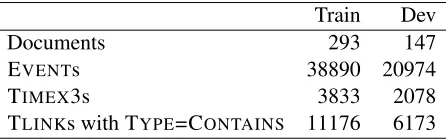
[image:2.612.315.538.60.130.2]TLINKs with TYPE=CONTAINS 11176 6173
Table 1: Number of documents, event expressions, time expressions and narrative container relations in the train-ing and development portions of the THYME data. (Dev is the Clinical TempEval 2015 test set.)
The corpus was split into three portions: Train (50%), Dev (25%) and Test (25%). For Clinical TempEval 2015, the Train portion was used for train-ing and the Dev portion was used for testtrain-ing. The Test portion was not distributed, and was reserved as a test set for a future iteration of the shared task. Table 1 shows the number of documents, event expressions (EVENTannotations), time expressions (TIMEX3 an-notations) and narrative container relations (TLINK annotations with TYPE=CONTAINSattributes) in the Train and Dev portions of the corpus.
3 Tasks
A total of nine tasks were included, grouped into three categories:
• Identifying time expressions (TIMEX3 annota-tions in the THYME corpus) consisting of the following components3:
– The spans (character offsets) of the expres-sion in the text
– Class: DATE, TIME, DURATION, QUAN -TIFIER, PREPOSTEXPor SET
• Identifying event expressions (EVENT annota-tions in the THYME corpus) consisting of the following components:
– The spans (character offsets) of the expres-sion in the text
– Contextual Modality: ACTUAL, HYPO -THETICAL, HEDGEDor GENERIC
– Degree: MOST, LITTLEor N/A
– Polarity: POSor NEG
– Type: ASPECTUAL, EVIDENTIALor N/A
3Normalized time values (e.g. 2015-02-05) were originally
• Identifying temporal relations between events and times, focusing on the following types:
– Relations between events and the doc-ument creation time (BEFORE, OVER -LAP, BEFORE-OVERLAPor AFTER), rep-resented by DOCTIMERELannotations in the THYME corpus
– Narrative container relations (Pustejovsky and Stubbs, 2011) between events and/or times, represented by TLINKannotations with TYPE=CONTAINSin the THYME cor-pus
The evaluation was run in two phases:
1. Systems were given access only to the raw text, and were asked to identify time expressions, event expressions and temporal relations 2. Systems were given access to the raw text and
the manual event and time annotations, and were asked to identify only temporal relations
4 Evaluation Metrics
All of the tasks were evaluated using the standard metrics of precision (P), recall (R) andF1:
P = |S|∩S|H|
R= |S∩H|
|H|
F1= 2P·P+·RR
whereSis the set of items predicted by the system andH is the set of items manually annotated by the humans. Applying these metrics to the tasks only requires a definition of what is considered an “item” for each task.
• For evaluating the spans of event expressions or time expressions, items were tuples of (be-gin, end) character offsets. Thus, systems only received credit for identifying events and times with exactly the same character offsets as the manually annotated ones.
• For evaluating the attributes of event expres-sions or time expresexpres-sions – Class, Contextual
Modality, Degree, Polarity and Type – items were tuples of (begin, end, value) where begin and end are character offsets and value is the value that was given to the relevant attribute. Thus, systems only received credit for an event (or time) attribute if they both found an event (or time) with the correct character offsets and then assigned the correct value for that attribute.
• For relations between events and the document creation time, items were tuples of (begin, end, value), just as if it were an event attribute. Thus, systems only received credit if they found a correct event and assigned the correct relation (BEFORE, OVERLAP, BEFORE-OVERLAP or AFTER) between that event and the document creation time. Note that in the second phase of the evaluation, when manual event annotations were given as input, precision, recall andF1are all equivalent to standard accuracy.
• For narrative container relations, items were tu-ples of ((begin1, end1), (begin2, end2)), where the begins and ends corresponded to the char-acter offsets of the events or times participating in the relation. Thus, systems only received credit for a narrative container relation if they found both events/times and correctly assigned a CONTAINSrelation between them.
For attributes, an additional metric measures how accurately a system predicts the attribute values on just those events or times that the system predicted. The goal here is to allow a comparison across systems for assigning attribute values, even when different systems produce very different numbers of events and times. This is calculated by dividing theF1on the attribute by theF1on identifying the spans:
A=attributespanFF1
1
-TAINSB and B CONTAINSC, so A CONTAINSC):
Pclosure= |S∩closure|S| (H)|
Rclosure= |closure|H(S|)∩H|
Fclosure= 2P·Pclosure·Rclosure closure+Rclosure
These measures take the approach of prior work (Uz-Zaman and Allen, 2011) and TempEval 2013 (UzZa-man et al., 2013), following the intuition that preci-sion should measure the fraction of system-predicted relations that can be verified from the human an-notations (either the original human anan-notations or annotations inferred from those through closure), and that recall should measure the fraction of human-annotated relations that can be verified from the sys-tem output (either the original syssys-tem predictions or predictions inferred from those through closure).
5 Baseline Systems
Two rule-based systems were used as baselines to compare the participating systems against.
memorize For all tasks but the narrative container task, a memorization-based baseline was used. To train the model, all phrases annotated as ei-ther events or times in the training data were collected. All exact character matches for these phrases in the training data were then examined, and only phrases that were annotated as events or times greater than 50% of the time were re-tained. For each phrase, the most frequently an-notated type (event or time) and attribute values for instances of that phrase were determined. To predict with the model, the raw text of the test data was searched for all exact character matches of any of the memorized phrases, pre-ferring longer phrases when multiple matches overlapped. Wherever a phrase match was found, an event or time with the memorized (most frequent) attribute values was predicted.
closest For the narrative container task, a proximity-based baseline was used. Each time expression
was predicted to be a narrative container, con-taining only the closest event expression to it in the text.
6 Participating Systems
Three research teams submitted a total of 13 runs:
BluLab The team from Stockholm University and University of Utah participated in all tasks, us-ing supervised classifiers with features gen-erated by the Apache clinical Text Analysis and Knowledge Extraction System (cTAKES)4. Their runs differed in whether and how many rules were used to constrain the search for nar-rative container relations.
KPSCMI The team from Kaiser Permanente South-ern California participated in the time expres-sion tasks. Their runs compared an extended version of the rule-based HeidelTime5 system (run 1) with systems based on supervised classi-fiers (run 2-3).
UFPRSheffield The team from Universidade Fed-eral do Paran´a and University of Sheffield par-ticipated in the time expression tasks. Their runs compared in-house rule-based systems (the Hynx runs) to systems based on supervised clas-sifiers (the SVM runs).
7 Human Agreement
We also give two types of human agreement on the task, measured with the same evaluation metrics as the systems:
ann-ann Inter-annotator agreement between the two independent human annotators who annotated each document. This is the most commonly re-ported type of agreement, and often considered to be an upper bound on system performance.
adj-ann Inter-annotator agreement between the ad-judicator and the two independent annotators. This is usually a better bound on system perfor-mance in adjudicated corpora, since the models are trained on the adjudicated data, not on the individual annotator data.
4https://ctakes.apache.org
span span + class
Team P R F1 P R F1 A
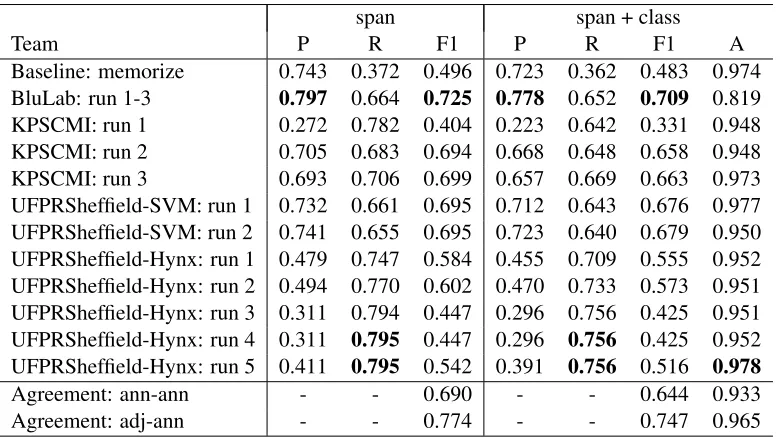
Baseline: memorize 0.743 0.372 0.496 0.723 0.362 0.483 0.974 BluLab: run 1-3 0.797 0.664 0.725 0.778 0.652 0.709 0.819 KPSCMI: run 1 0.272 0.782 0.404 0.223 0.642 0.331 0.948 KPSCMI: run 2 0.705 0.683 0.694 0.668 0.648 0.658 0.948 KPSCMI: run 3 0.693 0.706 0.699 0.657 0.669 0.663 0.973 UFPRSheffield-SVM: run 1 0.732 0.661 0.695 0.712 0.643 0.676 0.977 UFPRSheffield-SVM: run 2 0.741 0.655 0.695 0.723 0.640 0.679 0.950 UFPRSheffield-Hynx: run 1 0.479 0.747 0.584 0.455 0.709 0.555 0.952 UFPRSheffield-Hynx: run 2 0.494 0.770 0.602 0.470 0.733 0.573 0.951 UFPRSheffield-Hynx: run 3 0.311 0.794 0.447 0.296 0.756 0.425 0.951 UFPRSheffield-Hynx: run 4 0.311 0.795 0.447 0.296 0.756 0.425 0.952 UFPRSheffield-Hynx: run 5 0.411 0.795 0.542 0.391 0.756 0.516 0.978
Agreement: ann-ann - - 0.690 - - 0.644 0.933
Agreement: adj-ann - - 0.774 - - 0.747 0.965
Table 2: System performance and annotator agreement on TIMEX3 tasks: identifying the time expression’s span (character offsets) and class (DATE, TIME, DURATION, QUANTIFIER, PREPOSTEXPor SET). The best system score
from each column is in bold. The three BluLab runs are combined because they all have identical performance (since they only differ in their approach to narrative container relations).
Precision and recall are not reported in these scenar-ios since they depend on the arbitrary choice of one annotator as the “human” (H) and the other as the “system” (S).
Note that since temporal relations between events and the document creation time were annotated at the same time as the events themselves, agreement for this task is only reported in phase 1 of the evalu-ation. Similarly, since narrative container relations were only annotated after events and times had been adjudicated, agreement for this task is only reported in phase 2 of the evaluation.
8 Evaluation Results 8.1 Time Expressions
Table 2 shows results on the time expression tasks. The BluLab system achieved the bestF1at identify-ing time expressions, 0.725. The other machine learn-ing systems (KPSCMI run 2-3 and UFPRSheffield-SVM run 1-2) achieved F1 in the 0.690-0.700 range. The rule-based systems (KPSCMI run 1 and UFPRSheffield-Hynx run 1-5) all achieved higher recall than the machine learning systems, but at sub-stantial costs to precision. All systems outperformed the memorization baseline in terms of recall, and all
machine-learning systems outperformed it in terms ofF1, but only the BluLab system outperformed the baseline in terms of precision.
The BluLab system also achieved the bestF1 for predicting the classes of time expressions, though this is primarily due to achieving a higher F1 at identifying time expressions in the first place. UFPRSheffield-Hynx run 5 achieved the best accu-racy on predicting classes for the time expressions it found, 0.978, though on this metric it only outper-formed the memorization baseline by 0.004.
Across the time expression tasks, systems did not quite achieve performance at the level of human agreement. For the spans of time expressions, the top system achieved 0.725F1, compared to 0.774 adjudicator-annotatorF1, though almost half of the systems exceeded the lower annotator-annotatorF1 of 0.690. For the classes of time expressions, the story was similar forF1, though several models ex-ceeded the adjudicator-annotator accuracy of 0.965 on just the time expressions predicted by the system.
[image:5.612.113.504.59.278.2]8.2 Event Expressions
span span + modality span + degree
Team P R F1 P R F1 A P R F1 A
Baseline: memorize 0.876 0.810 0.842 0.810 0.749 0.778 0.924 0.871 0.806 0.838 0.995
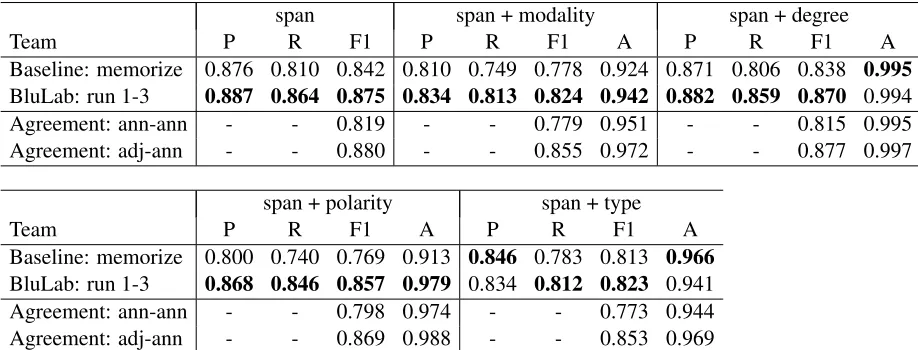
BluLab: run 1-3 0.887 0.864 0.875 0.834 0.813 0.824 0.942 0.882 0.859 0.870 0.994 Agreement: ann-ann - - 0.819 - - 0.779 0.951 - - 0.815 0.995 Agreement: adj-ann - - 0.880 - - 0.855 0.972 - - 0.877 0.997
span + polarity span + type
Team P R F1 A P R F1 A
Baseline: memorize 0.800 0.740 0.769 0.913 0.846 0.783 0.813 0.966
BluLab: run 1-3 0.868 0.846 0.857 0.979 0.834 0.812 0.823 0.941 Agreement: ann-ann - - 0.798 0.974 - - 0.773 0.944 Agreement: adj-ann - - 0.869 0.988 - - 0.853 0.969
Table 3: System performance and annotator agreement on EVENT tasks: identifying the event expression’s span (character offsets), contextual modality (ACTUAL, HYPOTHETICAL, HEDGEDor GENERIC), degree (MOST, LITTLEor N/A), polarity (POSor NEG) and type (ASPECTUAL, EVIDENTIALor N/A). The best system score from each column
is in bold.
one exception was the semantic type of the event, where the memorization baseline had a better preci-sion and also a better accuracy on the classes of the events that it identified.
The BluLab system got close to the level of adjudicator-annotator agreement on identifying the spans of event expressions (0.875 vs. 0.880 F1), identifying the degree of events (0.870 vs. 0.877
F1), and identifying the polarity of events (0.857 vs. 0.869F1), and it generally met or exceeded the lower annotator-annotator agreement on these tasks. There is a larger gap (3+ points ofF1) between the system performance and adjudicator-annotator agree-ment for event modality and event type, though only a small gap (<1 point ofF1) for the lower annotator-annotator agreement on these tasks.
[image:6.612.74.533.60.235.2]8.3 Temporal Relations
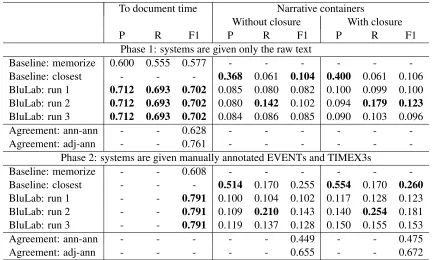
Table 4 shows performance on the temporal relation tasks. In detecting the relations between events and the document creation time, the BluLab system sub-stantially outperformed the memorization baseline, achievingF1 of 0.702 on system-predicted events (phase 1) and F1 of 0.791 on manually annotated events (phase 2). In identifying narrative container re-lations, the best BluLab system (run 2) outperformed the proximity-based baseline when using system-predicted events (Fclosure of 0.123 vs. 0.106) but not when using manually annotated events (Fclosure
of 0.181 vs. 0.260). Across both phase 1 and phase 2 for narrative container relations, the top BluLab system always had the best recall, while the baseline system always had the best precision.
Annotator agreement was higher than system per-formance on all temporal relation tasks. For rela-tions between events and the document creation time, adjudicator-annotator agreement was 0.761F1, com-pared to the best system’s 0.702F1, though this sys-tem did exceed the lower annotator-annotator agree-ment of 0.628F1. For narrative container relations using manually annotated EVENTs and TIMEX3s, the gap was much greater, with adjudicator-annotator agreement at 0.672Fclosure, and the top system (the baseline system) at 0.260Fclosure. Even the lower annotator-annotator agreement of 0.475Fclosurewas much higher than the system performance.
9 Discussion
agree-To document time Narrative containers
Without closure With closure
P R F1 P R F1 P R F1
Phase 1: systems are given only the raw text
Baseline: memorize 0.600 0.555 0.577 - - -
-Baseline: closest - - - 0.368 0.061 0.104 0.400 0.061 0.106 BluLab: run 1 0.712 0.693 0.702 0.085 0.080 0.082 0.100 0.099 0.100 BluLab: run 2 0.712 0.693 0.702 0.080 0.142 0.102 0.094 0.179 0.123
BluLab: run 3 0.712 0.693 0.702 0.084 0.086 0.085 0.090 0.103 0.096
Agreement: ann-ann - - 0.628 - - -
-Agreement: adj-ann - - 0.761 - - -
-Phase 2: systems are given manually annotated EVENTs and TIMEX3s
Baseline: memorize - - 0.608 - - -
-Baseline: closest - - - 0.514 0.170 0.255 0.554 0.170 0.260
BluLab: run 1 - - 0.791 0.100 0.104 0.102 0.117 0.128 0.123 BluLab: run 2 - - 0.791 0.109 0.210 0.143 0.140 0.254 0.181 BluLab: run 3 - - 0.791 0.119 0.137 0.128 0.150 0.155 0.153
Agreement: ann-ann - - - 0.449 - - 0.475
[image:7.612.90.523.59.319.2]Agreement: adj-ann - - - 0.655 - - 0.672
Table 4: System performance and annotator agreement on temporal relation tasks: identifying relations between events and the document creation time (DOCTIMEREL), and identifying narrative container relations (CONTAINS). The best system score from each column is in bold.
ment. Time expressions and relations to the docu-ment creation time were at the next level of difficulty, with a gap of about 0.05 from human agreement.
Identifying narrative container relations was by far the most difficult task, with the best systems down by more than 0.40 from human agreement. In absolute terms, performance on narrative container relations was also quite low, with system Fclosure scores in the 0.10-0.12 range on system-generated events and times, and in the 0.12-0.26 range on manually-annotated events and times. For compari-son, in TempEval 2013, which used newswire data,
Fclosurescores were in the 0.24-0.36 range on system-generated events and times and in the 0.35-0.56 range on manually-annotated events and times (UzZaman et al., 2013). One major difference between the cor-pora is that the narrative container relations in the clinical domain often span many sentences, while almost all of the relations in TempEval 2013 were ei-ther within the same sentence or across adjacent sen-tences. Most past research systems have also focused on identifying within-sentence and adjacent-sentence relations. This focus on local relations might explain the poor performance on the more distant relations
in the THYME corpus. But further investigation is needed to better understand the challenge here.
In almost all tasks, the submitted systems substan-tially outperformed the baselines. The one exception to this was the narrative containers task. The base-line there – which simply predicted that each time expression contained the nearest event expression to it in the text – achieved 4 times the precision of the best submitted system and consequently achieved the bestF1by a large margin. This suggests that future systems may want to incorporate better measures of proximity that can capture some of what the baseline is finding.
of this possibility: it has a constraint to only memo-rize phrases that corresponded with time expressions more than 50% of the time, and it has high preci-sion (0.743) and low recall (0.372) as is typically expected of a rule-based system, but if the constraint is removed, it has low precision (0.126) and high recall (0.521) like the participant rule-based systems.
Clinical TempEval was the first TempEval exercise to use narrative containers, a significant shift from prior exercises. Annotator agreement in the dataset is moderate, but needs to be further improved. Sim-ilar agreement scores were found when annotating temporal relations in prior corpora (for TempEval or using TimeML), although these typically involved the application of more complex temporal relation ontologies. The narrative container approach is com-paratively simple. The low annotator-adjudicator scores (i.e. below 0.90, a score generally recognized to indicate a production-quality resource) suggests that annotation is difficult independent of the num-ber of potential temporal relation types. Difficulty may lie in the comprehension and reification of the potentially complex temporal structures described in natural language text. Nevertheless, systems did well on the DCT task, achieving high scores – similar to the pattern seen in Task D of TempEval-2, which had a comparable scoring metric.
Though the results of Clinical TempEval 2015 are encouraging, they were limited somewhat by the small number of participants in the task. There are two likely reasons for this. First, there were many different sub-tasks for Clinical TempEval, meaning that to compete in all sub-tasks, a large number of sub-systems had to be developed in a limited amount of time (six months or less). This relatively high barrier for entry meant that of the 15 research groups that managed to sign a data use agreement and obtain the data before the competition, only 3 submitted sys-tems to compete. Second, the data use agreement pro-cess was time consuming, and more than 10 research groups who began the data use agreement process were unable to complete it before the evaluation.
In future iterations of Clinical TempEval, we ex-pect these issues to be reduced. The next Clinical TempEval will use the current Train and Dev data as the training set, and as these data are already avail-able, this leaves research teams with a year or more to develop systems. Furthermore, arrangements with
the Mayo Clinic have been made to further expedite the data use agreement process, which should signifi-cantly reduce the wait time for new participants.
Acknowledgements
This work was partially supported by funding from R01LM010090 (THYME) from the National Library of Medicine and from the European Union’s Seventh Framework Programme (grant No. 611233, PHEME).
References
Wei-Te Chen and Will Styler. 2013. Anafora: A web-based general purpose annotation tool. InProceedings of the 2013 NAACL HLT Demonstration Session, pages 14–19, Atlanta, Georgia, June.
James Pustejovsky and Amber Stubbs. 2011. Increasing informativeness in temporal annotation. InProceedings of the 5th Linguistic Annotation Workshop, pages 152– 160, Portland, Oregon, USA, June.
William F. Styler, IV, Steven Bethard, Sean Finan, Martha Palmer, Sameer Pradhan, Piet de Groen, Brad Erick-son, Timothy Miller, Chen Lin, Guergana Savova, and James Pustejovsky. 2014a. Temporal annotation in the clinical domain. Transactions of the Association for Computational Linguistics, 2:143–154.
William F. Styler, IV, Guergana Savova, Martha Palmer, James Pustejovsky, Tim O’Gorman, and Piet C. de Groen. 2014b. THYME annotation guidelines, 2. Weiyi Sun, Anna Rumshisky, and Ozlem Uzuner. 2013.
Evaluating temporal relations in clinical text: 2012 i2b2 challenge.Journal of the American Medical Informat-ics Association, 20(5):806–813.
Naushad UzZaman and James Allen. 2011. Temporal evaluation. InProceedings of the 49th Annual Meeting of the Association for Computational Linguistics: Hu-man Language Technologies, pages 351–356, Portland, Oregon, USA, June.
Naushad UzZaman, Hector Llorens, Leon Derczynski, James Allen, Marc Verhagen, and James Pustejovsky. 2013. SemEval-2013 Task 1: TempEval-3: Evaluating Time Expressions, Events, and Temporal Relations. In Second Joint Conference on Lexical and Computational Semantics (*SEM), Volume 2: Proceedings of the Sev-enth International Workshop on Semantic Evaluation (SemEval 2013), pages 1–9, Atlanta, Georgia, USA, June.
Identification. InProceedings of the Fourth Interna-tional Workshop on Semantic Evaluations (SemEval-2007), pages 75–80, Prague, Czech Republic, June. Marc Verhagen, Roser Sauri, Tommaso Caselli, and James