Biasing Attention-Based Recurrent Neural
Networks Using External Alignment Information
Tamer Alkhouli and Hermann Ney
Human Language Technology and Pattern Recognition Group Computer Science Department
RWTH Aachen University D-52056 Aachen, Germany
<surname>@i6.informatik.rwth-aachen.de
Abstract
This work explores extending attention-based neural models to include alignment information as input. We modify the at-tention component to have dependence on the current source position. The at-tention model is then used as a lexical model together with an additional align-ment model to generate translation. The attention model is trained using external alignment information, and it is applied in decoding by performing beam search over the lexical and alignment hypothe-ses. The alignment model is used to score these alignment candidates. We demon-strate that the attention layer is capable of using the alignment information to im-prove over the baseline attention model that uses no such alignments. Our experi-ments are performed on two tasks: WMT 2016 English→Romanian and WMT 2017 German→English.
1 Introduction
Neural machine translation (NMT) has emerged recently as a successful end-to-end statistical ma-chine translation approach. The best performing NMT systems use an attention mechanism that fo-cuses the attention of the decoder on parts of the source sentence (Bahdanau et al.,2015). The at-tention component is computed as an intermedi-ate part of the model, and is trained jointly with the rest of the model. The approach is appeal-ing because (1) it is end-to-end, where the neural model is trained from scratch without assistance from other trained models, and (2) the attention component is trained jointly with the rest of the model, requiring no pre-computed alignments.
In this work, we raise the question whether the
attention component is self-sufficient to attend to the source side, and if it can still benefit from ex-plicit dependence on the alignment information. To this end, we modify the attention model to bias the attention layer towards the alignment informa-tion, and evaluate the model in a generative frame-work consisting of two steps: alignment prediction followed by lexical translation.
Two decades ago, (Vogel et al., 1996) applied hidden Markov models to machine translation. The idea was based on introducing word align-ments as hidden variables, while using the first-order Markov assumption to simplify the depen-dencies of the alignment sequence. The approach decomposed the translation process using a lexi-cal model and an alignment model. These mod-els were simple tables enumerating all possible translation and alignment combinations. Nowa-days, HMM is used with IBM models to gener-ate word alignments, which are needed to train phrase-based systems.
Alkhouli et al. (2016) and Wang et al. (2017) apply the hidden Markov model decomposition using feedforward lexical and alignment neural network models. In this work, we are interested in using more expressive models. Namely, we lever-age attention models as lexical models and use them with bidirectional recurrent alignment mod-els. These recurrent models are able to encode un-bounded source and target context in comparison to feedforward networks.
The attention-based translation model is condi-tioned on the full source sentence, but it has no ex-plicit dependence on alignments as input. We pro-pose to bias the attention mechanism using align-ment information, while still allowing the model to compute attention weights dynamically. Condi-tioning the model on the alignment information as such makes it possible to combine with an align-ment model in a generative story. We demonstrate
that the attention model can benefit from such ex-ternal alignment information on two WMT tasks: the 2016 English→Romanian task and the 2017 German→English task.
2 Related Work
Alignment-based neural models have explicit de-pendence on the alignment information either at the input or at the output of the network. They have been extensively and successfully applied in the literature on top of conventional phrase-based systems (Sundermeyer et al.,2014a;Tamura et al.,
2014;Devlin et al.,2014). In this work, we focus on using the models directly to perform standalone neural machine translation.
Alignment-based neural models were proposed in (Alkhouli et al., 2016) to perform neural ma-chine translation. They mainly used feedforward alignment and lexical models in decoding. In this work, we investigate recurrent models instead. We use a modified attention model as a lexical model and apply it together with a recurrent alignment neural model.
Deriving neural models for translation based on the HMM framework can also be found in (Yang et al., 2013; Yu et al., 2017). Alignment-based neural models were also applied to perform sum-marization and morphological inflection (Yu et al.,
2016). The work used a monotonous alignment model, where training was done by marginaliz-ing over the alignment hidden variables, which is computationally expensive. In this work, we use non-monotonous alignment models. In addition, we train using pre-computed Viterbi alignments which speeds up neural training. In (Yu et al.,
2017), alignment-based neural models were used to model alignment and translation from the tar-get to the source side (inverse direction), and a language model was included in addition. They showed results on a small translation task. In this work, we present results on translation tasks con-taining tens of millions of words. We do not in-clude a language model in any of our systems.
There is plenty of work on modifying attention models to capture more complex dependencies. (Cohn et al., 2016) introduces structural biases from word-based alignment concepts like fertility and Markov conditioning. These are internal mod-ifications that leave the model self-contained. Our modifications introduce alignments as external in-formation to the model. (Arthur et al., 2016)
in-clude lexical probabilities to bias attention. (Chen et al., 2016; Mi et al., 2016) add an extra term dependent on the alignments to the training ob-jective function to guide neural training. This is only applied during training but not during decod-ing. Our work modifies the attention component directly, and we can choose whether to apply the alignment bias during decoding or not. We show that using alignment bias during search alongside an alignment model improves translation.
3 Alignment-Based Translation
Given a source sentencef1J = f1...fj...fJ, a tar-get sentence eI1 = e1...ei...eI, and an alignment sequence bI
1 = b1...bi...bI, where j = bi is the source position aligned to the target positioni, we model translation using an alignment model and a lexical model:
p(eI1|f1J) =X bI
1
p(eI1, bI1|f1J) (1)
≈max bI
1 I
Y
i=1
p(ei|bi, b1i−1, ei1−1, f1J)
| {z }
lexical model
·
p(bi|bi1−1, ei1−1, f1J)
| {z }
alignment model
Both the lexical model and the alignment model have rich dependencies including the full source context f1J, the full alignment history bi1−1, and the full target historyei1−1. The lexical model has an extra dependence on the current source position bi. First-order HMMs simplify the dependence on the alignment history and limit it to the pre-decessor alignment pointbi−1. This allows an
ef-ficient computation of the sum over the alignment sequence given in Eq. (1) using dynamic program-ming. In this work, we stick to the maximum ap-proximation, and keep the full dependence on the alignment history bi1−1. We use recurrent neural networks to model the unbounded source, target and alignment context. Nevertheless, the models we describe can be simplified easily to drop the full dependence on the alignment history, in which case integrated training using the sum can be per-formed as suggested byWang et al.(2017).
fj ei−1 di
di−1
ti−1
oi oi−1
embeddings bidirectional encoder
target states attention
p(ei|ei1−1, f
J
1)
ri−1
[image:3.595.75.282.60.257.2]mi
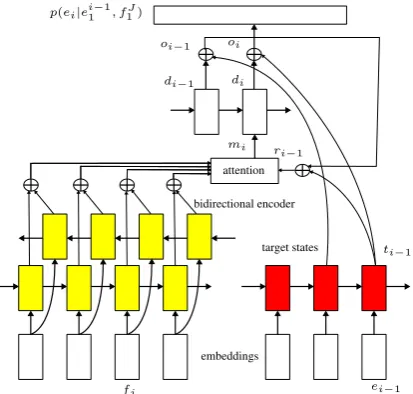
Figure 1: Attention model architecture.
architecture is illustrated in Fig. (1). We use long short-term memory (LSTM) recurrent layers throughout this work (Hochreiter and Schmidhu-ber,1997;Gers et al.,2000,2003). We include a bidirectional encoder where we sum the forward and backward source state representations:
− →
hj =LSTM(−→hj−1, F fj) ←−
hj =LSTM(←h−j+1, F fj)
hj =Y←−hj +Z−→hj (2)
where Y and Z are weight matrices, F is the source word embedding matrix, and fj ∈ {0,1}|Vf|×1 is the one-hot vector of the source word at position j. |Vf|is the size of the source vocabulary. The parameterization of the re-current layer is abstracted away using the LSTM notation for simplicity. We use an LSTM layer to represent the state of the target sequence:
ti−1 =LSTM(ti−2, Eei−1) (3)
whereEis the target word embedding matrix, and ei−1 ∈ {0,1}|Ve|×1 is the one-hot vector of the
target word at position i−1. |Ve|is the size of the target vocabulary. The attention weights are normalized using the softmax function according
to the following equations:
αij =
exp(sij)
PJ
j=1exp(sij)
sij =vTtanh(W hj+M ri−1+a)
ri−1 =Roi−1+Lti−1 (4)
oi−1 =Adi−1+Bti−2
di−1 =LSTM(di−2, mi−1) (5)
mi= J
X
j=1
αijhj
where αij denotes the normalized attention weights, sij denotes the unnormalized attention scores,ri−1is the translation state computed using
the decoder state at the previous stepoi−1and the
target state ti−1 which in turn is computed using
the target wordei−1. The decoder statedi is com-puted using an LSTM over the attended source po-sitionsmi. vandaare vectors, andA,B,W,M, R, andLare weight matrices.
The final target word probability is computed as a softmax function of the decoder state oi ∈ R|Ve|×1:
p(ei =w|ei1−1, f1J) =
exp(oiw)
P|Ve|
v=1exp(oiv)
5 Alignment-Biased Attention
In order to use the attention model as an alignment-dependent lexical model, we introduce a dependence on the alignment informationbi. We modify the attention mechanism according to the following equation:
sij =vTtanh(W hj+M ri−1+a+δj,bic) (6)
wherecis a vector, andδj,biis the Kronecker delta:
δj,bi =
(
1, if j=bi 0, otherwise.
We also experiment with a bias term that in-cludes the aligned source statehbi:
sij =vTtanh(W hj +M ri−1+a+δj,biDhbi)
(7)
fj ei−1
embeddings bidirectional encoder
qi zi
ti−1
target states selection based onbi−1=j
p(∆i|bi1−1, e
i−1 1 , f
J
[image:4.595.74.283.59.257.2]1)
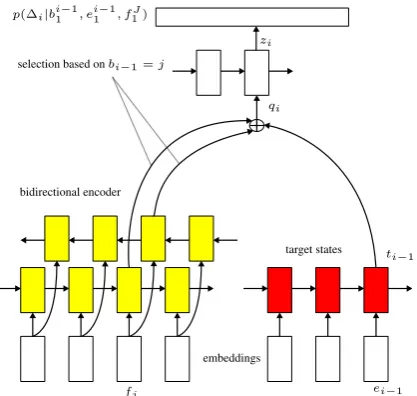
Figure 2: Bidirectional alignment model (BAM).
recurrency in Eq. (5), and the recurrent inputoi−1
that feedsri−1 in Eq. (4). In this work, however,
we stick to the richer representation and keep the full dependence on the alignment history.
If the alignment information is pre-computed, e.g. through IBM/HMM training, using it as an alignment bias might risk that the original at-tention part will learn nothing and that it be-comes completely dependent on the alignment in-formation. To alleviate this problem, we include the alignment bias term during training for some batches and drop it for others. In our experiments, we randomly include the bias term for50%of the training batches.
6 Recurrent Alignment Model
We use a recurrent alignment model to score alignments. The model architecture is shown in Fig. (2). Following (Alkhouli et al., 2016), the alignment model predicts the relative jump∆i = bi −bi−1 from the previous source position bi−1
to the current source positionbi. This model has a bidirectional source encoder consisting of two re-current layers (yellow), and a rere-current layer main-taining the target state (red). The most recent tar-get state computed including wordei−1 is paired
with the source states at positionbi−1, which is a
hard alignment obtained externally and not com-puted by the model. We pair the source statehj at positionj =bi−1with the target stateti−1at
posi-tioni−1to predict the jump∆ito the next source
positionbiaccording to the following equations:
qi=U ti−1+hbi−1
zi=LSTM(zi−1, qi) (8)
whereUis a weight matrix,qiis the paired source and target states, andzi is the decoder state used to predict the jump frombi−1tobi.hbi−1 andti−1 are defined in Eq. (2), and Eq. (3), respectively. Removing the recurrency in Eq. (8) results in a first-order model over the alignment sequence.
7 Training
In this work, we train the attention and the align-ment model separately. We obtain the alignalign-ments using IBM/HMM training. While this breaks up the simplicity of end-to-end training of attention models, we want to note that this is not central to the proposed approach. Integrated training using the sum instead of the maximum approximation in Eq. (1) can be performed using the Baum-Welch algorithm similar to (Yu et al.,2017;Wang et al.,
2017), but the models need to give up the recur-rency over the alignment information. Alterna-tively, the maximum approximation can be used to find the Viterbi alignments without changing the models, where training proceeds by alternat-ing between alignalternat-ing the trainalternat-ing data and model estimation. In this work, however, we focus on the modeling aspect and leave integrated training to future work.
8 Alignment-Based Decoding
Similar to (Alkhouli et al.,2016), we combine the lexical and alignment neural models in a beam-based decoder. Since the models depend on the alignment information, we also have to hypothe-size alignments during decoding. In training, we assume that each target position is aligned to ex-actly one source position. During decoding, we hypothesize all source positions for each target po-sition. We assign the models separate weights and obtain the best translation as follows:
eI1ˆ= arg max
I,eI
1
( 1 ImaxbI
1
( I
X
i=1
λlogp(ei|bi1, ei1−1, f1J)
+(1−λ) logp(∆i|b1i−1, ei1−1, f1J)
oo (9)
WMT 2016 WMT 2017
English Romanian German English
Sentences 604K 3.55M
Running Words 15.5M 15.8M 85M 86M
Vocabulary 92.3K 128.3K 671K 587K
[image:5.595.127.472.62.146.2]Neural Network Vocabulary 56.1K 80.9K 188K 131K
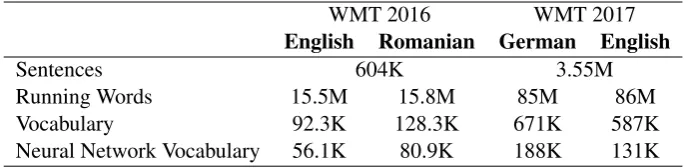
Table 1: Corpora and NN statistics.
9 Experiments
9.1 Setup
This section presents experiments on two WMT shared translation tasks: the 2016 English→Romanian task1 and the 2017
German→English task.2 The corpora
statis-tics are shown in Tab. (1). We use the full bilingual data of the English→Romanian task. For the German→English task, we choose the common crawl, news commentary and European parliament bilingual data. The data is filtered by removing sentences longer than 100 words. We also remove sentences where five or more consecutive source words are unaligned according to IBM1/HMM/IBM4 training. This is to remove noisy sentence pairs that are frequent in the common crawl corpus. We do not use any kind of synthetic or back-translated data in this work.
We reduce the vocabulary size by replac-ing sreplac-ingletons with the unknown token for both English and Romanian corpora in the English→Romanian task. Since we have more data in the German→English task, we replace words occurring less than 6times in the German corpus and less than 4 times in the English cor-pus by the unknown token. The reduced vocabu-laries are what we refer to as the neural network vocabulary in Tab. (1). To handle the large out-put vocabularies, all lexical models use a class-factored output layer, with1000singleton classes dedicated to the most frequent words, and 1000 classes shared among the rest of the words. The classes are trained using a separate tool to opti-mize the maximum likelihood training criterion with the bigram assumption. The alignment model uses a small output layer of201nodes, determined by a maximum jump length of100(forward and backward). We train using stochastic gradient de-scent and halve the learning rate when the devel-opment perplexity increases.
1http://www.statmt.org/wmt16/ 2http://www.statmt.org/wmt17/
We train feedforward models to compare to (Alkhouli et al.,2016). The models have two hid-den layers, the first has1000nodes and the second has500nodes. We use a9-word source window, and a5-gram target history. 100 nodes are used for word embeddings. The bidirectional alignment models have4LSTM layers as shown in Fig. (2). We use 200-node source and target word embed-dings and200nodes in each LSTM layer.
The attention models also use200-node LSTM layers, and 200-node source and target embed-dings. The internal dimension of the atten-tion component is also set to 200 nodes, i.e. v, a, c∈ R200×1.
Each model is trained on 4-12 CPU cores using the Intel MKL library, and takes about 2–4 days on average to converge.
We apply attention models with alignment bias and feedforward models in decoding using a de-coder similar to that proposed in (Alkhouli et al.,
2016). The decoder hypothesizes each source po-sition for every target popo-sition being translated. Beam search is applied where the search nodes consist of both lexical and alignment hypothe-ses. When the attention model is applied with-out the alignment bias term, the decoder simpli-fies to hypothesizing lexical translations only. To speed up decoding of long sentences, we limit alignment hypotheses to the source positionsj ∈ {i−20, ..., i+ 20}, whereiis the current target position being translated. We use a beam size of 16in all experiments. The alignments used during training are a result of IBM1/HMM/IBM4 training using GIZA++ (Och and Ney,2003).
These same datasets are used to halve the learning rate during model training.
All translation experiments are performed us-ing an extension of theJane toolkit (Vilar et al.,
2010; Wuebker et al., 2012). The neural net-works are trained using an extension of therwthlm
toolkit (Sundermeyer et al.,2014b). All results are measured in case-insensitive BLEU[%] (Papineni
et al.,2002) using mtevalfrom the Mosestoolkit (Koehn et al., 2007). Case-insensitive TER [%] scores are computed withTERCom(Snover et al.,
2006). Word classes are trained using an in-house tool (Botros et al.,2015) similar tomkcls.
9.2 Results
We compare our proposed system to three baseline systems on the WMT 2016 English→Romanian task and the WMT 2017 German→English task. The results are shown in Tab. (2). We set up a baseline system using a feedforward lexical model and a feedforward alignment model, to compare to the models used in (Alkhouli et al.,2016). This is shown in row 1. We first check the effect of us-ing a recurrent alignment model (row 2) instead of the feedforward model. This brings an improve-ment of up to1.6%BLEU. The attention baseline (row 3) performs much better in comparison, scor-ing up to3.1%BLEUbetter than the feedforward system. This model has no alignment bias com-ponent. We note here that the German→English training data size is about5.7times more than that of the English→Romanian task, which can explain the small gap in performance between the systems in row 2 and row 3 on the German→English task, as the feeforward networks have large hidden lay-ers of 1000 and 500 nodes, while the recurrent models use hidden layers of size200.
We train an attention model by adding the align-ment bias term in Eq. (6). We bias the attention model randomly during training for 50% of the training batches. During decoding, we include a bidirectional alignment model to score the align-ment hypotheses (rows 4, 5). The combination of the alignment-biased attention model and the bidi-rectional alignment model (row 4) outperforms the standard attention model (row 3). This shows that the model learns to use the alignment information. We also compare to adding source alignment bias as given by Eq. (7) (row 5). We observe no differ-ence to the case of constant alignment bias (row 4) on these tasks. Overall, we improve BLEU by
1.7% and 1.1% on the English→Romanian and the German→English task, respectively.
9.3 Alignment Model
In Tab. (3), we analyze the effect of the alignment model on the system. We observe that if the align-ment model is dropped, the attention model is un-able to score the alignments hypothesized during decoding on its own (row 4). If we drop the align-ment model in decoding, we also have to exclude the alignment bias term when computing attention weights during decoding (row 3) (the bias term is still included in training). In this case, the transla-tion degrades to the baseline performance.
9.4 Block out
In Tab. (3) we also investigate the effect of block out. On the English→Romanian task which has less training data in comparison to German→English, we observe that block out helps improve the system (row 2 vs. 5). This is because it avoids overfitting the alignment infor-mation, allowing the attention component to learn to attend on its own. This can be verified when comparing row 3 to row 6: When block out is used in training, and the attention model is used afterwards in decoding alone without an alignment model, it is able to perform close to the baseline at-tention performance if block out is used. Without using block out, the model fails to attend to the source side properly on its own.
9.5 Alignment Quality
WMT En→Ro WMT De→En newstest2016 newstest2017 lexical alignment bias
# model model term BLEU[%]
TER[%]
BLEU[%]
TER[%] 1 feedforward feedforward - 20.0 64.2 24.2 58.6 2 feedforward bidirectional - 21.6 62.7 25.5 57.6
3 attention - - 23.1 60.6 25.7 57.6
4 attention bidirectional δj,bic 24.8 58.1 26.8 55.6 5 attention bidirectional δj,biD hbi 24.8 58.1 26.8 55.5
Table 2: Translation results on the WMT 2016 English→Romanian task and the WMT 2017 German→English task.
WMT En→Ro WMT De→En newstest2016 newstest2017 lexical alignment decode w/ train w/
# model model align bias block out BLEU[%]
TER[%]
BLEU[%]
TER[%]
1 attention baseline - - - 23.1 60.6 25.7 57.6
2
+ alignment bias
bidirectional yes
yes 24.8 58.1 26.8 55.6
3 - no 23.1 60.6 25.7 59.4
4 - yes degenerate degenerate
5 bidirectional yes no 23.7 59.2 26.7 55.8
[image:7.595.131.469.62.193.2]6 - no degenerate degenerate
Table 3: The effect of using the alignment model in decoding and block out in training . The alignment bias term used here isδj,bic. Rows 1 and 2 are the same as rows 3 and 4 in Tab. (2). Block out means including the alignment bias term for50%of the training batches.
newstest2017 Europarl BLEU[%]
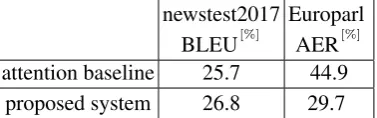
AER[%] attention baseline 25.7 44.9
proposed system 26.8 29.7
Table 4: A comparison between the WMT German→English proposed system and the base-line attention system in terms of the alignment er-ror rate (AER). The attention baseline and the pro-posed system are the same ones shown in Tab. (2), rows 3 and 4, respectively.
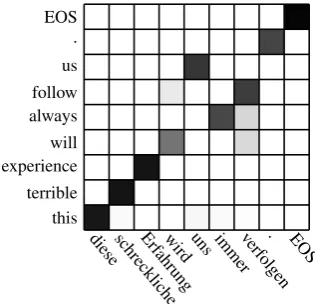
To illustrate what happens when we include the source alignment bias term, we take a sample from the translation hypotheses of the German→English system in Tab. (2, row 5), and compare it to the output of the standard attention model Tab. (2, row 3). The sample is chosen from the development setnewstest2015. The Ger-man sentence “diese schreckliche Erfahrung wird uns immer verfolgen .” has the reference transla-tion “this horrible experience will stay with us .”
In Fig. (3), we illustrate the best translation hy-pothesis and the corresponding attention weights produced by the standard attention model. Fig. (4) shows the same thing for the attention model using source alignment bias. We observe that the latter is able to generate a good translation while being able to attend to the source sentence in a proper order. On the other hand, the standard attention model has a problem in the first half of the hy-pothesis, where it attends to the second half of the source sentence instead. It ends up confusing the object and the subject. A more acceptable, though inaccurate, translation of ‘verfolgen’ under such reordering would be ‘followed by’, but the system fails to generate this translation.
[image:7.595.95.503.238.389.2] [image:7.595.88.277.457.516.2]we are always pursuing this terrible experience . EOS
dieseschrecklicheErf
[image:8.595.101.261.60.211.2]ahrungwird uns immerverfolgen. EOS
Figure 3: A translation example produced by the standard attention system in Tab. (2), row 3. EOS denotes the sentence end symbol. The shading de-gree corresponds to the attention weight.
this terrible experience will always follow us . EOS
dieseschrecklicheErf
ahrungwird uns immerverfolgen. EOS
Figure 4: A translation example produced by our best system using source alignment bias, given in Tab. (2), row 5. EOS denotes the sentence end symbol. The shading degree corresponds to the attention weight.
10 Conclusion
We presented a modification of the attention model to bias it using external alignment infor-mation. We also presented a bidirectional recur-rent neural network alignment model to be used alongside the proposed attention model. We used the two models in a generative scheme of align-ment generation followed by lexical translation. We demonstrated improvements over the standard attention model on two WMT tasks. We provided evidence that enabling the alignment bias term for all training samples makes the attention mecha-nism overfit the alignments on non-large datasets. To remedy this, we proposed to apply the align-ment bias on half of the training samples, which
22 22.5 23 23.5 24 24.5 25
0.6 0.7 0.8 0.9 59
59.5 60 60.5 61
BLEU[%] TER[%]
λ
[image:8.595.312.509.63.205.2]BLEU[%] TER[%]
Figure 5: Grid search tuning of the lexical weight of the system in Tab. (2, row 4). The re-sults are computed on the development set of the English→Romanian task.
yielded our best system.
While this work depends on pre-computed alignments to train the attention and alignment models, this is not central to our approach. In future work, we plan to perform integrated train-ing by alternattrain-ing between alignment generation and model estimation. Alignment generation can be performed using forced alignment where beam search is performed over the alignment positions, while fixing the lexical translations to the refer-ence translation. This can eliminate the need for pre-computing alignments using ad hoc methods like IBM1/ HMM/IBM4 training.
Acknowledgements
The work reported in this paper results from two projects, SEQCLAS and QT21. SEQCLAS has received funding from the European Research Council (ERC) under the European Union’s Horizon 2020 research and innovation programme under grant agree-ment no 694537. QT21 has received funding
from the European Union’s Horizon 2020 research and innovation programme under grant agreement no 645452. The work reflects only the authors’
views and neither the European Commission nor the European Research Council Executive Agency are responsible for any use that may be made of the information it contains.
[image:8.595.100.258.296.448.2]The authors would like to thank Kazuki Irie for contributing to the attention layer implementation.
References
Tamer Alkhouli, Gabriel Bretschner, Jan-Thorsten Pe-ter, Mohammed Hethnawi, Andreas Guta, and Her-mann Ney. 2016. Alignment-based neural machine translation. InProceedings of the First Conference on Machine Translation, pages 54–65, Berlin, Ger-many.
Philip Arthur, Graham Neubig, and Satoshi Nakamura. 2016. Incorporating discrete translation lexicons into neural machine translation. InProceedings of the 2016 Conference on Empirical Methods in Natu-ral Language Processing, pages 1557–1567, Austin, Texas.
Dzmitry Bahdanau, Kyunghyun Cho, and Yoshua Ben-gio. 2015. Neural machine translation by jointly learning to align and translate. InInternational Con-ference on Learning Representations, San Diego, Calefornia, USA.
Rami Botros, Kazuki Irie, Martin Sundermeyer, and Hermann Ney. 2015. On efficient training of word classes and their application to recurrent neural net-work language models. InInterspeech, pages 1443– 1447, Dresden, Germany.
Wenhu Chen, Evgeny Matusov, Shahram Khadivi, and Jan-Thorsten Peter. 2016. Guided alignment train-ing for topic-aware neural machine translation. In Proceedings of the 2016 Conference of the Asso-ciation for Machine Translation in the Americas (AMTA), pages 121–134, Austin, Texas.
Trevor Cohn, Cong Duy Vu Hoang, Ekaterina Vy-molova, Kaisheng Yao, Chris Dyer, and Gholamreza Haffari. 2016. Incorporating structural alignment biases into an attentional neural translation model. InProceedings of the 2016 Conference of the North American Chapter of the Association for Computa-tional Linguistics: Human Language Technologies, pages 876–885, San Diego, California.
Jacob Devlin, Rabih Zbib, Zhongqiang Huang, Thomas Lamar, Richard Schwartz, and John Makhoul. 2014. Fast and Robust Neural Network Joint Models for Statistical Machine Translation. In 52nd Annual Meeting of the Association for Computational Lin-guistics, pages 1370–1380, Baltimore, MD, USA.
Felix A. Gers, J¨urgen Schmidhuber, and Fred Cum-mins. 2000. Learning to forget: Continual prediction with LSTM. Neural computation, 12(10):2451–2471.
Felix A. Gers, Nicol N. Schraudolph, and J¨urgen Schmidhuber. 2003. Learning precise timing with lstm recurrent networks. The Journal of Machine Learning Research, 3:115–143.
Sepp Hochreiter and J¨urgen Schmidhuber. 1997. Long short-term memory. Neural computation, 9(8):1735–1780.
Philipp Koehn, Hieu Hoang, Alexandra Birch, Chris Callison-Burch, Marcello Federico, Nicola Bertoldi, Brooke Cowan, Wade Shen, Christine Moran, Richard Zens, Chris Dyer, Ondˇrej Bojar, Alexandra Constantine, and Evan Herbst. 2007. Moses: Open Source Toolkit for Statistical Machine Translation. pages 177–180, Prague, Czech Republic.
Haitao Mi, Zhiguo Wang, and Abe Ittycheriah. 2016.
Supervised attentions for neural machine translation. In Proceedings of the 2016 Conference on Empiri-cal Methods in Natural Language Processing, pages 2283–2288, Austin, Texas.
Franz J. Och and Hermann Ney. 2003. A Systematic Comparison of Various Statistical Alignment Mod-els. Computational Linguistics, 29(1):19–51.
Kishore Papineni, Salim Roukos, Todd Ward, and Wei-Jing Zhu. 2002. Bleu: a Method for Automatic Evaluation of Machine Translation. In Proceed-ings of the 41st Annual Meeting of the Associa-tion for ComputaAssocia-tional Linguistics, pages 311–318, Philadelphia, Pennsylvania, USA.
Matthew Snover, Bonnie Dorr, Richard Schwartz, Lin-nea Micciulla, and John Makhoul. 2006. A Study of Translation Edit Rate with Targeted Human Annota-tion. InProceedings of the 7th Conference of the As-sociation for Machine Translation in the Americas, pages 223–231, Cambridge, Massachusetts, USA.
Martin Sundermeyer, Tamer Alkhouli, Joern Wuebker, and Hermann Ney. 2014a. Translation Modeling with Bidirectional Recurrent Neural Networks. In Conference on Empirical Methods on Natural Lan-guage Processing, pages 14–25, Doha, Qatar.
Martin Sundermeyer, Ralf Schl¨uter, and Hermann Ney. 2014b. rwthlm - the RWTH Aachen university neu-ral network language modeling toolkit. In Inter-speech, pages 2093–2097, Singapore.
Akihiro Tamura, Taro Watanabe, and Eiichiro Sumita. 2014. Recurrent neural networks for word align-ment model. In52nd Annual Meeting of the Asso-ciation for Computational Linguistics, pages 1470– 1480, Baltimore, MD, USA.
David Vilar, Maja Popovi´c, and Hermann Ney. 2006. AER: Do we need to “improve” our alignments? In Proceedings of International Workshop on Spo-ken Language Translation, pages 205–212, Kyoto, Japan.
Stephan Vogel, Hermann Ney, and Christoph Tillmann. 1996. HMM-Based Word Alignment in Statistical Translation. InProceedings of the 16th conference on Computational linguistics, volume 2, pages 836– 841, Copenhagen, Denmark.
Weiyue Wang, Tamer Alkhouli, Derui Zhu, and Her-mann Ney. 2017. Hybrid neural network alignment and lexicon model in direct hmm for statistical ma-chine translation. InProceedings of the 55th Annual Meeting of the Association for Computational Lin-guistics, Vancouver, Canada.
Joern Wuebker, Matthias Huck, Stephan Peitz, Malte Nuhn, Markus Freitag, Jan-Thorsten Peter, Saab Mansour, and Hermann Ney. 2012. Jane 2: Open source phrase-based and hierarchical statistical ma-chine translation. In International Conference on Computational Linguistics, pages 483–491, Mum-bai, India.
Nan Yang, Shujie Liu, Mu Li, Ming Zhou, and Neng-hai Yu. 2013. Word alignment modeling with con-text dependent deep neural network. In51st Annual Meeting of the Association for Computational Lin-guistics, pages 166–175, Sofia, Bulgaria.
Lei Yu, Phil Blunsom, Chris Dyer, Edward Grefen-stette, and Tom´as Kocisk´y. 2017. The neural noisy channel. InProceedings of the International Conference on Learning Representations, volume abs/1611.02554.