Synchronous Bidirectional Neural Machine Translation
Long Zhou1,2, Jiajun Zhang1,2∗, Chengqing Zong1,2,3
1National Laboratory of Pattern Recognition, CASIA, Beijing, China 2University of Chinese Academy of Sciences, Beijing, China
3CAS Center for Excellence in Brain Science and Intelligence Technology, Shanghai, China
{long.zhou, jjzhang, cqzong}@nlpr.ia.ac.cn
Abstract
Existing approaches to neural machine trans-lation (NMT) generate the target language sequence token-by-token from left to right. However, this kind of unidirectional decod-ing framework cannot make full use of the target-side future contexts which can be pro-duced in a right-to-left decoding direction, and thus suffers from the issue of unbal-anced outputs. In this paper, we introduce a synchronous bidirectional–neural machine translation (SB-NMT) that predicts its outputs using left-to-right and right-to-left decoding simultaneously and interactively, in order to leverage both of the history and future in-formation at the same time. Specifically, we first propose a new algorithm that enables syn-chronous bidirectional decoding in a single model. Then, we present an interactive decod-ing model in which left-to-right (right-to-left) generation does not only depend on its pre-viously generated outputs, but also relies on future contexts predicted by right-to-left (left-to-right) decoding. We extensively evaluate the proposed SB-NMT model on large-scale NIST Chinese-English, WMT14 English-German, and WMT18 Russian-English trans-lation tasks. Experimental results demonstrate that our model achieves significant improve-ments over the strong Transformer model by 3.92, 1.49, and 1.04 BLEU points, respec-tively, and obtains the state-of-the-art
per-∗Corresponding author.
formance on Chinese-English and English-German translation tasks.1
1 Introduction
Neural machine translation has significantly im-proved the quality of machine translation in recent years (Sutskever et al., 2014; Bahdanau et al., 2015; Zhang and Zong, 2015; Wu et al., 2016; Gehring et al., 2017; Vaswani et al., 2017). Recent approaches to sequence-to-sequence learning typ-ically leverage recurrence (Sutskever et al., 2014), convolution (Gehring et al., 2017), or attention (Vaswani et al., 2017) as basic building blocks.
Typically, NMT adopts the encoder-decoder architecture and generates the target translation from left to right. Despite their remarkable suc-cess, NMT models suffer from several weak-nesses (Koehn and Knowles, 2017). One of the most prominent issues is the problem of unbal-anced outputs in which the translation prefixes are better predicted than the suffixes (Liu et al., 2016). We analyze translation accuracy of the first and last 4 tokens for left-to-right (L2R) and right-to-left (R2L) directions, respectively. As shown in Table 1, the statistical results show that L2R per-forms better in the first 4 tokens, whereas R2L translates better in terms of the last 4 tokens. This problem is mainly caused by the left-to-right unidirectional decoding, which conditions each output word on previously generated out-puts only, but leaving the future information from target-side contexts unexploited during transla-tion. The future context is commonly used in reading and writing in human cognitive process 1The source code is available at https://github. com/wszlong/sb-nmt.
91
Model The first 4 tokens The last 4 tokens
L2R 40.21% 35.10%
[image:2.595.310.522.56.156.2]R2L 35.67% 39.47%
Table 1: Translation accuracy of the first 4 tokens and last 4 tokens in NIST Chinese-English translation tasks. L2R denotes left-to-right decoding and R2L means right-to-left decoding for conventional NMT.
(Xia et al., 2017), and it is crucial to avoid under-translation (Tu et al., 2016; Mi et al., 2016).
To alleviate the problems, existing studies usu-ally used independent bidirectional decoders for NMT (Liu et al., 2016; Sennrich et al., 2016a). Most of them trained two NMT models with left-to-right and right-to-left directions, respectively. Then, they translated and re-ranked candidate translations using two decoding scores together. More recently, Zhang et al. (2018) presented an asynchronous bidirectional decoding algo-rithm for NMT, which extended the conventional encoder-decoder framework by utilizing a back-ward decoder. However, these methods are more complicated than the conventional NMT frame-work because they require two NMT models or decoders. Furthermore, the L2R and R2L de-coders are independent from each other (Liu et al., 2016), or only the forward decoder can utilize information from the backward decoder (Zhang et al., 2018). It is therefore a promising direction to design a synchronous bidirectional decoding algorithm in which L2R and R2L generations can interact with each other.
Accordingly, we propose in this paper a novel framework (SB-NMT) that utilizes a single de-coder to bidirectionally generate target sentences simultaneously and interactively. As shown in Figure 1, two special labels (hl2ri and hr2li) at the beginning of the target sentence guide trans-lating from left to right or right to left, and the decoder in each direction can utilize the previ-ously generated symbols of bidirectional decod-ing when generatdecod-ing the next token. Takdecod-ing L2R decoding as an example, at each moment, the gen-eration of the target word (e.g.,y3) does not only rely on previously generated outputs (y1 andy2) of L2R decoding, but also depends on previously predicted tokens (yn and yn−1) of R2L
decod-ing. Compared with the previous related NMT models, our method has the following advan-tages: 1) We use a single model (one encoder and one decoder) to achieve the decoding with
left-Figure 1: Illustration of the decoder in the synchronous bidirectional NMT model. L2R denotes left-to-right decoding guided by the start token hl2ri and R2L means right-to-left decoding indicated by the start token hr2li. SBAtt is our proposed synchronous bi-directional attention (see § 3.2). For instance, the generation ofy3 does not only rely ony1 andy2, but
also depends onynandyn−1of R2L.
to-right and right-to-left generation, which can be processed in parallel. 2) Via the synchronous bidirectional attention model (SBAtt, §3.2), our proposed model is an end-to-end joint framework and can optimize bidirectional decoding simulta-neously. 3) Compared with two-phase decoding scheme in previous work, our decoder is faster and more compact, using one beam search algorithm.
Specifically, we make the following contribu-tions in this paper:
• We propose a synchronous bidirectional NMT model that adopts one decoder to generate outputs with left-to-right and right-to-left directions simultaneously and interac-tively. To the best of our knowledge, this is the first work to investigate the effectiveness of a single NMT model with synchronous bidirectional decoding.
• Extensive experiments on NIST Chinese-English, WMT14 English-German and WMT18 Russian-English translation tasks demon-strate that our SB-NMT model obtains significant improvements over the strong Transformer model by 3.92, 1.49, and 1.04 BLEU points, respectively. In particular, our approach separately establishes the state-of-the-art BLEU score of 51.11 and 29.21 on Chinese-English and English-German trans-lation tasks.
2 Background
[image:2.595.72.290.57.98.2]Figure 2: (left) Scaled Dot-Product Attention. (right) Multi-Head Attention.
an encoder-decoder framework, where the en-coder network first transforms an input sequence of symbols x = (x1, x2, ..., xn) to a sequence
of continues representations z = (z1, z2, ..., zn),
from which the decoder generates an output se-quencey= (y1, y2, ..., ym)one element at a time.
Particularly, relying entirely on the multi-head attention mechanism, the Transformer with beam search algorithm achieves the state-of-the-art results for machine translation.
Multi-head attentionallows the model to jointly attend to information from different representa-tion subspaces at different posirepresenta-tions. It operates on queries Q, keys K, and values V. For multi-head intra-attention of encoder or decoder, all of
Q, K, V are the output hidden-state matrices of the previous layer. For multi-head inter-attention of the decoder, Q are the hidden states of the pre-vious decoder layer, and K-V pairs come from the output(z1, z2, ..., zn)of the encoder.
Formally, multi-head attention first obtains h
different representations of (Qi, Ki, Vi).
Specif-ically, for each attention head i, we project the hidden-state matrix into distinct query, key, and value representationsQi =QWiQ,Ki =KWiK, Vi=V WiV, respectively. Then we performscaled dot-product attention for each representation, concatenate the results, and project the concate-nation with a feed-forward layer.
MultiHead(Q, K, V) =Concati(headi)WO headi=Attention(QWiQ, KWiK, V WiV)
[image:3.595.316.511.55.227.2](1) where WiQ, WiK, WiV, and WO are parameter projection matrices.
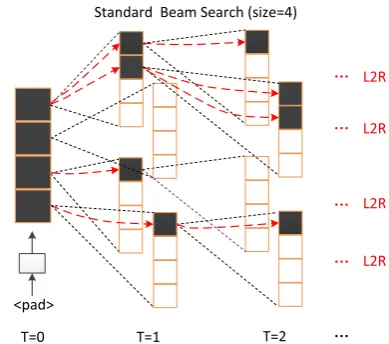
Figure 3: Illustration of the standard beam search algorithm with beam size 4. The black blocks denote the ongoing expansion of the hypotheses.
Scaled dot-product attentioncan be described as mapping a query and a set of key-value pairs to an output. Specifically, we can then multiply queryQi by keyKi to obtain an attention weight
matrix, which is then multiplied by value Vi
for each token to obtain the self-attention token representation. As shown in Figure 2, scaled dot-product attention operates on a queryQ, a keyK, and a valueV as:
Attention(Q, K, V) =Softmax
QKT
√
dk
V (2)
wheredkis the dimension of the key. For the sake
of brevity, we refer the reader to Vaswani et al. (2017) for more details.
Standard Beam Search Given the trained model and input sentence x, we usually employ beam search or greedy search (beam size = 1) to find the best translationyb= argmaxyP(y|x). Beam size N is used to control the search space by extending only the top-N hypotheses in the current stack. As shown in Figure 3, the blocks represent the four best token expansions of the previous states, and these token expansions are sorted top-to-bottom from most probable to least probable. We define a complete hypothesis as a hypothesis which outputs EOS, where EOS is a special target token indicating the end of sentence. With the above settings, the translation
yis generated token-by-token from left to right. 3 Our Approach
[image:3.595.81.287.56.198.2]design a synchronous bidirectional beam search algorithm (§3.1) which generates tokens with both L2R and R2L decoding simultaneously and interactively using a single model. The central module is the synchronous bidirectional atten-tion (SBAtt, see §3.2). By using SBAtt, the two decoding directions in one beam search process can help and interact with each other, and can make full use of the target-side history and future information during translation. Then, we apply our proposed SBAtt to replace the multi-head intra-attention in the decoder part of Transformer model (§3.3), and the model is trained end-to-end by maximum likelihood using stochastic gradient descent (§3.4).
3.1 Synchronous Bidirectional Beam Search
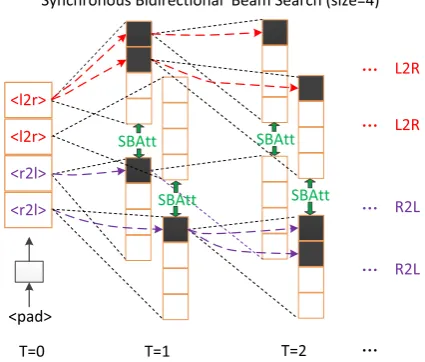
Figure 4 illustrates the synchronous bidirectional beam search process with beam size 4. With two special start tokens which are optimized during the training process, we let half of the beam keep decoding from left to right guided by the label hl2ri, and allow the other half beam to decode from right to left, indicated by the label hr2li. More importantly, via the proposed SBAtt
(§3.2) model, L2R (R2L) generation does not only depend on its previously generated outputs, but also relies on future contexts predicted by R2L (L2R) decoding.
Note that (1) at each time step, we choose the best items of the half beam from L2R decoding and the best items of the half beam from R2L decoding to continue expanding simultaneously; (2) L2R and R2L beams should be thought of as parallel, with SBAttcomputed between items of 1-best L2R and R2L, items of 2-best L2R and R2L, and so on2; (3) the black blocks denote the ongoing expansion of the hypotheses, and decoding terminates when the end-of-sentence flag EOS is predicted; (4) in our decoding algorithm, the complete hypotheses will not participate in subsequent SBAtt, and the L2R hypothesis attended by R2L decoding may change at different time steps, while the ongoing partial hypotheses in both directions of SBAtt always share the same length; (5) finally, we output the
[image:4.595.310.523.62.243.2]2We also did experiments in which all of L2R hypotheses attend to the 1-best R2L hypothesis, and all the R2L hypotheses attend to the 1-best L2R hypothesis. The results of the two schemes are similar. For the sake of simplicity, we employed the previous scheme.
Figure 4: The synchronous bidirectional decoding of our model.hl2riandhr2liare two special labels, which indicate the target-side translation direction in L2R and R2L modes, respectively. Our model can decode with both L2R and R2L directions in one beam search by using SBAtt, simultaneously and interactively. SBAtt means the synchronous bidirectional attention (§3.2) performed between items of L2R and R2L decoding.
translation result with highest probability from all complete hypotheses. Intuitively, our model is able to choose from L2R output or R2L out-put as final hypothesis according to their model probabilities, and if an R2L hypothesis wins, we reverse the tokens before presenting it.
3.2 Synchronous Bidirectional Attention
Instead of multi-head intra-attention which pre-vents future information flow in the decoder to preserve the auto-regressive property, we propose a synchronous bidirectional attention (SBAtt) mechanism. With the two key modules of syn-chronous bidirectional dot-product attention (§3.2.1) and synchronous bidirectional multi-head atten-tion (§3.2.2), SBAtt is capable of capturing and combining the information generated by L2R and R2L decoding.
3.2.1 Synchronous Bidirectional Dot-Product Attention
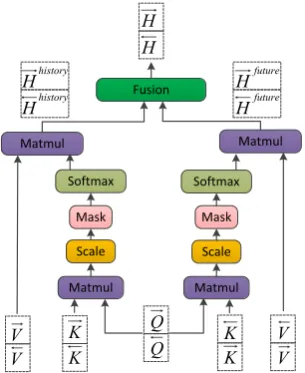
Figure 5 shows our particular attention Syn-chronous Bidirectional Dot-Product Attention (SBDPA). The input consists of queries ([−→Q;←Q−]), keys ([−→K;←K−]), and values ([−→V;←V−]) which are all concatenated by forward (L2R) states and backward (R2L) states. The new forward state −
→
Figure 5: Synchronous bidirectional attention model based on scaled dot-product attention. It operates on forward (L2R) and backward (R2L) queries Q, keys K, values V.
synchronous bidirectional dot-product attention. For the new forward state −→H, it can be calcu-lated as:
− →
Hhistory=Attention(−→Q ,−→K ,−→V)
− →
Hf uture =Attention(−→Q ,←K ,− ←V−)
− →
H =Fusion(−→Hhistory,−→Hf uture)
(3)
where −→Hhistory is obtained by using conven-tional scaled dot-product attention as introduced in Equation 2, and its purpose is to take ad-vantage of previously generated tokens, namely
history information. We calculate−→Hf utureusing forward query (−→Q) and backward key-value pairs (←K−,←V−), which attempts at making use offuture informationfrom R2L decoding as effectively as possible in order to help predict the current to-ken in L2R decoding. The role of Fusion(·)(green block in Figure 5) is to combine −→Hhistory and −
→
Hf uture by using linear interpolation, nonlinear interpolation, or gate mechanism.
Linear Interpolation −→Hhistory and −→Hf uture
have different importance to prediction of cur-rent word. Linear interpolation of −→Hhistory and −
→
Hf utureproduces an overall hidden state: −
→
H =−→Hhistory+λ∗−→Hf uture (4)
where λ is a hyper-parameter decided by the performance on development set.3
Nonlinear Interpolation −→His equal to−→Hhistory
in the conventional attention mechanism, and −
→
Hf uturemeans the attention information between current hidden state and generated hidden states of the other decoding. In order to distinguish two different information sources, we present a nonlinear interpolation by adding an activation function to the backward hidden states:
− →
H =−→Hhistory+λ∗AF(−→Hf uture) (5) where AF denotes activation function, such as
tanhorrelu.
Gate Mechanism We also propose a gate mech-anism to dynamically control the amount of information flow from the forward and backward contexts. Specifically, we apply a feed-forward gating layer upon−→Hhistoryas well as−→Hf utureto enrich the nonlinear expressiveness of our model:
rt, zt=σ(Wg[ − →
Hhistory;−→Hf uture])
− →
H =rt − →
Hhistory+zt − →
Hf uture
(6)
wheredenotes element-wise multiplication. Via this gating layer, it is able to control how much past information can be preserved from previous context and how much reversed information can be captured from backward hidden states.
Similar to the calculation of forward hidden states−→Hi, the backward hidden states
←−
Hi can be
computed as follows. ←−
Hhistory=Attention(←Q ,− ←K ,− ←V−)
←−
Hf uture=Attention(←Q ,− −→K ,−→V)
←−
H =Fusion(←H−history,←H−f uture)
(7)
where Fusion(·) is the same as introduced in Equations 4–6. Note that −→H and ←H− can be cal-culated in parallel. We refer to the whole proce-dure formulated in Equation 3 and Equation 7 as SBDPA(·).
[−→H;←H−] =SBDPA([←Q−;−→Q],[←K−;−→K],[←V−;−→V])
3.2.2 Synchronous Bidirectional Multi-Head Attention
Multi-head attention consists of h attention heads, each of which learns a distinct attention function to attend to all of the tokens in the sequence, where mask is used for preventing leftward information flow in decoder. Compared with the multi-head attention, our inputs are the concatenation of forward and backward hidden states. We extend standard multi-headed attention by letting each head attend to both forward and backward hidden states, combined via SBDPA(·):
MultiHead([←Q−;−→Q],[←K−;−→K],[←V−;−→V]) =Concat([−→H1;
←−
H1], ...,[ − →
Hh; ←−
Hh])WO
(9)
and[−→Hi; ←−
Hi]can be computed as follows, which
is the biggest difference from conventional multi-head attention:
[−→Hi; ←−
Hi] =SBDPA([ ←−
Q;−→Q]WiQ,
[←K−;−→K]WiK,[←V−;−→V]WiV)
(10)
whereWiQ,WiK,WiV andWOare parameter pro-jection matrices, which are the same as standard multi-head attention introduced in Equation 1.
3.3 Integrating Synchronous Bidirectional Attention into NMT
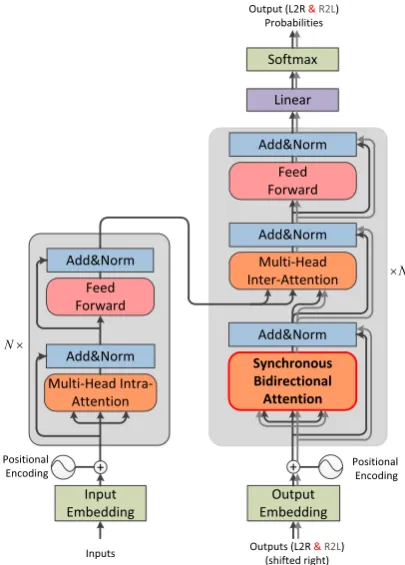
We apply our synchronous bidirectional attention to replace the multi-head intra-attention in the decoder, as illustrated in Figure 6. The neural encoder of our model is identical to that of the standard Transformer model. From the source tokens, learned embeddings are generated which are then modified by an additive positional encoding. The encoded word embeddings are then used as input to the encoder which consists of N blocks each containing two layers: (1) a multi-head attention layer (MHAtt), and (2) a position-wise feed-forward layer (FFN).
The bidirectional decoder of our model is extended from the standard Transformer decoder. For each layer in the bidirectional decoder, the lowest sub-layer is our proposed synchronous bidirectional attention network, and it also uses residual connections around each of the sublayers, followed by layer normalization:
sld=LayerNorm(sl−1+SBAtt(sl−1, sl−1, sl−1))
[image:6.595.313.516.56.339.2](11)
Figure 6: The new Transformer architecture with the proposed synchronous bidirectional multi-head atten-tion network, namely SBAtt. The input of decoder is concatenation of forward (L2R) sequence and back-ward (R2L) sequence. Note that all bidirectional information flow in decoder runs in parallel and only interacts in synchronous bidirectional attention layer.
where l denotes layer depth, and subscript d
means the decoder-informed intra-attention rep-resentation. SBAtt is our proposed synchronous bidirectional attention, and sl−1 is equal to
[−→sl−1;←−sl−1] containing forward and backward hidden states. In addition, the decoder stacks an-other two sub-layers to seek translation-relevant source semantics to bridge the gap between the source and target language:
sle =LayerNorm(sld+MHAtt(sld, hN, hN))
sl =LayerNorm(sle+FFN(sle))
(12) where MHAtt denotes the multi-head attention in-troduced in Equation 1, and we use eto denote the encoder-informed inter-attention representa-tion;hN is the source top layer hidden state, and FFN means feed-forward networks.
namely the final hidden states of forward and backward decoding:
p(−→y j|−→y <j,←−y< j, x, θ) =Softmax(−→sNW) p(←−yj|←−y<j,→−y< j, x, θ) =Softmax(←−sNW)
(13) where θ is shared weight for L2R and R2L de-coding, andW is the weight matrix.
3.4 Training
We design a simple yet effective strategy to enable synchronous bidirectional translation within a decoder. We separately add the special labels (hl2ri and hr2li) at the beginning of target sentence (−→y and←−y) to guide translating from left to right or right to left. Given a set of training examples {x(z), y(z)}Z
z=1, the training algorithm aims to find the model parameters that maximize the likelihood of the training data:
J(θ) = 1
Z Z
X
z=1
M
X
j=1
{log p(−→y(jz)|−→y<j(z),←−y(<jz), x(z),
θ) + log p(←−y(jz)|←−y<j(z),−→y(<jz), x(z), θ)} (14) Similar to asynchronous bidirectional decod-ing (Zhang et al., 2018) and bidirectional lan-guage models in BERT (Devlin et al., 2018), the proposed SB-NMT model also faces the same training problem: the bidirectional decoding would allow the words (the second half of the de-coding sequence) to indirectly “see themselves” from the other decoding direction. To ensure con-sistency between model training and testing, we construct pseudo references ←−yp (−→y p) for gold −
→y
g (←−yg). More specifically, we first train an
L2R model using (x, −→y g) and an R2L model
using (x, ←−yg). Then we use the two models to
translate source sentences x into pseudo target sentences −→yp and ←−yp, respectively. Finally, we
get two triples (x,−→y p,←−yg) and (x,−→y g,←−yp) as
our training data.
Once the proposed model is trained, we employ the bidirectional beam search algorithm to predict the target sequence, as illustrated in Figure 4. Compared with previous work that usually adopts a two-phase scheme to translate input sentences (Liu et al., 2016; Sennrich et al., 2017; Zhang et al., 2018), our decoding approach is more compact and effective.
4 Experiments
We evaluate the proposed model on three transla-tion datasets with different sizes, including NIST Chinese-English, WMT14 English-German, and WMT18 Russian-English translations.
4.1 Datasets
For Chinese-English, our training data includes about 2.0 million sentence pairs extracted from the LDC corpus.4We use the NIST 2002 (MT02) Chinese-English dataset as the validation set and NIST 2003-2006 (MT03-06) as our test sets. We use BPE (Sennrich et al., 2016b) to encode Chinese and English, respectively. We learn 30K merge operations and limit the source and target vocabularies to the most frequent 30K tokens.
For English-German translation, the training set consists of about 4.5 million bilingual sentence pairs from WMT 2014.5 We use newstest2013 as the validation set and newstest2014 as the test set. Sentences are encoded using BPE, which has a shared vocabulary of about 37,000 tokens. To evaluate the models, we compute the BLEU metric (Papineni et al., 2002) on tokenized, true-case output.6
For Russian-English translation, we use the following resources from the WMT parallel data7: ParaCrawl corpus, Common Crawl corpus, News Commentary v13, and Yandex Corpus. We do not use Wiki Headlines and UN Parallel Corpus V1.0. The training corpus consists of 14M sentence pairs. We employ the Moses Tokenizer8 for pre-processing. For subword segmentation, we use 50,000 joint BPE operations and choose the most frequent 52,000 tokens as vocabularies. We use newstest2017 as the development set and the newtest2018 as the test set.
4The corpora includes LDC2000T50, LDC2002T01, LDC2002E18, LDC2003E07, LDC2003E14, LDC2003T17, and LDC2004T07. Following previous work, we also use case-insensitive tokenized BLEU to evaluate Chinese-English which have been segmented by Stanford word segmentation and Moses Tokenizer, respectively.
5
http://www.statmt.org/wmt14/translation-task.html. All preprocessed datasets and vocab can be directly download in tensor2tensor website https://drive.google.com/ open?id=0B_bZck-ksdkpM25jRUN2X2UxMm8.
6This procedure is used in the literature to which we compare (Wu et al., 2016; Gehring et al., 2017; Vaswani et al., 2017).
4.2 Setting
We build the described models by modifying the tensor2tensor9toolkit for training and evaluating. For our bidirectional Transformer model, we em-ploy the Adam optimizer with β1 = 0.9, β2 =
0.998, and = 10−9. We use the same warmup and decay strategy for learning rate as Vaswani et al. (2017), with 16,000 warmup steps. During training, we employ label smoothing of value
ls= 0.1. For evaluation, we use beam search with
a beam size ofk= 4. For SB-NMT, we use two L2R and R2L hypotheses, respectively, and length penaltyα= 0.6. Additionally, we use 6 encoder and decoder layers, hidden size dmodel= 1,024,
16 attention heads, 4,096 feedforward inner-layer dimensions, and Pdropout = 0.1. Our settings
are close to transformer_big setting as defined in Vaswani et al. (2017). We employ three Titan Xp GPUs to train English-German and Russian-English translation, and one GPU for Chinese-English translation pairs. In addition, we use a single model obtained by averaging the last 20 checkpoints for English-German and Russian-English and do not perform checkpoint averaging for Chinese-English.
4.3 Baselines
We compare the proposed model against the fol-lowing state-of-the-art statistical machine transla-tion (SMT) and NMT systems10:
• Moses: an open source phrase-based SMT system with default configuration and a 4-gram language model trained on the target portion of training data.
• RNMT(Luong et al., 2015): it is a state-of-the-art RNN-based NMT system with default setting.
• Transformer: it has obtained the state-of-the-art performance on machine translation, which predicts target sentence from left to right relying on self-attention (Vaswani et al., 2017).
• Transformer (R2L): it is a variant of Transformer that generates translation in a right-to-left direction.
9https://github.com/tensorflow/tensor2tensor.
10For fair comparison, Rerank-NMT and ABD-NMT are based on strong Transformer models.
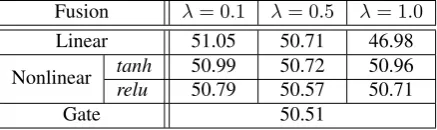
Fusion λ= 0.1 λ= 0.5 λ= 1.0
Linear 51.05 50.71 46.98
Nonlinear tanh 50.99 50.72 50.96
relu 50.79 50.57 50.71
[image:8.595.308.527.57.122.2]Gate 50.51
Table 2: Experiment results on the development set using different fusion mechanism with differentλs.
• Rerank-NMT: Via exploring the agreement on left-to-right and right-to-left NMT models (Liu et al., 2016; Sennrich et al., 2016a), first run beam search for forward and reverse models independently to obtain two k-best lists, and then re-score the union of two k-best lists (k= 10in our experiments) using the joint model (adding logprobs) to find the best candidate.
• ABD-NMT: it is an asynchronous bidirec-tional decoding for NMT, which equipped the conventional attentional encoder-decoder NMT model with a backward decoder (Zhang et al., 2018). ABD-NMT adopts a two-phrase decoding scheme: (1) use back-ward decoder to generate reverse sequence states; (2) perform beam search on the for-ward decoder to find the best translation based on encoder hidden states and backward sequence states.
4.4 Results on Chinese-English Translation
Effect of Fusion Mechanism We first investigate the impact of different fusion mechanisms with different λs on the development set. As shown in Table 2, we find that linear interpolation is sensitive to parametersλ. Nonlinear interpolation, which is more robust than linear interpolation, achieves the best performance when we usetanh
with λ = 0.1. Compared with gate mechanism, nonlinear interpolation is much simpler and needs less parameters. Therefore, we will use nonlinear interpolation with tanh and λ = 0.1 for all experiments thereafter.
Model DEV MT03 MT04 M05 MT06 AVE ∆
Moses 37.85 37.47 41.20 36.41 36.03 37.78 −9.41
RNMT 42.43 42.43 44.56 41.94 40.95 42.47 −4.72
Transformer 48.12 47.63 48.32 47.51 45.31 47.19
-Transformer (R2L) 47.81 46.79 47.01 46.50 44.13 46.11 −1.08
Rerank-NMT 49.18 48.23 48.91 48.73 46.51 48.10 +0.91
ABD-NMT 48.28 49.47 48.01 48.19 47.09 48.19 +1.00
[image:9.595.73.526.56.159.2]Our Model 50.99 51.87 51.50 51.23 49.83 51.11 +3.92
Table 3: Evaluation of translation quality for Chinese-English translation tasks using case-insensitive BLEU scores. All results of our model are significantly better than Transformer and Transformer (R2L) (p<0.01).
Model TEST
GNMT‡(Wu et al., 2016) 24.61
Conv‡(Gehring et al., 2017) 25.16
AttIsAll‡(Vaswani et al., 2017) 28.40
Transformer11 27.72
Transformer (R2L) 27.13
Rerank-NMT 27.81
ABD-NMT 28.22
Our Model 29.21
Table 4: Results of WMT14 English-German transla-tion using case-sensitive BLEU. Results with ‡mark are taken from the corresponding papers.
performance. These results confirm our hypothe-sis that the two directions are mutually beneficial in bidirectional decoding. Furthermore, compared with Rerank-NMT in which two decoders are relatively independent and ABD-NMT where only the forward decoder can rely on a backward decoder, our proposed model achieves substantial improvements over them on all test sets, which in-dicates that joint modeling and optimizing with left-to-right and right-to-left decoding behaves better in leveraging bidirectional decoding.
4.5 Results on English-German Translation
We further demonstrate the effectiveness of our model in WMT14 English-German translation tasks, and we also display the performances of some competitive models including GNMT (Wu et al., 2016), Conv (Gehring et al., 2017), and AttIsAll (Vaswani et al., 2017). As shown in Table 4, our model also significantly outperforms others and gets an improvement of 1.49 more 11The BLEU scores for Transformer model are our reproduced results. Similar to footnote 7 in Chen et al. (2018), our performance is slightly lower than those reported in Vaswani et al. (2017). Additionally, we only use 3 GPUs for English-German, whereas most papers employ 8 GPUs for model training.
Model DEV TEST
Transformer 35.28 31.02
Transformer (R2L) 35.22 30.57
Our Model 36.38 32.06
Table 5: Results of WMT18 Russian-English transla-tion using case-insensitive tokenized BLEU.
BLEU points than a strong Transformer model. Moreover, our SB-NMT model establishes a state-of-the-art BLEU score of 29.21 on the WMT14 English-German translation task.
4.6 Results on Russian-English Translation
Table 5 shows the results of large-scale WMT18 Russian-English translation, and our approach still significantly outperforms the state-of-the-art Transformer model in development and test sets by 1.10 and 1.04 BLEU points, respectively. Note that the BLEU score gains of English-German and Russian-English are not as significant as that on Chinese-English. The underlying reasons, which have also been mentioned in Shen et al. (2016) and Zhang et al. (2018), are that (1) the Chinese-English datasets contain four reference translations for each source sentence while the English-German and Russian-English datasets only have a single reference; (2) English is more distantly related to Chinese than German and Russian, leading to the predominant improve-ments for Chinese-English translation when lever-aging bidirectional decoding.
4.7 Analysis
We conduct analyses on Chinese-English transla-tion to better understand our model from different perspectives.
[image:9.595.72.291.210.330.2]Speed
Model Param Train Test
Transformer 207.8M 2.07 19.97
Transformer (R2L) 207.8M 2.07 19.81
Rerank-NMT 415.6M 1.03 6.51
ABD-NMT 333.8M 1.18 7.20
[image:10.595.316.516.54.210.2]Our Model 207.8M 1.26 17.87
Table 6: Statistics of parameters, training, and testing speeds. Train denotes the number of global training steps processed per second at the same batch-size sentences; Test indicates the amount of translated sentences in 1 second.
shown in Table 6. Rerank-NMT needs to train two sets of NMT models, so its parameters are dou-bled. The parameters of ABD-NMT are 333.8M since it has two decoders containing a backward decoder and a forward decoder. Hence, our model is more compact because it only has a single encoder-decoder NMT model.
We also show the training and testing speed of our model and baselines in Table 6. During training, our model performs approximately 1.26 training steps per second, which is faster than Rerank-NMT and ABD-NMT. When it comes to decoding procedure, the decoding speed of our model is 17.87 sentences per second with batch size 50, which is two or three times faster than Rerank-NMT and ABD-NMT.
Effect of Unbalanced Outputs According to Table 1, L2R usually does well on predicting the left-side tokens of target sequences, while R2L usually performs well on the right-side tokens. Our central idea is to combine the advantage of left-to-right and right-to-left modes. To test our hypothesis, we further analyze the translation accuracy of Rerank-NMT, ABD-NMT, and our model, as shown in Figure 7. Rerank-NMT and ABD-NMT can alleviate the unbalanced output problem, but fail to improve prefix and suffix accuracies at the same time. The experimental results demonstrate that our model can balance the outputs, and gets the best translation accuracy for both the first four words and the last four words. Note that our model chooses from L2R output or R2L output as final results according to their model probabilities, and the left-to-right decoding contributes 58.6% on test set.
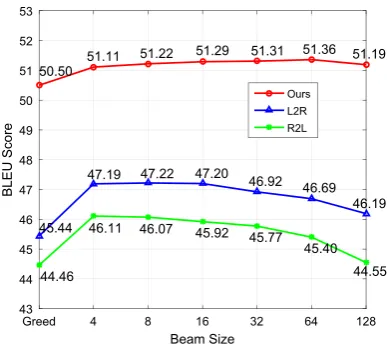
Effect of Varying Beam Size We observe that beam search decoding only improves translation quality for narrow beams and degrades translation
[image:10.595.71.292.57.148.2]Figure 7: Translation accuracy of the first and last 4 tokens for Transformer, Transformer (R2L), Rerank-NMT, ABD-Rerank-NMT, and our proposed model.
Figure 8: Translation qualities (BLEU score) of our L2R, R2L, and our SB-NMT model as beam size becomes larger12.
quality when exposed to a larger search space for L2R and R2L decoding, as illustrated in Figure 8. Additionally, the gap between greedy search and beam search is significant and can be up to about 1–2 BLEU points. Koehn and Knowles (2017) also demonstrate these phenomena in eight translation directions.
[image:10.595.319.513.269.441.2]Figure 9: Performance of translations on the test set with respect to the lengths of the source sentences.
the combined objective to model both history and future translation information.
Effect of Long Sentences A well-known flaw of NMT models is the inability to properly trans-late long sentences. We follow Bahdanau et al. (2015) by grouping sentences of similar lengths together and compute a BLEU score per group (left picture). Figure 9 shows the BLEU score and the averaged length of translations for each group (right picture). Transformer and Trans-former (R2L) perform very well on short source sentences, but degrade on long source sentences. Our model can alleviate this problem by taking advantage of both history and future information. In fact, incorporating synchronous bidirectional attention boosts translation performance on all source sentence groups.
Subjective Evaluation We follow Tu et al. (2016) by conducting a subjective evaluation to validate the benefit of the synchronous bidirec-tional decoder, as shown in Table 7. Four human evaluators are asked to evaluate the translations of 100 source sentences, which are randomly sam-pled from the test sets, without knowing which system the translation is selected from. These 100 source sentences have 2,712 words. We evaluate over- or under-translation based on the number of source words which are dropped or repeated in translation13, though we use subword (Senrich et al., 2016b) in training and inference. Trans-13For our SB-NMT model, 2 source words are over-translated and 147 source words are under-over-translated. Additionally, it is interesting to combine with better scoring methods and stopping criteria (Yang et al., 2018) to strengthen the baseline and our model in the future.
Over-Trans Under-Trans
Model Ratio ∆ Ratio ∆
L2R 0.07% - 7.85%
-R2L 0.14% - 7.81%
[image:11.595.308.524.263.325.2]-Ours 0.07% −0.00% 5.42% −30.6%
Table 7: Subjective evaluation on over-translation and under-translation for Chinese-English. Ratio denotes the percentage of source words which are over- or under-translated;∆indicates relative improvement.
former and Transformer (R2L) suffer from seri-ous under-translation problems with 7.85% and 7.81% errors. Our proposed model alleviates the under-translation problems by exploiting the com-bination of left-to-right and right-to-left decoding directions, reducing 30.6% of under-translation errors. It should be emphasized that the proposed model is especially effective for alleviating the under-translation problem, which is a more seri-ous translation problem for Transformer systems, as seen in Table 7.
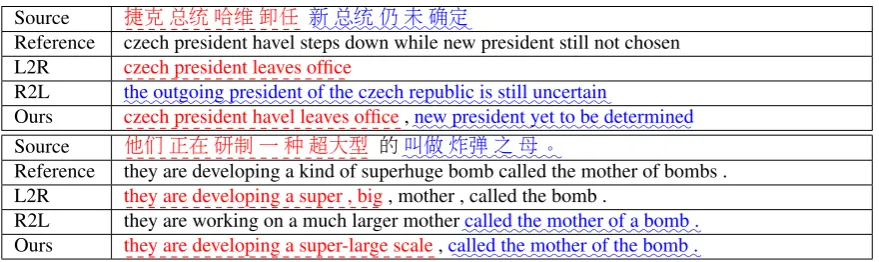
Case Study Table 8 gives three examples to show the translations of different models, in order to better understand how our model outperforms others. We find that Transformer produces trans-lations with good prefixes (red line or dotted line), whereas Transformer (R2L) generates trans-lations with better suffixes (blue line or :::::wave :::
line). Therefore, they are often unable to translate the whole sentence precisely. In contrast, the pro-posed approach can make full use of bidirectional decoding and remedy the errors in these cases. 5 Related Work
Source 捷克总统哈维卸任 新::::::总统:::仍::未:::::确定
Reference czech president havel steps down while new president still not chosen L2R czech president leaves office
R2L ::the::::::::outgoing::::::::president::of:::the:::::czech:::::::republic::is::::still::::::::uncertain
Ours czech president havel leaves office,:::new::::::::president:::yet::to:::be:::::::::determined
Source 他们正在研制一种超大型 的::::叫做:::::炸弹::之:::母::。
Reference they are developing a kind of superhuge bomb called the mother of bombs . L2R they are developing a super , big, mother , called the bomb .
R2L they are working on a much larger mother:::::called:::the::::::mother::of::a:::::bomb:.
[image:12.595.80.520.54.185.2]Ours they are developing a super-large scale,called:::::::the:::::::mother::of:::the:::::bomb:.
Table 8: Chinese-English translation examples of Transformer decoding in left-to-right and right-to-left way, and our proposed models. L2R performs well inthe first half sentence, whereas R2L translates well in::the::::::second::::half
::::::: sentence.
to future modeling and bidirectional decoding. We discuss these topics in the following.
Future Modeling Standard neural sequence decoders generate target sentences from left to right, and it has been proven to be important to establish the direct information flow between currently predicted word and previously gener-ated words (Zhou et al., 2017b; Vaswani et al., 2017). However, current methods still fail to es-timate some desired information in the future. To address this problem, reinforcement learning methods have been applied to predict future prop-erties (Li et al., 2017; Bahdanau et al., 2017; He et al., 2017). Li et al. (2018) presented a target foresight based attention which uses the POS tag as the partial information of a target foresight word to improve alignment and translation. In-spired by human cognitive behaviors, Xia et al. (2017) proposed a deliberation network, which leverages global information by observing both back and forward information in sequence decod-ing through a deliberation process. Zheng et al. (2018) introduced two additional recurrent layers to model translated past contents and untranslated future contents. The most relevant models in fu-ture modeling are twin networks (Serdyuk et al., 2018), which encourage the hidden state of the forward network to be close to that of the back-ward network used to predict the same token. However, they still used two decoders, and the backward network contributes nothing during in-ference. Along the direction of future modeling, we introduce a single synchronous bidirectional decoder, where forward decoding can be used as future information for backward decoding, and vice versa.
6 Conclusions and Future Work
In this paper, we propose a synchronous bidi-rectional NMT model that performs bidibidi-rectional decoding simultaneously and interactively. The bidirectional decoder, which can take full advan-tage of both history and future information pro-vided by bidirectional decoding states, predicts its outputs by using left-to-right and right-to-left directions at the same time. To the best of our knowledge, this is the first attempt to integrate synchronous bidirectional attention into a sin-gle NMT model. Extensive experiments demon-strate the effectiveness of our proposed model. Particularly, our model respectively establishes state-of-the-art BLEU scores of 51.11 and 29.21 on NIST Chinese-English and WMT14 English-German translation tasks. In future work, we plan to apply this framework to other tasks, such as sequence labeling, abstractive summarization, and image captioning.
Acknowledgments
We thank the anonymous reviewers as well as the Action Editor, George Foster, for insightful com-ments and suggestions. The research work has been funded by the Natural Science Foundation of China under Grant No. 61673380. This work is also supported by grants from NVIDIA NVAIL program.
References
Dzmitry Bahdanau, Philemon Brakel, Kelvin Xu, Anirudh Goyal, Ryan Lowe, Joelle Pineau, Aaron Courville, and Yoshua Bengio. 2017. An actor-critic algorithm for sequence prediction.
In Proceedings of ICLR 2017.
Dzmitry Bahdanau, Kyunghyun Cho, and Yoshua Bengio. 2015. Neural machine translation by jointly learning to align and translate. In Proceedings of ICLR 2015.
Mia Xu Chen, Orhan Firat, Ankur Bapna, Melvin Johnson, Wolfgang Macherey, George Foster, Llion Jones, Mike Schuster, Noam Shazeer, Niki Parmar, Ashish Vaswani, Jakob Uszkoreit, Lukasz Kaiser, Zhifeng Chen, Yonghui Wu, and Macduff Hughes. 2018. The best of both worlds: Combining recent advances in neu-ral machine translation. In Proceedings of the 56th Annual Meeting of the Association for
Computational Linguistics (Volume 1: Long Papers), pages 76–86. Association for Compu-tational Linguistics.
Yongchao Deng, Shanbo Cheng, Jun Lu, Kai Song, Jingang Wang, Shenglan Wu, Liang Yao, Guchun Zhang, Haibo Zhang, Pei Zhang, Changfeng Zhu, and Boxing Chen. 2018. Alibaba’s neural machine translation systems for wmt18. In Proceedings of the Third Con-ference on Machine Translation: Shared Task Papers, pages 368–376. Association for Com-putational Linguistics.
Jacob Devlin, Ming-Wei Chang, Kenton Lee, and Kristina Toutanova. 2018. Bert: Pre-training of deep bidirectional transformers for language understanding. arXiv preprint arXiv:1810.04805.
Andrew Finch and Eiichiro Sumita. 2009. Bidirectional phrase-based statistical machine translation. In Proceedings of the 2009 Con-ference on Empirical Methods in Natural Language Processing, pages 1124–1132. Asso-ciation for Computational Linguistics.
Jonas Gehring, Michael Auli, David Grangier, Denis Yarats, and Yann N. Dauphin. 2017. Convolutional sequence to sequence learning. In Proceedings of the 34th International Conference on Machine Learning, volume 70 ofProceedings of Machine Learning Research, pages 1243–1252, International Convention Centre, Sydney, Australia. PMLR.
Di He, Hanqing Lu, Yingce Xia, Tao Qin, Liwei Wang, and Tie-Yan Liu. 2017. Decoding with value networks for neural machine trans-lation. In I. Guyon, U. V. Luxburg, S. Bengio, H. Wallach, R. Fergus, S. Vishwanathan, and R. Garnett, editors, Advances in Neural Infor-mation Processing Systems 30, pages 178–187. Curran Associates, Inc.
Philipp Koehn and Rebecca Knowles. 2017. Six challenges for neural machine translation. In
Proceedings of the First Workshop on Neural Machine Translation, pages 28–39. Association for Computational Linguistics.
Jiwei Li, Will Monroe, and Dan Jurafsky. 2017. Learning to decode for future success. arXiv preprint arXiv:1701.06549.
Xintong Li, Lemao Liu, Zhaopeng Tu, Shuming Shi, and Max Meng. 2018. Target foresight based attention for neural machine translation. In Proceedings of the 2018 Conference of the North American Chapter of the Association for Computational Linguistics: Human Lan-guage Technologies, Volume 1 (Long Papers), pages 1380–1390. Association for Computa-tional Linguistics.
Lemao Liu, Masao Utiyama, Andrew Finch, and Eiichiro Sumita. 2016. Agreement on target-bidirectional neural machine translation. In
Proceedings of the 2016 Conference of the North American Chapter of the Association for Computational Linguistics: Human Language Technologies, pages 411–416. Association for Computational Linguistics.
Yuchen Liu, Long Zhou, Yining Wang, Yang Zhao, Jiajun Zhang, and Chengqing Zong. 2018. A comparable study on model averaging, ensembling and reranking in nmt. In Natural Language Processing and Chinese Computing, pages 299–308, Cham. Springer International Publishing.
Thang Luong, Hieu Pham, and Christopher D. Manning. 2015. Effective approaches to attention-based neural machine translation. In
Proceedings of the 2015 Conference on Empir-ical Methods in Natural Language Processing, pages 1412–1421. Association for Computa-tional Linguistics.
Haitao Mi, Baskaran Sankaran, Zhiguo Wang, and Abe Ittycheriah. 2016. Coverage embed-ding models for neural machine translation. In
Proceedings of the 2016 Conference on Empir-ical Methods in Natural Language Processing, pages 955–960. Association for Computational Linguistics.
Jan Niehues, Eunah Cho, Thanh-Le Ha, and Alex Waibel. 2016. Pre-translation for neural ma-chine translation. In Proceedings of COLING 2016, the 26th International Conference on Computational Linguistics: Technical Papers, pages 1828–1836. The COLING 2016 Organiz-ing Committee.
Kishore Papineni, Salim Roukos, Todd Ward, and Wei-Jing Zhu. 2002. Bleu: a method for automatic evaluation of machine translation. In Proceedings of the 40th Annual Meeting of the Association for Computational Linguistics. Rico Sennrich, Alexandra Birch, Anna Currey, Ulrich Germann, Barry Haddow, Kenneth Heafield, Antonio Valerio Miceli Barone, and Philip Williams. 2017. The university of edinburgh’s neural mt systems for wmt17. In Proceedings of the Second Conference on Machine Translation, pages 389–399. Associ-ation for ComputAssoci-ational Linguistics.
Rico Sennrich, Barry Haddow, and Alexandra Birch. 2016a. Edinburgh neural machine trans-lation systems for wmt 16. In Proceedings of the First Conference on Machine Translation: Volume 2, Shared Task Papers, pages 371–376. Association for Computational Linguistics. Rico Sennrich, Barry Haddow, and Alexandra
Birch. 2016b. Neural machine translation of rare words with subword units. InProceedings of the 54th Annual Meeting of the Association for Computational Linguistics (Volume 1: Long Papers), pages 1715–1725. Association for Computational Linguistics.
Dmitriy Serdyuk, Nan Rosemary Ke, Alessandro Sordoni, Adam Trischler, Chris Pal, and Yoshua Bengio. 2018. Twin networks: Matching the future for sequence generation. InInternational Conference on Learning Representations. Shiqi Shen, Yong Cheng, Zhongjun He, Wei
Ilya Sutskever, Oriol Vinyals, and Quoc V Le. 2014. Sequence to sequence learning with neu-ral networks. In Z. Ghahramani, M. Welling, C. Cortes, N. D. Lawrence, and K. Q. Weinberger, editors, Advances in Neural Information Pro-cessing Systems 27, pages 3104–3112. Curran Associates, Inc.
Zhixing Tan, Boli Wang, Jinming Hu, Yidong Chen, and Xiaodong Shi. 2017. Xmu neural machine translation systems for wmt 17. In
Proceedings of the Second Conference on Machine Translation, pages 400–404. Associa-tion for ComputaAssocia-tional Linguistics.
Zhaopeng Tu, Zhengdong Lu, Yang Liu, Xiaohua Liu, and Hang Li. 2016. Modeling coverage for neural machine translation. In Proceedings of the 54th Annual Meeting of the Association for Computational Linguistics (Volume 1: Long Papers), pages 76–85. Association for Computational Linguistics.
Ashish Vaswani, Noam Shazeer, Niki Parmar, Jakob Uszkoreit, Llion Jones, Aidan N Gomez, Ł ukasz Kaiser, and Illia Polosukhin. 2017. At-tention is all you need. In I. Guyon, U. V. Luxburg, S. Bengio, H. Wallach, R. Fergus, S. Vishwanathan, and R. Garnett, editors,Advances in Neural Information Processing Systems 30, pages 5998–6008. Curran Associates, Inc. Taro Watanabe and Eiichiro Sumita. 2002.
Bidi-rectional decoding for statistical machine trans-lation. In COLING 2002: The 19th International Conference on Computational Linguistics. Yonghui Wu, Mike Schuster, Zhifeng Chen,
Quoc V Le, Mohammad Norouzi, Wolfgang Macherey, Maxim Krikun, Yuan Cao, Qin Gao, Klaus Macherey, Jeff Klingner, Apurva Shah, Melvin Johnson, Xiaobing Liu, Lukasz Kaiser, Stephan Gouws, Yoshikiyo Kato, Taku Kudo, Hideto Kazawa, Keith Stevens, George Kurian, Nishant Patil, Wei Wang, Cliff Young, Jason Smith, Jason Riesa, Alex Rudnick, Oriol Vinyals, Greg Corrado, Macduff Hughes, and Jeffrey Dean. 2016. Google’s neural machine translation system: Bridging the gap between human and machine translation.arXiv preprint arXiv:1609.08144.
Yingce Xia, Fei Tian, Lijun Wu, Jianxin Lin, Tao Qin, Nenghai Yu, and Tie-Yan Liu. 2017.
Deliberation networks: Sequence generation beyond one-pass decoding. In I. Guyon, U. V. Luxburg, S. Bengio, H. Wallach, R. Fergus, S. Vishwanathan, and R. Garnett, editors,Advances in Neural Information Processing Systems 30, pages 1784–1794. Curran Associates, Inc. Yilin Yang, Liang Huang, and Mingbo Ma. 2018.
Breaking the beam search curse: A study of (re-)scoring methods and stopping criteria for neural machine translation. In Proceed-ings of the 2018 Conference on Empirical Methods in Natural Language Processing, pages 3054–3059. Association for Computa-tional Linguistics.
Hui Zhang, Kristina Toutanova, Chris Quirk, and Jianfeng Gao. 2013. Beyond left-to-right: Multiple decomposition structures for smt. In
Proceedings of the 2013 Conference of the North American Chapter of the Association for Computational Linguistics: Human Language Technologies, pages 12–21. Association for Computational Linguistics.
Jiajun Zhang and Chengqing Zong. 2015. Deep neural networks in machine translation: An over-view.IEEE Intelligent Systems, 30(5):16–25. Xiangwen Zhang, Jinsong Su, Yue Qin, Yang Liu,
Rongrong Ji, and Hongji Wang. 2018. Asyn-chronous bidirectional decoding for neural ma-chine translation.In Proceedings of AAAI 2018. Zaixiang Zheng, Hao Zhou, Shujian Huang, Lili Mou, Xinyu Dai, Jiajun Chen, and Zhaopeng Tu. 2018. Modeling past and future for neural machine translation. Transactions of the Asso-cation for Computational Linguistics, 6:145–157. Long Zhou, Wenpeng Hu, Jiajun Zhang, and
Chengqing Zong. 2017a. Neural system combi-nation for machine translation. In Proceedings of the 55th Annual Meeting of the Associa-tion for ComputaAssocia-tional Linguistics (Volume 2: Short Papers), pages 378–384. Association for Computational Linguistics.