
C
2013. The American Astronomical Society. All rights reserved. Printed in the U.S.A.
THE HOMOGENEOUS STUDY OF TRANSITING SYSTEMS (HoSTS). I. THE PILOT STUDY OF WASP-13
Yilen G ´omez Maqueo Chew1,2,3,4,13, Francesca Faedi2,3,13, Phillip Cargile1, Amanda P. Doyle5, Luan Ghezzi6,7, S´ergio Sousa8, Susana C. C. Barros9, Leslie Hebb1, Katia Cunha6,10, Simon C. Schuler10, Verne V. Smith6,10, Andrew Collier Cameron11, Don Pollacco2,3,13, Nuno C. Santos8, Barry Smalley5, and Keivan G. Stassun1,12
1Department of Physics and Astronomy, Vanderbilt University, Nashville, TN 37235, USA;[email protected] 2Department of Physics, University of Warwick, Coventry CV4 7AL, UK
3Astrophysics Research Centre, Queen’s University Belfast, University Road, Belfast BT7 1NN, UK 4Centro de Radioastronom´ıa y Astrof´ısica, UNAM, Apartado Postal 3-72, 58089 Morelia, Michoac´an, M´exico
5Astrophysics Group, Keele University, Staffordshire ST5 5BG, UK 6Observat´orio Nacional, Rua Gal. Jos´e Cristino 77, Rio de Janeiro, RJ 20921-400, Brazil
7Laborat´orio Interinstitucional de e-Astronomia—LIneA, Rua Gal. Jos´e Cristino 77, Rio de Janeiro, RJ 20921-400, Brazil 8Centro de Astrof´ısica, Universidade do Porto, Rua das Estrelas, 4150-762 Porto, Portugal
9LAM (Laboratoire d’Astrophysique de Marseille) UMR 7326, Aix Marseille Universit´e, CNRS, F-13388 Marseille, France 10Stewart Observatory, University of Arizona, Tucson, AZ 85721, USA
11School of Physics and Astronomy, University of St Andrews, St Andrews, Fife KY16 9SS, UK 12Department of Physics, Fisk University, Nashville, TN 37208, USA
Received 2013 January 7; accepted 2013 February 23; published 2013 April 17
ABSTRACT
We present the fundamental stellar and planetary properties of the transiting planetary system WASP-13 within the framework of the Homogeneous Study of Transiting Systems (HoSTS). HoSTS aims to derive the fundamental stellar (Teff, [Fe/H],M,R) and planetary (Mpl,Rpl,Teq) physical properties of known transiting planets using a
consistent methodology and homogeneous high-quality data set. Four spectral analysis techniques are independently applied to a Keck+HIRES spectrum of WASP-13 considering twodistinct cases: unconstrained parameters and constrained loggfrom transit light curves. We check the derived stellar temperature against that from a different temperature diagnostic based on an INT+IDS Hαspectrum. The four unconstrained analyses render results that are in good agreement, and provide an improvement of 50% in the precision ofTeff, and of 85% in [Fe/H] with respect to the WASP-13 discovery paper. The planetary parameters are then derived via the Monte Carlo Markov Chain modeling of the radial velocity and light curves, in iteration with stellar evolutionary models to derive realistic uncertainties. WASP-13 (1.187±0.065M; 1.574±0.048R) hosts a Saturn-mass, transiting planet (0.500± 0.037MJup; 1.407±0.052RJup), and is at the end of its main-sequence lifetime (4–5.5 Gyr). Our analysis of WASP-13 showcases that both a detailed stellar characterization and transit modeling are necessary to well determine the fundamental properties of planetary systems, which are paramount in identifying and determining empirical relationships between transiting planets and their hosts.
Key words: planetary systems – stars: fundamental parameters – stars: individual (WASP-13) – techniques: photometric – techniques: spectroscopic
Online-only material:color figures
1. INTRODUCTION
The detection and characterization of a large number of ex-trasolar planets with a variety of physical properties, in different environments and with a range of ages, is necessary for the un-derstanding of the formation and evolution of planetary systems. It is only with precise measurements of the fundamental proper-ties of the exoplanets and their host stars that the planetary bulk composition can be inferred and the planetary structure probed, and thus, we can explore the underlying physical processes in-volved in their formation and evolution.
Transit surveys, such as SuperWASP (Pollacco et al.2006), have been extremely successful in discovering planets for which measurements of their masses and radii are possible. These have revealed a large diversity of physical properties of the extrasolar planets and their host stars (see, e.g., Baraffe et al. 2010). With more than 290 transiting exoplanets confirmed to date,14 it is now possible to conduct statistical studies of planetary properties, and thus, derive more robust empirical relationships
13Part of the work was completed while at QUB. 14 Seehttp://exoplanet.eu.
between the planets and their host stars. For example, it is generally thought that in the case of hot Jupiters the planetary radius is correlated with the planet equilibrium temperature and the stellar irradiation, and anticorrelated with stellar metallicity (e.g., Santos et al.2004; Guillot et al.2006; Laughlin et al.2011; Enoch et al.2012; Faedi et al.2011; Demory & Seager2011). Buchhave et al. (2012), using recentKepler results, find that giant planets are found around metal-rich stars, while those with radii smaller than four times that of the Earth are found to orbit stars with a large range in metallicity (−0.6[Fe/H]0.5 dex). This is compatible with previous observational results (Udry & Santos 2007; Sousa et al. 2008, 2011a; Ghezzi et al. 2010), which show that Neptunian planets do not form preferentially around metal-rich stars. Moreover, Adibekyan et al. (2012a,
2012b) show that although the terrestrial planets can be found in a low-iron regime, they are mostly enhanced by alpha elements as compared to stars without detected planets showing that metals continue to be important also for the formation of these planets.
transiting planets and their host stars, aiming to minimize the effects of any systematics in the measurements due to the quality of the data and/or technique applied. Individual studies of sin-gle planetary systems make systematic uncertainties difficult to identify, and quantify. For example, Mancini et al. (2012) found HAT-P-8b to have a radius∼14% smaller than previous esti-mates (a difference larger than the quoted uncertainties), mak-ing it consistent with other transitmak-ing planet radii, and not significantly inflated. As more planets are being discovered and/or re-analyzed, the observed trends, like the anoma-lously large planetary radii, remain to be confirmed. A num-ber of recent studies employing consistent analysis proce-dures for subsets of the known stars with transiting planets have been attempted (e.g., Torres et al. 2008; Ammler-von Eiff et al.2009; Southworth 2008,2009, 2010, 2011,2012); however, these have largely employed heterogeneous spectro-scopicdata sets and adopted the stellar properties, likeTeff and [Fe/H], from the literature. Because these measurements are non-homogeneous—arising from different spectroscopic analysis techniques applied to spectra obtained with different spectrographs, different resolution, etc.—the typically quoted uncertainties of∼10% in the published stellar and planetary mass and radius likely contain currently uncharacterized sys-tematics. More recently, Torres et al. (2012) have thoroughly analyzed new and archival spectra (from different instruments, and with varied signal-to-noise ratio and resolution) of 56 tran-siting planet hosts comparing three different stellar characteri-zation methods. Torres et al. (2012) focused on the stellar hosts, deriving a new set of homogeneous spectroscopic stellar prop-erties and have been able to identify systematic errors due to the stellar characterization techniques applied. Thus, any empirical trend identified among the physical properties, like the observed inflated radii of hot Jupiters with respect to planetary models, may have to be revised.
HoSTS extends these previous studies in that the stellar host properties are derived from a homogeneous, high-quality spec-tral data set applying four stellar characterization techniques, andthat the planetary properties are also derived consistently. By means of our homogeneous spectral data set and subsequent analyses, we will be able to investigate systematic uncertain-ties on the derived stellar properuncertain-ties arising not only from the methodology, as exemplified by Torres et al. (2012), but also from the quality of the data. We will combine iteratively our results with the best available radial velocity data and transit photometry in the literature to derive a homogeneous set of properties for the transiting systems. The resulting consistent set of physical properties will allow us to further explore known correlations, e.g., core size of the planet and stellar metallicity, and to newly identify subtle relationships providing insight into our fundamental understanding of planetary formation, struc-ture, and evolution. And thus, this will allow us to reevaluate the planetary properties, of each planet alone, and with respect to different planet populations.
In this paper, we present our HoSTS pilot study of the transiting system WASP-13 which is composed of a Saturn-mass planet around an early G-type star. Section2describes both the data acquired by our team and the data from the literature utilized in our analyses. Section3describes the spectral analysis of the WASP-13 spectra implementing four different techniques in order to derive the stellar spectroscopic properties. For each of the four stellar characterization methods, we present two different cases for which stellar properties have been derived: (1) an unconstrained analysis where all parameters are left free
and (2) applying an external constraint on logg. We have used the temperature diagnostic based on Hα to verify the values derived from the stellar characterization methods, as well as the effect of fixingTeff on the other spectroscopically determined stellar properties. Then we describe the modeling of the system’s radial velocity and light curves to derive the stellar and planetary properties. In Section4, we discuss the results from our pilot study of WASP-13, and outline the future work of the HoSTS project.
2. DATA
For our analysis of the planetary system WASP-13, we have acquired new spectroscopic data described below in Sections2.1
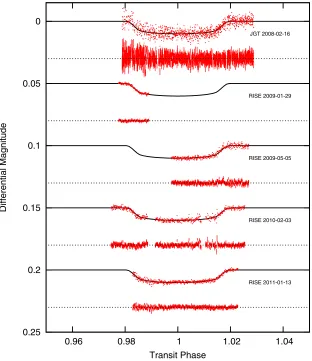
and2.2, and have utilized the data available from the literature and the SuperWASP archive. The SuperWASP light curve includes over 12,100 data points observed with the SuperWASP-North facility in La Palma, Spain (Pollacco et al. 2006) from 2006 November to 2009 April (see Figure1, left panel). These data expand the span of the SuperWASP light curve from that of the discovery paper for two additional years, and have a median photometric uncertainty of 0.006 mag. From Skillen et al. (2009), we have obtained the system’s radial velocities acquired with the SOPHIE instrument mounted on the 1.9 m telescope at the Haute Provence Observatory (see Figure 1, right panel), as well as the James Gregory Telescope (JGT) differential photometry in the R band. Additionally, we have adopted the high-cadence, high-precision light curves observed with the RISE instrument on the Liverpool Telescope published by Barros et al. (2012). All follow-up light curves are shown in Figure2.
2.1. WASP-13H αLong-slit Spectrum
For this work, we obtained a long-slit spectrum of the planet host WASP-13 around the Hαline using the Intermediate Dis-persion Spectrograph (IDS) mounted on the 2.5 m Isaac Newton Telescope at the Roque de los Muchachos Observatory in La Palma, Spain. We used the H1800V grating with the RED+2 CCD, and a 1.4 slit yielding a dispersion of 0.35 Å pixel−1and a resolution of R ∼10,000 at 6560 Å. The observations of WASP-13 and the standard calibrations, including a spectrum of Vega and Arcturus, were taken on 2012 May 8 and 9. To allow for a precise measurement of the Hαprofile, the WASP-13 spec-trum had a signal-to-noise ratio of∼500 as calculated by the IDL functionDER_SNR. The derived temperature (Section3.1) is used as an independent check on the effective temperature of WASP-13 derived from the stellar characterization methods.
2.2. WASP-13 HIRES Spectrum
We observed WASP-13 on 2011 March 14 UT with the High Resolution Echelle Spectrograph (HIRES) on Keck-I (Vogt et al.1994). We observed in the spectrograph’s “red” (HIRESr) configuration with an echelle angle of −0.◦018 and a cross-disperser angle of 0.◦737. We used the KV418 order-blocking filter and the 0.57×7.0 slit, and the chip was binned by 2 pixels in the spatial direction during readout. The resulting resolving power isR∼72,000.
-0.02
-0.01
0
0.01
0.02
0.03
0.6 0.8 1 1.2 1.4
Differential Magnitude
[image:3.612.56.563.57.230.2]Transit Phase
Figure 1.Left: SuperWASP-N light curve of transiting planetary system WASP-13. Comprising over 12,100 data points and spanning from 2006 November to 2009
April, the SuperWASP light curve is shown with gray points with the model transit light curve (see Section3.3) in black. The photometric data have been folded over the orbital period and exhibit at phase zero the characteristic dip in brightness as the Saturn-mass planet WASP-13b (Mpl=0.50±0.01MJup) passes in front of its host star, blocking part of the stellar light every 4.353 days. The median photometric uncertainty of the light curve is 0.006 mag. Right: the radial velocity measurements from the SOPHIE instrument at the Observatoire d’Haute Provence (Skillen et al.2009) are shown against the our model radial velocity curve that describes the reflex motion of WASP-13 due to the presence of the planet. The residuals to the fit are shown in the lower panel.
(A color version of this figure is available in the online journal.)
0
0.05
0.1
0.15
0.2
0.25
0.96 0.98 1 1.02 1.04
Differential Magnitude
Transit Phase
JGT 2008-02-16
RISE 2009-01-29
RISE 2009-05-05
RISE 2010-02-03
RISE 2011-01-13
Figure 2.WASP-13b follow-up transit light curves. The transit light curves of the WASP-13 system from JGT (Skillen et al.2009) and RISE (Barros et al.2012) are
shown in red points overplotted with the model light curves (in solid black lines) from our MCMC analysis (Section3.3), with their corresponding residuals including the uncertainty of the photometric data directly below (red error bars). The light curves and residuals have been shifted vertically from zero for clarity.
[image:3.612.152.464.315.676.2]these calibrations using standard IRAF15tasks and the MAKEE reduction package written for HIRES by T. Barlow. The latter includes optimal extraction of the orders as well as subtraction of the adjacent sky background. The three exposures of WASP-13 were processed separately and then median combined with cosmic-ray rejection into a single final spectrum. The signal-to-noise ratio of the final spectrum is∼300 per resolution element.
3. ANALYSIS
In this section, we describe the methods applied to our WASP-13 data set in order to derive the physical properties of the planetary system.
3.1. Determination of Teff fromH αSpectrum
This analysis is based on the Hα spectrum of WASP-13 described in Section2.1. The Balmer lines provide an excellent Teff diagnostic for stars cooler than about 8000 K due to their virtually nil gravity dependence (Gray2008). Normalization of the observations is critical, which the shape of the Balmer line must be preserved (Smith & Dworetsky1988). The extracted spectrum was normalized using a low-order polynomial fitted to the continuum regions more than 100 Å either side of Hα, in order to avoid any distortion due to the weak wings of this profile. The spectrum was then analyzed usinguclsyn with Castelli et al. (1997) ATLAS9 models with no overshooting and Hα profiles calculated using VCS theory (Vidal et al. 1973). The best-fitting Hαprofile hasTeff=5850±60 K.
However, the use of Balmer lines as temperature diagnostics is not without its difficulties due to uncertainties caused by different line broadening theories (Stehl´e & Hutcheon 1999; Barklem et al. 2000; Allard et al. 2008), the treatment of atmospheric convection (Gardiner et al. 1999; Heiter et al.
2002), and non-local thermodynamic equilibrium (LTE) effects (Barklem2007). We, therefore, also fitted the Hαprofile in the KPNO solar spectrum (Kurucz et al.1984) which gave aTeff 70±20 K lower than the direct value of 5777 K. Thus, Hα appears to underestimate stellar effective temperatures. Adding 70±20 K to the Teff derived above, it gives Teff =5920 ± 60 K for WASP-13. This was recently investigated in detail by Cayrel et al. (2011) who found similar systematic differences, and provide a correction:
Teff(direct)=20.3 + 1.014×Teff(Hα)
with an uncertainty of 31 K. Applying this correction, and adding the errors in quadrature, givesTeff =5950±70 K for WASP-13.
Both temperatures from our Hαtemperature diagnostic agree with each other, and with theTeffderived from the infrared flux method (Teff =5935±183 K; Skillen et al.2009). Moreover, they are consistent with the temperatures derived in the stellar characterization methods described below.
3.2. Stellar Characterization Analysis
We apply to the HIRES echelle spectrum (Section2.2) four different stellar characterization methods that are extensively used in the exoplanet literature. Each method is done indepen-dently from each other and is described in the subsections below
15 IRAF is distributed by the National Optical Astronomy Observatory, which
is operated by the Association of Universities for Research in Astronomy (AURA), Inc., under cooperative agreement with the National Science Foundation.
(Sections3.2.1–3.2.4). Method A is based on the technique of spectral synthesis, which compares an observed spectrum to synthetic model spectra generated for a range of stellar parame-ters. The best-fitting model (based on aχ2minimization) defines the final atmospheric parameters. The other three methods (B, C, and D) are based on the principle of excitation/ionization equilibrium of iron lines, in which equivalent width (EW) mea-surements of many lines are used to determine iron abundance, and the stellar atmospheric properties. Methods B, C, and D are each unique in their choice of line lists, model atmospheres, EW measurements, continuum normalization, and convergence criteria. Furthermore, Method B makes an absolute iron abun-dance measurement of the star, whereas the other three methods are differential analyses, and derive a stellar metallicity rela-tive to the Sun. Method A includes a careful determination of the line list parameters, i.e., excitation potential and oscillator strength, to match the spectrum of the Sun using spectral synthe-sis. Method C does a differential line-by-line analysis relative to the Sun using the same instrument setup, whereas Method D uses measured EWs and a standard solar iron abundance (e.g., 7.50±0.04; Asplund et al.2009) to derive the line properties.
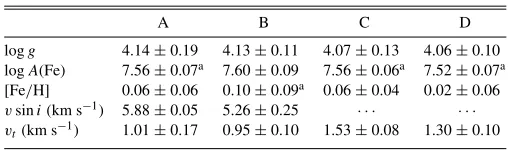
For each of the four stellar characterization methods, we present two distinct cases: (1) theunconstrainedanalysis, where Teff, logg, and [Fe/H] (andvsiniwhen appropriate) are derived freely; and (2) constraining loggfrom the mean stellar density as determined from the transit model to derive the other stellar properties. The spectroscopically determined stellar parameters derived for each case above with all four methods are shown in Table 1. Furthermore, the Teff derived using a different temperature diagnostic based on an Hα spectrum is used to check the stellar properties in Table1, as well as to explore the effect on the derived stellar spectroscopic properties by fixing Teff. The resulting spectroscopic properties are shown in Table2. Given the quality of our data, and the nuances of each of the stellar characterization methods, the preferred solution for each of the four methods is that derived through the unconstrained analysis. In the last column of Table1, we present the weighted mean of the four unconstrained solutions for each method which are used to derive the stellar mass and radius, and the planetary properties (see Section3.3). Additionally, we report two errors on the stellar properties of Table1: the first is calculated from the weighted quadrature sum of the individual internal errors, and the second is a measure of the systematic uncertainty based on standard deviation of the individual measurements. The systematic uncertainty is likely to be underestimated in the case of WASP-13 because only the four measurements from the unconstrained cases are taken into account. A more realistic systematic uncertainty will be possible once a larger HoSTS sample has been analyzed in the same consistent manner as we present in this paper.
3.2.1. Method A: SME
Method A consists on the implementation of Spectroscopy Made Easy (SME ver. 3.54; Valenti & Piskunov1996) to derive stellar parameters of WASP-13 described below. We base the general method of our SME analysis on that given in Valenti & Fischer (2005) including the grid of model atmospheres and derivation of macroturbulence; however, we use a line list, synthesized wavelength ranges, and abundance pattern adapted from Stempels et al. (2007) and Hebb et al. (2009).
Table 1
Spectroscopically Determined Stellar Parameters of WASP-13
A B C D Weighted Meana
Unconstrained
Teff(K) 6003±65 5955±75 5919±30 6025±21 5989±16±48
logg 4.16±0.08 4.13±0.11 4.02±0.06 4.19±0.03 4.16±0.03±0.07
logA(Fe) 7.54±0.06b 7.60±0.09 7.54±0.05b 7.58±0.05b 7.56±0.03±0.03
[Fe/H] 0.04±0.05 0.10±0.09b 0.04±0.02 0.08±0.02 0.06±0.01±0.03
vsini(km s−1) 5.79±0.08 5.26±0.25 · · · · · · 5.74±0.08±0.38
vt(km s−1) 1.01±0.17c 0.95±0.10 1.53±0.09 1.28±0.10 1.27±0.06±0.29
Fixing logg=4.10±0.04 dex
Teff(K) 5994±150 5955±70 5912±30 6048±63
logA(Fe) 7.55±0.12b 7.59±0.09 7.54±0.05b 7.56±0.07b
[Fe/H] 0.05±0.11 0.09±0.09b 0.04±0.02 0.06±0.06
vsini(km s−1) 5.86±0.22 5.26±0.25 · · · · · ·
vt(km s−1) 1.01±0.17c 1.00±0.10 1.53±0.09 1.33±0.10
Notes.
aThe first error (σw) is derived from the uncertainties in the individual measurements (σi),σ
w=[1/σi]−1/2, and the second error is calculated from the standard deviation of the individual measurements.
bDerived using the most current value for the solar abundance of iron, logA(Fe)
=7.50±0.04 (Asplund et al.2009).
cThev
thas been adopted from the empirical relationship described in Section3.2.1, and is not included in the weighted mean.
Table 2
Stellar Properties of WASP-13: FixingTeff=5950±70 K
A B C D
logg 4.14±0.19 4.13±0.11 4.07±0.13 4.06±0.10 logA(Fe) 7.56±0.07a 7.60±0.09 7.56±0.06a 7.52±0.07a
[Fe/H] 0.06±0.06 0.10±0.09a 0.06±0.04 0.02±0.06
vsini(km s−1) 5.88±0.05 5.26±0.25 · · · · · ·
vt (km s−1) 1.01±0.17 0.95±0.10 1.53±0.08 1.30±0.10
Note.aDerived using the most current value for the solar abundance of iron,
logA(Fe)=7.50±0.04 (Asplund et al.2009).
nonlinear least-squares algorithm, the LM-based solver in SME requires a good initial guess and a smoothly varyingχ2surface in order to consistently find the absolute global minimum (what we are calling the optimal solution). In addition, a single SME best-fit solution does not allow for an estimation of the error in the solution apart from the error calculated from that solution’s covariance matrix. This does not take into account the deviations from the best-fit solution depending on the specific choice of initial parameter values nor the internal precision of the solver. We have expanded on the technique outlined in Valenti & Fischer (2005) that allows us to operate SME in an auto-mated fashion and explore the effect of the initial conditions on the final resulting stellar parameters. Using the ACCRE High-Performance Computing Center at Vanderbilt University, we have developed an extensive Monte Carlo approach to us-ing SME. We start by randomly selectus-ing 500 initial parameter values from a multivariate normal distribution with five param-eters: Teff, logg, [Fe/H], [M/H], and vsini. For WASP-13, we defined this distribution using the derived stellar parameters and uncertainties from Skillen et al. (2009). The microturbu-lence (vt) for each of these initial values in this multivariate
distribution was fixed at 1.01 ± 0.17 km s−1, estimated us-ing a polynomial fit (Equation (1)) to the HARPS sample of stellarTeffand microturbulence (Sousa et al.2011a) atTefffrom Skillen et al. (2009). The value ofvtis kept fixed throughout our
SME analysis because the scatter of the HARPS sample around this temperature is larger than the change invt in the range of
temperatures explored in all cases. Furthermore, the change in the microturbulence value within its uncertainties does not affect significantly the derived [Fe/H]:
vt=0.909148 + (Teff−5700)/1318 + (Teff−5700)2/16602. (1) We then allow SME to find a best-fit synthetic spectrum and solve for the free parameters for the full distribution of initial guesses, producing 500 best-fit solutions for the stellar parameters. We determine our final measured stellar properties by identifying the output parameters that give the optimal SME solution (i.e., the solution with the lowestχ2). The overall SME measurement uncertainties in the final parameters are calculated by adding in quadrature: (1) the internal error determined from the 68.3% confidence region in theχ2map and (2) the median absolute deviation of the parameters from the 500 output SME solutions to account for the correlation between the initial guess and the final fit.
Following this procedure, we solved for the parameters of WASP-13 first letting all fitted parameters be free; then using a constraint on logg, and letting the other parameters free; and finally analyzing the spectrum fixingTeff. The resulting optimal parameters and uncertainties are given in the first results column of Tables1and2.
[image:5.612.41.296.332.407.2]loggor not, as well as to explore the dependence of physical properties on the data.
3.2.2. Method B: UCLSYN
Method B consists in the analysis performed with the spec-tral synthesis packageuclsyn (University College London SYNthesis; Smith & Dworetsky 1988; Smith 1992; Smalley et al.2001) using the methods given in Doyle et al. (2013). In general, the surface gravity (logg) was determined using the ionization balance of the Fei and Feii lines, as well as from the Cai line at 6439 Å and the Nai D lines. The excitation balance of the Fei lines was used to determine the effective temperature (Teff). A null dependence was required between Fe abundance and EW in order to ascertain the microturbulence (vt) using the Magain (1984) method. The Fe abundance was
determined from EW measurements of several unblended lines, and additional least-squares fitting of lines was performed when required. The projected stellar rotation velocity (vsini) was de-termined by fitting the profiles of several unblended Feilines. A value for macroturbulence (vmac) of 3.0±0.3 km s−1 was assumed, based on the calibration by Bruntt et al. (2010).
The parameters obtained from the analysis are listed in the second column of Tables1and2.
3.2.3. Method C: ARES/MOOG + Schuler Line List
In the case of the Method C for the unconstrained analysis, the atmospheric parameters (Teff, logg, andvt) and
metallic-ity ([Fe/H]16) of WASP-13 were derived using the standard spectroscopic method based on the excitation and ionization equilibrium of Feiand Feiilines. The [Fe/H] abundances were normalized on a line-by-line basis to the solar values taken from Schuler et al. (2011a). The analysis was done in LTE using the 2010 version of MOOG17(Sneden1973) and one-dimensional plane-parallel model atmospheres interpolated from the OVER grid of ATLAS9 models (Castelli & Kurucz2004).
The line list was adopted from Schuler et al. (2011b) and the EWs were measured using the automatic code ARES (Sousa et al.2007). Effective temperatures and microturbulence velocities were iterated until the slopes of [Fe/H] versus χ (the excitation potential of the lines) and log(EW/λ) (their reduced EWs) were respectively zero; i.e., until the individual [Fe/H] abundances were independent of excitation potential and reduced EWs. Surface gravities were iterated until the [Fe/H] abundances determined from Feiand Feii lines were equal. The iteration of the atmospheric parameters was done automatically, using codes adapted from Ghezzi et al. (2010). Any lines with [Fe/H] abundances that deviated more than 2σ from the average were removed and the above iteration was repeated until convergence was achieved. The final line list contained 45 Feiand 5 Feiilines.
The internal uncertainties on the atmospheric parameters were estimated as follows. The error of the microturbulence was determined by varying this parameter until the slope of [Fe/H] versus log(EW/λ) was equal to its standard deviation. The uncertainty of the effective temperature was obtained by changing this parameter until the slope of [Fe/H] versusχwas equal to its standard deviation. The error ofvt was also taken
into account when calculating the uncertainty ofTeff. The error of the surface gravity was obtained by varying this parameter until the difference between the average [Fei/H] and [Feii/H]
16 [Fe/H]=A(Fei)−A(Fei)
, whereA(Fei)=log [N(Fei)/N(H)] + 12.
17 Available athttp://www.as.utexas.edu/∼chris/moog.html.
abundances were equal to the standard deviation of the latter (divided by the square root of the number of Feiilines). The contribution fromTeffwas also included. Finally, the uncertainty of [Fe/H] is a combination of the standard deviation of the [Fei/H] abundance (divided by the square root of the number of Fei lines) and the variations caused by the errors in Teff, logg, andvt, all added in quadrature. We note that these are
the internal errors of the spectroscopic differential analysis used here and that the real uncertainties (e.g., from the comparison with other similar studies) might be larger.
In the second case, the surface gravity is fixed to the value determined from the analysis of the mean stellar density (logg= 4.10 ± 0.04), the other parameters are iterated upon (with the same line list as above). The uncertainties of Teff and vt
were estimated as described above. The error of the metallicity took into account all four contributions described above, but the influence of the surface gravity was estimated by varying logg by ±1σ (i.e., fixing this parameter at the values 4.06 and 4.14) and iterating the atmospheric parameters again. The larger difference between the new value and the one obtained with logg=4.10 was taken as the error on [Fe/H] due to the uncertainty on the surface gravity. We have observed that this variation of logghas no effect on [Fe/H].
In the third case, we fixed the effective temperature to the value determined from the analysis of the Hα line (Teff = 5950±70 K), and iterated the other parameters (with the same line list as above). The uncertainty ofvtwas estimated as in the
original procedure (with free parameters). The influence of the effective temperature on the errors of the surface gravity and metallicity was determined by varyingTeffby±1σ (i.e., fixing this parameter at the values 5880 and 6020 K) and iterating the atmospheric parameters again. The larger differences between the new values and the ones obtained withTeff=5950 K were taken as the errors on [Fe/H] and loggdue to the uncertainty on the effective temperature and then added in quadrature to the other contributions, giving the final values quoted above.
3.2.4. Method D: MOOG/ARES + Sousa Line List
In the case of Method D, the spectroscopic parameters were derived starting with the automatic measurement of EWs of Fei
and Feiilines with ARES (Sousa et al.2007) and then imposing excitation and ionization equilibrium using a spectroscopic analysis in LTE with the help of the code MOOG (Sneden1973) and a GRID of Kurucz Atlas 9 plane-parallel model atmospheres (Kurucz1993).
The Fei and Feii line list is composed of more than 300 lines that were individually tested in high-resolution spectra to check its stability to an automatic measurement with ARES (Sousa et al.2008). The atomic data of the lines were obtained from the Vienna Atomic Line Database (Kupka et al.1999) but the oscillator strength (loggf) of the lines were recomputed through an inverse analysis of the solar spectrum allowing this way to perform a differential analysis relatively to the Sun. A full description of the method can be found in Santos et al. (2004) and Sousa et al. (2008).
spectroscopically determined parameters from Methods A, B, and C, we only report the internal errors for each of the three cases.
For the constrained cases, the same method was used but fixing each specific parameter (logg andTeff) in the process. We also used the same procedure for the determination of the errors for which the uncertainty in each constrained parameter was considered.
3.3. Transit Model
The planetary properties were determined using a simultane-ous Markov Chain Monte Carlo (MCMC) analysis including the WASP photometry, and the high-precision photometry, together with the radial velocity measurements. A detailed description of the method is given in Collier Cameron et al. (2007) and Pollacco et al. (2008).
Our iterative fitting method uses the following parameters: the epoch of mid-transitT0, the orbital periodP, the fractional change of flux proportional to the ratio of stellar to planet surface areas ΔF = R2
pl/R2, the transit duration T14, the
impact parameter b, the radial velocity semi-amplitude K1, the stellar effective temperature Teff and metallicity [Fe/H], the Lagrangian elements√ecosωand√esinω(whereeis the eccentricity and ω is the longitude of periastron), and the systematic offset velocityγ. The spectroscopically determined Teffand [Fe/H] presented in the last column of Table1with the two reported errors added in quadratures are used within our MCMC code as priors in the stellar mass determination from the empirical Torres/Enoch relationship (see below). The sum of theχ2 for all input data curves with respect to the models was used as the goodness-of-fit statistics.
An initial MCMC solution with eccentricity as a free parame-ter was explored for WASP-13 deriving a small eccentricity (e= 0.10). However, the probability that it is a spurious non-circular orbit as defined by Lucy & Sweeney (1971) is 1.0 in agreement with previous circular solutions for the system (Skillen et al.
2009; Barros et al.2012). Thus, we adopt a circular orbit for the rest of our analysis. For the treatment of the stellar limb-darkening, the four-coefficient law of Claret (2000,2004) was used with their derived coefficients in theRband for both the JGT and as an approximation for the WASP photometry, which is in aV+Rpassband. In the case of the RISE photometry, we used the same limb-darkening law, using the coefficients de-rived specifically for the RISE passband and CCD response by I. Howarth, following the procedure in Howarth (2011).
From the parameters mentioned above, we calculate the mass M, radius R, densityρ, and surface gravity logg of the star (which we denote with subscript) and the planet (which we
denote with subscriptpl), as well as the equilibrium temperature of the planet assuming it to be a blackbody (Tpl,A=0) and that
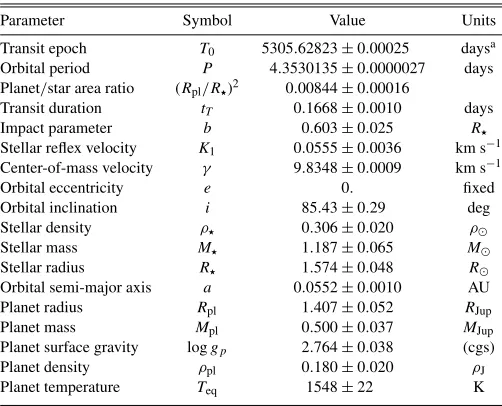
energy is efficiently redistributed from the planet’s day side to its night side. We also calculate the transit ingress(egress) times T12(T34), and the orbital semi-major axis a. These calculated values and their 1σ uncertainties from our MCMC analysis are presented in Table3. The observed light curves are plotted against the model light curves with their residuals in Figure2.
[image:7.612.318.569.75.278.2]The stellar mass of planet host star has been derived within our MCMC analysis from the empirical (Torres et al.2010) calibration, which is based on the precisely measured masses and radii of eclipsing binary stars, and relates logg, [Fe/H], andTeffto the stellar mass and radius. However, whileTeff can be determined with high precision from the stellar spectrum (see Sections3.1and3.2), loggis usually poorly constrained,
Table 3
System Parameters and 1σError Limits Derived from the MCMC Analysis
Parameter Symbol Value Units
Transit epoch T0 5305.62823±0.00025 daysa
Orbital period P 4.3530135±0.0000027 days
Planet/star area ratio (Rpl/R)2 0.00844±0.00016
Transit duration tT 0.1668±0.0010 days
Impact parameter b 0.603±0.025 R
Stellar reflex velocity K1 0.0555±0.0036 km s−1 Center-of-mass velocity γ 9.8348±0.0009 km s−1
Orbital eccentricity e 0. fixed
Orbital inclination i 85.43±0.29 deg
Stellar density ρ 0.306±0.020 ρ
Stellar mass M 1.187±0.065 M
Stellar radius R 1.574±0.048 R
Orbital semi-major axis a 0.0552±0.0010 AU
Planet radius Rpl 1.407±0.052 RJup
Planet mass Mpl 0.500±0.037 MJup
Planet surface gravity loggp 2.764±0.038 (cgs)
Planet density ρpl 0.180±0.020 ρJ
Planet temperature Teq 1548±22 K
Note.aGiven in BJD
TDB−2,450,000 as defined by Eastman et al. (2010).
and thus stellar masses derived from the spectroscopic logg can have large uncertainties and can suffer from systematics. Thus, our MCMC method derives the stellar mass using the empirical calibration as described by Enoch et al. (2010), which is based on that by Torres et al. (2010) but relies on the directly measuredρ, instead of logg. The stellar density,ρ, is directly
determined from transit light curves and as such is independent of the stellar mass, and the effective temperature determined from the spectrum (Sozzetti et al.2007; Hebb et al.2009), as well as of theoretical stellar models (MplMis assumed; see
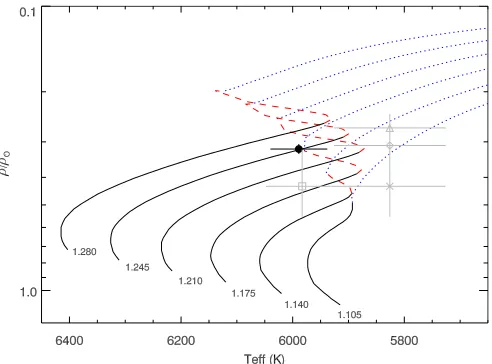
Seager & Mall´en-Ornelas2003). The error on the stellar mass that we first derived from the MCMC, which is based on the empirical relationship, seemed underestimated (∼1%), and thus so are the errors of the other properties that depend on the stellar mass (e.g., orbital separation). Therefore, we adopt a more realistic uncertainty in the stellar mass from the comparison of stellar evolutionary models to the observed properties of WASP-13, as described in the paragraph below and is shown in Figure3. This uncertainty in the stellar mass is included in the final MCMC analysis (see Table3) and is propagated through all other dependent parameters.
Because the planet physical properties depend directly on the stellar ones and to assure the validity of our MCMC results, we have derived independently the stellar mass from the Yonsei–Yale (Y2) stellar evolutionary models (see Figure3; Demarque et al. 2004). Furthermore, this consistency check allows us to estimate the age of the planetary system, and to derive a realistic error on the mass of the stellar host. We have interpolated the Y2 models considering the 1σ errors in the measured ρ, and in the spectroscopically determined [Fe/H]
Figure 3.Parameters of WASP-13 compared to the Y2stellar evolution models
(Demarque et al.2004). The effective temperature and mean stellar density of WASP-13 is plotted as a solid circle. The six mass tracks have been interpolated in metallicity to [Fe/H]= +0.06 to match the measured value of WASP-13. The mass of each track is labeled at the bottom of each line. Different evolutionary phases—main-sequence evolution (solid black), overall contraction phase (dashed red), and post-main sequence (blue dotted)—are given different line styles. Previous measurements of WASP-13 are also plotted in gray—diamond (Barros et al.2012), triangle (Southworth2012), square (Torres et al.2012), and asterisk (Skillen et al.2009). The best mass for WASP-13 derived from these tracks is 1.245Mif the star is on the main sequence, but a 1.175Mstar is equally likely if the star is slightly older and has already exhausted hydrogen in its core.
(A color version of this figure is available in the online journal.)
Thus, we do not consider the pre-main-sequence phase as a plausible evolutionary state for WASP-13. In addition, the measured surface gravity and temperature rule out the post-main-sequence, red giant phase. Therefore, the most likely scenario is that WASP-13 is at the end of its main-sequence lifetime and may or may not have reached the phase of overall contraction before exhausting hydrogen in its core. According to these models, the stellar mass is between 1.175 and 1.245M depending on the precise phase of evolution, and the age of the system is between 4 and 5.5 Gyr. Thus, the stellar mass derived from the Y2 theoretical models is consistent with the stellar mass from our MCMC analysis (1.187M). However, the range of possible stellar masses derived from a single set of evolutionary models is larger than the uncertainty on the stellar mass given by the empirical Enoch relation. Therefore, we conservatively adopt a larger uncertainty ofσM = ±0.065M on this parameter to account for all plausible mass values.
4. DISCUSSION AND CONCLUSIONS
In our re-analysis of WASP-13 presented in this paper, we are able to more accurately determine the system’s physical properties than in previous studies. An improvement of 85% and 50% in stellar metallicity and effective temperature, respec-tively, from the values reported in the discovery paper (Skillen et al.2009) is due primarily to the high-quality, high-resolution HIRES spectrum analyzed. Moreover, the comparison of the re-sults from the different stellar characterization methods allows us to derive uncertainties based on the internal errors, and in-cluding a systematic contribution, based on the range of derived stellar properties. Comparing the stellar spectroscopic proper-ties derived in this paper to those in the literature, we find a hotter, and slightly more metal-rich star (Teff =5989±51 K;
[Fe/H]=0.06 ±0.03 dex) than Skillen et al. (2009), which is entirely consistent with the stellar spectroscopic properties of Torres et al. (2012) for WASP-13. The stellar mass that we derive (1.187±0.065M) falls between the recent estimates for WASP-13 (1.09±0.04 and 1.22±0.12M, respectively; Barros et al.2012; Southworth2012), and above of that initially derived in the discovery paper (1.03±0.10M). Correspond-ingly, the Saturn-mass planet WASP-13b is found to be also slightly larger and more massive (Rpl =1.407±0.052RJup; Mpl = 0.500± 0.037 MJup) with respect to the results from Skillen et al. (2009) and Barros et al. (2012); but slightly less massive and smaller than in Southworth (2012). Furthermore, we derive a younger planetary system (∼4–5.5 Gyr) than be-fore. While WASP-13 has certainly evolved off the zero-age main sequence, and might have not reached the overall contrac-tion phase, it is equally likely that it has undergone contraccontrac-tion and has exhausted hydrogen in its core. This uncertainty in the stellar evolutionary stage of WASP-13 translates into an uncer-tainty in the stellar mass (see Section3.3and Figure3), which has not been typically accounted for. It is clear from our analysis that both a detailed stellar characterization, and a transit model including light curves and radial velocities are necessary to ac-curately determine the physical properties of planetary systems. It must be noted that there is very good agreement among the spectroscopic properties (Teff, [Fe/H], and logg) of WASP-13 derived from the four independent methods of stellar character-ization for the unconstrained analysis. These stellar properties are also consistent with the independent measurement of logg constrained from the transit light curve (viaρ), and ofTeff de-rived from the Hα spectrum. Thus, this suggests that there is no significant systematic differences between the methods, and that unconstrained spectroscopic analyses give reliable stellar parameters for a star such as WASP-13. Although seemingly at odds with the conclusions from Torres et al. (2012), our method-ology differs from their spectral synthesis-based analyses (see also Section3.2.1). Among these differences are the treatment of the microturbulence, the line list, the sampling of a large pa-rameter space in initial papa-rameters, and the convergence criteria. Specifically our linelist includes the Na I D region, as well as the region of the Mg b triplet. It could be that the biases identi-fied by Torres et al. (2012) due to the spectroscopic-loggon the other stellar parameters are not present in our implementation of SME. In addition, we have fixed theTeffto the value derived from the Hαanalysis (Section3.1) in the four stellar characterization methods to assess the effect on the other spectroscopically deter-mined stellar properties. In the case of WASP-13, we do not find any significant differences and the solutions are consistent with the unconstrained analyses. Although this is unsurprising given that all the derived temperatures are in agreement, the effect of fixingTefffor different kinds of stars remains to be fully tested. With the larger HoSTS sample, a more robust conclusion, as to whether or not to constrain the spectroscopic analysis of the planet hosts—with the stellar density from the transit light curve or with the Teff from a different temperature diagnostic—will be possible as a function of analysis method, quality of the data, and/or different stellar and planetary properties.
Empirical trends between the physical properties of planet hosting stars and their orbiting exoplanets have been previously identified and have been well studied (e.g., Guillot et al.2006; Fortney & Nettelmann2010; Bouchy et al.2010; Baraffe et al.
2010; Laughlin et al. 2011; Enoch et al. 2012; Faedi et al.
Figure 4.Top panel:Rplvs. [Fe/H] for the bulk of the HoSTS sample taken fromhttp://exoplanets.org(2012 November 19), and complemented with the literature. A linear regression to the data gives a correlation coefficient of−0.24, which supports the previously observed trend (e.g., Laughlin et al.2011; Enoch et al.2012). WASP-13 is marked by the filled circles with the shaded uncertainty areas: the gray box is for the [Fe/H] from Skillen et al. (2009), and theρfrom Barros et al. (2012), and the fuchsia oval represents the properties derived in this paper. The uncertainties of the other data points are given by the gray crosses. Lower panel: we show the trend betweenRpl, stellar [Fe/H], and the planetaryTeq(dependent on the stellar irradiation) for the HoSTS targets with planets in the Saturn-mass range (0.1Mpl
0.5MJup). Although the two WASP-13 points overlap, the errors on the metallicity are significantly smaller, showing the potential of the HoSTS project, by tightening the constraints rendered by the known transiting planets, including the identification of any systematics, and assess the validity of the observed trends.
(A color version of this figure is available in the online journal.)
that between the planetary radius and the stellar irradiation, have been proposed to probe planetary formation and structure. According to theoretical models, like those of Fortney et al. (2007), the planetary radius depends on the mass in the core of the planet. For example, a coreless Jupiter-mass planet that is dominated by its envelope has a radius that is several percent larger than a Jupiter-mass planet with a core mass of a few tens of M⊕. At lower planetary masses, like in the Saturn-mass range (0.1Mpl 0.5; Enoch et al. 2012), as the planets become
and evolution of planets remains unclear. The structure of the planet and its environment need to be better constrained to be able to account for the diversity of physical properties of the known transiting systems. Thus, understanding the empirical relationships that have been previously identified between the stellar metallicity and stellar irradiation and the planetary radius may expand our knowledge on planetary systems.
The top panel of Figure4shows the brightest (V<14 mag) transiting planets orbiting closest to the host star (Porb < 15 days) with planetary masses between 0.1 and 12.5 MJup, which compose the bulk of the HoSTS sample. Doing a linear regression including the data uncertainties, we get a correlation coefficient of −0.24 between the stellar metallicity and the planetary radius. This known anticorrelation is more significant (with a correlation coefficient of −0.37) for the Saturn-mass planets shown in the lower panel as mentioned above. However, there is a strong correlation between the amount of stellar flux received expressed byTeq(Fressin et al.2007, see color scale in the lower panel) which has not been taken into account in the linear regression. In this paper, we do not attempt to characterize the observed trends except qualitatively. We note the evident improvement in the precision of the derived physical properties of the WASP-13 planetary system from our analysis (from the gray-shaded area to the fuchsia-shaded area). Our analysis of WASP-13 showcases how the HoSTS project will allow us to tighten the constraints rendered by the known transiting planets, including the identification of any systematics, and correlations between the planet and stellar properties, as well as to assess the validity of the known empirical trends.
We are continuing to acquire and analyze the high-quality echelle spectra and the long-slit spectra forTeff determination for the known transiting hosts. The data products of the HoSTS project are the derivation of a homogeneous set of stellar and planetary properties that will allow us to identify any biases in the parameters arising from the analysis methods and the quality of the data. This will enable us to significantly compare the physical properties allowing us to discover, derive, and identify trends among the planetary parameters exploring in more detail the planetary mass–radius relationship.
The authors are grateful to the anonymous referee for improving significantly the scientific content of this paper. Y.G.M.C. acknowledges postdoctoral funding support from the Vanderbilt Office of the Provost, through the Vanderbilt Ini-tiative in Data-intensive Astrophysics (VIDA) and through a grant from the Vanderbilt International Office in support of the Vanderbilt–Warwick Exoplanets Collaboration. L.H.H. and K.G.S. acknowledge National Science Foundation grant AST-1009810. P.A.C. and K.G.S. acknowledge National Science Foundation grant AST-1109612. Y.G.M.C. and F.F. acknowl-edge Luca Fossati for fruitful discussions. P.A.C. and L.H.H. thank Jeff Valenti, and Eric Stempels for their extensive help in running SME and developing the SME implementation pre-sented in this paper. This work was supported by the European Research Council/European Community under the FP7 through Starting Grant agreement number 239953. S.G.S. is supported by the grant SFRH/BPD/47611/2008 from FCT (Portugal). L.G. acknowledges financial support provided by the PAPDRJ CAPES/FAPERJ Fellowship. N.C.S. also acknowledges the support from Funda¸c˜ao para a Ciˆencia e a Tecnologia (FCT) through program Ciˆencia 2007 funded by FCT/MCTES (Por-tugal) and POPH/FSE (EC), and in the form of grant reference PTDC/CTE-AST/098528/2008. The INT is operated on the
island of La Palma by the Isaac Newton Group in the Span-ish Observatorio del Roque de los Muchachos of the Instituto de Astrof´ısica de Canarias. The data presented herein were ob-tained at the W. M. Keck Observatory, which is operated as a scientific partnership among the California Institute of Technol-ogy, the University of California and the National Aeronautics and Space Administration. The Observatory was made possible by the generous financial support of the W. M. Keck Founda-tion. The authors wish to recognize and acknowledge the very significant cultural role and reverence that the summit of Mauna Kea has always had within the indigenous Hawaiian commu-nity. We are most fortunate to have the opportunity to conduct observations from this mountain.
REFERENCES
Adibekyan, V. Z., Delgado Mena, E., Sousa, S. G., et al. 2012a, A&A, 547, A36
Adibekyan, V. Z., Santos, N. C., Sousa, S. G., et al. 2012b,A&A,543, A89 Allard, N. F., Kielkopf, J. F., Cayrel, R., & van’t Veer-Menneret, C. 2008,A&A,
480, 581
Ammler-von Eiff, M., Santos, N. C., Sousa, S. G., et al. 2009, A&A, 507, 523
Asplund, M., Grevesse, N., Sauval, A. J., & Scott, P. 2009,ARA&A,47, 481 Baraffe, I., Chabrier, G., & Barman, T. 2010, RPPh,73, 016901
Barklem, P. S. 2007,A&A,466, 327
Barklem, P. S., Piskunov, N., & O’Mara, B. J. 2000, A&A,363, 1091 Barros, S. C. C., Pollacco, D. L., Gibson, N. P., et al. 2012,MNRAS,419, 1248 Bouchy, F., Hebb, L., Skillen, I., et al. 2010,A&A,519, A98
Bruntt, H., Bedding, T. R., Quirion, P.-O., et al. 2010,MNRAS,405, 1907 Buchhave, L. A., Latham, D. W., Johansen, A., et al. 2012, Natur,486, 375 Castelli, F., Gratton, R. G., & Kurucz, R. L. 1997, A&A,318, 841 Castelli, F., & Kurucz, R. L. 2004, arXiv:astro-ph/0405087
Cayrel, R., van’t Veer-Menneret, C., Allard, N. F., & Stehl´e, C. 2011,A&A, 531, A83
Claret, A. 2000, A&A,363, 1081 Claret, A. 2004,A&A,428, 1001
Collier Cameron, A., Wilson, D. M., West, R. G., et al. 2007, MNRAS, 380, 1230
Demarque, P., Woo, J., Kim, Y., & Yi, S. K. 2004,ApJ,155, 667 Demory, B.-O., & Seager, S. 2011,ApJS,197, 12
Doyle, A. P., Smalley, B., Maxted, P. F. L., et al. 2013,MNRAS,428, 3164 Eastman, J., Siverd, R., & Gaudi, B. S. 2010,PASP,122, 935
Enoch, B., Collier Cameron, A., & Horne, K. 2012,A&A,540, A99
Enoch, B., Collier Cameron, A., Parley, N. R., & Hebb, L. 2010, A&A, 516, A33
Faedi, F., Barros, S. C. C., Anderson, D. R., et al. 2011,A&A,531, A40 Fortney, J. J., Marley, M. S., & Barnes, J. W. 2007,ApJ,659, 1661 Fortney, J. J., & Nettelmann, N. 2010, SSRv,152, 423
Fressin, F., Guillot, T., Morello, V., & Pont, F. 2007,A&A,475, 729 Gardiner, R. B., Kupka, F., & Smalley, B. 1999, A&A,347, 876 Ghezzi, L., Cunha, K., Smith, V. V., et al. 2010,ApJ,720, 1290
Gray, D. F. (ed.) 2008, The Observation and Analysis of Stellar Photospheres (Cambridge: Cambridge Univ. Press)
Guillot, T., Santos, N. C., Pont, F., et al. 2006,A&A,453, L21 Hebb, L., Collier-Cameron, A., Loeillet, B., et al. 2009,ApJ,693, 1920 Heiter, U., Kupka, F., van’t Veer-Menneret, C., et al. 2002,A&A,392, 619 Howarth, I. D. 2011,MNRAS,413, 1515
Kupka, F., Piskunov, N., Ryabchikova, T. A., Stempels, H. C., & Weiss, W. W. 1999, A&AS,138, 119
Kurucz, R. L. 1993, SYNTHE Spectrum Synthesis Programs and Line Data (Cambridge, MA: Smithsonian Astrophysical Observatory)
Kurucz, R. L., Furenlid, I., Brault, J., & Testerman, L. 1984, Solar Flux Atlas from 296 to 1300 nm (Sunspot, NM: National Solar Observatory) Laughlin, G., Crismani, M., & Adams, F. C. 2011,ApJL,729, L7 Lucy, L. B., & Sweeney, M. A. 1971,AJ,76, 544
Magain, P. 1984, A&A,134, 189
Mancini, L., Southworth, J., Ciceri, S., et al. 2013,A&A,551, A11 Perna, R., Heng, K., & Pont, F. 2012,ApJ,751, 5
Pollacco, D. L., Skillen, I., Collier Cameron, A., et al. 2006,PASP,118, 1407 Pollacco, D., Skillen, I., Collier Cameron, A., et al. 2008,MNRAS,385, 1576 Santos, N. C., Israelian, G., & Mayor, M. 2004,A&A,415, 1153
Seager, S., & Mall´en-Ornelas, G. 2003,ApJ,585, 1038 Sestito, P., & Randich, S. 2005,A&A,442, 615
Skillen, I., Pollacco, D., Collier Cameron, A., et al. 2009,A&A,502, 391 Smalley, B., Smith, K. C., & Dworetsky, M. M. 2001, UCLSYN Userguide,
http://www.astro.keele.ac.uk/∼bs/publs/uclsyn.pdf Smith, K. C. 1992, PhD thesis, Univ. London
Smith, K. C., & Dworetsky, M. M. 1988, in IAU Working Group on AP Stars Workshop, Elemental Abundance Analyses, ed. S. J. Adelman & T. Lanz (Cambridge: Cambridge Univ. Press), 32
Sneden, C. A. 1973, PhD thesis, Univ. Texas at Austin
Sousa, S. G., Santos, N. C., Israelian, G., Mayor, M., & Monteiro, M. J. P. F. G. 2007,A&A,469, 783
Sousa, S. G., Santos, N. C., Israelian, G., Mayor, M., & Udry, S. 2011a,A&A, 533, A141
Sousa, S. G., Santos, N. C., Israelian, G., et al. 2011b,A&A,526, A99 Sousa, S. G., Santos, N. C., Mayor, M., et al. 2008,A&A,487, 373 Southworth, J. 2008,MNRAS,386, 1644
Southworth, J. 2009,MNRAS,394, 272 Southworth, J. 2010,MNRAS,408, 1689 Southworth, J. 2011,MNRAS,417, 2166 Southworth, J. 2012,MNRAS,426, 1291
Sozzetti, A., Torres, G., Charbonneau, D., et al. 2007,ApJ,664, 1190 Stehl´e, C., & Hutcheon, R. 1999, A&AS,140, 93
Stempels, H. C., Collier Cameron, A., Hebb, L., Smalley, B., & Frandsen, S. 2007,MNRAS,379, 773
Torres, G., Andersen, J., & Gim´enez, A. 2010, A&ARv,18, 67 Torres, G., Fischer, D. A., Sozzetti, A., et al. 2012,ApJ,757, 161 Torres, G., Winn, J. N., & Holman, M. J. 2008,ApJ,677, 1324 Udry, S., & Santos, N. C. 2007,ARA&A,45, 397
Valenti, J. A., & Fischer, D. A. 2005,ApJS,159, 141 Valenti, J. A., & Piskunov, N. 1996, A&AS,118, 595 Vidal, C. R., Cooper, J., & Smith, E. W. 1973,ApJS,25, 37
![Figure 4. Top panel: Rpl vs. [Fe/H] for the bulk of the HoSTS sample taken from http://exoplanets.org (2012 November 19), and complemented with the literature.A linear regression to the data gives a correlation coefficient of −0.24, which supports the previ](https://thumb-us.123doks.com/thumbv2/123dok_us/8723738.385120/9.612.53.555.57.548/exoplanets-november-complemented-literature-regression-correlation-coefcient-supports.webp)
