Designing the Spectator Experience
Stuart Reeves, Steve Benford, Claire O’Malley
The Mixed Reality Laboratory &
Learning Sciences Research Institute
The University of Nottingham
Computer Science Building
Wollaton Road, Nottingham
NG8 1BB, UK
{str, sdb}@cs.nott.ac.uk, [email protected]
Mike Fraser
Department of Computer Science
The University of Bristol
Merchant Venturers Building
Woodland Road, Bristol
BS8 1UB, UK
[email protected]
ABSTRACT
Interaction is increasingly a public affair, taking place in our theatres, galleries, museums, exhibitions and on the city streets. This raises a new design challenge for HCI – how should spectators experience a performer’s interaction with a computer? We classify public interfaces (including examples from art, performance and exhibition design) according to the extent to which a performer’s manipulations of an interface and their resulting effects are hidden, partially revealed, fully revealed or even amplified for spectators. Our taxonomy uncovers four broad design strategies: ‘secretive,’ where manipulations and effects are largely hidden; ‘expressive,’ where they tend to be revealed enabling the spectator to fully appreciate the performer’s interaction; ‘magical,’ where effects are revealed but the manipulations that caused them are hidden; and finally ‘suspenseful,’ where manipulations are apparent but effects are only revealed as the spectator takes their turn.
ACM Classification
H1.2 User/Machine Systems; H5. Information Interfaces and Presentation.
Keywords
Public experiences, spectators, design framework, museums, galleries, art, performance, expression, magic.
INTRODUCTION
The growing interest in cultural, artistic and entertainment applications of interactive technologies in settings such as
museums, galleries, theatres and even clubs, combined with the spread of mobile devices into the streets, means that interaction with computers is increasingly a public affair. In this paper, we shall show that crafting interaction for public settings raises a host of new challenges for HCI, shifting the focus of design away from the individual’s dialogue with their interface to also consider the ways in which interaction affects and is affected by spectators.
We consider what it means to ‘perform’ with an interface in a public setting and explore the challenge of designing the spectator experience, answering the key question: how should a spectator experience a user’s interaction with a computer? While this certainly includes issues already familiar to the HCI community such as mutual awareness and privacy, we shall see that there are also new issues to consider addressing topics such as expression, suspense and magical effect.
We deliberately take a broad view of performance that encompasses explicitly staged interaction by musicians, actors and artists in front of an audience, as well as more implicit performance, where users almost unconsciously perform their interactions for others to see in a public setting. While workplace studies have already shown us that users often subtly conduct their interaction so as to be visible to others, promoting mutual awareness, most notably in control room environments [13], we shall see how this becomes a far more explicitly designed affair in settings such as theatres, exhibitions, galleries amusement arcades, theme-parks and museums, where observing others interact is very much part of the experience. However, one might also apply our analysis to situations where people perform their use of a technology in everyday settings, for example conducting mobile phone conversations in restaurants, on trains and on the streets.
Drawing on a range of example interfaces and previous studies of interaction, especially from interactive art and performance, we will develop a taxonomy that shows how Permission to make digital or hard copies of all or part of this work for
personal or classroom use is granted without fee provided that copies are not made or distributed for profit or commercial advantage and that copies bear this notice and the full citation on the first page. To copy otherwise, or republish, to post on servers or to redistribute to lists, requires prior specific permission and/or a fee.
current design approaches can be related to one another using just a few underlying ideas. Our aim is to provide the HCI community, especially mainstream interface designers who may be relatively unfamiliar with designing public interfaces, with an insight into trade-offs involved in public interface design as well as knowledge of the techniques that are potentially available to them.
REVISITING NOTIONS OF PUBLIC AND PRIVATE
Our starting point is a common, but as it turns out, over-simplistic idea: the separation between public and private interaction. Personal phone calls, for example, are often an essentially private action and might ideally be shielded from others when conducted in public settings, for the benefit of both parties [1]. In the most extreme cases, technologies may be embedded in private booths that are placed in the public setting, such as in interactive photo kiosks. Other interactions are clearly intended to be public, such as those of an electronic musician or performance artist whose use of interactive technologies is a carefully staged spectacle. Other interactions fall somewhere in-between, such as museum installations, which as vom Lehn et al observe, involve multiple levels of engagement, including those who are directly interacting, those in an immediate co-located group who share the interaction, and bystanders who observe from a distance, learning by watching others and waiting their turn [19].
We argue, however, that this basic distinction between public and private is not sufficiently rich to capture some of the essential features of existing public interfaces. In particular, it is important to consider exactly what aspects of interaction are made available to bystanders and how this is achieved. We therefore introduce a further distinction in order to help us express the various possibilities; we deconstruct interaction into
manipulations and effects.
MANIPULATIONS
Manipulations are the actions carried out by the primary user of the interface who we shall henceforth refer to as the ‘performer.’ These actions of the performer include manipulations of physical controls (buttons, mice, joysticks and so forth) as well as gestures, movements and speech that are sensed by the interface.
Manipulations also include actions outside of the interface’s sensor scope; i.e., gestures, movements, and utterances that take place around the interface but that do not directly result in input to it. Sometimes these are purely functional, sometimes they are purely artistic, and sometimes a mixture of both. In any case, manipulations correspond to more than just system ‘input’ since their definition includes non-sensed actions as well.
Performers often gesture artistically ‘around’ their direct manipulations of the interface, performing distinctive movements prior to or following on from the actual moment of interaction. This can be seen in traditional performance contexts such as musicians playing conventional musical instruments or sportspeople striking balls. Such gestures play two important roles. Firstly, interactions consist of more than the moment of contact with the interface technology (e.g., pressing key); preparation and follow through are essential components of a skilfully performed physical action, perhaps best seen in a golfer’s swing. Secondly, such gestures are an essential element of deliberately performing interactions for others to see and appreciate, expressing skill and control and introducing an aesthetic component to the use of technology. Rosen [22], for example, describes how performer gestures at the piano fundamentally influence spectator appreciation of the skill and emotion involved in the performance of a piece of music, and Sudnow [27] describes how seemingly extraneous gestures become part of the practice of productions at the keyboard. Previous work in HCI has discussed the role of performative gestures in playing electronic instruments, using the term ‘expressive latitude’ to refer to performance gestures that are not directly sensed by the instrument [7].
Performers’ actions around their interfaces may also be more functional. They have to engage with and disengage from interactive technologies, for example, when approaching an interface, picking up an interaction device or donning a wearable technology such as a head-mounted display. The movements and gestures involved in approaching the technology, such as moving into sensor range or putting on an interface, may be publically visible and hence part of the performance even though they may not directly result in intentional input to the system. Indeed, there is a danger that such actions will cause input to the system anyway, accidentally triggering unintended interactions and making the performer appear to be clumsy or inept.
Performers may also disengage in order to rest or reposition themselves before resuming a performance, may put down one piece of technology in order to engage with another or may hand over a technology to another performer. These kinds of interactions can be seen in public settings such as museums where visitors hand over technologies as well as in stage managed performances.
begin to interact with the technology and the audience will be primarily interested in the dance. The dancers’ movements exist independently of the moment of contact, indeed they, not the technology, are the ‘main event’.
This discussion is closely related to Bellotti et al’s framework for the design of sensing-based interfaces in which they pose key challenges for interface designers including “how to disambiguate signal-to-noise” and “how to not address the system” [3]. Each of these directly impacts the ways in which spectators are handled by the interface.
EFFECTS
Effects are the results of these manipulations, for example the display of images, graphics and sounds or the actuation of physical objects. Effects include what we identify as the main ‘content’ of the performance, but may also include other visible effects of the performer’s manipulations of the system, such as the appearance of menus, icons, cursors and so forth that are a necessary part of manipulating the contents.
Effects also include the apparent action of the interface on the performer themselves. These may be direct effects, such as when the performer is tethered to the interface in some way, or in more extreme cases where the system is actively (and maybe autonomously) controlling the
performer’s body. An example of this can be seen in the work of the performance artist Stelarc, in which the system causes his body to move through a series of electrical impulses, triggered in the first instance by spectators [28, page 159].
Performers may also display a physical and/or emotional reaction to the interface, deliberately or involuntarily, and the resulting gestures, movements and expressions around the interface can also be seen as being part of the effect. Our definition of effects, therefore, does not correspond to system ‘output’ since effects are not confined to being located purely in the technology but can also be found in the human elements.
DESIGNING THE SPECTATOR’S VIEW BY REVEALING OR HIDING MANIPULATIONS AND EFFECTS
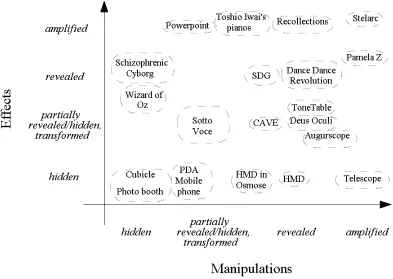
[image:3.595.89.482.437.716.2]We are now ready to revisit and expand on basic ideas of public and private, further developing them in terms of the varied ways in which a spectator can experience a performer’s interaction. We can classify a wide range of existing interfaces according the extent to which they hide or reveal a performer’s manipulations compared to the extent to which they hide or reveal the corresponding effects. Figure 1 shows the resulting taxonomy, populated with a range of example interfaces that we shall refer to throughout the rest of this paper.
At the bottom-left we see what is traditionally considered to be private interaction in which both manipulations and their effects are hidden from the spectator such that they are exclusively available only to the performer, an example being any interface located in a private booth such as the photo kiosk mentioned previously.
On the top-right we see the most public interactions in which both effects and the manipulations that cause them are revealed to spectators. An interactive whiteboard belongs in this general area, as do many conventional examples of Single Display Groupware (SDG) in which people collaborate openly around a shared display [26].
The areas to the top-left and bottom-right are somewhat less conventional. Towards the top-left we see examples of interfaces in which effects are revealed but manipulations, including the performer themselves in extreme cases, are hidden. Here we find interfaces employing magic-like effects, including ‘wizard of oz’ interfaces such as a performer speaking through a real-time animated character from off-stage.
At the bottom-right we have the converse, where manipulations are revealed but effects are hidden. Here spectators might watch a performer using a display or engaging with technology in some fashion, but cannot share in the content of their experience. For example, immersive head-mounted displays used in public settings permit spectators to see only performer manipulations. An example from a museum setting is the Telescope [21], a large stand-mounted augmented reality display that was deployed as part of a public visiting experience. Performers would rotate and tilt the Telescope to point it a physical target and then look through a small eyepiece in order to see the target augmented with video material. The eye-piece design rendered effects invisible to spectators and at the same time had the effect of further amplifying manipulations as the performer would be clearly seen bending over to look into the device.
Having explored the four extreme corners of our taxonomy we shall now consider, amongst further exploration of these extremes, other examples of public interfaces that lie more towards the centre of Figure 1 and therefore involve more subtle trade-offs between hiding and revealing manipulations and effects.
Mobile Personal Displays
Due to their small size, many of the fine details of interaction with mobile personal displays such as PDAs and phones may be hidden from most spectators. There are, however, further more subtle distinctions. A spectator who is close by, directly looking over the shoulder of someone who is using a PDA, may be able to observe their manipulations and the resulting effects. This has recently been put to interesting effect in a mobile Pacman game in which players use their own PDAs to control
‘ghosts’ that can appear on other players’ PDAs, causing players to dynamically reposition themselves in an attempt to see others’ displays or conversely hide their own display from the view of others, often amusingly tying themselves in knots in the process [23].
More distant spectators will miss small manipulations of mobile devices such as key presses, but will probably still be able to see that the device is being used due to characteristic ‘phone gestures,’ such as broader interactions with the device itself (e.g., placing a phone to one’s ear) and other characteristic bodily motions, such as physically marking private space by bodily orientation and pose [12]. Mobile phones in particular project some of their manipulations and effects into the surrounding environment, including ring-tones and the performer’s talk, which sometimes appears to be at least in part deliberately performed for spectators in the local environment as well as for the distant conversant.
The Sotto Voce museum guide system [2] is especially interesting because a spectator can elect to eavesdrop on a fellow participant’s audio (participants were arranged into pairs, and proximity did not affect the overhearing of this audio content), choosing whether or not to share the effects that the performer triggers.
Interactive Installations
Interactive installations demonstrate a very wide variety of approaches to hiding and revealing manipulations and effects. Some installations rely heavily on spectator comprehension of manipulations and their mapping to a revealed effect for their entertainment value. Dance Dance Revolution arcade machines, for example, present players with a set of footpads (usually with eight ‘buttons’) that must be triggered in specific sequences in time with an accompanying soundtrack. Manipulations of the machine are not hidden from spectators in any way; appreciation of the linkage between a performer’s steps and their success in the game (i.e., effects) is central to being a spectator.
Projected 3D displays such as CAVEs reveal both manipulations and effects to co-present spectators. Only a single tracked performer, however, receives the full 3D experience that is correct for their physical perspective as they move; in contrast, spectators may receive a ‘downgraded’ secondary view that is slaved to the performer’s movements.
clear that performers were interacting, the legibility of their interaction – the relationship between manipulations and effects – was not immediately obvious or even ultimately predictable, demanding further reflection. The use of non-linear mappings to partially obscure the relationship between manipulations and effects is common in artistic installations where it introduces a degree of ambiguity in an attempt to provoke curiosity, engagement and exploration (a more detailed discussion of the role of ambiguity in interface design can be found in [11]).
Our final example in this section is the Augurscope, a stand-mounted mobile display that can be wheeled around outdoors in order to view 3D models such as historical reconstructions from different physical vantage points [24]. Like the Telescope mentioned previously, this is a large interface that can be rotated and tilted in a highly visible way. Unlike the Telescope, it effects are displayed on a laptop-sized screen that makes them visible to nearby spectators, such as members of a co-visiting group.
Performances
Our final category of public interfaces is those used as part of deliberately staged public performances. Artists who interact with technologies in front of audiences are not always content with revealing manipulations, but may actively seek to amplify them in order to make their performances more expressive. Musician Pamela Z [29] uses gesture controllers in her performances in order to control electronic instruments in tandem with her voice. By using more expressive sensing interfaces, she both reveals and then amplifies the manipulations that are normally involved in the playing of electronic instruments. In a further example, Toshio Iwai’s pianos [28, page 767] are enhanced with automated lighting effects that amplify his manipulations of a conventional piano keyboard. Some of Stelarc’s performance pieces, such as Stimbo [28, page 159], where muscle stimulators were attached to his body and accessible via a touch-screen also amplify manipulations and effects, in this case by incorporating the performer into the interface itself.
Amplification is not necessarily involved in all performances however. In the Schizophrenic Cyborg [25] a participant plays the role of a ‘cyborg’ by having a digital display fixed onto their torso. A separate performer, the ‘parasite,’ then anonymously interacts with this display. This is done in such a way that their manipulations are hidden from the cyborg and other spectators, whereas the effects are made clearly visible on the cyborg’s body and so became a talking point for spectators.
As a final example, we briefly draw attention to a quite different and more everyday kind of performance, that of giving presentations using tools such as Microsoft
Powerpoint. We propose that current presentation tools are limited in terms of their ability to support fluid performance in ways that can be explained by our taxonomy. Spectators (i.e., audience members) typically see effects – a slideshow – in an amplified way (i.e., projected onto a large screen). The performer’s physical manipulations may be more or less visible depending on the set up. What is interesting – and problematic – is that spectators often see and hear the whole of the computer’s output, including alerts, system messages and all of the visible effects of the performer’s interactions with the underlying operating system. Ideally, in our view, only the performer would see this information so that they could more fluidly orchestrate the show for the spectator and reduce distractions. For example, as presenters, we have often wanted to be able to secretly alter later slides as a presentation progresses, perhaps in response to time pressure or questions from the audience, but without this being visible to all.
SECRETIVE, EXPRESSIVE, MAGICAL, SUSPENSEFUL
We now revisit our taxonomy in order to draw out some design principles from the varied examples that we have reviewed above. We propose that there are four general approaches to designing public interfaces, each of which addresses different concerns.
Secretive interfaces tend towards hiding both
manipulations and effects. This may be to protect spectators from knowing about the experience until it is their turn, or to protect performers from interference.
Expressive interfaces tend towards revealing, even
amplifying, both manipulations and effects. For performances, their primary concern is to entertain spectators by enabling them to appreciate how well a performer is interacting with the system, for example admiring the skill of a virtuoso user or being entertained by a new user’s attempts to use the interface. For installations, expressive interfaces are concerned with attracting spectators and then enabling them to learn by watching so that they can prepare themselves for their own turn with the interface.
envisaged as an extreme form of magical interface in which even the magician is hidden.
Suspenseful interfaces tend towards revealing
manipulations while hiding effects. While at first sight this may appear to be the most counter intuitive of the four strategies, it does offer some interesting possibilities. As with expressive interfaces, spectators may be attracted by seeing the interaction and may be able to learn something of what to do by observing, but in this case will not experience the effects until it is their turn. Watching others manipulate and react to the interface without seeing the content may serve to provoke curiosity and increase anticipation, heightening the ‘payoff’ delivered when it is finally their turn.
This suspenseful strategy might be particularly relevant to theme park design where it can be used to generate mounting anticipation, excitement and even limited apprehension before a ride. In the extreme, it may be important to convey the feeling that the experience is going to be much ‘worse’ than it actually turns out to be, perhaps by amplifying some of the revealed manipulations, for example emphasising the imposing physical scale of the technology. It also provides a way of engaging spectators who are queuing for their turn, especially in situations where visitors have to pay for the experience in which case it is important to attract
spectators to the interface and entertain them while queuing but without giving away the payoff for free.
Figure 2 positions these approaches on our taxonomy. It also extends its axes to show more possibilities than simply revealing or hiding manipulations and/or effects. Indeed, our example interfaces demonstrate a wide range of possibilities here including the following.
Partially revealing: Effects and manipulations may be
partially revealed, either as a result of the scale of the interface or distance of the spectators (e.g., PDAs, mobile phones and the Augurscope) or perhaps through more explicit means (e.g., we could redesign presentation tools so that background user interactions were prevented from being projected along with the primary content).
Transforming: We may transform manipulations, for
[image:6.595.116.470.97.368.2]example through non-linear mappings or by aggregating multiple inputs when mapping them onto effects, as employed by artists to introduce an element of unpredictability or ambiguity to an interface in order to provoke curiosity and reflection. Alternatively, manipulations may be transformed into unrelated actions by a performer in order to mislead spectators, such as a magician’s intentionally misleading bodily conduct that hides the methods employed to produce a trick [17].
Amplifying: Performers may deliberately amplify their manipulations and effects rather than merely reveal them. Again, this may be as a result of physical scale (manipulations of a large device are inherently more visible), technical augmentations such as using expressive sensing based interfaces, or by introducing additional visualisations or sonifications of manipulations alongside the primary effects. For example, Ed Tannenbaum’s video installation Recollections [28, page 684] tracks the performer’s body movements and projects these as silhouettes on a public display, layered to produce a vibrant collage of their movements over time.
OTHER FACETS OF THE SPECTATOR EXPERIENCE
Like all such taxonomies, ours necessarily simplifies the true picture in order to reveal broader underlying principles, in this case the idea that designers can trade off whether and how to reveal manipulations and effects in order to create spectator experiences that, in broad terms, can be thought of as secretive, expressive, magical or suspenseful. However, there are other aspects of designing the performer interface that also need to be considered. While a detailed treatment of these is beyond the scope of this paper, we now briefly consider some of them for completeness and to point the reader towards other relevant related work in this area.
Interactive Spectators
Although we have defined performers as being the primary users of the interface, it is possible for spectators to interact as well, either deliberately or accidentally.
In a typical performance (such as theatre, music or stand-up comedy), a performer is highly aware of spectator (audience) reaction; a performer’s awareness of spectators in such situations is often fundamental to the flow of the performance. Even where audiences are more restrained, the manifest presence of an audience is clearly critical to the sense of ‘liveness.’ Techniques for aggregating spectator input ranging from audience voting systems to video-tracking crowd behaviour have been employed in a range of interactive experiences [20].
Accidental interaction may arise through unintended interference with sensing systems, perhaps most obviously a problem with video-tracking where spectators can unintentionally interfere by moving into camera view, casting shadows or causing changes in ambient lighting (e.g., blocking light sources, opening or closing doors, or switching lights on and off). Designers might avoid interference by careful sensor placement or set design that incorporates somehow the constraints of ‘safe’ interaction space into the fundamental configuration of the design.
Performer Awareness of Spectators
Related to spectator interaction is the performer’s general awareness of spectators. As we have suggested, a
performer’s awareness of an audience is often vital to liveness. However, awareness of spectators may also have a negative impact on a performer who may feel pressure, both in terms of the potential embarrassment of making mistakes in front of strangers, but also the pressure to move on and let others have a turn. Whether such pressure is a positive or negative factor depends upon the situation, for example balancing the performer’s enjoyment of an experience against the need to maintain visitor flow.
Recent mobile performances on the city streets have introduced a quite different twist to performer awareness of spectators. Uncle Roy All Around You is a game-like performance in which members of the public, equipped with wireless PDAs, search the city streets for a mysterious character, guided by remote online players, encountering live actors and even interacting with members of the public as they go [4]. The experience is carefully designed to give street players (the performers in the sense of this paper) the unnerving but exciting sense of being involved in a conspiracy that potentially implicates everyone around them, even casual bystanders. The key here is a performer’s experience of interaction in public space is greatly enhanced by an implied awareness and involvement of spectators.
We do stress, however, that it is not always desirable for a performer to be aware of spectators. Some contemplative artistic experiences deliberately isolate the performer, an interesting case being the partially revealed manipulations of the virtual reality art installation Osmose [8]. This work hid the performer (who was immersed in a virtual environment via an HMD) behind a frosted glass screen, such that spectators could only see the performer as a partially revealed silhouette.
Transitions and Handovers
Many experiences involve moments of transition between spectating and performing, especially in exhibitions when visitors hand over control of exhibits to one another. Some experiences deliberately use these transitions in order to produce a particular effect, such as Deus Oculi [14]. This was a large renaissance-style painted scene featuring two figures whose faces were painted on small doors. Behind the doors were small screens that were linked directly to two handheld ‘mirrors’ situated on either side of the painting. When a visitor, assuming the role of a performer, picked a mirror and looked into it, an image of their face was captured on a hidden video camera and then displayed on one of the screens in the painting. As a result, performers could not see the effects of their own manipulations, resulting in highly engaging collaborative exchanges as the spectators pointed them out to the performers and/or other spectators.
transitions will be, choosing their technologies and techniques accordingly. For example, handing over a wearable technology such as HMDs will be more difficult than walking up to and away from a stand-mounted display. One theatrical technique for managing the transition from spectator to performer involves highly ritualised briefings in which an actor carefully introduces a spectator to the experience. For example, the Desert Rain performance embedded the interface within a theatrical setting including military-style briefing rituals for entering the experience and making the transition from spectating to performing. The Uncle Roy All Around You Performance employed similar rituals to place people in the role of street player (performer), including the unnerving step of requiring them to hand over their personal possessions – wallets, cash, mobile phones and so forth. Rituals such as these are also another important aspect of building suspense.
The concept of ‘traversable interfaces’ is worthy of note here as it deliberately supports transitions between spectating and performing by enclosing a performer and interface within a physically traversable secondary projected display (such as a curtain, screen made of smoke or water spray [16] or even a tent-like screen into which users can move [10]) while leaving spectators outside [15]. This fulfils several purposes. Firstly it isolates the performer and the interactive technologies from interference by the spectators. Secondly, it allows for a spectator view of events to be generated separately which may not show all of the performer’s effects, maintaining an element of surprise. Thirdly, by designing the screen so that spectators can physically pass through it, it supports dynamic transitions between spectating and performing.
Orchestration
Staged performances often involve an element of orchestration, meaning a set of activities that are oriented towards the smooth running of the experience. These typically include the activities of ‘front of house’ staff such as ushers, receptionists, and announcers, as well as those ‘behind the scenes,’ such as stage managers, floor managers, prompters and an extensive technical crew (sound, lighting, stagehands and so forth). Brenda Laurel has argued that interactive experiences can also be thought of in terms of orchestration [18] and studies of interactive performances have revealed the ways in which actors and technical crew monitor and intervene in ongoing interactions in order to subtly shape an experience as it unfolds [9]. Orchestration may also be seen in exhibitions where docents manage visitor flow and explain concepts and technologies.
In terms of manipulations and effects, orchestrators will typically be aware of the manipulations and effects of other participants, both performers and spectators, while
having their own manipulations hidden (and effects disguised) from spectators and possibly also from performers where these are members of the public.
CONCLUSIONS
Designing interfaces for public spaces raises significant and important new challenges for HCI, one of which is designing the spectator interface, with the key question being: how should a spectator experience a performer’s interaction with a computer?
Even a brief review of existing public interfaces in areas such as mobile personal displays, interactive installations and performances reveals that there are very many valid approaches to this question, and we have therefore developed a taxonomy that expresses the essential differences between current examples and draws out their underlying approaches to design.
By focusing explicitly on the spectator experience, our taxonomy is intended to complement other frameworks for designing public performances, most notably Borchers’ general pattern language for interaction design [5] and Sheridan et al’s discussion of the potential relationships between performers and spectators [25].
We have described a performer’s use of an interface in terms of manipulations which lead to effects, concepts that deliberately encompass their physical actions – movements, gestures, expressions and utterances – around an interface as well as their direct input to and output from it. We have then shown that the spectator’s view of events can then be described in terms of the extent to which they experience a performer’s manipulations versus their effects, specifically whether each is hidden, partially hidden, transformed, revealed or even amplified.
Four broad design strategies can then be located on this taxonomy: secretive, where both manipulations and effects tend to be hidden; expressive, where they are revealed; magical where effects are revealed but the manipulations that caused them are largely hidden; and
suspenseful; where manipulations are apparent, but effects only get revealed when the spectator gets to take their turn as a performer.
For these higher-level strategies, tensions will be part and parcel for any HCI design for which they are used. For example, interfaces are often deployed in settings in which non-experts are the intended audience, and so will quickly need to appreciate how to interact with an interface. Learning by watching others is one option that is supported more by expressive designs than for suspenseful experiences. For the heightening of suspense, it may be important not to give away too much of the experience beforehand, since it would reduce impact.
spectator can also interact; the performer’s awareness of spectators; supporting fluid transitions between spectating and performing; and support for behind-the-scenes orchestration.
We believe that designing the spectator experience will become an increasingly important aspect of mainstream HCI as computers continue to migrate from the workspace into our everyday lives, more often appearing in our public spaces – our theatres, galleries, museums, exhibitions and even the city streets. This will require a deeper understanding of new HCI issues such as expression, suspense and magic as well as a more sophisticated view of already known issues such as public and private interaction. We offer our taxonomy as a start in the hope that it raises awareness of both the challenges involved and also the wide range of potential solutions that are available.
ACKNOWLEDGEMENTS
We gratefully acknowledge the support of the UK’s Engineering and Physical Sciences Research Council (EPSRC) through the Equator Interdisciplinary Research Collaboration (www.equator.ac.uk).
REFERENCES
1. Agre, P. E., Changing Places, Contexts of Awareness in Computing. In Human Computer Interaction, 16 (2-4), pp. 177-192, 2001.
2. Aoki, P.M., Grinter, R.E., Hurst, A., Szymanski, M.H., Thornton, J.D. and Woodruff, A. Sotto Voce: exploring the interplay of conversation and mobile audio spaces. In Proc. CHI 2002, pp. 431-438, ACM Press.
3. Bellotti, V., Back, M., Edwards, W.K., Grinter, R.E., Henderson, A. and Lopes, C. Making sense of sensing systems: Five questions for designers and researchers. In Proc. CHI 2002, pp. 415-422, ACM Press.
4. Benford, S., Flintham, M., Drozd, A., Anastasi, R., Rowland, D., Tandavanitj, N., Adams, M., Row-Farr, J., Oldroyd, A. and Sutton, J. Uncle Roy All Around You: Implicating the City in a Location-Based Performance. In Proc. Advances in Computer Entertainment (ACE 2004), ACM Press.
5. Borchers, J. A Pattern Approach to Interaction Design. John Wiley & Sons, Inc., 2001.
6. Bowers, J., TONETABLE: A Multi-User, Mixed Media, Interactive Installation. In Proc. COST G-6 Conference on Digital Audio Effects (DAFX-01), 2001.
7. Bowers, J. and Hellström, S.O., Simple interfaces to complex sound in improvised music. In Proc. CHI 2000 Extended Abstracts, pp. 125-126, ACM Press.
8. Davies, C. and Harrison, J. “Osmose: Towards Broadening the Aesthetics of Virtual Reality,” ACM Computer Graphics: Virtual Reality, Vol. 30 (4) (1996).
9. Drozd, A., Bowers, J., Benford, S., Greenhalgh, C. and Fraser, M. Collaboratively Improvising Magic: An Approach to Managing Participation in an On-Line Drama. In Proc. European Conference on Computer-Supported Cooperative Work (ECSCW), pp. 159-178, Kluwer, 2001.
10. Fraser, M., Stanton, D., Ng, K. H., Benford, S., O’Malley, S., Bowers, J., Taxén, G., Ferris, K. and Hindmarsh, J. Assembling history: Achieving coherent experiences with diverse technologies. In
Proc. of European Conference on Computer Supported Cooperative Work (ECSCW), pp. 179-198. Oulu University Press, 2003.
11. Gaver, W. W., Beaver, J. and Benford, S, Ambiguity as a Resource for Design. In Proc. CHI 2003, pp. 233-240, ACM Press.
12. Geser, H., Towards a Sociological Theory of the Mobile Phone, University of Zürich, 2001.
13. Heath, C. and Luff, P. K. Collaboration and Control: Crisis management and multimedia technology in London Underground Line Control Rooms. In
Journal of Computer Supported Cooperative Work, 1 (1-2), pp. 69-94, Kluwer, 1992.
14. Heath, C., Luff, P. K., vom Lehn, D., Hindmarsh, J., and Cleverly, J. Crafting participation: Designing ecologies, configuring experience. In Visual Communication, 1(1), 2002, pp. 9-34.
15. Koleva, B., Schnädelbach, H., Benford, S., Greenhalgh, C. Traversable interfaces between real and virtual worlds. In Proc. CHI 2000, pp. 233-240, ACM Press.
16. Koleva, B., Taylor, I., Benford, S., Fraser, M., Greenhalgh, C., Schnädelbach, H., Lehn, D.v., Heath, C., Row-Farr J., and Adams, M. Orchestrating a mixed reality performance. In Proc. CHI 2001, pp. 38-45, ACM Press.
17. Lamont, P. and Wiseman, R. Magic in Theory: An introduction to the theoretical and psychological elements of conjouring. University of Hertfordshire Press, 1999.
18. Laurel, B., Computers as Theatre, Addison-Wesley, 1993.
19. vom Lehn, D., Heath, C. and Hindmarsh, J. Exhibiting interaction: Conduct and collaboration in museums and galleries. In Symbolic Interaction, 24(2), pp. 189-216.
20. Maynes-Aminzade, D., Pausch, R. and Seitz, S. Techniques for Interactive Audience Participation. In
21. Reeves, S., Fraser. M. and Benford, S., Engaging Augmented Reality, Presentation at alt.chi2005, in Adjunct Proceedings of CHI 2005, Portland, Oregon, 2005, ACM.
22. Rosen, C. Piano Notes: The Hidden World of the Pianist. Penguin Press, 2002.
23. Sanneblad, J. and Holmquist, L. E. "Why is everyone inside me?!'' Using Shared Displays in Mobile Computer Games. In Proc. of International Conference on Entertainment Computing (ICEC), 2004.
24. Schnädelbach, H., Koleva, B., Flintham, M., Fraser, M., Izadi, S., Chandler, P., Foster, M., Benford, S., Greenhalgh, C. and Rodden, T. The Augurscope: A mixed reality interface for outdoors. In Proc. CHI 2002, pp. 9-16, ACM Press.
25. Sheridan, J., Dix, A., Lock, S. and Bayliss, A. Understanding Interaction in Ubiquitous Guerrilla Performances in Playful Arenas. In Proc. British HCI Conference, 2004.
26. Stewart, J., Bederson, B. and Druin, A., Single Display Groupware: a Model for Co-present Collaboration. In Proc. CHI 1999, pp. 286-293, ACM Press.
27. Sudnow, D., Ways of the Hand: The Organization of Improvised Conduct, Routledge & Kegan Paul, 1978. 28. Wilson, S., Information Arts: Intersections of art,
science and technology, The MIT Press, 2002.
29. Z, P., Audible Image/Visible Sound: Donald Swearingen’s Living off the List. 21st Century Music, 8 (1).