EVOLUTION OF DIVERGENT FEMALE MATING
PREFERENCE IN RESPONSE TO EXPERIMENTAL
SEXUAL SELECTION
Allan Debelle,1Michael G. Ritchie,2and Rhonda R. Snook1,3
1Animal & Plant Sciences, University of Sheffield, Alfred Denny Building, Sheffield, S10 2TN, United Kingdom
2School of Biology, University of St Andrews, St Andrews, Fife, KY16 9TH, United Kingdom
3E-mail: [email protected]
Received February 14, 2014
Accepted May 25, 2014
Sexual selection is predicted to drive the coevolution of mating signals and preferences (mating traits) within populations, and
could play a role in speciation if sexual isolation arises due to mating trait divergence between populations. However, few
studies have demonstrated that differences in mating traits between populations result from sexual selection alone. Experimental
evolution is a promising approach to directly examine the action of sexual selection on mating trait divergence among populations.
We manipulated the opportunity for sexual selection (low vs. high) in populations ofDrosophila pseudoobscura. Previous studies
on these experimental populations have shown that sexual selection manipulation resulted in the divergence between sexual
selection treatments of several courtship song parameters, including interpulse interval (IPI) which markedly influences male
mating success. Here, we measure female preference for IPI using a playback design to test for preference divergence between
the sexual selection treatments after 130 generations of experimental sexual selection. The results suggest that female preference
has coevolved with male signal, in opposite directions between the sexual selection treatments, providing direct evidence of the
ability of sexual selection to drive the divergent coevolution of mating traits between populations. We discuss the implications in
the context sexual selection and speciation.
K E Y W O R D S : Coevolution, courtship song, Drosophila, experimental evolution, population divergence, speciation.
In theory, sexual selection has the ability to drive the coevolution of male and female mating traits (i.e., mating signals and their associated mating preferences) within populations (Fisher 1930). If such coevolution occurs in different directions among popula-tions, this can lead to the nonoverlapping distributions of mating traits among populations, resulting in individuals from a popula-tion being unwilling to mate with individuals from another popu-lation (and vice versa), hence potentially initiating or completing a speciation event (Lande 1981; West-Eberhard 1983; Panhuis et al. 2001; Kirkpatrick and Ravign´e 2002; Ritchie 2007; ITN Marie Curie Speciation 2011; Maan and Seehausen 2011). Fol-lowing the first models of divergent coevolution of mating traits via runaway sexual selection (Lande 1981; Kirkpatrick 1982), multiple theoretical studies have confirmed the potential of sex-ual selection to drive mating trait divergence among populations
through sexually antagonistic or other forms of sexual selection, eventually resulting in sexual isolation (Turner and Burrows 1995; Higashi et al. 1999; Gavrilets 2000; Kirkpatrick and Ravign´e 2002; Uyeda et al. 2009). Yet, despite its theoretical potential to influence reproductive isolation, sexual selection is often thought more likely to generate mating trait divergence by acting in part-nership with divergent ecological selection (Coyne and Orr 2004; Rundle and Nosil 2005; Ritchie 2007; Sobel et al. 2010; ITN Marie Curie Speciation 2011; Maan and Seehausen 2011). Sev-eral key studies have demonstrated a crucial role of ecologically based sexual selection in driving mating traits divergence and leading to speciation (Boughman 2001; Boughman et al. 2005; Maan et al. 2006). However, strong empirical support for the ability of sexual selection alone to drive mating trait divergence between populations is still largely lacking, or is only indirect
2 5 2 4
C
(Panhuis et al. 2001; Ritchie 2007; ITN Marie Curie Speciation 2011; Maan and Seehausen 2011; Rodr´ıguez et al. 2013; Safran et al. 2013).
For example, evidence used to support speciation via sexual selection is frequently historic, based on phylogenetic associa-tions between species richness and the degree of mating trait differences or sexual dimorphism (reviewed in Kraaijeveld et al. 2010). This correlative approach cannot distinguish either the chronology of mating trait divergence (e.g., whether mating trait divergence was at the origin of the speciation process or whether it occurred secondarily and maintained divergence) or the nature of the evolutionary process at the origin of mating trait diver-gence (e.g., sexual selection, ecologically based sexual selection, sex-specific ecological selection, or reinforcement) (Ritchie 2007; Hoskin and Higgie 2010; Kraaijeveld et al. 2010). Moreover, be-cause these meta-analyses often use male morphological traits as a proxy for the intensity of sexual selection, they cannot confirm the coevolution of female mating preference in such divergence (Ritchie 2007). Contemporary studies of wild populations can show the match between mating signals and preferences within species and their divergence across species, but still cannot ad-dress the nature of the evolutionary process that led to mating trait divergence in the first place. Some studies, however, provide strong indirect evidence that sexual selection alone contributed to the origin of reproductive isolation by driving mating trait divergence between populations. For example, explosive radia-tion events, such as the HawaiianLaupalacrickets (Shaw 2000; Mendelson and Shaw 2005), in which closely related species clearly differ in mating traits, and yet no apparent ecological di-vergence is observed, suggest that the divergent coevolution of mating traits was solely due to sexual selection. Artificial selec-tion has shown direct evidence for coevoluselec-tion between a given mating signal and its associated mating preference within species (Houde 1994; Wilkinson and Reillo 1994; Brooks and Couldridge 1999). Using experimental populations of a stalk-eyed fly species, Wilkinson and Reillo (1994) selected for increased and decreased male eye span, a male mating signal, for 13 generations and found a correlated response of female mating preference for male eye span. However, these artificial selection studies commonly pro-duced asymmetric or transient responses of mating trait evolution to selection (e.g., Houde 1994; Wilkinson and Reillo 1994). More-over, artificial selection constrains the response of phenotypes to determined phenotypic directions, which limits understanding how sexual selection may drive mating trait divergence. Thus, we still lack direct conclusive evidence of whether sexual selection can generate mating trait divergence on its own.
One way to directly address the evolution of traits under sex-ual selection is to employ experimental evolution. Experimental
evolution represents a powerful approach for studying mating trait evolution via sexual selection, as it allows the manipulation of the opportunity for sexual selection (and hence potentially sexual selection intensity) on replicated populations across multiple generations and the observation of the evolutionary consequences of this manipulation on male and female phenotypes (Garland and Rose 2009). Two studies demonstrated female mating preference divergence as a response to sexual selection using experimental evolution inDrosophila serrata(Rundle and Chenoweth 2005; Rundle et al. 2009). However, these studies examined the role of sexual selection during adaptation to a novel resource envi-ronment, and therefore the action of sexual selection occurred alongside the action of ecological adaptation. These findings highlight the need for further research on the divergence of mating preference for a mating signal as the sole result of sexual selection manipulation.
Material and Methods
SEXUAL SELECTION TREATMENTSThe establishment and maintenance of the selection lines are de-scribed in detail in Crudgington et al. (2005). Briefly, an ancestral wild-caught population ofD. pseudoobscurafrom Tucson (AZ; allopatric toD. persimilis), a naturally polyandrous species (wild-caught females have been shown to be frequently inseminated by at least two males at any given time; Anderson 1974), was used to establish the selection lines. From this population, four repli-cate lines (replirepli-cate 1, 2, 3, and 4) of two different sexual selection treatments were established. To modify the opportunity for sexual selection, adult sex ratio in vials is manipulated by either confin-ing one female with a sconfin-ingle male (“monogamy” treatment; M) or one female with six males (“elevated polyandry” treatment; E) in vials. Effective population sizes are equalized between the treatments (Snook et al. 2009). At each generation, offspring are collected and pooled together for each replicate line, and a random sample from this pool is used to constitute the next generation in the appropriate sex ratios, thus proportionally reflecting the differ-ential offspring production across families. In total, eight selection lines (M1, M2, M3, M4 and E1, E2, E3, E4) are maintained, in standard vials (2.5×80 mm) and with a generation time of 28 days. The ancestral population (A) is maintained in bottles (57× 132 mm) with an equal sex ratio of adult flies. All populations are kept at 22°C on a 12L:12D cycle, with standard food media and added live yeast.
EXPERIMENTAL FLIES
Both A, M, and E females were used to test for female mating preference coevolution with male IPI. To generate experimental females, parents were collected from each line, at the following generations: replicate 1 = 135; replicate 2 = 134; replicate 3 = 133; replicate 4 = 131; ancestral population= 155. We standardized for maternal and larval environments as previously described (Crudgington et al. 2010), but, in brief, parents were mated en masse in food bottles, transferred to bottles with oviposition plates (Snook and Markow 2001), allowed to oviposit for 24 h, and then 48 h later, 100 first instar larvae were seeded in standard food vials. Virgin E, M, or A females were collected on the day of eclosion and kept in vials of 12 individuals for five days, to ensure reproductive maturity (Snook and Markow 2001). We used playback (see section Playback design) to measure female mating preference functions (e.g., Ritchie 1996; Shaw 2000; Shaw and Herlihy 2000). BecauseDrosophila courtship song is produced by wing vibration, males used in playback experiments must be prevented from singing. This is usually achieved through the complete ablation of both wings (Ritchie et al. 1999; Rybak et al. 2002; Talyn et al. 2004). However, prelim-inary playback experiments using wingless D. pseudoobscura
Amplitude
Time (ms)
0 12.5 25 37.5 50 51.25
pulse
EE−like IPI E−like IPI
M−like IPI
[image:3.612.320.548.67.239.2]persimilis−like IPI
Figure 1. Representation of the four artificial courtship songs synthesized. The figure represents the interval of time between two consecutive pulses of song (IPI) of the four songs. All song parameters values are given in Table 1. To test for an effect of a further exaggeration of E-like IPI (an even shorter IPI), the dif-ference between E-like and M-like IPI was subtracted to E-like IPI value, to create an EE-like IPI song. M is for monogamous, and E is for polyandrous.
males resulted in very few matings (five out of 300 pairs tested; A. Debelle, unpubl. data). Matings were restored when wings were left partially intact. Partial ablation was performed by clipping both wings using a micro-scalpel under CO2 anesthetization longitudinally along a segment from the posterior part of the wing base to a point on the anterior wing margin located between the ends L2 and L3 veins (see Fig. S1), therefore drastically reducing the wing area and consequently the ability of a male to sing (Ewing 1964; Sivinski and Webb 1985). We only used virgin males from the ancestral (A) population so that any residual male song would be consistent across all trials. Virgin males were wing clipped at three days old, then kept in vials of 12 individuals for a further two days, to be used in playback trials.
ARTIFICIAL SONG CONSTRUCTION
Table 1. Parameters of the artificial courtship songs used in the playback experiment, including the interpulse interval (IPI), the carrier frequency (frequency), the pulse length (PL), and the interburt interval (IBI).
Artificial song IPI (ms) Frequency (Hz) PL (ms) IBI (s) Number of pulses
EE-like IPI 33 244.25 12.25 2 30
E-like IPI 36 244.25 12.25 2 30
M-like IPI 39.5 244.25 12.25 2 30
persimilis-Like IPI 52 244.25 12.25 2 30
pulses per burst, pulse length, and carrier frequency) were held constant as we found IPI to be the only parameter that consistently changed between treatments (Snook et al. 2005; Debelle 2013). To reflect the extent of evolutionary divergence in IPI between sexual selection treatments, we used the average IPI values of the replicate showing the largest difference between average E and average M IPI to create an “E-like” IPI and an “M-like” IPI song. This difference in IPI values between E-like IPI and M-like IPI was then used to create another artificial song by subtracting this value from the E-like IPI value, representing an exaggeration of E song with an even shorter IPI (“EE-like” IPI) than what was observed as a result of experimental sexual selection (Fig. 1 and Table 1). Finally, a song representing the IPI ofD. persimiliswas also synthesized (persimilis-like IPI song) which has a longer IPI thanD. pseudoobscura(Noor and Aquadro 1998). Thus, we have four artificial songs in total: an exaggerated IPI (EE-like) song, a short IPI (E-like) song, a long IPI (M-like) song, and an extended IPI (persimilis-like) song.
PLAYBACK DESIGN
To measure female mating preference via mating latency and mating probability, we used playback experiments. Our playback design consisted of three mesh floor chambers (45×14 mm) on top of a Torque T70CPA-M speaker, in a darkroom with artifi-cial light, and set on an antivibration table. Artifiartifi-cial songs were played using a Macbook Pro A1286, at a sound intensity level of 85dB (measured using a Radioshack sound level meter 33–2055), corresponding to the particle velocity generated by real courtship songs (Bennet-Clark 1971). Females (n=10) of the same popu-lation and replicate (e.g., M3 or E2, etc.) were loaded into each chamber. Females were prestimulated with the artificial courtship song for 2 min (Bennet-Clark et al. 1973; Hall 1986), to addition-ally minimize any effect of wing clipping on male courtship song. Clipped A males (n=10) were then loaded in each chamber, and the artificial song played for 20 min. Given that courtship and copulation take on average less than 10 min in virgins of this species (Bacigalupe et al. 2007, 2008), and that mated males court and mate sequentially with virgin females within minutes (Crudg-ington et al. 2009), all females had therefore the opportunity to be courted and to mate during the trial. In addition, selection line fe-males do not re-mate before at least 48 h after the previous mating
(Crudgington et al. 2005). Thus, the upper limit for the number of matings per chamber was fixed to a maximum of 10. Each ex-periment was videotaped (Sanyo VCC-6585P camera, Multicare Electronics Ltd, Leeds, U.K.) and subsequent analysis extracted the number of matings that occurred in each chamber, as well as the mating latency of each mating (defined as the difference between the time of male loading until the start of mating), to estimate female mating preference for IPI. Thirty females were tested per population (nine populations in total) per artificial song (four songs in total), for a total of 1080 females tested, and each female was only tested once.
PREDICTIONS AND STATISTICS
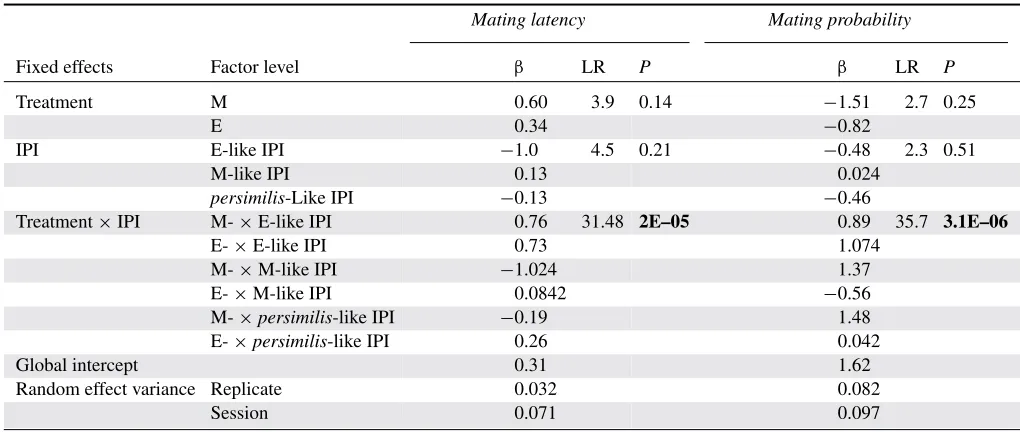
Table 2. Output of the mixed models for mating latency and mating probability analyses, including model estimates and tests statistics.
Mating latency Mating probability
Fixed effects Factor level β LR P β LR P
Treatment M 0.60 3.9 0.14 −1.51 2.7 0.25
E 0.34 −0.82
IPI E-like IPI −1.0 4.5 0.21 −0.48 2.3 0.51
M-like IPI 0.13 0.024
persimilis-Like IPI −0.13 −0.46
Treatment×IPI M-×E-like IPI 0.76 31.48 2E–05 0.89 35.7 3.1E–06
E-×E-like IPI 0.73 1.074
M-×M-like IPI −1.024 1.37
E-×M-like IPI 0.0842 −0.56
M-×persimilis-like IPI −0.19 1.48
E-×persimilis-like IPI 0.26 0.042
Global intercept 0.31 1.62
Random effect variance Replicate 0.032 0.082
Session 0.071 0.097
The effects of sexual selection treatment, IPI, and their interaction on the response variable (mating latency or mating probability) were tested using
likelihood ratio tests. Treatment is the sexual selection treatment (E is for polyandrous and M for monogamous), IPI is the artificial song tested (EE-like, E-like, M-like, orpersimilis-like IPI),βis the model estimate, LR is the likelihood ratio statistics, andPis theP-value with bolded values being significant. models were analyzed using the librarylme4(Bates and Sarkar
2007) in R 2.12.2 (R Development Core Team 2013).
Results
As predicted if sexual selection results in divergent female mat-ing preference for male matmat-ing signal, both female matmat-ing la-tency and mating probability are strongly affected by the interac-tion between female sexual selecinterac-tion treatment and artificial song (Table 2). Selection line females show distinct and opposite pat-terns of mating preference (Fig. 2). Females from E lines mate faster under conditions of short IPI values (E-like and EE-like IPIs) and females from M lines mate faster under conditions of long IPI values (M-like and persimilis-like IPIs; Fig. 2a and Table 2). However, there are broadly overlapping confidence in-tervals, with the exception of preference for M-like IPI. Mating probability is also affected by the interaction between female treatment and artificial song but shows a more pronounced pat-tern of response compared to mating latency (Fig. 2b and Table 2). Females from E lines are more likely to mate than females from M lines (80.5% of E females vs. 62.9% of M females mated) when an E-like IPI is being played, whereas females from M lines are more likely to mate than females from E lines (81.3% of M females vs. 56.8% of E females mated) when an M-like IPI is played (Fig. 2b and Table 2). Further, females from E lines are more likely to mate than females from M lines (68.7% of E females vs. 53.6% of M females mated) with very short IPI values (EE-like IPI), and females from M lines are more likely to mate than females from E
lines (76.3% of M females vs. 59.7% of E females) for very long IPI values (persimilis-like IPI). Hence, these differences between selection line females extend beyond the limits of experimentally evolved E and M IPI variation.
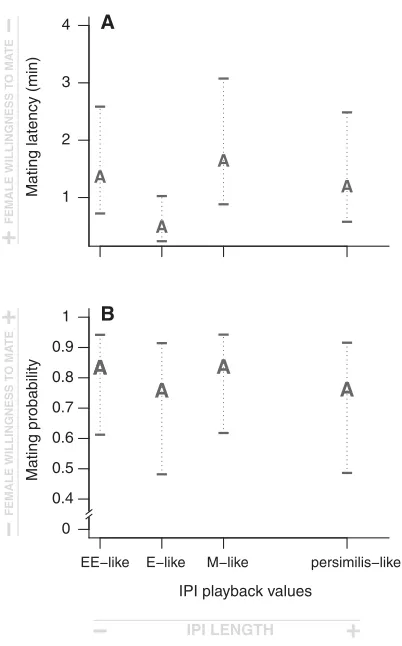
The confidence interval of ancestral female mating latency (Fig. 3a) is wide for both songs with longer IPI values (M-like IPI and persimilis-like IPI), but more restricted for the two shorter IPI values (EE-like IPI and E-like IPI). Ancestral females also show a high level of acceptance for all the four IPI values, overlapping either with M or E females ranges, and with greater variability (Fig. 3b)
Discussion
M − − E − − M − − E − − M − − E − − M − − E − − 1 2 3 4
Mating latency (min)
FEMALE WILLINGNESS T
O MA TE
+−
A M − −E − − M − −E − − M − − E − − M − − E − −EE−like E−like M−like persimilis−like
0 0.4 0.5 0.6 0.7 0.8 0.9 1
IPI playback values
Mating probability
FEMALE WILLINGNESS T
[image:6.612.342.543.64.387.2]O MA TE
−+
IPI LENGTH−
+
BFigure 2. Mating preference functions for IPI of selection line fe-males (E and M) for mating latency (A) and mating probability (B). The two figures show that E and M females present oppo-site mating preference functions for IPI, for both mating latency and mating probability. The letters represent the fitted values es-timated by the mixed-model associated with the four artificial songs, depending on female sexual selection treatment. M is for females from monogamous lines and E is for females from polyan-drous lines. Ninety-five percent confidence intervals around each estimated value are represented.
to mate when presented with a monogamous-like IPI (M-like IPI). Mating latency was affected in the same direction as mating probability, although to a lesser degree. Thus, our results suggest that female mating preference has coevolved with male courtship song and diverged between our populations, providing evidence for the divergence of a mating preference for a mating signal, within species, caused by sexual selection manipulation.
Mating trait divergence is generally expected to arise among populations experiencing high sexual selection intensity (West-Eberhard 1983; Panhuis et al. 2001; Ritchie 2007), initiated ei-ther by drift (Lande 1981; Uyeda et al. 2009) or differences in environmental conditions (van Doorn et al. 2009), Here, how-ever, we observe that mating trait divergence arose between populations evolving under different sexual selection intensities. Natural populations are often subjected to different ecological and demographic conditions, resulting in different intensities of sexual selection among populations (Lott 1991). Differences in
A − − A − − A − − A − − 1 2 3 4
Mating latency (min)
FEMALE WILLINGNESS T
O MA TE
+−
A A A − − A − − A − − A − −EE−like E−like M−like persimilis−like 0 0.4 0.5 0.6 0.7 0.8 0.9 1
IPI playback values
Mating probability
FEMALE WILLINGNESS T
O MA TE
−+
IPI LENGTH−
+
BFigure 3. Mating preference functions for IPI of ancestral fe-males, for mating latency (A) and mating probability (B). The two figures show that ancestral females present a relatively flat mat-ing preference function for IPI, for both matmat-ing latency and matmat-ing probability. The letters represent the fitted values estimated by the mixed-model associated with the four artificial songs. A is for an-cestral females. Ninety-five percent confidence intervals around each estimated value are represented.
parental investment (Trivers 1972; Emlen and Oring 1977), cost of breeding (Letters et al. 2001), resource distribution (Travis et al. 1995; Streatfeild et al. 2011), operational sex ratio (Weir et al. 2011), or the ability of the environment to propagate signals (Boughman 2001), can result in variation of sexual selection in-tensity among populations (Arnqvist 1992; Kwiatkowski and Sul-livan 2002; Mobley and Jones 2007). Changes in the strength of sexual selection could not only have consequences on the nature of the mating traits targeted by selection, but also on the nature of the sexual selection mechanisms acting on these traits (i.e., di-rect or indidi-rect selection) and on the form of selection operating. Variation in sexual selection intensity among populations may thus affect both the direction and strength of selection on mating trait in these populations, providing additional opportunities for mating trait divergence to occur.
[image:6.612.89.269.65.364.2]et al. 2003, 2006; Jones and Ratterman 2009; Kuijper et al. 2011). In D. pseudoobscura, any direct benefits resulting from mate choice are unknown. In the absence of direct benefits and strong direct selection on mating preference, indirect benefits may be sufficient to maintain a mating preference and drive the coevolu-tion of mating traits (Kirkpatrick 1996). E IPI has evolved away from M- and ancestral IPI toward a shorter pulse repetition rate. As pulse repetition rate increases, the cost of this trait is likely to increase. Moreover, short IPI values are associated with an increased overall courtship performance (faster speed to initiate courtship; Snook et al. 2005 and more bursts produced; Debelle 2013). One hypothesis to explain our results is that sexual selec-tion results in direcselec-tional selecselec-tion on male courtship song toward short IPI values which may select for more active males (i.e., ex-hibiting an increased courtship performance) which females from E lines prefer. Under high levels of male–male competition, se-lecting more active males could constitute a substantial source of indirect benefits via good genes or sexy sons (Wong and Candolin 2005). How females gain from their mate preference and the costs of such choice has yet to be studied.
Females from M lines evolved under enforced monogamy, and yet discriminate against E-like values of IPI. Female prefer-ence is expected to be strongly counterselected when its expres-sion results in direct costs for the female (Jennions and Petrie 1997). Fertility costs can be very important for females in the monogamous lines, as refusing to mate with the one randomly assigned male in her vial will result in zero fitness. However, a preference can be maintained when the benefits of express-ing it outweigh the costs (Jennions and Petrie 1997). Contrary to females from E lines, females from M lines mate preferen-tially with a long IPI, and therefore may benefit from a selec-tive advantage by favoring males who invest less in courting. Direct costs of male–female sexual interactions have been inves-tigated in our selection lines, as well as otherDrosophilaspecies. Male courtship inflicts longevity costs to both males and females (Partridge and Farquhar 1981; Partridge et al. 1987; Partridge and Fowler 1990; Cordts and Partridge 1996; Holland and Rice 1999; Friberg and Arnqvist 2003). Female fecundity is negatively af-fected by male courtship intensity inD. melanogaster (Friberg and Arnqvist 2003), and by male-biased sex ratios inD. pseu-doobscura(Crudgington et al. 2005). Males and females share similar reproductive interests in M populations, and therefore re-ducing direct costs due to courtship and matings is likely to be under strong direct selection. The long IPI values of males from M lines, preferred by females from M lines, may be associated with less intense courtship and less costly matings. Indeed, males from M lines court less and achieve fewer matings than males from E lines (Crudgington et al. 2009), therefore reducing the direct courtship and mating costs on both females and males. A relaxation of sexual conflict may thus have driven the evolution
of M female preference in the opposite direction of E female preference, as accepting to mate with less-active and less-harmful males is likely to be selected for in a monogamous context. Hence, mating trait coevolution may likely be resulting from the action of two different selection mechanisms, causing the mating traits of the two sexual selection treatments to evolve in different di-rections. More work will be needed to identify the exact selective mechanisms involved in the observed divergence of mating traits. Population-level variation in mating preference is required for mating trait divergence to evolve, but remains relatively poorly studied (Jennions and Petrie 1997; Wagner 1998; Widemo and Sæther 1999; Bailey 2008). Here, we observe an absence of dis-crimination against IPI by ancestral females at the population level, whereas selection line females actively discriminate be-tween different IPI values. As IPI has been previously shown to influenceD. pseudoobscura–persimilishybrid male mating suc-cess (Williams et al. 2001), a discrimination in our ancestral pop-ulation againstpersimilis-like IPI could be expected. However, as the geographical location of the ancestral population used in this study was both outside the range ofD. persimilisdistribution and different from the population used by Williams et al. (2001), dis-crimination againstpersimilis-like IPI in our ancestral population is a necessary outcome. Furthermore, the nondiscriminatory pat-tern of ancestral females against the entire range of IPI values at the population level does not mean an absence of discrimination against IPI at the individual level in this population (Wagner 1998; Widemo and Sæther 1999). The fact that IPI values are differen-tially discriminated against in the selection lines derived from the ancestral population, and this in opposite directions between the sexual selection treatments, suggests that variation in mating preference for IPI is present in the ancestral population (or has been present at first and secondarily been lost; Wiens 2001). The flat mating preference function observed at the population level in the ancestral population may thus reflect the variation in mating preference present in this population (both at the intra- and in-terindividual levels) recruited in contrasting directions by sexual selection in the selection lines. Investigating the structure of mat-ing preference variation is essential to understand and predict the divergence of mating traits between populations, and ultimately species (Maan and Seehausen 2011; Weissing et al. 2011), and thus studying mating preference variation in our populations may help to determine the impact of variation structure on the possible direction of mating trait evolution via sexual selection (Jennions and Petrie 1997; Wagner 1998).
this divergence in mating traits generates sexual isolation between populations experiencing different intensities of sexual selection, to understand whether sexual selection has the potential to be an important driving force in speciation.
ACKNOWLEDGMENTS
We are grateful to A. Turner for technical assistance with experimental flies collections and for the endless wing clipping sessions, and to A. Courtiol for discussions about statistical analyses. This work was funded by the Marie Curie Initial Training Network “Understanding the evolu-tionary origin of biological diversity” (ITN-2008-213780 SPECIATION), and by a U.S. National Science Foundation grant and NERC grants to RRS. We thank all the participants of this network for fruitful comments and discussions about this project, and particularly A. Hoikkala for her helpful insight throughout the project.
DATA ARCHIVING
The doi for our data is doi:10.5061/dryad.3h7g8.
LITERATURE CITED
Anderson, W. 1974. Frequent multiple insemination in a natural population ofDrosophila pseudoobscura. Am. Nat. 108:709–711.
Andersson, M. B. 1996. Sexual selection. Trends Ecol. Evol. 11:53– 58.
Arnqvist, G. 1992. Spatial variation in selective regimes: sexual selec-tion in the water strider, Gerris odontogaster. Evolution 46:914– 929.
Bacigalupe, L. D., H. S. Crudgington, F. Hunter, A. J. Moore, and R. R. Snook. 2007. Sexual conflict does not drive reproductive isolation in experimental populations ofDrosophila pseudoobscura. J. Evol. Biol. 20:1763–1771.
Bacigalupe, L. D., H. S. Crudgington, J. Slate, A. J. Moore, and R. R. Snook. 2008. Sexual selection and interacting phenotypes in experimental evo-lution: a study ofDrosophila pseudoobscuramating behavior. Evolution 62:1804–1812.
Bailey, N. W. 2008. Love will tear you apart: different components of female choice exert contrasting selection pressures on male field crickets. Behav. Ecol. 19:960–966.
Bates, D., and D. Sarkar. 2007. lme4: linear mixed-effects models using S4 classes. R package version 0.9975-13.
Bennet-Clark, H. 1971. Acoustics of insect song. Nature 234:255–259. Bennet-Clark, H., A. Ewing, and A. Manning. 1973. The persistence
of courtship stimulation in Drosophila melanogaster. Behav. Biol. 769:763–769.
Boughman, J. W. 2001. Divergent sexual selection enhances reproductive isolation in sticklebacks. Nature 411:944–948.
Boughman, J. W., H. D. Rundle, and D. Schluter. 2005. Parallel evolution of sexual isolation in sticklebacks. Evolution 59:361–373.
Brooks, R., and V. Couldridge. 1999. Multiple sexual ornaments coevolve with multiple mating preferences. Am. Nat. 154:37–45.
Casares, P., M. Carracedo, B. del Rio, R. Pineiro, L. Garcia-Florez, and A. R. Barros. 1998. Disentangling the effects of mating propensity and mating choice in Drosophila. Evolution 52:126–133.
Cordts, R., and L. Partridge. 1996. Courtship reduces longevity of male
Drosophila melanogaster. Anim. Behav. 52:269–278.
Coyne, J. A., and H. A. Orr. 2004. Speciation. Sinauer Associates, Sunderland, MA.
Crudgington, H. S., A. P. Beckerman, L. Br¨ustle, K. Green, and R. R. Snook. 2005. Experimental removal and elevation of sexual selection: does
sexual selection generate manipulative males and resistant females? Am. Nat. 165:S72–S87.
Crudgington, H. S., S. Fellows, N. S. Badcock, and R. R. Snook. 2009. Experimental manipulation of sexual selection promotes greater male mating capacity but does not alter sperm investment. Evolution 63:926– 938.
Crudgington, H. S., S. Fellows, and R. R. Snook. 2010. Increased opportu-nity for sexual conflict promotes harmful males with elevated courtship frequencies. J. Evol. Biol. 23:440–446.
Debelle, A. 2013. The role of sexual selection in the evolution of reproductive isolation. Ph.D. Thesis, University of Sheffield, Sheffield, U.K. Emlen, S., and L. Oring. 1977. Ecology, sexual selection, and the evolution
of mating systems. Science 197:215–223.
Ewing, A. 1964. The influence of wing area on the courtship behaviour of
Drosophila melanogaster. Anim. Behav. 12:316–320.
Fisher, R. 1930. The genetical theory of natural selection. Claredon Press, Oxford, U.K.
Friberg, U., and G. Arnqvist. 2003. Fitness effects of female mate choice: preferred males are detrimental forDrosophila melanogasterfemales. J. Evol. Biol. 16:797–811.
Garland, T., and M. R. Rose. 2009. Experimental evolution: concepts, meth-ods, and applications of selection experiments. University of California Press, Berkeley, CA.
Gavrilets, S. 2000. Rapid evolution of reproductive barriers driven by sexual conflict. Nature 403:886–889.
Gilbert, D. G. D., and W. T. T. Starmer. 1985. Statistics of sexual isolation. Evolution 39:1380–1383.
Hall, J. 1986. Learning and rythms in courting, mutant Drosophila. Trends Neurosci. 2:414–418.
Heymann, M. 2007. sound: a sound interface for R. R package version 1.1. Higashi, M., G. Takimoto, and N. Yamamura. 1999. Sympatric speciation by
sexual selection. Nature 402:523–526.
Hoikkala, A., J. Aspi, and L. Suvanto. 1998. Male courtship song frequency as an indicator of male genetic quality in an insect species,Drosophila montana. Proc. R. Soc. B Biol. Sci. 265:503–508.
Holland, B., and W. R. Rice. 1999. Experimental removal of sexual selection reverses intersexual antagonistic coevolution and removes a reproductive load. Proc. Natl. Acad. Sci. USA 96:5083–5088.
Hoskin, C. J., and M. Higgie. 2010. Speciation via species interactions: the divergence of mating traits within species. Ecol. Lett. 13:409–420. Houde, A. 1994. Effect of artificial selection on male colour patterns on
mating preference of female guppies. Proc. R. Soc. Lond. Ser. B. Biol. Sci. 256:125–130.
ITN Marie Curie Speciation. 2011. What do we need to know about speciation? Trends Ecol. Evol. 27:27–39.
Jennions, M. D., and M. Petrie. 1997. Variation in mate choice and mating preferences: a review of causes and consequences. Biol. Rev. Camb. Philos. Soc. 72:283–327.
———. 2000. Why do females mate multiply? A review of the genetic bene-fits. Biol. Rev. Camb. Philos. Soc. 75:21–64.
Jones, A. G., and N. L. Ratterman. 2009. Mate choice and sexual selec-tion: what have we learned since Darwin? Proc. Natl. Acad. Sci. USA 106:10001–10008.
Kirkpatrick, M. 1996. Good genes and direct selection in the evolution of mating preferences. Evolution 50:2125–2140.
———. 1982. Sexual selection and the evolution of female choice. Evolution 36:1–12.
Kirkpatrick, M., and V. Ravign´e. 2002. Speciation by natural and sexual selection: models and experiments. Am. Nat. 159:S22–S35.
Kokko, H., M. D. Jennions, and R. Brooks. 2006. Unifying and testing models of sexual selection. Annu. Rev. Ecol. Evol. Syst. 37:43–66.
Kraaijeveld, K., F. J. Kraaijeveld-Smith, and M. E. Maan. 2010. Sexual se-lection and speciation: the comparative evidence revisited. Biol. Rev. 86:367–377.
Kuijper, B., I. Pen, and F. J. Weissing. 2011. A guide to sexual selection theory. Annu. Rev. Ecol. Evol. Syst. 43:287–311.
Kwiatkowski, M., and B. Sullivan. 2002. Geographic variation in sexual se-lection among populations of an iguanid lizard, Sauromalus obesus. Evolution 56:2039–2051.
Lande, R. 1981. Models of speciation by sexual selection on polygenic traits. Proc. Natl. Acad. Sci. USA 78:3721–3725.
Letters, E., H. Kokko, and P. Monaghan. 2001. Predicting the direction of sexual selection. Ecol. Lett. 4:159–165.
Lott, D. F. 1991. Intraspecific variation in the social systems of wild verte-brates. Cambridge Univ. Press, Cambridge, U.K.
Maan, M. E., and O. Seehausen. 2011. Ecology, sexual selection and specia-tion. Ecol. Lett. 14:591–602.
Maan, M. E., K. D. Hofker, J. J. M. van Alphen, and O. Seehausen. 2006. Sensory drive in cichlid speciation. Am. Nat. 167:947–954.
Martin, O. Y., and D. J. Hosken. 2003. The evolution of reproductive isolation through sexual conflict. Nature 423:979–982.
Mendelson, T., and K. Shaw. 2005. Sexual behaviour: rapid speciation in an arthropod. Nature 433:375–376.
Mobley, K. B., and A. G. Jones. 2007. Geographical variation in the mating system of the dusky pipefish (Syngnathus floridae). Mol. Ecol. 16:2596– 2606.
Noor, M., and C. Aquadro. 1998. Courtship songs ofDrosophila pseudoob-scuraandD. persimilis: analysis of variation. Anim. Behav. 56:115–125. Panhuis, T. M., R. Butlin, M. Zuk, and T. Tregenza. 2001. Sexual selection
and speciation. Trends Ecol. Evol. 16:364–371.
Partridge, L., and M. Farquhar. 1981. Sexual activity reduces lifespan of male fruitflies. Nature 294:580–582.
Partridge, L., and K. Fowler. 1990. Non-mating costs of exposure to males in femaleDrosophila melanogaster. J. Insect Physiol. 36:419–425. Partridge, L., A. Green, and K. Fowler. 1987. Effects of egg-production and
of exposure to males on female survival inDrosophila melanogaster. J. Insect Physiol. 33:745–749.
R Development Core Team. 2013. R: a language and environment for statistical computing. R Foundation for Statistical Computing, Vienna, Austria. ISBN 3–900051–07–0, available at http://www.R-project.org/. Ritchie, M. G. 1996. The shape of female mating preferences. Proc. Natl.
Acad. Sci. USA 93:14628–14631.
———. 2007. Sexual selection and speciation. Annu. Rev. Ecol. Evol. Syst. 38:79–102.
Ritchie, M. G., E. J. Halsey, and J. M. Gleason. 1999. Drosophila song as a species-specific mating signal and the behavioural importance of Kyriacou & Hall cycles inD. melanogastersong. Anim. Behav. 58:649– 657.
Rodr´ıguez, R. L., J. W. Boughman, D. A. Gray, E. A. Hebets, G. H¨obel, and L. B. Symes. 2013. Diversification under sexual selection: the relative roles of mate preference strength and the degree of divergence in mate preferences. Ecol. Lett. 16:964–974.
Rundle, H. D., and S. F. Chenoweth. 2005. Divergent selection and the evolu-tion of signal traits and mating preferences. PLoS Biol. 3:1988–1995. Rundle, H. D., and P. Nosil. 2005. Ecological speciation. Ecol. Lett. 8:336–
352.
Rundle, H. D., S. F. Chenoweth, and M. W. Blows. 2009. The diversification of mate preferences by natural and sexual selection. J. Evol. Biol. 22:1608– 1615.
Rybak, F., T. Aubin, B. Moulin, and J.-M. Jallon. 2002. Acoustic communi-cation inDrosophila melanogastercourtship: are pulse- and sine-song frequencies important for courtship success? Can. J. Zool. 80:987–996. Saarikettu, M., J. O. Liimatainen, and A. Hoikkala. 2005. The role of male courtship song in species recognition inDrosophila montana. Behav. Genet. 35:257–263.
Safran, R. J., E. S. C. Scordato, L. B. Symes, R. L. Rodr´ıguez, and T. C. Mendelson. 2013. Contributions of natural and sexual selection to the evolution of premating reproductive isolation: a research agenda. Trends Ecol. Evol. 28:643–650.
Shaw, K. L. 2000. Interspecific genetics of mate recognition: inheritance of female acoustic preference in Hawaiian crickets. Evolution 54:1303– 1312.
Shaw, K. L., and D. P. Herlihy. 2000. Acoustic preference functions and song variability in the Hawaiian cricketLaupala cerasina. Proc. Biol. Sci. 267:577–584.
Sivinski, J., and J. Webb. 1985. Sound production and reception in the caribfly,
Anastrepha suspensa(Diptera: Tephritidae). Florida Entomol. 68:273– 278.
Snook, R. R., and T. A. Markow. 2001. Mating system evolution in sperm-heteromorphic Drosophila. J. Insect Physiol. 47:957–964.
Snook, R., A. Robertson, H. Crudgington, and M. Ritchie. 2005. Experimental manipulation of sexual selection and the evolution of courtship song in
Drosophila pseudoobscura. Behav. Genet. 35:245–255.
Snook, R. R., L. Br¨ustle, and J. Slate. 2009. A test and review of the role of effective population size on experimental sexual selection patterns. Evolution 63:1923–1933.
Sobel, J. M., G. F. Chen, L. R. Watt, and D. W. Schemske. 2010. The biology of speciation. Evolution 64:295–315.
Streatfeild, C. A., K. E. Mabry, B. Keane, T. O. Crist, and N. G. Solomon. 2011. Intraspecific variability in the social and genetic mating sys-tems of prairie voles,Microtus ochrogaster. Anim. Behav. 82:1387– 1398.
Sueur, J., T. Aubin, and C. Simonis. 2008. Equipment review seewave, a free modular tool for sound analysis and synthesis. Int. J. 18:213– 226.
Talyn, B. C., H. B. Dowse, and S. Bernardino. 2004. The role of courtship song in sexual selection and species recognition by femaleDrosophila melanogaster. Anim. Behav. 68:1165–1180.
Travis, S., C. Slobodchikoff, and P. Keim. 1995. Ecological and demographic effects on intraspecific variation in the social system of prairie dogs. Ecology 1794–1803.
Trivers, R. 1972. Parental investment and sexual selection. Pp. 136–179in
B. Campbell, ed. Sexual selection and the descent of man. Heinemann, London.
Turner, G. F., and M. T. Burrows. 1995. A model of sympatric speciation by sexual selection. Proc. R. Soc. Lond. Ser. B Biol. Sci. 260:287–292. Uyeda, J. C., S. J. Arnold, P. Hohenlohe, and L. S. Mead. 2009. Drift promotes
speciation by sexual selection. Evolution 63:583–594.
Van Doorn, G. S., P. Edelaar, and F. J. Weissing. 2009. On the origin of species by natural and sexual selection. Science 326:1704–1707.
Wagner, W. 1998. Measuring female mating preferences. Anim. Behav. 55:1029–1042.
Weir, L. K., J. W. A. Grant, and J. A. Hutchings. 2011. The influence of operational sex ratio on the intensity of competition for mates. Am. Nat. 177:167–176.
Weissing, F. J., P. Edelaar, and G. S. van Doorn. 2011. Adaptive speciation theory: a conceptual review. Behav. Ecol. Sociobiol. 65:461–480. West-Eberhard, M. M. J. 1983. Sexual selection social competition and
Widemo, F., and S. Sæther. 1999. Beauty is in the eye of the beholder: causes and consequences of variation in mating preferences. Trends Ecol. Evol. 14:26–31.
Wiens, J. J. 2001. Widespread loss of sexually selected traits: how the peacock lost its spots. Trends Ecol. Evol. 16:517–523.
Wilkinson, G. S., and P. R. Reillo. 1994. Female choice response to artificial selection on an exaggerated male trait in a stalk-eyed fly. Proc. R. Soc. B Biol. Sci. 255:1–6.
Williams, M. A., A. G. Blouin, and M. A. F. Noor. 2001. Courtship songs ofDrosophila pseudoobscuraandD. persimilis. II. Genetics of species differences. Heredity 86:68–77.
Wong, B. B. M., and U. Candolin. 2005. How is female mate choice af-fected by male competition? Biol. Rev. Camb. Philos. Soc. 80:559– 571.
Associate Editor: A. Maklakov
Supporting Information
Additional Supporting Information may be found in the online version of this article at the publisher’s website: