warwick.ac.uk/lib-publications
Original citation:
Suwondo, Riza, Gillie, Martin, Cunningham, Lee and Bailey, Colin. (2018) Effect of
earthquake damage on the behaviour of composite steel frames in fire. Advances in
Structural Engineering.
Permanent WRAP URL:
http://wrap.warwick.ac.uk/99184
Copyright and reuse:
The Warwick Research Archive Portal (WRAP) makes this work by researchers of the
University of Warwick available open access under the following conditions. Copyright ©
and all moral rights to the version of the paper presented here belong to the individual
author(s) and/or other copyright owners. To the extent reasonable and practicable the
material made available in WRAP has been checked for eligibility before being made
available.
Copies of full items can be used for personal research or study, educational, or not-for profit
purposes without prior permission or charge. Provided that the authors, title and full
bibliographic details are credited, a hyperlink and/or URL is given for the original metadata
page and the content is not changed in any way.
Publisher’s statement:
This had been posted ahead of publication.
Suwondo, Riza, Gillie, Martin, Cunningham, Lee and Bailey, Colin. (2018) Effect of
earthquake damage on the behaviour of composite steel frames in fire. Advances in
Structural Engineering. Copyright © 2018 The Authors. Reprinted by permission of SAGE
Publications.
http://journals.sagepub.com/home/asea
A note on versions:
The version presented here may differ from the published version or, version of record, if
you wish to cite this item you are advised to consult the publisher’s version. Please see the
‘permanent WRAP url’ above for details on accessing the published version and note that
access may require a subscription.
Effect of earthquake damage on the behaviour of composite steel frame in fire
Riza Suwondo, Martin Gillie, Lee Cunningham, Colin Bailey
Abstract
Fire loading following earthquake loading is possible in any building in a seismic prone area. However, most design approaches do not consider fire following earthquake as a specific loading case. Moreover, seismic design philosophies allow a certain degree of damage in structural elements which make structures more vulnerable when subjected to post-earthquake fire. This study uses three dimensional numerical models to investigate the effect of earthquake damage on the fire resistance of composite steel-frame office buildings. Two types of earthquake damage, fire insulation delamination and residual lateral frame deformation, are investigated. It is concluded that earthquake damage can significantly reduce the fire resistance of composite buildings, with delamination of fire protection having the greatest effect. The results of this study can be used by designers to improve the post-earthquake fire resistance of composite buildings.
Keywords: fire following earthquake; fire engineering; earthquake engineering; fire insulation; composite construction
1. Introduction
Fire occurring after earthquake has been demonstrated to be a major threat for buildings in seismic prone regions. Damage caused by fire following earthquake can be worse than that caused by the earthquake itself (Scawthorn et al., 2005). Recorded experiences indicate that fire following earthquake has caused numerous deaths and extensive losses. For example, it was estimated that 80% of total damage and fatalities in the 1906 San Francisco seismic event were caused by fires following the earthquake (Scawthorn, 2008). In the 1923 Tokyo earthquake, the losses due to fire following the earthquake accounted for over 70% of total building losses and resulted in 140,000 deaths (Scawthorn, 2008). More recently, in the 1995 Kobe earthquake, there were approximately 7000 buildings destroyed by fire following earthquake (Faggiano, 2007).
level. However, the fire resistance of the frames was still the same when the frame did not exceed the operational performance level limit.
Zaharia and Pintea (2009) presented post-earthquake fire resistance of two different seismically designed frames (moderate and severe seismic regions). The results showed that the frame designed for stronger seismic effects had a higher fire resistance rating in case of post-earthquake fire. Memari et al. (2014) presented post-earthquake fire performance of moment resisting frames with reduced beam section (RBS) connections. Post-earthquake fire exposure was only at the location of the RBS connections based on the assumption that fire insulation was damaged at the RBS connection after earthquake. The results showed that a post-earthquake fire produces smaller inter-storey drift ratios (IDR) than the earthquake itself. No structural collapse occurred as result of applied post-earthquake fires. Behnam and Ronagh (2015) performed pushover and thermal analyses to investigate the behaviour of 2D steel frames. Fire analysis only was also performed on an undamaged frame, as a benchmark. The results revealed that the damaged frames have lower fire resistance than the corresponding undamaged frame.
All of the aforementioned studies have focused on non-composite steel frames. Most of these structures have been analysed assuming 2D plane-frame behaviour, without considering the effects of out of plane behaviour. By contrast the current study focusses on composite steel-frame, concrete floor construction as is commonly used in mid-rise commercial frame structures. Although some essential aspects of the behaviour of these structures in fire can be captured in two dimensions, such an approach misses load redistribution in the out of plane direction which is a key load carrying mechanism available at large deflections, as identified by the Cardington fire tests (Gillie et al., 2001; Kirby, 1998). Thus, when a composite slab is present, three dimensional behaviour must be considered in an analysis to obtain realistic behaviour on a steel frame in fire. Additionally, previous research on post-earthquake fire behaviour has focused on unprotected steel frames. There is as yet a lack of detailed research into the influence of fire insulation on steel frames during fire following earthquake.
To address these knowledge gaps, the present study extends Suwondo et al.’s (2017) previous work on post-earthquake fire behaviour of composite steel-framed structures. Three dimensional numerical models are employed to simulate post-earthquake fires on earthquake damaged structures. Two types of damage, fire insulation delamination and residual lateral frame deformation, are investigated to represent earthquake damage. The consideration of the two types of damage will be explained in section 3. The main objectives of this study are to understand the influence of:
1. Delamination of the fire insulation on primary beams due to earthquake damage; 2. Delamination of the fire insulation on columns due to earthquake damage;
3. Residual deformation on the post-earthquake fire behaviour of composite steel frames. The remainder of this paper is structured as follows: a description of the generic building studied; the types of damage considered, the modelling approach adopted; the results of the study; and conclusions.
2. Generic building
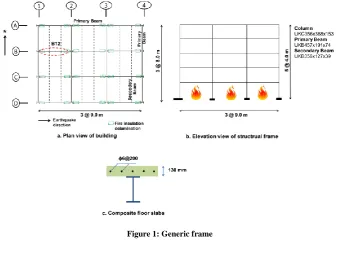
columns and beams with a yield stress of 355 MPa and Young’s modulus of 210 GPa at ambient temperature. The compressive strength of concrete in the slabs was taken as 30 MPa and the yield strength of the rebar is 450 MPa. Thermal expansion of steel and concrete are taken as 1.35x10⁵oC-1
and 9x10⁵ oC-1, respectively. The concrete and steel properties at elevated temperatures follow the
recommendations in Eurocode EN 1992-1-2 (CEN, 2004c) and EN 1993-1-2 (CEN, 2005b). The concrete slabs have a thickness of 130 mm and the rebar mesh consists of 6 mm diameter bars at 200 mm centres each way as shown in Figure 1c.
Primary beams and columns are assumed to be protected with a 10 mm thickness of lightweight insulating material which has thermal conductivity of 0.2 W/mK, specific heat of 1100 J/kgK and density of 300 kg/m3. In order to utilise tensile membrane action in the slab panels, which are
surrounded by the primary beams, the secondary beams are left unprotected, as is common in a performance-based fire design. The total design load at fire the limit state (1xdead+0.5xlive) is taken as 5.5 kN/m2. This load level results in a load ratio for the internal columns at bottom level and primary
[image:4.595.54.394.380.645.2]beams of 0.3 and 0.5, respectively. The load ratio is defined as the ratio of the applied load to the bearing capacity of a member and no further load reduction is considered. For simplicity, the columns are assumed to have the same section size at all heights. Only the ground floor is exposed to fire. The ground floor is assumed to have the worst fire scenario since the columns have the largest load ratio compared to upper floor. Moreover, the plastic hinges will only form during earthquake in the columns at ground floor so they are most likely to be damaged at ground level.
Figure 1: Generic frame
3. Earthquake damage
A key aspect of post-earthquake fire analysis is determining a structure’s physical state after an earthquake as this represents the initial condition for the subsequent fire event. It is well known that providing detailed information regarding earthquake damage is difficult due to randomness and uncertainties of both structural properties and earthquake vibration. Accordingly, in this study two generic types of earthquake damage are considered: fire insulation delamination and residual lateral frame deflections as a result of plastic deformations developed during the earthquake.
3.1 Fire insulation delamination
The philosophy of seismic design permits a certain degree of damage to structural elements. Past events have demonstrated that earthquakes can cause damage to active fire protection systems such as sprinklers and reduce the effectiveness of fire-fighting capability. Thus, passive fire protection systems, such as sprayed fire resistive material (SFRM), play a critical role in mitigating the effect of the post-earthquake fire on the structural system in a building. However, SFRM may also be damaged by becoming detached. Both experimental and field observations have indicated that SFRM can delaminate under static and dynamic load situations (Arablouei and Kodur, 2015; Braxtan and Pessiki, 2011; Kodur and Arablouei, 2015; Wang et al., 2013). SFRM delamination is most likely to occur in locations of high strain, such as where plastic hinges form.
Figure 2: Fire insulation delamination on the beam and column
3.2 Residual deformation
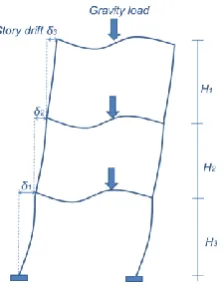
[image:6.595.171.283.359.503.2]Residual frame deformation is the irreversible lateral deformation that remains after an earthquake. This deformation can be dangerous since it enhances P-Δ effects that can increase stress on the structure under loads acting after the earthquake as illustrated in Figure 3. The repetitions of plastic deformations during the earthquake also cause some reduction of mechanical properties. However, for moment resisting frames designed according to Eurocode 8, the plastic deformation is relatively small. In this case, the reduction of mechanical properties is negligible (Della Corte et al., 2003). Therefore, an ideal elastic-perfectly plastic structure with a non-degrading component is considered in this study. As discussed in (Bruneau et al., 1997; Della Corte et al., 2002), the structural damage is mainly caused by inter-storey drift ratio. Thus, there is good agreement that the inter-storey drift ratio can be used for measuring damage of a frame under an earthquake. The inter-storey drift ratio is the ratio between storey displacement relative to the adjacent storey, and the storey height. Inter-storey drift ratio may also be associated with local plastic deformation (Gupta and Krawinkler, 2000).
Figure 3: Residual deformation of structure after earthquake
The level of residual deformation after an earthquake was here estimated by performing a “pushover analysis”. In a pushover analysis, the building is pushed incrementally using a specific lateral load to arrive at a target displacement, the load is then reduced to zero again. Lateral storey forces on the structure are applied in proportion to the product of storey mass and fundamental mode shape (ATC, 1996). The target displacement (represented by the roof displacement) is the expected displacement of the building when subjected to a design earthquake. The residual deformation pushover analysis results can be used as an initial step for the subsequent fire event. Pushover analysis is an approximate method and dynamic effects are not directly considered.
This study considers two different levels of damages, Damage-1 and Damage-2. Damage-1 is LS level with IDR 2% and Damage-2 is CP level with IDR 4.5%. Local buckling is not a possible failure mechanism in the composite structural form analysed so was not considered here. This assumption is in-line with the philosophy of seismic design that performance levels of structures do not exceed the intended level when subjected to design earthquake. Material deterioration other than plasticity was also not considered. Steel in the case of damage states considered here is unlikely to suffer permanent changes to its key parameters. Concrete may suffer from cracking during earthquake, which is crudely captured in the model, and possibly spalling during a fire. However, experimental and real fire experience suggests these effects are at worst secondary matters when considering structural behaviour during a fire. Spalling in the case of steel-deck composite construction is largely contained, for example. According to previous studies, spalling becomes important in elements with more than 4-5 cm cover (Majorana et al., 2010) or made of high-strength concrete (Kodur, 2005).
The two damage types discussed above are considered to represent earthquake damage in this study. It is apparent that when fire insulation delamination occurs, residual deformation always exists as a result of plastic deformation. Thus, the combined effect of fire insulation delamination and residual deformation could be considered. However, the aim of this study is to examine and quantify the effect of the two damage types separately in order to investigate which damage most significantly effects fire behaviour. For this reason the two types of damage have been analysed separately in this study.
4. Post-earthquake fire loading and failure
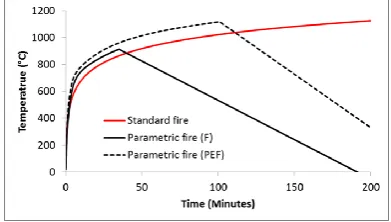
Two different fire scenarios, a “standard fire” (ISO, 1975) and parametric fire EN 1991-1-2 (CEN, 2002) as shown in Figure 4 were used to simulate post-earthquake fires in this research. The fire load of 511 MJ/m2 taken in the parametric fire is calculated according to Annex E of EN 1991-1-2 (CEN,
[image:7.595.127.323.539.650.2]2002), which is for office buildings. It should be noted that the parametric fire curve depends on several factors, such as ventilation, fire load, fire protection, etc. When an earthquake occurs, these factors may change which makes the appropriate parametric fire curve for use before an earthquake different to that for use after an earthquake. Opening factors of 0.06 and 0.08 are taken for the parametric fire before and after earthquake, respectively. This assumption is considered as there is a possibility of window breakage or damage to the building envelope after an earthquake that can increase the opening factor of the compartment. Moreover, fire-fighting measures may be different between fire in normal conditions and fire after earthquake. Using appropriate parameters from Table E.2 in Eurocode EN 1991-1-2 (2002), the assumed parametric fire after an earthquake (PEF) results in higher temperatures and a longer period than those that before an earthquake (F) as shown in Figure 4.
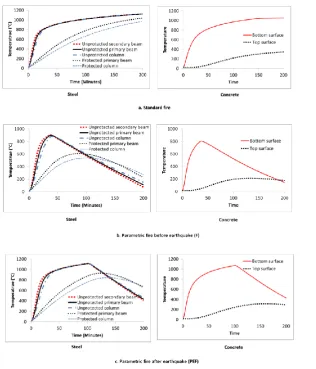
Since in modern buildings open-plan offices are the most common, full-floor compartments are considered and the hot gases are assumed uniform in the fire compartment. With these gas temperature-time curves, the procedure in Eurocode EN 1993-1-2 (CEN, 2005b) was used here to calculate the steel temperatures and a numerical heat transfer analysis to obtain concrete slab temperatures. Temperature-time curves for each fire scenario and for the steel and concrete are plotted in Figure 5.
Figure 5: Structural temperature
5. Numerical model and validation
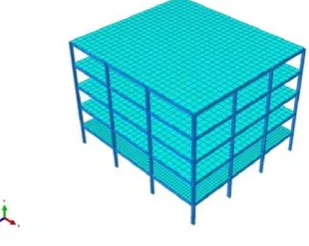
Structural performance of elements under fire can be affected by surrounding structure, due to the effect of thermal restraint (Ali and O’Connor, 2001; Laím and Rodrigues, 2016; Rodrigues and Laim, 2017; Valente and Neves, 1999). The axial restraint can generate extensive unforeseen forces in the element during fire that may cause unpredictable structural failure, in contrast to the rotational restraint, which can avoid a sudden failure. Thus, three dimensional frames as shown in Figure 6 are developed to consider thermal restraint affected by surrounding structure. A mesh size of 0.5 m x 0.5 m is used for first floor slab and a mesh size of 1.0 m x 1.0 m is used for the upper slab to save the computing cost. Eight elements are meshed for all columns and 18 elements for the beams.
Figure 6: Finite element mesh of the generic frame
A non-linear static analysis procedure was used because it was less time consuming and easier to interpret than a dynamic procedure. Numerical convergence problems were prevented by use of artificial viscous damping in the analyses. An appropriate dissipated energy fraction should be specified by trial and error (Abaqus, 2014). However, the results’ accuracy can be affected significantly if the fraction is too high. In this research, the default energy dissipation factor of 0.2 x10³ is used and
the ratio of the energy dissipated by viscous damping to the total strain energy is limited by an accuracy tolerance of 5%.
Using existing experimental and analytical work available in the literature, a series of validations were carried out to confirm that the results from the analysis gives an acceptable level of accuracy. To validate the pushover analysis, the “European calibration frame” previously analysed by Vogel (1985) was chosen. The frame was subjected to proportionally distributed gravity loads and concentrated lateral loads as shown in Figure 7. The yield stress of all members was 235 MPa and Young’s modulus
Figure 7: Dimension and loading condition of the European calibration frame
Figure 8: Load-deflection behaviour of the frame
To validate the fire analysis, a steel-concrete composite frame was chosen which is a simplified version of the Cardington British Steel fire test (Kirby, 1998) and which was previously analysed by Gillie (2009). Figure 9 shows the geometry of the composite frame.A load of 5.48 kN/m2 is applied as a
[image:11.595.135.317.389.555.2]Figure 9: Geometry of simplified version of the first Cardington test (Gillie, 2009)
Figure 10: Comparison of mid-span beam deflections
6. Result and discussion
6.1 Impact of delamination of fire insulation on the primary beams
First, frames with and without delamination of the fire protection on the beams were analysed. The unprotected secondary beams, the primary beams with and without delamination, and the slab were heated. In order to clearly investigate the effect of delamination on the primary beams, the column remained at ambient temperature. This is because heating columns would conceal the influence of delamination on the primary beams.
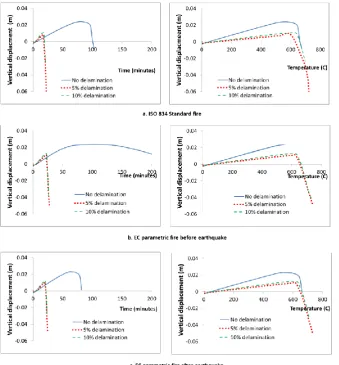
Figure 11 shows mid-span deflections of primary beam B12 (see Figure 1). It can be seen the beam
deflection exceeds the limit for all fire scenarios except under a parametric fire before earthquake. In general, the delamination reduces failure time of the beams but, the effect of the length of the delamination on the beam deflections is small.
can be seen in Figure 11, the differences become insignificant again when the temperature is above 800°C using the Standard Fire. At this point the temperature difference between protected and unprotected beams becomes small (due to prolonged high temperatures overwhelming the fire protection) so that the delamination has a small effect. Besides, at high temperature the role of concrete slab becomes dominant in supporting the loads since the beams have lost almost all strength and stiffness.
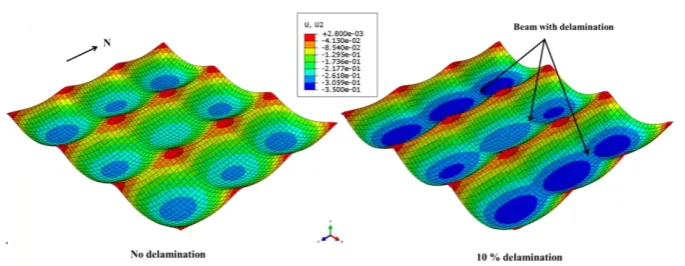
Figure 12 shows a comparison of the vertical deflection contours of concrete slabs without
delamination and with 10% delamination. It shows that the delamination influences tensile membrane action in the concrete slab. When no delamination occurs, tensile membrane action can be fully mobilised and the slab bends into a bowl-like shape. On the other hand, the delamination on the beam reduces the vertical support to the slab. The tensile membrane action is reduced and the deflected shape is more like that of a one way slab or like catenary action in a beam. This behaviour will have a negative effect on structural strength since catenary action provides a weaker load carrying mechanism than tensile membrane action. In this case, the benefit of tensile membrane action cannot be assumed in design.
[image:13.595.84.385.331.658.2]Figure 12: Concrete slab vertical deflection contours after 90 minutes Standard Fire exposure (unit in m).
6.2 Impact of fire insulation delamination on the columns
In this case, the delamination occurs only in the columns. The whole ground floor including beams, columns and slab are exposed to fire. As discussed earlier, the column failure is defined when the vertical displacement of column drops suddenly. Figure 13 shows vertical displacement of the top of column C2 (see Figure 1) for all cases. The fire resistance time of the column very significantly reduces (by around 70%) when the delamination occurs.
It can be observed that the column vertical deflections are initially positive due to thermal expansion. After a smooth and low rate of generation, the vertical deflection reaches a maximum value and then starts decreasing as the mechanical properties of the steel column reduce with time and temperature. At failure, the column starts to buckle, and the deflections reverse, when the axial force reaches a peak as shown in Figure 14.
Figure 15 show horizontal displacements against the height of column at certain gas temperatures. It
Figure 15: Horizontal displacement of C2 exposed to ISO 834 standard fire
6.3 Impact of residual deformation
Figure 16: Pushover curves for Damage-1 and Damage-2
Figure 17 shows mid-span deflection of primary beam B12 with and without damage. In general, the
fire resistance on the beam slightly reduces due to the initial deflection after damage. It can be seen that there is an initial deflection in the primary beam for the damaged frame. However, the patterns of deflection in fire in the undamaged and damaged frame are very similar. For the case of standard fire and parametric fire after earthquake, the analysis stops before the beam deflections exceed the limit since failures in the heated column due to buckling occur earlier than failure in the heated beams. Hence, fire resistance of the composite frame is determined by failure in the column.
Figure 18: Vertical displacement of C2
7. Summary
This study has presented a numerical investigation of a steel-framed composite floor system under fire following earthquake. Two types of earthquake damage: fire insulation delamination and residual deformation - were considered. Failure of the structure was defined using two measures, a beam deflection exceeding span/20 and column buckling.
residual deformation. Moreover, the results show that there is no failure for the structure exposed to fire following earthquake using a parametric fire suitable for the pre-earthquake condition except when the delamination occurs in the columns. Therefore, the building can resist the applied load during earthquake or fire separately. However, the earthquake event can result in damage to the structures that make the structure more vulnerable to post-earthquake fire than the corresponding undamaged structure. Besides, a fire after earthquake can be more onerous than that in normal conditions since an earthquake may increase the compartment opening factor by breaking the windows, and also by affecting the efficiency of fire-fighting.
Table 2: Failure time (minutes)
Delamination on beam
Delamination Standard fire Parametric fire (F) Parametric fire (PEF)
0 130 - 100
5% 121 - 92
10% 120 - 90
Delamination on column
Delamination Standard fire Parametric fire (F) Parametric fire (PEF)
0 100 - 77
5% 20 23 21
10% 20 20 20
Residual deformation
Deformation Standard fire Parametric fire (F) Parametric fire (PEF)
Undamaged 98 - 77
Damage-1 98 - 77
Damage-2 92 - 76
8. Conclusions
Based on this study, the following conclusions can be made for the structural configuration and damage types investigated:
1. Delamination of fire protection at the ends of primary beams, as is likely with seismic event induced damage to “strong-column, weak-beam” structures, means that tensile membrane action may not be fully available as a reserve load carrying mechanism in FFE (Figure 11). This has significant consequences for design because the benefits of tensile membrane action are often used for performance-based fire design of composite structures. Either designers should specify fire protection systems in these regions that are resistant to the deformations and strains that are likely to develop, or the benefits of tensile membrane action should not be relied upon. The results are only weakly dependent on the length of the assumed delamination, so consideration of beam length comparable with a plastic hinge is sufficient.
2. Delamination of fire protection at the bottom of columns will cause a large reduction in fire resistance time (up to 70%) because columns will buckle with no alternative load paths available. This finding is in line with earlier experimental work (Kirby, 1998), and consequent recommendations that columns are always fully fire protected. For design purposes, either columns with sufficient bending strength to avoid delamination of fire protection should be used (with due consideration of the implications of this for seismic design), or, again, deformation resistant fire protection systems should be specified
earlier than in an undamaged structure, and this should be accounted for in design, but no particular changes to fire protection or structural systems appear to be required.
4. Fire protection systems that are tolerant of substantial strains should be investigated for application to building structures. Such protection systems do exist for application where blast resistance is needed but they are expensive. It may be that local application of such systems in regions where plastic hinges are likely to form due to earthquake damage would be a practical and efficient solution.
5. The choice of design for fire use in a FFE analysis is not obvious. This study shows significant differences in predicted response between Standard and parametric fires, and between different parametric fires. The best choice of parametric fire is probably structure-dependent and may not be apparent at the design stage. A range of likely fires should be considered if performance-based fire design is used for FFE loading.
Acknowledgement
The authors would like to thank Indonesia Endowment Fund for Education (LPDP) for funding this PhD research.
References
Abaqus, 2014. ABAQUS/Standard analysis user’s manual v14.2. SIMULIA.
Ali, F., O’Connor, D., 2001. Structural performance of rotationally restrained steel columns in fire. Fire Saf. J. 36, 679–691. doi:10.1016/S0379-7112(01)00017-0
Arablouei, A., Kodur, V., 2015. Dynamic delamination of fire insulation applied on steel structures under impact loading. Int. J. Impact Eng. 83, 11–27. doi:10.1016/j.ijimpeng.2015.04.006
ASCE, 2007. Seismic rebabilitation of existing buildings. ASCE/SEI 41-06.
ATC, 1996. ATC-40 Seismic evaluation and retrofit of concrete building. Appl. Technol. Counc.
Behnam, B., Ronagh, H.R., 2015. Post-Earthquake Fire performance-based behavior of unprotected moment resisting 2D steel frames. KSCE J. Civ. Eng. 19, 274–284. doi:10.1007/s12205-012-0527-7
Braxtan, N.L., Pessiki, S.P., 2011. Postearthquake Fire Performance of Sprayed Fire-Resistive Material on Steel Moment Frames. J. Struct. Eng. 137, 946–953. doi:10.1061/(ASCE)ST.1943-541X.0000441
Bruneau, M., Chia-Ming Uang, Whittaker, A., 1997. Ductile Design of Steel Structures. McGraw-Hill Professional.
CEN, 2005a. Eurocode 3 Design of steel structures - Part 1-1: General rules and rules for buildings. Br. Stand. Institute, London, UK.
CEN, 2004a. Eurocode 4: Design of composite steel and concrete structures Part 1-1: General rules and rules for building. Br. Stand. Institute, London, UK.
CEN, 2004b. Eurocode 8 — Design of structures for earthquake resistance —Part 1: General rules, seismic actions and rules for building. Br. Stand. Institute, London, UK.
CEN, 2004c. Eurocode 2: Design of concrete structures - Part 1-2 General rules - Structural fire design. Br. Stand. Institute, London, UK 3.
CEN, 2002. Eurocode 1: Actions on structures. Part 1–2: General actions. Actions on structures exposed to fire. Br. Stand. Institute, London, UK.
Della Corte, G., De Matteis, G., Landolfo, R., Mazzolani, F.M., 2002. Seismic analysis of MR steel frames based on refined hysteretic models of connections. J. Constr. Steel Res. 58, 1331–1345. doi:10.1016/S0143-974X(02)00014-7
Della Corte, G., Landolfo, R., Mazzolani, F.M., 2003. Post-earthquake fire resistance of moment resisting steel frames. Fire Saf. J. 38, 593–612. doi:10.1016/S0379-7112(03)00047-X
Dwaikat, M.M.S., Kodur, V.K.R., 2011. A performance based methodology for fire design of restrained steel beams. J. Constr. Steel Res. 67, 510–524. doi:10.1016/j.jcsr.2010.09.004
Faggiano, B., 2007. Fire after earthquake. Proceeding from WG1 Meet. Urban Habitat Constr. Under Catrastophic Events.
Faggiano, B., Esposto, M., Mazzolani, F.M., 2008. Risk Assessment of Steel Structures Under Fire. 14th World Conf. Earthq. Eng. 2008, Beijing, China.
Gillie, M., 2009. Analysis of heated structures: Nature and modelling benchmarks. Fire Saf. J. 44, 673–680. doi:10.1016/j.firesaf.2009.01.003
Gillie, M., Usmani, a. S., Rotter, J.M., 2001. A structural analysis of the first Cardington test. J. Constr. Steel Res. 57, 581–601. doi:10.1016/S0143-974X(01)00004-9
Gupta, A., Krawinkler, H., 2000. Estimation of seismic drift demands for frame structures. Earthq. Eng. Struct. Dyn. 29, 1287–1305. doi:10.1002/1096-9845(200009)29:9<1287::AID-EQE971>3.0.CO;2-B
ISO, 1975. ISO 834-1975: Fire resistance test-elements of building construction. ISO 834-1975.
Kirby, B.R., 1998. The behaviour of multi-storey steel frame building in fire - Technical Report. Br. Steel.
Kodur, V., Arablouei, A., 2015. Effective properties of spray-applied fire-resistive material for resistance to cracking and delamination from steel structures. Constr. Build. Mater. 84, 367–376. doi:10.1016/j.conbuildmat.2015.03.022
Kodur, V.K.R., 2005. Guidelines for fire resistance design of high-strength concrete columns. J. Fire Prot. Eng. 15, 93–106. doi:10.1177/1042391505047740
Laím, L., Rodrigues, J.P.C., 2016. Numerical analysis on axially-and-rotationally restrained cold-formed steel beams subjected to fire. Thin-Walled Struct. 104, 1–16.
Majorana, C.E., Salomoni, V. a., Mazzucco, G., Khoury, G. a., 2010. An approach for modelling concrete spalling in finite strains. Math. Comput. Simul. 80, 1694–1712.
doi:10.1016/j.matcom.2009.05.011
Memari, M., Mahmoud, H., Ellingwood, B., 2014. Post-earthquake fire performance of moment resisting frames with reduced beam section connections. J. Constr. Steel Res. 103, 215–229. doi:10.1016/j.jcsr.2014.09.008
Milke, J.A., Ryder, N.L., Wolin, S.D., 2002. An investigation of the reduction in fire resistance of steel columns caused by loss of spray applied fire protection. J. Fire Prot. Eng.
Rezvani, F.H., Ronagh, H.R., 2015. Structural response of a MRF exposed to travelling fire. Proc. Inst. Civ. Eng. - Struct. Build. 168, 619–635. doi:10.1680/jstbu.14.00046
Rodrigues, J.P.C., Laim, L., 2017. Fire response of restrained composite columns made with concrete filled hollow sections under different end-support conditions. Eng. Struct. 141, 83–96. doi:10.1016/j.engstruct.2017.02.073
Scawthorn, C., 2008. Fire following earthquake. USGS file Rep. 2008-2015.
Scawthorn, C., Eidinger, J., Schiff, A., 2005. Fire following earthquake. Tech. Counc. Lifeline Earthq. Eng. Monogr. No. 26. Am. Soc. Civ. Eng.
Suwondo, R., Gillie, M., Bailey, C., Cunningham, L., 2017. Post-earthquake fire behaviour of composite steel-framed structures. Appl. Struct. Fire Eng. Conf.
Tomecek, D. V, Milke, J.A., 1993. A Study of the Effect of Partial Loss of Protection on the Fire Resistance of Steel Columns. Fire Technol. 29, 3–21.
Valente, J.C., Neves, I.C., 1999. Fire resistance of steel columns with elastically restrained axial elongation and bending. J. Constr. Steel Res. 52, 319–331. doi:http://dx.doi.org/10.1016/S0143-974X(99)00033-4
Vogel, U., 1985. Calibrating frame. Stahlbau 54, 295–301.
Wang, W.-Y., Li, G.-Q., 2009. Behavior of steel columns in a fire with partial damage to fire protection. J. Constr. Steel Res. 65, 1392–1400. doi:10.1016/j.jcsr.2009.01.004
Wang, W.-Y., Li, G.-Q., Kodur, V., Asce, F., 2013. Approach for Modeling Fire Insulation Damage in Steel Columns. J. Struct. Eng. 139, 491–503. doi:10.1061/(ASCE)ST.1943-541X.0000688.