warwick.ac.uk/lib-publications
Original citation:Stoneman, Paul (2018) The diffusion of innovations : some reflections. International Journal of the Economics of Business, 25 (1). pp. 85-95. doi:10.1080/13571516.2017.1390834
Permanent WRAP URL:
http://wrap.warwick.ac.uk/96041
Copyright and reuse:
The Warwick Research Archive Portal (WRAP) makes this work by researchers of the University of Warwick available open access under the following conditions. Copyright © and all moral rights to the version of the paper presented here belong to the individual author(s) and/or other copyright owners. To the extent reasonable and practicable the material made available in WRAP has been checked for eligibility before being made available.
Copies of full items can be used for personal research or study, educational, or not-for profit purposes without prior permission or charge. Provided that the authors, title and full bibliographic details are credited, a hyperlink and/or URL is given for the original metadata page and the content is not changed in any way.
Publisher’s statement:
This is an Accepted Manuscript of an article published by Taylor & Francis in International Journal of the Economics of Business on 15 February 2018, available online:
http://www.tandfonline.com/10.1080/13571516.2017.1390834
A note on versions:
The version presented here may differ from the published version or, version of record, if you wish to cite this item you are advised to consult the publisher’s version. Please see the ‘permanent WRAP url’ above for details on accessing the published version and note that access may require a subscription.
The diffusion of innovations: some reflections
By
Paul Stoneman
Abstract: This paper discusses a number of interrelated topics relating to the economics of
innovation diffusion that merit further research and study. These topics encompass: how
innovations are not just technological, may be horizontal or vertical, and may develop over
time; the role in the diffusion process of complementarities across and substitutability
between different technologies and innovations; how the many different sources of innovation
other than R&D are given insufficient attention in the literature; the international dimensions
of the diffusion process with emphasis on cross country effects; the role played by different
market structures in the industries supplying goods embodying new technologies; the
imbalance in the relative emphases upon intra firm and intra firm diffusion in the existing
diffusion literature; the need for more research on the relationship between firm performance
and the diffusion of innovations; and government policy on diffusion.
JEL classification: O3; O4
Key words: complementarities; diffusion; firm performance; sources of innovation;
international aspects; intra firm vs. inter firm; policy; supply side evolution.
Paul Stoneman, Warwick Business School, University of Warwick, Coventry, CV4 7AL, UK;
1. Introduction
This paper provides a personal commentary upon the current state of knowledge of the
economics of the diffusion (i.e. the spreading of ownership and/or use) of innovations by
exploring a limited number of issues that are of current importance in the field. This
contribution is not meant to be either particularly innovative or comprehensive1 but is
designed to encourage others to consider the study of diffusion as a much wider topic than
has often previously been the case. Being a personal reflection the bibliography is perhaps
more slanted to my own past work than it would normally be.
2. Defining innovation
Deliberately this paper is entitled as relating to innovation diffusion rather than technological
diffusion. The former is inclusive of the latter and thus a discussion of innovation widens the
area of consideration. Technological change essentially comprises the introducing of new or
significantly improved manufacturing or business processes and new products including (if
defined widely) new services. In much recent work, in line with Organisation for Economic
Cooperation and Development (2006), and as exemplified in the structure of the Community
Innovation Survey, innovation is taken to also encompass non technological innovations such
as implementing; new or significantly changed corporate strategies; advanced management
techniques; major changes to organizational structure; and changes in marketing concepts or
strategies. Recent literature in the field has explored these non-technological innovations
more extensively (e.g. Bloom and Van Reenen, 2010, Ruigrok et al, 1999).
New products include both consumer products and producer products. The growth of
demand for and ownership of consumer products has been more studied in the marketing
literature which has a long tradition of employing learning models of the Mansfield (1961)
type as introduced by Bass (1969). The diffusion of process innovations, which has been
most studied in Economics, is primarily the analysis of the growth of demand for and
ownership by firms of new producer products, such products being the embodiment of the
technology under study (e.g. computers, hybrid corn, robots, mechanical reapers etc.). The
work of Comin and Hobijn (2009, 2004, and 2003) provides extensive historical data upon
the spread across their potential usage of both new producer and consumer goods.
It is commonly observed that new technologies change over time. A characterisation
is that an original new product embodying a new technology is first placed on the market but
then, over time, further non-original but new-to-market products are also launched (by the
originator or others) that embody further technological changes. One characterisation is that
new products go through generations with later generations generally considered as superior
to, and probably cheaper than, earlier generations. This raises a basic issue as to whether
when studying diffusion one should study the diffusion of the innovation genus or the
separate generations of that innovation (e.g. should one study the diffusion of computers in
general or the diffusion of first, second, third, fourth etc. generations of computers
separately). Current practice appears to mainly be to take the former approach rather than the
latter. Under such an approach later improvements in the technology as embodied in
new-to-market products may be seen as drivers of the diffusion of the generic technology.
Most of the discussion about how later new-to-market products drive diffusion relies
largely upon an assumption that later products are superior in quality to earlier products. In
this view, new-to-market products are considered better than existing products and preferred
by all at the same price i.e. are superior, vertically differentiated, products. Such quality
improvements encourage greater usage or ownership and will be seen to be driving the
existing product. It may be inferior but cheaper. Such a product can extend ownership of the
generic technology by encouraging purchase by buyers with lower incomes, or less resources.
In such a case lower quality may drive diffusion e.g. lower quality tablet computers at prices
well below these charged by Apple have encouraged wider ownership of this technology.
In fact new-to-market products need not even be vertically differentiated from existing
products; they may be horizontally differentiated (i.e. considered, at the same price, by some
to be superior, but not by others). Such new products may be attractive to parts of the market
not previously encompassed, and, in this way may drive diffusion, but it is not quality
improvement that is the cause. Although there is a considerable literature that argues that
quality improvements are a driver of the diffusion process, there is not an extensive literature
that explores this formally using models of product differentiation, although Stoneman (1989,
1990) addresses diffusion and vertically and horizontally differentiated products and
Stoneman, Bartoloni and Baussola (2018) considers this more extensively.
Much of the current literature addresses how innovation affects the functionality of
products, for example speed, size, and memory capacity. However for a whole class of
products these are not relevant characteristics – aesthetic characteristics such as appearance,
smell, and sound are more important. This has led me to coin the term Soft Innovation to
encompass innovation that impacts upon these other characteristics, which is especially
(although not exclusively) important in, for example, film, theatre, publishing, food products,
video games, and recorded music etc. (see Stoneman 2011, 2015). Such products can rarely
be ranked vertically in terms of quality and new-to-market products of this kind, almost by
definition, will be horizontally differentiated. Thus for the diffusion of such products it is
horizontal product innovation that matters and not vertical improvements.
Because new technologies may be substitutes or complements to each other, the diffusion of
any one should be considered in frameworks that allow for the simultaneous adoption of
others. Examples of such modelling are Battisti, Colombo and Rabbiosi (2015), Stoneman
(2004), Stoneman and Toivanen (1997), and Stoneman and Kwon (1994). Without denying
the importance of such cross technology effects there are also other possible
complementarities that have figured less prominently in the diffusion literature. In particular,
as described above, in addition to the introduction of new manufacturing or business
processes, which one might consider as representative of the diffusion of new process
technologies, there are other innovative activities taking place, namely, the introduction of:
new products, corporate strategies, management techniques, organizational structures, and
marketing strategies. There is strong evidence that the introduction of new processes are
complementary with these other innovation activities (see, for example, Battisti and
Stoneman, 2010, Brynjolfsson and Saunders, 2009, Mol and Birkinshaw, 2009, Frenz and
Lambert, 2008, Black and Lynch 2004, and Milgrom and Roberts 1990). The analysis of the
introduction by firms of new process technologies should thus be placed firmly in the context
of their own and other firms’ wider innovative behaviour.
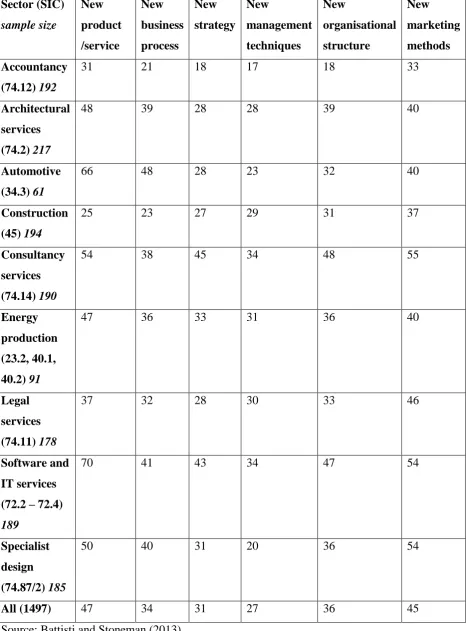
Battisti and Stoneman (2013) provide some further empirical support for these
arguments. Using a data set with special emphasis upon non-manufacturing and relating to
1497 UK enterprises in 2009 they observe the pattern of innovation activities detailed in
Table 1. The most prevalent innovative activities are the introduction of new
products/services (47% of the sample), new marketing techniques (45%) and new
organisational structures (36%). New processes are being introduced by 34%. The pattern of
innovation is quite heterogeneous across industries. These patterns clearly indicate that
alongside process innovation other innovation is also occurring. Most relevant however, there
50% of the firms that: (i) introduce new products and services also introduce new business
processes; (ii) introduce new strategies also introduce new business processes; (iii) introduce
new organisational methods also introduce new management methods; and (iv) introduce
new marketing techniques also introduce new strategy, management and organisational
techniques.
{Table 1 about here}
Using iterative principal factor analysis (IPFA) identifies two factors which account
for about 90% of the overall heterogeneity in the overall innovation pattern: the first factor is
driven by the extent of strategic, managerial, organizational and marketing innovations
(labelled wider innovation); whereas the second factor is driven by the introduction of new
products or services and new business processes is (traditional innovation). A two-step
cluster analysis identifies 4 clusters of firms in the sample: The largest, comprising 57.5% of
the sample, contains firms undertaking very low levels of both wide and traditional
innovations; a second cluster (15.7%) has low levels of wider innovation activity but a high
level of traditional innovation activity indicating complementarity between product and
process innovation; a third cluster (12.8%) shows a high level of wider innovations activity
and a low level of traditional innovations, indicating complementarity between the several
different wider innovations; a fourth cluster (13.9%) has high levels of use of both activities
indicating wide complementarity between all the different type of innovation.
Moreover, analysis across clusters shows that the sales growth of firms that undertake
both traditional and wide innovations is greater than of firms that undertake either wide or
traditional innovations alone or no adoption at all. This reinforces a view that at least some
the adoption of new process technologies by firms will be at least partly a reflection of their
overall innovative behaviour. To formally recognise this would be a step forward in the
development of diffusion analysis.
4. R&D and other sources of innovation
Much of the innovation literature, and in particular policy discussion, has a tendency to
associate technological (and other innovation) development with R&D alone. However,
innovation may in fact arise from a number of different sources and these other sources
should be given more prominence than has often been the case, it being made clear that R&D
is not necessarily the only (or necessarily prime) variable of relevance. Battisti and
Stoneman (2013), list the various innovation sourcing activities in their sample as engaging in
R&D or design, and sourcing changes in business processes (process innovation), new
equipment and software, or new branding and marketing methods. Table 2 shows the
proportion of sample firms undertaking each type of sourcing by industry. Between one fifth
and one half of firms have engaged in each of the different sourcing activities, with the
sourcing of new software, and branding and marketing activity, most frequently observed.
Only 21% of the sample reported having engaged in R&D activities indicating that the
traditional emphasis upon R&D activity or expenditure as the sole or best indicator of
sourcing activity could give a misleading picture of overall innovative activity.
{Table 2 about here}
There may also be significant complementarities across the different sourcing
activities. The data indicates, for example, that of all firms that do R&D, 54% also do design
IPFA identified just one factor which explains 54% of the overall sample heterogeneity. In
this factor the weight on design is greatest; R&D and sourcing new business processes carry a
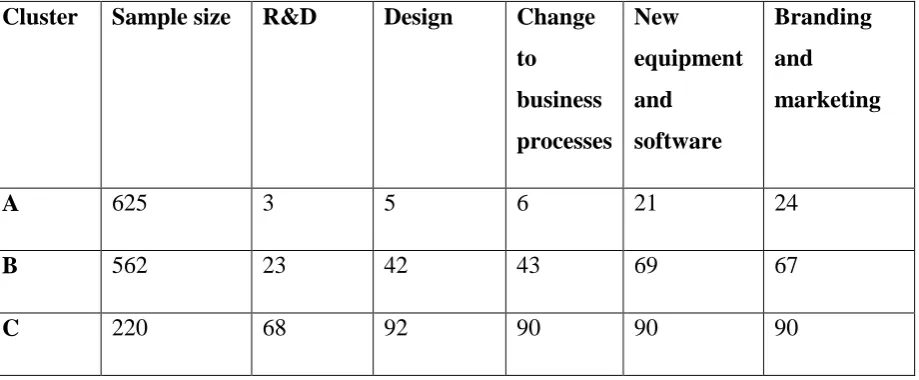
slightly lower weight, with software and branding carrying the lowest weights. Three clusters
of firms are identified (A, B and C) in the sample within each of which firms share similar
patterns of sourcing (Table 3). This data clearly illustrates that the intensity of engagement in
all activities steadily increases from cluster A to C, suggesting that few firms are very active
in seeking new ideas, but when they do seek new ideas they do so on all fronts
simultaneously. These findings reinforce the view that R&D is not necessarily the only (or
necessarily prime) variable of relevance when discussing innovation.
{Table 3 about here}
5 International Diffusion
The international dimension of the diffusion process has been much less studied than
diffusion within national boundaries. Although the growth and development literature has
emphasised how technologies migrate from the north to the south and how important this can
be to both economic development and the patterns of international trade (e.g. Grossman and
Helpman, 1993), the diffusion literature per se has not expended much effort in looking at
this international dimension. There is of course much literature that looks at the diffusion of
different technologies in different individual countries, even comparatively2, but there is little
that takes an a priori international stance. Improved historical data on cross country
technology diffusion (see, for example, Comin and Hobijn, 2003, 2009) has enabled much
more work to be done in this field and there are many opportunities open. Pulkki-Brännström
2Comparative studies can pick up impacts that do not vary within but may vary across countries e.g.
institutional factors such as patterns of taxation, degree of democratisation, extent of corruption, or the degree of
and Stoneman (2013) and Comin and Hobijn (2004) both talk of extensive and intensive
margins in the international diffusion of new technologies. The extensive margin refers to the
spreading of first use across countries while the intensive margin refers to the spreading of
use within countries. The data clearly shows that even when the former is complete the latter
continues.
Although little studied, taking an international standpoint immediately leads one to
enquire whether cross country effects impact upon national diffusion patterns.
Pulkki-Brännström and Stoneman (2013) explore possible effects via international information
spreading and from firms operating on international markets. An international approach may
also help to richen the story as to how supply side factors impact on the diffusion process. For
example, it may be the case that, if, in a given country, the new technology being spread is
imported with the supply side based overseas, then exchange rates may matter. The supply
side may also be supplying a number of international markets which will enable
cross-country feedback on supply side scale effects via learning by doing. In addition, in a given
country, the incentives to and effects of the introduction of a new process technology in a
firm may partially be derived from the overseas markets to which that firm exports. Moreover
if a firm is exporting, or if a new technology is imported, the economic analysis of the
welfare of different diffusion patterns may have to be conducted differently than under the
autarky regime often assumed.
6. Supply side market structures
Often the industries that are the suppliers of new technologies experience patterns of
evolution over time that suggest that it may not be particularly informative to represent such
industries as in static competitive, oligopolistic or monopolistic states. I have tried in the past
point to be made here is that, if the supply side is evolving over time, then we need to know
not only how and why, but also what impact this evolution will have on, for example, the
quality and prices of the goods and services that embody the new technology because this
will impact on the diffusion path. We know more on the former than the latter.
Consider a new technology that is embodied in a new original product and the first
manufacture of which represents the birth of an industry. There is a substantial amount of
existing literature that tells the story of what happens from here within several different
disciplines. In Economics Sutton (1996), Geroski (1995), Gort and Klepper (1982), and
Klepper and Graddy (1990) are relevant. This literature shows that for successful new
products, after birth, competitors enter the market and start to sell comparable goods. Klepper
and Graddy (1990) characterise industry development as having three stages. The dominant
pattern is one where in the initial phase there is an increasing number of firms, in the second
phase there is a decreasing number, and then in the third phase reasonable constancy. The
lengths of these phases differ considerably across products.
An alternative but complimentary approach is that of Utterback and Abernathy
(1975), see also Utterback (1994), who also identify three phases in industry development:
the fluid, transitional and specific. In the fluid stage, early participants experiment with new
forms and materials, there is no agreed or “dominant” design in the industry and firms test
markets and technologies with many and varied new products placed on the market. Once a
dominant design has been established this fluid stage with its intense rate of product
innovation is over. In the transitional phase process innovation becomes the major innovative
activity. In the final specific stage the rate of both major product and process innovations
declines, with industries becoming mainly focused on efficient production and cost
minimisation, with standardized, undifferentiated products. In different industries the phases
Such patterns of industry evolution will be reflected in the rate at which
new-to-market products (and thus improved or different processes for firms) are developed, the
pricing of these products over time, the time patterns of expectations of improvement and
obsolescence, and the rate of the development of standards and designs. All of these will
impact upon the inter-temporal demand for the new product and thus the diffusion process,
but currently are rarely considered.
7. Inter firm and intra firm diffusion
Within countries the extensive and intensive margins of use are across and within firms (or
households), labelled inter and intra firm (or household) diffusion. The inter firm diffusion of
new technology has always attracted most of the attention in the literature, intra firm being
the poor relation, despite the early work of Mansfield (1963). Although there have been
recent contributions in this area (e.g. Battisti, Canepa and Stoneman, 2009, Battisti et. al,
2007, Battisti and Stoneman, 2003, Fuentelsaz, Gomez and Palomas, 2012, 2009, and
Fuentelsaz, Gomez and Polo, 2003) there is still a lacunae of evidence on the actual patterns
of intra firm diffusion and their determinants and I believe that this area merits more
exploration.
8 Firm performance and the diffusion on innovations
Much of the extensive body of work in Economics that explores the relationship between
firm performance and innovation, has centred upon the relationship of performance (most
often, total factor productivity) to R&D spending as a proxy for innovative activity (see, for
example, the survey by Hulten, 2010). R&D may be a rather unsatisfactory proxy and it
would definitely be preferable if performance could be related to the measured use of new
international macro level TFP differences are related to the diffusion of new technologies.
However the relationship between the use and or diffusion of new technologies and firm
performance at the micro level has been less studied.
There is some work that relates to technology adoption and firm performance. For
example Bloom and Van Reenen (2007) relate firm sales growth to the use of new
managerial technologies, and Geroski, Machin and Van Reenen (1993) relate profitability to
innovative performance. However very little of this work takes a diffusion based point of
view. For example it would be informative to explore whether: early adopters do better or
worse than late adopters: firms of certain characteristics (e.g. size) gain more from adoption
than others; the gains of earlier adopters decline as more firms adopt; while others are
adopting non adopting firms suffer deteriorating performance. Any such findings would also
provide some foundations for the hypothesised impacts of technology adoption that underlie
many of the theoretical approaches in Economics to the modelling of technology adoption.
While we have empirical studies that test indirectly whether rank (i.e. differences in firm
characteristics), stock (more users means later returns) or order effects (early adopters gain
most) matter in determination of the hazard of adoption (e.g. Karshenas and Stoneman, 1993)
we have very little that directly attempts to measure the returns to adoption per se. Two
exceptions are Stoneman and Kwon (1996, 1995) the former looking at profitability and the
latter at productivity.
9. Diffusion Policy
It is disappointing that the vast majority of the political and academic comment on diffusion
policy begins from the point of view that fast is good and faster is better. Much commentary
relies upon simple international comparisons of adoption across countries where lagging
diffusion curve has three parameters, thus differences in usage at any point in time may be
the result of different start dates, different asymptotes and/or different slopes and a snapshot
of usage at a point in time cannot isolate which is important, and, for that matter, may not
necessarily reflect relative usage at a different date.
Diffusion policy, like the majority of other policy analysis in Economics, should be
based upon solid foundations (for support see David and Stoneman, 1986, and Ireland and
Stoneman, 1986). Although there are several views as to what these foundations should be,
my own preference is that they should involve defining the welfare optimal diffusion path
and then discussing why the economy might deviate from this path. If one does so then one
may argue that, for example, early policy stimulation of use may: lead to lock in to lower
quality technologies that delays later transfers to higher quality; cause excess costs to be
incurred by adopters because new technologies get cheaper over time; may encourage the
inappropriate extension of new technologies to users for whom they may not be of benefit.
Such observations previously seem to have had little impact on current policy discussion and
REFERENCES
Bass, F. M. (1969) A New Product Growth for Model Consumer Durables, Management
Science, 15(5), pp. 215-227.
Battisti, G., Canepa, A., and Stoneman P. (2009) E-Business usage across and within firms in
the UK, Research Policy 38 (1), pp. 133–143.
Battisti, G., Colombo, M., and Rabbiosi L. (2015) Simultaneous versus sequential
complementarity in the adoption of technological and organizational innovations: the case of
innovations in the design sphere, Industrial and Corporate Change, 24 (2), pp. 345–382.
Battisti, G., Hollenstein, H., Stoneman P., and Woerter, M. (2007) Inter- and Intra-firm
Diffusion of ICT in the United Kingdom and Switzerland, An Internationally Comparative
Study Based on Firm-level Data, Economics of Innovation and New Technology, 16(8), pp.
669 - 687.
Battisti, G. and Stoneman, P. (2013) Sourcing, Using and Exploiting new ideas: UK
Evidence, a paper presented at the 5th ZEW/MaCCI Conference on Innovation and Patenting,
Mannheim, June 3-4.
Battisti, G., and Stoneman, P. (2010) How Innovative are UK Firms? Evidence from the
Fourth UK Community Innovation Survey on Synergies between Technological and
Organizational Innovations, British Journal of Management, 21 (1), pp. 187 – 206.
Battisti, G and Stoneman, P. (2003) Inter Firm and Intra Firm Effects in the Diffusion of New
Process Technology, Research Policy, 32(9), pp. 1641 – 1655.
Black S. E. and Lynch, L. (2004) What's Driving the New Economy? The Benefits of
Workplace Innovation, Economic Journal, 114, pp 97-116
Bloom, N. and Van Reenen, J. (2010) Why Do Management Practices Differ across Firms
Bloom, N., & Van Reenen, J. (2007) Measuring and Explaining Management Practices
across Firms and Countries, Quarterly Journal of Economics 122 (4), pp. 1352-1408.
Brynjolfsson, E., and Saunders, A. (2009) Wired for Innovation: How Information
Technology is Reshaping the Economy, MIT Press.
Comin, D. and Mestieri, M. (2014) Technology Diffusion: Measurement, Causes and
Consequences, in Aghion, P. and Durlauf, S. (eds.). Handbook of Economic Growth, North
Holland, Elsevier, edition 1, vol. 2, pp. 565-622.
Comin, D., and Mestieri, M. (2013) If Technology Has Arrived Everywhere Why Has
Income Diverged? Presented at the 5th ZEW/MaCCI Conference on Innovation and
Patenting, Mannheim, June 3-4.
Comin, D & Hobijn, B. (2009) The CHAT Dataset, NBER Working Papers, 15319, National
Bureau of Economic Research, Inc.
Comin, D. and Hobijn, B. (2004) Cross-country technology adoption: making the theories
face the facts, Journal of Monetary Economics, 51, pp.39-83.
Comin, D. and Hobijn, B. (2003) Historical Cross-Country Technology Adoption Dataset
(HCCTAD). http://www.nber.org/hccta.
David, P. A. and Stoneman, P. (1986) Subsidisation vs. Information Provision as Instruments
of Technology Policy, Economic Journal, Conference Supplement, pp. 142-150.
Frenz, M. and Lambert, R. (2008) Technological and non-technological innovation, Science,
Technology and Industry Outlook, Paris: OECD publications, pp. 235-238.
Fuentelsaz, L., Gómez, J., and Palomas, S. (2012) Production technologies and financial
performance: The effect of uneven diffusion among competitors, Research Policy, 41(2), pp.
Fuentelsaz, L., Gómez, J., and Palomas, S. (2009) The effects of new technologies on
productivity: An intrafirm diffusion-based assessment, Research Policy 38(7), pp.
1172-1180.
Fuentelsaz, L., Gomez, J., and Polo, Y. (2003) Intrafirm diffusion of new technologies: an
empirical application, Research Policy, 32 (4), pp. 533–551.
Geroski, P.A., (2000) Models of technology diffusion. Research Policy 29 (4 – 5), pp.
603-25.
Geroski, P.A. (1995) What do we know about entry?” International Journal of Industrial
Organization 13(4), pp. 421–440.
Geroski P. A., Machin, S., and Van Reenen, J. (1993) The Profitability of Innovating Firms,
Rand Journal of Economics 24(2), pp. 198 – 211.
Gort, M., and Klepper, S., (1982) Time paths in the diffusion of product innovations, The
Economic Journal , 92, pp. 630-653.
Grossman, G. M. and Helpman, E. (1993) Innovation and growth in the global economy.
Cambridge, Mass., MIT Press.
Hulten, C.R. (2010) Growth Accounting, in B. Hall and Rosenberg, N. (eds.), The Handbook
of the Economics of Innovation, , Elsevier, North Holland, Vol. 2, pp. 987 – 1028.
Ireland, N.J. and Stoneman, P. (1986) Technological Diffusion, Expectations and Welfare,
Oxford Economic Papers, 38(2), pp. 283-304.
Karshenas, M. and Stoneman, P. (1993) Rank, Stock, Order and Epidemic Effects in the
Diffusion of New Process Technology, Rand Journal of Economics, 24(4), pp. 503-528.
Klepper, S. and Graddy, E. (1990). The Evolution of New Industries and the Determinants of
Mansfield, E. (1961) Technical Change and the Rate of Imitation, Econometrica 29 (4), pp.
741-766.
Mansfield, E. (1963) Intra Firm Rates of Diffusion of an Innovation, Review of Economics
and Statistics, XLV, pp. 348 – 59.
Milgrom, P and Roberts, J. (1990) The economics of modern manufacturing: technology,
strategy, and organisation, American Economic Review, 80 (3), pp. 511-28.
Mol, M. J. and Birkinshaw, J. (2009) The sources of management innovation: when firms
introduce new management practices, Journal of Business Research, 62 (12), pp. 1269-1280.
Organisation for Economic Cooperation and Development (2006). The Measurement of
Scientific and Technological Activities: Proposed Guidelines for collecting and Interpreting
Technological Innovation Data, Third Edition, Eurostat, Paris.
Pulkki-Brännström, A. M. and Stoneman, P. (2013) On the Patterns and Determinants of the
Global Diffusion of New Technology, Research Policy, 42(10), pp. 1768 – 1779.
Ruigrok, W., Pettigrew, A., Peck, S., and Whittington, R. (1999) Corporate Restructuring and
New Forms of Organizing: Evidence from Europe, Management International Review,
Special Issue, 39(2), pp. 41 – 64.
Stoneman, P. (2015) Changes in Product Aesthetics, an omitted dimension in economic
analyses of innovation activities.” in Archibugi, D. and Filippetti, A. (eds.), The Handbook of
Global Science, Technology and Innovation Policy, Wiley-Blackwell, pp. 88 – 112.
Stoneman. P. (2011) Soft Innovation: economics, product aesthetics, and the creative
industries, Oxford, Oxford University Press.
Stoneman, P. (2004) Path Dependency and Reswitching in a model of Multi -Technology
Adoption, in Guinnane, T., Sundstrom, W., and Whatley, W.(eds.), History Matters: Essays
on Economic Growth, Technology and Demographic Change, Stanford, Stanford University
Stoneman P. (2002) The Economics of Technological Diffusion, Oxford, Basil Blackwell.
Stoneman, P. (1990) Technological Diffusion, Horizontal Product Differentiation and
Adaptation Costs, Economica, 57 (225), pp. 49-62.
Stoneman, P. (1989) Technological Diffusion and Vertical Product Differentiation, Economic
Letters, 31(3), pp. 277-280.
Stoneman P., Bartoloni, E. and Baussola, M. (2018). The Microeconomics of Product
Innovation, Oxford, Oxford University Press, forthcoming.
Stoneman, P. and Battisti, G. (2010) Technological Diffusion, in B. Hall and Rosenberg, N
(eds.), The Handbook of the Economics of Innovation, Amsterdam, Elsevier, Vol. 2, pp. 734 –
60.
Stoneman, P. and Kwon M. J. (1996) Technology Adoption and Firm Profitability, Economic
Journal , 106, pp. 952-962.
Stoneman, P. and Kwon, M. J. (1995) The Impact of Technology Adoption on Firm
Productivity, Economics of Innovation and New Technology, 3 (3 - 4), pp. 1- 15.
Stoneman, P. and Kwon, M. J. (1994) The Diffusion of Multiple Process Technologies,
Economic Journal, 104, pp. 420-431.
Stoneman, P. and Toivanen, O. (1997) The Diffusion of Multiple Technologies: an empirical
study, Economics of Innovation and New Technology, 5(1), pp. 1-18.
Sutton, J. (1996), Technology and market structure, European Economic Review,
40 (3–5), pp. 511-530.
Utterback, J. M. (1994) Mastering the Dynamics of Innovation. Cambridge , Mass., Harvard
Utterback, J. M. and Abernathy, W. J. (1975) A Dynamic Model of Product and Process
Table 1. Percentage of sample firms undertaking various innovative activities by sector. Sector (SIC) sample size New product /service New business process New strategy New management techniques New organisational structure New marketing methods Accountancy (74.12) 192
31 21 18 17 18 33
Architectural
services
(74.2) 217
48 39 28 28 39 40
Automotive
(34.3) 61
66 48 28 23 32 40
Construction
(45) 194
25 23 27 29 31 37
Consultancy
services
(74.14) 190
54 38 45 34 48 55
Energy
production
(23.2, 40.1,
40.2) 91
47 36 33 31 36 40
Legal
services
(74.11) 178
37 32 28 30 33 46
Software and
IT services
(72.2 – 72.4)
189
70 41 43 34 47 54
Specialist
design
(74.87/2) 185
50 40 31 20 36 54
All (1497) 47 34 31 27 36 45
Table 2. Percentage of sample firms sourcing innovation by activity, by sector.
Sector R&D Design Business
processes
Software Branding
Accountancy 6 22 21 57 46
Architectural
services
30 35 39 58 46
Automotive 20 39 48 41 40
Construction 16 21 23 38 51
Consultancy
services
24 46 38 50 56
Energy
production
34 32 36 41 52
Legal
services
10 25 32 42 60
Software and
IT services
38 51 41 55 50
Specialist
design
18 32 40 63 60
All 21 33 34 51
Table 3. Percentage of sample firms sourcing innovation by activity and cluster,.
Cluster Sample size R&D Design Change
to
business
processes
New
equipment
and
software
Branding
and
marketing
A 625 3 5 6 21 24
B 562 23 42 43 69 67
C 220 68 92 90 90 90