warwick.ac.uk/lib-publications
Original citation:Murray, Neil (2018) University gatekeeping tests : what are they really testing and what are the implications for EAP provision? JACET Journal, 62 . pp. 15-27.
Permanent WRAP URL:
http://wrap.warwick.ac.uk/104812
Copyright and reuse:
The Warwick Research Archive Portal (WRAP) makes this work by researchers of the University of Warwick available open access under the following conditions. Copyright © and all moral rights to the version of the paper presented here belong to the individual author(s) and/or other copyright owners. To the extent reasonable and practicable the material made available in WRAP has been checked for eligibility before being made available.
Copies of full items can be used for personal research or study, educational, or not-for-profit purposes without prior permission or charge. Provided that the authors, title and full
bibliographic details are credited, a hyperlink and/or URL is given for the original metadata page and the content is not changed in any way.
Publisher’s statement:
Copyright © JACET
A note on versions:
The version presented here may differ from the published version or, version of record, if you wish to cite this item you are advised to consult the publisher’s version. Please see the ‘permanent WRAP URL’ above for details on accessing the published version and note that access may require a subscription.
University Gatekeeping Tests: What are they Really Testing
and What are the Implications for EAP Provision?
Neil Murray
Centre for Applied Linguistics, University of Warwick, UK
Abstract
Higher education today is a global enterprise. In order to compete in this environment, a growing number of universities are offering programmes and courses delivered through the medium of English. These programmes promise to increase enrolment numbers and attract high-fee paying international students. However, if academic standards are to be maintained and all students to benefit maximally from their university experience, then English language entry standards need to be suitably rigorous. This article calls into question the suitability of high-currency gatekeeping tests such as IELTS and TOEFL in terms of their ability to prepare students adequately for the particular demands of their degree programmes. It goes on to consider the implications of this for the practice of post-enrolment language assessment (PELA) and the nature of in-sessional English language provision offered by universities.
Keywords: academic literacy, university gatekeeping tests, English language provision,
Introduction
The globalisation of higher education has led to its marketization and to a neoliberal modus operandi as increased competition is forcing universities to be highly strategic as they seek to internationalise, spread their brands and academic reputations far and wide, and improve the student experience and levels of graduate employability in an effort to secure market share (Naidoo and Jamieson, 2005; Naidoo, 2016; Peters and Olssen, 2005;
Ramachandran, 2010). The growing importance of university league tables and the fact that they feature in almost every aspect of universities’ thinking is testament to this trend and to the realisation by their senior management that failure to compete can mean failure to remain viable. The stakes are high indeed.
With the globalisation of higher education has come a far greater diversity of the student body – and indeed academic staff – than has hitherto been the case. Greater mobility is both a cause and consequence of globalisation and the fact that it is reflected in the student
demographic is seen by many as a positive thing in that it reflects what Vertovec (2010) has referred to as the ‘superdiversity’ that increasingly characterises society in general, while providing a teaching-learning context that prepares students for living and working in that environment. Multicultural, multilingual classrooms can be exciting and dynamic
environments with the potential to draw on experiences and realities that extend beyond those of local students and staff; so a business or engineering seminar, for example, can benefit from authentic examples taken from the Chinese or Indian contexts. This promotes greater student engagement and nurtures a sense of recognition and validation of their own lives and cultures.
The fact of greater student mobility and the opportunity this has presented for
such courses the benefits are many. They offer an opportunity to develop valuable English language and intercultural skills, along with associated qualities such as tolerance,
understanding, and the ability to adapt, develop effective communication strategies, integrate, and work collaboratively (Montgomery, 2009; Spencer-Oatey & Dauber, 2016; Sweeney, Weaven & Herington, 2008; Volet & Ang 1998). These skills and qualities are highly prized by employers an increasing number of whom operate in international contexts and with a workforce that is similarly diverse (Diamond et al., 2011; The Economist Intelligence Unit, 2012; British Council, 2013), and the premium they place on these skills can be reflected in the enhanced salaries they offer employees who come equipped with them. Universities are very much alive to this reality and what it means for their reputations and ability to recruit; for them, producing students who embody the kinds of graduate qualities employers most value is key to achieving high levels of graduate employability, with the attendant benefits around institutional ranking in league tables (Global University Employability Ranking, 2016 https://ei.britishcouncil.org/news/news-alerts-which-universities-produce-most-work-ready-graduates).
English Language Proficiency and the Question of Academic Standards
While the globalisation of higher education and the diverse classrooms it has promoted have brought the kinds of benefits illustrated above, it has not been without it challenges. Ironically perhaps, it is arguably two of its most recognised benefits – the opportunity to develop English language and intercultural skills – that are also the greatest threat to the
experience and academic success of all students, not just native speakers. Students who are
84 per cent of respondents agreed with the statement: ‘The squeeze on resources for universities is “having an adverse effect on academic standards”.’ Half ‘strongly agreed’.
The sector now takes thousands of overseas students who ‘place different pressures on
standards with divergent learning cultures and, often, language problems’.
Almost three quarters of respondents believed that their university has been forced to
accept students who ‘are not capable of benefiting’ from university study.
48 per cent of academics agreed with the statement: ‘I have felt obliged to pass a student
whose performance did not really merit a pass’. 42 per cent said ‘decisions to fail students' work have been overruled at higher levels in the institution’.
Invoking evidence that emerged from the 2009 report Students and Universities and the then
Select Committee on Innovation, Universities, Science and Skills, Alderman (2010) has similarly spoken of
… pressures to maximise non-governmental sources of income, primarily from "full fee-paying" non-European students, to whom it is deemed prudent by these same senior leaderships to award qualifications to which they are often not entitled, so as to ensure future "market share" (Alderman, in The Guardian Online, March 10 2010).
‘… specific challenges have been identified with regard to the admission of students with English-language skills that are either insufficient to deal with the demands of their programme of study or have the potential to have a detrimental effect on the learning experience of all students (UK Quality Assurance Agency 2009, p. 2).
The fact that students are entering universities yet struggling to cope with the demands of their studies suggests that either the gatekeeping tests typically employed by universities (e.g. IELTS and TOEFL) as a measure of linguistic suitability are being misused in that entry thresholds are being set too low, or that the tests are not really measuring what they need to be measuring or are only measuring part of what they need to be measuring. In order to consider what might be going wrong, it is helpful to consider a distinction made by Lea & Street (1998) between study skills and academic literacy.
The ‘Study Skills-Academic Literacy’ Distinction
Lea and Street see study skills as adopting a generic, one-size-fits-all approach to language in which ‘literacy is a set of itemised skills which students have to learn and which are then transferable to other contexts. The focus, they argue, is on attempts to ‘fix’ problems with student learning, which are treated as a kind of pathology. The theory of language on which it is based emphasises surface features, grammar and spelling’ (Lea and Street 1998: 158), and in this it contrasts with the academic literacies model which is more nuanced in that it
point of view a dominant feature of academic literacy practices is the requirement to switch practices between one setting and another, to deploy a repertoire of linguistic practices appropriate to each setting, and to handle the social meanings and identities that each evokes (Lea and Street ibid.: 159).
In other words, the academic literacies model recognises that different disciplines have associated with them particular sets of literacy practices conversancy in which ‘qualifies’ the individual to become a member of their respective communities of practice (Lave & Wenger, 1991). As Lea and Street suggest, such conversancy goes beyond control of the surface features of language; it also requires the individual – the student in this case – to become socialised into their discipline through participating in its socially constituted traditions of meaning making and learning how to communicate in particular ways and to ‘be’ particular kinds of people: that is, to write (or indeed speak) ‘as academics’, ‘as geographers’, ‘as social scientists’ (Curry & Lillis 2003, p. 11). Only then can they claim competence in using language effectively and appropriately, and as bone fide members of their disciplinary communities. As Rex and McEachen note, those traditions
I have argued elsewhere (Murray, 2016) that the need for discipline-based language instruction is an argument for its decentralisation; that is, rather than being located in a central unit, support is devolved to faculties, with a team of English language tutors assigned to and working directly with and within each faculty. The advantages of this arrangement are many and include:
Emphasising the fundamental relationship between academic literacies and disciplines,
while de-emphasising the misleading construction of academic literacy in terms of a set of general skills that will equip students to cope with the academic demands of their studies (see also Wingate, 2006).
Enabling English language teachers to understand the local context and its
expectations and requirements around such things as assessment methods, and to become experts in the discourses of the disciplines of the departments and faculties with which they are aligned, and therefore to better serve students by developing syllabi and materials that are better informed, relevant and thus engaging.
Assisting English language teachers to forge productive relationships with academic
staff in the faculties/departments where they are located. This, in turn, helps them understand departmental priorities and student needs as well as influence policy and decision-making in the interests of increasing their effectiveness.
Providing a vehicle via which to highlight the value of what English language
Embedding Academic Literacies in the Curriculum
One might argue that gatekeeping tests are not designed to prepare students linguistically
to be carried out by English language teaching staff who are not ‘insiders’ and fully socialised into the discipline in the way academic staff are. It needs to be imparted by the experts, staged, delivered and recycled at strategic points within the curriculum where it is most relevant. I have reported elsewhere on the process and challenges of implementing such a model (see. for example, Murray & Nallaya 2014, Murray 2016, op cit.).
Testing Student Proficiency Post-Entry
If all students are to be educated in the academic literacies of their disciplines as part of the degree programme curriculum, this raises the question of whether and why English language support units – a staple of most if not all universities – are needed. In fact, such units can and should play an important role, firstly in supporting academics’ efforts to impart to students the academic literacies relevant to their disciplines, and secondly to ensure that students have a sufficient level of general proficiency such that they can operate fully in social and academic contexts, both within and outside of university, as well as understand and engage with the academic literacy tuition they receive. While the fact of students struggling with English post-entry may in part be put down to a lack of understanding of the academic literacies of their discipline in the way I have described above, there are other reasons that may also account for the language challenges students face. These include:
students studying to the test and benefiting from the co-called ‘practice effect’
issues around the security of high stakes tests such as IELTS and TOEFL
universities in some countries accepting multiple forms of evidence of language
some students being categorised as domestic (despite being recent immigrants with modest language skills) and therefore not being required to provide evidence of language proficiency
Together, these vulnerabilities constitute an argument for some form of post-enrolment language assessment of students in order to ensure that they have a level of general proficiency that will enable them to function adequately. As we shall see, regardless of whether the test is simply or screening test or a more sophisticated diagnostic test, it can play an important role in determining which students should get access to which forms of support – an important consideration in light of the fact that universities typically fund only limited language support services that rarely meet the needs of all students who could potentially benefit from them. Post-enrolment assessment is a means via which to identify those in greatest need with a view to giving them priority access to limited resources, something we shall return to later.
There has been a good deal written in recent years about post-enrolment language assessment (PELA) (Murray, 2014; Ransom, 2009; Read & von Randow, 2013; Read, 2015;
Elder & Knoch, 2009). One question frequently discussed is that of who should be assessed
Mandatory assessment is problematic for other reasons: firstly, it sends out a confusing message to would-be students: ‘You have met the English language entry conditions we ourselves have stipulated, but we would like you to take a post-entry test of proficiency nonetheless in order to determine whether your language skills are sufficient and whether you would benefit from support’. Secondly, assessing all students presents logistical problems in terms of administering the test to large numbers of students – particularly if it is an electronic test that requires access to a workstation – and because it has the potential to raise security
issues, especially if all students are assessed simultaneously. Furthermore, it can represent a
huge marking load unless it is marked electronically; unfortunately, while software exists to do this, its ability to mark written work effectively has yet to be convincingly proven. One alternative to assessing all students is to assess only those who meet the university’s English language entry criteria but still fall below a pre-determined threshold, such as an IELTS 7.0 (or equivalent). Finally, mandatory assessment raises the thorny issue of how one secures compliance. As Ransom (2009) has indicated, it is difficult know how and on what basis to penalise students who refuse to undergo assessment, even where it is mandated.
Another question that has been addressed in the literature is how PELA should assess
students’ proficiency, and here two options have tended to hold sway. One option is to use some form test, either a simple screening test or a diagnostic test that can inform test-takers of their weaknesses and be used by in-sessional English teachers to help direct the focus of their lessons. An alternative option is to use a piece of assessed coursework. This has the advantage of helping ensure that students perform to their full competence, as anything less has the potential to undermine their grade for the piece of work in question, and thus their grade point average.
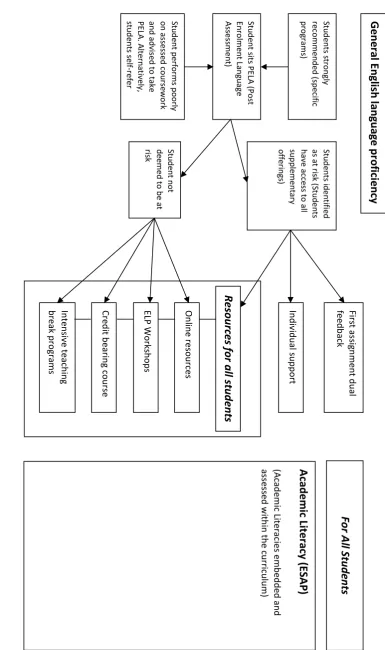
should get access to more resource-intensive forms of English language support. Typically, such support includes one or more of the following:
One-to-one consultations with an English language tutor
Feedback on coursework assignments
A programme of courses, typically focusing on the four skills areas
A cycle of workshops run throughout the academic year
Online resources
Credit-bearing and non-credit-bearing proficiency courses, as negotiated with
individual departments
Intensive general proficiency/academic literacy programmes run during teaching
breaks
Of these forms of support, one-to-one consultations and the provision of written feedback on coursework assignments are the most resource-intensive. This being the case, PELA can be used to ensure that only those in greatest need as measured by performance on PELA are granted access to these forms of support, in addition to all other forms of support available to all students, with the exception of those credit-bearing and non-credit-bearing courses
Gene ra l Engl ish la ng ua ge pr of ici en cy Fo r A ll S tu de nt s Stu d en t n o t d ee me d to b e at ri
sk Stud
en ts id e n ti fi ed as at ri sk (S tu d e n ts h ave ac ce ss to all su p p le me n tar y o ff eri n gs ) Firs t as sign m en t d u al fe ed b ack Stu d en ts s tr o n gly re co mmen d ed ( sp ec ific p ro grams ) Stu d en t sits PE LA (P o st En ro lme n t L an gu ag e A ss e ss me n t) Stu d en t p erfo rms p o o rl y on as se ss ed c o u rs ew o rk an d ad vis ed to take PE LA . A lte rn ati ve ly, stu d en ts s elf -r efer In d iv id u al su p p o rt R es ou rc es for al l s tud ent s In ten siv e t each in g b re ak p ro grams Cre d it b ear in g co u rs e ELP Wo rk sh o p s On line res o u rc e s A cadem ic Liter acy (ES A P ) (Ac ad em ic Lit era cie s e m b ed d ed a n d ass es se d w ith in t h e cu rricu lu m )
Fi
gur
e 1
: PEL
A as a
[image:16.595.134.520.87.738.2]Conclusion
(1979, 1980) referred to Basic Interpersonal Communication Skills (BICS). Perhaps, then, the solution is to embed academic literacies in the curriculum while also increasing IELTS entry requirements slightly as this will help enable students to integrate both socially and academically, to more easily induce the academic literacies of their disciplines through simple exposure, and to better understand what is imparted to them directly via academic literacy tuition delivered within the curriculum.
References
Alderman, G. (2010). Why university standards have fallen. The Guardian, Wednesday 10th
March 2010. Retrieved March 20, 2014, from
http://www.theguardian.com/commentisfree/2010/mar/10/universities-standards-blair-target
Baty, P. (2004). Caught in vicious cycle of declining standards. The Times Higher Education,
November 19th, 2004. Retrieved March 27, 2017, from
http://www.timeshighereducation.co.uk/news/caught-in-vicious-cycle-of-declining-standards/192504.article
British Council. (2013). Culture Means Business. How International Cultural Relationships
Contribute to Increased Trade and Competitiveness for the UK. Accessed March 25, 2017. http://www.britishcouncil.org/sites/britishcouncil.uk2/files/culture-means-business-report.pdf.
Coley, M. (1999). The English language entry requirements of Australian universities for
students of non-English speaking background. Higher Education Research &
Cotton, F. & Conrow, F. (1998). An Investigation of the Predictive Validity of IELTS amongst a Group of International Students studying at the University of Tasmania’, IELTS Research Reports 1998, Vol. 1, pp. 72–115.
Cummins, J. (1979). Cognitive/academic language proficiency, linguistic interdependence,
the optimum age question and some other matters. Working Papers on Bilingualism, 19,
121–129.
Cummins, J. (1980). The construct of language proficiency in bilingual education. In J.E.
Alatis (ed.), Current issues in bilingual education. Georgetown University Round Table
on Languages and Linguistics (GURT) 1980 (pp. 81–103). Washington, DC: Georgetown University Press.
Curnow, T. J., & Liddicoat, A.J. (2008). Assessment as learning: Engaging students in
academic literacy in their first semester. In Proceedings of the ATN assessment
conference 2008: Engaging students in assessment, eds. A. Duff, D. Quinn, M. Green, K.
Andre, T. Ferris and S. Copland [Online].Available from:
http://www.ojs.unisa.edu.au/index.php/atna/issue/view/ISBN%20978-0-646-504421/showToc (accessed March 26, 2017).
Curry, M.J., & Lillis, T.M. (2003). Issues in academic writing in higher education. In C.
Coffin, M.J. Curry, S. Goodmann, A. Hewings, T. Lillis and J. Swann (eds.), Teaching
academic writing: A toolkit for higher education, 1–18. London: Routledge.
Diamond, A., Walkley, L., Forbes, P., Hughes, T., & Sheen, J. (2011). Global graduates.
The Economist Intelligence Unit. (2012). Competing across borders. How cultural and communication barriers affect business. Accessed March 19, 2017.
http://www.economistinsights.com/countries-trade-investment/analysis/competing-across-borders
Elder, C., & Knoch, U. (2009). Report on the development and trial of the Academic English
Screening Test (AEST). Melbourne: The University of Melbourne.
Ingram, D. E., & Bayliss, A. (2007). IELTS as a predictor of academic language
performance. Part 1: The view from participants. IELTS Impact Studies Vol. 7 (IELTS
Joint-funded research programme). IELTS Australia & the British Council. Kachru, B.B. (1985). Standards, codification and sociolinguistic realism: The English
language in the outer circle, in English in the world: Teaching and learning the language
and literatures, ed. R. Quirk and H.G. Widdowson, 11–30. Cambridge: Cambridge University Press.
Kerstjens, M, & Nery, C. (2000). Predictive validity in the IELTS test: A study of the relationship between IELTS scores and students’ subsequent academic performance. English Language Testing System research reports, 3, 85–108.
Lave, J., & Wenger, E. (1991). Situated learning: Legitimate peripheral participation.
Cambridge: Cambridge University Press.
Lea, M. R., & Street, B. V. (1998). Student writing in higher education: an academic
literacies approach. Studies in Higher Education, 23(2), 157−172.
Light, R.L., Xu, M., & Mossop, J. (1987). English proficiency and academic performance of
international students. TESOL Quarterly, 21(2), 251–61.
Lobo, A., & Gurney, L. (2014). What did they expect? Exploring a link between students’
expectations, attendance and attrition on English language enhancement courses. Journal
Montgomery, C. (2009). A Decade of Internationalisation. Has it Influenced Students’ Views
of Cross-Cultural Group Work at University? Journal of Studies in International
Education, 13(2), 256–270.
Murray, N. (2014). Reflections on the implementation of post-enrolment English language
assessment. Language Assessment Quarterly, 11(3), 325–337.
Murray, N. (2016). An academic literacies argument for decentralizing EAP provision. English Language Teaching Journal, 70(4), 435–443.
Murray, N., & Hicks, M. (2016). An institutional approach to English language proficiency. Journal of Further and Higher Education, 40(2), 170–187.
Murray, N., & Nallaya, S. (2016). Embedding academic literacies in university programme
curricula: a case study. Studies in Higher Education, 41(7), 1296–1312.
Naidoo, R., & Jamieson, I. (2005) Empowering Participants or Corroding Learning? Towards a Research Agenda on the Impact of Students Consumerism in Higher Education.
Journal of Education Policy, 20(3), 267–281.
Naidoo, R. (2016) The competition fetish in higher education: varieties. British Journal of
Sociology of Education, 37(1), 1–10.
Olssen, M., & Peters, A. (2005) Neoliberalism, Higher Education and the Knowledge
Economy: from the free market to knowledge capitalism. Journal of Education Policy,
20(3), 313–345.
Popov, V., Brinkman, D., Biemans, H.J.A., Mulder, M., Kuznetsove, A., & Noroozi, O. (2012). Multicultural Student Group Work in Higher Education. An Explorative Case
Study on Challenges as Perceived by Students. International Journal of Intercultural
Relations, 36(2): 302–317.
concerns about academic quality and standards in higher education in England. Gloucester: Quality Assurance Agency for Higher Education. Accessed March 9, 2013,
from www.qaa.ac.uk/Publications/.../Documents/FinalReportApril09.pdf
Ramachandran, N.T. (2010) Marketing Framework in higher education: addressing aspirations
of students beyond conventional tenets of selling products. International Journal of
Education Management, 24(6), 544–556.
Rex, L. A., & McEachen, D. (1999). If anything is odd, inappropriate, confusing, or boring, it’s probably important: The emergence of inclusive academic literacy through English
classroom discussion practices. Research in the Teaching of English, 24, 65–129.
Ransom, L. (2009). Implementing the post-entry English language assessment policy at the
University of Melbourne: Rationale, processes and outcomes. Journal of Academic
Language & Learning, 3(2), A13–A25.
Read, J. (2015). Issues in post-entry language assessment in English-medium universities. Language Teaching, 48(2), 217–234.
Read, J., & von Randow, J. (2013). A university post-entry English language assessment:
Charting the changes. English Language Studies, 13(2), 89–110.
Spencer-Oatey, H., & Dauber, D. (2016). The gains and pains of mixed national group work
at university. Journal of Multilingual and Multicultural Development,
http://dx.doi.org/10.1080/01434632.2015.1134549
Sweeney, A., Weaven, S., & Herington, C. (2008). Multicultural Influences on Group
Learning: A Qualitative Higher Education Study. Assessment & Evaluation in Higher
Education, 33(2), 119–132.
Turner, Y. (2009). ‘Knowing Me, Knowing You,’ is There Nothing We Can Do? Pedagogic
Challenges in Using Group Work to Create an Intercultural Learning Space’. Journal of
Vertovec, S. (2010). Towards post-multiculturalism: Changing communities, conditions and contexts of diversity. UNESCO.
Volet, S. E., & Ang, G. (1998). Culturally Mixed Groups on International Campuses: An
Opportunity for Inter-cultural Learning. Higher Education Research & Development,
17(1), 5–23.
Wingate, U. (2006). Doing away with ‘study skills’. Teaching in Higher Education, 11(4),