© 2018, IRJET | Impact Factor value: 7.211 | ISO 9001:2008 Certified Journal | Page 4835
SCHEDULE DELAY ANALYSIS IN CONSTRUCTION MANAGEMENT USING
PRIMAVERA P
6Mr. I. Michael Raj
1, Ms. M. Panimalar
21
Assistant Professor, Department of Civil Engineering, RVS Technical Campus, Coimbatore-641402, India,
2
PG Student, Department of Civil Engineering, RVS Technical Campus, Coimbatore-641402, India.
---***---Abstract - Construction delay may be a common scenario in each construction project. Delay happens altogether construction comes, whether or not it's an easy or a posh project. When the comets square measure delayed, they will invite to the additional cost. Therefore, managing project delay is important. The aim of this project is to look at the management of the delayed completion on construction comes and therefore the objectives of this study square measure to judge the degree of delay on construction comes, to identify the notification of delay on construction projects and to investigate the respondent's actions when rectifying the delayed completion. For the successful completion of a project, planning and scheduling are two most important factors. The demand of industry needs a definite designing, scheduling and management which can allow the overall optimization of the cost, time and resources. Due to the increase in workloads and shrinking resources public work department found new technology which helps to manage the project easily. Project management code is employed as a tool for managing and organizing work that helps industries to grow during a fast manner. There are so many computer software are available in market now a day’s which is such as MSP, Primavera p6,etc.,for doing project management. With the help of these software proper planning and scheduling of project can be done. Primavera will simply compare between the planned progress of construction work and actual progress of construction project. Project Management code Primavera p6, embrace grouping, recording, monitoring, dominant and coverage data regarding project performance.Key Words: Delay analysis, Primavera p6 ,
1. INTRODUCTION
Planning and control of resources within the framework of a project is the main target of construction management. Construction management procedures guide managers about how the resources can be best used during construction process and aims for the timely and efficient application of the resources in construction projects. Many issues should be carefully thought in order to conduct a project successfully. Construction website activities area unit solely the second a part of the complete construction method. The first part is comprised of all kinds of office work. The planning, designing, estimating, negotiating, purchasing, scheduling, controlling, accounting, etc. should be done rigorously within the workplace before the work starts on the location to accomplish the target of a high quality project among budget and on schedule.
Construction delays area unit widespread in most comes round the world. Some delays may happen in the preconstruction phase which is defined as the period beginning from the initial conception of the project to the signing of the contract between the owner and also the contractor; but a number of them might happen within the construction section that's the amount once actual construction is beneath method. Project schedules are consistently dynamic and uncertain. Several governable and uncontrollable factors will adversely have an effect on the project schedule and cause delays. These delays positively produce negative impacts on project performance. Schedule delay within the completion of a construction project is also a serious issue for contractors resulting in pricey disputes and adverse relationships between project participants. The challenge is to live world wide web impact of construction delays accurately. Otherwise, there could seem delay claims between all parties concerned within the construction method. The method of schedule delay analysis technique ought to be acceptable to all or any participants through the project.
© 2018, IRJET | Impact Factor value: 7.211 | ISO 9001:2008 Certified Journal | Page 4836
Delays in the completion of construction projects are often unavoidable. The project schedule that is planned at the start of the project is vulnerable to being modified for several times and sadly causes delays. As a result, schedule delays may be a major problem for contractors as well as the owners, resulting in costly disputes, controversial issues and adverse relationships between all the project participants. Therefore, the identification, quantification and analysis of delays become essential. Contractors are prone to see most of the delays in the responsibility of the owner, while owners usually want to put the blame on the contractor or third parties. Consequently, it is necessary to analyze schedule delays and research the most significant causes of delay in construction projects to avoid or minimize their adverse impacts on the project and project participants.2. LITERATURE REVIEW
Oberlender (2000) agrees with Smith that planning coordinates all works of the construction to reach a completed quality project. The author determines the basic benefit of project planning and scheduling as an effective tool of preventing some of the problems like delays in work, cost overrun or decline in productivity and principally puts in order the desired results of project planning and scheduling as indicated below:
1. Finish the project on time.
2. Continuous (uninterrupted) flow of work (no delays). 3. Reduced amount of rework (least amount of changes). 4. Minimize confusion and misunderstandings.
5. Increased knowledge of status of project by everyone. 6. Meaningful and timely reports to management. 7. You run the project instead of the project running you. 8. Knowledge of scheduled times of key parts of the project. 9. Knowledge of distribution of costs of the project.
10. Accountability of people, defined responsibility/ authority. 11. Clear understanding of who does what, when, and how much. 12. Integration of all work to ensure a quality project for the owner.
2.1 TYPES OF CONSTRUCTION DELAYS
General types of construction delays should be clearly examined before schedule delay analysis begins. Schedule construction delays are categorized in many ways. According to Trauner et al. (2009), there are four main groups of construction delays.
Critical or non critical Excusable or non-excusable Compensable or non-compensable Concurrent or non-concurrent
2.2 CAUSES OF DELAYS
Odeh and Battaineh (2002) carried out a study to determine the most significant causes of construction delays with traditional type of contracts with regard to contractors and consultants. According to the results of the study, owner interference, inadequate contractor experience, financing and payments, labor productivity, slow decision making, improper planning, and subcontractors are among the top ten most significant causes of delays.
Kaliba, Muya, and Mumba (2009) which aimed to determine the causes and effects of cost escalation and schedule delays in road construction projects in Zambia. The authors compile the main causes of delays in road construction projects which are determined according to their survey, as in the following: delayed payments, financial processes and difficulties on the part of contractors and clients, contract modification, economic problems, materials procurement, changes in drawings, staffing problems, equipment unavailability, poor supervision, construction mistakes, poor coordination on site, changes in specifications and labour disputes and strikes.
3. SCHEDULE DELAY ANALYSIS
© 2018, IRJET | Impact Factor value: 7.211 | ISO 9001:2008 Certified Journal | Page 4837
that the techniques which have been developed for analyzing construction delays until today are referred to as “delay analysis methodologies” (DAM).The various types of schedule delay analysis
As-planned versus as-built,
Impacted as-planned,
Collapsed as-built,
Window analysis, and
Time impact analysis.
4. RESEARCH METHODOLOGY
The Time Impact Analysis method (TIA) was selected to analyze the construction delays in the work-schedule of the construction project in order to determine the delays and apportion the responsibility of such delays amongst all parties. The aim was to identify construction delays, to quantify their net impacts on the project completion date and to allocate responsibility to all parties. Accurate allocation of liability is very important in schedule delay analyses in order to prevent delay claims amongst project parties. From the literature survey it was seen that the TIA would be the most appropriate technique to be used in this study. Therefore, for the successful application of this method, the daily records and diaries had been noted meticulously during the construction process. This study was conducted in three stages; which are explained in detail in the following sections
Collection of Information and Data;
Determination of Causes, Types and Liability of Delays; and Conducting the schedule delay analysis with TIA.
5. RESULTS AND DISCUSSIONS
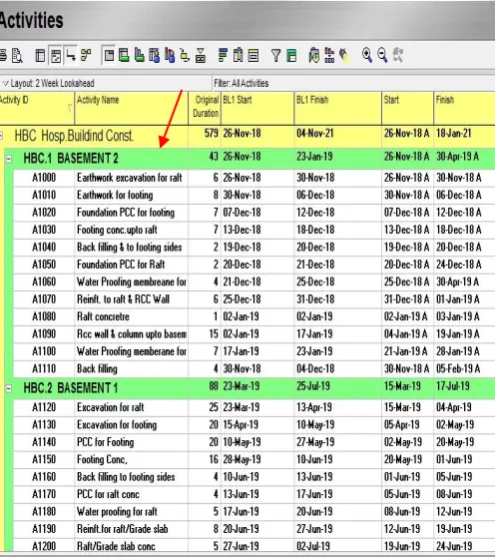
In PRIMAVERA software the multi speciality hospital project has been used, and their scheduled activities and we identifying the delays using TIA.
© 2018, IRJET | Impact Factor value: 7.211 | ISO 9001:2008 Certified Journal | Page 4838
DELAYED ACTIVITIESPROBLEMS INDENTIFIED IN BASEMENT 2:
[image:4.595.175.423.115.394.2]1) Problems In Foundation Pcc For Raft 2) Problems In Basement 2 Water Proofing 3) Problems In Reinforcement To Raft 4) Problems In Water Proofing Membrane 5) Problems In Back Filling
Table 5.1: Summary of Delay Identification in basement 2
No Delay Description Impacted Activity
Name Impacted Activity Code (IAC) 1 Problems in Foundation PCC
for raft Foundation PCC for raft A1020
2 Problems in basement 2
water proofing water proofing A1060
3 Problems in Reinforcement
to raft Reinforcement to raft A1070
4 Problems in Water proofing
membrane Water proofing membrane A1100
© 2018, IRJET | Impact Factor value: 7.211 | ISO 9001:2008 Certified Journal | Page 4839
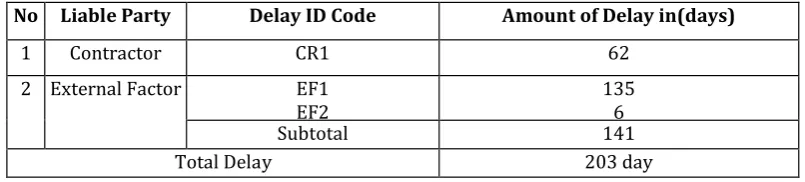
Table 5.2: Allocation of Project Delays to Parties [image:5.595.77.521.320.454.2]Consequently, the project finish date was postponed from 26 November 2018 to 18 January 2021; i.e. the project was delayed by 203 days due to these five construction delays. This means that the project duration was extended by 15.4 % or in other words more than 1/2 of the estimated construction period. These delays can further be categorized as 135-days excusable compensable delays,6-135-days non-excusable delays and 6-135-days excusable non-compensable delays ; which can be seen in Table 5.3.
Table 5.3: Summary of Project Delays According to Compensability
Consequently, fines should have been paid by the contractor according to the related clauses of the contract because of 62-days non-excusable delays.
The delay has been identified in basement 2 itself using primavera p6 software and the project has been finishing with rectifying delay by
1. Increasing man power 2. Increasing work time 3. Increasing equipment 4. Increasing relationship work
5. Changing working process like using ready mix concrete, miller, etc..
No Liable Party Delay ID Code Amount of Delay in(days)
1 Contractor CR1 62
2 External Factor EF1
EF2 135 6
Subtotal 141
Total Delay 203 day
No Type of Delay Delay ID Code Amount of Delay
1 Excusable Compensable EF 1
Subtotal 132 3
135 days
2 Excusable Non-compensable EF2
Subtotal 6 day 6
3 Non-excusable CR1
Subtotal 62 day 62
© 2018, IRJET | Impact Factor value: 7.211 | ISO 9001:2008 Certified Journal | Page 4841
6. CONCLUSIONS© 2018, IRJET | Impact Factor value: 7.211 | ISO 9001:2008 Certified Journal | Page 4842
extra work and frequent change orders. In this multi specialty project work the delay has been rectified in basement 2 and the project has been goes on and it has been finished with schedule delay analysis.In the case of the project analyzed in this study, the causes of the delayed events can be listed as follows:
1. Problem in Foundation PCC for raft
2. Problem in basement 2 water proofing
3. Problems in reinforcement to raft
4. Problems in water proofing membrane
5. Problems in back filling
6. Change in access route to the site,
7. Extra work load in steel roof
8. Delay of choice of material
These were 8 delays caused due to both critical and non-critical activities. Of these all except one correspond to the causes of delays mentioned by Arditi et al. (1985) in the previous sections. The fourth one was due to force majeure and therefore beyond the control of all parties.
According to the TIA schedule delay analysis the delays due to the critical activities extended the project duration by 203 days in totality i.e. by 26%of the estimated construction period. On the other hand, the delays due to the noncritical activities did not impact the total duration. The reason for selecting the Time Impact Analysis (TIA) method was that it can show the progress of construction works step by step with the assistance of PRIMAVERA® package. The main advantage of this technique is that things of construction on the updated dates may be pictured clearly. It is important for the delay analysis to be able to reflect the actual process of the construction in order to reach an accurate analysis of construction schedule delays. The delayed events are entered into the as-planned schedule respectively to see the changes on the project. Therefore, this analysis method is the most realistic. On the other hand, the most important constraint of TIA method is that the available records, related data and as-planned schedule should be accurate in order to obtain accurate and clear results; otherwise, the analysis will be incorrect. Another drawback of the method is that the analysis of concurrent delays is difficult in terms of understanding the net portion of the liability. Despite these drawbacks, this selected method is the most reliable as recommended by many researchers and the best technique for determining amount of time extension caused by construction schedule delays.
Based on this study, some general recommendations are presented here, which could also have been useful in minimizing or avoiding the impacts of the construction delays in the project analyzed.
The design of the project should be finalized with all details before tendering the work so as to avoid change orders by the owners.
Owner should allocate sufficient time and adequate finances for the design stage of the project. The selection of the contractor should be done through a pre-qualification of the firms.
The owners should mobilize all resources and get the necessary permissions before signing the contract. The contract should include clauses of incentive for early completion.
The schedule should be prepared and agreed over by both the contractors and the consulting companies.
The contractor should employ qualified work teams and provide in-house worker training in order to improve managerial and technical skills.
The contractor should also have a project manager in his team to check the progress of work and ensure timely delivery of materials.
© 2018, IRJET | Impact Factor value: 7.211 | ISO 9001:2008 Certified Journal | Page 4843
REFERENCES[1] Abd El-Razek, M. E., H. A. Bassioni, and A. M. Mobarak (2008) “Causes of Delay in Building Construction Projects in
Egypt”, Journal of Construction Engineering and Management, Vol. 134, No. 11, pp.831-841.
[2] Ahmed, S. M., S. Azhar, P. Kappagantula, and M. Castillo (2003) “Construction Delayin Florida: An Empirical Study”, [3] Alkass, S., M. Mazerolle, and F. Harris (1996) “Construction delay analysis techniques”, Construction Management
and Economics, Vol. 14, Issue 5, pp 375-394.
[4] Arditi, D., G. T. Akan, and S. Gurdamar (1985) “Reasons for Delays in Public Projects in Turkey”, Construction Management and Economics, Vol. 3, pp 171-181.
[5] Arditi, D., and T. Pattanakitchamroon (2008) “Analysis Methods in Time- Based Claims”, Journal of Construction Engineering and Management, Vol. 134, No. 4 pp. 242-252.
[6] Arıkan, M. and İ. Dikmen (2004) “Construction Engineering and Management, Lecture Notes”, Middle East Technical University, Department of Civil Engineering.
[7] Assaf, S. A., M. Al-Khalil, and M. Al-Hazmi (1995) “Causes of delay in large building construction projects”, Journal of Management in Engineering, Vol. 11, Issue 2, pp. 45-50.
[8] Baldwin, J. R., J. M. Manthei, H. Rothbart, and R. B. Harris (1971) “Causes of Delay in the Construction Industry”, Journal of the Construction Engineering Division, Vol. 97, No. 2, pp. 177-187.
[9] Barrie, D. S. and B. C. Paulson (1992) “Professional Construction Management: Including CM, Design-Construct, and
General Contracting”, McGraw-Hill, USA.
[10] Callahan, M. T., D. G. Quackenbush, and J. E. Rowings (1992)“Construction Project Scheduling”, McGraw-Hill, USA. [11] Faridi, A. S., and S. M. El-Sayegh (2006) “Significant factors causing delay in the UAE construction industry”, Journal
of Construction Management and Economics, Vol. 24, Issue 11, pp. 1167 – 1176.
[12] Frimpong, Y., J. Oluwoye, and L. Crawford (2003) “Causes of delay and cost overruns in construction of groundwater
projects in a developing countries; Ghana as a case study”, International Journal of Project Management, Vol. 21, Issue 5, pp 321-326.