Original citation:
Biggs, Caroline I., Packer, Christopher, Hindmarsh, Steven A., Walker, Marc, Wilson, Neil R.,
Rourke, Jonathan and Gibson, Matthew I.. (2017) Impact of sequential surface-modification
of graphene oxide on ice nucleation. Physical Chemistry Chemical Physics, 19. 21929-21932.
Permanent WRAP URL:
http://wrap.warwick.ac.uk
/
91013
Copyright and reuse:
The Warwick Research Archive Portal (WRAP) makes this work of researchers of the
University of Warwick available open access under the following conditions. Copyright ©
and all moral rights to the version of the paper presented here belong to the individual
author(s) and/or other copyright owners. To the extent reasonable and practicable the
material made available in WRAP has been checked for eligibility before being made
available.
Copies of full items can be used for personal research or study, educational, or not-for-profit
purposes without prior permission or charge. Provided that the authors, title and full
bibliographic details are credited, a hyperlink and/or URL is given for the original metadata
page and the content is not changed in any way.
Publisher statement:
First published by Royal Society of Chemistry 2017
http://doi.org/10.1039/C7CP03219F
A note on versions:
The version presented here may differ from the published version or, version of record, if
you wish to cite this item you are advised to consult the publisher’s version. Please see the
‘permanent WRAP URL’ above for details on accessing the published version and note that
access may require a subscription.
Journal Name
COMMUNICATION
Received 00th January 20xx, Accepted 00th January 20xx DOI: 10.1039/x0xx00000x
www.rsc.org/
Impact of Sequential Surface-Modification of Graphene Oxide on
Ice Nucleation
Caroline I. Biggs,a Christopher Packer,a Steven Hindmarsh, c Marc Walker,c Neil. R. Wilson, c Jonathan P. Rourkea and Matthew I. Gibsona,b*
Base-washed graphene-oxide which has been sequentially-modified by thiol-epoxy chemistry, results in materials with ice-nucleation activity. The role of hydro-philic/phobic grafts and polymers was evaluated with the most potent functioning at just 0.25 wt %. These 2-D hybrid materials may find use in cryopreservation and fundamental studies on ice formation.
The formation and growth of ice crystals presents problems in many fields from aerospace to cell cryopreservation to the automotive industry. Whilst ice formation is thermodynamically preferred below 0 °C, there exists a large barrier to this, such that pure water undergoes homogenous nucleation at ~ – 40 °C. For nucleation to occur above this temperature, a nucleator is necessary. In the environment, nucleators have been identified including dust,1 minerals, birch and conifer pollen2 and recently a species of fungus was found to be a potent nucleator.3 Ice nucleating proteins also exist in living species,4 for example Pseudomonas syringae produce ice nucleating proteins to promote frost formation on plant leaves, to release nutrients for feeding.5 However, the mechanisms of ice nucleation are not understood, and remain a significant challenge for modelling and theory.6,7 A key barrier to this understanding is the lack of sequentially modified materials to enable structure-activity relationships to be drawn. The few known nucleators are insoluble, inorganics such as kaolinite8 or bacterial proteins. Synthetic ice
nucleators could play a key role in e.g. cellular cryopreservation, where control over the exact nucleation temperature could improve reproducibility in the cryopreservation process.9 In the past few years, significant progress has been made in the development of synthetic materials for ice recrystallization inhibition (IRI) – the growth of pre-formed ice crystals as mimics of antifreeze proteins (which sometimes, but not always, can influence ice nucleation
also).10 For example, Gibson et al. have explored poly(vinyl alcohol) and poly(ampholytes) as an IRI active biomimetics.11,12 Progress in
synthetic mimics of ice nucleators has been slower though. Whale et
al. have reported that carbon nanotubes and graphene nanoflakes
can promote ice nucleation, which is appealing as these are synthetic, organic, and compared to previous inorganic nucleators, very small in size.13 Soots (carbon rich materials) present in the
atmosphere (from burning of fuels) have also been found to show a range of nucleation temperatures supporting carbonaceous materials as promising lead candidates for new nucleators.14,15 Suspensions of these materials are unstable, settling out of solution rapidly preventing their application and testing. Rourke and co-workers have demonstrated that base-washed graphene oxide reproducibly provides a route to a distinct graphene-like material, of higher quality than normal graphene oxide.16,17 The base-washing process removes oxidative debris from the surface revealing reactive epoxide groups on the surface, enabling conjugation of a range of functionalities, including thiols, gold nanoparticles, 18 atomically precise clusters19 and polymers.20
COMMUNICATION Journal Name
Table 1. Polymers synthesised
a Determined by SEC; b determined by NMR
To synthesise the GO composites, the thiols (Scheme 1) were reacted with bwGO in DMF suspension and the composites isolated by repeated centrifugation/washing cycles and freeze-drying. Infrared spectroscopy of the pNIPAM conjugates revealed characteristic amide bond stretches, but the alkyl thiols did not have characteristic stretches. Therefore, XPS (X-ray photo-electron spectroscopy) and TGA (thermogravimetric analysis) was employed to confirm successful grafting (Supp. Info.). The actual grafting density is low, limited by the number of epoxide groups for all the additives used and could only be detected by XPS not FTIR analysis. SEM analysis confirmed a wide range of GO sheet sizes from 100 nm – 1µm (ESI).
Scheme 1. Synthetic procedure used to generate graphene oxide composite materials.
To quantify ice nucleation activity, a microliter droplet freezing assay was performed – it is essential to have large data sets for this, due to the stochastic nature of ice nucleation, which makes
single-point measurements unsuitable.8 Briefly, 1 μL droplets of
[image:3.595.43.293.308.470.2](Milli-Q) water were added to a hydrophobic glass slide. Small droplets reduce the probability of competing nucleators being present and enable a true “average” nucleation temperature to be determined. These droplets were cooled under an atmosphere of dry nitrogen, and the freezing point of each droplet recorded by visual observation using a microscope. Example images of droplets nucleating are shown in Figure 1.
Figure 1. Example ice nucleation assays. Red circles are to show droplets which have
frozen. At – 20 °C all water droplets but at -30 °C all have frozen.
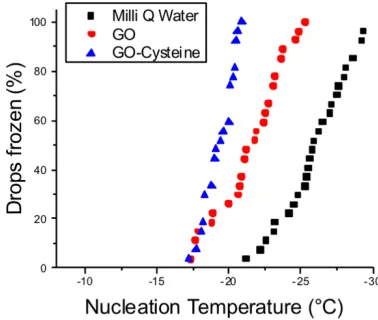
Initially, ultra-pure Milli-Q water, bwGO and bwGO-Cysteine were tested for their nucleation activity. Pure water nucleated at -26 °C in our assay above the homogenous nucleation temperature of water suggesting some heterogeneous nucleation; it should be noted that batch to batch differences in water source can affect this value, hence all experiments were conducted with a single batch of water, which was tested for background nucleation before each experiment. There is always
some variation in this value though.10 Both the bwGO and
bwGO-Cyst increased the nucleation temperature by over 5 °C, to -20 and -18 °C, in line with observations by Whale at el.8 This is a significant deviation itself, as very few materials are reported to either promote or inhibit nucleation.10
Figure 2. Ice nucleation spectra comparing the activity of Milli-Q water and 2.5 mg.mL-1
solutions of graphene oxide and cysteine-functionalised graphene oxide in Milli-Q water
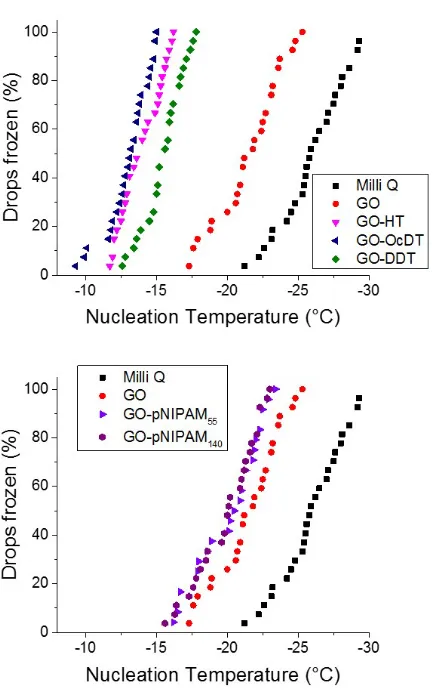
Encouraged by our initial results, the full library of bwGO composites were assayed for nucleation activity, Figure 3. Hydrophobic alkane modifications gave remarkable nucleation promotion activity, increasing the nucleation temperature by > 15 °C to –12 °C in the case of octadecanethiol modified bwGO. All the alkyl modified GOs were more active than bwGO and the cysteine modified bwGO, suggesting that their increased hydrophobicity might play a role and were all more active than previously reported ‘bare’ graphenic surfaces.8 The pNIPAM-bwGO conjugates showed almost identical activity to the native bwGO indicating it had little affect the nucleation temperature. It has been recently observed that GO has some ice recrystallization inhibition (IRI) activity, which is a mechanistically distinct process to nucleation, but in these other reports, GOs did not have the oxidative debris layer
removed.21 IRI tests were conducted on the bwGO composites
used here, but no significant activity was seen. It should be
noted that at the concentration required for IRI (~ 10 mg.mL-1)
the composites aggregated in the frozen wafer, which could have neutralized activity and this does not suggest that 2D materials cannot be employed as cryoprotectants in the future.
Polymer DP a Conversion (%)
b Mn
a
(g.mol-1) Mw/Mn a
[image:3.595.44.291.656.744.2]Figure 3. Ice nucleation spectra comparing the activity of Milli-Q water and 2.5 mg.mL-1 solutions of graphene oxide and graphene oxide functionalised with hexanethiol, octadecanethiol and dodecanethiol, pNIPAM55 and pNIPAM140
The data above clearly supports the hypothesis that 2-dimensional materials are appealing candidates for the discovery of new ice nucleating materials. Whilst the mechanisms for nucleation are not revealed here, this is a long-standing problem. Recent modelling results from Michaelides and coworkers found that both hydrophobicity and surface
roughness can contribute to ice nucleation22 but other
simulations have suggested that hydrophobicity does not
contribute.6 The GO surface is intrinsically heterogeneous and
the low density, grafted ligands used here increase this, which at a first approximation would support that hydrophobicity promotes nucleation. It should be noted that each GO derivative has a different extent of aggregation, with larger aggregates potentially leading to more nucleation. Due to the size distributions of the GO it was not possible to precisely correlate this effect, and as the grafting densities were low, even the most hydrophobic (ODT) modification was not obviously more aggregated. The role of the underlying GO is not clear, but its flat structure, enabling layers of water to form, is likely to play a role.
In conclusion, we have demonstrated a synthetically accessible approach to generate surface-modified GO as a 2D template to enable the development, and study, of ice nucleating materials. It was found that hydrophobic chains increased the heterogeneous nucleation temperature by over 15 °C. Hydrophilic surface modifications (small molecule and polymer) did not promote activity, but also did not reduce the underlying nucleation activity of the GO, but role of aggregation state has not yet been determined. These results are significant as we introduce a highly tuneable surface, which will enable the extraction of structure-activity relationships and help design new ice nucleating materials which would have many applications ranging from cellular cryopreservation to cloud seeding.
Notes and references
This study has received funding from ERC grant (CRYOMAT 63866). The Royal Society are also thanked for funding the cryo-microscopes used in this study. The Electron Microscopy research technology platform and photo-emission facility, supported by Advantage West Midlands and the ERDF are thanked also.
1 B. J. Murray, D. O’Sullivan, J. D. Atkinson and M. E. Webb,
Chem. Soc. Rev., 2012, 41, 6519.
2 B. G. Pummer, H. Bauer, J. Bernardi, S. Bleicher and H.
Grothe, Atmos. Chem. Phys. Atmos. Chem. Phys., 2012, 12, 2541–2550.
3 D. OʹSullivan, B. J. Murray and J. F. Ross, Sci. Rep., 2015, 5, 8082.
4 J. G. Duman, Annu. Rev. Physiol., 2001, 63, 327–357.
5 N. Cochet and P. Widehem, Appl. Microbiol. Biotechnol.,
2000, 54, 153–161.
6 L. Lupi, A. Hudait and V. Molinero, J. Am. Chem. Soc., 2014,
136, 3156–3164.
7 A. Haji-Akbari and P. G. Debenedetti, Proc. Natl. Acad. Sci., 2015, 112, 201509267.
8 B. J. Murray, S. L. Broadley, T. W. Wilson, J. D. Atkinson and
R. H. Wills, Atmos. Chem. Phys., 2011, 11, 4191–4207.
9 G. John Morris and E. Acton, Cryobiology, 2013, 66, 85–92.
10 T. Congdon, B. T. Dean, J. Kasperczak-Wright, C. I. Biggs, R.
Notman and M. I. Gibson, Biomacromolecules, 2015, 16, 2820–2826.
11 T. Congdon, R. Notman and M. I. Gibson,
Biomacromolecules, 2013, 14, 1578–1586.
12 C. Stubbs, J. Lipecki and M. I. Gibson, Biomacromolecules,
2017, 18, 295–302.
13 T. F. Whale, M. Rosillo-Lopez, B. J. Murray and C. G.
Salzmann, J. Phys. Chem. Lett., 2015, 6, 3012–6.
14 B. J. Murray, D. O’Sullivan, J. D. Atkinson and M. E. Webb,
Chem. Soc. Rev., 2012, 41, 6519.
15 K. Diehl and S. K. Mitra, Atmos. Environ., 1998, 32, 3145–
3151.
16 J. P. Rourke, P. A. Pandey, J. J. Moore, M. Bates, I. A. Kinloch, R. J. Young and N. R. Wilson, Angew. Chemie Int. Ed., 2011, 50, 3173–3177.
COMMUNICATION Journal Name
and J. P. Rourke, Chem. Mater., 2013, 25, 3580–3588.
18 H. R. Thomas, A. J. Marsden, M. Walker, N. R. Wilson and J.
P. Rourke, Angew. Chemie Int. Ed., 2014, 53, 7613–7618.
19 C. Bosch-Navarro, Z. P. L. Laker, H. R. Thomas, A. J.
Marsden, J. Sloan, N. R. Wilson and J. P. Rourke, Angew.
Chemie Int. Ed., 2015, 54, 9560–9563.
20 H. R. Thomas, D. J. Phillips, N. R. Wilson, M. I. Gibson and J. P. Rourke, Polym. Chem., 2015, 6, 8270–8274.
21 H. Geng, X. Liu, G. Shi, G. Bai, J. Ma, J. Chen, Z. Wu, Y. Song, H. Fang and J. Wang, Angew. Chemie Int. Ed., 2017, 56, 997–1001.
22 M. Fitzner, G. C. Sosso, S. J. Cox and A. Michaelides, J. Am.