Supply chain alignment as process: Contracting, learning
and pay-for-performance
Kostas Selviaridis1
Department of Management Science Lancaster University Management School
LA1 4YX, Lancaster, United Kingdom Tel: +44(0)1524594602
Email: [email protected]
Martin Spring
Department of Management Science Lancaster University Management School
LA1 4YX, Lancaster, United Kingdom Tel.: +44(0)1524592739
Email: [email protected]
To appear in the International Journal of Operations & Production Management
Accepted: 6 October 2017
1Corresponding author: Department of Management Science, Lancaster University Management School,
1
Supply chain alignment as process: Contracting, learning
and pay-for-performance
Abstract
Purpose: This paper seeks to understand how buyers and suppliers in supply chains learn to align their performance objectives and incentives through contracting.
Design/methodology/approach: Two longitudinal case studies of the process of supply chain alignment were conducted based on 26 semi-structured interviews and 25 key documents including drafts of contracts and service level agreements.
Findings: The dynamic interplay of contracting and learning contributes to supply chain alignment. Exchange-, partner- and contract framing-specific learning that accumulates during the contracting process is used to (re)design pay-for-performance provisions. Such learning also results in improved relationships that enable alignment, complementing the effect of contractual incentives.
Research limitations/implications: The study demonstrates that the interplay of contracting and learning is an important means of achieving supply chain alignment. Supply chain alignment is seen as a process, rather than as a state. Supply chain alignment does not happen automatically or instantaneously, nor is it unidirectional. Rather, it is a discontinuous process triggered by episodic events that requires interactive work and learning.
Practical implications: Development of performance contracting capabilities entails learning how to refine performance incentives and their framing to trigger positive responses from supply chain counterparts.
Originality/value: The paper addresses supply chain alignment as a process. Accordingly, the paper unearths some important features of supply chain alignment.
2
Introduction
An effective supply chain strategy aligns a firm’s performance priorities and objectives, and
those of its suppliers, with the requirements of customers (van der Vaart and van Donk, 2006;
Vachon et al., 2009). This view of alignment is arguably the defining concept of supply chain management: if firms in a supply chain are aligned in achieving the end customer’s
requirements, then this benefits the supply chain as a whole, as it can improve performance and
increase its collective share of the end-customer’s business (Christopher and Towill, 2002).
Alignment is achieved through inter-organisational relationships, which are governed by a
combination of formal contracts and relational norms (e.g. trust) (Cao and Lumineau, 2015;
Wacker et al., 2016). These underpin more specific alignment practices, including information sharing, increasing levels of integration and collaboration, and the design of compatible
performance measures (Frohlich and Westbrook, 2001; Simatupang and Sridharan, 2002).
To achieve the latter, firms must define and jointly prioritise objectives to reflect supply
chain performance requirements (Gunasekaran et al., 2001). They must also align their own incentive systems with these objectives (Lee, 2004), by designing payment mechanisms for
their suppliers that reward success and /or penalise failure (i.e., pay-for-performance), and
enable sharing of related gains and risks (Hypko et al., 2010). Such mechanisms are embodied in contracts, which have typically been seen as safeguarding tools that protect against
opportunism; increasingly, however, contracts are also seen as enablers of inter-firm
coordination and alignment (Schepker et al., 2014). Pay-for-performance contracts, in particular, emphasise incentive alignment (Kim et al., 2007; Datta and Roy, 2011), motivating suppliers to achieve the buyer’s objectives e.g. cost reduction or innovation (Sumo et al., 2016).
The literature on pay-for-performance contracting is mainly underpinned by agency
theory (Eisenhardt, 1989) and transaction cost economics (TCE) (Williamson, 1979) and
3
and supplier and the exchange attributes (Zu and Kaynak, 2012; Selviaridis and Wynstra,
2015). For example, pay-for-performance provisions are suitable for incentive alignment in
cases of conflicting objectives and information asymmetry (Simatupang and Sridharan, 2002).
This focus on supply chain contingencies and their impact on the content of contracts, however,
underplays the process by which supply chain counterparts align their objectives and incentives. Alignment through contracts takes place over often extended periods, through
relationships characterised by shifting patterns of power and trust, and by processes of learning.
And yet, despite the centrality of bounded rationality in their analysis, both TCE- and
agency-theory-informed studies treat learning as a trivial matter, dismissing it as something that
happens almost instantaneously and thoroughly (Mayer and Argyres, 2004).
We problematise this assumption (Alvesson and Sandberg, 2011), and suggest instead
that learning in general, and in contracting specifically, tends to be gradual, through reflection
on prior experiences and evolving interactions (Lumineau et al., 2011). Learning entails elaborate group interactions within and between firms to articulate and codify implicit
knowledge (Nonaka and Takeuchi, 1995) e.g. about the exchange relationship. Learning
enables firms in supply chains to align with their changing environments and market
requirements and to improve performance (Matthews et al., 2017).
In this paper, we propose that supply chain alignment is a process partly underpinned by
the dynamic interplay of contracting and learning. A process perspective is important also
because performance objectives and incentives often must be re-aligned, even long after a
contract is agreed (Lee, 2004). Accordingly, the study poses the following research question
4
This RQ is pursued through two in-depth, longitudinal case studies of the process of
supply chain alignment. The analysis focuses on the key role of learning in the (re)design of
pay-for-performance provisions and the management of inter-firm relationships.
The study contributes to contracting literature by demonstrating that the interplay of
contracting and learning is an important means of achieving supply chain alignment. Such
alignment, as an outcome of contracting, has not been much in focus by scholars stressing a
learning perspective on contracting. The paper also contributes to research on
pay-for-performance contracting by demonstrating the learning process by which supply chain
counterparts align their objectives and incentives. It also directs attention to the development
of performance contracting capabilities, and unpacks the objects of learning that the
development of such capabilities entails. In addition, the study contributes to supply chain
alignment literature by treating alignment as a process, rather than as a state. It demonstrates
that supply chain alignment does not happen automatically or instantaneously, and that it is not
unidirectional. Rather, it is a discontinuous process triggered by episodic events (e.g. contract
renegotiation) and it entails interactive work and learning. The findings present implications
for managers seeking to achieve supply chain alignment.
The next section presents the conceptual background, followed by a discussion of
methodology. Subsequently, the two longitudinal case studies are presented and analysed. The
last two sections discuss the cross-case findings and draw out research and managerial
implications and avenues for further research.
Conceptual background
Supply chain alignment: possible theoretical perspectives
Alignment is a central concept in both operations strategy and supply chain strategy (van der
5
resources and capabilities should be aligned with market requirements, through the
prioritisation of operations performance objectives e.g. cost or flexibility (Slack and Lewis,
2002). Supply chain strategy extends this logic upstream, arguing that a firm should align its
performance priorities with the priorities of its suppliers, which should also be in line with the
requirements of the focal firm’s customers (Vachon et al., 2009; Gobbi and Hsuan, 2015). Supply chain alignment towards a specific performance objective is contingent and
context-dependent: whether firms in a supply chain jointly focus on efficiency (cost) or responsiveness
(e.g. flexibility) is determined by the type of product, and demand and supply characteristics
(Fisher, 1997; Lee, 2002).
However, although it is useful in some ways to treat them as unified entities, supply
chains in fact comprise firms with separate, and more or less diverging, strategic priorities. As
such, we need to examine more critically, relationship by relationship, why, how and to what
extent alignment actually takes place. Here, we outline various theoretical perspectives that
might be adopted to understand this issue.
Agency theory (Eisenhardt 1989) specifically focusses on how the incentives – and
hence, it is assumed, actions – of actors with diverging priorities can be aligned. It is directly
applicable to supply chain alignment, because it addresses the very question of how
performance priorities can be made consistent between principals and agents (Zu and Kaynak,
2012). Indeed, agency theory has been particularly important in the literature on
pay-for-performance contracts, as discussed further below. But the broader assumption here is that
actors need to be given explicit financial incentives to align their actions with those of supply
chain counterparts. This implies that appeals to the general principle of the whole supply chain
‘delivering superior customer value’ (Christopher, 2005:3) are not enough: further mechanisms
such as contracts and related financial incentives are needed to translate potential, longer-term,
6
Trust is often considered as an alternative to formal governance mechanisms2 based on contracts, as understood in agency theory and TCE. Trust is “a belief or expectation that the
vulnerability resulting from the acceptance of risk will not be taken advantage of by the other
party” (Lane, 1998:3) in a relationship between interdependent actors. On this view then,
supply chain alignment would be achieved not because of explicit incentives but, for example,
by counterparts making relationship-specific investments in the expectation of improving
overall supply chain performance, even in the absence of formal agreements on, e.g., sharing
increased costs and risks.
There is considerable debate about the relationship between contractual governance and
trust. They can be seen as substitutes (Cao and Lumineau, 2015): broadly, parties who trust
one another have less need for formal governance in the form of extensive contracts. Puranam
and Vanneste (2009) frame the problem as a decision about the choice of [formal] governance
structure, given certain degrees of pre-existing trust between two firms. They argue that unduly
complex governance (extensive contracts) can ‘crowd out’ trust, undermining the effect of
pre-existing trust in the success of a relationship. Other accounts suggest that trust and contractual
governance act as complements (Poppo and Zenger, 2002). The process of developing and
implementing a contract requires parties to interact to explore and define processes for dealing
with unexpected circumstances, which arise from the inevitably incomplete nature of contracts
and the inability to foresee all eventualities (Roehrich and Lewis, 2014). In this sense, the
development of trust aids the development of contractual governance, and vice versa (Cao and Lumineau, 2015). As with TCE more generally, such analyses typically only capture a one-off
‘choice’ of governance structure: they do not, for example, seek to understand how a given
7
level of pre-existing trust has come about, nor how the exchange performance may affect future
levels of trust (cf. Puranam and Vanneste, 2009). This points to the value of a processual
perspective, which we examine further in this study.
As indicated, much of the debate in the inter-organisational relationships literature
contrasts trust with the ‘relentless application of calculative economic reasoning’ (Williamson
1993:453) as exemplified by TCE. However, trust has also been critically examined in the
literature on power (Clegg, 1989), rooted in sociology. Taking a power perspective, alignment
can come about without detailed contracts not because of an expectation that the other party
will forego taking advantage of a counterpart’s vulnerability arising from risky investments
and actions, but because other structural factors reduce the choices available. Simple treatments
of power in buyer-supply relations (Ramsay 1994) have drawn equivalences between power
and dependence: one firm ‘has power’ over another to the extent that the other firm depends
on it for its input supplies/sales. A more sophisticated view (see Clegg et al. 2006), however, would see power as a process, and incorporate the subtler ways in which one actor can shape
the ‘rules of the game’ in a relationship, and mobilise new technologies and methods to change
the prevailing institutional logics by which a counterpart evaluates what is in its interest, and
what it should do. Power in this sense is something that organisations do, rather than something
they have: in a supply chain alignment context, the way power plays out is through the
normalisation of practices such as supplier auditing, open-book accounting, or the imposition
of standardised logistics processes.
These practices might be seen as evidence of a ‘trust-based’ supply relationship, and
contrasted with contractually-governed, ‘adversarial’ relationships (e.g. Lamming, 1996).
They could also, however, be understood as power masquerading as trust (Hardy et al., 1998). Norms and expectations are typically seen as an aspect of non-contractual governance
8
an effective and enduring instantiation of power. In this sense, the practices of alignment can
also be seen as the practices of power. It should be noted here that power is treated neutrally:
power is not necessarily bad, but simply one way to get things done (Hardy and Clegg, 1999).
Our critique of the static, ‘one-shot’ nature of much TCE and agency-theoretic analysis,
combined with the more sophisticated understanding of power – which also moves away from
one-off static analysis, albeit of a different kind – suggests the need for a more processual view.
The Industrial Marketing and Purchasing (IMP) literature offers some useful insights here.
Early IMP research (Håkansson, 1982) drew explicitly on Williamson but presented a
long-term developmental perspective on inter-organisational relationships, rather than treating
relational contracting as simply an intermediate choice of governance structure. In the original
IMP interaction model (Håkansson, 1982), relationships were seen as a sequence of interaction
‘episodes’ – exchanges of products/services, information, money, or social exchanges – with
past episodes influencing present ones, and present episodes being shaped by expectations
about future ones. The interaction model also stressed adaptation: firms in a relationship may,
deliberately or in a more emergent manner, change aspects of their products/services or pricing
so as to adapt to their counterpart. They may deliberately resist adaptation (e.g. refuse to deliver
customised services) to retain economies of scale or avoid over-dependence. Alignment in
supply chain terms can be seen as a more specific case of the adaptation process.
In summary, the above theoretical perspectives come from very different starting points
and focus on different aspects of inter-organisational relationships, but serve to sensitize us to
alternative issues in supply chain alignment. They also point, in various ways, to the value of
processual rather than static approaches, relevant here because the existing supply chain
9
Supply chain alignment, contracting and learning
The operations and supply chain literature argues that alignment can be achieved by various
means, such as integrating processes across firm boundaries (Frohlich and Westbrook, 2001),
collaborating and sharing information, and making performance priorities consistent
(Simatupang and Sridharan, 2002) by translating them into specific objectives and measures
(Gunasekaran et al., 2001). Achieving these performance objectives requires the alignment of supply chain counterparts’ incentives (e.g. Narayanan and Raman, 2004), and contracting plays
an important part in this (Kim et al., 2007). In particular, buyers use pay-for-performance contracts to tie supplier compensation to the required performance outcomes, thus creating
incentives for suppliers to expend effort in the achievement of these outcomes (Datta and Roy,
2011). These incentives can take various forms e.g. a bonus /malus or a gain- /pain-share
mechanism (Caldwell and Howard, 2014).
As we have seen, alignment could be understood from a variety of theoretical
perspectives. The literature on pay-for-performance contracts draws largely on agency theory
and TCE (Selviaridis and Wynstra, 2015), according to which, contract design choices depend
on factors pertaining to the contracting parties and the exchange attributes. Agency theory
suggests that information asymmetry, objective conflict, outcome uncertainty, outcome
measurability, risk aversion of the buyer and supplier, and task programmability determine the
choice between a contract that emphasises monitoring of supplier behaviour (behaviour-based),
and one that incentivises supplier performance (outcome-based) (Eisenhardt, 1989; Zu and
Kaynak, 2012). Pay-for-performance incentives are suitable in cases of conflicting objectives,
low outcome uncertainty, high outcome measurability, and low service provider risk aversion
10
suppliers may require duration-related safeguards or incentives (long-term contracts) to prevent
buyer opportunism and ensure return on their investments (Selviaridis and Wynstra, 2015).
Although most of the contracting literature focusses on the state of alignment based on a match between contract design and exchange characteristics, some authors have taken a more
processual perspective, stressing the role of learning in contract design and the development of
contracting capabilities (e.g. Mayer and Argyres, 2004; Ryall and Sampson, 2009; Hartmann
et al., 2014). Contracting capabilities entail learning about what provisions and safeguards to include in a contract, when (i.e., under which exchange conditions), and to what level of detail
(Mayer and Solomon, 2006; Vanneste and Puranam 2010).
The process of drafting or re-writing contracts fosters learning - about each other’s needs,
intentions, and expectations, and about the exchange itself e.g. in terms of objectives and tasks
(Lumineau et al., 2011). This can feed into subsequent contractual negotiations (Mayer and Argyres, 2004). During contract execution, new information is generated that further enables
parties to learn how more effectively to (re)design contracts by adjusting the level of
contractual detail (e.g. to clarify responsibilities or plan for contingencies), and to collaborate
(Mayer and Argyres, 2004). Such learning tends to be incremental, and experiential rather than
vicarious (Argyres et al., 2007). Learning to contract and the development of contracting capabilities are empirically manifested by the level of extensiveness of contracts (e.g. number
and detail level of contract provisions, or number of pages) and the reduction in negotiation
time required to agree provisions (Ryall and Samspon, 2009; Arino et al., 2014). As successive agreements (or drafts of a contract in-the-making) codify exchange- and partner-specific
learning, contracts include more extensive provisions and safeguards and serve as repositories
of knowledge (Mayer and Argyres, 2004).
More recent literature suggests another object of learning. During the contracting
11
to the framing of contractual provisions (Weber et al., 2011). Different ways of framing a contractual provision, which otherwise have identical consequences, may elicit different
behavioural responses and views of the buyer-supplier relationship (Cao and Lumineau, 2015).
A contractual provision (e.g. pay-for-performance) can be framed as a gain (bonus payment)
which is likely to promote creativity, flexibility and a collaborative relationship. Alternatively,
it can be framed as a loss (financial penalty) which can induce a vigilant behaviour, close
monitoring and an arm’s-length relationship (Weber and Mayer, 2011). Learning about the
counterpart’s perceptions and responses that specific contract frames produce is important as
it can trigger the re-framing of provisions to stimulate positive responses and foster
collaboration (Cao and Lumineau, 2015).
Learning to contract entails the development of organisational capabilities and is, in that
sense, consistent with more general notions of organisational learning. Learning matters, as it
enables firms to align with their changing environments and customer requirements (Matthews
et al., 2017). According to Nonaka and Takeuchi (1995), learning occurs through group-level interactions within and between organisations, as implicit knowledge held by individuals is
articulated and codified as explicit knowledge, through e.g. written plans and instructions. This
explicit knowledge can then be shared within and between organisations and later internalised
by individuals as it is put into use (Nonaka and Takeuchi, 1995). This knowledge-creation
process is relevant to contracting, as groups of individuals involved in contractual negotiations
articulate, codify (in contractual documents) and later internalise knowledge regarding the
exchange and the buyer-supplier relationship (Lumineau et al., 2011).
In sum, the learning perspective on contracting is consistent with a processual view of
supply chain alignment. It helps to examine how buyers and suppliers, through the contracting
process, learn about the exchange and each other’s needs, perceptions and responses to the
pay-for-12
performance provisions to achieve supply chain alignment. A notion of learning that focusses
on the codification of knowledge is empirically accessible through the analysis of contract
documentation (e.g. Mayer and Argyres, 2004). However, we are aware that the relationships
in which alignment, learning and contracting take place are infused with processes of power
and trust, which are less readily available to us through documentation analysis. This informs
our method, discussed in the next section, in that we triangulate documentary evidence with
in-depth interviews of managers playing a key role during the contracting process; it also makes
it theoretically desirable to keep power and trust perspectives in mind as we analyse our cases
of the process of supply chain alignment through contracting.
Research methodology and design
Given our focus on the process of supply chain alignment, a case study design was adopted to
analyse in-depth the specific context and help build theory (Ketokivi and Choi, 2014).
Case-based research is suitable for longitudinal, process-oriented investigations (Voss et al., 2002) that aim to make sense of a sequence of events over time, and in context (Pettigrew, 1990).
Longitudinal cases are particularly useful for studying the interplay of contacting and learning
and evolution in contracts (Mayer and Argyres, 2004). Unlike surveys, case studies facilitate
the collection and analysis of contractual documents (Lumineau et al., 2011). In this study, drafts of service level agreements (SLAs) and payment provisions proved instrumental in
capturing how supply chain counterparts learn to align their objectives and incentives.
We selected two cases, whereby supply chain counterparts had initiated contractual
negotiations to align their objectives and incentives, to track the alignment process
longitudinally. Table 1 provides background information about the buying and suppling firms
in the two cases. Longitudinal cases present challenges regarding access to data and effort
13
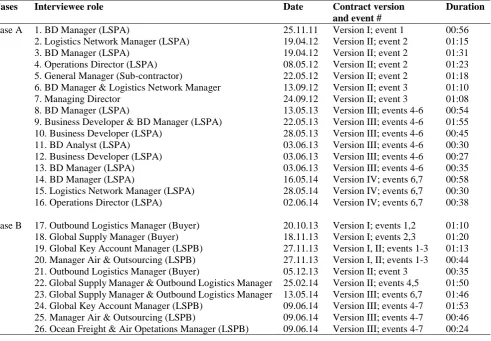
[Insert Table 1]
The case selection strategy followed a theoretical sampling approach (Pagell and Wu, 2009;
Barratt et al., 2011). Supply chain alignment is influenced by multiple contingencies, many of which are industry-specific (e.g. demand characteristics), and hence we limited our case
sampling to a single industry to control for cross-industry differences (Pagell and Wu, 2009).
We focused on the logistics industry because, although buyers and logistics service providers
(LSPs) have adopted pay-for-performance contracts to achieve alignment (Langley and
Capgemini, 2016), they face challenges in designing effective contractual incentives and must
climb a steep learning curve in this regard. The process of alignment was therefore relevant in
this context.
Our sampling was theoretically motivated also because we selected cases that differed in
terms of the counterparts’ experience in pay-for-performance, which can influence the process
and objects of learning: while in the first case pay-for-performance provisions were introduced
for the first time, in the second case pre-existing pay-for-performance provisions were revisited
to improve alignment. Case selection also considers the relative size of buyer and supplier firms
and the potential role of power-dependence relations in contractual negotiations. Our case
sampling reflected such differences in terms of firm size balance between buyers and suppliers
(cf. Pagell and Wu, 2009).
Data were collected between November 2011 and June 2014 and involved 26
semi-structured interviews with managers, and analysis of 25 key documents. The managers spanned
multiple functions including Operations, Business Development (BD), Key Account
Management (KAM) from the LSP side, and Logistics and Supply from the buyer side (Table
14
multiple times to track the changes in the drafted contracts, and why these were introduced.
We interviewed key respondents at regular intervals. However, these intervals were not fixed;
additional interviews were being conducted to understand the rationale for contractual changes,
as and when these occurred.
[Insert Table 2]
The interview guide included ‘open-ended’ questions (Miles and Huberman, 1994) and
the interviewees were asked to provide a chronology and details of key events that led to
contractual changes. Interview themes included the rationale for introducing or revising
pay-for-performance provisions, contract design challenges, the effects of incentives, and
perceptions of other aspects of the relationship such as power, trust, and collaboration.
The process of alignment was reconstructed as a sequence of time- and context-bound
events by using a combination of retrospective and real-time data from interviews and
documents (Pettigrew, 1990). Retrospective interviewee accounts of early phases of the
contracting process were complemented by a high volume of contemporaneous data as the
process of negotiating pay-for-performance provisions was tracked in real time (in Case A for
a period of 32 months, while in Case B for ten months).
Access was granted to key documents, notably successive versions of SLAs and contract
payment and incentive mechanisms, presentation files used during contractual re-negotiations,
and performance evaluation records. Document analyses helped reconstruct key contracting
events and triangulate interviewee accounts. These documents also proved instrumental in Case
A, where access was not granted to managers of the buyer. Access to the successive versions
15
significantly towards triangulating LSP managers’ accounts and ensuring data accuracy and
validity (Voss et al., 2002).
Data analysis and coding were performed in line with recommendations by Miles and
Huberman (1994). All data were considered to produce rich narratives and within-case
analyses. The data were represented visually using figures and tables (see the next two sections)
to arrange key events of the contracting process in a chronological order (Yin, 2003).
Cross-case analysis was performed to discern patterns (Miles and Huberman, 1994) regarding the
alignment process and the interplay of learning and contracting underpinning such alignment.
Data coding was informed by the conceptual background (e.g. the learning perspective
and power and trust aspects), but additional codes emerged during the analysis. Open codes
(e.g. ‘exchange-specific learning’, ‘partner-specific learning’) were initially assigned to
interview transcripts and documents, and these were later grouped into higher categories (e.g.
‘objects of learning’) using axial coding (Voss et al., 2002). Overall, these codes were refined
by iterating between data and the literature, as additional data were being collected (Barratt et al. 2011).
Analysis of the cases
This section presents the within-case analyses of how buyers and LSPs learn to align their
objectives and incentives through contracting, and the dynamics of the alignment process.
Case A
This case concerns a contractual relationship between a fourth-party logistics provider
(hereafter LSPA) and an international food retailer. LSPA began supplying services to the
buyer in 1997, supporting the company in the rapid international expansion of its store network.
16
slowing growth and customer pressure to reduce food prices. Consequently, the parties jointly
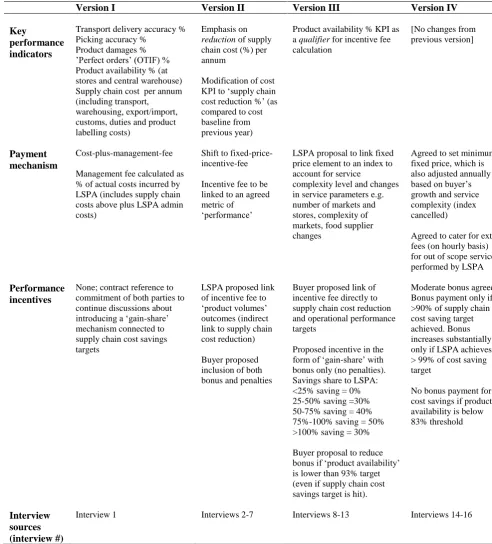
decided to revisit the existing cost-plus contract (first version in Table 3) and introduce
pay-for-performance provisions to re-align their incentives towards cost reduction. Figure 1
summarises the multi-year process of negotiating and drafting the pay-for-performance
provisions. Table 3 shows how these provisions evolved in four successive drafts of the
contract.
[Insert Figure 1]
[Insert Table 3]
LSPA managers became aware early on in the process that the buyer intended to stress
efficiency targets, because prior performance reviews had indicated that growth in established
markets was slowing down. As a result, LSPA’s perception of the framing of the original
contract payment scheme changed. LSPA managers initially saw the cost-plus management fee
provision in a positive light, since it mitigated their financial risk and allowed for flexibility.
However, given the changing situation, they came to see it as a dis-incentive for cost reduction.
As the LSPA Operations Director explained the transition from the first to the second contract
version: “The customer’s focus on supply chain cost reduction meant that we would be losing
money under a cost-plus contract since our management fee depends on service costs…we need to renegotiate to align our incentives”.
A long process of drafting the details of a ‘fixed-price-plus-incentive-fee’ principle was
initiated. This was facilitated by the absence of a formal re-tendering point in the 12-month
rolling contract, and had been foreseen in the first contract version (payment clause): “The
17
of time with the objective to introduce a new model during 2012”. Prior exchange experiences
of the buyer and LSPA informed the drafting process, and so did the accumulating knowledge
of each other’s needs, objectives, and operating mentalities, and of service operations (see
Figure 1).
It was important to determine how the incentive fee would be linked to performance, and
how performance would be operationalised and measured. LSPA initially proposed that the
incentive fee be tied to product volume increase outcomes and, hence, only indirectly to cost
savings. This reasoning was based on accumulated knowledge of the buyer firm’s business and
the assumption that supply chain cost reduction would help reduce food prices at stores, and
hence increase sales and volume throughput. As the LSPA Managing Director commented on
the second contract version (Table 3): “We have suggested that we want a model based on
volume, but without being given the benefits for things that could be done without our support. Because volumes can go up with building new stores, which has nothing to do with our cost efficiency performance”. LSPA was initially reluctant to link the incentive fee directly to cost
savings, because it knew that cost reduction outcomes were influenced by several factors (e.g.
buyer actions) and thus not easily attributable to LSPA effort. The LSPA BD Manager
explained regarding the negotiations of the second contract version: “there is a lot of noise
when you are trying to measure cost improvements […] we won’t be able to measure the improvements as clearly as we would like to connect them to our revenue”.
LSPA’s proposal to link payment to volume outcomes was, however, rejected due to the
buyer’s understanding that sales and product volume growth were partly independent of
LSPA’s supply chain planning effort. Instead, the buyer insisted that the incentive fee be linked
directly to cost savings. This was reflected in the third version of the contract, which also
specified the product availability KPI as a ‘qualifier’ for triggering incentive payments. At that
18
LSPA to link the incentive fee to cost savings targets. Given the fact that this specific customer
account formed a large part of the provider’s total revenue, LSPA eventually acceded to the
buyer’s request. As the LSPA Operations Director admitted: “[…] we are quite dependent on this client, I mean it’s a big part of our business”.
Through the contracting process, LSPA managers became conscious of the complex
interrelations between cost reduction, volumes and service levels and their implications for the
design of performance incentives. Specifically, cost efficiency initiatives could negatively
influence store service levels and volume throughput in the LSPA network, thus reducing
LSPA-driven efficiencies. The LSPA BD Manager explained the challenges related to
negotiating the third contract version: “when we reduced the service to cut costs, they actually
took out volume which means less economies of scale, increasing cost for the volumes that are left”.
Learning about the counterparts’ responses to incentive framing was also important.
Initially the buyer proposed that the cost reduction incentive include both a bonus and penalty
fee, which was rejected by LSPA, given the cost savings attribution challenges and the supply
chain complexity and dynamism. A penalty fee (see second contract version) was perceived as
too risky: “From our point of view penalties are excluded […] we hope that we got them
[buyer] to a state where the base is very low margin and then the bonus is on top of that as a kick-back” (LSPA, BD Manager). Consequently, the parties re-drafted the incentives and, according to a presentation file used during negotiations (May 2013), the buyer agreed to a
“bonus system in relation to operational performance and cost”. The third version (Table 3)
stipulated that the bonus size would be determined based on amount of cost savings generated
and product availability against the 93% target. This provision was refined in the fourth version
19
While designing the gain-share mechanism, LSPA managers worried that they were
unlikely to receive a salient bonus because of the high annual cost savings targets. During
negotiating the third and fourth contract versions, LSPA managers became familiar with the
buyer’s attitude to pay-for-performance: “They have the mentality that we need to reach almost
100% to get a bonus...if [targets] are not achievable, then the bonus will be something that we won’t budget for” (LSPA, Business Developer). Because of this attitude, LSPA instead
emphasised securing an appropriate fixed price. LSPA managers initially proposed to link the
fixed price element to an index reflecting varying service complexity levels arising from
changes in the buyer’s supply chain. This approach, with additional allowances reflecting buyer
growth and any extra services, was subsequently adopted (see fourth version). In this way,
LSPA mitigated its financial exposure.
Overall, Table 3 suggests that pay-for-performance provisions were being re-drafted as
parties were growing aware of service delivery intricacies and each other’s needs and responses
to the proposed frames of performance incentives. This process also instigated learning about
the respective LSPA and buyer responsibilities and actions that would promote collaboration
to achieve the cost reduction objective. This joint learning helped to reinforce trust between
the counterparts, but at the same time the pre-existing trust built based on past relationship
successes influenced the contracting process. The pay-for-performance provisions contributed
to aligning the objectives and incentives of the buyer and LSPA, but there was a common
understanding that the new contractual provisions would be subject to adjustments to further
improve such alignment (see Event 7). LSPA interviewees referred to the importance of
maintaining the trustful relationship and stressed the need to remain flexible to revisit the
contract in case it failed to achieve incentive alignment. To this end, the parties also deliberately
20
monitoring systems which would potentially create a “finger-pointing”, arm’s length
atmosphere in the relationship and erode trust.
Case B
This case concerns a contract for transport management services between a manufacturer of
packaging production machines and a global LSP (henceforth LSPB). The exchange
relationship was established in 2003, but pay-for-performance provisions were first introduced
in the contract only in 2012 to instigate LSPB continuous performance improvement and
innovation. The process of buyer and LSPB alignment and the related events are summarised
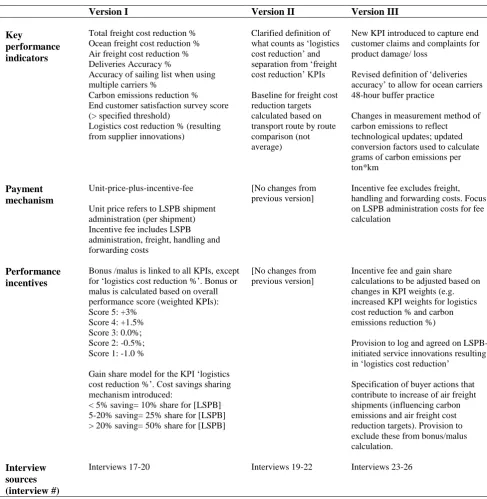
in Figure 1. Table 4 shows how key pay-for-performance provisions were revisited and refined
in three successive versions of the SLA.
[Insert Table 4]
In 2012 a bonus/ malus clause and a mechanism to share cost savings resulting from
LSPB innovation were included in the contract (first version in Table 4). This reflected the
strategic priorities of the buyer in relation to sustainability performance (more specifically
carbon emissions reduction across the supply chain) and innovation-driven cost reduction. The
buyer established and implemented related performance measurement and auditing practices
in all its supplier relations. Consequently, LSPB was also made to accept measuring and
reporting carbon emissions and service innovation-driven savings against annual targets.
The LSPB interviewees initially perceived the specific framing of these provisions
positively, because of the gain-share principle and the higher weighting assigned to bonus for
performance achievement as compared to penalties for performance shortcomings. This
21
contract version: “[The buyer] needed us to support them to achieve cost efficiency […] so that was the SLA with the penalty and bonus scheme and we would have something to gain as well”.
The provisions were first implemented in 2013 and, soon after, it became evident that
they did not trigger LSPB performance improvements as effectively as had been envisaged.
The incentives as designed at that stage tied LSPB payment to the buyer’s strategic supply
chain goals, namely innovation, cost reduction (while maintaining end customer service
levels), and environmental supply chain performance. In principle, this would align the
incentives of the buyer and LSPB. In practice, however, the parties faced challenges with
respect to: (a) definition of innovation performance and related cost reductions, and (b)
attribution of performance in terms of emissions reduction and on-time deliveries to end
customers. These difficulties instigated revisions and refinements to the pay-for-performance
provisions.
The buyer found LSPB insufficiently proactive in performance improvement and
innovation, while LSPB interviewees reported that the buyer would not agree that certain
innovative ideas were developed and owned by LSPB, and that it would claim ownership of
the supplier’s innovative ideas during performance review meetings. At the end of 2013 an
annual performance evaluation was conducted and the LSPB was asked to pay a financial
penalty based on its under-performance on four KPIs and an overall performance score below
3.0 (Table 4). This event and the related contractual deficiencies triggering episodes of
opportunism eroded trust and caused temporary strain in the relationship, as LSPB perceived
the imposed penalty fee as unfair, not least because several performance aspects such as
‘carbon emissions’ and ‘deliveries accuracy’ (first contract version) had been influenced by the
actions of the buyer and transport sub-contractors. As the LSPB Global KAM exemplified:
“The transport accuracy KPI is hard to hit because we are dependent on carriers’
22
Over time, LSPB managers understood better the complexity of the buyer’s supply chain
and the requirements of the buyer’s customers e.g. regarding delivery lead times. The parties
also faced difficulties in clearly separating ‘logistics cost reduction’ from ‘freight cost
reduction’ outcomes as specified in the SLA, and the buyer’s role in enabling innovations in
service delivery. For example, LSPB suggested that packaging machines be transported on
ship-deck, rather than ‘under-deck’, to save loading /unloading time. However, this innovation
entailed changes in the product architecture, and these were resisted by the buyer’s production
department.
Once the buyer recognised that external factors were affecting outcomes and that the
LSPB had made significant freight cost savings, they decided to excuse LSPB from paying the
penalty stipulated in the first contract version: “Even though we got the savings we wanted and
even higher, the overall score was still below the target. So we didn’t want to get the penalty […]. They didn’t do well in terms of emissions reduction, but this was affected by decisions
and actions of [our customers]” (Buyer, Outbound Logistics Manager).Negotiations allowed the joint identification of several factors affecting LSPB performance, and the adjustment of
pay-for-performance provisions. More specifically, the accumulated service delivery-specific
learning allowed refinement of two KPIs: what ‘logistics cost reduction’ meant, and how the
freight cost reduction outcomes should be calculated route by route (second version, Table 4).
The parties subsequently agreed on the need to refine the KPIs and their weighting, and
the measurement method for some of them (‘carbon emissions’ and ‘deliveries accuracy’).
LSPB requested that all buyer-driven decisions to use airfreight for urgent deliveries should be
excluded from the LSPB-inflicted carbon emissions and the incentive fee calculation. There
was also agreement on a process for documenting innovative ideas from LSPB that could result
23
the subsequent joint work to refine the pay-for-performance provisions (see Events 5-6) helped
to restore trust between the counterparts to a large extent.
However, during this SLA adjustment process, and despite their original positive
perception of pay-for-performance provisions, LSPB interviewees expressed concerns about
the fairness of the incentives scheme. The LSPB Air and Outsourcing Manager commented
during the negotiations of the third contract version: “We need to have clear and fair KPIs in place, which are controllable by us, or we are in agreement that we can handle them. We have tried to change the weighting of the KPIs based on what we can control”. These negotiations
led to a third version of the SLA which was more elaborate in terms of the KPI matrix and
performance incentives (Table 4). The incentive fee was also restricted to LSPB administration
work and decoupled from costs outside LSPB’s control.
Examination of the successive SLA versions suggests that the parties gradually
developed an understanding of the factors influencing performance, and each other’s exchange
perceptions. Buyer managers also gained an insight into the impact the SLA framing had on
LSPB response to risk, and used this to refine relevant provisions in the third contract version:
“They [LSPB] were surprised with the level of the penalty that they would have to pay […].
That was also a reason for changing the basis of the incentive model for this year” (Buyer, Outbound Logistics Manager).
Such learning collectively influenced the adjustment of pay-for-performance provisions
to improve incentive alignment. Buyer interviewees argued that the revised contract (second
and third versions) contributed to LSPB behaviour change and closer alignment towards the
buyer’s goals: It [SLA] has been an absolutely positive experience and we got their attention;
24
was confirmed by LSPB managers: “This [SLA] has helped to change our mentality and to think in terms of performance improvement” (LSPB, Global KAM).
Discussion
In what follows we revisit the RQ posed in the introduction: How do buyers and suppliers in supply chains learn to align their objectives and incentives through contracting? The findings suggest that the dynamic interplay of contracting and learning contributes to supply chain
alignment by affecting both the pay-for-performance contractual provisions and the
buyer-supplier relationship more broadly. As a result of the contracting process, exchange- and
partner-specific learning is accumulated (Lumineau et al., 2011). Such learning concerns the exchange features (e.g. service characteristics and factors influencing performance targets) as
well as the counterparts’ objectives, needs, actions and operating mentalities. In addition,
contracting parties learn about each other’s perceptions and responses to the framing of the
contract (Weber et al., 2011). This object of learning refers specifically to the counterparts’ perceptions of risk and exchange fairness in response to the way pay-for-performance
provisions are framed e.g. penalty/ bonus, intensity of performance targets and salience of
incentives. Both cases demonstrated that exchange-, partner- and contract framing-specific
learning develops gradually as counterparts interact and reflect upon prior exchange
experiences (Lumineau et al., 2011).
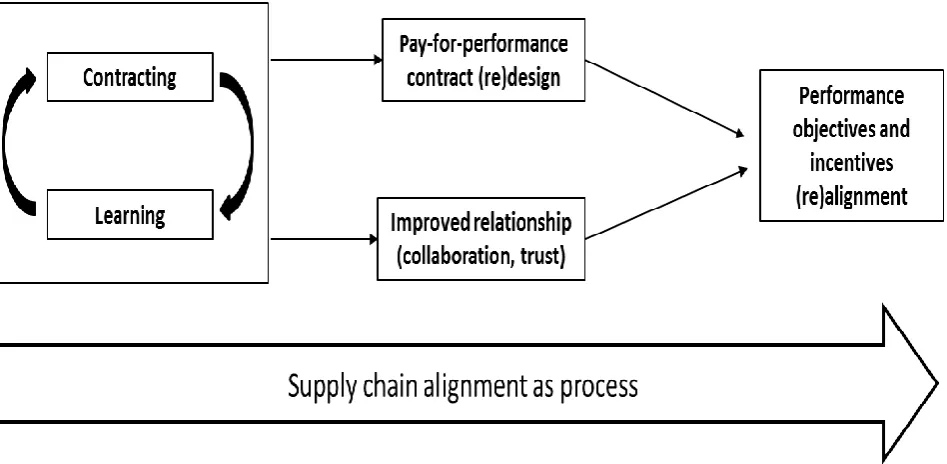
The above objects of learning are used to revisit pay-for-performance provisions so as to
achieve alignment. In other words, learning arising from the contracting process triggers further
negotiations and contract re-design (Argyres and Mayer, 2007). Both cases demonstrate how
parties gradually learn to contract e.g. by designing more effective performance incentives.
However, the exchange-, partner-, and contract framing-specific learning may not be fully
25
result in improved relationships by promoting collaboration and trust (Mayer and Argyres,
2004). Such improved relationships enable the alignment of objectives and incentives between
buyers and suppliers (Lee, 2004), complementing the effect of pay-for-performance provisions.
Figure 2 depicts this dynamic interplay of learning and contracting, and its effects on
pay-for-performance contract design, buyer-supplier relationships and alignment.
[Insert Figure 2]
Comparative analysis of the two cases suggests that the rationale for alignment
determines whether the interplay of contracting and learning results in a relative emphasis on
the design of contractual provisions or on the (collaborative) relationship. In Case A, the
rationale was the changing performance priorities in the supply chain. The case emphasises
how parties learn, during contracting-related interactions (Lumineau et al., 2011), to shape a shared definition of these changing performance priorities and operations trade-offs (e.g.
volumes, costs and service levels), and to re-align their objectives. In this case, improved
buyer-supplier collaboration and trust were instrumental for re-alignment. Such collaborative
relationship was manifested through the joint intention to revisit the cost-plus contract to
address incentive misalignments, the identification of required buyer and third-party actions
contributing to supply chain cost reduction, and the mitigation of performance attribution
challenges by explicating external uncontrollable factors influencing supply chain costs.
In contrast, Case B stresses how alignment can be improved by using accumulating
knowledge regarding the effects of pay-for-performance contract, and its unintended
consequences. The case shows how parties learn to design more effective pay-for-performance
contract provisions (Mayer and Argyres, 2004) by using actual data from prior implementation
26
learning that was used to address existing contractual deficiencies included awareness of the
role of the buyer in achieving certain performance targets, the imbalances in KPI weights, and
deficiencies in KPI measurement methodologies.
The two cases present differences with respect to the role of power and trust vis-à-vis
contracting and the process of supply chain alignment. Regarding power, the cases differ in
terms of how power was exerted by the buyer during the contracting process. In Case A, the
dependence of the supplier on the buyer (Ramsay, 1994) in terms sales revenue meant that the
supplier had to accept the buyer’s request to link part of the payment to supply chain cost
savings (and not to product volumes) during a specific episode of the contractual negotiations.
The supplier’s dependence on the buyer was mainly due to firm size imbalance, with the
buyer’s business forming a very large part of the supplier’s total revenues. In contrast, in Case
B, where the buyer and supplier were of similar size, power played out in the subtler way
suggested by Clegg et al. (2006) in that the buyer socialised the supplier (and all its other suppliers) into accepting performance monitoring and reporting practices related to the buyer’s
strategic focus on sustainability, innovation and cost. In this sense, the buyer shaped the ‘rules
of the game’ and these were also reflected in the contract through the bonus /malus and the
gain share provisions, which were linked to carbon emission reduction and innovation-related
cost saving targets.
Trust also played out differently in the two cases in relation to contracting and the process
of alignment. In Case A the pre-existing trust (Puranam and Vanneste, 2009) facilitated the
process of adjusting the contract payment mechanism to re-align the counterparts’ incentives.
In this case, trust functioned as a complement to formal /contractual governance (Roehrich and
Lewis, 2014) in that both parties were not relying only on the contract and accepted that
pay-for-performance provisions may need to be revisited in case they failed to contribute to
27
(Cao and Lumineau, 2015): deficiencies in the design of pay-for-performance contract
provisions and related disputes eroded pre-existing trust, albeit only temporarily. The learning
that occurred during the process of contractual renegotiation (e.g. that the supplier was hardly
responsible for failures to reduce carbon emissions) and the buyer’s decision to excuse the
supplier from paying the penalty that the contract stipulated helped to restore trust and facilitate
alignment later in the process. In that specific episode, then, the formal contract was ignored
in the interest of restoring trust and fairness in the relationship (Cao and Lumineau, 2015).
The findings can offer broader insights regarding the role of contracting in achieving
supply chain alignment. The notion of the perfectly aligned supply chain delivering superior
value to end-customers with minimum cost and shared benefits to chain members (Christopher,
2005) is challenging to translate into the actual practice at each relationship. Firms in the supply
chain may simply not know how to achieve the ideal outcomes of the perfectly aligned supply
chain, or they may not want to because of their diverging priorities and interests (Lee, 2004).
Contracting and contracts have a role here – contracts provide information by explicating and
specifying performance objectives (of immediate customers) conducive to the ideal outcomes
of the aligned supply chain. In addition, contracts help translating these ideal outcomes into
more concrete incentives that potentially contribute to alignment (cf. Kim et al., 2007). However, contracting is part of the solution and its interaction with other elements such
as trust and power in achieving alignment should be considered. On a more speculative level,
contracts with less detailed specifications allowing flexibility may be considered as
manifestation of trust and complement relational governance (Vanneste and Puranam, 2010),
but they may also reflect a power relationship in that open-ended contractual specifications
result from the powerful party’s expectation that it can request from its counterpart to adapt to
changing requirements at short notice. In this sense, alignment could be achieved through
28
Conclusions
This section concludes by discussing research and managerial implications as well as future
research opportunities.
Research implications
The paper contributes to two research areas: (a) contracting and, more specifically,
pay-for-performance contracting, and (b) supply chain alignment. These contributions are discussed in
turn below.
This study demonstrates that the interplay of contracting and learning is an important
means of achieving supply chain alignment, by allowing supply chain counterparts to align
their performance goals and incentives. Such alignment, as an outcome of contracting, has not
been much in focus by scholars stressing a learning perspective on contracting (e.g. Lumineau
et al., 2011). Our study also offers some initial insights regarding the interaction of contracting and power relations during the process of alignment. Although the contracting literature has
examined the complex interactions between contracting, trust and learning (e.g. see Mayer and
Argyres, 2004; Vanneste and Puranam, 2010), it has yet to consider the role of power.
In relation to pay-for-performance contracting research, more specifically, this study
shows that learning is important in the process of alignment in that buyers and suppliers learn
to design more effective pay-for-performance contracts e.g. designing effective incentive
systems (Caldwell and Howard, 2014). Compared to research using agency theory and TCE,
which adopts a static view of contract design and alignment (e.g. Hypko et al., 2010; Zu and Kaynak, 2012), our study captures the learning process by which supply chain counterparts
align their objectives and incentives, and it directs attention to the development of performance
contracting capabilities. Specifically, the study unpacks the objects of learning that the
29
about the counterparts’ perceptions and responses to contract frames, and learning to re-frame
contracts accordingly, is an important aspect. In this sense, this paper builds upon recent
research on performance contracting capabilities (e.g. Hartmann et al., 2014; Spring and Araujo, 2014). In our study, these capabilities are manifested via the gradual elaboration of
pay-for-performance provisions as counterparts learn to gauge KPIs, and refine performance
incentives and their framing.
The second area to which our paper contributes is the supply chain alignment literature.
Our study shows that contracting is as a central mechanism for supply chain alignment,
although it has been underplayed in the operations and supply chain literature (e.g. Frohlich
and Westbrook, 2001; Vachon et al., 2009). Focussing on pay-for-performance contracting, our study has demonstrated just one important way in which supply chain alignment can be
seen a process, rather than a state. Our work builds on existing research on supply chain
alignment (e.g. Lee, 2004) by identifying the processes by which contractual performance
objectives and incentives of buyers and suppliers are used to align and re-align supply chains
in response to changing performance priorities or other contingencies, and the types of learning
that this entails. This contrasts with previous studies taking a contingency view of alignment
(e.g. Narayanan and Raman, 2004; Kim et al., 2007) and underplaying the role of learning. More generally, through contracting or indeed any other mechanism, we show that supply
chain alignment does not happen automatically. Firms and managers have choices about which,
if any, of their customers’ requirements to translate into requirements upon their own suppliers
(Easton and Araujo, 1997). Neither does alignment happen instantaneously. It entails effort
and takes time, to interpret and understand customers’ requirements, and then to work out how
to achieve the required alignment with suppliers, through adjustments to contracts or through
other mechanisms. In this sense, there is not a unidirectional transmission of objectives,
30
buyers and suppliers. It also seems likely that alignment is never perfect (see also Lee, 2004):
certainly, there is a good deal of trial and error and unintended consequences; some of the
effectiveness of the customer’s incentives is likely to be lost or distorted in transmission; and
alignment is always a work-in-progress. Finally, and as a consequence of the realities of
cognition and the processes of contracting and interaction between supply chain counterparts,
alignment is to a greater or lesser extent discontinuous, being brought about in part by episodic
events (Håkansson, 1982) such as contract renewals and periodic performance reviews.
Managerial implications
The findings present implications for managers seeking to achieve alignment with their supply
chain counterparts through contracting. The development of performance contracting
capabilities entails learning about how to gauge the framing of pay-for-performance provisions
to elicit positive reactions from counterparts. Managers should set performance targets at
appropriate levels of intensity and should also consider the marginal benefits and costs of bonus
payments to complement and reinforce any initial positive perceptions of bonus-related
provisions. The design and framing of pay-for-performance provisions should be evaluated in
the context of specific exchange goals as the same provision (e.g. payment mechanism) can
stimulate different reactions at different points in time, given changing performance objectives
in the supply chain.
Different objects of learning may need stressing by managers, depending on the rationale
for supply chain alignment. Exchange- and partner-specific learning is more important when
drafting pay-for-performance provisions for the first time to address changing performance
priorities and objectives, and potential future misalignments. In such cases the counterparts’
reactions to frames of provisions are based on assumptions and projections of the future, rather
31
exchange characteristics and each other’s aims and intentions results in improved ability to
collaborate to achieve the re-set objectives. On the other hand, learning regarding existing
contractual deficiencies and perceptions and responses to the way provisions are framed may
be more important when refining existing pay-for-performance provisions to improve
alignment. Learning to re-frame provisions to elicit positive behaviours from counterparts is a
key contracting capability in such instances.
Limitations and future research
We have studied the process of supply chain alignment in relation to contracting. A more
holistic treatment of alignment requires a processual understanding of other important
mechanisms, such as information sharing among supply chain counterparts. Although our
study offers some initial insights into the interaction of power and contracting in the process of
alignment, further research is needed to develop a better understanding of this interaction and
its effects. In addition, the paper has not examined the effects of learning on firm and supply
chain performance. Future research should address this aspect in line with a broader interest in
the impact of formal contracts on performance (Cao and Lumineau, 2015). The lack of access
to the buying firm in Case A potentially limits our findings, although the analysis of documents
produced by the buyer to complement missing data and triangulate supplier interviewees’
accounts largely ensured validity. The findings’ generalisability is restricted by the case-based
design, though the longitudinal cases offer rich insights into the process of supply chain
alignment. Survey research across industries and legal-institutional contexts could help refine
32
References
Alvesson, M. and Sandberg, J. (2011), “Generating research questions through problematization, Academy of Management Review, Vol. 36 No. 2, pp. 247-271.
Arino, A. Reuer, J. Mayer, K. and Jane, J. (2014), “Contracts, negotiation, and learning: An examination of termination provisions, Journal of Management Studies, Vol. 51 No. 3, pp. 379-405.
Argyres, N. Bercovitz, J. and Mayer, K. (2007), “Complementarity and evolution of contractual provisions: An empirical study of IT services contracts.” Organization Science, Vol. 18 No, 1, pp. 3-19.
Argyres, N. and Mayer, K. (2007), “Contract design as a firm capability: An integration of learning and transaction cost perspectives”, Academy of Management Review, Vol. 32 No. 4, pp. 1060-1077.
Barratt, M. Choi, T. and Li, M. (2011), “Qualitative case studies in operations management: Trends, research outcomes and future research implications”, Journal of Operations Management, Vol. 29, pp. 329-342.
Caldwell, N. and Howard, M. (2014), “Contracting for complex performance in markets of few buyers and sellers: The case of military procurement”, International Journal of Operations & Production Management, Vol. 34 No. 2, pp. 270-294.
Cao, Z. and Lumineau, F. (2015), “Revisiting the interplay between contractual and relational governance: A qualitative and meta-analytic investigation”, Journal of Operations Management Vol. 33-34, pp. 15-42.
Christopher, M. (2005), Logistics and Supply Chain Management: Creating Value-adding Networks (3rd Edition), Pearson Education, Harlow.
Christopher, M. and Towill, D. (2002), “Developing market specific supply chain strategies”,
International Journal of Logistics Management, Vol. 13, No. 1, pp. 1-14. Clegg, S. (1989), Frameworks of Power, Sage, London.
Clegg, S., Courpasson, D. and Phillips, N. (2006), Power and organizations, Sage, London. Datta, P. and Roy, R. (2011), “Operations strategy for the effective delivery of integrated industrial product-service offerings: Two exploratory defense industry case studies”,
International Journal of Operations & Production Management, Vol. 31 No. 5, pp. 579-603. Easton, G. and Araujo, L. (1997), “Interfirm responses to heterogeneity of demand over time” in Ebers, M. (Ed.) The Formation of Interorganisational Networks, Oxford University Press, Oxford, pp. 66-94.