© 2019, IRJET | Impact Factor value: 7.211 | ISO 9001:2008 Certified Journal | Page 7400
Analysis of Protocols Suitable for Wireless Body Area Network
Harshitha S
1, Durga Prasad
21
Student, Dept. of Electronics and Communication Engineering, NMAMIT, Nitte, Karnataka, India
2Associate Professor, Dept. of Electronics and Communication Engineering, NMAMIT, Nitte, Karnataka, India
---***---Abstract –
Wireless Body Area Network was developed inthe year 1995 with the help of idea used in Wireless Personal Area Network (WPAN). WBAN was developed to continuously monitor the aged group of population and also to monitor the patients suffering from chronic diseases. Also with the help of WBAN working parents can monitor their children from a far away place. In the proposed paper, two multiple access protocols suitable for IEEE 802.15.6 standard namely, Carrier Sense Multiple Access with Collision Avoidance (CSMA/CA) and Time Division Multiple Access (TDMA) are analyzed using OMNeT++ simulation tool in terms of its successful transmissions, number of packets lost and percentage of packets received and lost at
the coordinator node.
Key Words: Wireless Body Area Network, WPAN, Carrier Sensor Multiple Access with Collision
Avoidance, Time Division Multiple Access, IEEE 802.15.6, OMNeT++.
1. INTRODUCTION
Body Area Network (BAN) is one of the techniques which had been developed to provide continuous health monitoring of aged group of population and also people suffering from chronic diseases. BAN is a network of wearable computing devices. BAN consists of various scaled down sensors connected to one central unit.
Not only the aged population group and patients are benefited by the WBAN system but also the working parents can also monitor the health conditions of their children by using this system. Therefore WBAN can be considered as a step up process in the improvement of the health of an individual.
Body sensors can be implantable or placed only on the surface of the human body. This area relies on the placement of scale down biosensors inside or outside the human body. The information will be transmitted by using wireless communication to an external processing unit [1].
WBAN system can also communicate with the wireless devices like Wireless Local Area Network, Bluetooth, ZigBee, Wireless Personal Area Network etc. WBAN consists of sensors, actuators, transceivers and processors. Components used in WBAN may be categorized into two, namely sensors and actuators. With the help of sensors
value of certain parameters like heart beat rate, body temperature etc can be determined. Actuators are the devices that act accordingly to the signals received from the sensors [1].
Fig -1: Overview of WBAN [1].
Figure 1 shows the Overview of a Body Area Network wherein various nodes or sensors and actuators are placed on the human body.
Rest of the paper is structured as follows. Section 2 discusses about the review of the related works that has been carried out. In section 3, proposed methodology has been described. Section 4 details about the obtained results and discussion on it. Section 5 concludes the paper.
2. RELATED WORKS
[image:1.595.332.532.253.516.2]© 2019, IRJET | Impact Factor value: 7.211 | ISO 9001:2008 Certified Journal | Page 7401
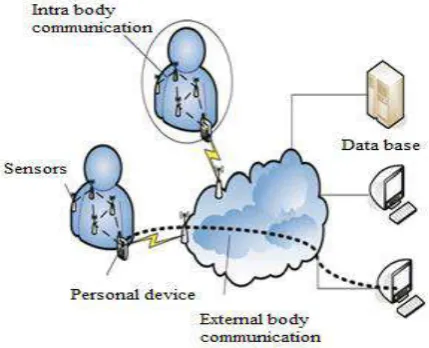
human body and it will try to transmit this data to thepersonal device with the help of Bluetooth, ZigBee etc. External communication is the communication between the personal device and the external devices like the data base present at the hospital or to communicate with the doctors with the help of internet.
Figure 2 shows the types of communication possible in WBAN.
Fig -2: Types of communication in WBAN [2] Sana ullah et al. 2012 [3], have discussed the architecture of WBAN. Antenna is used for the transmission and the reception of the signal. Patch antenna is used in this case which is a flat substrate and both sides of these substrate are coated by a conducting material. One side is coated with alluminium where the transmitter and the receivers are placed and the other side is connected to the implant. Samaneh Movassaghi et al. 2014 [4], have discussed about different types of node that can be implemented in and around the human body based on roles, functionality and implementation.
Personal Device (PD): Collects the information from all sensors and forwards it to the medical personnel.
Sensors: Sensors are used to collect the information based on the physical stimuli. The sensors used may be ECG, Temperature, Humidity etc.
Actuators: Actuators receive the signal from the sensors and act accordingly to the received signals. Example is the pumping of the correct dosage of the medicine into the human body.
Implant node: These are present under the skin of the human body or injected into the human tissue.
Body surface node: These are the nodes that are touching the human skin.
Coordinator node: Coordinate node coordinates all the nodes that are present in the WBAN architecture. Various
other nodes present in WBAN architecture can communicate with each other only through coordinator nodes.
Behrouz A Forouzan 2006 [5], has discussed about data communication and networking in which CSMA/CA and TDMA have been discussed.
CSMA/CA was intended to use in wireless network systems. In wireless networks collisions are to be avoided since they cannot be detected in wireless networks. In CSMA/CA even though the channel is found to be idle, it will wait for a period known as Inter Frame Space (IFS). After IFS, node will choose a random amount of time slot as its wait time. Node will sense the channel in each time slot. If the channel is found to be busy it restarts the timer and transmit when the channel becomes idle.
Another important protocol discussed by Behrouz A Forouzan is the TDMA protocol where time slot is allotted for each stations.
Figure 3 shows the Flow diagram of TDMA.
Fig -3: Flow diagram of TDMA [5]
Hande et al. 2010 [6], has presented a survey paper on wireless sensor networks for healthcare in which they have discussed about various challenges that has been faced by the nodes deployed in Wireless Body Area Network.
Jamil et al. 2010 [7], has presented a paper that discuss about the WBAN for medical applications in which various protocol design techniques has been developed for WBAN. Sang Hun Han et al. 2011 [8], have discussed about the channel models of WBAN. Channel models of WBAN are classified as off-body, on-body or in-body.
3. METHODOLOGY
[image:2.595.38.253.216.390.2] [image:2.595.321.537.357.554.2]© 2019, IRJET | Impact Factor value: 7.211 | ISO 9001:2008 Certified Journal | Page 7402
2) As the transmission of the packets continues, energypresent in the nodes will be reduced and the energy needs to be subtracted by the nodes from the initial value.
3) Transmissions of the packets are carried out using Carrier Sense Multiple Access with Collision Avoidance (CSMA/CA) and Time Division Multiple Access (TDMA).
4) Number of successful transmissions, number of packets lost and retransmitted is recorded for CSMA/CA and TDMA.
4. SIMULATION AND RESULTS
It is assumed that BAN Radio is charged up to 1J and the simulation is carried out using OMNeT++ simulation tool.
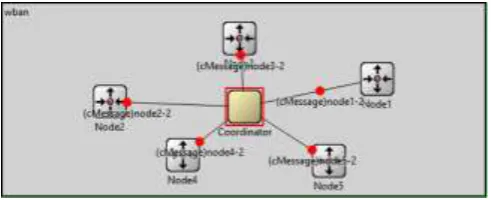
Figure 4 shows the description of the network that is implemented on the surface of the human body using OMNeT++ simulation tool employing TDMA and CSMA/CA protocol.
Fig -4: Network description for TDMA and CSMA/CA
protocol
Transmission of packets from all the nodes to the coordinator node using TDMA and CSMA/CA protocols are as shown in Figure 5
Fig -5: Transmission of packets in TDMA and CSMA/CA
protocol
As per protocol, after receiving the packets, coordinator node will send an acknowledgment to the respective nodes as shown in Figure 6.
Fig -6: Transmission of the acknowledgment
If any packet is lost at the coordinator node, the same will be retransmitted using second attempt. Figure 7 shows that 4th packet of node 1 is lost which has to retransmitted.
Fig -7: Display of loss of packet in event log
As the transmission of the packets continues, energy present in the nodes decreases and at one point of time node will be turned off. Figure 8 shows that, there is no sufficient amount of energy and the node is not able to make any further transmissions.
Fig -8: No sufficient energy for transmissions
[image:3.595.306.558.96.223.2]Number of packets that have been transmitted, received in single attempt, lost packet and retransmitted packet using TDMA and CSMA/CA for all the five nodes are as shown in Table 1 and Table 2 respectively.
[image:3.595.36.284.359.465.2] [image:3.595.37.283.557.657.2]© 2019, IRJET | Impact Factor value: 7.211 | ISO 9001:2008 Certified Journal | Page 7403
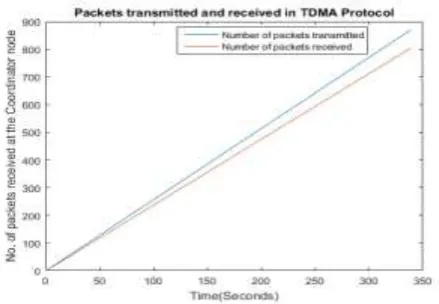
Table -2: Packets transmitted using CSMA/CAFigure 9 shows the plot of number of packets received and number of packets lost at the coordinator node for TDMA protocol.
Fig -9: Number of packets transmitted and received at
coordinator node using TDMA
Figure 10 shows the plot of number of packets received and number of packets lost at the coordinator node for CSMA/CA protocol.
Fig -10: Number of packets transmitted and received at
coordinator node using CSMA/CA
Table 3 shows the percentage of packets received and percentage of packets lost at the coordinator node.
Table -3: Average percentage of packets received and lost
using TDMA and CSMA/CA
5. CONCLUSIONS
WBAN system has been created, where five body sensor nodes will try to send the packets to the coordinator node. The simulation initiates the transmission of packets between the body sensor nodes and the coordinator. After analyzing the energy consumption, BAN Radio has been utilized in the system. In the setup CSMA/CA and TDMA has been incorporated as channel access phase. Number of successful transmissions and retransmission are recorded for both the protocols. It is found that TDMA has a percentage of packet loss of 7.55% and CSMA/CA has a percentage of loss of 10.35%
ACKNOWLEDGEMENT
Authors are grateful towards the institution for providing all the necessary facilities required for carrying out the work in a more successful way. We acknowledge our sincere thanks to the HOD of ECE department. We are also thankful for the support given by the entire department of the institution.
REFERENCES
[1] Koren, Ana, and Dina Šimunić “Modelling an energy efficient zigBee (IEEE 802.15. 4) body area network in IoT-based smart homes.", 2018 24(3), pp.852-860.
[2] Benoit, L., Bart, B., Ingrid, M., Chirs B., Piet, D., “A survey on wireless body area networks”, IEEE Communications Surveys & Tutorials, 2014, 16(3), pp.1635-1657.
[3] Ullah, S., Higgins, H., Braem, B., Latre, B., Blondia, C., Moerman, I., Saleem, S., Rahman, Z. and Kwak, K.S., “A comprehensive survey of wireless body area networks”, Journal of Medical Systems, 2012, 36(3), pp.1065-1094.
[image:4.595.45.265.345.497.2] [image:4.595.49.267.593.738.2]© 2019, IRJET | Impact Factor value: 7.211 | ISO 9001:2008 Certified Journal | Page 7404
[5] Forouzan, A.B., (2006). Data Communications & Networking (sie). Tata McGraw-Hill Education.
[6] Alemdar, H. and Ersoy, C., “Wireless sensor networks for healthcare: A survey”, Computer Networks, 2010, 54(15), pp.2688-2710.
[7] Khan, J.Y. and Yuce, M, “Wireless body area network for medical applications”, In New Developments in Biomedical Engineering. 2010, 47(2), pp.189-228.
![Fig -1: Overview of WBAN [1].](https://thumb-us.123doks.com/thumbv2/123dok_us/9347750.436810/1.595.332.532.253.516/fig-overview-of-wban.webp)