
Pervasive Data Science: New Challenges at the
Intersection of Data Science and Pervasive
Computing
Nigel Davies and Sarah Clinch
Abstract—Technology is increasingly enabling us to instrument our physical environment with complex sensors and actuators, creating a connected world that generates huge volumes of complex data. In this article we describe a number of opportunities and challenges that this new data-rich world brings to pervasive computing and highlight the emergence of a new field of pervasive data science.
F
1
I
NTRODUCTIONR
Ecent years have seen the rise of data as a central tenant in computing applications, products, research, and innovation. Commentators have identified a big data “paradigm shift” [17], and use of the term “data science” to describe the interdisciplinary field of collecting, drawing inference from and acting on data has grown exponentially (e.g. Google Trends reveals a ten-fold interest in search volume for the term since 2010). Beyond the hype, it is clear to see how our world is genuinely becoming one that is increasingly data-centric, in which both physical and electronic services depend on the collection, analysis, and response to, large volumes of heterogenous data.Examples of the success of data science abound – the application of new machine learning techniques to prob-lems such as speech recognition have made common place levels of performance that would have seemed impossible a few years ago. Apple’s Siri is reported to receive over 2 billion requests per week and provides clear evidence of the transformative nature of such innovation. Such successes have encouraged substantial levels of new research into algorithms and systems for data processing, storage and visualisation.
In contrast to this focus on data, pervasive computing has historically often focused on user experience, principally motivated by Weiser’s original papers and his compelling vision of “calm computing” [18]. Of course data has often had a role to play in providing this user experience, and research areas such as activity recognition and location technologies are highly quantitive in nature. However, in recent years the field of pervasive computing has invested significant effort into understanding the societal implica-tions and applicaimplica-tions of Weiser’s vision. This focus on the human elements of pervasive computing is in contrast to technology and application trends that increasingly enable us to instrument our physical environment with complex sensors and actuators, creating a connected world that gen-erates huge volumes of interconnected data. The importance of these trends can be seen in the growing momentum of exemplars such as the Internet of Things (IoT), smart environments and smart cities. These applications demand a new focus on how we capture, process and utilise data in pervasive environments.
In this article we identify a new field of research that we term pervasive data science. Our objective is to highlight the importance of work in this area and identify examples of key research challenges for the community, thus acting as a catalyst for new research. We define pervasive data science as research that exists at the intersection of pervasive computing and data science and is characterised bya focus on the collection, analysis (inference) and use of data (actuation) in pursuit of the vision of ubiquitous computing. Examples of topics that we would consider part of the pervasive data science agenda include the design of new IoT sensor net-works, new architectures for data processing at the edge of cloud, algorithms for processing pervasive sensor data, new techniques for data visualisation in pervasive environments and cross-cutting concerns such as privacy and trust. These topics highlight the inherently multidisciplinary nature of the field of pervasive data science – we are not simply talking about a shift towards more quantitive ubicomp research but a more fundamental refocusing on data as a key element in delivering Weiser’s vision.
2
E
XAMPLEA
PPLICATIONA
REASTo what extent does pervasive data science really have an important role to play in our everyday lives? Understanding the breadth of data-driven pervasive applications is a worth-while foundation for defining the field. In the following examples we illustrate some of the potential opportunities for data-driven pervasive applications. While the applica-tion areas may not be completely new, to date pervasive computing has failed to make them an everyday reality – we believe that the new capabilities provided by pervasive data science will be transformative in enabling such applications.
2.1 Augmented Cognition
to help with productivity. As data collection, processing, and presentation becomes all-encompassing, the potential for more effectively supporting these processes increases dramatically. Indeed, since many have proclaimed that in-dustrialisation, technology, etc. have greatly increased the cognitive demands on human beings [16], it seems only fitting that technology now helps to address these very concerns by helping to support cognition and reduce load. The exact nature of these technologies in terms of user in-terfacing is currently unclear, nevertheless there is undoubt-edly an important role for data-intensive pervasive systems in a huge array of cognitive processes including decision making; evaluation of risk; regulating mood and emotion; creative thinking; attention and information processing; and retrospective and prospective memory.
Designing these systems will require a clear under-standing of cognition. Psychologists have recently begun to distinguish between two metaphorical systems of thought – System 1 (“intuition”) and System 2 (“reasoning”) [9]. While operations of System 1 are fast, automatic and ef-fortless, they are also often emotionally charged, governed by biases and habit, associative, and difficult to control. By contrast, the operations of System 2 are slower, effortful, resource-intensive, and deliberately controlled, but are are also more adaptive and neutral with regard to emotion and bias. Pioneered as a metaphor for psychologists and be-havioural economists, this distinction may also be valuable in understanding target processes to support with pervasive data applications. Critically, System 1 and 2 thinking is often used to explain flaws in our cognition – e.g. in the evaluation of risk, decision making – as being primarily a result of relying on use of System 1 thinking because we have either insufficient time or inclination to engage in deeper processing. If technology can reduce the barriers to System 2 thinking, or indeed provide System 2 like thought in System 1 timeframes, then many of the impairments to reasoning caused by System 1’s inherent biases may well be overcome. For example, one could easily envisage data processing techniques being put to use to reduce the effort of System 2 thinking, whilst the additional data provided by pervasive sensing could also provide a richer input to that processing.
In addition to helping address flaws in cognition gen-erally, pervasive data science could help to address grow-ing concerns with regard to mental health problems and disorders of cognition. In 2015, the US National Institute of Mental Health1estimated the prevalence of diagnosable
mental disorder at 1 in 4 adults, with nearly 1 in 25 having serious functional impairment due to a mental illness. In terms of cost, it is estimated that this amounts to in excess of $300 billion per year. Similarly, the rising prevalence of dementia incurs costs of around $200 billion annually, more than both heart disease and cancer, largely due to the need to provide institutional and home-based long-term care for individuals that are no longer able to engage in their day-to-day activities without support. Providing unobtrusive support that helps individuals maintain their own identities, mood, emotion, attention, memories and thought processes could be critical in reducing the costs associated with
cogni-1. https://www.nimh.nih.gov/
tion and mental health related illness and decline.
2.2 Autonomous Vehicles
Delivering the vision of mobility as a service.
Ever since Weiser’s original description of the “foreview mirror” pervasive computing has looked to enable smart transportation; autonomous vehicles represent a natural extension of this work. For many years, computation and electronics have been an increasing feature of cars and other vehicles. However, the wealth of available sensor data (both in the environment and on-board the vehicle) together with advances in machine learning to interpret the data and predict future environmental changes means that we have now moved fromautomationto genuinelyautonomous vehi-cles. The arguments for such vehicles are well rehearsed: improved safety is perhaps the most obvious, eco-driving is another, as is the reduced burden for users.
Although one could simply envisage autonomous vehi-cles as enhanced cars that improve each individual jour-ney by allowing those being transported to travel more comfortably, safely or economically, the reality is that they will offer new opportunities for transport and logistics as a whole – forming part of a new vision of “mobility as a service”. This vision extends beyond autonomous vehicles and imagines a world in which mobile applications allow travellers to dynamically select the most appropriate form of transportation to achieve their mobility objectives with potentially profound implications for transport infrastruc-ture, urban planning and economics.
2.3 Smart Spaces
Weaving technology into the fabric of our everyday lives to improve our physical environment.
Exemplars such as the Internet of Things (IoT), smart en-vironments and smart cities are arguably the most obvious current applications of pervasive data science. Technology increasingly enables us to instrument our environment with sensors and actuators, creating a connected world that gen-erates huge volumes of complex data.Of course, the addition of ‘smart’ into our environments is not new for pervasive computing – Weiser’s vision for Ubicomp included domes-tic appliances that interpreted future needs based on recent activity, neighbourhoods that tracked mobility patterns, and an office that supported awareness and communication be-tween remote colleagues. However, progress in data science is beginning to provide tools with which to realise elements of this vision and to offer previously unenvisioned services based on the collection, analysis and application of data in our physical environments.
offers the most potential for optimisation?. Schools and places of education can build an understanding of how non-classroom environments (corridors, social spaces) can be used to complement learning. Similarly, use of pervasive data science in outdoor environments can help tackle chal-lenges like climate change, traffic congestion and urban air pollution.
While many of the above examples approach smart spaces as something that benefits populations and organi-sations as a whole, pervasive data science also lends itself perfectly to tailoring of physical environments in order to provide a personalised experience for the individual. Shared spaces could be uniquely configured to respond the user within them, changing not only the aesthetics but also the physical configuration of the space itself.
3
C
HALLENGES3.1 Overview
In considering the challenges associated with pervasive data science it is worth reflecting on those traditionally associated with its two parent domains of data science and pervasive computing. While data science is a relatively new field it draws on many years of prior work in areas such as statistics, algorithms and databases. Data science challenges are often based on the characteristics of so-called big-data, as expressed in the “3Vs” of i.e. Volume, Variety and Veloc-ity [11] and sometimes supplemented with an additional V in the form of Veracity (we revisit these challenges in Section 3.3), though it is worth noting that general papers on the challenges of data science are rare.
By contrast, there are a large number of papers that have articulated challenges relating to mobile and ubiquitous computing, including [14] and Weiser’s original paper [18]. Indeed, the inaugural issue of IEEE Pervasive Computing focused on articulating the challenges that still existed in the field ten years after its inception. Many of these challenges remain and cover a broad space including the development of appropriate systems architectures, new forms of user interaction and cross-cutting concerns such as ease of de-ployment and system maintainability.
In this section we set out some of the new challenges that arise at the intersection of these two fields. We structure our discussion in terms of the key stages in any data processing application, i.e. data collection, inference and subsequent action.
3.2 Data Collection
The first stage in any data pipeline is data collection (and cleaning). Pervasive data can originate from a wide range of sources including sensors embedded in the environment, sensors attached to users, and explicit user input as in the case of initiatives such as citizen science. While the design of any large-scale data collection system is non-trivial, the emergence of systems to support pervasive data science give rise to a number of exciting new research challenges.
How do we manage complex models of data and sensor own-ership?In conventional sensor systems the question of data ownership is relatively clear – the data owner is normally the same as the owner of the system being instrumented.
Similarly, most data scientists assume data ownership has been resolved prior to them obtaining data for analysis. However, in a world of pervasive sensors the question of data ownership becomes significantly more complex. For example, in many smart environment applications the same space may be instrumented by many different stakeholders, mobile users may bring their own sensors, or wish to use those of their peers, and the use of spaces and sensors may be highly transient. As a result the ownership of any given data stream (or combination thereof) may be unclear. Can we develop techniques for automatically resolving data ownership in such pervasive computing scenarios? How do we model shared ownership of data? How do we accom-modate ownership expectations when considering personal data that users typically perceive as belonging to them even though they may not own the sensing infrastructure (e.g. information on energy and activities in a domestic environ-ment collected by a smart heating manageenviron-ment system)? How do we ensure that ownership of data reflects transient use of pervasive sensors and spaces?
Can data provenance be ensured in pervasive data systems? Determining the provenance of data in existing systems is a well documented research challenge with solutions typically involving techniques such as audit trails based on digital signatures. However, in pervasive systems many new aspects of data provenance become important [10]. For example, how do we capture the identity and motivations of humans involved in sensor placement given that even a small bias in the placement of sensors may have a significant impact on the data captured? Once provenance data has been captured, how should this be presented to end-users to enable them to understand the likely impact on the data? Given that pervasive systems are likely to involve complex data pipelines it makes sense to record details of these pipelines and yet some aspects (e.g. data redaction policies) may be sensitive. How do we balance the need for end-to-end provenance with the need to mask the identity and motivations of some users?
How do we resolve the tension between pervasive data sci-ence’s insatiable demand for data and concerns regarding user privacy?Privacy has long been recognised as a challenge in pervasive environments [12]. Despite extensive research, the challenge of protecting user privacy remains and, indeed, is becoming significantly more difficult to address as the number of sensors in the environment increases. Are we now reaching the point where the only way to effectively protect user privacy is to limit data collection at source? If so, new architectural solutions will be required to enable data to be quenched at source. In [6] the authors propose a model in which users are able to control the release of data from their homes. While the model is simple “users should be able to control the release of their own data” the implementation is complex, necessitating the introduction of new architectural components such as privacy mediators that are able to denature data prior to disclosure [6].
about them. However, it is equally important to ensure that users understand and consent to the collection of informa-tion and, crucially have a genuine opinforma-tion to opt-out of data collection. Once consent has been provided many systems provide tools for data collectors to track subject consent. However, there is a dearth of tools that enable users them-selves to track when and where they provided consent. This opens up the opportunity for unscrupulous data collectors to simply claim that consent has been provided – how many users could really assert with confidence whether or not such a claim was true? While this discussion suggests that pervasive data science is likely to make managing consent extremely challenging, pervasive data science also offers the potential for entirely new ways of managing consent – based on systems that automatically learn user’s preferences and behaviours and infer whether or not to automatically provide consent.
3.3 Inference
Inference lies at the heart of what many consider to be data science and represents the process of analysing data to gain understanding and insight.
How does pervasive computing impact on traditional chal-lenges of data science?In future pervasive environments the volumeof data is likely to dwarf that produced by most ex-isting data systems – for example, while classic data systems may examine feeds such as web browsing histories or social media posts, pervasive data applications operate in a world in which every aspect of a user’s experience is captured by sensors. As a point of reference, current life logging cameras capture over 2000 images per day – far exceeding the number any user might manually process or post in a typical day. How can we store and process such volumes of data? Widespread user and environmental sensing is also likely to lead to avarietyof data previously unseen – creating heterogenous datasets in terms of format, frequency and quality (amongst others). This raises challenges in terms of data consistency but opens up exciting new possibilities – e.g. how can we effectively combine data from such a wide range of sensors? While any individual sensor is unlikely to produce very high-velocity data, the number of sensors in any given environment is likely to lead to data aggregators experiencing streaming data at unprecedentedvelocity. This raises important questions regarding future data processing architectures.
How should we architect pervasive data science environments? Existing data systems tend to assume large-scale data cen-tres that are available to carry out the processing necessary to draw inference. Where sensors are the source of this data they are typically assumed to be “dumb” sensors with all of the processing being conducted in the cloud. However, research has clearly demonstrated the shortcomings of a purely cloud-based model [15] and new architectures have been proposed that provide data processing at the edge of the cloud. What are the correct processing architectures for future pervasive data environments? Future pervasive environments may offer a wide range of options for hosting data processing – from highly sophisticated sensors that can carry out significant levels of analysis on-board, through edge-of-cloud solutions to micro and and full data centres.
To what extent does the exact configuration of processing elements used depend on the intended applications and how will it be influenced by security and privacy concerns?
3.4 Actuation
Traditional data science has often focused on information presentation as its key output. Likewise, other fields that work with large emerging datasets (e.g., computational social science [13]) reach their end with the analysis of data representing human behaviour patterns. Each of these fields achieve actuation only through humans implementing changes based on the outcome of data. By contrast, actuation has been a common feature of ubiquitous computing since Weiser’s early vision, and exemplars such as the IoT and smart cities continue to demonstrate its importance. While, pervasive data science requires inference to deliver value, its data lifecycle does not end with analysis; instead perva-sive data applications offer opportunities and challenges in both new forms of information presentation and physical actuation.
How can we best use pervasive technology to help visualise rich data sets?Data scientists have always sought new ways of visualising data. Pervasiveness provides a wealth of new presentation opportunities, enabling the process of engag-ing with data to be switched from one of active interpreta-tion to one of passive immersion. Weiser observed that nat-ural environments can convey a wealth of information that can be readily absorbed and yet still deliver a positive user experience, and a number of trends in pervasive displays are helping to realise a similar paradigm for digital inter-actions [4]. Given the range of available technologies, how do we select the most appropriate medium for engaging users? How do we take into account factors including the contextual relevance of the device, the scale and resolution of data that can be represented, the shared or private nature of the content, and individual aspects such as attention and task engagement? While data science has focused primarily on visualisation of data for expert users, pervasive data po-tentially creates a requirement for information presentation to become accessible to a wide range of individuals. This “data-for-the-masses” poses considerable new challenges – how do we develop a set of patterns for comprehendible representations (not necessarily visual) that are accessible to populations of different ages, education levels and cultural backgrounds?
3.5 Pervasive Data Science in Context
The questions raised in this section highlight the research opportunities that exist at the intersection of data science and pervasive computing. Pervasive computing brings new challenges to conventional data science tools by virtue of both the scale at which it operates and its focus on the rela-tionship between technology and users. However, the suc-cessful application of data-driven approaches to pervasive computing challenges open up the possibility of genuinely smart environments and applications as described in section 2.
Of course there have been numerous attempts to transfer the techniques and insights of data science to a broad set of disciplines. For example, almost ten years ago, Lazer et al. [13] described the emergence of data-driven compu-tational social science – an application of data at scale to describe individual and group interactions. Likewise, social and community intelligence (as articulated by Zhang, Guo and Yu in 2011 [19]) leverages these same tools to reveal human behaviour patterns and dynamics. Furthermore, ubicomp itself has often had a data dimension (e.g. the computational location applications of John Krumm and others [7]), incorporating qualitative and quantitative data from a range of sources to capture both ‘the masses’ and the individual. While domains such as computational social science and quantitive ubicomp have focused predomi-nantly on data collection and analysis, one unique feature of pervasive data science is its end-to-end use of data – collection, analysis and actuation. Indeed, we believe that the emerging trend for pervasive data science is the natural progression of such disciplines, but broadened to reflect the original ambition of Weiser’s ubiquitous computing.
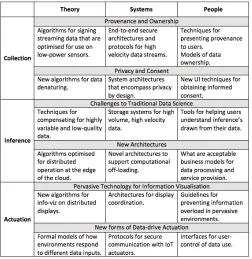
Another key distinction of pervasive data science is its interdisciplinary nature – whilst a field such as compu-tational social science integrates computing methods with those of the social sciences, pervasive data science must bring together social sciences and humanities with a broad set of computer science expertise – including theory, systems architecture, human-computer interaction. The challenges that we have highlighted all span multiple fields of com-puter science (see Figure 1) and this is deliberate – we believe that this intersection offers new opportunities for interdisciplinary research and development, and is a distinct feature of this emerging field.
4
E
ARLYC
ASES
TUDIESAs a prime example of these interdisciplinary challenges in practice, we return to our earlier scenarios. Specifically, we consider two specific case studies of work in the area of augmented cognition, specifically on task assistance and augmented memory. These examples provide an important illustration of the end-to-end nature of pervasive data sci-ence, whilst providing a foundation from which challenge areas may be considered and addressed.
4.1 Cognitive Assistance for Task Completion and De-cision Support
[image:5.612.313.565.44.303.2]Reseachers at CMU have set out a vision for angel on your shouldercognitive assistance that takes the familiar models
Fig. 1. Examples of emerging challenges in pervasive data science
of detailed directions given by current GPS systems and applies them to everyday living [3]. Such systems combine wearable sensing and presentation with local processing in order to guide users through complex tasks, telling them what to do next (with audio-visual cues) and correcting any erroneous actions. Whilst arguably an ambitious con-cept with very broad parameters that apply in virtually all facets of everyday life, the Carnegie Mellon-based group have focused predominantly on support for well-defined tasks that may require the prompt application of specific knowledge or skills (e.g. administering first aid, engaging in competitive sport). A key challenge is that completion of such tasks is both latency sensitive (a decision must be made in finite time) and resource intensive (requiring processing of the current context, identification of relevant skills or knowledge, and determination of the correct behavioural response).
To address these challenges, the Gabriel platform [3] uses a cloudlet computing infrastructure [15] in which each cog-nitive process (e.g. face recognition, motion classification) is encapsulated in its own virtual machine (VM). Each VM is then able to independently process incoming sensor data from a control VM. Any resulting output from the cognitive processing is then passed back to a shared user guidance VM which can aggregate the results and perform any high-level integration or further processing needed to deliver assistive input to the user. The Gabriel architecture has been verified with an initial set of demonstrators indicating that cloudlets could be a key part of future cognitive assistance applications.
Fig. 2. The Gabriel Architecture for Cognitive Assistance [3]. Used with Permission.
(typically visual) data feeds representing the task to be completed and the associated context. Computer vision and other data processing techniques can then be used to interpret sensor input and predict the outcome of multiple future behaviours, leading to an optimal target behaviour that the assistant should support the user in achieving. Further processing of historical data may then be needed to identify the best cues and presentation medium for this user in the given context. Finally, the system then presents input to the user and continues collecting data to close the loop and measure the ongoing success of its advice.
4.2 Human Memory Augmentation
Our own research has seen us address human cognition in terms of retrospective and prospective memory. Human memory is critical to self-identity, and to the success of most of our everyday activities. Whilst prospective memory (memory for intention) is a relatively constrained problem space, retrospective memory encompasses recollection of personal experiences (episodic memory), knowledge ac-quired (semantic memory), and motor skills learned (pro-cedural memory). With this in mind, we focus here pre-dominantly on episodic memories (although many of our approaches may well generalise beyond these).
Through a series of prototypes and deployments, our research has led us to an architecture that combines mobile, wearable and environmental devices to capture a rich rep-resentation of an individual’s experience (and thus derived knowledge) [5], including occurrences in which the human memory itself was known to have failed. These data streams serve as input to a graph-based storage, thememory vault, which attempts to reflect human cognition in its model of both how individual pieces of information connect together to form a single digital memory, and also the interconnection between multiple digital memories. Since many human experiences are the product of social interactions, and since memory of those experiences is continuously shaped by ongoing interaction with those (and other) individuals, it is not the case that a single centralised digital memory will meet an individual’s needs. Instead, we anticipate that our memory vault will be a distributed memory, with intercon-nections spanning multiple instances, and with data from others being made readily available to those who shared an experience [2].
Human memories continuously draw on traces formed over many years, and ongoing processing and inference are clearly critical to the success of memory augmentation systems. Unlike the example of task assistance that focused primarily on real-time processing, our memory augmenta-tion architecture makes heavy use of continuous long-term data aggregation and inference; the output of these is stored alongside raw experience data in the memory vault. When an individual then engages in a situation that would be facilitated by access to extended memory, our architecture can pass current contextual feeds to the memory vault and select an appropriate cue for presentation. The system then presents input to the user and continues collecting data to close the loop and measure its ongoing success.
In line with challenges outlined earlier, our research in the area of augmented memory has highlighted significant security and privacy concerns related to the acquisition, processing and presentation of datasets [5]. Bystander pri-vacy is one that is often raised (and is thus the target of considerable research to date [1], [8]), but many more subtle data challenges also emerge. For example, the issue of provenance discussed above becomes important in ensuring that digital memory is an accurate representation of what occurred, particularly since the very need for augmented memory means the human may be unable to determine this for themselves. The phenomenon of recall induced forgetting is a good example of a threat that arises only when our understanding of human cognition is applied to the design of data-intensive pervasive applications – in this case, psychology theory indicates that rehearsal of one memory has a detrimental effect on the subsequent recall of related memories, a clear concern for those designing technology interventions in this space.
5
C
ONCLUDINGR
EMARKSRecent developments in fields such as machine learning have demonstrated the potential of data science to transform our ability to deliver solutions to traditionally very demand-ing problems such as speech recognition. These develop-ments, coupled with widespread deployment of sensing and actuating technologies mean that there is the potential for pervasive computing to adopt an increasingly data-driven approach – which we have termed pervasive data science.
In analysing the challenges such an approach raises we observe that many are cross-cutting in two distinct axis. Firstly, the challenges span all stages of the data pipeline – from data collection through to data visualisation and ac-tuation. Secondly, the challenges require multi-disciplinary approaches as they raise issues in terms of systems, algo-rithms and people. For example, protecting user privacy in future pervasive environments demands new systems work on topics such as privacy mediation, new algorithms for efficient data denaturing, and new techniques to enable users to visualise and control the release of their personal data. However, the pay-off for developing solutions to these problems is significant – applications such as augmented cognition and memory have the potential to transform our society, delivering benefits to millions.
we therefore believe that the field is particularly well suited to addressing these types of problem. Pervasive computing has always favoured researchers that adopt a holistic view, and the emergence of pervasive data science serves to reenforce the validity of this approach.
A
CKNOWLEDGMENTSThis research is partially funded through the Future and Emerging Technologies (FET) programme within the 7th Framework Programme for Research of the European Com-mission, under FET grant number: 612933 (RECALL) and the EPSRC under grant EP/N028228/1 (PACTMAN:Trust, Privacy and Consent in Future Pervasive Environments).
R
EFERENCES[1] P. Aditya, R. Sen, P. Druschel, S. J. Oh, R. Benenson, M. Fritz, B. Schiele, B. Bhattacharjee, and T. Wu. I-pic: A platform for privacy-compliant image capture. InProceedings of the 14th Annual International Conference on Mobile Systems, Applications, and Services, MobiSys ’16, pages 235–248, New York, NY, USA, 2016. ACM. [2] A. Bexheti, M. Langheinrich, and S. Clinch. Secure personal
memory-sharing with co-located people and places. InProceedings of the 6th International Conference on the Internet of Things, IoT 2016, 2016.
[3] Z. Chen, L. Jiang, W. Hu, K. Ha, B. Amos, P. Pillai, A. Hauptmann, and M. Satyanarayanan. Early implementation experience with wearable cognitive assistance applications. InProceedings of the 2015 Workshop on Wearable Systems and Applications, WearSys ’15, pages 33–38, New York, NY, USA, 2015. ACM.
[4] S. Clinch, J. Alexander, and S. Gehring. Pervasive displays for information presentation.Pervasive, 15(3), 2016.
[5] N. Davies, A. Friday, S. Clinch, C. Sas, M. Langheinrich, G. Ward, and A. Schmidt. Security and privacy implications of pervasive memory augmentation. Pervasive Computing, IEEE, 14:44 – 53, 2015.
[6] N. Davies, N. Taft, M. Satyanarayanan, S. Clinch, and B. Amos. Privacy mediators: Helping IoT cross the chasm. InProceedings of the 17th International Workshop on Mobile Computing Systems and Applications, HotMobile ’16, pages 39–44, New York, NY, USA, 2016. ACM.
[7] D. Delling, A. V. Goldberg, M. Goldszmidt, J. Krumm, K. Talwar, and R. F. Werneck. Navigation made personal: Inferring driving preferences from gps traces. InProceedings of the 23rd SIGSPA-TIAL International Conference on Advances in Geographic Information Systems, page 31. ACM, 2015.
[8] M. Fan, A. T. Adams, and K. N. Truong. Public restroom detection on mobile phone via active probing. InProceedings of the 2014 ACM International Symposium on Wearable Computers, ISWC ’14, pages 27–34, New York, NY, USA, 2014. ACM.
[9] D. Kahneman. Maps of bounded rationality: Psychology for behavioral economics. The American Economic Review, 93(5):1449– 1475, 2003.
[10] B. Knowles. Emerging trust implications of data-rich systems. Pervasive, 15(4):76–84, 2016.
[11] D. Laney. 3d data management: Controlling data volume, velocity and variety. Technical report, Gartner, 2001.
[12] M. Langheinrich. A privacy awareness system for ubiquitous computing environments. InProceedings of the 4th International Conference on Ubiquitous Computing, UbiComp ’02, pages 237–245, London, UK, UK, 2002. Springer-Verlag.
[13] D. Lazer, A. S. Pentland, L. Adamic, S. Aral, A. L. Barabasi, D. Brewer, N. Christakis, N. Contractor, J. Fowler, M. Gutmann, et al. Life in the network: the coming age of computational social science.Science (New York, NY), 323(5915):721, 2009.
[14] M. Satyanarayanan. Fundamental challenges in mobile comput-ing. InProceedings of the Fifteenth ACM Symposium on Principles of Distributed Computing, 1996.
[15] M. Satyanarayanan, P. Bahl, R. Caceres, and N. Davies. The case for vm-based cloudlets in mobile computing.Pervasive, 8(4), 2008. [16] C. S. Saunders and A.-F. Rutkowski. Growing pains with
informa-tion overload.Computer, 43, 2010.
[17] R. Schutt and C. O’Neil. Doing Data Science: Straight Talk from the Frontline. ” O’Reilly Media, Inc.”, 2013.
[18] M. Weiser. The computer for the 21st century. Scientific American, 265(3):94–104, 1991.
[19] D. Zhang, B. Guo, and Z. Yu. The emergence of social and community intelligence.Computer, 44(7):21–28, 2011.
Nigel Davies is a Professor of Computer Sci-ence at Lancaster University, UK, and co-director of Lancaster’s Data Science Institute. His research is in the area of pervasive comput-ing includcomput-ing systems support for new forms of data capture and interaction and is characterized by an experimental approach involving large-scale deployments of novel systems with end-users. Contact him at [email protected]. uk.
![Fig. 2. The Gabriel Architecture for Cognitive Assistance [3]. Used withPermission.](https://thumb-us.123doks.com/thumbv2/123dok_us/9362702.438809/6.612.52.298.44.188/fig-gabriel-architecture-cognitive-assistance-used-withpermission.webp)
