Educational Development for Online Teaching Jordanne Christie, BComm(Hons), MEd
April, 2016.
This thesis is submitted in partial fulfilment of the requirements for the degree of Doctor of Philosophy.
Educational Development for Online Teaching Jordanne Christie, BComm(Hons), MEd
This thesis results entirely from my own work and has not been offered previously for any other degree or diploma.
i Jordanne Christie, BComm(Hons), MEd
Educational Development for Online Teaching Doctor of Philosophy, April, 2016
Abstract
This thesis discusses a case study that explores the impact on educators’ teaching practices, particularly their assumptions and beliefs about teaching and self-efficacy, as a result of their participation in an educational development programme designed to prepare college educators to develop and teach online and hybrid courses. The philosophical worldview adopted in this study is closely aligned to the constructivist perspective. It draws upon the conceptions of teaching literature, Bandura’s theory of self-efficacy (1977; 1986; 1997) and Mezirow’s (1978) theory of transformational learning as a conceptual framework. The data were collected through an online survey of 34 participants, face-to-face interviews with 18 participants and
documentary evidence review of 6 participants, and was analysed using Braun and Clarke’s (2006) thematic analysis approach.
The findings suggest that the knowledge and experience that college educators acquire when participating in educational development for online teaching produce a positive increase in technological and pedagogical knowledge and understanding of accessibility for some educators. This new understanding, in turn, results in changes to both online and face-to-face teaching practices of educators. The results also indicate that for some educators, participation in an educational development
programme for online teaching encouraged more student-centred teaching approaches and helped to dispel misconceptions about the lower quality and value of online learning. Participation in educational development for online teaching was also found to increase some educators’ technical and pedagogical confidence, although a few participants experienced an initial decline in self-efficacy. Finally, the results reveal that educators perceived their participation in the educational development
ii
Contents
Abstract...i
Contents ... ii
Acknowledgements ... v
List of Figures and Tables ... vi
Chapter 1 Introduction ... 1
1.1 Introduction ... 1
1.2 Statement of the Problem ... 2
1.3 Context of the Study ... 3
1.4 Purpose of the Study ... 7
1.5 Research Questions ... 8
1.6 Research Approach ... 9
1.7 Thesis Outline ... 9
Chapter 2 Literature Review ... 11
2.1 Introduction ... 11
2.2 Defining Educational Development ... 11
2.3 The Growing Demand for Educational Development ... 12
2.4 Review of Educational Development ... 14
2.5 Review of Educational Development for Online Teaching ... 17
2.6 Conceptions of Teaching ... 19
2.7 The Impact of Educational Development on Conceptions of Teaching ... 21
2.8 The Impact of Educational Development for Online Teaching on Conceptions of Teaching ... 24
2.9 Teacher Self-Efficacy ... 26
2.10 The Impact of Educational Development on Teacher Self-Efficacy ... 28
2.11 Transformational Learning ... 29
2.12 Transfer of Learning ... 31
2.13 Summary ... 33
2.14 Conceptual Framework ... 35
Chapter 3 Research Design ... 40
3.1 Introduction ... 40
3.2 The Researcher ... 41
3.3 Paradigm of Inquiry/Research Stance ... 43
3.3.1 Ontology ... 44
3.3.2 Epistemology ... 44
iii
3.5 Case Study Design ... 47
3.6 Study Participants ... 48
3.7 Data Collection Instruments ... 49
3.7.1 Online Survey ... 49
3.7.2 Interviews... 51
3.7.3 Documentary Evidence ... 54
3.8 Data Analysis Procedures ... 55
3.8.1 Online Survey ... 55
3.8.2 Interviews... 55
3.8.3 Documentary Evidence ... 57
3.9 Pilot ... 57
3.10 Trustworthiness ... 57
3.10.1 Credibility ... 57
3.10.2 Transferability ... 58
3.10.3 Confirmability ... 58
3.10.4 Dependability ... 59
3.11 Ethical Considerations ... 59
3.12 Summary ... 60
Chapter 4 Findings ... 61
4.1 Introduction ... 61
4.2 Online Survey Data ... 61
4.2.1 Demographics ... 62
4.2.2 Perception of impact of Online/Hybrid Course Development Institute ... 64
4.3 Interview Data ... 66
4.3.1 Demographics of interviewees ... 67
4.3.2 Interview responses ... 69
4.3.2.1 Motivation for participating in the Institute ... 71
4.3.2.2 Self-Reported Benefits of the Institute ... 74
4.3.2.3 Impact of participation in the Institute on teaching practice ... 76
4.3.2.4 Impact of participation in the Institute on assumptions and beliefs about teaching ... 81
4.3.2.5 Impact of participation in the Institute on confidence in ability to teach (self-efficacy) ... 84
4.3.2.6 Perceived impact of participation in the Institute on students ... 88
4.3.2.7 Summary ... 90
4.4 Documentary Evidence ... 91
4.5 Critical Discussion of Findings ... 99
iv
Chapter 5 Discussion and Conclusion ... 102
5.1 Introduction ... 102
5.2 Summary of the Findings ... 103
5.2.1 Motivation for participating in the Institute ... 103
5.2.2 Self-Reported Benefits of the Online/Hybrid Course Development Institute ... 105
5.2.3 Impact of participation in the Online/Hybrid Course Development Institute on teaching practice... 109
5.2.4 Impact of participation in the Online/Hybrid Course Development Institute on assumptions and beliefs about teaching ... 114
5.2.5 Impact of participation in the Online/Hybrid Course Development Institute on confidence in ability to teach (self-efficacy) ... 116
5.2.6 Perceived impact of participation in the Online/Hybrid Course Development Institute on students ... 119
5.3 Implications for the Conceptual Framework ... 121
5.4 New Knowledge Contribution ... 124
5.5 Implications for Policy and Practice ... 127
5.6 Limitations ... 135
5.7 Recommendations for Future Research ... 136
5.8 Conclusion ... 138
v
Acknowledgements
I would like to express my sincerest gratitude to the research participants who actively participated in the Online/Hybrid Course Development Institute and were willing to share their learning journey with me. In addition, I would like to thank my thesis advisor Julie-Ann Sime for her direction and ongoing support, and my Committee Members for their insightful feedback. I would also like to recognise Alice Jesmont for assisting me on multiple occasions throughout the last few years. I am also very thankful to the peers in my cohort as they have been a great support system over this entire process, and I look forward to celebrating all of their future successes. I am eternally grateful to Ruth Rodgers for her guidance, friendship and mentorship
throughout the last several years. I am also thankful to Chris Hinton, who has been an extremely supportive boss and a great resource and sounding board during this
vi
List of Figures and Tables
Figures
Figure 2.1 - Conceptual framework ... 35
Figure 3.1 - Online survey questions ... 51
Figure 3.2 – Example of Coding in NVivo ... 56
Figure 4.1 - Cohort of the Online/Hybrid Course Development Institute of online survey respondents ... 62
Figure 4.2 - Academic school of online survey respondents ... 63
Figure 4.3 - Face-to-face teaching experience prior to completing the Institute of online survey respondents ... 63
Figure 4.4 - Online teaching experience prior to completing the Institute of online survey respondents ... 64
Figure 4.5 - Years of online teaching experience prior to completing the Institute of online survey respondents ... 64
Figure 4.6 – Application to face-to-face and online/hybrid teaching practice ... 65
Figure 4.7 – Implementation of more student-centred teaching strategies ... 65
Figure 4.8 – Change in approach to teaching and self-efficacy ... 66
Figure 4.9 - Cohort of the Online/Hybrid Course Development Institute of interviewees ... 67
Figure 4.10 - Academic school of interviewees ... 68
Figure 4.11 - Face-to-face teaching experience prior to completing the Institute of interviewees ... 69
Figure 4.12 - Online teaching experience prior to completing the Institute of interviewees ... 69
Figure 4.13 - Years of online teaching experience prior to completing the Institute of interviewees ... 69
Figure 4.14 - The JumpStart lesson planning model ... 78
Figure 4.15 - Content activity example #1 ... 92
Figure 4.16 - Content activity example #2 ... 92
Figure 4.17 - Treasure Hunt activity ... 93
Figure 4.18 - Virtual Field Trip activity ... 93
Figure 4.19 - Formative online quiz... 93
Figure 4.20 - Sample practice activities ... 94
Figure 4.21 - Sample videos ... 94
Figure 4.22 - Sample JumpStart model lesson plans ... 95
vii
Figure 4.24 - Sample evaluation criteria from course outline... 97
Figure 4.25 - Sample Murder Mystery evaluation ... 97
Figure 4.26 - Sample introduction videos ... 98
Figure 5.1 - Revised conceptual framework ... 124
Tables Table 1.1 – Demographics of Institute participants ... 7
1
Chapter 1 Introduction
1.1 Introduction
As online learning in higher education has grown rapidly over the past decade, so too has the need for educational development to prepare educators to teach online. A growing body of literature suggests that when educators move from traditional to online classrooms, they require a transformational shift in their approach to teaching, and often need to re-examine their underlying assumptions about teaching and learning (Garrison, 2006; Kreber & Kanuka, 2006; McShane, 2006; Natriello, 2005; Scagnoli, Buki, & Johnson, 2009; Wiesenberg & Stacey, 2008). Unlike the
traditional face-to-face classroom where educators are often at the centre of the instruction, the asynchronous online environment can be more learner-centred, allowing educators to share control of the learning process with students (Coppola, Hiltz & Rotter, 2002; Hixon et al., 2012; Natriello, 2005; Schrum & Hong, 2002). Educators making the transition to teaching online are challenged to shift their approach from one of disseminating information to one of facilitating a learning environment where students co-construct knowledge (Redmond, 2011; Vaughan, 2010). Taking on this new role of “guide on the side” rather than “sage on the stage” requires many educators to re-examine their approach to teaching and to implement teaching practices that may be new and uncomfortable to them (Anderson, et al., 2001; Berge, 2009; King, 1993; Major, 2010). Therefore, it is particularly important that educational development initiatives prepare educators for these challenges and support them as they reconstruct their teaching approaches and instructional practices during this transitional period.
2 presented by the transition to the online environment; thus, building self-efficacy is also a key element of educational development for online teaching.
Despite the challenges in transitioning from face-to-face to online teaching, learning to teach online can be a catalyst for educators to reflect on and reinvent their current teaching practices (McQuiggan, 2012). Many educators, after gaining experience with online teaching, start to reconsider their traditional teaching approaches with a
renewed orientation towards student-centred learning (Dennen, 2007). Online teaching experience can cause educators to re-evaluate their conceptions of teaching and their beliefs about how students learn (Baran & Correia, 2014). Thus, educational development programmes targeting online teaching have the potential to create a far-reaching and lasting impact on educators beyond the online environment
(McQuiggan, 2012).
1.2 Statement of the Problem
While educational development for online teaching has become more commonplace within higher education institutions, little is known about the changes in teaching practice resulting from educators’ preparation to teach online (Herman, 2012). Most of the literature to date has focused on the types and frequency of educational
3 There is also a need for research focusing on educators within the community college sector in Canada, as this setting is not well represented in the literature. Given that colleges and universities are offering online courses at an accelerated rate, preparing educators to teach online is an important issue facing higher education, and the evaluation and improvement of educational development programmes is a necessary step in achieving the goal of quality online learning (Horvitz & Beach, 2011). Thus, in order to improve and advance educational development programmes for online teaching, it is important to have an understanding of the impact of educational development on teaching practice, assumptions and beliefs, and self-efficacy (Storandt, Dossin & Lacher, 2012).
1.3 Context of the Study
This study is set within the Canadian community college system which emerged in the 1960s as an alternative to university for learners seeking access to local, career-oriented programming (Skolnik, 2008). While the range of programmes varies among provincial college systems, community colleges in Canada typically offer vocational courses leading to certificates, diplomas, advanced diplomas and graduate certificates, as well as trades and apprenticeship training, adult upgrading and a variety of adult continuing education offerings. Some community colleges also offer selected baccalaureate degrees in academic and applied fields (Floyd, Skolnik, & Walker, 2005).
4 programmes and courses (Ministry of Advanced Education and Skills Development, 2014).
Durham College, the focus of this study, was founded in 1967 and has campuses in Oshawa and Whitby, Ontario. Durham offers more than 140 full-time, programmes through the Schools of Business, Information Technology (IT) and Management; Centre for Food; Continuing Education; Health and Community Services;
Interdisciplinary Studies and Employment Services; Justice and Emergency Services; Media, Art and Design; Science and Engineering Technology; and Skilled Trades, Apprenticeship and Renewable Technology, and offers more than 1,500 courses through the School of Continuing Education. Durham College currently has more than 12,000 full-time post-secondary and apprenticeship students and thousands of students enrolled in part-time, continuing education and online studies. In addition, there are over 300 full-time educators, and almost 600 part-time educators who teach at Durham College. Durham College is a provincial leader in the development and delivery of online programs and courses. The college currently has approximately 250 online courses delivered in full-time programs across the college and through Continuing Education. In addition, a number of full-time programs offer hybrid courses to students which feature a combination of in-class and online delivery and assessment.
Educators within the community college system are usually hired for their discipline-specific knowledge, which is typically demonstrated by their work experience in the field and/or their credentials in the academic discipline. Many community college educators have had little preparation to be educators, as teaching expertise is not always a requirement for employment (Cohen & Brawer, 1996). Thus, few college educators are experts in pedagogical approaches, and even fewer are experts in
pedagogy for online environments (Whitelaw, Sears, & Campbell, 2004). As a result, most community colleges devote resources toward educational development in areas such as adult learning, curriculum design and assessment, facilitation skills,
programme development, and educational technology to help educators achieve the relevant knowledge and skills needed to enhance student learning. Consequently, educational development has become increasingly recognised as a key success factor for community colleges (Howard & Taber, 2010).
5 educators for teaching online (Lane, 2013). Educational development programmes vary greatly, from single workshops to longer intensive programmes, and range in focus from technology to pedagogy (Herman, 2012). In an effort to support educational development for online teaching, the Centre for Academic and Faculty Enrichment at Durham College in Oshawa, Ontario, Canada developed an educational development programme, known as the Online/Hybrid Course Development Institute, to prepare educators to teach online successfully, as well as to help them design or modify a course for online or hybrid delivery. At Durham College “online” refers to courses where all of the instruction is delivered online (with the exception of
proctored examinations in some courses), whereas “hybrid” refers to courses where a portion of the traditional face-to-face instruction is replaced by online learning.
The Online/Hybrid Course Development Institute began in 2011 and is designed to familiarise educators with best practices in online teaching. It employs an active learning approach in which participants engage in a hybrid learning environment while applying principles of course design and delivery to a course they are preparing to teach online or hybrid. The curriculum is focused on defining and creating student-centred learning experiences and examines effective design of content and activities, as well as implementation of successful assessment and facilitation techniques. The following are the learning outcomes of the Online/Hybrid Course Development Institute:
• Identify the similarities and differences between face-to-face and online course design and delivery.
• Describe a student-centred approach and how it applies to online learning. • Discuss relevant learning theories and how they might be incorporated into
online learning design.
• Develop online learning modules which utilise an interactive, student-centred approach for at least one online/hybrid course.
• Develop evaluation strategies that address the challenges and opportunities of online delivery.
• Develop familiarity with a variety of online tools and strategies by participating as a student in a hybrid course.
• Participate in a cohort model of development wherein educators share ideas and support each other’s development.
6 format (2 hours face-to-face per week and 1 hour online per week) during the fall and winter semesters. The face-to-face time during the first half of the Institute is spent discussing theory and showcasing best practices for online course design and delivery, and the online time is devoted to the practical application of the theory to the
participants’ own course development. The content of the Institute includes topics such as planning your online/hybrid course, online teacher competencies, active and student-centred learning strategies, assessment and evaluation strategies, academic integrity, creating a positive climate for learning, building community, supporting students, facilitating discussions, managing group work, accessibility and Universal Design for Learning, and copyright and fair use. During the second half of the Institute, the face-to-face time is devoted to peer sharing and review, and the
participants have the opportunity to showcase their on-going course development and obtain feedback from each other.
At the time of this study, in the fall of 2014, there were a total of 91 educators who had participated in the Online/Hybrid Course Development Institute. The Institute was initially offered in the spring semester over seven weeks in May and June. There were 10 participants in the spring of 2011 and 8 in the spring of 2012. Due to
increasing demand for the Institute, in 2013 it was decided that the Institute would also be offered in the fall and winter semester, over a fourteen-week period. In 2013, there were 8 participants in the winter, 10 in the fall, and 47 in the spring, and in 2014 there were 8 participants in the winter semester. In terms of subject area, a large majority of the participants have attended the Institute in order to develop courses related to Interdisciplinary Studies. The main reason for this is that Durham College has a strategic mandate to offer more general education courses in an online/hybrid format to allow more flexibility for students, so many of the participants in the
Institute have been part of this initiative. There has typically been a good mix of both full-time and part-time educators who have participated in the Institute, which has resulted in a wide range of prior teaching experience. The following table provides a more detailed overview of the demographics of the Online/Hybrid Course
7
Subject Area
Total Number of Participants
Business and IT Management 10
Continuing Education 1
Health and Community Services 10
Interdisciplinary Studies 52
Justice and Emergency Services 13
Media Art and Design 1
Science, Engineering and Technology 4
Employment Status
Full-Time 51
Part-Time (includes partial load and sessional) 40
Gender
Female 65
[image:16.594.111.525.65.351.2]Male 29
Table 1.1 – Demographics of Institute participants
1.4 Purpose of the Study
8 The purpose of this study was to examine the impact of the Online/Hybrid Course Development Institute on college educators’ teaching practice, and to determine if there was any change to their previously held assumptions and beliefs about teaching as a result of participating in the Institute. This study also aimed to understand how participation in the Online/Hybrid Course Development Institute impacted educators’ confidence in their ability to teach (self-efficacy). This study used a descriptive case study approach to examine these areas of inquiry (Yin, 2009). At an institutional level, the results of this study are intended to help educational developers at Durham College evaluate the effectiveness of the Online/Hybrid Course Development Institute on transforming educators’ approaches to teaching, self-efficacy, and ability to apply knowledge gained from the Institute into their teaching practice. These findings can be used to inform decisions about possible modifications to the design and facilitation of the Online/Hybrid Course Development Institute. In addition, the findings may be used to develop new professional development opportunities to support educators teaching online and could also help to inform policies and procedures related to the online environment. From a general scope, findings from this study can be used to develop recommendations for educational development for online teaching, and these insights may be transferable to other institutions seeking to revise, enhance or
establish educational development offerings to help educators successfully transition to the online environment. The results of this study can also help to influence policy makers and inform policy development related to educational development for online teaching. In addition, what is learned from this study can help to close the current gap in research by exploring, in depth, the influence of educational development on the pedagogical transformation of educators as they move from face-to-face teaching to online teaching (Storandt, Dossin & Lacher, 2012).
1.5 Research Questions
This study set out to answer the following main and sub research questions:
Main Research Question
• How does participation in the Online/Hybrid Course Development Institute impact college educators’ teaching practice?
Sub-Research Questions
9 • What changes, if any, do educators experience in their confidence in their
ability to teach (self-efficacy) as a result of participating in the Online/Hybrid Course Development Institute?
1.6 Research Approach
The philosophical worldview adopted in this study was closely aligned to the constructivist worldview which proposes that meaning is constructed by humans as they engage with the world they are interpreting (Crotty, 1998). The participants in the study interpreted and constructed their own vision of reality through the
discussion of their experiences in the Online/Hybrid Course Development Institute (Patton, 2002). In this study, meaning and reality were determined collectively through the face-to-face interviews, and knowledge acquisition was interactional and collaborative (Patton, 2002). This study was oriented towards exploration and
discovery, and attempted to make sense of the situation without imposing pre-existing theories or expectations. A single descriptive case study approach was determined to be the most appropriate method for this study, as it allowed the researcher to capture the rich and detailed experiences of the educators in the Online/Hybrid Course Development Institute (Yin, 2009). A retrospective design was utilised because the research questions were focused on the impact of the Online/Hybrid Course
Development Institute on college educators’ teaching practice and a lapse of time was needed in order to measure changes to teaching practice. The data collection for this case study consisted of an online survey, in-depth interviews with educators, and an analysis of educator-provided documentary evidence.
1.7 Thesis Outline
Chapter 1 provides an introduction to the topic, a description of the context of the study and problem statement, a summary of the purpose of the study and the research questions, and discusses the research approach and significance of the study. Chapter 2 reviews the literature related to the study and lays the groundwork for the rationale of this study and the conceptual framework. Chapter 3 describes the research
11
Chapter 2 Literature Review
2.1 Introduction
The purpose of this study was to investigate changes in educators’ teaching practice that arose as a result of participation in the Online/Hybrid Course Development Institute. In addition, the study aimed to examine the influence of the Institute on participants’ previously held assumptions and beliefs about teaching, and self-efficacy. There are several areas of the literature that were explored to provide the foundation for this research. The review begins with a summary of educational development and discusses several systematic literature reviews focusing on the effects of educational development activities in higher education. It then provides a summary of the educational development literature that focuses specifically on online teaching. It continues by examining the research related to conceptions of teaching and the impact of educational development on educators’ conceptions of teaching. It also highlights the literature associated with teacher self-efficacy and educational development. It concludes with a review of literature related to educational development, transformational learning and transfer of learning.
2.2 Defining Educational Development
12 Fraser, Gosling and Sorcinelli (2010) describe three broad approaches to educational development: (1) Educational development focused on the individual staff member; (2) Educational development focused on the institution; and (3) Educational
development focused on the sector. The focus of this study is educational
development at the individual educator level. Bergquist and Phillips (1975) describe two models of educational development at the individual level: instructional
development which focuses on the process of education and the design of courses, and personal development which includes programmes to promote individual personal growth. Boud and McDonald (1981) suggest three models of educational
development: (1) Professional service – providing specialized services such as computer-assisted learning, instructional design, and diversifying assessment; (2) Counselling - supporting academics in their personal and professional development; (3) Collegial - focussing on collaboration with academics in joint projects to improve practice. The Online/Hybrid Course Development Institute aligns with Bergquist and Phillips’s (1975) instructional development model and Boud and McDonald’s (1981) professional service model.
More recently, Amundsen and Wilson (2012) proposed a conceptual framework for classifying educational development initiatives based on stated processes and
intended outcomes. They identified six process and outcome clusters, as follows: (1) Skills cluster - focuses on the acquisition or enhancement of observable teaching skills and techniques; (2) Methods cluster - focuses on mastery of a particular teaching skill, such as problem-based learning; (3) Reflection cluster - focuses on change in individual teacher conceptions of teaching and learning; (4) Institutional cluster - focuses on coordinated institutional plans to support teaching improvement; (5) Disciplinary cluster - focuses on disciplinary understanding to develop
pedagogical knowledge; and (6) Action research or inquiry cluster - focuses on individuals or groups of faculty investigating teaching and learning questions of interest to them. There is overlap among these categories and many of the
educational development initiatives may fit within more than one cluster (Randall, Heaslip & Morrison, 2013). In the case of the Online/Hybrid Course Development Institute, the intended outcomes are consistent with the skills, methods, and reflection clusters.
2.3 The Growing Demand for Educational Development
13 community at large (Jacob, Xiong & Ye, 2015). As accountability for the quality of teaching and learning has garnered increased attention, so too has recognition of the importance of educational development. Educational development plays a vital role in ensuring the quality of teaching and learning in higher education (Devlin, 2006). The prevalence of teaching and learning centres on campuses, dedicated courses or programmes for educators on teaching and learning, and the use of teaching portfolios and other forms of teaching evaluation all show an increase in the perceived
importance of the quality of teaching in higher education (Evers et al., 2009; Schönwetter, Ellis, Taylor, & Koop, 2008).
The value of educational development is increased at the postsecondary level, as most educators have extensive training in their academic discipline and significant
professional backgrounds, but little or no formal education, training, or experience related to teaching (Brancato, 2003; Cranton & King, 2003; Elliott, Rhoades, Jackson & Mandernach, 2015). In Canada, and in most developed nations, postsecondary educators are not required to have any formal teaching qualifications. In the absence of formal qualifications, many postsecondary educators tend to base their teaching approach on their own experience as students, and often teach the way that they were taught (Daley, 2003; Gallant, 2000). A study by Britnell et al. (2010) found that many educators in the postsecondary environment learn to teach through an informal process of trial and error. These experiences tend to reinforce teacher-centred approaches that do not inspire the high-quality learning experiences required by the current higher learning context (Pleschová et al., 2012).
Historically, the need for educational development has been more prevalent in the community college sector as colleges are typically represented as placing relatively more value on teaching compared to universities which also have a strong research mandate. In Canada, teaching is the primary activity of college educators as opposed to research which is the principal mandate of university educators (Gregory &
14 the community college setting to ensure high quality teaching and learning across the college sector.
As online instruction becomes more abundant at colleges and universities worldwide, so does the need for educational development programmes designed to prepare educators for this new teaching environment (Golightly, 2012). Many institutions have come to appreciate that teaching in the online environment involves different teaching and learning approaches from the classroom setting, and have begun to offer educational development programmes to prepare educators for teaching online
(Herman, 2012; Hinson & LaPrairie, 2005). These educational development initiatives can help provide educators with the necessary online learning experience and pedagogical expertise to teach effectively in the online learning environment and can aid in the promotion of student-centred teaching methods (Rhode &
Krishnamurthi, 2016).
2.4 Review of Educational Development
To date, there have been a number of systematic literature reviews focusing on the outcomes of educational development activities in higher education (Levinson-Rose & Menges, 1981; Prebble et al., 2004; Steinert et al., 2006; Stes, Min-Leliveld, Gijbels & Van Petegem, 2010; Weimer & Lenze, 1991; Wilson, 2012). Levinson-Rose and Menges (1981) conducted the first systematic review which examined 71 studies, mostly from American institutions, published between the mid-1960s and 1980s. The articles were grouped by the format of the educational development initiative (i.e. grants for faculty projects; workshops and seminars; feedback from student ratings; practice with feedback; and concept-based training) and categorised according to level of impact (i.e. self-reported change in teacher attitude; tested or observed change in teacher knowledge; observed change in teacher skill; self-reported change in student attitude; and tested or observed change in student learning). The results indicated positive effects for most interventions studied, when taking into account only those studies where high confidence could be placed in the results. The authors noted that although workshops and seminars were the most common
15 A decade later, Weimer and Lenze (1991) found a similar state of affairs in a review of the literature published in the 1980s, drawing again from mostly American sources. Their review focused on the effectiveness of five common instructional interventions: workshops, one-on-one instructional consultation, instructional grants for improving teaching, peer assistance programmes, and resource materials. Reported effects were categorized using the same categories used by Levinson-Rose and Menges (1981). In comparison with the earlier review, they found greater variation in the instructional methods and accounts of more lengthy workshops and seminars. They also found more targeting of specific populations within the university or college including new faculty and teaching assistants (TAs). They noted that instructional interventions with TAs were far more widespread and that many of the programmes and activities first offered to TAs were being extended to new faculty. They suggested that the attention focused on TAs and new faculty could stem from the fact that it was often easier and more effective to intervene early in a person’s teaching career.
Overall, Weimer and Lenze (1991) felt their review provided inconclusive evidence of the positive effects of educational development and also called for more rigorous approaches to the research related to educational development (Parsons, Hill, Holland & Willis, 2013). Both of the Levinson-Rose and Menges (1981) and Weimer and Lenze (1991) reviews were based on articles from mostly American sources that were published more than 30 years ago when educational development was still in its infancy. Thus, these reviews offer important historical information but may not be representative of educational development initiatives today.
Prebble et al. (2004) conducted a review or more than 150 published studies between 1990 and 2004 from Australia, New Zealand, North America, the United Kingdom (UK), Singapore and Hong Kong. They grouped the research articles into five categories: short training courses; in-situ training; consulting, peer assessment and mentoring; student assessment of teaching; and intensive staff development. For each category, reported effects were examined using the same categories as Levinson-Rose and Menges (1981). Prebble et al. (2004) determined that educational development programmes contribute to educators’ beliefs about teaching and their teaching practices, which indirectly influences student outcomes. Prebble et al.’s (2004) review was the first to include articles from a wide range of countries and the date of publication of the articles is more recent, which makes the findings more applicable to current educational development practices. Steinert et al. (2006) conducted a
16 majority of which were United States (US) based. The articles were coded by the format of the initiative (e.g., workshop, seminar), level of learning or assessment outcome (similar to the levels used by Levinson-Rose and Menges in 1981), and research design type. The review revealed a high satisfaction rate with faculty development programmes, and reported positive changes in attitudes and teaching behaviour, increased knowledge of educational principles, and gains in teaching skills. Given that this review was focused specifically on the medical sciences and the studies were mostly American, the generalisability of the findings is limited.
A more recent empirical review by Stes et al. (2010) examined 36 studies related to the impact of educational development which were predominately from American sources. They coded the literature by level of learning or assessment outcome, by format of the initiative, and by research design type. They also investigated the relationship of several individual variables (duration, format, target group) to impact levels. They found that thirty-one studies reported changes in teachers’ behaviour and discovered that interventions that were extended over time had more behavioural outcomes than one-time events. Wilson (2012) conducted a meta-study of 73 research studies related to educational development in higher education conducted between 2000 and 2009. She noted that the relationship between educational development approaches used in higher education and effective teaching outcomes could not be answered given weaknesses with the approach to research in the field. She concluded that: “We in fact know very little about the connection between instructional development initiatives and improvements in university teaching” (Wilson, 2012, p. 138).
The systematic reviews show differences in the reported effects of educational development. Authors of these reviews were able to draw only tentative and weak conclusions about the effectiveness of educational development initiatives (Amundsen & Wilson, 2012). This reflects, in part, the breadth and scope of educational
development approaches. The studies examined in the systematic literature reviews included educational development initiatives with varied outcomes and contexts, delivered through different formats, using diverse indicators or measures of
performance, and numerous data collection methods and analysis procedures, making direct comparison of results problematic. The reviews reveal that well-designed studies are limited and highlighted the need for more research with improved research design on the impact of educational development. Several of the reviews also
17 build upon each other to enable comparability of study results. Most of the
systematic reviews (Levinson-Rose & Menges, 1981; Steinert et al., 2006; Stes et al., 2010; Weimer & Lenze, 1991) were based on articles from American sources, with some of the reviews dating back over thirty years. There are very few Canadian sources represented in the systematic reviews, and most of the reviews focused on face-to-face educational development initiatives.
2.5 Review of Educational Development for Online Teaching
Given the rise in online teaching and learning, it is not surprising that studies related to educational development for online teaching are increasingly being represented in the literature. In 2012, Herman investigated the types and frequency of educational development programmes for online instruction at 821 non-profit higher education institutions in the United States. He found that there were a large number of formats for providing educational development which differed by length of time, type of activity, training content, and number of individuals involved. The study reported that the average teaching and learning centre offered fifteen types of faculty development programmes, the most popular being course management systems (90.4%), online seminars (85.7%), consultation with instructional design experts (84.2%), workshops less than four hours in length (83.1%), peer review of a designed course (75.0%), multiple day workshops (63.8%), expert review of online courses (57.4%), and external options (44.0%). The study revealed that although some institutions are investing in educational development programmes to support online teaching, the support is not widespread and is still lacking in some areas.
In 2014, Meyer and Murrell conducted a national study of 39 American higher
education institutions regarding their practices for educational development for online teaching from 2011-2012. This study found that over 90% of institutions were
offering workshops, one-on-one training opportunities, short sessions, hands-on training, one-time training, and the creation of an online course. The most frequently offered training content was assessment of student learning (97%); followed by creating online community (91.1%); and training on the institution’s LMS, student learning styles, and instructional design models (all at 84%).
Meyer (2013) conducted an extensive review of 68 articles and five books on
18 Weimer & Lenze, 1991; Wilson, 2012) she concluded that the literature lacks rigorous research comparing the effects of different educational development models across different institutions. She also discovered that only 15% of the articles included a theoretical underpinning, and those that did made reference to adult learning or transformative learning theory. Meyer (2013) called for a need to base educational development on theory, to develop consistent models of educational development that can be replicated across institutions, and to disentangle treatments. As well, she noted a need for better evaluations that align with outcome measures, and the need to consider educator differences and costs when evaluating educational development programmes.
In addition to the types, frequency and models of educational development
programmes, a number of studies have also provided recommendations for the design of educational development related to teaching online. Gallant (2000) suggests that educational development for online teaching be based on adult learning principles, be offered on an ongoing basis, include collegial sharing, and provide an opportunity for educators to experience the online environment from the viewpoint of a student. Gallant’s emphasis on adult learning principles is consistent with Meyer’s (2013) call for a more theoretical basis. Hinson and LaPrairie (2005) suggest that faculty should be provided with opportunities to actively apply their online skills within their own course context. This is consistent with Barker’s (2003) recommendation that educators should be added to an online course as a student to get a better
understanding of the online environment. Vaill and Testori (2012) suggest a three-tiered approach to educational development that includes initial orientation, peer mentoring, and ongoing support. Mishra and Koehler (2006) propose a model known as the TPACK framework, which suggests that educational development programmes related to technology integration, including those aimed at online teaching and
learning, should include a focus on the interaction between technology, content, and pedagogy. The TPACK framework has led to a critique of techno-centric educational development approaches that focus on the attainment of technology skills separate from pedagogy and content (Baran, Chuang & Thompson, 2011).
19 outcomes of educational development for online teaching. Further longitudinal research would be useful to examine long-term effects of educational development for online teaching. The literature offers a picture of educational development
programmes for online teaching, but there remains uncertainty about the most effective models. Furthermore, the literature does not communicate agreement on how to best assess the influence of different educational development programmes on educators’ beliefs and practices.
2.6 Conceptions of Teaching
An important dimension to the mandate of quality teaching and learning is how educators conceive the nature and process of teaching and learning (David, 2014). A considerable amount of research has been conducted on conceptions of teaching within higher education. A number of terms are used to describe how educators conceptualise teaching including orientations, beliefs, attitudes, approaches, views, and intentions (Degago & Kaino, 2015; Kember, 1997). Conceptions, according to Pratt (1992) are:
Specific meanings attached to phenomena which then mediate our response to situations involving those phenomena. We form conceptions of virtually every aspect of our perceived world, and in so doing, use those abstract
representations to delimit something from, and relate it to, other aspects of our world. In effect, we view the world through the lenses of our conceptions, interpreting and acting in accordance with our understanding of the world. (p. 204)
With respect to teaching, conceptions can be considered the specific meanings and interpretations educators ascribe to teaching, which inform their teaching decisions, actions and behaviours (Degago & Kaino, 2015). Entwistle and Walker (2000) describe conceptions of teaching as being derived from knowledge, experience and associated feelings, over substantial periods of time. Other researchers have revealed that conceptions of teaching result from faculty’s own personal experiences, both as students and teachers (Dall’Alba, 1991; Martin & Balla, 1991; Pratt, 1992; Prosser, Trigwell & Taylor, 1994; Samuelowicz & Bain, 1992). A number of studies have identified a continuum of teaching conceptions which range from strongly teacher-focused and content-oriented conceptions on the one end, to strongly student-teacher-focused and learning-oriented on the other (Calderhead, 1996; Kember, 1997; Light &
20 with a teacher-centred conception consider teaching to be the transmission of
knowledge to students, whereas educators with a student (or learner)-centred conception regard teaching as facilitating students’ construction of knowledge
(Calderhead, 1996; Kember, 1997; Light & Calkins, 2008; Trigwell & Prosser, 2004). The current trend in higher education is a shift toward more student-centred
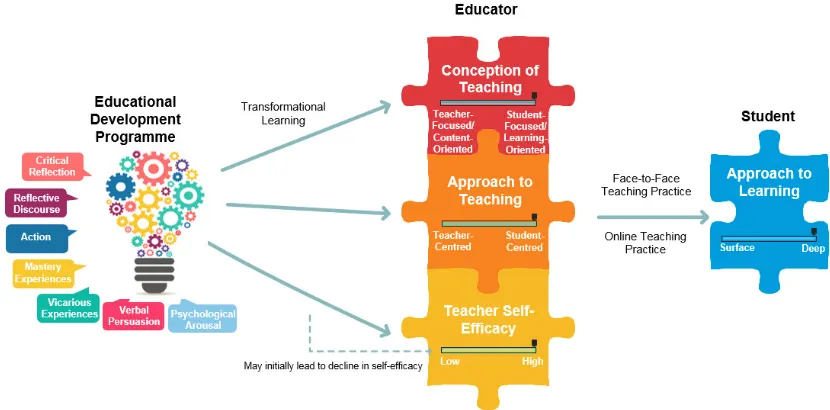
approaches to teaching which is supported by constructivist learning theories that emphasise the importance of active engagement of learners (Cross, 2009). The Online/Hybrid Course Development Institute was intended to develop participants’ conceptions of teaching and learning and to help participants develop the practical teaching skills necessary to initiate more student-centred approaches to teaching.
Educators’ conceptions of teaching have been shown to shape their choices and behaviours in the classroom, including their approaches to teaching and assessment. Educators who hold certain conceptions of teaching are more likely to adopt an approach to teaching consistent with those conceptions (Trigwell & Prosser, 1996). For example, Kember and Kwan (2000) discovered that educators who considered teaching to be a process of transmitting knowledge were more likely to use teacher-centred approaches to teaching, while those who perceived teaching to be a
facilitative process tended to use learner-centred approaches. Coffey and Gibbs (2002) found that student-centred teachers use a wider range of teaching methods than teachers who adopt a teacher-centred approach to teaching. Research on conceptions of teaching has also revealed a relationship between educator approaches to teaching and student approaches to learning (Kember & Gow, 1994; Prosser & Trigwell, 1999; Sheppard & Gilbert, 1991). A study by Kember and Gow (1994) found that educators who employed student-centred approaches encouraged more meaningful learning among students. Trigwell and Prosser (1996) and Trigwell, Prosser and Waterhouse (1999) also found that students of educators who described teaching as the
transmission of knowledge were more likely to adopt a surface approach to learning, whereas students of educators who adopted a student-centred approach were more likely to take a deep approach to learning.
21 information. In a later study, González (2010) proposed two related sets of teaching conceptions: (1) focused on the provision of information; and (2) focused on
communication-collaboration-knowledge-building. Ellis, Steed and Applebee (2006) and Lameras, Levy, Paraskakis and Webber (2012) explored conceptions of teaching in blended learning environments and their findings were consistent with Roberts (2003) and González (2009, 2010) who saw a continuum of approaches from
information focused to collaboration and knowledge creation. These studies suggest that consensus may be emerging with regard to conceptions of teaching in the online environment, with information focused conceptions being consistent with teacher-centred approaches and collaboration and knowledge creation conceptions being consistent with student-centred approaches that have been identified in past literature.
2.7 The Impact of Educational Development on Conceptions of Teaching
According to Kember and Kwan (2000), fundamental changes in the quality of
22 Ho, Watkins and Kelly (2001) examined a 12-hour educational development
programme at Hong Kong Polytechnic University by comparing conceptions of teaching at the end of the programme and again one year later using a revised ATI measurement. They discovered that those who participated in the educational development programme showed positive changes in their conceptions of teaching and demonstrated a significant improvement in their teaching practices as perceived by their students. In addition, a positive impact on their students’ studying approaches was observed for half of the faculty who changed their teaching conceptions. This is particularly significant given the short length of the educational development
programme. Postareff, Lindblom-Ylanne and Nevgi (2007) examined the relationship between the amount of educational development and the changes in teaching
approaches of 200 educators who had completed educational development
programmes of varying lengths, with the longest courses lasting over one year. They found that only by engaging with an educational development programme for
approximately one year did educators increase their student-focused approaches to teaching scores as measured by the ATI. This study implied that approaches to teaching change slowly and that it can take at least one year for positive effects to emerge. Cilliers and Herman (2010) examined the level of impact of an educational development programme on educators’ teaching practice over time. They found that changes to individual behaviour and organisational practice, and benefits to
academics as well as perceived benefits to their students were reported up to seven years after participation in the educational development programme.
In 2007, Stes, Clement and Van Petegem (2007) researched the long-term impacts of a one-year development programme for educators and found that two years after the programme, educators continued to report both attitudinal and behavioural changes as a result of participating in the programme. In 2010, Stes, Coertjens and Van Petegem conducted a follow-up study to investigate more formally how educators’ approaches to teaching changed as a result of participating in educational development
23 A study by Hanbury, Rickinson and Prosser (2008) observed changes to teaching conceptions in over 30 UK universities using the ATI scale. They learned that educators who participated in educational development programmes perceived their approaches to teaching to be significantly more student-focused, and significantly less teacher-focused, after completing the programme. This offers further support for the effectiveness of educational development found in previous research. They also found that when educators adopt a student-focused teaching approach following participation in an educational development programme, their students adopt deep learning approaches to their studies. More recently, Butcher and Stoncel (2012) presented a case study of a post-graduate certificate in higher education for new teaching staff at the University of Northampton in the UK. Their analysis revealed that new educators adopted innovative approaches to teaching, planning and
assessment, and observed a shift from teacher-centred to learner-centred approaches after participating in the certificate programme.
Condon et al. (2015) describe the results of the “Tracer Project” which was a mixed-methods study that was conducted over three years on two different campuses, Carleton College and Washington State University, tracing educational development effects into educator teaching and student learning outcomes. The data collection for the study combined educator perceptions about their teaching (self-report data) with direct observation of change either through analysis of assignments or student work, or through observations of teaching. Student learning was measured through
structured analysis of student work. The study produced evidence that educators who participate in professional development alter classroom pedagogy in ways congruent with the development. They also found that educators who participated in several educational development initiatives showed measurably larger changes in their teaching than educators whose participation was minimal. They also discovered that those who are self-motivated to improve and those with a strong sense of self-efficacy are more likely to make changes. In addition, they were able to conclude through analysis of student work that participation in educational development by educators positively influences students’ learning.
In general, the literature confirms that participation in educational development
24 participants students’ approaches to learning (Condon et al., 2015; Gibbs & Coffey, 2004; Hanbury, Rickinson & Prosser, 2008; Ho, Watkins & Kelly, 2001).
Nevertheless, there are still gaps in the current literature including an overreliance on self-reported sources of information, lack of control groups, and need for greater longitudinal research (Eley, 2006; Gibbs, 2003; Kane, Sandretto & Heath, 2002). In addition, it is often difficult to determine which specific components of educational development programmes produce the greatest impact, due to the considerable differences in programme hours, duration, format and focus (Dawson et al., 2014).
2.8 The Impact of Educational Development for Online Teaching on Conceptions of Teaching
A few studies have explored the impact of educational development for online teaching on conceptions of teaching. A study conducted by Hinson and LaPrairie (2005) indicated that changes in teaching practices could be initiated through a programme of continuous educational development as opposed to a one-time
workshop. They found that ongoing support given by knowledgeable support staff and peers was instrumental to changes in conceptions of teaching. Owens (2012)
conducted a survey of 529 UK educators and found that educators with teaching credentials who had received educational development in the use of online learning environments were significantly more likely to utilise teaching practices that promote interactive practices in online learning environments.
Other studies have focused on whether the experience of participating in educational development for online teaching, and subsequently teaching an online course, leads towards instructional change in the face-to-face classroom. A study of 255 online teachers from 31 colleges in the State University of New York Learning Network who participated in an educational development programme for online teaching found that 85% of participants reported a positive effect on their classroom instruction (Shea, Pelz, Fredericksen & Pickett, 2001). It is important to note that self-reports are prone to many kinds of response bias, as research participants often want to respond in a way that makes them look as good as possible (Barczyk, Buckenmeyer, Feldman & Hixon, 2011; Crowne & Marlowe, 1964). Thus, the respondents in this study may have over-reported the positive effect of the educational development programme on their classroom practice.
25 in this study reported changes to their assumptions and beliefs about teaching, and changes to their face-to-face teaching practices after participating in an educational development programme. Opportunities to communicate with more experienced online colleagues, view examples of online courses, and time to reflect were identified by the participants to be most effective in supporting their conceptual and practical changes. Buckenmeyer, Hixon, Barczyk and Feldman (2013) also examined an educational development initiative for online teaching and discovered that participants in the programme experienced a transfer of learning from online teaching to other teaching contexts and were able to apply what they learned in the programme to their teaching more broadly. Respondents in this study were able to apply the skills and knowledge acquired from the educational development programme to their other courses, and made specific changes to other courses as a result of participating in the programme.
Scagnoli, Buki and Johnson (2009) examined four experienced faculty members who had participated in educational development for teaching online and found that the online teaching experience had an influence on some face-to-face teaching practices, but that not all educators showed evidence of transfer of online practices to the classroom. Their findings suggest that transfer is more likely to occur when the instructor has a positive prior experience in the online environment, and when there is a connection between the content and context of the online and face-to-face courses that the instructor is teaching. Another study that examined a three-week online educational development programme at the University of Wisconsin-La Crosse indicated that the programme significantly changed participants’ beliefs about some common conceptions (myths) of online education. After completing the educational development programme, educators were less likely to believe that: (1) students get less attention from their instructors in online courses than in face-to-face courses; (2) it is easier to cheat in an online course than in a face-to-face course; (3) online courses lack resources for students. In addition, instructors were more likely to believe that students will want to take online courses versus face-to-face courses. This study also found that participation in the educational development programme led to a
significant increase in the implementation of sound pedagogical strategies in online courses, and some positive pedagogical strategies in face-to-face courses (Koepke & O’Brien, 2012). The results suggested that participation in the educational
26 Although these studies seem to indicate the potential for changes to conceptions of teaching and face-to-face teaching practices as a result of participation in educational development for online teaching, it is unclear how much of the change can be
attributed to the educational development and how much might be due to other factors such as the experience of teaching online, or the affordances of the online
environment (Shea, Pelz, Fredericksen & Pickett, 2001). While educational development may be responsible for encouraging educators to rethink their
conceptions of teaching and make changes in their classroom teaching, some of these changes may also be a result of the experience of designing and teaching an online class or a result of learning to use tools for online learning (McQuigan, 2007).
2.9 Teacher Self-Efficacy
The concept of teacher self-efficacy is based on Bandura’s (1977) seminal work related to social cognitive theory and self-efficacy. Self-efficacy can be defined as “beliefs in one’s capabilities to organize and execute the courses of action required to produce given attainments” (Bandura, 1997, p. 3). Bandura (1977; 1997) proposed four possible sources of self-efficacy: (1) mastery experience or actual experience; (2) vicarious experience; (3) verbal or social persuasion; and (4) physiological arousal or emotional state. Mastery experience is the most powerful source of self-efficacy as it involves experiences that are direct and personal (Bandura, 1997). Vicarious
experiences provide individuals with an opportunity to observe the successes and failures of others and may thereby alter self-efficacy. The third source of self-efficacy comes from the verbal persuasions individuals receive from others. Finally,
physiological and affective states, including stress, fatigue, anxiety and mood can also influence self-efficacy (Morris & Usher, 2011).
27 educational system can work for all students, regardless of outside influences (Burton, Bamberry & Harris-Boundy, 2005; Swackhamer, Koellner, Basile & Kimbrough, 2009).
Bandura’s (1997) theory of self-efficacy suggests that efficacy is developed early in an educator’s teaching career, thus the first years of teaching can be critical to the long-term development of teacher self-efficacy. According to Mulholland and Wallace (2001), one of the most powerful influences on the development of teacher efficacy is mastery experiences during the first years of teaching. Similarly, Morris and Usher (2011) found that successful instructional experiences, which involve a combination of mastery experiences and verbal persuasions, are important for developing self-efficacy especially within the first few years of teaching.
Self-efficacy is context specific, and teachers may exhibit different levels of efficacy depending on the course, group of students or institutional environment (Tschannen-Moran & Woolfolk Hoy, 2001). Gibson and Dembo’s (1984) Teacher Efficacy Scale (TES) is predominately used within the field of education to measure teacher self-efficacy (Henson, Kogan & Vacha-Haase, 2001), although a variety of other
instruments exist including the Ashton Vignettes (Ashton, Buhr & Crocker, 1984), the Science Teaching Efficacy Belief Instrument (Riggs & Enochs, 1990), the Ohio State Teacher Efficacy Scale (Tschannen-Moran & Hoy, 2001), the Responsibility for Student Achievement Scale (Guskey, 1981) and the Teacher Locus of Control Scale (Rose & Medway, 1981).
self-28 efficacy persist longer with students who struggle, and promote greater achievement and motivation in their students.
Moreover, research has shown that teachers with high self-efficacy tend to utilise more student-centred teaching approaches in their classrooms and persist longer in the face of challenges (Goddard, Hoy, & Woolfolk Hoy, 2004; Wheatley, 2005).
Czernaik (1990) also found that educators with high self-efficacy were more likely to use interactive teaching methods, while educators with low levels of self-efficacy used more teacher-directed methods. Woolfolk and Hoy (2000) indicate that self-efficacy beliefs are influenced to a greater extent during the early stages of a teacher’s career and that self-efficacy can be increased by providing mentorship opportunities, early in novice teachers’ careers.
In summary, the research indicates that teacher self-efficacy may positively impact teacher beliefs, attitudes, and conceptions of teaching as well as student achievement. There has been a call for more qualitative and mixed methods studies examining teacher self-efficacy as well as greater use of longitudinal data to help inform further research in this area (Tschannen-Moran et al., 1998; Wheatley, 2005). The transition from face-to-face teaching to the online environment requires that educators adopt a variety of new student-centred teaching strategies and methods. Given that educators with high self-efficacy tend to persist longer in the face of challenges, such as those encountered by the transition to online teaching, building self-efficacy has become a key outcome of many educational development initiatives.
2.10 The Impact of Educational Development on Teacher Self-Efficacy
Much of the research related to educational development and teacher self-efficacy has focused on pre-service teachers and on educators in the Kindergarten (K)-12
compulsory school sector, with research focused on higher education being quite limited. Postareff et al.’s (2007) study, which was mentioned previously, examined the impact of educational development on both approaches to teaching and self-efficacy beliefs. They found that longer training periods result in greater increases in teacher self-efficacy. Interestingly, they also discovered that shorter educational development courses could result in a negative effect on self-efficacy because they raise the educators’ awareness of good teaching practices, which can make them more uncertain about themselves as teachers. They suggest that positive impacts on
educators’ self-efficacy beliefs are unlikely to occur outside of longer-term
29 that trying new teaching strategies and methods can initially have a negative effect on a teacher’s sense of efficacy. The results of a study of graduate teaching assistants at the university level by Prieto and Meyers (1999) revealed that participation in formal educational development had a positive, statistically significant effect on teaching assistants’ sense of self-efficacy towards teaching compared to those who did not receive such development. Horvitz and Beach (2011) also found that participants in their study showed gains in self-efficacy both during and after the educational development programme. Overall, the literature related to educational development and teacher self-efficacy within the higher education environment is still quite limited, but studies seem to suggest that long-term educational development programmes can have positive impacts on teacher self-efficacy.
2.11 Transformational Learning
The theory of transformational learning (Mezirow, 1978) also helps to provide insight into the changes educators experience in their assumptions, beliefs and practices as a result of participating in educational development initiatives (Cranton, 2006; King, 2002; Meyer, 2013). “Transformational learning theory serves as a comprehensive way to understand the process whereby adult learners critically examine their beliefs, assumptions, and values in light of acquiring new knowledge and correspondingly shift their worldviews to incorporate new ideas, values and expectations” (King, 2002, p. 286). Learning is said to be transformative when learners’ views of their world are altered through their learning, enabling them to achieve a different perspective than they had previously held (Cranton, 2006; Mezirow, 1997). Mezirow (1978) identified 10 precursor steps to transformative learning: (a) being faced with a disorienting dilemma, (b) self-examination or reflection, (c) recognition of some sort of dissonance that is shared with others, (d) exploring possible options, (e) critical assessment of assumptions, (f) trying on new roles, (g) planning a course of action, (h) acquiring knowledge and skills to implement new actions, (i) competence-building, and (j) integrating the newly gained perspective into one’s life. For some educators, a disorienting dilemma experienced in practice might urge them to pursue educational development, whereas for others participation in an educational
development programme itself may act as the disorienting dilemma that challenges their teaching and learning conceptions, encouraging them to critically reflect on their experience and practice (Cranton, 2006).
30 expectations about learning and teaching, and for engagement in critical reflection, reflective discourse, and action. Cranton (2006) also describes critical reflection as a central process in transformative learning, and argues that if educators are to change their practice, educational development programmes need to provide educators with the opportunity to critically reflect on their existing assumptions, values, and
perspectives. Mezirow (2003) defined reflective discourse as “dialogue involving the assessment of beliefs, feelings and values” (p. 59) and it appears that reflective discourse and dialogue with others plays a major role in transformative learning (Cranton, 2006). Educational development programmes that provide opportunities for educators to engage in discussions with colleagues can help promote reflective
discourse which can challenge educators’ existing assumptions and beliefs about teaching and learning. In addition, Mezirow (1991) argued that, “action is an integral and indispensable component of transformative learning” (p. 209). Thus, educational development programmes that include active learning techniques and provide
opportunities for participants to act on their new learning can help to support transformative learning.
Given the definition and elements of transformative learning, it is not surprising that several research studies related to educational development are based on this theory. The literature review of educational development for online teaching by Meyer (2013), mentioned previously, found that of those articles that included mention of a theoretical framework, transformative learning theory was frequently cited. A study by King (2002) examined the experience of 175 educators who participated in an educational development programme regarding educational technology that was based on transformative learning theory. The results of the study revealed that
transformative learning theory was effective in the design of the educational development programme and that the participants were able to participate in the critical reflection and development phases of transformative learning theory. Another study by King (2004) investigated the experiences of 58 educators enrolled in
graduate education courses related to adult education. The findings indicated
substantial perspective transformation for 36 of the participants and found that critical reflection was an important component of transformation for 62% of the educators. These findings suggest that critical reflection is an important component of
educational development programmes as it provides participants with an opportunity to reflect on their existing assumptions and beliefs which can help to promote