Novel Intercell Interference Mitigation Algorithms
for Multicell OFDMA Systems with Limited Base
Station Cooperation
Jia Shi, Member, IEEE, Lie-Liang Yang, Fellow, IEEE, and Qiang Ni, Senior Member, IEEE
Abstract— Resource allocation in multicell downlink
orthog-onal frequency division multiple-access (OFDMA) systems is investigated, where BSs first independently carry out subcarrier-allocation and then mitigate intercell interference (InterCI) with the aid of very limited base station (BS) cooperation. Two novel InterCI mitigation algorithms are proposed. The first one is the distributed decision making assisted cooperation (DDMC) algorithm, and the second one is the centralized decision making assisted cooperation (CDMC) algorithm. When employing the DDMC algorithm, each BS independently makes the InterCI mitigation decisions. By contrast, when employing the CDMC algorithm, the centralized InterCI mitigation decisions are made with the aid of the cell-edge users’ discrete InterCI information sharing among BSs. While both the algorithms motivate to maximize the spectral-efficiency (sum rate), the CDMC algorithm also aims to maximize the frequency reuse factor. In this paper, we study and compare the performance, including spectral-efficiency of cell-edge users, frequency reuse factor, overhead, etc., of the multicell downlink OFDMA systems employing the proposed and other InterCI mitigation algorithms. Our studies show that both the DDMC and CDMC algorithms can achieve better spectral-efficiency performance than the existing on-off power (OOP) algorithm. Moreover, the CDMC algorithm is capable of achieving the performance close to the upper-bound attained by the so-called full InterCI information assisted decision making (FIIDM) algorithm, which uses exhaustive search to determine the InterCI mitigation decisions. Additionally, the CDMC algorithm is demonstrated to have the highest frequency reuse factor in addition to its spectral-efficiency advantage.
Index Terms— Resource allocation, subcarrier-allocation,
mul-ticell, OFDMA, intercell interference, base station cooperation, optimization.
I. INTRODUCTION
Orthogonal frequency division multiple access (OFDMA) has emerged as one of the key techniques for high-speed broadband wireless communications. In the literature, re-source allocation in single-cell OFDMA systems have been widely investigated, especially, in association with subcarrier-allocation [1–6]. However, mobile communication systems are typically multicell systems with frequency spectrum reused in geographic areas. Moreover, towards the future generations of wireless systems, unity of frequency reuse is desired. In this case, users may experience severe intercell interference
Copyright (c) 2015 IEEE. Personal use of this material is permitted. However, permission to use this material for any other purposes must be obtained from the IEEE by sending a request to [email protected]. J. Shi and Q. Ni are with the School of Computing and Communications, Lancaster University, LA1 4WA, UK; L.-L. Yang is with School of Electronics and Computer Science, University of Southampton, SO17 1BJ, UK. (E-mail: [email protected], [email protected], [email protected].)
(InterCI), resulting in significant performance degradation, if it is not efficiently managed.
In multicell communications, resource allocation ap-proaches proposed in the literature may be categorized into two classes, namely, centralized and distributed resource al-location, based on where and how the resource allocation is carried out. Specifically, in centralized resource alloca-tion, central control units are used to collect the required information, which are also responsible for managing and allocating resources jointly to all users in all cells. Centralized resource allocation may consume the enormous resources, which could be exploited for data transmission, for information exchange and system controlling [7]. In the literature, there are a range of references, including [7–12], having proposed and studied the centralized resource allocation in multicell OFDMA systems. In [8], the authors have proposed a load matrix approach for jointly managing both the InterCI and the intracell interference (IntraCI) experienced by users. In [9], a NP-hard joint resource allocation problem for a two-cell OFDMA system has been approximated by a weighted sum throughput maximization problem. Using the geometric programming approach to transform the original mixed integer nonconvex problems, the authors in [7, 11] have proposed the sub-optimal subcarrier- and power-allocation solutions in the downlink OFDMA networks with BS coordination. By contrast, in [12], the authors have dealt with the IntraCI of a subcarrier reused OFDMA networks.
It can be understood that, in order to combat the InterCI existing in multicell OFDMA systems, one may employ so-phisticated InterCI mitigation technique at the receiver side, by using, such as, maximum likelihood detection, successive interference cancellation, multiple-antenna based interference nulling, etc. On the other hand, BS cooperation can be another efficient InterCI mitigation approach, which shifts the processing burden to the BSs, rather than causing too much computational complexity at mobile terminals [16, 19, 20]. For example, the authors in [19, 20] have studied the scheduling and power-allocation in the context of the multicell downlink OFDMA systems and other networks, by handling the InterCI via BS coordination supported by the CSI exchange among BSs. By contrast, the researches in [10, 21–23] have been devoted to the resource allocation in multicell OFDMA systems with full BS cooperation, which requires BSs to share both CSI and data. Under the constraint of certain backhaul capacity, a heuristic BS assignment algorithm has been proposed in [22], and a user scheduling algorithm has been developed in [23], respectively. Furthermore, in [24, 25], the authors have addressed the energy-efficiency issue of the BS cooperation based resource allocation in multicell OFDMA systems.
Against the background, in this paper, we investigate both the subcarrier-allocation and InterCI mitigation in multicell downlink OFDMA systems. In our considered systems, each cell independently allocates subcarriers based on our pro-posed bidirectional worst subchannel avoiding (BWSA) algo-rithm [26]. Our focus is on the InterCI mitigation after the distributed subcarrier-allocation. We propose two novel InterCI mitigation algorithms. The first one is the distributed deci-sion making assisted cooperation (DDMC) algorithm, which motivates to maximize the pay-off of BS cooperation, while simultaneously minimize the caused cost. The second InterCI mitigation algorithm proposed is named as the centralized decision making assisted cooperation (CDMC), which moti-vates to make the best InterCI mitigation decisions based on the limited discrete InterCI information of the cell-edge users shared among the BSs, in order to maximize both the spectral-efficiency, and the frequency reuse factor of the frequency spectrum. In this paper, we study and compare the spectral-efficiency of cell-edge users, frequency reuse factor, overhead, etc., of the multicell downlink OFDMA systems employing the BWSA and various InterCI mitigation algorithms. Our studies and performance results show that both the proposed DDMC and CDMC algorithms are high-efficiency InterCI mitigation algorithms, which outperform the existing on-off power (OOP) algorithm in terms of the spectral-efficiency. The CDMC algorithm outperforms the DDMC algorithm, and is capable of achieving the sum rate close to the upper-bound achieved by the full InterCI information assisted de-cision making (FIIDM) algorithm. In this FIIDM algorithm, cooperation decisions are made via the exhaustive search with ideal information about the InterCI. Additionally, the CDMC algorithm is demonstrated to have the highest frequency reuse factor in addition to its spectral-efficiency advantage.
The rest of this paper is organized as follows. Section II introduces the system model. Section III provides the
gen-BS 2 user 1
...
...
...
BS 1 BS 0
user 0
Intercell transmission Intracell transmission user 2
userK
user 2K
userK+ 1
user 2K+ 1 user 2K+ 2 userK−1
user 2K−1 userK+ 2
[image:2.595.335.531.59.244.2]user 3K−1
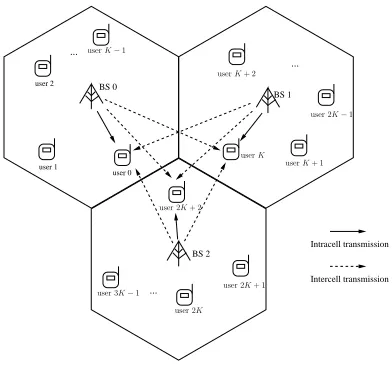
Fig. 1. Conceptual structure of the multicell downlink OFDMA systems.
eral theory about the distributed subcarrier-allocation and the InterCI mitigation. In Section IV, we discuss the FIIDM which is the upper-bound of our InterCI mitigation. Section V extends the OOP algorithm to the multicell downlink OFDMA systems. Sections VI and VII detail the proposed DDMC and CDMC algorithms, respectively. Performance results are shown in Section VIII. Finally, we summarize the main conclusions in Section IX.
II. SYSTEMMODEL
In order to reflect the main features of multicell systems while make the problems relatively easy to mange, in this pa-per, we consider the same system model studied in [10, 27–29], which is a three-cell downlink OFDMA system, as depicted in Fig. 1. In this system, each cell has one BS communicating with K mobile users. Each of the communication terminals, including both BSs and mobile users, is assumed to employ one antenna for signal receiving and transmission. The BSs communicate with their users based on OFDMA having in totalM subcarriers.
We consider the extreme case that each cell supportsK=
should satisfy the constraints of
[
m∈M
Fm(u)=K(u), ∀u∈ {0,1,2}, (1)
F(u)
m \
Fm(u′)=∅, m6=m
′,∀m, m′∈ M,∀u∈ {0,1,2},
(2)
|F(u)
m |= 1, ∀m∈ M,∀u∈ {0,1,2} (3) whereM={0,1, . . . , M−1}is the set of subcarrier indexes,
Fm(u)contains the indexes of the users assigned to subcarrierm in cellu, andK(u)={uK+0, uK+1, . . . , uK+K−1}holds
the indexes of theK users in cellu. Note that, in the above equations, (1) explains that each BS assignsM subcarriers to its K users, while (2) and (3) impose the constraints that, in one cell, different users are allocated different subcarriers, and one user is assigned just one subcarrier.
As shown in Fig. 1, the BSs are located at the centers of the cells, and each cell has K users, which are assumed to obey uniform distribution. In each of the three cells, we assume for simplicity the ideal power control as in [2, 3, 21, 22], in order to maintain the same average received power of one unit per user. Furthermore, we assume that InterCI only exists between adjacent cells as the result of propagation pathloss. Let the InterCI be characterized by a factor α. Then, when taking into account of the combined effect of propagation pathloss and shadowing, we can have [30]
α=
s
d0 d1
µ
10ζ010−ζ1 (4)
where d0 and d1 represent the distances from a BS to the considered intracell and intercell users, respectively, µis the pathloss exponent, whileζ0andζ1 (in dB) are the zero-mean Gaussian random variables with a standard deviation Υ (in dB), which account for the shadowing effect [30]. In addition to the propagation pathloss and shadowing effects, signals transmitted from BSs also experience fast fading, which is assumed to be the independent Rayleigh flat fading in terms of different users.
Let us assume that a data symbol to be transmitted by BS
u to its intracell user k (k ∈ K(u)) is expressed as x(u)
k , which satisfies E[x(ku)] = 0 and E[|x(ku)|2] = 1. Since the M subcarriers in one cell are assumed to be orthogonal, the signal received by userk of cellucan be written as
y(ku)=h(k,mu)w(k,mu)x(ku)+
h(k,mu′)αk(u′,k′)w
(u′)
k′,mx
(u′)
k′ +h
(u′′)
k,mα
(u′′)
k′′,kw
(u′′)
k′′,mx
(u′′)
k′′
| {z }
InterCI
+n(ku) (5)
when assuming that k ∈ Fm(u), k′ ∈ F(u
′)
m and k′′ ∈ F(u
′′)
m ,
meaning that users k, k′ and k′′ in cells u, u′ and u′′,
respectively, are assigned to share subcarrierm. Hence, users
k,k′ andk′′ are referred to as the co-subcarrier users. In (5), n(ku)represents the Gaussian noise at userk, which is assumed to obey the complex Gaussian distribution with zero mean and a variance of2σ2= 1/γ
s, whereγsdenotes the average SNR per symbol. h(k,mu) denotes the fast fading gain on the mth subcarrier from BSuto userk, andhk,m(u′)α(ku′,k′) represents the
InterCI that userkreceives from BSu′, when it uses subcarrier mto send signals to userk′. Here,h(u′)
k,mis the fast fading gain on themth subcarrier from BSu′ to userk, andα(u′)
k′,k is the
corresponding InterCI factor. In this paper, we assume that the uplinks and downlinks are operated in the TDD mode, and a BS is capable of acquiring the CSI of the channels between the BS and itsK intracell users. In this case, a BS is capable of preprocessing the signals to be transmitted to its intracell users by setting wk,m(u) seen in (5) as w(k,mu) = (h
(u) k,m)∗
q
|h(k,mu)|2, where(·)
∗
denotes the conjugate operation. We assume that any BS does not have the CSI of the InterCI channels, including both the slow and fast fading, which is possibly due to the complexity constraint. From (5), the signal-to-interference-plus-noise ratio (SINR) for userk can be expressed as
γk,m(u) = |h
(u)
k,m|2
|h(k,mu′)α(ku′,k′)|2+|h
(u′′)
k,mα
(u′′)
k′′,k|2+ 2σ2
= |h
(u)
k,m|2
Iu′,k+Iu′′,k+ 2σ2
, m∈ M (6)
where Iu′,k =|h
(u′)
k,mα
(u′)
k′,k|
2 is the InterCI power received by
user kfrom BSu′. Alternatively, (6) can be written as
γk,m(u) = 1
(ηk,m(u))−1+ (A(u)
k,m)−1
,
η(k,mu) = |h
(u)
k,m|2
Iu′,k+Iu′′,k
, A(k,mu) =|h
(u)
k,m|2
2σ2 (7)
where ηk,m(u) and A(k,mu) are respectively the signal-to-interference ratio (SIR) and signal-to-noise ratio (SNR) of user
k in cell u.
From (6) and (7) we imply that, in order to achieve high SINR but at low implementation complexity, we may design the subcarrier-allocation motivating to maximize the channel gains from a BS to its K intercell users, while the InterCI mitigation aiming to minimize the InterCI with the backhaul cost as low as possible. For these purposes, we consider two InterCI mitigation methods, which are the power off and BS cooperation. With the power off method, the transmissions to some users experiencing strong InterCI are turned off. The method is easy to operate, does not require BS cooperation and is sometimes very efficient, as shown in [31].
(5). Let us assume that BS u′ cooperating with BS u to
transmitx(ku)(t)andxk(u)(t+T)to userkbased on Alamouti’s scheme [32], where T represents the symbol duration. Then, the observations received by user k at time t andt+T can be written as
yk(u)(t) =hk,m(u)x(ku)(t) +h(k,mu′)α(ku′,k′)x
(u)
k (t+T)+
h(k,mu′′)α(ku′′′′,k)x
(u′′)
k′′ (t) +n
(u)
k (t), (8)
yk(u)(t+T) =−h(k,mu)(x(ku)(t+T))∗+hk,m(u′)α(ku′,k′)(x
(u)
k (t))
∗+
h(k,mu′′)α(ku′′′′,k)x
(u′′)
k′′ (t+T) +n
(u)
k (t+T). (9) Assume that userkis capable of estimating the channels from BSs u and u′. Then, it can form the decision variables for
detectingx(ku)(t)andx(ku)(t+T)as
r(ku)(t) = (h(k,mu))∗yk(u)(t) +hk,m(u′)α(ku′,k′)(y
(u)
k (t+T))
∗, (10)
rk(u)(t+T) = (hk,m(u′)α(ku′,k′))
∗y(u)
k (t)−h
(u)
k,m(y
(u)
k (t+T))
∗.
(11)
From (10) and (11), we can derive the SINR of user k for detectingxk(t)andxk(t+T), which is
γk(u)=|h
(u)
k,m|2+|h
(u′)
k,mα
(u′)
k′,k|2
|h(k,mu′′)αk(u′′′′,k)|2+ 2σ2
. (12)
Note that, the above cooperation is usually set up, when BSu′
generates strong InterCI on user k, meaning that the term of
|h(k,mu′)αk(u′,k′)|2in the above equation has a relatively large value.
In this case, the SINR of (12) resulted from the cooperation can be significantly enhanced in comparison with the SINR of (6) of the case without BS cooperation, which consequently improves the multicell system’s overall throughput.
III. GENERALTHEORY
In this section, we address the general theory of the dis-tributed subcarrier-allocation and the design motivation for the InterCI mitigation in the multicell downlink OFDMA sys-tems. For achieving relatively low-complexity implementation, in this paper we propose to first carry out the distributed subcarrier-allocation, and then operate the InterCI mitigation, when different levels of BS cooperation are considered. The distributed subcarrier-allocation is motivated to maximize the sum rate of each cell, with the optimization problem described as
n
F(u)
m ,∀m o∗
=argn max
F(u) m ,∀m
o
X
k∈K(u)
log2(1 +γ
(u)
k )
,
∀u∈ {0,1,2}
subject to (1), (2), (3) (13)
whereγ(ku)is the SINR of userkin cellu, such as that in (6). In (13),
n
Fm(u),∀m o
means testing all the possible
subcarrier-allocations for cell u, while nFm(u),∀m o∗
returns the final results of the subcarrier-allocation.
However, the problem in (13) is a mixed integer nonconvex problem that is very hard to solve. Therefore, as done in [6,
26, 33], the distributed subcarrier-allocation can be motivated to maximize the SNRs of all the users in one cell without considering the impact of InterCI. Correspondingly, this opti-mization problem can be expressed as
n
F(u)
m ,∀m o∗
=arg max
n
Fm(u),∀m
o
n
A(ku), k∈ K(u)o,∀u∈ {0,1,2}
subject to (1), (2), (3) (14)
where A(ku)is the SNR of userk, such as that defined in (7). Based on (14), in [26], we have designed a bidirectional worst subchannel avoiding (BWSA) algorithm for the single-cell OFDMA systems, which is demonstrated to be low-complexity and capable of achieving near-optimum performance. In this paper, we investigate the performance of the multicell down-link OFDMA systems employing the BWSA algorithm in association with our proposed and other InterCI mitigation algorithms.
As the subcarrier-allocation considered above does not deal with the InterCI, after the subcarrier-allocation, the InterCI mitigation is then operated for the cell-edge users. Let us define the user set of celluasKˆ(u)={k|η
k< ηt, k∈ K(u)}, where ηt represents a SIR threshold. The thresholdηtcan be set according to various communication objectives. Then, the users in set K˜(u) are called as the cell-edge users of cell u.
Here, the set K˜(u) includes both the users in Kˆ(u) as well as
the users in K(u)−Kˆ(u) that share the same subcarriers as
the users in Kˆ(u′)
of cell u′ and the users in Kˆ(u′′)
of cell
u′′. In general, our InterCI mitigation motivates to maximize
the sum rate of the cell-edge users by solving the optimization problem of
D D
D∗=argmax
DDD
2
X
u=0
X
k∈K˜(u)
log2(1 +γ
(u)
k )| n
F(u)
m ,∀m, u o∗
(15)
where 3M-length InterCI mitigation decision (IMD) vector can be written in the form of DDD = [DDDT
0, . . . , DDDTM−1]T,
where (·)T is the transpose operation. Here, DDD
m =
[D0,m, D1,m, D2,m]T is referred to as the IMD vector of subcarrierm, which defines the transmission states of the users in the three cells assigned subcarrierm.
In order to minimize the cost of backhaul resources for BS cooperation, in this paper, we classify Du,m only into three states. Let us again assume that subcarrier m is assigned to userk, k′ andk′′in cellu, u′ andu′′, respectively. Then, the
three states of Du,m are defined as
Du,m=
k BS utransmitsx(ku)to its intracell userk on subcarrierm,
−1 BS uswitches off its transmission on subcarrierm,
k′ (ork′′) BS ucooperates to transmit x(u′)
k′
(or x(ku′′′′)) to userk′ (ork′′) in cell
u′ (or u′′) on subcarrierm.
Correspondingly, the InterCI mitigation is carried out under the constraints of
Du,m∈ {k, k′, k′′,−1}, (17)
2
X
u=0
Du,m≥ −2 (18)
for u ∈ {0,1,2} and m ∈ M. Note that, the constraint of (18) prevents from switching off all the three transmissions on one subcarrier. Furthermore, as shown in Section II, In-terCI only exists among the three users sharing a subcarrier. Therefore, the InterCI mitigation can be considered subcarrier-by-subcarrier independently without performance loss. Hence, by considering the constraints of (17) and (18), we can re-write the optimization problem of (15) as
DDD∗m=
argmax D D Dm
( 2
X
u=0
log2(1 +γ
(u)
k ), k∈K˜
(u)∩ F(u)
m |
n
F(u)
m ,∀u o∗)
,
∀m∈ M (19)
subject to (17) and (18).
It can be shown that both (15) and (19) are the mixed integer nonlinear nonconvex problems, whose optimal solutions are extremely hard to derive. Below we will propose two novel InterCI mitigation algorithms, namely the DDMC and CDMC, which aim to find the promising sub-optimal solutions for the problem of (19). Furthermore, we extend the OOP algo-rithm [31, 34, 35] to the multicell downlink OFDMA systems, and investigate its performance in association with the BWSA subcarrier-allocation. Additionally, as a benchmark, we also consider the FIIDM scheme, which uses exhaustive search to find the optimal solutions for (19).
IV. FULLINTERCI INFORMATION RELIEDDECISION
MAKINGALGORITHM
As above-mentioned, the OOP, DDMC and the CDMC algorithms will be compared against the FIIDM algorithm, which relies on the continuous InterCI information, in contrast to the discrete InterCI information used by the DDMC and CDMC algorithms. Furthermore, the FIIDM algorithm uses exhaustive search to find the optimum solutions to the problem of (19). Hence, its performance represents an upper-bound of the InterCI mitigation algorithms considered. The FIIDM algorithm can be described by Algorithm 1 with the aid of some further explanation.
Algorithm 1: (FIIDM Algorithm)
Initialization:
(1) Set K˜m ={k |k ∈K˜(u)∩ F
(u)
m ,∀u∈ {0,1,2}},∀m ∈
M.
(2) SetDu,m=k ifF
(u)
m ={k},∀u∈ {0,1,2},∀m∈ M.
For Subcarrierm∈ M:
IfK˜m6=∅, the central unit (CU) first collects the InterCI information of all the users inK˜m, and then executes:
Step 1 Compute the sum rates of all the optional decisions with power off only. The optional decisions include: (1) Power off to one user: Dˆu,m = −1, Dˆu′,m =
Du′,m,Dˆu′′,m =Du′′,m, ∀u, u′, u′′ ∈ {0,1,2} and
u6=u′6=u′′.
(2) Power off to two users:Dˆu,m = ˆDu′,m =−1, ˆ
Du′′,m = Du′′,m, ∀u, u′, u′′ ∈ {0,1,2} and u 6=
u′6=u′′.
Step 2 Compute the sum rates of all the optional decisions with cooperation only. The optional decisions in-clude:
(1) Cooperation between two BSs:Dˆu,m= ˆDu′,m=
Du,m, Dˆu′′,m = Du′′,m, ∀u, u′, u′′ ∈ {0,1,2} and
u6=u′6=u′′.
(2) Cooperation among three BSs:Dˆu,m= ˆDu′,m=
ˆ
Du′′,m=Du,m,∀u, u′, u′′∈ {0,1,2}andu6=u′6=
u′′.
Step 3 Compute the sum rates of all the optional decisions with power off and/or cooperation. The optional decisions include:
(1) One BS sets power off to one user while the other two BSs cooperate for one user:Dˆu,m = ˆDu′,m =
Du,m, Dˆu′′,m = −1, ∀u, u′, u′′ ∈ {0,1,2} and
u6=u′6=u′′.
Step 5 The CU first identifies the best one among the above optional decisions, which can be expressed as:
D D
Dm= arg max
ˆ
D DDm
X
k∈K˜m
log2(1 +γk)
(20)
where DDDˆm = [ ˆDu,m,Dˆu′,m,Dˆu′′,m]T. Then,
the CU informs the final IMD vector DDDm = [Du,m, Du′,m, Du′′,m]T to the three BSs.
As shown in Algorithm 1, the FIIDM algorithm assumes that there is a CU, which is capable of collecting the ideal continuous InterCI information of all the cell-edge users. Based on the InterCI information collected, the CU then makes the optimum InterCI mitigation decisions by exhaustive search, and finally informs them to the BSs. From Algorithm 1, we can find that, there are in total 21 optional decisions for one cell-edge user group, such as that inK˜m, containing three co-subcarrier users. Specifically, at Step 2, the FIIDM algorithm may turn off one or two transmissions to the three users, which gives 6 optional decisions. At Step 3, any one or two BSs may help another BS to set up a cooperative transmission, which gives 9 different decisions. Finally, at Step 4, two BSs may cooperate while the other one is turned off, resulting in total 6 optional decisions. Therefore, there are in total 21 optional decisions. In Algorithm 1, (20) finds the best one among these 21 optional decisions.
it may be very hard to implement the FIIDM algorithm in the practical scenarios having a large number of cells. Therefore, we propose the more practical DDMC and CDMC algorithms, which only require the limited discrete InterCI information.
V. ON-OFFPOWERINTERCI MITIGATION
The OOP algorithm employs an efficient method to combat InterCI, which does not require BS cooperation. It has been widely studied and used in multicell communication systems, such as, in [31, 34, 35]. The basic principle of the OOP algorithm is to allow a BS to turn off the transmission on the subchannels conflicting strong InterCI. By doing this, there are two-fold of benefits. First, transmission on the poor subchannels can be avoided, which saves power for the future transmission, when the subchannels become better. Second, the InterCI imposed by these subchannels on the other cells can also be removed. The OOP algorithm is usually scheduled to be carried out by a BS at a time, in order to avoid that two or three cells simultaneously turn off the transmission on the same subcarrier.
Let us below illustrate the OOP algorithm with the aid of an example. Assume that subcarriermis allocated to usersk,k′, k′′ in cellsu,u′ andu′′, respectively. Then, we can express
the subchannel qualities on subcarriermin a matrix form as
AAAm=
A(k,mu) A(ku′,m) A
(u)
k′′,m
A(k,mu′) A(ku′,m′) A
(u′)
k′′,m
A(k,mu′′) A(ku′,m′′) A
(u′′)
k′′,m
=
|h(k,mu)|2
2σ2
|h(ku′,m) α(k,ku)′|2 2σ2
|h(ku′′),mα(k,ku)′′|2 2σ2
|h(k,mu′)αk(u′′,k)|2 2σ2
|h(ku′′,m)|2 2σ2
|h(ku′′′,m) αk(u′,k′)′′|2 2σ2
|h(k,mu′′)αk(u′′′′,k)|2 2σ2
|h(ku′,m′′)αk(u′′′′,k)′|2 2σ2
|h(ku′′′′,m)|2 2σ2
(21)
whereA(j,mi) represents the subchannel quality of the transmis-sion from BSito userj on subcarrierm. Based on a column ofAAAm, we can calculate a user’s SIR. For example, the SIR of userkis given byη(k,mu) = A
(u) k,m A(k,mu′)+A(k,mu′′).
Let us consider one realization of the above example, and the matrix is given by
A A
Am=
2.1909 0.0018 0.5078
1.4294 1.8621 0.1583
0.1168 3.3187 1.6459
. (22)
Then, by setting different SIR thresholds, the OOP algorithm generates different results for the IMD vectors DDDm, and derives different sum rates CΣ = Pi∈{k,k′,k′′}log2(1 +γi).
Note that, for the example we assume the unit noise power. Specifically, for (22), when the SIR thresholds are respectively
ηt =−5 dB, 0 dB and5 dB, the OOP algorithm gives the InterCI mitigation decisions as
(a):Du,m=k, Du′,m=k′, Du′′,m =k′′if ηt=−5 dB,
(b):Du,m=k, Du′,m=−1, Du′′,m=k′′ ifηt= 0 dB,
(c):Du,m=Du′,m=−1, Du′′,m=k′′ if ηt= 5 dB
(23)
which are explained as follows. First, ifηt=−5 dB= 0.316, there is no user turned off, since the SIRs of the three users are all higher than this SIR threshold. In this case, the sum rate on subcarrier m isCΣ= 2.4039. Second, when ηt= 0 dB= 1, during the first stage, userkstays on, since its SIR isη(k,mu) =
1.4171> ηt. During the second stage, the transmission to user
k′ is switched off, as its SIR ofη(u′)
k′,m= 0.5608is lower than
the threshold. During the third stage, userk′′finds that its SIR
is higher than the threshold, after userk′′is turned off. Hence,
it stays on. In this case, the sum rate becomes CΣ= 2.6311, which is higher than CΣ = 2.4039 of the first case. Finally, when ηt = 5 dB= 3.1623, the OOP algorithm turns off the transmissions to users k and k′′. In this case, the sum rate
attained on subcarriermisCΣ= 1.4038, which is also lower than that obtained in the case of ηt= 0dB.
From the above example, we know that the performance of the system employing the OOP algorithm is highly dependent on the SIR threshold. If an improper SIR threshold is set, it may turn off too many or too few subchannels, which may lead to the degradation of throughput performance.
VI. DISTRIBUTEDDECISIONMAKINGASSISTED
COOPERATIONINTERCI MITIGATION
In this section, we propose a novel InterCI mitigation scheme referred to as the distributed decision making assisted cooperation (DDMC). As its name suggests, the DDMC algorithm introduces BS cooperation to improve the system performance. In Section III, we have shown the benefits from the cooperative transmission to a user, if the cooperative BS imposes strong InterCI on the user. However, the cost for this cooperation is the increase of the complexity for information exchange between the BSs, and the cooperative BS has to stop transmitting information to its own user. Therefore, our DDMC algorithm is motivated to maximize the pay-off from cooperation, while simultaneously minimize the cost caused by cooperation.
In the DDMC algorithm, the BSs are scheduled to make their InterCI mitigation decisions successively and indepen-dently. When the SIR measured by a user is lower than the SIR threshold, it informs its BS to take one of the two actions: 1) setting up a cooperative transmission for the user, and 2) switching off the transmission to the user. Let us below use the example shown in (21) to explain the principles. Assume that, the SIR of userkis lower than the thresholdηt, the rules for userk to choose the desired action are:
Cooperation from BSu′, if I
u′,k > Ic &Iu′′,k≤Ic, (24) Cooperation from BSu′′, ifIu′,k≤Ic &Iu′′,k > Ic, (25)
Power off, ifIu′,k> Ic &Iu′′,k > Ic,
orIu′,k≤Ic &Iu′′,k≤Ic. (26)
Above, Ic is the cooperation threshold, which can be set according to the various communication objectives, such as, maximization of sum rate. Note that, a user can only ask for cooperation when there is only one strong InterCI.
suppose userk obtains the cooperation from BSu′, then, the
SINRs of users k,k′ andk′′become
γk,m(u) =|h
(u)
k,m|
2+I
u′,k
Iu′′,k+ 2σ2
, γk(u′,m′) = 0,
γ(ku′′′′,m) =
|h(ku′′′′,m)|2
Iu,k′′+Iu′,k′′+ 2σ2
. (27)
From (27), we can know that the SINR of user k can be significantly improved, as the conditions in (24) are met. In this case, the sum rate of the three users is most probably increased, owing to making use of the strong InterCI ofIu′,k. By contrast, when the conditions in (26) are met, we can know from (27) that the sum rate contributed by BS cooperation is insignificant. In these cases, it is better to simply turn off the transmission to userk, while keeping the other two users active.
In more detail, let us consider the values given in (22), from which we can find that the SIRs of the three uses areηk,m(u) =
1.417, ηk(u′,m′) = 0.5608 andη
(u′′)
k′′,m = 2.471, respectively. By setting the various SIR thresholds and InterCI thresholds for cooperation, the DDMC algorithm yields the IMD variables as
(
(a):Du,m=k, Du′,m=Du′′,m=k′ ifηt= 0dB, Ic= 1,
(b):Du,m=Du′,m =k, Du′′,m=−1 ifηt= 5 dB, Ic = 1.
(28)
Let us first consider the case of (28)(a). In this case, user
kstays on during the first stage, as its SIR is higher than ηt. During the second stage, userk′finds that its SIR is lower than ηt. Then, it informs BSu′to request the cooperation from BS
u′′, sinceI
u,k′≤IcandIu′′,k′ > Ic, and the conditions in (26)
are met. As a result, BSu′′switches off its transmission to user k′′, and helps to transmit information to userk′. Consequently,
the sum rate of subcarriermisCΣ= 3.5213, which is higher than that achieved by the OOP algorithm. Similarly, in the case of (28)(b), the DDMC algorithm obtains the decision: BS uobtains the cooperation from BS u′ for user k, while
BS u′′ turns off the transmission to user k′′. Consequently,
the sum rate achieved is CΣ= 2.2080. Clearly, the sum rate is higher than 1.4038obtained by the OOP algorithm for the corresponding case.
Based on the above analysis and the examples, we can now summarize the DDMC algorithm as follows.
Algorithm 2: (DDMCAlgorithm)
For Stageu= 0,1,2:
For Userk∈ K(u):
Initialization: SetDu,m=kif Fm(u)={k},m∈ M.
Userk estimates its SIRη(k,mu). If ηk< ηt, execute: Step 1 User k informs BS u the requirement of InterCI
mitigation. Go to Step 2 if (26) is met, otherwise go to Step 3.
Step 2 BSuswitches off the transmission to userk, yielding
Du,m=−1.
Step 3 BSurequests BS u′ (oru′′) for cooperation if (24)
(or (25)) is met.
(1) BS u′ (or u′′) accepts the request if it has not
accepted the cooperation requirement from another BS, givingDu′,m=k(or Du′′,m=k). Then, go to Step 4.
(2) Otherwise, BSu′ (or u′′) refuses the request of
BSu, and proceeds to Step 2.
Step 4 BS usends the data of user kto BSu′ (or u′′), and
the two BSs carry out the STBC-based transmission to userk.
VII. CENTRALIZEDDECISIONMAKINGASSISTED
COOPERATIONINTERCI MITIGATION
In this section, we propose another InterCI mitigation scheme called the centralized decision making assisted cooper-ation (CDMC). It motivates to make the best InterCI mitigcooper-ation decisions, in order to maximize the sum rate of the users on a subcarrier, and also to improve the frequency reuse of the subcarriers. In addition to the assumptions made for the DDMC algorithm, the BSs operated under the CDMC are also assumed to share the “three-valued InterCI information” of the cell-edge users.
The DDMC algorithm is unable to always yield the best decisions because of the lack of InterCI information, such as the example in (28)(b). Inspired by this observation, the CDMC algorithm motivates to make the better decisions based on the three-valued InterCI information shared among the BSs while to keep the complexity low. Let us return the example of (21), where subcarrier mis assumed to be allocated to users
k,k′andk′′in cellsu,u′ andu′′, respectively. In the CDMC,
the three values for the InterCI suffered by, e.g., userk from BS u′ are defined as
vu′,k =
−1 ifIu′,k< Io,
0 ifIo≤Iu′,k< Ic,
1 ifIu′,k≥Ic
(29)
where Io and Ic are two new thresholds introduced for clas-sifying the InterCI into three regions, which are 1) ignorable InterCI, when vu′,k=−1; 2) moderate InterCI, ifvu′,k= 0;
and 3) strong InterCI, whenvu′,k= 1. Let the discrete InterCI
among the three users be expressed as
V V
Vm=
νk vu,k′ vu,k′′
vu′,k νk′ vu′,k′′
vu′′,k vu′′,k′′ νk′′
=vvvk,m vvvk′,m vvvk′′,m
. (30)
Here, VVVm is referred to as the discrete InterCI matrix, or simply the InterCI matrix, of subcarrier m, and vvvk,m = [νk vu′,k vu′′,k]T is the InterCI vector of userjon subcarrier
m. In (30), a non-diagonal element explains the strength of the InterCI between a BS and a user, which is given by (29). By contrast, a diagonal element indicates whether the corresponding user has its SIR below or above the SIR thresholdηt, defined as
νi=
1 if ηi< ηt,
0 if ηi≥ηt, i=k, k
′, k′′. (31)
• Case 0 (No Actions): When νk = νk′ = νk′′ = 0,
meaning that the SIRs from BSs u, u′ and u′′ to users k, k′ andk′′ are all above the SIR threshold η
t. In this case, all BSs transmit data respectively to their users on subcarrierm.
• Case 1 (Cooperation): At least one of the three users on subcarriermsatisfies the conditions:
νk= 1 & vu′,k= 1 &vu′′,k6= 1, k∈ K(u),
u6=u′6=u′′, ∀u∈ {0,1,2}. (32)
• Case 2 (Possible Cooperation): Any of the three users
on subcarrierm does not satisfy the conditions in (32), but at least one of the users satisfies the conditions:
νk= 1 & vu′,k= 1 &vu′′,k= 1, k∈ K(u),
u6=u′6=u′′, ∀u∈ {0,1,2}. (33)
• Case 3 (No Cooperation): Any of the three users on subcarrierm does not satisfy the conditions of (32) and (33), but at least one of the users satisfies the conditions:
νk= 1 & vu′,k6= 1 &vu′′,k6= 1, k∈ K(u),
u6=u′6=u′′, ∀u∈ {0,1,2}. (34)
Let us below discuss the operations in the Cases of 1-3 in detail.
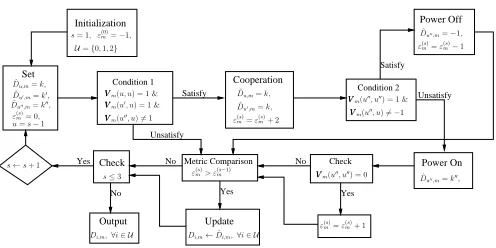
When the InterCI matrixVVVmbelongs to Case 1, the CDMC algorithm is operated as the flow chart shown in Fig. 2. In this case, cooperative transmission for a user with its SIR below the SIR thresholdηtcan always be set up. In order to find the best cooperation option to maximize the sum rate of subcarrier
m, as shown in Fig. 2, the decisions are made using three iterations indexed bys. Furthermore, for the sake of evaluating the quality of the decision made in an iteration, we introduce a metric ε(ms) for the sth iteration of subcarrier m. It can be shown that, in Case 1, there are three possible strategies for InterCI mitigation.
Strategy 1: Two BSs cooperate to transmit to a user, while
the other BS stops transmission. In this case, we haveε(ms)= 1, and the IMD variables are in the form ofDu,m=k,Du′,m=
k,Du′′,m=−1.
Strategy 2: Two BSs cooperate to transmit to a user, while
the other BS transmits to its own user with the SIR below the SIR thresholdηt. In this case, we haveε
(s)
m = 2associated with the IMD variables taking the values asDu,m=k,Du′,m=k,
Du′′,m=k′′.
Strategy 3: Two BSs cooperate to transmit to a user, while
the other BS transmits to its own user with the SIR above the SIR threshold ηt. In this case, we have ε(ms) = 3 the IMD variables taking the values as Du,m = k, Du′,m =k,
Du′′,m=k′′.
As mentioned previously, the CDMC algorithm motivates to maximize the sum rate of subcarrier m and the overall frequency reuse factor of the system. Hence, the algorithm makes the final decision in favor of these. Clearly, Strategy 1 has a very high probability to generate a smaller sum rate than Strategies 2 and 3, since Strategy 1 yields only one information transmission flow on subcarrier m. By contrast, Strategy3 is the most desirable one, which has a much higher probability
Check Metric Comparison
Check
Cooperation
Condition 1
Condition 2 Satisfy
Satisfy
Unsatisfy
Unsatisfy
Initialization
Output Update
No Yes Yes
No No
Yes
Set
Power Off
Power On V
V Vm(u′′, u′′) = 0
ε(s)
m> ε(s−1)
m
ε(s)
m=ε(s)
m+ 1
s←s+ 1
V VVm(u′′, u)6=−1
V V Vm(u′′, u′′) = 1 &
s≤3 Dˆu′′,m=k′′, ˆ
Du,m=k, ˆ
Du′,m=k,
ε(s)
m=ε(s)
m+ 2
VVVm(u, u) = 1 &
VVVm(u′, u) = 1 &
VVVm(u′′, u)6= 1
Di,m,∀i∈ U Di,m←Dˆi,m,∀i∈ U U={0,1,2}
s= 1,ε(0)
m=−1,
ˆ
Du,m=k, ˆ
Du′,m=k′, ˆ
Du′′,m=k′′,
u=s−1
ε(s)
m= 0,
ε(s)
m=ε(s)
m−1 ˆ
[image:8.595.306.554.49.173.2]Du′′,m=−1,
Fig. 2. Flow chart showing the operations of the CDMC algorithm in Case 1, when assumingu6=u′6=u′′, and usersk,k′,k′′are in cellsu,u′ and u′′, respectively.
than the other two strategies to obtain a higher sum rate. This is because Strategy 3 allows a cooperation between two BSs and another transmission from a BS to its user yielding a high SIR. Hence, the cooperation in Strategy 3 has the least cost.
Let us further use the example of (22) to explain, when
ηt = 5 dB and Ic = 1, Io = 0.1. Then, when the CDMC algorithm is used, the InterCI matrix is given by
V
VVm=
1 −1 0
1 1 0
0 1 1
. (35)
Explicitly, the operational situation is in Case 1, as the conditions in (32) are met for both usersk andk′.
According to the operations in Fig. 2, during the first (s= 1) iteration, the algorithm checks if a cooperation can be set up for user k. Since Condition 1 is met, a cooperation between BS uand BS u′ can be set up for user k. However, BS u′′
has to turn off the transmission to user k′′, as Condition 2
of VVVm(2,0) = 0 is satisfied. Consequently, from the first
iteration, the decisions derived are Dˆu,m = k, Dˆu′,m = k
and Dˆu′′,m = −1, which belong to Strategy 1 and have a
metric of ε(1)m = 1. During the second iteration, BS u′ and BS u′′ set up a cooperation for user k′. Furthermore, user k stays on because of VVVm(0,1) = −1. Therefore, from the second iteration, the decisions are Dˆu,m = k, Dˆu′,m = k′
and Dˆu′′,m = k′, and the metric is ε
(1)
m = 2. During the third iteration, the algorithm finds that it is unable to set up a cooperation for userk′′. Therefore, the final InterCI mitigation decisions are given by the second iteration. It can be shown that, in this case, the sum rate achieved isCΣ= 3.5213, which is much higher thanCΣ= 2.208 achieved by the DDMC.
Check Update Set Update Condition 4 Yes Yes No Check Satisfy Unsatisfy Satisfy Unsatisfy Cooperation No Set Condition 3 Power On Power Off Power Off V V Vm(u, u) = 1
u←Uˆ(0)
ˆ
U ←U − {u}ˆ
ˆ
U ← U U ←ˆ U − {u}ˆ u←Uˆ(0)
V V Vm(u′′, u) =−1
V V Vm(u′, u) =−1 &
ˆ
U=∅
Du′,m=k
Du′,m=k′,
Du,m=k,
Du,m=−1
Du′′,m=−1 P
i∈UVVVm(i, u) = 3 &
P
i∈UVVVm(i, u′)<3 &
P i∈UVVVm(i, u′′)<3
U={0,1,2},
ˆ
U ← U, u=U(0),
Du′′,m=k′′
[image:9.595.42.291.57.183.2]Du,m=k
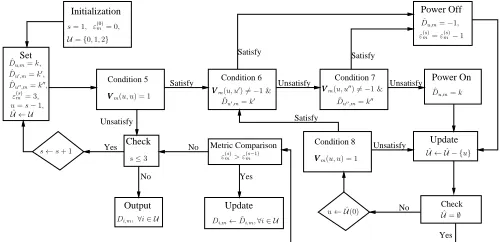
Fig. 3. Flow chart showing the operations of the CDMC algorithm in Case 2, when assuming thatu6=u′6=u′′,u′< u′′, and usersk,k′,k′′are in
cellsu,u′andu′′, respectively.
Condition 5 Condition 8 Check Initialization Update Metric Comparison Check Update Unsatisfy Satisfy Satisfy Unsatisfy Satisfy Output No Yes No Yes Set
Condition 6 Condition 7
Unsatisfy Power Off Power On Satisfy Unsatisfy Yes No
s←s+ 1
V V Vm(u, u) = 1
V V Vm(u, u) = 1
ˆ U=∅
u←Uˆ(0)
s= 1,
V V Vm(u, u′′)6=−1 &
s≤3 U={0,1,2}
ˆ
Du′,m=k′ Dˆu′′,m=k′′
ˆ U ←U − {ˆ u}
Di,m←Dˆi,m,∀i∈ U
Di,m,∀i∈ U
ε(s)
m> ε(s−1)
m ˆ
U ← U
u=s−1,
ε(s)
m= 3, ˆ
Du,m=k, ˆ
Du′,m=k′, ˆ
Du′′,m=k′′,
ε(0)
m= 0,
ε(s)
m=ε(s)
m−1 ˆ
Du,m=−1,
ˆ
Du,m=k V
VVm(u, u′)6=−1 &
Fig. 4. Flow chart of Case 3 showing the operations of the CDMC algorithm, when assuming thatu6=u′6=u′′,u′< u′′, and usersk,k′,k′′are in cells u,u′andu′′, respectively.
the transmission to user k is switched off. Second, there are more than one user having the SIR belowηt. In this scenario, a cooperation can be set up for a user, e.g., userk, with low SIR, while the transmission to the other user is switched off in order not to interfere the cooperation. Consequently, in Case 2, there are two possible InterCI mitigation strategies, one is Strategy 1, which has been described under Case 1. The other one is Strategy 4 corresponding to the first scenario described above, which is stated as
Strategy 4: Switching off the transmission to one user,
while keeping the transmission to the other two users, corre-sponding to the IMD variables in the form of Du,m = −1,
Du′,m=k′,Du′′,m=k′′.
Finally, let us consider the CDMC algorithm operated under Case 3 with the aid of Fig. 4. In this case, no cooperation for the users with poor SIR can be established, and the algorithm only needs to decide whether some transmissions should be switched off, in order to remove the strong InterCI imposing on the other users. As shown in Fig. 4, the final InterCI mitigation decisions can be made after three iterations to consider all the possible options. Similar to Case 1, here a metricε(ms) is introduced so as to evaluate the qualities of the decisions made during an iteration. As seen in Fig. 4, there are three optional decisions. The most desirable one is to keep all the three transmissions on subcarrierm, which gives a metric of ε(ms)= 3. The next desirable decision is Strategy 4, which gives a metric of ε(ms) = 2. The least desirable decision is
given by Strategy 5, described as:
Strategy 5: Switching off two transmissions to two users,
while remaining the other one on. Correspondingly, we have
ε(ms)= 1, and the IMD variables with the values ofDu,m =
−1,Du′,m=−1,Du′′,m=k′′.
In summary, the principles of CDMC algorithm considering Cases 0-3 can now be described as follows.
Algorithm 3: (CDMC Algorithm)
Initialization:
(1) All users in the three cells estimate their SIRs:
η(k,mu) = |h
(u) k,m|
2
Iu′,k+Iu′′,k, if k ∈ F
(u)
m & k′ ∈ F(u
′)
m & k′′ ∈
Fm(u′′)andm∈ M; ∀k∈ K(u) and∀u∈ {0,1,2}.
(2) Set Km = {k|k ∈ Fm(u),∀u ∈ {0,1,2}}, ˆ
Km={k|ηk < ηt, k∈ Km},∀m∈ M.
For subcarrierm∈ M:
If Kˆm6=∅, execute:
Step 1 All discrete InterCI of the users in Kˆm are sent to the head BS.
Step 2 Head BS asks for the discrete InterCI of all the users inKm−Kˆm. (Note that, after Steps 1 and 2, the head BS has the knowledge ofVVVm.)
Step 3 Based onVVVm, the head BS makes the InterCI miti-gation decisions based on the strategies in Cases 1, 2 and 3, as described in Figs. 2 - 4.
Step 4 The head BS informs the other BSs the InterCI decisions by sending them the decisions ofDm. Note that, instead of letting a head BS make the decisions, we may let all the BSs make the decisions. In this way, there is no need for a BS to inform the other BSs its decisions, but all the BSs have to share the InterCI information for making decisions. Specifically, in this approach, when a BS knows that one of its users has the SIR below the threshold
ηt, it then broadcasts the discrete InterCI vector of the user, such as the vector vvvk,m in (30), to the other two BSs. Once receiving the InterCI vector, the other two BSs also broadcast the InterCI information of their users sharing the same subcarrier, regardless of the SIR values of their users. In this way, all the three BSs have the full knowledge of the discrete InterCI matrix of a subcarrier. Hence, they can make the same decisions in the principles of the CDMC under cases
1,2 or3.
[image:9.595.41.291.235.356.2]groups, then all the algorithms considered in our paper can be directly applied for InterCI mitigation. However, there is a possibility that one user is simultaneously a member of two or more cell-edge user groups. In this case, the InterCI algorithms can be modified to simply switch off the transmission to a user belonging to two or more cell-edge user groups. In fact, our proposed DDMC and CDMC algorithms can be readily modified to implement this operation. This can be achieved by switching off the transmission to one user on a subcarrier, whenever the user’s serving BS receives two or more requests from other BSs for cooperation. Second, concerning the case that different cells may have different number of users, this only affects the subcarrier-allocation, but not the InterCI mitigation, as the InterCI mitigation only considers cell-edge users. However, when the number of subcarriers is higher than the number of users in a cell, one benefit is that a cell-edge user has an extra option to choose another subcarrier experiencing less InterCI. Nevertheless, this paper focuses on the InterCI mitigation, we hence avoid considering these trivial cases.
VIII. PERFORMANCERESULTS
In this section, we provide a range of simulation results, in order to demonstrate and compare the achievable spectral-efficiency performance of the multicell downlink OFDMA systems employing the BWSA subcarrier-allocation algorithm and the various InterCI mitigation algorithms. We assume that all subcarriers experience independent flat Rayleigh fading. The pathloss exponent in (4) is assumed to be µ= 4.0, and the standard deviation of the shadowing effect is Υ = 8dB. Furthermore, for the sake of explicit comparison, we address the performance by focusing on the cell-edge users in the system. In the following figures, the average spectral-efficiency of cell-edge users per cell is given by
C= 1
3 X
u∈{0,1,2}
X
k∈K˜(u)
log2(1 +γk), (bits/s/Hz/cell). (36)
Correspondingly, the average spectral-efficiency per cell-edge user is
C= 1
|K|˜
X
u∈{0,1,2}
X
k∈K˜(u)
log2(1 +γk), (bits/s/Hz/user)
(37)
where K˜ = ˜K(0)∪K˜(1)∪K˜(2), and K˜(u), u ∈ {0,1,2}, is
defined in (15). In (36) and (37), γk is the SINR of userk, which is given by (6) or (7).
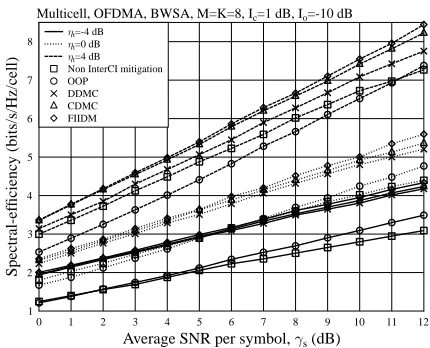
Fig. 5 compares the spectral-efficiency performance of the different InterCI mitigation algorithms employed by the three-cell downlink OFDMA systems. From the results we can obtain the following observations. First, for all the considered SIR thresholds, both the proposed DDMC and CDMC algo-rithms yield higher spectral-efficiency than the OOP algorithm, and also higher than the case without InterCI mitigation, labeled as “non InterCI mitigation” in the figure. As shown in the figure, the DDMC and CDMC algorithms become more advantageous over the OOP algorithm as the threshold ηt reduces. This is because, the DDMC and CDMC algorithms
Multicell, OFDMA, BWSA, M=K=8, Ic=1 dB, Io=-10 dB
1 2 3 4 5 6 7 8
Spectral-ef
ficienc
y
(bits/s/Hz/cell)
0 1 2 3 4 5 6 7 8 9 10 11 12
Average SNR per symbol, s(dB)
t=-4 dB t=0 dB t=4 dB
Non InterCI mitigation OOP
[image:10.595.327.542.53.227.2]DDMC CDMC FIIDM
Fig. 5. Spectral-efficiency of cell-edge users in the multicell downlink OFDMA systems employing the BWSA subcarrier-allocation algorithm and various InterCI mitigation algorithms.
motivate to establish cooperative transmissions for the cell-edge users, instead of simply switching off. As ηt reduces, the number of users requiring cooperation or switching off becomes less, meaning that the “edge-users” are closer to the cell’s physical edge. In this case, setting up cooperation for the cell-edge users will be more beneficial than simply switching them off. Second, we can observe that the CDMC algorithm always outperforms the DDMC algorithm, and the gain becomes bigger as the SIR threshold ηt increases. This is because, in the CDMC algorithm, the BSs find the joint InterCI mitigation decisions, while, in the DDMC algorithm, each BS makes distributed InterCI mitigation decisions only for its own users. Furthermore, the CDMC algorithm attains more SNR gain than the DDMC algorithm, when the number of cell-edge users increases, as a result of increase of the SIR thresholdηt. Third, Fig. 5 shows that the OOP algorithm may become useless in InterCI mitigation, when the SIR threshold is high, such as ηt = 4 dB. In this case, there will be many users turned off. Fourth, as shown in Fig. 5, the OOP algorithm becomes more effective, when the average SNR gets larger. Therefore, when the system is too noisy or when the switching off threshold is too high, too many users may be switched off, which is not beneficial for the systems to use the OOP algorithm. Explicitly, the proposed DDMC and CDMC algorithms are capable of avoiding these drawbacks of the OOP algorithm, by setting up cooperation for cell-edge users, instead of simply turning off them. Lastly, we can observe that the spectral-efficiency performance attained by the CDMC algorithm is very close to that obtained by the FIIDM scheme, which uses the continuous InterCI information for decision making, while the CDMC algorithm only relies on the three-valued discrete InterCI information for decision making. As seen in the figure, the CDMC algorithm attains nearly the same spectral-efficiency as the FIIDM scheme when the average SNR is relatively low.
Multicell, OFDMA, BWSA, M=K=8, s=3 dB, Ic=1 dB, Io=-10 dB
2 3 4 5
Spectral-ef
ficienc
y
(bits/s/Hz/cell)
-5 -4 -3 -2 -1 0 1 2 3 4 5
SIR Threshold, t(dB)
Non InterCI mitigation OOP
DDMC CDMC FIIDM
(a) γs= 3dB
Multicell, OFDMA, BWSA, M=K=8, s=9 dB, Ic=1 dB, Io=-10 dB
2 3 4 5 6 7 8
Spectral-ef
ficienc
y
(bits/s/Hz/cell)
-5 -4 -3 -2 -1 0 1 2 3 4 5
SIR Threshold, t(dB)
Non InterCI mitigation OOP
DDMC CDMC FIIDM
[image:11.595.79.537.54.259.2](b)γs= 9dB
Fig. 7. Comparison of spectral-efficiency performance of cell-edge users in the multicell downlink OFDMA systems employing various InterCI mitigation algorithms, when different SIR thresholds are applied.
Multicell, OFDMA, BWSA, M=K=8, Ic=1 dB, Io=-10 dB
1 2 3 4 5
Spectral-ef
ficienc
y
(bits/s/Hz/user)
0 1 2 3 4 5 6 7 8 9 10 11 12
Average SNR per symbol, s(dB)
t=-4 dB t=0 dB t=4 dB
Non InterCI mitigation OOP
DDMC CDMC FIIDM
Fig. 6. Spectral-efficiency per active cell-edge user in the multicell downlink OFDMA systems employing the BWSA subcarrier-allocation algorithm and various InterCI mitigation algorithms.
the three InterCI mitigation schemes significantly outperforms the case of “non InterCI mitigation”. Second, the CDMC algorithm achieves lower spectral-efficiency than the DDMC algorithm for all the SIR thresholds considered. The CDMC algorithm aims to maximize both the system’s sum rate and the frequency reuse factor, while the DDMC algorithm is only sum rate motivated. Specifically, the DDMC algorithm simply switches off the transmission to the user when a cooperation is unavailable. By contrast, the CDMC algorithm still allows the transmission to the user, provided that this transmission does not cause strong InterCI to the other users. Consequently, given the same SIR threshold, the number of active cell-edge users resulted from the CDMC algorithm is higher than that resulted from the DDMC algorithm. This makes the average spectral-efficiency per active edge user attained by the CDMC algorithm smaller than that obtained
by the DDMC algorithm. Finally, the FIIDM scheme yields the highest spectral-efficiency as seen in Fig. 6.
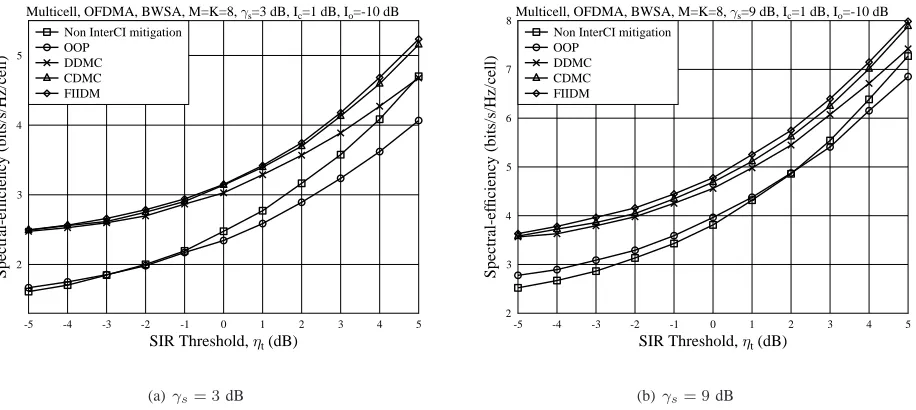
Fig. 7 compares the spectral-efficiency performance of the cell-edge users, when the SIR threshold varies in the range of −5 dB≤ηt≤5 dB. From the figures we observe that the proposed DDMC and CDMC algorithms outperform the other two algorithms considered. As seen in the figures, the spectral-efficiency performance of the proposed DDMC and CDMC algorithms as well as the OOP algorithm are all dependent on the SIR threshold applied. By comparing Fig. 7 (a) with Fig. 7 (b), we can see that the intersection between the curves of the OOP algorithm and the non InterCI mitigation case shifts fromηt=−2dB to ηt= 2dB, when the average SNR per symbol is increased from γs= 3dB to γs= 9dB. Note that, as seen in Fig. 7, the spectral-efficiency in the case of “Non InterCI mitigation” also increases, asηtincreases. This is because more users are considered as the cell-edge users, as
ηtincreases, which makes the spectral-efficiency evaluated by (36) increases. Note furthermore that, at a given SNR, whenηt increases, more users will be included as the cell-edge users, among which more users could be turned off, when the OOP algorithm is applied. This makes the spectral-efficiency of a cell achieved by the OOP algorithm become lower than that obtained by doing nothing. Furthermore, Fig. 7 once again shows that the proposed CDMC is capable of achieving the spectral-efficiency close to that of the FIIDM scheme.
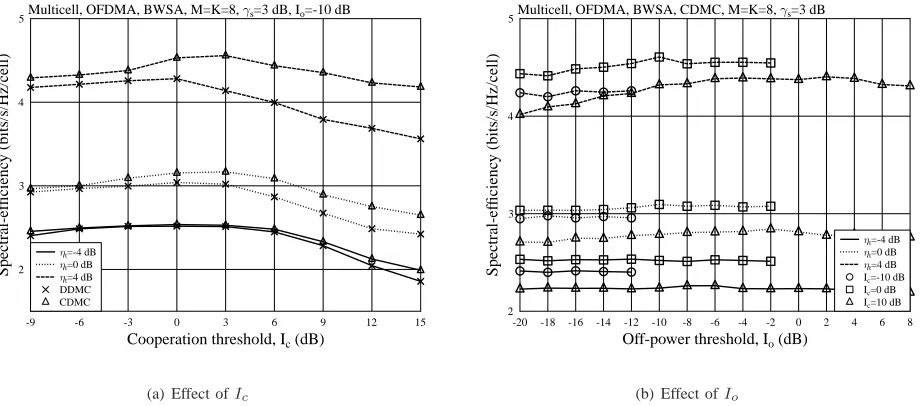
In Fig. 8, we show the effect of the InterCI cooperation threshold Ic and the off-power threshold Io on the spectral-efficiency per cell, when the multicell downlink OFDMA sys-tems employs the DDMC or CDMC algorithms. Explicitly, in Fig. 8 (a), for both the proposed algorithms, there are desirable
[image:11.595.65.280.305.478.2]Multicell, OFDMA, BWSA, M=K=8, s=3 dB, Io=-10 dB
2 3 4 5
Spectral-ef
ficienc
y
(bits/s/Hz/cell)
-9 -6 -3 0 3 6 9 12 15
Cooperation threshold, Ic(dB)
t=-4 dB t=0 dB t=4 dB
DDMC CDMC
(a) Effect ofIc
Multicell, OFDMA, BWSA, CDMC, M=K=8, s=3 dB
2 3 4 5
Spectral-ef
ficienc
y
(bits/s/Hz/cell)
-20 -18 -16 -14 -12 -10 -8 -6 -4 -2 0 2 4 6 8
Off-power threshold, Io(dB)
t=-4 dB t=0 dB t=4 dB
Ic=-10 dB
Ic=0 dB
Ic=10 dB
[image:12.595.78.538.55.258.2](b) Effect ofIo
Fig. 8. Comparison of spectral-efficiency performance of cell-edge users in the multicell downlink OFDMA systems employing various InterCI mitigation algorithms with different InterCI cooperation thresholdsIcand off-power thresholdsIo.
and CDMC algorithms requires that −6 dB≤ Ic ≤ 6 dB. However, the bestIc range for the two algorithms is reduced to −3 dB≤ Ic ≤ 3 dB when ηt = 0 dB, and to −1 dB≤
Ic ≤1 dB whenηt= 4dB. This observation implies that the spectral-efficiency achieved by the two proposed algorithms becomes more sensitive to the cooperation thresholdIc, as the SIR threshold increases. In Fig. 8 (b), the results show that, at a low SIR threshold, such as ηt = −4 dB, the spectral-efficiency per cell slightly varies, when different values ofIo are employed. However, the CDMC algorithm yields a more explicit fluctuating spectral-efficiency per cell with respect to
Io, as the SIR threshold ηt gets higher. Overall, we see that the spectral-efficiency achieved by the CDMC algorithm is not very sensitive to the InterCI off-power thresholdIo.
From Figs. 5-7, we may conclude that the SIR thresholdsηt for both the DDMC and CDMC algorithms should be chosen according to the design objectives, so as to yield a good trade-off between performance and complexity. From Fig. 8, we are implied that the threshold Ic can be set to an appropriate value, so that a ‘good’ fraction of users experiencing strong InterCI are identified for BS cooperation, in order to improve the spectral-efficiency. Once the SIR threshold ηt and the cooperation threshold Ic are set, an off-power threshold Io can then be chosen within a relative large range of Io < Ic by the CDMC algorithm, as seen in Fig. 8(b).
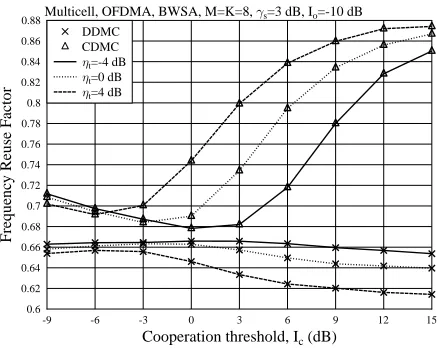
In Figs. 9 and 10, we investigate the frequency reuse factor of the downlink OFDMA systems. Explicitly, the frequency reuse factor obtained by the CDMC algorithm is significantly higher than those given by the other algorithms. We also observe that the frequency reuse factor obtained by the CDMC algorithm increases sharply, asηt increases. By contrast, the frequency reuse factor achieved by the other two algorithms decreases, asηtincreases. The above observations imply that, with the CDMC algorithm, the multicell downlink OFDMA system can simultaneously provide services for more users, even though some of them might have relatively low rates. By contrast, when the DDMC or OOP algorithm is employed,
Multicell, OFDMA, BWSA, M=K=8, s=3 dB, Ic=1 dB, Io=-10 dB
0.62 0.64 0.66 0.68 0.7 0.72 0.74 0.76 0.78 0.8
Frequenc
y
Reuse
F
actor
-5 -4 -3 -2 -1 0 1 2 3 4 5
SIR Threshold, t(dB)
[image:12.595.322.541.304.478.2]OOP DDMC CDMC FIIDM
Fig. 9. Frequency reuse factor of cell-edge users in the multicell downlink OFDMA systems employing various InterCI mitigation algorithms with respect to different SIR thresholdsηt.
the number of users switched off increases as ηt increases, which results in the drop of the frequency reuse factor. Figs. 9 shows that the frequency reuse factor achieved by the DDMC algorithm is slightly higher than that obtained by the OOP algorithm, owing to the cooperation introduced in the DDMC algorithm. Additionally, as seen in Fig. 9, the FIIDM algorithm yields a lower frequency factor than the DDMC and OOP algorithms in the lowηtregimes. This means that, in order to maximize the spectral-efficiency, the FIIDM algorithm has to turn off the transmissions with poor SIR.
Multicell, OFDMA, BWSA, M=K=8, s=3 dB, Io=-10 dB
0.6 0.62 0.64 0.66 0.68 0.7 0.72 0.74 0.76 0.78 0.8 0.82 0.84 0.86 0.88
Frequenc
y
Reuse
F
actor
-9 -6 -3 0 3 6 9 12 15
Cooperation threshold, Ic(dB)
[image:13.595.60.279.54.228.2]DDMC CDMC t=-4 dB t=0 dB t=4 dB
Fig. 10. Frequency reuse factor of cell-edge users in the multicell downlink OFDMA systems employing various InterCI mitigation algorithms with respect to different InterCI cooperation thresholdsIc.
Multicell, OFDMA, BWSA, M=K=8, s=3 dB, Ic=1 dB, Io=-10 dB
0 2 4 6 8 10 12 14
Ov
erhead
(bits/user)
-5 -4 -3 -2 -1 0 1 2 3 4 5
SIR Threshold, t(dB)
OOP DDMC CDMC
Fig. 11. Overhead required by the various InterCI mitigation algorithms.
kept on. Furthermore, as the figure shows, whenIc ≤0 dB, the frequency reuse factor achieved by the CDMC algorithm slightly decreases, as the SIR threshold increases. For the DDMC algorithm, as shown in Fig. 10, the frequency reuse factor slightly decreases, as the threshold Ic increases. This is the result that the DDMC algorithm turns off more users, when the thresholdIc becomes higher.
Explicitly, the operations of the OOP, DDMC and CDMC algorithms require different overhead. Hence, in Fig. 11, we compare the overhead required by the various InterCI mitigation algorithms. Here, the overhead is measured by the number of bits per user, which is obtained from the total overhead (bits) of a cell divided by the number of users in the cell. The overhead considered includes the control information transmitted between users and their BSs and those among BSs, plus the data symbols shared among the BSs for cooperation. For all the three InterCI mitigation algorithms, we assume that one bit is required to transmit a request for cooperation or off-power. Furthermore, in Fig. 11, we assume that, under
the CDMC algorithm, the decisions are made by the head BS, as described in Algorithm 3. The discrete InterCI vector of a subcarrier, such as vvvk,m in (30), has 18 different states. Hence, a BS needs 4 bits to convey the discrete InterCI vector of a subcarrier. Therefore, in total 8 bits of overhead are required for the two BSs to inform the head BS their InterCI information of a subcarrier. In addition, another 3 bits are required for the head BS to broadcast the InterCI mitigation decisions of a subcarrier to the other two BSs, since the decisions have 9 states in total. As the number of cell-edge users increases, when the SIR threshold gets higher, Fig. 11 correspondingly shows that the required overhead for all the three algorithms increases, as the SIR threshold becomes higher. Furthermore, the CDMC algorithm requires higher overhead than the other two algorithms. However, the DDMC algorithm requires very low overhead, which is similar to that required by the OOP algorithm.
IX. CONCLUSIONS
In this paper, we have proposed the DDMC and CDMC algorithms for mitigating the InterCI among the cell-edge users sharing the same subcarrier. While both the DDMC and CDMC InterCI mitigation algorithms motivate to maximize the spectral-efficiency, the CDMC algorithm also aims to maximize the frequency reuse factor. In this paper, we have compared from different perspective the achievable perfor-mance of the downlink OFDMA systems employing the vari-ous InterCI mitigation schemes. Our studies and performance results show that both the DDMC and CDMC algorithms are capable of achieving higher spectral-efficiency than the OOP algorithm, and, certainly, than the case without employing any InterCI mitigation. Although only the three-valued discrete InterCI information is shared among the BSs, the CDMC algorithm is capable of attaining nearly the same performance as the optimal FIIDM scheme that uses the continuous InterCI information for decision making. Additionally, the CDMC algorithm is demonstrated to have the highest frequency reuse factor in addition to its spectral-efficiency advantage, whereas, the DDMC algorithm requires a small amount of overhead, which is similar to that of the OOP algorithm.
REFERENCES
[1] J. Jang and K. B. Lee, “Transmit power adaptation for multiuser OFDM systems,” IEEE Journal on Selected Areas in Communications, vol. 21, no. 2, pp. 171 – 178, Feb. 2003.
[2] K. Kim and J. Kim, “A 2-D subcarrier allocation scheme for capacity enhancement in a clustered OFDM system,” IEICE Transactions on
Communications, vol. E90-B, pp. 1880 – 1883, July 2007.
[3] K. A. D. Teo, Y. Otani, and S. Ohno, “Adaptive subcarrier allocation for multi-user OFDM system,” IEICE Transactions on Communications, vol. E89-A, pp. 3131 – 3137, July 2006.
[4] N. Y. Ermolova and B. Makarevitch, “Performance of practical subcar-rier allocation schemes for OFDM,” Proceedings of IEEE International
Symposium on Personal, Indoor and Mobile Radio Communications (PIMRC), pp. 1 – 4, Sept. 2007.
[5] O. Nwamadi, X. Zhu, and A. Nandi, “Dynamic subcarrier allocation for single carrier - FDMA systems,” in Proceedings of EUSIPCO-2008, Aug. 2008.
[6] T. Liu, C. Yang, and L.-L. Yang, “A low-complexity subcarrier-power allocation scheme for frequency-division multiple-access systems,” IEEE
Transactions on Wireless Communications, vol. 9, no. 5, pp. 1564 –
[image:13.595.64.280.291.465.2]