Field Manual
FM 46-1
Headquarters
Department of the Army
Washington, DC, 30 May 1997
Public Affairs Operations
Contents
PREFACE . . . 5
INTRODUCTION . . . 6
Chapter 1 PUBLIC AFFAIRS ENVIRONMENT . . . 9
Information Environment . . . 10
Information Operations. . . .10
Commanders and Public Affairs . . . 13
Chapter 2 PUBLIC AFFAIRS PRINCIPLES . . . 15
Principles of War . . . .15
Public Affairs Principles. . . 17
Chapter 3 PUBLIC AFFAIRS CORE PROCESSES . . . 20
Public Affairs Planning . . . 20
Information Strategies . . . 22
Media Facilitation . . . 24
Public Affairs Training . . . 25
Community Relations . . . .26
Chapter 4 PUBLIC AFFAIRS AND ARMY OPERATIONS . . . 29
Levels of War . . . 29
Tenets of Army Operations . . . 30
Elements of Combat Power . . . 31
Force Projection Cycle . . . 33
Multinational Operations . . . 35
Joint Operations . . . 36
Sustaining Base Operations . . . 37
* This publication supersedes FM 46-1, 23 July 1992.
Chapter 5 STABILITY AND SUPPORT OPERATIONS . . . 40
Support to Diplomacy ... . . . 41
Noncombatant Evacuations . . . 42
Domestic Support . . . 42
Chapter 6 PERSONNEL AND ORGANIZATIONS .. . . . ...45
Personnel ... . . . 45
Organizations. . . 46
Chapter 7 EMPLOYMENT AND SUPPORT OF PA FORCES . . . 56
Employment of PA units... . . . 56
Required Support ... . . . 58
REFERENCES . . . .61
APPENDIX A DoD PRINCIPLES OF INFORMATION ...62
APPENDIX B COVERAGE OF DoD OPERATIONS...63
APPENDIX C PUBLIC AFFAIRS ANNEX ...64
APPENDIX D PUBLIC AFFAIRS ESTIMATE...66
APPENDIX E MEDIA GROUND RULES...69
GLOSSARY . . . .70
The PA Mission
Preface
Our vision is to build a trained, readily
deployable force of Public Affairs professionals,
resourced, capable and organized to conduct
operations in peace, conflict and war, and to
maintain a timely flow of accurate, balanced
information to the American people.
F
ield Manual 46-1 is the keystone doctrinal manual for U.S. Army Public Affairs operations. It focuses on how the Army thinks about public affairs and de-scribes public affairs roles, missions, capabilities and organizations for the active Army, U.S. Army Reserve and Army National Guard. It also describes public af-fairs employment, command and control, and support across the operational continuum.This manual is the basis for Public Affairs force design and materiel acquisition. It supports the doctri-nal requirements of the Concept Based Requirements System and is the authoritative foundation for the
in-!
tegration of Public Affairs into Army doc-trine, individual and unit train-ing, leader de-v e l o p m e n t , force design and materiel ac-quisition initia-tives. FM 46-1 is directly
linked to, and must be used in conjunction with FM 100-5, FM 100-6, TRADOC PAM 525-5 and Joint Publication 1-07.
FM 46-1 is the doctrinal guide for commanders, planners, and users of Army Public Affairs. It is also a guide for those who must consider the effects public affairs has on military operations. It describes the fun-damental principles and concepts for providing infor-mation to a wide range of internal and external audi-ences– soldiers, family members, retirees, political leaders, the general public, allies and adversaries.
Public affairs personnel must use their professional
knowledge, skills and judgment in adapting the prin-ciples in this manual to their specific situations. Public Affairs commanders and trainers should use this manual and Army Training and Evaluation Programs (ARTEP) to plan and conduct their training.
Numerous terms, acronyms, and abbreviations are found in the manual. Users should refer to the glossary for their meanings or definitions.
This manual aligns public affairs operations with the command and control Battlefield Operating Sys-tem (BOS) and is intended for Army-wide dissemina-tion. This edition of FM 46-1 supersedes the 1992
ver-sion of the manual.
The proponent for this manual is the Office of the Chief of Public Affairs. Send comments and recom-mendations on DA Form 2028 to Director, Public Af-fairs Proponent Activity, ATTN.: SAPA-PA-CFST, Fort Meade, MD 20755-5650.
"Every senior leader must personally
set the example by taking a proactive
rather than reactive approach to
dealing with the media."
General Dennis J. Reimer
U.S. Army Chief of Staff
Introduction
T
he mission of the United States Army is to protect and defend the Constitution of the United States of America by deterring war, and when deterrence fails, by achieving quick, decisive victory – on and off the battlefield – anywhere in the world and under virtu-ally any conditions. Army Public Affairs is an inte-gral part of all military missions across the operational continuum. Everything that the Army does to accom-plish its mission – both good and bad – occurs within today’s Global Information Environment. Army Pub-lic Affairs assists the commander in understanding and operating in this new environment. Whether in peace, conflict, or war, military operations are moreeffec-The end of the Cold War, changing international alliances and dynamics, and ambiguous regional threats have led America’s Army to expand its war fighting doctrine. FM 100-5, Operations, describes a strategic force-projection Army prepared to fulfill its obliga-tions across a continuum of military operaobliga-tions. It pre-scribes an Army able to alert, mobilize and deploy rap-idly from CONUS and overseas theaters to conduct joint, multinational or interagency operations anywhere in the world. It presents concepts for warfighting and conducting stability and support operations, such as humanitarian, domestic and peace operations.
FM 100-5 also addresses the impact that
emerg-tive when they include public affairs support from the very beginning. They support the commander’s effort to meet the information needs and expectations of in-ternal and exin-ternal audiences without detriment to suc-cessful mission accomplishment.
!
The requirement for the Army to conduct Public Affairs derives from Title 10, U.S. Code which states that the Secretary of the Army is responsible for pub-lic affairs and will establish the Office of Pubpub-lic Af-fairs. Implicit in a government of the people, by the people and for the people are the concepts that the people have a right to know about the activities of the government, and the government has an obliga-tion to inform the people about its activities. These principles also apply to information about the activi-ties of the military, which is established in the Con-stitution of the United States to “provide for the com-mon defense and general welfare of the United States.” One of the most significant conduits through which information is passed to the people is the free press guaranteed by the Constitution. Since the nation’s founding, the Army has communicated in-formation to the American people through the me-dia.
Chapter 1
Public Affairs
Environment
America’s Army will conduct joint, multinational or interagency operations, and does not operate alone. Units work in coordination with elements from the other services, as well as military forces from other nations, representatives from governmental organiza-tions other than DoD, and representatives from pri-vate, non-governmental organizations. They contrib-ute a full range of unique combat, combat support and combat service support functions.
To give soldiers an edge, America’s Army exploits major technological opportunities. It pursues advance-ments which afford a significant increase in lethality, offers major improvements for force protection, ex-ploits key vulnerabilities of potential adversaries and offers a capability that presents an adversary with mul-tiple threats simultaneously. Microprocessing, minia-turization, automation, electronics, communications and space technologies are continually changing the way and pace at which operations are conducted.
America’s Army, in addition to being prepared for war, will increasingly be called upon to conduct sta-bility and support operations. Although the Army’s prime focus is war fighting, it is often involved in a wide range of noncombat operations. The use of deci-sive force to win against an armed enemy and the ex-ecution of combat operations in the environment of war is the principal role for which the Army prepares. During peacetime, however, the Army helps keep the day-to-day tensions between nations below the thresh-old of conflict. When peacetime efforts are thwarted and adversaries seek to provoke a crisis or initiate hos-tilities, conflict occurs. In such an environment, the
W
e live in a turbulent world of broad social and political changes. The end of the Cold War, changing international alliances and dynamics, and am-biguous regional threats have resulted in new chal-lenges and altered priorities for the nation and the mili-tary. Army Public Affairs must be prepared to operate in a dramatically restructured military and in a rapidly changing media environment.Americas Army
America’s Army has undergone a significant trans-formation in recent years. It has become a strategic force-projection Army prepared to fulfill its obliga-tions across a continuum of military operaobliga-tions. It is continuously evolving to maintain its capability in a changing environment.
America’s Army is a smaller, more efficient force, and places a heavy reliance on the U.S. Army Reserve and Army National Guard. The Army has reduced its force structure and realigned programs and responsi-bilities to achieve operating efficiencies. It has devel-oped new force design concepts such as modularity and split-based operations.
Army may be required to conduct operations to deter enemy actions or compel compliance and resolve con-flict.
The Information
Environment
Public affairs operations are conducted in infor-mation domains termed the Global Inforinfor-mation Envi-ronment and the Military Information EnviEnvi-ronment. The GIE is defined in FM 100-6, Information
Opera-tions, as including “all individuals, organizations or
systems, most of which are outside the control of the military or National Command Authorities, that col-lect, process and disseminate information to national and international audiences.” The MIE is the “envi-ronment contained within the GIE, consisting of in-formation systems and organizations, friendly and ad-versary, military and non-military, that support, en-able or significantly influence a specific military op-eration.”
The impact of new communications technologies on the conduct of operations is equal to that of emerg-ing weapons technologies. Continuously evolvemerg-ing col-lection and dissemination capabilities have radically altered the dynamics of the news and information con-sumer market.
Telecommunications equipment has rapidly be-come more sophisticated and more widely avail-able. Continuously ex-panding capabilities in in-creasingly smaller, more mobile packages enables ever greater numbers of
independent media representatives to be present throughout an area of operations from the start of, if not before an operation.
Ever smaller, more portable, more affordable and powerful radios, televisions, telephones, computers, fax machines and other communication devices also fa-cilitate the consumer’s access to information. Audi-ences throughout the world — including our deployed forces and actual or potential adversaries — are able to receive a wider range of information from a vastly expanded spectrum of sources.
In an age of instant communications,
ca-pabilities available to the media have had
increasingly important impacts on military
operations.
-- FM 100-5 Operations
The emerging electronic information communica-tion technologies, the proliferacommunica-tion of commercial sat-ellite technology and the expansion of international satellite alliances have resulted in the spread of world-wide communications. Coverage can be instantaneous with audiences throughout the world — the American public, allies and adversaries — receiving and react-ing to the coverage even as the National Command Authority is deciding on appropriate responses, or as deployments are taking place.
Because the public is able to receive greater quan-tities of information through proliferating outlets, the demand for information has increased dramatically. The need to fill more channels of communication leads to wider, more frequent coverage and media competi-tion to find and tell unique stories. It results in more analysis, critique and editorial commentary about events occurring in an area of operations, the impact of those events, and people’s reactions to those events. Military operations have become spectator events watched in real time by the American public, allies and adversaries — indeed by the whole world.
Information Operations
Effective operations in both the GIE and MIE re-quire coordinated information operations. Addressed
at length in FM 100-6, they are in their simplest form “the activities that gain information and knowledge and improve friendly execution of operations while de-nying an adversary similar capabilities by whatever possible means. Effects of information operations pro-duce significant military advantage for forces conduct-ing such operations.”
sys-Information Operations Unity of Effort
CIVIL
AFFAIRS
supports by:
•Developing information products to protect soldiers against the effects of disinformation or misinformation.
•Coordinating with PSYOP planners to ensure consistent mes-sages and maintenance of OPSEC
•Influencing/informing populace of CA activities and support
•Neutralizing
disinformation and hostile propaganda directed against civil authorities
•Controlling EMS for legitimate communica-tions purposes.
•Conducting counter-propaganda and protect-ing from misinformation and rumor
•Developing EEFI to preclude inadvertent public disclosure
•Sychnronizing PSYOP and OPSEC with PA strategy
C2W
CIVIL AFFAIRS
PUBLIC AFFAIRS
•Providing information on CMOC activities to support PA strategy
•Synchronizing
information, communi-cations media and messages.
•Identifying and integrating media and public information from host nation sources
•Providing accurate, timely and balanced information to the public.
•Coordinating with CA to verify facts and validity of information •Providing information to
support information infrastructure picture
•Synchronizing
communications media and messages with PSYOP
•Coordinating C2 target sets with target cell
•Establishing and main-taining liaison and dialogue with local civilians, NGOs and PVOs
PUBLIC
AFFAIRS
supports by:
COMMAND
Commanders need to understand
that the perception of Americas Army
and how it conducts its
operations can be as important to the
Armys success as actual combat.
tems and capabilities to achieve an operational advan-tage in a conflict, or to control the situation in opera-tions short of war, while denying those capabilities to the adversary.”
Public affairs operations are one element of a larger information strategy encompassing command and con-trol warfare (C2W), Civil Affairs and Public Affairs. Command and control warfare is both offensive and defensive. The goal of “C2-attack” is to control or de-stroy the adversary C2 capability. The goal of “C2-protect” is to maintain friendly C2 capability by coun-tering adversary efforts to influence, degrade or de-stroy it. C2-protect includes measures to counter ad-versary propaganda and its effects on operations, op-tions, public opinion, and the morale of friendly sol-diers. Public affairs operations support C2-protect by
facilitating open reporting and access to units and by maintaining robust internal information programs.
Effective information operations require careful synchronization of many staff elements. FM 100-6
Information Operations describes the formation of IO
battle staffs and addresses IO in depth.
Formal, dedicated information operations councils have proven very effective in recent stability and sup-port operations. An information operations coordina-tion committee met weekly during Operacoordina-tion Uphold Democracy in Haiti to share information and coordi-nate the activities of the committee members. The IOCC was comprised of representatives from J-3, J-5, Psychological Operations, Joint Information Bureau, Civil Affairs and the U.S. Information Agency.
In Bosnia, Task Force Eagle formed an informa-tion operainforma-tions council which developed a formal pro-cedure for conducting information operations. The council was chaired by the operation PAO and staffed by representatives of G-2, G-3, Joint Military
Com-mission, Civil Affairs, PSYOP, the task force PAO, and the Joint Information Bureau. The council met regularly to identify issues that could have either posi-tive or negaposi-tive impacts on operations and then devel-oped appropriate information strategies.
The Task Force Eagle information operations pro-cess consisted of eight steps —
•identifying the issue,
•determining if the issue was a problem or an opportunity,
•defining audiences, •defining target result
•evaluating resources and choosing methods and actions,
•coordinating actions and synchronizing messages, •implementing actions, and
•evaluating the success
An illustration of the process is the IOC response to a specific event it identified as potentially having a negative impact on the IFOR mission:
“A Bosnian radio station re-ported that Russian soldiers were going into villages in areas of transfer and telling Moslems that they must leave before the Serbs moved in. The council met and developed a course of action that included media opportunities in the Russian Bri-gade showing the solidarity of IFOR, Civil Affairs per-sonnel talking to locals about the fact that the Rus-sians did not want them to leave, and providing a tape to local radio stations telling people that the Russians wanted them to stay in their homes.” (TF Eagle
Les-sons Learned)
The IOC also produced “Weekly Messages for Commanders” that included public affairs guidance and talking points for commanders and other members of the task force who interacted with the media. The mes-sages were e-mailed to the G-5 in each brigade head-quarters and further disseminated as desired by the brigade commander. One brigade commander directed that the messages be issued as fragmentary orders down to companies.
across the full spectrum of operations. The PA repre-sentative to the IO battle staff —
•represents PA concerns in IO
•identifies, assesses, and advises the commander on information and issues with PA implications
•reviews strategic and operational information with PA implications such as events, missions and pro-paganda
•coordinates with CA and PSYOP representatives to ensure consistency of messages and OPSEC with-out compromising PA credibility
•facilitates the availability of battlefield informa-tion for PA purposes (such as releasable visual imag-ery) used to inform the public of Army capabilities and accomplishments
Effective information operations require the early coordination and synchronization of PA, CA and PSYOP. Each may use the same communications me-dia to communicate essentially the same messages to different audiences. While CA and PSYOP address local populations and adversary forces, PA operations are directed toward U.S. forces and U.S. and interna-tional media. The target audiences may differ, but the consistency of messages is important to credibility.
With the expanding role of public affairs and in-formation operations, it remains important to preserve the separation of PA and PSYOP in order to maintain the credibility of public affairs spokespersons and prod-ucts. Although coordination of PA and PSYOP occurs in the IO cell, the public affairs representative to the cell should not be the primary command or operation spokesperson.
Information Operations planning and operations are beneficial in peacetime, conflict and war. The com-position of the IO cell will depend upon the circum-stances. In peacetime, the cell may include the G-5, PAO, Staff Judge Advocate, and chaplain. During sta-bility and support operations or war, the IO cell may include intelligence, signal, fire support, PA, CA, EW, OPSEC, PSYOP and logistics.
Postconflict operations also benefit from coordi-nated IO. PSYOP and CA may be needed to enhance support of local populations. Information about the Army and civil-military operations may be dissemi-nated through the media. Public affairs operations can-not focus on directing or manipulating public opinion,
but may contribute to public understanding of U.S. in-tentions and activities by providing timely informa-tion about the operainforma-tions.
Public affairs may also contribute to information strategies developed to counter misinformation and propaganda communicated in the GIE.
In stability and support operations, the IO plan-ners may work with and receive information from a variety of foreign and domestic government agencies, non-governmental organizations, state and local agen-cies and private volunteer organizations. The U.S. may not have the lead in these operations and therefore must work closely with the lead agency to ensure U.S. in-formation operations are consistent with the overarching operational theme and objectives.
Commanders and
Public Affairs
The changes occurring in America’s Army, the evolving information environment and the emerging information communications technologies have made it much more difficult to control, limit or restrict in-formation. The greater availability of detailed, graphic, real-time information from anywhere in the world impacts the linkage between national strategic goals, theater strategic and operational objectives, and op-erational and tactical execution.
The fact that information is more available has bridged the gap between what occurs on the ground and the goals and objectives of the national military strategy. Real-time or near real-time reports of the ac-tions of a soldier manning a roadblock, the results of a minor skirmish, or the effects of a major combat ac-tion become the subject of public discussion and de-bate.
Commanders must focus on providing complete, accurate, timely information, rather than on guarding information. It is critically important to achieve a bal-anced, fair and credible presentation of information to the American public. Commanders must know the in-formation needs and expectations of their soldiers and their family members, the home station community and other internal audiences.
T
he Public Affairs mission fulfills the Army’sobli-Chapter 2
Public Affairs
Principles
Information Environment. Commanders require their PAOs to include public affairs operations in their plan-ning guidance. The results are specific tasks that as-sist the commander in —
•exercising command and control over public affairs assets in the theater of operations
•assessing the public affairs situation •preparing public affairs plans and orders •establishing media operation centers •supporting command and control warfare •coordinating and integrating combined, joint, and/or interagency public affairs support
•facilitating media involvement in collecting and distributing information
•producing and distributing command and public information products to the internal and external audiences
•participating in Information Operations
Public Affairs and the
Principles of War
The principles of war — objective, offensive, mass, economy of force, maneuver, unity of command, se-curity, surprise, and simplicity are the basis for the Army’s warfighting doctrine. The Public Affairs Of-ficer provides input to the warfighting planning pro-cess, and supports political, economic, and informa-tional goals, as well as military objectives. The PAO assesses the impact of military operations in both the global (GIE) and military (MIE) information environ-ments. PA operations will have the same impact on
gation to keep the American people and the Army informed, and helps to establish the conditions that lead to confidence in America’s Army and its readi-ness to conduct operations in peacetime, conflict and war.
The active Army, U.S. Army Reserve and Army National Guard have an obligation to keep the Ameri-can people, its internal audiences and other key pub-lics informed about its achievements and successes, as well as its problems and failures. Providing infor-mation openly and honestly—with minimum delay— shows courage, candor, competence and commitment, and contributes to confidence, trust, respect and es-teem in the force. The PAO communicates the Army’s professional character, beliefs, values and ethics. Army Public Affairs promotes a greater understanding of the Army and its contribution to the nation.
When America’s Army is understood, America’s Army is strengthened. Army morale and esprit are en-hanced, which further enhances understanding, confi-dence, trust, respect and esteem.
Public Affairs support
to military operations
Objective: Direct every military operation toward a clearly defined, decisive and attainable objective.
Offensive: Seize, retain and exploit the initiative.
Mass: Mass the effects of overwhelming combat power at the decisive place and time.
Economy of Force: Employ all combat power available in the most effective way possible; allo-cate minimum essential combat power to second-ary efforts.
Maneuver: Place the enemy in a position of disad-vantage through the flexible application of combat power.
Unity of Command: For every objective, seek unity of command and unity of effort.
Security: Never permit the enemy to acquire unexpected advantage.
Surprise: Strike the enemy at a time or place or in a manner for which he is unprepared.
Simplicity: Prepare clear, uncomplicated plans and concise orders to ensure thorough understanding.
The Principles of War - FM 100-5
these basic military principles as any other element inthe operational force.
Objective
Once the strategic, operational, and tactical mili-tary objectives are specified, the PAO supports the commander through the analytical framework of mis-sion, enemy, troops, terrain, and time available (METT-T) to designate operational objectives. Objec-tives include conducting public affairs training, plan-ning, developing information strategies, conducting media center operations, facilitating media access to the force, acquiring and analyzing information, and targeting products to specific
audi-ences.
Offensive
To be an asset to the field com-mander, the PAO must seize the ini-tiative and actively assess and re-spond to potential public affairs situ-ations, incidents, and force move-ments in support of the commander’s objective.
Public Affairs operations are combat multipliers by:
• keeping soldiers informed • maintaining public support for the soldier in the field
• mitigating the impact of mis-information and propaganda
Mass
The principle of mass requires the quick assembly of public affairs forces and resources at a particular place and time. PA forces must be deployed early, in sufficient num-bers, and utilized in accordance with the established battlefield laydown if they are to conduct professional PA operations appropriately tailored to their assigned missions. The com-manders most likely to succeed will have accurately assessed the level of news media interest in their opera-tion, and will have provided the as-sets necessary to accomplish the public affairs mission.
Economy of force
Unity of command
Unity of command requires that all public affairs forces are under a single commander with the requi-site authority to direct all PA forces in pursuit of a unified purpose. Whether that commander is a divi-sion, corps, theater, joint, or unified public affairs com-mander, PA units must have a clear chain of command that minimizes the number of higher headquarters in that chain. The chain must be flexible enough to syn-chronize PA functional activities throughout the the-ater of operations.
Unity of effort
Unity of effort, essential to unity of command, re-quires the coordination and cooperation among all forces, especially those public affairs operations at the joint or unified level where more than one service is involved in the public affairs operation. It is essential if we are to effectively tell the Army’s story.
Security
Public affairs operations support security by de-veloping a plan for the inclusion of news media, es-tablishing and enforcing media ground rules and de-veloping procedures for explaining the sensitivity and complexity of military operations to the media. To pre-vent the release of classified or protected information into the public domain, individuals must practice se-curity at the source and adhere to OPSEC requirements.
Surprise
Speed, effective intelligence, deception, applica-tion of unexpected combat power, OPSEC and varia-tions in tactics and methods of operavaria-tions are elements of surprise. The elements of the principle of security carry over to the principle of surprise. Public affairs forces must ensure that the element of surprise is not compromised by the inadvertent release of critical op-erational information.
Simplicity
Public affairs relationships are simplified by us-ing a sus-ingle-staff focal point. The PAO, workus-ing with the G3/S3, can relieve the unit’s staff and command of many related functions. PA plans and annexes must be simple and direct, and must be supportable by the available resources. Early coordination and comple-tion of operacomple-tional annexes will ensure effective and successful operations.
T
he Global Information Environment (GIE) hasreal time. They can dramatically influence public opin-ion and may force the Natopin-ional Command Authority to react more rapidly than it would prefer. They may lead to changes in strategic level goals and guidance, result in significant modifications to operational mis-sions, policies and procedures, and cause unexpected tactical restraints and constraints. They have a direct impact on soldier morale, discipline and performance.
Public Affairs Principles
Conducting operations in the GIE requires an un-derstanding of basic public affairs principles. Army leaders at all levels need to understand the fundamen-tal concepts which underlie the development of pub-lic affairs strategies and guide the planning and ex-ecution of public affairs operations. They should also be familiar with the DoD Principles of Information (Appendix A) and the Guidelines for Coverage of DoD
Combat Operations (Appendix B) which provide
overarching guidelines for public affairs operations.
Soldiers and families come first
Internal audiences include soldiers, civilian em-ployees, retirees and all affiliated family members throughout the Army’s active and reserve components. These audiences must be thoroughly and appropriately informed to ensure maximum effectiveness and the highest sustainable morale. These audiences often be-come public spokespersons and effectively managed internal information programs contribute to their abil-ity to do that well. Although operational needs may at times divert immediate attention to external audiences, the information needs of soldiers, families, civilian employees, retirees and employers of reservists must be considered first.
Truth is paramount
tacti-ues, policies and procedures. Because every active and reserve component soldier, civilian and family mem-ber is perceived as a credible spokesperson, telling the Army story is a total Army responsibility. Once lost, credibility cannot be easily regained. The quickest way to destroy credibility is to misrepresent the truth. Com-municating different messages to different audiences is also a sure way to destroy credibility of the source. When credibility is undermined, communication be-comes ineffective and it is impossible to achieve in-formation objectives.
If news is out its out
The GIE makes more information easier to dis-seminate and more accessible to wide audiences. As the value of information continues to increase, the abil-ity to limit or restrict its flow continues to decrease. Leaders must recognize this, consider the impact that information availability will have on mission, and pre-pare to address issues openly, honestly and in a timely manner. Once information is available, attempting to deny it or failing to acknowledge it will destroy the Army’s credibility.
Not all news is good news
In the GIE, the presentation of information about the Army and its operations will be both positive and negative. Information about failures will be just as available as information about successes. Army poli-cies, decision and actions will be criticized and praised. PAOs cannot control media coverage or guarantee posi-tive media products. DoD policy is that information will not be classified or otherwise withheld to protect the government from criticism or embarrassment. In-formation can only be withheld when its disclosure would adversely affect national and operations secu-rity or threaten the safety or privacy of members of the military community.
It is DoD and Army policy to take an active ap-proach to providing information. The Army will prac-tice the principle of “maximum disclosure with mini-mum delay,” even though this will sometimes result in the publication of stories which are not favorable to the command.
Army spokespersons must avoid speculation and confirm the accuracy of their information. Successes and strengths as well as failures and weaknesses must be addressed if internal and external audience
confi-dence in the Army is to be maintained. Issues must be addressed quickly, honestly and accurately. Explana-tions may be given in terms of corrective acExplana-tions and preventive measures. Withholding or appearing to withhold negative information creates the perception of cover-ups, leads to speculation, and destroys the credibility of the Army and the operation. Denying information about, or refusing to comment on, poli-cies, operations, activities, positions or procedures which are clearly in the public domain undermines confidence in the Army.
Telling our story is good for the Army
In stability and support operations in particular, but also in war, providing accurate and timely infor-mation about the force and its operation will contrib-ute to mission accomplishment. Providing informa-tion about the force, intent and acinforma-tions communicates restraint, indicates perseverance, and can serve as a deterrent. It can clarify the nature of the mandate and the Army’s efforts to operate within that mandate.
The active release of complete and accurate in-formation influences the perception of events, clari-fies public understanding and frames the public de-bate. It preempts attempts to misrepresent situations. When intentional misinformation or disinformation efforts are being made by adversaries, providing open access and independent media coverage is the most effective defense. It is a key tool for countering the impact of enemy information operations.
Public affairs must be deployed early
mission and his soldiers’ welfare.
Media interest will be intense at the outset of op-erations. Public interest and media attention will be high during the initial deployment of forces. The me-dia will closely cover the deployment of American forces, their arrival in the theater and their initial op-erations. Once operations have been initiated and sta-bility has been achieved, media attention will dimin-ish until a significant event occurs or there is a no-table change in the situation. Media interest will re-surface as the force completes its mission and begins to redeploy.
Media are not the enemy
While military professionals and journalists both serve the American people, their philosophies, values and basic outlook don’t always correspond. These dif-ferences can easily lead to misunderstandings. Yet the vast majority of journalists and the organizations they represent are committed to the ideals of providing re-sponsible, accurate, balanced coverage. Good report-ers will thoroughly investigate issues, and ask tough challenging questions. They seek information, inter-pretation and perspective. Yet many reporters today have not served in the military and their inexperience and uncertainty may create obstacles in communica-tion between themselves and soldiers. They may fail to properly prepare for their assignments. Soldiers may need to educate them on military operations and help them understand the significance of the events on which they report.
Reporters covering operations should not only be provided access to units and soldiers, but whenever feasible, should be included in the operation as a part of a unit. Incorporating journalists into units provides them with a unique perspective. It gives them the chance to know soldiers, understand the operation and experience America’s Army. It results in the best cov-erage.
Practice security at the source
The characteristics of the military and global in-formation environments essentially render field cen-sorship impractical in its traditional sense, as well as impossible. All individuals must be responsible for sensitive information. Whether being interviewed by a reporter, or sharing news with a spouse or a friend, communicators must be aware of operational security,
T
he public affairs functional areas have historically been public information, command information and community relations. As broad references, the terms are still useful. To adequately describe the “value-added” provided by public affairs to the com-mander, a more precise method is required. Addition-ally, the traditional terms do not adequately address the challenge of providing public affairs support in the global information environment. The realities of rap-idly evolving technology, radical changes in the busi-ness structure affecting the commercial media and tele-communications companies, and the pervasive net-working of a global community demand a new approach to articulating what public affairs professionals do.This chapter focuses on core processes, within the framework of the three broad public affairs functional areas, allowing Army Public Affairs to meet the chal-lenges of supporting Army XXI in the Information Age.
The public affairs core processes are — •conduct public affairs planning •execute information strategies •facilitate media operations
•conduct public affairs training, and •maintain community relations
While the traditional functional area designations such as Command Information and Public Informa-tion may be used to describe public affairs product cat-egories or organizational focus, the public affairs core process definitions describe the esssential components of Army public affairs operations.
Chapter 3
Public Affairs
Core Processes
Public Affairs planning
From receipt of a mission through mission analy-sis, course of action development, analyanaly-sis, recommen-dation, decision and implementation, public affairs planners continuously assess the situation, develop solutions and monitor effects of public affairs opera-tions. Public affairs planning is an integral element of the decision-making process at every level and across the continuum of operations. Done in concert with op-erational planning, it enhances the commander’s range of options.
Public affairs planning reduces the constraints which inhibit a commander’s range of possibilities and increases his freedom to decide and act without dis-traction. This planning is conducted in concert with all information operations planners, and when appro-priate, with the Information Operations Battle Staff.
Once operations have been initiated, public affairs planners continuously monitor operations and the GIE. They evaluate the situation, measure the effectiveness of the effort and make adjustments to the PA opera-tion as necessary. They react to operaopera-tional events with a public affairs impact, and public affairs events with an operational impact. They participate in future op-erations planning.
Public Affairs Assessment
The Public Affairs Assessment addresses all as-pects of the information environment, whether or not they are under the control of the commander. Primary emphasis is placed on identifying, measuring and evaluating the implications of the external informa-tion environment that the Army does not control, but can influence through a coherent, comprehensive strat-egy and early integration in the planning and decision-making process. The blurring of the line between ex-ternal and inex-ternal information adds to the value of assessing the internal environment as well.
The assessment identifies and evaluates the public affairs environment, the global infor-mation environment and the military information environ-ment of a country, geographic area or the area of operation. It includes an examination of the physical and social infra-structure from a public affairs viewpoint. The assessment is continually updated and is used as a reference document
which briefly describes characteristics of the region which are pertinent to public affairs operations. Much of the information used to develop this assessment is obtained from other contributors to Information Op-erations. For example, the Civil Affairs representative to the Information Operations Battle Staff may have information about commercial media and communi-cations capabilities and availability in the area of op-erations. The assessment is a compilation of informa-tion on the GIE and MIE, and requires the PA special-ist to review and coordinate the development of the assessment with information being collected by the Civil Affairs, Psychological Operations, and Military Intelligence sections. This ensures coordination in the development of campaigns, themes and messages dur-ing the operation.
The Public Affairs Assessment serves as the foun-dation from which the Public Affairs Estimate is writ-ten and focuses on:
Media presence. A commander needs to know the number of media representatives in the theater be-fore the deployment of his force, and what level of media presence he should anticipate once deployment begins. The commander must also have an analysis of the type of media (print or broadcast), the visibility of the media (local, national, international, American or foreign) and the style of the media (news, information or entertainment) covering the operation. The assess-ment of the media presence should address the
author-ity under which media representatives are operating in
the theater and their degree of access to the theater of operations.
Media capabilities. A commander needs an
analysis of the technological capabilities of media rep-resentatives present in the theater. He needs to know,
for example, if they have live video transmission ca-pability or interactive satellite telecommunications access. An analysis of the sophistication of the media’s
logistics support provides information about the
trans-portation assets or resupply channels available to me-dia representatives, and can be an important planning consideration.
Information needs. A commander needs to know who he must provide information to and what information he will need to provide. Public affairs plan-ners will conduct an audience analysis to determine the information needs of soldiers, family members, hometown audiences, and the American public. A thor-ough audience analysis will evaluate how information made available to the media will be perceived by
non-Dramatic visual presentations can
rapidly influence public and political
opinion, so that the political
U.S. publics, including allied as well as adversary pub-lics, what they will be interested in, and what they might do with that information.
Media content analysis. A commander needs to know what is being said and by whom. A media content analysis will provide an evaluation of the quantity and the nature of that coverage, and re-veal intended as well as unintended messages. This is essential to understanding how stated intentions and conditions contrast with real intentions and conditions, and helps identify media trends or agendas. This will help the commander understand how the situation is being framed and what messages are being communi-cated to the public. How the situation is framed — the context in which it is being presented — will influ-ence how the American public defines success and the desired end-state of an operation. Understanding how the situation is framed is essential to designing effec-tive strategies for communicating the Army perspec-tive within the public discourse, and for achieving a balanced, fair and credible flow of information.
Public opinion. A commander needs to know how the American people and their civilian leaders per-ceive the situation and the use of military power. He needs to understand the perceptions held by interna-tional audiences, both those tradiinterna-tionally allied with the U.S. and those traditionally considered to be ad-versaries. Assessment of public opinion must not only evaluate the perceptions held, but also the relative so-lidity or strength of those attitudes.
Information infrastructure. A commander needs to know what sources are accessible for trans-mitting and receiving information. Among other things, an analysis must be conducted of the availability of telephone lines for voice and data transmission, the accessibility of audio and video channels, the preva-lence of private communications devices such as tele-phones, facsimiles, computers with modems, radios and televisions, and the nature of the information avail-able through these information channels.
Public Affairs Estimate
The Public Affairs Estimate (see Appendix D) is an assessment of a specific mission from a public af-fairs perspective. It includes analysis of the news me-dia and public environments to evaluate the degree of understanding about strategic and operational objec-tives and military activities and to identify levels of
public support. The Public Affairs Estimate evaluates the existing global information environment, emerg-ing trends, current events, and internal and external information communication issues. It contains an analysis and comparison of alternative courses of ac-tion, recommendations about public affairs force struc-ture and how to employ available PA assets.
Public Affairs Plans
Based on the information developed in the Public Affairs Estimate, planners develop a strategy to
sup-port the operation. The public affairs strategy links
the national strategic goals and operational objectives. It defines the Army perspective of an operation, and describes how an operation supports strategic goals. It provides the intent for public affairs operations and the Army’s approach to meeting the information needs of critical internal and external audiences. In final form it becomes the Public Affairs Annex to the operations plan and serves as the framework for developing Pub-lic Affairs Guidance for the operation.
Public affairs plans are integrated into the opera-tion plan/operaopera-tion order through the PA Annex. The annex provides the details for media facilitation, news and information, and force training operations. It is coordinated with all staff agencies, especially those that significantly impact the information environment — i.e., Psychological Operations, Civil Affairs, Sig-nal, Military Intelligence — to ensure that public af-fairs activities are synchronized with other activities.
Public Affairs Guidance
Public Affairs Guidance (PAG) provides mission-specific guidance to support public discussion of the operation. Public Affairs Guidance establishes the command’s public affairs policies, identifies issues likely to be of interest, delineates the Army perspec-tive, recommends appropriate themes, and addresses the methods, timing and authority for releasing infor-mation to news media representatives.
Information Strategies
created an endless stream of data and information that flows into a world filled with images, symbols, words, and sounds. Much of this information is a strategic asset, capable of altering high-level decisions by the National Command Authority, and senior military lead-ers.
To effectively deal with this barrage of informa-tion, public affairs professionals must be skilled at in-forming their publics, both internal (Command Infor-mation) and external (Public InforInfor-mation). Informa-tion strategies are synchronized plans for using all available and appropriate methods of communication to achieve specific goals of informing target audiences. The process includes: acquisition, production,
distri-bution and protection.
Acquisition
Information acquisition is initiated by PAOs de-veloping story ideas that support the PA guidance and themes for the operation. They monitor events in the GIE/MIE, and seek out creditable sources for infor-mation.
Information Sources. Public affairs special-ists acquire information using a variety of sources. Be-cause of the volume of information and the vast num-ber of potential distribution mediums, the public af-fairs team, detachment or office develops and uses a systematic acquisition strategy. They acquire informa-tion from—
•participants •leaders
•developed sources •the media
•research and development •intelligence
•culture at large •subject matter experts
Acquisition equipment. Public affairs spe-cialists must be equipped with the latest “off-the-shelf” digital technology, capable of collecting images to be processed and distributed internally or marketed over commercial radio and television broadcast mediums, across the Internet and the World Wide Web, and to newspapers and magazines.
Production
For information to be of value it must be
devel-oped into a story, release, or product. Producing a pub-lic affairs product requires state-of-the-art digital in-formation technology. The nature, distribution, capac-ity, usability and flexibility of public affairs systems, including their links with satellite and communications networks are crucial in the rapid processing and distri-bution of information. While most production is tech-nical in nature–writing a release, shooting a picture, developing a story, editing a story, conducting an interview–the PAO must also review the context of the information for its impact on internal and external community relations.
Distribution
Information must reach an audience. Distribution systems or platforms must keep up with changes in the technology used to deliver information. The pub-lic affairs community should be able to deliver infor-mation to all audiences via all mediums. Connectivity within the public affairs networks and the external me-diums used in the dissemination of information is cru-cial. Wars can be won or lost on the world’s television screens as well as on the battlefield.
PAOs employ many information strategies to pro-vide news and information to internal and external audiences. Using organic military assets and contracted services, PAOs provide print, video, audio and elec-tronic information products to deployed soldiers, news media representatives, family members, and other home station audiences such as members of the local community. They fill news and information needs and expectations by maintaining an expedited flow of com-plete, accurate and timely information.
This information helps them understand and in-terpret the activities and events they are covering. It is a critical element in communicating the Army perspec-tive and contributes to achieving a timely, accurate, balanced presentation of information about America’s Army, the force and the mission. It builds confidence in the force and the operation, maintains morale, re-duces distractions, and minimizes factors which de-tract from effective, efficient operations.
can appear in public media. To maintain credibility, news and information provided to internal and exter-nal audiences must be timely, accurate and consistent. If the information provided to internal audiences dif-fers from that provided to other audiences, the discrep-ancy will affect the perception of, and confidence in America’s Army.
The information products provided to internal and external audiences are varied. They provide news and information about America’s Army, the force, unit activities, the operation, exercise, and Annual Traing for reservists. For deployed soldiers, they also in-clude products which provide news and information about home station, the local community, and national and international events. Public media products—print, broadcast and electronic—must also be made avail-able to soldiers.
Protect
The process of informing requires a clear-cut un-derstanding of how information must be protected. In-formation as a resource is inexhaustible. Both sides can benefit from information and use information si-multaneously against each other. Pieces of the right information can have a dramatic impact on the out-come of an operation. PAOs will continue to protect vital information by practicing “security at the source” and following established operational security mea-sures. In addition to protecting “raw” and completed information products, PAOs must also take the neces-sary steps to protect information networks.
Media Facilitation
The commercial news media are major players in the global information environment. Fewer than 150 reporters covered the 1944 D-Day invasion of Europe. More than 800 covered Operation Just Cause in 1990, and more than 1500 journalists from around the world covered the Persian Gulf War in 1991. There is no ques-tion that the news media will cover future military operations, and in most cases will be on the ground before American forces arrive. Images of events as they happen, in real-time, from both sides of the conflict will be transmitted to the world. It is the commander’s task, through the public affairs officer and staff, to develop a well resourced and responsive infrastruc-ture to facilitate media operations. Failure to do so will not affect the scale of news media coverage; it will, however, limit the command’s ability to communicate effectively and risk distorting the public’s perception
of the military’s effectiveness.
Media facilitiation includes—
•assisting media entry into the area •registering media representatives
•orienting them on ground rules for coverage •ensuring they understand security policies •arranging interviews and briefings
•coordinating unit visits and escorts
•providing thorough and timely responses to media queries
•embedding media in operational units
Establish a media center early
Setting up a media center early establishes a focal point for media representatives seeking to cover an operation and also provides a central location for Army personnel seeking assistance with reporters in their area. It is a place for resolving problems or incidents resulting from media/military interaction.
Understand and prepare for the media
To prepare for encounters with the media, com-manders must accept and understand the role of the news organizations and the journalists in the theater, and their capabilities in getting information from the battlefield or area of operations. Commanders must provide media access to the force, keeping in mind the impact their technology will have on operational se-curity. They must identify and provide support and re-sources to assist the media in their mission. Command-ers have a responsibility to ensure that their public af-fairs operations are positioned and resourced to ad-equately facilitate the media’s needs. Successful com-manders will have accurately assessed the level of news media interest in their operation and anticipated and provided the assets necessary to accomplish the media facilitation mission. Commanders and staff must assess the intensity of news media interest and anticipate the personnel, communications, transportation, and deploy-ment requiredeploy-ments necessary to communicate through the news media during all stages of the operation. The objective of media facilitation is to support reporters in their efforts to cover the force and the operation, while minimizing the possibility that media activities will disrupt the operation, endanger mission accomplishment or compromise soldier safety or privacy.
Embedding the media
with soldiers during an operation, embedding them into the unit they cover. Embedding is the act of assigning a reporter to a unit as a member of the unit. The porter eats, sleeps, and moves with the unit. The re-porter is authorized open access to all sections of the unit and is not escorted by public affairs personnel. Rather, the unit is the reporter’s escort. Reporters file their stories from unit
lo-cations and security is ac-complished at the source, by establishing with the reporter what can be cov-ered and reported on and what cannot be reported on, or when material can be reported.
Ground rules
and security
Commanders must understand that sustained con-tacts between military forces and the news media re-sult in the most complete and accurate stories about their units. They should seek to convince reporters that the acceptance of reasonable military ground rules (see
Appendix E, Media Ground Rules Example) and the
integration of journalists into operational units are in the best interest of both institutions. However, some reporters will choose not to cooperate and in those cases, commanders have no responsibilities for such individuals and should focus their attention on the re-porters who desire to abide by the procedures outlined for the operation.
While members of the media may say that their security is of no concern to the military and DoD policy calls for working with journalists without regard for their safety, the capture of journalists by U.S. adver-saries in Panama during Operation Just Cause and in Iraq during Desert Storm have proven that while no one can guarantee the security of all reporters, those who accept the protection afforded them by military units are in the best position to cover the story and survive.
Interviews, escorts and briefings
Public affairs and operational personnel should be available to furnish explanations to provide context to the transmitted images and reports. Without command assistance, there is a chance that misperceptions and misunderstandings will result.
The expectation that all journalists will be accom-panied by trained public affairs professionals is unre-alistic. There will always be more media than PA per-sonnel. Often PAOs are not the most qualified person-nel to act as escorts because they lack the specialized expertise to explain detailed activities of different units involved in an operation. The PAO’s duties will be to
make arrangements for the press to visit a unit, to as-sist in transporting them to the unit and then to rely on a designated subject matter expert (such as an execu-tive officer, first sergeant, platoon leader) to assist the media while they are in the unit.
Transportation arrangements need not place spe-cial requirements on the commander. Reporters can move forward with supply columns or with any trans-port which inevitably shuttles within the organization.
Commanders at every level should be interested in what is being said about their efforts. Those at the tactical level will often learn from the reporters inte-grated with their units or from news summaries sev-eral days old. They don’t have to like or agree with what is being reported, but they do have to understand what is being reported. The public obtains its informa-tion about the operainforma-tion from the news media, and those reports help to shape public perceptions and opinion about the command’s effectiveness. With an effective media facilitation program, the command is aware of differences between what it knows to be true and what the news media are reporting. Relying on technology, their assessments, and their media facilitation plans, commanders and their PA staffs have to continuously work to ensure that the inevitable gap is as narrow as possible.
Public Affairs Training
The underlying principle of Army training is to train in peacetime in a way that replicates expected
Reporters will be on the ground
before soldiers arrive.
Commanders must develop
well-resourced and responsive
wartime conditions. Public affairs training includes—
•training for public affairs soldiers
•media interaction training for non-public affairs soldiers, civilian employees and family members
The goal of public affairs training is to prepare soldiers to interact with and operate under the scrutiny of the press. It teaches soldiers that journalists are not adversaries, and focus on providing accurate, balanced coverage. It helps soldiers understand that the media is a communication channel to the American public as well as to audiences worldwide.
Although public affairs training familiarizes soldiers with their rights regarding interaction with the press, it also prepares them to facilitate journalists efforts to gather and report information. It trains them on how to react when they encounter
media in their area of op-erations. It prepares them to give interviews, provide briefings and escort jour-nalists. It ensures they are ready to perform their du-ties while accompanied by reporters without allowing the media presence to influ-ence or interfere with the execution of their duties.
For commanders, staffs and other Army leaders, public affairs training builds on individual training. It focuses on integrating public affairs considerations into the planning and decision-making process. It prepares them to recognize that soldier morale, combat effec-tiveness, tactical execution and mission accomplish-ment can be affected by media coverage of the opera-tion. It enables them to recognize, understand and plan for the strategic, operational and tactical impact of a media-intensive, global information environment. It trains them to identify and develop public affairs plans which are fully synchronized with and mutually sup-portive of all other aspects of the operation.
Training for public affairs personnel expands on soldier and leader training. It stresses individual as well as collective tasks with an aim of developing units fully prepared to accomplish the range of public affairs mis-sions. It integrates public affairs into the battle staff. It ensures public affairs is involved in mission
assess-ment, planning and execution. It trains PA planners to assess the operations environment from a public af-fairs perspective, produce a Public Afaf-fairs Estimate, develop the Public Affairs Annex and Public Affairs Guidance.
Training for public affairs units and personnel en-ables them to validate standard operating procedures for media operations centers and media facilitation, develop and execute information strategies, create and distribute information products, and fully participate in information operations. Public affairs sections and units should be routinely incorporated into the entire spectrum of training events.
Public affairs training can also be conducted for journalists. They should be educated on the rights and responsibilities of military community members, as well as the roles and mis-sions of particular units and the Army.
Every commander, every
soldier, every unit in a Force
Projection Army must be
fully trained and ready to
deploy.
-FM100-5, Operations
T h e
Community Relations
America’s Army. The Army’s ability to meet its man-power needs is heavily dependent upon the acceptance and support of the American public. Effective com-munity relations programs help project an image of the Army as a good place for America’s youth, thus enhancing the Army’s ability to attract and retain the quality soldiers needed to remain an effective and vi-tal force. Army community relations policy is pre-scribed in AR 360-61, Community Relations.
In the sustaining base, management of commu-nity relations programs is primarily a function of pub-lic affairs. In overseas operational areas, community relations is a shared task with the G5. At both CONUS and overseas locations, public affairs personnel help civic leaders and local populations understand the ac-tivities of nearby installations and units. Community relations audiences include the public, government of-ficials at all levels, business leaders, and church, ser-vice, civic and school organizations.
Overseas, host nation civilians are often em-ployed as media and community relations spe-cialists. They advise PAOs and commanders of host nation sensitivi-ties, local political issues and press reaction to American activities.
The objectives of Army community relations pro-grams, as outlined in AR 360-61, are to—
•increase public awareness of the Army’s mission, policies and programs
•inspire patriotism
•foster good relations with the various publics with
which the Army comes into contact at home and abroad
•maintain the Army’s reputation as a respected
professional organization responsible for national se-curity
•support the Army’s recruiting and personnel pro-curement mission
An active approach to CR requires thorough plan-ning to develop specific objectives and courses of ac-tion and to identify potential obstacles. Community relations are also impacted by what is reported in the media, and thus are affected by the media facilitation and information strategy processes. Media facilitation
Effective community relations
programs enhance the
projection and sustainment
capabilities of the Army and
supports soldiers families.
is in turn related to the public affairs process of train-ing by which the military community is trained in ef-fective media relations practices. Community relations are also affected by a variety of command and com-munity initiated events and activities.
The importance of community relations cannot be underestimated. The relationship between the Army and the public is a fundamental objective of the public affairs mission of contributing to “the conditions that lead to confidence in America’s Army and its readi-ness to conduct operations in peacetime and war.” This relationship is not created and maintained only during operations, but is an ongoing one requiring regular at-tention. While it can be affected by specific events, both planned and not, it is also shaped by perceptions of what one community thinks of the other. Thus, an Army organization that is thought to be uncaring about its surrounding community, will naturally be unlikely to experience a positive relationship with that community.
The public’s relation-ship with a local re-serve unit or an active duty installation neces-sitates that the potential implications of every installation activity, op-eration or major train-ing activity be consid-ered at all times. This is especially important during crisis management and mobilization, deployment and redeployment operations, even when the installation or reserve unit is not directly involved. It is also im-portant when national debate is occurring about a po-litically sensitive or controversial issue related to the Department of the Army or Department of Defense. During such times, the information requirements of both internal and external audiences increase dramati-cally. Installation and reserve unit commanders and their staffs, advised and supported by their public af-fairs elements, need to develop effective public afaf-fairs programs which stress the open, honest, accurate, com-plete and timely release of information and is based on:
Identifying, understanding and fulfilling
information needs
co-operation and mutual interdependence. It eases con-cerns and distractions so that the installation, armory or reserve center can concentrate on performing its mis-sion of improving readiness and providing community support. It reduces uncertainty, rumor and misinfor-mation which can cause stress and conflict. It results in interaction and cooperative problem identification, definition and resolution. An active, coordinated pub-lic affairs program contributes to local community members understanding and supporting the installa-tion goals and objectives.
Practicing maximum disclosure
with minimum delay
Because the Army is an agency of the U.S. gov-ernment, its internal audiences, local community mem-bers, and members of the American public as a whole, have a right to know about its operations. More im-portantly, the Army has an obligation to keep these audiences informed. Installation, armory and reserve center commanders should make information readily available. Open and independent reporting will be the norm and journalists should be granted access to all units, activities and operations, within the bounds of operational security. Information must not be withheld solely to protect the installation or the Army from criti-cism or embarrassment. Being open and forthcoming about negative events as well as the positive greatly enhances the credibility of the installation or center.
Chapter 4
Public Affairs and
Army Operations
M
ilitary force is used in combination with other elements of national power to preserve, protect, and advance the vital interests of the nation. Gaining public support for national policy and the appropriate-ness of the decision to use America’s Army to accom-plish a national goal is the responsibility of the nation’s political leaders. This chapter focuses on the synergy between Public Affairs and the fundamentals of Army operations. It examines the role of Public Affairs at different levels of operations and discusses how the Tenets of Army Operations apply to Public Affairs.Public Affairs
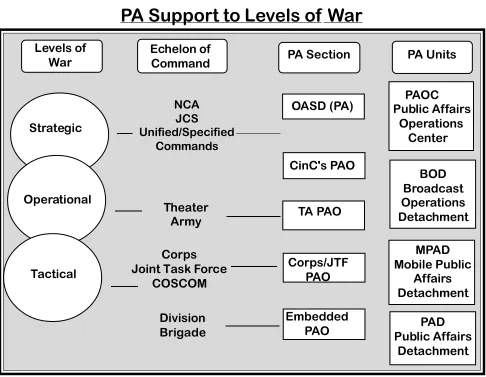
and the levels of war
At all levels of war, public affairs operations are critical to the ability of the Army to accomplish the mission. This is especially true because the global in-formation environment has compressed the strategic, operational and tactical levels. By bridging the gap between the soldier on the ground and the American public, elements of the global information environment may influence the direction, range, duration and con-duct of operations. Live coverage of tactical events influence soldier morale, unit cohesion, public opin-ion, affect strategic goals, impact operational objec-tives and have a bearing on tactical execution.
Public Affairs at the strategic level
At the strategic level, Public Affairs helps to es-tablish the foundation and framework for conducting Army operations in support of national security
objec-tives. Strategic public affairs operations inform inter-nal and exterinter-nal audiences about Army organization, training, and capability. They help demonstrate the Army’s readiness to react promptly, decisively and appropriately, and are planned to clarify the linkage between national strategic goals and the Army mis-sion. They are conducted to communicate Army goals in support of the mission, identify the desired end state and describe the conditions that constitute success. Ef-fective strategic public affairs operations engender con-fidence in the force, establish credibility for the op-eration, and enhance the Army’s ability to achieve decisive victory (Figure 3-1).
Public Affairs at the
operational level
At the operational level, public