warwick.ac.uk/lib-publications
Original citation:
Lindsay, Geoff and Totsika, Vasiliki. (2017) The effectiveness of universal parenting
programmes : the CANparent trial. BMC Psychology , 5 . 35.
Permanent WRAP URL:
http://wrap.warwick.ac.uk/93587
Copyright and reuse:
The Warwick Research Archive Portal (WRAP) makes this work of researchers of the
University of Warwick available open access under the following conditions.
This article is made available under the Creative Commons Attribution 4.0 International
license (CC BY 4.0) and may be reused according to the conditions of the license. For more
details see:
http://creativecommons.org/licenses/by/4.0/
A note on versions:
The version presented in WRAP is the published version, or, version of record, and may be
cited as it appears here.
R E S E A R C H A R T I C L E
Open Access
The effectiveness of universal parenting
programmes: the CANparent trial
Geoff Lindsay
1*and Vasiliki Totsika
2Abstract
Background:There is substantial evidence for the efficacy and effectiveness of targeted parenting programmes but much less evidence regarding universal parenting programmes. The aim of the present study was to evaluate the effectiveness of the CANparent Trial of 12 universal parenting programmes, which were made available to parents of all children aged 0–6 years in three local authorities in England. To the best of our knowledge, this is the first study of universal parenting programmes on this scale.
Methods:Parents accessed a voucher, value £100, to attend an accredited programme of parenting classes. Parents completed measures of their mental well-being, parenting efficacy, parenting satisfaction, and parenting stress, at pre- and post-course. Comparative data were derived from a sample of non-participant parents in 16 local authorities not providing CANparent programmes. A quasi-experimental design was adopted following estimation of propensity scores to balance the two groups on socio-demographic variables.
Results:Following their programme, changes in parenting stress were small and nonsignificant (Cohen’sdfrequency 0. 07; intensity, 0.17). Participating parents showed significantly greater improvements than the comparison group for parenting efficacy (0.89) but not parenting satisfaction (−0.01). Mental well-being improved from 0.29SDbelow the national norm to the national norm after the course. Parents were overwhelmingly positive about their course (88–94%) but this was lower for improvement in their relationship with their child (74%) and being a better parent (76%).
Conclusions:The CANparent Trial demonstrated that universal parenting programmes can be effective in improving parents’sense of parenting efficacy and mental well-being when delivered to the full range of parents in community settings. However, there was no evidence of a reduction in levels of parenting stress; nor was there a significant improvement in satisfaction with being a parent. This is the first study of its kind in the UK; although the results point to a population benefit, more research is needed to determine whether benefits can be maintained in the longer term and whether they will translate into better parenting practices.
Background
A significant challenge to education and public health systems in many countries is the high prevalence of chil-dren with behavioural, emotional and social difficulties, with estimates of 10–20% being reported [1–4]. There is now substantial evidence that positive mental health and social development in children is grounded in the quality of parent-child interactions [5, 6] and positive, warm, nurturing environments [7]. Furthermore, positive par-enting is associated with reducing the negative impact of social disadvantage [8–12]. In addition to the positive
impact on the life chances of individuals, reduction in later negative outcomes will substantially reduce the fi-nancial cost to society [13].
Evidence for the effectiveness of parenting programmes to improve parenting skills and reduce child behavioural difficulties is now well established [6, 14–18]. These pro-grammes are typically designed to be targeted at parents with children exhibiting or at risk of developing behav-ioural, emotional and social difficulties. However, a limita-tion of this approach is that the programmes can be made available only to a relatively small number of parents who may benefit [19, 20] and also that both recruitment and retention of parents to programmes is often difficult [20]. Consequently, interest has grown in the development of universalprogrammes in addition to
* Correspondence:[email protected]
1Centre for Educational Development, Appraisal and Research (CEDAR),
University of Warwick, Coventry CV4 7AL, UK
Full list of author information is available at the end of the article
targetedprogrammes. The latter have been developed for parents of indicated children that have been referred to clinics orselectedchildren (high risk children in the com-munity who have not been referred to a clinic). Universal parenting programmes are a public health intervention that could benefit both those in need of parenting support and advice (i.e., those at risk of adverse parenting), but also other families in general, essentially supporting a generation of parents with the expectation that im-provements in child well-being will be measurable at the population-level.
Provision of parenting programmes has been a policy feature of the UK government’s Department for Education in England. The government funded local authorities to provide targeted evidence based parenting programmes to parents of children exhibiting or at risk of developing be-havioural, emotional and social difficulties through its Par-enting Early Intervention Programme (2006–11). Lindsay et al. [21, 22] reported the success of the Parenting Early Intervention Pathfinder (2006–08) using three evidence based parenting programmes in 18 local authorities. On the basis of this evidence, the Parenting Early Intervention Programme was extended across all higher tier local authorities in England (2008–11). Our evaluation of this national roll-out demonstrated that this large scale imple-mentation of targeted evidence based programmes had also been effective [23, 24].
The CANparent trial
Following the UK general election in 2010, the new Conservative-Liberal Democrat coalition government im-plemented a change of policy, shifting central government resources away from targeted to universal parenting sup-port. Drivers of this policy change included the desire to provide high quality support to all parents, in order to de-velop their parenting skills, and a concern that targeting support was potentially stigmatising. The aim, therefore, was to make available high quality universal parenting support to all parents of children in their early years, which would enable all parents to access one of a range of quality-assessed parenting programmes.
The Department for Education implemented the two year CANparent Trial in three English local authorities during 2012–14. Although this was not a randomized controlled trial, as described below (Design), we use the term‘Trial’, where appropriate, as‘The CANparent Trial’ was the formal designation of the initiative by the Department for Education; otherwise we refer to the‘study’. Unlike the Parenting Early Intervention Programme, local authorities were not funded to set up and implement par-enting programmes. The Department for Education’s aim for the CANparent Trial was to stimulate the supply of parenting programmes suitable for universal use by parents of children 0–6 years, at a cost that would be reasonable to
expect at least some parents to pay in a nationwide market of universal parenting support. The Department for Educa-tion considered that the supply of good quality evidence based parenting support would potentially be improved by a market driven approach; and that the delivery of such programmes would be normalised by increased supply, as has been the case with antenatal classes in the UK [25], so reducing stigma associated with taking a par-enting programme. As a result, it was expected that increased participation by a high proportion of all parents in universal programmes would improve parenting across the country.
It was postulated that development of a market would limit the costs of the study and eventually transfer the main costs from government spending to individuals pur-chasing their own access to parenting programmes [26]. The overall aim of the study was to examine whether the provision of free parenting programmes in the three CANparent Trial areas would provide sufficient incentive to providers to start offering additional universal pro-grammes nationally, including for parents of children be-yond 6 years of age, and whether a universal approach could normalise and de-stigmatise parenting programmes. The Department for Education’s approach was to develop the market in two ways. First, the supply side would be stimulated to attract a number of providers offering different variants of parenting programmes in terms of, for example, content, length and mode of delivery. Quality assurance was achieved by an accreditation process conducted by the Department for Education. The demand side was to be stimulated during the study by provision of a voucher, with a face value of £100, for every eligible parent.
The present paper focuses on the effectiveness of the parenting programmes implemented during the CANpar-ent Trial. This study aims to examine the effectiveness of the parenting programmes with respect to reducing par-enting stress and increasing parents’sense of parenting ef-ficacy, satisfaction with being a parent, and their own mental well-being.
Methods Design
to submit for accreditation to participate in this two year study (April 2012 to March 2014). Fourteen providers were selected by the Department for Education for offer-ing universal parentoffer-ing programmes appropriate to all parents of children of ages 0–6 years, which met speci-fied quality standards [27].
All parents of children in the relevant age group (both mothers and fathers, male and female carers) in the three areas were eligible to receive a voucher of value £100 to access one of the approved parenting pro-grammes at no cost. Voucher distribution and local sup-port to providers was managed by a delivery consortium funded by the Department for Education. Vouchers were widely available in the three areas through the early years workforce (e.g. children’s centres for pre-five year olds), other community organisations and branches of a national pharmacy; from November 2012 vouchers could also be downloaded from the CANparent website.
The study was designed to produce data that were re-ported to the Department for Education at points over the two year period. This enabled the Department for Education to learn from the accumulative evidence and make modifications to the Trial as appropriate. Several changes were made, primarily to improve take up by parents in the three implementation areas. For example, in addition to parents resident in the areas, eligibility was given in Year 2 to parents who worked in one of the Trial areas.
To address the question of effectiveness, which is the focus of the present paper, relevant data from the evalu-ation design are reported, including outcomes from CANparent participants, and comparison data drawn from the comparison local authorities. Initially, the trial design of the CANparent Trial aimed to include evalu-ation data from 10% of CANparent programme partici-pants, but that was later changed to every participating parent to account for the smaller than anticipated CAN-parent registration rate.
Parenting programmes
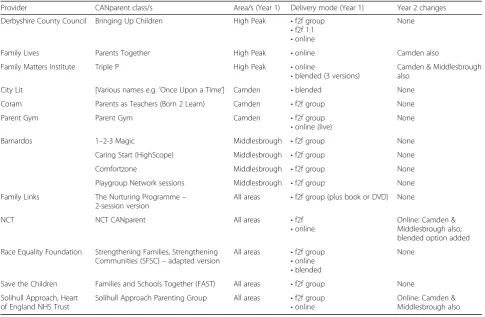
At the start of the CANparent Trial, 14 providers offered programmes of parenting classes to eligible parents. Four main delivery models were offered: face-to-face groups; face-to-face one-to-one; blended face-to-face with online and/or self-directed learning (book or CD/ DVD); and pure online (Table 1). In order to be eligible for the Trial, providers were required to demonstrate that their programme would meet the Department for Education’s quality standards. These were defined as evi-dence based principles derived from research into what works to improve parenting skills: specified programme content to include communication and listening, man-aging relationships (parent/child and parent/parent), play/ explore/learning, parenting styles/behaviour, rules and
routines, and creating a supportive and nurturing home environment; as well as delivery approach, workforce training and supervision, and evaluation of impact [27: Appendix 4]. Examples of the content of both face-to-face and online programmes included: managing rou-tines and boundaries, supporting each other’s parenting, managing and promoting positive behaviour in the family, understanding the importance of play and exploration, se-cure relationships, and who’s in charge: What to do when your child says no [27, Appendix 3]. The face-to-face group classes included discussion and role play, with one programme ending with a group meal; these programmes also included support materials and tasks to be carried out between sessions. Programmes differed in length from one of 2 sessions over 2 weeks to others comprising 8, 9 or 10 weekly sessions. Two providers dropped out of the Trial in Year 2 leaving 12 providers (Table 1).
Participants
Participating parents
Six hundred and seventy five parents participated in the present evaluation study. These are the parents who returned outcome evaluation questionnaires at the start of the study (pdata). About 30% of participants re-ceived a programme of parenting classes in Middles-brough, 46% in Camden, and 24% in High Peak. The majority (93%) attended a face-to-face group. Approxi-mately half of all parents (53%) were aged between 26 and 35 years, while 26% were aged between 36 and 45 years-old. Fathers comprised just 9% of the group. Seventy four per cent identified as White British, while the largest ethnic minority group were Asians (11%). In terms of education, 18% reported having no educational qualifications, whereas 43% had Level 4 and above, which is equivalent to a university bachelor degree level or higher. Single parents comprised 25% of participants, and 18% of the overall sample lived in the most deprived neighbourhoods of their area [28]. Most parents (41%) had just one child aged 0–16 years, while 36% had two children aged 0–16 years in the household.
nonsignificant. However, parents with missing post-data reported higher parenting self-efficacy at pre-course compared to those without missing data (t = 2.39, p = .017). With respect to demographic characteristics, few differences were present, suggesting non-systematic differences between non-responders and responders: no differences in terms of parental age, gender, area deprivation, marital status, single parent status, number of children in the house, but more people with no/low edu-cational qualifications (p = .040) and non-white ethnic background (p= .045) had missing data at post.
Comparison sample
In the context of the study, 16 local authorities were se-lected among all English local authorities where CAN-parent was not operating. These 16 local authorities were nationally representative in terms of key demo-graphics and were selected as comparison areas to the CANparent areas. Using a two-stage random sampling procedure eligible parents (based on Her Majesty’s Revenue & Customs Child Benefit records, which at the time of the study was a non-means tested benefit with a near universal coverage) were identified to create a com-parison group to the CANparent Trial. A total of 1535 comparison parents were identified. However, in terms
of the effectiveness arm of the Trial (the present study), not all 1535 comparison area parents served as the com-parison group, but a randomly selected subset was iden-tified to provide national norms on two measures: the BAP and the PDH. The third outcome measure of the evaluation, WEMWBS, was not completed by compari-son parents because national norms were available on this measure [30]. Therefore, among the 1535 compari-son parents, a randomly selected sub-sample of 521 par-ents completed the PDH and another 547 parpar-ents completed the BAP. These comparison groups provided norms on the PDH and BAP, against which CANparent scores on these measures were benchmarked.
[image:5.595.56.542.98.415.2]A further function of the comparison sample was to serve as a comparison group to gauge level of change in the outcomes of the study (i.e., provide a controlled evaluation). For this reason, the comparison group was invited to a repeat administration of the BAP and PDH 8 weeks later, a period that corresponds to the average duration of the parenting programmes. Retention rate for the comparison group was between 34% and 40% (N= 209 and 186, for the PDH and BAP, respectively). To enhance the controlled evaluation, we adopted a quasi-experimental design by balancing the two groups across a range of socio-demographic indicators using a
Table 1The CANparent programmes in the three voucher areas
Provider CANparent class/s Area/s (Year 1) Delivery mode (Year 1) Year 2 changes Derbyshire County Council Bringing Up Children High Peak •f2f group
•f2f 1:1
•online
None
Family Lives Parents Together High Peak •online Camden also Family Matters Institute Triple P High Peak •online
•blended (3 versions)
Camden & Middlesbrough also
City Lit [Various names e.g.‘Once Upon a Time’] Camden •blended None Coram Parents as Teachers (Born 2 Learn) Camden •f2f group None
Parent Gym Parent Gym Camden •f2f group
•online (live)
None
Barnardos 1–2-3 Magic Middlesbrough •f2f group None Caring Start (HighScope) Middlesbrough •f2f group None Comfortzone Middlesbrough •f2f group None Playgroup Network sessions Middlesbrough •f2f group None Family Links The Nurturing Programme–
2-session version
All areas •f2f group (plus book or DVD) None
NCT NCT CANparent All areas •f2f
•online
Online: Camden & Middlesbrough also; blended option added Race Equality Foundation Strengthening Families, Strengthening
Communities (SFSC)–adapted version
All areas •f2f group
•online
•blended
None
Save the Children Families and Schools Together (FAST) All areas •f2f group None Solihull Approach, Heart
of England NHS Trust
Solihull Approach Parenting Group All areas •f2f group
•online
Online: Camden & Middlesbrough also
propensity score method. Propensity scores are useful for strengthening quasi-experimental designs by balan-cing the distribution of any pre-intervention differences in the absence of randomisation [32].
Outcome measures
Three outcome measures were selected to assess import-ant factors that the parenting programmes addressed. Two were selected also because of their successful use in our earlier study of targeted parenting programmes [21–24]. A third measure, of parenting stress, was se-lected as appropriate for parents of children 0–6 years. In addition, a fourth measure examined parents’ views of the parenting programme they had attended.
Being a parent
The Being a Parent scale (BAP) was developed by Johnston and Mash (1989) [31] and comprises 17 items, which are worded positively or negatively, rated on 6-point scales. Johnston & Mash proposed a two factor solution translat-ing into two subscales but Gilmore and Cuskelly (2008) [33] have produced evidence for a three factor solution: Parenting satisfaction (7 items) is an affective dimension reflecting parental motivation, anxiety and frustration with being a parent, for example:‘A difficult problem in being a parent is in not knowing whether you’re doing a good job or a bad one’. Parenting efficacy (7 items) is an instrumental dimension reflecting the parent’s sense of perceived compe-tence, capability and problem-solving as a parent, for ex-ample:‘Being a parent is manageable and any problems are easily solved’. The third subscale, Parenting interest (3 items) assesses interest in being a parent, for example,‘ Be-ing a good mother/father is reward in itself’. The three scale scores can be aggregated to produce a Total score. Internal consistency in the present study was good, with Cronbach’s alpha coefficients of .80 for Parenting satisfaction, .79 for Parenting efficacy, and .82 for Total score. Comparison group alphas were .82, .74, and .79 for satisfaction, efficacy, and Total score respectively. The internal consistency for Parenting interest was lower at alpha .53 for the CANpar-ent group and .59 for comparison group. Though we in-cluded it in the analysis, interpretation of findings of parenting interest should be cautious.
Parenting stress
The Parenting Daily Hassles (PDH) [29] is a measure of minor stresses generally experienced by parents in rou-tine interactions with their children and in rourou-tine tasks involving children. The PDH comprises 20 items, each of which is rated on a 0–5 scale along two dimensions: frequency of occurrence and intensity (degree of ‘hassle’) as perceived by the parent. Example items include ‘the kids resist or struggle over bedtime with you’,‘the kids won’t listen - won’t do what they are asked without
being nagged’. Internal consistency was very good: Cronbach’s alpha .88 and .92 for intensity in the CANparent and comparison groups respectively; alpha .88 and .87 for frequency in the CANparent and com-parison groups respectively.
Parent mental well-being
The Warwick-Edinburgh Mental Well-being Scale (WEMWBS) [30] comprises 14 items rated on a 5-point scale. High scores represent greater mental well-being. It measures positive mental health, including subjective ex-perience of happiness and life satisfaction, and perspectives on psychological functioning and personal relationships. Examples include,‘I’ve been feeling good about myself,’I’ve been feeling useful,’and ‘I’ve been dealing with problems well’. It has moderate to high levels of construct validity with nine other comparable scales: median .73, range .42–.77 [30]. It was used successfully in our earlier studies of parenting programmes [21–24]. Internal consistency in the present study was high, alpha .91. The national mean is 51 (inter-quartile range 45–56) [30].
How was your class?
A range of perspectives on the programmes taken by the parents was assessed using the How was your class? questionnaire, developed for the present study. The scale comprises eight items rated on a 5-point Likert scale where higher scores represented more positive views. Examples include, ‘I feel more confident as a parent/ carer,’ ‘I have learned new parenting skills’and‘Overall I was satisfied with my CANparent class.’[27].
Procedure
Parents accessed a voucher from an available source and presented this to the programme provider of their choice. Numbers of providers varied between the areas (Table 1). Each voucher had a nominal value of £100 and could be used to access any of the programmes available in their area. Ten providers submitted data on 675 parents who participated in this study.
Analysis
To explore the psychological profile of parents who elected to sign up to a universal intervention, we com-pared CANparent participants’scores before the parent-ing programmes with national norms. Comparisons are reported as standardised mean differences (d; Table 2) estimated using the mean group difference (prior to the start of CANparent groups) standardised by the pooled standard deviation.
To address our main research question of CANparent effectiveness, we compared CANparent participants to comparison group parents. A quasi-experimental design was adopted following estimation of a propensity score to balance the two groups on parental age, parent gen-der, ethnicity, educational qualifications, single parent status, total number of children in the household, Index of Multiple Deprivation, and the Income Deprivation Affecting Children Index [28]. A weight was then cre-ated using the reciprocal of the propensity score. This was effective in balancing the two groups in terms of the distribution of most covariates; balance was not achieved for parental age (the comparison groups for BAP and PDH were significantly younger) and single parent status (the comparison group for PDH included 2% additional single parent families). A propensity score weighted mul-tiple regression model was fitted to examine whether group differences were significant for each outcome, controlling for the equivalent baseline measure. A stan-dardised mean difference (d) was estimated using the re-gression coefficient for group [34]. Models were fitted in MPlus 7.4 [35], which allows for a maximum likelihood estimator with robust standard errors to make full use of available data. Maximum likelihood estimation as an ap-proach to dealing with missing data is a good alternative to multiple imputation, and in fact better than maximum imputation when levels of missingness are high [36].
Finally, to explore potential mediators of change within the CANparent group, we plotted change over time (standardised mean difference of the CANparent
baseline (pre) to post scores only) against programme characteristics.
Results
Parenting and mental well-being of parents who opted to take up a universal offer
CANparent was a universal intervention that was offered to any parent who had a child in the 0–6 age range in the Trial areas. As such, parents could choose whether to take it up or not. To understand the psychological profile of par-ents who opted totake upthe intervention, we compared their parenting profile, parental stress and mental well-being (before parenting programme) to national norms. In the case of BAP and PDH, the norms were derived from the randomly selected comparison group of 547 and 521 parents, respectively. WEMWBS norms are available from a standardisation sample of 1749 UK adults [30].
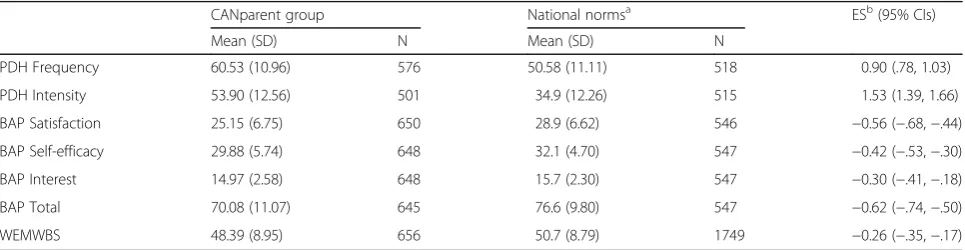
Table 2 includes the effect sizes (d) and 95% confi-dence intervals (CIs) that compared the pre-intervention psychological profile of CANparent participants to na-tional norms. Parenting stress, as measured by the PDH, was substantially greater among the CANparent group than norms on both frequency (d = 0.90, 95% CI: 0.78, 1.03) and intensity (d= 1.53, 95% CI: 1.39, 1.66) of daily hassles. CANparent participants had a lower level of sat-isfaction as a parent compared to available norms with a medium effect size (d=−0.56, 95% CI:−.68,−.44). Their sense of efficacy as a parent was also lower (d= −0.42, 95% CI: −.53, −.30), as was their interest in parenting (d =−0.30, 95% CI: -0.41,−0.18) and the BAP total score (d=−0.62, 95% CI: −.74, −.50). CANparent participants had lower initial levels of mental well-being (WEMWBS d=−0.26, 95% CI:−.35,−.17) compared to UK norms.
[image:7.595.57.540.581.706.2]These results suggest that parents who opted to take up the universally-offered parenting programmes were experiencing substantially higher levels of parenting stress, had less confidence in their ability to parent, had less satisfaction with being a parent, and a slightly lower level of mental well-being and interest in being a parent.
Table 2Comparison of parenting, stress and mental well-being levelsbeforethe start of the CANparent programmes
CANparent group National normsa ESb(95% CIs)
Mean (SD) N Mean (SD) N
PDH Frequency 60.53 (10.96) 576 50.58 (11.11) 518 0.90 (.78, 1.03) PDH Intensity 53.90 (12.56) 501 34.9 (12.26) 515 1.53 (1.39, 1.66) BAP Satisfaction 25.15 (6.75) 650 28.9 (6.62) 546 −0.56 (−.68,−.44) BAP Self-efficacy 29.88 (5.74) 648 32.1 (4.70) 547 −0.42 (−.53,−.30) BAP Interest 14.97 (2.58) 648 15.7 (2.30) 547 −0.30 (−.41,−.18) BAP Total 70.08 (11.07) 645 76.6 (9.80) 547 −0.62 (−.74,−.50) WEMWBS 48.39 (8.95) 656 50.7 (8.79) 1749 −0.26 (−.35,−.17)
a
With the exception of WEMWBS, comparison data came from the comparison group: a randomly selected population sample. WEMWBS comparison data are from the scale’s standardisation sample [30]
b
Effectiveness of CANparent
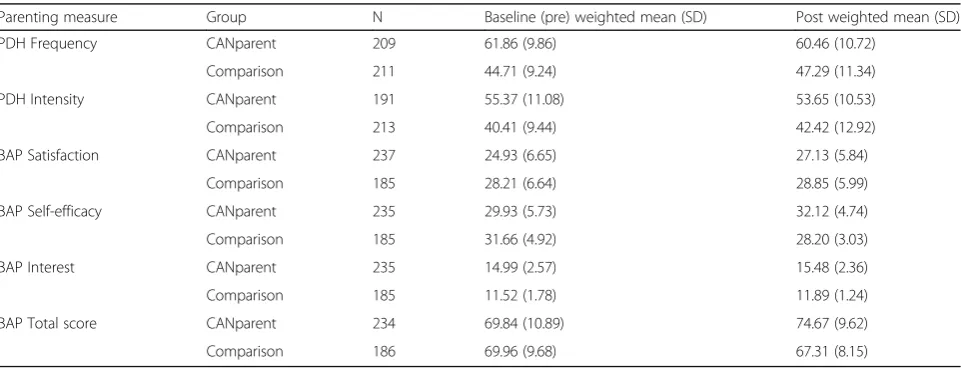
We compared parental stress and parenting between CANparent and comparison parents, after propensity weighting. Table 3 presents the weighted means at each time point. Table 4 presents the results of the multiple regression models fitted to examine the effect of group (CANparent vs comparison) on the propensity weighted data, whilst also accounting for the effect of baseline scores at pre-course. A standardised mean difference was also estimated using the standardised group coefficient from the weighted regression model [34].
The change in the weighted scores of parenting stress (PDH frequency and PDH intensity) was not significantly associated with group (standardised betas: .034 and .083, for frequency and intensity respectively), and this was also demonstrated by the very small and non-significant effect sizes: PDH frequency d = 0.07 (95% CI: -0.12, to 0.26); PDH intensityd= 0.17 (95% CI: -0.03, 0.36).
The effectiveness of CANparent was demonstrated through significant gains in parental efficacy, parenting interest and total parenting scores. In particular, the weighted effect size for parenting efficacy demonstrated a large effect in favour of CANparent,d= 0.89 (95% CI: 0.68, 1.09); small to moderate gains in terms of parent-ing interest,d= 0.45 (95% CI: 0.26, 0.65), and moderate gains for total parenting scores,d = 0.61 (95% CI: 0.41, 0.81). Parenting satisfaction was the only BAP measure not associated with a significant gain for CANparent, d=−0.01 (95% CI: -0.20, 0.19).
The WEMWBS was not administered to the compari-son group as national norms were available [30]. We compared CANparent WEMWBS scores at post-course (Mean = 51.0, SD: 8.28) with the national norms (Table 2, last row) and this resulted in a near-zero standardised mean difference (effect sized= 0.03, 95% CI: -0.08, 0.14). Taken together with the pre-course WEMWBS effect
size reported in Table 2, it can be concluded that on average mental well-being of CANparent participants improved from being about one third of a standard deviation below the national norm before they attended the programme to about the national norm after their courses.
Exploring potential mediators of change
Programme characteristics
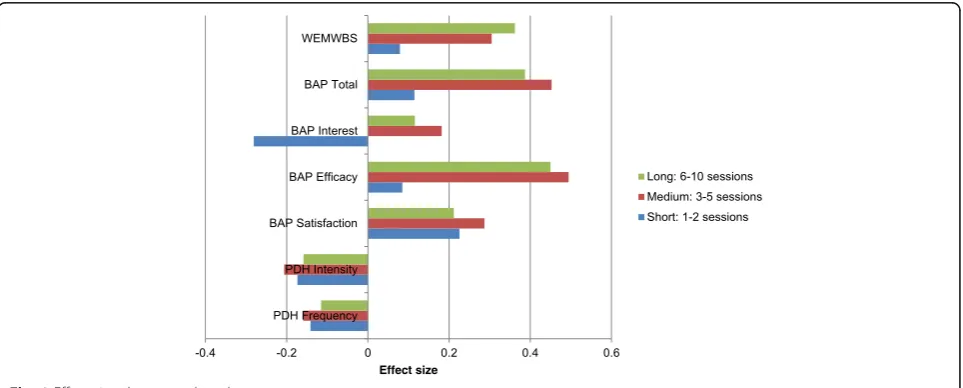
Type of programme (face to face or blended course) was not associated with any notable differences. Programme length was categorised as short duration (1–2 sessions, n= 86 parents), medium duration (3–5 sessions,n= 121) and long duration (6–10 sessions, n = 258). Short pro-grammes were associated with very little change, on any outcome, other than parenting interest where interest decreased after the programme (d=−0.37; 95% CI: -0.62,
−0.15; see Fig. 1). Effect sizes for medium duration and long programmes were similar in magnitude. In terms of parental stress, changes were very small regardless of programme length. Some differences were seen in parent-ing efficacy and Total BAP scores and mental well-beparent-ing, where medium and longer programmes were associated with small but significant improvements (between a third and half of a standard deviation; see Fig. 1) whereas short programmes were associated with no change (BAP effi-cacy:d= 0.08, 95% CI: -0.12, 0.30 and BAP total:d= 0.11, 95% CI: -0.08, 0.31).
Parents’satisfaction with the programme
[image:8.595.58.539.540.724.2]Parents gave consistently positive ratings of their programme across the eight items of the How was your class? scale. The percentage of parents giving negative rat-ings ranged from just 4% - 5% per item. In comparison, 93% were satisfied or very satisfied with their programme and would recommend a CANparent programme to other
Table 3Means and standard deviations in the two groups following propensity score weighting (maximum likelihood estimation)
Parenting measure Group N Baseline (pre) weighted mean (SD) Post weighted mean (SD)
PDH Frequency CANparent 209 61.86 (9.86) 60.46 (10.72)
Comparison 211 44.71 (9.24) 47.29 (11.34)
PDH Intensity CANparent 191 55.37 (11.08) 53.65 (10.53)
Comparison 213 40.41 (9.44) 42.42 (12.92)
BAP Satisfaction CANparent 237 24.93 (6.65) 27.13 (5.84)
Comparison 185 28.21 (6.64) 28.85 (5.99)
BAP Self-efficacy CANparent 235 29.93 (5.73) 32.12 (4.74)
Comparison 185 31.66 (4.92) 28.20 (3.03)
BAP Interest CANparent 235 14.99 (2.57) 15.48 (2.36)
Comparison 185 11.52 (1.78) 11.89 (1.24)
BAP Total score CANparent 234 69.84 (10.89) 74.67 (9.62)
Comparison 186 69.96 (9.68) 67.31 (8.15)
parents; 89% said that the programme had met their ex-pectations; 90% had learned new parenting skills; and 88% would like to attend further classes in the future. Most parents felt more confident as a parent (84%), thought their relationship with their child had improved (74%), and that they were a better parent (76%).
Discussion
In this paper we examined the effectiveness of the CAN-parent Trial, a universal offer of CAN-parenting programmes implemented in three local authorities in England.
Universality
Recruitment comprised parents in three local authorities who selected to take up the offer of a parenting programme, subsidised by the UK Government. Unlike the earlier roll-out of targeted parenting programmes in England (Parenting Early Intervention Programme), where parents were referred or self-referred for the high levels of (or risk for) behaviour problems in their children, univer-sal recruitment in CANparent was aimed at all parents with a child in the specified age range (0–6 years). This in-volved ensuring publicity, awareness and availability of the
offer in the areas through several means including the early years’ workforce, a national pharmacy and website and then parents deciding on their own whether to sign up or not [27].
The demographic profile of CANparent participants suggested a predominantly White British group where about half of the parents were young (<35 years) and well-educated (degree level and above), and about a quarter were single parents. When we compared the psychological profile of parents who undertook the CANparent universal intervention with national norms, participants in CANparent were experiencing substan-tially higher levels of parenting stress, replicating a study of universal parenting programmes in Sweden [37] and also were feeling moderately less efficacious and satisfied as parents compared to national norms. They also expe-rienced lower mental well-being, by about a third of a standard deviation.
Effectiveness
[image:9.595.57.541.110.207.2]Accounting for any socio-demographic differences in the intervention and comparison groups through a propen-sity score weight methodology, findings suggested that
Table 4Propensity weighted multiple regression model results controlling for baseline scores (maximum likelihood estimation with robust standard errors)
Parenting measure R2(
pvalue) Group beta (SE) Effect size (95% CIs) PDH Frequency 53.3% (<.001) .034 (.041) .07 (−.12, .26) PDH Intensity 43.0% (<.001) .083 (.050) .17 (−.03, .36) BAP Satisfaction 43.3% (<.001) −.003 (.037) −.01 (−.20, .19) BAP Self-efficacy 42.7% (<.001) .402 (.037) .89 (.68, 1.09)
BAP Interest 55.1% (<.001) .218 (.045) .45 (.26, .65)
BAP Total score 49.0% (<.001) .289 (.034) .61 (.41, .81)
Note:PDH = Parenting Daily Hassles; BAP = Being a Parent
[image:9.595.58.540.526.720.2]following parenting programmes there was a substantial improvement in participants’perception of their efficacy as a parent with a large effect size compared with the comparison group. There was a moderate improvement in parenting interest but not in parenting satisfaction. Interestingly, there was no significant group difference in parenting stress following the intervention.
Overall, these results indicate variable gains for par-ents receiving universal parenting programmes with significant and substantial improvement in parenting efficacy but no change in parenting stress. Previous evi-dence on the effectiveness of universal parenting pro-grammes has also been varied. Prinz et al. (2009) [38] reported improvements in child-maltreatment popula-tion outcomes of over one standard deviapopula-tion (Cohen’sd range 1.09 to 1.22), effects that remained following a fur-ther analysis of their data [39]. Eisner et al. (2012) [40], by contrast, report no consistent effects on a range of 16 relevant dimensions of parenting practices and child be-haviour (d range 0.00 to 0.24); only two measures had effect sizes reaching 0.2, the lowest level for a ‘small’ effect size. Other studies have also found no effect [41, 42]. Eisner et al. [40] argue that the evidence for positive effects is greatest in studies of universal or pre-vention parenting programmes for indicated treatment in clinical settings and that small sample size is a key factor as effect sizes decrease in studies with large samples.
With regard to CANparent, the pattern of results sug-gests that the initiative’s success was in improving parents’ sense of how to be effective as a parent and to gain a sense of improved ability to cope, increasing mental well-being. However, CANparent had limited or no effect on chan-ging parents’ perspectives of their levels of stress associ-ated with, or their satisfaction in, their role as a parent. This is supported by parents’ratings of the programme, as they were overwhelmingly positive about the experience, but they were less likely to report a better relationship with their child or that they were a better parent.
In part this is likely to depend on the ‘dosage’, which we were able to assess given the different lengths of pro-grammes in CANparent. We found that short courses were associated with very limited changes on the parent-ing satisfaction and well-beparent-ing measures, and there was even a negative effect of short courses on parents’ inter-est in parenting. Longer courses, by contrast, were more effective in improving parents’ self-efficacy as a parent and their mental well-being but there was no difference between programmes of medium length (3–5 sessions) compared with longer courses (6–10 sessions).
Targeted parenting programmes are typically longer than those in CANparent [43] but are intended to im-prove parenting skills which are substantially less than optimal. Whereas some universal programmes also ad-dress this subgroup [44], CANparent was designed to
address the full demographic range of parents, who gen-erally have a higher level of positive parenting skills. Nevertheless, the finding of a plateau effect for course length is potentially important with implications for cost effectiveness. Interestingly, we found no differences for fully online and blended courses (i.e., those that offered re-mote and face to face contact). Comparative studies of specific parenting programmes are rare but Lindsay et al. (2011) found no relationship between targeted pro-grammes and course length for Triple P, Incredible Years, and Strengthening Families Strengthening Communities [22], and for these programmes plus the Strengthening Families 10–14 programme in a second study [24]. Subject to further replication, this finding in the present study has implications for cost effectiveness considerations in future larger roll outs of universal interventions.
These findings indicate that a universal level interven-tion such as CANparent can have measurable benefits on parents’ self-efficacy and mental well-being, though parenting stress does not appear to reduce substantially. While some programme characteristics may mediate the effectiveness, it is unclear at this stage whether gains can be maintained over a longer period or translate into ac-tual improvements in parenting practice. Future research needs to include follow up evaluation, along with mea-sures of parenting practices.
Limitations
examine the development of a market of providers. A second limitation in the set-up of the CANparent Trial by the Department for Education, that registration and parent demographic information be recorded by a separ-ate organisation, resulted in a reduction in the overall number of participants for whom available programme registration (including completion) and demographic characteristics could be matched to their evaluation data. Third, although the PDH includes items that relate dir-ectly to child behaviour, it focuses on parents and is not primarily a means to measure child behaviour. Measures of parental reported child behaviour are useful in asses-sing parenting programme effectiveness as, although the main target of the programme itself is parent change, the ultimate intention is also to address child behaviour.
Conclusions
The CANparent Trial was designed as a universal interven-tion on the basis that all parents will benefit from support to develop their parenting skills and that, as a consequence, this public health approach would reduce the prevalence of child behavioural difficulties as they develop. A large posi-tive effect of the CANparent Trial was found with respect to parents’sense of efficacy with being a parent, and a small effect on their parenting interest and their mental well-being. There was no evidence of a reduction in levels of parenting stress or their satisfaction with being a parent as a result of the programmes.
This was a unique study in the UK of a universal ap-proach to the provision of parenting programmes. Our re-sults indicate that universal parenting programmes may have a positive effect on parents’increase in their sense of their efficacy as a parent and on their mental well-being when delivered to the full range of parents in a commu-nity. In the absence of data on actual parenting practices and child behaviour problems, we cannot yet determine whether universal interventions have measurable benefits for overall levels of behaviour problems in the population.
Abbreviations
BAP:Being a Parent; PDH: Parenting Daily Hassles; WEMWBS: Warwick Edinburgh Mental Well-being Scale
Acknowledgements
We acknowledge the assistance provided by the many parents who participated in the study and staff of the parenting programme providers who provided or organised the collection of data. We also acknowledge our colleagues on the overall research study of the CANparent Trial, Mairi Ann Cullen and Stephen Cullen; research partners TNS-BMRB (in particular Richard Brind and Emily Pickering) and Bryson Purdon Social Research (Caroline Bryson and Susan Purdon) who carried out the population surveys; and Ecorys (Russell Peacock) who managed the collection of parents’registration data. We also acknowledge the UK Government’s Department for Education, which provided funding for the study. The Department gave approval for the design of the study but did not engage in or influence the analysis or interpretation of the data, the writing or decision to submit the manuscript.
Funding
The research on which this paper is based was funded by the UK Government’s Department for Education, Ref: EOR/SBU/2011/073.
Availability of data and materials
The datasets used and/or analysed during the current study are available from the corresponding author on reasonable request.
Authors’contributions
GL led the research and drafted the overall manuscript. VT undertook the data analysis, drafted the Results section and contributed to the drafting of the overall manuscript. Both authors read and approved the final manuscript.
Authors’information
GL is Director of the Centre for Educational Development, Appraisal and Research (CEDAR) at the University of Warwick, UK; VT is Associate Professor in CEDAR and the Centre for Education Studies.
Ethical approval and consent to participate
Ethical approval was given by the University of Warwick Humanities and Social Sciences Research Ethics Committee (Ref: Eth App 59/11–12). Parents were provided with information about the study including that all data would be anonymised and would be used in an anonymised form in publications, and that they were free to withdraw at any time and have their data deleted. Parents gave their written informed consent for their participation in the study and the use of their anonymised data for publication when they registered for their CANparent programme.
Consent for publication
Parents gave their written informed consent for the use of their anonymised data for publication when they gave informed consent for participation–see above.
Competing interests
The authors declare that they have no competing interests.
Publisher’s Note
Springer Nature remains neutral with regard to jurisdictional claims in published maps and institutional affiliations.
Author details
1Centre for Educational Development, Appraisal and Research (CEDAR),
University of Warwick, Coventry CV4 7AL, UK.2CEDAR and Centre for
Education Studies, University of Warwick, Coventry, UK.
Received: 10 August 2017 Accepted: 9 October 2017
References
1. Green H, McGinnity A, Meltzer H, Fort T, Goodman R. The mental health of children and young people in great Britain, 2004. Basingstoke: Palgrave MacMillan; 2005.
2. Piquero A, Farrington D, Fontaine N, Vincent G, Coid J, Ullrich S. Childhood risk, offending trajectories, and psychopathy at age 48 years in the Cambridge study in delinquent development. Psychol Public Policy Law. 2012;18:577–98.
3. Collishaw S. Annual research review: secular trends in child and adolescent mental health. J Child Psychol Psychiat. 2014;56(3):370–93. doi:10.1111/jcpp. 12372.
4. Child BL, disorders a m. The magnitude of the problem across the globe. J Child Psychol Psychiat. 2008;49:226–36. doi:10.1111/jcpp.12372.
5. Coren E, Barlow J, Stewart-Brown S. Systematic review of the effectiveness of parenting programmes for teenage parents. J Adol. 2002;26:79–103.
6. Sanders MR, Kirby JN, Tellegen CL, Day JJ. The triple P–positive parenting program: a systematic review and meta-analysis of a multi-level system of parenting support. Clin Psych Rev. 2014;34:337–57. doi:10.1016/j.cpr.2014.04.003. 7. Biglan A, Flay BR, Embry DD, Sander IN. The critical role of nurturing
environments for promoting human well-being. Am Psychol. 2012;67:257–72. 8. Lindsay G, Cullen S, Wellings C. Bringing families and schools together:
9. Marmot M. Fair society, healthy lives (the marmot review). 2010 http://www. instituteofhealthequity.org/resources-reports. Accessed 4 Aug 2017. 10. Kiernan KE, Mensah FK. Parenting, family resources and children’s early educational
attainment: the mediating role of parenting. Brit Ed Res J. 2011;37(2):317–36. 11. Odgers CL, Caspi A, Russell MA, Sampson RJ, Arseneault L, Moffit TE.
Supportive parenting mediates neighborhood socioeconomic disparities in children’s antisocial behavior from ages 5-12. Develop Psychopath. 2012;24: 705–21. doi:10.1017/s09545-79412000326.
12. Hinshaw SP. Intervention research, theoretical mechanisms, and causal processes related to externalizing behavior patterns. Develop Psychopath. 2003;14:789–818.
13. Bonin E-M, Stevens M, Beecham J, Byford S, Parsonage M. Costs and longer-term savings of parenting programmes for the prevention of persistent conduct disorder: a modelling study. BMC Public Health. 2011;11:803. 14. Scott S, Briskman J, O’Connor TG. Early prevention of antisocial personality:
long-term follow-up of two randomized controlled trials comparing indicated and selective approaches. Amer J Psychiat. 2014;171(6):649–57. 15. Nowak C, Heinrichs NA. Comprehensive meta-analysis of triple P-positive parenting program using hierarchical linear modelling: effectiveness and moderating variable. Clin Child Fam Psychol Rev. 2008;11:114–44. 16. Dretze J, Davenport C, Frew E, Barlow J, Stewart-Brown S, Bayliss S, Taylor
RS, Sandercock J, Hyde C. The clinical effectiveness of different parenting programmes for children with conduct problems: a systematic review of randomized control trials. Child Adol Psychiat Ment Health. 2009;3:7. doi:10.1186/1753-2000-3-7.
17. Furlong M, McGilloway S, Bywater T, Hutchings J, Smith SM, Donnelly M. Behavioural and cognitive-behavioural group-based parenting programmes for early-onset conduct problems in children aged 3-12 years. Cochrane Database Sys Rev 2012,2, CD008225. doi:10.1002/14651858. CD008225.pub2. 18. Stewart-Brown SL, Schrader-McMillan A. Parenting for mental health: what
does the evidence say we need to do? Report of Workpackage 2 of the DataPrev project. Health Prom Int. 2011;26:i10–26. doi:10.1093/heapro/dat056. 19. Spoth R, Redmond C. Research on family engagement in preventive
interventions: towards improved use of scientific findings in primary prevention practice. J Prim Prev. 2000;21:267–84.
20. Heinrichs N, Bertram H, Kuschel A, Hahlweg K. Parent recruitment and retention in a universal prevention program for child behavior and emotional problems: barriers to research and program participation. Prev Sci. 2005;6(4):275–86. doi:10.1007/s11121-005-0006-1.
21. Lindsay G, Davis H, Strand S, Band S, Cullen MA, Cullen S, Hasluck C, Evans R, Stewart-Brown S. Parenting early intervention pathfinder evaluation DCSF-RW054. London: department for. Education. 2008; http://webarchive. nationalarchives.gov.uk/20140401094711/https://www.gov.uk/government/ publications/parenting-early-intervention-pathfinder-evaluation. Accessed 13 Oct 2017.
22. Lindsay G, Strand S, Davis HA. Comparison of the effectiveness of three parenting programmes in improving parenting skills, parent mental well being and children’s behaviour when implemented on a large scale in community settings in 18 English local authorities: the parenting early intervention pathfinder (PEIP). BMC Public Health. 2011;11:962. doi:10.1186/ 1471-2458-11-962.
23. Lindsay G, Strand S, Cullen MA, Cullen S, Band S, Davis H, Conlon G, Barlow J, Evans R. Parenting early intervention programme evaluation:DFE-RR121A.
London: Department for Education. 2011; http://webarchive.nationalarchives. gov.uk/20140401094706/https://www.gov.uk/government/publications/ parenting-early-intervention-programme-evaluation. Accessed 4 Aug 2017. 24. Lindsay G, Strand S. Evaluation of a national roll-out of parenting
programmes across England: the parenting early intervention Programme (PEIP). BMC Public Health. 2013;13:972. doi:10.1186/10.1186/147-2458-13-972. 25. Healthcare Commission. Towards better births: a review of maternity
services in England. London: Healthcare Commission; 2008. 26. Cullen S, Cullen MA, Lindsay G. The CANparent trial: The delivery of
universal parenting education in England.Brit Educ Res J. 2017; Early view. doi:10.1002/berj/3282.
27. Lindsay G, Cullen MA, Cullen S, Totsika V, Bakopoulou I, Goodlad S, Brind R, Pickering E, Bryson C, Purdon S, Conlon G, Mantovani I. CANparent trial evaluation: final report. Research report DFE-RR357. London: Department for Education. 2014; https://www.gov.uk/government/publications/canparent-trial-evaluation-final-report. Accessed 13 Oct 2017.
28. Department for Communities and Local Government. English indices of deprivation. London: Department for Communities and Local Government.
https://www.gov.uk/government/statistics/english-indices-of-deprivation-2015. Accessed 13 Oct 2017.
29. Crnic KA, Greenberg MT. Minor parenting stresses with young children. Child Dev. 1990;61:1628–37.
30. Tennant R, Hiller L, Fishwick R, Platt S, Joseph S, Weich S, Parkinson J, Secker J, Stewart-Brown S. The Warwick-Edinburgh mental well-being scale (WEMWBS): development and UK validation. Health Qual Life Outcomes. 2007;5:63. doi:10.1186/1477-7525-5-63.
31. Johnston C, Mash EJ. A measure of parenting satisfaction and efficacy. J Clin Child Psychol. 1989;18:167–75.
32. Rosenbaum PR, Rubin DB. The central role of the propensity score in observational studies for causal effects. Biometrika. 1983;70:41–55. 33. Gilmore L, Guskelly M. Factor structure of the parenting sense of
competence scale using a normative sample. Child: Care Health Develop. 2009;35(1):48–55.
34. Lipsey MW, Wilson DB. Practical meta-analysis. Thousand Oaks, CA: Sage Publications; 2001.
35. Muthén LK, Muthén BO. Mplus user’s guide seventh edition. Los Angeles, CA: Muthén & Muthén; 2015.
36. Allison PD. Handling missing data by maximum likelihood. Statistics and data analysis. SAS Global Forum. 2012; https://statisticalhorizons.com/ resources/unpublished-papers. Accessed 4 Aug 2017.
37. Alfredsson EK, Broberg AG. Universal parent support groups for parents of adolescents: which parents participate and why? Scan. Aust J Psychol. 2016; 57:77–184.
38. Prinz RJ, Sanders MR, Shapiro CJ, Whitaker DJ, Lutzker JR. Population-based prevention of child maltreatment: the U.S. triple P system population trial. Prevent Sci. 2009;10(1):1–12. doi:10.1007/s11121-009-0123-3.
39. Prinz RJ, Sanders M, Shapiro CJ, Whitaker DJ. Addendum to‘ population-based prevention of child maltreatment: the US triple P system population trial’. Prev Sci. 2016;17:410–6. doi:10.1007/s11121-016-0631-x.
40. Eisner M, Nagin D, Ribeaud D, Malti T. Effects of a universal parenting program for highly adherent parents: a propensity score matching approach. Prev Sci. 2012;13:252–66. doi:10.1007/s11121-011-0266-x. 41. Hiscock H, Bayer JK, Price A, Ukoumonne OC, Rogers S, Wake M. Universal
parenting programme to prevent early childhood behavioural problems: cluster randomised trial. BMJ. 2008;336:322–5.
42. Gottfredson D, Kumpfer K, Polizzi-Fox D, Wilson D, Puryear V, Beatty P, Vilmenay M. The strengthening Washington D.C. families project: a randomized effectiveness trial of family-based prevention. Prev Sci. 2006;7:57–74.
43. United Nations Office on Drugs and Crime. Compilation of evidence-based family skills raining programmes. New York: United Nations; 2010. 44. Zubrick SR, Ward KA, Silburn SR, Lawrence D, Williams AA, Blair E, Robertson
D, Sanders MR. Prevention of child behavior problems through universal implementation of a group behavioral family intervention. Prevent Sci. 2005;6(4):287–304. doi:10.1007/s11121-005-0013-2.
• We accept pre-submission inquiries
• Our selector tool helps you to find the most relevant journal
• We provide round the clock customer support
• Convenient online submission
• Thorough peer review
• Inclusion in PubMed and all major indexing services • Maximum visibility for your research
Submit your manuscript at www.biomedcentral.com/submit