warwick.ac.uk/lib-publications
Manuscript version: Author’s Accepted Manuscript
The version presented in WRAP is the author’s accepted manuscript and may differ from the
published version or Version of Record.
Persistent WRAP URL:
http://wrap.warwick.ac.uk/117308
How to cite:
Please refer to published version for the most recent bibliographic citation information.
If a published version is known of, the repository item page linked to above, will contain
details on accessing it.
Copyright and reuse:
The Warwick Research Archive Portal (WRAP) makes this work by researchers of the
University of Warwick available open access under the following conditions.
Copyright © and all moral rights to the version of the paper presented here belong to the
individual author(s) and/or other copyright owners. To the extent reasonable and
practicable the material made available in WRAP has been checked for eligibility before
being made available.
Copies of full items can be used for personal research or study, educational, or not-for-profit
purposes without prior permission or charge. Provided that the authors, title and full
bibliographic details are credited, a hyperlink and/or URL is given for the original metadata
page and the content is not changed in any way.
Publisher’s statement:
Please refer to the repository item page, publisher’s statement section, for further
information.
Michael Morgan
Monash University Melbourne, Australia [email protected]
Matthew Butler
Monash University Melbourne, Australia [email protected]
Neena Thota
University of Massachusetts Amherst, USA [email protected]
Jane Sinclair
University of Warwick Coventry, UK [email protected]
ABSTRACT
There are several national benchmarks used to measure student engagement, including the National Survey of Student Engagement in the USA and Canada, the Student Experience Survey in Aus-tralia, and the UK Engagement Survey . For a number of years, the world-wide performance of Computer Science (CS) on these benchmarks and across a range of instruments has been weak and shows little sign of improvement. The weakness of CS ratings is apparent especially when compared to related STEM disciplines that consistently rate more highly on many measures.
In order to understand the nature of the problems that result in our own students rating their engagement with their CS stud-ies so poorly, it is essential to understand the perspectives of CS academics on student engagement in general, and how the nature of the CS discipline and CS students relate to engagement issues. Previous work has suggested that CS academics’ views on student engagement differ significantly and that they attempt to address student engagement using a variety of strategies. In this paper, we carry out an in-depth analysis of CS academic perspectives re-garding student engagement by analysing 16 interviews conducted with academics from several countries. Since student engagement measures are used by students to make course study decisions, it is important to understand why CS students rate CS courses so poorly and how the views of CS academics feed into this issue.
CCS CONCEPTS
•Social and professional topics→Computing education;
KEYWORDS
Student engagement, computing education, higher education
ACM Reference Format:
Michael Morgan, Matthew Butler, Neena Thota, and Jane Sinclair. 2018. How CS Academics View Student Engagement. InProceedings of 23rd Annual ACM Conference on Innovation and Technology in Computer Science Education
Permission to make digital or hard copies of all or part of this work for personal or classroom use is granted without fee provided that copies are not made or distributed for profit or commercial advantage and that copies bear this notice and the full citation on the first page. Copyrights for components of this work owned by others than ACM must be honored. Abstracting with credit is permitted. To copy otherwise, or republish, to post on servers or to redistribute to lists, requires prior specific permission and/or a fee. Request permissions from [email protected].
ITiCSE’18, July 2–4, 2018, Larnaca, Cyprus © 2018 Association for Computing Machinery. ACM ISBN 978-1-4503-5707-4/18/07...$15.00 https://doi.org/10.1145/3197091.3197092
(ITiCSE’18).ACM, New York, NY, USA, 6 pages. https://doi.org/10.1145/
3197091.3197092
1
INTRODUCTION
As Kahu [8] in her 2013 conceptual framework on student engage-ment points out, student engageengage-ment is a dynamic process that involves multiple inputs. Structural and psychosocial influences on engagement emerge not only from the ‘student’ themself but also from the ‘university’, as represented by the institutional facilities and support provided, the program of study offered, and the indi-vidual academics involved in specific teaching interactions. Given the poor ratings that CS students give their engagement experi-ence, in this paper, we are interested in the views of CS academics regarding student engagement. We interviewed 16 CS academics from a variety of countries concerning their views. In this paper we carry out a thematic analysis of their responses, discovering several emerging themes. It is important to understand what views on student engagement CS academics hold and how this might be influencing attempts to improve student engagement in CS.
2
BACKGROUND AND CONTEXT
Student engagement is an area where teachers and institutions can influence the learning experience in such a way that students reach their full academic potential [3]. It is also a way to monitor stu-dents in order to prevent them becoming disengaged and dropping out. Students who are engaged actively participate as partners in the learning process. This produces a range of learning benefits and produces students who are more socially connected and well rounded [10, 12, 16]. Conversely, students who are disengaged tend to experience feelings of isolation and become demotivated, and are therefore at greater risk of dropping out of their courses.
A concise definition of student engagement by Trowler: ... is concerned with the interaction between the time, effort and other relevant resources invested by both students and their institutions intended to optimise the student experience and enhance the learning out-comes and development of students and the perfor-mance, and reputation of the institution. [16, p3]
ITiCSE’18, July 2–4, 2018, Larnaca, Cyprus Michael Morgan, Matthew Butler, Neena Thota and Jane Sinclair.
As student behaviour is easily observable and quantifiable, many survey instruments have been based on this perspective (for ex-ample the NSSE [1]). These surveys gather mainly quantitative data and aim to measure the time students spend on educationally purposeful or "high impact" activities that are "strongly associated with high levels of learning and personal development" [9, p 12].
Despite the emphasis placed on behavioural engagement by the major survey instruments, this is only one aspect of student en-gagement and many authors also point to cognitive and affective dimensions [7]. The cognitive aspect of engagement is associated with students’ intellectual engagement with the content and often results in intrinsic interest and flow states where learning is effort-less and the attention is fully engaged [8]. The cognitive dimension also has meta-cognitive aspects, where learners assume ownership and control over the learning process, for example through reflec-tive practices, self-regulation and the effecreflec-tive use of deep learning strategies [7]. It can be characterised as "a student’s psychological investment in and effort directed towards learning, understanding, or mastering the knowledge, skills or craft" [10, p12].
The third dimension of engagement refers to the affective or emotional aspects of engagement [12]. This tends to be linked to the perceived relevance of the learning experience to the student’s goals and sense of belonging, and is often evidenced by the student’s enthusiasm and interest in a subject [7]. Creating a supportive learn-ing community that fosters the sense of belonglearn-ing for the students and that allows them to construct a sense of their own identity in their field of study can promote emotional engagement [11].
A number of authors note that the different dimensions of en-gagement are complementary, all contributing to a more "holis-tic" conceptualisation of the term [8]. Investigation of student en-gagement as conceived in an holistic view should encompass be-havioural, cognitive and affective aspects [7]. Concentrating on a single dimension can lead to the employment of practices and policies which are narrowly focused on one aspect only while ne-glecting equally important considerations [2].
3
STUDENT ENGAGEMENT SURVEYS
Several national survey instruments are used to measure student engagement, including the National Survey of Student Engagement (NSSE, used in the USA and Canada), the Student Experience Survey (SES, used in Australia) and the UK Experience Survey (UKES). All focus to a greater or lesser extent on the behavioural aspects of student engagement, with SES and UKES including some questions focused on the cognitive and and affective dimensions. The NSSE tends to have a wider focus on the entire university experience, while the SES and UKES focus more on a course of study.
The North American National Survey of Student Engagement (NSSE) is the longest running survey and in 2016, 322,582 students from across 560 colleges and universities were surveyed [1]. Both first-year and senior bachelor degree students participate. The Aus-tralian Student Experience Survey (SES) was originally based on NSSE in 2011 but is now less focused on specific behavioural en-gagement activities. All Australian universities participate, along with 55 non-university higher education institutions [5]. In 2016 over 178,000 first and later year undergraduate students were sur-veyed. Detailed results are available to institutions and a report is
also made available to the general public. The UK Experience Sur-vey (UKES), commenced in 2013 and is a nation-wide but optional instrument where universities can opt in or out. In 2016, 23,198 students from 29 UK institutions were surveyed [14]. Survey results are available to institutions and are also available to the general public on request through a report and tabulated aggregated data that can be searched by discipline. For a more detailed discussion of these survey instruments see [4, 13, 15]. Even though there are a variety of national student engagement instruments that use dif-ference benchmarks and questions, the performance of Computer Science as measured by these instruments is remarkably consistent.
3.1
Student engagement and CS
Previous work has documented the relatively poor performance of CS across a variety of student engagement survey instruments over time [4, 13, 15]. For example in the 2016 SES survey, CS (named Computing and Information Systems) ranked lowest at 74% (Mean 80, Min. 74, and Max. 87 out of 100) out of all 21 discipline areas in the overall measure called Entire Experience. In contrast to the performance of CS on this bench mark, the related STEM disciplines of Science and Mathematics scored an above average 82. A careful examination of the CS student engagement results in these surveys points to the need to examine the role of CS academics and their views on engagement. In the NSSE data for 2016, the mean for the Student-Faculty Interaction for the first year is 20.3 out of 60 across all disciplines, but only 17.9 for CS. In the 2016 UKES survey, results for the Interacting With Staff engagement measure across all courses is 33.34 out of 100, but for CS is 30.65. For a related measure of Student Support in SES 2016, the overall mean is 72 but for CS is 69. Clearly, internationally CS students rate their interaction with faculty and support more poorly than do students in other courses. For the NSSE 2016 measure of Effective Teaching Practices, a sightly below average score for CS of 39.2 in the first year drops to a well below average result of 36.5 for seniors. While CS drops 2.7 points from first to senior year on this measure, the mean for all courses rises by 1.1 points. In the SES 2016 data for Skills Devel-opment, the mean is 81 but CS scores 75. For the UKES 2016 data for the measure Critical Thinking, the overall mean is 78.05 while CS scores the category minimum of 69.85. CS students also rate CS teaching practices, skills development and critical thinking skills development poorly. Given the above results, it is clearly important to examine the views of CS academics on student engagement.
4
METHODOLOGY
two researchers in order to extract initial themes and until no new themes emerged. Significant quotes were also transcribed in order to carry out a detailed thematic analysis. Once the material was transcribed and the initial themes were identified, the research group worked together to refine the themes and reach a consensus on the interpretation of the material.
The work seeks to address the following research questions: RQ1 - How do CS academics define student engagement? RQ2 - How might the nature of the CS discipline and CS students influence student engagement?
5
ANALYSIS AND RESULTS
The interviews averaged 44 minutes in length and involved aca-demics from Australia (9), UK (3), USA (2), Netherlands (1) and Canada (1). Of the participants, 9 were female and 7 were male. Most were experienced CS academics with an average of over 21 years of teaching experience in a wide variety of CS areas ranging from very technical to more social issues. In the following analysis and presentation of quotes, academics are identified as I01 to I16.
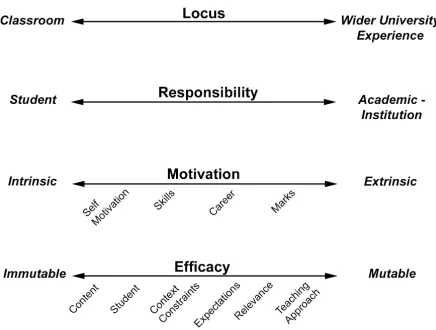
During the analysis of the interviews, the traditional dimensions of engagement described in literature [16] emerged clearly and will be addressed first. However, as the analysis continued a number of other themes emerged from the data as shown in Figure 1. These themes resulted from an interaction between the views that CS academics hold about the nature of student engagement, the nature of the CS discipline, and the nature of CS students. A unique CS per-spective on issues of student engagement emerges from the quotes we have highlighted. This is particularly notable in discussion of CS academic efficacy in the area of student engagement, i.e. Do CS academics believe they have the ability to influence the level of engagement of their students?
5.1
Dimensions of Engagement
There are multiple dimensions of student engagement and the full range of these was reflected in the interviews. However, the notable feature of the responses was the dominant focus on the Behavioural dimension. Typical responses when defining the meaning of student engagement from a Behavioural perspective include: "They respond to my questions, they attend classes regularly and they respond to other students." (I01); "The way I make students attend classes, I have assessment in the lecture so that they will turn up and be involved." (I01); "I think the student active participation in the unit activities, like attempting the assessment and attending tutorials and participate in the tutorial and in the lecture." (I06); and "The expectation is that they will work through a variety of exercises." (I11). The majority defined student engagement in similar terms. However, as Trowler [16] has pointed out, turning up to class and tutorials does not always equate to a high level of engagement.
Some responses also mentioned the Cognitive dimension of stu-dent engagement and had more focus on the cognitive impact of the student’s participation in class. Good examples of this type of response include: "It was the way the student is able to grasp or understand and take it with him in terms of the activities we provide." (I04); and "Trying to get students actively connected with what the content and processes of unit itself is, so I think of it in terms of student involvement in the actual learning process." (I05).
One CS academic highlighted the role they felt that the academic played in fostering the Cognitive engagement of students with the course materials: "Is how a student interact with you as both a guide and the way that you impact knowledge to ensure that the student actually understands what the concepts are but also more importantly how to apply those concepts." (I08). Another aca-demic highlighted the role that peer learning played in facilitating Cognitive engagement: "Student engagement in the classroom in-volves students actively working either individually or more likely in small groups on problem-solving on developing experience and background with techniques and algorithms and structures." (I11). The specific teaching technique mentioned in connection with fos-tering Cognitive engagement for CS students was problem-based learning, particularly if carried out in groups: "What they do get engaged in is problem-solving." (I12).
The Affective or Emotional dimension of student engagement was mentioned by relatively few. An example that highlights this view of engagement as a process of students constructing a sense of identity is: "Sometimes engagement means that they discover what they want to do." (I12).
Only one CS academic specifically acknowledged all dimensions of student engagement in defining the term: "Its about students connect, making connections with students, students connecting with us, physically and mentally and emotionally." (I07). The pre-dominance of the Behaviour view of student engagement to some extent mirrors the Behavioural focus of some survey instruments, such as NSSE. However a focus on attendance and participation may point to a need to more carefully consider what it means to students to be fully engaged in their studies in the CS context.
5.2
Emergent Themes on Student Engagement
[image:4.612.327.545.520.685.2]The relationship between how CS academics defined student en-gagement, the nature of the CS discipline and the nature of CS students, proved to be complex. Due to the complexity of the re-sponses we decided to map these along four main dimensions, sev-eral of which contained distinct themes as shown in Figure 1. The following sections provide an explanation of each theme, including selected quotes to illustrate the nature of the responses.
ITiCSE’18, July 2–4, 2018, Larnaca, Cyprus Michael Morgan, Matthew Butler, Neena Thota and Jane Sinclair.
5.3
Locus of Engagement
This theme related to whether the focus of the discussion was inside the classroom or embraced the wider university experience. This was an important factor as this defined the scope of actions available to the CS academic and also influenced views on who was responsible for promoting student engagement. This issue is also important in relation to the design of student engagement survey instruments, with SES more focused on ’program of study’ and NSSE designed to capture the wider university experience.
A clear majority of CS academics defined student engagement in terms of a narrow classroom focus. Typical responses include: "It means where the students are engaged in the learning process or whatever I’m teaching." (I01); "Attending in the tutorials and lectures, involvement in online forums and discussions." (I03); and "If I get my students to participate in class" (I12). Several CS aca-demics mentioned their role in encouraging participation in class and discussed ways to do this: "Trying to encourage the students to come on campus and come to class. Because if the’re physically there, then that is the first step." (I07). One academic discussed the importance of creating a ‘culture’ of high expectations for stu-dent engagement: "the culture forms in the first couple of weeks." (I10). This academic suggested that taking action against those who were not attending, submitting assignments or participating sent a strong message to those who were considering disengaging from their studies.
While most CS academic tended to focus specifically on their own classrooms, a few mention the importance of the wider university experience and recognised the importance of fostering this type of engagement: "But that might not be the place to do it ... engagement is beyond what is in the syllabus. We should put resources into activities that are not directly correlated to study." (I14); and "A series of activities that we can do to engage the students with everything to do with the department, whether that be the course materials, whether that be some of the other things that we do, so for example our outreach work, the societies that the students can get involved with." (I16). A wider consideration by CS academics of the entire university experience in terms of student engagement may benefit our students and improve the performance of CS on student engagement surveys, particularly the NSSE survey.
5.4
Responsibility for Engagement
CS academics differed in their views on who was responsible for student engagement, whether this rested mainly with the student or if the academic and institution had a significant role to play.
Interestingly, the majority of CS academics felt that engagement was primarily the student’s responsibility, with engagement often associated with the concept of motivation. For example: "In a most common sense it means, how interested and how self motivated students are in their studies." (I02); and "How much we need to encourage the students, this is a negative I guess." (I02). Several indicated that they could create the conditions for learning but that the students need to put in the effort to learn, with the implication that this was to some extent beyond the academics control: "I think I am the facilitator to all of that and it is up to the student to be engaged, to do their part in being engaged." (I12);“I think that we got a responsibility to do a professional job and make sure that
what we are doing with the students is absolutely relevant, but I think the main onus is on the students to deal with it." (I15); and "I think there are things we do as faculty to start that engagement and it is up to the student to do that extra step and take it further." (I12). One academic related the responsibility to the students’ level of maturity, indicating that first year students often lack the maturity to fully engage with their studies: “Moved from being what they consider being child-student." (I02). He pointed out that such stu-dents often failed to take advantage of opportunities to engage with their studies, in particular enrichment activities such as industry visits, but tended to become more engaged in later years of studies. Other CS academics saw the responsibility for engagement as shifted towards the academic and institution to provide students with appropriate opportunities to engage with their studies. Typical examples of this type of response include: "I guess engagement is a sum of motivations and opportunities to learn, which is something that the course organisers can provide." (I14); "I don’t think it is the students responsibility ... in way, their responsibility is to pass. The contract is for them to study enough to pass the exam." (I14); and "General engagement would be, I think is the responsibility of the university. To inculcate into students a feeling that they are not here just to fulfil the contract and getting a first class degree of whatever, but to open their minds to further issues." (I14).
One academic made specific reference to student engagement as joint responsibility, needing commitment from both the student and the academic/institution: "We would say its forming a social contract. I can expect you to do everything to learn, to make the hours, and you can expect me to have a good talk, to select the materials with care, to be open to your feedback, to change the materials." (I10). This reflects the framework of student engagement proposed by Kahu [8] which highlights the importance of both the student and academic/institution in facilitating engagement. The predominate focus of CS academics on student responsibility, is somewhat troubling in this regard.
5.5
Motivating Factors
A number of comments from CS academics discussed the issues of what motivated students to engage, with views ranging from intrinsic interest in learning to a more extrinsic focus on factors such as marks, acquiring technical skills, and careers.
Views of CS academics on what motivated student engagement related to an intrinsic interest in the discipline included: "Students that are eager, proactive, engaged, excited." (I09); "How much they feel it is interesting to learn for the sake of learning." (I14); "If they are really interested in IT they would be able to grasp the knowledge quite quickly." (I01); and "How much students are what you might considered to be adult learners who are self-motivated, interested in their, the subject without being forced to be." (I02).
they can be very creative." (I08). Perhaps the unstated assumption in this view of student engagement by CS academic was that be-cause the academic themselves were interested in technology and computation, they think that students would automatically share this interest. This was also evident in comments that suggested that introducing the latest technology would also motive students to engage in their studies.
There were a range of factors mentioned by CS academics that could be considered as extrinsic motivators for student engagement. For example, several referred to CS students being engaged in gaining or mastering technical skill set and completing allocated tasks: "Our students are a little more goal focused perhaps than the people I know from the fine arts." (I02); and "It is not the hardest in an intellectual way I would say. It is the hardest because it requires a constant discipline, a routine of everyday putting in the hours, not always being successful." (I10).
Several comments suggested CS students were often motivated to engage to secure high paying careers in the IT industry, and that many students in class were not actually interested in CS itself. The other responses mentioned the teaching technique of increasing the engagement by relating the content under discussion to potential careers in the industry: "... having real problems brought into the classroom by "real people", so bringing in industry to talk with the students ..." (I08); and "Relevant to the industry" (I12).
The most negative view of the extrinsic motivation of CS students to engage was the view that many students were motivated by grades and marks: "How much they are willing to learning the module without it being only associated with marking and passing the modules." (I14). Several academics commented that students tended to only engage in activities that were associated with marks. For example, when implementing pre-class readings and quizzes in a flipped class room one academic suggested that students did not engage with the material until marks were allocated.
5.6
Efficacy in Influencing Student Engagement
This theme related to whether CS academics saw the level of student engagement as fixed by factors beyond their control, or whether the level of engagement could be influenced by the academic. In other words, how much efficacy did CS academics have in influ-encing the engagement of their students? A number of comments tended to suggested that CS academics had a limited impact on the level of student engagement due to factors such as: the nature of CS content, the nature of CS students, constraints related to the teaching context, and mismatched student expectations.
Several CS academics suggested that the nature of programming in particular tended to isolate students leading to less opportunities for engagement: "In programming they are, most students are iso-lated, they are just by themselves, so they don’t need to create that relation, so that it isolates them so they are in their own world." (I03); and "It is not a very social kind of study." (I03). Some suggested that some CS content did not lend itself to active discussion and exploration of differing approaches: "But for other programming it is very straight forward... so it not really allows for students to comment on each other" (I03); and "How many different ways are there to teach programming or learn programming? I don’t know, maybe you’re constrained that way. (I05).
One academic suggested that a number of important topics in the CS curriculum are inherently difficult, and to some extent dis-engaging to students, and therefore not much could be done about this: "There are the activities that can be made exciting in some ways ... something which is fun to do ... There are some activities where you can’t within the constraints of how you deliver them ... There is only a limited range of things you can do in that one hour lecture to make that sound exciting. It is what it is" (I15). Another academic went on to suggest that a focus on skills can lead to a situation where students do the exercises set, to gain a particular skill or pass a test, but do not really engage with the topic: "You can get the skills and you can learn subjects without engaging in a way... I think engagement means having a-ha moments" (I14).
A number of academics commented on the nature of CS students and how this might influence their ability to engage with the con-tent, their courses, and with others: "There are students, I don’t know why, they just can’t do programming." (I01); and "They just don’t have the problem solving capabilities, and like think it has a lot to do with Maths abilities." (I13).
The communication and social skills of CS students was an area that provoked extreme views on their ability to engage with others. While academics noted that this did not apply to all students, the following comments are examples of extremely negative views: "You have the statistics right that people, some, that there is more, a higher percentage of student with some autistic spectrum." (I10); and "I think that many of our IT students do not like people. Because I think many of our IT students probably went into IT because they did not get on with people." (I09). The skills of CS students were contrasted by one academic with students from another faculty, based on a study she had conducted: "The difference between the IT students and the Education students was just amazing. The Educa-tion students were really willing to talk of ideas, really interested in what was going on. The IT students would just come in and do the exercise and I got nothing else from them. .... The IT students were doing what they were asked and they were cooperative but the Education students were more interested in talking, they were more personable." (I07). Of interest was a comment by one academic on the engagement of female students in CS classes: "Getting female students is not an issue for us, but keeping them in the major is a problem because they tend to hang out together. I try to pair them up with a male companion during the lab time but somehow the girls tend to stick together and that doesn’t help either for the boys or for the girls." (I13). This academic suggested that many female students often dropped out of their CS majors due to engagement issues rather than due to issues to do with their ability in CS.
One academic suggested that current CS teaching methods were failing to get CS students to engage: "I think we have got huge problems because the students aren’t coming to class ... they’re just opting to work on their own ... Obviously (they are) finding other ways to learn, so we don’t seem to be; in providing a lecture and a tutorial class, that model; we don’t seem to be providing for their learning very well." (I07). Another noted that a lack of engagement limits the achievements of students: "In a practical sense, the more the students are engaged, the less digging trenches I need to do and the more I can build towers." (I02).
ITiCSE’18, July 2–4, 2018, Larnaca, Cyprus Michael Morgan, Matthew Butler, Neena Thota and Jane Sinclair.
am not the greatest fan of a kind of standing at the front and talking to people for any length of time but I think that sometimes its very difficult for lots of reasons ... to move away from that. Our teaching spaces are kind of set up for someone standing at the front with a whiteboard or a Powerpoint presentation or something." (I16). Some suggested that initiatives to increase engagement, such as flipped classrooms, active learning and work integrated learning, had lit-tle or no impact: "I don’t believe that [blended learning, flipped classrooms to engage students] works" (I09); and "I don’t think any university activity has any effect on student engagement." (I10).
The final issue noted with regard to academics’ lack of ability to influence student engagement relates to the concept of CS students’ expectations of their courses. Several noted that there was a mis-match between what students expected their courses to be about and their subsequent experiences, which sometimes resulted in a lack of engagement with their studies. For example: "They think it is mostly game playing, internet browsing." (I13); and "I think a lot of our students come in to us with not particularly a much distinction between what CS is and program development." (I16).
In contrast, fewer CS academics made comments suggesting that they thought they could have a substantial impact on the level of engagement of their students. A number commented that their teaching style and approach to communicating with students could promote engagement, for example: "Trying to give them the idea that I am connected with them all the time ... So they don’t drift off." (I07); and "Making them more interested in the subject, spark their interest." (I12). Another suggested that the key to increasing student engagement was to demonstrate the relevance of the material to the students and their career aspirations: "When you talk to students about how it is applied and how it is relevant" (I12).
6
CONCLUSIONS AND FURTHER RESEARCH
The above analysis details the variation and complexity of CS aca-demic views on the definition of student engagement, how this relates to the discipline of CS, and how the characteristics of CS students influence their engagement with their studies. In regard to RQ1 it is notable that CS academics tend to focus on the be-havioural dimensions of student engagement and perhaps a view that included cognitive and affective dimensions would be more productive. Also of interest in terms of RQ1 and 2 was the domina-tion of the view that it was responsibility of the students to engage, rather than the idea that the relationship was reciprocal. The focus of CS academic thinking was largely within their own classes and rarely embraced a wider view of the total university experience. This limited perspective of engagement may demonstrate reasons for the poor performance of CS in national indicators, given that the instruments take a wider institutional perspective of engagement. With regard to factors motivating CS students to engage with their courses, extrinsic factors, such as careers, skills and marks, were often cited. Of note was that there was perhaps an over reliance on an interest in technology to stimulate engagement with CS studies. The most surprising insight to emerge from the analysis in terms of RQ2 was the issue of how academics view their efficacy in the area of student engagement. Many comments related to factors that tended to limit the academics’ ability to engage their students; such as the CS specific factors regarding CS content, CS students, the
teaching context, and CS students’ expectations of their studies. Relatively few CS academics expressed positive sentiments about their ability to positively influence student engagement in their classes. This emerging insight on the perception of CS academics lack of agency to impact the level of students engagement in their classes, is an issue that should be investigated further.
Future work will include: 1) collecting further academic inter-views to validate the themes identified in this paper and to explore any international variation in student engagement issues; and 2) analyzing the remaining portions of interview data relating to the academics responses to specific questions extracted from the national student engagement survey instruments. It will also be im-portant to better understand student perspectives on engagement, and to uncover any misalignments between students and academics that may exist.
ACKNOWLEDGMENTS
The authors would like to thank the following 2017 ITiCSE Working Group members who contributed to the initial work on this project: Janet Fraser, Gerry Cross, and Jana Jackova.
REFERENCES
[1] 2017. NSSE Home. (2017). http://nsse.indiana.edu/
[2] Paul Ashwin and Debbie McVitty. 2015. The meanings of student engagement: implications for policies and practices. InThe European Higher Education Area. Springer, 343–359.
[3] Elizabeth F Barkley. 2018. Terms of Engagement: Understanding and Promoting Student Engagement in Today’s College Classroom. InDeep Active Learning. Springer, 35–57.
[4] Matthew Butler, Jane Sinclair, Michael Morgan, and Sara Kalvala. 2016. Com-paring international indicators of student engagement for computer science. In Proceedings of the Australasian Computer Science Week Multiconference. ACM, 6. [5] Social Research Centre. 2017. 2016 Student Experience Survey - National Report.
(2017). Available from https://www.qilt.edu.au/docs/default-source/gos-reports/ 2017/2016-ses-national-report-final.pdf.
[6] John W Creswell and Vicki L Plano Clark. 2007. Designing and conducting mixed methods research. (2007).
[7] Jennifer A Fredricks, Phyllis C Blumenfeld, and Alison H Paris. 2004. School engagement: Potential of the concept, state of the evidence.Review of educational research74, 1 (2004), 59–109.
[8] Ella R Kahu. 2013. Framing student engagement in higher education.Studies in higher education38, 5 (2013), 758–773.
[9] George D Kuh. 2001. Assessing what really matters to student learning inside the national survey of student engagement. Change: The Magazine of Higher Learning33, 3 (2001), 10–17.
[10] S Lamborn, F Newmann, and G Wehlage. 1992. The significance and sources of student engagement.Student engagement and achievement in American secondary schools(1992), 11–39.
[11] Heather P Libbey. 2004. Measuring student relationships to school: Attachment, bonding, connectedness, and engagement.Journal of school health74, 7 (2004), 274–283.
[12] Raymond B Miller, Barbara A Greene, Gregory P Montalvo, Bhuvaneswari Ravin-dran, and Joe D Nichols. 1996. Engagement in academic work: The role of learning goals, future consequences, pleasing others, and perceived ability.Contemporary educational psychology21, 4 (1996), 388–422.
[13] Michael Morgan, Jane Sinclair, Matthew Butler, Neena Thota, Janet Fraser, Gerry Cross, and Jana Jackova. 2017. Understanding International Bench- marks on Student Engagement: Awareness and Research Alignment from a Computer Science Perspective. InITICSE-WGR’17: ITiCSE 2017 Working Group Reports, July 3âĂŞ5, 2017, Bologna, Italy.ACM, 24.
[14] Jonathan Neves. 2017. Student Engagement and Skills Development: The UK Engagement Survey 2016. (2017). Available by request from https://www. heacademy.ac.uk/institutions/surveys/uk-engagement-survey-2016. [15] Jane Sinclair, Matthew Butler, Michael Morgan, and Sara Kalvala. 2015. Measures
of student engagement in computer science. InProceedings of the 2015 ACM Conference on Innovation and Technology in Computer Science Education. ACM, 242–247.