warwick.ac.uk/lib-publications
A Thesis Submitted for the Degree of PhD at the University of Warwick Permanent WRAP URL:
http://wrap.warwick.ac.uk/98837 Copyright and reuse:
This thesis is made available online and is protected by original copyright. Please scroll down to view the document itself.
Please refer to the repository record for this item for information to help you to cite it. Our policy information is available from the repository home page.
A COGNITIVE APPROACH TO ORGANIZATIONAL SLACK:
DEVELOPMENT AND VALIDATION OF THE ATTITUDES TOWARDS
SLACK RESOURCES QUESTIONNAIRE (ATSRQ)
By
M. Selim CAKIR
A thesis submitted in partial fulfilment of the requirements
for the degree of Doctor of Philosophy
Warwick Business School
The University of Warwick
TABLE OF CONTENTS
List of tables . . . IV
List of figures . . . V
Acknowledgements . . . VI
Declaration . . . VII
Abstract . . . VIII
Abbreviations . . . IX
Chapter 1 -Introduction . . . 1
Chapter 2 -Literature review . . . 10
Chapter 3 - Research methods and design of the measurement instrument . . . 33
Chapter 4 - Initial construct validation of the Attitudes Towards Slack Resources Questionnaire (ATSRQ) . . . 54
Study 1 - Assessment of the factor structure of the ATSRQ item pool . . . 55
Study 2 - Confirmatory factor analysis of the ATSRQ . . . 67
Study 3 - Test-retest reliability assessment of the ATSRQ . . . 81
Chapter 5 - Nomological network of the ATSRQ . . . 90
Study 4 - Convergent and discriminant validity of the ATSRQ . . . 90
Study 5 - Criterion-related validity of the ATSRQ . . . 106
Chapter 6 - Conclusion . . . 135
Appendices . . . 144
Appendix 2 - The 30 attitudes towards slack resources items initially
retained at the conclusion of Study 1 . . . 150
Appendix 3 - Study 1 revisited . . . 152
Appendix 4 - Study 1 data collection instrument . . . 155
Appendix 5 - Study 2 data collection instrument . . . 164
Appendix 6 - Study 3 data collection instrument . . . 169
Appendix 7 - Study 4 data collection instrument . . . 174
Appendix 8 - Study 5 data collection instruments . . . 180
Appendix 8.a - Store manager data collection instrument . . . 180
Appendix 8.b - Subordinate data collection instrument . . . 185
LIST OF TABLES
Table 2.1: Varying definitions of organizational slack in the literature . . . 13
Table 3.1: A sample of previous studies with organizational slack scales . . 36
Table 3.2: Categorizations of slack resources from selected studies . . . 44
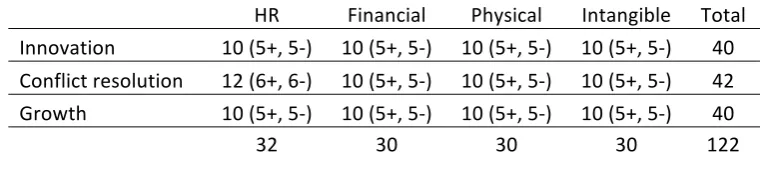
Table 3.3: Item distribution . . . 52
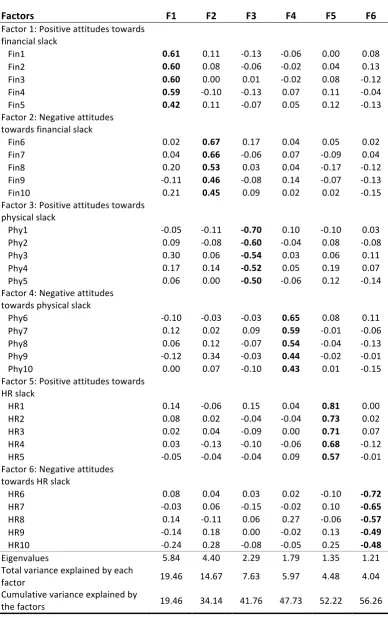
Table 4.1: EFA results . . . 65
Table 4.2: Correlations and reliability estimates . . . 66
Table 4.3: Model fit indices . . . 75
Table 4.4: Model fit indices . . . 79
Table 4.5: Correlations and reliability estimates . . . 80
Table 5.1: Correlations and reliability estimates . . . 103
Table 5.2: Models comparing the ATSRQ with external criteria . . . 104
Table 5.3: Correlations and reliability estimates . . . 125
Table 5.4: Comparison of null models . . . 126
Table 5.5: Multilevel regression results . . . 128
LIST OF FIGURES
Figure 2.1: Summary of the empirical findings . . . 11
Figure 2.2: Distribution of type 1 and type 2 errors in inverted-U shape argument . . . 28
Figure 2.3: Risk taking-slack resource relationship of U-shape argument . . 30
Figure 2.4: Performance-slack resource relationship of U-shape argument . . . 30
Figure 3:1: Resource level positions . . . 44
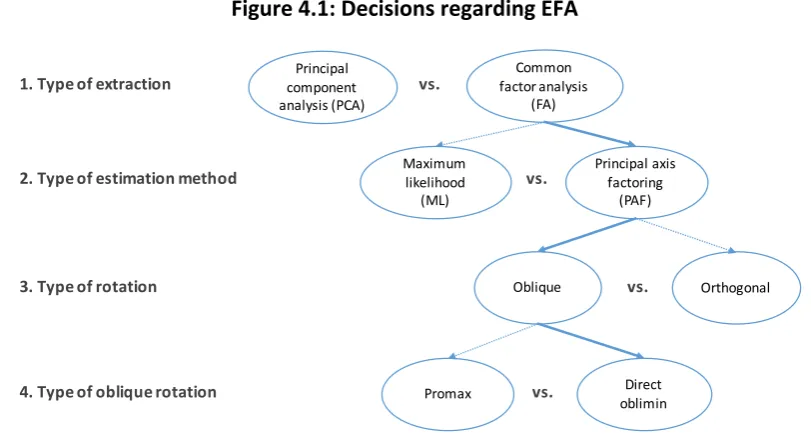
Figure 4.1: Decisions regarding EFA . . . 59
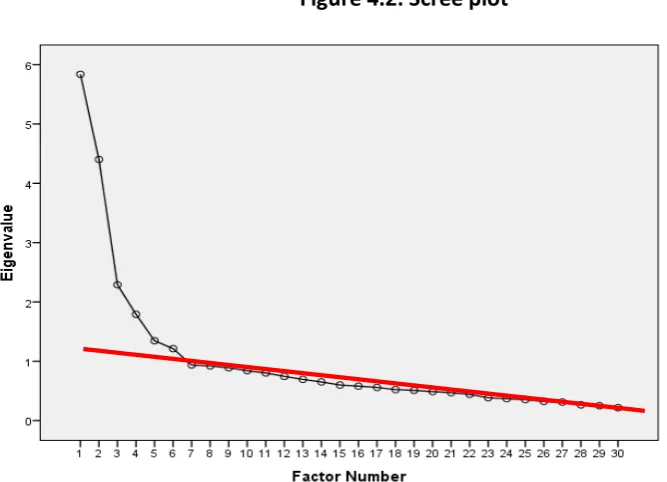
Figure 4.2: Scree plot . . . 63
Figure 4.3: Flow chart of participation . . . 69
Figure 5.1: Flow chart of participation . . . 99 Figure 6.1: Three-level model for future studies . . . Figure A.1: Scree plot . . .
ACKNOWLEDGEMENTS
First, I would like to express my gratitude to my exceptional supervisors, Professor Gerard Hodgkinson and Professor Keith Glaister. What I learned from our supervision meetings goes beyond academic matters. Gerard, thank you for your endless patience and constructive criticisms. This thesis has enhanced immeasurably through your detailed comments and suggestions. Keith, thank you for your support and guidance. It has been a privilege to work with you.
I need to thank the participants of my studies. This thesis would have not been completed without their inputs. I am indebted to RADMA for their financial support for data collection.
I would also like to thank the company that has granted me the permission for data collection for Studies 3 and 5. Special thanks go to Emre Ipekli for making necessary arrangements during data collection.
Thanks are also due to my colleagues at Warwick Business School who have
helped me through this process. I am particularly grateful to Elvan Gokalp for making this long journey enjoyable and Raouf Bouguerra for insightful debates and exchanges of knowledge.
DECLERATION
This thesis is submitted to the University of Warwick in support of my
application for the degree of Doctor of Philosophy. It has been composed by
ABSTRACT
This thesis integrates the cognitive modelling perspective into the literature on organizational slack by developing and validating a questionnaire-based instrument which measures managers’ attitudes towards slack resources. The literature is deeply polarized regarding the role played by slack in organizations. Researchers debate whether organizational slack is a sure sign of inefficiency in the workplace or a necessary cost to enhance the competitiveness of firms. Empirical studies have not been able to resolve this conceptual debate as the results are highly diverse. In order to explain conflicting empirical findings, scholars have made untested assumptions about the interaction between organizational slack and managerial psychology. However, despite repeated calls, managerial cognition regarding organizational slack remains a black box in empirical studies. This thesis addresses this shortfall in the literature by developing a new measurement instrument which reveals managers’ attitudes towards slack resources.
The instrument, i.e. the Attitudes Towards Slack Resources Questionnaire (ATSRQ), consists of three five-item subscales reflecting attitudes towards HR, financial, and physical slack and a combined higher-order scale measuring overall attitudes towards slack. It is developed and validated by means of a rigorous and systematic paradigm. The psychometric properties of the ATSRQ are assessed with five empirical studies which provide evidence for the internal consistency reliability, test-retest reliability, convergent validity, discriminant validity, and criterion-related validity of the ATSRQ.
ABBREVATIONS
AMOS Analysis of moment structures
ATSRQ Attitudes towards slack resources questionnaire CFA Confirmatory factor analysis
CFI Comparative fit index
CLVR Composite latent variable reliability
CMV Common method variance
DF Degrees of freedom
FA Common factor analysis
HLM Hierarchical linear modelling
HR Human resources
IGLS Iterative generalised least squares
KMO Kaiser-Meyer-Olkin
LMX Leader-member exchange
ML Maximum likelihood
NA Negative affect
OCB Organizational citizenship behaviour OLS Ordinary least squares
PAF Principal axis factoring
POS Perceived organizational support R&D Research and development
RBV Resource-based view
RMSEA Root mean square error of approximation SAS Statistical Analysis System
SPSS Statistical Package for the Social Sciences SRMR Standardized root mean square residual
TLI Tucker-Lewis index
CHAPTER 1: INTRODUCTION
The aim of this research is to develop and validate a questionnaire-based
measurement instrument in order to examine managerial cognition regarding
organizational slack. Even though the idea of slack in organizations in the literature
dates back to the 1930s (Barnard, 1938), the term, organizational slack, was not
coined until March and Simon (1958) used it in their seminal work. Due to its
significant and complex relationships with other organizational processes and
outcomes, organizational slack has received growing scholarly attention, both in
theoretical and empirical work. While some scholars see organizational slack as a
sign of inefficiency in the workplace (Leibenstein, 1969; Williamson, 1963, 1964),
others consider it as a key element for maintaining the survival of organizations
(Bourgeois and Singh, 1983; Cyert and March, 1963). Empirical findings,
unfortunately, are not able to resolve this conceptual debate on organizational
slack as findings are highly diverse. This thesis aims to advance our understanding
regarding the role played by slack in organizations by investigating the nature and
role of managerial attitudes towards slack resources.
Theoretical perspectives on organizational slack
While organizational slack appears in various economic and organizational
theories, most of the arguments regarding organizational slack in the literature
rely on two theoretical perspectives: the resource-based view of the firm (RBV)
and agency theory. Although these theories are based on fundamentally different
the psychological characteristics of the members of organizations hold great
importance for both perspectives. The following discussion introduces key ideas
of the RBV and agency theory perspectives and assesses the impact of managerial
and organizational cognition on their approaches to organizational slack.
The resource-based view of the firm
The resource-based view of the firm describes organizations as a collection
of resources (Peteraf, 1993; Rugman and Verbeke, 2002; Wernerfelt, 1984). It
prioritizes internal dynamics of firms, particularly the possession of resources, in
generating competitive advantage. Accordingly, it is argued that competitive
advantage arises from strategies pursued with firm specific resources that are not
perfectly mobile in resource markets (Ray, Barney, and Muhanna, 2004).
Managerial cognition has great impact on RBV arguments. Barney (1991)
notes “it is managers that are able to understand and describe the economic
performance potential of a firm's endowments [i.e. resources]. Without such
managerial analyses, sustained competitive advantage is not likely" (p. 117).
Similarly, Lockett, Thompson, and Morgenstern (2009) argue that managers play
an important role in the identification of resource functionality and decisions
regarding resource recombination, both of which are critical for achieving
competitive advantage in RBV. Firms can exploit opportunities in different markets
in a timely manner by using secondary functions of their existing slack resources if
control. Thus, managerial cognition affects the level of slack resources and also
their consequences in organizations (Lau, 2011; Simsek, Veiga, and Lubatkin, 2007).
RBV posits that competitive advantage often arises from novel combinations
of resources which lead to the creation of distinctive capabilities (Sirmon, Hitt, and
Ireland, 2007), and unique products and services (Lado, Boyd, and Wright, 1992).
Among other factors, managerial cognition plays an important role in the
successful recombination of organizational resources. First, managers need to be
aware of different functions of resources for useful recombination of resources.
Second, they should be aware of the type and level of organizational slack under
their control in order to recombine resources freely without affecting the current
business operations.
To sum up, while scholars favouring RBV support holding excess resources
in the workplace, they did not elaborate the impact of managerial cognition in the
transformation of slack resources into performance outcomes. This thesis
addresses this limitation by revealing managers’ perspectives regarding
organizational slack.
Agency theory
Agency theory is concerned with hierarchical relationships between
principals and agents in organizations (e.g., owner-manager,
manager-subordinate) (Brau, 2002; Eisenhardt, 1989; Hill and Jones, 1992; Roth and
O'Donnell, 1996). It is argued that the nature of the relationship between
between parties. Information asymmetry arises from the fact that principals are
not able to monitor all the actions of their agents in the workplace and/or they do
not have enough knowledge regarding agents’ tasks. It is a serious problem in
agency theory because of the assumption that principals and agents have different
and clashing interests. Since agents are expected to maximize their self-interests
at the expense of principals, agency theory supports an adoption of governance
mechanisms and policies which minimize adverse effects of information
asymmetry.
In agency theory, slack resources are considered as a means for agents to
take advantage of information asymmetry between them and principals. Since the
opportunistic behaviour of agents in the workplace is treated as the main problem,
scholars favouring agency theory support immediate removal of free resources
from organizations (Davis and Stout, 1992; Jensen, 1986; Jensen and Meckling,
1976; Fama, 1980).
Agency theory offers a narrow perspective of social exchanges in
organizations which leads to an incomplete picture of the consequences of
organizational slack. For example, while it singles out the conflict between
principals and agents, principals may also have conflicting interests between each
other on a wide range of issues, including the accumulation of resources. Even
though slack resources might give rise to the expression of opportunistic
behaviour by agents, they can minimize the unhealthy competition among
principals. Thus, in order to gain better understanding regarding the consequences
organizational slack on organizational behaviour, especially social exchanges
between organization members.
To sum up, the resource-based view of the firm and agency theory have
opposing views about organizational slack due to their fundamentally different
expectations from members of organizations. Agency theory hypothesizes a static
relationship between principals and subordinates where agents are invariably
characterized as opportunistic individuals. However, some of the agents might
think that “their future fortunes are bound to their current corporate employers
through an expectation of future employment or pension rights, then the
individual executive may perceive their interest as aligned with that of the
corporation and its owners” (Donaldson and Davis, 1991, p.51).
RBV expects that the members of organizations use excess resources in
unique combinations to yield competitive advantage. However, there is no
explanation of which condition managers and employees would be able or willing
to use resources for the success of organizations. It is evident from this discussion
that viability of RBV and agency theory assumptions in organizational settings
depends on attitudes and behaviours of organization members, especially those
holding managerial posts. This thesis investigates the role of managers on the
relationship between organizational slack and firm performance by adopting a
cognitive perspective. Among its other advantages, the power of cognitive
modelling for representing managers’ understanding of organizational
phenomena (Calori, Johnson, and Sarnin, 1994; Hodgkinson, Maule, and Bown,
1992; Sparrow, 1999; Tyler and Steensma, 1995) are of particular importance for
gaining fundamental insights into the decisions regarding slack resources.
Review of empirical work on organizational slack
Organizational slack is employed in empirical studies in different ways.
Researchers have studied organizational slack as a moderator (e.g., Barreto, 2012;
Dutta, Malhotra, and Zhu, 2016; Ettlie, 1985), mediator (e.g., Simsek et al., 2007),
control (e.g., Dooley and Fryxell, 1999; Gaba and Joseph, 2013; Galbreath, 2016;
Haleblian and Finkelstein, 1993), and dependent variable (e.g., Gentry, Dibrell, and
Kim, 2016). Nevertheless, the main enquiry in empirical studies is to determine
the impact of slack resources on organizational processes and outcomes, such as
financial performance (e.g., Tan and Peng, 2003), market share (e.g., Ettlie, 1997),
risk taking (e.g., Singh, 1986), new patent registrations (e.g., Mellahi and Wilkinson,
2010), innovation (e.g., Nohria and Gulati, 1996), interfirm cooperation (e.g.,
Combs and Ketchen, 1999b), and corporate bankruptcy (e.g., Daily and Dalton,
1994).
Contradictory empirical results regarding the impact of slack resources have
led studies into the factors that may affect the relationship between
organizational slack and outcome variables. These factors are investigated along
three lines of enquiry. The first is the dimensions of organizational slack. Scholars
use various criteria to define dimensions of organizational slack, such as ease of
recovery (Bourgeois and Singh, 1983), the level of discretion (Sharfman et al.,
different types of organizational slack may lead to differential impact on
organizational processes and outcomes (e.g. Bergh, 1997; Combs and Ketchen,
1999a; Mishina et al., 2004; Singh, 1986).
The second line of enquiry is the operationalization of organizational slack.
While some scholars employ lagged slack variables in order to take into account
the impact of managerial decisions regarding slack resources on outcome
variables (e.g., Alvarez-Gil et al., 2007; Chen and Huang, 2010; Tseng et al., 2007),
others employ subjective (Atuahene-Gima, 2005; Atuahene-Gima, Slater, and
Olson, 2005; Chattopadhyay, Glick, and Huber, 2001; Dooley and Fryxell, 1999;
Nohria and Gulati, 1996) and composite measures of organizational slack (Ang and
Straub, 1998; Barreto, 2012).
The third line of enquiry is the intervening mechanisms between
organizational slack and firm performance. By arguing that the impact of
organizational slack is context dependent, some scholars introduce moderators
between slack resources and organizational outcomes, such as CEO stock option
remuneration (Alessandri and Pattit, 2014), environmental munificence (Bradley,
Shepherd, and Wiklund, 2011), firm age (George, 2005), entrepreneurial
orientation (Liu et al., 2014), ownership structure (i.e. venture capital investors)
(Vanacker, Collewaert, and Paeleman, 2013), and resource allocation pattern
(Cheng and Kesner, 1997).
The last two lines of enquiry (i.e operationalization of organizational slack
discretion in the relationship between organizational slack and firm performance.
For example, subjective measures of organizational slack aim to quantify slack
resources from the manager’s point of view, since the impact of slack resources
on the strategic direction of the firm depends on the perceptions of managers
(Nohria and Gulati, 1996). Similarly, moderators such as entrepreneurial
orientation of managers and presence of venture capital investors in firms are
proposed primarily because they might influence managerial discretion over slack
resources (Bradley et al., 2011). Nevertheless, none of these studies were
designed to look inside the black box of managerial discretion regarding slack
resources. Instead, they posited presumptions regarding managerial discretion
based on various observable characteristics of managers, which are widely
criticized as being weak estimators for cognitive values of individuals (Lawrence,
1997; Pitcher and Smith, 2001; Priem, Lyon, and Dess, 1999; Smith et al., 1994).
For this reason, this thesis seeks to open up the black box of managerial discretion
by revealing managers’ beliefs and perceptions regarding slack resources.
Research methods
There is no assessment tool in the extant literature devised to examine
managerial cognition regarding slack resources. In order to address this shortfall,
this thesis develops and validates a multi-item, questionnaire-based instrument
which measures individuals’ attitudes towards slack resources. The new
developed through five empirical studies which display the psychometric
properties of the ATSRQ in greater detail.
Structure of the thesis
This thesis is organized into six chapters. The next chapter (i.e. Chapter 2)
reviews the literature on organizational slack from a cognitive perspective. It
explores the viability of the cognitive modelling perspective to examine untested
assumptions regarding organizational slack in the literature. Chapter 3 sets out the
research methods employed in the empirical studies. Chapters 4 and 5 report the
empirical studies, all of which are concerned with the assessment of the
psychometric properties of the new instrument. Chapter 4 encompasses three
studies which aim to establish the factor structure of the new instrument and
evaluate its reliability through various statistical tests. Chapter 5 aims to establish
a nomological network of the ATSRQ by providing evidence for convergent,
discriminant, and criterion-related validity of the new instrument. The final
chapter of this thesis summarizes the implications of the empirical findings. In
addition, it presents the limitations of the research and suggest future research
CHAPTER 2: LITERATURE REVIEW
Figure 2.1: Summary of the empirical findings
My intention in this research is not to support any one of the arguments depicted in Figure 2.1 by conducting an empirical study that adopts the same approach as previous studies. Rather, the primary goal of this thesis is to gain fundamental insights into the reasons behind the ambiguous relationship observed in previous work between organizational slack and firm performance. Accordingly, the present research departs from previous studies by adopting a cognitive perspective to reveal managers’ varying attitudes towards organizational slack which may be one of the reasons behind the diversity in empirical findings.
Previous empirical studies were typically designed to examine the impact of organizational slack by building direct relationships between slack resources and organizational outcomes, both of which are measured objectively. From a
cognitive perspective, this research design is beset by two important limitations, namely, the spurious operationalization of organizational slack due to scholars’ endeavours to measure it objectively and the causal gap arising from the untested
Organizational Slack Performance
RBV
Agency
Inverted-U shape
decision-making processes regarding slack resources. Accordingly, this chapter reports how these two limitations play a central role in the creation of seeming paradoxes in the literature. At the same time, it assesses the viability of a cognitive modelling approach for overcoming the limitations observed in previous work.
Operationalization of slack resources
One of the serious drawbacks in previous studies, which were often informed by a positivist philosophy, is that managers were treated as “perfect information processors” who could gather and analyse data in an objective manner (Smircich and Stubbart, 1985, p. 725). In reality, however, decision makers are constrained by information processing capacity limitations and operate under bounded rationality (Simon, 1957b). Since the effectiveness of slack resources in strategy formulation depends on their perception by the decision makers, it is crucially important to understand how managers construe and perceive slack resources in which the cognitive modelling perspective appears to hold great promise for unveiling managers’ belief systems (e.g., Axelrod, 1976; Hodgkinson and Clarkson, 2005; Nadkarni and Narayanan, 2005).
The definition of organizational slack further demonstrates limitations of objective measures of organizational slack. Thanks to its polymorphous nature, researchers are able to proffer definitions of organizational slack that reflect their research perspectives, some examples of which are outlined in Table 2.1. Contrary to domain-specific definitions in Table 2.1, organizational slack can be defined broadly as excess resources (e.g., cash reserves, machinery, office space, personnel, land) that firms possess over and above what they require to continue their normal day-to-day business activities.
Table 2.1: Varying definitions of organizational slack in the literature
Author(s) Related organizational issue Definition Cyert and March, 1963 Maintenance of coalition
“disparity between the resources available to the organization and the payments required to maintain the coalition” (p. 36)
Child, 1972 Maintenance of coalition
“the surplus or margin which permits organization's dominant coalition” (p. 11)
Dimick and Murray, 1978
Managerial discretion
“excess resources which can be used in a discretionary manner” (p. 616)
March, 1979 Changes in external environment
“spare resources and unexploited opportunities which then become a buffer against bad times” (p. 3) Bourgeois, 1981 Changes in internal and external environment
initiate changes in strategy with respect to the external environment.” (p.30)
Antle and Eppen, 1985
Resource allocation
“the difference between the budget allocation and the amount that must be invested in the process in order to achieve the targeted return” (p. 164) Fox and Marcus, 1992 Changes in external environment
“ability to purchase a valuable option” (p. 69)
Stan, Peng, and Bruton, 2014
Continuity in internal workflow
“cushion of spare resources that can act as shock absorbers for the workflow, preventing
disruptions” (p. 2)
Although it is possible to measure the actual amount of organizational resources (e.g., cash holdings, number of employees, level of inventory, physical assets, etc.), the question of whether such resources constitute slack, as such, cannot be determined objectively because what is considered as excess is based on individuals’ interpretations of reality (Chatterjee and Wernerfelt, 1988). Accordingly, by adopting a cognitive perspective, I hope to unveil the perceptions of managers, i.e. the actors whose views determine the organization’s corporate strategies pertaining to the accumulation and use of slack resources.
Black box modelling of managerial decision making regarding organizational slack
intervening processes. Slack resources per se do not automatically yield inefficiency or effectiveness in organizations. Instead, the manager, who utilizes (or not) organizational slack, determines both the accumulation and impact of slack resources on organizational processes and outcomes.
Although some researchers have acknowledged the importance of managerial discretion on the slack-performance relationship, they have not yet addressed the crucially important question of the role played by managers’ perceptions. Greenley and Oktemgil (1998), for example, criticized their own study on these very grounds.
“… the measurement of slack was restricted to data from published accounts, and did not include managerial perceptions of available slack resources and how they can be used to achieve strategic advantage. Further research could incorporate managerial perceptions of slack” (p. 395).
McKelvie, Wiklund, and Davidsson (2006) also highlighted the need to address more fulsomely the role of managerial discretion in organizational slack studies, specifically stressing its importance in resource utilization. Similarly, Dong (2016) draws attention to the role of managers in slack resource allocation and argues that
knowledge and organizational resources that generates sustainable competitive advantage” (p. 4361).
Even though 19 years have elapsed since Greenley and Oktemgil (1998) suggested the incorporation of managerial perceptions as a direction for further studies, surprisingly, as far as is known, no researchers, to date, have risen to the challenge. Rather, researchers have continued to treat managerial discretion as something of a black box in the modelling of the slack-performance relationship, which results in seeming paradoxes in the literature that will be discussed next. This thesis aims to open up this black box by examining how decision makers construe variously the nature and sources of organizational slack at their disposal and its attendant links to performance-related outcomes pertaining to their organizations.
organizations (e.g., Antle and Eppen, 1985; Jensen, 1993). In the third line of interpretation, on the other hand, managerial actions are predicted from the level of organizational slack (e.g., Bromiley, 1991; Ginsberg, 1994; Seifert, Morris, and Bartkus, 2003; Singh, 1986). I now turn to discuss these three approaches in greater detail.
Treating managers as powerless actors to shape the impact of organizational slack
There may be two reasons why scholars have overlooked the role of managerial discretion in organizational slack studies. One is practical: Obtaining access to the top management team is often problematic for researchers and difficult to achieve (Pettigrew, 1992). This can discourage researchers from integrating managerial discretion into their research designs. Another reason may be researchers’ perspectives about managers in organizations. Some organization theorists (e.g., population ecologists) posit that managers can play only a passive role in firms’ destinies since firms are highly constrained by external forces (see Hannan and Freeman, 1977 for review). Accordingly, managers are viewed as “relatively indistinguishable in their contributions” (Hambrick and Finkelstein, 1987, p.370).
organizational slack and its impact on organizations, the majority of scholars agree that slack resources increase the level of managerial discretion in organizations. Thus, treating managers as powerless actors calls into question the value of organizational slack as a construct because the impact of organizational slack appears through managerial decisions.
Scholars have often overlooked the role of managers in the discussion of the buffering effect of organizational slack which is proposed as a mediator in the relationship between the firm and its external environment (e.g., Bourgeois, 1981; Meznar and Nigh, 1995). Theorists favouring slack argue that buffering is mandatory to deal with changes in the external environment. In addition to its important role in economic downturns (Sharfman et al., 1988), buffering is also beneficial in economic growth periods since firms can enjoy favourable market conditions at maximum level (Cyert and March, 1963). Slack allows firms to meet increasing demand in markets they already operate in (Bowman and Hurry, 1993), as well as expanding into new, promising markets (Mishina et al., 2004).
opportunities) at an early stage of development, a high level of work in process (WIP) inventories and finished goods can prevent them from taking the required immediate actions
In order to understand which of the conflicting arguments summarized above account better for the behaviour of organizations, it is essential to elicit managers’ understanding of the buffering role of slack since buffering is under the direction of managers. In this regard, adopting a cognitive perspective would help unveil managers’ purposes of building buffers; whether to serve new markets or to protect organizations from fluctuations in the external environment which can lead to different consequences as discussed above.
Managers: Loyal servants or self-utility maximizers?
how managers and slack resources are accommodated in the core arguments of RBV and agency theory.
Agency theorists argue that slack resources intensify the conflict between principals (e.g., shareholders) and agents (e.g., managers, employees) in organizations. It is proposed that principals and agents are naturally in conflict because of their goal divergences. Due to information asymmetry, the principal is often unable to evaluate what the agent actually does and how she or he behaves. Since, according to this view, managers are “self-utility maximizers” (Shapiro, 2005, p. 266), organizations need to have governance mechanisms that can detect and minimize “self-serving behaviours” in the workplace (Eisenhardt, 1989, p. 59). Because the establishment of these mechanisms is often expensive (Antle and Eppen, 1985) and ineffective (Dharwadkar, George, and Brandes, 2000), the agency theory solution to the principal-agent problem is the removal of slack resources from the use of managers (Fama, 1980; Fama and Jensen, 1983; Jensen and Meckling, 1976).
external environment when needed. For instance, it is difficult to receive cash flow from money markets during a financial crisis (e.g., Stiglitz, 2003), or to attract talented employees from human resource markets during economic growth periods (e.g., Acemoglu, 1997; Acemoglu and Pischke, 1999). Therefore, scholars favouring the RBV argue that organizational slack is vital to firms due to market failures in the procurement of resources from the external environment.
Although agency and RBV arguments provide important insights about organizational slack, they each offer incomplete propositions about the impact of slack resources on organizational processes and outcomes. Accordingly, agency theory does not explain what happens if the principal-agent problem is overcome, especially in small firms where the owner of the firm is also the main administrator of slack resources.
Similarly, RBV arguments do not explain how managers transform resources to create competitive advantage (Barney and Arikan, 2001; Priem and Butler, 2001). Even if managers are completely trustworthy, there is no guarantee that they are capable of turning resources into desired organizational outcomes. For this reason, rather than taking an a priori stand in the debate over whether managers are merely opportunist individuals or loyal servants, this thesis aims to investigate the underlying mechanisms that shape decision making processes of managers regarding slack resources.
firm growth. Agency and RBV theorists agree that organizational slack is a facilitator of growth. However, whereas agency theorists argue that managers utilize organizational slack for uneconomic growth, scholars favouring the RBV consider it as a necessity for healthy growth. Penrose (1959), in her classic work, stressed that the demand for managerial resources in organizations increases exponentially in periods of rapid growth and that such demand cannot be met from outside the firm. New managers often require an orientation process that includes some training sessions. Earley and Peterson (2004) maintain that the orientation and training programmes of newcomers are often undertaken with the involvement of current managers of the firm, resulting in lost time that could have been used to support core business operations. Therefore, according to RBV scholars, in order to obviate disruptions in on-going business, firms should hold excess managerial resources that are already oriented to the organization, and ready to be utilized prior to the growth period (e.g., Goerzen and Beamish, 2007; Kor and Mahoney, 2000).
because typically the knowledge in question is of a tacit nature and embedded in cultural processes and artefacts (Buckely and Casson, 1976; Walsh and Ungson, 1991). Second, because the requisite codified information includes confidential materials, sharing it with external actors risks eroding the firm’s competitive advantage.
Agency theorists argue that managers pursue the growth of their firms to generate higher compensation and increase their personal social standing, even when the level of growth they desire exceeds what is in the interest of the company’s shareholders. Supporting this line of argument, Murphy (1985) found a positive relation between sales and the salary of top managers. Avery, Chevalier, and Schaefer (1998) demonstrated how managers who lead diversification and takeover initiatives, two of the most common approaches for achieving growth non-organically, enhances their power and prestige in the wider business world.
decline of funding for profitable projects due to undervaluation by the creditor. For this reason, firm growth strategies can be suspended if they are solely based on external financing.
In summary, RBV and agency theorists draw completely different conclusions about the consequences of firm growth with the utilization of slack resources. In fact, both theories are based on strong arguments with empirical support. My aim is to introduce the cognitive mind-set of managers as one of the underlying factors which leads to this dichotomy in the literature.
Prediction of managerial behaviours from the level of organizational slack Having identified discrepant views concerning the impact of organizational slack on firm growth due to scholars’ biases concerning managers, I now turn to consider another basis of conflict in organizational slack studies, which is to predict managers’ behaviours from the level of organizational slack.
This type of interpretation is often seen in studies where scholars focus on the impact of organizational slack on innovation. Although researchers commonly share the idea that creative and risk-taking behaviours are prerequisites for successful innovation (e.g., Brockhaus, 1980; Martins and Terblanche, 2003), they debate whether slack resources facilitate or inhibit this outcome.
Creativity
Amabile et al., 1996; Im and Workman, 2004; Sethi, Smith, and Park, 2001), or as Chen and Huang (2010, p.412) state, “the raw material” for innovation. Some scholars examine the slack-innovation relationship through downsizing studies. In one, Love and Nohria (2005) stressed that the main aim of downsizing is the elimination of slack resources that inhibits innovation. Another study, Mellahi and Wilkinson (2010) indicated that human resource downsizing results in the loss of organizational memory and low morale among employees, which in turn diminishes the expression of creative behaviours in the workplace.
Agency theorists (e.g., Jensen, 1986; McGrath, 1999), on the other hand, dwell upon unsuccessful projects carried out in organizations to highlight the inhibitory impact of slack resources on creativity. Jensen (1993) proposed that unsuccessful innovation projects, which have been pursued with organizational slack, reduce the incentive of new innovative project initiations. Marucheck and McClelland (1992) state that the loss of productivity arising from unsuccessful projects decreases employee morale, in turn stifling innovation in future work.
However, all of the arguments regarding the impact of slack resources on creativity depicted above are left as untested assumptions. For instance, Mellahi and Wilkinson (2010) did not empirically investigate whether organizational memory or morale actually decrease with downsizing. Similarly, Jensen (1993) did not report past successful and unsuccessful project initiations in organizations to examine their impact on new project initiations.
slack studies, where researchers make assumptions on behalf of managers, by unveiling managers’ own assumptions and beliefs regarding the nature and purpose of slack resources in facilitating innovation.
Risk taking behaviour
Innovation projects often include processes that depart from the daily routines of the organization, which makes them risky ventures for managers. Therefore, risk-taking behaviour should be promoted in the workplace if the enterprise wants to be innovative.
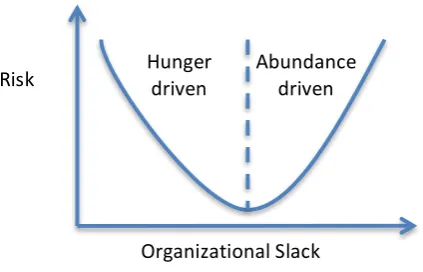
Proponents of slack argue that risk-taking behaviour is abundance-driven (e.g., Franquesa and Brandyberry, 2009; Singh, 1986; Steensma and Corley, 2001). Accordingly, they propose that when the level of organizational slack is high, decision makers tend to try new and risky projects, and when it is low they become afraid of taking risks as they can drive further decline.
In reply to the abundance-driven view, slack opponents propose that risk-taking behaviour is hunger-driven. Hartmann (2006) argues that the scarcity of resources shifts the attention of managers from the threat of loss to the possibility of gains, thereby fostering the taking of risks. By criticizing the abundance-driven argument, Fama (1980) states that organizational slack is an inhibitor for risk taking because it decreases the necessity of risk taking behaviour in the workplace.
be seen in the next section, they have introduced another set of arguments regarding the expression of risk taking behaviour, in which managerial discretion is continued to be interpreted with untested assumptions.
Again, these major differences highlight the urgent need for new perspectives that move the field beyond the black box approach that has dominated the literature on organizational slack. Adopting a cognitive perspective illuminates the underlying role of managers in the accumulation and use of slack resources.
Curvilinear approach as a reconciliation attempt
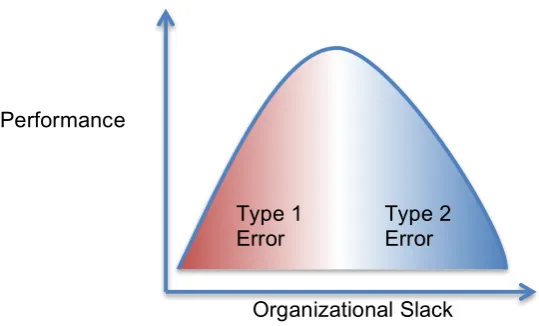
managers stop projects that would have been successful if continued, whereas type 2 errors occur when managers continue to allocate resources to failing projects. While low levels of slack are associated with type 1 errors, type 2 errors occur under high levels of slack, as shown in Figure 2.2.
Figure 2.2: Distribution of type 1 and type 2 errors in inverted-U shape argument
Nohria and Gulati’s type 1 and type 2 errors are not new ideas in the organizational slack literature. RBV and agency theorists frequently use type 1 and type 2 errors, though without calling them errors, to support their respective arguments. Thus, it can be argued that the curvilinear approach supports theories according to the level of slack resources rather than offering reconciliation. Recast in this manner, the organizational slack-performance relationship is explained by the RBV perspective up to the optimal level of slack. After the optimal level, agency theory accounts better for the relationship.
Once again, it is noticeable that despite alluding to the crucial role of judgment and choice on the part of managers, even this group of researchers has not investigated managerial cognition as the basis for evaluating which projects
Type 1 Error
Type 2 Error
are more, or less, likely to succeed, further underscoring why the body of work encompassed in the present thesis is timely. There is an important limitation at the core message of the inverted-U shape relationship due to the omission of managerial discretion. There is no explanation as to why type 1 and type 2 errors occur respectively under high and low levels of organizational slack. For instance, as a counter argument, if an organization has lower slack than desired, managers can pursue ambitious projects to bring it to the target level, which can cause the funding of failing projects (i.e. type 2 errors in low level of slack) (Bromiley, 1991; March and Shapira, 1987). In another case, managers can eliminate new projects to protect existing high levels of slack even if these projects could potentially boost the firm performance (i.e. type 1 errors under high levels of slack). As seen from these two counter arguments, the occurrence of errors cannot be explained merely with reference to the level of organizational slack per se. On the contrary, it is clear that managerial cognition has a major bearing on what managers consider appropriate levels of slack accumulation, how such slack is to be deployed, and to what ends.
highlights is yet another reason why new work is required to probe more directly the cognitive basis of managerial discretion pertaining to the procurement and deployment of slack resources.
Figure 2.3: Risk taking-slack resource relationship of U-shape argument
Figure 2.4: Performance-slack resource relationship of U-shape argument
After reviewing various arguments regarding the impact of slack resources on risk taking behaviour, I should stress that I neither agree nor disagree with any of them, because I do not accept they are generalizable propositions. It is erroneous to think that managers in different organizations will exhibit the same behaviours depending on the level of slack resources. Although organizational slack allows managers to select from multiple courses of action, it cannot determine how managers act. For this reason, I think it is time to try new
Abundance driven
Organizational Slack Hunger
driven Risk
Taking
RBV
Organizational Slack Agency
[image:40.595.120.346.397.521.2]approaches rather than persist with fruitless efforts to predict organizational behaviours from the level of organizational slack, because there is no such causality between them. In this regard, this research accommodates organizational slack as a means for managers to reflect their preferences in action rather than slack being a determinant of them.
Conclusion
CHAPTER 3: RESEARCH METHODS AND DESIGN OF THE MEASUREMENT INSTRUMENT
Introduction
The aim of this chapter is to report research methods employed in this
thesis. It is organized into three sections. The first section presents the
philosophical foundations of the thesis and the rationale for developing an
attitude measurement instrument regarding organizational slack. The second
section reviews attitude measurement techniques in the literature in order to
assess their particular strengths and weaknesses for measuring attitudes towards
slack resources. The last section reports the process of item generation, as well as
methodological choices regarding the instrument design, i.e., the number of
response options and the use of neutral response options.
Critical realism and the investigation of managerial attitudes as an underlying mechanism behind the diverse consequences of slack in organizations
Studies on organizational slack are predominantly conducted with positivist
epistemology. As is documented in the literature review, this approach does not
lead to a compelling answer regarding the impact of organizational slack as the
empirical results are highly diverse. The present research, in contrast, adopts the
critical realist epistemology (Bhaskar, 1978, 1989, 1998) to investigate actors’
perceptions of the generative mechanisms that underpin the slack-performance
relationship. The critical realist philosophy has emerged as a mid-range ontological
(Hodgkinson and Starkey, 2011, 2012). One of the key features of critical realism
that distinguishes it from other epistemologies is its proposition of stratified
ontology. Accordingly, Bhaskar (1978) the originator of critical realism, identifies
three ontological domains. The real consists of generative mechanisms and
structures which may (or may not) trigger the occurrence of events in the lower
level strata. The actual includes events and entities which are not empirically
observed. The final stratum, the empirical, is a subset of the actual in which events
are empirically detectable via observation or experiences. Following the stratified
ontology perspective, causality, which is reduced to the observable events, often
misleads researchers, because generative mechanisms may potentially
manipulate the result of the causality that is observed in the domain of empirical.
For this reason, Bhaskar (1978) advocates the shift of the focus of research from
observed events to generative (underlying) mechanisms. This thesis exactly aims
to make this transition in research on organizational slack by examining underlying
mechanisms behind the conflicting empirical results observed in the literature
between slack resources and organizational processes and outcomes.
In the previous chapter, I argued that managerial decisions regarding slack
resources are one of the fundamental underlying mechanisms behind the
conflicting empirical results observed in the literature between slack resources
and organizational processes and outcomes. In order to gain insights about the
impact of slack resources on organizations, it is critical to examine factors affecting
perspective, this research aims to reveal managers’ attitudes towards slack
resources due to their fundamental impact on decision making.
The research of managerial and organizational cognition (MOC) “concern[s]
with the processes through which actors acquire, interpret, store, retrieve,
disseminate and respond to information in order to make decisions and solve
problems” (Hodgkinson, 2008, p. 861).One of the underlying arguments in MOC
studies which highlights the critical role of cognition in decision making is the
notion of bounded rationality (March and Simon 1958; Simon, 1957b).
Accordingly, managers, as other individuals, have limited cognitive capacities
which restrict them to absorb and use all of the information that is relevant to the
particular decision. They have to simplify the reality through various knowledge
structures (e.g. mental models) which guide them in dealing with complex
problems (Levinthal, 2011). Since decisions on strategic issues, including the level
and utilization of slack resources, are complex in nature, it can be argued that
mental models take active roles in strategic decision making by helping managers
to take actions in a timely manner. Empirical studies indeed show that managers’
mental models influence strategic decisions in the workplace (e.g., Hodgkinson et
al., 1999; Porac, Thomas, and Baden-Fuller, 1989; Reger and Huff, 1993; Walsh,
1995) and give rise to heterogeneity of firm performance (e.g., Gary and Wood,
2011; Osborne, Stubbart, and Ramaprasad, 2001; Surroca, Prior, and Tribo, 2016).
Even though decisions regarding slack resources are an important
component of strategic management (George, 2005; Lenway and Rehbein, 1991;
organizational slack has mostly undervalued the impact of managerial cognition.
There is no existing assessment tool in the extant literature in order to examine
managerial cognition regarding organizational slack. In order to address this
shortfall in the literature, this research develops and validates a
questionnaire-based instrument which measures managers’ attitudes towards slack resources,
due to the fact that attitudes play a fundamental role in decision making by guiding
managers’ behavioural intentions (Bissing-Olson et al., 2013; Cameron,
Brown-Iannuzzi, and Payne, 2012; Kraus, 1995).
The proposed instrument differs from its counterparts in the literature on
organizational slack in terms of its intended aim and applicability across research
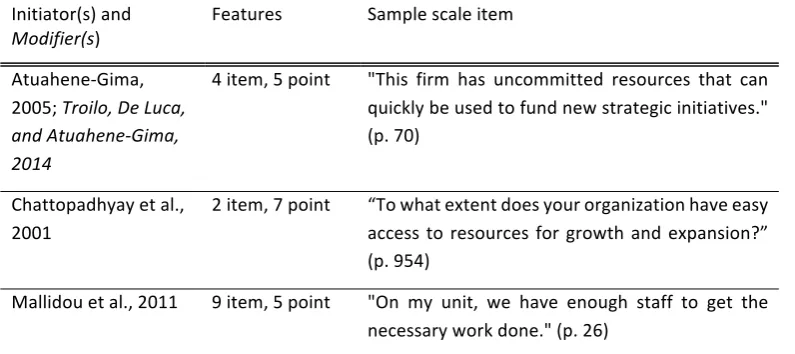
settings. As can be seen from Table 3.1 below, previous scales of organizational
slack are limited to reflect only managers’ perceptions of levels of slack resources.
They are all self-report descriptive measures that aim to quantify slack resources
in a given unit from the managers’ point of view. While such measures can be
useful for comparison purposes, they are not helpful to identify managers’
attitudes regarding the role played by slack resources as determinants of
organizational processes and outcomes. The proposed scale, as far as is known, is
the first in terms of its intended aim of measuring attitudes towards slack
resources.
The only attitudinal measure related to slack in the literature is Onsi’s (1973)
four-item questionnaire. As can be seen from the sample item, i.e. Slack in the
budget is good to do things that cannot be officially approved, the measure is
their business units. Accordingly, it is used exclusively in management accounting
studies (Lau and Eggleton, 2003; Merchant, 1985; Nouri, 1994).
While Onsi’s measure offers important insights on budgetary decisions in the
context of management accounting, it does not cover the same theoretical
domain with attitudes towards slack resources. As Glaser, Lopez-de-Silanes, and
Sautner (2013, p. 1588) state it is merely concerned with managers’ attitudes
towards “overbudgeting of capital expenditures”. Organizational slack, however,
has a wider impact on organizational processes and outcomes, such as innovation
(e.g., Nohria and Gulati, 1996), growth (e.g., Tseng et al., 2007), and conflict
resolution (e.g., Cyert and March, 1963). Therefore, managers’ propensity for
creating budgetary slack does not reveal many insights regarding the black box of
strategic decisions involving organizational slack and their consequences for
[image:47.595.113.511.504.681.2]organizational processes and outcomes.
Table 3.1: A sample of previous studies with organizational slack scales Initiator(s) and
Modifier(s) Features Sample scale item Atuahene-Gima,
2005; Troilo, De Luca, and Atuahene-Gima, 2014
4 item, 5 point "This firm has uncommitted resources that can quickly be used to fund new strategic initiatives." (p. 70)
Chattopadhyay et al., 2001
2 item, 7 point “To what extent does your organization have easy access to resources for growth and expansion?” (p. 954)
Nohria and Gulati, 1997; Dai and Kittilaksanawong, 2014
2 item, value
range: [0,30] “Assume that due to some sudden development, 10 per cent of the time of all people working in your department has to be spent on work totally unconnected with the tasks and responsibilities of your department. How seriously will your output be affected over the next year?” (p. 607)
Stock, Six, and
Zacharias, 2013 4 item, 7 point "Despite different bottlenecks, our company has sufficient resources to cope with these bottlenecks" (p. 296)
Revealing managers’ attitudes towards slack resources should help
researchers to better undertake future studies, which in turn, will advance
understanding of the role played by slack resources in organizations. Since the
reliability and validity of the proposed scale will be verified in the later stages of
scale development, researchers will be able to administer it directly to a sample
of respondents without any preliminary work on their part. The next section
reviews attitude measurement techniques in order to reveal their particular
strengths and weaknesses for measuring attitudes towards slack resources.
Attitude measurement techniques
Research on attitude measurement has received a great deal of scholarly
attention, even though it is relatively new to the literature on organizational slack.
Scholars have developed various measurement techniques to capture attitudes as
accurately and efficiently as possible ever since Thurstone (1928, p. 529) declared
in his seminal work that “attitudes can be measured”.
Attitude measurement techniques can be classified into two categories,
namely explicit and implicit measures (Karpinski, Steinman, and Hilton, 2005). The
Guttman, Thurstone) which are designed to reveal individuals’ attitudes through
their deliberate responses. While these measures have undoubtedly advanced our
understanding about attitudes, their construct validity has been called into
question for attitudes which people do not consciously control and/or have the
motivation to report them accurately (Cunningham, Preacher, and Banaji, 2001;
Greenwald and Banaji, 1995). Accordingly, the past three decades have witnessed
a surge of interest in the development and use of implicit measures. One of the
arguments that forms the basis for the use of implicit measures is that some
attitudes operate primarily at nonconscious levels, which make them inaccessible
through introspection (Hofmann et al., 2005; Wilson and Brekke, 1994). Thus,
using explicit techniques to measure attitudes that are formed primarily through
implicit cognitive processes causes erroneous representations of mental models
(Uhlmann et al., 2012).
Another argument is that participants may intentionally distort their
responses, especially when they have fears about their scores (e.g., evaluation of
jobs, managers) and/or the research covers socially sensitive domains (Gawronski
and De Houwer, 2014). Studies show that implicit measures are less susceptible to
deliberate distortion than explicit measures (e.g., Leavitt, Fong, and Greenwald,
2011; LeBreton et al., 2007).
Since implicit and explicit measures are based on different underlying
assumptions, their relative performance on predicting behaviour varies
significantly with the attitudes and behaviours under examination. There are two
explicit measures: dual and single representation of attitudes. The former model
asserts that individuals hold implicit and explicit attitudes independent of each
other towards the same attitude object (e.g., DeCoster et al., 2006; Wilson,
Lindsey, and Schooler, 2000). While implicit attitudes influence spontaneous
behaviour, explicit attitudes affect deliberate behaviour. In the single
representation model, explicit and implicit measures are considered to represent
different aspects of the same attitude in a single system (Fazio and Towles–
Schwen, 1999; Karpinski and Hilton, 2001). While each measure has unique
contribution in the prediction of behaviour, explicit measures are proposed to
explain much of the variance in the attitude-behaviour relationship when
individuals have sufficient resources and motivation to give deliberate responses
(e.g., Dovidio et al., 1997; Fazio et al., 1995).
Despite the differences between the single and dual representation of
attitudes, both models assume that explicit measures are better predictors of
behaviours and decisions that are based on deliberate evaluation. Generally,
managers are not under pressure to make snap decisions regarding organizational
slack, which allows the activation of deliberate evaluation processes. Additionally,
managers are accountable for the consequences of their decisions regarding slack
resources, which motivates them to engage in effortful cognitive processing. Thus,
a reliable and valid Likert-type explicit attitude measure is likely to explain a great
deal of variance in managerial behaviours related to slack resources.
Due to its clear advantages over other explicit measures (Oppenheim, 2000),
studies (Aiken, 1996, 2002; Cohen, Manion, and Morrison, 2013; DeVellis, 2012).
Compared with Likert scales, the main weakness of other scaling techniques (i.e.
Thurstone, 1928; Guttman, 1944) is that they require a preliminary item sorting
process in which items are ranked by judges in terms of favourability. Item sorting
is based on the assumption that a panel of judges would agree on the rank of the
particular item statements. However, there is no assurance that ranking of the
items are independent from the attitudes of the judges (Hovland and Sherif, 1952;
Oppenheim, 2000; Zavalloni and Cook, 1965). In addition to the limitation in the
item sorting process, the Guttman scaling technique assumes that a participant’s
agreement with one item implies his or her agreement with more favourable
items. However, scales exceeding six items are unlikely to maintain the cumulative
scaling property and shorter scales could provide limited discrimination among
individuals (Oppenheim, 2000). On the contrary, Likert scales allow researchers to
build lengthy scales if necessary. In addition, they are suitable to examine the
dimensionality of the construct of interest (Himmelfarb, 1993). It is one of the
reasons behind the selection of Likert-type scaling because there is no a priori
expectation regarding the dimensional properties of attitudes towards slack
resources.
Item development and the design of the measurement instrument
Cognitive tasks in the item response process
Responding to items in explicit attitude measures is a multi-stage process
retrieval, judgment, and response selection (for a review, see Krosnick, 1999;
Tourangeau, Rips, and Rasinski, 2000). Firstly, respondents need to read and
understand the question (i.e. comprehension). Then, they need to retrieve
relevant information from the memory and evaluate the question in the light of
the retrieved information (i.e. information retrieval and judgment). In the final
task, they need to map their judgments onto one of the response choices provided
in the scale (i.e. response selection).
The quality of data obtained from explicit attitude measures depends on the
extent to which respondents perform cognitive tasks in a diligent and unbiased
manner (Krosnick, 1999; Podsakoff, MacKenzie, and Podsakoff, 2012). That is why
the new instrument is designed to minimize cognitive complexity and its attendant
biases in the item response process. The remainder of this section reports all
preparatory work conducted for making the attitude measurement instrument
ready to be administered to a sample of respondents. It sets out the rationale
behind construct definition and item creation, and also explains the reasons
behind the choices in the instrument design.
Construct definition
Scale development starts with a definition of a construct which the scale
intends to measure. There are two main approaches for construct definition
(Hinkin, 1998; Spector, 1992). In the inductive approach, the construct is defined
iteratively through analyses of empirical data. In contrast, construct definition
relevant theories and arguments in the literature to define constructs and
generate items. The main advantage of adopting the deductive approach is being
able to set up a conceptual model for the measurement instrument, which helps
maintain consistency among scale items (Bauer et al., 2001; Bolino and Turnley,
1999; Hinkin, 1995, 1998; Spector, 1992).
Since construct definition relies on previous research in the deductive
approach, there should be well-developed theoretical foundations regarding the
construct(s) under examination. Helpfully, organizational slack and its
hypothesized relationships with other organizational processes and outcomes
have been widely discussed in the literature, which allows the adoption of the
deductive approach.
The term organizational slack has several definitions in the literature. They
have been evaluated with two criteria which are particularly important for the
proposed scale. First, an adopted definition should not contain any positive or
negative statements about the impact of slack resources on organizations.
Otherwise, it would bias respondents’ answers by providing guidance. Second, it
should be broad enough to cover different aspects of slack resources because, as
mentioned earlier, one purpose of this study is to develop a generic scale that can
be used in different contexts. Taking these two criteria into consideration,
organizational slack is defined as excess resources (e.g., machinery, office space,
human resources, land) that firms possess over and above what they require to
continue their normal day-to-day business activities. In order to help respondents
will be provided to respondents, which will help maintain consistency regarding
the conceptualization of organizational slack among respondents.
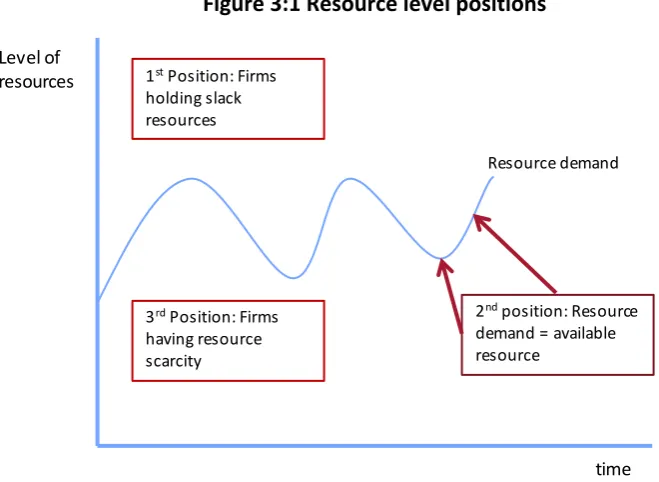
Organizations can be located into three distinct positions according to the
relationship between the amount of resources they demand and hold at a time,
as shown in Figure 3.1. In the first position, organizations’ resources exceed
resource demand. This is the position where organizations hold slack resources. In
the second position, the level of resources is equal to the resource demand. In the
third position, firms experience a shortage of resources to conduct day-to-day
business activities.
Items in the proposed scale will cover situations only when organizations
hold slack resources because individuals’ attitudes towards other resource
positions do not reveal their attitudes towards slack resources. For instance,
individuals’ negative attitudes towards resource scarcity (i.e. 3rd position) do not
necessarily indicate that they favour holding slack resources (i.e. 1st position) as
their ideal may be to maintain just enough resources to meet requirements (i.e.
Figure 3:1 Resource level positions
Referring to the adopted definition, organizational slack covers different
types of excess resources, which makes it potentially a multidimensional construct.
While scholars mostly agree on the multidimensional nature of organizational
slack, they have used different classifications as shown in Table 3.2. In order to
unveil whether managers’ attitudes vary systematically with respect to the type of
slack resources, each item in my scale reflects a specific type of slack resource. For
this reason, a careful classification of organizational slack is crucial to ensure a fair
representation of the construct in the proposed scale and balance the impact of
each slack resource type in the summated scores of individuals.
Table 3.2: Categorizations of slack resources from selected studies Author(s) Dimensions Slack types Indicators
Bourgeois and Singh (1983), Geiger and Cashen (2002)
Ease of recovery
Available Cash and marketable securities
Recoverable Excess overhead costs Potential Capital raising ability 1stPosition: Firms
holding slack resources
3rdPosition: Firms
having resource scarcity
time Level of
resources
Resource demand
2ndposition: Resource
[image:55.595.112.477.683.754.2]