Original citation:
Zhang, Yu, Liao, Xiaofei, Jin, Hai, Gu, Lin, Liu, Haikun, He, Bingsheng and He, Ligang (2018)
CGraph : a correlations-aware approach for efficient concurrent iterative graph processing.
In: 2018 USENIX Annual Technical Conference (USENIX ATC 18), Boston, MA, 11–13 Jul 2018
Permanent WRAP URL:
http://wrap.warwick.ac.uk/102609
Copyright and reuse:
The Warwick Research Archive Portal (WRAP) makes this work by researchers of the
University of Warwick available open access under the following conditions. Copyright ©
and all moral rights to the version of the paper presented here belong to the individual
author(s) and/or other copyright owners. To the extent reasonable and practicable the
material made available in WRAP has been checked for eligibility before being made
available.
Copies of full items can be used for personal research or study, educational, or not-for-profit
purposes without prior permission or charge. Provided that the authors, title and full
bibliographic details are credited, a hyperlink and/or URL is given for the original metadata
page and the content is not changed in any way.
Publisher’s statement:
Copyright to this work is retained by the author[s].
A note on versions:
The version presented here may differ from the published version or, version of record, if
you wish to cite this item you are advised to consult the publisher’s version. Please see the
‘permanent WRAP URL’ above for details on accessing the published version and note that
access may require a subscription.
CGraph: A Correlations-aware Approach for Efficient Concurrent Iterative
Graph Processing
Yu Zhang, Xiaofei Liao, Hai Jin, Lin Gu, Haikun Liu
Service Computing Technology and System Lab, Cluster and Grid Computing Lab,
School of Computer Science and Technology, Huazhong University of Science and Technology
Bingsheng He
Department of Computer Science, National University of Singapore
Ligang He
Department of Computer Science, University of Warwick
Abstract
With the fast growing of iterative graph analysis appli-cations, the graph processing platform have to efficiently handle massiveConcurrent iterative Graph Processing (CGP) jobs. Although it has been extensively studied to optimize the execution of a single job, existing solutions face high ratio of data access cost to computation for the CGP jobs due to significant cache interference and mem-ory wall, which incurs low throughput. In this work, we observed that there are strong spatial and temporal correlations among the data accesses issued by different CGP jobs because these concurrently running jobs usu-ally need to repeatedly traverse the shared graph struc-ture for the iterative processing of each vertex. Based on this observation, this paper proposes a correlations-aware execution model, together with a core-subgraph based scheduling algorithm, to enable these CGP jobs to effi-ciently share the graph structure data in cache/memory and their accesses by fully exploiting such correlations. It is able to achieve the efficient execution of the CGP jobs by effectively reducing their average ratio of data access cost to computation and therefore delivers a much higher throughput. In order to demonstrate the efficiency of the proposed approaches, a system called CGraph is developed and extensive experiments have been con-ducted. The experimental results show that CGraph im-proves the throughput of the CGP jobs by up to 2.31 times in comparison with the existing solutions.
1
Introduction
In the past decade, iterative graph analysis has be-come increasingly important in a large variety of do-mains [7, 28], which need to iteratively handle the graph round by round until convergence. Due to the increas-ing need of analyzincreas-ing graph-structured data (e.g., social networks and web graphs), many iterative graph algo-rithms run as concurrent services on a common platform. These Concurrent iterative Graph Processing (CGP) jobs
(a) Number of the CGP jobs
(b) Ratio of shared graph data
Nu
m
b
e
r
o
f
C
GP
jo
b
s
0 5 10 15 20 25
0 20 40 60 80 100 120 140 160
Time (hours)
0 1 2 3 4 5 6 7 8 9
0 20 40 60 80 100
Ra
tio
sha
re
d by
# j
obs
(%
)
Time (hours)
#>16 #>8 #>4
#>2 #>1
interference and limited bandwidth. As the result of high ratio of data access cost to computation in graph algo-rithm, the current graph processing systems experience low throughput. This paper investigates whether and how we can improve the throughput of the CGP jobs.
In practice, the CGP jobs usually need to repeatedly traverse the shared graph and iteratively process each vertex for their own purpose. It suggests that there are a large number of intersections among the graph struc-ture data being accessed by these jobs in each iteration, which we call thespatial correlationof data accesses. In addition, the partition of the shared graph structure may need to be accessed by multiple jobs within a short time interval, which we call thetemporal correlationof data accesses. These two correlations indicate that there ex-ist significant redundant data storing and accessing cost in the jobs, which leaves us good opportunities to reduce these unnecessary costs and improve the throughput.
Based on the observation, we propose a data-centric Load-Trigger-Pushing (denoted by LTP) model to im-prove the throughput of CGP jobs by fully exploiting the correlations of their data accesses. It decouples the graph structure data from the vertex state associated with each job. Within each iteration, the graph structure partitions shared by multiple CGP jobs are streamed into the cache and trigger the related jobs to concurrently process the data, followed by vertex state pushing for convergence. In this way, many accesses to the shared graph parti-tions can be amortized by multiple CGP jobs through handling them along a common order. The consump-tion of cache/memory is also reduced since a single copy of the graph structure data is used to serve multiple jobs at the same time. It indicates higher throughput thanks to much lower data access cost. To further improve the throughput, a core-subgraph based scheduling algorithm is designed to maximize cache utilization by judiciously arranging the loading order of the partitions.
To demonstrate the efficiency of our method, we conducted the extensive experiments with our system CGraph and compare its performance with those of three cutting-edge graph processing systems, i.e., CLIP [6], Nxgraph [11] and Seraph [31, 32]. Experimental results show that CGraph improves the throughput of the CGP jobs by up to 3.29 times, 4.32 times and 2.31 times over CLIP, Nxgraph and Seraph, respectively.
The remainder of this paper is organized as follows. Section 2 discusses the the motivation of this work. Sec-tion 3 outlines our approach, followed by experimental evaluation in Section 4. Section 5 gives a survey of re-lated work. Finally, we conclude this paper in Section 6.
2
Problem Presentation and Motivation
A common characteristic of an iterative graph process-ing job is that the operations are usually operated on
two types of data: graph structure data and vertex state data. The graph structure data contains the edges be-tween vertices and the information associated with each edge, whereas the vertex state data (e.g., ranking scores for PageRank [23], and the distances from the source ver-tex for SSSP [22]) is computed by its tasks in a paral-lel way within each iteration and typically consumed in the next iteration. The graph structure data always oc-cupies a majority of the memory, as compared with the vertex state data (i.e., job-specific data), and its propor-tion varies from 71% to 83% for different datasets [32]. As evaluated in Figure 1, the graph structure data is usu-ally shared by multiple CGP jobs. However, in exist-ing graph processexist-ing systems, these CGP jobs handle the shared graph in an individual manner along different graph paths, incurring low throughput for many redun-dant accesses to the shared graph and cache interference.
2.1
Data Access Problems in the CGP jobs
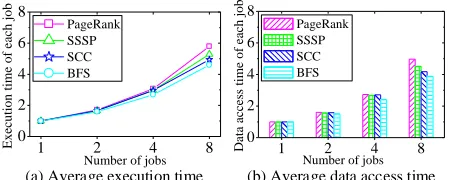
In order to investigate the level of the inefficiency of the individual data accessing manner of the CGP jobs, we conducted the benchmark experiments to evaluate the ex-ecution time of different number of CGP jobs over Ser-aph [31, 32] on uk-union [3]. The hardware platform and benchmarks are the same as those described in Section 4. From Figure 2(a), we made two observations. First, the concurrent way performs better than the sequential way of executing the jobs one by one. As observed in the experiments, it is because that the execution time of graph processing job is dominated by the data access cost and the CPU is always underutilized. Seraph is able to utilize the CPU in a better way by concurrently executing the jobs and also allowing them to share the in-memory graph structure data for less average data access cost. When there are eight jobs, the total execution time of the concurrent execution way is about 60% of the sequential way. Note that the total execution time of the concur-rent way is the maximum value of these jobs’ execution time, while it is the sum of those of all jobs for the se-quential way. Second, the average execution time of each job, however, is significantly prolonged as the number of jobs increases. It is almost doubled when the number of jobs increases from four to eight, because of higher data access cost for each vertex processing.
(a) Average execution time (b) Average data access time
1 2 4 8
0 2 4 6 8
Exe
cuti
on ti
m
e of e
ac
h job
Number of jobs PageRank SSSP SCC BFS
1 2 4 8
0 2 4 6 8
Da
ta
ac
ce
ss
time
of e
ac
h
job
[image:4.612.75.300.74.164.2]Number of jobs PageRank SSSP SCC BFS
Figure 2: Normalized performance of each CGP job over Seraph against that of the sequential way
it also incurs more serious cache interference due to the fact that more redundant data are stored into the cache for different jobs at different time. It eventually leads to low system throughput, since the data accessing cost typ-ically represents a major proportion of the total execution time for an iterative graph algorithm.
Take Figure 3 as an example and assume that the cache can only store a partition for the CGP jobs. With the existing solutions, the SSSP job may first access partition 1 and then partition 2, whereas the PageRank job may first access partition 2 and then partition 1. Besides, the processing of each partition is various for different jobs, making their accesses more irregular. As a result, the partition 1 and partition 2 need to be repeatedly loaded into the cache. It leads to serious contention among the jobs for the data access channel, the cache and so on.
2.2
Correlations between the CGP jobs
It is common that a set of CGP jobs involve in the anal-ysis of the same graph. Figure 1(b) shows the ratios of a graph shared by different number of CGP jobs at various time sampled from the real trace. We discover that there are strong temporal and spatial correlations between the data accesses of the CGP jobs due to the repeated tra-verse of the graph shared by them. It indicates that many redundant accesses are issued by the CGP jobs and much cache space is also wasted to store several copies of the same graph structure data for the jobs at different time.
As described in Figure 1(b), the intersections of the set of graph partitions to be handled by different CGP jobs in each iteration are large (more than 75% of all active partitions on average). This is called thespatial correla-tion. However, the CGP jobs in existing systems access the shared graph partitions in different order individually, inducing much redundant overhead. Ideally, these CGP jobs should consolidate the accesses to the shared graph structure and store a single copy of the shared data in the cache to serve multiple CGP jobs at the same time.
In addition, some graph partitions may be accessed by multiple CGP jobs (may be more than 16 jobs) within a short time duration. This is called the temporal corre-lation. The traced results show that the number of CGP jobs to access each partition is skewed at any time. The current solutions, e.g., Least Recently Used (LRU)
algo-rithm, may load the infrequently-used data into the cache when it is needed. It not only incurs the cost to load the data, but also swaps out the frequently-used data. A bet-ter solution should take into account the temporal corre-lations, e.g., the usage frequency of the graph partitions, when loading them into the cache.
These observations motivate us to develop a solution for efficient use of cache/memory and the data access channel to achieve a higher throughput by fully exploit-ing the spatial/temporal correlations discussed above.
3
Our Proposed Approach
Although we have identified the correlations between the CGP jobs, there are still several challenges that need to be tackled in order to exploit them. First, the shared ver-tices and edges may be individually handled by different jobs along different graph paths. Second, the CGP jobs have different properties (e.g., the rounds for conver-gence and the submitting time), which reduce the chance of sharing the accesses to the graph structure data within a short time interval. For example, some graph structure partitions may be accessed by some jobs (e.g., PageR-ank) much more frequently than the others (e.g., BFS). Besides, the CGP jobs that share the same graph structure may be put into execution at different time. Third, it is a non-trivial task to design an efficient partition-loading order that can achieve a high cache utilization ratio.
Therefore, we propose a data-centric LTP (Loading-Trigger-Pushing) model so as to fully exploit the spa-tial/temporal correlations between the CGP jobs, aiming to minimize the redundant accessing and storing cost of the shared graph structure data. In our LTP model, the shared graph is divided into a set of partitions. These par-titions are loaded into the cache in sequence and in the same order for all jobs, where each partition is concur-rently handled by the related CGP jobs. By such means, the accessing and storing of most graph structure parti-tions can be shared by multiple CGP jobs, thus signifi-cantly reducing the data access cost. When loading the graph partitions, a scheduling algorithm is further devel-oped to specify the loading order of graph partitions (as well as the related job-specific data). The scheduler aims to maximize the cache utilization by fully exploiting the temporal correlations among the jobs’ data accesses.
3.1
Data-centric LTP Execution Model
differ-ent jobs andGiis theith partition of the graphG. Each job has its ownS, and repeatedly updates itsS through its processing iterations until the calculated results con-verge. The processing of each iteration is divided into three stages: graph loading, parallel trigger and pushing stage, which are formalized as follows.
Graph Loading: In each iteration, the shared graph structure partitions, e.g.,Gi, are sequentially loaded for the CGP jobs along an order. It performs the following operation to load a graph partition: Li←L(Gi,∪j∈JSij),
whereL(∗)denotes an operator that loads the data spec-ified in the parameter list “*” into the cache,Jis the job set,Sijdenotes the states of the vertices inGiassociated with the jthjob, andLiis the data loaded into the cache. Sj=∪iSijis the set of vertex states related to the jthjob.
In this way, it only needs to load a copy of each shared graph partition, e.g.,Gi, for multiple CGP jobs and the partitions are also loaded for these jobs along a common order to provide opportunity to the sparing of redundant accesses by fully utilizing the correlations of these jobs.
Trigger and Parallel Execution: For each loaded graph partitionGi, the related CGP jobs, which are the
jobs that need to process the vertices in the partition Giand have not yet obtained the convergent results, are triggered to concurrently execute the following operator: Sinew← ∪
j∈JTj(Gi,Sij). The functionTj(Gi,Sij)denotes
the specific graph processing operations performed by the activated job j on the loaded data (i.e., Gi andSij)
towards its own objectives. Its outputs (denoted bySinew
j )
are the new states related to the vertices inGiand are as-sociated with the jthjob. Sinew=∪
j∈JSijnew is the new
ver-tex states that are related to the vertices inGifor all CGP jobs. When the processing ofGi is finished for all re-lated jobs, the next partition then can be loaded. By such means, it enables multiple jobs to regularly and concur-rently process the set of shared graph partitions for their own goals along the same order and efficiently share the accesses to them for lower overhead.
State Pushing: If a job, e.g., j, has processed all its active partitions in an iteration, its new calculated results, i.e.,Snewj =∪iSijnew, at this iteration are pushed for the state
synchronization between the vertices of its different par-titions (stored in its own job-specific space) for conver-gence. Then, the job starts a new iteration. Note that a CGP job will move to the next iteration once it has processed all active partitions in its current iteration and therefore different CGP jobs may be in different itera-tions of their graph processing. For example, BFS [10] may only need to handle a few active partitions in each it-eration while other algorithms, e.g., PageRank [23], may have to go through all partitions to complete an iteration. Figure 3 gives an example to illustrate the LTP model. In this example, the graph in Figure 4(a) is divided into
Memory/Disk
Partition 1 Partition 2
...
Scheduler(Arranging the Loading order of graph structure partitions) Global Spacev1
v2 2.9 v3
Partition 1
PageRank job
Job specific space of PageRank Job
SSSP job
Job specific space of SSSP Job
...
IsNotConvergent(vh):return |vh.Δvalue|>ε
Acc(value1, value2):
return value1+value2 Compute(Gi, vh)://Processing of each vertex
vh.value Acc(vh.value, vh.Δvalue) <links> look up outlinks of vh from Gi
for(each link <vh, ve><links>){ Δvalue d× vh.Δvalue/Gi[vh].OutDegree ve.ΔvalueAcc(ve.Δvalue, Δvalue) }
IsNotConvergent(vh):
return |vh.Δvalue| 0
Acc(value1, value2):
return min(value1, value2) Compute(Gi, vh)://Processing of each vertex
vh.value Acc(vh.value, vh.Δvalue) <links>look up outlinks of vh from Gi
for(each link <vh, ve><links>){ Δvalue vh.value+<vh, ve>.distance ve.Δvalue Acc(ve.Δvalue, Δvalue) }
Cache
v1
v2 2.9 v3 v3
v4
v5 1.5
Vertex ID Value
v1 0.2
v2 0.1
v3 0.25
Vertex ID Value
v1 1.2
v2 0
[image:5.612.318.544.72.284.2]v3 2.9
Figure 3: Illustration of our data-centric LTP model
two partitions, which need to be handled by two jobs, i.e., a PageRank job and a SSSP job. The graph structure data is stored in the global space and is shared by these two CGP jobs, while the job-specific space is provided for each CGP job to store its own vertex states. It can load the two partitions along the order of partition 1 then 2. When the partition 1 and the related job-specific data are loaded into the cache, the related jobs (i.e., the PageRank job and the SSSP job) are triggered to concurrently han-dle it and update their own vertex states. When the two jobs have handled the partition 1, the partition 2 can be loaded for processing. When both the two partitions are handled by the jobs, the new iteration of each job begins.
3.2
Correlations-aware Execution of Jobs
This section discusses how to efficiently implement our LTP model for the execution of multiple CGP jobs.
3.2.1 Graph Storage for Multiple CGP Jobs
We first show how to efficiently store the graph for the CGP jobs in our approach.
Data Structure of Graph Partition.For parallel pro-cessing, large-scale graph needs to be divided into parti-tions. However, the real-world graph usually has highly skewed power-law degree distributions [12], incurring imbalanced load among the partitions. Thus, our system also uses existing vertex-cut partitioning method [33], and evenly divides the edges of the graph into same-sized partitions in terms of the number of edges. Note that a vertex may have multiple replicas (e.g.,v3in
v1
v2 v3
v4
v5
2.9 1.5
Partition 1 Partition 2
(a) Example graph
Vertex ID Value
v1 0.2
v2 0.1
v3 0.25
PageRank Job
Vertex ID Edge List Flag Master Location Information Associated with Its Edges
v1 v3 Master Partition 1 1.1
v2 v1, v3 Master Partition 1 1.2, 2.9
v3 Ø Master Partition 1 Ø
…
Private Table Partitions
Graph Structure Partitions
Vertex ID Value
v3 0.05
v4 0.1
v5 0.3
Vertex ID Value
v1 1.2
v2 0
v3 2.9
SSSP Job
Private Table Partitions
Vertex ID Value
v3
v4
v5
Vertex ID Edge List Flag Master Location Information Associated with Its Edges
v3 v5 Mirror Partition 1 1.5
v4 v3, v5 Master Partition 2 0.9, 2.5
v5 Ø Master Partition 2 Ø
[image:6.612.334.512.72.153.2](b) Details for the related tables
Figure 4: An example to show how to store data for mul-tiple jobs, where the graph is divided into two partitions
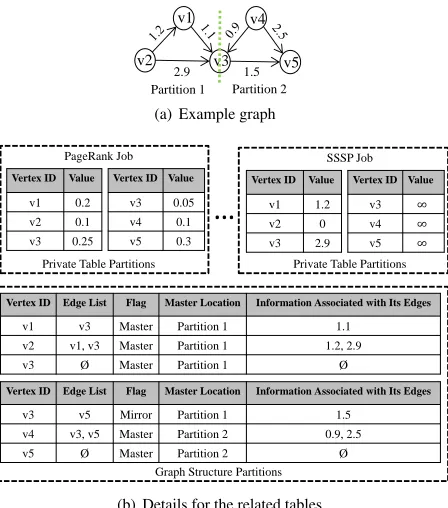
when handling each partition. The communication only occurs when the replicas of the same vertex in different partitions synchronize their states. In order to effectively store the graph partitions for the CGP jobs, multiple key-value tables are established. In detail, a single global table is created to store the graph structure data for all CGP jobs. Multiple private tables are used to store the vertex states of the jobs, i.e., one table for each job.
Each global table entry represents a graph structure partition indexed by its key and with three other fields to describe corresponding information. The first two fields indicate the location of this graph structure partition and the number of its vertices, respectively. The third field stores the IDs of the jobs to process it at the next iteration (along with the locations of the related private tables as-sociated with these jobs). The information of each graph structure partition is also stored in a key-value table and its each data item indicates a vertex and contains four fields: vertex ID, edges assigned in this partition, flag, master location and the information associated with its edges, e.g., priority. Each private table entry represents a vertex state and has two fields, i.e., vertex ID and its state. Figure 4 gives an example to illustrate how to store the data for multiple jobs.
Suitable Size of Graph Partition. In order to effi-ciently use the parallelism of CPU and ensure good cache locality, the cache is expected to be just fully loaded when each core has data to handle. Therefore, the suit-able size of each graph structure partition, i.e.,Pg, is
de-termined by the number of CPU cores, i.e.,N, and the
Timestamp 1 Timestamp 2 Timestamp3
Job 1 Job 2 Job 3
Partition 4 Partition 2
Partition 4 Partition 1
Partition 2
Partition 3
Partition 4
Time
Figure 5: An example to illustrate how to store evolv-ing graph structure for the CGP jobs submitted at differ-ent timestamps, where partitions 2 and 4 are changed at timestamp 2, and partition 4 is changed at timestamp 3
size of the cache, i.e.,C. The value ofPgis expected to be
the maximum integer such thatPg+ Pg
sg×sp×N+b≤C,
wheresgis the average size of each graph structure
parti-tion’s item,spis the size of each private table’s item, and
bis the size of reserved buffer.
Details to Store Evolving Graph Structure.In prac-tice, the graph structure may evolve with time. Thus, we also maintain a series of snapshots for it, where the graph updates, e.g., the adding/deleting of vertices and edges, are only visible to the jobs submitted later than the up-dates. In this way, different jobs are able to correctly handle the related snapshots of the graph, respectively. Because the changes of graph structure are usually very small at each time, the most part of these snapshots is the same. Thus, the series of snapshots can be stored in an incremental way for low overhead. For each snapshot, it creates a new global table and labels it with a timestamp, where this table only stores the new version of the parti-tion with changes. The newly submitted job handles the graph partitions with the highest timestamp yet less than its arrival time. Figure 5 gives an example to illustrate it. Note that most graph structure partitions, e.g., the parti-tions 1 and 3, are usually shared by the jobs when they handle different snapshots, respectively.
3.2.2 Loading of Graph Partition
In practice, a partition is to be handled by a job in the next iteration only when its vertices are activated by the other ones of this job at the current iteration. Therefore, it is easy for each partition to identify the set of CGP jobs to process it within the next iteration through trac-ing the partitions activated within the current iteration. This profiled information, i.e., the temporal correlations of the jobs, is stored in the global table for each parti-tion. The spatial correlations between the data accesses issued by the CGP jobs can be gotten by calculating the intersection of the set of graph partitions to be processed by different jobs. After that, it is able to load the shared graph partitions for exactly once along a common order to serve multiple CGP jobs within each iteration, amor-tizing the data access cost.
[image:6.612.77.301.74.328.2]Algorithm 1Details of Each Trigger
1: procedureTRIGGER(Gi,Sij)
2: for eachvh∈Sij∧IsNotConvergent(vh)do 3: Compute(Gi,vh)
4: ifvhis a mirror vertexthen 5: D←vh.MasterLocation 6: Snewj .Insert(vh,i,D,vh.∆value)
7: end if
8: end for
9: end procedure
converged at the early iterations, although some vertices need hundreds of iterations for convergence. The load-ing and processload-ing of the inactive vertices can be skipped for the related job for low overhead. In detail, when a graph structure partitionGi is loaded into the cache, it
only loads the related job-specific private partitions, e.g., Sij, of the CGP jobs which need to processGi. It does not loadGiwhen there is no job to handleGi, i.e., the states of the vertices inGiare inactive for all jobs. Specifically, when a graph structure partition is not used by any job at the next iteration, this graph structure partition is labeled as an inactive one so as to skip its loading. Similarly, it is relabeled as an active one when it needs to be processed by some jobs at the next iteration.
3.2.3 Parallel Processing of Graph Partition
After loading a graph partitionGiinto the cache, it trig-gers the related CGP jobs (e.g., j) to concurrently handle their private vertex states (e.g.,Sij) associated with this partition, respectively. Note that any newly submitted job only needs to register the partitions to be processed by it at its first iteration and waits to be triggered to han-dle them. It is possible that the number of CGP jobs is more than the number of CPU cores, i.e.,N. Assume a partition is shared by|J|number of jobs. When the value of|J|is larger thanN, these CGP jobs are assigned to be processed as different batches, where the shared graph structure partition is fixed in the cache and only the job-specific partitions are replaced. A graph structure parti-tion is swapped out of the cache only when it has been processed by the related jobs within the current iteration. Otherwise, the unprocessed jobs need to load it again.
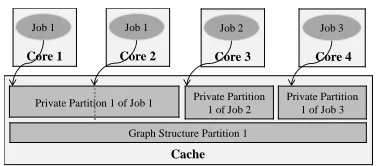
For the processing of each partition, the computation load of different CGP jobs is usually skewed, leading to low utilization ratio of hardware. In order to tackle this problem, it identifies the straggler, i.e., the job with the most number of unprocessed vertices in its private table for this partition. Note that the number of unprocessed vertices can be easily gotten, because the number of ac-tive vertices for each job in each partition is known as this partition is handled by the jobs at the previous itera-tion. Then, as described in Figure 6, it logically divides
Cache
Private Partition 1 of Job 1 Private Partition 1 of Job 2
Private Partition 1 of Job 3
Graph Structure Partition 1
Core 1
Job 1
Core 2
Job 1
Core 3
Job 2
Core 4
[image:7.612.332.522.68.151.2]Job 3
Figure 6: An example to illustrate how to get balanced load, where the core 1 and the core 2 are handling the partition 1 of the private table of the job 1 together
the unprocessed vertices in the private partition of the straggler into pieces and assigns them to the free cores to assist its processing.
The processing details for a job are given in Algo-rithm 1, where each job only compute the new state for its vertices inSij according to their local neighbors recorded in the graph structure partitionGi(See Lines 2-8). Therefore, there is no cache miss when handling a partition, because no communication occurs between the vertices on different partitions. Obviously, the vertex with replicas on different partitions needs to synchronize their states. The mirror vertex needs to push its new state to its master vertex to get this vertex’s final state at the current iteration. The new calculated state on the master vertex need to be pushed to its mirrors. As a result, for such a vertex state synchronization, many partitions of private table are frequently loaded into the cache and in-cur high cache miss rate. In order to tackle this problem, for each mirror vertex, its new state is directly buffered inSnewj (See Line 6), which will be implicitly sent to the master replica for batched vertex state synchronization at the data synchronization stage.
3.2.4 Data Synchronization
When there are multiple CGP jobs to synchronize vertex state, it is done for the jobs one by one so as to reduce resource contention, because there is no data sharing be-tween the jobs. For efficient vertex state synchroniza-tion among replicas, as depicted in Algorithm 2, they are done together in batches at this stage for each job, aiming to avoid the frequent load of private table’s partitions at runtime. The items buffered in the queueSnewj (with the new states of the mirror vertices, e.g.,vh) are first sorted
according to the IDs (e.g.,vh.MasterLocation, which is
described in Figure 4(b)) of the partitions with the related master vertices, before pushing them (See Line 2).
Algorithm 2Details of Data Synchronization
1: procedurePUSH(j,Snewj )
2: SortD(Snew
j ) /*Sort the items recorded inSnewj */ 3: for<vh,i,MasterLocation,∆value>∈Snewj do
4: D←Snew
j [vh].MasterLocation 5: value←Snewj [vh].∆value
6: SDj[vh].∆value←Acc(SDj[vh].∆value,value) 7: ifLast update ofSDj[vh].∆valueis endthen 8: val←SDj[vh].value
9: SDj[vh].value←Acc(val,SDj[vh].∆value) 10: for eachSnewj [vh].MasterLocation=Ddo 11: Snewj [vh].∆value←SDj[vh].∆value
12: end for
13: end if
14: end for
15: SortS(Snewj ) /*Sort the items recorded inSnewj */
16: for<vh,i,MasterLocation,∆value>∈Snewj do 17: i←Snewj [vh].i
18: Sij[vh].∆value←Snewj [vh].∆value
19: end for
20: end procedure
that, with the traditional solutions, it is impossible to know whether the final state is gotten for a master vertex until all updates are done. Then, the master vertex needs overhead to be reloaded for accessing, because it may have been swapped out of the cache. After that, it is done in a similar way to update mirror vertices’ states accord-ing to the related master vertices’ states (See Lines 15-19), where the items are sorted according to the IDs of the partitions with the mirror vertices (See Line 15).
3.3
Scheduling Based on Core-subgraph
With existing solutions, the partitions loaded into the cache may be underutilized. First, some vertices need more iterations to converge than the others for much higher degree. They make the partitions containing them repeatedly loaded into the cache and incur high overhead to load and store the early convergent vertices in the same partition. Second, the usage frequency of different par-titions is also skewed and also evolving with time. In detail, the same partition of different jobs and different partitions in the same job all may need various iterations to converge. Besides, a graph partition is only visible to the jobs with the arrival time latter than its timestamp. As a result, a loaded partition may need to be processed by very few (even one) jobs when the partition is arbitrarily loaded into the cache, inducing poor performance.
In order to maximize the utilization ratio of each parti-tion loaded into the cache, we propose a scheduling algo-rithm based on core-subgraph partitioning. The key idea is to first divide the core vertices (with degree higher than
a given threshold) together and then make the loaded par-tition shared by as many jobs as possible on average via arranging the loading order of graph partitions. In de-tail, it first identifies a core subgraph, consisting of the core vertices and the edges on the paths between them, from the graph. Then it evenly divides the graph based on such a subgraph, where the edges of this subgraph are di-vided together into several same-sized partitions and the remaining edges are divided into the other same-sized partitions. By such means, the frequently loading and processing of core vertices incurs less cost to load the early convergent vertices in the same partition, sparing the consumption of bandwidth and the cache space.
After that, it gives each partition Pa priorityPri(P)
and schedules the loading order of these partitions based on the dynamically profiled priorities of them. The parti-tion with the highest priority is first loaded into cache for the CGP jobs to handle, so as to improve the cache uti-lization ratio. The basic scheduling rules are as follows:
• First, a partition should be given the highest priority and be first loaded into the cache when it is needed by the most number of jobs for processing.
• Second, a partition should be set with a higher pri-ority when it has a higher average vertex degree or a larger average vertex state changes, because more vertex states will be propagated to others through them. Then, most vertices need less iterations (also less consumption of the cache) to absorb other ver-tices’ states for convergence.
The above rules are captured by such an equation:
Pri(P) =N(P) +θ·D(P)·C(P) (1) whereN(P) is the number of jobs to processP and is used to capture the temporal correlations for the CGP jobs.D(P)is the average degree of the vertices inP, and C(P)is the average state changes of the vertices inPfor all its jobs at the previous iteration. The initial values of N(P)andC(P)and the value ofD(P)are gotten at pre-processing time, whileN(P)andC(P)are incrementally updated at the execution time. There, 0≤θ< 1
Dmax·Cmax
is the scaling factor set by the runtime system at prepro-cessing time to ensure that a partition with the highest value ofN(P)is first processed, whereDmaxandCmaxare
the maximum values of any partition’sD(P)andC(P), respectively. By such means, the partition loaded into the cache is able to serve as many jobs as possible, while the other partitions have more opportunity to be needed by more jobs after a time interval, further improving the throughput via reducing the average data access cost.
3.4
Implementation and Interfaces
Algorithm 3Executor for CGraph
1: procedureEXECUTOR(G,SJobs)
2: whilethe job setSJobsis not emptydo
3: whileGhas unprocessedGifor some jobsdo 4: Gi←LoadPartition(G) /*LoadGi*/
5: /*Get the set of jobs to handle Gi*/ J←GetJobs(Gi,SJobs)
6: for each j∈Jdo
7: /*Trigger the job j to handle Gi*/ ParallelTrigger(j,Gi,Sij)
8: end for
9: for each j∈JandSnewj are gottendo 10: /*Vertex state synchronization forj*/
Push(j,Snewj )
11: ifvertex states of jare inactivethen 12: /*Remove j from the set SJobs*/
Remove(SJobs, j)
13: end if
14: end for
15: end while
16: end while
17: end procedure
to the scheduling algorithm (See Line 4). For eachGi,
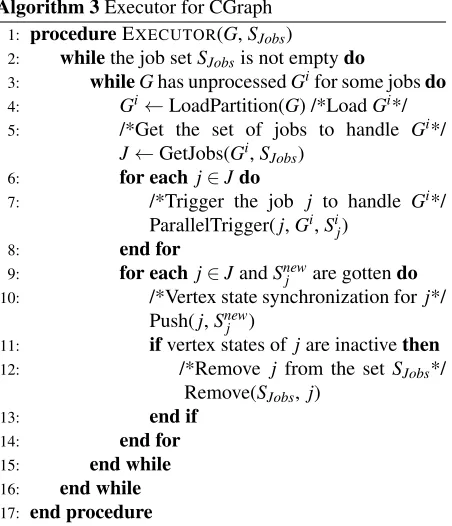
the job-specific partitions, e.g., Sij, of the related CGP jobs are also loaded and these jobs are triggered to con-currently handle the loaded data (See Lines 5-8), where each job calculates the new states of its vertices accord-ing to the states of their local neighbors. When all ac-tive partitions ofGhas been handled for a job, e.g., j, at the current iteration (See Line 9), this job synchronizes the states of the vertices with several replicas distributed over different partitions (See Line 10). Then, its new it-eration begins. Each job is repeatedly triggered until all its vertex states are inactive (See Lines 11-13). Note that it allows to add new jobs intoSJobsat runtime.
For programming, a user only needs to instantiate three functions, i.e., IsNotConvergent(), Compute() and Acc(), which are used in existing systems [25, 32, 33]. The first one indicates whether a vertex is convergent. Compute() is employed to update a vertex state and cal-culate the contributions of a vertex for the new states of its neighbors, and Acc() is utilized for a vertex to accu-mulate the contributions of its neighbors. Figure 7 gives two examples to show how to implement iterative graph algorithm on CGraph. Within each iteration, each vertex updates its state according to the accumulated contribu-tions of its neighbors. After that, it calculates and sends its contributions to its neighbors for their state updates.
4
Experimental Evaluation
The hardware platform used in our experiments is a server containing 4-way 8-core 2.60 GHz Intel Xeon
[image:9.612.312.549.71.171.2] [image:9.612.74.300.75.338.2]IsNotConvergent(vh): return |vh.Δvalue|>ε
Acc(value1, value2): return value1+value2
Compute(Gi, vh)://Processing of each vertex vh.value Acc(vh.value, vh.Δvalue) <links> look up outlinks of vhfrom Gi for(each link <vh, ve> <links>){ Δvalue d× vh.Δvalue/Gi[vh].OutDegree
ve.Δvalue Acc(ve.Δvalue, Δvalue) }
IsNotConvergent(vh): return |vh.Δvalue| 0
Acc(value1, value2): return min(value1, value2)
Compute(Gi, vh)://Processing of each vertex vh.value Acc(vh.value, vh.Δvalue) <links> look up outlinks of vhfrom Gi for(each link <vh, ve> <links>){ Δvalue vh.value+<vh, ve>.distance
ve.Δvalue Acc(ve.Δvalue, Δvalue) }
(a) PageRank (b) SSSP
Figure 7: Instantiation of graph algorithms on CGraph
Table 1: Data Sets Properties
Data sets Vertices Edges Sizes
Twitter [18] 41.7 M 1.4 B 17.5 G Friendster [4] 65 M 1.8 B 22.7 G uk2007 [3] 105.9 M 3.7 B 46.2 G uk-union [3] 133.6 M 5.5 B 68.3 G hyperlink14 [5] 1.7 B 64.4 B 480.0 G
CPU E5-2670 and each CPU has 20 M last-level cache, running a Linux operation system with kernel version 2.6.32. Its memory is 64 GB and the secondary stor-age for it is a disk with 1TB. It spawns a worker for each core to run benchmarks. The program is compiled with cmake version 2.6.4 and gcc version 4.7.2.
In experiments, four popular iterative graph algo-rithms from web applications and data mining are em-ployed as benchmarks: (1) PageRank [23]; (2) single-source shortest path (SSSP) [22]; (3) strongly con-nected component (SCC) [16]; (4) breadth-first search (BFS) [10]. The datasets used for these algorithms are real-world graphs existing on websites [3, 4, 5, 18] as de-scribed in Table 1. The performance of CGraph is com-pared with three cutting-edge graph processing systems, i.e., CLIP [6], Nxgraph [11] and Seraph [31, 32]. Seraph is the state-of-the-art system optimized to support the ef-ficient execution of multiple CGP jobs. Note that the jobs (e.g., PageRank, SSSP, SCC and BFS) in the experiments are submitted to each system simultaneously.
4.1
Performance of Scheduling Strategy
T wi t t e r
F ri e n ds t
e r
u k2 0 0 7
u k- u n io n
h yp e r l in k
1 4 0 2 0 4 0 6 0 8 0 1 0 0
N o rm a liz e d e x e c u ti o n t im e ( % )
D a t a s e t s
C G r a p h - w i t h o u t C G r a p h
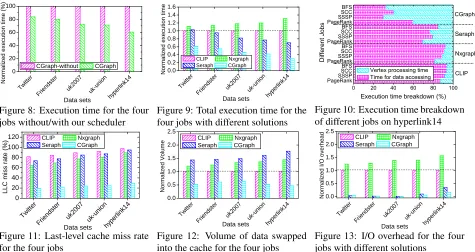
Figure 8: Execution time for the four jobs without/with our scheduler
T wi t t e r
F ri e n ds t
e r
u k2 0 0 7
u k- u n io n
h yp e r l in k
1 4 0 . 0
0 . 2 0 . 4 0 . 6 0 . 8 1 . 0 1 . 2 1 . 4 1 . 6
. . . . N o rm a liz e d e x e c u ti o n t im e
D a t a s e t s C L I P N x g r a p h S e r a p h C G r a p h
Figure 9: Total execution time for the four jobs with different solutions
PageRankSSSP SCCBFS PageRankSSSP SCCBFS PageRankSSSP SCCBFS PageRankSSSP SCCBFS
[image:10.612.73.548.72.324.2]0 20 40 60 80 100 ... ... ... CGraph Seraph Nxgraph CLIP
Execution time breakdown (%)
Di
ff
ere
nt Job
s
Vertex processing time Time for data accessing
Figure 10: Execution time breakdown of different jobs on hyperlink14
T w i t te r
F ri e n ds t
e r
u k2 0 0 7
u k- u n io n
h yp e r l in k
1 4 0 2 0 4 0 6 0 8 0 1 0 0 1 2 0
L L C m is s r a te ( % )
D a t a s e t s
C L I P N x g r a p h
S e r a p h C G r a p h
Figure 11: Last-level cache miss rate for the four jobs
T wi t t e r
F ri e n ds t
e r
u k2 0 0 7
u k- u n io n
h yp e r l in k
1 4 0 . 0
0 . 5 1 . 0 1 . 5 2 . 0 2 . 5
. . . . N o rm a liz e d V o lu m e
D a t a s e t s C L I P N x g r a p h
S e r a p h C G r a p h
Figure 12: Volume of data swapped into the cache for the four jobs
T w i t te r
F ri e n ds t
e r
u k2 0 0 7
u k- u n io n
h yp e r l in k
1 4 0 . 0
0 . 5 1 . 0 1 . 5 2 . 0 2 . 5
. . . . N o rm a liz e d I /O o v e rh e a d
D a t a s e t s C L I P N x g r a p h
S e r a p h C G r a p h
Figure 13: I/O overhead for the four jobs with different solutions
4.2
Overall Performance Comparison
To compare the performance of CLIP, Nxgraph, Ser-aph and CGrSer-aph, we simultaneously submit PageRank, SSSP, SCC and BFS as four jobs to each of these sys-tems. Figure 9 gives the total execution time of the four jobs over different systems. We can find that the four jobs over CGraph are able to converge with less time, which indicates higher throughput than the other systems. For example, over hyperlink14, CGraph is able to improve the throughput by 2.31 times, 3.29 times and 4.32 times in comparison with Seraph, CLIP and Nxgraph, respec-tively. We identify that the highest throughput of CGraph mainly comes from much lower average data access cost to computation ratio than them.
Figure 10 shows the execution time breakdown of dif-ferent jobs evaluated on hyperlink14 with difdif-ferent so-lutions. We can observe that the pure vertex processing time of the job over CGraph occupies the most ratio of its total execution time, while the ratio is very low in CLIP, Nxgraph and Seraph. There are two reasons lead-ing to lower average data access cost to computation ratio for CGraph than the other solutions. First, through effi-ciently exploiting the data access correlations between the CGP jobs, CGraph needs to store less data into the cache, getting a lower cache miss rate. Second, CGraph needs to access less volume of data due to efficient share of data accesses for the jobs, which means less consump-tion of bandwidth for main memory and the disk.
In order to demonstrate it, we first evaluate the last-level cache miss rates of CLIP, Nxgraph, Seraph and CGraph using Cachegrind [1]. The miss rates of the above four jobs over different systems are given in
Fig-ure 11. As described, the cache miss rate of CLIP is larger than Nxgraph, because CLIP tries to trade off lo-cality for the reduction of the total amount of data ac-cesses while Nxgraph uses destination-sorted sub-shard structure to store a graph for better locality. However, the cache miss rate of Nxgraph is still more than CGraph. For example, the cache miss rate of Nxgraph is 89.5% for hyperlink14, while the rate is only 29.6% for CGraph. It is mainly because that a single copy of graph structure data in the cache is able to serve multiple jobs of CGraph.
Next, we evaluate the total volume of data swapped into the cache for the above four jobs over different sys-tems. The normalized results of them against CLIP are depicted in Figure 12. We can find that CLIP needs to swap much smaller volume of data into the cache than Nxgraph and Seraph, because it is able to reduce the number of iterations for convergence via reentry of loaded data and beyond-neighborhood accesses. Note that the method employed by CLIP can also be used in Seraph as well as CGraph, rather than Nxgraph.
1 2 4 8 1 6 3 2 0 . 0
0 . 2 0 . 4 0 . 6 0 . 8 1 . 0 1 . 2 1 . 4 1 . 6
. . . .
N
o
rm
a
liz
e
d
e
x
e
c
u
ti
o
n
t
im
e
N u m b e r o f w o r k e r s
C L I P N x g r a p h
[image:11.612.76.535.75.212.2]S e r a p h C G r a p h
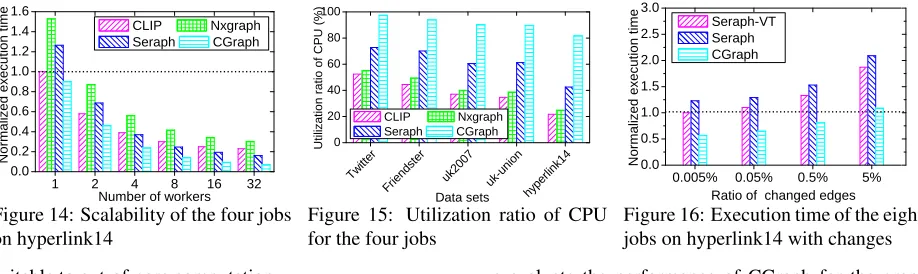
Figure 14: Scalability of the four jobs on hyperlink14
T wi t t e r
F ri e n ds t
e r
u k2 0 0 7
u k- u n io n
h yp e r l in k
1 4
0
2 0 4 0 6 0 8 0 1 0 0
U
ti
liz
a
ti
o
n
r
a
ti
o
o
f
C
P
U
(
%
)
D a t a s e t s C L I P N x g r a p h
S e r a p h C G r a p h
Figure 15: Utilization ratio of CPU for the four jobs
0 . 0 0 5 % 0 . 0 5 % 0 . 5 % 5 %
0 . 0 0 . 5 1 . 0 1 . 5 2 . 0 2 . 5 3 . 0
. . . .
N
o
rm
a
liz
e
d
e
x
e
c
u
ti
o
n
t
im
e
R a t i o o f c h a n g e d e d g e s S e r a p h - V T
S e r a p h C G r a p h
Figure 16: Execution time of the eight jobs on hyperlink14 with changes
suitable to out-of-core computation.
Finally, the I/O overhead of the above four jobs is also evaluated over different systems. As shown in Fig-ure 13, the jobs on the first three graphs almost not in-cur I/O overhead for both CGraph and Seraph, because they only needs to store one copy of the graph structure data in the main memory and these graphs can be totally loaded. When the graph size is larger than the mem-ory size, CGraph needs less I/O overhead than Seraph through consolidating data accesses for the jobs. It also indicates a better performance of CGraph for out-of-core computation, because the data access time dominates the total execution time under such circumstances.
4.3
Scalability of CGraph
The scalability of CGraph is evaluated via executing the above four jobs on hyperlink14 and increasing the num-ber of workers. Figure 14 gives the results relative to that of CLIP with only one worker. We can observe that CGraph has much better scalability than the other ones. The best scalability of CGraph mainly comes from effi-cient share of data accesses, while the other systems suf-fer from limited bandwidth for main memory and mag-netic disk. Meanwhile, such a limited bandwidth also induces low utilization ratio of CPU for them.
In Figure 15, we evaluate the average utilization ratio of CPU for the vertex processing of the four jobs over different systems. As observed, existing systems suffer from low CPU utilization ratio, because the long data ac-cess time leads to the waste of CPU for them. Besides, from Figure 14 and Figure 15, we can find that the CPU cores of CGraph are almost fully utilized thanks to bal-anced load and low data access cost to computation ra-tio. It indicates that the limited computation ability of the CPU cores becomes the bottleneck of CGraph. GPGPU may be a suitable accelerator to help CGraph to process the CGP jobs for its powerful computing ability.
4.4
Performance on Graph with Changes
In real-world applications, several snapshots may be cre-ated for the graph with changes, and multiple CGP jobs are generated to handle them, respectively. In this part,
we evaluate the performance of CGraph for the graph with structure changes. In the following experiments, we repeatedly generate the CGP jobs in the order of PageR-ank, SSSP, SCC and BFS until a given number of jobs are created, where the CGP jobs are executed over a series of snapshots, respectively. Note that Seraph-VT is the ver-sion of Seraph, using the state-of-the-art multi-verver-sion switching approach [17] on Seraph.
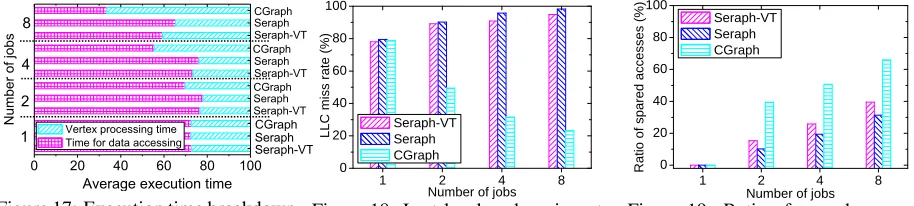
First, we evaluate the total execution time of eight CGP jobs over different systems for hyperlink14 with the graph change ratio ranging from 0.005% to 5%. In detail, the change on the successive two snapshots ranges from 0.005% to 5%. Figure 16 gives the results relative to the execution time of Seraph-VT when the ratio of changed edges is 0.005%. We can observe that CGraph always gets the best performance under different graph change ratios. It is because that CGraph still gets a low average data access cost to computation ratio, although the snap-shots have differences in graph structure. Besides, we can also find that CGraph needs longer execution time to handle the graph when the graph change ratio is larger, because of less data access correlations between the jobs. In the following experiments, we take a series of snap-shots of hyperlink14 as datasets, where the change ratio between any successive two snapshots is 5% and each job handles a snapshot. Figure 17 depicts the execution time breakdown of the jobs over different systems on hy-perlink14 when the the number of jobs increases. We can find that the jobs over CGraph have a lower average data access cost to computation ratio with the increase of the number of jobs, because there is more jobs to amortize the data access cost. However, for Seraph-VT and Ser-aph, the condition with more jobs leads to much more volume of data loaded into the cache and makes them suffer from serious cache interference and limited band-width. Thus, CGraph performs much better than Seraph-VT and Seraph when the number of jobs is larger.
0 20 40 60 80 100
CGraph
[image:12.612.74.531.75.178.2]8
...
...
CGraph Seraph Seraph-VT
4
2
1
Average execution time
Numb
er of
jobs
Vertex processing time Time for data accessing
CGraph Seraph Seraph-VT Seraph Seraph-VT CGraph Seraph Seraph-VT
...
Figure 17: Execution time breakdown of different solutions on hyperlink14
1 2 4 8
0
2 0 4 0 6 0 8 0 1 0 0
L
L
C
m
is
s
r
a
te
(
%
)
N u m b e r o f j o b s S e r a p h - V T S e r a p h C G r a p h
Figure 18: Last-level cache miss rate of different solutions on hyperlink14
1 2 4 8
0
2 0 4 0 6 0 8 0 1 0 0
R
a
ti
o
o
f
s
p
a
re
d
a
c
c
e
s
s
e
s
(
%
)
N u m b e r o f j o b s S e r a p h - V T S e r a p h C G r a p h
Figure 19: Ratio of spared accessed data on hyperlink14
with eight jobs is even only 32.8% of the condition with one job. However, in the other solutions, the cache miss rate is significantly increased when the number of jobs is more, because of serious cache interference.
Figure 19 gives the ratio of the total accessed data (in-cluding the data from the disk to the main memory and the main memory to the cache) spared by different so-lutions on hyperlink14 in comparison with the way se-quentially executing the jobs over Seraph. As expected, the number of data accesses spared by CGraph is much more than the other solutions. For example, when the number of jobs is eight, the ratio is even up to 65.9% for CGraph, while the ratios of Seraph-VT and Seraph are only 39.5% and 31.3%, respectively. Besides, as ob-served, CGraph spares much more data accesses when the number of jobs increases, thanks to more opportunity to share data accesses between different jobs.
5
Related Work
With the explosion of graph scale, many systems [15, 21, 29, 34] have focused on achieving high efficiency for it-erative graph analysis. However, most of them focus on supporting single graph processing job. They improve the efficiency either by fully utilizing the sequential us-age of memory bandwidth, or by achieving a better data locality and less redundant data accesses, which conse-quently reduces the volume of the accessed data.
GraphChi [19] is a popular one to achieve sequential storage access by employing parallel sliding windows. X-Stream [25] and Chaos [24] improve GraphChi by us-ing the streamus-ing partitions for better sequential access of out-of-core data. Xie etc. [30] propose a novel block-oriented computation model, in which computation is iterated locally over blocks of highly connected nodes, which improves the amount of computation per cache miss. PathGraph [33] models a large graph using a col-lection of tree-based partitions for better locality. Grid-Graph [35] proposes 2-Level hierarchical partitioning scheme to improve the locality and reduce the amount of I/Os. Mosaic [20] proposes a Hilbert-ordered tiles to store the graph for locality-optimizing and a hybrid execution model for fast heterogeneous computing. NX-graph [11] uses the destination-sorted sub-shard structure
to store a graph for better locality and adaptively chooses the fastest strategy to fully utilize the memory space and reduce the amount of data transfer. Instead of targeting a better locality, CLIP [6] proposes a method to reduce the total data access cost through the reentry of the loaded data and the so called beyond-neighborhood accesses.
Although these systems can support efficient execu-tion of a single iterative graph processing job, multiple separate copies of the same graph need to be created in the main memory by them for the CGP jobs. Follow-ing on this direction, Seraph [31, 32] is designed to al-low multiple jobs to correctly share one copy of the in-memory graph structure data. However, in Seraph, the accesses to the same graph partitions are performed sep-arately by the jobs along different graph paths, incur-ring redundant accesses and wasting the cache as well. Note that graph databases [8] are recently proposed to support concurrent queries over a graph. For example, TAO [9] provides a simple data model and APIs to store and query graph data. Wukong [26] uses a RDMA-based approach to provide low-latency concurrent queries over large graph-based RDF datasets. However, these graph database solutions can not efficiently support the execu-tion of the CGP jobs because they are dedicated to graph queries which usually only touch different small subsets of a graph for exactly once, instead of iteratively process-ing the entire graph for many rounds.
6
Conclusion
References
[1] Cachegrind.http://www.valgrind.org/, 2017.
[2] facebook.http://www.facebook.com/, 2017.
[3] Law.http://law.di.unimi.it/datasets.php, 2017.
[4] Snap. http://snap.stanford.edu/data/index.html, 2017.
[5] Wdc. http://webdatacommons.org/hyperlinkgraph/, 2017.
[6] AI, Z., ZHANG, M., WU, Y., QIAN, X., CHEN, K., AND
ZHENG, W. Squeezing out all the value of loaded data: An out-of-core graph processing system with reduced disk i/o. In Proceedings of the 2017 USENIX Annual Technical Conference (2017), pp. 125–137.
[7] BALUJA, S., SETH, R., SIVAKUMAR, D., JING, Y., YAGNIK, J.,AND ET AL. Video suggestion and discovery for youtube: Taking random walks through the view graph. InProceedings
of the 17th international conference on World Wide Web(2008),
pp. 895–904.
[8] BORNEA, M. A., DOLBY, J., AND ET.AL. Building an effi-cient rdf store over a relational database. InProceedings of the 2013 ACM SIGMOD International Conference on Management
of Data(2013), pp. 121–132.
[9] BRONSON, N., AMSDEN, Z., CABRERA, G.,AND ET.AL. TAO: Facebook’s distributed data store for the social graph. In
Proceed-ings of the 2013 USENIX Annual Technical Conference(2013),
pp. 49–60.
[10] BULUC¸ , A.,ANDMADDURI, K. Parallel breadth-first search on distributed memory systems. InProceedings of 2011 Interna-tional Conference for High Performance Computing,
Network-ing, Storage and Analysis(2011), pp. 1–12.
[11] CHI, Y., DAI, G., WANG, Y., SUN, G., LI, G.,ANDYANG, H. Nxgraph: An efficient graph processing system on a single ma-chine. InProceedings of the 2016 IEEE International Conference
on Data Engineering(2016), pp. 409–420.
[12] GONZALEZ, J. E., LOW, Y., GU, H., BICKSON, D., AND
GUESTRIN, C. Powergraph: distributed graph-parallel computa-tion on natural graphs. InProceedings of the 10th Usenix
Confer-ence on Operating Systems Design and Implementation(2012),
pp. 17–30.
[13] GUPTA, S., KUMAR, R., LU, K., AND ET AL. Local search methods for k-means with outliers. Proceedings of the VLDB Endowment 10, 7 (2017), 757–768.
[14] HAN, M., ANDDAUDJEE, K. Giraph unchained: Barrierless asynchronous parallel execution in pregel-like graph processing systems.Proceedings of the VLDB Endowment 8, 9 (2015), 950– 961.
[15] HARSHVARDHAN, WEST, B., FIDEL, A., AMATO, N. M.,AND
RAUCHWERGER, L. A hybrid approach to processing big data graphs on memory-restricted systems. InProceedings of the 2015 IEEE International Parallel and Distributed Processing Sympo-sium(2015), pp. 799–808.
[16] HONG, S., AND ET.AL. On fast parallel detection of strongly connected components (scc) in small-world graphs. In Proceed-ings of the 2013 International Conference for High Performance
Computing, Networking, Storage and Analysis(2013), pp. 1–11.
[17] JU, X., DAN, W., JAMJOOM, H.,ANDKANG, G. S. Version traveler: fast and memory-efficient version switching in graph processing systems. InProceedings of the 2016 USENIX Annual
Technical Conference(2016), pp. 523–536.
[18] KWAK, H., LEE, C., PARK, H.,ANDMOON, S. What is twitter, a social network or a news media? InProceedings of the 19th
international conference on World wide web(2010), pp. 591–600.
[19] KYROLA, A., BLELLOCH, G.,ANDGUESTRIN, C. Graphchi: Large-scale graph computation on just a pc. InProceedings of the 10th USENIX Symposium on Operating Systems Design and
Implementation(2012), pp. 31–46.
[20] MAASS, S., MIN, C.,AND ET AL. Mosaic: Processing a trillion-edge graph on a single machine. InProceedings of the 12th
Eu-ropean Conference on Computer Systems(2017), pp. 527–543.
[21] MALICEVIC, J., LEPERS, B. J. E., ANDZWAENEPOEL, W. Everything you always wanted to know about multicore graph processing but were afraid to ask. InProceedings of the 2017
USENIX Annual Technical Conference(2017), pp. 631–643.
[22] MEYER, U. Single-source shortest-paths on arbitrary directed graphs in linear average-case time. InProceedings of the 12th
annual ACM-SIAM symposium on Discrete algorithms(2001),
pp. 797–806.
[23] PAGE, L., BRIN, S., MOTWANI, R.,ANDWINOGRAD, T. The pagerank citation ranking: Bringing order to the web. Tech. rep., Stanford Digital Library Technologies Project, 1998.
[24] ROY, A., BINDSCHAEDLER, L., MALICEVIC, J.,AND ET AL. Chaos: Scale-out graph processing from secondary storage. In Proceedings of the 25th Symposium on Operating Systems
Prin-ciples(2015), pp. 410–424.
[25] ROY, A., MIHAILOVIC, I.,ANDZWAENEPOEL, W. X-stream: Edge-centric graph processing using streaming partitions. In Proceedings of the 24th ACM Symposium on Operating Systems
Principles(2013), pp. 472–488.
[26] SHI, J., YAO, Y., CHEN, R.,AND ET.AL. Fast and concurrent RDF queries with rdma-based distributed graph exploration. In Proceedings of the 12th USENIX Symposium on Operating
Sys-tems Design and Implementation(2016), pp. 317–332.
[27] VORA, K., XU, G.,ANDGUPTA, R. Load the edges you need: A generic i/o optimization for disk-based graph processing. In Proceedings of the 2016 USENIX Annual Technical Conference (2016), pp. 507–522.
[28] WANG, K., HUSSAIN, A., ZUO, Z., XU, G.,ANDAMIRISANI, A. Graspan: A single-machine disk-based graph system for interprocedural static analyses of large-scale systems code. In Proceedings of the 22nd International Conference on Architec-tural Support for Programming Languages and Operating Sys-tems(2017), pp. 389–404.
[29] WU, M., YANG, F., XUE, J., XIAO, W.,AND ET AL. Gram: scaling graph computation to the trillions. InProceedings of the
6th ACM Symposium on Cloud Computing(2015), pp. 408–421.
[30] XIE, W., WANG, G., BINDEL, D.,AND ET AL. Fast iterative graph computation with block updates.Proceedings of the VLDB Endowment 6, 14 (2013), 2014–2025.
[31] XUE, J., YANG, Z., HOU, S.,ANDDAI, Y. Processing concur-rent graph analytics with decoupled computation model. IEEE Transactions on Computers 66, 5 (2017), 876–890.
[32] XUE, J., YANG, Z., QU, Z.,AND ET AL. Seraph: an efficient, low-cost system for concurrent graph processing. InProceedings of the 23rd international symposium on High-performance
par-allel and distributed computing(2014), pp. 227–238.
[33] YUAN, P., ZHANG, W.,AND ET AL. Fast iterative graph com-putation: A path centric approach. InProceedings of the 2014 International Conference for High Performance Computing,
Net-working, Storage and Analysis(2014), pp. 401–412.
[34] ZHANG, K., CHEN, R.,ANDCHEN, H. Numa-aware graph-structured analytics. InACM SIGPLAN Notices(2015), vol. 50, pp. 183–193.
[35] ZHU, X., HAN, W.,ANDCHEN, W. Gridgraph: Large scale graph processing on a single machine using 2-level hierarchical partitioning. InProceedings of the 2015 USENIX Annual