NIH Career Development Awards: conversion to
research grants and regional distribution
Marisa L. Conte, M. Bishr Omary
J Clin Invest.
2018;128(12):5187-5190. https://doi.org/10.1172/JCI123875.
The four major NIH-supported career development K awards are the K01, K08, K23, and
K99, which comprise 70% of the investment allocated to the 15 K-type career awards. One
measure of early career success is the conversion of the K award to an NIH R01 grant.
Analysis of the outcomes of K-to-R01 conversion within 5 years of receipt of the K award
across the NIH during the period 2008–2012 showed that K99 awards have a uniform (up to
60%) increased conversion success compared with the K01, K08, and K23 mechanisms.
The K99 success continued to 7 years for the available analysis period (2008–2010). The
largest number of K award recipients and their conversion to R01 were at institutions
located in California, Massachusetts, and New York. Several measures that may enhance
conversion of the K01/K08/K23 and diversify the distribution of the awardees are
highlighted. Investing in early-career researchers The NIH has made significant investments
in researcher career development, including a range of research training (T-type), career
development (K-type), and fellowship (F-type awards) (1). In federal fiscal year 2017 alone,
NIH directed 4.5% ($1.5 billion) of its $33.1 billion budget to K ($680 million), T ($664
million), and F ($158 million) grants (2, 3). After completion of higher degree training (e.g.,
PhD/MD/DDS/PharmD), four NIH-supported awards account for nearly 70% of 15 K-type
[…]
Viewpoint
Find the latest version:
5 1 8 7
jci.org Volume 128 Number 12 December 2018
NIH Career Development Awards: conversion to
research grants and regional distribution
Marisa L. Conte1 and M. Bishr Omary2,3
1Taubman Health Sciences Library, University of Michigan, Ann Arbor, Michigan, USA. 2Department of Molecular and Integrative Physiology, and 3Department of Internal Medicine, Division of
Gastroenterolo-gy and HepatoloGastroenterolo-gy, University of Michigan Medical School, Ann Arbor, Michigan, USA.
T
he four major NIH-supported career development K awards are the K01, K08, K23, and K99, which comprise 70% of the investment allocated to the 15 K-type career awards. One measure of early career success is the conversion of the K award to an NIH R01 grant. Analysis of the outcomes of K-to-R01 conversion within 5 years of receipt of the K award across the NIH during the period 2008–2012 showed that K99 awards have a uniform (up to 60%) increased conversion success compared with the K01, K08, and K23 mechanisms. The K99 success continued to 7 years for the available analysis peri-od (2008–2010). The largest number of K award recipients and their conversion to R01 were at institutions located in Califor-nia, Massachusetts, and New York. Several measures that may enhance conversion of the K01/K08/K23 and diversify the distri-bution of the awardees are highlighted.Investing in early-career
researchers
The NIH has made significant investments in researcher career development, includ-ing a range of research traininclud-ing (T-type), career development (K-type), and fellow-ship (F-type awards) (1). In federal fiscal year 2017 alone, NIH directed 4.5% ($1.5 billion) of its $33.1 billion budget to K ($680 million), T ($664 million), and F ($158 million) grants (2, 3). After comple-tion of higher degree training (e.g., PhD/ MD/DDS/PharmD), four NIH-supported awards account for nearly 70% of 15 K-type awards (2): K01 (established in 1997, sup-ports postdoctoral or early-career research scientists committed to research), K08 (established in 1997, supports clinician scientists to develop into independent investigators), K23 (established in 1999,
supports clinically trained professionals committed to patient-oriented research), and K99 (established in 2007, supports an initial mentored research K99 experience for postdoctoral researchers, and 3-year independent R00 funding if an indepen-dent faculty position is secured) (4, 5). The NIH has published two detailed reports to evaluate the career development mecha-nism (6, 7). Most recently, the 2011 analysis indicated that K01, K08, or K23 awardees had higher R01 award success and R01 renewal rates than individuals with no prior career development support; K99 awards were not included in this analysis since that K-type award was relatively new (7). One conclusion is that these awards are meeting the goal of fostering indepen-dent research careers of early-stage clini-cians and research doctorates (7).
Assessing outcomes of career
awards
In order to evaluate the K99 mechanism and compare it to K01/K08/K23 mecha-nisms, we examined the career develop-ment success of the K01/K08/K23/K99 awards using conversion to R01 indepen-dent research funding within 5 and 7 years of receipt of the K as a benchmark. We col-lected data from the NIH Research Port-folio Online Reporting Tool (RePORTER) and tabulated conversion success to an R01, including the distribution of the K awardees and the K-to-R01 recipients in different states within the United States. We focused on the number of awards giv-en during 2008–2012, which allowed a full 5-year follow-up through 2017. There were some fluctuations in the number of K awards, with slightly more K99 awards than K01/K08/K23 awards given annu-ally since 2012 (e.g., 235 K99 awards in
2017 compared with 195–217 awards for K01/K08/K23; Supplemental Table 1; supplemental material available online with this article; https://doi.org/10.1172/ JCI123875DS1).
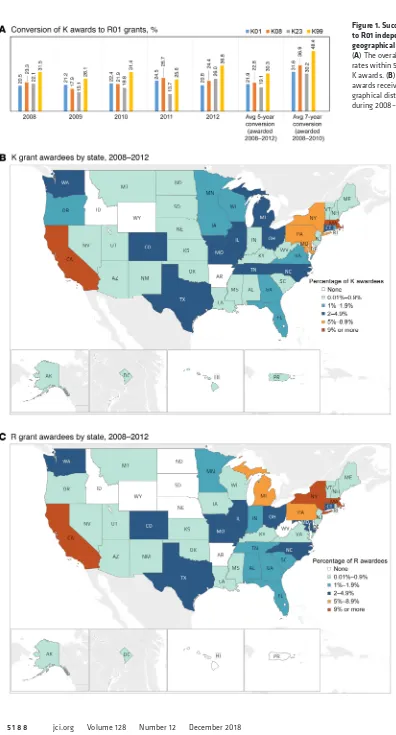
For investigators who converted to more than one R01, only the first R01 was included in the analysis. The overall mean K-to-R01 within 5 years of receipt of the K awards was markedly higher for the K99 awardees during the period 2008–2012 (30.3% average for K99 compared with 19.1%–22.8% for K01/K08/K23) (Fig-ure 1A). The average 7-year conversions increased for all K awards (30.2%–48.4% conversions during 2008–2010) (Figure 1A and Supplemental Table 2). This com-pares with the R01-equivalent success rates of 33%–39% during 2008–2017 (Sup-plemental Table 3). The 7-year, compared with the 5-year, conversion success for the K01 increased by 44%, whereas the K08/K23/K99 increased by 58%–62%. As might be expected, most conversions to R01 (82%) took place at a different insti-tution than where the K99 was received (Supplemental Table 4).
For the K awards received during 2008–2012, 39–43 of the states had at least one K awardee, and 28–36 of the states had at least one R01 awardee who convert-ed their K within 5 years (Supplemental Tables 5 and 6). Of note, three states (CA, MA, NY) collectively had the largest num-ber of K (40%) and K-R01 (35%) awardees of the total (Figure 1, B and C), with Cal-ifornia and Massachusetts capturing 78% (K) and 73% (K-to-R01) of the three-state share (Supplemental Tables 7 and 8). Between 2008–2012, the average popula-tions of the three states relative to the US population were 12.1% (CA), 2.1% (MA), and 6.3% (NY), while the corresponding market share of the NIH budget was 15.6% (CA), 10.3% (MA), and 8.5% (NY) (8).
Although the K99 mechanism has been in place for 10 years, this 5-year Conflict of interest: The authors have declared that no conflict of interest exists.
5 1 8 9
jci.org Volume 128 Number 12 December 2018
almost exclusively to individuals holding a PhD degree (12). One potential caveat of our analysis, particularly for the K23 mech-anism given that we focus strictly on the first R01, is that many K23 awardees may not be engaged in R01-type research.
Finally, we call attention to the uneven distribution of career awards across the US and encourage NIH to further assess diversification of career awards to broaden distribution within the US, while still mak-ing selection decisions based on candidate qualifications and the research environ-ment. However, further analysis of the apparent geographic disparity is needed, including whether it is related to the num-ber of research-intensive institutions (e.g., using the Carnegie Classification, ref. 13) and the support infrastructure of the insti-tutions in the more heavily represented states. A challenge for diversification is the need to have the necessary infrastructure, resources, and mentoring to insure suc-cess of the awardees. Such challenges can be addressed, in part, by forming partner-ships with appropriately resourced institu-tions, encouraging co-mentoring (possibly by providing a discretionary stipend), and continued monitoring of awardee prog-ress. Although investing in research career development does not guarantee a con-tinued successful research career for any one individual, it does show that research careers are valued, which is critical for a diverse and successful research workforce pipeline of biomedical investigators.
Acknowledgments
We thank Dr. Kay Lund and Heather Off-haus for very helpful discussions, Tyler Nix for producing the map visualizations, and Joyce Kennedy for assistance with fig-ure and table preparation. MBO is support-ed by NIH grants DK47918, DK116548, and GM111725.
Address correspondence to: Marisa Conte, Taubman Health Sciences Library, Univer-sity of Michigan, 1135 E. Catherine Street, Ann Arbor, Michigan 48109-2038, USA. Email: [email protected]. Or to: Bishr Omary, Department of Molecular & Inte-grative Physiology, University of Michigan Medical School, 7720 Medical Science II, 1301 E. Catherine Street, Ann Arbor, Mich-igan 48109-5622, USA. Email: mbishr@ umich.edu.
enhancing mentoring and training and related expectations, and standardizing data on outcomes (11). Second, we suggest that institutions share best practices that increase both infrastructure and capac-ity for mentoring, including recognition of mentoring activities as service for pro-motion and tenure purposes, and focused training on grant writing for early-career researchers. Third, we believe there is a need to increase funding and success rates for the K99 mechanism: FY2017 support for the K99 was $27.1 million (a marked increase from the $17.1 million allocated in 2008), as compared with $30.5 million for the K01, $33.8 million for the K08, and $39.7 million for the K23. This can be achieved by increased allocation for K awards in the NIH budget, and potential-ly changing the indirect cost recovery rate for the R00 to the standard 8% to match other K awards. We estimate that the latter could add more than $50 million annually if the R00 is capped annually at $150,000 (excluding the 8% indirects), although we acknowledge that discussion regarding indirect cost recovery can be both con-tentious and complicated. Fourth, institu-tional commitment to K awardees and not sole reliance on the NIH is essential. Fifth, since the K01 is the primary comparator with the K99, as applicants for both mech-anisms are typically PhD scientists (though the K99 does not require US citizenship or permanent resident status), strength-ening the K01 deserves assessment. This could involve modifying the mechanism to include the additional R00 resources: for example, making the K01 award 2–3 years and coupling it with 2–3 additional years of an R00 (5 years of total support), similar to the K99/R00 in terms of expectations. This may enhance the future success and career development of the K01 awardees by providing additional resources, a fac-ulty position with a start-up package, and other associated benefits. Sixth, similar considerations can be made for the K08 and K23 mechanisms; clearly, maintain-ing the pipeline of clinicians and clinician scientists engaged in biomedical research is essential (11). Notably, the NIH Phy-sician-Scientist Workforce 2014 Report made several recommendations, including that NIH should provide physician scien-tists with programs similar to the K99/ R00, since the K99/R00 program goes comparative analysis indicates it is
out-performing by 33%–59% the K01/K08/ K23 mechanisms in K-to-R01 conversion. What accounts for this difference? One possible factor is the requirement to obtain a faculty position within 2 years of receipt of the K99, coupled with the availability of the R00; these may serve as catalysts to jump-start an independent career, par-ticularly as the tenure-track faculty desig-nation provides awardees with additional infrastructure and resource support. Also, the more competitive nature of the K99 has been documented (9); this might con-tribute to preselecting candidates who are more prepared to publish and write grants. The mean success rates to secure a K award during the period of analysis were 36% (K01), 44% (K08), 38% (K23), and 24% (K99) (Supplemental Table 9); these numbers are similar to the 2017 success rates (10). Finally, the shorter postdoc-toral period for K99 awardees may play a motivational role. A candidate cannot be a postdoctoral trainee for more than 4 years when applying for a K99, versus the 5- to 7-year allowable postdoctoral window for the other three K mechanisms.
Improving support for the next
generation of researchers
comes for the NHLBI K99/R00 Pathway to Independence Program in relation to long-standing career development programs: implications for trainees, mentors, and institu-tions. Circ Res. 2016;119(8):904–908. 10. NIH Funding Success Rate. National Institutes
of Health. https://report.nih.gov/success_rates/ index.aspx. Updated June 30, 2018. Accessed September 19, 2018.
11. National Academies of Sciences, Engineering, and Medicine. The Next Generation of Biomedical and
Behavioral Sciences Researchers: Breaking Through.
Washington, DC: The National Academies Press; 2018. https://doi.org/10.17226/25008. 12. Physician-scientist workforce (PSW) report
2014. Research Portfolio Online Reporting Tolls (RePORT). National Institutes of Health. https:// report.nih.gov/Workforce/PSW/psw-group. aspx. Updated June 30, 2018. Accessed September 19, 2018.
13. The Carnegie Classification of Institutions. Indi-ana University. http://carnegieclassifications. iu.edu/. Accessed September 19, 2018. Awards: Number of Entry-Level Awards. National
Institutes of Health. https://report.nih.gov/ nihdatabook/charts/Default.aspx?chartId= 223&catId=16. Accessed September 19, 2018. 6. Review of the National Institutes of Health
Bio-medical Research Training Programs, October 1989. National Institutes of Health. https:// researchtraining.nih.gov/sites/default/files/ pdf/NIH_biomedical_research_review_oct89. pdf. Accessed September 2018.
7. National Institutes of Health Mentored Career Development Award Program. National Insti-tutes of Health. https://researchtraining.nih.gov/ sites/default/files/pdf/K_Awards_Evaluation_ FinalReport_20110901.pdf. Published August 29, 2011. Accessed September 19, 2018. 8. NIH Awards by Location & Organization.
National Institutes of Health. https://www. report.nih.gov/award/index.cfm?ot=&fy= 2012&state=&ic=&fm=&orgid=&distr=
&rfa=&om=n&pid=#tab1. Updated June 12, 2018. Accessed September 19, 2018. 9. Carlson DE, Wang WC, Scott JD. Initial 1. NIH Parent Announcements (For
Unsolic-ited or Investigator-Initiated Applications), Career Development (K) Announcements. National Institutes of Health. https://grants. nih.gov/grants/guide/parent_announcements. htm#train. Accessed September 19, 2018. 2. Research Career Development Awards:
Appli-cations, awards, success rates, and funding, by institute/center and activity code. Research Portfolio Online Reporting Tools (RePORT). National Institutes of Health. https://report. nih.gov/budget_and_spending/index.aspx. Accessed September 19, 2018.
3. HHS FY 2017 Budget in Brief – NIH. US Depart-ment of Health & Human Services. https://www. hhs.gov/about/budget/fy2017/budget-in-brief/ nih/index.html. Accessed September 19, 2018. 4. Research Career Development Awards. National
Institutes of Health. https://researchtraining. nih.gov/programs/career-development. Accessed September 19, 2018.