© 2019, IRJET | Impact Factor value: 7.34 | ISO 9001:2008 Certified Journal | Page 1735
Review on the Development and Implementation of Real-Time Flex
Sensor based Prosthetic hand
Atishay. M
1, D. Mahesh Kumar
2, Nikhitha. P. Rao
3, Jyothi. S
4, Afifa Parveen
52
Associate Professor, JSS Academy of Technical Education, Bengaluru, India
1,3,4,5
Students, JSS Academy of Technical Education, Bengaluru, India
---***---Abstract -
On a survey it’s recorded that there are morethan 1 million annual limb amputations globally. In order to provide a quality life with independence and freedom to the amputees for performing their day to day activities prosthesis was developed. In this paper, the development of a real-time flex sensor based Prosthetic Hand is discussed. Currently different types of prosthetic arms based on different control techniques have been developed and is around the global market. The proposed paper involves a glove control technique for the control of the arm motion, where flex sensors which is incorporated into the glove gives the gesture input to the system.
Thus, here the results would be experimentally validated by measuring real-time variations by phantom mimicking the properties of human muscle. Monitoring and control of the rotation of prosthetic arm is therefore demonstrated using glove control and the action is facilitated by the actuators interfaced. The prosthetic arm here is developed using the 3-D Printing technique.
Key Words
:
Prosthetic hand, Flex sensors, Glove control, Phantom Mimicking, Actuators, 3-D printing.
1. INTRODUCTION
Currently, wide range of amputation cases is recorded globally. On an average, in our country there are about 5, 00,000 amputees and every year 23,500 are added [1]. The reasons might be due to inborn diseases or due to the increase in the number of accidents. The amputees are unable to perform their regular work due to the loss of their limb and always require the help of one or the other person. It would be a very difficult task for them to always depend on others; hence prosthesis can be used in order to replace the loss. But the use of prosthesis is only limited to the appearance and cannot perform any task. Therefore, an electronically controlled prosthesis is designed so that it would replace the loss and also perform the activities that the original limb would perform. It would also avoid the dependency on others.
There are robotic arms available which are very expensive and since most of the amputees are poor, they cannot afford to buy the prosthetic arms which costs around lakh. Hence, a prosthetic arm would be designed which would be affordable to everyone. Several kinds of prosthetic arms are available based on the different types of control
having their own advantages and disadvantages, which would be discussed later in this paper.
This paper presents the use of a 3D printed prosthetic hand. A 3D printed prosthetic hand is a faster and efficient way to replace with the loss of limb of an amputee, since the processing of 3D printing is very fast. The biggest advantage of using a 3D printed hand is that it can be operated in hazardous environments and also in the areas where the humans cannot reach. In addition, it is easily changeable, so that the prosthesis can adapt to the needs of different types of amputation and people belonging to the age group of constant growth. The actions to be performed by the 3D printed prosthetic arms are controlled by a micro-controller. Flex sensors are used to obtain the movement of the fingers made by the human hand and this information is sent to the micro-controller to imitate the working of the hand, thereby the prosthetic arm will perform the operation performed by the human hand. The movement of the fingers is controlled by servomotors and the movement of the wrist is controlled by a gyroscope, thereby functioning as an original hand. By the use of this, the amputee would be able to grasp objects and also to lift heavy objects without the help of any.
The aforementioned design would be able to mimic the functioning of a human hand and would be dexterous with an easy and natural control. The most important thing considered is the cost which would be as low as possible and would be affordable to everyone.
1.1 Literature Survey
There are a lot of prosthetic hand designs around the world. Some prosthetic hands differ in the sensors used, some in the materials with which they are built and some the methodology. These prosthetic hands are costly, harder to use since the design, usage is very complex. There are few papers below which shows how similar or different is our paper from them.
© 2019, IRJET | Impact Factor value: 7.34 | ISO 9001:2008 Certified Journal | Page 1736
The main disadvantage here is that it is very difficult tosense and process an EMG signal.
Prosthetic hand with Biomimetic Tactile sensing and force feedback [3]: This paper proposes the use of force feedback actuation system in order to drive the motors to control the movement of the fingers. Feedback actuation mechanism is integrated to myoelectric band on residual limb and the sensor is designed based on biomimetic strategy. 3D printed structure is integrated onto a surface. The drawbacks of this are that it exhibits only linear characteristics and is difficult to handle with non-linear motions.
Thumb controlled Low-Cost Prosthetic Robotic Arm [4]: In this paper, the proposed methodology has a particle board frame which has the whole circuit. This can add to the prosthetic hand being bulkier. And the prosthetic arm has a claw shaped arm, which don’t serve our purpose of making it look exactly like an arm so that the amputees feel comfortable wearing it.
Optoelectronically innervated soft prosthetic hand via stretchable optical waveguides [5]: In this paper, the proposed methodology uses optical waveguides which very costly. Optoelectronic strain sensors used here are susceptible to interference from environmental effects. A solenoid valve is used which requires the control signal continuously which is difficult to provide.
Three-Dimensional Printing of Prosthetic Hands for Children [6]: This paper mainly proposes about the 3D printing technology and the materials used to develop prosthetic hand. In children, the growth period would bring a lot of physical changes which is challenging, in order to adapt to those changes, the 3D printed prosthetic hand was designed accordingly in here. So, prosthetic hand can be designed and developed faster using 3D printing technology and also to get a better quality, creative design and freedom to customize.
Design and Fabrication of a Soft Robotic Hand with Embedded Actuators and Sensors [7]: The proposed methodology uses a silicone rubber material for the body of the arm which is soft and recovers the shape after removing the pressure applied to it. Piezoelectric transducer is used to sense the finger movements. Fabrication process is tedious. Embedded shape memory alloy (SMA) actuator is used to provide the movement which is made of Ni-Ti strip. This Ni-Ti strip picks up false signal as they are very sensitive.
Use of accelerometers in the control of practical prosthetic arm [8]: The proposed methodology uses accelerometers to control the movement of the prosthetic arm and also provides the information on the orientation of limb segments. Inertial Measurement Unit (IMU) is used which is a combination of accelerometer, gyroscope and
magnetometers. EMG sensor is used to sense the contractions of the muscles. But the major disadvantage is that the prosthetic arm developed is very heavy and as well as slower in operation and hard to use.
Voice control based prosthetic human arm [9]: In this paper, the proposed methodology contains a prosthetic arm whose movement can be controlled by voice. This is actually a big step in the advancement of technology, but it has its own disadvantages. Since the prosthetic arm is voice controlled, it causes problems in the noisy environment. Sometimes the prosthetic arm might have delayed response than the glove controlled prosthetic arm. And the major disadvantage is that is requires constant internet connection since it’s using Google’s API to convert voice commands into to text.
Design of multi grip patterns, prosthetic hand with single actuator [10]: In this paper, the proposed methodology has only one actuator to control the prosthetic hand with five finger multi grip pattern which helps to perform daily activities. But the size of the actuator is very big. The grasp of the fingers is not stable.
User friendly LabVIEW GUI for prosthetic hand control using Emotive EEG headset [11]: In this paper, controlling of the prosthetic hand is done through Brain Computer Interface (BCI). The signals are recorded through the emotive Electroencephalograph (EEG) headset. EEG is integrated with Graphical User Interface (GUI) and designed using LabVIEW. It has a lot of disadvantages as the range of functions performed is limited and has to be trained to perform the required functions and a lot of disturbances occur in data due to artifacts.
2. Methodology
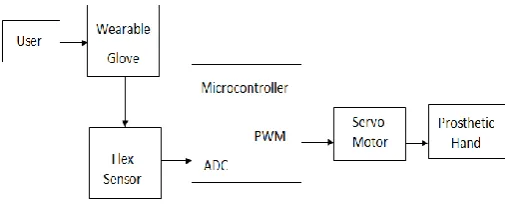
The proposed prototype consists of a wearable control glove in order to control the movement of the hand. A wearable glove is a simple way to communicate with the machines in the form of commands. It gives the control signals of the robotic arm. It consists of sensors within it in order to obtain the information about the finger positions.
The flex sensors present in the gloves operate on the amount of deflection or bending created. A change in the resistance is being created due to the bending action of the sensor. The user can control the arm motion by wearing the glove and moving the fingers to which the arm imitates the finger movements of the user.
© 2019, IRJET | Impact Factor value: 7.34 | ISO 9001:2008 Certified Journal | Page 1737
pulse width modulated signals are used to control theworking of the servomotors, thereby the control of the prosthetic hand.
A gyroscope is present on the middle of the glove to determine the amount of rotation caused by the human hand. Based on this, the pulse width modulated signals are varied, thereby controlling the servomotors.
Synchronous movement of each finger is done by using nylon threads, which act as artificial tendons attached to the servo pulleys, present at the finger tips.
After the completion of the 3D printing, the hand is so designed such that it does not cause any disturbance to the movement of each finger. The 3D printed hand is finally connected to the electrical circuit, consisting of the controller, sensors and the servo motors.
The micro-controller controls all the actions to be performed by the prosthetic hand. It is programmed, to collect data from the sensors and send it to the actuator for controlling.
The prosthetic hand is designed by using a 3D printer, in which actuators are installed. The control signals are given to the actuator from the micro-controller which is used to control the movements of the arm.
Fig -1: Block diagram
2.1 Flex sensor:
A flex sensor or bend sensor is a sensor that measures the amount of deflection or bending. Usually, the sensor is stuck to the surface, and resistance of sensor element is varied by bending the surface. Since the resistance is directly proportional to the amount of bend it is used as goniometer, and often called flexible potentiometer. Flex sensor is used in wide areas of research from computer interfaces, rehabilitation, security systems and even music interfaces.
Fig -2: Flex Sensor
2.2 Servo Motor:
A servo motor is an electrical device which can push or rotate an object with great precision. If you want to rotate and object at some specific angles or distance, then you use servo motor. It is just made up of simple motor which run through servo mechanism. It consists of a suitable motor coupled to a sensor for position feedback. It also requires a relatively sophisticated controller, often a dedicated module designed specifically for use with servomotors. Servomotors are not a specific class of motor, although the term servomotor is often used to refer to a motor suitable for use in a closed-loop control system. Servomotors are used in applications such as robotics, CNC machinery or automated manufacturing.
Fig -3: Servo motor
2.3 Analog to Digital Conversion (ADC):
[image:3.595.37.290.437.541.2] [image:3.595.383.479.450.561.2]© 2019, IRJET | Impact Factor value: 7.34 | ISO 9001:2008 Certified Journal | Page 1738
2.4 Pulse Width Modulation (PWM):Pulse width modulation (PWM), or pulse-duration modulation (PDM), is a method of reducing the average power delivered by an electrical signal, by effectively chopping it up into discrete parts. The average value of voltage (and current) fed to the load is controlled by turning the switch between supply and load on and off at a fast rate. The longer the switch is on compared to the off periods, the higher the total power supplied to the load. 2.5 Gyroscope:
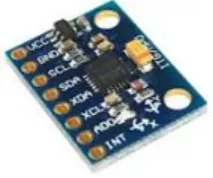
These are the devices which sense the angular velocity. They are also called as angular rate sensors or angular velocity sensors. The MPU6050 gyroscope consists of a 3-axis gyroscope, 3-3-axis accelerometer and a Digital Motion Processor (DPM).
Fig -4: Gyroscope module
3. CONCLUSION
This work aims to propose a cost effective robotic prosthetic arm and also to avail amputees with a better and effective way to carry on regular activities involving the need of both the hands. The work also details about the design of a simple prosthetic hand developed using 3D printing technology. The proposed methodology tries to resolve the medically inclined issues with the phantom limb disorder in the affected arm and also the issues regarding the different kind of amputation needs and especially in people belonging to the age group of constant growth with the easily adaptable mechanical design of 3D printed prosthetic hand.
REFERENCES
[1] “A report on amputees in India”, http://www.oandplibrary.org/op/1986_01_016.asp [2] Alejandro Ca˜nizares, Jean Pazos and Diego Ben´ıtez,
“On the use of 3D printing technology towards the development of a low cost robotic prosthetic arm”, 2017 IEEE International Autumn Meeting on Power, Electronics and Computing (ROPEC 2017), Ixtapa, Mexico.
[3] William Taube Navaraj, Habib Nassar and Ravinder Dahiya, “Prosthetic hand with Biomimetic Tactile sensing and force feedback”, 2019 IEEE International
Symposium on Circuits and Systems (ISCAS), Sapporo, Japan, Japan.
[4] Amit Hasan Khan, Fairoz Nower Khan, Lamiah Israt and Md. Saiful Islam, “Abdulla Samy, “Thumb Controlled Low-Cost Prosthetic Robotic”, 2019 IEEE International Conference on Electrical, Computer and Communication Technologies (ICECCT), Coimbatore, India.
[5] Huichan Zhao, Kevin O’Brien, Shuo Li and Robert F. Shepherd, “Optoelectronically innervated soft prosthetic hand via stretchable optical waveguides”, December 2016, Science Robotics, Vol. 1, Issue 1, eaai7529 .
[6] Matthew B. Burn, Anderson Ta and Gloria R. Gogola, “Three-Dimensional Printing of Prosthetic Hands”, March 2016, The Journal of Hand Surgery .
[7] Yu She, Chang Li, Jonathon Cleary and Hai-Jun Su, “Design and Fabrication of a Soft Robotic Hand with Embedded Actuators and Sensors”, May 2015, Journal od Mechanisms and Robotics .
[8] Peter J Kyberd and Adrian Poulton, “Use of accelerometers in the control of practical prosthetic arm”, October 2017, IEEE Transactions on Neural Systems and Rehabilitation Engineering, Volume: 25, Issue: 10.
[9] Ujwal, Rakshith Narun, Harshell Surana, Naga Surya and Ch Preetham Dheeraj, “Voice control based prosthetic human arm”, July 2018, International Research Journal of Engineering and Technology (IRJET), Volume: 05 Issue: 07.
[10]Panipat Wattanasiri, Pairat Tangpornprasert, and Chanyaphan Virulsri, “Design of multi grip patterns, prosthetic hand with single actuator”, June 2018, IEEE Transactions on Neural Systems and Rehabilitation Engineering, Volume: 26, Issue: 6.
[11]Mohamad Amlie Abu Kasima, Cheng Yee Lowb, Muhammad Azmi Ayuba, Noor Ayuni Che Zakariaa, Muhammad Haszerul Mohd Salleha, Khairunnisa Johara and Hizzul Hamlia, “User friendly LabVIEW GUI for prosthetic hand control using Emotiv EEG headset”, 2016 IEEE International Symposium on Robotics and Intelligent Sensors, IRIS 2016, Tokyo, Japan.
[12]Shiva Subhashini Pakalapati, G. Govardhana Chary, Atul K. Yadaw, Sushil Kumar, Hitesh K. Phulawariya and Rahul Kumar, “A Prosthetic hand control interface using ESP8266 Wi-Fi module and android application”, 2017 International Conference on Innovations in Information, Embedded and Communication Systems (ICIIECS), Coimbatore, India. [13]Farah Alkhatib, John-John Cabibihan and Elsadig
Mahadi, “Data for benchmarking low-cost, 3D printed prosthetic hands”, Data in Brief, Volume 25, August 2019, 104163.
[image:4.595.108.215.306.395.2]© 2019, IRJET | Impact Factor value: 7.34 | ISO 9001:2008 Certified Journal | Page 1739
Advanced Research in Electronics and CommunicationEngineering (IJARECE) Volume 4, Issue 12, .
[15]John-John Cabibihan, M. Khaleel Abubasha, and Nitish Thakor, “A method for 3D printing patient specific prosthetic arm with high accuracy shape and size”, 2018 IEEE Access, Volume 6, 2018.
[16]Mohammed Fattah Saqib, Aurnab Islam, MD Labib Arefin Bari, Mir Sadif Ahmed and MD. Arif Abdulla Samy, “Gesture controlled prosthetic arm with sensation sensors”, 2018 3rd International Conference for Convergence in Technology (I2CT), Pune, India.
BIOGRAPHIES
Mr. Atishay M is currently pursuing Bachelors of Engineering (Electronics and Instrumentation) from JSS Academy of Technical Education. He is currently recruited by Accenture.
D. Mahesh Kumar is presently working as Associate Professor and the Head of the Department of Electronics and Instrumentation Engineering, JSS Academy of Technical Education. He is working in teaching field from past 19 years and has published more than 16 publications in international journals and national & international conferences.
Ms. Nikhitha P Rao is currently pursuing Bachelors of Engineering (Electronics and Instrumentation) from JSS Academy of Technical Education. She is currently recruited by TCS.
Ms. Jyothi S is currently pursuing Bachelors of Engineering (Electronics and Instrumentation) from JSS Academy of Technical Education. She is currently recruited by TCS.