Postdigital Science and Education
Networked Learning and Postdigital Education
--Manuscript
Draft--Manuscript Number: PDSE-D-18-00002R1
Full Title: Networked Learning and Postdigital Education
Article Type: Original Article
Funding Information:
Abstract: This paper considers the positon of networked learning in higher education learning and teaching in the postdigital era. The underlying origins and principles upon which networked learning are based can be traced back to the critical pedagogy of Freire and emphasise a critical relationship with the digital, the human and the current socio-political and material higher educational context. We examine the theoretical and practical ideas around networked learning in which connections are forged between learners; between learners and their tutors; and between learning communities and learning resources. We describe two case studies to illustrate the theory, pedagogy and practice of networked learning for contemporary higher education learning and teaching. One from the perspective of the online distant learner and their experience of networked learning; the other from the perspective of tutors, which focuses on the challenges they face in moving into the digital world. We conclude by claiming that the way networked learning has developed in theory and practice means it is an approach and pedagogy that makes it entirely suitable for a postdigital world.
Corresponding Author: Vivien Hodgson Lancaster University UNITED KINGDOM
Corresponding Author Secondary Information:
Corresponding Author's Institution: Lancaster University
Corresponding Author's Secondary Institution:
First Author: Vivien Hodgson
First Author Secondary Information:
Order of Authors: Vivien Hodgson
David McConnell
Order of Authors Secondary Information:
Author Comments: Whilst we have anonymised our names in the text as requested it is probably not too difficult to work out who the authors of the paper are in practice
Response to Reviewers: Specific responses below, within the text of reviewer 2’s comments
Comments from and responses to reviewer 2 In any case, here are some comments:
*Although I appreciated and really enjoyed the historical account from a networked learning perspective I am wondering if you could initially make it clearer why this is important in relation to the postdigital. Why go back in time, rather than just discussing recent literature from NL? You do state that the principles are more or less the same, so a devil's advocate question would be why the historical development is important? I am certainly not suggesting it isn't, but I thought this could perhaps become more explicit - and I will also mention it in relation to the next comments
*I think the relations between the postdigital and networked learning could be explored more thoroughly in the article. There are initially a few remarks about postdigital education, and postidigital perspective as congruent with NL emerges later in the paper, however, it is not quite clear what you mean by the postdigital apart from the initial reference "we are no longer in a world where…". I would suggest that you in the discussion/conclusion engage in discussing the postdigital and NL even more carefully. I know the literature on the postdigital might be scant, but then there is the more reason to engage with it, and also there are some recent papers in PDSE that could perhaps be interesting. This could help us all in better grasping with and thinking about how to conceptualise and think of postdigitality; and could unearth some links between current postdigital thinking with the history of NL (also emphasising the relevance of the historical account). Further, in the
intro it says you will discuss NL as relevant for postdigital education, and postdigital education is in title, but not something that appears explicitly in the concluding part and discussion. I think this could be elaborated - what is the vision or understanding of postdigital education from a networked learning perspective. How can networked learning help us realise postdigital education, what could it look like etc. I think that could be interesting - using the past experiences also a bridge to the future (and that would perhaps also make it clearer why the historical account is important). I think this to some extent is already there, but could be strengthened.
Response; these are very important comments which we have tried to address by bringing in more of the postdigital education literature and thinking. We have done this not so much to show how NL can help to realise postdigital education perhaps but more to show it is by the way it has developed in parallel with digitalisation a living social and material example of postdigital education and pedagogy.
*The notion of critical pedagogy features quite strongly in the abstract/intro, but then actually disappears as an explicit concept until page 8 - so it is not explicitly picked up in relation to the principles, but is later stressed as very essential in relation to NL. This mainly being an observation, but perhaps it could also be woven more explicitly in with the principles, and perhaps also later in the concluding part become a stronger bridging concept between the history and development of NL and the current thinking within the postdigital literature (where my feeling is that it also features quite strongly) -so this could perhaps al-so be a concept that could weave together NL and
postdigitality in the concluding/discussing part and in thinking about the future of postdigital education.
Response; we agree that critical pedagogy features quite strongly within the postdigital literature and consequently have made the position of critical pedagogy within NL and postdigital education stronger in the paper in an attempt to show how this does indeed reflect and bridge NL and postdigital education.
*One minor comment: In the section 'Illustrative example of Networked Learning' there are some shifts between past- and present tense - as I wrote in a specific comment: "Here it is written in past tense and as describing something you once did. However, in the text following it is mostly in present tense 'we encourage learners to set aside' - not sure it should be changed, but just wondering since it is a description of a design made some years back?" I have marked up some examples in the attached PDF, where it seems to shift between past/present.
Response; thanks for pointing this out – we have we hope now addressed this issue in the resubmission!
Networked Learning and Postdigital Education
Abstract
This paper considers the positon of networked learning in higher education learning and teaching in the postdigital era. The underlying origins and principles upon which networked learning are based can be traced back to the critical pedagogy of Freire and emphasise a critical relationship with the digital, the human and the current socio-political and material higher educational context. We examine the theoretical and practical ideas around networked learning in which connections are forged between learners; between learners and their tutors; and between learning communities and learning resources. We describe two case studies to illustrate the theory, pedagogy and practice of networked learning for contemporary higher education learning and teaching. One from the
perspective of the online distant learner and their experience of networked learning; the other from the perspective of tutors, which focuses on the challenges they face in moving into the digital world. We conclude by claiming that the way networked learning has developed in theory and practice means it is an approach and pedagogy that makes it entirely suitable for a postdigital world.
Keywords
Networked Learning, Postdigital, Education, Critical Pedagogy,
Introduction
In this paper, we will explain and explore the origins of the early principles and characteristics of networked learning (NL) and consider their relevance and importance for postdigital education. We will then describe further with an illustrative example the theory and practice of networked learning. We conclude with a review and consideration of important issues that take thinking about
networked learning forward in an era where ‘We are increasingly no longer in a world where digital technology and media is separate, virtual, ‘other’ to a ‘natural’ human and social life’ (Jandrić et al 2018)
We have written elsewhere a brief history of networked learning (McConnell et al 2012). In that chapter, we describe the ITOL (information technology based open learning) project where we developed the initial framework using information technology to support a Master’s programme based on the early principles of networked learning. We applied the ITOL networked learning principles to an existing part time MA that already ran at Lancaster University and in 1989 was offered as a computer mediated MA for the first time to a small cohort of management
development students. Importantly the ITOL framework and MA were influenced by educational theories and approaches that linked to radical emancipatory and humanistic educational ideas and approaches. Thus from the beginning networked learning sought to reflect principles associated with existing areas of educational thinking, such as critical pedagogy (cf Freire 1972 ; Giroux 1992) and democratic and experiential learning (cf. Dewey 1916 ; Kolb et al. 1974 ) . Further, it adopted what Fawn describes as a
‘
postdigital perspective’
in that networked learning has always taken a critical stance towards understanding how technology is used, or adopted, for educational purposes (Fawn 2018). Indeed the rationale for establishing the Networked Learning Conference in 1998 was a reaction against the technological determinism of the time, and as a way of critically examining that determinism.Other programmes based on the ideas and principles of networked learning followed alongside the Networked Learning Conferences, which became a forum to share and discuss the emerging
research interest in networked learning. It is probably true to say that, while these programmes were considered innovative back in the 1990s they were seen at that time as specialist and often niche and were not considered mainstream or very likely to become a main fare pedagogy or
Manuscript, excl. authors' name(s) and affiliation(s) Click here to access/download;Manuscript, excl. authors' name(s) and affiliation(s);Networked learning and PDSE_Dec Click here to view linked References
integral to campus based institutions of higher education course designs or provision. As often observed, many early online and/or blended HE programmes were designed and run by enthusiasts and largely bypassed the majority of educators
.
Fawn, and increasing others, argue we should no longer be making these distinctions between digital and non-digital forms of education but should be recognising that technology and education are interdependent and can support more effective teaching. (Fawn op. cit.). As he comments, ‘All teaching should take account of digital and non-digital, material and social’.It is the case that increasingly, traditional campus based institutions no longer feel they can be left behind or ignore digital learning and education. However, as Bates (2018) found in a survey of Canadian Institutions, while almost three quarters reported integration of online learning with classroom teaching, in the form of blended or hybrid learning or teaching was occurring in their institution, two thirds reported that fewer than 10% of courses are in this format. In other words, integrated online learning is wide but not deep. What is more, where it is occurring there is often limited understanding of changes needed to work successfully with online groups of students who live in a digitally mediated world with constant access to social media, collaborative platforms and other digital resources.
Networked learning on the other hand has developed alongside and in parallel with these
developments. We will go on to describe how it has developed in theory and practice to become an approach and pedagogy that make it entirely suitable for a postdigital world.
Characteristics and principles of networked learning
The early principles and characteristics of NL were reflected in two definitions that emerged, the first with the first Networked Learning Conference (NLC) in 1998 (McConnell 1998) and the second in an early 1999 UK JISC (Joint Information and Systems Committee) project on Understanding Networked Learning in Higher Education. This latter definition has since become the accepted standard
definition used by the conference and as cited in the first book of papers based on the NLC 2002 (Goodyear et al 2004). They are respectively:
Networked collaborative learning (NCL) is therefore the bringing together of learners via personal computers linked to the Internet, with a focus on them working as a “learning community”, sharing resources, knowledge, experience and responsibility through reciprocal collaborative learning (McConnell, 1998).
And
We define ‘networked learning’ as learning in which information and communications technology (ICT) is used to promote connections: between one learner and other learners, between learners and tutors; between a learning community and its learning resources. (Goodyear et al 2004)
What is interesting to note here is that in both definitions there was already a socio-material dimension to the way networked learning was being depicted. This dimension today is at the forefront of many discussions about networked learning.
Arguably, two other key projects helped establish the characteristics of networked learning in those early years. One a UK project that led to the presentation of the 'E-quality in e-learning Manifesto' at
NLC 2002, available at http://csalt.lancs.ac.uk/esrc/. The other a large European follow-up project, EQUEL, which had 14 partners from six different European countries that presented several symposia and papers from the project at NLC 2004 conference. As with the Manifesto, the project title stood for ‘e-quality in e-learning’.
What was stressed in this early work and definitions of networked learning was not how technology could change or enhance learning but the way new connections that technology was materially offering to staff and learners alike could assist and extend important pedagogical thinking and ideas. Following on from the ‘EQUEL’ project, ENSel - Engaging Networks for Sustainable eLearning,
another EU funded project identified and described the learning principles reflected in the earlier EQUEL project. A full description of the ENSel learning principles is available in Ponti and Hodgson, 2006. The eight principles capture and reflect the emergent pedagogical ideas and concepts that were associated with networked learning programme designs and the growing research into the theory and practice of networked learning. An abridged version of them are;
1. The focus is on learning which has a perceived value to the learners.
2. Responsibility for the learning process should be shared (between all actors in the network). 3. Time has to be allowed to build relationships
4. Learning is situated and context dependent
5. Learning is supported by collaborative or group settings
6. Dialogue and social interaction support the co-construction of knowledge, identity and learning.
7. Critical reflexivity is an important part of the learning process and knowing. 8. The role of the facilitator/animator is important in networked learning.
Before going on to give an example of an actual networked learning progamme in practice we will first describe some of the underlying learning theories and ideas associated with each of the eight principles at that time and largely still are. In doing so we draw on Ponti and Hodgson, 2006 and a UK CEL (Centre for Excellence in Leadership) research report from 2006*.
Principle 1: The focus is on learning which has a perceived value to the learners.
This principle upholds the view that learning is an ongoing process that involves knowledge that matters to the learner. The focus is on how knowledge is applied to make sense of the world, including making sense of their own position in it, of unclear situations, solving issues or problems and creating value. Learning from this perspective also includes the development of the capacity to interact with other relevant interlocutors and the generation of new ways of seeing things, that leads to change. Knowledge associated with such learning is not necessarily explicit but very often tacit (Polanyi, 1966) and cultural (Choo, 1998), rooted in the assumptions, norms and beliefs of the local context/situation and embodied in the relationships between the learner and others social actors. Thus, it assumes that what we know and how we practice it is inter-subjective, inherently indeterminate and continually emerging (Tsoukas, 1996).
Principle 2: Responsibility for the learning process should be shared (between all actors in the network).
The idea of taking responsibility for the learning process has moved on since the early work of adult educators such as Malcolm Knowles (Knowles, 1975) who placed a great emphasis on self-directed learning. Critical writers, such as Brookfield (1994), recognized the political and socio-cultural aspects associated with self-directed learning and adopt a more critical perspective. Increasingly the unequal distribution of power and control between learners and educators within the educational process has been seen as a significant element in the learning process when learners are being invited to take greater responsibility. (See also Gore, 2001, Ellsworth, 1989)
Power, age, gender, identity, socio-cultural norms, language, and discourse are all recognized as important dimensions and influences on the process and experience of taking and sharing of responsibility. Language and discourse are seen to be the key medium through which relations of power and control are practiced (Fairclough, 2003). From this perspective, language is seen as the means by which learners construct reality, establish social relations, act in relation to each other and develop their professional identity. Implicit in this view is the idea that we are both shaped by such social and linguistic processes and are agents who can intervene in and change them.
Principal 3: Time has to be allowed to build relationships
Learning and knowing that is seen as a social process based on dialogical interactions is associated with and can depend on the relationships between learners and other social agents (i.e., peers, facilitators, experts, intermediaries, etc.). Building reciprocal and positive relationships requires time and patience. Relationship building is developmental and starts with establishing knowledge and understanding of each other’s views and histories. Both the learners and other social agents involved in the learning experience need to get to know each other. In any learning relationship there is, however, always the danger of reciprocity of perspectives being privileged over different perspectives (Keddie, 1971). As Hodgson and Reynolds (2005) point out, consensus-bound discourses that frequently dominate participative practices in adult and higher education can discourage recognition of differences and different perspectives.
Jones et al (2006) argue that trust is at the heart of networked relationships for learning and in particular, they point to how the condition of trust affects different types of relationships, including the weak links identified in network analysis and the strong links of community and collaboration.
Garcia-Lorenzo (2006) claims that, particularly in knowledge intensive networks, trust is becoming reconfigured and inscribed in informational social bonds that are based less in hierarchical relations and more in the complex, reciprocal intricacies of transverse networks of information exchange. Trust, she suggests, becomes based less on knowledge of someone’s character and more on the knowledge of someone’s resources and his or her position in the social field and a matter of ‘mutual influence’ (Garcia-Lorenzo, op cit.)
Principle 4: Learning is situated and context dependent
Situated learning theorist such as Brown, Collis and Duguid (1989) argue that learning is inextricably connected with the activities that people perform. Lave and Wenger (1991) make similar claims and suggest that ‘learning’ and ‘education’ is not the same thing. Two important consequences result from situated learning theory or ‘SLT’: one being that learning cannot be considered independently of the learner (in terms, for example, of experience, assumptions and expectations); the other being that practice and learning are inseparable.
Context also becomes important within this view of learning and influences who interacts with whom and how interactions occur. Lave (1988) argued that individuals will always address a problem in different ways according to the context. Each context shapes and is being shaped by forms of thought and action, which implies that learning and knowing should not be considered from a perspective or idea of “universal truth” and/or “general knowledge”. Ponti and Hodgson (2006) refer
instead to Dewey’s alternative way of seeing learning and knowing as a sort of “warranted
assertability” (Dewey, 1938), which grounds coherent action with respect to the context, purposes, history, and needs of the situation.
Principle 5: Learning is supported by collaborative or group settings
Following on from the previous principles, collaborative group work is frequently seen as a main pedagogical method for networked learning. According to McConnell (2005), the literature claiming this was growing and within that literature there is an emphasis on community building and group work within networked e-learning environments. Jones and Steeples (2002) concurred with this view and claimed that the use of collaborative methods has been absorbed into the outlook of
experienced practitioners of networked learning. McConnell argued that collaboration can help to clarify ideas and concepts through discussion, develops critical thinking and provides opportunities for learners to share information and ideas. In addition, he suggested that it also helps to develop communication skills, provide a context where the learners can take control of their own learning in a social context and offers or provides validation of individuals’ ideas and ways of thinking through conversation (verbalising); multiple perspectives (cognitive restructuring); and argument (conceptual conflict resolution) (McConnell, 2000).
Cousins and Deepwell (2005), like other writers in the field, made a direct connection to the overlap between the collaborative pedagogic values of network learning and Wenger’s theory of situated learning within communities of practices. They explain that Wenger has acknowledged a debt to Paul Willis’ study of human agency with respect to school countercultures (Willis, 1977) as well as to similar theorists of culture such as symbolic interactionism (Goffman, 1959), ethnomethodology (Garfinkel, 1967) and anthropology (Lave, 1988). All of whom, they explain, Wenger used to support and refine his understanding of how we make meanings in the context of the people we meet, the times, purpose, places and social conditions of those meetings.
Principle 6: Dialogue and social interaction support the co-construction of knowledge, identity and learning.
In many discussions of SLT the emphasis is on the relationship between learning and activities or practice. Networked learning, however, moves the emphasis more towards learning that emerges from relational dialogue with both online resources and significantly, with others in either learning networks or communities. It thus aligns itself to a social constructionist view of the world and the social constructionist emphasis on language and the construction of meaning (Berger & Luckman 1966, Gergen, 1973). SLT theorists Cook and Brown’s notions of ‘productive inquiry’ and the ‘generative dance’ that takes place in conversations and leads to or evokes new insights and new meanings (Cook and Brown, 1999) is not dissimilar to the idea of learning through relational dialogue.
Ferreday et. al. (2006) go further than Cook and Brown and claim that through dialogue we construct meaning about who we are and what is acceptable knowledge within a given social and cultural context. In addition, they argue, hierarchies and inequalities are structured and
re-structured through interaction/dialogue and social norms are reproduced. In the networked learning literature, they suggest, there had been a tendency to foreground communication at the expense of recognizing the continuing importance that social categories, such as nationality, race and gender etc. have in dialogical exchanges.
Online dialogue from this relational dialogue perspective provides learners with opportunities to articulate their social and cultural experiences and develop critical thinking through questioning and
challenging existing work practices and organizational conditions, especially taken-for-granted assumptions embedded in both theory and professional practice (Reynolds and Vince, 2004). Dialogue also offers learners an opportunity to learn to listen to others' goals and interests. Social constructionists (Shotter, 1994; Gergen, 1999) stress the importance of understanding "different interests" without searching for the “most relevant” perspective. This constructionist tenet holds considerable value in a world increasingly dominated by uncertainty and contradictions – where there is a need to develop a sense of multiple perspectives to handle differences and tensions (Reynolds and Vince, 2004).
Networked learning aspires to provide a space and a place for dialogue and interaction that not only supports the co-construction of knowledge, identity and learning but also where this co-construction is exposed to critical analysis and reflection that acknowledges ongoing uncertainty.
Principle 7: Critical reflexivity is an important part of the learning process and knowing.
A Critically reflexive approach to learning aims to go beyond the immediate context in which the learner operates. Reynolds and Vince (2004) describe those aspects of a critical perspective that they believe point specifically to the advantages of work-based or action-based learning. A summary of the aspects they identified for critical management education, are equally relevant to networked learning however if where they refer to managers we substitute learners. They can be summarized as:
- A critical approach will emphasize the value of questioning and challenging existing structures and practices.
- From a reflexive position, questioning own practice is important too. Managers’ collective experience has validity - particularly if understood critically in ways that highlight its political, emotional and ethical components as well as its conceptual or technical aspects.
- Management education has been overly influenced by individualistic - chiefly psychological - perspectives. Working, managing and learning involve social and cultural processes as well as their personal and psychological counterparts. A critical approach implies a focus on a collective, situated (contextually specific) process that assists inquiry into actual and current organizational projects and projections. This enables managers to question critically organizational practices within their specific situation. (Reynolds and Vince, 2004)
Principle 8: The role of the facilitator/animator is important in networked learning.
The role of facilitators/animators – as we describe it here – is predicated on the belief that learners should take and share responsibility for their own learning and are encouraged to engage in critical analysis and reflection. Therefore, facilitation involves interacting with members of the network to support them throughout the experience: to work with them, to manage learning resources and to sustain the dialogue with peers and/or experts etc. This role is different from the one played by more traditional forms of face-to-face education. For instance, in his Guide du tuteur en enterprise, Cerf (1995) pointed out that the skills required to be a face-to-face facilitator (e.g., coaching, guidance, communication, assessment, sharing, etc.) are similar to those required to be an e-facilitator. Nevertheless, they also indicated that e-facilitating implies differences linked to the management of the virtual features of the learning environment. Similar points are made by Berge (1995) and, increasingly, writers such as Salmon (2000) and Collinson et al (2000) stress the importance of fostering online cultures in which participants are encouraged to take charge of their own learning and tutoring. Nonetheless, a concern for expertise and skill in the questioning, coaching and guidance role in technology-supported learning is often underappreciated or not sufficiently recognized. Too often concern is predominantly for subject matter expertise and/content alone. As we increasingly focus on handling complex situations, we can expect that academics, professionals, consultants, and
more experienced colleagues will be expected to ask questions and help learners develop their own knowledge and skills of inquiry.
In the next section, we will offer an example of a networked learning progamme to illustrate how these learning principles and other networked learning characteristics become attainable through and because of learning designs that in part adopt and use digital technology. The example amongst other things demonstrates the centrality of the pedagogical learning design rather than technology per se within networked learning practice and theory.
Illustrative example of Networked Learning in Practice
In the early 1990s the then new Information and communication technologies that were being developed allowed us to achieve new learning designs directed at particularly part-time adult and professional students. Such students had previously at best only been able to connect and
collaborate on the few opportunities they had to meet face-to-face. To be able to carry on their discussions and collaborate online on a continuous basis was a new and very different learning experience for both staff and students and had to be carefully designed and managed to work well. Moreover, we wanted to maintain the levels of criticality and reflexivity that we sought in our pedagogical thinking and the learning principles just described.
The following description of the practice and evaluation of a networked learning course is given as an illustrate example of how networked learning courses may be designed and taught, and how those participating in them can experience them. Closely following on from the early 1989 Lancaster Computer Mediated Masters, the Master of Education (MEd) in Networked Learning, University of Sheffield was established in 1996. This programme was designed for higher education staff and professional developers wishing to learn about networked learning. It was followed in 2008 by the PhD programme in E-Research and Technology Enhanced Learning at Lancaster University. These programmes are among the first successful examples of higher education courses offered in the UK designed completely on networked learning principles. They were designed to be run globally via a learning management system and Web 2.0 social media technologies.
For illustrative purposes the focus here is on the MEd, its impact on the student learning experience and its potential to offer an alternative course design approach to the conventional instructional systems design approach (McConnell, 2006). In designing the course, as mentioned in the learning principles above, the starting premise was that our personal values and beliefs help determine how we view the world and how we conduct our lives, and that similarly, our educational values and beliefs play an important role in our educational practice.
The intention was to provide participants with the opportunity to experience a course designed on networked learning principles, and to engage in critical reflective processes in which they share and discuss their experiences with the members of the online learning community. Additionally,
participants had the opportunity to understand the benefits of this form of online learning and teaching for themselves. This form of experiential learning with others comprised a major and important part of the ‘content’ of the course.
In the practice and doing of the programme, value was placed on how the networked learning course design could encompass six key features that formed its organisational culture and pedagogy, and which guided the pedagogic practice of staff, and the learning practice of students.
The first of these is democracy andopenness in the educational process,in which attention is paid to structures and processes that promote democratic relationships in learning and teaching and challenges the myth of the ‘expert teacher’ and the ‘naïve student’.Openness leads to meaningful learning and can be facilitated by the development of a learning community, where one works for oneself and for others and where development occurs (Pedler, 1981). This approach also centers on the learner and their experiences, which is key to the formation of a critical pedagogy (Freire, 1972: Leonardo, 2004) in which learners are encouraged to set aside what they accept as ‘learning’ and re-consider who they are as learners, and how they learn. Secondly, self-determined/managed
learning provides participants with as much freedom to learn as is possible.
Self-determined/managed learners take primary responsibility for identifying their own learning needs, and help others in determining theirs. In these processes, the aim is for learners to become aware of how they learn, and develop deep approaches to learning.
The third area is a real purpose in the cooperative process. Much higher education learning is abstract and often unrelated to real situations, and many students struggle to see the purpose of it. If learners have a real purpose in learning, they engage with the learning process in a qualitatively different way. Fourth, a supportive learning environment. A supportive learning environment is one where learners encourage and facilitate each other’s efforts. Being supportive does not, however, mean a lack of intellectual challenge. Organising learning in social, action learning sets and
communities helps bring about opportunities for the co-construction of knowledge, and
opportunities for participants to share their expertise and engage in skeptical and critical thinking. The fifth area is collaborative assessment of learning. Collaborative self-peer-tutor-assessment processes are central to networked learning: they are a corollary of cooperative learning, and support the cooperative process. We take the view that learners are well placed to judge their own learning, and that of their peers (Illich, 1977; Heron, 1984). However, the tutor is included in the process because of the need for validation of the “institutional” view of learning, but seeking not to use our power as teachers to say exactly what must or does count as learning. This requires
negotiation and sensitivity to the learner, and a willingness as critically engaged educators to be open about their experience and judgement (Perriton and Reedy, 2002). Finally, the sixth area is
review and evaluation of the ongoing learning process: assessing and evaluating the networked learning course is also a cooperative tutor-learner process. Learners should feel that there is a real opportunity to change the design of the course as it proceeds. This is achieved by the tutors and learners reflectively working together to examine the design of the course and the teaching and learning processes.
The following design components of the MEd helped to provide a structure and supportive learning environment which sought to achieve the principles of networked learning and the organisational features described above.
Learning community – The idea of the learning community is present in both definitions of networked learning and is considered a significant feature in the design of networked learning courses including for the MEd as described above. McConnell, (2006) describes a networked learning community as a cohesive community that embodies a culture of learning. The learning community is expected to attend to issues of climate, needs, resources, planning, action and evaluation. A key feature of such a learning community is that responsibility for learning is ‘shared’ among community members who all bring their own knowledge and skills to the community. However, as described in principle 2 above, power, age, gender, identity, socio-cultural norms, language, and discourse are all recognized as important dimensions and influences on the process and experience of taking and sharing of responsibility. It is not a case of simply incorporating group-work into a traditional teacher led course with predefined syllabus, aims and objectives. The learning outcomes are intended to emerge from the community. Participants and tutors alike collectively review, assess and evaluate their learning. Which in turn, as Alexander & Alexander (2018) recently commented,
leads to the community contributing to the co-design of the progamme. In a learning community, power relations (Mann 2008) are opened for discussion with the aim of making them more transparent and democratically shared. There is a determination to build new insights, ideas and knowledge and become skilled in researching and developing critical thinking. The process of examining the power relationships (including between tutor and community, of which the tutor is a member) does expose many contradictions, as well as forcing tutors to be more open about their own practice as it becomes manifest in the community.
Action research and inquiry are widely associated with the design and practice of networked learning programmes and were central to the design of the MEd. Action research is a “cyclical inquiry process that involves diagnosing a problem situation, planning action steps, and
implementing and evaluating outcomes. Evaluation leads to diagnosing the situation anew based on learnings from the previous activities cycle” (Elden and Chisholm, 1993). The action learning/action research format (Carr and Kemmis 1986; Whitehead 1989; Winter 1989) allows participants to make choices about the management, focus and direction of their learning. Throughout the programme, there was an emphasis on reflecting on the shared educational practice of both participants and tutors alike; discussing what was happening and why; and planning together what to do next.
Learning sets are another important component of the design, and used as an alternative to tutor groups. The major purpose of the learning sets is to offer participants a place to come together as a group of 5 or 6 students to learn, share resources, discuss their learning and generally support each other. As emphasised in principle 6 above, one of the key ideas underpinning networked learning is that interactions between students are a significant aspect in constructing meaningful, intentional and planned development. Changes may reside in the individual, in the learning set, or at the organisational level and may be enhanced by the supportive interaction of the individual and the learning set members. Learning sets are closely aligned to the work of Revans, 1979 and Pedler, 1996 on action learning and action learning sets. As Bird (2002) explains in his NLC 2002 paper
The action learning process provides opportunities for facilitated shared reflection on individual perceptions of personally engaging, hitherto intractable problems, in order to clarify and render them more manageable, and to facilitate the creation and iterative exploration of alternative actions in the light of new insights. The learning set provides a balance of emotional support and intellectual challenge through comradeship and insightful questioning which enables each member to act and learn effectively on three levels: i.e. about the problem being tackled; about what is being learned about oneself; and about the process of learning itself, i.e. ‘learning to learn’. (Bird, 2002)
Workshops - while module is the more prevalent term adopted for individual units of a programme in networked learning, the term workshop is frequently adopted in a deliberate attempt to engage participants in rethinking their learning. Workshops are places where the whole cohort takes part in active, participatory learning, where new ideas about learning and teaching can emerge, and where tutors and participants can experiment and take risks in what they do. The workshops were designed to have an action research ‘rhythm’, in which the issues or problems for discussion or examination are introduced, sometimes by tutors, sometimes by participants. The action research rhythm becomes a powerful mechanism for participants to also carry out their learning set work, and to support each other.
All of the above components featured in the design of the MEd, as illustrated in Figure 1.
A key aspect of the design focused on the ways in which staff engage participants in understanding its underpinning educational philosophy. This was an important element in helping participants make the shift from conventional ideas about learning and teaching which most of them came to the
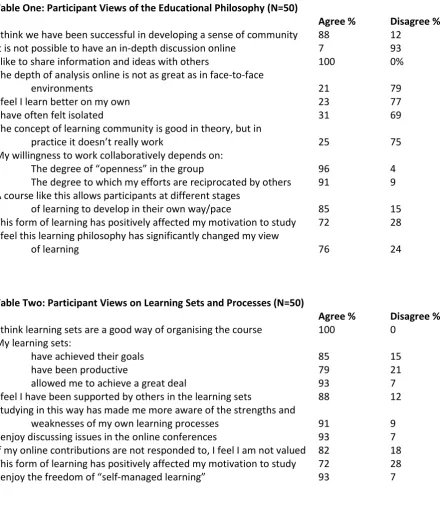
course with, to a form of learning that required them to consider how to work as a community, share and cooperate in their learning, and engage in critical and inclusive dialogue. An evaluation of the course design provided an opportunity to understand their views on these issues (Table One).
We were also interested in participants’ experience of working in networked learning sets, a central feature of the course which was designed to assist them achieve their personal and collective learning needs and outcomes (Table Two).
Figure 1: Master of Education (MEd) in Networked Learning – Features of the Online Action Research Design
YEAR ONE
Workshop 1 (4 months): Theme - Purpose of MEd, and Developing the Community • Phase 1: Our collective purpose – discussions in the large community
• Phase 2: Plenary discussions; networking; sharing biographies
• Phase 3: Focus on your collaborative projects (in learning sets)
• Phase 4: Collaborative self-peer-tutor review and assessment of projects; sharing projects with the community & discussions
Workshop 2 (4 months): Theme- Collaborative Learning Online
• Phase 1: Community review of Workshop 1 and integration of outcomes into Workshop 2; Learning set formation
• Phase 2: Your cooperative (personal) project (in learning sets)
• Phase 3: Collaborative self-peer-tutor assessment of personal projects; sharing projects with the community & discussions.
Workshop 3 (4 months): Theme - The Internet as a Learning Environment
• Phase 1: Community review of Workshops 1 & 2 and integration of outcomes into Workshop 3
• Phase 2: Your collaborative (group) project
• Phase 3: Collaborative self-peer-tutor review and assessment of group projects; sharing projects & discussion.
YEAR TWO
Workshop 4 (4 months): Theme - Designing for Research & Evaluation
• Phase 1: Community review of Workshop 3 and integration of outcomes into Workshop 4; learning set formation (in large community)
• Phase 2: Personal (cooperative) mini-action research project
• Phase 3: Design of personal action research dissertation project
• Phase 4: Review: Collaborative self-peer-tutor assessments of mini projects; sharing projects & discussion.
Workshop 5 (8 months): Theme – Action Research Dissertation
• Phase 1: Community review of Workshop 4 and integration of outcomes into Workshop 5
• Phase 2: Dissertation work (in learning sets)
• Phase 3: Collaborative self-peer-tutor review and assessment of dissertations
• Phase 4: Sharing dissertations in community; reviews and discussion. Your future plans
Table One: Participant Views of the Educational Philosophy (N=50)
Agree % Disagree %
I think we have been successful in developing a sense of community 88 12 It is not possible to have an in-depth discussion online 7 93 I like to share information and ideas with others 100 0% The depth of analysis online is not as great as in face-to-face
environments 21 79
I feel I learn better on my own 23 77
I have often felt isolated 31 69
The concept of learning community is good in theory, but in
practice it doesn’t really work 25 75
My willingness to work collaboratively depends on:
The degree of “openness” in the group 96 4
The degree to which my efforts are reciprocated by others 91 9 A course like this allows participants at different stages
of learning to develop in their own way/pace 85 15 This form of learning has positively affected my motivation to study 72 28 I feel this learning philosophy has significantly changed my view
of learning 76 24
Table Two: Participant Views on Learning Sets and Processes (N=50)
Agree % Disagree % I think learning sets are a good way of organising the course 100 0
My learning sets:
have achieved their goals 85 15
have been productive 79 21
allowed me to achieve a great deal 93 7
I feel I have been supported by others in the learning sets 88 12 Studying in this way has made me more aware of the strengths and
weaknesses of my own learning processes 91 9
I enjoy discussing issues in the online conferences 93 7 If my online contributions are not responded to, I feel I am not valued 82 18 This form of learning has positively affected my motivation to study 72 28 I enjoy the freedom of “self-managed learning” 93 7
The evaluation of the MEd networked learning design is discussed more fully elsewhere (McConnell, 2006). Its findings were central in developing more sophisticated understandings of participants’ experiences of networked learning. Together, with over two decades of other research – and as evidenced in the eight learning principles described above - the research reported in the Proceedings of the Networked Learning Conference, various journal special issues and in the
Springer Book Series on Researching Networked Learning – have all assisted us in understanding how to develop our networked learning practice.
The evaluation and ongoing networked learning research indicate that it is important to pay attention to developing the culture of collaborative and community-based learning that the programme expects, and to actively maintain its presence throughout the course. Raffaghelli and Richieri (2012) discuss the complexity of working in a networked learning community, stating that
the quality of peoples’ relations is an important characteristic in these settings. Value has to be placed on students learning how to belong to a learning community and how to discover and practice how to take part in the community. As Hodgson, McConnell and Dirckinck-Holmfed (2012) put it:
There is a tangible shift during the history of a learning community from seeing itself as a group of individual learners, to the members seeing themselves as people learning in a social environment where collaboration and cooperation is excepted and rewarded. The learners come to own the value of seeing learning as “community”, and we believe that this value can be transferred into the wider socio-political lives of the learners”. (Hodgson et al 2012)
In summary, we have learnt that to maintain a collaborative networked learning community it is important to;
- Provide guidance, and support learning processes. We cannot assume learners know how to work together in groups or communities, or how to collaborate.
- Learners have to be given time to learn how to learn in these ways. This is sometimes provided through modelling of inclusive participation (Ryberg and Sinclair, 2016).
- Learners have to be given time to develop trusting relationships in order for them to feel comfortable working together online. “Trust, in turn, fosters a collaborative culture which enhances the creativity of the team.” (Barczak, Lassk, & Mulki, 2010)
- Learning takes time to mature – a crowded curriculum prevents participants from taking a critical perspective on their learning, and makes it difficult for them to think about what they are doing and why (Nielsen and Danielsen, 2012).
- Process and relational dialogue is central to networked learning- that is where new understandings and new knowledge are created.
Our experience indicates the many learning benefits of involving students as active partners in decision making about the course, and in its ongoing design. By doing so, we are showing that we are serious about their involvement, that it counts and that reciprocity in partnership is important (Mercer-Mapstone et al, 2017). Students as partners has been described as:
“A collaborative, reciprocal process through which all participants have the opportunity to contribute equally, although not necessarily in the same ways, to curricular or pedagogical conceptualisation, decision-making, implementation, investigation, or analysis.” (Cook-Sather, Bovill & Felten, 2014)
As we can see from the results of the evaluation, participants’ views indicate that they experience the pedagogical attributes of networked learning in different ways. Some students are less positive than others about some of the characteristics and features of networked learning. Views on learning collaboratively in sets and in communities are however mostly positive. Nevertheless, responses show there are participants who are not so enthusiastic and who apparently still see face-to-face as a preferable option. There have been some well-rehearsed critiques of the potential downsides of community. For example, by Mann (2005) on how the learning environment from a communication and social organisation perspective of the learning and teaching context creates conditions that can lead to experiences of alienation for some.
Blitz (2013) carried out a literature review into the possible benefits and draw-backs of online learning communities. She suggests that there can be many benefits to these new forms of learner support; “Overall, there is good (but not strong) evidence that online communities of teachers can achieve the professional development goals of professional learning communities”. However, Blitz
points out that “Across the studies reviewed there were multiple indications that teachers’
motivation to engage with their peers and contribute regularly to the group was lower online than face-to-face.” Something we will discuss further in the following section.
The purpose of the evaluation was not to compare networked learning with face-to-face, or conventional learning. It was designed to illuminate the experience of learners who had been involved in networked learning for some considerable time – over two years in fact. They were well placed to assess the strengths and weaknesses of networked learning and to consider the potential of this form of learning in higher education contexts. The outcomes of this and other research (eg see Arasaratnam-Smith & Northcote, 2017) has generally been encouraging. Most of the research indicates that when networked learning is designed with care and attention to the meaning of learning in groups and communities, the experience of learners is generally positive and the learning outcomes of a good standard.
The evaluation of the MEd and other networked learning research led the course team to consider ways in which the course design could be changed to be more inclusive and to support better those participants who felt alienated or less than enthusiastic about more participative and community based learning approaches. As already observed it is important to recognise that in any community or group there are issues of power, control and difference, and these cannot be eliminated or designed out. They can however and should be acknowledged and addressed if we want to take full account and embrace the principles of criticality and reflexivity that networked learning aspires to. One of the key factors in achieving this is the approach and support offered by programme tutors and staff. We will discuss their experience of networked learning and working online briefly in the next section.
The Educators’ Experience of Working Online
Up to now, our focus has been on student participants and their experience of networked learning designed programmes. Equally important and often less explored is the experience of staff
participants, particularly staff new to working on such programmes. The literature that does exist often focuses on staff resistance (Mitchell et al 2015) or lack of interest in becoming involved in online programmes (Redpath 2012). However a review by Englund, et al (2017) of existing research into the successful implementation of any kind of educational technology higher education initiative identified that a critical factor is the competence of teachers to know why, when and how best to implement educational technologies. Other research suggests teachers might be struggling with being squeezed between top down demands by their institutions and bottom up expectations of their students regarding the use of web based blended learning instruction (Benson and Kolsaker, 2015 and Hanson, 2009). Preston (2018) however comments, ‘some previous literature in this area has tended to lament academics’ lack of participation in the move to online teaching rather than acknowledging that there may be real concerns for the academics involved.’ (p 266)
Recent work with staff from all the departments at Lancaster University Management School would concur with Preston’s remarks. We found that it was the same principles of a networked learning approach that helped to support staff to develop their confidence and capability to design online learning modules and initiatives. The things that one group of staff claimed to have found during a 2/3-year initiative to support and increase the use and adoption of digital pedagogical practices and resources into the School’s learning designs and pedagogy are interesting and complex. They are being written up in a joint paper intended for publication but some of the ideas emerging include, in their own words;
That the introduction of an online learning project takes place within a complex and contested political environment. Within the context of higher education such projects take place within the competing organizational and wider political market economy which has become increasingly driven by tables of ranking and consumerist discourses.
(our) case study suggests that there is a need for academic institutions to ensure the existence of a ‘holding environment’ (Heifetz and Laurie, 1997: 127) where academics and students alike can ‘process and mutually adjust to the changed identities and roles implicit in’ (Iszatt-White et al, 2017: 594).
Particularly in the early days of adoption, a shift to networked learning approaches can highlight an academic’s lack of skill with new technologies when compared with their students, thus breaching their ‘protective cocoon’ (Giddens, 1991: 3) of being an expert knowledge provider.
Spatial and temporal dimensions of delivery matter, getting used to the online space, being willing to fail requires courage and celebration – otherwise distancing occurs (Ingleton 2000).
Institutional guardians are of paramount importance in the process to encourage a new social category of digital educators – pushing individuals past the shame nexus into a situation where one let’s go.
Assessment in the online module becomes a continuing and regular activity that is done every week, and not only at the end of the term.
Students participate in the assessment activities by co-evaluating one other. Thus, instead of a one to one interaction where the instructor assesses each student, the assessment routine incorporated a change in that students peer-evaluated one another.
These and other findings and experiences of this group of staff and others involved in the initiative demonstrate that ‘becoming a networked learning educator’ (Hodgson et al 2016) is challenging and complex for most academic staff. It requires support and development that as in the case of the MEd described above allows the staff concerned to work as a community, share and cooperate in their learning, and engage in critical and inclusive dialogue.
Networked Learning and Higher Education in General
Since we started running the Networked Learning Conference and researching networked learning in the 1980s/90s, much has changed in the higher education landscape in general, including but also beyond digitisation. Perriton and Reynolds (2018) considering critical pedagogies in the context of critical management education (CME) identify three significant influences on the way such
pedagogies have developed. They are the emergence of full tuition fees as part of the marketisation of education along with other public services. Internationalization of the student body, though few studies examine how international students respond to critical content and/or pedagogy and/or the experience of critical educators, in teaching international students. And the reduction in risk-taking, by educators where they claim a visible effect is the reduction of financial and pedagogical risk-taking has seen the homogenisation of management education.
Alongside this, as we have already discussed there is still considerable general skepticism concerning the educational benefit of the use of technology in higher education learning and teaching. To the extent that the vice-principal for internationalisation at the University of Glasgow recently
commented:
“
There is much talk of e-learning, and no doubt it has its place, but on the evidence to date it is hardly a substitute for the intellectual encounter that more traditional forms ofeducational practice entail.” (Conroy, 2018).
While the focus of Perriton and Reynolds is on critical management education, the same influences are relevant to any pedagogical approach such as networked learning that aligns itself with the ideas and values of critical pedagogy. In addition, as they comment they have had the effect of crowding out programmes that appeal to social solidarity, aesthetic gratification and intellectual
accomplishment that has traditionally formed critical practice in HE. (Gross and Hogler, 2005)
Similarly, Levinsen and Nielsen (2012) suggested that in the current context of higher education, there are two contrasting meta discourses:
The Economic-Pragmatic discourse: that demands fast, efficient, predictable and controllable productivity; uses instructional system designs with predetermined learning goals, activities, assessments; and where determinism is most likely to dominate. And the Political-Ethical discourse: that focuses on the good life and what ought to be done; concentrates on the new educational paradigm inspired by social constructivism; knows that the complexities of learning take time to mature and be recognized; and in which knowledge and identity are linked.
Levinsen and Nielsen indicate that these opposing demands produce a paradox between the political demands of society and the qualitative demands of a learning paradigm, such as networked learning, that asks for self-initiated lifelong learners. “The paradox exposes itself at this level as students who demand instructional teaching, where we stress constructivist and social constructivist approaches” (Levinsen and Nielsen, 2012).
In such a socio-political educational context, the challenges to critical pedagogies and specifically networked learning programmes are becoming more demanding but also, we would argue, more important and significant than ever if we wish to bridge these different discourses and maintain a social justice and equality agenda for higher education. As Giroux commented in Pedagogy of the Precariat chapter in Jandrić (2017), ‘critical pedagogy ought to adjust to the circumstances in which it finds itself’ and the circumstances we know are increasingly socially and materially challenging.
However, Perriton and Reynolds are critical of the way critical management educator (CME) scholars and academics have responded to these emergent challenges. They comment ‘We need to also question the easy assumption that any critical space we create is a ‘clean’ or ‘safe’ space for discussion and encounter (Eliasoph, 2011) while ignoring the permeable boundaries to the exterior world and its inequalities. Critical education may, as
Yoon (2005)
suggests, be impossible, but it is the impossibility of critical pedagogy that creates the forward momentum as we try and move through one stuck moment after another.’ (Perriton and Reynolds, 2018).Unlike Perriton and Reynolds, networked learning scholars, as witnessed at NLC 2018, we would suggest, have been quicker than their CME counterparts to take up and examine the issues associated with the complexities of the changing and postdigital landscape of HE. Gallagher(2018) and Lee (2018), for example, both consider the multiple interactional contexts of mobile or networked international students and the resultant multiple and different communities that they have to span and manage during their studies. While Nelson and Parchoma (2018) set out to theorize the spatial-cultural ‘othering’ in networked learning and teaching practices. Ross and Macleod (2018) on the other hand address the increased issue in a low risk HE environment of lack of trust and greater surveillance processes that have followed the advent of digitalisation within HE.
These and other networked learning researchers critically address the political, cultural and social realties of higher education while continuing to still develop networked learning theoretically and practically. This is we would suggest is what it means to take a ‘postdigital perspective’ to education and what it means if networked learning and/or higher education is going to be able to ‘assist the current generation in creating a world less infused with the injustices that are evident everywhere that we look’ (McLaren, 2015)
Conclusions
In this paper, we have set out to show how networked learning emerged and developed historically as a critical pedagogical response to the advent and development of new Information and
communication technology and ultimately online learning programmes and provision. We have done this by describing and illustrating the theoretical and practical ideas and principles upon which we based our thinking about networked learning. We have then examined and reviewed these ideas and principles in the light of more recent work and research. We believe networked learning by focusing on and not separating pedagogical and socio-material aspects of integrating new
technology into learning designs captures and is in keeping with a postdigital attitude and approach. We have not sought to provide or claim we have the answer or a predetermined way to design a networked learning course or progamme so much as portray the origins and ongoing critical attitude to the development and practice of networked learning.
As Peters and Besley (2018) point out in this journal, postdigital does not describe a situation, condition or event after the digital. It is not a chronological term rather a critical attitude (or philosophy) that inquires into the digital world, examining and critiquing its constitution, its theoretical orientation and its consequence. Networked learning emerged as a critical pedagogical response and attitude to perceived technological determination and set out to develop a more pedagogically driven theory and practice not determined by technology. In terms of not only its theoretical orientation but also its consequences. Network learning researchers have been doing this for over 20 years since the first networked learning conference in 1998. Over that time, the world of education has become, as in other sectors completely digitalised, which makes the
continued development of the theory and practice of networked learning as important and relevant now as it was 20 years ago.
Acknowledgements
The research report from 2006* is an unpublished report written during a CEL project on Networked management learning for educational leaders and was based on input from Debra Ferreday and Chris Jones in addition to its lead author Vivien Hodgson.
We would like to acknowledge and thank staff at Lancaster University Management School for allowing us to reference some of the findings from their research on digital and educator disruption.
Conflict of Interest: The authors declare that they have no conflict of interest.
References
Alexander, I. D. and Alexander, F. (2018) Designing an inclusive intercultural online participatory seminar for higher education teachers and professionals. In Bonderup Dohn, N.,Cranmer, S., Sime, J. A., de Laat, M. & Ryberg, T (es) (2018) Networked learning: Reflections and challenges. NY: Springer
Arasaratnam-Smith, L. A., & Northcote, M. (2017). Community in Online Higher Education: Challenges and Opportunities. Electronic Journal of e-Learning, 15(2), 188-198.
Barczak, G., Lassk, F., & Mulki, J. (2010) Antecedents of Team Creativity: An Examination of Team Emotional Intelligence, Team Trust and Collaborative Culture. Creativity and Innovation Management. 19(4)
Bates, T. (2018). The 2017 national survey of online learning in Canadian post-secondary education: methodology and results. International Journal of Educational Technology in Higher Education, 15(1), 29.
Benson, V., & Kolsaker, A. (2015). Instructor approaches to blended learning: a tale of two business schools. The International Journal of Management Education, 13(3), 316-325.
Berge, Z.L. (1995). Facilitating Computer Conferencing: Recommendations From the Field. Educational Technology. 35(1) 22-30.
Berger, P. & Luckman, T. (1966). The social construction of reality, London, Penguin Books
Bird, L. (2002). Action Learning Sets: the case for running them online. In proceedings of Networked Learning Conference 2002. Accessed 30th October 2018:
http://www.networkedlearningconference.org.uk/past/nlc2002/proceedings/index.htm
Blitz, C. L. (2013). Can online learning communities achieve the goals of traditional professional learning communities? What the literature says.(REL 2013–003). Washington, DC: U.S. Department of Education, Institute of Education Sciences, National Center for Education
Evaluation and Regional Assistance, Regional Educational Laboratory Mid-Atlantic. Retrieved 22nd October 2018 from http://ies.ed.gov/ncee/edlabs
Brookfield S. (1994) Tales from the dark side: a phenomenography of adult critical reflection International Journal of lifelong Education 13 (3) 203-16
Brown, J.S., Collins, A. & Duguid, P. (1989). Situated cognition and the culture of learning. Educational Researcher, 18, 1, 32-42.
Carr, W. and Kemmis, S. (1986) Becoming critical: Education, knowledge and action research. Brighton: Falmer
Cerf, J. M. (1995). Guide du tuteur en enterprise. Foucher, Paris.
Collinson, G.,Elbaum., B.Haavind and Tinker, R. (2000). Facilitating Online Learning: Effective Strategies for Moderators, Madison:Atwood.
Choo, C. W. (1998). The Knowing Organization: How Organizationse Information to Construct Meaning, Create Knowledge, and Make Decisions. Oxford University Press, Oxford
Conroy, J., Times Higher Education October 23 2018
https://www.timeshighereducation.com/news/flipped-classroom-struggles-catch-europe
Cook, S.D.N. and Brown, J.S. (1999) Bridging Epistemologies: The Generative Dance between Organizational Knowledge and Organizational Knowing. Organizational Science, Vol. 10 No 4 pp 381-400
Cook-Sather, A., Bovill, C. & Felten, P. (2014) Engaging Students as Partners in Learning and Teaching: A Guide for Faculty. Jossey-Bass
Cousin, G, and Deepwell, F (2005) Designs for networked learning; A communities of practice perspective. Studies in Higher Education 30, (1) 57-66
Dewey, J. (1916). Democracy and education: An introduction to the philosophy of education (1966 edn) . New York: Free Press
Dewey, J. (1938/1991). Logic: The theory of inquiry. In J. A. Boydston (Ed.), John Dewey: The later works, 1925—1953, Vol. 12. SIU Press, Carbondale, IL. [Originally published in 1938]
Ellsworth, E (1989) ‘Why Doesn’t This Feel Empowering: Working Through the Repressive Myths of Critical Pedagogy’. Harvard Educational Review Vol 59, No 3 pp 297-324
Elden, M. & Chisholm, R.F. (1993) Emerging varieties of action research. Human Relations, 46(2):121-142
Englund, C., Olofsson, A. D., & Price, L. (2017). Teaching with technology in higher education: understanding conceptual change and development in practice. Higher Education Research & Development, 36(1), 73-87.
Eliasoph N (2011) Making Volunteers: Civic Life after Welfare’s End. Princeton, NJ: Princeton University Press.
Fairclough, N. (2003) Analysing Discourse: Textual Analysis for Social Research. London/New York: Routledge
Fawn, T. (2018) Postdigital Education in Design and Practice. Postdigital Science and Education https://doi.org/10.1007/s42438-018-0021-8
Ferreday, D., Hodgson, V., & Jones, C. (2006). Dialogue, language and identity: critical issues for networked management learning. Studies in Continuing Education, 28(3), 223-239.
Freire, P. (1972). Pedagogy of the oppressed. Great Britain: Penguin Education.
Gallagher, M. (2018). Amira’s complexity and cosmopolitanism: the role of disposition in mobilities and mobile learning’. In Proceedings of the 10th International Conference on Networked Learning (pp. 189-196).
Garfinkel, H. (1967). Studies in ethnomethodology. Englewood Cliffs, NJ: Prentice Hall.
Gergen, K. (1973). Social psychology as history. Journal of Personality and Social Psychology Vol. 26(2) 309-320
Giddens, A. (1991) Modernity and self-identity. Self and society in the late modern age. Stanford: Stanford University Press.
Giroux, H. (1992). Border crossings: Cultural workers and the politics of education . New York: Routledge