ABSTRACT- Seismic analysis of high rise RCC framed structure has been carried out considering different types of bracing system this system serves as one of the component in RC framed buildings to resist the lateral load to increasing the strength, stability, and stiffness. In proposed problem G+20 story building is analyzed for different bracing system such as inverted V brace, K, X, and diagonal brace in different seismic zone condition ( ZONE II, III, IV and V) by using STAAD PRO V8i software.
Key Words:Base shear, storey drift, displacement, steel
bracings, seismic behavior
1. INTRODUCTION:
A building whose height creates different condition in the design, construction, used in common building of a certain region and period. A structure because of its height is affected by the lateral forces due to an wind or earthquake action to an extent that they play an important role in the structural design.
2. DEMAND FOR HIGH RISE BUILDING:
1. Scarcity of land in urban areas.
2. Increasing demand for business and residential space.
3. Economic growth.
4. Technological advancements. 5. Innovations in structural systems. 6. Desire for aesthetics in urban settings. 7. Concept of city skyline.
3. BRACE FRAME SYSTEM
Brace frame to develop their resistance to lateral force by the bracing action of diagonal members. The braces induce forces in the associated beams and columns so that all work together like a truss with all members subjected to stresses that are primarily axial.
3.1 DIFFERENT TYPES OF BRACED FRAME
STRUCTURE:
1. Inverted v brace
2. Diagonal brace
3. K brace
4. V brace
3.1.1 ADVATAGES OF BRACING SYSTEM
1. Braced frames are applicable to all kind of structure likes bridges, aircrafts, cranes, buildings and electrical transmission line tower.
2. It gives better strength, stability, and stiffness. 3. Providing the structural integrity during
fabrication and installation
4. Transmission of horizontal load to the foundation.
5. These bracings are easy to fabricate at construct no lots of knowledge or skill is needed.
4. OBJECTIVE OF PROJECT
In this project G+20 RCC without braced frame structure is analyzed under the effect of lateral forces such as seismic forces for different zones (ZONE-II, III, IV, and V) and considering different bracing system.
4.1 Type of structure analyzed:
1. RCC Bare frame without bracing system. 2. RCC Bare frame with bracing system.
In this project, analysis of structure is done using STAAD PRO V8i., the comparison of structural
behavior is observed such as joint displacement of building, storey drift, Base shear, Axial load at base and providing perfect model with perfect brace system to this type of building after results and discussion.
5. LITRATURE REVIEW
5.1. VISWANATH K. G, PRAKASH K. B, ANAND DESAI.
(2010)
The seismic performance of reinforced concrete building rehabilitated using concentric steel bracing is investigated. These bracing provide peripheral column. a storey building is analyzed for seismic zone 4 as per IS 1893 – 2002 using software.. The % reduction in lateral displacement is found out. X type of steel brace is significantly contributed to the stiffness and reduce the inter storey drift of the frame.
Steel bracing reduce flexural and shear transfer to the axial load. X brace system will have minimum possible bending moment compare to other bracing element.
5.2. SHALK, DHOKANE, K.K.PATHAN. (DECEMBER
28- 2016)
the displacement of the building decreases depend upon the bracing system maximum reduction in deflection accrues in 9th storey as soft storey steel building compare to 5 the storey as soft storey steel framed structure the use of X brace reduce the storey drift by 60-90% in all bracing pattern compare to un braced building. Maximum reduction in axial force is observed in G+9 type of building as compare to G+5 type building.
6. METHODOLOGY
For the purposes analysis of the given structure is carried out for the behavior in of G+20 stories R.C Frame building with regular plan. Floor height provided as 3mt. the grid sparing in +X direction 3.5mt and +Z direction is 4.5mt. The models ore carried out by using STAAD PRO V8i software with different type of bracing system. They are inverted V brace, diagonal, K brace, V brace and X brace with geometrical types are consider for analysis in different seismic zone (ZONE-11, ZONE-1(ZONE-11,ZONE-IV, AND ZONE-V)
Results in parameter taken are Base shear, Displacement, Storey drift. From using software. IS code used for seismic analysis is IS 456-2000 for the gravity load, and IS 1893-2002 for the earthquake load. IS 875 part-1and part-2 is used for the design purposes.
1. Draw a plan G+20 RCC building using AUTOCAD software and that import in STAAD PRO V8i.
2. Apply support condition to all structural members.
3. Calculation of dead load and live load for different members using IS:875(part-1) 4. Designing of structure using IS 456-2000. Checking the behavior after analysis and represented in the form of graph and table.
6.1. MODELING AND ANALYSIS
MODEL 1: BARE FRAME WITHOUT BRACE
[image:3.595.314.514.281.380.2][image:3.595.371.496.415.535.2]
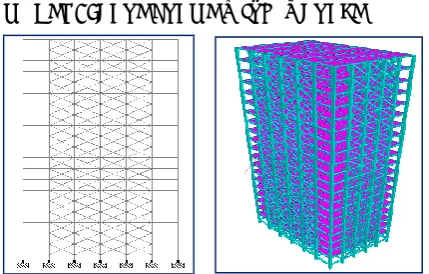
Fig 6.1.: conventional building plan with dimensions.
Fig 6.1.2:3D Isometric view of structure. MODEL 2: BARE FRAME WITH INVERTED V BRACE
[image:3.595.335.534.604.718.2]
MODEL 3: BARE FRAME WITH DIAGONAL BRACE
[image:4.595.307.522.113.250.2]
Fig 6.1.4: Building plan and 3D Isometric view of diagonal brace frame.
MODEL 4: BARE FRAME WITH K BRACE
Fig 6.1.5: Building plan and 3D Isometric view of K brace frame.
MODEL 5: BARE FRAME WITH V BRACE
[image:4.595.57.271.140.250.2]
Fig 6.1.6: Building plan and 3D Isometric view of V brace frame.
MODEL 6: BARE FRAME WITH X BRACE
Fig 6.1.7: Building plan and 3D Isometric view of X brace frame.
TABLE 7.1DESIGN PARAMETERS
Plan dimension 17.5X15m
Total height of building 61.5m
No. of stories 20 floors
Height of each story 3m
Depth of foundation 1.5m
Column size 400X600mm (from 1st
floor to 2nd floor)
300X550mm (from 3rd
floor to 20th floor)
Beam size 230X300mm
Inverted V brace, K brace, Diagonal brace, X brace, V brace system thickness.
150X150mm
Slab thickness 150mm
Ultimate tensile strength and yield strength
[image:4.595.56.281.335.451.2]Table-7.3: Conventional building results are compared with X brace & Diagonal frame building = (A-B)/A in +X & +Z direction for ZONE - II
A – Conventional building displacement results
[image:5.595.342.533.124.351.2]B - X brace & Diagonal frame displacement results
Fig; 7.3.1 Reduced displacement results in +X & +Z direction for ZONE - II
Table-7.3.1: Conventional building results are compared with X brace & Diagonal frame building = (A-B)/A in +X & +Z direction for ZONE - III
A – Conventional building displacement results
B - X brace & Diagonal frame displacement results Importance factor (I) 1.5
Reduction Factor (R) 5
Damping Ratio 5%
Period in +X direction (PX)
1.61sec
Period in +Z direction(PZ)
1.61sec
Codes
IS 456:2000 IS875-
1987(Part-II)-Live Loads
Zone Factor
IS:1893(part-1) 2002– For Earthquake Designing
Zone-II = 0.10 Zone-III =0.16 Zone-IV =0.24 Zone-V = 0.36
No of floors
Reduced displacement results in +X & +Z
direction(mm)
Percentage (%)
+X +Z
G 53.23 59.27 %
5 56.75 58.07 %
10 58.41 54.22 %
15 59.40 48.14 %
20 46.10 24.12 %
No of floors
Reduced displacement results in +X & +Z
direction(mm)
Percentage (%)
+X +Z
G 56.74 67.82 %
5 61.42 68.90 %
10 64.62 67.61 %
15 67.37 63.61 %
[image:5.595.47.252.138.529.2]20 51.22 29.58 %
[image:5.595.36.542.495.787.2]Fig; 7.3.1.1 Reduced displacement results in +X & +Z direction for ZONE - III
Table -7.3.2: Conventional building results are compared with Inverted V & K brace frame building = (A-B)/A in +X & +Z direction for ZONE - IV
A – Conventional building displacement results
[image:6.595.339.529.212.574.2]B - Inverted V & K braceframe displacement results
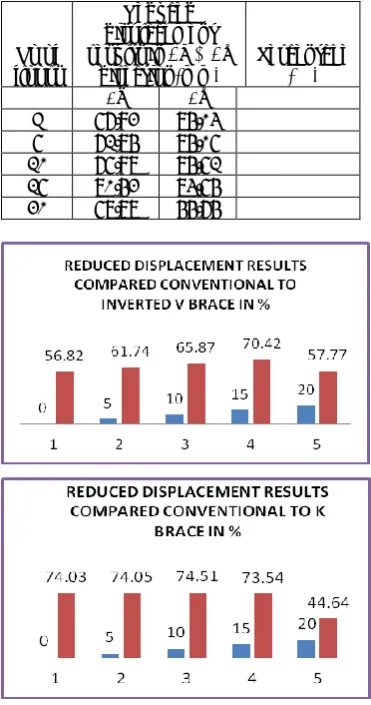
Fig; 7.3.2.1 Reduced displacement results in +X & +Z direction for ZONE - IV
Table - 7.3.3: Conventional building results are compared with Inverted V & V brace frame building = (A-B)/A in +X & +Z direction for ZONE - V
A – Conventional building displacement results B - Inverted V & V braceframe displacement results
Fig; 7.3.3.1 Reduced displacement results in +X & +Z direction for ZONE - V
Table - 7.3.4: Conventional building results are compared with X brace frame building = (A-B)/A for ZONE - II
A – Conventional building Base shear results
B - X brace frame Base shear results No of
floors
Reduced displacement results in +X & +Z
direction(mm)
Percentage (%)
+X +Z
G 56.82 74.03 %
5 61.74 74.05 %
10 65.87 74.51 %
15 70.42 73.54 %
20 57.77 44.64 %
No of floors
Reduced displacement results in +X & +Z
direction(mm)
Percentage (%)
+X +Z
G 57.68 61.12 %
5 62.90 65.36 %
10 67.56 68.14 %
15 73.03 70.17 %
[image:6.595.59.245.379.732.2]
Fig; 7.3.4.1 Increased base shear results for ZONE - II Table - 7.3.5: Conventional building results are compared with X brace frame building = (A-B)/A for ZONE – III
A – Conventional building Base shear results
[image:7.595.47.238.118.343.2]B - X brace frame Base shear results
Fig; 7.3.5.1 Increased base shear results for ZONE - III
Table - 7.3.6: Conventional building results are compared with X brace frame building = (A-B)/A for ZONE – IV
A – Conventional building Base shear results
[image:7.595.334.522.230.470.2]B - X brace frame Base shear results
Fig; 7.3.6.1 Increased base shear results for ZONE - IV Table - 7.3.7: Conventional building results are compared with X brace frame building = (A-B)/A for ZONE – V
A – Conventional building Base shear results
B - X brace frame Base shear results No of
floors
Increased base shear results
(kN)
Percentage (%)
G 17.64 %
5 5.19 %
No of floors
Increased base shear results
(kN)
Percentage (%)
G 13.33 %
5 5.18 %
10 5.18 %
15 5.19 %
20 2.84 %
No of floors
Increased base shear results
(kN)
Percentage (%)
G 17.02 %
5 5.3 %
10 5.4 %
15 5.3 %
20 2.9 %
No of floors
Increased base shear results
(kN)
Percentage (%)
G 17.02 %
5 5.3 %
10 5.4 %
15 5.3 %
20 2.9 %
10 5.18 %
15 5.19 %
[image:7.595.49.232.492.721.2] [image:7.595.337.513.623.712.2]Fig; 7.3.7.1 Increased base shear results for ZONE - V Table - 7.3.8: Conventional building results are compared with X brace frame building = (A-B)/A for ZONE – II
A – Conventional building Storey drift results
B - X brace frame building Storey drift results
Fig; 7.3.8.1 Reduced storey drift for ZONE - II
Table – 7.3.9: Conventional building results are compared with X brace frame building = (A-B)/A for ZONE – III
A – Conventional building Storey drift results
B - X brace frame building Storey drift results
[image:8.595.330.524.119.340.2] [image:8.595.48.237.385.619.2]Fig; 7.3.9.1 Reduced storey drift results for ZONE - III Table – 7.3.10: Conventional building results are compared with X brace frame building = (A-B)/A for ZONE – IV
A – Conventional building Storey drift results
B - X brace frame building Storey drift results
Fig; 7.3.10.1 Reduced storey drift results for ZONE - IV No of
floors
Reduced storey drift results
(kN)
Percentage (%)
G 67.47 %
5 70.22 %
10 58.68 %
15 47.05 %
20 16.32 %
No of floors
Reduced storey drift results
(kN)
Percentage (%)
G 70.76 %
5 71.33 %
10 59.35 %
15 47.60 %
20 16.20 %
No of floors
Reduced storey drift results
(kN)
Percentage (%)
G 74.87 %
5 72.60 %
10 60.15 %
15 48.30 %
[image:8.595.338.523.491.710.2]A – Conventional building Storey drift results
B - X brace frame building Storey drift results
Fig; 7.3.11.1 Reduced storey drift for ZONE - V
CONCLUSION
7.4 DISPLACEMENT RESULTS:
1. The displacement is reduced by 59.4% for X
brace frame system in +X direction For ZONE-II.
2. The displacement is reduced by 59.27% for
Diagonal brace frame system in +Z direction For
ZONE-II.
3. The displacement is reduced by 67.37% for X
brace frame system in +X direction For ZONE-III.
4. The displacement is reduced by 68.90% for
diagonal brace frame system in +Z direction For
ZONE-III.
5. The displacement is reduced by 70.42% for
inverted V brace frame system in +X direction For
ZONE-IV.
6. The displacement is reduced by 74.51% for K
brace frame system in +Z direction For ZONE-IV
7. The displacement is reduced by 73.03% for
inverted V brace frame system in +X direction for
ZONE-V.
8. The displacement is reduced by 75.19% for V
brace frame system in +Z direction for ZONE-V
7.4.1 BASE SHEAR RESULTS:
1. The maximum base shear is increased by 17.64% for X brace frame system and least reduced in 11.5% for K brace in ZONE-II. 2. The maximum base shear is increased by
13.33% for X brace frame system and least reduced in 6.65% for K brace in ZONE-III. 3. The maximum base shear is increased by
17.02% for X brace frame system and least reduced in 6.38% for Diagonal brace in ZONE-IV
4. The maximum base shear is increased by 13.33% for X brace frame system and least reduced in 6.25% for Diagonal brace in ZONE-V No of
floors
Reduced storey drift results
(kN)
Percentage (%)
G 71.58 %
5 58.16 %
10 43.65 %
15 32.36 %
20 32.57 %
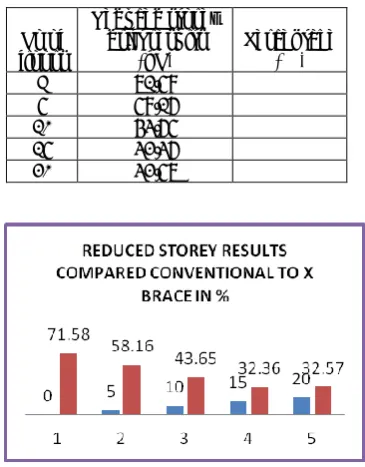
Table - 7.3.11: Conventional building results are compared with X brace frame building = (A-B)/A
[image:9.595.64.247.217.451.2]7.4.2 STOREY DRIFT RESULTS:
1. The storey drift is reduced by 70.22% for X brace frame system in ZONE-II.
2. The storey drift is reduced by 71.33% for X brace frame system in ZONE-III.
3. The storey drift is reduced by 74.87% for X brace frame system in ZONE-IV.
4. The storey drift is reduced by 71.58% for X brace frame system in ZONE-V.
REFERENCES
1. IS-1893(part1)-2002 code, “earthquake resistant design of structures”.
2. Viswanath k. g, prakash k. b, anand desai.
3. Jagadish j. s, tejas d, doshi. (july – 2013) “ a study on bracing system on high rise steel structure”
BIOGRAPHIES
Shruti Neeralagi M.TECH
(Structural engineering) S.G
Balekundri Institute
Of Engineering college Belgavi,
Karnataka.