Aslam, Nauman (2018) Towards Distributed Battery Switch Based Electro-Mobility Using
Publish/Subscribe System. IEEE Transactions on Vehicular Technology, 67 (11). pp.
10204-10217. ISSN 0018-9545
Published by: IEEE
URL: https://doi.org/10.1109/tvt.2018.2870780 <https://doi.org/10.1109/tvt.2018.2870780>
This version was downloaded from Northumbria Research Link:
http://nrl.northumbria.ac.uk/35916/
Northumbria University has developed Northumbria Research Link (NRL) to enable users to
access the University’s research output. Copyright
©and moral rights for items on NRL are
retained by the individual author(s) and/or other copyright owners. Single copies of full items
can be reproduced, displayed or performed, and given to third parties in any format or
medium for personal research or study, educational, or not-for-profit purposes without prior
permission or charge, provided the authors, title and full bibliographic details are given, as
well as a hyperlink and/or URL to the original metadata page. The content must not be
changed in any way. Full items must not be sold commercially in any format or medium
without formal permission of the copyright holder. The full policy is available online:
http://nrl.northumbria.ac.uk/policies.html
Towards Distributed Battery Switch Based
Electro-Mobility Using Publish/Subscribe System
Yue Cao,
Member, IEEE
, Omprakash Kaiwartya,
Member, IEEE
, Chong Han, Kezhi Wang,
Member, IEEE
,
Houbing Song,
Senior Member, IEEE
and Nauman Aslam,
Member, IEEE
Abstract—With the growing popularization of Electric Vehicle (EVs), Electro-mobility (in terms of where to charge EV) has become an increasingly important research problem in smart cities. One of the major concerns is the anxiety of EVs, as drivers may suffer from discomfort due to long charging time. In this article, we leverage the battery switch technology to provide an even faster charging than plug-in charging service, by cycling switchable (fully-recharged) batteries at Charging Stations (CSs). Upon that, a cost-efficient Publish/Subscribe (P/S) system is pro-visioned, to facilitate the design of distributed charging manner for privacy guarantee. The proposed communication framework utilizes Mobile Edge Computing (MEC)-functioned Road Side Units (RSUs) to bridge, process and aggregate the information flow between CSs and EVs. We further design an advanced reservation based charging system, in which the knowledge of EVs’ reservations is utilized to predict how likely a CS will be congested. This benefits to a smart transportation planning on where to charge, in order to improve charging comfort. Results show the advantage of our enabling technology comparing to other benchmark solutions, in terms of minimized waiting time for the battery switch (as the benefit for EV drivers), and a higher number of batteries switched (as the benefit for CSs).
Index Terms—Electric Vehicle, Battery Switch, E-Mobility, Delay Tolerant Networks.
I. INTRODUCTION
T
HE popularity of Electric Vehicles (EVs) [1] has been playing an increasingly important role in Electro-Mobility (E-Electro-Mobility). Due to short anxiety of EVs, how to explore the E-mobility to improve drivers’ comfort, is a vital research issue for the success and long-term viability of the EV industry. Majority of previous works investigate “charging scheduling” [2] (concerning when/whether to charge EVs), while EVs have already been parked at homes/Charging Stations (CSs). In contrary, we focus on “CS-selection” (ccerning where/which CS to charge) [3] when EVs are on-the-move, that has recently attracted attention thanks to the popularity of EVs. In order to improve the charging experience of EV drivers, one solution is to optimally deploy CSs at the places where there is high high EVs concentration, such as shopping mall parking places. Another complementaryY.Cao; K.Wang (corresponding author) and N.Aslam are with the Depart-ment of Computer and Information Sciences, Northumbria University, UK. email: yue.cao; kezhi.wang; [email protected]
O.Kaiwartya is with the School of Science and Technology, Nottingham Trent University, UK. email:[email protected]
C. Han is currently with pureLiFi Limited, UK, email: l: [email protected]
H.Song is with the Department of Electrical, Computer, Software, and Systems Engineering, Embry-Riddle Aeronautical University, USA email: [email protected]
solution is to optimally manage where to charge, when EVs are with low energy status and need to seek CSs for charging. Literature works [4]–[6] have addressed charging recom-mendation to improve the charging Quality of Experience (QoE), e.g., to reduce the service waiting time for charging. Usually, the local condition of CSs (e.g., number of EVs being parked and their remaining charging time) [6] is considered to make charging recommendation decision. Inevitably, only using the CS’s local condition for CS-selection would bring potential charging hotspot, this mainly happens if many EVs head to the same CS for charging. In this context, the EV reservation [1], [7]–[9] initiated from EV, has been considered as an additional signalling delivered to the selected CS. Here, at what time and which CS will be heavily congested can be predicted, to avoid selecting that CS as the best charging plan. From transport and energy aspect, even if EV drivers can benefit from the smart CS-selection to potentially experience a shorter charging service waiting time, the widely applied plug-in charging technology still requires a relatively longer duration to complete battery charging (typically, half to several hours [10]). In contrary, as a promising alternative approach, the battery switch service, has the potential to replace a fully charged battery for an EV just within several minutes (running with a lower charging power for green battery cycling), thanks to involved elaborate industrial automation robots to execute fast battery switch. There have been a few works [11]–[15] on either the energy scheduling, or deployment at the battery switch based CS, whereas [16] firstly integrates ICT with the system focusing on transportation aspect.
From Information Communication Technology (ICT) aspec-t, the CS-selection decision is generally made by Global Con-troller (GC) in a centralized manner. Here, the GC monitors CSs’ condition seamlessly through cellular communications1.
In comparison, the distributed system alleviates privacy con-cern, as the CS-selection is made by EV individually (based on their accessed condition information from CSs). In most of previous works [6], [9], [18], the cellular infrastructures are typically applied in the centralized manner, for the benefit of real-time optimization thanks to the good network coverage. Alternatively, a cost efficient solution is by the deployment of fixed Road Side Units (RSUs) [19], supported by licence-free WiFi but with limited network coverage. This supports the distributed charging manner, where RSUs (with functioned
1Concerning privacy issue [17] of hiding sensitive information of EV, e.g.,
light-weight edge computing, and authorized network entities) bridge information from power grid to EVs. In [1], we have proposed a distributed plug-in charging based CS-selection scheme, via Publish/Subscribe (P/S) [20] system. Therein, EVs subscribe to the CSs’ condition information from RSUs, through Vehicle-to-Infrastructure (V2I) communication [21], [22].
The rapid growth of mobile applications have placed severe demands on cloud infrastructure, which has led to moving computing and data services towards the edge of the cloud, resulting in a novel Mobile Edge Computing (MEC) [23] (also known as fog computing) architecture. MEC could reduce data transfer times, remove potential performance bottlenecks, and increase data security and enhance privacy while enabling ad-vanced applications. In spite that the battery switch technology has been investigated in the “charging scheduling” [24] from energy scheduling aspect, efforts towards distributed “CS-selection” from transportation planning aspect (with advanced reservation service and provisioning of cost-efficient ICT framework) have not been addressed in literature. Motivated by above, our two contributions are as follows:
Provisioning of Basic P/S Mode With Enhanced
CS-selection: Our preliminary work [16] has brought the P/S
system with RSU for battery switch service, study shows the advantage of that over traditional plug-in charging system for CS-selection. Here, we extensively present the detail design and analysis of battery switch based P/S system, with a fundamental study on how to achieve the best driving comfort, e.g., the minimum Expected Waiting Time to Switch (EWTS), through an enhanced CS-selection scheme over that in [16]. The CS with the minimum EWTS is selected by the EV which needs battery switch service.
Study of Advanced P/S Mode Enabling Reservation:
Upon above, we further study the benefit to bring reservation service for CS-selection. This concerns that congestion may occur at CS side, if many EVs travel towards the same CS for charging in a near future. Here, those EVs which are travelling towards their selected CSs for charging, additionally send their reservations2. Such knowledge will be utilized to estimate
whether a CS will be congested in a near future, in order to make optimal CS-selection to experience the minimum waiting time for battery switch service.
The EV reservation is aggregated by MEC functioned RSUs, in order to reduce communication signalling cost in the system (due to implementing necessary data transmission over more expensive wireless links, e.g., cellular network communication), that is bounded by the delay constraint of actual CSs publication. The EV mobility prediction is also taken into account for smart reservation uploading, through the cellular network as the back-up solution if no RSU is accessible along the route an EV traverses.
2The reservation includes when an EV is expected to arrive and how long
its battery needs to get fully charged, is harvested by CSs for processing and future publication.
II. RELATEDWORK
A. Battery Switch Service
To promote the popularization of EVs, it is necessary to build the infrastructure for charging batteries. Traditional plug-in rechargplug-ing is accomplished by pluggplug-ing EVs plug-into chargplug-ing slots (set by CSs placed at different city locations). In contrast, at the CS providing the battery switch service [16], the automated switch platform switches the depleted battery from an EV, with a fully charged battery it maintains. The depleted battery is placed and recharged so that it can be used by other EV drivers. The battery switch service could be described as a mixture of a drive-through car wash, which normally switches an EV’s battery in several minutes but without requiring the driver to get out of the EV. Note that, as the cost to the battery’s lifespan may be taken into account, the fast charging still takes a toll that should be avoided when possible. The nature that depleted batteries are charged by CSs (normally via a lower power than plug-in charger), certainly removes that burden from EV drivers to maintain batteries.
B. CS-selection
In recent few years, the “charging recommendation” prob-lem has started to gain interest from industrial thanks to the popularity of EVs. The generic solutions [6], [18] make decision based on the queueing information at CSs, and the one with the minimum queueing time is recommended. This feature has been evaluated in [4] against with the charging recommendation just taking the closest distance to CS, the former is deemed as an effective guidance in urban city with limited charging infrastructures.
Beyond that, the integration of ICT and energy network is of importance for the sustainability of EV charging, where a set of works have addressed the constraint of energy network and study its impact. From ICT aspect, additional communication signalling is built to support the advanced charging recommen-dation, to bring anticipated EVs mobility information (charing reservations). The work in [7] concerns a highway scenario where the EV will pass through all CSs. Other works [1], [8], [9] focus on urban city scenario, where the EV travels towards a single CS (which is geographically distributed in city) for charging. Inherently, the expected waiting time for charging is associated to that CS, rather than a subsequent charging in highway case.
C. Our Motivation
TABLE I
TOPICSDEFINED INBASICP/S MODE
Topic Dissemination
Nature
Publisher(s) Subscriber(s) Payload
CS Condition Update One-to-Many CS RSUs <CS ID&CS’s ATS,NB, Publication Time Slot> Cached CSs’ Condition Access Many-to-Many RSUs EVs <All Cached CS IDs&CSs’ ATS,NB, Publication Time Slot>
Battery Switch
EV1
CS EV2
RSU1
RSU2
RSU3
Ubiquitous Cellular Communication Opportunistic WiFi
Communication Cycling Depleted
Batteries
Moving Direction
Fig. 1. Big Picture of Network Entities And Scenario
III. SYSTEMMODEL
A. Basic P/S Mode
In our proposed system, the locations of CSs are known by all EVs in advance, this is achievable through vehicle On-Board Unit (OBU) system. Each CS is connected to all RSUs using authorized cellular network communication (3G/LTE), publishes its Available Time for Switch3 (ATS) and number
of switchable batteriesNB (how many fully charged batteries
are ready for switch) periodically. How frequent these are published, depends on a system-level control strategy. Here a tight interval implies the requirement for peak hour charging demand, and vice versa.
Concerning the practical infrastructure deployment strategy, there will not be an overlap between the radio coverage of adjacent RSUs. This inevitably results in an obsolete4
information accessed by EVs, due to the missed encounter with RSUs.
EV RSU
1 CS
CS Information Publication
3 EV Sends Subscription Query
2 RSU Replies
Cached Information Ubiquitous Cellular
Network
CS-Selection Basic P/S Mode
Opportunistic WiFi Network
Information Cached at RSU
[image:4.612.80.262.534.638.2]Service Discovery
Fig. 2. Time Sequences of Basic P/S Mode
3This information reflects the status of those batteries being charged. For
example, given that a CS initially maintains 10 batteries, as time passes the status that 7 batteries are switchable while 3 batteries are being charged, is published regarding the charging finish time (availabilities) of these 3 batteries being charged.
4This happens when RSU has cached the information published at 12:00
AM and accessed by EV, but later an EV has never traversed RSU before 12:30 AM. Therefore, that EV (to make CS-selection decision at 12:30) will use the knowledge it accessed at 12:00 AM.
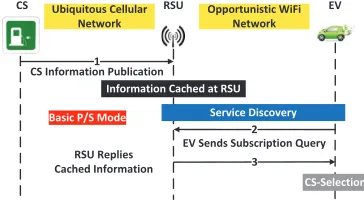
The communication in Intelligent Transportation Systems (ITS) enables the information broadcasting to involved entities. Here, the basic application of “ETSI TS 101 556-1” [25] standard is to notify EV drivers about the CSs condition information, which is to be used for selecting a CS for battery switch. Further to [1] which focuses on the plug-in charging technology, we herein enhance this communication framework with additional effort to reduce communication cost and bring it to the battery switch service. The time sequences are illustrated in Fig. 2:
• Step 1: All CSs’ condition publications are
synchro-nized. Each CS periodically (with interval T) publishes its condition information (including ATS and NB) to
RSUs, using the topic “CS Condition Update” defined in TABLE I. This refers to a “One-to-Many” nature, as each CS’s publication is cached at all RSUs. In the meanwhile, RSUs will merge information from multiple CSs and cache it. RSUs will also replace the obsolete one cached in the past, when they have received the publications from CSs released in a new interval.
• Steps 2-3: When encountering with RSU, the EV
being aware of updated service from that RSU, will send a subscription query5 using the topic
“Cached CS Condition Access”. This is generally based on V2I communication initiated from the EV to RSU, via a short range WiFi technology. This refers to a “Many-to-Many” nature as EVs opportunistically access information from RSUs, and there is no need for EV to perform a periodical subscription particularly when there is no RSU in proximity.
Note that the communication between EVs and RSUs is event driven, that is triggered by EV’s subscription. All related infor-mation will be included using a specific topic, unambiguous information, e.g., not used in EV battery switch application will not be accessed using topics defined in TABLE I.
Compared to [1] via single topic for accessing CSs’ queue-ing time, two desiderated topics illustrated in TABLE I are used in Basic P/S Mode to enable computation at RSUs side. This is motivated by shifting the data services towards the network edges which are closer to EV drivers, known as MEC [23] which is deemed for increasing data security while reducing information access times. If using single topic for publication, there is no information merged at RSUs. In that case, an EV needs to use different subscription topic (associated to a CS) to access all CSs information from
5Upon receiving the subscription queries from EVs, RSUs only reply the
RSU, particularly when CS is owned by different stakeholders. In comparison, in the MEC based system, all merged CSs information at RSUs can be subscribed by an EV using a unique topic. Each RSU can further verify the information of CSs and selected authorized one for caching, meanwhile check the time slot involved in the EV subscription.
1) Other Alternative Modes: We also present two alterna-tive modes that can support information dissemination,
name-ly, Centralized Mode and Periodical Broadcasting (PB)
Mode.
EV GC
1 CS
CS Information Monitoring
3 EV Sends Request
2
GC Replies Decision Ubiquitous Cellular
Network
CS-Selection
Centralized Mode
[image:5.612.87.262.190.288.2]Ubiquitous Cellular Network
Fig. 3. Time Sequences of Centralized Mode
Centralized Mode is widely adopted by majority of
pre-vious works. As shown in Fig. 3, the GC monitors CSs’ condition through cellular network, and processes charging requests from on-the-move EVs. The CS-selection decision is solely implemented by the GC in a centralized manner.
EV
1 CS
CS Information Broadcasting Ubiquitous Cellular
Network
CS-Selection PB Mode
Fig. 4. Time Sequences of PB Mode
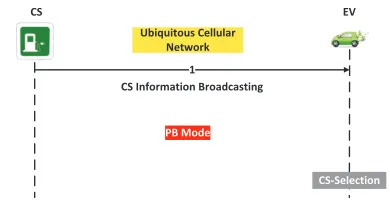
PB Mode is the case where each CS periodically (with
interval T) broadcasts its condition information to all EVs. Particularly, this mode is also similar to a cloud system where CSs publish information to a cloud connecting all RSUs, from which users would access through cellular network link. As shown in Fig. 4, since there is no RSU involved, the communi-cation between CSs and EVs is based on the cellular network communication. In this context, each EV can definitely access CSs’ condition information withinT, different fromBasic P/S Modeaffected by opportunistic encounters.
2) Possibility to Access Information in Basic P/S Mode: The P/S system has been proposed in [1] for the plug-in chargplug-ing service (with CS queuplug-ing time published). The possibility that an EV can access CSs’ condition information from RSUs depends on:
• If an encounter between EV and RSU happens.
• If the RSU (encountered by EV) has cached the informa-tion published from CSs.
The possibilityPp/s for an EV to access information from at
the least one (or more than one) of Nrsu RSUs along road,
has been given by:
Pp/s≤1− N∏rsu
i=1 {
1−
[(i−1)V +F+R
S·T
]}
(1)
Here, V is the distance between adjacent RSUs along the road, T is the CS’s publication interval, and R stands for a valid communication range between EV and RSU. Note that,Rdepends on the transmission power and other practical configurations at EV side, as it is the initiator to establish com-munication with RSU for information subscription. Besides,S
is the EV moving speed (we assume as a constant speed, where the influence of dynamic traffic on moving speed will be of interest for further study), whileF ≥R is the distance from the starting point to the center of first RSU.
In spite that the above analysis is modeled on a straight road where an EV will pass through a number of deployed RSUs with equal distance, the features of the proposed ICT system are certainly also applicable under a complex/realistic city scenario. Under city scenario, the distance between any adjacent RSUs is not straight road based and not equal, while EV moving speed is not constant. Just take a simple example, even if there is the path with a number of RSUs deployed for EV to pass, the actual distance the EV from one RSU to another RSU, can be mapped from nonlinear path to a straight road. That is to say, the model represents a wide application.
In order to increasePp/s, we obtain: • To enlarge radio coverageR.
• To extend the number of RSUs Nrsu.
• To reduce CS publication interval T (or increase CS publication frequency).
3) Communication Cost: Concerning the scalability of communication system, we denoteNev as number of EVs in
the network, and discuss the communication costs of Basic
P/S Mode,Centralized Mode, andPB Mode as follows:
• InBasic P/S Mode, the cost forNev EVs to access CS’
condition is given by O
(P p/s×Nev
T )
. This is because
there are (Pp/s×Nev )
subscriptions sent from EVs within eachT interval.
• In Centralized Mode, the cost at GC side for handling
EVs’ charging requests is O(Nev), and is linearly
in-creased by EVs density.
• In PB Mode, each CS broadcasts its condition
informa-tion to allNev EVs, within in interval T. Therefore, the
communication cost is bounded by O(Nev T
) .
Due to decoupling between CSs (publishers) and EVs (sub-scribers), the end-to-end connections between CSs and EVs in
theBasic P/S ModeandPB Modeare avoided. Different from
theCentralized Mode, the system can benefit from scalability (i.e., the number of connections at CS side is not linked to the number of EVs, as referred toBasic P/S Mode).
4) Privacy and Security Concern: The distributed manner
(Basic P/S Mode and PB Mode) does not need to release
[image:5.612.73.268.396.500.2]The solutions to achieve trusted message exchange for EV charging use case is to encrypt the sensitive information and hide the real identity. One development aspect of the encryp-tion involves the light-weight and highly secured encrypencryp-tion algorithm, while another one is to design an efficient and scalable key management scheme. As for the privacy side, pseudonym is proposed to hide the identities. This including the pseudonym changing algorithms and pseudonym reuse schemes, both are required to be implemented in efficient and scalable manners.
B. Battery Switch Based Charging Management Cycle
Battery Switch
CS-Selection Driving
[image:6.612.339.537.52.253.2] [image:6.612.313.565.302.542.2]Battery Charging Battery Cycling
Fig. 5. System Cycle of EV Battery Switch
Fig. 5 presents four phases of the battery switch system:
• Driving Phase: The EV is moving on the road during
driving phase.
• CS-selection Phase:The EV with its battery volume
be-low the SOC threshold, starts to find a CS for the battery switch. Here, based on the CSs’ condition information accessed through the P/S system, the EV implements CS-selection decision.
• Battery Cycling Phase:
– Battery Switch Phase:When reaching the selected
CS, the EV’s own battery (electricity consumed) is depleted, while EV is switched with a battery (which has been fully charged) by CS. Initially, the CS would have sufficient (fully charged) batteries to switch for incoming EVs, whereas the service wait-ing time is only due to the actual battery switch time (several minutes). However, with the fully charged batteries been switched from CS and consumed bat-teries from EVs been depleted, if the number of fully charged batteries at CSs is less than the number of EVs currently been parked, the charging scheduling (concerning when/whether to charge those depleted batteries) is based on the First Come First Serve (FCFS) order. This regulates that the EV with an earlier arrival time will be scheduled with a higher charging priority.
– Battery Charging Phase: Those batteries depleted
from EVs will be charged by CSs in parallel (de-pending on the number of charging slots), and they become switchable once been fully recharged. Note that the transition between Battery Switch Phase
andBattery Charging Phaseis bidirectional.
TABLE II LIST OFNOMENCLATURES γ System resolution
NB Number of switchable batteries at CS ND Number of batteries depleted from incoming EVs TBsw Time to switch a battery
NC Number of batteries being charged NW Number of EVs waiting for battery switch
δ Number of charging slots at CS
β Charging power at CS
EmaxB Full volume of EV battery
EBcur Current volume of EV battery ATSLIST Output list about ATS
TBf in Charging finish time of EV battery
NE
B Expected number of switchable batteries at CS Tarr
ev EV’s arrival time at CS Ttra
ev Time for EV to travel towards a CS Tcur Current time in network
NR Number of EVs made reservations
C. Battery Cycling
Algorithm 1 Battery Cycling at CS
1: foreach EV parked at CSdo
2: if(NB>0)then
3: start to switch a battery for EV 4: else
5: wait until a battery becomes switchable
6: end if
7: ifa fully recharged battery is switched, with durationTsw
B then
8: NB=NB−1
9: include depleted battery from EV into the queue ofND
10: end if
11: end for
12: foreach intervalγdo
13: while(NC< δ)do
14: sort the queue ofNW according to STCF 15: schedule a depleted battery from the queue ofND
16: end while
17: for(i= 1;i≤NC;i+ +)do
18: while(Ecur
B(i)< EmaxB(i) )
do
19: Ecur
B(i)=EB(i)cur +β×γ
20: end while
21: remove this battery from the queue ofND 22: NB=NB+ 1
23: end for
24: end for
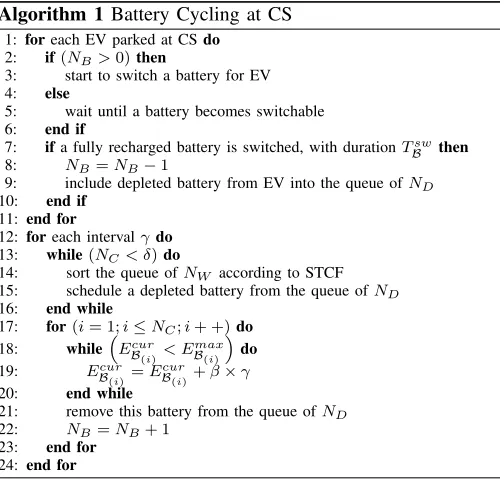
Throughout the battery switch system, we denote as ND
the number of batteries depleted from EVs, and as NC the
number of batteries being charged by the CS. Upon arrival at a CS, the incoming EVs that need battery switch services are managed as follows:
• If there are switchable batteries at the CS, given by the condition(NB >0)at line 2 in Algorithm 1, the EV will
be directly switched with a fully charged battery. • Alternatively, presented between lines 4 and 5, the EV
has to wait until the recharging of a battery is finished. This is because there has not been any switchable (fully charged) battery available at the CS.
We herein denote as TBsw the time to switch a battery (nor-mally takes several minutes). Here, the number of switchable batteries NB decreases by 1, after the period of TBsw for
will be included into the queue of ND (the queue of number
of batteries waiting to be charged). This refers to the operations between lines 8 and 9.
Note that each CS is with δ charging slots, meaning that at most δ depleted batteries can be charged in parallel. Here, depleted batteries are sorted following the Shortest Charging Time First (SCTF) order, meaning the depleted battery with the earliest time to be fully charged, is with the highest priority for charging. Note that the way to cycle batteries has been studied in [16], therein the SCTF provides the best performance. A depleted battery will be scheduled from the queue ofND into
the queue of NC, only if (NC < δ) as presented at line 15.
This happens when there is still at least one available charging slot could be utilized for battery charging.
From line 18, for each battery in the queue of NC, it
will be charged with (β×γ) electricity per time interval
γ. If a battery is fully recharged given by the condition (
Ecur B(i) =E
max B(i)
)
, NB increases by 1 since a fully charged
battery is switchable. Then, the information regarding this given battery is removed from the queue of ND, at line 21.
IV. CS-SELECTION INBASICP/S MODE
Here, the CS-selection is based on local condition informa-tion of CSs (as published to RSUs and further accessed by opportunistically encountered EVs). Algorithm 2 details the logic to generate the ATS, upon which Algorithm 3 gives the CS-selection based on the EWTS.
A. Generation of Available Time for Switch
Algorithm 2 Generation of ATS
1: for(i= 1;i≤NC;i+ +)do
2: add (Emax
B(i)−E cur
B(i) β +Tcur
)
into ATSLIST
3: add (EBmax
(i)−E
cur
B(i) β +Tcur
)
into TLIST
4: end for
5: sort ATSLIST with ascending order 6: ifno battery is waiting for chargingthen
7: return ATSLIST
8: else
9: sort the queue ofNW according to STCF 10: for(j= 1;j≤ND;j+ +)do 11: sort TLIST with ascending order
12: TB(j)f in =
(
TLIST1+ EBmax
(j)−E
cur
B(j) β
)
13: replace TLIST1withTB(j)f in
14: addTB(j)f in into ATSLIST
15: end for
16: return ATSLIST
17: end if
Algorithm 2 starts from processing each battery (in the queue ofNC), where the time duration (Emax
B(i)−E cur
B(i) β
)
to fully recharge a battery, will be summated
withTcur. This calculates the charging finish time of battery,
and it is included into ATSLIST and TLIST (for temporary computation purpose).
By checking the status of above batteries being charging, Algorithm 2 will return the ATSLIST, if there is no additional
batteries waiting to be charged (the condition at line 6), or upon checking those batteries to be scheduled for charging thorough a loop operation (between lines 10 and 16).
In the latter case, the loop operation firstly sorts the queue ofND, following the SCTF charging scheduling order.
Mean-while, the TLIST containing elements about the charging finish time of those batteries (in the queue ofNC), is initialized
with an ascending order. This means the earliest time to finish charging a battery is placed as the first element in TLIST, denoted by TLIST1.
Within each loop, the time TBf in
(j) to finish charging of a battery (in the queue ofND) will replace with TLIST1. At line 12, TBf in
(j) is given by the summation of time to start charging (the TLIST1), and battery charging time
giv-en by (Emax
B(j)−E cur
B(j) β
)
. Furthermore, TBf in
(j) will be included
into ATSLIST. The loop operation will process all batteries (in the queue ofND), then the ATSLIST is returned.
B. CS-Selection Based on EWTS
We introduce the following notations to facilitate problem formulation for fundamental CS-selection:
• γlcs: Number of EVs currently being parked at a CS, with locationlcs.
• ωlcs: Average time for each EV to wait for the battery switch(not included the time to switch batteryTsw
B ). • W: Total battery switch waiting time for all EVs in
network.
Here, note that γlcs is a function of Ncs, as the number of CSs in network. This is because that a larger number ofNcs
drives a small γlcs EVs distributed at each CS. Furthermore,
ωlcs is related toγlcs, δ andβ. Given a number of switchable batteriesNB, we aim to minimizeW:
W=
{∑ lcs∈Ncs
( γlcs×
( ωlcs+T
sw B
))
if(NB< γlcs) ∑
lcs∈Ncs (
γlcs× (
0 +Tsw
B )) otherwise
(2)
• The first sub-condition implies that a potential charging congestion would happen if larger number of γlcs EVs intend to charge at a CS, this inevitably increases their average battery switch waiting time at CS. Of course, applying fast charging power β and deploying more charging slotsδbenefit to reduced waiting time. • The second sub-condition implies that ωlcs tends to 0,
when each CS maintains sufficient number of switchable batteries, given by (NB ≥γlcs).
In order to achieve the minimum EVs’ battery switch waiting time amongNcs CSs, (γlcs×(ωlcs+T
sw
B ))should be equal among all CSs, as ideal situation given in [7], [9]. Since all CSs are assumed to share the same β andδ for simplicity6, we obtainγlcs=F(
1
Ncs), andωlcs=F( γlcs
δ×β)to achieve the
minimum W. Also, enabling a large NB is an alternative to
minimize W.
6Practically thinking, there have been many EV manufacturers in market
In this context, the CS with the highest number of available batteries for switch, is selected with the highest priority, in order to hold the second sub-condition. In case that all CSs have run out of batteries for switch, the CS through which an EV experiences the minimum time to wait for the battery switch is selected.
Algorithm 3 Estimation of EWTS in Basic P/S Mode
1: for(j= 1;j≤ |ATSLIST|;j+ +)do
2: if(TB(j)f in < Tarr ev(r)
) then
3: NB=NB+ 1
4: end if
5: end for
6: if(NB>0)then
7: return EWTS=Tsw
B /NB
8: else
9: return EWTS=ATSLIST1−Tevarr(r)+T sw B 10: end if
Our proposed CS-selection scheme is detailed as follows. In Algorithm 3, the arrival time of EVr as Tevarr(r), will be compared with the charging finish time Tsw
B(j) in ATSLIST. If
TBf in
(j) is earlier thanT arr
ev(r) happens at line 2, one more battery will be switchable upon the arrival of EVr, withNBincreases
by 1.
• If (NB >0) happens at line 6, TBsw/NB is returned at
line 7. This is because a battery will be available upon the arrival of EVr.
• Otherwise,( the EWTS is given by
ATSLIST1−Tevarr(r)+T sw B
)
at line 9, where (
ATSLIST1−Tevarr(r) )
is the time to wait until a fully recharged battery is switchable. Note that ATSLIST1 is the value with the earliest switchable time in the ATSLIST.
C. Performance Evaluation
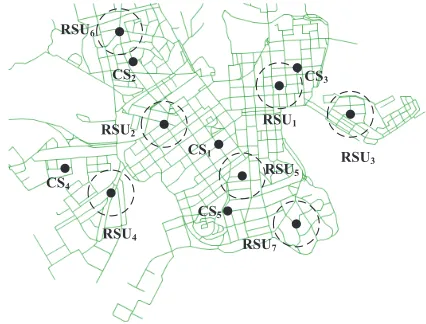
1) Simulation Configurations: We have built up an EV charging system in Opportunistic Network Environmen-t (ONE) [26]. In Fig. 8, Environmen-the scenario wiEnvironmen-th 4500×3400m2area is shown as the down town area of Helsinki city in Finland.
There are 300 EVs with [30∼50]km/h variable moving speed placed in the simulation. The setting of EVs associates to the charging specification (Maximum Electricity Capacity, Max Travelling Distance: 16.4 kWh, 140 km) of Hyundai BlueOn EV7. We configure a distribution of State Of Charge (SOC), ranging from 15%to 45%for all EVs. The actual route of EV is formed based on the shortest path feature, considering a practical mobility pattern. Here, the shortest path towards a CS is formed considering the Helsinki road topology.
There are totally 5 CSs deployed with sufficient electric en-ergy for battery charging, where the suggested battery switch time is given as 5 minutes. Each CS maintains NB = 30
batteries (which are fully recharged) from beginning, and is able to charge δ = 30 batteries (which are depleted from EVs) in parallel, based on β = 10 kW low charging power. Referring to [16], EVs would need to wait for additional
7en.wikipedia.org/wiki/Hyundai BlueOn.
time for battery switch, and thus the impact of Pp/s can
be examined. There are 7 RSUs and 300 EVs in network, based on 300m radio coverage for communication pattern. The default information dissemination interval (CSs publication frequency) of CS is T = 120s, and the simulation time is 43200s = 12 hours.
CS2 CS3
CS4
CS5 CS1 RSU6
RSU4
RSU5
RSU7
RSU3 RSU1
[image:8.612.328.541.137.299.2]RSU2
Fig. 8. Simulation Scenario of Helsinki City
The following metrics are evaluated:
• Average Waiting Time for Switch (AWTS): The average
period between the time an EV arrives at the selected CS and the time it finishes battery switch. This is the charging performance metric at EV side.
• Total Switched Batteries (TSB): The total number of
EVs have been switched with batteries at CSs. This is the charging performance metric at CS side.
• Total Information Accesses (TIA): The total number of
accesses at EV side, in terms of communication cost. It is worthy noting that key advantage of battery switch system over plug-in charging system has been presented in [16]. We herein focus on the advantage of the proposed CS-selection scheme, with those based on the centralized Minimum Queueing Time (MQT) under plug-in charging technology [6], and the centralized scheme based on battery switch [16] namelyCentralized (O)which does not consider the switchable batteries. Upon that, the influence of Basic
P/S Mode, Centralized Mode and PB Mode based on the
proposed scheme in Section III are evaluated.
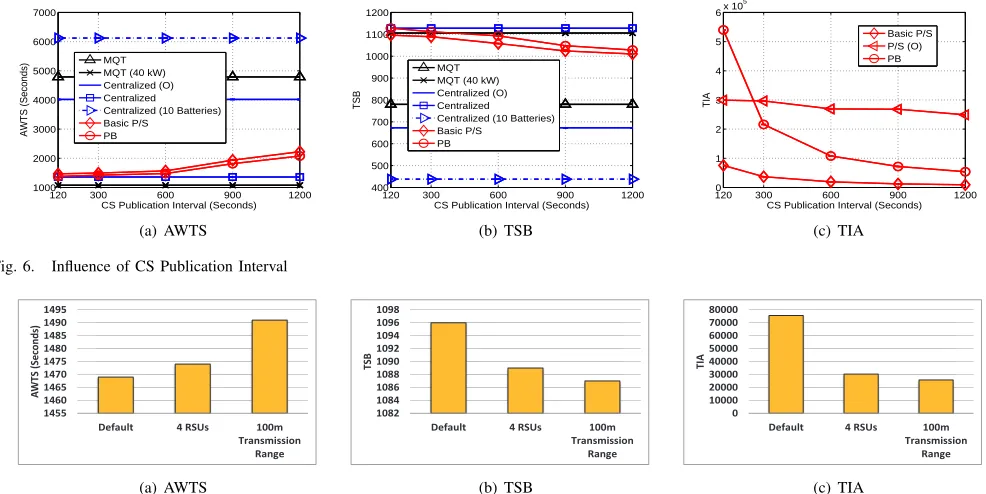
120 300 600 900 1200 1000 2000 3000 4000 5000 6000 7000
CS Publication Interval (Seconds)
AWTS (Seconds)
MQT MQT (40 kW) Centralized (O) Centralized Centralized (10 Batteries) Basic P/S
PB
(a) AWTS
120 300 600 900 1200 400 500 600 700 800 900 1000 1100 1200
CS Publication Interval (Seconds)
TSB
MQT MQT (40 kW) Centralized (O) Centralized Centralized (10 Batteries) Basic P/S
PB
(b) TSB
120 300 600 900 1200 0 1 2 3 4 5 6x 10
5
CS Publication Interval (Seconds)
TIA
Basic P/S P/S (O) PB
[image:9.612.53.546.55.302.2](c) TIA
Fig. 6. Influence of CS Publication Interval
1455 1460 1465 1470 1475 1480 1485 1490 1495
Default 4 RSUs 100m Transmission Range A W T S ( S e co n d s) (a) AWTS 1082 1084 1086 1088 1090 1092 1094 1096 1098
Default 4 RSUs 100m
Transmission Range T S B (b) TSB 0 10000 20000 30000 40000 50000 60000 70000 80000
Default 4 RSUs 100m
Transmission Range
T
IA
(c) TIA
Fig. 7. Influence of RSUs Deployment and Transmission Range
proposed CS-selection scheme (Centralized Mode) achieves noticeable improvement, by considering average service in-tensity.
Secondly, we observe the influence of CS publication in-terval T. Both Basic P/S Mode and PB Mode benefit from frequent CS publication interval (120s). This follows the discussion on access possibility, where a higherPp/s implies
CSs’ condition information can be accessed timely. As such, the minimized AWTS can be achieved by distributed manner (Basic P/S Mode and PB Mode), compared to the Centralized Mode. Due to the same reason, the TSB is increased in Fig. 6(b) because more EVs can experience fast battery switch services. In Fig. 6(c), we observe the PB Mode involves much communication costs (with frequent CS publication), which is inefficient compared to the Basic P/S Mode (concerning their close AWTS and TSB). Besides, the P/S system without MEC-functioned RSU is evaluated as P/S (O), which suffers from much higher communication cost. This is mainly due to the lack of mechanism to deny redundant subscription.
0 50 100 150 200 250 300
Centralized Centralized (O) MQT
D is tr ib u ti o n o f T S B /C h a rg e d E V s
[image:9.612.89.256.585.684.2]CS1 CS2 CS3 CS4 CS5
Fig. 9. Distribution of TSB at CSs
Fig. 9 further shows the distribution of TSB (charged EVs in case of MQT) among CSs, in case of centralized manner
to examine the feature of compared CS-selection schemes. Noticeably, the proposed scheme achieves the best balance, by jointly considering the AWTS and TSB.
3) Influence of RSUs Deployment and Transmission Range: Results in Fig. 7(a), Fig. 7(b), Fig. 7(c) show that, either decreased RSUs density (by excluding RSU1, RSU2 and RSU5) or shorter transmission range also degrades perfor-mance because of decreasedPp/s. This is mainly because that
EVs will have less chance to communicate with encountered RSUs and thus fail to subscribe to the most latest CSs status information for making CS-selection.
V. ADVANCEDP/S MODEENABLINGRESERVATION
In previous section, we have proposed a distributed CS-selection under the Basic P/S Mode. Nevertheless, that de-cision making only considers the local condition of CSs (ATS and NB), not with the capability to predict congestion
level of CSs in a near future. Although sharing the gener-al battery switch framework in Fig. 5, the Advanced P/S Mode integrates EVs’ reservations (including at what time EV would reach its selected CS, and how long it will take to charge its depleted battery) into the CS-selection. Here, the reservation from EVs (those have selected where to charge), will be bridged by RSUs (with MEC functioned information aggregation and mining) to their selected CSs. As summarized in Algorithm 4, the EV needs battery switch service will keep track of those switchable batteries, those being charged locally at a CS (already considered in Basic P/S Mode), and other EVs with an earlier arrival time to reserve charging at this CS. In summary, the MEC functions positioned at RSUs, mainly operate:
• Prevent redundant transmission from RSU to EV, at the stage when EV subscribes to information, covered in
TABLE III
TOPICSDEFINEDFORRESERVATION
Topic Dissemination
Nature
Publisher(s) Subscriber(s) Payload
EV Reservation Upload One-to-Any (One)
EV which has selected CS
Any encountered RSU (select-ed CS)
<Reservation defined in TABLE V>
Aggregated EVs’ Reservations Upload Many-to-One RSUs CS selected by common EVs <Aggregated reservations defined in TABLE V>
• Analyse collected EVs’ reservation, and identify only the valid information, covered in Advanced P/S Mode. • Aggregate valid EVs’ reservations and report to CS once
(over the case the RSU relays per EV reservation to CS upon an encounter with an EV), covered in Advanced
P/S Mode.
A. Signallings of Advanced P/S Mode
TABLE IV
FORMAT OFCS PUBLICATION INADVANCEDP/S MODE
—CS ID—
CS1
—Number of Switchable Batteries—
NB= 7
—Available Time For Switch—
ATS = [1000s, 1400s, 1900]
—Anonymous EVs’ Reservations—
Entry Arrival Time Expected Charging Time of Depleted Battery
1 3500s 730s
2 4700s 700s
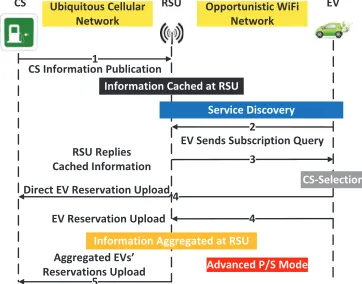
Regarding the practicality consideration, the “ETSI TS 101 556-1: Electric Vehicle Charging Spot Notification Specifi-cation” [25] and the “ETSI TS 101 556-3: Communications System for the Planning and Reservation of EV Energy Supply Using Wireless Networks” [27] can potentially support the reservation based battery switch service. In Fig. 10, signallings are listed:
• Steps 1-3: An EV accesses CSs’ publications (given
in TABLE IV) from encountered RSUs, following the same procedure inBasic P/S Mode(Section III-A). The EV selects where to charge if with low electricity status threshold than SOC threshold.
• Steps 4: Two options are designed for reservation
up-loading, through the “EV Reservation Upload” topic in TABLE III:
– The direct cellular link will be established to EV’s selected CS, if there will not be any (accessible) RSU along the trajectory towards that selected CS. This refers to a “One-to-One” nature, as the EV’s reservation is solely uploaded to its selected CS. – Alternatively, the EV’s reservation will be uploaded
to an encountered RSU (with MEC intelligence detailed in Section V-E). This refers to a “One-to-Any” nature, as the uploading happens at any one of RSUs.
• Step 5: At the time slot approaching the next
C-Ss’ publication, RSUs report their aggregated EVs’
reservations to associated CSs, through the “Aggregat-ed EVs’ Reservations Upload” topic. This refers to a “Many-to-One” nature, as RSUs will simultaneously send aggregated EVs’ reservation to their associated CS.
EV RSU
1 CS
CS Information Publication
3
EV Sends Subscription Query 2
RSU Replies Cached Information Ubiquitous Cellular
Network
CS-Selection
Advanced P/S Mode Opportunistic WiFi
Network
4
5
4 Information Cached at RSU
Service Discovery
EV Reservation Upload Direct EV Reservation Upload
Aggregated EVs’ Reservations Upload
[image:10.612.344.525.209.351.2]Information Aggregated at RSU
Fig. 10. Time Sequences for Advanced P/S Mode
B. Format of EV’s Reservation
Once a CS-selection decision is made from on-the-move EV with pending battery switch request, the following information in TABLE V will be included as the EV’s reservation:
TABLE V
FORMAT OFEV RESERVATION
EV ID ID of Selected CS Arrival Time Expected Charging Time of Depleted Battery
Arrival Time:We denote Tevarr as the EV’s arrival time at
its selected CS:
Tevarr=Tcur+Tevtra (3)
Here,Ttra
ev is as the travelling time to be taken from the current
location of EV to the selected CS, and Tcur is as the current
time in network. Note that, the actual travelling path is formed based on the shortest road path topology, with an assumption of constant moving speed.
Expected Charging Time:We denote asTBchathe expected
charging time of EV’s depleted battery, upon its arrival at selected CS:
TBcha=E
max
B −EBcur+Sev×Tevtra×α
β (4)
Here, (Sev×Tevtra×α) is the energy consumed for the
movement to reach the selected CS, based on a constant α
specified as the energy consumption per meter. Therefore, (Emax
B −EcurB +Sev×Tevtra×α) is the expected electricity
be recharged by a CS, depending on the charging powerβ of that CS.
C. Privacy Concern
TABLE VI
STRUCTURE OFINFORMATIONMAINTAINED ATRSUANDEV
Key Value
ID ATS NB EVs’ Reservations
CS3 [3060s, 3300s, 3520s] 20 [3500s, 730s], [4700s, 700s] Upon the reservation uploading to CS (through opportunistic communication with RSU, or direct cellular network), the CS will process its captured reservations (formatted in TABLE V) within current publication interval T. Then the CS aggregates them with the local condition (ATS and NB) for publication
at the next T.
Both RSUs and EVs will maintain a “Map<Key, Value>” data structure following TABLE VI. The “Key” is the entry for each CS, while the “Value” is a tuple consisting of the CS local condition (ATS and NB), and those EVs’ reservations.
Note that, the “Value” associated with previous CS publication time slot, will be replaced with that currently published.
As formatted in TABLE IV and TABLE VI, the defined information format well alleviates privacy concern. As such, EVr will not obtain any knowledge about ID of those have
reserved for battery switch, this is because only the arrival time and expected charging time of batteries (to be depleted from those EVs) are included. Besides, the locations of those EVs when made reservations are also hidden. This is because the calculation of an EV’s arrival time is depending on its location and speed, whereas these two factors are not released.
D. Estimation of EWTS in Advanced P/S Mode
Algorithm 4 requires the knowledge of from Algorithm 2, as well as those EVs made reservations (detailed in TABLE V). Throughout Algorithm 4, the EWTS at a given CS can be estimated by EVrlocally. Here,TkarrandTkchaare denoted as
the arrival time and expected charging time at the kthentry. Algorithm 4 initially sorts the queue of NR following the
FCFS order, as the charging scheduling priority been discussed in Section III-C. Here, EVk stands for the kth EV in the
queue of NR. Besides, the expected number of switchable
batteriesNBE, is initialized with the value ofNBat line 2. The
arrival time Tkarr of each EVk (in the queue ofNR) made
reservation at its selected CS, will be compared with Tevarr(r) (arrival time of EVr). As highlighted at line 5, for each EVk
with its Tarr
k earlier thanT arr
ev(r), the former will involve the dynamic update of the ATSLIST from line 6.
Note that the ATSLIST has been initially sorted according to the ascending order (at line 1), such that the earliest available time for switch is at the head of ATSLIST. From line 6,
Tarr
ev(k) is compared with the charging finish time of each battery (being charged or waiting to be charged, as included in ATSLIST) at this CS. IfTBf in
(j) is earlier thanT arr
ev(k) happens at line 7, one more battery will be switchable upon the arrival of EVk, withNBE increases by 1 at line 8.
Algorithm 4 Estimation of EWTS in Advanced P/S Mode
1: sort ATSLIST returned by Algorithm 2, with ascending order 2: define TEMLIST,NE
B =NB
3: sort the queue ofNRaccording to FCFS 4: for(k= 1;k≤NR;k+ +)do 5: if(Tarr
k < T arr ev(r))then
6: for(j= 1;j≤ |ATSLIST|;j+ +)do
7: if(TB(j)f in < Tarr k )then
8: NE
B =NBE+ 1
9: deleteTB(j)f in from ATSLIST and TEMLIST
10: end if
11: end for
12: if(|ATSLIST| ≥δ)then
13: if(|TEMLIST|= 0)then
14: include firstδelementsTB(j)f in into TEMLIST
15: end if
16: sort TEMLIST with ascending order
17: TB(k)f in =TEMLIST1+ (EB(k)max−EB(k)cur)/β+TBsw
18: replace the TEMLIST1withTB(k)f in 19: else
20: TB(k)f in =Tarr ev(k)+ (E
max
B(k)−EB(k)cur)/β+TBsw
21: includeTB(k)f in into TEMLIST
22: NE
B =NBE−1
23: end if
24: includeTB(k)f in into ATSLIST
25: end if
26: end for
27: for(j= 1;j≤ |ATSLIST|;j+ +)do
28: if(TB(j)f in < Tarr ev(r))then
29: NE
B =NBE+ 1
30: end if
31: end for
32: if(NE
B >0)then
33: return EWTS=TBsw/NBE
34: else
35: return EWTS=ATSLIST1−Tevarr(r)+T sw B 36: end if
As such, the given TBf in
(j) will be removed from ATSLIST (and also TEMLIST initialized from line 14), means the number of batteries being charged or to be charged decreases. This is because a fully charged battery will be switched to EVk. Then:
• As given by the condition (|ATSLIST| ≥δ) at line 12, the number of batteries being charged or to be charged, is larger thanδas the total number of charging slots a CS is equipped. This reflects any incoming EVk still needs
to wait an additional time for a switchable battery. In this case, the charging finish time TBf in
(k) of the battery depleted from EVk, is given at line 17:
TB(k)f in =TEMLIST1+ (EmaxB(k)−EB(k)cur)/β+TBsw (5)
where TEMLIST18 is the time slot when a charging slot is available at the CS, (Emax
B(k) −E cur
B(k))/β is the time duration to fully recharge the battery depleted from EVk,
while Tsw
B is the time duration to deplete this battery from EVk and switch with a fully recharged battery.
8As we also define TEMLIST at line 2, the firstδvalue in ATSLIST are
• Otherwise, EVk will be directly switched with a fully
recharged battery (without waiting), then TBf in
(k) is given at line 20:
TB(k)f in =Tevarr(k)+ (EB(k)max−EB(k)cur)/β+TBsw (6)
Note that the time to start battery switch is asTarr ev(k) (ar-rival time of EVk). At line 22, the number of switchable
batteries decreases by 1, meaning EVk will be replaced
with a fully charged battery.
Furthermore, the charging finish time of each battery depleted from incoming EVk, will be included into ATSLIST at line
24.
Above loop operation is repeated, until all EVk
(in the queue ofNR) have been processed. Then, Tevarr(r) is compared with the charging finish time TBf in
(j) included in ATSLIST. If there is any TBf in
(j) earlier than T arr ev(r) (the
condition (TBf in
(j) < T arr
ev(r)) at line 28), this means one more battery will be available for switch when EVr arrives. As
such, the expected number of switchable batteries NBE
increases by 1. Finally:
• The EWTS is returned as Tsw
B /NBE at line 33, if there
will be a switchable battery given by (NE B >0). • Alternatively,( the EWTS is returned as
ATSLIST1−Tevarr(r)+T sw B
)
at line 35. This implies that there will not be any battery available for switch, when EVrarrives at its selected CS. In other words, EVr
will need to wait (
ATSLIST1−Tevarr(r) )
, and experience
Tsw
B for battery switch.
E. Reservation Uploading
The motivation for each RSU to aggregate EVs’ reservation-s, is to reduce the communication cost (in terms of how many times the connections are established to CSs). In detail, as CSs publish their information at previous publication time stamp P, it is compulsory that the aggregated EVs’ reservations is required to be delivered at associated CSs, before given (T +P). This means the information collection is to be operated within the interval T.
Therefore, the EV’s reservation does not need to be sent instantaneously, as it is with a delay tolerance of (T+P). By means of optimally deployed RSUs, all EVs’ reservations can be ideally collected by RSUs in a V2I manner. However, it is by no means that all EV’s reservations will be successfully delivered to their associated CSs. This is mainly due to the opportunistic encounters between EVs and RSUs. In the worst case, an EV’s reservation must be delivered to its associated CS, before any RSU is encountered. This means the time to encounter the first RSU along the trajectory towards an EV’s selected CS, is later than (T+P).
In the light of this, the proposed reservation uploading considers the trajectory towards the EV’s selected CS, and those locations of RSUs along that trajectory, specifically:
• MEC-Functioned RSU Uploading:If any RSU is
acces-sible before (T+P), the reservation uploading will be de-layed until that encounter happens. The valid reservation refers to that of which the EV’s arrival is reserved later
than (T+P). This is because an EV’s reservation will be deleted by its selected CS, when it is parked therein. Then any arrival happens before the next CS’s publication will be removed from RSUs, this potentially reduces the size of data to be uploaded to CSs. The EV’s reservation gathered by MEC-functioned RSU will be aggregated with those select the common CS, and reported at (T+P).
• Direct Cellular Networking Uploading: Alternatively,
the cellular network is established, where the EV’s reser-vation is directly uploaded to the selected CS.
F. Communication Efficiency
Firstly, if EVs’ reservations are delivered to their selected CSs through the cellular network, ideally, there will not be any delivery delay because we assume it is with ubiquitous communication range. Here, the communication cost is scaled by O(Nev), as the number of reservations made is directly
related to that of EVs.
Secondly, we consider that EVs’ reservations are delivered to their selected CSs through RSUs in proximity. Referring to Fig. 10, the delay only depends on the time for the EV to encounter an RSU, because the communication between RSUs and CSs can be considered as delay free (thanks to the cellular network communication). Therefore, the communication cost is scaled byO(Pp/s×Nev), recall thatPp/sis the possibility
that an EV to encounter at least one ofNrsuRSUs. This refers
to the reservation uploading in an opportunistic manner, as implemented in [1].
Thirdly, we consider the case with aggregated EVs’ reser-vations uploading to CSs, before (T+P). Here, the commu-nication cost is scaled by O(Nrsu
T ), as the communication is
established from Nrsu RSUs within interval T. In order not
to miss-upload any EV’s reservation, the cellular network is applied as the back-up solution9.
Based on above, the communication cost is scaled between
O((1−Pp/s )
×Nev )
and O(Nrsu T
)
. Note that Pp/s also
benefits from a larger Nrsu and shorter T, that is consistent
to O(Nrsu T
)
. As such, excluding the deployment of RSUs, in nature, a largerNev drives the sustainable communication
efficiency for the long term EVs popularity.
G. Discussion
1) Integration of Renewable Energy: The mismatch be-tween EVs and infrastructures would potentially hinder the deployment rate of EVs. With the ever increasing penetrations in EVs, the resultant charging energy imposed on the electric-ity network could lead to grid issues such as voltage limits violation, transformer overloading, and feeder overloading at various voltage levels. Coordination of the charging deplet-ed batteries with renewable energy source provides a more straightforward approach to cope with the potential network issues as mentioned above. Future works would be on the inte-gration of power network [28], to achieve an interdisciplinary work on ICT, route planning and energy integration.
9For example, any EV
r will not encounter any RSU along the trajectory towards its selected CS, with possibility(1−P(p/s)
2) Heterogeneity of Batteries: Of course, it is practical to consider the compatibility of heterogeneous batteries switched between different type of EVs. There have been many EV manufacturers, and each type of EV may only be compatible with one or a few types of batteries. As such the estimation of batteries number and AWTS should differentiate each type of battery and its support EVs’ reservations.
3) Combination of Battery Switch and Plug-in Charging: Concerning the service provisioning, those EVs (private driver-s) which are not with emerging demand could experience plug-in chargplug-ing service, whereas those (public taxis) are suggested to experience battery switch service due to demand of being actively hired. The deployment of these two types of stations requires analysis on EVs traffic history, and could share the same ICT framework that we propose in this article.
H. Performance Evaluation
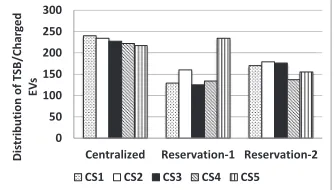
The performance is also based on the configuration in Section IV-C. We further bring two previous works on reser-vation enabled CS-selection (under plug-in charging system) for comparison, namely Reservation-1[1] and Reservation-2 [8] both are implemented in centralized manner. Besides, we consider the Total Reservations Making (TRM) as the additional communication cost brought in reservation service.
0 50 100 150 200 250 300
Centralized Reservation-1 Reservation-2
D
is
tr
ib
u
ti
o
n
o
f
T
S
B
/C
h
a
rg
e
d
E
V
s
[image:13.612.89.256.362.457.2]CS1 CS2 CS3 CS4 CS5
Fig. 12. Distribution of TSB at CSs
1) Influence of CS Publication Interval: In Fig. 11(a) and Fig. 11(b), we observe the Advanced P/S Mode outperforms Basic P/S Mode, in terms of reduced AWTS and increased TSB. This mainly thanks to bringing the knowledge of EVs’ reservations, which helps to avoid planning charging at likely congested CSs. Thus EVs experience shorter time to wait for service and more batteries can be switched. For fundamental comparison, the centralized version of CS-selection in Section IV (namely Centralized herein) still outperforms Reservation-1 and Reservation-2, due to the advantage of battery switch system. By prolonging the CS publication interval from 120s to 1200s, the decentralized manners, e.g., Advanced P/S Mode, Basic P/S Mode, and Reservation-1 (P/S) (the disturbed manner of [1]) suffer from performance degradation. Such a nature can be referred to the observation in Section III, where the information (ATS, NB and associated EVs’ reservations
of CSs) accessed by EVs is obsolete due to infrequent publi-cation.
In Fig. 11(c), all centralized manners (Reservation-1, Reservation-2 and Centralized) experience higher communi-cation cost for reservations making, as solely the cellular
network is established. The decentralized manners are with lower cost, where Reservation-1 (P/S) only relies on oppor-tunistic encounters between RSUs for reservation uploading. The Advanced P/S Mode runs the reservations aggregation at MEC-functioned RSUs (upon collected EVs’ reservations), and alternatively utilizes the cellular network as back-up solu-tion. As CSs publication interval increases, the TRM becomes decreased.
Fig. 12 further shows the distribution of TSB (charged EVs) among CSs, in case of centralized manner with reserva-tion funcreserva-tion enabled. Regardless of charging system (battery switch vs plug-in charging), our proposed scheme achieves the best balance.
2) Influence of EVs Density: In Fig. 13(a), Fig. 13(b) and Fig. 13(c), all schemes experience an increased AWTS and TSB, following the increased EVs’ density. This is because of congestion happened at CSs, as such most likely EVs have to wait for longer time to get battery switched while the less batteries can be switched during simulation time. Here, Centralized also achieves the best performance, as an optimal case of Advanced P/S Mode. With strategically deployed RSUs applied in Section III, most of EVs’ reservations can be captured and aggregated, thus alleviates the cost through cellular network in Fig. 13(c). The performance of other compared schemes also follows similar observation in case of varied CSs publication interval.
3) Influence of RSUs Deployment and Transmission Range: The decreased number of RSUs and reduced transmission range also degrade performance in Fig. 14(a), Fig. 14(b) and Fig. 14(c), similar to that discussed in Section IV-C. Particu-larly, we observe the reservations making through the cellular network dramatically increases due to missed opportunistic encounter, compared to that through the RSUs. This implies that the importance of infrastructures positioning and ICT configuration to maintain a good coverage of information dissemination.
VI. CONCLUSION
In this paper, we proposed a distributed charging sys-tem supported battery switch service, in line with the P/S communication framework (applying MEC-functioned RSUs for intermediate information handling). The communication efficiency of P/S system has been studied and compared with that using the cellular network communication and broadcast-ing. We further propose the Advanced P/S Mode which en-ables EVs to publish their reservations (intelligently uploaded through opportunistically encountered MEC-functioned RSUs, or cellular network) for communication efficiency. Results show the charging system benefits from this anticipated infor-mation to make CS-selection decisions, which further reduces the EVs’ waiting time for battery switch and increased CSs’ switched batteries. Further results also imply the strategies on position of RSUs and ICT configurations, to support low cost information exchange within E-Mobility system.
REFERENCES