http://www.scirp.org/journal/ce ISSN Online: 2151-4771
ISSN Print: 2151-4755
DOI: 10.4236/ce.2018.93034 Mar. 27, 2018 479 Creative Education
Project Based Learning Applied to Technical
Drawing
Eduardo Ferro dos Santos
1, Bruna Caroline Marques Gonçalves
2, Karine Borges de Oliveira
2,
Messias Borges Silva
11Lorena School of Engineering, University of Sao Paulo (USP), Sao Paulo, Brazil
2Production Engineering Department, Sao Paulo State University (UNESP), Sao Paulo, Brazil
Abstract
New technological advances have been challenging professionals in education area to reach the new generation of students. Since this new generation is surrounded by this new technology, it is mandatory to associate new practices and teaching methods to their education plan. In this way, educators must re-flect not only on their usual pedagogical practices but also in the efficacy of the method that has been practiced in the teaching and learning process. Technical Drawing is a discipline that takes place in High School programs in addition to Technical and Higher Education. It is directly influenced by this technological advance, once the student goes from the draw in the paper to the draw in computers during the classes and is encouraged to execute the projects that arise from the step-by-step draw. In this context, this work aimed to show a study performed during the Technical Drawing discipline to report a new structure in the educational methodology related to project-based learning. The focus of this study was to encourage students to develop a greater interest in engineering using project based learning and use this as a method for learning.
Keywords
Project Based Learning, Active Methodologies in High Education, Technical Drawing
1. Introduction
The current technological development has stimulating advances in all fields of knowledge. New technologies have been emerging every day and allow the quick satisfaction of the market needs along with the creation of new market segments.
How to cite this paper: dos Santos, E. F., Gonçalves, B. C. M., de Oliveira, K. B., & Silva, M. B. (2018). Project Based Learning Applied to Technical Drawing. Creative Education, 9, 479-496.
https://doi.org/10.4236/ce.2018.93034
Received: February 13, 2018 Accepted: March 24, 2018 Published: March 27, 2018
Copyright © 2018 by authors and Scientific Research Publishing Inc. This work is licensed under the Creative Commons Attribution International License (CC BY 4.0).
DOI: 10.4236/ce.2018.93034 480 Creative Education
To assure updated knowledge to be shared in the classroom and competitive professionals, the teaching-learning processes must monitor this development. In this way, new applications, new strands, and a way applied to the develop-ment of products and services, involving various fields of knowledge as a way of stimulating the labor market to represent new strategies to approach the stu-dents of the real world, consolidating their interest to the classes.
According to Meyer and Nascimento (2011), developed countries have been showing a great concern regarding the attraction of excellent students to areas related to Technology and Engineering. The improvement of the technology in industries and services has been demanding high skilled professionals. Due to the rapid technological advances, there is a lack of availability of such profes-sionals in the market. Therefore students must be attracted and prepared to act to occupy these places. The development of Technology and Engineering areas strongly depend on the “attractiveness policy” that makes the high intellectual level of students to choose careers in excellent schools. One of the most success-ful initiatives on this subject is the “Harvard Project Physics” that created attrac-tive and interacattrac-tive ways for teaching physics for high school students during the 1960’s (Pena, 2012).
The main reason for evasion in engineering in different universities is the ab-andonment of the course, often in the first period, due to two main factors: (i) students who get the approval in more than one university, for the same course or not. These students enroll in all universities where they got approval. Howev-er they develop the studies in only one of them, leaving the othHowev-er(s); and (ii) students who start the course and realize they have another vocation or difficulty in exact sciences, abandoning the course. Most students are very young, teenag-ers, and usually, they are forced to choose a profession, sometimes without knowing what the profession does (Campello & Lins, 2008; dos Santos, Nasci-mento, & Rios, 2000;Lins et al., 2014).
DOI: 10.4236/ce.2018.93034 481 Creative Education
The PBL is a teaching and innovative learning method. It focuses on the con-cepts and principles of one or more subjects, involving students in research ac-tivities to solve relevant projects and problems, allowing the student to work in-dependently to build their knowledge based on projects that involve real situa-tion. It allows educators to teach classes with greater proximity to students and identify the current needs. As a result, this method allows a better preparation of professionals.
In Technical Drawing, the advance of the theoretical-practice technology is presented to the students through the evolution of applications from drawing in pencil and paper to new current applications assisted by computer and network projects, which is underexplored by teachers and students involved in this dis-cipline. This discipline should be explored as a tool for projects. However the teaching of Technical Drawing does not make any relation to the development of a project (Santos et al., 2015). This subject has been handled by teachers as pure science, and the classes are usually based on reading and interpretation, requiring a great effort of abstraction for their learning. As long as the major goal in the teaching of Technical Drawing is to arouse the student ability for ab-straction besides the development of a three-dimensional vision along with three-dimensional reasoning, a paradoxical is identified.
In this way, this paper proposes an innovative methodology related to the teaching of projects, especially for the Technical Drawing course, to link this Science to their original objective: the project. Thus, the techniques of represen-tation, projections and descriptive methods are the main focus of the project troubleshooting.
2. Actives Methodologies to Teaching and Learning
It is necessary to update teachers regarding the necessity of pedagogical know-ledge and skills. The complexity of the educational scenario show that teaches the concepts and theories is not enough. It is important and essential to educate students to manage their knowledge, acquiring ability related to research, prob-lem solution, projects, team spirit, analysis, synthesis, and communication.
DOI: 10.4236/ce.2018.93034 482 Creative Education
learn, not only teaches.
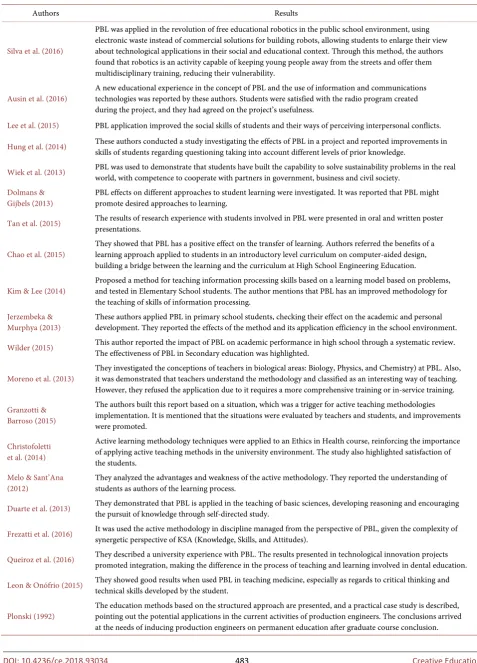
The learning methodology based on projects or problems is characterized by the use of questions and real-world cases to encourage students to develop criti-cal thinking and skills to solve problems, acquiring knowledge about the essen-tial concepts of the area in question (Nanda & Manjunatha, 2013). The method may be implemented in the whole course; as a partial educational strategy or even in separate subjects. In this method, the student is exposed to motivating situations in tutorial groups where, through a project, they are led to define goals of learning related to the topics listed in the curriculum. One of the main fun-damentals of this method is to teach the student to learn in different ways. In addition to the constant updated, the student develops agility to solve problems and creativity to explore new organizational methods. As a result, the student develops independence, a permanent study attitude, and real learning. Moreo-ver, the acquired knowledge is kept longer (Long & Qin, 2014). Several authors applied the PBL and Active Learning Methods with important results, as shown in Table 1.
In Technical Drawing, the application of PBL can also be facilitated using de-sign software computer-aided (CAD—Computer Aided Dede-sign). The use of this technology has created a great change in the development of engineering projects, given its qualities not found in the design manual forms, such as speed, efficiency, and ease of review (Ye et al., 2014), as well as providing opportunities for viewing objects in three dimensions from orthographic views and perspec-tives (Cao et al., 2013).
Action-Research
The methodology of this study defines action-research as a type of empirical re-search, which is conceived and developed in association with an action or solv-ing of a collective problem, in which researchers, and participants are involved in a cooperative or participatory way. It was possible to choose this method due to the direct participation of the researcher along with the target of analysis
(Santos & Lima, 2012). In this way, the researcher assumes the role of leader, of-fering structured activities under the principles of the method and leading the development of the conceptual research and reports from the students.
The population of this study was composed of first-year High School students (34 students). The variables of the research were the application of the learning method based on projects and the students’ perception of the dynamics of the method. The main activity planned was divided over twelve months of imple-mentation. Classes were given over 40 weeks, totalizing 80 hours. It was the time required for implementation of the subject content in an annual-base discipline.
DOI: 10.4236/ce.2018.93034 483 Creative Education Table 1. Research on PBL and active learning methods.
Authors Results
Silva et al. (2016)
PBL was applied in the revolution of free educational robotics in the public school environment, using electronic waste instead of commercial solutions for building robots, allowing students to enlarge their view about technological applications in their social and educational context. Through this method, the authors found that robotics is an activity capable of keeping young people away from the streets and offer them multidisciplinary training, reducing their vulnerability.
Ausin et al. (2016) A new educational experience in the concept of PBL and the use of information and communications technologies was reported by these authors. Students were satisfied with the radio program created during the project, and they had agreed on the project’s usefulness.
Lee et al. (2015) PBL application improved the social skills of students and their ways of perceiving interpersonal conflicts.
Hung et al. (2014) These authors conducted a study investigating the effects of PBL in a project and reported improvements in skills of students regarding questioning taking into account different levels of prior knowledge.
Wiek et al. (2013) PBL was used to demonstrate that students have built the capability to solve sustainability problems in the real world, with competence to cooperate with partners in government, business and civil society.
Dolmans &
Gijbels (2013) PBL effects on different approaches to student learning were investigated. It was reported that PBL might promote desired approaches to learning.
Tan et al. (2015) The results of research experience with students involved in PBL were presented in oral and written poster presentations.
Chao et al. (2015) They showed that PBL has a positive effect on the transfer of learning. Authors referred the benefits of a learning approach applied to students in an introductory level curriculum on computer-aided design, building a bridge between the learning and the curriculum at High School Engineering Education.
Kim & Lee (2014) Proposed a method for teaching information processing skills based on a learning model based on problems, and tested in Elementary School students. The author mentions that PBL has an improved methodology for the teaching of skills of information processing.
Jerzembeka &
Murphya (2013) These authors applied PBL in primary school students, checking their effect on the academic and personal development. They reported the effects of the method and its application efficiency in the school environment.
Wilder (2015) This author reported the impact of PBL on academic performance in high school through a systematic review. The effectiveness of PBL in Secondary education was highlighted.
Moreno et al. (2013) They investigated the conceptions of teachers in biological areas: Biology, Physics, and Chemistry) at PBL. Also, it was demonstrated that teachers understand the methodology and classified as an interesting way of teaching. However, they refused the application due to it requires a more comprehensive training or in-service training.
Granzotti & Barroso (2015)
The authors built this report based on a situation, which was a trigger for active teaching methodologies implementation. It is mentioned that the situations were evaluated by teachers and students, and improvements were promoted.
Christofoletti et al. (2014)
Active learning methodology techniques were applied to an Ethics in Health course, reinforcing the importance of applying active teaching methods in the university environment. The study also highlighted satisfaction of the students.
Melo & Sant’Ana
(2012) They analyzed the advantages and weakness of the active methodology. They reported the understanding of students as authors of the learning process.
Duarte et al. (2013) They demonstrated that PBL is applied in the teaching of basic sciences, developing reasoning and encouraging the pursuit of knowledge through self-directed study.
Frezatti et al. (2016) It was used the active methodology in discipline managed from the perspective of PBL, given the complexity of synergetic perspective of KSA (Knowledge, Skills, and Attitudes).
Queiroz et al. (2016) They described a university experience with PBL. The results presented in technological innovation projects promoted integration, making the difference in the process of teaching and learning involved in dental education.
Leon & Onófrio (2015) They showed good results when used PBL in teaching medicine, especially as regards to critical thinking and technical skills developed by the student.
DOI: 10.4236/ce.2018.93034 484 Creative Education
of each stage; (iii) present a project and its specifications relating to technical drawing; (iv) building physical models of the project, evaluating the technical and economic viability.
Firstly, the discipline was presented to the students regarding the content and organization. The challenge was given to the groups as a current problem expe-rienced by the society and may have a solution based on projects. The theme “reuse” and “economy” of water was proposed followed by a discussion of how water reuse and water saving would be possible, in an attempt to collaborate with the preservation of the environment and society. The specification “cisterns to capture rainwater” was the choice by the students. In this way, the main theme was democracy chosen by the students, and entitled as “Development of a capture system and rainwater treatment in the dependencies of the school”.
The construction of physical models is a key step for the project-based learn-ing once one of the project phases is the construction of models (Mockups) and prototypes, which has the function to test both, form and function. At this stage, students built models of solids from the planning of their surfaces. This is a very important stage for the process of teaching and learning as provides an effective contact between the student and the object of study through the experience of manufacturing and actual three-dimensional experience. All students built their models using low-cost materials.
All the groups showed their prototype on the day and place previously sche-duled by the teacher. The prototypes were retained by the school for future exhi-bitions. The following material was utilized during the development of the pro-totypes: (i) initial hand sketches: pencil, paper, rubber, compass, square, among other basic features; (ii) shaped pieces: blocks, pieces patterns, modeling sponges; (iii) free software: FreeCAD® and Google Sketch Up®; (iv) hardware: software classes were held in classrooms with computers organized by group (1 machine for each group).
The purpose of the Technical Drawing discipline in High School is the accu-rate and absolute representation of the forms in the three-dimensional material world. This is important to enable the spatial reconstruction of the form in drawing in the plan and the project, as a concise and unequivocally mean of communication in projects. National and international standards must be fol-lowed. The reason for this discipline is the need for preparation of the technical course of the student to the challenge of interpretation and creativity in the ab-stract and graphic presentation from two and three-dimensional elements. It is through technical design, arrives at the project detailing.
Students should understand the project, formulate hypotheses and formulate learning objectives, representing the knowledge that the group defines as neces-sary to compose the project. Every week there was a practice section and a theo-retical section, as follows:
• Week 1—Introduction to Technical Drawing: presentation of the history and
DOI: 10.4236/ce.2018.93034 485 Creative Education
Leonardo da Vinci (importance in engineering and art) Steve Jobs (impor-tance design and usability) were presented. In a practical class; students were encouraged to present applications and reports of good and bad use of draw-ing highlightdraw-ing its importance;
• Week 2—Applications of Technical Drawing: Applications such as
flow-charts, mechanical design, architectural, pipes, automation, electro electron-ics and others, were presented. It was followed by a discussion about the im-portance of knowing how to read and make an interpretation of the drawing as professional engineering;
• Week 3—Presentation of PBL and projects were chosen by students: The
teaching methodology based on projects was presented, highlighting its im-portance in the process of teaching and learning. The schedule and forms of assessment were also presented and agreed with the students. The presenta-tion was very receptive, once “put your hands on” is faced by students as an excellent approach. After the presentation, the groups were divided, and the project rules were given;
• Week 4—Design by Canvas: Canvas (Naggar, 2015) was presented as a
de-sign model. The mission of insert the project in Canvas was asde-signed to stu-dents. They had five weeks to present the final version. Therefore deadline was week 9;
• Week 5—Symbology and Standards: Standards and necessary technical
drawing symbols were presented and a discussion of the importance of these rules were carried out with students;
• Week 6—Geometric Constructions: Theory was presented to students in
ad-dition to written exercises. Analytic geometry concepts and use of square and compasses were taught;
• Week 7—Plans and Projections: Theory was presented to students in
addi-tion to written exercises;
• Week 8—Sheet and Subtitles: sheets were presented in various sizes, with
folding practices and building legends;
• Week 9—Practice Evaluation: Presentation of Canvas previously assigned on
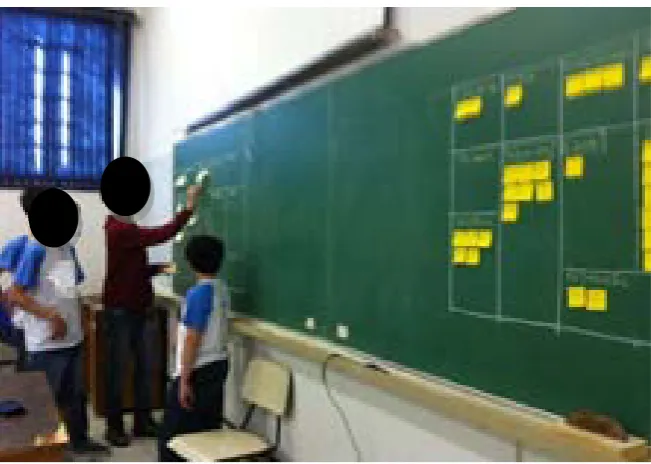
week 4 was performed in this class. The activity was conducted with the presentation of the groups. Post-it was utilized to insert information at each stage of the project subject (Figure 1).
• Week 10 - 17—Theory Contents: The subjects scales, dimensions, views and
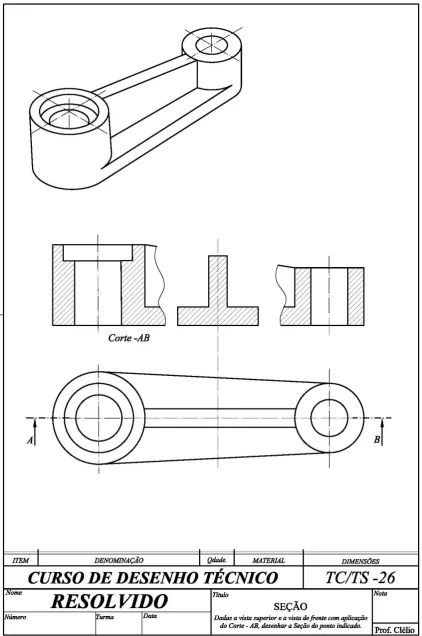
perspectives, auxiliary views, courts, sessions, tolerances, and adjustments were presented with their practices using the online workbook. Students seek the reading and interpretation of Technical Drawing front of the exercises. The workbook was based on the book “Drawing Course Technical and Au-tocad” (Ribeiro et al., 2013). This is an important engineering book, leading the High School and Technical students at the highest level of education. The workbook exercise example is shown in Figure 2.
DOI: 10.4236/ce.2018.93034 486 Creative Education Figure 1. Presentation of the PMC by students.
By the end of 40 hours, a written test with questions of importance on Tech-nical Drawing in dichotomous and trichotomous format, multiple choice and dissertation questions on the matters related the main commonalities of Technical Drawing was performed. At this point, the course reported in this paper turns similar to the end of the major courses offered in High School, in which an assessment is performed by the end of the course (80 hours). In this class, students also presented the manual drawing of the parts that would make up the cistern project. The number of pieces was according to the com-plexity of the project. Therefore, a minimum of 3 parts (pieces) was required for each group;
• Week 20 and 21—Modeling in Sponge: An excellent practice of spatial
visuali-zation and representation of views and projections is to build three-dimensional blocks made by material type floral sponge or soap from representations of two-dimensional views. Students reproduced the pieces, which were given in printed exercises in moldable block (class 20) and performed the reverse ac-tivity (class 21) (Figure 3).
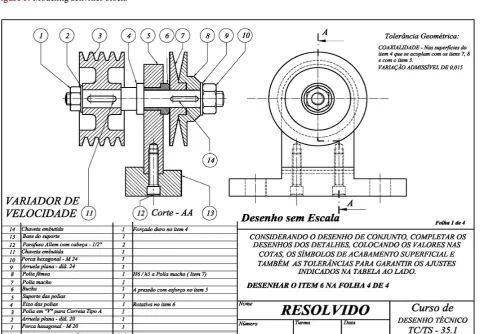
• Week 22—Assembly Drawing: Drawing of joint and assembly were explained
in their theoretical and practical Reading (Figure 4).
• Week 23—Surface Elements: Subject usually explored in engineering degree
courses were explained in their theoretical and practical reading.
• Week 24 to 28—From week 24 the teaching computer-aided was included.
DOI: 10.4236/ce.2018.93034 489 Creative Education Figure 3. Modeling activities block.
Figure 4. Assembly drawing.
• Week 29—Project editor and the Project Delivery CAD: Students learned project instruction utilizing a scientific paper and a poster template. The work was later presented at a Science Fair.
• Week 30—Models and Mockup Project: In this lesson, there was an exposure
[image:11.595.61.542.260.594.2]DOI: 10.4236/ce.2018.93034 490 Creative Education
project.
• Week 31—Practice activity in the construction of mockup and project
clo-sure: Students built or adjusted details of their models in the classroom with the help of teachers and monitor of the discipline.
• Week 32 and 33—Theory of Analysis of Failure in Projects: Projects may fail.
A class about techniques of risk analysis in projects using tools, such as the tree of causes and the cause-and-effect diagram was performed. Groups were instructed to predict failures in their projects.
• Week 34 and 35—Presentation of Projects and mockups in the Classroom:
Students present their projects for the other groups in the classroom.
• Week 36—Presentation of mockups in Science Fair: In the Science Fair event,
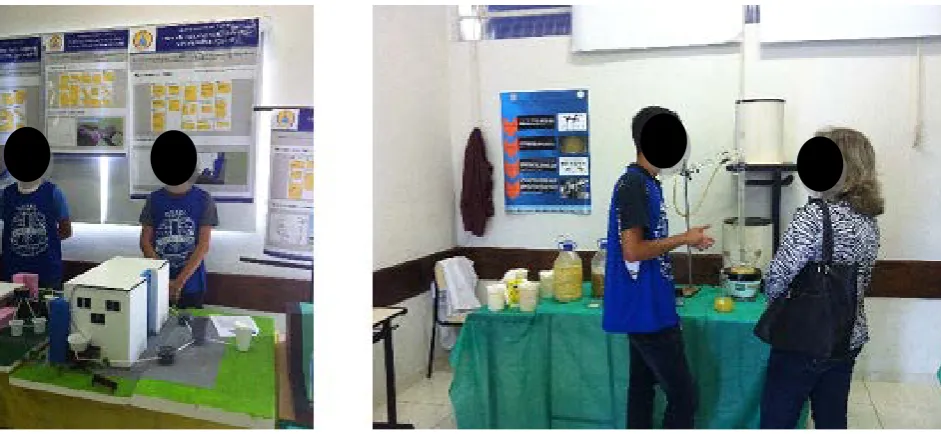
the institution opens the doors to the community for the presentation of Technical Course projects. A room was reserved exclusively for the Technical Drawing project. Teachers of other subjects were asked to evaluate the quality of the projects (Figure 5). The event lasted three days (morning and after-noon) and received over a thousand visitors.
• Week 37—Monitoring: After the presentation it was performed a discussion
about the projects and mockups, taking into account the comments of the evaluators and the analysis of failure performed at weeks 32 and 33;
• Week 38 and 39—Presentation of Final Reports of Projects: Projects in poster
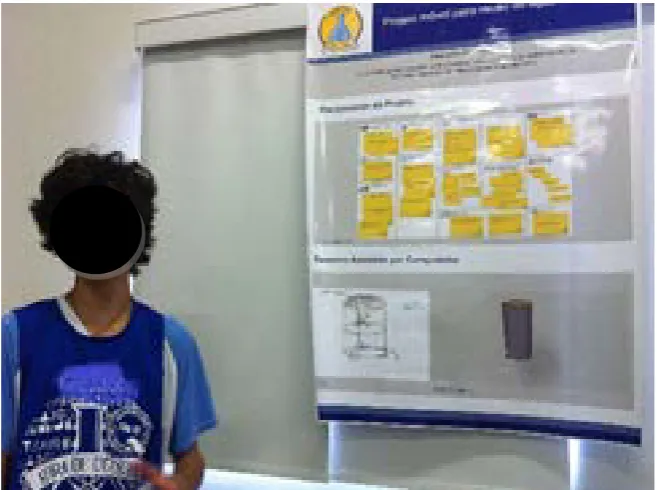
format were presented by the students, with a time of 10 minutes per group (Figure 6).
• Week 40—Project Closing: Reports and discussions about learning during
[image:12.595.65.536.489.706.2]the year were conducted, and a questionnaire for evaluation of the discipline and method was applied. Engineering applications were presented by other teachers, for example, an automation mockup (Figure 7(a)) and a real cistern which was implemented from the projects developed in class (Figure 7(b)).
DOI: 10.4236/ce.2018.93034 491 Creative Education Figure 6. Presentation of posters.
[image:13.595.213.538.350.508.2]
(a) (b) Figure 7. Mockup of cistern (a) and real cistern (b).
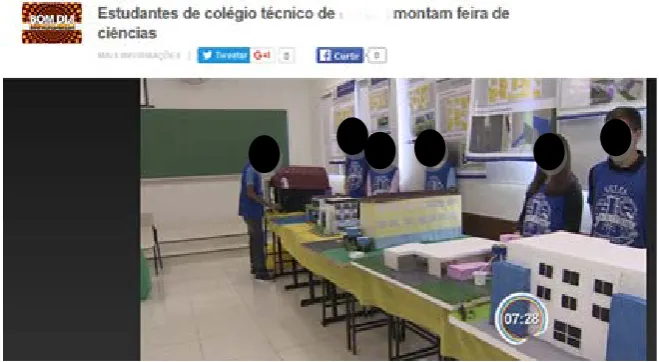
A news report was developed by regional news (TV Vanguard), where activi-ties were presented, and a student was interviewed (Figure 8).
During the whole period, control points (checkpoints) were established for the formal control of the progress of the project, similar to what occurs in profes-sional life, in which goals and deadlines are part of the profesprofes-sional routine. These controls set the pace of progress of the project, keeping some freedom of action for the teams. The objective was to control basic aspects of the imple-mentation of the project so that the rhythm of work to be done could flow prop-erly. Also, support material to be used during the course was available on the in-ternet, and the communication with the leader was possible through the social network.
DOI: 10.4236/ce.2018.93034 492 Creative Education Figure 8. Interview on TV Vanguarda.
give their opinion about the method, their commitment, and participation. The question: “Would you like to be the monitor of Technical Drawing discipline next year?” was answered as “yes” by 31 of the 34 respondents, reflecting the in-terest acquired by them. The justification included:
“Yes, because I thought I would feel a lot of trouble with the programs and
manual drawings, but I’m doing better than I thought. I enjoyed working
with projects. It is something that I had never done, so I think my help can
be somewhat useful”.
“Yes, the matter gives a very good background for college and I’ve enjoyed
it.”
“Yes, because I liked this method of learning and I would like to spend a
lit-tle of what I learned this year to another student.”
“To be a monitor next year would be my pleasure. During the year I got
at-tached to the discipline, and I also reinforced my aspiration to become an
architect, civil engineer or mechanical engineer.”
“Yes, because I liked to use creativity to make innovative projects.”
In addition to this, it was suggested to the students to “Let your criticism or
suggestions regarding projects by learning method”:
“The project was very good for our learning.”
“I liked the teacher’s availability for service to answer questions about the
matter.”
“Professor and monitor were always very attentive, provide the time to
an-swer our questions and provide support.”
“It was interesting to have class this way, something quite different from the
materials with which I was used to.”
“In my opinion, the idea ofdeveloping projects was very good.”
“I think it should be proposed something even more innovative. The
sub-ject was great. However almost all the groups used the same solution. I
re-DOI: 10.4236/ce.2018.93034 493 Creative Education
quirement (and also technology).”
Considering the verbalizations, it’s possible to conclude that the students were interested in the discipline in addition to the teaching method. Moreover, some of them got inspired and open to take place as a monitor and work harder on new projects, or even follow the career in Engineering and Technology.
3. Conclusions and Considerations
Several papers have already been published demonstrating gains in the imple-mentation of active teaching and learning methodologies. However it rarely finds application in a full discipline. Some disciplines are more suitable to the PBL than others. Therefore there is not a recipe to solve the education and teaching practice problems, neither a pattern, due to the teaching practices cover many variations and adaptations. Disciplines based on projects, such as Tech-nical Drawing, seem to be relatively more suitable. On the other hand, it’s man-datory to keep full attention on theoretical content during the implementation.
Besides the knowledge acquired, the development of projects allows students to contribute socially. All participants demonstrated sufficient understanding of the concepts in assessments in addition to the concern related to the implemen-tation of the practices and the presenimplemen-tation of the developed project. These re-sults corroborate to an initiative to be developed in education area to promote changes in practices of students and teachers.
Overall, the students had a positive reaction to the PBL, suggesting its possible use in another discipline in an integrated way, since some aspects of the imple-mentation presented here were reconsidered and resized according to the prob-lems and approaches of each application case.
References
Ausin, V., Abella, V., Delgado, V., & Hortigüela, D. (2016). Aprendizaje Basadoen Proyectos a través de las TIC: Una Experiencia de Innovación Docente desde las Aulas Universitarias. Formaciónuniversitaria, 9, 31-38.
Campello, A. D. V. C., & Lins, L. N. (2008). Metodologia de análise e tratamento da evasão e retencão em cursos de graduacão de instituicões federais de ensino superior. XXVIII Encontro Nacional de Engenharia De Producão, RJ, 13.
http://www.abepro.org.br/biblioteca/enegep2008_TN_STO_078_545_11614.pdf Cao, Y., Lu, Y., Yao, H., & Cheng, H. (2013). CAD Education Resource Platform for
Me-chanical Design and Manufacture. Research Journal of Applied Sciences, Engineering and Technology, 5, 3026-3031. http://maxwellsci.com/print/rjaset/v5-3026-3031.pdf https://doi.org/10.19026/rjaset.5.4618
Chao, C. Y, Chen, Y. T., & Chuang, K. Y. (2015). Exploring Students Learning Attitude and Achievement in Flipped Learning Supported Computer Aided Design Curriculum: A Study in High School Engineering Education. Computer Applications in Engineering Education, 23, 514-526. https://doi.org/10.1002/cae.21622
DOI: 10.4236/ce.2018.93034 494 Creative Education
8, 188-197. https://doi.org/10.14244/19827199823
Dos Santos, A. P., Nascimento, C., & Rios, J. R. T. (2000). Estudo da evasão e da retencão nos cursos de engenharia da Escola de Minas da Universidade Federal de Ouro Preto. In Cobenge 2000. http://www.abenge.org.br/CobengeAnteriores/2000/artigos/175.PDF Dolmans, D., & Gijbels, D. (2013). Research on Problem-Based Learning: Future
Chal-lenges. Medical Education, 47, 214-218. https://doi.org/10.1111/medu.12105
Duarte, A. L. A., Monaco, C. F., & Manso, M. E. G. (2013). A Aprendizagem baseada em Problemas no Ensino de Ciências Básicas: experiência no segundo semestre do curso de Medicina de um Centro Universitário. Revista O Mundo da Saúde, 37, 89-96.
http://www.saocamilo-sp.br/pdf/mundo_saude/101/9.pdf https://doi.org/10.15343/0104-7809.20133718996
Frezatti, F., Borinelli, M. L., Martins, D. B., & Espejo, M. M. S. B. (2016). Análise do Desempenho de alunos na Perspectiva do CHA em Disciplina utilizando PBL: O que significa a síntese? Revista de Contabilidade e Organizações, 10, 3-19.
Granzotti, G., & Barroso, R. (2015). Problem-Situation as a Trigger of the Teaching-Learning Process in Active Teaching Methodologies. Revista CEFAC, 17, 2081-2087.
Hung, P. H., Hwang, G. J., Lee, Y. H., Wu, T. H., Vogel, B., Milrad, M., & Johansson, E. (2014). A Problem-Based Ubiquitous Learning Approach to Improving the Question-ing Abilities of Elementary School Students. Journal of Educational Technology & So-ciety, 17, 316-334. http://www.learntechlib.org/p/156109
Jerzembeka, G., & Murphya, S. (2013). A Narrative Review of Problem-Based Learning with School-Aged Children: Implementation and Outcomes. Educational Review, 65,
206-218. https://doi.org/10.1080/00131911.2012.659655
Kim, D. G., & Lee, J. (2014). A Study on Improving Information-Processing Abilities Based on PBL. Turkish Online Journal of Distance Education, 15, 41-52
https://doi.org/10.17718/tojde.18487
Kolmos, A., De Graaff, E., & Du, X. (2009). Diversity of PBL:-PBL Learning Principles and Models. Research on PBL Practice in Engineering Education (Vol. 4).
https://doi.org/10.7771/1541-5015.1180
Lee, D., Huh, Y., & Reigeluth, C. M. (2015). Collaboration, Intragroup Conflict, and So-cial Skills in Project-Based Learning. Instructional Science, 43, 561-590.
https://doi.org/10.1007/s11251-015-9348-7
Leon, L. B., & Onófrio, F. Q. (2015). Aprendizagem Baseada em Problemas na Graduação Médica—Uma Revisão da Literatura Atual. Revista Brasileira de Educação Médica, 39,
614-619.https://doi.org/10.1590/1981-52712015v39n4e01282014
Lins, L. M., Salerno, M. S., Araújo, B. C., Gomes, L. A. V., Nascimento, P. A. M. M., & Toledo, D. (2014). Escassez de engenheiros no Brasil? Uma proposta de sistematização do debate. Novos Estudos—CEBRAP, 98, 43-67.
https://doi.org/10.1590/S0101-33002014000100004
Long, T., & Qin, D. (2014). Challenges of Conducting Problem-Based Learning in a Large Class. Chinese Education & Society, 47, 106-110.
https://doi.org/10.2753/CED1061-1932470312
Melo, B. C., & Sant’Ana, G. (2012). A prática da Metodologia Ativa: Compreensão dos discentes enquanto autores do processo ensino-aprendizagem. Revista Ciências e Saúde, 23, 327-339.
DOI: 10.4236/ce.2018.93034 495 Creative Education
Revista mercado de trabalho: Conjuntura e análise, 49, 19-28. http://repositorio.ipea.gov.br/handle/11058/3908
Moreno, M. A., Reis, M. J., & Calefi, P. S. (2013). Concepções de professores de Biologia Física e Química sobre aprendizagem baseada em Problemas. Revista Hipótese, Itapetininga, 2, 104-117. http://itp.ifsp.edu.br/ojs/index.php/HIP/article/view/284 Naggar, R. (2015). The Creativity Canvas: A Business Model for Knowledge and Idea
Management. Technology Innovation Management Review, 5, 50-58. http://timreview.ca/article/914
Nanda, B., & Manjunatha, S. (2013). Indian Medical Students’ Perspectives on Prob-lem-Based Learning Experiences in the Undergraduate Curriculum: One Size Does Not Fit All Nanda, Bijli, Manjunatha, Shankarappa. Journal of Educational Evaluation for Health Professions, 31, 10-11.
Pena, F. L. A. (2012). Sobre a presença do Projeto Harvard no sistema educacional brasileiro. Revista Brasileira de Ensino de Física, 34, 1-4.
https://doi.org/10.1590/S1806-11172012000100016
Pereira, M. A. C., Barreto, M. A. M., & Pazeti, M. (2017). Application of Project-Based Learning in the First Year of an Industrial Engineering Program: Lessons Learned And Challenges. Production, 27, e20162238.https://doi.org/10.1590/0103-6513.223816 Plonski, G. A. (1992). Inovando métodos na educação continuada dos engenheiros de
produção. Production, 2, 71-80.https://doi.org/10.1590/S0103-65131992000100006 Queiroz, J. R. C., Oliveira, M. F. J., Souza, D. M. C., Araújo, A. L. L. S., & Fuscella, M. A.
P. (2016). Aprendizagem por Projeto e Inovação Tecnológica: União por Competências. Revista ABENO, 16, 2-6.
http://revabeno.emnuvens.com.br/revabeno/article/view/243
Ribeiro, A. C., Peres, M. P., & Izidoro, N. (2013). Curso de Desenho Técnico e Autocad-Editora Pearson. http://loja.pearson.com.br/auto%20cad
Santos, E. F., & Lima, C. A. C. (2012). DMAICR in an Ergonomic Risks Analysis. Work, 41, 1632-1638.
Santos, E. F., Pereira, C., Auxiliadora, M., Barreto, M., & Silva, M. B. (2017). Parceria Universidade e Hospital Para a Melhoria dos Processos Através do Lean Healthcare. In Xlv Cobenge-Congresso Brasileiro de Ensino em Engenharia.
http://www.abenge.org.br/sis_submetidos.php?acao=abrir&codigo=COBENGE17_000 20_00000415.pdf
Santos, E. F., Robeiro, T. J. G., Silva, M. B., Pereira, M. A. C., & Silva, A. V. F. M. (2015).
Proposta de uma metodologia baseada em projetos na disciplina de controle e automação no curso de engenharia de produção. In Anais do XXII Simpósio de Engenharia de Produção-SIMPEP. SIMPEP/UNESP.
Santos, E. F., Silva, M. B., & Barreto, M. A. M. (2015). Proposta de uma estratégia de ensino-aprendizagem na disciplina de desenho técnico utilizando software livre e metodologia baseada em projetos. In N. Hattum-Janssen, R. M. Lima, D. Carvalho, S. Fernandes, R. M. Sousa, F. Moreira, N. A. Arexolaleiba et al. (Eds.), Proceedings of 17th International Symposium on Project Approaches in Engineering Education (pp. 479-486). San Sebastian: Aalborg University Press.
DOI: 10.4236/ce.2018.93034 496 Creative Education Tan, L. T., Goh, B., & Yap, N. W. (2015). Project-Based Learning: Engaging Secondary School Students in Authentic Environmental Science Research. Asian Youth Journal of Biology, 3, 1-4. http://hdl.handle.net/10497/16879
Wiek, A., Xiong, A., Brundiers, K., & Van Der Leeuw, S. (2013). Integrating Problem and Project-Based Learning into Sustainability Programs: A Case Study on the School of Sustainability at Arizona State University. International Journal of Sustainability in Higher Education, 15, 431-449.
Wilder, S. (2015). Impact of Problem-Based Learning on Academic Achievement in High School: A Systematic Review. Educational Review, 67, 411-435.
https://doi.org/10.1080/00131911.2014.974511