Enabling Better Collaborative Intelligence
?Bingsheng Zhang1, Roman Oliynykov2, and Hamed Balogun3 1
Lancaster University, UK
2 Input Output Hong Kong Ltd.
3 Lancaster University, UK
Abstract. A treasury system is a community controlled and decentral-ized collaborative decision-making mechanism for sustainable funding of the blockchain development and maintenance. During each treasury period, project proposals are submitted, discussed, and voted for; top-ranked projects are funded from the treasury. The Dash governance sys-tem is a real-world example of such kind of syssys-tems. In this work, we, for the first time, provide a rigorous study of the treasury system. We modelled, designed, and implemented a provably secure treasury sys-tem that is compatible with most existing blockchain infrastructures, such as Bitcoin, Ethereum, etc. More specifically, the proposed treasury system supports liquid democracy/delegative voting for better collabo-rative intelligence. Namely, the stake holders can either vote directly on the proposed projects or delegate their votes to experts. Its core compo-nent is a distributed universally composable secure end-to-end verifiable voting protocol. The integrity of the treasury voting decisions is guar-anteed even when all the voting committee members are corrupted. To further improve efficiency, we proposed the world’s first honest verifier zero-knowledge proof for unit vector encryption with logarithmic size communication. This partial result may be of independent interest to other cryptographic protocols. A pilot system is implemented in Scala over the Scorex 2.0 framework, and its benchmark results indicate that the proposed system can support tens of thousands of treasury partici-pants with high efficiency.
?
1 Introduction. . . 1
1.1 Collaborative decision-making. . . 2
1.2 Our contributions . . . 3
2 Preliminaries. . . 4
2.1 Notations . . . 4
2.2 The blockchain abstraction . . . 4
2.3 Additively homomorphic encryption . . . 5
2.4 Pedersen commitment. . . 6
2.5 Universal composability. . . 6
2.6 UC ideal functionalities . . . 7
3 The Treasury System. . . 9
3.1 Entities . . . 9
3.2 Enabling stake delegation . . . 9
3.3 System overview . . . 11
3.4 Treasury funding sources. . . 12
3.5 Project proposal . . . 12
3.6 Voter/Expert registration . . . 13
3.7 Voting committee selection . . . 13
3.8 Supplying the treasury. . . 14
3.9 Handling the treasury specific data in the payload. . . 15
3.10 Decision making. . . 15
3.11 Post-voting execution. . . 16
3.12 Partitionary budgeting. . . 16
4 The proposed voting scheme. . . 17
4.1 Security modeling . . . 17
4.2 The voting scheme . . . 19
4.3 Security. . . 23
5 A new unit vector ZK proof. . . 26
5.1 Zero-knowledge proofs/arguments . . . 26
5.2 Schwartz-Zippel lemma . . . 27
5.3 The proposed unit vector ZK proof/argument. . . 27
6 Implementation and performance . . . 31
6.1 Prototyping . . . 31
6.2 Test network. . . 31
6.3 Evaluations. . . 32
7 Analysing consensus. . . 34
7.1 Example treasury consensus evaluation. . . 36
8 Related work. . . 41
9 Conclusion. . . 43
1
Introduction
Following the success of Bitcoin, a great number of new cryptocurrencies and blockchain platforms are emerging on almost daily basis. Blockchains have become largely ubiquitous across various sectors, e.g., technology, academia, medicine, economics and finance, etc. A key feature expected from cryptocur-rencies and blockchain systems is the absence of a centralized control over the operation process. That is, blockchain solutions should neither rely on “trusted parties or powerful minority” for their operations, nor introduce such (centrali-sation) tendencies into blockchain systems. Decentralization not only offers bet-ter security guarantees by avoidingsingle point of failure, but may also enable enhanced user privacy techniques. On the other hand, real-world blockchain sys-tems require steady funding for continuous development and maintenance of the systems. Given that blockchain systems are decentralized systems, their main-tenance and developmental funding should also be void of centralization risks. Therefore, secure and “community-inclusive” long-term sustainability of funding is critical for the health of blockchain platforms.
In the early years, the development of cryptocurrencies, such as Bitcoin, mainly rely on patron organizations and donations. Recently, an increasing num-ber of cryptocurrencies are funded throughinitial coin offering(ICO) – a popular crowd-funding mechanism to raise money for the corresponding startups or com-panies. A major drawback of donations and ICOs is that they lack sustainable funding supply. Consequently, they are not suitable as long-term funding sources for cryptocurrency development due to the difficulty of predicting the amount of funds needed (or that will be available) for future development and main-tenance. Alternatively, some cryptocurrency companies, such as Zcash Electric Coin Company, take certain percentage of hair-cut/tax (a.k.a. founders reward) from the miners’ reward. This approach would provide the companies a more sustainable funding source for long-term planning of the cryptocurrency devel-opment.
Nevertheless, the aforementioned development funding approaches have risks of centralization in terms of decision-making on the development steering. Only a few people (in the organisation or company) participate in the decision-making process on how the available funds will be used. However, the decentralized ar-chitecture of blockchain technologies makes it inappropriate to have a centralized control of the funding for secure development processes. Sometimes disagreement among the organisation members may lead to catastrophic consequences. Exam-ples include the splitting of Ethereum and Ethereum Classic as well as Bitcoin and Bitcoin Cash.
is a real-world example of such systems. A treasury system consists of iterative treasury periods. During each treasury period, project proposals are submitted, discussed, and voted for; top-ranked projects are then funded. However, the Dash governance system has a few potential theoretical drawbacks. i) It does not offer ballot privacy to the voters (a.k.a. masternodes) [2]. Therefore, the soundness of any funding decision might be ill-affected. For instance, the masternodes may be subject to coercion. ii) It fails to effectively utilize the knowledge of commu-nity experts in the decision-making process. This is because the system can only support very basic type of voting schemes, and the voting power of experts are limited.
In this work, we propose to use a different approach – liquid democracy – to achieve better collaborative intelligence. Liquid democracy (also known as delegative democracy [3]) is an hybrid of direct democracy and representative democracy. It provides the benefits of both systems (whilst doing away with their drawbacks) by enabling organisations to take advantage of experts in a treasury voting process, as well as giving the stakeholders the opportunity to vote. For each project, a voter can either vote directly or delegate his/her voting power to an expert who is knowledgeable and renowned in the corresponding area.
1.1 Collaborative decision-making
The core component of a treasury system is a decision-making system that al-lows members of the community collectively reach some conclusions/decisions. During each treasury period, anyone can submit a proposal for projects to be funded. Due to shortage of available funds, only a few of them can be supported. Therefore, a collaborative decision-making mechanism is required. Note that in the literature, a few blockchain based e-voting schemes have been proposed. However, our treasury decision-making have a number of differences: (i) con-ventional e-voting scheme requires real-world identity authentication, while our treasury decision-making do not need to link voters to their real identities; (ii) in a conventional e-voting scheme, typically, each voter has one vote, while in our treasury decision-making, the voting power is proportional to the corresponding stake; (iii) our treasury decision-making supports liquid democracy with privacy assurance, while no other known e-voting scheme can support liquid democracy with provable security.
Proper selection of the voting scheme allows maximizing the number of voters satisfied by the voting results as well as minimizing voters’ effort. In practice, there are two commonly used voting schemes: i) preferential or ranked voting
1.2 Our contributions
In this work, we aim to resolve the funding sustainability issue for long-term cryptocurrency development and maintenance by proposing a novel treasury system. The proposed treasury system is compatible with most existing off-the-shelf cryptocurrencies/blockchain platforms, such as Bitcoin and Ethereum. We highlight the major contributions of this work as follows.
– For the first time, we provide a rigorous security modeling for a blockchain-based treasury voting system that supports liquid democracy/delegative vot-ing. More specifically, we model the voting system in the well-known Uni-versally Composable(UC) framework [5] via an ideal functionalityFVotet,k,n,m. The functionality interacts with a set voters and experts as well as k vot-ing committee members. It allows the voters to either delegate their votvot-ing power to some experts or vote directly on the project. If at leastt out ofk
voting committee members are honest, the functionality guarantees termi-nation. Even in the extreme case, when all the voting committee members are corrupted, the integrity of the voting result is still ensured; however, in that case we don’t guarantee protocol termination.
– We propose an efficient design of the treasury system. The system collects funding via three potential sources: (i) Minting new coins; (ii) Taxation from miners’ reward; (iii) Donations or charity. In an iterative process, the treasury funds accumulate over time, and the projects are funded periodi-cally. Each treasury period consists of pre-voting epoch, voting epoch, and post-voting epoch, which can be defined in terms of number of blockchain blocks. In the pre-voting epoch, project proposals are submitted, and the voters/experts are registered. In the voting epoch, the voting committee is selected; after that, they jointly generate the voting key for the treasury period. The voters and experts then cast their ballots. In the post-voting epoch, the voting committee computes and signs the treasury decision. Win-ning proposals will then be funded. Any stakeholder in the community can participate in the treasury voting, and their voting power is proportional to their possessed stake. In our system, we distinguish coin ownership from stake ownership. That is, the owner of a coin can be different from the owner of the coin’s stake. This allows blockchain-level stake delegation without transferring the ownership of the coin. It means that the user can delegate his/her stake to someone else without risk of losing the ultimate control of the coin(s). To achieve this, we introduced stake ownership verification mech-anism using the payload of a coin. (Without loss of generality, we assume a coin has certain storage field for non-transactional data.)
voting schemes, e.g., Helios. However, the proof size is linear in the length of the unit vector, and thus the communication overhead is quite signifi-cant when the unit vector length becomes larger. In this work, we propose a novel special honest verifier ZK (SHVZK) proof/argument for unit vector that allows the prover to convince the verifier that a vector of ciphertexts (C0, . . . , Cn−1) encrypts a unit vectore
(n)
i ,i∈[0, n−1] withO(logn) proof size. The proposed SHVZK protocol can also be Fiat-Shamir transformed to a non-interactive ZK (NIZK) proof in the random oracle model.
– We provide prototype implementation [7] of the proposed treasury system for running and benchmarking in the real world environment. Our implemen-tation is written in Scala programming language over Scorex 2.0 framework and uses TwinsChain consensus for keeping the underlying blockchain. Main functionality includes proposal submission, registration of voters, experts, voting committee members and their corresponding deposit lock, random-ized selection of the voting committee members among voters, distributed key generation (6-round protocol), ballots casting, joint decryption with re-covery in case of faulty committee members (4-round protocol), randomness generation for the next treasury period (3-round protocol), reward payments, deposit paybacks, and penalties for faulty actors. All implemented protocols are fully decentralized and resilient up to 50% of malicious participants. During verification we launched a testnet that consisted of 12 full nodes successfully operating tens of treasury periods with different parameters.
2
Preliminaries
2.1 Notations
Throughout this paper, we will use the following notations. Let λ∈ N be the security parameter. Denote the set {a, a+ 1, . . . , b} by [a, b], and let [b] denote [1, b]. We abbreviate probabilistic polynomial time as PPT. Bya(`), we denote a length-` vector (a1, . . . , a`). When S is a set, s ← S stands for sampling s
uniformly at random from S. When A is a randomised algorithm, y ← A(x) stands for runningAon inputxwith a fresh random coinr. When needed, we denotey:=A(x;r) as runningAon inputxwith the explicit random coinr. Let poly(·) andnegl(·) be a polynomially-bounded function and negligible function, respectively.
2.2 The blockchain abstraction
Without loss of generality, we abstract the underlying blockchain platform en-compasses the following concepts.
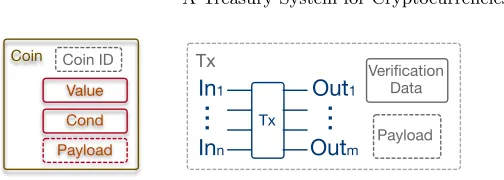
◦ Coin. We assume the underlying blockchain platform has the notion of
Value
Coin
Cond
Payload
Tx
Tx
In
1In
n…
Out
1 VerificationDataOut
m…
Coin ID
[image:7.612.193.445.98.188.2]Payload
Fig. 1: Coin and transaction structure.
– Coin ID: It is an implicit attribute, and every coin has a unique ID that can be used to identify the coin.
– Value: It contains the value of the coin.
– Cond: It contains the conditions under which the coin can be spent.
– Payload: It is used to store any non-transactional data.
◦Address.We also generalize the concept of theaddress. Conventionally, an address is merely a public key, pk, or hash of a public key, h(pk). To create coins associated with the address, the spending condition of the coin should be defined as a valid signature under the corresponding public keypkof the address. In this work, we define an address as a generic representation of some spending condition. Using the recipient’s address, a sender is able to create a new coin whose spending condition is the one that the recipient intended; therefore, the recipient may spend the coin later.
◦Transaction.Each transaction takes one or more (unspent) coins, denoted as {Ini}i∈[n], as input, and it outputs one or more (new) coins, denoted as
{Outj}j∈[m]. Except special transactions, the following condition holds:
n X
i=1
Ini.Value≥ m X
j=1
Outj.Value
and the difference is interpreted as transaction fee. As shown in Fig.1, the trans-action has aVerification datafield that contains the necessary verification data to satisfy all the spending conditions of the input coins {Ini}i∈[n]. In addition,
each transaction also has a Payload field that can be used to store any non-transactional data. We denote a transaction as Tx(A;B;C), where Ais the set of input coins,B is the set of output coins, andCis thePayloadfield. Note that the verification data is not explicitly described for simplicity.
2.3 Additively homomorphic encryption
the DDH assumption holds with respect to the group generator Gengp. More specifically, the additively homomorphic cryptosystemHEconsists of algorithms (KeyGenE,Enc,Add,Dec) as follows:
– KeyGenE(param): picksk←Z∗
q and set pk:=h=gsk, and output (pk,sk).
– Encpk(m;r): outpute:= (e1, e2) = (gr, gmhr). – Add(c1, . . . , c`): outputc:= (Q`i=1ci,1,Q`i=1ci,2).
– Decsk(e): outputDlog(e2·e−1sk), whereDlog(x) is the discrete logarithm ofx.
(Note that sinceDlog(·) is not efficient, the message space should be a small set in practice.)
Lifted ElGamal encryption is additively homomorphic, i.e.
Encpk(m1;r1)·Encpk(m2;r2) =Encpk(m1+m2;r1+r2) .
2.4 Pedersen commitment
In the unit vector zero-knowledge proof, we use Pedersen commitment as a building block. It is perfectly hiding and computationally binding under the discrete logarithm assumption. More specifically, it consists of the following 4 PPT algorithms. Note that those algorithms (implicitly) take as input the same group parameters,param←Gengp(1λ).
– KeyGenC(param): picks←Z∗
q and setck:=h=gs, and outputck.
– Comck(m;r): outputc:=gmhr andd:= (m, r).
– Open(c, d): outputd:= (m, r).
– Verifyck(c, d): returnvalidif and only ifc=gmhr.
Pedersen commitment is also additively homomorphic, i.e.
Comck(m1;r1)·Comck(m2;r2) =Comck(m1+m2;r1+r2) .
2.5 Universal composability
We model our system security under the standardUniversal Composability(UC) framework. The protocol is represented as interactive Turing machines (ITMs), each of which represents the program to be run by a participant. Adversarial entities are also modeled as ITMs.
The model of computation consists of a number of ITIs that can write on each other’s tapes in certain ways (specified in the model). The pair (SID,PID) is a unique identifier of the ITI in the system. With one exception (discussed within) we assume that all ITMs are PPT.
We consider the security of the voting system in the UC framework with static corruption in the random oracle (RO) model. The security is based on the indistinguishability between real/hybrid world executions and ideal world executions, i.e., for any possible PPT real/hybrid world adversary A we will construct an ideal world PPT simulatorS that can present an indistinguishable view to the environment Z operating the protocol.
2.6 UC ideal functionalities
In this work, we adopt the following UC ideal functionalities as building blocks.
The distributed key generation functionality. We use the key generation functionalityFDKGt,k [8] for threshold key generation of the underlying public key crypto system. The functionality depicted in Fig.2, interacts with a set of com-mitteesC:={C1, . . . ,Ck}to generate a public keypkand deal the corresponding secret keyskamong the committees. In AppendixA, we give a detailed descrip-tion of our threshold distributed key generadescrip-tion protocol adopted from Gennaro
et al.[9].
The functionalityFDKGt,k interacts with a set of voting committeesC := {C1, . . . ,Ck}, any partyP, and the adversaryA. It is parameterised with variableJ and algorithmsKeyGen() andDeal().
Initially, setJ :=∅.
– Upon receiving (KeyGen,sid) fromCj∈ C, setJ :=J ∪ {Cj}. – If|J |=k, generate a public key pair (pk,sk)←KeyGen(1λ) and
compute (sk1, . . . ,skk)←Deal(t, k,sk). Forj∈[k], send message
(PrivKey,sid,skj) toCj.
– Upon receiving (ReadPK,sid) from any partyp∈ P, ifpkis not defined yet, ignore the request. Otherwise, it sends (PublicKey,sid,pk) to the requestor.
FunctionalityFDKGt,k
Fig. 2: FunctionalityFt,k
The global clock functionality. The global clock functionality GClock inter-acts with all the parties. To handle offline parties, the parties can register and deregister themselves to the functionality GClock, and the clock will advance if and only if all the registered honest parties have sent Tickcommand to it.
The functionality interacts with a set of partiesP, a set of functionalitiesF,
and the adversaryA. It is parametrized with variableτ,P, andF.
Initially, setτ := 0,P:=∅, andF:=∅.
Registration:
– Upon receiving (Register,sid) from partyp, setP:=P∪ {p}and create
variableTp:= 0.
– Upon receiving (Register,sid) from functionalityF, setF:=F∪ {F }
and create variableTF:= 0.
– Upon receiving (De-Register,sid) from partyp, setP:=P\ {p}and
remove variableTp.
– Upon receiving (De-Register,sid) from functionalityF, set
F:=F\ {F }and remove variableTF.
– Upon receiving (Get-Reg,sid) fromA, return (Get-Reg,sid,P,F) to
A.
Synchronization:
– Upon receiving (Tick,sid) from partyp∈P, setTp:= 1; Invoke procedureClock-Updateand send (Tick,sid, p) toA.
– Upon receiving (Tick,sid) from functionalityF ∈F, setTF := 1; Invoke
procedureClock-Updateand send (Tick,sid,F) toF. – Upon receiving (GetTime,sid) from any participant, return
(GetTime,sid, τ) to the requester.
ProcedureClock-Update:
– IfTF= 1 for allF ∈FandTp= 1 for all the honestp∈P, then set
τ :=τ+ 1, and resetTF:= 0 for allF ∈FandTp:= 0 for allp∈P.
FunctionalityGClock
Fig. 3: FunctionalityGClock
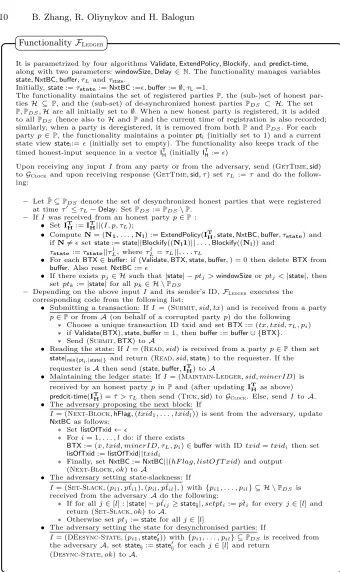
H ⊆ P, and the (sub-set) of de-synchronized honest partiesPDS ⊂ H. The set P,PDS,H are all initially set to∅. When a new honest party is registered, it is added to allPDS (hence also toHandPand the current time of registration is also recorded; similarly, when a party is deregistered, it is removed from bothP and PDS. For each party p∈ P, the functionality maintains a pointer pti
(ini-tially set to 1) and a current state view statei:=(initially set to empty). The
functionality also keeps track of the timed honest-input sequence in a vectorIT H
(initiallyITH:=)
3
The Treasury System
3.1 Entities
As mentioned before, the core of a treasury system is a collaborative decision-making process, and all the stake holders are eligible to participate. Letk, `, n, m
be integers in poly(λ). The stake holders may have one or more of the following roles.
– The project ownersO :={O1, . . . ,Ok} are a set of stake holders that have proposed project for support.
– The voting committeesC:={C1, . . . ,C`} are a set of stake holders that are responsible for generating the voting public key and announcing the voting result.
– The voters V := {V1, . . . ,Vn} are a set of stake holders that lock certain amount of stake to participate.
– The experts E :={E1, . . . ,Em} are a special type of voters that have spe-cialist knowledge and expertise in some field.
3.2 Enabling stake delegation
It is parametrized by four algorithmsValidate,ExtendPolicy,Blockify, andpredict-time, along with two parameters:windowSize,Delay∈N. The functionality manages variables
state,NxtBC,buffer, τLandτstate.
Initially,state:=τstate:=NxtBC:=,buffer:=∅, τL=1.
The functionality maintains the set of registered partiesP, the (sub-)set of honest par-tiesH ⊆ P, and the (sub-set) of de-synchronized honest partiesPDS ⊂ H. The set P,PDS,Hare all initially set to∅. When a new honest party is registered, it is added to allPDS(hence also toHandPand the current time of registration is also recorded; similarly, when a party is deregistered, it is removed from bothPandPDS. For each partyp∈P, the functionality maintains a pointerpti (initially set to 1) and a current state viewstatei:=(initially set to empty). The functionality also keeps track of the timed honest-input sequence in a vectorITH(initiallyITH:=)
Upon receiving any inputI from any party or from the adversary, send (GetTime,sid) toGClockand upon receiving response (GetTime,sid, τ) setτL :=τand do the follow-ing:
– Let ˆP⊆PDS denote the set of desynchronized honest parties that were registered at timeτ0≤τL−Delay.SetPDS:=PDS\P.
– IfIwas received from an honest partyp∈P: • SetITH:=ITH||(I, p, τL);
• Compute N= (N1, . . . ,Nl) :=ExtendPolicy(ITH,state,NxtBC,buffer, τstate) and
ifN6=setstate:=state||Blockify((Nl1)||. . . ,Blockify((Nl)) and τstate:=τstate||τLl,whereτLl =τL||, . . . τL
• For eachBTX∈buffer: if (Validate,BTX,state,buffer,) = 0 then deleteBTXfrom
buffer. Also resetNxtBC:=
• If there existspj∈ Hsuch that|state| −ptj>windowSizeorptj<|state|, then setptk:=|state|for allpk∈ H \PDS
– Depending on the above inputIand its sender’s ID,FLedger executes the
corresponding code from the following list:
• Submitting a transaction: IfI = (Submit, sid, tx) and is received from a party
p∈Por fromA(on behalf of a corrupted partyp) do the following ∗ Choose a unique transaction ID txid and setBTX:= (tx, txid, τL, pi) ∗ ifValidate(BTX),state,buffer= 1,thenbuffer:=buffer∪ {BTX}. ∗ Send (Submit,BTX) toA
• Reading the state: IfI= (Read, sid) is received from a partyp∈Pthen set
state|min{pti,|state|}and return (Read, sid,statei) to the requester. If the requester isAthen send (state,buffer,ITH) toA
• Maintaining the ledger state: IfI= (Maintain-Ledger, sid, minerID) is received by an honest partypinPand (after updatingIT
Has above)
predcit-time(ITH) = ˆτ > τLthen send (Tick,sid) toGClock.Else, sendI toA.
• The adversary proposing the next block: If
I= (Next-Block,hFlag,(txid1, . . . , txidl)) is sent from the adversary, update
NxtBC as follows: ∗ SetlistOfTxid←
∗ Fori= 1, . . . , ldo: if there exists
BTX:= (x, txid, minerID, τL, pi)∈bufferwith IDtxid=txidithen set
lisOfTxid:=listOfTxid||txidi
∗ Finally, setNxtBC:=NxtBC||(hF lag, listOf T xid) and output (Next-Block, ok) toA
• The adversary setting state-slackness: If
I= (Set-Slack,(pi1,ptˆi1),(pil,ptˆil),) with{pi1, . . . , pil} ⊆ H \PDS is received from the adversaryAdo the following:
∗ If for allj∈[l] :|state| −ptˆij≥stateij|, setpti:= ˆptifor everyj∈[l] and return (Set-Slack, ok) toA.
∗ Otherwise setptj:=statefor allj∈[l]
• The adversary setting the state for desynchronised parties: If
I= (DEesync-State,(pi1,stateil0)) with{pi1, . . . , pil} ⊆PDSis received from the adversaryA, setstateij:=state0ijfor eachj∈[l] and return
[image:12.612.136.476.80.652.2](Desync-State, ok) toA. FunctionalityFLedger
Project proposing stage
Voter/Expert registration stage Pre-voting epoch
Committee
selection stage Key setup stage Voting epoch
Ballot
casting stage stageTally
Post-voting epoch
[image:13.612.137.485.113.164.2]Execution stage
Fig. 5: Treasury system epochs.
However, this type of delegation only guarantees pseudonymity-based privacy level, as anyone can learn “who owns” the stake of the coin by checking the S-Attr of the coin.
3.3 System overview
A treasury system consists of iterative treasury periods. A treasury period can be divided into three epochs: pre-voting epoch, voting epoch, and post-voting epoch. As shown in Figure 5, the pre-voting epoch includes two con-current stages: project proposing stage and voter/expert registration stage. In the project proposing stage, the users can submit project proposals, asking for treasury funds. Meanwhile, the interested stake holders can register themselves as either voters and/or experts to participate in the decision making process by locking certain amount of their stake in the underlying cryptocurrency. The voter’s voting power is proportional to his locked stake; while, the expert’s vot-ing power is proportional to the amount of votvot-ing power delegated to him. (We will explain delegation in details later.) Analogously, the voter’s (resp. expert’s) treasury reward is proportional to his locked stake (resp. his received delega-tions).
3.4 Treasury funding sources
As earlier motivated, treasury funding, perhaps is the most crucial ingredient in a decentralised community-controlled decision-making system. It must not only be regular, but also sourced from decentralised means. That is, source of funding for treasury system should not introduce centralisation into the system. To this end, desirable properties from the funding sources are secure, sustainable and decentralized.
We note that although not all potential funding sources possess these proper-ties, a clever combination of some of these sources satisfy the set out requirement. Therefore, we propose 3 major sources of funding for the treasury system.
– Taxation/Haircut from block reward:Most blockchain platforms offer block rewards (including transaction fees) to proposers of new blocks, incentiviz-ing honest behaviour. A fraction of such block rewards can be taken and contributed to the decentralised treasury. This type of funding source is sus-tainable as long as the block rewards of the underlying blockchain platform remain. However, block rewards may fluctuate over time, and it could cause unpredictability of the available funds.
– Minting new coins: Coin minting represents, perhaps, the most sustainable funding source of the potential sources. At the beginning of each treasury period, certain amount of new coins are created to fund projects. However, minting may cause inflation in terms of the fiat market value of the under-lying cryptocurrency.
– Donations or charity:Donation is an opportunistic ad-hoc but unsustainable funding source. Therefore, meticulous blockchain development planning is difficult if donations is the only means of treasury funding.
3.5 Project proposal
To ensure input independency and eliminate unfair advantage caused by late submission, we adopt a two-stage project proposal scheme. In the first stage, the project owners O1, . . . ,Ok post an encryption of their project proposals (encrypted under the election public key of the previous treasury period) to the blockchain. At the end of pre-voting epoch and the beginning of the vot-ing epoch, the votvot-ing committee of previous treasury period will jointly decrypt those project proposals (together with revealing the seed, which will be explained later).
To commit a project, the project owner needs to submit a special transaction in form of
Tx{Ini}ni=1;TCoin;{Project,TID,P-Enc,Addr}
,
where {Ini}ni=1 are the input coins, and TCoin is a special output coin whose
spending condition is defined as, the coin can only be spent according to the corresponding treasury decision (cf. Subsection “supplying the treasury”, be-low). Moreover, the coin valueTCoin.Value≥αmin, where αmin is the minimum
Payload field, Project is a tag that indicates it is a special project proposal transaction; TIDis the treasury ID that is used to uniquely identify a treasury period;P-Enc is the encrypted project proposal, andAddris the return address for the project owner to receive money if the project succeeds in getting funded.
3.6 Voter/Expert registration
In order to register to be a voter, a stake holder (or a set of stake holders) need(s) to submit a specialvoter registration transaction in form of
Tx{Ini}n
i=1;TCoin;nVoter-Reg,TID,{Si}`
i=1,S-Cond,vk,Addr
o
,
where {Ini}ni=1 are the input coins, and TCoin is a special output coin whose
spending condition is defined in Subsection “supplying the treasury”, below. In the Payload field, Voter-Reg is a tag that indicates it is a special voter registration transaction;TIDis the treasury ID that is used to uniquely identify a treasury period;{Si}`i=1are thefreezedunspent coins that will be used to claim
stake value,S-Condis the required data that satisfies all the stake attributes of {Si}`i=1, vkis a freshly generated signature key; and Addris the return address
for the voter to receive treasury reward. The voter’s ID is defined as the hash of vk, denoted asVi:=hash(vk).
Letβminbe a predefined system parameter. To register as an expert, a stake
holder (or a set of stake holders) need(s) to depositexact βminamount of coins,
by submitting a specialexpert registration transaction:
Tx{Ini}n
i=1;TCoin;{Expert-Reg,TID,vk,Addr} ,
where {Ini}ni=1 are the input coins, and TCoin is a special output coin whose
spending condition is defined in Subsection “supplying the treasury”. Moreover, the coin value TCoin.Value≥βmin. In the Payloadfield,Expert-Reg is a tag
that indicates it is a special expert registration transaction;TIDis the treasury ID that is used to uniquely identify a treasury period;vk is a freshly generated signature key; and Addris the return address for the expert to receive treasury reward.
The expert’s ID is defined as the hash ofvk, denoted asEj:=hash(vk). Note that the expert does not gain reward based on the amount of deposited coins, so it is not rational to deposit significantly more thanβmincoins in practice.
3.7 Voting committee selection
At the beginning of the voting epoch, the voting committee of the previous treasury epoch jointly reveal the committed seed,seed.
Letsti=P `
with claimed stake sti, can volunteer to participate in the voting committee if the following inequality holds:
hash vki,signsk0
i(seed)
≤sti·T
wheresk0iis the corresponding signing key forvki, andT is a pre-defined thresh-old. When the inequation holds, he/she can submit a special registration trans-action in form of
Tx{Ini}ni=1;TCoin;nVC-Reg,TID,vk,pk˜,signsk0
i(seed),Addr o
,
where {Ini}ni=1 are the input coins, and TCoin is a special output coin whose
spending condition is defined in Subsection “supplying the treasury”, below. Moreover, the coin valueTCoin.Value≥γmin. In thePayloadfield,VC-Regis a
tag that indicates it is a special voting committee registration transaction;TID is the treasury ID that is used to uniquely identify a treasury period; vk is a freshly generated signature verification key; ˜pkis a freshly generated public key for a pre-defined public key cryptosystem; signsk0
i(seed) is the signature ofseed
under the signing key corresponding to vki; andAddr is the return address for the committee member to receive treasury reward. The thresholdT is properly defined to ensure that approximatelyλ0 =ω(logλ) (e.g.,λ0 = polylog(λ)) com-mittee members are selected, assuming constant fraction of them will be active. Note that, analogous to most proof-of-stake systems, T needs to be updated frequently. See [11] for a common threshold/difficultyT adjustment approach.
Remark.Jumping ahead, we will need honest majority of the voting committee to guarantee voter privacy and protocol termination. Assume the majority of the stake of all the registered voters is honest; therefore, the probability that a selected committee member is honest is p= 1/2 +ε for anyε∈(0,1/2]. LetX
be the number of malicious committee members selected among allλ0committee members. Since λ0 =ω(logλ), by Chernoff bound, we have
Pr[X≥λ0/2] = Pr[X ≥(1 +δ)(1/2−ε)λ0]
<exp(−δ2(1/2−ε)λ0/4)
= 1
exp(ω(logλ))=negl(λ)
forδ= 2ε/(1−2ε).
3.8 Supplying the treasury
certain treasury period must allow the voting committee in that treasury period to jointly spend. More specifically, there are λ0 committee members selected at the beginning of the voting epoch of each treasury period. Let seedTIDi denote
the seed opened in the treasury period indexed by TIDi. Let {vkj}`j=1 be the
set of signature verification keys in the valid committee registration transactions proposed byvki such that the conditionhash vki,signsk0
i(seed)
≤sti·T holds. The treasury coin can be spent in a transaction if majority of the signatures w.r.t.{vkj}`j=1 are present.
3.9 Handling the treasury specific data in the payload
Note that typically the underlying blockchain transaction validation rules do not take into account of the content stored in the payload of a transaction. Therefore, additional checks are needed for the treasury specific transactions. More specifically, we verify the payload data of those transactions with additional algorithms. In particular, a coin must befrozenduring the entire treasury period in order to claim its stake. This can be done by, for example, adding extra constrain in spending condition, saying that the coin cannot be spent until the certain block height, which is no earlier than the end of the treasury period. Furthermore, the stake of one coin can only be claimed once during each treasury period.
3.10 Decision making
3.11 Post-voting execution
Certain proportion (e.g. 20%) of the treasury fund will be used to reward the voting committee members, voters and experts. The voting committee members C`∈ Cwill receive a fix amount of reward, denoted asζ1. Note that as the voting
committee members are required to perform more actions in the next treasury period, their reward will only be transferred after the completion of those actions at the end of pre-voting epoch in the next treasury period. The voter Vi ∈ V will receive reward that is proportional to his/her deposited amount, denoted as
ζ2·sti, wherestiis the amount of the stake claimed byVi. The expertEj∈ E will receive reward that is proportional to his/her received delegations, denoted as
ζ3·Dj, whereDj is the amount of delegations thatEj has received. Meanwhile, if a voting committee member cheats or an expert fails to submit a valid ballot, he/she will lose the deposited coin as a punishment. In addition, the voting committee members will jointly generate and commit to a random seed for the next treasury period, in a protocol depicted as follows. To generate and commit a random seed, voting committee members C`, ` ∈ [k] needs to invoke a coin flipping protocol. However, the cost of such a protocol is very small when they already jointly setup a public keypk. More specifically, each voting committee members C`, ` ∈ [k] will pick a random group element R` ← G and post the encryption of it,C`←Encpk(R`) to the blockchain.C:=Q
k
`=1C` is defined as the committed/encrypted seed for the next treasury period. Note thatC can be jointly decrypted as far as majority of the voting committee members are honest, and the malicious voting committee members cannot influence the distribution of the seed.
3.12 Partitionary budgeting
The main goal of treasury is decentralized community-driven self-sustainable cryptocurrency development through projects funding and adoption. The naive approach is to select projects for funding by ranking all submitted proposals according to the number of votes they get and take a number of projects whose total budget does not exceed the treasury budget. However, there exists a risk of underfunding vital areas due to numerous project submissions and inflated discussions on some other areas. We can categorize proposals and allocate a certain amount of treasury funding for each category to independently guarantee funds to every vital area.
Analysis of existing blockchain development funding [2] reveal marketing, PR, integration, software development and organisational costs are most prominent categories. Considering this and general business development rules, we propose to include (at least) the following categories.
– Technology adoption. This includes costs needed for wider spreading of cryptocurrency; integration with various platforms, websites and applica-tions, deployment of ATMs etc.
– Development and security.This includes costs allocated for funding core and non-core development, security incident response, patch management, running testnets, as well as similar critical technology areas.
– Support.This category includes user support, documentation, maintaining of web-infrastructure needed for the community and other similar areas.
– Organization and management. This category includes costs on team coordination and management, legal support, etc.
– General. This includes projects not covered by the earlier categories, e.g., research on prospective technologies for cryptocurrency application, external security audit, collaboration with other communities, charity and so on.
It should be noted that the given list of categories is not final, and treasury deployment in cryptocurrencies will take into account specific of a given solution based on its development effort.
Nevertheless, having such an approach guarantees that critical areas for cryp-tocurrency routine operation, support and development will always get funding via treasury, which in turn, guarantees cryptocurrency self-sustainability.
4
The proposed voting scheme
4.1 Security modeling
The entities involved in the voting schemes are a set of voting committee mem-bers C :={C1, . . . ,Ck}, a set of voters V :={V1, . . . ,Vn}, and a set of experts E := {E1, . . . ,Em}. We consider the security of our treasury voting scheme in the UC framework with static corruption. The security is based on the indistin-guishability between real/hybrid world executions and ideal world executions, i.e., for any PPT real/hybrid world adversaryAwe will construct an ideal world PPT simulatorS that can present an indistinguishable view to the environment Z operating the protocol.
The Ideal world execution. In the ideal world, the voting committee C, the voters V, and the experts E only communicate to an ideal functionality FVotet,k,m,nduring the execution. The ideal functionalityFVotet,k,m,naccepts a number of commands fromC,V,E. At the same time it informs the adversary of certain actions that take place and also is influenced by the adversary to elicit certain actions. The ideal functionality FVotet,k,m,nis depicted in Fig. 6, and it consists of three phases: Preparation, Voting/Delegation, and Tally.
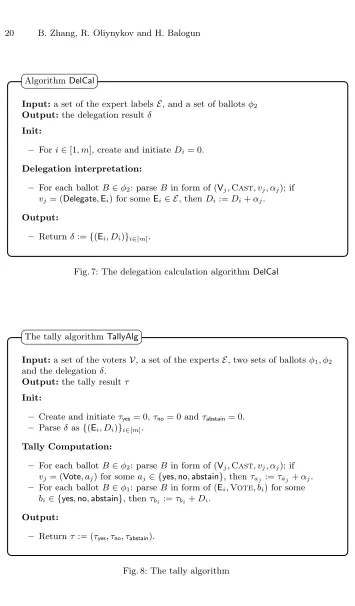
The functionalityFVotet,k,m,n interacts with a set of voting committeesC := {C1, . . . ,Ck}, a set of votersV := {V1, . . . ,Vn}, a set of expertsE := {E1, . . . ,Em}, and the adversaryS. It is parameterized by a delegation cal-culation algorithmDelCal(described in Fig.7) and a tally algorithmTallyAlg
(described in Fig.8) and variablesφ1, φ2,τ,J1, J2, J3,T1andT2. Denote CcorandChonestas the set of corrupted and honest voting committees, respec-tively.
Initially,φ1=∅,φ2=∅,τ =∅,J1=∅,J2=∅, andJ3=∅. Preparation:
– Upon receiving (Init,sid) from the voting committeeCi∈ C, set
J1:=J1∪ {Ci}, and send a notification message (InitNotify,sid,Ci) to the adversaryS.
Voting/Delegation:
– Upon receiving (Vote,sid, vi) from the expertEi∈ E, if|J1|< t, ignore the request. Otherwise, record (Ei,Vote, vi) inφ1; send a notification message (VoteNotify,sid,Ei) to the adversaryS. If|Ccor| ≥t, then additionally send a message (Leak,sid,Ei,Vote, vi) to the adversaryS. – Upon receiving (Cast,sid, vj, αj) from the voterVj∈ V, if|J1|< t,
ignore the request. Otherwise, record (Vj,Cast, vj, αj) inφ2; send a notification message (CastNotify,sid,Vj, αj) to the adversaryS. If |Ccor| ≥t, then additionally send a message (Leak,sid,Vj,Cast, vj) to
the adversaryS.
Tally:
– Upon receiving (DelCal,sid) from the voting committeeCi∈ C, set
J2:=J2∪ {Ci}, and send a notification message
(DelCalNotify,sid,Ci) to the adversaryS.
– If|J2∪ Chonest|+|Ccor| ≥t, send (LeakDel,sid,DelCal(E, φ2)) toS. – If|J2| ≥t, setδ←DelCal(E, φ2).
– Upon receiving (Tally,sid) from the voting committeeCi∈ C, set
J3:=J3∪ {Ci}, and send a notification message (TallyNotify,sid,Ci)
to the adversaryS.
– If|J3∪ Chonest|+|Ccor| ≥t, send (LeakTally,sid,TallyAlg(V,E, φ1, φ2, δ)) toS.
– If|J3| ≥t, setτ←TallyAlg(V,E, φ1, φ2, δ).
– Upon receiving (ReadTally,sid) from any party, ifδ=∅ ∧τ=∅ ignore the request. Otherwise, return (ReadTallyReturn,sid,(δ, τ)) to the requester.
The ideal functionalityFVotet,k,m,n
Voting/Delegation phase. During the voting/delegation phase, the expert Ei ∈ E can vote for his choice vi by sending (Vote, sid, vi) to the ideal func-tionalityFVotet,k,m,n. Note that the voting choiceviis leaked only when majority of the voting committees are corrupted. The voterVj ∈ V, who ownsαj stake, can either vote directly for his choice vj or delegate his voting power to an expert Ei ∈ E. Similarly, when all the voting committees are corrupted,FVotet,k,m,n leaks the voters’ ballots to the adversaryS.
Tally phase. During tally phase, the voting committee Ci ∈ C sends (DelCal,sid) to the ideal functionality Ft,k,m,n
Vote to calculate and reveal the
delegations received by each expert. After that, they then send (Tally, sid) to the ideal functionality FVotet,k,m,nto open the tally. Once all the committees have opened the tally, any party can read the tally by sending (ReadTally, sid) to FVotet,k,m,n. Note that due to the nature of threshold cryptography, the adversaryS can see the voting tally result before all the honest parties. Hence, the adversary can refuse to open the tally depending on the tally result. The tally algorithm TallyAlgis described in Fig. 8.
The real/hybrid world execution. In the real/hybrid world, the treasury voting scheme utilises a number of supporting components. Those support-ing components are modelled as ideal functionalities. First of all, we need a blockchain functionalityFLedger (cf. Fig.4) to model the underlying blockchain infrastructure that the treasury system is built on. We then use the key gen-eration functionality Ft,k
DKG [8] for threshold key generation of the underlying
public key crypto system. Finally, a global clock functionalityGClock(cf. Fig. 3) is adopted to model the synchronised network environment. LetEXECΠ,A,Z
de-note the output of the environment Z when interacting with parties running the protocolΠ and real-world adversaryA. LetEXECF,S,Z denote output ofZ
when running protocolφinteracting with the ideal functionalityFand the ideal adversaryS.
Definition 1. We say that a protocol Π UC-realizesF if for any adversary A
there exists an adversarySsuch that for any environmentZthat obeys the rules of interaction for UC security we have EXECΠ,A,Z≈EXECF,S,Z.
4.2 The voting scheme
Let m be the number of experts and n be the number of voters. Let e(im) ∈ {0,1}m be the unit vector where its i-th coordinate is 1 and the rest coor-dinates are 0. We also abuse the notation to denote e(0`) as an `-vector con-tains all 0’s. We useEncpk(e
(`)
i ) to denote coordinate-wise encryption ofe
(`)
i , i.e. Encpk(e
(`)
i,1), . . . ,Encpk(e
(1)
i,`), wheree
(`)
i = (e
(`)
i,1, . . . , e (`)
Input:a set of the expert labelsE, and a set of ballotsφ2 Output:the delegation resultδ
Init:
– Fori∈[1, m], create and initiateDi= 0.
Delegation interpretation:
– For each ballotB∈φ2: parseB in form of (Vj,Cast, vj, αj); if
vj= (Delegate,Ei) for someEi∈ E, thenDi:=Di+αj.
Output:
– Returnδ:={(Ei, Di)}i∈[m].
[image:22.612.130.485.64.670.2]AlgorithmDelCal
Fig. 7: The delegation calculation algorithmDelCal
Input:a set of the votersV, a set of the expertsE, two sets of ballotsφ1, φ2 and the delegationδ.
Output:the tally resultτ
Init:
– Create and initiateτyes= 0,τno= 0 andτabstain= 0. – Parseδas{(Ei, Di)}i∈[m].
Tally Computation:
– For each ballotB∈φ2: parseB in form of (Vj,Cast, vj, αj); if
vj= (Vote, aj) for someaj∈ {yes,no,abstain}, thenτaj :=τaj+αj. – For each ballotB∈φ1: parseB in form of (Ei,Vote, bi) for some
bi∈ {yes,no,abstain}, thenτbi :=τbi+Di.
Output:
[image:22.612.132.478.99.334.2]– Returnτ := (τyes, τno, τabstain). The tally algorithmTallyAlg
Vote encoding. In our scheme, we encode the vote into a (unit) vector. Let encodeE and encodeV be the vote encoding algorithm for the expert and voter, respectively. For an expert, upon receiving inputx∈ {Yes,No,Abstain}, the encodeE returns 100, 010, 001 forYes,No,Abstain, respectively. For a voter, the input is y ∈ {E1, . . . ,Em} ∪ {Yes,No,Abstain}. When y = Ei, i ∈ [m], it means that the voter delegate his/her voting power to the expertEi. When
y ∈ {Yes,No,Abstain}, it means that the voter directly vote on the project. The encodeV returns a unit vector of length (m+ 3), denoted as v, such that
v=e(im+3) ify=Ei, for i∈[m]; and v is set toem(m+1+3),em(m+2+3), ande(mm+3+3)ify
isYes,No,Abstain, respectively.
Since sending data to the blockchain consumes coins, we implicitly assume all the experts E and voters V have spare coins to pay the transaction fees that occurred during the protocol execution. More specifically, we let each party prepare{Ini}`i=11 ,{Outj}`j2=1 s.t.
`1
X
i=1
Ini.Value≥ `2
X
j=1
Outj.Value .
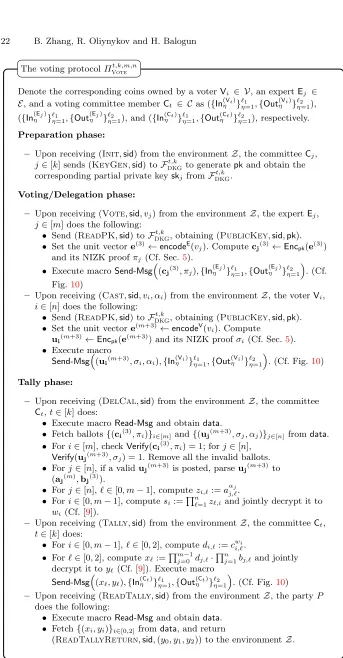
Denote the corresponding coins owned by a voter Vi ∈ V, an expert Ej ∈ E, and a voting committee member Ct ∈ C as ({In(ηVi)}
`1
η=1,{Out (Vi)
η }
`2 η=1),
({In(Ej)
η }
`1
η=1,{Out (Ej)
η }
`2
η=1), and ({In (Ct)
η }
`1 η=1,{Out
(Ct)
η }
`2
η=1), respectively. The
protocol is depicted in Fig.9. It consists of preparation phase, voting/delegation phase, and tally phase.
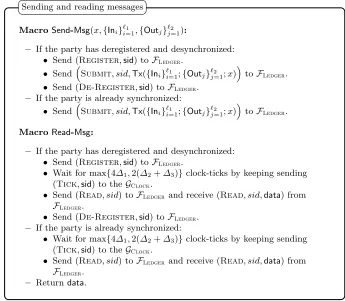
Sending/Reading data to/from FLedger. Fig. 10 describes the macro for a party to send and read data to/from the blockchain FLedger. According the blockchain model proposed by [10], three types of delays need to be considered. First, we have a bounded network delay, and it is assumed that all messages can be delivered within∆1 rounds, which is 2∆1 clock-ticks in [10]. Subsequently, a
desynchronised user can get up-to-date within 2∆1rounds (i.e. 4∆1clock-ticks)
after registration. The second type of delay is the fact that the adversary can hold a valid transaction up to certain blocks, but she cannot permanently denial-of-service such a transaction. This is modeled by the ExtendPolicy in FLedger, where if a transaction is more than ∆2 rounds (i.e. 2∆2 clock-ticks) old, and
still valid with respect to the current state, then it will be included into the state. Finally, we have a so-called windowsize. Namely, the adversary can set state-slackness of all the honest parties up to thewindowsize, which is consistent with thecommon prefix property in [12]. Hence, all the honest parties can have a common state of any blocks that have been proposed more than windowsize. Denote∆3 rounds (i.e. 2∆3 clock-ticks) as thewindowsize.
Denote the corresponding coins owned by a voterVi ∈ V, an expertEj ∈ E, and a voting committee memberCt ∈ C as ({Inη(Vi)}`η=11 ,{Out
(Vi) η }`η=12 ), ({In(Ej)
η }`η=11 ,{Out (Ej)
η }`η=12 ), and ({In (Ct)
η }`η=11 ,{Out (Ct)
η }`η=12 ), respectively. Preparation phase:
– Upon receiving (Init,sid) from the environmentZ, the committeeCj,
j∈[k] sends (KeyGen,sid) toFt,k
DKGto generatepkand obtain the
corresponding partial private keyskjfromFDKGt,k .
Voting/Delegation phase:
– Upon receiving (Vote,sid, vj) from the environmentZ, the expertEj,
j∈[m] does the following: • Send (ReadPK,sid) toFt,k
DKG, obtaining (PublicKey,sid,pk).
• Set the unit vectore(3)←encodeE(vj). Computec
j(3)←Encpk(e(3))
and its NIZK proofπj(Cf. Sec.5). • Execute macroSend-Msg(cj(3), πj),{In
(Ej)
η }`η=11 ,{Out (Ej) η }`η=12
. (Cf.
Fig.10)
– Upon receiving (Cast,sid, vi, αi) from the environmentZ, the voterVi,
i∈[n] does the following: • Send (ReadPK,sid) toFt,k
DKG, obtaining (PublicKey,sid,pk).
• Set the unit vectore(m+3)←encodeV(vi). Compute
ui(m+3)←Encpk(e(m+3)) and its NIZK proofσi(Cf. Sec.5). • Execute macro
Send-Msg(ui(m+3), σi, αi),{In(ηVi)}`η=11 ,{Out (Vi) η }`η=12
. (Cf. Fig.10)
Tally phase:
– Upon receiving (DelCal,sid) from the environmentZ, the committee
Ct,t∈[k] does:
• Execute macroRead-Msgand obtaindata.
• Fetch ballots {(ci(3), πi)}i∈[m]and{(uj(m+3), σj, αj)}j∈[n] fromdata. • Fori∈[m], checkVerify(ci(3), πi) = 1; forj∈[n],
Verify(uj(m+3), σj) = 1. Remove all the invalid ballots.
• Forj∈[n], if a validuj(m+3) is posted, parseuj(m+3)to
(aj(m),bj(3)).
• Forj∈[n],`∈[0, m−1], computezi,`:=a αj j,`.
• Fori∈[0, m−1], computesi:=Qn`=1z`,iand jointly decrypt it to
wi (Cf. [9]).
– Upon receiving (Tally,sid) from the environmentZ, the committeeCt,
t∈[k] does:
• Fori∈[0, m−1],`∈[0,2], computedi,`:=cwi,`i.
• For`∈[0,2], computex`:=Qj=0m−1dj,`·Qnj=1bj,`and jointly decrypt it to y`(Cf. [9]). Execute macro
Send-Msg(x`, y`),{In (Ct)
η }`η=11 ,{Out (Ct) η }`η=12
. (Cf. Fig.10)
– Upon receiving (ReadTally,sid) from the environmentZ, the partyP
does the following:
• Execute macroRead-Msgand obtaindata. • Fetch{(xi, yi)}i∈[0,2]fromdata, and return
(ReadTallyReturn,sid,(y0, y1, y2)) to the environmentZ.
[image:24.612.134.477.56.714.2]The voting protocolΠVotet,k,m,n
Fig. 9: The voting protocolΠt,k,m,n
Vote in{FLedger,F
t,k
[image:24.612.139.471.440.709.2]whose input coins and output coins share the same owner (spending condition), and the messagexis stored in the payload of the transaction. To read a message (stored in the payload of some transaction) fromFLedger, analogously a deregis-tered party needs to first send (Register,sid) toFLedger. After 4δ1clock-ticks,
the party can get synchronised. In order to receive the latest message, the party needs to wait a maximum of 2(∆2+∆3) clock-ticks for the transaction that
carries the intended message to be included in the state of the party.
MacroSend-Msg(x,{Ini}`1
i=1,{Outj} `2
j=1):
– If the party has deregistered and desynchronized: • Send (Register,sid) toFLedger.
• SendSubmit, sid,Tx({Ini}`1
i=1;{Outj} `2
j=1;x)
toFLedger.
• Send (De-Register,sid) toFLedger.
– If the party is already synchronized: • Send
Submit, sid,Tx({Ini}`1
i=1;{Outj} `2
j=1;x)
toFLedger.
MacroRead-Msg:
– If the party has deregistered and desynchronized: • Send (Register,sid) toFLedger.
• Wait for max{4∆1,2(∆2+∆3)}clock-ticks by keeping sending (Tick,sid) to theGClock.
• Send (Read, sid) toFLedgerand receive (Read, sid,data) from
FLedger.
• Send (De-Register,sid) toFLedger.
– If the party is already synchronized:
• Wait for max{4∆1,2(∆2+∆3)}clock-ticks by keeping sending (Tick,sid) to theGClock.
• Send (Read, sid) toFLedgerand receive (Read, sid,data) from
FLedger.
– Returndata.
[image:25.612.133.478.234.535.2]Sending and reading messages
Fig. 10: Macro for sending and receiving message viaFLedger
4.3 Security
Theorem 1. Let t, k, n, m = poly(λ) and k/2 < t ≤ n. Protocol Πt,k,n,m Vote described in Fig. 9 UC-realizes FVotet,k,m,n in the {FLedger,FDKGt,k }-hybrid world against static corruption under the DDH assumption.
Proof. To prove the theorem, we construct a simulator S such that no non-uniform PPT environment Z can distinguish between (i) the real execution
EXECFLedger,F
t,k
DKG Πt,k,n,m
Vote ,A,Z
where the partiesV := {V1, . . . ,Vn}, E := {E1, . . . ,Em} and C := {C1, . . . ,Ck} run protocol ΠVotet,k,n,m in the {FLedger,F
t,k
DKG}-hybrid world
and the corrupted parties are controlled by a dummy adversary A who sim-ply forwards messages from/toZ, and (ii) the ideal executionEXECFt,k,m,n
Vote ,S,Z where the parties interact with functionality FVotet,k,m,n in the ideal model and corrupted parties are controlled by the simulatorS. LetVcor⊆ V,Ecor⊆ E and Ccor⊆ Cbe the set of corrupted voters, experts and voting committee members,
respectively. Note that the underlying encryption scheme is IND-CPA secure, and its corresponding NIZK proofs are simulatable ZK under the DDH assump-tion.
Simulator.The simulatorSinternally runsA, forwarding messages to/from the environmentZ. The simulatorSsimulates honest votersVi∈ V \Vcor, honest
expertsEi∈ E \ Ecor, trusteesCj ∈ C \ Ccor and functionalitiesFLedger,F
t,k
DKG. In
addition, the simulatorS simulates the following interactions with A.
In the preparation phase:
– Upon receiving (InitNotify,sid,Cj) from the externalF t,k,m,n
Vote for an
hon-est voting committeeCj∈ C \ Ccor, the simulatorS acts asCj, following the protocolΠVotet,k,n,mas ifCj receives (Init,sid) from the environmentZ.
– S simulatesFDKGt,k so that it generates and stores (pk,sk).
In the voting/delegation phase:
– Upon receiving (VoteNotify,sid,Ej) from the externalFVotet,k,m,nfor an hon-est expertEj ∈ E \ Ecor, the simulator S reads pkfrom FDKGt,k . S computes
cj(3)←Encpk(0(3)) and simultates its NIZK proofπjusing the NIZK simula-tor. It then executes macroSend-Msg(cj(3), πj),{In(ηEj)}
`1 η=1,{Out
(Ej)
η }
`2 η=1
.
– Upon receiving (CastNotify,sid,Vi, αj) from the external F t,k,m,n
Vote
for an honest expert Vi ∈ V \ Vcor, the simulator S reads pk
from FDKGt,k . S computes ui(m+3) ← Encpk(0(m+3)) and simultates its
NIZK proof πi using the NIZK simulator. It then executes macro
Send-Msg(ui(m+3), σi, αi),{In(ηVi)} `1 η=1,{Out
(Vi)
η }
`2 η=1
.
– Once the simulatedFLedger receives (Post,sid,cj(3)) from a corrupted ex-pertEj ∈ Ecor, the simulator S usessk to decrypt cj(3), obtaining the vote
vj.S then sends (Vote,sid, vi) toF t,k,m,n
Vote on behave ofEj.
In the tally phase:
– Upon receiving (DelCalNotify,sid,Cj) from the externalFVotet,k,m,n for an honest trusteeCj ∈ C \Ccor, the simulatorSacts asCj, following the protocol
ΠVotet,k,n,m as ifCj receives (DelCal,sid) fromZ.
– Upon receiving (TallyNotify,sid,Cj) from the external FVotet,k,m,n for an honest trusteeCj ∈ C \Ccor, the simulatorSacts asCj, following the protocol
Πt,k,n,m
Vote as ifCj receives (Tally,sid) fromZ.
– Upon receiving (LeakDel,sid, δ) from the externalFt,k,m,n
Vote , the simulator
S simulates the last honest committeeCt’s decryption share according to δ, and it simulates the corresponding NIZK proof in the 1st round of the tally phase.
– Upon receiving (LeakTally,sid, τ) from the externalFVotet,k,m,n, the simulator Ssimulates the last honest committeeCt’s decryption share according toτ, and it simulates the corresponding NIZK proof in the 2nd round of the tally phase.
Indistinguishability.The indistinguishability is proven through a series of hy-brid worldsH0, . . . ,H4.
Hybrid H0:It is the real protocol execution EXEC FLedger,F
t,k
DKG Πt,k,n,m
Vote ,A,Z .
Hybrid H1: H1 is the same as H0 except that during the voting/delegation
phase, in H1, the honest voter Vj’s encrypted ballots are replaced with Encpk(0(m+3)) and simulates its corresponding unit-vector NIZK proof.
Claim. H1 andH0 are indistinguishable if the underlying encryption scheme is
IND-CPA and the unit-vector NIZK proof is simulatable ZK.
Proof. The proof is straightforward. Namely, if an adversaryAcan distinguish H1 from H0, then we can construct an adversary B who can either break the
IND-CPA game of the PKE encryption or the ZK probability of the unit-vector
NIZK proof. ut
Hybrid H2: H2 is the same as H1 except the following: During the
vot-ing/delegation phase, inH2, the honest expertEi’s encrypted ballots are replaced withEncpk(0(3)) and simulates its corresponding unit-vector NIZK proof.
Claim. H2 andH1 are indistinguishable if the underlying encryption scheme is
IND-CPA and the unit-vector NIZK proof is simulatable ZK.
Proof. The same as the previous proof.
HybridH3:H3is the same asH2except the followings. During the tally phase,
H3uses NIZK simulator to simulate all the decryption proofs instead of the real
ones.
Claim. H3 and H2 are indistinguishable if the underlying decryption NIZK is
Proof. The advantage of the adversary is bounded by the ZK property of the
decryption NIZK. ut
HybridH4:H4is the same asH3except the followings. During the tally phase,
the honest committeeCt’s decryption shares are backwards calculated from the
δandτ received from theFVotet,k,m,n.
Claim. H4and H3 are statistically indistinguishable.
Proof. The distribution of the decryption shares inH4have identical distribution
to the shares in H3. ut
The adversary’s view of H4 is identical to the simulated view
EXECFt,k,m,n
Vote ,S,Z
. Therefore, no PPT Z can distinguish the view of the ideal execution from the view of the real execution with more than negligible
proba-bility. This concludes our proof. ut
5
A new unit vector ZK proof
5.1 Zero-knowledge proofs/arguments
LetLbe an NP language andRLis its corresponding polynomial time decidable
binary relation, i.e., L:={x| ∃w: (x, w)∈ RL}. We say a statement x∈ Lif
there is a witnesswsuch that (x, w)∈ RL. Let the proverP and the verifierV
be two PPT interactive algorithms. Denote τ ← hP(x, w), V(x)ias the public transcript produced byP andV. After the protocol,V accepts the proof if and only ifφ(x, τ) = 1, whereφis a public predicate function.
Definition 2. We say(P, V)is a perfectly complete proof/argument for an NP relation RL if for all non-uniform PPT interactive adversaries Ait satisfies
– Perfect completeness:
Pr
(x, w)← A;τ← hP(x, w), V(x)i: (x, w)6∈ RL∨φ(x, τ) = 1
= 1
– (Computational) soundness:
Pr
x← A;τ← hA, V(x)i:
x6∈ L ∧φ(x, τ) = 1
=negl(λ)
LetV(x;r) denote the verifierV is executed on inputxwith random coinr. A proof/argument (P, V) is calledpublic coinif the verifierV picks his challenges randomly and independently of the messages sent by the proverP.
Definition 3. We say a public coin proof/argument (P, V)is a perfect special honest verifier zero-knowledge (SHVZK) for a NP relation RL if there exists a PPT simulatorSimsuch that
Pr
(x, w, r)← A;
τ← hP(x, w), V(x;r)i: (x, w)∈ RL∧ A(τ) = 1
≈Pr
(x, w, r)← A;
τ←Sim(x;r) :
(x, w)∈ RL∧ A(τ) = 1
Public coin SHVZK proofs/arguments can be transformed to a non-interactive one (in the random oracle model [13]) by using Fiat-Shamir heuristic [14] where a cryptographic hash function is used to compute the challenge in-stead of having an online verifier.
5.2 Schwartz-Zippel lemma
For completeness, we recap a variation of the Schwartz-Zippel lemma [15] that will be used in proving the soundness of the zero-knowledge protocols.
Lemma 1 (Schwartz-Zippel).Letf be a non-zero multivariate polynomial of degreedoverZp, then the probability off(x1, . . . , xn) = 0evaluated with random x1, . . . , xn←Zp is at most dp.
Therefore, there are two multi-variate polynomialsf1, f2. Iff1(x1, . . . , xn)−
f2(x1, . . . , xn) = 0 for randomx1, . . . , xn ←Zp, then we can assume thatf1= f2. This is because, if f16=f2, the probability that the above equation holds is
bounded by max(d1,d2)
p , which is negligible inλ.
5.3 The proposed unit vector ZK proof/argument
We denote a unit vector of length n as e(in) = (ei,0, . . . , ei,n−1), where its i-th
coordinate is 1 and the rest coordinates are 0. Conventionally, to show a vec-tor of ElGamal ciphertexts element-wise encrypt a unit vecvec-tor, Chaum-Pedersen proofs [6] are used to show each of the ciphertexts encrypts either 0 or 1 (via Sigma OR composition) and the product of all the ciphertexts encrypts 1. Such kind of proof is used in many well-known voting schemes, e.g., Helios. However, the proof size is linear in the length of the unit vector, and thus the communi-cation overhead is quite significant when the unit vector length becomes larger. In this section, we propose a novel special honest verifier ZK (SHVZK) proof for unit vector that allows the prover to convince the verifier that a vector of ciphertexts (C0, . . . , Cn−1) encrypts a unit vector e
(n)
i , i ∈ [0, n−1] with
O(logn) proof size. Without loss of generality, assumenis a perfect power of 2. If not, we appendEncpk(0; 0) (i.e., trivial ciphertexts) to make the total number
of ciphertexts to be the next power of 2. The proposed SHVZK protocol can also be Fiat-Shamir transformed to a non-interactive ZK (NIZK) proof in the random oracle model. The basic idea of our construction is inspired by [16], where Groth and Kohlweiss proposed a Sigma protocol for the prover to show that he knows how to open one out of many commitments. The key idea behind our construction is that there exists a data-oblivious algorithm that can take input asi∈ {0,1}logn and output the unit vectore(n)
i . Let i1, . . . , ilogn be the binary representation ofi. The algorithm is depicted in Fig.11.
Input:indexi= (i1, . . . , ilogn)∈ {0,1}logn
Output:unit vectore(n)i = (ei,0, . . . , ei,n−1)∈ {0,1}n
1. For`∈[logn], setb`,0:= 1−i`andb`,1 :=i`;
2. Forj∈[0, n−1], setei,j :=Q`=1lognb`,j`, wherej1, . . . , jlognis the binary representation ofj;
3. Returne(n)i = (ei,0, . . . , ei,n−1);
[image:30.612.142.480.95.224.2]The algorithm that mapsi∈[0, n−1] toe(n)i
Fig. 11: The algorithm that mapsi∈[0, n−1] toe(n)i
commitments of (i1, . . . , ilogn) indeed contain 0 or 1, using the Sigma protocol proposed in Section 2.3 of [16]. Note that in the 3rd move of such a Sigma protocol, the prover reveals a degree-1 polynomial of the committed message. Denote z`,1 :=i`x+β`, ` ∈[logn] as the corresponding degree-1 polynomials, where β` are chosen by the prover andxis chosen by the verifier. By linearity, we can also definez`,0:=x−z`,1= (1−i`)x−β`,`∈[logn]. According to the
algorithm described in Fig.11, for j ∈ [0, n−1], let j1, . . . , jlogn be the binary representation ofj, and the productQlogn
`=1 z`,j` can be viewed as a degree-(logn)
polynomial of the form
pj(x) =ei,jxlogn+
logn−1
X
k=0 pj,kxk
for some pj,k, k ∈ [0,logn−1]. We then use batch verification to show that each of Cj indeed encrypts ei,j. More specifically, for a randomly choseny ←
Zp, let Ej := (Cj)x logn
·Enc(−pj(x); 0); the prover needs to show that E := Qn−1
j=0(Ej)
yj·Qlogn−1 k=0 (Dk)
xkencrypts 0, whereD
`:=Encpk(Pjn=0−1(pj,`·yj);R`),
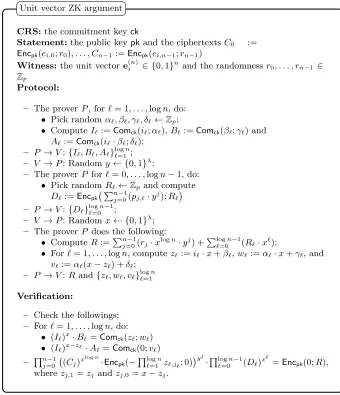
` ∈[0,logn−1] with fresh randomnessR` ∈Zp. The construction is depicted in Fig. 12, and it consists of 5 moves. Both the prover and the verifier shares a common reference string (CRS), which is a Pedersen commitment key that can be generated using random oracle. The prover first commits to each bits of the binary representation ofi, and the commitments are denoted as I`, `∈[logn]. Subsequently, it produces B`, A` as the first move of the Sigma protocol in Sec. 2.3 of [16] showingI` commits to 0 or 1. Jumping ahead, later the prover will receive a challenge x ← {0,1}λ, and it then computes the third move of the Sigma protocols by producing{z`, w`, v`}
logn
`=1 . To enable batch verification,
before that, the prover is given another challenge y ← {0,1}λ in the second move. The prover the computes and sends the aforementioned{D`}log`=0n−1. The
verification consists of two parts. In the first part, the verifier checks the following equations to ensure thatI` commits to 0 or 1.
– (I`)x·B`=Comck(z`;w`)
– (I`)x−z` ·A
In the second part, the verifier checks if
n−1
Y
j=0
(Cj)x logn
·Encpk(−
logn Y
`=1
z`,j`; 0)
yj ·
logn−1
Y
`=0
(D`)x
`
is encryption of 0 by asking the prover to reveal the randomness.
CRS:the commitment keyck
Statement:the public keypkand the ciphertextsC0 :=
Encpk(ei,0;r0), . . . , Cn−1:=Encpk(ei,n−1;rn−1)
Witness:the unit vectore(n)i ∈ {0,1}n and the randomnessr
0, . . . , rn−1 ∈
Zp Protocol:
– The proverP, for`= 1, . . . ,logn, do: • Pick randomα`, β`, γ`, δ`←Zp;
• ComputeI`:=Comck(i`;α`),B`:=Comck(β`;γ`) and
A`:=Comck(i`·β`;δ`); – P →V:{I`, B`, A`}log`=1n; – V →P: Randomy← {0,1}λ
;
– The proverP for`= 0, . . . ,logn−1, do: • Pick randomR`←Zp and compute
D`:=Encpk Pn
−1
j=0(pj,`·yj);R`
– P →V:{D`}logn−1 `=0 ;
– V →P: Randomx← {0,1}λ ; – The proverP does the following:
• ComputeR:=Pn−1 j=0(rj·x
logn·yj) +Plogn−1 `=0 (R`·x
`);
• For`= 1, . . . ,logn, computez`:=i`·x+β`,w`:=α`·x+γ`, and
v`:=α`(x−z`) +δ`; – P →V:Rand{z`, w`, v`}log`=1n
Verification:
– Check the followings: – For`= 1, . . . ,logn, do:
• (I`)x·B
`=Comck(z`;w`) • (I`)x−z`·A
`=Comck(0;v`) – Qn−1
j=0 (Cj)
xlogn·Enc
pk(−Qlog`=1nz`,j`; 0) yj
·Qlogn−1 `=0 (D`)
x` =Enc pk(0;R), wherezj,1=zj andzj,0=x−zj.
[image:31.612.135.475.226.621.2]Unit vector ZK argument

![Fig. 11: The algorithm that maps i ∈ [0, n − 1] to e(n)i](https://thumb-us.123doks.com/thumbv2/123dok_us/9313346.433056/30.612.142.480.95.224/fig-the-algorithm-that-maps-i-n-to.webp)