TESTING FOR UTILITY INTERDEPENDENCE
IN MARRIAGE:
EVIDENCE FROM PANEL DATA
Nattavudh Powdthavee
No 705
WARWICK ECONOMIC RESEARCH PAPERS
Testing for Utility Interdependence
in Marriage:
Evidence from Panel Data
Nattavudh Powdthavee*,
University of Warwick
April, 2004
This paper is the first of its kind to study utility interdependence in marriage using
information on subjective well-being of a large sample of people living in the UK over the
period 1991-2001. Using “residual” self-rated health to provide instrument for spouse’s
well-being and allowing controls on individual fixed effects, we find strong evidence of
altruism represented by interdependent relationships in the reported well-being found only
among spouses, and not by partners in cohabiting union. Panel data also show that the
well-being impact resulting from “caring” can be used to predict future income,
unemployment, and marital status for the individuals. (100 words)
JEL Classification:
D64, J12
Keywords:
happiness, altruism, marriage, interdependent utility
1 Introduction
People get married for a variety of reasons. Most, however, do so for the bene…cial reasons that go beyond
acquiring a marriage certi…cate. In terms of economic bene…ts, marriage reduces the cost of frequent
contact and of resource transfer between two people by sharing the same household (Becker, 1973). It can
lead to specialization within the family, which allows one of the spouses to possess higher human capital
accumulation in task demanded in the labor market compared to single people (Becker, 1981). This is
re‡ected in a number of studies that married men earn more than their single counterparts, ceteris paribus
(Dolton and Makepeace, 1987; Korenmanet al, 1991; Loh, 1996; Chun and Lee, 2001)1. Individuals may
also be entitled to …nancial gains in the form of various legal bene…ts resulting from marriage. This is
summarized by the evidence that marriage often comes with legal rights for the couples to joint insurance
policies for home, auto, and health, as well as rights to bene…ts such as annuities, pension plans, social
security, and medical care.
One other aspect of marital bene…ts is achieved through intra-household sharing of “nonmarketable
house-hold commodities” that includes partner’s expressed love and caring, as well as other emotional attachments,
such as sexual activity or frequent contact with a particular person (Becker, 1974). It is these implications
of “loving” and “caring” in marriage that are thought to have a direct contribution to individual’s health
and welfare, holding other things constant. For instance, greater social contact resulting from marriage can
reduce the risks for the individuals from having to su¤er stress-related and loneliness-related illness in their
life time, leading to the evidence that married couples face a much lower risk of mortality compared to single
people (Gove, 1973; Hu and Goldman, 1990; Rosset al, 1999; Wilson and Oswald, 2002). This impact of
marriage on health is also found to be substantial; a single study has shown that the estimated e¤ect of
marriage on a reduced mortality risk is so large that it can almost exactly o¤set the consequent (negative)
e¤ect generated by smoking (Gardner and Oswald, 2002).
Other evidence on the bene…ts from sharing nonmarketable goods in marriage can be found in recent
that there exists a positive e¤ect of marriage on psychological well-being, even after taking income and other
relevant factors into consideration (Gerdtham and Johannesson, 1997; Frey and Stutzer, 2000; Graham and
Pettinato, 2002; Di Tella and MacCulloch, 2004). The estimates of non-pecuniary e¤ects of marriage have
been found to be both substantial and signi…cant. For instance, a lasting marriage in the US is estimated to
be worth around $100,000 per annum compared to being widowed or separated (Blanch‡ower and Oswald,
2004).
However, even though it has been found that marriage often goes hand in hand with higher levels of
psychological well-being for the individual, less attention has been paid on how it actually works. Economists
have yet to test and quantify what Becker (1974) referred to as the implication of “loving” and “caring” in
marriage. That is, since loving someone usually involves a¤ectionate caring about what happens to him or
her, if M cares aboutF, it then implies that M’s utility levels depend onF’s utility levels2. In economics,
the term “caring” between spouses, which can also be de…ned broadly as altruism in marriage, plays an
important role in the analysis of intra-household distribution of income and consumption. The principal
idea is that, if a person is said to be altruistic towards his spouse then it implies that his welfare will also
depend on his spouse’s welfare. Hence, an exogenous decrease (increase) in the altruist’s personal income
will e¤ectively lead to a fall (a rise) in money transfers to his bene…ciary, which would imply a fall (a rise)
in the welfare of both spouses as a result of the reduction (increase) in joint income (Ermisch, 2003). A
similar idea of interdependent utility also appears in a series of psychology and sociology papers; there is a
similar conjecture made by Argyle (1999) on how one spouse’s happiness may encourage the happiness of
the other in a marriage. This is perhaps because better psychological well-being facilitates social contacts,
especially contacts with spouse and children (Veenhoven, 1998). On the other hand, as marriage is currently
seen as a main source of happiness, there are possibilities that spouses may think something is wrong if one
or both feel unhappy. In that case, even if nothing is wrong with their marriage, unhappiness within the
household may still shatter con…dence for the couple and work as a self-ful…lling prophecy towards future
separation and divorce (Ross, 1955). Nevertheless, the concept of interdependent utility among married
problems involved into estimating them. It is not a straight forward task, for example, to come up with a
valid exclusion restriction that identi…es the true e¤ect ofM’s utility on F’s utility. This is partly because
most of the household commodities are shared between M and F, and hence are perfectly transferrable,
within the household. Therefore, unless we can …gure out how household commodities are being shared
between the married couple, instrumental variables (IV) approach on the e¤ect ofM’s utility onF’s utility,
which has risen as a result from an overall increase in household commodities consumption, will yield biased
results.
In this paper we propose a direct test for the utility interdependence in marriage by using the “residual”
self-rated health of the respondent’s spouse (or sub jective health status that cannot be explained by one’s
actual physical condition and the standard socio-economic indicators) to provide instruments for spouse’s
well-being. This variable, which is the di¤erence between self-reported and predicted subjective health
status, is known to psychologists as the proxy ability to adjust to ill-health, which re‡ects one’s personality
as well as one’s level of emotional adjustment. Hence, our IV approach relies on the assumption that the
ability of the respondent’s spouse to adapt to poor physical conditions is correlated with spouse’s well-being,
but uncorrelated with the respondent’s well-being for reasons beyond its e¤ect on the endogenous regressor.
In addition to the IV approach, we also examine the trend of utility interdependence among cohabiting
partners, the separated, and the divorced, as well as estimate the well-being impact of a change in the
spouse’s well-being from t¡1toton future income, unemployment, and marital status for the respondents.
Section 2 describes the data and presents some initial results that, on average, married people report
greater psychological well-being than individuals who have never been married or have been divorced,
sep-arated or widowed. Section 3 considers the utility model of marriage and discuss the estimation strategy.
Section 4 shows, using a panel analysis of individuals, that there exists a strong and positive e¤ect of spouse’s
well-being on the respondent’s well-being in the data set. In addition to the evidence of utility
interdepen-dence among married couples, we also show that there is no clear eviinterdepen-dence of utility interdepeninterdepen-dence between
non-married couples, i.e. those cohabiting with a partner, and separated and divorced individuals. Our
well-being can be used to predict future income, unemployment status, and the decision to stay married for
the individuals. Section 5 concludes.
2 Data and the Well-being of Married Individuals in Britain
The data set used in this analysis is taken from eleven waves, Wave 1-11, of the British Household Panel
Survey (BHPS) for the year 1991 to 2001. This general survey is a nationally-representative household
panel covering a total sample of approximately 19,000 randomly selected individuals from 10,000 British
households3. The data set contains information on a series of subjects about individual and household
demographics, education, health, employment status, and income. There is both entry into and exit from
the panel, leading to unbalanced data with an increased number of individual interviews over time. This is
due to the inclusion of children in the original household sample who turn 16, and of the new members of
household formed by original panel members.
Our analysis will refer to individuals of working age (16-65 years). This produces 98,972 observations
in total, covering 22,342 di¤erent individuals. Of those, 10,487 people are married, and 1,918 of whom are
present over all eleven waves. Of the married sample, 9,497 individuals has identi…ed their current spouse to
be living in the same household as they are, making a total sample of approximately 4,749 married couples
in the data set.
The proxy utility measure used in this paper is the GHQ (General Health Questionnaire) measure of
mental well-being (see Goldberg, 1972). This is constructed from the responses to 12 questions (administered
via a self-completion questionnaire) covering the feelings of happiness, strain, depression, inability to cope,
anxiety-based insomnia, and lack of con…dence, among others (see Appendix A). Responses are based on a
4-point scale of the frequency of a feeling in relation to person’s usual state: “not at all”, “no more than usual”,
“rather more than usual”, and “much more than usual”. The GHQ well-being has been studied intensively
by medical researchers, psychologists, and sociologists, and it is considered to be a robust indicator of the
[TABLE 1 HERE]
There are various ways to work with GHQ well-being responses. This paper calculates what is known
as the “Likert GHQ score”, which is simply the sum of the responses to the 12 questions, coded so that
the response with the lowest well-being value scores 3 and the highest well-being value scores 0. In other
words, the highest GHQ well-being score of 36 corresponds to the worst mental distress condition in the
raw data. However, we have chosen to reverse the order of the data here for simplistic reasons, so that
higher GHQ well-being scores indicate lower mental distress. As it stands, the measure now runs from the
worst psychological health (score 0) to no responses indicating poor psychological health (score 36). The
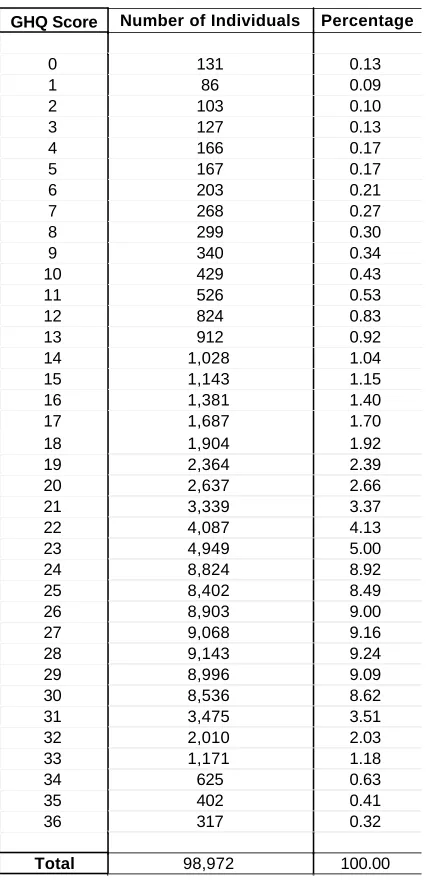
distribution of this well-being index in the BHPS sample is shown in table 1. The mean and mode of this
distribution are 25 and 28, respectively. However, there is a long-tail: roughly half of the sample have scored
less than 25, and around one-third have scored between 26 and 29.
Do married people in the U.K. report a higher psychological well-being score, on average, compared to
their non-married counterparts? In order to answer this question, a multivariate approach is required.
As there are 36 possible categorical responses to the Likert measure of psychological health, ordinary least
squares (OLS) regressions are preferable to ordered limited dependent models in this paper5.
[TABLE 2 HERE]
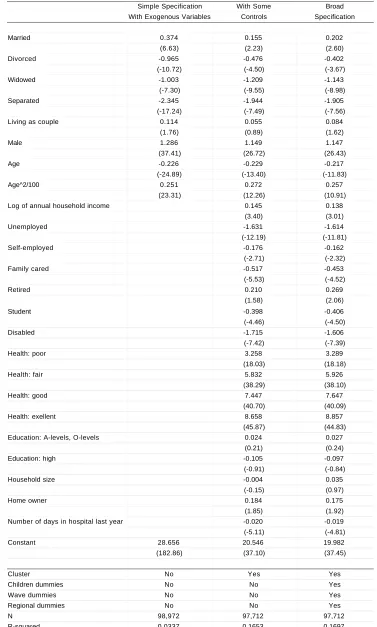
Table 2 reports the results from OLS regressions on the pooled BHPS data; we checked that ordered
logit estimation, which treats GHQ well-being index as ordinal variable, produces the same substantive
conclusions. The …rst column shows the estimates from regressing GHQ well-being scores on some exogenous
variables, i.e. age and gender, and the respondent’s marital status. The omitted marital status category
here is “single”. Being married is found to be associated positively and signi…cantly with individual’s
well-being compared to single individuals, while those living with a partner have reported a well-being
level somewhere around half way in between. The coe¢cients on divorced, separated, and widowed are
negative and signi…cant, thus in keeping with previous studies. Separated individuals seem to have the
that males have reported, on average, higher well-being levels than females and that there is a U-shaped
pattern in age, minimizing around mid-30’s (Oswald, 1997).
The second column adds in a number of other personal and household characteristics, including education,
employment, sub jective and objective health status, as well as household size, home ownership, and (natural)
log of household income per annum. Household income variable is measured in the real term, having been
adjusted by the yearly consumer price index. It also takes into consideration the number of people living
in the household, making it real income per capita. Descriptive statistics of all variables are provided in
Appendix B. Being married continues to produce a positive and signi…cant coe¢cient, with a t-statistic of
2.23. Other categories of marital status remain qualitatively the same with additional controls, apart from
those living with a partner category, where the positive coe¢cient becomes insigni…cant with a t-statistic of
0.89. These results are robust to standard errors adjusted to clustering in 19 regions.
Column 3 moves on to full speci…cation, adding controls for wave and regional dummies, as well as
the number of children in the household. With these controls, staying married continues to be strongly
positively correlated with individual’s well-being, whilst the coe¢cient on living with a partner has improved
slightly in its signi…cance from the second speci…cation. Separation seems to bring the least happiness for
the individuals, followed by widowhood and divorce.
The estimated coe¢cient on household income is positive and signi…cant in the equation for an individual’s
well-being. Unemployed people have reported, on average, a signi…cantly lower GHQ well-being level than
employed individuals. This is consistent with the …nding from previous studies on the non-pecuniary
costs of unemployment on individual’s happiness levels (see Darity and Goldsmith, 1996; Winkelmann and
Winkelmann, 1998; Clark, 2003). With full controls, Column 3 produces the following ranking of worst
recorded well-being among the BHPS’ employment statuses: the …rst was unemployment, then disability,
followed by family cared, student, and then self-employed. Self-reported well-being is higher for those
owning their home outright, while an estimation on the household size yields a positive, though insigni…cant,
coe¢cient. The levels of education obtained are negatively correlated, albeit insigni…cant, with individual’s
stayed in hospital last year) is associated negatively and signi…cantly with the GHQ well-being scores. There
are, however, stronger correlations between subjective health status and the reported psychological well-being
within the data set.
3 The Utility Model of Married Couples
It now seems to have been established beyond reasonable doubt that married people have better psychological
health, on average, compared to their non-married counterparts, and by far more than their pooling of
physical resources can predict. One question of interest is how such psychological, which is also
non-pecuniary, gain from marriage come about. Psychologists have been explaining this in terms of intimacy
and social support in a marriage (Dieneret al, 1999). However, to the best of our knowledge, no empirical
work to date has been able to demonstrate, systematically, this positive e¤ect stemmed from intimacy, i.e.
the “caring” for the well-being of one another, in a marriage on any large-scale data set. Therefore, we
aim to go further in this paper by proposing a situation where individuals are able to gain additional utility
directly from an increase in his or her spouse’s utility level, and attempt to test this using the BHPS data
set.
For simplicity, let us …rst de…ne the function of a married individual’s utility at any given time period as
U=U(X; Y ; USP OU SE(X; Y)); (1)
whereX is a vector of commodities consumption within the household,Y is the total real money in-take
by the couple, andUSP OU SE is the spouse’s utility. The individual’s utility is assumed to be increasing with
each level of X andY, both of which are divisible and can be shared between the couple. An increase in
X therefore raises individual’s utility both through a direct e¤ect uponU(X)and an indirect e¤ect, acting
through a rise in spouse’s utility, USP OU SE(X). Note that we assume in equation (1) that the spouse’s
well-being is generally observable to the respondent. However, the individual’s ability to assess the spouse’s
true welfare will depend partly on the spouse’s ability to convey his or her true well-being, as well as the
perfectly and, hence, derive more satisfaction from an increase in the true welfare of his bene…ciary, which
is what we are trying to measure.
Hence, for a marriage between individualiandj, the empirical counterpart to equation (1) can be written
as
Uit = ®0+®1Ujt+®2Xt+®3Yt+"it; (2)
Ujt = ¯0+¯1Uit+¯2Xt+¯3Yt+"jt; (3)
wheret= 1;2; :::; T, andE("it; "jtjXt; Yt) = 0: Equation (2) and (3) imply thatUit andUjt are endogenous
variables,Xt and Yt are exogenous variables, while"it and"jt are the stochastic disturbance terms. The
error term, "t; is thought to subsume the inability of human beings to communicate accurately the true
well-being levels, as well as unobserved personal traits such as optimism and intelligence. The parameters
®1and¯1can be de…ned such that the higher the value of®1(¯1) the more satisfaction individuali(j) can
derive from the same increase in his or her spouse’s utility. This is equivalent to saying that the larger the
parameter ®1 (¯1) the more altruistic individual i (j) becomes, provided that altruists derive satisfaction
from an increase in his bene…ciary’s welfare.
The reduced form of (2) and (3) are
Uit = ¦1+ ¦2Xt+ ¦3Yt+v1t; (4)
Ujt = ¦4+ ¦5Xt+ ¦6Yt+v2t; (5)
where the parameters are de…ned as
¦1 =
®0¯1+®0 1¡®1¯1
; ¦2=
®2¯1+¯2 1¡®1¯1
; (6)
¦3 =
®3¯1+¯3 1¡®1¯1
; ¦4=
®1¯0+¯0 1¡®1¯1
;
¦5 =
®1¯2+®2 1¡®1¯1
; ¦6=
®1¯3+®3 1¡®1¯1
;
with the error terms v1t =
®1"jt+"it 1¡®1¯1
and v2t =
¯1"it+"jt 1¡®1¯1
. Therefore, unless it can be shown that
estimation on equation (3). Nevertheless, the true (unbiased) e¤ect of spouse’s utility on own utility can
still be obtained if there is a valid instrument, sayZt, that a¤ects spouse’s utility but not own utility. Hence,
with additional information on the instrument, equation (2) and (3) become
Uit = ®0+®1Ujt+®2Xt+®3Yt+®4Zit+"it; (2’)
Ujt = ¯0+¯1Uit+¯2Xt+¯3Yt+¯4Zjt+"jt; (3’)
whereZita¤ects onlyUitand notUjt, whileZjta¤ects onlyUjtand notUit: It then follows that the reduced
forms of (2’) and (3’) are given by
Uit = ¦1+ ¦2Xt+ ¦3Yt+ ¤1Zjt+ ¤2Zit+v1t; (4’)
Ujt = ¦4+ ¦5Xt+ ¦6Yt+ ¤3Zjt+ ¤4Zit+v2t; (5’)
where
¤1 =
®1¯4 1¡®1¯1
; ¤2=
®4 1¡®1¯1
; (8)
¤3 =
¯4
1¡®1¯1
; ¤4=
®4¯1 1¡®1¯1
;
with other parameters have remained the same as de…ned in (4). We can now solve for parameter®1and¯1
from the structural equation that will give us the true e¤ects of spouse’s utility on the utility of individual
iandj, respectively.
¤1 ¤3
= ®1¯4
1¡®1¯1
¢1¡¯®1¯1
4
=®1; (9)
¤4
¤2 =
®4¯1 1¡®1¯1 ¢
1¡®1¯1
®4 =¯1:
(10)
A key speci…cation issue concerns the validity of Z. It is not a straight forward task to come up with
a valid exclusion restriction that identi…es the true e¤ect of spouse’s utility on individual’s utility, provided
that the composition of each household within the data set remains unidenti…ed. That is, unless we can
distinguish between private consumption from the consumption of public goods for each of the households in
the BHPS, personal variables that can be shared within household, such as individual’s income or ownership
identi…cation arises if we were to instrument individual’s well-being by personal characteristics that can a¤ect
spouse’s well-being by more than one way. For example, individual’s unemployment can a¤ect his or her
spouse’s well-being via these four routes: i) a drop in joint income, ii) a drop in own well-being independent
of income e¤ects, iii) heightening job insecurity for the spouse, and/or iv) a loss in family’s reputation in
the society, as in Akerlof (1980). In this paper we propose to use the spouse’s unobservable characteristics,
those that can neither be shared with the respondent nor have other known externalities on the respondent’s
well-being, as instrument. One of the instruments used in this article is the “residual” subjective health
levels that are not correlated with the objective health status and the usual socio-demographic determinants
of subjective health index.
There are several main arguments for the use of spouse’s residual subjective health status as a valid
instrument for spouse’s utility levels. The …rst relies on the substantive evidence of strong correlations
between individual’s subjective health status and di¤erent measures of psychological well-being (for a general
review on health and happiness, see Dieneret al, 1999). In other words, for a marriage between individual
iandj,Cov(Uit; Hit 6= 0) andCov(Ujt; Hjt 6= 0), where H is individual’s subjective health status at wave
t. The second counts on the medical literature, which suggests that subjectively interpreted health are
re‡ected not only by one’s actual physical condition but also by one’s level of emotional adjustment to
the adverse life events of illness and disability (Watson and Pennebaker, 1989; Larsen, 1992). Those who
have greater abilities to adapt are believed to su¤er less psychologically from physical health problems7.
Hence, the function of subjective health status for individual i at wave t is Hit = H(Pit; Ait), where Pit
is the actual physical health status (as indexed, for example, by age and hospitalization), and Ait is the
unobserved ability to adapt to ill health, which is more of an emotional component than anything else. We
assume thatPitis correlated with individualj’s utility,Ujt. This is because an individual’s objective health
condition is thought to have a direct e¤ect on the spouse’s utility through a number of physical externalities.
For example, an individual’s ill health may lead to a short-fall in the current household earnings, as well
as interfere with the spouse’s work or daily activities. On the other hand, it is unlikely that Ait will be
can use the predicted Ait; or the so-called “residual” subjective health levels that are not correlated with
the objective health status and the usual socio-demographic determinants of Hit, as a valid instrument for
individual’siutility levels.
4
Empirical
Evidence
of
Interdependent
Utility
in
Marriage
4.1 Pooled Cross-sectional Regressions
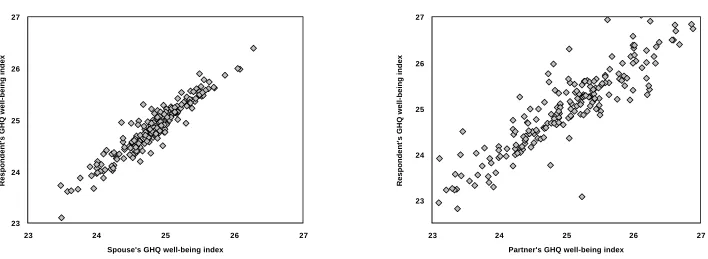
Figures 1-2 present a …rst pass at the question of utility interdependence among married and cohabiting
couples in the UK. In …gure 1, the average GHQ well-being score of the respondent is plotted against the
average GHQ well-being score of the respondent’s spouse, both of which are calculated by region and year,
in panel A, whilst panel B concentrates on the same relationship for couples in cohabiting union. It can
then be seen in panel A that there is a clear positive correlation between the average GHQ well-being of the
respondent and the average GHQ well-being of the respondent’s spouse. On the other hand, the relationship
between the average GHQ well-being of the respondent and the average GHQ well-being of the respondent’s
cohabiting partner, as shown in panel B, though positive, is less clear cut compared to the married sample
in panel A.
[FIGURE 1 HERE]
Figure 2 extends this analysis further, and plot the average change in the GHQ well-being of the
re-spondent from periodt¡1against the average change in the GHQ well-being of the respondent’s spouse or
cohabiting partner from periodt¡1. Panel A of …gure 2 reveals for the married sample a noticeable positive
correlation in the well-being among spouses over time. Again, the same relationship seems to be relatively
weaker for the cohabiting union sample. In an OLS regression, the estimated coe¢cients on the average
change in the well-being of the respondent’s spouse and cohabiting partner are 0.871 and 0.861, respectively.
Nonetheless, the robust standard error appears to be nearly twice as large for the estimation carried out on
when regional and year dummies are included into the regression. These aggregate numbers provide some
…rst evidence that utility between married couples may be jointly determined and much more so compared
to those couples who are not legally married, leading to smaller di¤erences in the GHQ score being recorded
for each set of husband and wife in the survey.
[FIGURE 2 HERE]
However, one of the limitations of the analysis using bivariate technique is that it does not allow controls
for other characteristics that are likely to a¤ect sub jective well-being, such as income and health, for example.
This calls for further multivariate approach. Table 3 presents some preliminary results from estimating
empirical counterpart to equation (1) on the married sample in the BHPS data. The …rst column has the
same broad speci…cation as in column 3, table 2, and shows that, for most of the socio-economic variables,
the use of the married sample has produced the same well-being structure as the use of the full sample
would. The second column then introduces the GHQ well-being of spouse variable into the regression. On
its own, the GHQ well-being of spouse enters the equation with a coe¢cient of 0.166 and a large t-statistic of
15.23, suggesting a positive and well-determined relationship between spouse’s and individual’s self-related
psychological well-being.
[TABLE 3 HERE]
Nevertheless, it is quite likely that own and spouse’s well-being are being determined simultaneously in the
optimizing utility model, which implies that OLS estimates will be biased upward. In an attempt to correct
for these biases, the last two columns adopt an IV approach and estimate the same well-being equation using
Heckman’s two-step least square (2SLS), with the GHQ well-being of spouse being instrumented by two
experimental variables. In order to make the identi…cation problem evident in our choices for instrumental
variable, the …rst IV regression in column 3 uses a personal characteristic, known in the literature as a
variable that can a¤ect the respondent’s well-being by more than one way, e.g. spouse’s unemployment
status, as instrument for spouse’s well-being. The positive simultaneity bias on the spouse’ well-being
an instrumental variable produces an in‡ated coe¢cient on the GHQ well-being of spouse of 0.301 with a
t-statistic of 2.58.
The last column of table 3 introduces spouse’s “residual” subjective health index as a potential valid
exclusion restriction. A three-step approach is chosen into calculating this variable. In the …rst step, we
began with an ordered logit regression estimating, for the respondent’s spouse, the relationship between the
standard proxies of objective health status and the subjective health index (see Appendix C). In preparation
for the second step, the predicted probability of falling into a particular health category for each respondent
is obtained from the regression8. We then multiplied the probability of being in those categories by the
value of each health category. The “expected” subjective health status variable, Hbt;for each respondent’s spouse at wavet is then calculated as followed:
b
Ht = Pr(very poor)£1 + Pr(poor)£2 + Pr(f air)£3 + Pr(good)£4 + Pr(excellent)£5: (11)
In the third step, each spouse’s “expected” subjective health status, Hbt; is subtracted from his or her reported subjective health index, Ht; and based on this di¤erence we created a variable for each spouse’s
residual subjective health index9. The mean and standard deviation of the residual subjective health index
is approximately 0.01 and 0.89, suggesting that the expected value is very close to the actual value of
self-reported health itself. Estimating the equation with spouse’s residual sub jective health status continues to
produce a positive and signi…cant coe¢cient on spouse’s well-being. There is, nevertheless, a stark decrease
of 11% and 51% in the impact of spouse’s well-being on individual’s well-being compared to the coe¢cients
on GHQ well-being of spouse obtained in column 2 and 3, respectively (the GHQ well-being of spouse now
enters the equation with a coe¢cient of 0.147 and a t-statistic of 6.69), as well as a substantial improvement
in the overall R2. Hence, by instrumenting spouse’s well-being by residual health status we have removed the
positive simultaneity bias a¤ecting the GHQ well-being of spouse parameter in the utility model of marriage.
The size of the coe¢cient is also qualitatively important as well as the statistically signi…cant. The
mean of spouse’s GHQ well-being score is 24.88 and its overall standard deviation is 5.16. A one standard
change from 19.72 to 30.04. Taking a conservative central estimate of spouse’s GHQ well-being score to be
0.147, the implied change in the individual’s well-being is approximately 1.5. This is greater than switching
gender; it can completely o¤set the non-pecuniary cost of unemployment; it is equal of not having to spent
around two and a half months in the hospital last year. All in all, the results thus suggest that there exists a
degree of altruismvis-á-vis interdependency in the reported well-being among the married couples for Great
Britain.
Of other particular interest is the role of household income among married couples after spouse’s
well-being has been taken into account in these equations. There is a signi…cant drop in the coe¢cient size
for the estimated coe¢cient on household income from 0.214 in column 1 to 0.105 in column 4, despite
the fact that there is virtually no correlation between the instrumented GHQ well-being of spouse and
the household income variable. One explanation for this is that money in-take at the household level
contributes to individual’s well-being in two ways: i) directly, and ii) indirectly through spouse’s well-being.
By controlling for the instrumented GHQ well-being of spouse we explicitly remove the indirect e¤ect of
income from the equation. As a result, the coe¢cient on household income re‡ects only the direct e¤ect of
income on individual’s well-being, which in this case is roughly half of what was originally estimated in the
…rst column of table 3.
[TABLE 4 HERE]
Given the possibilities that the degree of utility interdependence may be stronger for some groups of the
married individuals than others, it seems useful to examine sub-samples in the population. Table 4 does
this by spliting the data into categories of gender, age group, and income level. With the same controls as in
column 4, table 3, the results reveal a larger estimated e¤ect (and in its signi…cance) of spouse’s well-being on
individual’s well-being for females compared to males, and for the young compared to the older generations.
For those with low household income (the poorest 25% of household), the GHQ well-being of spouse entered
the equation with a coe¢cient of 0.159 and a t-statistic of 4.72. Running the same equation on those with
t-statistic of 2.29.
[TABLE 5 HERE]
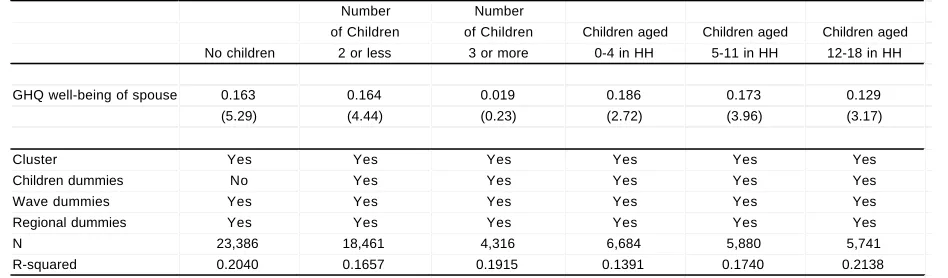
Table 5 further examines sub-samples for Great Britain, this time by the number of own children and
their age-group. The hypothesis is that the degree of utility interdependence is strongest when there are
only two people in the marriage, i.e. no own children presence in the household. This is presumably
because there may be greater intimacy presence among married couples with no children. The coe¢cient
on spouse’s well-being for those married with no children is positive and signi…cant at 0.163 (t = 5:29).
The estimated e¤ect, as well as the signi…cance of the coe¢cient, is roughly the same size for those with no
children than the one obtained for those with either one to two children in the marriage. On the other hand,
the same estimated coe¢cient for those married with three or more children, though positive, is insigni…cant
(t= 0:23). For those married with children aged from 0 to 4 only, the GHQ well-being of spouse entered the
equation with a relatively larger coe¢cient of 0.186 (t= 2:72) compared to those married with no children.
The same coe¢cients estimated on those with older children sub-samples (aged 5-11 and 12-18) are positive,
albeit slightly less signi…cant compared to those married with young children.
Finally, separate regressions can be run on each of the GHQ-12 well-being components. This should
give an idea of the principle conduits through which the interdependencies work. The results (not reported
here) show spouse’s well-being to be positive and signi…cant at the 1% level for 10 out of 12 GHQ well-being
components. For example, the individuals are better at overcoming di¢culties when in a marriage where
the spouse possesses high psychological well-being. The same qualitative results were also obtained when
we unpacked the spouse’s well-being into 12 components in our regressions. Hence, the positive e¤ects from
spouse’s well-being on individual’s well-being can work via a di¤erent route of mental components rather
4.2 Fixed E¤ect Regressions
We turn now to the panel aspect of our data. Here, repeated observations on the same individual allows us
to test for correlations between changes in own well-being and spouse’s well-being over time. Controlling for
unobserved individual heterogeneity in the normal way, table 6 presents the main results from OLS and 2SLS
with …xed-e¤ect regressions. In the …rst column, the use of full married sample produces panel-equation
results that are generally consistent in structure with those from the …rst column of table 3’s pool
cross-section regression. Unemployment continues to have a profound negative e¤ect on individual’s well-being.
Better health status, subjectively and ob jectively (i.e. less days spent in hospital last year), still have the
same positive e¤ects on self-rated well-being, while disability and family cared continue to enter the equation
with strong negative coe¢cients. Lastly, the pattern of home ownership and the non-linear e¤ect in age is
similar under …xed-e¤ect regression to that of table 3. Household income, on the other hand, has a negative,
albeit insigni…cant, in‡uence on the respondent’s GHQ well-being score.
[TABLE 6 HERE]
Column 2 adds in control for spouse’s well-being in the full married sample estimation. The choice for
instrumental variable in these …xed-e¤ect regressions, and for the remaining of this paper, will be spouse’s
residual sub jective health status. The GHQ well-being of spouse variable continues to have a well-de…ned
positive e¤ect on the respondent’s well-being; the proxy for spouse’s utility enters with a well-de…ned
coe¢-cient of 0.085 and a t-statistic of 2.89. Again, the e¤ect of spouse’s well-being is also quantitatively important
as well as statistically signi…cant. Note that the estimated impact of spouse’s well-being on individual’s
well-being is roughly one-half that of what was estimated in the cross-sectional analysis in column 4, table
3. Given that the mean of spouse’s GHQ well-being score is 24.84 with a within group standard deviation
of 3.53, if we were to take a conservative central estimate of spouse’s well-being to be 0.085, a move from one
standard deviation below to one standard deviation above implies a change in the respondent’s well-being of
approximately 0.6. This is more than enough to compensate a change from being employed the last period
on well-being; it is greater than the e¤ect of owning home outright; it is equivalent of not having to spent
around three weeks in the hospital last year.
Column 3 and 4 further explore the gender sub-samples overtime. The GHQ well-being of spouse variable
continues to have a strong positive e¤ect on individual’s well-being for both males and females in these panel
regressions. Similar to the …gure from column 1 and 2 of table 4’s pooled cross-sectional regressions, the size
of the coe¢cient on spouse’s well-being is signi…cantly larger for females than males. The respective …gures
for the estimated coe¢cients on spouse’s well-being for males and females are 0.074 and 0.104, suggesting
that females gain more than males do from the same increase in the spouse’s well-being. In other words,
the results o¤er some …rst-hand evidence that females are, on average, more altruistic in their marriage
compared to males.
4.3 The Well-being Trend Outside Marriage
One question of interest is whether these interdependencies are statistically signi…cant only for the married
sample. For instance, there is no a priori reason to assume that the utilities of those who live in a
cohabiting union are not jointly determined. As the term cohabitation suggests, intra-household transfers
between partners’ utilities are still possible, provided that one or both cohabiting partners are altruistic
individuals who care about the welfare of the current partner. This is represented by the positive, albeit
relatively weaker, correlation in the well-being between cohabiting partners compared to married sample in
…gures 1-2.
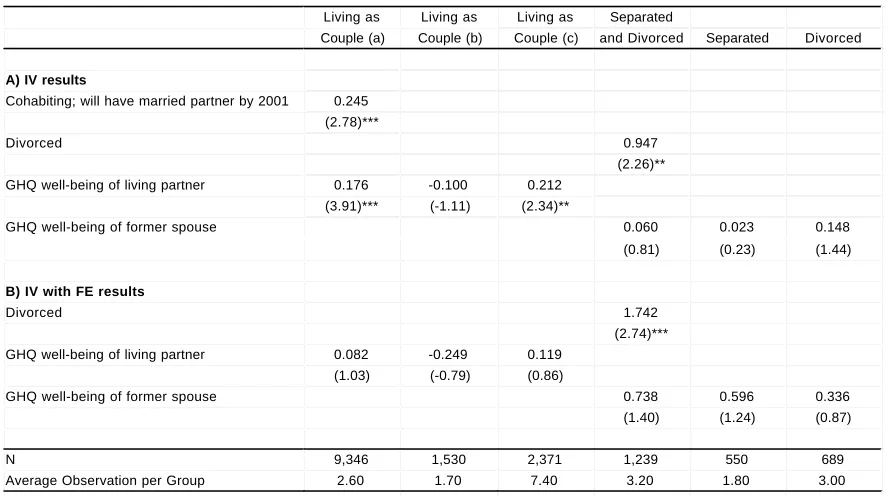
Table 7 tests the hypothesis of utility interdependence among those identi…ed themselves as living with
a partner in the BHPS. The …rst panel presents the estimated coe¢cients from pooled cross-sectional
regressions, while the second panel reports the …xed-e¤ect regression results. We begin by presenting in the
…rst column of table 7 the main regression results estimated on the living as couple sample (N = 9;346).
With the same speci…cation used to estimate the married sample in column 4 of table 3, the GHQ well-being
of current partner enters the equation with a positive and signi…cant coe¢cient of 0.176, with a t-statistic
cross-sectional analysis; happy people are likely to be found cohabiting with an equally happy partner. The
results are also robust to the control of selection e¤ects into marriage; we do so by including in the pooled
regression a dummy representing those people who subsequently marry their partner sometimes in the future
wave. Consistent with the idea that happier people stand a better chance of getting married than their less
happy counterpart (see Mastekaasa, 1992; Frey and Stutzer, 2003), the estimated coe¢cient on this dummy
variable is positive and signi…cant for the U.K. sample, suggesting that people who subsequently marry their
partner have, on average, a higher psychological well-being level compared to their contemporaries who did
not marry in the data set.
We move on to estimate a …xed-e¤ect regression on those cohabiting couples in the second panel of
column 1, table 7. With full set of control variables, the …xed-e¤ect results show that the GHQ well-being
of spouse now enters the well-being equation with a positive, albeit insigni…cant, coe¢cient. Hence, unlike
the married sample, there seems to be no evidence of utility interdependence among cohabiting couples over
time.
[TABLE 7 HERE]
The second column examines the well-being trend among those couples who subsequently marry within
the BHPS. As far as the theory of selection e¤ects would predict, the hypothesis is that the degree of utility
interdependence may be stronger for those cohabiting couples who will marry each other sometimes in the
future than those who did not. However, we could not …nd any signi…cant trend of utility interdependence
between partners among those who subsequently marry in the data set, from either pooled or …xed-e¤ect
regressions. It is also worth noting here that, for the BHPS sample, the average number of years individuals
spent cohabiting before marriage is approximately 4 years, with a standard deviation of around 2. This leaves
339 individuals (or 2,765 observations across the panel) who cohabited for at least 6 years, and still have not
been married by the …nal wave. Assuming that these people may prefer cohabitation to marriage, the third
column of table 8 checks whether there exists any degree of utility interdependence between these individuals
between the respondent’s well-being and the partner’s well-being; the GHQ well-being of partner enters the
equation with a sizeable coe¢cient of 0.212 and a t-statistic of 2.34. The interdependent relationship on
cohabiting union is not long-lasting, however, as we cannot replicate the same qualitative results for the
…xed-e¤ect regression. One explanation of this is that, even though happy people are attracted to equally
happy people, individuals who live in a cohabiting union tend not to be as committed as married couples.
Consequently, they tend to care more about their own personal autonomy and less about the well-being of
their partner over time. This is consistent with the recent sociological literature’s …ndings of higher break-up
rates, and eventual marital failures, by those cohabiting with a partner compared to spouses (see Popenoe
and Whitehead, 2002, for a comprehensive review on separation and divorce in cohabiting union).
We also provide in table 7 some evidence regarding the trend of GHQ well-being after future separation
and divorce: going into future waves, we can observe the correlation between individual’s well-being and
spouse’s well-being after the marriage and living together is over. Looking at the last two columns of the
table, it can be seen that the e¤ects of former spouse’s well-being on own well-being, though positive, are
largely insigni…cant in all of our full sample and sub-sample analysis. Based on these …ndings, it thus seems
reasonable to conclude that the same signi…cant trend of utility interdependence among married couples
does not exist between spouses after the marriage has ended.
4.4 Future Socio-economic Status and Behavior
We have shown, so far in this section, that changes in the well-being of the respondent’s spouse has a strong
positive in‡uence on the respondent’s own well-being, whilst the same e¤ects do not seem to hold for either
the cohabiting union, the separated, or the divorced. One question mainstream economists might ask is,
“What di¤erence does this make?” A pragmatic response to this is that well-being information has been
shown to provide useful information about individual socio-economic status and behavior in the future. For
example, Grahamet al (2003) …nd for Russia that residual happiness (i.e. happiness that cannot explained
by the usual demographic and socio-economic determinants of happiness) in the initial period is positively
Clark (2003) also shows that those well-being fell the most on entering unemployment are more likely to
search for job in t+ 1, and less likely to remain unemployed in t+ 2. In keeping with this spirit, we will
be examining whether the GHQ well-being impact of spouse’s well-being has any signi…cant bearing on the
respondent’s future earnings, unemployment, and marital status.
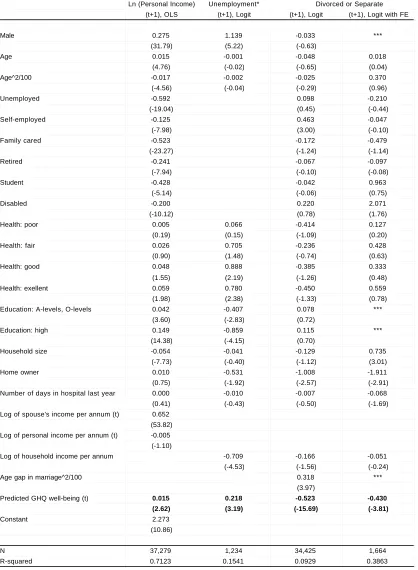
Table 8 uses the panel aspect of the BHPS data to provide some …rst evidence that movements in the GHQ
well-being has a signi…cant explanatory power on individual income, employment, and marital status one
period into the future. Controlling for individual …xed e¤ects, we began with the standard 2SLS regression
estimating the impact of changes in the spouse’s well-being on the respondent’s well-being. Based on the
predicted GHQ well-being score we created a variable for each respondent’s well-being at wave t that can
only be explained by movement in spouse’s GHQ well-being from the last period,t¡1. We then checked
for any casual relationships between this predicted well-being and a set of socio-economic status and labor
market behavior at wavet+ 1.
[TABLE 8 HERE]
The …rst column of table 8 examines the correlation between the predicted well-being int and log of
personal income per annum in t+ 1. The OLS results show a positive and signi…cant relationship between
the GHQ well-being impact of spouse’s well-being and future earnings for the individual. Those whose
GHQ well-being has improved as a result from an increase in the spouse’s well-being have experienced higher
income on average in t+ 1compared to t. This …nding is consistent to the idea that happier people are
more productive in the labor market than others, and hence are likely to earn more income in the future.
The next column considers the possible outcome of labor market behavior int+ 1by the unemployed at
periodt. The rough idea is that the decision to remain unemployed will be,ceteris paribus, an increasing
function of the individual’s utility, which does not necessarily have to be gained from employment (relative
to unemployment). In this case, the hypothesis to be tested is whether the GHQ well-being impact of
spouse’s well-being increases the probability for the unemployed at wave tto remain jobless int+ 1. The
joblessness for the unemployed. In addition, the estimates imply that, for an average unemployed individual
at periodt, a move of 1-point in the predicted GHQ well-being score is associated with a 22% chance that
she will remain unemployed at wavet+ 1.
How about the impact of predicted GHQ well-being on the probability of staying married itself? One
hypothesis is that, as marriage is currently seen as a main source of happiness, spouses may think something
is wrong with their marriage if one or both feel unhappy. Thus possibilities may arise when extreme
unhappiness within the household may work as a self-ful…lling prophecy towards future separation and
divorce (Ross, 1955). The next two columns look at whether the GHQ being impact of spouse’s
well-being also predicts future marital status. Going one wave into the future, there were 576 observations of the
married sample at wavet whose marital status changed to either separation or divorce at wavet+ 1: The
logit results in the third column of table 7 show a negative and signi…cant relationship between the predicted
GHQ well-being at wavetand the probability of separation and divorce at wavet+ 1. In other words, the
higher the individual’s well-being at wave t, which can only be explained by movements in spouse’s GHQ
well-being from t¡1to t, the less likely that the marriage will end in either separation or divorce at wave
t+ 1. This is consistent to Kiernan and Mueller (1998)’s …nding for the U.K. of lower reported psychological
well-being among married men and women who subsequently break up compared to their contemporaries
who did not break up. The other estimated coe¢cients show that moves from marriage to either separation
or divorce are more likely for the unemployed, the self-employed, and the highly educated, while the same
movements are less likely for males, and those looking after home (i.e. family cared). Though not reported
here, these results remain robust to control for the estimated individual …xed e¤ects, which have been used
as an independent variable in each of our future income, unemployment, and marital status equations.
Regarding the respondent’s decision to stay in marriage one wave into the future, a further robustness
check is carried out in the next column where a logit with …xed e¤ect equation of either separation or
divorce in t+ 1is estimated. Controlling for within e¤ects, the results show that increases in the predicted
GHQ well-being signi…cantly reduce the probabilities of either separation or divorce in the next period: a
probabilities for an average married individual of future separation or divorce by over 43%.
In summary, the evidence presented in table 8 provide two additional information that may be useful to
economists when analyzing how marriage works. The …rst, which is consistent with the previous …ndings
in psychology and economics, is that measure of sub jective well-being can be used successfully to predict
labor market behavior and socio-economic outcomes. Secondly, the results o¤er an alternative psychological
explanation - other than specialization, and resource pooling - as to why some people may be gaining more
from marriage than others.
5 Conclusion
This empirical paper uses a form of proxy utility data to test theories of interdependent utility in marriage.
Using a large UK panel sample from 11 waves of the BHPS data, we exploit the psychological nature of
“residual” health status of each respondent’s spouse to provide an instrument for their current well-being at
di¤erent time periods. Consistent with the standard assumptions in the economic and psychology literature,
the IV estimates reveal a strong and positive correlation between own well-being and spouse’s well-being
for the married sample in Great Britain. There is strong evidence that ‘happy’ individuals are likely to be
observed living with a ‘happy’ partner, and this e¤ect is well-de…ned for most groups of married individuals
in the data set. The results are also robust to controls for individual …xed e¤ects. That is, over-time
changes in the respondent’s well-being are shown to be positively and signi…cantly correlated to over-time
changes in the well-being of the respondent’s spouse. The estimated impacts of spouse’s well-being on
the individual’s well-being are of a reasonable size. For instance, a change in the spouse’s well-being by
one standard deviation can compensate around one third of the negative impact unemployment has on
individual’s well-being.
In addition to the IV’s …ndings, our estimates suggest no signi…cant evidence of interdependence utility
among those couples who may prefer cohabitation to marriage, as well as those whose marriage ended
spouse’s well-being fromt¡1totis associated with higher personal earnings, higher probabilities of remaining
unemployed, and lesser chance of separation or divorce for the respondents, one wave into the future. As
such, the results seem to provide some of the …rst direct, large-scale evidence of utility interdependence
resulting from “caring” or altruism in marriage, as in Becker (1974), which has proved hard to quantify in
the past. More generally, the …ndings of this article o¤er some …rst empirical insights as to why married
individuals are, on average, happier compared to those who have never been married or have been divorced,
separated or widowed.
References
[1] Akerlof, George. “A Theory of Social Custom, of Which Unemployment May Be One Consequence”,
Quarterly Journal of Economics, 1980, 94, no. 4, pp. 749-75.
[2] Argyle, Michael. The Psychology of Happiness. London: Routledge, 1989.
[3] Argyle, Michael. “Causes and Correlates of Happiness.”, in Daniel Kahneman, Edward Diener and
Norbert Schwarz, eds., Well-Being: The Foundations of Hedonic Psychology. New York: Russell Sage
Foundation, 1999, pp. 353-373.
[4] Becker, Gary S. “A Theory of Marriage: Part I.”, Journal of Political Economy, 1973, 81(4), pp.
813-846.
[5] _____. “A Theory of Marriage: Part II.”, Journal of Political Economy, 1974, 82(2), pp. S11-S26.
[6] _____.A Treatise on the Family. Cambridge, MA: Harvard University Press, 1981.
[7] Blanch‡ower, David G., and Oswald, Andrew J. “Well-Being Over Time in Britain and the USA.”,
Journal of Public Economics, 2004, 88, pp. 1359-1386.
[8] Breetvelt, I.S. and Van Dam, F.S. “Underreporting by Cancer Patients: The Case of the
[9] Brickman, Phillips, Coates, Dan, and Jano¤-Bulman, Ronnie. “Lottery Winners and Accident Victims:
Is Happiness Relative?”, Journal of Personality and Social Psychology, 1978, 36, 917-927.
[10] British Household Panel Survey. Waves spanning the year 1991-2001; made available by the University
of Essex through the ESRC United Kingdom longitudinal studies centre data archive.
[11] Chun, Hyunbae and Injae Lee. “Why Do Married Men Earn More: Productivity or Marriage
Selec-tion?”,Economic Inquiry, 2001, 39(2), pp. 307-319.
[12] Clark, Andrew E. “Unemployment as a Social Norm: Psychological Evidence from Panel Data.”,
Journal of Labor Economics,2001,21, pp. 323-351.
[13] Darity, William, and Goldsmith, Arthur H. “Social Psychology, Unemployment, and Macroeconomics.”,
Journal of Economic Perspectives, 1996, 10 (1), pp. 121-40.
[14] Di Tella, Rafael, and MacCulloch Robert J. “Partisan Social Happiness.”,Review of Economic Studies,
2004, forthcoming.
[15] Diener, Edward. Subjective Well-Being,Psychological Bulletin, 1984, 93, 542-575.
[16] Diener, Edward, Suh, Eunkook M.; Lucas, Richard E., and Smith, Heidi L. “Sub jective Well-Being:
Three Decades of Progress.”,Psychological Bulletin, 1999, 125 (2), pp. 276-302.
[17] Ekman, Paul, Davidson, Richard, and Friesen Wallance. “The Duchenne Smile: Emotional Expression
and Brain Physiology II.”,Journal of Personality and Social Psychology, 1990, 58, pp. 342-53.
[18] Ermisch, John F. An Economic Analysis of the Family. Princeton University Press, 2003.
[19] Ferrer-i-Carbonell, Ada and Frijters, Paul. “How Important is Methodology for the Estimates of the
Determinants of Happiness?”, The Economic Journal, forthcoming, July, 2004.
[20] Frey, Bruno S. and Stutzer, Alois. “Happiness, Economy, and Institution.”, The Economic Journal,
[21] _____. “Does Marriage Make People Happy, Or Do Happy People Get Married”, Mimeo, University
of Zurich, 2003.
[22] Fordyce, Michael. “A Review of Research on Happiness Measures: A Sixty Second Index of Happiness
and Mental Health”,Social Indicators Research, 1988, 20, pp. 355-81.
[23] Gardner, Jonathan, and Oswald, Andrew J. “Is it Money or Marriage that Keeps People Alive?”
Mimeo, University of Warwick, 2002.
[24] Gerdtham, Ulf G., and Johannesson, Magnus. “The Relationship between Happiness, Health and
Socio-economic Factors: Results based on Swedish Micro Data.”, Journal of Socio-Economics, 2001, 30, pp.
553-57.
[25] Graham, Carol, and Pettinato, Stefano. Happiness and Hardship: Opportunity and Insecurity in New
Market Economies. Brookings Institution Press, 2002.
[26] Graham, Carol, Eggers, Andrew, and Sukhtankar, Sandip. “Does Happiness Pay? An Exploration
Based on Panel Data from Russia.”, The Journal of Economic Behavior and Organization, forthcoming,
2003.
[27] Goldberg, David P. The Detection of Psychiatric Illness by Questionnaire. Oxford: Oxford University
Press, 1972.
[28] Gove, Walter R. “Sex, marital status, and mortality.”,American Journal of Sociology, 1973, 79(1), pp.
45-67.
[29] Hu, Yuanreng , and Goldman, Noreen. “Mortality di¤erentials by marital status: An international
comparison.”, Demography, 1990, 27(2), pp. 233-50.
[30] Kiernan, Kathleen and Mueller, Ganka. “The Divorced and Who Divorces?”, published as chapter 16 in
Susan McRae, eds.,Changing Britain: Families and Households in the 1990s, Oxford University Press,
[31] Konow, J. and Earley, J. “The Hedonistic Paradox: Is Homo-Economicus Happier?”, Mimeo, Loyola
Marymouth University, Department of Psychology, 1999.
[32] Korenman, Sanders, and Neumark, David. “Does Marriage Really Make Men More Productive?”,
Journal of Human Resources, 1991, 26(2), pp. 282-307.
[33] Larsen, Randy J. “Neuroticism and Selective Encoding and Recall of Symptoms: Evidence From a
Combined Concurrent-Retrospective Study.”, Journal of Personality and Social Psychology, 1992, 62,
pp. 489-488.
[34] Loh, Eng S. “Productivity Di¤erences and the Marriage Wage Premium for White Males”,Journal of
Human Resources, 1996, 31(3), pp. 566-89.
[35] Mastekaasa, Arne. “Marriage and Psychological Well-Being: Some Evidence on Selection into
Mar-riage.”,Journal of Marriage and the Family, 1992, 54(4), pp. 901-11.
[36] Oswald, Andrew J. “Happiness and Economic Performance.”,Economic Journal, 1997, 107, pp.
1815-31.
[37] Popenoe, David and Whitehead, Barbara D. Should We Live Together? What Young Adults Need
to Know About Cohabitation Before Marriage: A Comprehensive Review of Recent Research. Second
Edition. The National Marriage Project: Rutgers University, 2002.
[38] Rose, Arnold M. “Factors Associated with the Life Satisfaction of Middle-class, Middle Aged Persons.”,
Marriage and Family Living, 1955, 17, 15-19.
[39] Ross, Catherine E., Mirowsky, John, and Goldsteen, Karen. “The Impact of the Family on Health: The
Decade in Review.”, Journal of Marriage and the Family, 1990, 52(4), pp. 1059-78.
[40] Siedlitz, Larry, Wyer, Robert, and Diener, Edward. “Cognitive Correlates of Subjective Well-Being:
The Processing of Valenced events by Happy and Unhappy Persons”,Journal of Research in Personality,
[41] Silver, Roxane L. “Coping with Undersirable Life Events: A Study of Early Reactions to Physical
Disability.” Ph.D. dissertation, Northwestern University, 1982.
[42] Veenhoven, Ruut. “The Utility of Happiness.”,Social Indicator Research, 1998, 20, pp. 333-54.
[43] Watson, David and Pennebaker, James W. “Health Complaints, Stress, and Distress: Exploring the
Central Role of Negative A¤ectivity.”, Psychological Review, 1989, 96, pp. 234-54.
[44] Wilson, Chris M., and Oswald, Andrew J. “How Does Marriage A¤ect Physical and Psychological
health? A Survey of the Longitudinal Evidence.” Mimeo, University of Warwick, 2002.
[45] Winkelmann, Liliana, and Winkelmann, Rainer. “Why Are the Unemployed So Unhappy?”,Economica,
Table 1: The Distribution of GHQ: BHPS, 1991-2001
GHQ Score Number of Individuals Percentage
0 131 0.13
1 86 0.09
2 103 0.10
3 127 0.13
4 166 0.17
5 167 0.17
6 203 0.21
7 268 0.27
8 299 0.30
9 340 0.34
10 429 0.43
11 526 0.53
12 824 0.83
13 912 0.92
14 1,028 1.04
15 1,143 1.15
16 1,381 1.40
17 1,687 1.70
18 1,904 1.92
19 2,364 2.39
20 2,637 2.66
21 3,339 3.37
22 4,087 4.13
23 4,949 5.00
24 8,824 8.92
25 8,402 8.49
26 8,903 9.00
27 9,068 9.16
28 9,143 9.24
29 8,996 9.09
30 8,536 8.62
31 3,475 3.51
32 2,010 2.03
33 1,171 1.18
34 625 0.63
35 402 0.41
36 317 0.32
Total 98,972 100.00
Table 2: Marriage and GHQ Measure of Well-Being Regressions for the UK,
1991-2001 (OLS Results)
Simple Specification With Some Broad With Exogenous Variables Controls Specification
Married 0.374 0.155 0.202
(6.63) (2.23) (2.60)
Divorced -0.965 -0.476 -0.402
(-10.72) (-4.50) (-3.67)
Widowed -1.003 -1.209 -1.143
(-7.30) (-9.55) (-8.98)
Separated -2.345 -1.944 -1.905
(-17.24) (-7.49) (-7.56)
Living as couple 0.114 0.055 0.084
(1.76) (0.89) (1.62)
Male 1.286 1.149 1.147
(37.41) (26.72) (26.43)
Age -0.226 -0.229 -0.217
(-24.89) (-13.40) (-11.83)
Age^2/100 0.251 0.272 0.257
(23.31) (12.26) (10.91) Log of annual household income 0.145 0.138
(3.40) (3.01)
Unemployed -1.631 -1.614
(-12.19) (-11.81)
Self-employed -0.176 -0.162
(-2.71) (-2.32)
Family cared -0.517 -0.453
(-5.53) (-4.52)
Retired 0.210 0.269
(1.58) (2.06)
Student -0.398 -0.406
(-4.46) (-4.50)
Disabled -1.715 -1.606
(-7.42) (-7.39)
Health: poor 3.258 3.289
(18.03) (18.18)
Health: fair 5.832 5.926
(38.29) (38.10)
Health: good 7.447 7.647
(40.70) (40.09)
Health: exellent 8.658 8.857
(45.87) (44.83) Education: A-levels, O-levels 0.024 0.027
(0.21) (0.24)
Education: high -0.105 -0.097
(-0.91) (-0.84)
Household size -0.004 0.035
(-0.15) (0.97)
Home owner 0.184 0.175
(1.85) (1.92) Number of days in hospital last year -0.020 -0.019 (-5.11) (-4.81)
Constant 28.656 20.546 19.982
(182.86) (37.10) (37.45)
Cluster No Yes Yes
Children dummies No No Yes
Wave dummies No No Yes
Regional dummies No No Yes
N 98,972 97,712 97,712
R-squared 0.0337 0.1653 0.1697
Figure 1: The Respondent’s GHQ Well-being and The GHQ Well-being of Spouse or Partner in the UK, BHPS waves 1-11
A) Married Sample
B) Cohabiting Union Sample
Note: Each data point is calculated with region-specific (19 regions) fixed-effect and year-specific (11 years) fixed-effect.
23 24 25 26 27
Spouse's GHQ well-being index 23
24 25 26 27
Respondent's GHQ well-being index
23 24 25 26 27
Partner's GHQ well-being index 23
24 25 26 27
Figure 2: The Change in the Respondent’s GHQ Well-being from Period t-1 and
The Change in the GHQ Well-being of Spouse or Partner from Period t-1 in the UK, BHPS waves 1-11
A) Married Sample
B) Cohabiting Union Sample
Note: The change in the GHQ well-being is defined as GHQ - GHQ . Each data point is calculated with region-specific (19 regions) fixed-effect and year-specific (11 years) fixed-effect.t t-1
-2 -1.5 -1 -0.5 0 0.5 1 1.5 2
Change in the spouse's GHQ well-being from t-1 -2
-1.5 -1 -0.5 0 0.5 1 1.5 2
Change in the respondent's GHQ well-being from t-1
-2 -1.5 -1 -0.5 0 0.5 1 1.5 2
change in the partner's GHQ well-being from t-1 -2
-1.5 -1 -0.5 0 0.5 1 1.5 2
Table 3: Well-Being Regressions and GHQ of Spouse for the UK, 1991-2001 (IV Results)
(1) (2) (3) (4)
Male 1.018 1.208 1.359 1.208
(18.29) (17.28) (8.67) (16.83)
Age -0.223 -0.201 -0.170 -0.199
(-8.06) (-8.46) (-5.33) (-7.76)
Age^2/100 0.259 0.235 0.201 0.234
(7.69) (8.24) (5.39) (7.60) Log of household income per annum 0.214 0.103 0.017 0.105 (3.68) (1.98) (0.24) (2.02) Unemployed -1.588 -1.460 -1.339 -1.495 (-8.47) (-6.76) (-5.23) (-6.77) Self-employed -0.215 -0.163 -0.133 -0.183 (-3.04) (-2.27) (-1.59) (-2.41) Family cared -0.352 -0.305 -0.258 -0.296 (-2.77) (-3.01) (-2.32) (-3.07)
Retired 0.338 0.248 0.213 0.303
(1.84) (1.31) (1.25) (1.64)
Student -0.545 -0.623 -0.630 -0.610
(-1.68) (-1.86) (-1.77) (-1.66)
Disabled -1.618 -1.471 -1.338 -1.459
(-6.04) (-5.54) (-4.53) (-5.71)
Health: poor 3.309 3.110 2.945 2.981
(9.44) (9.83) (7.78) (8.42)
Health: fair 5.793 5.523 5.299 5.453
(21.83) (24.11) (15.41) (20.30)
Health: good 7.502 7.127 6.843 7.093
(26.48) (26.58) (17.07) (23.20) Health: exellent 8.708 8.264 7.927 8.257
(31.25) (31.04) (18.24) (26.71) Education: A-levels, O-levels 0.022 0.002 -0.006 -0.000
(0.20) (0.02) (-0.06) (-0.00) Education: high -0.189 -0.224 -0.218 -0.227 (-1.81) (-2.22) (-2.15) (-2.28) Household size -0.035 -0.051 -0.041 -0.053 (-0.55) (-0.85) (-0.73) (-0.87)
Home owner 0.209 0.138 0.081 0.141
(2.03) (1.51) (1.10) (1.42) Number of days in hospital last year -0.021 -0.019 -0.018 -0.020 (-3.67) (-2.81) (-2.42) (-2.98) GHQ well-being of spouse 0.166 0.301 0.147
(15.23) (2.58) (6.69)
Constant 20.937 17.549 14.317 18.026
(24.04) (21.26) (4.83) (19.93)
Cluster Yes Yes Yes Yes
Children dummies Yes Yes Yes Yes
Wave dummies Yes Yes Yes Yes
Regional dummies Yes Yes Yes Yes
N 54,564 48,245 48,245 46,163
R-squared 0.1616 0.1876 0.1701 0.1877
Instrument variables spouse's spouse's residual on GHQ of spouse unemployment subjective
status health index*
Table 4: Well-Being Regressions and GHQ of Spouse - By Groups, 1991-2001 (IV Results)
HH income HH income Males Females Age <= 30 Age > 30 <= £5,000 >= £17,000
Male 1.800 1.126 1.324 0.993
(8.59) (15.12) (7.89) (4.17) Age -0.287 -0.138 0.471 -0.210 -0.233 -0.201 (-9.89) (-3.18) (1.33) (-4.95) (-5.83) (-2.38) Age^2/100 0.328 0.170 -1.070 0.247 0.284 0.224 (9.79) (3.26) (-1.60) (5.12) (5.81) (2.34) Log of household income per annum 0.036 0.152 0.104 0.107 -0.161 0.045 (0.39) (1.63) (1.25) (1.83) (-1.46) (0.15) Unemployed -1.555 -1.730 -0.825 -1.656 -1.538 -2.553 (-7.56) (-4.20) (-1.62) (-7.80) (-6.88) (-3.76) Self-employed -0.122 -0.373 -0.154 -0.176 -0.384 -0.295
(-0.85) (-1.54) (-0.50) (-2.23) (-2.24) (-0.99) Family cared -0.547 -0.187 -0.642 -0.209 -0.686 1.372
(-1.25) (-1.86) (-3.52) (-1.61) (-3.95) (2.15) Retired 0.081 0.475 -0.634 0.295 -0.390 1.510 (0.34) (2.22) (-2.47) (1.48) (-1.53) (4.60) Student -1.504 0.212 -0.426 -0.659 -0.292 0.484 (-2.83) (0.59) (-0.48) (-1.75) (-0.57) (1.09) Disabled -1.963 -0.957 -1.847 -1.421 -1.510 -1.612 (-5.82) (-2.01) (-2.27) (-5.13) (-5.00) (-0.96) Health: poor 3.084 2.940 3.534 2.934 4.456 0.136
(5.51) (6.68) (2.76) (7.78) (7.32) (0.10) Health: fair 5.418 5.490 5.380 5.496 6.831 2.215 (9.97) (13.64) (5.20) (19.20) (16.31) (1.76) Health: good 6.937 7.222 7.148 7.117 8.652 3.847 (12.34) (17.11) (6.22) (22.21) (22.47) (3.05) Health: exellent 7.990 8.494 8.223 8.283 9.821 5.045 (13.97) (17.96) (7.09) (26.41) (23.84) (4.01) Education: A-levels, O-levels 0.022 -0.003 0.198 -0.005 -0.073 0.094 (0.15) (-0.02) (0.96) (-0.05) (-0.59) (0.34) Education: high -0.205 -0.194 0.112 -0.255 -0.327 -0.142 (-1.23) (-1.72) (0.49) (-2.62) (-1.65) (-0.43) Household size -0.064 -0.037 0.101 -0.065 0.125 0.047 (-1.05) (-0.40) (1.17) (-1.04) (0.86) (0.57) Home owner 0.036 0.212 0.271 0.129 0.320 0.229 (0.34) (1.13) (1.40) (1.27) (1.62) (1.09) Number of days in hospital last year -0.020 -0.017 -0.003 -0.021 -0.009 -0.040 (-1.58) (-2.32) (-0.13) (-2.63) (-1.00) (-1.96) GHQ well-being of spouse 0.110 0.187 0.232 0.139 0.159 0.125
(4.40) (5.95) (6.04) (6.08) (4.72) (2.29) Constant 22.629 15.367 5.956 18.606 18.506 21.638 (17.52) (12.75) (1.32) (16.51) (10.11) (6.72)
Cluster Yes Yes Yes Yes Yes Yes
Children dummies Yes Yes Yes Yes Yes Yes
Wave dummies Yes Yes Yes Yes Yes Yes
Regional dummies Yes Yes Yes Yes Yes Yes
N 22,910 23,253 6,610 39,553 10,927 4,653
R-squared 0.1878 0.1748 0.1579 0.1917 0.2431 0.1333
Table 5: Well-Being Regressions and GHQ of Spouse,
By Number of Children in the Household for the UK, 1991-2001 (IV Results)
Number Number
of Children of Children Children aged Children aged Children aged No children 2 or less 3 or more 0-4 in HH 5-11 in HH 12-18 in HH
GHQ well-being of spouse 0.163 0.164 0.019 0.186 0.173 0.129 (5.29) (4.44) (0.23) (2.72) (3.96) (3.17)
Cluster Yes Yes Yes Yes Yes Yes
Children dummies No Yes Yes Yes Yes Yes
Wave dummies Yes Yes Yes Yes Yes Yes
Regional dummies Yes Yes Yes Yes Yes Yes
N 23,386 18,461 4,316 6,684 5,880 5,741
R-squared 0.2040 0.1657 0.1915 0.1391 0.1740 0.2138