Using Serious Games to Teach
Cause Effect Relationships in
Asphalt Quality
By Peter Verzijl s1317369 University of Twente EWI Creative Technology
Supervisor Job Zwiers 2nd Robby van Delden Client Janine Profijt
Introduction
In 2018 the minister of OCW, Education Culture and Science (Onderwijs Cultuur en Wetenschap in Dutch), plans to make minor like modules mandatory for all MBO (Secondary vocational education, Middelbaar Beroepsonderwijs in Dutch) education
[1]. Minors, which are similar to electives, where students spend half a semester deepening their knowledge in the chosen subject. The University of Twente and the department of Civil Engineering are developing such a minor for infrastructure education. This minor will deepen the students’ knowledge on asphalt road
construction and the emerging technologies that are developed in the field. This was needed as the study material did no longer reflect the state of the industry, as stated by two teachers from both the ROC of Twente (Regional Education Center, Regionaal Opleidingen Centrum in Dutch) and SOMA College (Foundation for the Education of Machinists for Contractor Companies, Stichting tot Opleidingen van Machinisten voor Aannemersbedrijven in Dutch). Janine Profijt develops this minor in cooperation with the construction conglomerate ASPARi. Janine is also the client supervisor for this project.
The minor consists of an introduction, five assignments and an evaluation in the form of a presentation and a portfolio. In the third assignment of the minor, a serious game is played by the student in order for them to better understand the cause effect
relationships in asphalt quality. The learning objective of the game is to prepare the player/learner to make real time decisions in the field based on the data that emerging technologies bring. These technologies include: real time weather data, real time heat maps from thermal cameras attached to waltzes and asphalt spreader, location data from both machines and microwave density sensors. The student needs to be able to prepare for weather conditions and make real time decisions when these conditions change to preserve the quality of the asphalt.
The design serious game and its development is the objective of this project. Therefore, the research question is stated as:
How can an effective serious game be developed for teaching students to make better decisions in both the planning phase as well as during the construction work, based on both real-time data and environmental factors?
From this main research question, two sub-questions need to be answered before the main question can be resolved:
How could the cause effect relationships between external factors and the quality of the asphalt be best taught by means of this serious game?
What type of interactions with the simulation are best suited to train students to make better decisions based on real-time weather, temperature and
geolocation data in the real word?
serious game will be discussed. The results of the test and a discussion on the
resulting serious game will be discussed in the section thereafter. Finally, a discussion on the results will follow, which includes recommendations for future work,
Table of Contents
USING SERIOUS GAMES TO TEACH CAUSE EFFECT RELATIONSHIPS IN ASPHALT
QUALITY ... 1
ABSTRACT ... ERROR! BOOKMARK NOT DEFINED. INTRODUCTION ... 2
TABLE OF CONTENTS ... 4
STATE OF THE ART ... 7
EXISTING SERIOUS-/SIMULATION GAMES ... 7
Graphical Simulations ... 7
XPactor ... 7
Construction Simulator 2 ... 8
University of Twente Simulations ... 9
Non Graphical Simulations ... 9
SERIOUS GAME TECHNOLOGIES ... 10
Unity 3D ... 10
Unreal Engine ... 11
Java LWJGL, jMonkey and other Java engines ... 12
SEROUS GAME CREATION METHODOLOGIES ... 13
Balancing Engagement and Education ... 14
TESTING SERIOUS GAMES ... 14
ASPHALT QUALITY ... 15
PRE-EXISTING ASPHALT HEAT &COMPACTION VISUALIZATION METHODS ... 15
ANALYSIS OF EXECUTORS AND CONSTRUCTION PROJECTS ... 15
An Executors Project Description ... 15
Decisions Made by Executors ... 16
Possible Problems During Construction... 17
Grading Systems for Decisions ... 18
Usage of (Real-time) Data in Asphalt Construction ... 18
Positional Tracking ... 19
Temperature Measuring ... 19
Compaction Sensors ... 19
Real-time Weather Data ... 20
METHODS ... 21
INTRODUCTION &SUB QUESTIONS ... 21
DEFINING LEARNING GOALS ... 21
IDEATION ... 23
Introduction ... 23
First Ideation Phase ... 23
Initial Idea Phase ... 24
3 Concepts ... 24
Concept 1 - Planning & Simulation ... 24
Concept 2 - Asphalt Road Construction Adventures ... 24
Concept 3 - Asphalt Road Construction Tycoon ... 25
Concepts Summary ... 25
Chosen Concept & Results Ideation Phase 1 ... 26
Ideation Phase 2 - Refinement of the Concept ... 28
Game Loops ... 30
Requirements... 31
Must have ... 31
Should have ... 31
Could have ... 32
Won't have ... 32
FINAL CONCEPT DESCRIPTION... 32
Planning Phase ... 32
Feedback Phase ... 32
SERIOUS GAME DEVELOPMENT ... 33
Data Representation Strategies... 33
Decision & Conclusion ... 36
Texture Filling Strategies ... 36
Heat Dissipation Data ... 37
Visualization ... 38
Usage in the Serious Game ... 39
Explanation of the Implementation ... Error! Bookmark not defined. Machines Control ... 41
Compactor Control ... 41
Paver Control ... 42
Usage of Proposed Systems ... 42
Camera Control ... 43
2nd Iteration ... 44
Time Control ... 45
Feedback Phase ... 46
Planning Phase ... 47
Game Mechanics ... 48
Tutorial Design ... 49
Level Design ... 49
Level Loading ... 51
Text Loading System ... 51
Analytics System ... 51
RESULTS ... 53
TEST DESIGN ... 53
Questionnaire ... 53
Observation ... 53
Test Planning ... 54
FIRST TESTING ROUND (SOMA) ... 54
Technical & Design Issues ... 54
Questionnaire Results ... 55
Understandability of the Game... 55
Game Input ... 56
Level Progress ... 57
Learning Related Questions ... 57
Questions on Fun Factor ... 59
Remarks ... 61
ITERATION ON THE SERIOUS GAME ... 62
Identified Problems during Testing ... 62
Solutions to Identified Problems ... 62
Performance Optimizations & Bug Fixes ... 63
Rendering ... 63
Simulation Calculations ... 64
Collision ... 64
User Interface Improvements ... 64
Tutorial Improvements ... 65
Implementation of Goals ... 65
Temperature Implementation ... 65
Other Improvements and Changes ... 66
SECOND TESTING ROUND -QUESTIONNAIRE ... 66
Technical & Design Issues ... 66
Questionnaire Results ... 67
Understandability of the Game... 67
Game Input ... 68
Level Progress ... 69
Learning Related Questions ... 69
Questions on Fun Factor ... 71
Remarks ... 71
SECOND TESTING ROUND -ANALYTICS DATA ... 72
DISCUSSION ... 74
DISCUSSION QUESTIONNAIRE RESULTS ... 74
DISCUSSION ANALYTICS RESULTS ... 76
CONCLUSION ... 77
THE RESEARCH QUESTIONS... 77
REFLECTION &LIMITATIONS ... 78
What went well ... Error! Bookmark not defined. FUTURE WORK ... 79
TABLE OF FIGURES ... 81
REFERENCES ... ERROR! BOOKMARK NOT DEFINED. APPENDIX 1 - GAME GENRE BASED IDEAS ... 84
APPENDIX 2 - ASPHALT CONSTRUCTION MIND MAP ... 88
APPENDIX 3 - EXAMPLE LEVEL ... 89
APPENDIX 4 - TEMPERATURE TABLE ... 90
APPENDIX 5 – TEST QUESTIONARE (DUTCH) ... 94
APPENDIX 6 – SOMA QUESTIONNAIRE RESULTS ... 97
State of the Art
Existing Serious- / Simulation Games
Graphical Simulations
XPactor
In 2005, Turkiyyah et al. [2] released a paper on virtual training tools for
transportation infrastructure construction. This paper describes the development and need for cost-effective 3D (three-dimensional) training environments for hot mix asphalt paving called XPactor. The software allows for multiple users with different roles to work together on a single virtual construction site. It also allows for multiple scenarios like different geometries, multi-lane or inclined roads, weather conditions, time of day and traffic patterns. These parameters can be set at runtime. They stated that future simulations should stress the importance of planning and timing of a broader range of paving tasks and implement artificial intelligence (AI) to allow users to focus on timing and coordination of tasks rather than execution of the paving process.
Figure 2: XPactor
In 2011, Merge games created the simulation game Road Construction Simulator that simulates being a road construction worker. The simulation is a very simplified simulation of what road construction entails. It consists of the following activities: driving delivery vehicles and positioning road signs, laying asphalt by driving a truck filled with HMA (hot mix asphalt), paving the asphalt by driving a roller over the asphalt once to complete the asphalt, stripping old asphalt, drilling away cracks in asphalt and putting down line markings. Asphalt temperature and waltzing strategies nor the types of asphalt are simulated.
Figure 3: Road Construction Simulator -
Screenhost 1 Figure 4: Road Construction Simulator - Screenhost 2
Construction Simulator 2
Figure 5: Construction Simulator 2 - Screenshot
simulation is done and the thickness of the asphalt is not simulated, it provides a reasonable simulation of how the machines move around while working.
University of Twente Simulations
In august of 2013, two simulations of the paving process were made at the University of Twente in the faculty of Civil Engineering at the department of Infrastructure. In one simulation (figure 5), a paver moves with a certain speed along the blue path that can be seen in the image. The roller can be moved with the left mouse button, the path that the roller has traveled can be seen as the red line on the image. The red dot is the desired new destination given by the user by pressing the left mouse button.
Figure 6: Roller simulation University of Twente
Figure 7: Roller compaction and temperature simulator
The right image (figure 6) is a frame taken from a video [4] that was made of the second prototype that was created after the one shown in figure 5. This shows an asphalt paver and two rollers that both autonomously and in the case of the roller, user controlled move around. The temperature and the compaction can both be shown as red to black colors (red is hot, and black is cold) on the road. The black to green colors indicate compaction (green is sufficiently compact, black is not compacted). By controlling the roller, the effect of waltz strategies on the compaction can be shown.
Non Graphical Simulations
Figure 8: Animation & Output
Figure 9: Input
In the input section, the user is able to select between different real life pavers, rollers, loaders and dump trucks and chose how many of each are used in the construction. Each have six or more settings. For example, the paver has settings for: the amount of asphalt pavers, aggregate pavers, asphalt containment capacity, pave width, operator efficiency and working hours. Besides setting up the machinery, the user also
specifies the wearing course, base course and sub-base course layers that are to be paved, including lane width, layer height and the amount of layers.
The process logic section describes the mathematical model that is based on input and output nodes where the flow of data can be controlled. All three layers are modeled separately. The animation and output panel shows the resulting information based on the model and input. Here construction costs, asphalt plant requirements, equipment function and other factors are described. From this data, potential bottlenecks can be determined and acted upon in the planning phase of asphalt road construction.
Serious Game Technologies
There are many different technologies with which you could create serious games, with equal variety of control, ease of use and capabilities. The most used game technologies and some technology used by the mentioned existing simulations are also mentioned.
Figure 10: Unity Editor
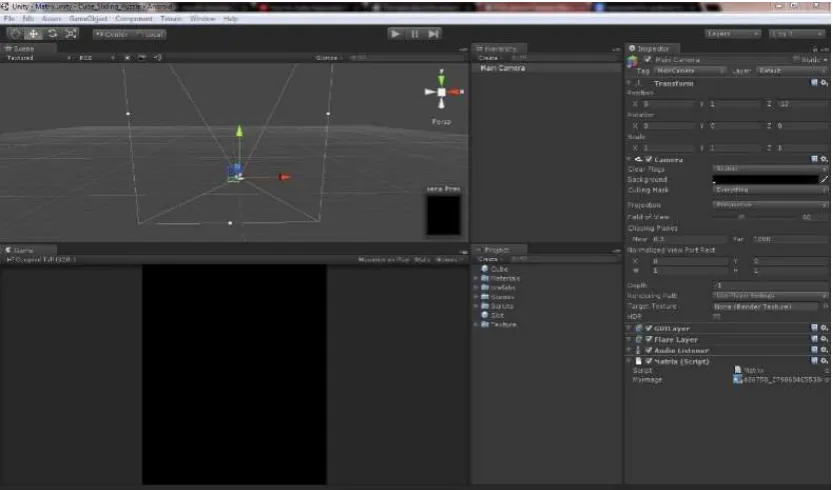
Unity 3D, or now commonly referred to as Unity is a game engine combined with various editors that is used a lot in the independent- and mobile game industry [6]. This is because created games can be easily ported to a wide variety of platforms such as: Windows, Mac, Linux, Android, IOS, Tizen OS, PS4, Xbox One, PSVita,
WebGL, Nintendo Switch, Wii U, 3DS, VR (virtual reality) platforms and Facebook [7]. It comes with a multitude of tools [8] to help design such as a level editor, animation editor, state machines, lights, multiple rendering engines, 2D tools, audio mixers, path finding and much more. It also has an API for creating your own editor windows and scripts for game behavior in Mono C#. It is also able to use compiled DLL files from other languages.
Figure 11: Unreal Editor
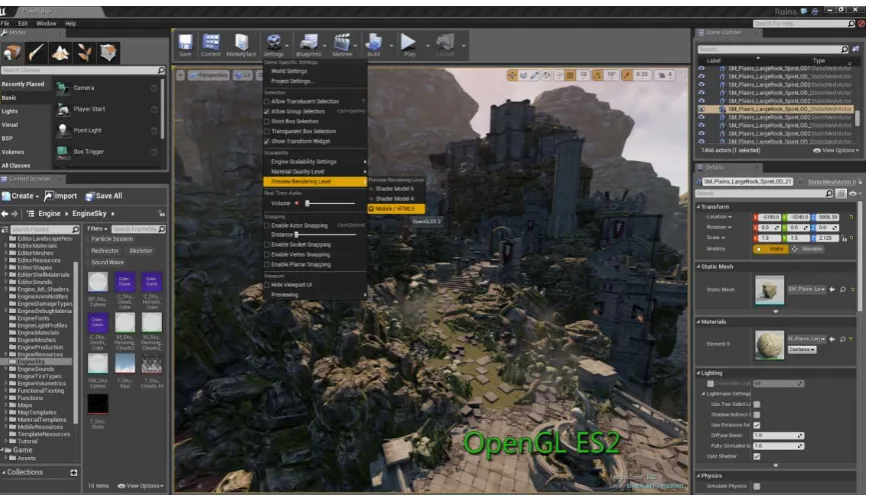
Unreal Engine is the main competitor of Unity when it comes to graphical fidelity and the amount of commercial console and triple-A game that are released. It is also a lot older than Unity (Unity was released in 2005 for Mac only and Unreal Engine was first released in 1998). A big advantage of Unreal to Unity is that it uses the industry standard language C++ instead of an older Mono C# version, which is still the
standard, even for proprietary game engines. Besides this advantage, the whole engine has recently been published as open source. Which means you can change every single bit of the engine code to your liking, which is impossible on Unity since you are stuck with binaries and thus is less modifiable.
It also supports a visual coding interface called blueprint where you can drag behavior boxes and lines between boxes to do the coding for you.It also implements many of the features that Unity also has [9]. But also some additional features such as: changing code while the game is running, recoding gameplay and replaying it with different code, a VR editor, new Vulcan graphics API (application programing interface) and a node based material editor.
Both Unity and Unreal Enginehave been used in the past to create serious games in various fields such as tactical training for soldiers, explaining fracking and medical training [10, 11, 12, 13].
Figure 12: jMokey Editor
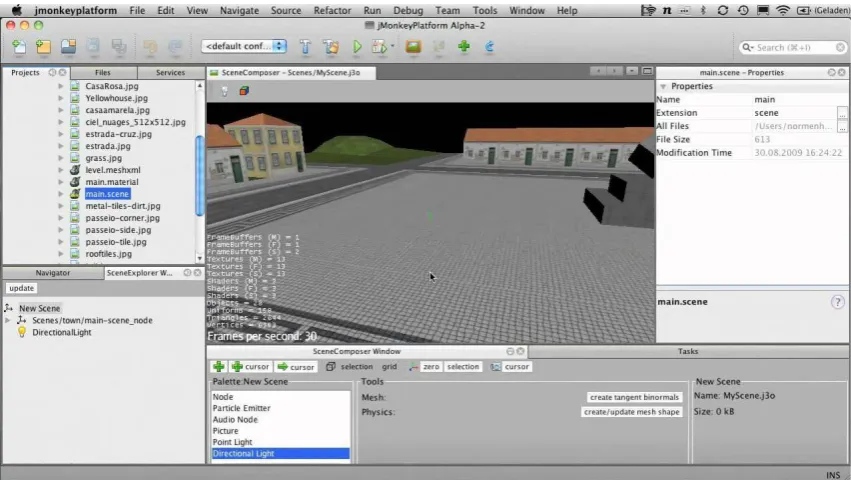
Java is quite an often used programming language in the computer science and business circles due to its many uses and object oriented nature. Many programmers in the field use Java and thus the pool of programmers is very large. It is also argued that Java is easier to learn because it does not allow you to directly modify memory and use pointers, such as C and C++, also called garbage collected. Therefore, there are not many triple-A games released due to the lack of control over the memory usage of the game and the fact that you can get very irregular frame rates when the garbage collector does interfere. However, this is only a problem when dealing with high fidelity games. Unless that is a requirement for the intended serious game, Java could, and has been used, in serious games. For example, the paving and roller simulator built by the University of Twente [4] is using jMonkey.
JMonkey is a game engine for Java with a scene, properties and navigator editor build in and looks familiar to the interface that Unity uses.
Serous Game Creation Methodologies
Catalano et al. [14] reinforces this idea that engagement can be increased by challenge through keeping the player on the flow curve. A concept introduced by
Csíkszentmihályi [15]. They also state that player reflection on their choices is important to learning, this is reinforced by Harteveld et al. [16] andCatalano et al. [14] whom introduce the KWS method which describes three thought processes by the player: what I Know; what I want/Need to know; and what I have Solved. The serious game should provide these tools to make sure the player wants to learn new information in order to get better at the game and be able to progress. They also argue that choices in serious games should avoid ending in a success or fail state. They argue that this will hamper improvement in the player and promotes a guessing game instead of coming to meaningful conclusions.
Harteveld et al. [16] created a design philosophy for serious games that states that serious games design needs to balance three characteristics: play, meaning and reality. The effectiveness of the serious game relates strongly to how well these three pillars are in balance. It is the task of the game designer to make decisions based on the design dilemmas and trilemmas that are present in the design space. Play embodies the play and fun side of the game, including all the game design and technology behind the game. Meaning emphasizes the learning content in the game, the
pedagogical theories and transferal of knowledge. Reality represents the closeness to the real life scenario’s that the game is trying to prepare the player/learner for, such that he can make better decisions in real life scenarios based on in-game gained knowledge. This philosophy was later called triadic game design inHarteveld’s book [17].
This game presents three options: One: training, to familiarize the player with the controls and procedures in the game. Two: the main mode, sequentially more challenging scenarios (like a story mode in an entertainment game). Three: a single scenario generator where weather, type of failures and types of responsibilities can be set up. They also believe that a workshop needs to be set up in order to facilitate effective transfer of the learning goals. They show failure types in levees and are given one scenario to train with this type of issue (mini scenarios). Reflection is a critical aspect of the learning process
Balancing Engagement and Education
Roger and Freiberg [18] stated that learning is difficult when learners are not
motivated. Therefor it is paramount that engagement is maintained. This engagement can be achieved by removing cognitive load, user-friendly interfaces that don’t wastes the users time, progressively introducing learning content, remove redundancy, preventing blocks in game flow, an appropriate interaction mode, snapshots of currently achieved progress, real-time feedback and self-evaluation, preventing repetitiveness and minimizing too deterministic actions [14].
Testing Serious Games
intermingled with irrelevant questions with respect to learning goals in the pre- and post-questionnaires [14].
Control groups are useful at all levels [14].
Logs created by the game could be used to do quantitative analysis. In this way, behaviors can be tracked in real time [14].
Asphalt Quality
Therefore, you conduct background research to deepen your understanding of the research area. This research is not limited to a literature (papers, journals, periodicals, books etc.) study, but also includes other forms of information elicitation (e.g. client meetings, attending conferences, exhibition visits). You use the newly acquired knowledge and information to analyze the problem, which in turn leads to multiple research questions by asking “How?”, “What?” and “Why?” questions.
Pre-existing Asphalt Heat & Compaction
Visualization Methods
HCQ (Hamm Compaction Quality) is a system for compaction specifically. It tracks position data for multiple connected compactors, interfaces with heat sensing cameras and GPS. Trimble creates a similar system (the cb460), however this system only tracks location and is not specifically designed for compaction. This system does do prescribed amount of passes.
Analysis of Executors and Construction Projects
An understanding of the roles, tasks and responsibilities that an asphalt construction executor has during the construction, has been gained through a wide variety of documents, interviews and meetings. The most clear depiction of the job is a document created by Infra education center SBW and VBW-Asphalt called "De asfaltuitvoerder".
An Executors Project Description
At the start of a project, the executor is informed by their superior by the way of a folder. This folder contains all the project data such as the dimensions, location and amount of layers in the asphalt paving project; the amount, kind and types of machines available to the project; the time, date and duration of the project and information as such. Images and technical drawings for the project are also provided.
The executor then examines the construction site by himself to see if the drawings and the terrain match up. Calculations on the amount of asphalt, the surroundings and the foundation soil or pre-existing asphalt is then inspected by the executor.
positioned where, what asphalt is paved when and how. For example, when a junction is created and how the asphalt lanes should meet. The amount of asphalt is then recalculated by the executor and a series of calls is made between the asphalt factory and the executor to estimate the amounts. This estimate gets refined during the planning phase of the execution. In this planning phase, the speeds of the machines is also set, based on the weather predictions at that time.
The amount of asphalt delivery trucks is then calculated based on the speed an
thickness of the paving machines, the capacity of the trucks, the round trip travel time to the asphalt factory from the construction site and the density of the asphalt mixture. The mixture is usually decided by the client or consulted based on client needs and requirements, and is therefor stated in the folder.
All of this information is updated as the project gets closer to starting. On the last evening the weather is checked once again to make sure the paver speed is correct and there is no waiting time on heavy rain. The asphalt factory is called on the day itself one last time before construction can start.
During the construction, the executor is responsible for the timely and quality of the construction process. He directs the crew who operates the machines, measures the asphalt compaction and supporting personal. The order of construction and time planning is managed by the executor and communicated to his subordinates. The way the road is paved, compacted and measured is decided by the crew itself, but is observed and understood by the executor. The executor also keeps the project manager up to date on the progress.
The executor is mostly on site to make sure that the entire project is progressing as planned, issues are dealt with and immediate solutions are found. As he is responsible for the delivery of a quality end product.
At the end of a project a short report is created to justify made decisions and document possible discrepancies in the final product.
Decisions Made by Executors
From the project description, decisions that are made by the executor during a project, can be identified. The executor can:
Decide the order and way at which the road is paved.
Decide the amount of asphalt that is needed during the project
Decide at which temperature the asphalt is delivered
Decide the speed of the paver
Decide the initial setup and organization of machinery
Decide how junctions, lanes and additional special cases for asphalt construction are handled
Decide when to stop paving, or continue at a lower speed, when the weather conditions change
Decide the amount of asphalt trucks are used (this influences the amount of asphalt available per time frame)
Decide on when and how often to measure the compaction of the asphalt
Decide on when or weighter to call the project lead for an update on the construction process
Decide to postpone the construction process for any reason
Decide to hire additional trucks during the project, if needed
Possible Problems During Construction
As can be seen, the decisions that an executor can make are quite limited. To get a better understanding on where these decisions come into play, both parties were asked to come up with problems they have had to solve during their career.
The weather could change the speed at which the asphalt cools down, for example when it starts to rain, this means that the compaction process needs to speed up. → If the asphalt cools down more quickly the paving speed needs to decrease such that compactors have enough time to compact the entire road sufficiently. Or compactors need to compact faster.
Machines can break down. → In this case the solution depends on the machine that has a malfunction or the ability to fix the machine. In the case of a paver malfunction, if there are other pavers, these pavers could stop their work and focus on the main road, or the pavers finish this part of road after their own jobs are finished. In the case of a compactor breakdown, the remaining compactors have to do double duty,
therefor the paver should slow down for the time compensation.
Long during heavy rain could pose a big problem such that the paving process can no longer continue at that particular day. → In such a case, construction often has to be stopped. Asphalt stays relatively warm over night if situated inside a delivery truck. These trucks then need to be hired for longer periods of time until the rain stops.
The effective travel time between the factory and the asphalt construction site could becomes longer, i.e. in the event of a traffic jam. → In this case the paver could slow down such that it uses less asphalt per unit of time, therefor not having to wait until the next delivery and paving against a cold slab of asphalt.
term quality. In the case of too much asphalt, asphalt could be transported back to the factory, or transported to a nearby project.
The required compaction percentage is not reached. → If the asphalt is still hot
enough, more passes could still work. Often this requires more compactors. Otherwise a fine is often payed to the contractor, or the entire layer needs to be stripped and redone.
Grading Systems for Decisions
To effectively grade the decisions made by experts and future experts alike, the goals of asphalt road construction need to be defined. As stated in the introduction, there is a trend towards a heightened focus on the quality of asphalt. The quality is dependent on the compaction of the asphalt after paving, but also on the uniformity of the compaction.
The compaction is important as the denser the asphalt is compacted, the longer the asphalt lasts over time. However at a certain point, the asphalt is too compact. After a compaction of 99%, the asphalt is so compact, that it can no longer stretch and shrink with outside temperatures, and cracks start to form during the summer and winter periods. Shortening the longevity of the asphalt significantly. Uniformity is important as differences in compaction lead to quicker wear and tear. The locations where the compaction differs a lot is the first area where wear starts to form as the strains, e.i. endured when cars drive or outside temperature changes, put on the asphalt cannot be uniformly distributed. Therefor it could be stated that the decision that results in the best and most uniform compaction is the best decision.
However, more factors come into play when grading on decisions. Time and money are also important factors in decision making. As time can be converted to money by calculating the labor costs and costs for hiring machinery, total amount of money spend or amount of budged used could be a measure for grading decisions. This measure could also be used to describe long term effects of decisions as paved roads may require reconstruction or costly repair if the guaranteed lifetime is not reached.
A final way of grading could be to pick a plethora of common issues and problems to solve grade decisions based on the universal truths in the field. For example, if a certain decision is always made in a particular situation by executors, that would be the only correct answer. As it is the industry standard.
Usage of (Real-time) Data in Asphalt Construction
Positional Tracking
Positional tracking methods are methods of tracking vehicles' positions over time. Usually this data is used to see how machines behave over the duration of a project. This data can then be analyzed and used by logistics optimizers to better the road construction process.
But location tracking can also be used in real-time ways. For example to
automatically track the amount of passes a compactor has done over a particular section of paved asphalt. This could give the operator of the compactor a better
understanding on how he has compacted and what spots might need additional passes. Another way this same idea could be implemented is to prescribe an amount of passes at the project planning stage. A compactor then knows if his job has been done to the specifications of the project.
Positional tracking could also be used to inform parties not present on the construction site on the progress and operations of the project. For example, if an executor is at the office, or present on an entirely different section of the project, he could still be able to see progress on all other sections that are not in his direct vision.
Temperature Measuring
Temperature has a huge importance in asphalt road construction as the amount of compaction possible depends on how hot the asphalt mixture is on paving. There is a range of temperature wherein compaction is effective. Is the temperature too hot, then the asphalt simply slides right under the compactors, effectively hoping up at the edges. The compactor could even sink so far into the asphalt that all asphalt is pushed to the sides of the compactor and the compactor becomes stuck. When the
temperature is too cold, the amount of compaction will either be very little or none at all. But to know how hot the asphalt is at a certain point, heat camera's or heat sensors are required.
There are currently three main ways of measuring asphalt heat, by using heat sensitive camera's, by attaching sensors to the compactor itself that measure the temperature of the compaction cylinders or to embed sensors into the surface of the asphalt. The former two methods are only really useful for measuring surface temperatures as as they cannot measure heat from within the asphalt itself. But surface temperatures are sufficiently accurate to make good compaction strategy decisions.
The first method requires the sensors to be placed before paving and also need to survive the extreme paving temperatures and strains. These sensors are quite
expensive and require extensive personal training in order to install and handle them correctly, therefor they are not used as often.
Compaction Sensors
temperature where it can still be compacted. It does however, in combination with positional tracking and temperature sensors, allow analyzers to draw conclusions and correlations between passes, temperature and compaction.
Real-time Weather Data
Methods
Introduction & Sub Questions
In this section the methods for defining the learning goals; ideation; constructing and designing the serious game and testing the serious game are described. This includes justifications for the decisions made along the duration of the project.
The goal of the project is to answer the research questions posed in the introduction. An effective serious game is to be developed for students in the field of asphalt road constructions. To develop a serious game the following needs to be considered:
What methodologies for serious game development would fit such a project?
What learning methodologies are effective in serious games?
What are the learning goals of the serious game?
How can students be familiarized with new and emerging technologies in the field of asphalt road construction through a serious game?
How do effective serious games balance learning and fun?
What external factors are involved in the asphalt paving process?
How could decision making be trained in serious games?
In the next chapter the learning goals are discussed. The chapter thereafter the other questions are answered in relation to the information to the state-of-the-art.
Defining Learning Goals
To define the learning goals for the serious game that developed, the research questions are to be considered. These state that the game needs to teach students to make better decisions in both phases of asphalt road construction. The decisions also need to incorporate real-time data and environmental factors. To list the learning goals, questions that are raised need to be answered.
What kinds of decisions are made by asphalt road construction executors, in both of the phases?
How can these decisions be graded?
What real-time data is available during road construction, now and in the future?
The decisions that are made in asphalt road construction can be found in the state-of-the-art in the section Decisions Made by Executors. However not all decisions might benefit learning or the serious game. On the other hand, there are decisions which are not made by the executor, which do benefit the learning process.
A qualification dossier for the minor, drafted by Janine Profijt states the overall learning goals. As the serious game is part of the minor, some of these learning goals might overlap. The ones deemed relevant to the project are summed up (and
translated) here:
has specialized knowledge on processes in asphalt road construction
has specialized knowledge on different compaction patterns and strategies for asphalt road construction
has specialized knowledge on execution strategies in asphalt road construction
has knowledge on the inner workings and operation of asphalt road construction machinery (such as compactors and pavers)
has knowledge on emerging and current developments of new technologies in the asphalt road construction field
can handle different compaction strategies
can handle new technologies and innovations in the asphalt road construction field
can analyze and map specific data on execution processes
can defend an asphalt road construction plan
Considers an implementation on the basis of data interpretation, and communicates on this
systematically choses compaction strategies and executes those strategies
With the executor decisions, executor activities and minor learning goals, the learning goals for the serious game can be defined. These have been compiled by all the former. After playing the serious game the player / learner:
has knowledge on the asphalt road construction process
has knowledge on how temperature effects the compaction speed of asphalt
has knowledge on how compaction speed influences paver speed
can deduce the amount of pavers, compactors and trucks needed for a particular asphalt road construction job from the project data
can read temperature maps produced by heat cameras
can read compaction passes from a compaction map
can deduce changes in hot mix asphalt as a result of changes in weather conditions
has knowledge on the amount of asphalt needed for an asphalt road construction project based on the road dimensions
can deduce the amount of asphalt needed per unit of time based on: distance between the construction site and the asphalt plant; paver speed; capacity of the asphalt delivery trucks
has knowledge on the different types of compactors and their usage on different types of asphalt mixtures
can identify and solve commonly occurring problems during asphalt road construction
can identify, interpret and reflect upon asphalt road construction results and data
can reason about the speeds at which pavers and compactors should move
can reason about the distance at which compactors should compact in relation to the paver
In order to achieve these learning goals, player / learners need to be trained by the game and its mechanics. The next section will delve into the conceptualization and ideation on how the game could incorporate these learning goals into its design.
Ideation
Introduction
Asphalt road construction is a very broad topic and there is a lot that can be done by simulation and serious games that could teach many of it's aspects. This project will focus on the many roles that are played by the construction executor during a road construction project. To get a feel for what kind of simulation and serious games could be created to train aspiring executors, ideation techniques were used. This chapter will first explain the initial idea generation, then selection and evaluation of valuable ideas, and finally the presentation of a final concept.
First Ideation Phase
Before ideation can start, one must have a rough idea what a road construction job looks like and what roles the executor fulfills in this role. To get this initial feel for the job, an interview and visit to a real construction site was planned in the very
needed look into the world of the executor. It also provides an opportunity to ask questions, observe and talk to the target demographic. This grounds the ideators pre-concieved ideas of what asphalt road construction means and provides mental context when reading additional literature on the topic.
Initial Idea Phase
To generate as many ideas as possible, a few methods were used. Method one was to compile a list of well known traditional game genres. This list was then used to come up with game ideas that would fit that particular genre. This list can be found in Appendix 1. The second ideation step was to create a mind map of asphalt
construction concepts and relevant game mechanics, this can be found in Appendix 2. The third ideation step was to think of ways that the previous work could be
incorporated and or improved to create a serious game.
3 Concepts
From all of the ideas generated, three concepts were generated. The previous ideas were filtered on the wishes and needs of the client (Janine Profijt) and feasibility. They were also filtered on how well they represented real asphalt paving and how well they would be able to teach the learning goals. These three ideas were then pitched during a conference presentation. All three ideas got feedback from industry veterans and teachers who will be using the serious game.
Concept 1 - Planning & Simulation
This concept came about when studying previous work in the state-of-the-art phase of the project. The idea was created from the simulations made previously by the
University of Twente and is the most straight forward concept when considering the goals for the project. It is a simulation of an asphalt construction job with added gamification elements such as score, levels and difficulty progression. A planning phase was conceived and added as the initial research showed that decisions made in the planning phase of asphalt road construction greatly effect the end result. This was deemed an important addition.
The simulation would be able to be played multiple times to let the player/learner see what the effects of weather would be on the construction of asphalt. Dynamic weather changes and common (randomly generated, or pre-baked) construction difficulties could also be simulated to train the player/learner's problem solving skills in real time.
Figure # - Concept 1 sketches
Concept 2 - Asphalt Road Construction Adventures
This idea was conceived during the ideation phase while exploring existing game genres. The asphalt road construction pamphlet emphasized the importance of communication during a project. Therefor a concept focusing on this aspect was created. Historically role playing games and adventure games have had a great emphasis on communication with other non player characters. However, due to time
constraints it is not feasible to create a traditional role playing game. Role playing games also rely on very deep combat mechanics and characterization to be enjoyable. Which are not as suitable for an asphalt road construction game.
Adventure games on the other hand have more flexibility as they focus on interaction with environments, characters and compelling narrative to keep the player interested. Which could be used to create an asphalt road construction job simulator / adventure serious game. Where the player needs to visit multiple locations to ensure the crew is happy, the right amounts of materials are ordered and the progress is inspected in real time. Real time events could trigger in pre-designed scenarios that would test the ability of the player to solve these issues.
Figure # - Concept 2 sketches
Concept 3 - Asphalt Road Construction Tycoon
The third concept focuses on the management of an asphalt road construction firm. The player acquires project contracts from clients and needs to complete these project by assigning the correct amount of machines, resources and personal to the project. Each project is planned and executed by the player on a high level. The long term results are then shown to the player at a later state. The time is sped up greatly such that the player can see how long the constructed road's lifespan was. This way, the player/learner can see the effects of asphalt road construction parameters on the constructed roads quality over time.
The player/learner can manage multiple projects at the same time. This way, the player needs to divide resources between multiple projects. Successful play, results in more resources and rewards such that the virtual company can be contracted for more complex asphalt road construction projects. This is the core game loop for the game. The complexity of the projects increases the difficulty of the game.
The game shows the player a road construction companies complex where he/she can store their resources, machines and manage their crew. With buttons (in the form of buildings) and menus, the player/learner can acquire projects, send resources to those projects and visit the construction site. Statistics on the performance of the
player/learner can be shown also. The resources are acquired by buying them from in-game currency which is gained by successfully completing projects. The in-game is finished when either all pre-designed construction projects are finished, or the company has gone bankrupt.
Figure # - Concept 3 sketches
Concepts Summary
Concept 1 - Planning & Simulation
Concept 2 - Asphalt Adventures
Concept 3 - Asphalt Construction Tycoon
The linked image cannot be displayed. The file may have been moved, renamed, or deleted. Verify that the link points to the correct file and location.
A serious game with two phases. Planning and Execution (simulation). In the planning phase the user reads the requirements for the road that he is going to build. After thorough reading, he/she inputs the amount of machines, kilos of asphalt. This phase is also used to make a time planning and select the type of asphalt which is going to be used. After the planning phase the user is presented with a fully interactive simulation of the asphalt road
construction process. He is tasked with setting the speeds for the
compactor(s) and paver(s). The compaction patterns are also directly input by the user. After the simulation phase is done and the entire road is paved and compacted the user is presented with feedback.
In this concept the difference between planning and
execution is less defined. This concept focuses on the communication between the executor and his/her crew, the asphalt factory, trucks, lead project manager and 3rd parties. The player is graded based on his communication skills, ability to solve
scripted issues and problems in a timely manner and the way the issues are solved. Both long term and short term decisions are presented. At the end of a construction day the player is graded on his performance that particular day.
The player is the owner of an asphalt construction company and is
responsible for keeping the company afloat and
profitable. The user is presented with jobs and contracts which he needs to fulfill by hiring crew, machines and buying resources such as asphalt. The user needs to assure quality on his delivered projects and needs to eventually manage multiple projects at the same time. The game focuses on the user to be able to plan, balance money, time and resources to get the best results. This concept has a big focus on long term decision making and shows long term effects that compaction has on roads.
Table 1: Concepts Table
Chosen Concept & Results Ideation Phase 1
At a meeting on the future of asphalt road construction education the three concepts were presented. Attendees came from a variety of construction companies (BAM, TWW and KWS among others) and school teachers from the asphalt paving field (SOMA and ROCTwente among others). Concepts 1 and 3 were very well received. Concept 2 was not well understood and it's potential did not match the other two concepts according to the field experts. The group was most excited about concept 1 for its simulation purposes and when done well, could be useful for not just students but existing employees as well.
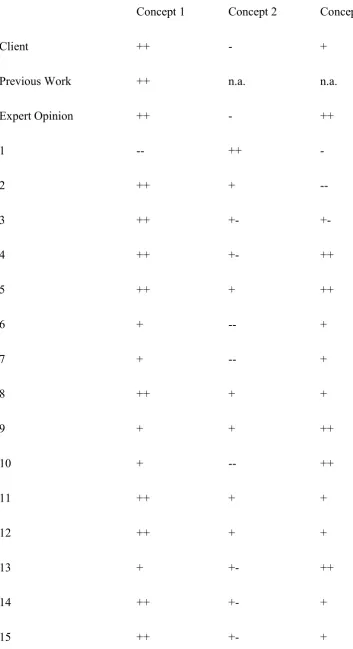
Concept 1 Concept 2 Concept 3
Client ++ - +
Previous Work ++ n.a. n.a.
Expert Opinion ++ - ++
1 -- ++ -
2 ++ + --
3 ++ +- +-
4 ++ +- ++
5 ++ + ++
6 + -- +
7 + -- +
8 ++ + +
9 + + ++
10 + -- ++
11 ++ + +
12 ++ + +
13 + +- ++
14 ++ +- +
[image:27.595.93.447.82.732.2]15 ++ +- +
The grading is done on the following basis: ++ if the learning goals is integral to the game and is fully taught by the games mechanics; + if the game contains and or teaches the learning goal; +- if the game somewhat contains or could incorporate the learning goal; - if the game does not fully contain but hints at the learning goal; -- if the game could not reasonably incorporate or does not contain the learning goal at all.
When comparing the concepts to the learning goals, concept 1 has the most potential. It focuses on the paving and compaction process most, and is able to teach the
differences in weather best. Concept 2 also would be able to do this, but is less
flexible and realistic. Its focus was on communication, but this was not something that was needed most, according to the experts and the client. Concept 3 would also be able to show the results of weather changes and incorporate the planning phase, but that is not the focus of the concept and would require a lot more hours of work to realize, as it also has a whole other game to construct.
Ideation Phase 2 - Refinement of the Concept
The concept, at this stage, was very much based on the previous simulations made by the University of Twente as presented in the State of the Art. However, this concept still lacks many of the elements that differentiate a simulation from a simulation game or serious game. This chapter goes into the game mechanics, polish, and ideation of the simulation as a game and the two phase cycle.
To get a better understanding of what an executor does during and before a project, an interview was scheduled with two experts. One of the interviewees currently worked as an executor and the other had been and now lectured at the ROC of Twente. Which is an institute that teaches, among other things, asphalt road construction in theory and practice.
These interviews gave insight into the process that goes before and continues up to the completion of a project. Two major phases have been identified:
1. This is the planning phase of the project. During the planning phase, a binder with all information on the project is given to the executor. This binder contains information like a map with the dimensions of the road and
surrounding terrain; multiple tables with asphalt mixture amounts, types and deliveries; a table with the amount and types of machines that are presumed to be needed for the project; the date and time, including the presumed project duration; and additional project details.
During the planning phase the executor plans out the paving process. When multiple roads are to be paved, or lanes, or crossings; the executor plans the order at which the work is done. This is based on the time planning, amount of machines and requirements set by the contractor of the project. Sometimes certain techniques are prohibited as specified by the specification of the road. One of such specifications is the absence of cold welding, where one or more gaps between cold asphalt lanes are connected with hot asphalt.
executor thereafter recalculates the presumed amount of asphalt he needs per hour and figures out how many trucks would be needed based on the distance to the factory. He then proceeds to call the asphalt factory for the precise amount of asphalt, usually one day in advance. This is also the day he looks at the weather report.
2. The second phase is the execution phase. During this phase the executor oversees the construction process, calls with the factory to talk them trough the details and manages the construction crew. He calls with his manager on the progress and directs the pavers, compactors and measuring crew. He is responsible for the delivery and quality of the asphalt.
3. After the execution phase, the executor is required to draft a report on the construction.
This idea of chopping up the game into phases was incorporated into the concept. Where the serious game would feature a planning, execution and feedback phase. Where the first two phases are graded in the final phase of the game. Planning would impact the execution phase based on choices made by the user and user inputed values.
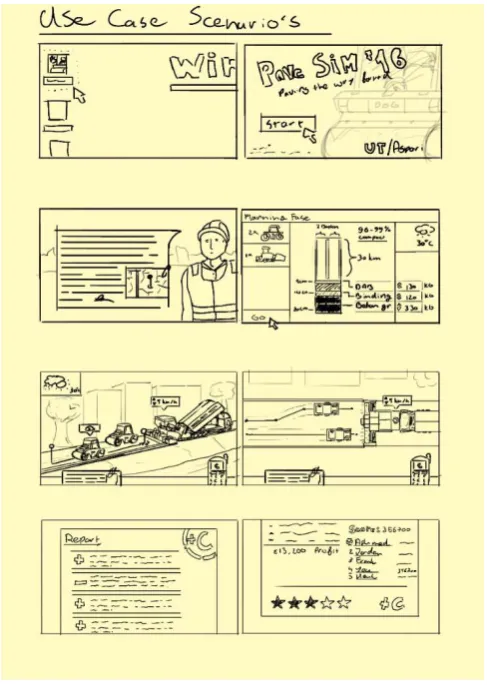
The planning phase can clearly be seen in panel 3, the execution phase in panels 5, and 6; and the execution phase can be seen in panels 7 and 8. The feedback is shown in the form of a report, as this closely correlates with the report that has to be written by real executors. The report shows the good and the bad decisions, some statistics, a player leader board and a total amount of stars gained. The idea of using a simple final grading scheme was chosen to clearly communicate a final goal. This would inspire additional tries to get the perfect score and rewards the player based on performance. The good and bad points shows the user where to improve the next time around.
Game Loops
The core design for the serious game is that a player/learner plays multiple scenarios. These scenarios all follow the same structure: planning -> execution -> reflection. This aggregate of actions will be further described as a loop. This name is chosen as the player/learner after the reflection phase, will play a new scenario starting at planning again. As an analog, this loop can be viewed as a product development loop; analysis -> ideation -> concept selection -> prototyping -> reflection -> analysis -> etc.
[image:30.595.176.420.70.413.2]This loop allows the player to learn from his/her past mistakes by re-playing a specific scenario and using their acquired knowledge. This loop structure also allows for showing differences of weather, temperature and other outside events to the player. As each scenario can be seen as it's own loop. This structure was ultimately chosen as
reflection and discovery based learning methods align well with such a game structure.
Requirements
In order to organize all the ideas for the serious game concept, a requirements list for the game was created. These requirements are split up into the following categories: Must have; Should have; Could have; Won't have, according to the MoSCoW model proposed by Clegg and Baker in 1994.
Must have
Heat distribution simulation on asphalt surfaces over time
Paver speed selection
Compaction strategy input
Asphalt compaction simulation
Multiple levels / scenarios
A score based on performance of the player/learner
The ability to input ability for the width, height, thickness and type of top layer asphalt
The ability to input the amount of pavers, compactors and trucks to hire
Should have
Weather simulation
Multiple compactor machine selection
Road width selection
Audio/graphics/gameplay settings for running the game
A tutorial mode which explains the game to the user
Asphalt delivery simulation between the factory and the construction site
Varying levels of difficulty
Statistics on the performance of the player/learner in the game for teachers
A planner in which the player/learner can plan the order in which to pave roads
Could have
A scenario / level editor
Gameplay analytics
The ability to pave the support layers of the asphalt
The ability to view the location where asphalt construction will happen
Different simulated locations where asphalt can be paved
Won't have
Accurate amount of passes for compaction strategies
Fully accurate simulation of the entire asphalt road construction
All machine types and brands for pavers, compactors and trucks
A company simulator component
First person control of machines in asphalt road construction
Accurate heat transfer simulation throughout the asphalt
Physically accurate heat and compaction simulation
Final Concept Description
Planning Phase
In the planning phase, the player/learner will select which and the amount of machines the player/learner wants to use. The player/learner then selects the parameters of the road that is to be constructed; the width, the height, the thickness and the type of asphalt. Finally, the player/learner can inspect the weather.
Execution Phase
The execution phase is where the simulation is started. In the simulation, the pavers and compactors can be controlled. The player/learner can only control the paver's speed, where as the compactors can be controlled freely. To see the progress of the compaction process, the user can select to see the heat and/or compaction of the asphalt. The compaction process can be seen through a free from camera which can be manipulated with a mouse and is rendered in 3D. The user can, himself, decide on when the simulation should end, and the compaction process as reached a satisfiable result.
In the feedback phase the user is shown the results of his/her performance. Here the compaction of the road is shown, including various statistics on the compaction and speed at which the road was constructed. The feedback phase will also give the player/learner tips and feedback based on that data. For example, suggesting to use more or less machines or compacting a certain section of the road. The feedback phase will assign points based on both the planning and execution phases of the game loop. At the end an aggregate score will be given.
[image:33.595.93.438.210.456.2]Serious Game Development
Figure 14: Diagram - Pixel Method
For the development of the serious game, Unity 3D was used. As it has a wide variety of platforms it can build to and has support for WebGL, which was deemed useful for environments where executable binary formats are not allowed. Unity was also a the most obvious choice as I had the most experience with the tool. Which allowed the focus to shift from the development of the serious game to the design more than with any other tool.
Data Representation Strategies
At the start of the development process, most of the focus was put on the simulation of the heat and compaction. To implement the way heat and compaction were
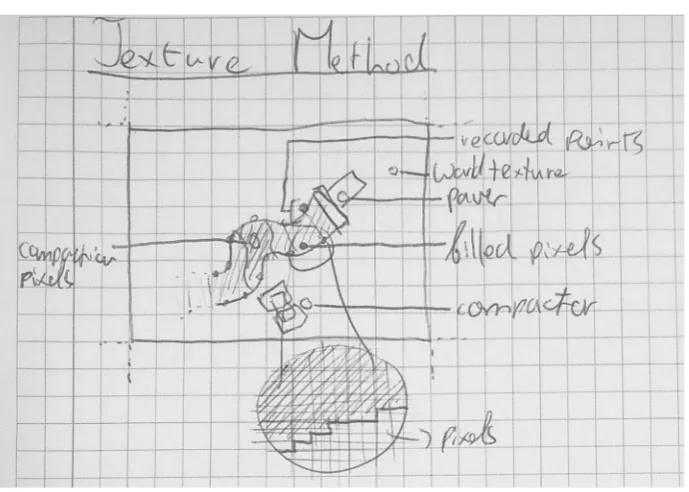
represented in the game, a system needed to be developed for containing that data. A few strategies were considered for this to happen:
texture contained a 1 in that particular spot. The compaction texture would work in the same way. Where the compaction value would be stored as a color between fully transparent black up to fully opaque green.
Filling in the pixels works the same for both a compactor and a paver. Each of the vehicles kept a record of it's width at the points where paving or
compaction would occur. It would record these global position every x amount of seconds. Once at least two records were created, a rectangle containing these four points would be filled by the program on the designated textures. This rectangle was filled with the use of the Bresenham's line drawing algorithm and the implementation was based on both Sunshine2K's examples
and Alexey Frunze's example on Stack Overflow. This was done twice for both triangles of the given rectangle. The rectangle was drawn as triangles due to higher performance as trying to draw rotated quads.
This method has a big disadvantage, which is the size of the textures. As a big portion of the texture will be unused. This data bandwidth is basically thrown away. On systems with low video memory, resolution will be very low, thus the paving and compacting resolution will be very low.
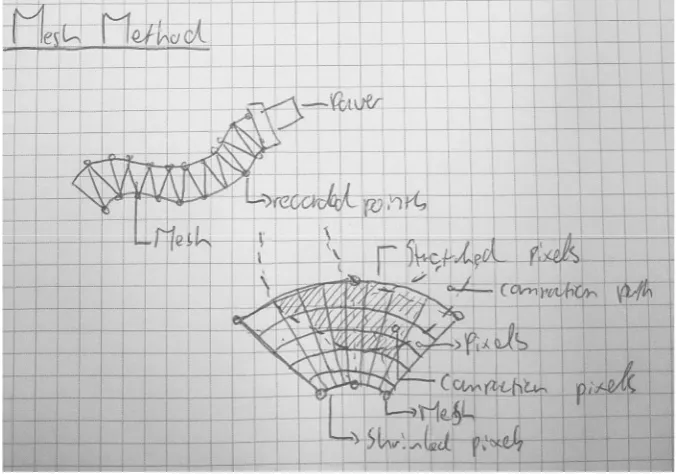
2. The second approach to the problem was to generate 3D meshes on the fly. A road generator would generate a mesh during the paving process where once every meter of paving two points at the edges of the paver's paving rods two points would be recorded. These points would then connect with two triangles to the existing mesh. Textures are generated for the mesh where the data for temperature and compaction are stored.
[image:34.595.126.472.345.584.2]from those points, the texture is filled. However, this method has a major downside as the resolution of the pixels and compaction is different based on the turn radius of the mesh as can be seen in figure 17. The inner pixels of the curve are of higher resolution per meter as the outside pixels of the curve. Due to the texture being stretched by the distance of the vertexes of the mesh. This problem does not happen with the texture method.
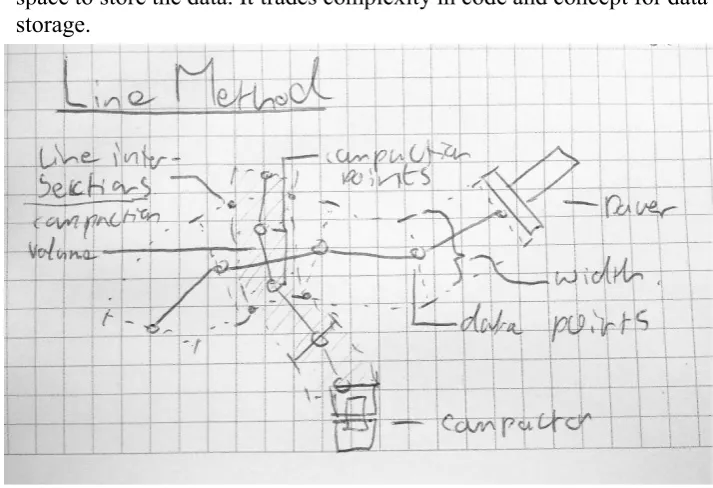
3. The third method for saving the heat and compaction data is to not use textures at all. Positions could be saved where the data type for the recording of
position also contains heat and compaction data. The points would be generated by the moving compactor and paver. These points could either contain a width of a line, or two lines could be generated. Both approaches work similarly for the rest of the explanation. Volumes could then be calculated for where the compaction overlaps the paving lines. Line
intersection points including with the lines generated by the compactor and paver describe the volume. This can be seen in figure 18.
All compaction would then be represented as compaction volumes. The paving volumes and compaction volumes would then have to be rendered in some way. As they are only represented as these points. Temperature would be stored in the points where the values between points would be interpolated in distance and time at which the point was generated. The resolution of this representation would obviously depend on the frequency at which points are generated.
Two downsides to this approach are that there is no way to store individual heat/compaction points, only volumes. The second is that the complexity of the code and the rendering is greatly increased. But the benefit is that
[image:35.595.128.467.161.398.2]space to store the data. It trades complexity in code and concept for data storage.
Decision & Conclusion
For the sake of keeping things simple and direct, method 2 was chosen with the restriction of allowing the paver to only move in straight lines. The ability to pave curved surfaces was deemed not necessary to convey the intended results of external influences on the quality of asphalt and the compaction process. This also got rid of the curve resolution problem. This solution is also a nice compromise between the easiest to implement and data abundant solution 1 and the complex but sparse solution 3. Therefor solution 2 was chosen for the representation of heat and compaction data.
Texture Filling Strategies
In the first iteration of the code, the texture pixel updating procedure was very slow and slowed down the performance of the game significantly. Taking seconds to do the work. In order to optimize the texture fill process, a few ideas were considered. One was to parallelize the work. Where once updating needed to be done for either the heat or the compaction, worker threads would be created to do rendering for a particular part of the road. These would then run until finished. Once the threads would finish they either would start again, with new data, or wait for new data to arrive. If data would be submitted twice to a stack of work, only the most recent directive would be executed. However Unity WebGL does not currently support threading.
[image:36.595.118.475.81.325.2]Another option that was considered was to update the pixels on the GPU as shader code. This shader would then take the input bitmaps, temperature table and the delta time to calculate the heat dissension. However, this idea was not developed further as custom shader code is not supported on WebGL but also not supported on older video cards. Which the game was likely to encounter as most school PC's at schools that were visited had older hardware, and no dedicated GPU.
The last set of solutions that were considered and eventually implemented, was to only require a small amount of pixels for every column (width of the road), and let the texture mapping do the stretching over long distances. This approach reduced the compute time for the heat texture significantly. As the amount of pixels in one dimension was reduced significantly. The constraint that this optimization brought was that heat dispensation would no longer be able to be influenced by the
compaction process. Therefor, thinner but denser asphalt would not change the rate at which the heat gets dissipated, nor does passing a compactor reduce the temperature.
Another optimization for the heat texture updating, was to only record time intervals on distance intervals. This time position would then look into a lookup table with heat dissipation values. These values would then be used to look up heat color values during rendering. These values would be replicated for a number of pixel columns based on the distance to the previous time point. These values are not interpolated, to reduce computation strain.
Heat Dissipation Data
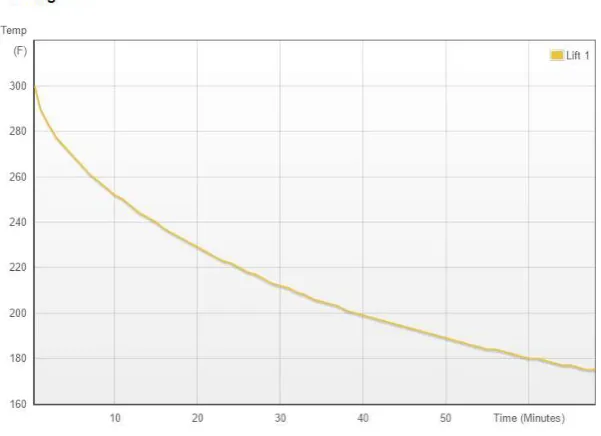
Due to a lack of specialization in the field of thermodynamics, and the complexity of modeling heat dissipation over time in asphalt road construction, lookup tables were used. These tables were generated by MultiCool, a tool that calculates hot mix asphalt cooling time graphs for asphalt paving. Output for such a graph can be seen in figure 19.
[image:37.595.146.447.449.667.2]With this tool many parameters are available for input, but as the serious game is only interested in showing the difference in temperature as it effects cooling, temperature was used as the only changing input. In the final version of the game four temperature data curves are used. For -5°C, 0°C, 10°C and 20°C. All values in between these data
sets, such as for example 18°C, are linearly interpolated. Sadly, no precipitation parameters are adjustable in the tool. No alternatives were found during the literature review, nor the execution stage of the project. These would have to be developed in the future to get a better approximation based on the thermodynamics between asphalt types and precipitation types like: water, snow and hail. The temperature data table can be seen in appendix 4
Visualization
All of this data needs to be communicated in some way or form to the user in such a way that makes sense and is clear. Such that the player/learner can make decisions based on the data, without looking at a set of incomprehensible numbers. To do this successfully, visualization techniques already used in the field, or just being
introduced in the field of asphalt road construction were analyzed.
Denis Makarov at the University of Twente is developing a system for giving feedback to compactor operators. He develops ways to visualize temperature and compaction data in real time on a screen that will be placed in compactor cabins. Markov encodes temperature between red and blue. Where red encodes the hottest point and blue encodes the coldest temperature. He also uses discrete rectangles to encode the data with a relative low resolution per meter.
The Hamm compaction meter and the Trimble CB460 Control Box are both in cabin screens which display asphalt compaction through the amount of passes that a compactor has done on a particular location. Both systems use GPS to track the location of the compactor. Both systems use color to represent compaction percentage of pass counts. Both software show what color maps to what percentage of
Figure 19: HAMM compaction meter render Figure 20: Trimble visualizer
Both visualizations are quite similar to that what Makarov was pursuing. They use a two dimensional, top down view of the work and the asphalt. They both allow you to set the colors of the compaction and passes to the preferences of the user. They also allow for the representation of the compactor on the screen. Such that the user can see how his machine relates to the positioning on the screen. In the HAMM system, the colors for the compaction and the passes are the same in the render, which could be confusing in real life usage. As the two could be confused. The HAMM system also uses green for the right amount of passes and uses a color scheme from red to yellow to green to blue. The Trimble system uses a blue to light blue to blue to red to blue scheme as default. Which was very confusing due to the fact that three different values were encoded as the same color.
Usage in the Serious Game
As the color scheme convention for temperature maps in heat camera equipment also uses colors from white to yellow to red to blue to black, a similar was used in the serious game to represent heat. It was changed however, from red to yellow to green to blue. The color green was added as a way to tell the user when to start the
yellow to green and green to blue are quite harsh. This was chosen as it made it more clear when the asphalt would be 'green enough' to start compaction.
The compaction visualization was chosen to linearly interpolate between fully opaque and fully transparent green. This was chosen as it could be easily lain over the
temperature. Such that both temperature and compaction percentage could be viewed at the same time by the user. Showing the relation between the two and for
convenience. Another reason was to show the percentage of compaction as a
percentage of green. More green meant more compaction. This was to be easily read by the user. If the compaction exceeds a 100%, or compaction is started too early (on too hot asphalt) the asphalt is essentially destroyed. Compaction then shown as a red color, indicating that something has irreversibly gone wrong. This value cannot be easily seen on the figure below, but is actually there.
[image:40.595.144.453.475.679.2]This feature was implemented as a custom shader at first. However the custom shader posed problems on older hardware thus was removed. In the final version of the serious game, this feature is no longer available and thus the motivation for choosing green is less sound. However, in the future this could be easily changed by another
Figure 21: Heat Data Visualization
developer as the gradients can be changed in a visual editor. This editor can be seen in figure 22.
Machines Control
The next challenge for finishing the simulation was deciding on how the user was to control and direct the pavers, compactors and trucks. Not only on how to control, but also how much control was required in order for the game to convey its meaning, be accurate to real life but also fun to interact with. This traility of relationships was also described by Harteveld.
Compactor Control
At first the easiest system was implemented. Where the user could control a waypoint on the screen where the compactor would move towards. This can be seen in figure 23. However, this system proved to be quite cumbersome to control as it requires you to change the point quite frequently. It also was not realistic as the execution manager does not control how the compactor moves, nor was it very fun to control the
compactor in that way. It did give you a lot of control where the compaction would happen. But due to all the negatives the system was replaced with a ping pong equivalent quite early in development.
The second system that was tried out was to let the compactor move between two user definable points. This motion is often called ping pong, where an agent moves
between a series of points by going back and forth along the chain. This solution can be seen in figure 24. This still requires control, but slightly less. Only when the lane of road has been compacted. This system allows the user to control in what direction or angle the compactor would compact the asphalt.
Figure 25 describes the third iteration of the compactor control. In this system, just the locations between which the compactor compacts, can be set. The compactor moves up and down over the with of the road by itself. Compacting the road evenly. This way, the user can focus their attention on figuring out when to compact, without knowing the specifics in the way compaction is done. Which is closer to realty as the executor usually does not interfere with the way the compactor compacts, but only where the compactor is too close or too far away from the paver.
Figure 23: Compactor movement - single waypoint
Figure 24: Compactor movement - Ping pong
[image:42.595.306.502.304.430.2]
Figure 25: Compactor movement - Ping pong with width movement
Figure 26: Compactor movement - Distance based
Paver Control
Paver control only had two implementations during the development of the game. At first, in the early stages of development, where all the systems and the mechanics of the road data representation was explored, the paver was moved by a single waypoint system. The same system that was used for controlling the paver. However, once the decision was made to only allow for straight roads, the decision was made that the only thing the user would be able to control was the speed of the paving process. This removed the need for needing waypoints and simplified the control for the user.
Usage of Proposed Systems