Bachelor’s Thesis
Can a Stress Mindset be Changed? – A Randomized Controlled Trial
Felizia Leonie Wellinger
s1784005
University of Twente
First Supervisor: Dr. Marcel Pieterse
Second Supervisor: Dr. Marijke Schotanus-Dijkstra
Positive Psychology and Technology
Abstract
Background: Stress mindset can be conceptualised as a lens that guides individuals to specific expectations and in turn to equivalent responses (Crum, Salovey, & Achor, 2013). It can affect one’s motivation, learning, achievements in different domains and one’s well-being. Therefore, this study aimed at assessing whether people’s stress mindsets can be changed by means of an educational text. Furthermore, it was tested whether a change in stress mindset mediated the impact of the intervention on one’s mental well-being and whether the effect of the intervention was moderated by age, and two personality traits – neuroticism and extraversion.
Methods: A randomized controlled trial was conducted among 103 German-speaking participants (Mage = 34.58; 58% females) sampled based on convenience. The participants were
randomly allocated to an intervention group in which they were provided with a simple educational text about the positive effects of stress and the beneficial consequences of holding a “stress-is-enhancing” mindset, or to a control group, receiving a text about another psychological construct. Data were collected at baseline, directly after the intervention, and one week following the intervention, using online questionnaires.
Results: Repeated measure analyses revealed that stress mindset scores at post-test were higher than at baseline for both conditions (F(1.62, 163.55) = 22.16, p < .001, partial η2 = .18). Further, a marginally significant interaction effect of time with condition on stress mindset was found (F(1.62, 163.55) = 2.75, p = .078), indicating that the positive change in stress mindset over time was more pronounced in the intervention condition. Additionally, analyses demonstrated that mental well-being improved (F(2, 202) = 9.64, p < .001, partial η2 = .09), which did not depend on condition (F(2, 202) = .58, p = .562). Moreover, this change was not evoked by a change in stress mindset. The effect of the intervention was not moderated by age nor by the two measured personality traits – neuroticism and extraversion.
Introduction Stress
Stress is predominantly viewed in an unfavourable light by laypersons, but also by researchers since it has the reputation of having negative psychological as well as physiological consequences, which is amplified in the news. Many types of research deal with how stress can be best handled or even removed so that it cannot affect the individual anymore (Lazarus & Folkman, 1984). Stress is defined as the situation in which there exist “real or perceived challenges to an organism’s ability to meet its real or perceived needs” (Greenberg, Carr, & Summers, 2002, p. 508). Especially in its chronic form, stress can lead to reduced immune functioning, which in turn makes individuals more susceptible for diseases (Glaser & Kiecolt-Glaser, 2005), or lead directly to illnesses such as cardiovascular diseases, cancer (Quick, Horn, & Quick, 1987), and hypertension (Schneiderman, Ironson, & Siegel, 2005). Psychological consequences of stress include depression, anxiety disorders, burn out, substance abuse, or eating disorders (Schneiderman et al., 2005; Trufelli et al., 2008). Stress can also have detrimental effects on society since it can provoke non-productive time (Donald et al., 2005) and increased health care costs (Schneiderman et al., 2005).
Only rarely, stress has been said to have positive and enhancing qualities. In fact, some people can also use stress to arrive at good results. In general, Selye (1974) termed the construct “eustress” which defines the opposite of “distress” - good stress. Further, Lazarus (1993) distinguished between eustress and distress in terms of the consequences they yield: he associated eustress with positive feelings and healthy bodily states, while distress was associated with negative feelings and disturbed bodily states. In contrast to distress, eustress can even improve the immune system (Lazarus, 1993), cause the body and specifically the brain to perform optimally by narrowing its focus (Crum, Salovey, & Achor, 2013), and enhance general health. Eustress can also have different impacts on mental health, such as resulting in hope, positive affect, and meaningfulness (Lazarus, 1993) and viewing stress as motivator for a challenge that one is able to solve, in turn leading to enhanced self-esteem (Crum et al., 2013; Swann, Chang-Schneider, & Larsen McClarty, 2007).
Stress Mindsets
This apparent paradox can be explained by referring to mindsets. In general, a mindset can be conceptualised as a mental frame or lens that guides an individual to specific expectations and in turn to equivalent responses (Crum et al., 2013; Jamieson, Crum, Goyer, Marotta, & Akinola, 2018). Dweck (2006) was one of the first to distinguish between two types of mindsets in her Fixed versus Growth Mindset Theory: the fixed mindset, defined as the belief that certain personal characteristics are permanent and cannot be changed, as opposed to the growth mindset, that proposes that those characteristics can be altered. Holding one or the other mindset was shown to impact motivation, learning, and achievement in various domains, in that individuals with a growth mindset are more curious and challenge seeking (Dweck, 2006). According to Hochanadel and Finamore (2015) and Blackwell, Trzesniewski, and Dweck (2007), a fixed mindset about intelligence leads to less effort, while adhering to a growth mindset results in positive effort beliefs, learning goals, and positive strategies to achievement. Additionally, the mindset about one’s ageing – whether or not one perceives one’s ageing as positive and still worthy to live at an older age – determines if one performs a healthy lifestyle (Levy & Myers, 2004).
Crum et al. (2013) extended the mindset theory by referring to stress and developed the Stress Mindset Model. Research investigated two different mindsets: a “stress-is-enhancing” mindset is defined as “the extent to which one holds the belief that stress has enhancing consequences for various stress-related outcomes such as performance and productivity, health, and well-being, and learning and growth”, and a “stress-is-debilitating” mindset represents the opposite: one “holds the belief that stress has debilitating consequences for those outcomes” (Crum et al., 2013). Earlier studies indicated that stress mindset is related to health, well-being, and performance (Crum et al., 2013). Further, it was found, that individuals that hold a “stress-is-enhancing” mindset are of better physical and psychological health as they report higher levels of energy and satisfaction with life compared to individuals adhering to a “stress-is-debilitating” mindset (Crum et al., 2013).
Changeability of Mindsets
In addition to that, there is some – even though limited – evidence, that mindsets indeed are modifiable. Aronson, Fried, and Good (2002) showed that students who took part in a pen-pal program convincing other students of the malleable nature of the brain and intelligence developed an “intelligence-is-malleable” mindset, later studied harder, and received better grades than students with an “intelligence-is-fixed” mindset. Furthermore, in a study by Good, Aronson, and Inzlicht (2003), students’ math and reading achievements increased after a mentor intervention aimed at altering the students’ mindsets about intelligence. In this intervention, college students served as mentors for younger students and promoted either an “intelligence-is-malleable” mindset or to assign difficulties in school to the unknown academic setting.
The evidence for changing in particular stress mindsets is even more limited. For example, the study of Crum et al. (2013) showed that watching short video clips about the effects of stress changed the participants’ stress mindset quite easily – in both the enhancing and debilitating direction, by watching three short video clips about the effects of stress related to health, performance, and learning. Additionally, these changes in stress mindset were accompanied by positive changes in psychological symptoms and quality of life. Especially participants that changed to a “stress-is-enhancing” mindset reported fewer symptoms of anxiety and depression, a better health status, as well as higher quality of life (Crum et al., 2013). Moreover, Wegmann, Moshman, and Ruby (2017) tried to change students’ stress mindsets by a simple stress management course, wherein they took part in projects promoting a positive stress mindset and also found supporting results on the changeability of stress mindsets, which lasted for at least twelve weeks.
Moreover, prior studies that aimed at changing mindsets used either videos (Crum et al., 2013) or other more elaborate programs (Aronson et al., 2002; Good et al., 2003; Wegmann et al., 2017), no study so far provided participants with educational texts to alter their mindsets – which represents a simpler intervention. However, it can still be expected that this type of manipulation elicits a positive change in stress mindset.
Constructs Influencing the Changeability of Stress Mindsets
changes in their early adult years, which decreases rapidly again so that individuals after that period rather persist in their attitudes. Moreover, results showed that values changed during one’s life, with younger people - below 30 years - preferring “Openness to Experience”, in contrast to older people - above 30 years - that appreciated the retention of their values (Tulviste, Kall, & Rämmer, 2016). However, because attitude is not the same as mindset, this study also seeks to determine any age differences in the openness to change the mindset.
Another factor that has the potential to impact the intervention effect was one’s personality. However, no study yet directly assessed, whether personality traits were related to a specific mindset, or whether one’s personality moderates the effect of an intervention aimed at altering one’s mindset. Existing research connecting stress to personality nevertheless identified personality dimensions that might do so, since they make individuals more prone to experience stress positively as a challenge or rather negatively as a threat (Kilby, Sherman, & Wuthrich, 2018). In particular, two personality traits have been linked to stress research: Neuroticism and Extraversion. Neuroticism is the “tendency to experience anxiety, tension, self-pity, hostility, impulsivity, self-consciousness, irrational thinking, depression, and low self-esteem” (Penley & Tomaka, 2002). Higher levels of neuroticism have shown to be correlated with stronger threat appraisals as well as weaker challenge appraisals (Kilby et al., 2018; Gallagher, 1990), indicating that highly neurotic individuals are more prone to view stress as a threat than as a challenge. Moreover, neuroticism was linked to higher levels of perceived distress (Kilby et al., 2018), lower perceived abilities to cope (Penley & Tomaka, 2002), and more negative emotions in general (Gallagher, 1990; Penley & Tomaka, 2002).
Present Research
In light of both the negative and the positive outcomes that stress can bring about and the consequences that a mindset can have on the stress response, it is important to explore whether a stress mindset can be changed. As a result, this paper aims to contribute to stress mindset theory and to test whether stress mindset can be changed by an intervention in the form of an educational text. It is expected, that participants receiving the educational text promoting a is-enhancing” mindset would change their stress mindset more likely from a “stress-is-debilitating” mindset to a “stress-is-enhancing” mindset than participants in the control condition. Further, it is hypothesised, that the change from a “stress-is-debilitating” mindset to a “stress-is-enhancing” mindset would be accompanied by an increase in mental well-being. In addition to that, it is expected, that age would moderate the effect of the intervention on stress mindset, with a higher age attenuating the effect. Therefore, it is hypothesised, that the higher someone’s age, the lower the effect of the intervention on one’s stress mindset, meaning that older people are more resistant to a change in their mindsets about stress. Lastly, it is hypothesised, that personality indeed affects the impact of the intervention on the participants’ stress mindsets, in that people higher in neuroticism would be less likely to change their stress mindset as response to the intervention, in contrast to people high in extraversion.
Methods Design
This study was a parallel double-blind randomised controlled trial (RCT), including two experimental conditions and one control condition, with an allocation ratio of 1:1:1. Online questionnaires were received at baseline, and at one and two weeks after baseline. This study was approved by the Ethics Committee of the University of Twente (nr. 190218). The participants gave their online informed consent before taking part in the study.
Participants and Procedure
After having agreed to the informed consent, the baseline survey started, firstly asking for their demographic information, such as age, gender, highest education, and job status. Following that, they were provided with the questionnaires (Appendix A) and asked to indicate their honest responses.
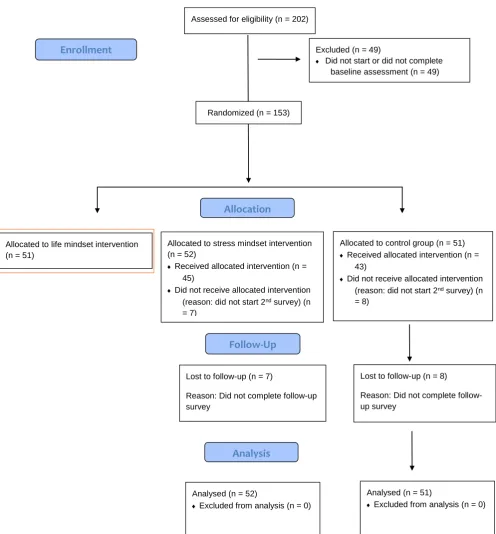
Figure 1. Flow chart of participants. Participants in the coloured box refer to a different study.
Interventions
The interventions were administered in the form of educational texts that were written by the researchers. The educational text for both the intervention and the control condition were similar in length. Before the participants were provided with the text, they were instructed to read it carefully, as there was a question about the given information afterwards.
Assessed for eligibility (n = 202)
Excluded (n = 49)
Did not start or did not complete baseline assessment (n = 49)
Allocated to life mindset intervention (n = 51)
Lost to follow-up (n = 8) Reason: Did not complete follow-up survey
Allocated to control group (n = 51)
Received allocated intervention (n = 43)
Did not receive allocated intervention (reason: did not start 2nd survey) (n = 8)
Analysed (n = 51)
Excluded from analysis (n = 0) Allocation
Analysis Follow-Up Randomized (n = 153) Enrollment
Allocated to stress mindset intervention (n = 52)
Received allocated intervention (n = 45)
Did not receive allocated intervention (reason: did not start 2nd survey) (n = 7)
Lost to follow-up (n = 7)
Reason: Did not complete follow-up survey
Analysed (n = 52)
“Stress-is-enhancing” Intervention Condition. The participants allocated to the stress condition were provided with a text about the positive nature of stress and the beneficial consequences that holding a “stress-is-enhancing” mindset can have on one’s personal growth, performance, and health (Appendix B). The given information was based on Crum, Salovey, and Achor (2013).
Control Condition. A neutral control condition was chosen due to ethical reasons. The participants allocated to the control condition received a text with information about the “Big Five” personality traits (Appendix B). This text on a psychological phenomenon was chosen to conceal allocation.
Measures
Primary outcome. Stress mindset was measured on all three time points using the Stress Mindset Measure - General (SMM-G). This assessment is an 8-item questionnaire with high internal consistency (.86), its responses follow a normal distribution, and are unrelated to both age and gender. Additionally, confirmatory factor analyses proved its unifactoriality (Crum et al., 2013). For the current sample, Cronbach’s alpha ranged from .90 to .93, which represents excellent internal consistency (Tavakol & Dennick, 2011). However, it was shown to consist of two factors, which is contrary to Crum et al. (2013). For the purpose of this study, the two-factor structure was ignored, and the questionnaire was applied in its original format since the second factor only adds 17% of the variance and is therefore not considered important enough to change the measure. Additionally, the high values of the reliability analyses confirmed its consistency.
as a neutral type of mindset, scores below two were interpreted as “stress-is-debilitating” mindset, whereas scores above two were interpreted as “stress-is-enhancing” mindset (Crum, Akinola, Martin, & Fath, 2017).
Secondary outcome. In order to assess the participants’ mental well-being, the Mental
Health Continuum - Short Form (MHC-SF) was administered at all three time points. This is a 14-item questionnaire measuring three dimensions of well-being: emotional, psychological, and social well-being, as well as the combined overall well-being. As the inclusion criteria for taking part in this study consisted of being at least 18 years old, the adult version of this assessment was used. The participants were instructed to indicate their responses by marking how often they felt the way asked in the item during the past month on a five-point Likert-scale, ranging from “never” to “every day” (0 = never, 1 = once or twice, 2 = about once a week, 3 = about 2 or 3 times a week, 4 = almost every day, 5 = every day, e.g. “That you had warm and trusting relationships with others”). Total scores were computed by adding all responses, which resulted in a continuous range of scores between zero and 70. The MHC-SF was shown to be of excellent internal consistency (> .80) and discriminant validity, as well as acceptable three-month test-retest reliabilities (.68). Additionally, its structure constituting three dimensions of well-being was confirmed in different samples (Keyes, 2009). Analyses of the current study revealed good to excellent internal consistencies (Tavakol & Dennick, 2011), ranging from .84 to .92 and confirmatory factor analyses with varimax rotation replicated the three-factor structure of the MHC-SF (Keyes, 2009).
six positively and six negatively formulated items, the latter ones were reverse coded before total score computations. The participants’ total scores were calculated by adding up all responses and dividing them by the total number of items, resulting in a range from one to five. The reliability for both scales is good, with a Cronbach’s Alpha of .88 for Neuroticism and .86 for Extraversion (Danner et al., 2016). Internal consistencies in this study were also high, with a Cronbach’s alpha of .90 for Neuroticism, and .86 for Extraversion. Additionally, they were proven to be composed of three factors for this sample as well.
Statistical Analyses
For the statistical analyses, SPSS version 24.0 and 2-tailed tests with a significance level of < 0.05 were used, however, p-values of < 0.10 were considered as marginally significant. Participants that did not finish the baseline assessment were excluded, while missing data on post-test and follow-up were imputed for stress mindset (Little’s MCAR test: χ2(40) = 4588.88,
p < .001) and mental well-being (Little’s MCAR test: χ2(105) = 2523.95, p < .001) using the expectation-maximization algorithm, because this method was found to be highly reliable and valid (Blankers, Koeter, & Schippers, 2010). In this paper, only the results of the intention-to-treat analysis are reported, since the results of the per-protocol analysis (only including participants that completed at least baseline assessment, received the intervention, and took part in the post-test) revealed comparable results.
Descriptive statistics of participant characteristics were analysed using their baseline data to outline the sample. The two groups were compared for their baseline characteristics using independent-samples t-tests and Pearson’s chi-square tests. For reliability and validity analyses, Cronbach’s alpha and confirmatory factor analyses with varimax rotation were performed. Drop-outs were defined as incomplete data at post-test. Pearson’s chi-square tests were conducted to test for differences between completers and drop-outs on baseline characteristics.
Further, mediation and moderation analyses were performed following the PROCESS approach (version 3.3) of Hayes (2013) in SPSS. A simple mediation analysis was used in order to check whether the change of people’s stress mindset causes a difference in their mental well-being. In this analysis, X was the condition (coded 1 for the intervention group and 2 for the control group), Y was the change score of well-being from baseline to follow-up (t2-t0) and M was the change score of stress mindset from baseline to post-test (t1-t0). For each path of the mediation model, unstandardised regression coefficients were calculated. Path a depicts the effect of X on M, path b represents the effect of M on Y statistically controlling for X, path c is the total effect of X on Y, and path c’ represents the direct effect of X on Y while partialling out the effect of M. Further, the indirect effect of X on Y through M equals the product of a
and b of which the 95% CIs were based on 10,000 bootstrapped resamples (Hayes, 2013). When the 95% CI does not contain zero, this indicates that in 95% of the bootstrapped samples the effect of the intervention on mental well-being is mediated through a change in stress mindset. To examine whether age or personality moderate the effect of the intervention on stress mindset, three moderation models were applied. In these analyses, X was the condition (coded 1 for the intervention group and 2 for the control group), Y was the change score of stress mindset from baseline to post-test (t1-t0), and M were the variables age, neuroticism, and extraversion.
Results Participant Characteristics
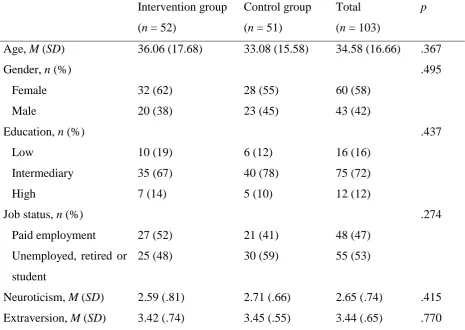
The baseline characteristics of the sample are displayed in Table 1. The total sample consisted of 103 German speaking individuals with their ages ranging from 18 to 84 (M = 34.58,
SD = 16.66). The majority of the participants were female (58%), had an intermediary education (72%) and were in paid employment (55%). Compared to the norms presented in Danner et al. (2016), the participants scored in a normal range on both neuroticism and extraversion.
Table 1
Baseline characteristics of participants in the intervention group, the control group, and the total sample.
Intervention group (n = 52)
Control group (n = 51)
Total (n = 103)
p
Age, M (SD) 36.06 (17.68) 33.08 (15.58) 34.58 (16.66) .367 Gender, n (%)
Female Male 32 (62) 20 (38) 28 (55) 23 (45) 60 (58) 43 (42) .495
Education, n (%) Low Intermediary High 10 (19) 35 (67) 7 (14) 6 (12) 40 (78) 5 (10) 16 (16) 75 (72) 12 (12) .437
Job status, n (%) Paid employment Unemployed, retired or student 27 (52) 25 (48) 21 (41) 30 (59) 48 (47) 55 (53) .274
Neuroticism, M (SD) 2.59 (.81) 2.71 (.66) 2.65 (.74) .415 Extraversion, M (SD) 3.42 (.74) 3.45 (.55) 3.44 (.65) .770
Note. There were no significant differences between the two groups.
Drop-Out
In total, 88 participants (85%) received their allocated intervention and completed the post-test. Overall, there were no significant differences in the number of drop-outs between conditions (13.5% vs. 15.7%, χ2(1) = 2.03, p = .214). Further, there were no significant differences in the baseline characteristics between drop-outs and completers.
The Changeability of Stress Mindset and Mental Well-Being
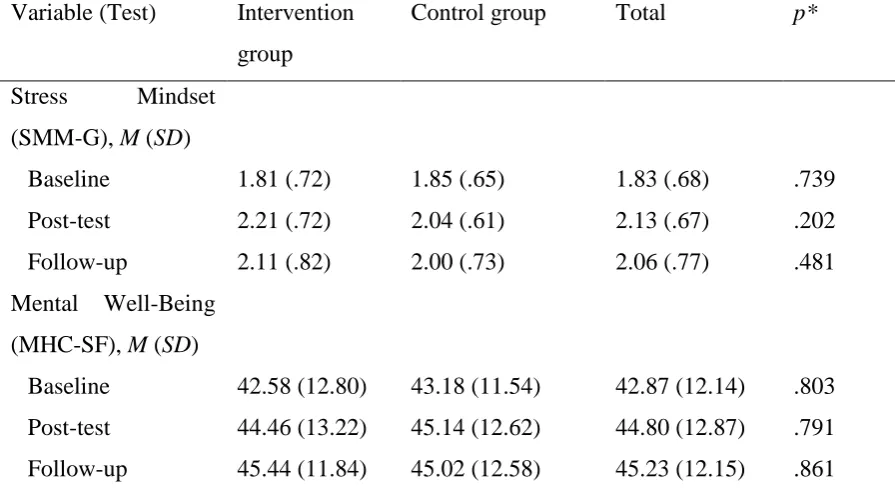
Table 2
Means and standard deviations for stress mindset and mental well-being on the three measures.
Variable (Test) Intervention group
Control group Total p*
Stress Mindset (SMM-G), M (SD) Baseline Post-test Follow-up 1.81 (.72) 2.21 (.72) 2.11 (.82) 1.85 (.65) 2.04 (.61) 2.00 (.73) 1.83 (.68) 2.13 (.67) 2.06 (.77) .739 .202 .481 Mental Well-Being
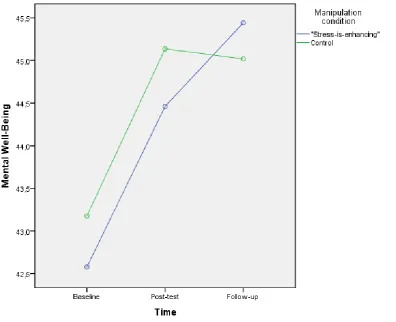
(MHC-SF), M (SD) Baseline Post-test Follow-up 42.58 (12.80) 44.46 (13.22) 45.44 (11.84) 43.18 (11.54) 45.14 (12.62) 45.02 (12.58) 42.87 (12.14) 44.80 (12.87) 45.23 (12.15) .803 .791 .861
*. Independent-samples t-tests for comparing the two groups were done cross-sectionally at each of the three time points on stress mindset and mental well-being.
Repeated Measures GLM for Stress Mindset Change
Repeated measures GLM was conducted to determine whether there were statistically significant differences in stress mindset after an intervention, as assessed at baseline, at a post-test directly following the intervention, and at a follow-up one week past the intervention. There were no outliers and the data were normally distributed, as assessed by boxplot and Shapiro-Wilk test (p > .05), respectively. Mauchly’s test of sphericity indicated that the assumption of sphericity had been violated, χ2(2) = 26.79, p < .001. Therefore, a Greenhouse-Geisser correction was applied (ε = .81) to correct the repeated measures GLM.
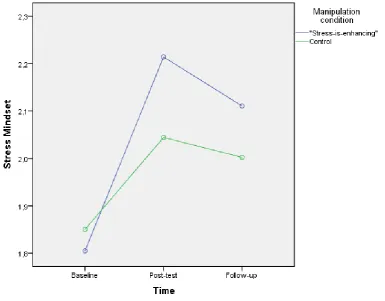
There was a marginally significant interaction effect of time with condition on stress mindset F(1.62, 163.55) = 2.75, p = .078, which indicates that the positive change in stress mindset over time was more pronounced in the “stress-is-enhancing” mindset condition compared to the control condition. When looking at the contrasts within subjects, a quadratic approach best fits the data, as it indicates a model in which the effect of condition on the increase of stress mindset over time is strong at first, and then weakens. As a result, the intervention likely has an effect, but this occurs mainly in the first time period, from baseline to post-test. However, this effect is of marginal significance (F(1, 101) = 3.81, p = .054), and the effect size is small (partial η2 = .04). Figure 2 shows the development of stress mindset during the time span of three weeks per condition.
Figure 2. Stress mindset versus time per condition (N = 103, nintervention = 52, ncontrol = 51).
Repeated Measures GLM for Mental Well-Being Change
Time was found to have a main effect on mental well-being, as mental well-being was statistically significantly different at the different time points during the assessment, F(2, 202) = 9.64, p < .001, partial η2 = .09. Post-hoc contrasts revealed a statistically significant increase in mental well-being from baseline to post-test in both conditions (1.92), p = .005, a statistically significant increase in mental well-being from baseline to follow-up (2.35), p = .001, and no significant increase in mental well-being from post-test to follow-up (.43), p = 1.00.
There was no significant interaction effect of time with condition on mental well-being,
[image:17.595.80.477.360.682.2]F(2, 202) = .58, p = .562, which signifies that the change in mental well-being over time did not depend on condition. When looking at the contrasts within subjects, a quadratic approach best fits the data, as it indicates a model in which the effect of condition on the increase of mental well-being over time is strong at first, and then weakens. As a result, the intervention had no significant effect on the change in mental well-being (F(1, 101) = .41, p = .525). Figure 3 shows the development of mental well-being in the time span of three weeks per condition.
Mediation Analysis
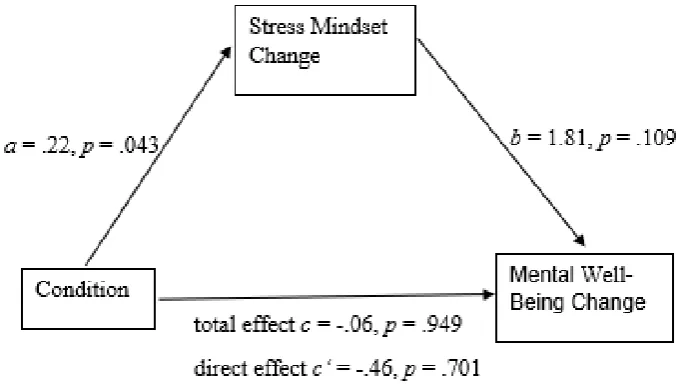
[image:18.595.77.424.262.456.2]A simple mediation analysis was performed to test whether the allocated condition predicted a change in mental well-being and whether this was mediated by a stress mindset change. The coefficient of the a-path was significant, while the coefficients of the b-path and c-path were non-significant. The coefficient for the direct effect (c’-path) of the intervention on the change in mental well-being also was not significant. Further, the BC 95% CI of the indirect effect (.39; [-.05, 1.12]) contained zero, which indicates that no mediation effect existed. Resulting from that, stress mindset was not shown to mediate the relationship between the intervention and mental well-being. Figure 4 shows the mediation model.
Figure 4. Simple mediation model of stress mindset change as a mediator (t1-t0) of the “stress-is-enhancing” intervention group versus control group on mental well-being change (t2-t0).
Model statistics.R² = .04.
Moderation Analyses
Table 3
Linear model of predictors of stress mindset (age).
b t 95% CI p
Constant -.30 -5.72 -.41, -.2 .000
Condition .20 1.91 -.08, .41 .059
Age .00 -1.40 -.01, .00 .164
Interaction (Condition x Age)
.00 .11 -.01, .01 .912
Model statistics.R² = .06, F(3, 99) = 2.08.
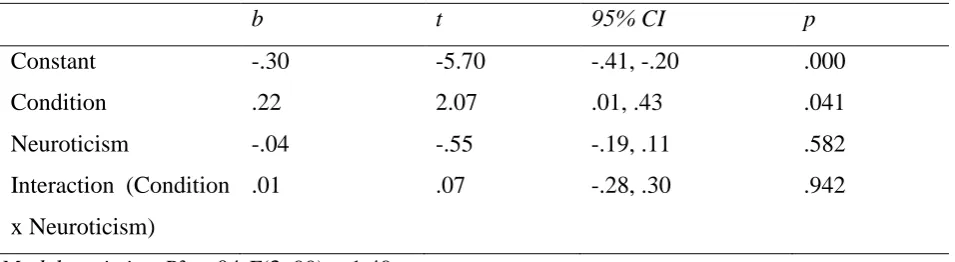
Personality – Neuroticism. To test the hypothesis that the two personality traits, neuroticism and extraversion, moderate the effect of the intervention on stress mindset, two moderation analyses were performed. The overall model with neuroticism was not significant (p = .223). Moderation was not found, as the interaction effect was also not significant (p = .942), indicating that the relationship between the intervention and stress mindset was not moderated by neuroticism (Table 4). As a result, neuroticism did not impact the effect of the intervention on stress mindset.
Table 4
Linear model of predictors of stress mindset (neuroticism).
b t 95% CI p
Constant -.30 -5.70 -.41, -.20 .000
Condition .22 2.07 .01, .43 .041
Neuroticism -.04 -.55 -.19, .11 .582
Interaction (Condition x Neuroticism)
.01 .07 -.28, .30 .942
Model statistics.R² = .04 F(3, 99) = 1.49.
[image:19.595.71.549.485.616.2]Table 5
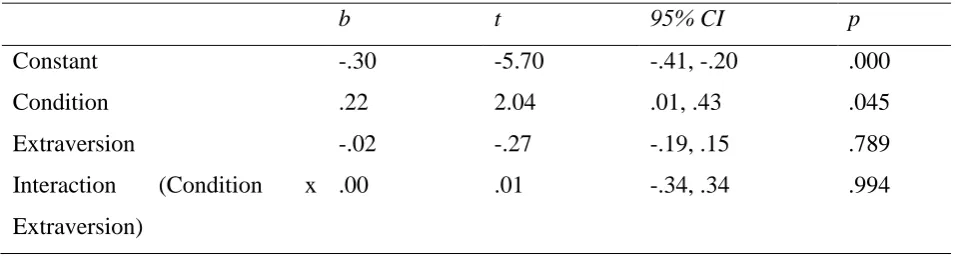
Linear model of predictors of stress mindset (extraversion).
b t 95% CI p
Constant -.30 -5.70 -.41, -.20 .000
Condition .22 2.04 .01, .43 .045
Extraversion -.02 -.27 -.19, .15 .789
Interaction (Condition x Extraversion)
.00 .01 -.34, .34 .994
Model statistics. R² = .04, F(3, 99) = 1.40.
Discussion
The purpose of this study was to assess whether stress mindset can be changed by an intervention in the form of an educational text and whether this effect was moderated by factors like age and personality. Furthermore, it was tested whether a change in mental health was mediated by a change in stress mindset. Therefore, a RCT was conducted with a sample of 103 German speaking participants, which were assessed at three points in time.
The current study demonstrates that a relatively small and simple intervention can marginally change and improve people’s stress mindsets. Merely reading a text providing information about the productive nature of stress and the beneficial effects of positive beliefs about stress lead participants in the manipulation condition to develop a slightly more positive stress mindset compared to participants in the control condition. However, the effect size was rather small.
stress mindsets. On the one hand, this manipulation is a limitation, since it can explain some of the findings that proved to be not clearly significant. On the other hand, as there were indeed effects of marginal significance found for the interaction effect of stress mindset and condition even with this weak manipulation, this indicates that experiments with a stronger manipulation might give more powerful and significant results, and can prove to be even more effective in changing people’s beliefs about stress.
Further, it appears that this beneficial effect on people’s stress mindsets slightly weakened one week past the intervention, and the time frame of the study does not permit for any predictions regarding long-term effects. Nevertheless, even though the positive change in stress mindset could not be maintained as strongly at follow-up compared to directly after the intervention, it still suggests that it is possible to change how people view stress. Additionally, follow-up scores were after all above initial scores.
In general, participants in both groups started with a rather negative mindset at baseline, which is in line with the findings of Crum et al. (2013). This indicates that most participants viewed stress unfavourably and as debilitating. Such a pessimistic prevailing mindset was also found by Norton, Anik, Aknin, and Dunn (2011), who demonstrated that the most famous life philosophy was to regard life as short and hard, as opposed to long and easy.
Another remarkable finding of the current study is that stress mindset seems to be quite volatile, even without manipulation, as participants in both groups showed changes over time. This would suggest that it is more open to change than a trait-like characteristic and considering the potential outcomes it can have, this is a positive finding. Further research needs to determine how to achieve stable positive changes in this fluctuating entity.
Based on literature, it was further expected that certain personality traits, such as neuroticism, could work as a barrier to mindset change, while others, such as extraversion, facilitate a positive mindset change (Penley & Tomaka, 2002). However, this moderation effect clearly was not found, which is a surprisingly positive finding, because even people that are more prone to adhering to “stress-is-debilitating” mindsets are able to change it slightly. Prior research showed that neurotic and older people represent a risk group of acquiring negative mindsets (Kilby et al., 2018; Tulviste et al., 2016), and for these people, it is most important to benefit from an intervention like this.
Additionally, the experiment seems to have positively impacted the participants’ mental health, although the proposed mechanism that a change in stress mindset provokes a change in mental well-being could not be confirmed, as suggested by a prior study using quality of life measures (Crum et al., 2013). As this effect happened in everyone, irrespectively of the allocated condition, and therefore independently of the educational text they have read, this is an odd finding. However, Crum et al (2013) found a similar outcome, with the positive manipulation group, as well as the control condition, improving in health symptoms, like anxiety and depression. Nevertheless, the current study used a different measurement approach, with Crum et al. (2013) asking for mood and anxiety symptoms, while in our study, a more positive concept of mental health was used. Further, the sample in the study by Crum et al. (2013) consisted of employees experiencing downsizing at their workplace. This might have an effect on mental health, general stress levels, and stress mindsets, as these people might have feared to lose their jobs. In contrast, the current sample was more diverse in job status and other baseline characteristics, as it was not recruited from only one firm.
Strengths and Limitations
This research makes several contributions to the literature about stress mindset. A first strength is that it is one of the only few available studies using the concept of stress mindset and its measure (SMM-G) in combination with an intervention to change it. This can yield important insights and might have great implications, for the individual as well as the society. With the knowledge of how to best change people’s stress mindsets, it is possible to influence how people best deal with stress to reduce the negative consequences that it can bring about. Another asset is that the randomisation process was performed by an independent researcher who was neither implicated in recruitment nor in analyses, therefore minimising selection and analysis bias. Moreover, the used assessment instruments were validated in prior studies to ensure high reliability of the results. Further, the study was partially blinded, since the data analysts were blinded and the participants could not sense whether they were assigned to the intervention condition or not, because they also received an educational text about a psychological construct. As a result, the participants likely did not respond differently because of any knowledge about their condition and a related placebo effect. Additionally, all statistical analyses were performed with an intention-to-treat analysis, which decreases attrition bias. Moreover, all tests proved to be of good to excellent reliability as well as validity (except the SMM-G), which is an indicator for reliable results.
Second, there were also some methodological issues with the used measures. For this study, the observed two-factor structure of the SMM-G was ignored, since the second factor did not explain much variance to be considered important enough. However, this indicates that the results need to be considered cautiously and raises the concept stress mindset into question. Additionally, the MHC-SF has a time frame of one month, and as the time lag between post-test and follow-up was only one week, real changes in well-being could not be assessed. Nevertheless, the moderate test-retest reliability of the MHC-SF indicates that this measurement is both “sensitive to change and stable over time” (Lamers, Westerhof, Bohlmeijer, ten Klooster, & Keyes, 2011). Therefore, it neither is a state-, nor a trait-like measure and for the purpose of this study, a rather state-like instrument would be more appropriate to assess sensitive changes. Nevertheless, this leads to another problem of this study, which is that the follow-up clearly happened too early. On the one hand, it was too early to assess any long-term effects of the intervention on stress mindset, and on the other hand, it was too soon to measure any changes in mental well-being due to the time setup of the MHC-SF. As a result, it was not possible to assess any long-term consequences of the intervention.
Thirdly, another group of limitations concern this study’s sample. The used sample size of 103 participants seems small, especially for complex mediation and moderation analyses, and as there was no power calculation beforehand, this is arguable. Moreover, the participants represented a rather young sample, so old people were underrepresented. This was particularly a problem for finding age differences in the changeability of stress mindsets because more older people would have been needed for that.
Future Research
altered back following the experiment, in order to fulfil any ethical guidelines. Additionally, the time frame of future research should be extended in order to assess long-term consequences and what is necessary to maintain a persistent change in stress mindset. Moreover, as stress not only has implications for one’s mental health, additional stress-related outcomes should be assessed, such as physical and behavioural consequences. These latter ones are also more likely to be found after a longer period of time past the intervention. Furthermore, there is more research needed to examine factors that might moderate the impact of the intervention in general, to be able to develop interventions suiting a specific population. These recommendations help in achieving more insights into stress mindset and how they can be changed to enhance people’s quality of life. In addition to that, this study ignored the finding that for this population, the stress mindset measurement (SMM-G) was proven to consist of two factors, instead of only one. More research into this might lead to a deeper understanding of the second factor that makes up stress mindset and how it is built.
Conclusion
References
Aronson, J., Fried, C. B., & Good, C. (2002). Reducing the Effects of Stereotype Threat on African American College Students by Shaping Theories of Intelligence. Journal of Experimental Social Psychology, 38(2), 113–125. https://doi.org/10.1006/jesp.2001.1491
Blackwell, L. S., Trzesniewski, K. H., & Dweck, C. S. (2007). Implicit Theories of Intelligence Predict Achievement Across an Adolescent Transition: A Longitudinal Study and an Intervention. Child Development, 78(1), 246–263. https://doi.org/10.1111/j.1467-8624.2007.00995.x
Blankers, M., Koeter, M.W., Schippers, G.M. (2010). Missing data approaches in eHealth research: simulation study and a tutorial for nonmathematically inclined researchers.
Journal of Medical Internet Research, 12(5), 54.
Chiu, C., Hong, Y., & Dweck, C. S. (1997). Lay dispositionism and implicit theories of personality. Journal of Personality and Social Psychology, 73(1), 19–30. https://doi.org/10.1037/0022-3514.73.1.19
Crum, A. J., Akinola, M., Martin, A., & Fath, S. (2017). The role of stress mindset in shaping cognitive, emotional, and physiological responses to challenging and threatening stress. Anxiety, Stress, & Coping, 30(4), 379–395. https://doi.org/10.1080/10615806.2016.1275585
Crum, A. J., Salovey, P., & Achor, S. (2013). Rethinking stress: The role of mindsets in determining the stress response. Journal of Personality and Social Psychology, 104(4), 716–733. https://doi.org/10.1037/a0031201
Danner, D., Rammstedt, B., Bluemke, M., Lechner, C., Berres, S., Knopf, T., . . . John, O. P. (2016). Das Big Five Inventar 2. Diagnostica, 1–12. https://doi.org/10.1026/0012-1924/a000218
Donald, I., Taylor, P., Johnson, S., Cooper, C., Cartwright, S., & Robertson, S. (2005). Work environments, stress, and productivity: An examination using ASSET. International Journal of Stress Management, 12(4), 409–423. https://doi.org/10.1037/1072-5245.12.4.409
Dweck, C. S. (2006). Mindset: The New Psychology of Success. New York, New York: Ballantine Books.
Theory of Values. Journal of Cross-Cultural Psychology, 42(2), 253–270. https://doi.org/10.1177/0022022110396888
Gallagher, D. J. (1990). Extraversion, neuroticism and appraisal of stressful academic events.
Personality and Individual Differences, 11(10), 1053–1057. https://doi.org/10.1016/0191-8869(90)90133-c
Glaser, R., & Kiecolt-Glaser, J. K. (2005). Stress-induced immune dysfunction: implications for health. Nature Reviews Immunology, 5(3), 243–251. https://doi.org/10.1038/nri1571 Good, C., Aronson, J., & Inzlicht, M. (2003). Improving adolescents' standardized test performance: An intervention to reduce the effects of stereotype threat. Journal of Applied Developmental Psychology, 24(6), 645–662. https://doi.org/10.1016/j.appdev.2003.09.002
Greenberg, N., Carr, J. A., & Summers, C. H. (2002). Causes and Consequences of Stress.
Integrative and Comparative Biology, 42(3), 508–516. https://doi.org/10.1093/icb/42.3.508
Hayes, A. F. (2013). Introduction to Mediation, Moderation, and Conditional Process Analysis: A Regression-Based Approach (1st ed.). New York City, New York: Guilford Publications.
Hochanadel, A., & Finamore, D. (2015). Fixed And Growth Mindset In Education And How Grit Helps Students Persist In The Face Of Adversity. Journal of International Education Research (JIER), 11(1), 47–50. https://doi.org/10.19030/jier.v11i1.9099 Jamieson, J. P., Crum, A. J., Goyer, J. P., Marotta, M. E., & Akinola, M. (2018). Optimizing
stress responses with reappraisal and mindset interventions: an integrated model.
Anxiety, Stress, & Coping, 31(3), 245–261. https://doi.org/10.1080/10615806.2018.1442615
Keyes, C. L. M. (2009). Brief Description of the Mental Health Continuum Short Form (MHC-SF). Retrieved March 13., 2019, from https://www.aacu.org/sites/default/files/MHC-SFEnglish.pdf
Kilby, C. J., Sherman, K. A., & Wuthrich, V. (2018). Towards understanding interindividual differences in stressor appraisals: A systematic review. Personality and Individual Differences, 135, 92–100. https://doi.org/10.1016/j.paid.2018.07.001
Lamers, S. M. A., Westerhof, G. J., Bohlmeijer, E. T., ten Klooster, P. M., & Keyes, C. L. M. (2011). Evaluating the psychometric properties of the mental health Continuum-Short Form (MHC-SF). Journal of Clinical Psychology, 67(1), 99–110. https://doi.org/10.1002/jclp.20741
Lazarus, R. S. (1993). From Psychological Stress to the Emotions: A History of Changing
Outlooks. Annual Review of Psychology, 44, 1–21.
https://doi.org/10.1146/annurev.ps.44.020193.000245
Lazarus, R. S., & Folkman, S. (1984). Stress, Appraisal, and Coping. New York, New York: Springer Publishing Company.
Levy, B. R., & Myers, L. M. (2004). Preventive health behaviors influenced by self-perceptions
of aging. Preventive Medicine, 39(3), 625–629.
https://doi.org/10.1016/j.ypmed.2004.02.029
Norton, M. I., Anik, L., Aknin, L. B., & Dunn, E. W. (2011). Is Life Nasty, Brutish, and Short? Philosophies of Life and Well-Being. Social Psychological and Personality Science, 2(6), 570–575. https://doi.org/10.1177/1948550611401425
Penley, J. A., & Tomaka, J. (2002). Associations among the Big Five, emotional responses, and coping with acute stress. Personality and Individual Differences, 32(7), 1215–1228. https://doi.org/10.1016/s0191-8869(01)00087-3
Quick, J. D., Horn, R. S., & Quick, J. C. (1987). Health Consequences of Stress. Journal of Organizational Behavior Management, 8(2), 19–36. https://doi.org/10.1300/j075v08n02_03
Schneiderman, N., Ironson, G., & Siegel, S. D. (2005). Stress and Health: Psychological, Behavioral, and Biological Determinants. Annual Review of Clinical Psychology, 1(1), 607–628. https://doi.org/10.1146/annurev.clinpsy.1.102803.144141
Selye, H. (1974). Stress without distress. Philadelphia, Pennsylvania: Lippincott.
Swann, W. B., Chang-Schneider, C., & Larsen McClarty, K. (2007). Do people's self-views matter? Self-concept and self-esteem in everyday life. American Psychologist, 62(2), 84–94. https://doi.org/10.1037/0003-066x.62.2.84
Tavakol, M., & Dennick, R. (2011). Making sense of Cronbach’s alpha. International Journal of Medical Education, 2, 53–55. https://doi.org/10.5116/ijme.4dfb.8dfd
Tulviste, T., Kall, K., & Rämmer, A. (2016). Value Priorities of Younger and Older Adults in Seven European Countries. Social Indicators Research, 133(3), 931–942. https://doi.org/10.1007/s11205-016-1392-4
Tyler, T. R., & Schuller, R. A. (1991). Aging and attitude change. Journal of Personality and Social Psychology, 61(5), 689–697. https://doi.org/10.1037/0022-3514.61.5.689 Wegmann, J., Moshman, R. A., & Rubin, L. (2017). Is it Possible to Change the Way College
Appendices Appendix A: Questionnaires
Stress Mindset Measure - General (SMM-G).
Please rate the extent to which you agree or disagree with the following statements. For each question choose from the following alternatives:
0 = Strongly Disagree 1 = Disagree
2 = Neither Agree nor Disagree 3 = Agree
4 = Strongly Agree
1. The effects of stress are negative and should be avoided. 2. Experiencing stress facilitates my learning and growth. 3. Experiencing stress depletes my health and vitality.
4. Experiencing stress enhances my performance and productivity. 5. Experiencing stress inhibits my learning and growth.
6. Experiencing stress improves my health and vitality.
7. Experiencing stress debilitates my performance and productivity. 8. The effects of stress are positive and should be utilised.
Mental Health Continuum - Short Form (MHC-SF).
Please answer the following questions about how you have been feeling during the past month. Place a check mark in the box that best represents how often you have experienced or felt the following:
0 = Never
1 = Once or Twice 2 = About Once a Week
3 = About 2 or 3 Times a Week 4 = Almost Every Day
5 = Every Day
During the past month, how often did you feel... 1. Happy
2. Interested in Life 3. Satisfied with Life
5. That you belonged to a community (like a social group, or your neighbourhood) 6. That our society is a good place, or is becoming a better place, for all people 7. That people are basically good
8. That the way our society works makes sense to you 9. That you liked most parts of your personality
10. Good at managing the responsibilities of your daily life 11. That you had warm and trusting relationships with others
12. That you had experiences that challenged you to grow and become a better person 13. Confident to think or express your own ideas and opinions
14. That your life has a sense of direction or meaning to it
Big Five Inventory - 2 (BFI-2).
Here are a number of characteristics that may or may not apply to you. Please indicate for every statement the extent to which you agree or disagree with that statement.
1 = disagree strongly 2 = disagree a little 3 = neutral, no opinion 4 = agree a little 5 = agree strongly
Neuroticism
1. I am someone who is relaxed, handles stress well.
2. I am someone who stays optimistic after experiencing a setback. 3. I am someone who is moody, has up and down mood swings. 4. I am someone who can be tense.
5. I am someone who feels secure, comfortable with self. 6. I am someone who is emotionally stable, not easily upset. 7. I am someone who worries a lot.
8. I am someone who often feels sad.
9. I am someone who keeps their emotions under control. 10. I am someone who rarely feels anxious or afraid. 11. I am someone who tends to feel depressed, blue.
Extraversion
1. I am someone who is outgoing, sociable. 2. I am someone who has an assertive personality. 3. I am someone who rarely feels excited or eager. 4. I am someone who tends to be quiet.
5. I am someone who is dominant, acts as a leader. 6. I am someone who is less active than other people. 7. I am someone who is sometimes shy, introverted. 8. I am someone who finds it hard to influence people. 9. I am someone who is full of energy.
10. I am someone who is talkative.
11. I am someone who prefers to have others take charge. 12. I am someone who shows a lot of enthusiasm.
Appendix B: Interventions
“Stress-is-enhancing” Intervention Condition.
The beneficial nature of stress
Did you know that stress is beneficial for your health and personal growth? Although stress is being portrayed in a negative way in the media and by the people around us, there is also a positive side of experiencing stress. For example, people who believe that stress is positive have higher energy levels, show better workplace performance, are more satisfied with their life in general and have fewer symptoms of depression and anxiety. How do you interpret a stressful situation? Do you find stress negative or positive?
Recent scientific studies have shown that experiencing stress puts the body and the brain in an optimal condition to function in order to fulfil the demands and tasks asked for. Therefore, the attention is focused on the demands and this will boost memory and performance. Stress is an essential ingredient of being able to fulfil everyday tasks as well as more difficult challenges. Thus, individuals who perceive stress as a necessary and positive aspect of life are more likely to succeed and feel happy.
Control Condition.
Did you know that ‘The Big Five’ are not only animals but also indicate your personality? While the big five animals in Africa refer to the five animals most difficult to hunt on foot - the lion, leopard, rhinoceros, elephant and cape buffalo - psychologists use the term to describe the five core traits of your personality:
Openness to experience: curious, broad range of interests, try new things. Conscientiousness: thoughtfulness and planning, organized, attention to detail. Extraversion: sociable, talkative, assertive, outgoing and energized.
Agreeableness: trust, kindness, cooperative, care about other people. Neuroticism: emotional unstable, mood swings, gets upset easily.
Recent scientific studies have shown that both biological and environmental influences play a role in shaping our personalities. Studies also suggest that these big five personality traits tend to be relatively stable over the course of adulthood. It is important to note that each of the five personality factors represents a range between two extremes. For example, extreme extraversion versus extreme introversion, and neuroticism (emotional instability) versus emotional stability. In the real world, most people lie somewhere in between the two polar ends of each dimension.