Pretium
or
Simulans
?
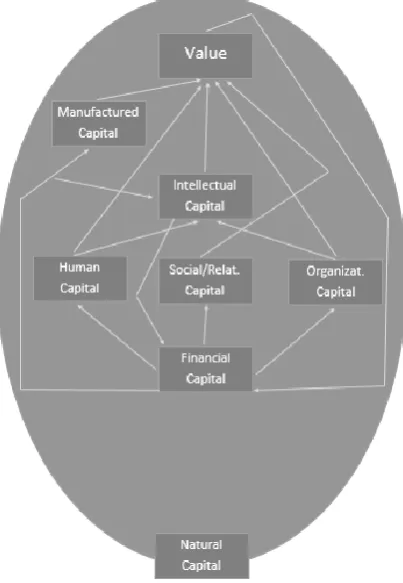
Mapping of the capital indicators and their
relationship towards value within the
Integrated Report Framework.
Author
.
G.F.M. Akse
Faculty of Management and Governance
Business Administration
MSc Thesis
5
thof June 2015
2
Preface
Copyright © 2015 by Gido Akse
All rights reserved. No part of this publication may be reproduced, distributed, or transmitted in any form or by any means, including photocopying, recording, or other electronic or mechanical methods, without the prior written permission of the
publisher, except in the case of brief quotations embodied in critical reviews and certain other noncommercial uses permitted by copyright law. For permission requests, write to the publisher, addressed “Attention: Permissions Coordinator,” at the address below.
Gido Akse
Gemeenteweg 2-b 7693 PM Sibculo
3
Acknowledgements
The end of an era. That is what this master thesis means to me. After years of lectures, articles, paper writing and exams it is time to find a job and leave my
beloved college life behind me. A lot has happened during these six years of college, both good and bad.
During these six years there has been the infinite support of my parents, both academically and generally. I want to thank my dad for all the times he drove me (and therefore allowed me to sleep) to the University. Besides my dad, I want to thank my mum for all the coffee she prepared. Looking back, I think we could fill the Atlantic ocean with it.
During these six years I met my girlfriend Liset. She has been one of the main motivations for me to work relentlessly on this thesis. I want to thank her for her unending support during this period. This thesis, but also life in general became far more interesting once she entered my life! Reality is finally better than my dreams!
I also want to thank my supervisor H. (Henk) Kroon. Besides being supervisor, Henk was one of the few teachers who could intrigue his students during classes. He made us realize why we love studying Business Administration and supported us
throughout our academic career. He spent a significant amount of time in criticizing, discussing and supporting my thesis and for that I am grateful. I want to thank Ger Vergeer for being my second supervisor.
Because I do not wish to forget anyone, I want to thank everyone who supported me during these 6 years, especially my family and friends.
Now that my final chapter closes all that remains to be said is: Acta fabula est.
The end! Time to find a new challenge!
Yours sincerly,
4
Abstract
Value creation is a key concept within Integrated Reporting (IR). Within the IR Framework six possible capital indicators have been given without any in-dept mapping and/or operationalization. This master thesis will propose several mapping models in the area of financial capital, manufactured capital, intellectual capital, human capital, social/relational capital and nature capital. What is shown in this paper is that the inter-connectivity of the variables plays a pivotal role due to the fact that non-financial information can severely influence financial information. The operationalization should therefore allow this mutualistic relationship.
The lack of mapping and/or operationalization leads to implementation difficulties within the practitioners field and could explain why IR faces adoption problems. This paper aims to clarify the value indicators within the IR framework in order to enhance implementation and possibly remove any barriers that hinder the acceptance of IR as the main financial reporting standard. In an age of technological innovation,
intangible assets are becoming very important. IR makes the capturing of the value created by these intangible assets possible as long as we have a clear and coherent mapping and operationalization of the indicators described in the IR Framework.
This paper intends to propose several mapping models and is to be considered explorative. It is a peak in the black box of causation. Further empirical research should determine whether these models are correct and all-embracing. Once this has been done, the actual operationalization of the capital indicators can start. It is only then that we can truly discover whether the value indicators given are a pretium or a
simulans.
5
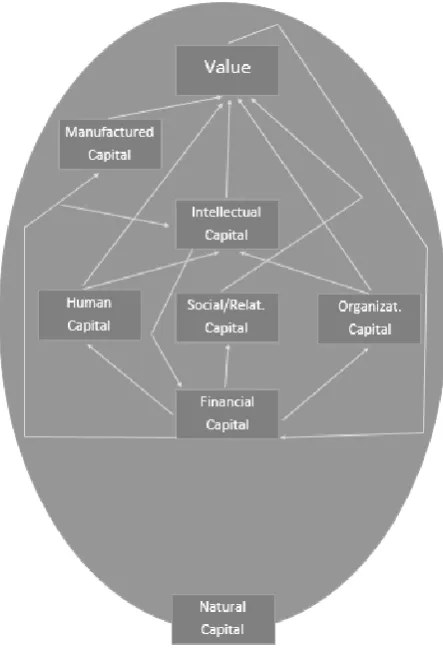
The actual relationships that are described within this thesis are shown below. Figure 1 shows the final result of my research. This figure describes the overall relationships between the capital indicators and their relationship towards value. These
relationships are both direct and indirect.
[image:5.595.75.297.176.505.2]
Figure 1. Mapping of capital indicators and their relationship towards value. This thesis shows that either the framework that has been described in the Integrated Reporting Framework is too broad or that current academic research has not
discovered enough relationships in order to fully describe the interdependency of the capital indicators. Face validity lies in the latter explanation. This is supported by the case study done in this thesis.It is a necessity that, from this point forward, further empirical research should continue with the operationalization of the capital
6
Table of Contents
Chapter I: Introduction.
1. Introduction p.5
2. Research aim and scientific relevance p.8
3. Research question and sub-questions p.9
4. Research design, Case selection, Data collection p.10
Chapter II: Theoretical Framework
1. Explanatory reasons for corporate disclosure p.11
2. A close relative: development of CSR p.15
3. Integrated Reporting: An introduction p.18
Chapter III Creation of the research model.
1. Proposition of the model p.27
1. Financial Capital p.31
2. Social/Relational Capital p.32
3. Intellectual Capital p.35
4. Human Capital p.37
5. Natural Capital p.39
6. Manufactured Capital p.42
7. Organizational Capital p.43
Chapter IV Mapping the capital indicators
1. Mapping the capital indicators p.45
2. Separate graphical description of the capital indicators p.48
3. Case Study: Philips p.58
Chapter V Conclusions, limitations and future research p.58
1. Conclusion p.58
2. Limitations p.60
3. Future research p.61
Chapter VI APA-list and Appendix p.62
1. APA p.62
7
Index of Figures
Figure 1. Mapping of capital indicators and their relationship towards value. p.5 Figure 2. Financial and information flows. p.15
Figure 3. The value creation process. p.22
Figure 4. Value creation according to the IR Framework. p.27
Figure 5. The relationship between the capital indicators and value . p.29
Figure 6. The interconnectedness of the capital indicators. p.30
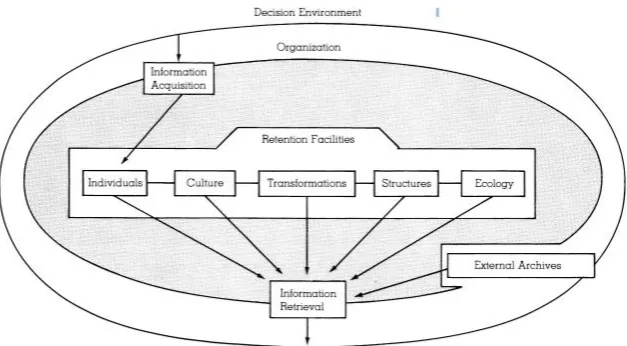
Figure 7. Organizational Memory. p.43
Figure 8. Mapping of capital indicators and their relationships towards value p.50
Figure 9. Mapping of financial capital. p.51
Figure 10. Mapping of Social/Relational Capital p.52
Figure 11. Mapping of Intellectual Capital p.53
Figure 12. Mapping of Human Capital p.54
Figure 13. Mapping of Natural Capital p.55
Figure 14. Mapping of Manufactured Capital p.56
Figure 15. Capital indicators Philips p.59
8
Index of Tables
9
List of Abbreviations
IR Integrated Reporting
IIRC International Integrated Reporting Council IFRS International Financial Reporting Standards IAS International Accounting Standards
GRI Global Reporting Initiative
SASB Sustainability Accounting Standards Board IAS International Accounting Standards
R&D Research and Development
10
Chapter I. Introduction
1.1 INTRODUCTION
This research focuses on the operationalization of IR. According to the IIRC IR holds the following purpose:
The primary purpose of an integrated report is to explain to providers of financial
capital how an organization creates value over time. An integrated report benefits all stakeholders interested in an organization’s ability to create value over time, including
employees, customers, suppliers, business partners, local communities, legislators,
regulators and policy-makers.1
One of the most important factors in IR is how an organization creates value over time. IR includes the creation of value through non-financial parameters. The main difference between traditional financial reporting and IR is the inclusion of this non-financial information. Besides basic non-financial and material information, IR shows human, intellectual, social and natural aspects of a company that either add or diminish value.2
Longitudinal studies have shown that companies are presenting more information. However, data is published separately and therefore often difficult to interpret.3
The result of this separate publishing is that current reporting falls short in delivering the information needed. In addition, this type of reporting is exactly the opposite of what IR is trying to deliver. A real IR is a concise communication about how an organization’s strategy, governance, performance and prospects in the context of its external environment, leads to the creation of value over the short, medium and long term.4
1 The International Integrated Reporting Council. The International <IR> Framework. December 2013.
2 García-Sánchez, I. M., Rodríguez-Ariza, L., & Frías-Aceituno, J. V. (2013). The cultural system and integrated
reporting. International Business Review, 22(5), 828-838.
3 Frias‐Aceituno, J. V., Rodriguez‐Ariza, L., & Garcia‐Sanchez, I. M. (2013). The role of the board in the
dissemination of integrated corporate social reporting.Corporate social responsibility and environmental management, 20(4), 219-233.
11
The current reporting is still heavily relying on old company structures. The problem is that the current business models are no longer investing in so called brick and mortar structures. Intangible assets are becoming more important leading to a decrease in reliability of current financial reporting standards.5 This leads to a lower
market efficiency when one assumes that the market both overreacts and underreacts on information.6
Besides the mere theoretical arguments we see a development within institutions that promote IR. Organizations such as the GRI, the SASB and the European
Commission are already more focused on materiality as one of their fundamental aspects. Stock exchanges around the world have developed socially responsible investment indexes.
All these reasons leads to the conclusions that IR is going to be the next big “thing”. Recent developments show that there will be a stronger focus on non-financial issues in the future.
However, people in the actual working field still find it hard to grasp the idea of IR. The reason why IR is still difficult to implement is because not enough research has been done concerning the conceptualization of value. The current academic field is too much focused on specific IR subjects while the actual operationalization has not even been finished yet. What I aim to achieve in this paper is defining
operationalization’s of the value indicators. Whereas financial parameters and indicators in current financial reporting are easy to reproduce, IR is not. The reason why I think this is the case has to do with the intangible and other non-financial parameters within this type of reporting being influenced by social, governmental and legal requirements which differ in every country (even every company) and make it therefore hard to “template”. A company that has mastered IR is capable of
combining both qualitative and quantitative value indicators that show the overall value creation within a company. These indicators would show that while the actual value is contained within the company, the value creation and/or acquisition can be done outside firm-boundaries.
5 Tomo, O. (2010). Ocean Tomo’s Intangible Asset Market Value Study. Ocean Tomo Announces Result of
Annual Study of Intangible Asset Market Value.
6 Fama, E. F. (1998). Market efficiency, long-term returns, and behavioral finance. Journal of financial
12
What I aim to achieve is to develop a model showing the relationships between the capital indicators and the overall value described in the IR framework. Besides the development of a model I will try to create a better conceptualization of these variables. I will also identify possible “knowledge gaps” that might explain why
accountants and controllers have not yet accepted IR as their main financial reporting standard through the use of a case study. We will discuss the operationalization of Philips, a frontrunner considering Integrated Reporting. From this point forward academic research can continue to develop and check the operationalization’s which control for these operationalization and further investigate these “knowledge gaps”.
13
1.2 RESEARCH AIM AND SCIENTIFIC RELEVANCE
IR has become the next big thing in the area of financial reporting standards. For reasons unknown, companies are not willing to accept it as their financial reporting standard. One reason could be the fact that companies find it difficult to
operationalize their value creation. Often, these difficulties are not seen in the valuation itself, but the possible dependent relationships between different value creating indicators. This research will thoroughly investigate the relationships of the capital indicators in the IR framework while taking into account the interdependency between the capital indicators.
A positive component of IR is that companies are becoming more aware about the influence they have on society as a whole. Stakeholders are starting to realize that companies do not only effect their employees or building grounds. They can have either or both negative and/or positive spillovers. However, current reporting standards have not incorporated these societal effects. It is in my opinion that the creation of a higher level of social awareness is something that we should try to achieve. IR might be the a possibility to accomplish this higher level of awareness.
Goals
Improve the quality of financial information.
Enable a more efficient and productive allocation of capital.
A more cohesive and efficient approach to corporate reporting.
Enhance accountability.
Enhance stewardship.
Promote the understanding of all the capital indicators and their interdependencies.
Support integrated thinking considering the value creation over the short, medium and long term.
14
Current financial reporting systems are purely based on economic users. IAS 1 describes that the main objective of general financial statements is to provide information about the financial performance, cash flows and the overall financial positions that is useful to a wide range of users in making economic decisions.7
Integrated Reporting has far more objectives. These goals can be seen in Table 1.8
The goals described in the IR framework are very complex. While the concepts of the different capital indicators are rather clear it does raise questions considering the boundaries between these indicators. That remains rather fuzzy.9 In addition, the IR
framework forces companies to show the capitals that influence the firm but not how the firm influences specific capitals. This means that both the enhancement of
stewardship and accountability are endangered because of the fact that the company might have a higher stewardship and accountability than only their inputs during the productive process.10
Another difficulty lies in the fact that the completeness, comparability and the correctness of information is hard to measure. The IR framework leaves a lot of discretion to the firm’s management. This will lead to wrong information considering the performance of companies related to sustainability and their impact on
stakeholders, society and the environment.11 This impacts the quality of financial
information and the overall understanding of the capital indicators and their
interdependencies which in terms influences the determination of value created in the short, medium and long term.
All these points show us that IR and its framework are still in its infancy. If we want to make sure that companies adopt IR as their reporting standard, we have to make sure that all these barriers are removed. It is the task of the academic world to
investigate which barriers are still standing and how they can be removed. I seriously hope that mapping the capital indicators described within the IR framework will be the first step towards a larger understanding of IR as a whole.
7 International Accounting Standard 1
8 The International Integrated Reporting Council. The International <IR> Framework. December 2013, 3. 9 Flower, J. (2014). The international integrated reporting council: a story of failure. Critical Perspectives on
Accounting, 4.
10 Flower, J. (2014). The international integrated reporting council: a story of failure. Critical Perspectives on
Accounting, 5.
11Flower, J. (2014). The international integrated reporting council: a story of failure. Critical Perspectives on
15
1.3 RESEARCH QUESTION AND SUB-QUESTIONS
This paper hopes to create a coherent framework that helps to create a clear and cohesive picture regarding the interdependencies between the capital indicators and their overall relationship towards value. This paper does not primarily serve the academic world. The working field could seriously benefit from this work because of the fact that the overall dependencies will finally be described. In order to be able to serve both the academic and the practitioner I will propose the following research (sub)questions:
How can value creating indicators described in the IR framework be mapped?
o From sustainability reporting to IR: How did IR develop into its current practice?
o What are the key capital indicators influencing value according to the IR Framework?
o Current practices: Are there other Indicators influencing value described in current academic research?
o How could we map the value creating indicators defined in the Integrated reporting Framework according to current academic research?
o How do these mapped relationship look separately?
o Is there a difference between the relationships found within this study and current working-field practice?
16
1.4 RESEARCH DESIGN, CASE SELECTION, DATA COLLECTION
The intention of this research is to create a map considering the interdependencies between the different capital indicators and their relationships towards value. In order to create this map a literature review will be done considering the conceptualization of value within other areas of business administration. This literature review will serve as the fundament for this thesis.
The literature selection will be done by looking at the most important academic websites. I do not wish to select on references or citations. To be as comprehensive as possible all papers and other academic material should be read.
Considering the case study, this study will look at the annual integrated reports of Philips to determine how this company operationalizes its capital indicators.
The purpose of this model is not to see whether the mapped relationships are actually already being used by the current working field. This is because current academic research has not yet formally operationalized and tested the mapped model that I will propose. As a result, the model that I will create might not be all-embracing meaning that other variables could be discovered during future research. Therefore, case studies are not yet important in this area of research. First other academic work should continue to focus on the mapping of the capital indicators. Once this work has been completed, if it ever will, different operationalizations should be discovered in order to measure the interdependencies reliably and completely. In addition, this research will only contain the proposed relationships. The strength of the relationships can’t be given, since no literature about this specific topic is
available at this point. The relationships described can be either positive, negative or both considering overall value creation. This research can only tell that the
relationship is there, not whether it is positive or negative.
17
Chapter II: Theoretical Framework
2.1 The role of information disclosure
Within this chapter we will explain the actual role of financial information disclosure in capital markets. In a perfect capital market there are no information differences and conflicting incentives been possible investors and companies. This optimal allocation of savings is a constant challenge for any economy.12
Current academic research has discovered two main reasons for corporate
disclosure. First of all, entrepreneurs typically have better information about the value of their business investment and tend to overstate this value due to incentives.
People that are willing to invest face an “information problem”.13 This information or
“lemons” problem arises from differences and conflicting incentives between entrepreneurs and savers.
The example often described is the situation where half the business ideas are “good” and the other half are “bad”. If investors cannot distinguish between the two types of information due to the lack of information, entrepreneurs with “bad” ideas will claim that their ideas are as good as the ideas that actually are good. Realizing this possibility, investors will value all the business ideas as average. Therefore, the capital market rationally undervalues some good ideas and overvalues some bad ideas.14
Several well-known solutions have been proposed to the “lemons” problem. Kreps
(1990) proposed contracts between entrepreneurs and savers leading to optimal contracts that diminish or remove information asymmetry.15 Another possible solution
is the creation of regulation by governments that force companies to disclose both public and private information.16
12 Healy, P. M., & Palepu, K. G. (2001). Information asymmetry, corporate disclosure, and the capital markets:
A review of the empirical disclosure literature. Journal of accounting and economics, 31(1), 407.
13Ibid.
14 Healy, P. M., & Palepu, K. G. (2001). Information asymmetry, corporate disclosure, and the capital markets:
A review of the empirical disclosure literature. Journal of accounting and economics, 31(1), 408.
15 Kreps, D. M. (1990). A course in microeconomic theory . New York: Harvester Wheatsheaf, 630.
16 Healy, P. M., & Palepu, K. G. (2001). Information asymmetry, corporate disclosure, and the capital markets:
18
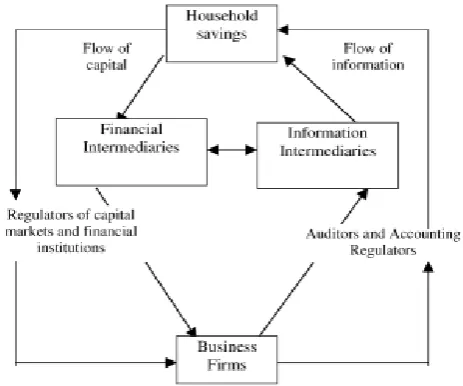
Because of this information asymmetry there is a demand for information intermediaries that discover private information production in order to uncover managers’ information.17
Fig. 2 has been added in order to show the relationship of household savings, financial/information mediators and the entrepreneurs in a capital market economy.
[image:18.595.145.377.210.403.2]
Figure 2. Financial and information flows.18
Scholars who theorize about the management of information have also argued about the “agent” theory. The definition of an agency relationship is a contract under which one more persons engage another person to perform some service on their behalf
which involves delegating some decision making authority to the agent.19 This
situation arises because investors normally do not intend to play an active role in the management of the company they invest in.20 However, the person allowing this
agent to make decisions, the “principle”, has to monitor the expenditures done by the agent and faces a residual loss. This is because the “agent” is not fully rational and
17 Healy, P. M., & Palepu, K. G. (2001). Information asymmetry, corporate disclosure, and the capital markets:
A review of the empirical disclosure literature. Journal of accounting and economics, 31(1), 408.
18Ibid.
19 Jensen, M. C., & Meckling, W. H. (1979). Theory of the firm: Managerial behavior, agency costs, and
ownership structure Springer Netherlands, 5
20 Healy, P. M., & Palepu, K. G. (2001). Information asymmetry, corporate disclosure, and the capital markets:
19
does not behave as if he were maximizing the welfare of the “principle”.21 The sum of
these cost are defined as “agency costs”.
Therefore, both the principle and the agent might have different incentives. This can lead to conflicts of interest, information asymmetries and concealment by
management.22 Information asymmetries arise because managers’ daily involvement
gives them privileged access to information. Conflict of interest occur when incentives of managers and investors differ. Managers might decide to conceal negative
organizational information because of the possible adjustment of their incentive contracts or the decision of the directors to replace them.23
The last theory suggests that disclosure is motivated by the corporate in order to legitimize activities.24 This “legitimacy” theory proposes that companies respond to
community expectations through the disclosure of information.25 Given a growth in
community (either local, regional or global) awareness and concern, companies will reinforce the community’s perception of specific subjects.
21 Jensen, M. C., & Meckling, W. H. (1979). Theory of the firm: Managerial behavior, agency costs, and
ownership structure Springer Netherlands, 6.
22 Abrahamson, E., & Park, C. (1994). Concealment of negative organizational outcomes: An agency theory
perspective. Academy of management journal,37(5), 1304.
23Ibid.
24 Hogner, R. H. (1982). Corporate social reporting: eight decades of development at US Steel. Research in
Corporate Performance and Policy, 4(1), 245.
25 Tilt, C. A. (1994). The influence of external pressure groups on corporate social disclosure: some empirical
20
2.2 A close relative: development of (corporate) sustainability reporting
The number of companies that started to publish separate information reports containing environmental, social or sustainability policies and/or impacts has been rising since the first separate environmental report in 1989.26 Whereas a large
number of banks and insurance companies that publish a sustainability report is increasing, traditionally, the more ‘polluting’ sectors have been most active in this regard. Purely based on face validity, the mere “legitimacy” theory described in the previous chapter seems like a plausible reason why “polluting” companies adopt sustainability reporting more active than other sectors in this regard.
Besides these factors, many reasons can be found why companies produce a separate sustainability report. Table 1 lists various reasons and motivations. These reasons can sometimes be company-specific, however, are not always internal. Other societal aspects such as reputation and credibility play an important role.
Table 1. Motivations for producing separate sustainability reports.27
26 Kolk, A. (2004). A decade of sustainability reporting: developments and significance. International Journal of
Environment and Sustainable Development, 3(1), 51.
21
Regarding the content, a clear tendency can be observed that environmental
reporting is starting to include societal issues. This development started since 1999. In 2002, the number of environmental reports that did not report any societal activities dropped from 98% compared to 71% in 1999.28 While this predecessor of integrated
reporting kept developing, the overwhelming majority of companies that adopted sustainability reporting remained focused on the mere “traditional” reporting topics.29
Once (corporate) sustainability became an accepted corporate disclosure method, companies started to include more performance measures in their sustainability reports. There was a need to asses companies’ results rather than their policies.30
However, with the deliverance of more corporate information towards stakeholders, especially non-financial information, a judgement of performance indicators as such without any context and/or comparison proved to be difficult.31 Therefore, companies
created forms of benchmarking for items such as societal issues and health, safety and environment.32
There is still a lot of discussion about the significance of sustainability reporting. Due to the whole quest for good standardised performance indicators and the need for external verification by the academic world of these indicators, it is hard for investors to see whether companies have really implemented the issues they add in their sustainability report.33 One factor that might positively influence the adoption of
corporate sustainability reporting is the external verification of sustainability reports. More and more big accountancy are willing and capable to verify corporate
sustainability reports.34
28 Kolk, A. (2004). A decade of sustainability reporting: developments and significance. International Journal of
Environment and Sustainable Development, 3(1), 51.
29 Kolk, A. (2003). Trends in sustainability reporting by the Fortune Global 250.Business strategy and the
environment, 12(5), 284.
30 Kolk, A., & Mauser, A. (2002). The evolution of environmental management: from stage models to
performance evaluation. Business strategy and the environment, 11(1), 17.
31 Kolk, A. (2004). A decade of sustainability reporting: developments and significance. International Journal of
Environment and Sustainable Development, 3(1), 58.
32Ibid. 33Ibid.
22
However, the more business world has adopted (corporate) responsibility reporting, the more it has been blamed for the failures of society. Due to recent history,
legitimacy of businesses has fallen to dramatically low levels.35
According to academics, this problem lies within the companies themselves due to the fact that they remain active in outdated value creation approaches that still
differentiate between the financial information and non-financial information shown in current financial disclosure frameworks.
As a consequence, companies must create a situation through which they bring business and society back together. While there is still a lack of an overall framework, academics argue that the solution lies in the principle of shared value. This means that companies create value for both the company and for society as a whole. This means that new value indicators would have to be created and the company should be seen as an actor active in a economic and societal community.36 Because
(corporate) sustainability reporting was not capable to show the intertwined relationship between financial and non-financial information another corporate disclosure method deemed necessary. Integrated reporing was born.
23
2.3 Integrated reporting: an introduction.
The conceptualization of IR has initially been done by two separate bodies, the King Report on Governance for South Africa, and the International Integrated Reporting Council (Henceforth: IIRC) in the United Kingdom. For companies and organizations that are listed on the Johannesburg Stock Exchange the preparation of an integrated report became mandatory.Elsewhere in the world, several organizations are trying to implement an integrated report. Denmark, Norway and Sweden demand
sustainability reporting to varying degrees. In France, legislation called the Grenelle II
legislation requires “all major French listed and non-listed large companies to disclose how they take the enviromental and social impact of their activities into account.37 Although the process is evolving and frameworks are being created, no
unified description of this concept has yet been created.38
The King Report on Governance for South Africa describes integrated reporting as “a holistic and integrated representation of the company’s performance in terms of both
its finance and its sustainability”.39
The International Integrated Reporting Council (IIRC) states that integrated reporting “brings together the material information about an organization’s strategy,
governance, performance and prospects, reflects the commercial, social and
environmental context within which it operates. It provides a clear and concise
representation of how an organization demonstrates stewardship and how it creates
value, now and in the future”.40
Both organizations show that a clink between the reported non-financial information and the financial information in a manner allowing an assessment is the future for corporate disclosure.41
The aim of an integrated report is therefore to allow a better communication of a company’s short, medium and long term value creation proposition through providing
37 Eccles, R. G., & Saltzman, D. (2011). Achieving sustainability through integrated reporting. Stanf Soc Innov
Rev Summer, 56-61.
38 Abeysekera, I. (2013). A template for integrated reporting. Journal of Intellectual Capital, 14(2), 238. 39 IRCSA (Integrated Reporting Council of South Africa) (2011), “Integrated reporting and the integrated report.
Discussion paper”, 2.
40 The International Integrated Reporting Council. The International <IR> Framework. December 2013, 3. 41 Cheng, M., Green, W., Conradie, P., Konishi, N., & Romi, A. (2014). The international integrated reporting
24
“a concise communication about how a company’s strategy, governance,
performance and propects, in the context of its external environment, lead to the
creation of value”.42
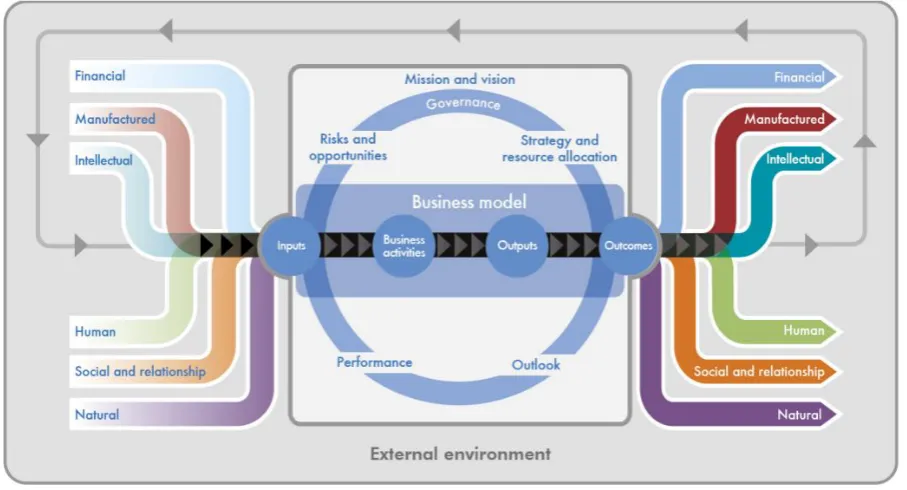
At the heart of the IR conceptual framework lies the notion that the companies should expand their reporting not only to financial information, but include all the resources that they use as inputs to their business activities.43 These various resources are
called capitals and the IR Framework identifies six of these capitals namely: financial; manufactured; intellectual; human; social/relational and natural.44
Financial capital is described as a pool of funds that can be obtained through debt and equity financing for the use in the production of goods or the provision of services.
Manufactured capital describes physical objects that can be used by an organization for the use of production of goods of the provision of services. Examples of
manufactured capital could be either buildings or equipment.45
Intellectual property such as patents, copyrights, software and other typoes of rights and licences are defined as intellectual capital. Besides these mere “obvious”
organizational knowlegde-based intangibles, organizational capital, such as tactic knowlegdge about systems, procedures and protocols, can also be seen as intellectual capital and is therefore added.46
People’s competencies, capabilities and experience and their motivations to innovate can be described as human capital.
Social and relationship captial is described as the relationships within and between communities, groups of stakeholders and other networks, and the ability to share information within this network, in order to enhance individual and collective well-being. Social and relationship capital includes shared normes and common values, key stakeholder relationships and intangibles associated with brand and reputation.
42 The International Integrated Reporting Council. The International <IR> Framework. December 2013, 8. 43 Cheng, M., Green, W., Conradie, P., Konishi, N., & Romi, A. (2014). The international integrated reporting
framework: key issues and future research opportunities. Journal of International Financial Management & Accounting,25(1), 95.
25
The last capital is natural capital. Natural capital describes all renewable and non-renewable environmental resources and processes that provide goods and/or
[image:25.595.73.527.162.407.2]services. It includes air, water, minerals and forests. In addition, biodiversity and eco-system health is added as well.
Figure 3. The value creation process.47
What can be seen is that all these values are conceptualized, but not
operationalized. This leaves a lot of freedom to the companies that adopt IR. Freedom that can be abused if IR does not provide the neccesary indicators and operationalizations to create comparative benchmarks that can be used to asses company performance. This will lead to a decrease in both reliability and
comparability.
The problem is that each capital dimension can interact with eachother in various permutations. While this allows companies to create value through the interactions of these capitals, it might be difficult for companies to link their core business activities to the six captials and measure it adequately.48
In addition, questions like what form should the integrated report take to present the interconnectedness between financial and non-financial information and which performance metrics stakeholders value remain.
47The International Integrated Reporting Council. The International <IR> Framework. December 2013, 13.
26
Therefore, achieving truly integrated reporting is far more difficult than is often admitted. It is a constant challenge to combine two fundamentally traditions of
corporate disclosure, financial and sustainability reporting. The complexity of financial reporting is increasing due to different sources of value, financial instruments and intangible assets while the difficulty of sustainability reporting lies in the measurement of the latter. Meshing the these two types of corporate disclosure is difficult, but
neccesary.49
The IIRC has given guiding principles and content elements in their framework in order to enhance the interconnectedness of financial and non-financial information. According to the guiding principles an integrated report should explain the
connectivity of information. It should show the interrelatedness between the value indicators that determine the overall value creation of companies. An integrated report should show key relationships with value holding stakeholders. The integrated report should also contain a high level of materiality, meaning that the report should contain information that explains the value creation over the short, medium and long term. Besides these mere “new” guiding principles, older principels such as reliabilty, completeness, conciseness, comparability and consistency are given aswell.50
Besides these guiding principles the IIRC created content elements that should be taken into account. These content elements describe that organizations that adopt IR as their main disclosure standard should look at their performance, outlook, business model, governance and their organizational overview and external environment. The framework once again stresses the importante of the interconnectedness by
describing that these elements are linked and should not be described as mutual exclusive elements of a company.51
Academic research has shown that there are several reasons why companies adopt IR. Table 2 summarizes these company determinants of IR.
49 White, A. (2010). The five capitals of integrated reporting: Toward a holistic architecture for corporate
disclosure. Eccles, R. et al.(2010).‘The Landscape of Integrated Reporting’, Massachusetts, 49.
27
These determinants are different from the factors influencing the choice for mere traditional sustainability reporting meaning that the institutional character of
companies that adopt IR is different compared to companies that adopt traditional sustainability reporting.52 Academic research has proven that IR companies are more
likely to originate from countries with higher investor protection, higher market coordination and a higher level of union density. The mere political conditions of a country are not influencing the choice for IR.53
Other determinants have been proven statistically relevant as well. Companies that have a monopolistic position within a market are less likely to publish additional information through an integrated report. The reason is that these companies are scared for losing their abnormal profits.54 Besides the market position of a company,
company size and profitability are important determinants aswell. If a company
52 Jensen, J. C., & Berg, N. (2012). Determinants of traditional sustainability reporting versus integrated
reporting. An institutionalist approach. Business Strategy and the Environment, 21(5), 312.
53Ibid.
54 Frias‐Aceituno, J. V., Rodríguez‐Ariza, L., & Garcia‐Sánchez, I. M. (2014). Explanatory factors of integrated
sustainability and financial reporting.Business Strategy and the Environment, 23(1), 68.
Author Determinant
Jensen & Berg (2012) Higher investor protection.
Jensen & Berg (2012) Higher market coordination.
Jensen & Berg (2012) Higher union density
Aceituno et all. (2014) Monopolistic position
Aceituno et all. (2014) Company size
Aceituno et all. (2014) Profitability
Aceituno et all. (2013)
Sanchez et all. (201 3)
National legal system
Cultural system
28
increases her profitability through the disclosure of an integrated report incentives will rise. In addition, bigger companies are more likely to publish an integrated report than smaller companies.55
The national legal system of a company is another determinant for IR. A company which has national regulation that focuses towards the protection of stakeholders, a civil law system, is more likely to create an integrated report. Civil law system
promote managerial responsibility and encourages companies to act within the law and promote transparency.56 Cultural norms influence the possible adoption of IR.
Firms located in country’s that have collectivitist or feminist values are more likely to adopt IR as their main reporting standard.57
Although integrated reporting is still in its childhood, three classes of possible benefits have already been described. The first class describes internal benefits that include better inernal resource allocation decisions, greater engagement with shareholders and other stakeholders and the possibility to lower reputational risk.
The second class of beneftis are external benefits. Through integrated reporting a company is capable of improving managing the needs of mainstream investors. The company will also appear on sustainability indices. The last group describes the possiblity of better management of regulatory risks. Companies that adopted IR are prepared for the likely wave of global regulation responding to the introduction of IR.58 No real academic research has yet been done in possible benefits arising from
IR and the reasons mentioned above remain speculative. In order to stimulate the adoption of IR more research should be done in this specific area.
55 Ibid.
56 Frías-Aceituno, J. V., Rodríguez-Ariza, L., & García-Sánchez, I. M. (2013). Is integrated reporting determined
by a country's legal system? An exploratory study. Journal of cleaner production, 44, 45-55.
57 García-Sánchez, I. M., Rodríguez-Ariza, L., & Frías-Aceituno, J. V. (2013). The cultural system and
integrated reporting. International Business Review, 22(5), 828-838.
58 Eccles, R. G., & Saltzman, D. (2011). Achieving sustainability through integrated reporting. Stanf Soc Innov
29
Chapter III: The creation of the research model
3.1 Proposition of the model
The main aim of this research is to operationalize the six capital indicators described within the IIRC framework. Before we can actually start with this operationalization, we need to make sure that we know the relationships between these capital
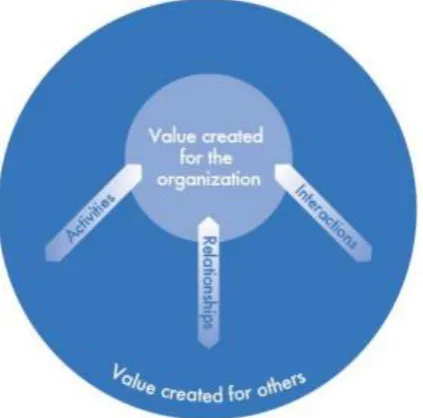
indicators. One of the basic assumptions underlying the model is that there are interactions, activities and relationships between these capitals. If the capitals are material for the organization they should be added within the integrated report. The integrated report takes a picture of a company that reflects the dynamic and
[image:29.595.83.295.385.594.2]systematic interactions of the organization’s activities as a whole. These interactions include activities, relationships and interactions. This includes the interdependencies and trade-offs between the capitals.59
Figure 4. Value creation according to the IR Framework.60
It is from the utmost importance to first conceptualize these six indicators. While the specific conceptualization of the six value indicators has already been done in the framework, the actual relationship between these capital indicators and value creation has not. Previous academic research will help us to discoverer these relationships. Once we have distinguished whether and what kind of relationships
59 The International Integrated Reporting Council. The International <IR> Framework. December 2013, 17-18.
30
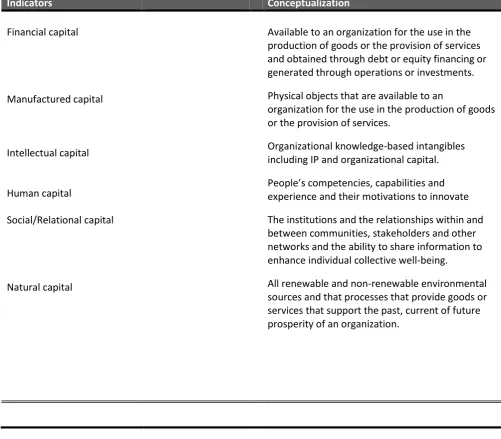
[image:30.595.64.566.212.651.2]excist between these six capital indicators and how they create value this paper will continue with the operationalization of the latter. The specific conceptualizations of the six capital indicators are summarized within Table 3. The underlying assumption within our research model is the fact that financial information is being influenced by non-financial information.
Table 3. The six value indicators according to the IR framework.61
61 The International Integrated Reporting Council. The International <IR> Framework. December 2013, 11-12.
Indicators Conceptualization
Financial capital
Manufactured capital
Intellectual capital
Human capital
Social/Relational capital
Natural capital
Available to an organization for the use in the production of goods or the provision of services and obtained through debt or equity financing or generated through operations or investments.
Physical objects that are available to an
organization for the use in the production of goods or the provision of services.
Organizational knowledge-based intangibles including IP and organizational capital.
People’s competencies, capabilities and experience and their motivations to innovate
The institutions and the relationships within and between communities, stakeholders and other networks and the ability to share information to enhance individual collective well-being.
All renewable and non-renewable environmental sources and that processes that provide goods or services that support the past, current of future prosperity of an organization.
31
3.2 Relationship between the six capital indicators and the creation of
value.
Before I start with the operationalization of the six capital indicators one first needs to know the relationship between the six capital indicators and the possible value that they can either add or remove. The basic underlying model that has been described in the IR framework is shown in Figure 5. As can be seen, all the capital indicators influence the value creation of a company. As an example one could say that relational capital influences the level of innovation due to an increased amount of open innovation projects, which could possibly lead to a competetive advantage in comparison with other companies In the same industry thereby increasing value. Figure 5 also shows us the interconnectedness of the capital indicators. Not only do the 6 indicators influence the overall value creation of companies, they are also intertwined and influence eachother. As an example we could say that the
expenditure in innovation project could positively influence intellectual capital while decreasing financial capital. The IR framework describes no specific relationships. If figure 5 serves as an example, one should draw all hypothetical relationhips that are possible. This research attempts to describe these relationships. While the IR
[image:31.595.76.306.530.738.2]framework describes a situation in which all relationships are possible, academic research tells us the opposite. I will model the capital indicators and their relationship towards value. All these relations will be explained as once I start with the overal modelling of the capital indicators and their relationship towards value.
32
Because the most important objective of IR is a clear and coherent picture of value creation within companies a clear understanding of the six capital indicators is needed. Therefore, not only the relationship between the six indicators and value creation should be understood. The interrelatedness of these six capital indicators should also be mapped. Through a literature review, I will try to be as cohesive as possible in order to understand the relationships between these indicators and their relationship towards value creation.
3.2 Financial capital
A company’s financial capital consist of its debt and equity position. The debt of a company is composed of long and/or short term loans acquired from third parties such as banks, venture capitalists and business angels.62 A company’s equity
composition depends on the phase a company is in. In the mere entrepreneural phase, a company’s equity composition often entails the “three F”; Friends, Family and Fools. Once a company gains maturity, equity is obtained from financial markets. Acquiring financial capital through shareholders and loans is often not without
financial consequences. In order to obtain financial capital of third parties, companies have to pay rent that compensates the risk. Both debt and equity are combined, transformed and leveraged to produce outputs and outcomes, resulting in either value creation or destruction through an organization’s business model. The business model is defined by the IIRC as “the chosen system of inputs, business activities, outputs and outcomes that aims to create value over the short, medium and long term”. 63 Financial capital has been described as cash being needed by an
organization in order to invest into other capital indicators. In addition, cash is a necesssary input as well as an output of operations in form of a cash flow.64
Financial capital is used in order to invest in other resources needed in order to create value over the short, medium and long term.65 However, this relationship is
62 These type of lenders can also demand a equity position within the company. I will not further elaborate on
this due to the fact that this does not fit the purpose of this thesis.
63
64 Itami, H., & Roehl, T. W. (1991). Mobilizing invisible assets. Harvard University Press.
33
merely based on logic rather then on causation. It is not possible (on academic research level) to create a causal relationship between financial capital and the other capital indicators described in the IIRC framework while we do know that there is an actual relationship. Academic research does not tell what the specific relationship is in terms of value creation, but it does know that if there would be no financial capital, no investment would be possible in the other five capital indicators, making them non-excistent. 66 Therefore, financial capital is a necessary, but not a sufficient
variable in the relationship with the other five indicators and value creation. In addition, financial capital can both be an input and an output within the business model of a company.
3.3 Relational/Social Capital
The concept of social capital has become increasingly popular in a wide range of academic disciplines. Social capital is not only used in an economic perspective, but it has also been used in political and social studies. The relational/social capital conceptualization within the IR framework focuses on the capability of companies to create and maintain relationships and to be active in a network. This will be the focal point considering the mapping.
Within the economic perspective several authors have conceptualized social capital with all of them holding a piece of the (social capital conceptualization) puzzle.
Baker (1990) has conceptualized social capital as “a resource that actors derive from specific social structures and then use to pursue their interest; it is created by
changes in the relationship among actors.67
Bourdieu (1985) stated that social capital is “the aggregate of the actual or potential
resources which are linked to a possession of a durable network of more or less institutionalized relationships of mutual acquaintance or recognition”.68
Portes & Sensenbrenner (1993) see social capital as “those expectations for action
within a collectivity that effect the economic goalsand goal-seeking behavior of its
66Ibid.
67 Baker, W. E. (1990). Market networks and corporate behavior. American journal of sociology, 619.
34 members, even if these expectations are not oriented towards the economic
sphere”.69
Putnam (1995) puts an emphasis on value creation stating that social capital shows
“features of social organization such as networks, norms and social trust that facilitate coordination and cooperation for mutual benefit”.70
Pennar (1997) sees social capital as “the web of social relationships that influences
individual behavior and there affects economic growth”.71
In all the conceptualizations social capital is seen as a resource active in a social structure of networks that influences the possible creation or acquisition of value. Social capital is divided in five different dimensions: civic engagement, asscioational membership, high trust, reliability and reciprocity. 72Nahapiet and Ghoshal (1996)
distinguish three challenging dimensions for an organization when trying to create value through social capital.73 These three dimensions are highly interrelated.74
- Structural dimensions
- Relational dimensions
- Cognitive dimensions
The structural dimension explains the overall position an organization maintains in a network and whether the people active in an organization perceive themselve as part of a specific network.75
Relational obligations occur once an organization enters a network. This
development is described in the relational dimension. A sense of mutual obligations developes once a company enters a network.76
69 Portes, A., & Sensenbrenner, J. (1993). Embeddedness and immigration: Notes on the social determinants of
economic action. American journal of sociology, 1323.
70 Putnam, R. D. (2001). Bowling alone: The collapse and revival of American community. Simon and Schuster,
67.
71 Pennar, K., & Mueller, T. (1997). The ties that lead to prosperity. Business Week, 15, 154.
72 Cooke, P., & Wills, D. (1999). Small firms, social capital and the enhancement of business performance
through innovation programmes. Small Business Economics, 13(3), 223.
73 Nahapiet, J., & Ghoshal, S. (1998). Social capital, intellectual capital, and the organizational
advantage. Academy of management review, 23(2), 248.
74Nahapiet, J., & Ghoshal, S. (1997, August). SOCIAL CAPITAL, INTELLECTUAL CAPITAL AND THE
CREATION OF VALUE IN FIRMS. InAcademy of Management Proceedings Academy of Management, 37.
75 Bueno, E., Paz Salmador, M., & Rodríguez, Ó. (2004). The role of social capital in today's economy:
Empirical evidence and proposal of a new model of intellectual capital. Journal of Intellectual Capital, 5(4), 557.
35
The last dimension describes the cognitive dimension. Due to the fact that actors in the same network share the same interest, they start sharing knowlegde.77
The value creation within the social capital is done through the interaction between actors active within the same network or between different networks. This
“networking” leads to increased learning processes.78 Social capital has an eminent
role in the creation of capacity for the sharing of knowlegde that could possibly lead to a competative advantage through the possible increase of product and/or process innovation.7980
In addition, regional social interaction helps product innovation through localized connectivity.81 Several academic articles have already shown that localized learning
is an catalyst for innovation, meaning that companies active in regional innovation systems have a higher level of absorptive capacity, a pre-condition for innovation.82
Besides being a pre-condition, social capital helps as a mere framework for companies to make decisions when dealing with radical innovations.83
The interaction between actors can also lead to long lasting relationships between buyer and supplier and manufacturer and customer. This can lead to a competative advange increasing the overall value creation of a company.84
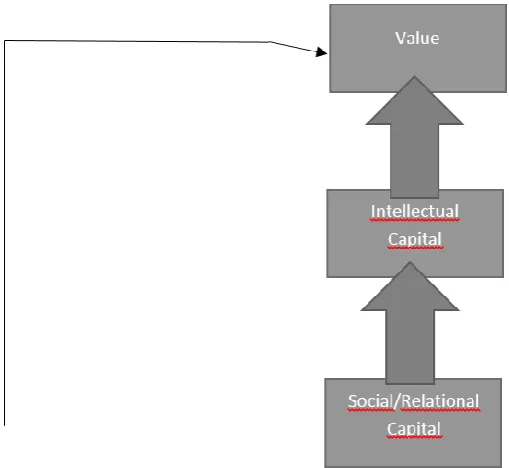
To conclude, social capital does create value both directly and indirectly. It does so indirectly by the possible increase of innovation through for instance localized learning mechanisms. In addition, social capital leads to a higher amount of product and process innovations, possibly influencing manufactured capital that leads to a more efficient production process or a better product. The overall mapping of social capital should therefore show this indirect relationship.85 Social capital facilitates the
development of intellectual capital by affecting the requirements necessary for the
77Ibid. 78Ibid
79 Landry, R., Amara, N., & Lamari, M. (2002). Does social capital determine innovation? To what
extent?. Technological forecasting and social change,69(7), 684.
80Tsai, W., & Ghoshal, S. (1998). Social capital and value creation: The role of intrafirm networks. Academy of
management Journal, 41(4), 473.
81 Laursen, K., Masciarelli, F., & Prencipe, A. (2012). Regions matter: how localized social capital affects
innovation and external knowledge acquisition.Organization Science, 23(1), 182.
82 Diez, J. R., & Kramer, J. P. Regions as Catalysts of Open Innovation? The Case of SAP in the Regional
Innovation System of Baden-Württemberg.
83 Landry, R., Amara, N., & Lamari, M. (2002). Does social capital determine innovation? To what
extent?. Technological forecasting and social change,69(7), 683.
84Snehota, I., & Hakansson, H. (Eds.). (1995). Developing relationships in business networks. Routledge.
36
exchange of knowlegde. Through network ties, shared codes and languages and other social capital indicators social capital allows for an increase in intellectual capital.86 Besides the increase in intellectual capital, social capital allows for long
lasting relationships that could lead to possible competative advantages through for instance preferred customer treatment.87
3.4 Intellectual capital
Since the rise of the “new economy”, one that is driven by information and
knowlegde, intellectual capital became instrumental in the determination of enterprise value and economic performance.88 The information age and the increasing
importance of intellectual capital can be seen in the difference between book value and market value which during mid-1980s widens noticeably for many companies and shows that the value created depends far less on their physical assets and more on their intangible ones.8990
Currently there is no world wide accepted definition of intellectual capital. However, current academic research al include the idea that intellectual capital essentialy centers around “knowlegde that can be converted into value”.91 Besides this basic
conceptualization three elements are commonly used, namely (i) intangiblity; (ii) knowlegde that creates value; (iii) effect of collective practice. This current conceptulization means that the intellectual value that is irrelevant for the
determination of the short, medium and long term value creation of a company is not taken into account.92 This underlying idea is coherent to the current IR framework
and is for this reason adopted in this master thesis.
86Nahapiet, J., & Ghoshal, S. (1997, August). SOCIAL CAPITAL, INTELLECTUAL CAPITAL AND THE
CREATION OF VALUE IN FIRMS. InAcademy of Management Proceedings, 39.
87Schiele, H., Veldman, J., & Hüttinger, L. (2011). Supplier innovativeness and supplier pricing: The role of
preferred customer status. International Journal of Innovation Management, 15(01), 3.
88 Petty, R., & Guthrie, J. (2000). Intellectual capital literature review: measurement, reporting and
management. Journal of intellectual capital, 1(2), 155.
89 Petty, R., & Guthrie, J. (2000). Intellectual capital literature review: measurement, reporting and
management. Journal of intellectual capital, 1(2), 161.
90 do Rosário Cabrita, M., & Vaz, J. L. (2005). Intellectual Capital and Value Creation: Evidence from the
Por-tuguese Banking Industry. Electronic Journal of Knowledge Management, 4(1), 12.
91 Edvinsson, L., & Sullivan, P. (1996). Developing a model for managing intellectual capital. European
management journal, 14(4), 361.
92 do Rosário Cabrita, M., & Vaz, J. L. (2005). Intellectual Capital and Value Creation: Evidence from the
37
But does intellectual capital create value, and if so, how? Academic research has shown that investors place higher value on firms with better intellectual capital
efficiency.93Therefore, companies that invest in intellectual capital are appreciated by
possible investors, thereby positively influencing the financial capital of a company through either debt or equity financing even while current accounting standards are still very restrictive in terms of intellectual property being recognised in financial statements.94 Academic research results also underline the importance of intellectual
property in enhancing profitablity and revenue growth showing a direct relationship between intellectual property and value creation.95 It is important to once again show
in our model that there is a direct relationship between intellectual capital and value creation.
However, besides this mere direct relationship, our model will also have to show that a higher level of investment within intellectual capital could possible lead to a higher willingness of possible investors to invest into financial capital, which can be used to invest in all the capital indicators possibly leading to a higher overall value. As stated in the previous chapter, financial capital is a necessary but not sufficient condition considering value creation. This indirect relationship will also be described in our model.
Other relationships have been described as well. Where the IR framework shows a differentiation between intellectual capital, human capital and social/relational capital, academic research does not. This means that both human capital and social capital are conceptually seperated, but does accumulate and distribute knowlegde leading to a higher level of intellectual capital.96 While I have already shown that social capital
influences intellectual capital in the previous chapter, human capital possesses a same kind of relationship with intellectual capital. This will be discussed in other chapters.
In addition, a third conceptually seperated variable that influences intellectual capital is the so called “organizational” dimension. This part of intellectual capital has not been defined and conceptualized in the IR framework which is rather surpriing.
93 Chen, M. C., Cheng, S. J., & Hwang, Y. (2005). An empirical investigation of the relationship between
intellectual capital and firms' market value and financial performance. Journal of intellectual capital, 6(2), 174.
94Ibid. 95Ibid.
96 Subramaniam, M., & Youndt, M. A. (2005). The influence of intellectual capital on the types of innovative
38
Organizaitonal capital is the institutional knowlegde and codified experience residing within and utilized through databases, manuals, structures, systems and processes.97
A new area within the field of innovation and research is “responsible research and innovation”. Current academic research is only very primal, but there seems to be the idea that innovations have been democratized in its use and privatized in its
production. Technology development can and should be discussed in terms of
benefits and risks for all citizens.98 The idea of responsible research and innovation is
the organization of collective responsibility meaning that technological forecasting should lead to a discussion between all stakeholders whether or whether not to further invest into specific technology.99 Concerning my thesis, it is important to
determine whether specific product or proces research and innovation could have influence on for instance societal and/or natural capital. If this influence is negative, the overall company value could diminish in the long term. While no emperical evidence is yet present, it seems like a valid assumptions that technological innovation does influence quite more than only the company that is producing this form of intellectual capital.
97Ibid.
98 Von Schomberg, R. (2013). A vision of responsible research and innovation.Responsible innovation:
managing the responsible emergence of science and innovation in society, 54.