DESIGN
AND
DESIGN
DOGMAS
AN EXPLORATION AND
THOUGHT EXPERIMENT
Design and Design Dogmas
An Exploration and Thought Experiment
Bachelor Thesis
Author: S. A. W. Hesseling s1340867
Industrieel Ontwerpen Industrial Design Universiteit Twente University of Twente
Supervisor: Ing. R. E. Wendrich Examiner: Dr. Ir. D. Lutters Number of Pages: 93 Appendices: 2 Prints: 10
“We cannot see anything until we are possessed with the idea of it, take it into our heads, and then we can hardly see anything else”
Henry David Thoreau1
Summary
In the multi-interpreted concept of ‘design’, there exist ostensible ‘rules-of-thumb’, that guide present-day designers. Industrial designers have traditionally bridged the gap between industry and consumers, which is an interaction that dominates the world’s economic, capitalist system. Since this system, on which our ‘First World culture’ is based, has severe consequences on the earth and its inhabitants, it is important to understand how these rules were shaped and how they influence designers. This essay is an attempt to understand the origin of these rules, and presents alternative ways of thinking. This is achieved by critically questioning ‘design’, according to the following structure: ‘Why do we design?’ (Part I), ‘What is design?’ (Part II), ‘How do we design?’ (Part III), ‘How should we design?’ (Part IV). Through these parts, socio-cultural, economic, technological and natural perspectives are interweaved.
Part I, ‘Why do we design?’, starts by addressing ‘A Short History on Mass Design Culture and Production’, which elaborates on the emergence of the ‘designer for industry’, who has its roots anchored in the ‘Era of Modernity’. After the industrial revolution, people attempted to validate and create profit from invented production techniques, by selling the industry’s products to the ‘ordinary citizen’. The second subject, ‘Industrialisation, Progress and Capitalism’ demonstrates the way our capitalist system, in which industry is embedded, has evolved. Perceptions on ‘money’, ‘property’ and ‘freedom’ are discussed, that have led to a modern economic system that requires and produces rational models. These models make our world predictable and adaptable to multinational enterprises, who use ‘globalisation’ to expand more and more, in order to achieve ‘progress’ and compete with other multinationals. This is steered by marketing and branding.
Part II, ‘What is design?’, proposes a definition of the ‘Core of Design’, by evaluating ‘qualities’ and ‘traps’ of technology and art – a combination of the initial sources of design. The ‘qualities’ and ‘traps’ of technology include its instrumentality and the way that covers up technology’s origin. For art, the ‘qualities’ and ‘traps’ include its easy value judgements that cover up the art creation process. Subsequently, a definition of the ‘Core of Design’ is suggested, and two views on design are advocated, in which ‘common’ design is based on the ‘traps’, and ‘core’ design includes the ‘qualities’ as well.
Capitalism on Nature’ shows the harsh effects that natural resource extraction and use have.
Part IV, ‘How should we design?’, summarises and tackles ‘design dogmas’ in ‘Dismantling Design Dogmas’, by reflecting on the socio-cultural, economic, technological and natural perspectives. In ‘Recommendations for Higher Design Education’ the way Industrial Design Education (IDE) is based on ‘design dogmas’ is discussed. It is proposed that by involving more critical and reflective thinking on fixed design methods, and by including a broader design context, IDE could be enriched and resonate the demands of the real world.
Finally, a ‘Dogma Overview and Alternative Approaches’ is presented, which outlines the way ‘design dogmas’ have been derived from general dogmas. In addition, it includes alternative approaches towards design dogmas.
Samenvatting
Het begrip ‘ontwerpen’ is niet eenduidig: in verschillende contexten heeft het een andere betekenis. Hedendaagse ontwerpers hanteren zogenoemde vuistregels waar ze in hun werk houvast aan hebben. Met deze vuistregels dichten industrieel ontwerpers de kloof tussen industrie en consumenten en voeden ze daarmee het kapitalistische, geglobaliseerde systeem van massaproductie. Aangezien dit economische systeem, waarop de cultuur van de westerse maatschappijen gebaseerd is, zware consequenties heeft voor de aarde en haar bewoners, is het belangrijk om te begrijpen hoe deze vuistregels zijn ontstaan, en hoe ze ontwerpers precies beïnvloeden. Dit essay is een poging deze vuistregels te doorgronden, in perspectief te plaatsen en vandaaruit een tot een alternatieve visie op ontwerpen te komen. Om hiertoe te komen, wordt ontwerpen op een kritische wijze benaderd volgens de volgende structuur: ‘Waarom ontwerpen we?’ (Deel I), ‘Wat is ontwerpen?’ (Deel II), ‘Hoe ontwerpen we?’ (Deel III), ‘Hoe zouden we moeten ontwerpen?’ (Deel IV). In deze delen worden de volgende perspectieven in overweging genomen: het sociaal-cultureel-, economisch-, en technologisch perspectief, en het perspectief uit de natuur.
laat zien hoe het kapitalistische systeem waarin deindustrie (van multinationals) verankerd is, zich door de jaren heen heeft ontwikkeld. Hier komen de begrippen ‘geld’, ‘bezit’, en ‘vrijheid’, die ons hedendaagse economische systeem tot stand hebben gebracht, aan bod. Daarbij komt dat het kapitalistische systeem baat heeft bij het modelleren van de werkelijkheid. Modellen zorgen ervoor dat onze wereld voorspelbaar en aanpasbaar lijkt te zijn. Modellen helpen bij het ontwerpen van groeiscenario’s voor nieuwe merken (branding) en markten (marketing). Onder het mom van ‘vooruitgang’ gebruikt de industrie (van multinationals) globalisering om te blijven doorgroeien.
Deel II, ‘Wat is ontwerpen?’ geeft een definitie van de ‘Kern van Ontwerpen’ vanuit kunst en technologie. De kwaliteiten en de valkuilen van zowel kunst als technologie vormen samen de basis voor wat ontwerpen in de kern is. De valkuil van het gebruik van technologie is dat dit gebruik zo vanzelfsprekend wordt, dat de inspanning die nodig is om de desbetreffende technologie tot stand te brengen, niet meer opgemerkt wordt. Bij kunst is de valkuil dat er snel een waardeoordeel over het kunstobject wordt gegeven, zonder oog voor het (creatieve) totstandkomingsproces. Bij huidige ontwerpprocessen komen beide valkuilen voor: technologie wordt puur als instrument gezien en de vormgeving wordt alleen op smaak beoordeeld. In dit essay wordt een ander (nieuw) perspectief op ontwerpen gegeven en wordt een definitie voor gesteld voor wat beschouwd kan worden als: de kern van ontwerpen. Deel III, ‘Hoe ontwerpen we?’, schetst een beeld van de manier waarop er tegenwoordig wordt ontworpen. In ‘De Schillen om de Kern van Ontwerpen’, wordt er uitgelegd hoe een kunstmatige gelaagdheid in ontwerpen tot consumentisme aanzet. Deze gelaagdheid verhult waar ontwerpen echt om zou moeten gaan. In het ‘Intermezzo – de Consequenties van Kapitalisme op de Natuur’, komen de ongewenste effecten van extractie en gebruik van natuurlijke grondstoffen op de natuur aan de orde.
Preface
Over the time that I have studied my Bachelor Industrial Design at the University of Twente a personal awakening has taken place. This started when I began as a freshman in 2012, and it slowly came to stream during the recent years of education. Of course, I had all kinds of vague expectations, but what would really intrigue and absorb me in ‘the world of design’ was completely open. During the past years, I was introduced to many fields of design, thanks to all teachers that I have had.
For now, I would like to very much thank my supervisor, Robert Wendrich, who has played a major role in the – ever unfinished – exploration of my personal aspirations as a designer and the composition of the essay. A few years ago, the first thing he taught me during one of his lectures was to question everything, and to behave independently. He triggered me to get a hold onto topics that I found truly interesting, by encouraging me to actually use my brain, to read and to write. In the meantime, there were certain events I attended (the Dutch Design Week, the Expo Milano, and the Venice Biennale); and I completed several design-courses (at the University of Twente, and at Budapest University of Technology and Economics). Importantly, I have realised that these institutes raise (design) values that are often highly contradictive to the values that really matter to me, because they are very disproportionate to the global context they appear in.
In my optimistic view designers, in their own way, should be able to contribute more to humanity and earth, than they do now. The numerous conversations I have had with Robert Wendrich have inspired me to keep myself motivated to indeed contribute something from my own designer perspective, and this essay is one of the first real attempts.
Contents
SUMMARY
SAMENVATTING
4
5
PREFACE
7
FOREWORD FOR DESIGNERS A Broader Context of Design Common Frameworks for Designers RULES-OF-THUMB?
10 12 13 15
Part I: Why do we design?
17A SHORT HISTORY OF MASS DESIGN CULTURE AND PRODUCTION The Era of Modernity
The Rise of the Industrial Designer Aesthetics, Style and Brands
18 18 19 20 INDUSTRIALISATION, PROGRESS AND CAPITALISM
The Concept of Money Freedom and Property
Thesaurus for Need, Want, Desire and Demand
The Neo-liberal Construct: An Introduction to Adam Smith and Ayn Rand 21 21 22 24 26 Humans and Econs
The Fallacy of Rational Modelling
Multinational Enterprises, Profits, planning and Production Processes Planning and Advanced Technology
Globalisation Preliminary Conclusion 27 28 29 29 30 30
Part II: What is Design?
33
THE CORE OF DESIGN Technology
Art
Part III: How do we design?
43 THE PEELS AROUND THE CORE OF DESIGNConsumerism Design Niches as Peels
44 44 44 INTERMEZZO – THE CONSEQUENCES OF CAPITALISM ON NATURE
Purpose of the Intermezzo The Magnitude of The Problem
Extraction and Usage of Non-Renewable Resources Extraction of Renewable Resources
Waste and Disposal Summary 46 46 47 48 49 49 50
Part IV: How should we design?
51DISMANTLING DESIGN DOGMAS Socio-Cultural Perspective Economic Perspective Technological Perspective Natural Perspective 53 53 55 56 58
RECOMMENDATION FOR HIGHER DESIGN EDUCATION
Critical and Reflective Thinking as a Goal for Higher Education Educational Programs of Industrial Design Engineering Within the Netherlands Differences Between the ‘Higher Aims’ and Educational Fulfilment Concrete Educational Suggestions
60 60 61 62 63
DOGMA OVERVIEW AND ALTERNATIVE APPROACHES 65
FOR YOUR CONSIDERATION 68
REFERENCES 71
APPENDIX A – INVESTIGATING DESIGNERS – A REVIEW APPENDIX B - PLAY THE GAME
Foreword for Designers
This essay is directed at you: the Designer, you act, feel, live, play and work as a ‘Designer’. During your working life, you often bumped into systematic design methods, such as described by e.g. Pahl&Beitz (1995). These methods attempt to encompass the complete Product Development ‘Cycle’, by initiating a ‘design-demand’ that should be investigated and developed according to an established sequence. In general it resembles the following: planning, target group investigation, market analysis, brainstorm, concept generation, concept elaboration, prototyping, testing, and evaluation.
Turning to present-day design topics that you might have heard of, you may conclude that those topics do not resonate with these systematic design methods. The international platform ‘What Design Can Do’1, discusses “design as a catalyst of change” and wants to address “societal questions of our time”. For example, Thomas Rau2 is designer of a new economic system in which the consumer changes from owner to user: the consumer buys cooling instead of a refrigerator; she or he buys light instead of a lamp. The ‘Ocean Clean-up’3 is an initiative to develop “the first feasible method to rid the oceans of plastic”. Design for longevity4 and durability5, is addressed more and more often, for instance by the Stanford Centre of Longevity6. The previous examples indicate that traditional design methods, addressed as ‘fixed design loops’ are not applicable to many present-day design dilemmas. The ‘Introduction to a Broader context of Design’ will introduce the bigger picture that encompasses design’s relation to societal questions.
To elucidate, this essay will not explain ways to get more creative, it does not give you insight in new target groups, it will not reveal exclusive ways of brainstorming, it will not show how to better visualise your designs, it cannot lead you to new ways to choose the best concept, it is not about making a test set-up, it does not tell you how to find the most high-tech solution and it certainly does not explain how to make designs in the most cost-efficient way.
More importantly, this essay is about asking questions before the other questions. It wants to broaden your scope on design ideology by examining the embedment of design in society. It attempts to show how traditional design values have emerged through the 20th and 21st century, and it challenges you to overview and rethink
1 ‘What Design Can Do’: http://www.whatdesigncando.com/ 2 Thomas Rau, architectect RAU B.V.: http://www.rau.eu/
3 ‘The Ocean Clean-up’: http://www.theoceancleanup.com/?gclid=CNCxv6K4-coCFYkBwwodNXYMNA
4 ‘longevity’: something that has a long life, existence or service (Oxford Dictionary)
these values. It is about the reason before and the consequences after ‘design’. No matter which ‘type’ of designer you think or feel you are, this essay applies to you. As a designer you (are) ought to be creative and free thinking, however, if it is your profession, you follow certain standardized rules and fixed ideological ideas. These rules you have at first come across while entering design education, and you have had to adapt to business goals once you get your diploma. This manifest attempts to address your curiosity towards the way these rules were shaped and the way they influence you, as a person and as a designer, in hyper-modern society, upward mobility culture and progress-based civilisation.
To get a hold on this theme, four main questions will encompass the matter; 1)Why do we design?, 2) What is design?, 3) How do we design?, 4) How should we design? These questions are approached from different societal aspects that are either entangled, crossed over or stand alone. The rough sketch of the focus within the different parts is presented in Figure 1.
Within every topic, several ‘unwritten design rules’ will be discovered while unravelling the developing and evolvement of design, which is of major importance, since these rules regulate design today.
The first leading question is ‘Why do we design?’, which is elaborated in ‘A Short History on Mass Design Culture and Production’ and ‘Industrialisation, Progress and Capitalism’. The first clarifies the need for design, and its development at the beginning of the 20th century. The latter explains the fundaments of this need, which lay within our economic system. The final topic is: how does this economic system have consequences for our designing and for our world?
[image:13.432.59.398.309.453.2]The second leading question is ‘What is design?’, which is particularly investigated in ‘The Core of Design’: how does it relate to technology and art, and
how does that influence the way it is practised? The third leading question, ‘How do we design?’, does not unravel existing design methods, but it debates the particular consequences that derive from the way we practise design.
‘The Peels around the Core of Design’ discusses design diversification, and the ‘Intermezzo - the Consequences of Capitalism on Nature’ dives into the major consequences. The last leading question, ‘How should we design?’, tries to get rid of the common ‘design rules’ by broadening the scope within different fields. ‘Dismantling Design Dogmas’ announces the dogmas within the entangled economic, socio-cultural, natural and technological fields, and ‘Recommendations for Education’ provokes our current higher design education.
A Broader Context of Design
Close to all human earthlings depend upon industry through its means of production, meaning: basic sustenance products, fuels, medicines, jobs, cities, etc. Whereas governments claim to be in control, the industry establishes life’s replenishments that get more and more common every decade.
At least, this commonality counts for Western-styled countries. There exists a huge inequality in wealth. Globalisation is driven by these rich countries in favour of themselves, to sustain and grow their wealth. As stated by Sloterdijk (2004), ‘globalisation is the result of commercial transactions that lead to distant consequences’.
Our capitalist driven society affects Earth, and all other earthlings critically. Our globe is the only habitat we will ever have (the latter is opposed by e.g. Stephen Hawkings, who claims that humankind has to leave Earth within 1000 years, and colonize another planet, or face extinction). Many argue that the globe will not withstand, but it is more likely to presume that all living species on earth – plants, animals and humans – are increasingly unbalanced within their habitat. What we need is a global paradigm shift that encompasses the hybridisation of human nature and human culture: two entities that have been diverting for a long time. This has resulted in human intervention on earth, which is embodied by industry that patronises consumers.
For designers, a notion of a global context is hard, because it is too vast. What has become of design, is that it inflicted far reaching consequences, such as forced labour, resource exploitation, extensive use of energy and production of enormous amounts of waste. Effectively, designers influence the way industry uses our common habitat for its resources, and designers are being influenced by industry.
Common Frameworks for Designers
Designers are susceptible to many internal and external influences such as their own motivation, ambition, and wellbeing (internal), but also to things that appeal to their emotion, such as the people they meet, events that occur, and economic welfare (external) – the latter is their frame, which defines the way they behave and design. This determines their own perceptions of design and of being a designer. A certain group of designers may have a common frame. This frame could involve a certain time-period, continent, region, school, gender and these concepts always interfere, which creates a new frame: anything that classifies a group of designers within a specific natural, geographical and cultural sphere. Personal attitudes towards design are ‘coloured’ by those frames, which encourage special adaptation and integration towards them.
If the common frame has a certain influence, this influence will evolve into a set of ‘common rules’, which describe important values that ‘should’ be obtained/ executed/fulfilled by other designers. It will eventually outgrow the initial frame, and when it does, it turns into an ideology, because the appearance of the frame has dissolved.
“According to our common sense, we think that ideology is something confusing and blurring our straight view: ideology should be glasses that distort our view, and the critique of ideology should be the complete opposite: taking off the glasses so that you can finally see how things really are. This precisely is the ultimate illusion. Ideology is not simply imposed on ourselves. Ideology is our spontaneous relationship to our social world, how we perceive its meaning. We, in a way, enjoy our ideology. To step out of ideology, it hurts” (Žižek, The Pervert’s Guide to Ideology, 2012).
or drawing’ (Oxford Dictionary), the Dutch meaning of design is briefly stated as ‘form-giving’. This represents a Dutch common understanding of ‘Design’.
Either way, we will abolish ‘form-giving’ as the only explanation for design. Therefore, this research will use a universal understanding of design, design as a means for solution, in order to create an analytical space for investigating if and how common frameworks in Design manifest themselves, whether they can be announced as ‘dogmas’, and if they affect designers in such a way that their creations follow from those dogmas.
Rules-Of-Thumb?
Design fulfils needs
Design needs to be functional and aesthetic
Design can serve as an instrument or a mediator
Design should leverage profit
Design requires technology to solve a problem
Design requires the use of standardised algorithms or models
Part I
A Short History of
Mass Design Culture & Production
“Like Janus, design looks in two directions at the same time: as a silent quality of all mass-produced goods it plays a generally unacknowledged but vital role in all our lives. As a named concept within the mass media it is, however, much more visible and generally recognised” (Sparke, 2004)
The Era of Modernity
Due to technological and scientific progress at the beginning of the 20th century, new attitudes towards a modern life were established. It was the start of the new era of Modernity. According to Marx(1867) “what was the basis of Modernity was the emergence of Capitalism”. “The fundamental impulse to modernity is rather industrialism accompanied by the new scientific forces” (Larraín, 2000). Scientific forces inflicted indeed that trust in God and religion had been shaken. Next to religion a second “faith” appeared: scientific faith. Due to this scientific faith, the belief in technological progress, and therefore, of parametrising life increased. This parametrising of life meant that commodities could be parametrised as well, in order to eventually be available to ‘everyone’. The same rationalism underpinned the process of industrial production, and it was linked to the concepts of objectivity, collectivity, universality and utility (Sparke, 2004). These terms have a close connection with the neo-liberal ideology, as will be explained in ‘Capitalism & Industry’.
“Modernism was essentially conceived of as a rebellion against 19th Century academic and historicist traditions and against Victorian nationalism and cultural absolutism, on the grounds that the “traditional” forms of art, architecture, literature, religious faith, social organization and daily life (in a modern industrialized world) were becoming outdated” (Mastin, 2008).
In design, modernism was at last reduced to ‘form follows function’7 , which played a key-role in functionalism, which in the end diluted to a mere visual style. It is important to acknowledge that modernity and modernism serve as foundations for designers’ historical framework.
7 ‘Form follows function’ is appropriated to Louis Sullivan for his Autobiography of an Idea (1924).
The Rise of The Industrial Designer
The industrial revolution, that took place after the mid-18th century in the United Kingdom, manifested ways of industrial manufacturing, which could replace the work of artisans, due to new technological inventions. Although faith in science and industrialisation increased, industrial manufacturing was not sanctifying in itself, because it still was very expensive. A new strategy was needed to compensate for all costs: people simply had to swap handicraft for industrially produced goods.
The key was to create products, such as furniture and domestic appliances, that were as good as their handcrafted predecessor, and which were industrially feasible. These products could help in fulfilling basic tasks in the domestic environment. In the beginning, there was no such thing as a ‘designer’, so many different existing creative and technical professionals (architects, decorators, technicians etc.) (Sparke, 2004) took responsibility for varying products. “The need to make decisions earlier represented an important paradigm shift from the working process of the artisan, who had depended upon tacit skills, to that of the designer for industry, who had to undertake more self-conscious, rational planning”(Sparke, 2004).
According to Sparke (2004), architects ruled the world of product design until the late 1920s. They thought that ‘creation of the forms and decoration of the banal goods that made up the everyday environment’ was a part of their work in the built environment. Later, the “graphic designer, defined as someone who would receive instructions from a client, devise drawings and plans and then instruct technicians, typesetters and printers to realise the designs”(Sparke)(Aynsley, 2001), translated ‘craft’ to ‘industry’. The invention of electric lighting had activated a shift from people’s acting mainly inside a domestic environment towards acting inside a public environment as well (Sparke, 2004). Moreover, shop owners permitted themselves to create attractive shop windows to be able to sell their industry-made products. In that time, ‘shop designer’ and ‘shop window display artist’ were important professions (Sparke, 2004).
Significantly, women functioned as the primary target group.
The established ‘designers’ were men, who believed that women should be in control of their household, for which they would need all kinds of devices and appliances. The ‘designers’ would provide them with these, since they were under the impression that men were in charge of everything outside that domestic environment. Their practised design-credo was: “selling Mrs Consumer”(Sparke, 2014). Today, marketing is still led foremost by men, only 3% of American creative directors are female (Dishman, 2013).
evolved and diverted to ‘live up’ to the consumers ‘desires’. Within these years, the concept of the consultant designer for industry came of age (Sparke, 2004).The American consultant designers of the 1930s created what we now know as ‘designer-culture’. This is because they showed the way a commercial design process and profession was dependent on background skills that were influenced by commerce and spectacle. The ‘designer-culture’ can be described as “the attribution of value, both cultural and economic to an object, image or environment because it had a well-known designer’s name attached to it, in emulation of the importance of attribution to the value of a work of art” (Sparke, 2004).
In twenty years from now, the ‘industrial designer’ has existed for 100 years. It is interesting to see how the tasks of an industrial designers have changed so little over almost a century. Among several tasks, such as filling the gap between the demand of the customer and industry; combining visual arts and technical solutions; their most important task was to make sure that manufacturers could remain in business (Sparke, 2014).
Aesthetics, Style and Brands
Industrialisation, Progress & Capitalism
“All of economics is, in the end, economics of good and evil. It is the telling of stories by people of people to people. Even the most sophisticated mathematic model is, de facto a story, a parable, our effort to (rationally) grasp the world around us” (Sedlacek, 2011)
This section will describe how the emergence of (neo)liberal ideologies throughout the centuries has encouraged desire for property and freedom, by treating humans as ‘Econs’8 and the Earth as a regular model, and confirms capitalism which induces globalisation. These subjects will be elaborated by 1) addressing the concept of money as a means for trade; 2) weighing freedom as a matter of property by reflecting on this using the mental legacy of Rudolf Steiner; 3) examining how desire is a driving factor; 4) introducing Adam Smith and Ayn Rand – two thinkers that have greatly influenced neo-liberal ideologies; and 5) mentioning parametrisation of humans and their environment. Combined, a broader framework is suggested for the everyday designers who are embedded in the design industry.
The Concept of Money
Let us start by touching upon the key-issue of Capitalism: money. The concept of money started when our ancestors evolved from hunter-gatherer nomads into farming domesticated villagers. At first, money was a means for trade in order to be able to postpone a paying back in goods (Achterhuis, 2010).For example, when a shepherd liked to trade one of his sheep with a baker for bread, it would be uneasy to donate ten loafs at one time, since the bread could not be preserved. In this case, the baker would give ‘money’ to the shepherd, so that he could buy an amount of bread if he needed to. Because money is an abstract construct, it is not bound by matter, space or even time. This means that it can travel in three dimensions: “vertically (those who have capital lend to those who do not), horizontally (speed and freedom in horizontal or geographic notion has become the by-product – or driving force? – of globalisation) and in time” (Sedlacek, 2011). Georg Simmel (2006), calls money common, (which means vulgar in this context): “Objects themselves are devalued of their higher significance … Money is ‘common’ because it is the equivalent for anything and everything. Only that which is unique is distinguished; whatever is equal for many is the same even for the lowest among them, and for that reason it
pulls even the highest down to the level of the lowest. That is the tragedy of every levelling process: it leads directly to the position of the lowest element.”
Freedom and Property
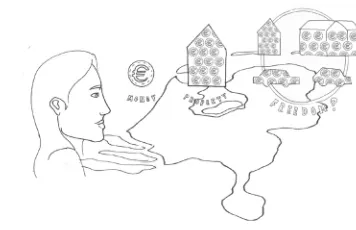
Money buys you time. Time is one of the most important things in our lives. Through centuries we have been favoured with a little more, yet we are highly concerned about our short time on earth. Does this mean that the more money we have, the more time can be literally saved, in such that the more options we have, ‘the freer we are?’ This reasoning has been illustrated in Figure 2. Rudolf Steiner’s understanding of freedom could not be a bigger contrast to ‘freedom of choice by buying what you want’, because the want is steered by perceptions that were arranged by big commercial enterprises.
RUDOLF STEINER (1861-1925)
[image:24.432.45.377.247.446.2]Rudolf Steiner (1921), wrote “Die Philosophie der Freiheit”, which touches the fundamental concept of freedom. “Trotzdem richten sich bis zum heutigen Tage die Hauptangriffe der Freiheits-gegner nur gegen die Wahlfreiheit” (Steiner, 1921). Steiner immediately opposes the idea that freedom cannot merely exist of our freedom to choose the most preferred option from a certain set. He claims that before we know what is truly free, we have to separate terms (“Begriffe”) and ideas (“Ideen”) from the more original thinking (“das Denken”). This is because terms and ideas are shaped by our combined thinking and perceiving (Steiner, 1921). The immediate understanding or perception [the perceptual framework] creates the reason for the want; the character defines whether new activities are aimed for in
favour of that reason (Steiner, 1921). This describes why the thinking on its own is purer than perceiving, because perceptions are framed.
In my view, pure thinking means that you are able to zoom out and reflect on the context in which things are happening, so that your actions always relate to that context with awareness of the context. Figure 3 illustrates this for the bigger scope of money and property. The influence of pure thinking leads to actions that are less dependent on immediate perception. Freedom of thoughts leads to freedom of actions and free people: “Leben in der Liebe zum Handeln und Leben lassen im Verständnisse des fremden Wollen ist die Grundmaxime der freien Menschen” (Steiner, 1921).
Humans are free if they can realise the same “Seelenstimmung” (that lives within them) in their wants, when they are conscious of the arrangement of their absolute ideal (mental) intuitions (Steiner, 1921). To reach this state, it is required that people are more autonomous by nurturing their individuality, which makes it unnecessary to keep hold on their framework that is created by their membership of a certain group (Steiner, 1921).
[image:25.432.224.402.299.414.2]However, we can conclude that we are not free in the way Steiner proposes, since it is very hard for us to rely on our pure thinking, since we are so much involved in the context (Figure 4). Our freedom is most of the time limited to our freedom of choice. This freedom of choice is closely connected to demand and supply, which is related to a perceived scarcity. In design, this ‘scarcity’ is artificially constructed, and tries to work on the human psyche. In the human psyche there always exists a certain discrepancy between demand and supply. There are two ways of tackling this problem: either decreasing demand, as the Stoics declared, or increasing supply, as the Epicureans argued (Sedlacek, 2011). Diogenes, a Stoic, considered himself a ‘free man’ when he got rid of all his belongings, including one of his last ones, a jug, which he did not need because water could be held within one’s hands. Unfortunately, in
[image:25.432.53.218.300.419.2]our present society, such people would be known as ‘hobos’ or homeless people. As well as the moneybags of our society, people who give less power to profit and money agree with a hedonistic9 rather than a Stoic approach. The question remains, are we really ‘free’ if we would be able to buy any conceivable property, or, would we be free if we would have no possessions at all, is questionable: within this range there is opportunity for differentiation. Subsequently, “the ends justify the means” has become the most worldly-practised credo. Sloterdijk (2006), summarised today’s freedom in a pungent way: “people’s minds are not boggled by scarcity and need, but they are boggled by choices. After this change, weak arguments like pure whims and personal tastes have taken over strong arguments, like scarcity and need. This is what we call freedom.”
Thesaurus for Need, Want, Desire and Demand
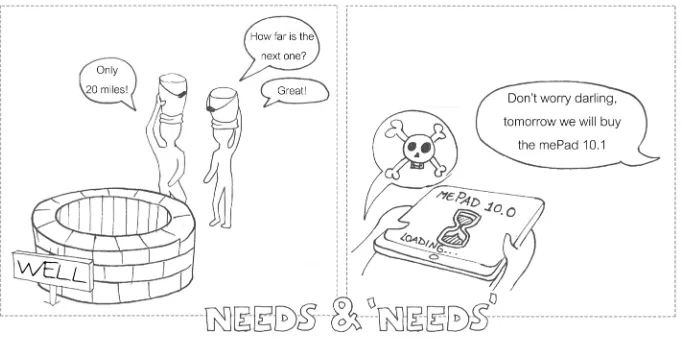
Sloterdijk’s words also show the present meaning of desire. “It appears that ‘the effort to constantly be dissatisfied and want more’ is a natural phenomenon – and lies at the very heart of our civilisation, of being human” (Sedlacek, 2011). The key concept of desire is that it is never ending, since fulfilling desires will create new ones. Therefore, desire is one of the driving factors for the materialism, and therefore of market-capitalism (Sedlacek, 2011) (Barthes, 1983). “From the outset, design was characterised by its dual alliance, its main raison d’être being its role within industrial production but its primary function being that of stimulating desire”(Sparke, 2004). Whereas industry uses and invents people’s ‘desires’, those ‘desires’ are often asserted as ‘needs’, ‘wants’ or ‘demands’. To be able to understand these terms better, the
9 Hedonistic – related to the way Epicurean way of thinking: engaged in the pursuit of pleasure;
[image:26.432.40.381.216.386.2]sensually self-indulgent (Oxford Dictionary)
Figure 5: the difference between needs (necessities) and ‘needs’ (desires)
following explanation is proposed.
1) A ‘need’ has never been totally absolute (Whitely, 1993): different
cultures have different needs. Once, a ‘need’ was close to absolute: a ‘need’ followed from ‘necessity’. Nowadays, a ‘need’ used in design, is the consumer’s ‘wish’ that is induced by marketing. This wish is based on infinitesimal, relative variances in goods or products, that have been greatly inflated.
2) The ‘needs’ we try to fulfil are actually ‘desires’. 3) A ‘want’ can either be a ‘need’ or a ‘desire’.
4) ‘Needs’ and ‘desires’ could all be captured under ‘demand’, however, ‘demand’ is also misused. ‘Demand’ creates the illusion that people are actually requesting the products that industry fabricates.
5) To suggest, ‘demand’ and ‘supply’ do not exist, instead ‘supply’ and ‘eat’ are more applicable. If ‘the supply’ appears to be ‘inedible’ or ‘indigestible’, the product has failed.
6) ‘Scarcity’ can either be (close to) absolute or relative. To propose, ‘scarcity’ is close to absolute if within a society there is a lack of basic necessities. In design, ‘scarcity’ is mostly relative: ‘scarcity’ is constructed by marketing that fakes ‘desires’ and turns them into ‘needs’.
The Neo-liberal Construct: An Introduction to Adam Smith and Ayn Rand
Views on freedom, property and desire are part of a mental legacy that goes beyond the Ancient Greeks. However, in the last three centuries these ideas made a leap towards the rise of Capitalism, which has been shaped by many influential thinkers and philosophers. In the following, Adam Smith and Ayn Rand will be discussed, since they can be found at two ends of a chain of development that concerns the present view and implementation of neo-liberal ideologies. A more detailed elaboration has been done by Achterhuis (2010), who presents many intermediate philosophers. The explication in this text will show how today’s neo-liberal ideologies, such as propagated by Rand – the driving ideology for Capitalism – have been finally derived from the ideas from Adam Smith.
ADAM SMITH (1737-1790)
Adam Smith is often called the ‘father of economics’, and this is due to one the most influential books on our present economic discipline: An inquiry into the Nature and Causes of the Wealth of Nations (abbreviated by “The Wealth of Nations”), written in 1776. The Wealth of Nations contains some very fundamental neo-liberal ideas, that without considering the ethical nuances of his other works, such as The Theory of Moral Sentiments (1759), has led a life of its own.
In the Wealth of Nations, it seems that Smith appoints humans as individuals whose motives are guided by self-interest. In addition, he used the notion of the invisible hand, which has been used as a reason for market-capitalism by other neo-liberal thinkers ever since. He used it once, which adds to a total of three notions, spread over three of his books in three different contexts: “First, as a coordinator of the individual pursuit of self-love, second as the collective hand of redistribution, and third, as a mystical, godlike power” (Sedlacek, 2011,). These three contexts have caused confusion, which clarifies that there is no such thing as a true interpretation. Therefore, it is peculiar that today it is thought that the invisible hand prevents our society from collapsing (Sedlacek, 2011). Moreover, as clarified by Smith (1776), he did not believe in an Open Market, he was aware of dangers and wanted to curb the banks’ scopes and interests.
considered without his principle of loving benevolence. Hence, this leads to the core of the reason why today’s strong belief in some invented interpretation of ‘the invisible hand’ could be brought into question: what if we chose the ethics instead, as dominant belief-set?
AYN RAND (1905-1982)
Among many things, Ayn Rand was an American novelist and thinker. She made up her own philosophy – Objectivism – in which she treats humans as ‘self-serving rationalists’. As said, such theories have developed themselves ever since the Wealth of Nations, and Rand takes it to the extremes. She believes that there exists an objectively perceivable reality which is understandable by human rationing. In this rationing, choosing for oneself is the most reasonable and therefore objective choice; there is no subjective reasoning (Achterhuis, 2010). This ‘Objectivism’ is the driving force of her bulky novel Atlas Shrugged (1957), in which she describes the United States of America (USA) as a dystopian Welfare State, and in which she introduces Atlantis: her capitalist Utopia.
Together with Milton Friedman and Friedrich Hayek, Ayn Rand has been a master for influential American people, such as Alan Greenspan – who has been the chairman of the American Federal Reserve Bank. The monetary system belonging to that bank has affected every person, which was shown by the Financial Crisis in 2008 (Achterhuis, 2010).
“Utopian ideas are often a handsome cover-up for a dystopian reality, so is this Rand’s. The dystopic features of the neoliberal utopia show up more often over the years: People’s interrelations shrink because the whole world is reduced to an open market, violent expropriation and uprooting of large groups of people, increased social inequality, exclusion of civilians that cannot live up to the market, and disruption of governmental influence are just examples” (to paraphrase Achterhuis, 2010).
Humans and Econs
Not only Ayn Rand has treated humans as self-serving rationalists. The ‘homo economicus’10 is a pure rationalist with an endless intelligence, memory and determination (Thaler, 2008). Thaler (2008) makes a difference between econs – the homo economicus, and humans – the homo sapiens.
The Fallacy of Rational Modelling
“Econs live in the land of theory, Humans live in the real world” (Taleb, 2008). ‘Humans’ and ‘Econs’ are so opposing, that mixing up the two has far
reaching consequences, when they are applied to economic models. To make our world understandable, econometrists and mathematicians make up algebraic representations for the many instances our world consists of. By seeking validation for our biases, we try to describe the world in such a way that it becomes predictable. According to Taleb (2008) a world can be approached in two different ways. On the one hand, there is the world of ‘Mediocristan’, in which particular events do not add much individually – only collectively. By using large samples, no single entity will significantly disrupt the combined or the total. “The largest observation will remain remarkable, but eventually insignificant, to the sum” (Taleb).
On the other hand, there is ‘Extremistan’, in which “inequalities are such that one single observation can disproportionately impact the aggregate, or the total” (Taleb).
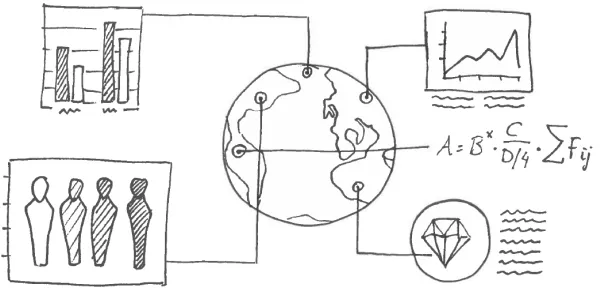
[image:30.432.48.353.442.588.2]The land of theory can be described as ‘Mediocristan’, however, our practical, physical world looks a lot more like ‘Extremistan’, because it mainly grew from rare events. Height, calorie consumption and age belong to ‘Mediocristan’, but wealth, natural disasters, assaults and inventions are the property of ‘Extremistan’. Tomas Sedlacek adds to this “It appears that economic (and other) model prophecies work “well” when reality (randomly or coincidently?) behaves according to those models (therefore [they work] if they do not vary too much from the previous observations the models are based on)” (Sedlacek, 2011). In addition, not only the world is parametrised, but humans are parametrised as ‘Econs’. So, our ‘Mediocristan’ is filled with rational ‘Econs’, which the models try to describe, and the Real World, alias ‘Extremistan’ is filled with humans, and we do not get a good and firm grip on those!
Figure 6: parametrisation of the earth
Multinational Enterprises, Profit and Production Processes
The parametrisation is done by scientists, engineers, designers (everyone who is trying to get a grip on ‘reality’), and within the current economical context, it is done by multi-national enterprises. Planning is a form of parametrisation, and it is one of the driving factors of large enterprises that produce or use advanced technologies. The following paragraphs will briefly describe how this works.
Planning and Advanced Technology
“Planning exists because [it] has ceased to be reliable. Technology, with its companion commitment of time and capital, means that the [desire] of the consumer must be anticipated - by months or years” (Galbraith, 1967). “As viewed by the industrial firm, planning consists of foreseeing the actions required between the initiation of production until its completion and preparing for the accomplishment of these actions. And it consists also of foreseeing, and having a design for meeting, any unscheduled developments, favourable or otherwise, that may occur along the way”(Galbraith, 1967). So, the more complex technology becomes, the more planning it needs. It is important to recognise the influence large enterprises have on many levels because of their planning.
Whereas scientists persistently describe and predict what is happening, multinational corporations plan and prescribe what will happen, in order to keep up their sales, maximise their profits, and keep the enterprise going (Galbraith, 1967). “It is a feature of all planning that, unlike the market, it incorporates within itself no mechanism by which [want] is accommodated to supply and vice versa. This must be deliberately accomplished by human agency” (Galbraith, 1967). In short, within our economic system, demand (or desire) and supply is a farce. Corporations use it as a tool to justify their profit maximisation: they pretend to “react to global market challenges” by “predicting what the consumer [desires] in the future”.
According to Dorfman (1964), the maximisation hypothesis that assumes that profits need to be maximised, is not founded as thoroughly on facts of life as a fundamental scientific hypothesis should be. He adds that differentiations of that ‘profit-maximising’ behaviour are extremely rare, especially when industries have many participants.
technology to get increasingly more advanced, and while proceeding this they need ever more human and material resources, which are found all over the world. Globalisation
“The first attempts to globalisation originate from the rationalisation or blue-printing of the world by ancient cosmologists, who have tried to cast the wholeness of being, with theoretical, or rather morphological seriousness, into a spherical shape, and who have presented this edifying arrangement to the intellect” (to paraphrase Sloterdijk, 2006).
As we have seen in the former chapter, the apparently descriptive scientific models narrows our sight on the real world. Furthermore, they prescribe a certain progress, expressed in economic growth, which ‘requires’ globalisation.
“Within the capitalist framework, economic facts take precedence over mundane facts – however those facts include intrinsic world politics, to be more precisely: they have a geopolitical character, because the Enormous Greenhouse cannot function without security of resources and management of peels that cover it (to paraphrase Sloterdijk, 2006). The core of the Enormous Greenhouse is protected by cultivation of its boundaries. Analogical to that, it is the cultivation of an onion’s peels that protect, and more important, withdraw from the core.
Eventually, due to European colonialism and technological progress, earthly distances could be diminished in time, which increased control. By plane, any place in the world can be reached. “If you take away the dignity of distances, earth and her local ecstasies shrink to an almost nothingness, until her majestic elaborateness is reduced to a worn-out logo” (to paraphrase Sloterdijk, 2006).
Preliminary Conclusion
Part II
The Core of Design
“We pre-suppose labor in a form that stamps it as exclusively human. A spider conducts operations that resemble those of a weaver, and a bee puts to shame many an architect in the construction of her cells. But what distinguishes the worst architect from the best of bees is this, that the architect raises his structure in imagination before he erects it in reality” (Marx, 1867)
Humans have been able to develop from their ancestors, because they were capable of manifestation11. The intrinsic urge of externalisation of ‘thoughts’ and eventually ‘ideas’, resulted into the act of creation (Koestler, 1964). This act of creation made us produce artifacts: objects [and processes or events] that have been intentionally made for some purpose (Aristotle, Physica, Book II) such as tools (technology) and artworks.
As revealed in ‘A Short History of Mass Design Culture’, technology and art were the sources out of which ‘design’ developed. Today, ‘design’ is still understood in multiple ways. By examining its sources – technology and art – and by means of discussing different philosophers, I suggest options for augmented layers on the core of design.
Technology
The first concept that I will discuss, which relates to design is technology. technology has been discussed by numerous philosophers and opinions exist in a highly diverted range. To know what signifies design, we have to know what defines technology. The foundations of technology are based on the fact that a piece of technology serves as an instrument to solve a problem or to serve as a solution. In Die Frage nach der Technik, Heidegger (1954) argues, that when goals have to be reached and means are being used, technology cannot just serve as an instrument. To discover what technology really is, Heidegger uses Aristotles perception of causality, which can be divided into four causes: I) the ‘causa materialis’ – the material; II) the ‘causa formalis’ – the shape or appearance; III) the ‘causa finalis’ – the final goal that defines the shape and material; and IV) the ‘causa efficiens’, the effect that the object brings about. It seems obvious that these causalities provide a reason for any artefact to come into existence. Heidegger says that technology’s tendency to put extreme emphasis to the causa efficiens, is atrap. After long reasoning, he says that this results into the following. “Technology enables and drives us to obtain earth’s natural
11 Manifestation: An event, action, or object that clearly shows or embodies something abstract or
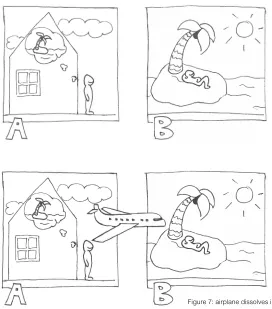
resources, from wherever and whenever we want, in order to store it and have access to it at any time and place.” Heidegger calls this “Bestellen aus das Bestand”, in which ‘Bestand’ stands for a the acquired unlimited guaranty of a possibility to be realised. For instance, an airplane counts for ‘Bestand’ rather than an object. The airplane (Figure 7) as an object would give you the possibility to fly over long distances, this cannot be denied. However, within the context of aviation, the airplane as ‘Bestand’ secures the unlimited traveling and transportation to any place in the world. The fact that the airplane and aviation as a whole belong to ‘Bestand’, indicate that we have lost track of their origin, and this counts for many other technologies, artifacts and systems. They are dissolved into application.
[image:37.432.75.347.208.517.2]Whereas Heidegger claims that in this way technology changes the way humans see and use the world, Verbeek (2000) negates this, he states that “to understand technology, we have to prefer concrete objects to ontological ideas: for reasoning, we need utilitarian objects and appliances.” Verbeek uses Don Idhe’s (1990) classification of human-technology relations to provide for this reasoning. Ihde distinguishes four human-technology relations: 1) embodiment relations, 2) hermeneutic relations, 3)
alterity relations and 4) background relations (Ihde, 1990). Using these relations, Verbeek states that the most important is to look at the way technology ‘mediates the way humans experience the world.’
By comparing Heidegger’s and Verbeek’s views, it is clear that the intrinsic approach on technology and what it does differs from the perspective one takes. In this text it is suggested that technology drives us to ‘Bestellen aus das Bestand’; along with that, a piece of technology mediates the way humans perceive the world. Technology, if designed well, does this mediation in a transparent way: it dissolves into application.
For consumers it is hard to see, understand and recognise how technology is a mediator: technology’s origins have disappeared from sight. We do not recognize how technology drives us towards using the world as a palette with unlimited paint. Art
The matter of paint will take us to the following subject: art. Art has always required craft and manufacturing. It is the outcome of the human characteristic to express oneself. Nevertheless, art defines itself in a completely different way than technology.
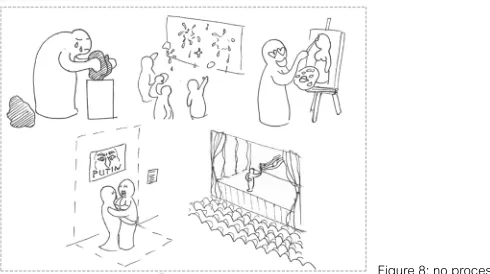
[image:38.432.49.294.450.587.2]“Design, the work of technology, stops, and art begins, when we are unable to take the background of our familiar technologies and activities for granted,” Alva Noë (2015) writes. Walter Benjamin (1977) agrees and writes that the value of a unique piece of art is founded on the ritual of creating (Benjamin, 1977). This is illustrated in Figure 8. Indeed, art is not made for the purpose of being embedded in our lives in a transparent way, because according to Noë (2015):“the measure of art is rarely how well it is made, or how effective it is in fulfilling this or that function”, “it wants to disrupt plain looking”. Art imposes creativity, wonder, and profundity; and accomplishes what technology fails to do.
Art is an Endangered Species 12
Unfortunately, art has a hard time to appeal to a broad public these days. This is more or less induced by technology. Technology made it possible to make art reproducible, that is, photography and film are types of reproduction as well. In Das Kunstwerk im Zeitalter Seiner Technischen Reproduzierbarkeit Benjamin (1977) states, that the reason to make art reproducible results from the larger public’s longing for filling gaps between citizen’s classes, and their passionate efforts to erase the uniqueness of every reality. Furthermore, whereas art requires concentration, today’s larger public is constantly craving for distraction (Benjamin, 1977) The role of art today has changed with this yearning for entertainment. There has emerged a leisure culture in which museums and art-fairs battle to acquire the most popular works in order to draw large audiences. For those audiences, art needs to be clear-cut, by which it easily degrades into terms of beauty and ugliness and loses its origin. Hence, art is endangered by aesthetics, for it is easier to grasp.
Design: What Does It Mean?
By comparing technology to art, the sources that have played a role in the emergence of design, an outline is presented for the meaning of design.
The act of designing is in all steps a creation process. The establishing of the plan for creation, as well as the act of creating raises new questions and requires choices. A century ago, there was more emphasis on the act of an artisan’s/artist’s creation. Since industrial manufacturing of a product required a plan, the emphasis of design has shifted towards the creation of a plan.
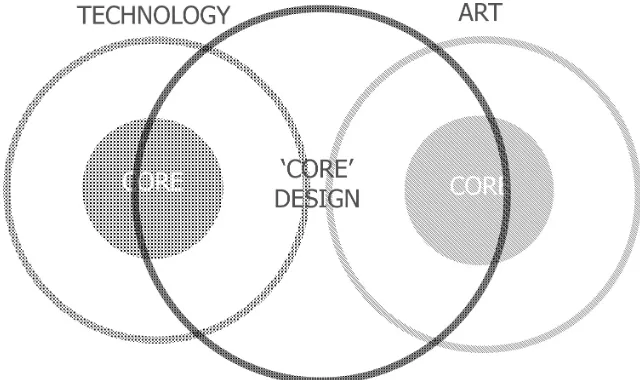
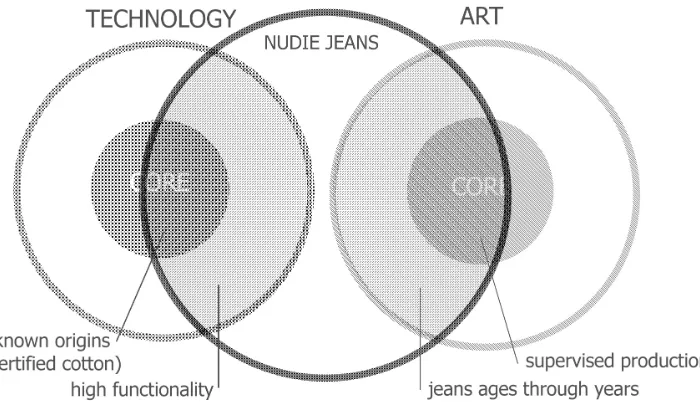
The ‘core’ of design, is that design bridges the act and ritual of creation which belongs to art, and the instrumental utility of technology. A design can inhibit the qualities of technology and art (‘core’ design), such as shown in Figure 10a, but it is even more prone to fall in the accompanying traps (‘common’ design, Figure 9a). Especially ‘designing for industry’ tends to venture these traps, because it depends on both industry and the bulk of consumers. Driven by capital and planning, mass production is the embodiment of ‘Bestellen aus das Bestand’, which is hidden because it dissolves into application and it is distracted by aesthetics. To get a better understanding of the so-called ‘core’ and ‘common’ design, two examples are provided.
12 Art is an Endangered Species: A History of Western Art, Paleolithic-Romanesque (2013) By Zaho
Figure 9a: ‘common’ design
Figure 9a: ‘common’ design
Figure 10a: ‘core’ design
Figure 9b: ‘regular’ smartphone fit to ‘common’ design
42
‘COMMON’ DESIGN
Any regular smartphone serves for the indication ‘common’ design, since it combines both ‘pitfalls’, instrumentality (technology) and aesthetics (art), without considering the cores: material origin and extraction (technology) and process of creation (art) (Figure 9a). A smartphone (Figure 9b) serves many functional purposes: apart from calling and texting, one can make photos of high quality, use social media, watch high quality movies, play games, check emails, etc. In addition, its appearance is ought to be ‘attractive’ and ‘high-end’. However, because both the functional and aesthetic features are satisfying, the ‘core’ stays concealed. There is no sight on the origin and extensive extraction of its materials, and current production of smartphones, such as iPhones by Foxconn13, is misty as well.
‘CORE’ DESIGN
‘Core’ design refers to products that do not dismiss the ‘core of technology’ and the’ core of art’. Such a design goes beyond pure instrumentality and appearance and takes its origin (materials) and (production) processes into account. For example, ‘Nudie Jeans’14 (Figure 10b) produces jeans that are quite wearable pants, and their appearances evolves because of the wearing. The initial ‘dry denim’ looks ‘used’ and ‘acquires history’ over the years, so the owners should get more attached to their jeans. That is not all, in addition, Nudie Jeans claims to be in control of the materials’ origin (certified organic cotton), and supervise the jeans’ production (Nudie Jeans, n.d.). Of course, it is hard to exactly verify, but if it is, it is a good example of ‘core’ design.
Preliminary Conclusion
Within the search for the ‘Core of Design’, the ‘design dogmas’ have been emanated through the exploration on thoughts of the cores of technology and art that resulted in an interpretation of the ‘Core of Design’.
Firstly, while investigating technology, it appeared that technology serves as an instrument, and technology is a mediator, these attitudes cannot stand on their own, which is in contrast to what is thought in general. Indeed, they seem to explain the full definition of technology, actually this is exactly the reason to address them as dogmas.
Secondly, ‘design needs to be functional and aesthetic’ is a belief-set that is
13 Article about Foxconn: ‘1 Million Workers. 90 Million iPhones. 17 Suicides. Who’s to Blame?’ http://
illustrated by exclamations such as ‘form follows function’ (Sullivan, 1924) and ‘form follows fun’ (Peter, 2007).
Part III
The Peels Around the Core of Design
“Stanley slowly peeled an onion. He liked eating them one layer at a time” (Louis Sachar, Holes, 2003)
Consumerism
As shown in ‘A Short History of Mass Design Culture and Production’, company’s effective branding and design strategies have led to a phenomenon that is called ‘consumerism’. Miles (1998) states, that consumerism is a way of life, rather than an act of consumption. Therefore, consumerism is a cultural expression and manifestation of the apparently ubiquitous act of consumption. Miles (1998) suggests, that design maintains consumerism as a way of life. This is because “consumers are encouraged to become members of a consumer society by purchasing goods primarily through the attraction of superficial differentiations in design” (Miles, 1998). These superficial differentiations in design, is what I call the ‘peels’ around the ‘core’ of design, a concept which will be elucidated in the succeeding text.
Design Niches as Peels
[image:46.432.69.353.340.439.2]To paint a picture, the Netherlands counts more than thirty different ‘creative’ educational programmes. This is to provide all creative branches with creative professionals. According to Centraal Bureau voor Statistiek (2011), 42% of the creative industry exists of professionals occupied with ‘creative commercial services’, which is a total of 71.000 workers. 20.000 people have an architectural or engineering profession, 15.000 work for the graphical industry and 12.000 people work at advertising agencies (Urlings & Braams, 2011).
Figure 11: peels of an onion cover up its core, design peels cover the ‘core’ of design
These numbers indicate only the top layer of the vast amount of niches that exist within design, that needs professionals. The niches or rather ‘peels’, have emerged around the ‘core’ of design. These peels cover up the ‘core’ of design, by focusing on the extreme detailing of within design areas, which is illustrated in Figure 11. The moment that a plan, draft or process is needed to create an artefact, there is the tendency to call it design. Despite this, the purpose of design has shifted throughout the centuries, which is partly explained in ‘A Short History of Mass Design Culture and Production’. Before ‘mass design culture’, the creation of useful solutions to fundamental problems provided a reason good enough to create a tool or appliance in the first place. What’s more, the creation of appliances/devices was not the monopoly of designers – since so-called ‘designers’ did not exist – but it was done by anyone who had insight into solutions and had the skills to execute her or his ideas. Industrial Design, as it came into existence during Modernity, has an intrinsic commercial value. This exact commercial value is the reason for the development of the enormous amount of niches. To illustrate this range: today’s design engineering explores extraordinarily advanced territory, such as aerospace, nanotechnology and virtual reality. In contrast, design that is closely connected to styling, is occupied with the graphical language of products and packages. For every layer, the growth of new peels around the core increased differentiation and augmentation. It seems that being a designer means that one is part of the league, in which income is based on what Sloterdijk (2006) calls ‘non-performance’. A profession of ‘non-performance’ is indicated as a job that has no specific purpose other than to earn a living.
Intermezzo - The Consequences of
Capitalism on Nature
“The asymmetrical world occupancy has its fundaments in the harbours, courts and ambitions of Europe” (to paraphrase Sloterdijk, 2006). Firstly, this asymmetry is represented within the world’s population progress: “of the now seven billion people in the world, one billion people live in the Americas, one billion in Europe, one billion in Africa and four billion in Asia” (Rosling, 2014) . By the end of the century, Africa’s population will be four billion people, and there will be five billion people in Asia (Rosling, 2014). Secondly, this huge population increase has a clear correlation to extreme poverty within those areas (Rosling, 2014). These facts indicate how wealth is unevenly distributed, which is an asymmetry that is expressed in First and Third World living standards, and the efforts of Brazil, Russia, India and China (BRICs) and other developing countries to close that gap. This has big consequences that unfortunately are usually ignored (Diamond, 2005).
These countries try to live up to a modern society, which does not lean on the “liberation of humans from unproductivity of which they are guilty themselves” (Dostojevski, 1992), as it does on the fact that the “space for action and experience is constantly overflowed by undeserved richness and energy” (Sloterdijk, 2006). This means that there exists an aspiration for a modern society, like ours, in which people do not contribute to the wealth that was once acquired for them, of which they are not aware.
“The prohibition of squandering has been replaced by banning frugality” (to paraphrase Sloterdijk, 2006). Because the appearance of motors gave a new meaning to power, energy, expression, operation and freedom (Sloterdijk, 2006), “the exploitation of humans by humans has been replaced by systematically exploiting the earth by humans” (Sloterdijk, 2006). “In the past, the complete human had to make a long journey to get access to scattered, esoteric and expensive sources of development, whereas in the present it is sufficient to learn how to use productive access-technologies” (to paraphrase Sloterdijk, 2006).
Purpose of the Intermezzo
‘causa materialis’ (Aristotle, Physics Book II, 350 B.C.E.). In the use of resourcesfor any design, the most important part of the word, ‘source’, is easily forgotten. This ‘Intermezzo’ elaborates how the extraction of non-renewable and renewable resources affects our planet. First, we will address the extent of the problem, by revealing the way it disturbed our planet already. Then, the effects caused by act of extraction itself will be presented. Subsequently, we will turn to the problems caused by the use of the extracted natural resources for products.
The Magnitude of the Problem
Global material extraction has grown by more than 90% over the past 30 years and is reaching almost 70 billion tonnes today (Giljum et al., 2014). This has major consequences: the extraction and use of many resources as well as the release of waste and emissions from their use have exceeded crucial ecological limits (Giljum et al., p. 319). In the past, some societies – Societies on Easter Islands and Pitcairn Islands, the Mayas, the Vikings on Iceland, and the Norse on Greenland (Diamond, 2005) – have even collapsed precisely because of natural resource depletion. These societies were very remote and were unable to adapt to the (new, acquired, colonised) habitat. Traditional values were one of the causes of this inability to change. Nowadays, not so accessible societies, such as Rwanda, Australia, India and China cope with the consequences of this resource depletion directly, not to speak of all other societies that depend upon both non-renewable natural resources (like oil and metals) and renewable ones (like wood and fish) extracted from more remote areas (Diamond, 2005). Proceeding extraction of non-renewable resources requires increasingly extensive ways to obtain them, which implicates higher environmental burden (Mudd, 2009), and various renewable resources are extracted at a much faster rate than what our global ecosystem can regenerate (WWF, 2012).
[image:49.432.58.388.436.612.2]50
eventually eco-system earth will be demolished if depletion will last until the end. The following section will elaborate on the extraction of non-renewable and renewable resources respectively. Furthermore, it will describe the material consumption that belongs to material extraction, which can be related to consumption of products and therefore to design.
Extraction and Usage of Non-renewable Resources
“Since 1980, global material extraction grew on average 2.4% per year, with an aggregated growth of 93.4%, from around 35 billion tonnes in 1980 to 67.6 billion tonnes in 2009. The share of non-renewable materials (fossil fuels, metal ores and minerals) in global extraction increased from 61% in 1980 to 71% in 2009” (Giljum et al., 2014). Non-renewable resources do not reproduce themselves, and they are not an important part of the environment. They become formed over long geological times, but that is much too slow to balance our pumping extraction rates (Diamond, 2005).
First, we will discuss non-renewable resources that are extracted through mining. For hard coal and hard rock mining, the act of extraction leads directly to land degradation and therefore soil erosion (Diamond, 2005), which hugely affects the ecosystem, since flora needs the fertile soil to grow on and fauna needs flora and ground for food and shelter. In addition, the environment gets intoxicated because hard rock mining creates a lot of heavy metal waste, which is dumped on the grounds and the rivers (Diamond, 2005). Of all fossil fuels, hard coal is extracted the most often: it encompasses 46% of all fossil fuel extraction (Giljum et al., 2014) (The Guardian, 2014). The drilling of crude oil (27% of all fossil fuels) and natural gas (17% of all fossil fuels) does not directly rupture the whole surface, since an oil well can access the source at one place, but drilling can eventually cause earthquakes (Smith, 2015). Furthermore, oil and gas leakage caused by accidents is extremely damaging.
The main purpose of fossil fuels such as gas, oil and coals is to be used as a source of energy (The Guardian, 2015). Apart from the act of extraction, the eventual use of these resources has significant effects on earth, its eco-systems and its earthlings (The Guardian, 2014). Fossil fuel combustion is the most important source for greenhouse gas emissions (IPCC, 2013)15, therefore, its combustion is clearly linked to climate change (350.org, 2014)16. The consequences of climate change are numerous, and they will be noted shortly: world’s water resources are affected by melting of glaciers; marine, freshwater and terrestrial species have shifted their geographic ranges, seasonal activities migration patterns, abundances, and species
15 Intergovernmental Panel on Climate Change