University of Warwick institutional repository: http://go.warwick.ac.uk/wrap
This paper is made available online in accordance with
publisher policies. Please scroll down to view the document
itself. Please refer to the repository record for this item and our
policy information available from the repository home page for
further information.
To see the final version of this paper please visit the publisher’s website.
Access to the published version may require a subscription.
Author(s): Kasra Rafi and Saul Schleimer
Article Title: Curve complexes are rigid
Year of publication: 2011
Link to published article:
KASRA RAFI and SAUL SCHLEIMER
Abstract
Any quasi-isometry of the curve complex is bounded distance from a simplicial auto-morphism. As a consequence, the quasi-isometry type of the curve complex determines the homeomorphism type of the surface.
1. Introduction
Thecurve complexof a surface was introduced into the study of Teichm¨uller space by Harvey [11] as an analogue of the Tits building of a symmetric space. Since then the curve complex has played a key role in many areas of geometric topology such as the classification of infinite volume hyperbolic three-manifolds, the study of the cohomology of mapping class groups, the geometry of Teichm¨uller space, and the combinatorics of Heegaard splittings. Our motivation is the work of Masur and Minsky [22], [23], which focuses on the coarse geometric structure of the curve complex, the mapping class group, and other combinatorial moduli spaces. It is a sign of the richness of low-dimensional topology that the geometric structure of such objects is not well understood. Suppose thatS = Sg,bis an orientable, connected, compact surface with genusgand withbboundary components. Define thecomplexityofSto beξ(S)=3g−3+b. LetC(S) be the curve complex ofS. Our main theorem is the following.
THEOREM7.1
Suppose thatξ(S)≥2. Then every quasi-isometry ofC(S)is bounded distance from a simplicial automorphism ofC(S).
Before discussing the sharpness of Theorem 7.1 recall the definition ofQI(X). This is the group of quasi-isometries of a geodesic metric spaceX, modulo an equivalence relation; quasi-isometriesf andgare equivalent if and only if there is a constantdso that for everyx∈Xwe havedX(f(x), g(x))≤d. DefineAut(C(S)) to be the group of simplicial automorphisms ofC(S); notice that these are always isometries. From Theorem 7.1 deduce the following.
DUKE MATHEMATICAL JOURNAL
Vol. 158, No. 2, c2011 by Kasra Rafi and Saul Schleimer DOI 10.1215/00127094-1334004 Received 1 February 2009. Revision received 5 September 2010.
2010Mathematics Subject Classification.Primary 57M50; Secondary 20F65.
COROLLARY1.1
Suppose thatξ(S)≥2. Then the natural mapAut(C(S))→QI(C(S))is an isomor-phism.
Proof
The map is always an injection. To see this, recall Ivanov’s theorem (see [13], [19], [21]): ifξ(S) ≥2,then everyf ∈Aut(C(S)) is induced by some homeomorphism ofS, calledfS. (Whenξ(S) = 2 every automorphism of C(S) is induced by some homeomorphism ofS0,5; see [21].) Suppose thatf ∈ Aut(C(S)) is not the identity
element. Then there is some curveawithfS(a) not isotopic toa. Consider the action of fS on PML(S). There is a small neighborhood of a in PML(S), say U, so that fS(U)∩U = ∅. Since ending laminations are dense,fS moves some ending lamination ofS. By Klarreich’s [18, Theorem 1.3] theorem (see Theorem 2.3 below), we deduce thatf moves some point of∂C(S). Finally, any isometry of a Gromov hyperbolic space moving a point of the boundary is nontrivial in the quasi-isometry group.
On the other hand, Theorem 7.1 implies that the homomorphismAut(C(S)) →
QI(C(S)) is a surjection. 䊐
Note that Theorem 7.1 and Corollary 1.1 are sharp. IfS is a sphere, disk, or pair of pants, then the complex of curves is empty. IfSis an annulus, then, following [23], the complexC(S) is quasi-isometric toZ(see below) and the conclusion of Theorem 7.1 does not hold. IfS is a torus, four-holed sphere, or once-holed torus, then the curve complex is a copy of the Farey graph. Thus C(S) is quasi-isometric to T∞, the countably infinite valence tree [4]. HenceQI(C(S)) is uncountable while Aut(C(S))= PGL(2,Z) is countable. Thus, for these surfaces the conclusion of Theorem 7.1 does not hold.
We now give an application of Corollary 1.1.
THEOREM1.2
Suppose thatSandare surfaces withC(S)quasi-isometric toC(). Then r Sandare homeomorphic,
r {S, } = {S
0,6, S2},
r {S, } = {S
0,5, S1,2},
r {S, } ⊂ {S
0,4, S1, S1,1}, or
r {S, } ⊂ {S,D, S0,3}.
Thus, two curve complexes are quasi-isometric if and only if they are isomorphic.
THEOREMA.1
Suppose thatS and are compact, connected, orientable surfaces withMC G(S) isomorphic toMC G(). Then
r Sandare homeomorphic, r {S, } = {S
1, S1,1}, or
r {S, } = {S,D}.
Apparently no proof of Theorem A.1 appears in the literature. In Appendix 7 we discuss previous work (Remark A.2) and, for completeness, we give a proof of Theorem A.1.
Proof of Theorem 1.2
For brevity, we restrict to the case whereξ(S) andξ() are at least four. By Corol-lary 1.1 the automorphism groups ofC(S) andC() are isomorphic. Ivanov’s theo-rem (see [13], [19], [21]) tells us that the simplicial automorphism group is isomorphic to the mapping class group. Finally, it follows from Theorem A.1 that such surfaces are characterized, up to homeomorphism, by their mapping class groups. 䊐
Outline of the paper
The proof of Theorem 7.1 has the following ingredients. A pair of ending laminations iscoboundedif the projections of this pair to any strict subsurface ofSare uniformly close to each other in the complex of curves of that subsurface (see Definition 2.8).
THEOREM5.2
Suppose that ξ(S) ≥ 2, and suppose that φ: C(S) → C()is a quasi-isometric embedding. Then the induced map on boundaries preserves the coboundedness of ending laminations.
Theorem 5.2 is important in its own right and may have other applications. For example, it may be helpful in classifying quasi-isometric embeddings of one curve complex into another (see [26]). The proof of Theorem 5.2 uses the following theorem in an essential way.
THEOREM1.3 (Gabai [8, Theorem 0.1])
Suppose thatξ(S)≥2. Then∂C(S)is connected.
Remark 1.4
Leininger and Schleimer [20] previously gave a quite different proof of Theorem 1.3 in the cases whereS has genus at least four, or whereS has genus at least two and nonempty boundary. Note that Gabai’s theorem is sharp;∂C(S) is not connected when
LetM(S) denote themarking complexof the surfaceS. We show that a marking on
S can be coarsely described by a pair of cobounded ending laminations and a curve inC(S). Theorem 5.2 implies that a quasi-isometric embedding ofC(S) intoC() induces a map fromM(S) toM().
THEOREM6.1
Suppose that ξ(S) ≥ 2andφ: C(S) → C() is a q-quasi-isometric embedding. Thenφinduces a coarse Lipschitz map: M(S)→M()so that the diagram
M(S) −−−−→ M() ⏐⏐
p ⏐⏐π
C(S) −−−−→φ C()
commutes up to an additive error. Furthermore, ifφis a quasi-isometry, then so is.
As the final step of the proof of Theorem 7.1 we turn to a recent theorem of Behrstock, Kleiner, Minsky, and Mosher [2] (see also [10]).
THEOREM1.5
Suppose thatξ(S)≥2andS =S1,2. Then every quasi-isometry ofM(S)is bounded distance from the action of a homeomorphism ofS.
So, iff: C(S)→C(S) is a quasi-isometry, then Theorem 6.1 gives a quasi-isometry
F of marking complexes. This and Theorem 1.5 imply Theorem 7.1, except when
S = S1,2. But the curve complexesC(S0,5) andC(S1,2) are identical. Therefore to
prove Theorem 7.1 forC(S1,2) it suffices to prove it forC(S0,5).
2. Background
Hyperbolic spaces
A geodesic metric spaceXisGromov hyperbolicif there is ahyperbolicity constant δ ≥ 0 so that every triangle isδ-slim: for every triple of verticesx, y, z ∈ X and every triple of geodesics[x, y],[y, z],[z, x] theδ–neighborhood of[x, y]∪[y, z] contains[z, x].
Suppose that(X, dX) and (Y, dY) are geodesic metric spaces andf: X→Yis a map. Thenf isq-coarsely Lipschitzif for allx, y ∈Xwe have
wherex=f(x) andy=f(y). If, in addition,
dX(x, y)≤qdY(x, y)+q,
thenf is aq-quasi-isometric embedding. Two mapsf, g: X→Yared-closeif for allx∈Xwe have
dY
f(x), g(x)≤d.
Iff: X→Yandg: Y→Xareq-coarsely Lipschitz and alsof ◦gandg◦f are q-close to identity maps thenf andgareq-quasi-isometries.
A quasi-isometric embedding of an interval[s, t]⊂Z, with the usual metric, is called aquasi-geodesic. In hyperbolic spaces quasi-geodesics arestable.
LEMMA2.1
Suppose that(X, dX)has hyperbolicity constantδand thatf: [s, t]→ X is aq -quasi-geodesic. Then there is a constantMX =M(δ,q)so that for any[p, q]⊂[s, t] the imagef([p, q])and any geodesic[f(p), f(q)]have Hausdorff distance at most MXinX.
See [6] for further background on hyperbolic spaces.
Curve complexes
LetS = Sg,b, as before. Define the vertex set of the curve complex,C(S), to be the set of simple closed curves inSthat are essential and nonperipheral, considered up to isotopy.
When the complexity ξ(S) is at least two, distinct vertices a, b ∈ C(S) are connected by an edge if they have disjoint representatives.
Whenξ(S)= 1 distinct vertices are connected by an edge if there are represen-tatives with geometric intersection exactly one for the torus and once-holed torus or exactly two for the four-holed sphere. This gives theFarey graph. WhenSis an annulus the vertices are essential embedded arcs, considered up to isotopy fixing the boundary pointwise. Distinct vertices are connected by an edge if there are representatives with disjoint interiors.
For any vertices a, b ∈ C(S) define the distance dS(a, b) to be the minimal number of edges appearing in an edge path betweenaandb.
THEOREM2.2 (Masur and Minsky [22, Theorem 1.1]) The complex of curvesC(S)is Gromov hyperbolic.
Boundary of the curve complex
Let∂C(S) be the Gromov boundary ofC(S). This is the space of quasi-geodesic rays inC(S) modulo equivalence: two rays are equivalent if and only if their images have bounded Hausdorff distance.
Recall thatPML(S) is the projectivized space of measured laminations onS. A measured lamination isfillingif every componentS is a disk or a boundary-parallel annulus. TakeFL(S)⊂PML(S) to be the set of filling laminations with the subspace topology. DefineEL(S), the space of ending laminations, to be the quotient ofFL(S) obtained by forgetting the measures. See [17] for an expansive discussion of laminations.
THEOREM2.3 (Klarreich [18, Theorem 1.3])
There is a mapping class group equivariant homeomorphism between ∂C(S) and
EL(S).
We defineC(S)=C(S)∪∂C(S).
Subsurface projection
Suppose thatZ⊂S is anessentialsubsurface:Zis embedded, every component of
∂Zis essential inS, andZis not a boundary-parallel annulus or a pair of pants. An essential subsurfaceZ⊂S isstrictifZis not homeomorphic toS.
A laminationbcutsa subsurfaceZif every isotopy representative ofbintersects
Z. Ifbdoes not cutZ,thenbmissesZ.
Suppose now thata, b ∈ C(S) both cut a strict subsurface Z. WhenZ is not an annulus, define thesubsurface projection distancedZ(a, b) as follows: isotopea
with respect to∂Z to realize the geometric intersection number. Surger the arcs of
a∩Z to obtainπZ(a), a finite set of vertices in C(Z). WhenZ is an annulus, let
SZ
be the annular cover ofSdetermined byZ. Now defineπZ(a) to be all essential arcs in the lift ofatoSZ. Notice thatπ
Z(a) has uniformly bounded diameter inC(Z) independent ofa,Z,orS. Define
dZ(a, b)=diamZπZ(a)∪πZ(b)
.
We now recall the Lipschitz projection lemma proved in [23, Lemma 2.3]. (See also the material on projection bounds in [25, Section 4].)
LEMMA2.4 (Masur and Minsky)
For geodesics, Masur and Minsky have given a much stronger result: the bounded geodesic theorem (see [23], [25]).
THEOREM2.5
There is a constantc0=c0(S)with the following property. For any strict subsurface
Z and any pointsa, b ∈ C(S), if every vertex of the geodesic[a, b] cutsZ,then dZ(a, b)<c0.
Marking complex
We now discuss themarking complex, following Masur and Minsky [23]. Acomplete clean markingmis a pants decompositionbase(m) ofStogether with atransversal ta for each elementa ∈base(m). To defineta, letXa be the nonpants component of
S(base(m){a}). Then any vertex ofC(Xa) not equal toaand meetingaminimally may serve as a transversalta. Notice that diameter ofminC(S) is at most 2.
Masur and Minsky also defineelementary moveson markings. The set of markings and these moves define the marking complex M(S): a locally finite graph quasi-isometric to the mapping class group. The projection mapp:M(S)→C(S), sending
mto any element ofbase(m), is coarsely mapping class group equivariant. We now record, from [23], the elementary move projection lemma.
LEMMA2.6
Ifmandmdiffer by an elementary move, then for any essential subsurfaceZ⊆ S, we havedZ(m, m)≤4.
A converse follows from thedistance estimate[23].
LEMMA2.7
For every constant cthere is a bounde = e(c, S) with the following property. If dZ(m, m)≤cfor every essential subsurfaceZ⊆S,thendM(m, m)≤e.
Tight geodesics
The curve complex is locally infinite. Generally, there are infinitely many geodesics connecting a given pair of points in C(S). In [23] the notion of a tight geodesic is introduced. This is a technical hypothesis which provides a certain kind of local finiteness. Lemma 2.9 below is the only property of tight geodesics used in this paper.
Definition 2.8
Minsky [25, Lemma 5.14] shows that ifa, b∈C(S) are distinct points, then there is a tight geodesic[a, b] ⊂ C(S) connecting them. All geodesics from here on are assumed to be tight.
LEMMA2.9 (Minsky)
There is a constantc1 =c1(S)with the following property. Suppose that(a, b)is a c-cobounded pair in C(S)and c ∈ [a, b] is a vertex of a tight geodesic. Then the pairs(a, c)and(c, b)are(c+c1)-cobounded.
3. Extension lemmas
We now examine how points ofC(S) can be connected to infinity.
LEMMA3.1 (Completion)
There is a constantc2 = c2(S)with the following property. Suppose thatb∈ C(S) and ∈C(S). Suppose that the pair(b, )isc-cobounded. Then there is a marking mso thatb∈base(m)and(m, )are(c+c2)-cobounded.
The existence of the markingmfollows from the construction preceding [1, Lemma 6.1].
LEMMA3.2 (Extension past a point)
Suppose thata, z ∈ C(S)witha = z. Then there is a point ∈∂C(S)so that the vertexalies in the one-neighborhood of[z, ].
Proof
Letk ∈∂C(S) be any lamination. LetY be a component ofSathat meetsz. Pick any mapping classφwith support inY and with translation distance at least(2c0+2) inC(Y). We have either
dY(z, k)≥c0 or dY
z, φ(k)≥c0.
By Theorem 2.5, at least one of the geodesics[z, k] or [z, φ(k)] passes through the
one-neighborhood ofa. 䊐
PROPOSITION3.3 (Extension past a marking)
There is a constant c3 = c3(S) such that if m is a marking onS, then there are laminationsk and such that the pairs(k, ),(k, m),and(m, )arec3-cobounded and[k, ]passes through the one-neighborhood ofm.
There are only finitely many markings up to the action of the mapping class group. Fix a class of markings and pick a representativem. We find a pseudo-Anosov map with stable and unstable laminationskand such that[k, ] passes through the one-neighborhood ofm. This suffices to prove the proposition: there is a constantc3(m) large enough so that the pairs(k, ), (k, m), and (m, ) arec3(m)-cobounded. The same constant works for every marking in the orbitMC G(S)·m, by conjugation. We can now takec3to be the maximum of thec3(m) asmranges over the finitely many points of the quotientM(S)/MC G(S).
So choose any pseudo-Anosov mapφwith stable and unstable laminationsk
and . Choose any pointb ∈[k, ]. We may conjugateφtoφ, sending(k, , b) to (k, , b), so thatb is disjoint from some curve a ∈ base(m). This finishes the
proof. 䊐
4. The shell is connected
LetB(z,r) be the ball of radiusraboutz∈C(S). The difference of concentric balls is called ashell.
PROPOSITION4.1
Suppose thatξ(S)≥2andd≥max{δS,1}. Then, for anyr≥0, the shell
B(z,r+2d)B(z,r−1)
is connected.
Below we only need the corollary thatC(S)B(z,r−1) is connected. However, the shell has other interesting geometric properties. We hope to return to this subject in a future paper.
One difficulty in the proof of Proposition 4.1 lies in pushing points of the inner boundary into the interior of the shell. To deal with this we use the fact thatC(S) has nodead ends.
LEMMA4.2
Fix verticesz, a∈C(S). SupposedS(z, a)=r. Then there is a vertexa∈C(S)with dS(a, a)≤2,anddS(z, a)=r+1.
Proof of Proposition 4.1
For any z ∈ C(S) and any geodesic or geodesic segement [a, b] ⊂ C(S) define
dS(z,[a, b])=min{dS(z, c)|c∈[a, b]}. Define a product onC(S) by
a, bz=inf
dS
z,[a, b],
where the infimum ranges over all geodesics[a, b]. For everyk ∈∂C(S) let
U(k)= ∈∂C(S)k, z>r+2d
.
The setU(k) is a neighborhood ofk by the definition of the topology on the bound-ary (see [9]). Notice that if ∈U(k), thenk ∈U( ).
Consider the setV(k) of all ∈ ∂C(S) so that there is a finite sequence k = k0, k1, . . . , kN = withki+1 ∈U(ki) for alli. Now, if ∈V(k),thenU( )⊂V(k); thusV(k) is open. If is a limit point ofV(k),then there is a sequence i ∈V(k) entering every neighborhood of . So there is somei where i ∈ U( ). Thus ∈
U( i) ⊂ V(k), and we find that V(k) is closed. Finally, as ∂C(S) is connected (Theorem 1.3),V(k)=∂C(S).
Leta, bbe any vertices in the shellB(z,r+2d)B(z,r−1). We connecta, via a path in the shell, to a vertexaso thatdS(z, a)=r+d. This is always possible: points far fromzmay be pushed inward along geodesics and points nearzmay be pushed outward by Lemma 4.2. Similarly connectbtob.
By Lemma 3.2 there are pointsk, ∈∂C(S) so that there are geodesic rays [z, k] and[z, ] within distance one ofaandb,respectively. Connectkto by a chain of points{ki}inV(k), as above. Defineai ∈[z, ki] so thatdS(z, ai)=r+d. Connecta toa0via a path of length at most2.
Notice thatdS(ai,[ki, ki+1]) > d ≥ δ. As triangles are slim, the vertex ai is
δ-close to[z, ki+1]. Thusaiandai+1may be connected inside the shell via a path of
length at most2δ. 䊐
5. Image of a cobounded geodesic is cobounded We begin with a simple lemma.
LEMMA5.1
For everycandrthere is a constantKwith the following property. Let[a, b]⊂C(S) be a geodesic segment of length 2r with (a, b) being c-cobounded. Let z be the midpoint. Then there is a path P of length at mostK connectinga tob outside of
κ
λ
a k
α
b β
z
φ(z)
∂
[image:12.491.102.386.95.233.2](S) ( )
Figure 1. Points outside anr-ball aboutzare sent byφoutside an (q+M+2)-ball about∂.
Proof
There are only finitely many such triples (a, z, b), up the action of the mapping class group. (This is because there are only finitely many hierarchies having total length less than a given upper bound; see [23].) The conclusion now follows from the connectedness of the shell (Proposition 4.1). 䊐
Note that any quasi-isometric embeddingφ:C(S)→C() extends to a one-to-one continuous map from∂C(S) to∂C().
THEOREM5.2
There is a functionH: N→N, depending only onqand the topology ofSand, with the following property. Suppose that(k, )is a pair ofc-cobounded laminations and φ: C(S) →C()is aq-quasi-isometric embedding. Thenκ =φ(k)andλ=φ( ) areH(c)-cobounded.
Proof
For every strict subsurface ⊂ we must bound d(κ, λ) from above. Now, if
d(∂,[κ, λ]) ≥ 2, then by the bounded geodesic image theorem (2.5) we find
d(κ, λ)≤c0=c0(),and we are done.
Now supposed(∂,[κ, λ])≤1. Note that [κ, λ] lies in theM-neighborhood of
φ([k, ]), whereM =M is provided by Lemma 2.1. Choose a vertexz∈[k, ] so thatd(φ(z), ∂)≤M+1. Setr=q(q+2M+3)+q. Thus
dS(y, z)≥r =⇒ d
φ(y), φ(z)≥q+2M+3
=⇒ d
Letaandbbe the intersections of[k, ] with∂B(z,r), chosen so that [k, a] and [b, ] meetB(z,r) at the verticesa andbonly. Connecta tobvia a pathP of lengthK, outsideB(z,r−1), as provided by Lemma 5.1.
Letα=φ(a) andβ=φ(b). Now, any consecutive vertices ofP are mapped by
φ to vertices ofC() that are at distance at most 2q. Connecting these by geodesic segments gives a pathfromαtoβ.
Note thathas length at most2qK. Since every vertex ofφ(P) is (q+M+2)-far from∂every vertex ofis(M+2)-far from∂. So every vertex ofcuts. It follows thatd(α, β)≤6qK, by Lemma 2.4.
All that remains is to boundd(κ, α) andd(β, λ). It suffices, by the bounded geodesic image theorem, to show that every vertex of[κ, α] cuts. The same holds for[β, λ].
Every vertex of[κ, α] isM-close to a vertex ofφ([k, a]). But each of these is (q+M+2)-far from∂. This completes the proof. 䊐
6. The induced map on markings
In this section, given a quasi-isometric embedding of one curve complex into another we construct a coarsely Lipschitz map between the associated marking complexes.
Let M(S) andM() be the marking complexes of S and, respectively. Let
p: M(S) → C(S) and π: M() → C() be maps that send a marking to some curve in that marking.
THEOREM6.1
Suppose that ξ(S) ≥ 2andφ: C(S) → C() is a q-quasi-isometric embedding. Thenφinduces a coarse Lipschitz map: M(S)→M()so that the diagram
M(S) −−−−→ M() ⏐⏐
p ⏐⏐π
C(S) −−−−→φ C()
commutes up to an additive error. Furthermore, ifφis a quasi-isometry, then so is.
Proof
For a markingmand laminationskand , we say the triple(m, k, ) isc-admissible if r dS(m,[k, ])≤3 and
r the pairs(k, m), (m, ), and (k, ) arec-cobounded.
λ
λ
κ
κ
α
α
μ
μ
[image:14.491.166.323.94.255.2]( )
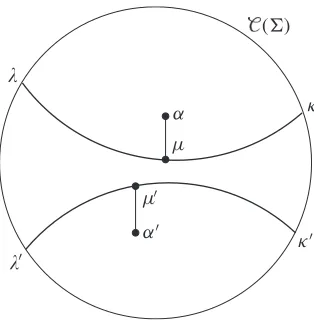
Figure 2. Markingsμandμare bounded apart.
Given ac-admissible triple(m, k, ) we now construct a triple (μ, κ, λ) for. Letαbe any curve inφ(m)⊂C(),κ=φ(k),andλ=φ( ). Note that
d
α,[κ, λ]≤4q+M, (6.2) by the stability of quasi-geodesics (Lemma 2.1). Also(κ, λ) is aH(c)-cobounded pair, by Theorem 5.2. Letβbe a closest point projection ofα to the geodesic[κ, λ]. By Lemma 2.9, the pair(β, κ) is (H(c)+c1)-cobounded. Using Lemma 3.1, there is a markingμso thatβ∈base(μ) and (μ, κ) are (H(c)+c1+c2)-cobounded. Therefore, forC=2H(c)+c1+c2the triple(μ, κ, λ) isC-admissible. Define(m) to be equal toμ.
We now proveis coarsely well defined and coarsely Lipschitz. Suppose thatm
andmdiffer by at most one elementary move and the triples(m, k, ) and (m, k, ) arec-admissible. Let(μ, κ, λ) and (μ, κ, λ) be any corresponding C-admissible triples in, as constructed above (see Figure 2). We must show that there is a uniform bound on the distance betweenμand μ in the marking graph. By Lemma 2.7, it suffices to prove the following.
Claim
For every subsurface⊆,d(μ, μ)=O(1).
Now, Lemma 2.6 givesdS(m, m)≤4. Deduce
d
Therefore,
d(μ, μ)≤d
μ, φ(m)+d
φ(m), φ(m)+d
φ(m), μ)
≤2(7q+M+2)+5q.
On the other hand, for any strict subsurface⊂, we have
d(μ, μ)≤d(μ, κ)+d(κ, κ)+d(κ, μ).
The first and third terms on the right-hand side are bounded byC. By Theorem 5.2, the second term is bounded byH(2c+4). This is because, for every strict subsurface
Y ⊂S,
dY(k, k)≤dY(k, m)+dY(m, m)+dY(m, k)≤2c+4.
This proves the claim; thusis coarsely well defined and coarsely Lipschitz. Now assume that φ is a quasi-isometry with inverse f: C() → C(S). Let
andF be the associated maps between marking complexes. We must show that
F ◦is close to the identity map onC(S). Fixm ∈M(S) and defineμ= (m),
m=F(μ). For any admissible triple (m, k, ) we have, as above, an admissible triple (μ, κ, ). Sincef(κ) =k andf(λ)= it follows that(m, k, ) is also admissible for a somewhat larger constant.
As above, by Lemma 2.7 it suffices to show thatdZ(m, m) = O(1) for every essential subsurfaceZ⊂S. Sincef◦φis close to the identity, commutivity up to ad-ditive error implies thatdS(m, m) is bounded. Since (m, k) and (m, k) are cobounded, the triangle inequality implies thatdZ(m, m)= O(1) for strict subsurfacesZ⊂ S.
This completes the proof. 䊐
7. Rigidity of the curve complex
THEOREM7.1
Suppose thatξ(S)≥2. Then every quasi-isometry ofC(S)is bounded distance from a simplicial automorphism ofC(S).
Proof
Let f: C(S) → C(S) be a q-quasi-isometry. By Theorem 6.1 there is a Q-quasi-isometryF: M(S) → M(S) associated to f. By Theorem 1.5 the action ofF is uniformly close to the induced action of some homeomorphismG: S →S. That is,
dM
Let g: C(S) → C(S) be the simplicial automorphism induced by G. We need to show thatf andgare equal inQI(C(S)). Fix a curvea ∈C(S). We must show the distancedS(f(a), g(a)) is bounded by a constant independent of the curvea. Choose a markingmcontainingaas a base curve. Note thatdS(a, p(m))≤2, thus
dS
f(a), fp(m)≤3q.
By Theorem 6.1, for every markingm∈M(S),
dS
fp(m), pF(m)=O(1).
From equation 7.2 and Lemma 2.6 we have
dS
pF(m), pG(m)=O(1).
Also,g(a) is a base curve ofG(m); hence
dS
pG(m), g(a)≤2.
These four equations imply that
dS
f(a), g(a)=O(1).
This finishes the proof. 䊐
Appendix. Classifying mapping class groups
For any compact, connected, orientable surfaceSletMC G(S) be the extended map-ping class group, the group of homeomorphisms ofS considered up to isotopy. We use Ivanov’s [12] characterization of Dehn twists viaalgebraic twist subgroups, the action ofMC G(S) onPML(S), and the concept of abracelet(see [3]) to give a detailed proof of the following.
THEOREMA.1
Suppose thatS and are compact, connected, orientable surfaces withMC G(S) isomorphic toMC G(). Then
r Sandare homeomorphic, r {S, } = {S1, S1,1}, or r {S, } = {S,D}.
Remark A.2
Theorem A.1 is a well-known folk theorem. A version of Theorem A.1, for pure mapping class groups, is implicitly contained in [12] and was known to N. Ivanov as early as the fall of 1983 (see [14]). Additionally, Ivanov and McCarthy [16] proved Theorem A.1 wheng≥1 (see also [15]).
There is also a “folk proof” of Theorem A.1 relying on the fact that the rank and virtual cohomological dimension are algebraic and give two independent linear equations in the unknownsgandb. However, the formula for the virtual cohomology dimension changes wheng=0 and whenb=0. Thus there are two infinite families of pairs of surfaces which are not distinguished by these invariants.
These difficult pairs can be differentiated by carefully considering torsion ele-ments in the associated mapping class groups. We prefer the somewhat lighter proof of Theorem A.1 given here.
Therankof a group is the size of a minimal generating set. Thealgebraic rankof a groupG,rank(G), is the maximum of the ranks of free abelian subgroupsH < G. Now, the algebraic rank ofMC G(S) is equal toξ(S), whenξ(S)≥ 1 (see Birman, Lubotzky, and McCarthy [5]). Whenξ(S)≤0 the algebraic rank is zero or one.
So whenξ(S) ≥ 1 the complexity is algebraically determined. There are only finitely many surfaces havingξ(S) < 1; we now dispose of these and a few other special cases.
Low complexity
A Dehn twist along an essential, nonperipheral curve in an orientable surface has infinite order in the mapping class group. Thus, the only surfaces where the mapping class group has algebraic rank zero are the sphere, disk, annulus, and pants. We may compute these and other low complexity mapping class groups by using theAlexander method(see [7]).
For the sphere and the disk we find
MC G(S), MC G(D)∼=Z2,
whereZ2is the group of order two generated by a reflection.
For the annulus and pants we find
MC G(A)∼=K4 and MC G(S0,3)∼=Z2×3,
whereK4is the Klein4-group and3is the symmetric group acting on the boundary
ofS0,3. Here, in addition to reflections, there is the permutation action ofMC G(S)
The surfaces with algebraic rank equal to one are the torus, once-holed torus, and four-holed sphere. For the torus and the once-holed torus we find
MC G(T), MC G(S1,1)∼=GL(2,Z).
The first isomorphism is classical (see [28, Section 6.4]). The second has a similar proof: the pair of curves meeting once is replaced by a pair of disjoint arcs cuttingS1,1
into a disk.
Now we compute the mapping class group of the four-holed sphere:
MC G(S0,4)=∼K4PGL(2,Z).
The isomorphism arises from the surjective action ofMC G(S0,4) on the Farey graph.
Ifφlies in the kernel, thenφfixes each of the slopes{0,1,∞}setwise. Examining the induced action ofφon these slopes and their intersections shows thatφis either the identity or one of the three “fake” hyperelliptic involutions. It follows thatMC G(S0,4)
has no center, and so distinguishesS0,4fromS1andS1,1.
All other compact, connected, orientable surfaces have algebraic rank equal to their complexity and greater than one (again, see [5]). Among theseS1,2 andS2 are
the only ones with mapping class group having nontrivial center (see [7]). As the complexities ofS1,2 andS2 differ, their mapping class groups distinguish them from
each other and from surfaces with equal complexity. This disposes of all surfaces of complexity at most threeexceptfor tellingS0,6apart fromS1,3. We defer this delicate
point to the end of the appendix.
Characterizing twists
Recall that ifa⊂S is an essential nonperipheral simple closed curve, thenTa is the Dehn twistabouta. We callathesupportof the Dehn twist. Ifais a separating curve and one component ofSais a pair of pants, then ais apants curve. In this case there is ahalf-twist,T1/2
a , abouta. (Whenacuts off a pants on both sides, then the two possible half-twists differ by a fake hyperelliptic.)
We say that two elementsf, g ∈ MC G(S)braidiff andg are conjugate and satisfyf gf = gf g. From [24, Lemma 4.3] and [16, Theorem 3.15] we have the following.
LEMMAA.3
Two powers of twists commute if and only if their supporting curves are disjoint. Two twists braid if and only if their supporting curves meet exactly once.
LEMMAA.4
Two twists commute if and only if the underlying curves are disjoint. Two half-twists braid if and only if the underlying curves meet exactly twice.
Now, closely following Ivanov [12, Section 2], we essay an algebraic character-ization of twists on nonseparating curves inside of MC G(S). Define a subgroup
H <MC G(S) to be analgebraic twist subgroupif it has the following properties:
r H = g
1, . . . , gkis a free abelian group of rankk=ξ(S), r for alli, j the generatorsgi, gj are conjugate inside ofMC G(S), r for alliandnthe center of the centralizer,Z(C(gn
i)), is cyclic, and r for alli, the generatorgiis not a proper power inC(H).
THEOREMA.5
Suppose that ξ(S) ≥ 2, and MC G(S) has trivial center. Suppose that H =
g1, . . . , gkis an algebraic twist group. Then the elementsgi are all either twists on nonseparating curves or are all half-twists on pants curves. Furthermore, the underlying curves for thegiform a pants decomposition ofS.
Proof
By work of Birman, Lubotzky, and McCarthy [5] (see also [24]) we know that there is a power m so that each element fi = gim is either a power of Dehn twist or a pseudo-Anosov supported in a subsurface of complexity one. Suppose thatfi is pseudo-Anosov with support inY ⊂ S; then the center of the centralizerZ(C(fi)) contains the group generated byfi and all twists along curves in∂Y. However, this group is not cyclic, which is a contradiction.
Deduce instead that eachfiis the power of a Dehn twist. Letbi be the support of
fi. Since thefi commute with each other and are not equal it follows that thebiare disjoint and are not isotopic. Thus thebiform a pants decomposition. Since thegiare conjugate the same holds for thefi. Thus all thebi have the same topological type.
IfShas positive genus, then it follows that all of thebi are nonseparating. IfSis planar, then it follows thatS =S0,5orS0,6and all of thebiare pants curves.
Now fix attention on anyh∈C(H), the centralizer ofH inMC G(S). We show thathpreserves each curvebi. First recall that, for any indexiand anyn∈ Z, the elementhcommutes withfin. Let ∈P MF(S) be any filling lamination. We have
fin( )→bi as n→ ∞,
Fix attention on any b ∈ {bi}. Suppose first that the two sides of b lie in a single pair of pants,P. If∂P meetsb and no other pants curve, thenS=S1,1, which
is a contradiction. If∂P meets only b and bk, thenb is nonseparating and bk is separating, which is a contradiction. We deduce thatb meets two pants,P andP. Now, ifhinterchangesP andP,thenSis in fact the union ofPandP; asξ(S)>1 it follows thatS = S1,2 orS2. However, in both cases the mapping class group has
non trivial center, which is contrary to the hypothesis.
We next consider the possibility thathfixesP setwise. Soh|P is an element of
MC G(P). Ifh|P is orientation reversing, then so ish; thus,hconjugatesf tof−1, which is a contradiction. Ifh|P permutes the components of∂Pb ,then eitherb
cuts off a copy ofS0,3orS1,1fromS; in the latter case we havebi’s of differing types, which is a contradiction.
To summarize,his orientation preserving, after an isotopyhpreserves each of thebi, andhpreserves every component ofS{bi}. Furthermore, when restricted to any such componentP, the elementhis either isotopic to the identity or to a half twist. The latter occurs only whenP ∩∂S=δ+∪δ−, withh(δ±)=δ∓.
So, if thebiare nonseparating, thenhis isotopic to the identity map onS{bi}. It follows thathis a product of Dehn twists on thebi. In particular this holds for each of thegi,and we deduce thatTbi, the Dehn twist onbi, is an element ofC(H). Now,
sinceZ(C(gi))=Zwe deduce that the support ofgi is a single curve. By the above,
giis a power ofTbi; sincegiis primitive inC(H) we findgi =Tbi, as desired.
The other possibility is that thebiare all pants curves. It follows thatS =S0,5or S0,6. Herehis the identity on the unique pants component ofS{bi}meeting fewer than two components of∂S. On the others,his either the identity or of order two. So
his a product of half-twists on the{bi}. As in the previous paragraph, this implies that
gi =Ta1/2. 䊐
Bracelets
We now recall a pretty definition from [3]. Supposeg is a twist or a half-twist. A braceletaroundgis a set of mapping classes{fi}so that
r everyfi braids withg(and so is conjugate tog), r ifi=j, thenfi =fj and[fi, fj]=1, and r nofi is equal tog.
Note that bracelets are algebraically defined. Thebracelet numberofgis the maximal size of a bracelet aroundg.
Claim A.6
Proof
If two half-twists braid, then they intersect twice (Lemma A.4). Thus, the pants they cut off share a curve of∂S. If two half-twists commute, the pants are disjoint (again, Lemma A.4). Therefore, there are at most two commuting half-twists braiding with a
given half-twist. 䊐
In contrast with Claim A.6 we have the following.
Claim A.7
Suppose that S = T. Then a twist on a nonseparating curve has bracelet number 2g−2+b.
Proof
Suppose thatais a nonseparating curve with associated Dehn twist. Let{bi}be curves underlying the twists in the bracelet. Each bi meetsa exactly once (Lemma A.3). Also, eachbi is disjoint from the others and not parallel to any of the others (again, Lemma A.3). Thus the bi cutS into a collection of surfaces {Xj}. For each j let
aj =a∩Xj be the remains ofainXj. Note thataj = ∅. Each component of∂Xj either meets exactly one endpoint of exactly one arc ofajor is a boundary component ofS. Now
r ifXj has genus, r if|∂Xj|>4, or
r if|∂Xj| =4 andaj is a single arc,
then there is a nonperipherial curve inXj meetingaj transversely in a single point. However, this contradicts the maximality of{bi}. Thus everyXj is planar and has at most four boundary components. IfXj is an annulus, thenSis a torus, violating our assumption. IfXj is a pants, thenaj is a single arc. IfXj =S0,4,thenaj is a pair of arcs. A Euler characteristic computation finishes the proof. 䊐
Proving the theorem
Suppose now that ξ(S) ≥ 4. By Theorem A.5 any basis element of any algebraic twist group is a Dehn twist on a nonseparating curve. Here the bracelet number is 2g−2+b. Thusξ(S) minus the bracelet number isg−1. This, together with the fact thatξ(S) agrees with the algebraic rank, gives an algebraic characterization ofg. Whenξ(S) ≤ 2 the discussion of low-complexity surfaces proves the theorem. The same is true whenξ(S)=3 andMC G(S) has nontrivial center.
The only surfaces remaining areS0,6andS1,3. InMC G(S0,6) every basis element
of every algebraic twist group has bracelet number two. InMC G(S1,3) every basis
Acknowledgments. This paper was sparked by a question from Slava Matveyev. We thank Dan Margalit for useful conversations.
References
[1] J.A.BEHRSTOCK,Asymptotic geometry of the mapping class group and Teichm¨uller space, Geom. Topol.10(2006), 1523 – 1578. MR 2255505
[2] J.BEHRSTOCK,B.KLEINER,Y.MINSKY, andL.MOSHER,Geometry and rigidity of mapping class groups, preprint, arXiv:0801.2006v4. [math.GT]
[3] J.BEHRSTOCKandD.MARGALIT,Curve complexes and finite index subgroups of mapping class groups, Geom. Dedicata118(2006), 71 – 85. MR 2239449 [4] G.C.BELLandK.FUJIWARA,The asymptotic dimension of a curve graph is finite, J.
Lond. Math. Soc.77(2008), 33 – 50. MR 2389915
[5] J.S.BIRMAN,A.LUBOTZKY, andJ.MCCARTHY,Abelian and solvable subgroups of the mapping class groups, Duke Math. J.50(1983), 1107 – 1120. MR 0726319 [6] M.R.BRIDSONandA.HAEFLIGER,Metric spaces of non-positive curvature, Grund.
Math. Wiss.319, Springer, Berlin, (1999). MR 1744486
[7] B.FARBandD.MARGALIT,A primer on mapping class groups, preprint, 2010. [8] D.GABAI,Almost filling laminations and the connectivity of ending lamination space,
Geom. Topol.13(2009), 1017 – 1041. MR 2470969
[9] M.GROMOV, “Hyperbolic groups” inEssays in Group Theory, Math. Sci. Res. Iast. Publ.8, Springer, New York, 1987, 75 – 263. MR 0919829
[10] U.HAMENSTAEDT,Geometry of the mapping class groups III: Quasi-isometric rigidity, preprint, arXiv:math/0512429v2 [math.GT]
[11] W.J.HARVEY, “Boundary structure of the modular group” inRiemann Surfaces and Related Topics: Proceedings of the 1978 Stony Brook Conference (State Univ. New York, Stony Brook, N.Y., 1978), Ann. Math. Stud.97, Princeton Univ. Press, Princeton, 1981, 245 – 251. MR 0624817
[12] N.V.IVANOV, “Automorphisms of Teichm¨uller modular groups” inTopology and geometry—Rohlin Seminar, Lecture Notes in Math.1346, Springer, Berlin, 1988, 199 – 270. MR 0970079
[13] ———, “Mapping class groups” inHandbook of Geometric Topology, North-Holland, Amsterdam, 2002, 523 – 633. MR 1886678
[14] ———, personal communication 2007.
[15] N.V.IVANOVandJ.MCCARTHY,On injective homomorphisms between Teichm¨uller modular groups, preprint 1995.
[16] ———,On injective homomorphisms between Teichm¨uller modular groups, I. Invent. Math.135(1999), 425 – 486. MR 166675
[17] M.KAPOVICH,Hyperbolic manifolds and discrete groups, Progr. Math.183, Birkh¨auser, Boston, 2001. MR 1792613
[19] M.KORKMAZAutomorphisms of complexes of curves on punctured spheres and on punctured tori, Topology Appl.95(1999), 85 – 111. MR 1696431
[20] C.J.LEININGERandS.SCHLEIMER,Connectivity of the space of ending laminations, Duke Math. J.150(2009), 533 – 575. MR 2582104
[21] F.LUO,Automorphisms of the complex of curves, Topology39(2000), 283 – 298. MR 1722024
[22] H.A.MASURandY.N.MINSKY,Geometry of the complex of curves. I: Hyperbolicity, Invent. Math.138(1999), 103 – 149. MR 1714338
[23] ———,Geometry of the complex of curves. II: Hierarchical structure, Geom. Funct. Anal.10(2000), 902 – 974. MR 1791145
[24] J.D.MCCARTHY,Automorphisms of surface mapping class groups:A recent theorem of N. Ivanov, Invent. Math.84(1986), 49 – 71. MR 0830038
[25] Y.MINSKY,The classification of Kleinian surface groups,I: Models and bounds, Ann. of Math. (2), 171 (2010), 1 – 107. MR 2630036
[26] K.RAFIandS.SCHLEIMER,Covers and the curve complex, Geom. Topol.13(2009), 2141 – 2162. MR 2507116
[27] S.SCHLEIMER,The end of the curve complex, Groups Geom. Dyn.5(2011), 169 – 176. [28] J.STILLWELL,Classical topology and combinatorial group theory, 2nd ed. Grad. Texts
in Math.72, Springer, New York, 1993. MR 1211642
Rafi
Department of Mathematics, University of Oklahoma, Norman, Oklahoma 73019-0315, USA; [email protected]
Schleimer