Report
01 / 2018
Master Thesis Industrial Design Engineering
Tom Oostewechel
Developing and applying a conceptual framework
to translate and embed 'the curriculum' into an
Report
Developing and applying a conceptual framework
to translate and embed 'the curriculum' into an
existing e-health application
Master Thesis Industrial Design Engineering
01 / 2018
Tom Oostewechel
Name
Tom Oostewechel
Educational details
Faculty - Faculty of Engineering Technology Department - Design, Production and Management Master programme - Industrial Design Engineering Master track - Management of Product Development
Educational institution
University of Twente Drienerlolaan 5 7522 NB Enschede
Company 1
Jouw Omgeving B.V. Maliebaan 79 3581 CG Utrecht
Company 2
Quality of Life Centre Mariahoek 6
3511 LD Utrecht
Examination date
07-02-2018
Examination board
Prof. dr. ir. D. Lutters (chairman)
Dr. ir. R.G.J. Damgrave (supervisor)
Dr. J.A. Garde (external member)
Preface
This report is the result of the graduation project which has been conducted to obtain the Master of Science (MSc) degree in Industrial Design Engineering at the University of Twente in the Netherlands. The research project described in this report has been executed within the organisation Jouw Omgeving, and in co-creation with the Quality of Life Centre, both located in Utrecht. Jouw Omgeving supplies an e-health application as a Software as a Service (SaaS) to healthcare providers in the Netherlands, while the Quality of Life Centre provides coherent and integrated products and services focused on persons with complex intensive support needs (CISN).
This research project has pursued the translation and embedding of the curriculum - a blueprint for delivering optimal care to persons with CISN - created by the Quality of Life Centre, into the existing e-health application of Jouw Omgeving. While writing this thesis, I experienced first-hand how complex and sometimes even ‘contradictory’ healthcare is organised in the Netherlands, especially if an individual has multiple complex support questions. The most demanding challenge in this research was to find ways to describe this complexity concisely without wandering off and losing sight of the primary purpose. This study achieved this goal through conducting extensive analysis, re-framing large parts of this report, learning to apply new knowledge, and above all, staying persistent throughout this iterative process. Eventually, it was very liberating when all the individual pieces coalesced into one coherent solution in the last chapter. Working on this thesis has been a gratifying experience since it contributed to the development of a solution for a group of individuals where many large problems and obstacles occur and so far, no suitable and structural solutions exist. Helping to develop a product that could substantially advance the lives of others has kept me highly motivated throughout the project. However, the fundamentals laid out in this thesis should not be interpreted as final, but rather as dynamic and constantly evolving alongside the changes that are happing in the Dutch healthcare field.
Finally, I wish to thank those who have been involved in the execution of this research project. Without their valuable and imperative knowledge, critical feedback, and guidance it would not have been possible to reach such results. Robbert Slotman, my mentor and co-owner of Jouw Omgeving, for providing me with the opportunity to perform my thesis at Jouw Omgeving and giving me all the freedom during the process. Mia Nijland, owner of the Quality of Life Centre, for conveying extensive background information and critical knowledge of the target group that helped me substantiate important design choices throughout this report. And Roy Damgrave, my mentor from the University of Twente, for providing professional guidance during our meaningful discussions. Special thanks go out to all my colleagues at Jouw Omgeving for the open and friendly work atmosphere and all the after-work activities!
I hope you enjoy reading!
Table of contents
Summary ... Samenvatting ... Glossary of terms ...
Chapter 1 - Formulating strategic intent
1.1 Introduction ... Intermezzo ... 1.2 Company profiles ... 1.3 Research motive ... 1.4 Problem statement ... 1.5 Research approach ...
Chapter 2 - Mapping the research environment
2.1 Dutch healthcare system: the need for change ... 2.1.1 Trends as driver of change ... 2.1.2 The fundamental concepts of healthcare functioning ... 2.1.3 Conclusion ... 2.2 E-health: a domain within the healthcare system ... 2.2.1 The notion e-health explained ... 2.2.2 Factors that influence the adoption of e-health applications .... 2.2.3 Conclusion ...
Chapter 3 - Conceptual framework
3.1 Conceptual framework ... 3.1.1 Underlying rationale conceptual framework ...
3.1.2 Organising concepts into three ‘maps’ ...
3.1.3Conclusion ...
Chapter 4 - End user value map
4.1 Customer segmentation ... 4.1.1 Which actors are regarded as end users? ...
4.1.2 Apply need-based and end use segmentation strategies ...
4.2 Value proposition design ... 4.2.1 Applying the value proposition design canvas ...
4.2.2 Value proposition design is a never ending process ...
4.2.3 Conclusion ... 4.3 Workflow analysis ...
4.3.1 Mapping the workflow of the curriculum ...
4.3.2 Conclusion ...
Chapter 5 - Stakeholder value map
5.1 Descriptive value web ... 5.2 Prescriptive value web ...
Chapter 6 - Solution map
6.1 Requirements ... 6.2 Visual design ... 6.2.1 The 'work model' of the curriculum ... 6.3 Future scenario ... 6.3.1 Positioning the solution in the current healthcare system ... 6.3.2 The healthcare landscape in 2025 ... 6.3.3 Worst-case scenario ... 6.3.4 Future role Quality of Life Centre and Jouw Omgeving ...
Chapter 7 - Conclusions
Chapter 8 - Recommendations
References
90 93 97 104 104 105 107 107
110
116
Summary 8
Summary
Delivering care to people with complex intensive support questions (CISN) is complicated. Both parents, relatives and professionals face complex challenges while providing care services to this group. Parents entangle in a web of bureaucracy, professionals are forced to do more tasks in less time, and the cooperation between formal and informal networks is not optimal. Recent digital developments attempt to make it easier to organise care around a person, family and other stakeholders. The Dutch government and patient federation assume that a personal health record (PHR) provides citizens with more insight, freedom, and control over their health. A PHR is an information platform, through which individuals can access, manage and share their health information, and that of others from whom they are authorised, in a private and secure environment. However, the concrete applications and their added value for people with CISN are still unknown.
Jouw Omgeving, a developer of an e-health application, intends to use its online platform as PHR. However, as elaborated, there is still insufficient knowledge and insight into what is needed to facilitate this for persons with CISN. Thus, to acquire more insight into this group, contact was made with the Quality of Life Centre, developer and provider of services and products aimed at achieving a ‘good life’ for the target group. One of their products is a curriculum ‘Flourish and Stimulate’ which is a blueprint for delivering optimal care to persons with CISN. As a result of a meeting, the researcher drafted a research proposal to jointly collaborate on the development of a PHR for this specific target group. The proposal suggested that their curriculum, based on an evidence-based support program, should be translated into an e-health application and embedded in the existing platform of Jouw Omgeving. Both parties commissioned the execution of the proposal after chapter one provided insight into the consequences and strategic advantages for those directly involved. Hereafter, the report followed a four-part layout: an analysis of the Dutch healthcare landscape and the e-health domain, the design of a conceptual framework for the development of e-health applications, the application of this framework to the curriculum, and finally, to determine the conditions for embedding the curriculum in the platform of Jouw Omgeving.
9 Summary
Since it is intended to translate the curriculum into an e-health application, the e-health domain has been studied. It turned out that the healthcare sector lacks a structural integration of new technological applications. Thus, to unearth the causes of why so many applications fail to be sustainable, the second part of chapter two executed a literature study. Common obstacles for the adoption of e-health applications have been identified, classified, and coupled to relevant concepts (frameworks, methods, tools), which are mentioned in literature as possible solutions to these problems. Based on those results, chapter three developed a conceptual framework which can guide the development of e-health applications in general, and that of the curriculum in particular. The framework is based on value creation for both end users and stakeholders and can be considered as the foundation for the development and implementation of sustainable e-health applications.
In chapter four, five and six, the conceptual framework is applied to the curriculum. In chapter four the added value of the curriculum becomes clear from the perspective of the end users. The curriculum has three end-user groups, but since these are not uniform, two segmentation strategies are applied. Through applying value proposition design, the most critical needs were mapped out for each end user group and subsequently, it was elaborated in which way the curriculum can meet those needs. The end use of the curriculum has been mapped through applying workflow analysis. This detailed analysis reveals which processes are carried out by the end users on the one hand while providing insight into the information they need during actual use on the other.
Chapter five describes the added value of the curriculum from the perspective of stakeholders. During the arrangement of care for a person with CISN, parents come in contact with each of the four core healthcare acts. Since each healthcare act has different procedures and stakeholders, four stakeholder networks have been designed which illustrate who the involved stakeholders are and how they exchange value with each other. Based on the results from chapter four, multiple leverage points were identified where the application of the curriculum was expected to be of added value. Besides, network structures also provide a visual overview of how stakeholders might be affected in the case of implementation.
Samenvatting 10
Samenvatting
De zorg voor personen met intensieve ondersteuningsvragen is complex. Zowel ouders, verwanten als professionals ervaren veel problemen die de zorg voor deze groep met zich meebrengt. Ouders raken verstrikt in een web van bureaucratie, professionals moeten steeds meer doen in minder tijd en de samenwerking tussen formeel en informeel netwerk verloopt moeizaam. Recente ontwikkelingen op digitaal gebied proberen het beter mogelijk te maken om zorg rondom een persoon, gezin en andere betrokkenen te organiseren. De overheid en de patiëntenfederatie veronderstellen dat een persoonlijke gezondheids omgeving (PGO) burgers meer inzicht, vrijheid en regie kan geven over de eigen gezondheid. Een PGO is een digitaal hulpmiddel, in beheer van de persoon zelf, waarmee de gebruiker in een besloten, beveiligde omgeving gezondheidsinformatie kan openen, beheren en delen met anderen die hiervoor geautoriseerd zijn. De concrete toepassingen en de toegevoegde waarde hiervan zijn echter nog onbekend voor personen met intensieve ondersteuningsvragen.
Jouw Omgeving, een ontwikkelaar van een e-health applicatie, heeft de intentie om haar online platform in te zetten als PGO. Zoals gezegd, is er nog onvoldoende kennis en inzicht om dit te kunnen faciliteren voor personen met intensieve ondersteuningsvragen. Voor meer inzicht op dit gebied, is er contact gelegd met het Quality of Life Centre, ontwikkelaar en aanbieder van diensten en producten gericht op een mooi leven voor deze doelgroep. Eén van hun producten is het curriculum ‘Floreren en Stimuleren’, een blauwdruk voor het proces van goede zorg en leermogelijkheden voor de doelgroep. Naar aanleiding van dit contact is er een onderzoeksvoorstel opgesteld om gezamenlijk op te trekken in de ontwikkeling van een PGO voor deze specifieke
doelgroep. Dit voorstel opperde om het curriculum, gebaseerd op een evidence-based
ondersteuningsprogramma, te vertalen naar een e-health applicatie en in te bedden in het bestaande platform van Jouw Omgeving. Nadat in hoofdstuk een de consequenties en strategische voordelen voor beide partijen inzichtelijk waren gemaakt, gaven zij akkoord voor de concrete uitvoering van het voorstel. Het uitgevoerde onderzoek kent hierna een vierledige indeling: de analyse van het Nederlandse zorglandschap en e-health domein, het opstellen van een conceptueel framework voor de ontwikkeling van e-health applicaties in het algemeen, de toepassing van dit framework op het curriculum, en ten slotte, het vaststellen van de voorwaarden voor het inbedden van het curriculum in het platform van Jouw Omgeving. Dit rapport volgt deze indeling.
11 Samenvatting
Aangezien het de bedoeling is dat het curriculum wordt vertaald naar een e-health applicatie, is ook het e-health domein onderzocht. Het bleek dat de zorgsector achterblijft bij het duurzaam en structureel integreren van nieuwe technologische toepassingen. Om te achterhalen waarom dit het geval is, werd een literatuurstudie uitgevoerd. Obstakels voor de adoptie van e-health applicaties in het algemeen, zijn geïdentificeerd, geclassificeerd en gekoppeld aan relevante concepten (frameworks, methoden, tools), die in de literatuur worden aangedragen als oplossingen voor deze belemmeringen. Naar aanleiding hiervan is in hoofdstuk drie een conceptueel framework ontwikkeld dat richting kan geven aan de ontwikkeling van e-health applicaties in het algemeen, en het curriculum in het bijzonder. Het framework gaat uit van waarde creatie voor zowel eindgebruikers als stakeholders van een e-health applicatie. De resultaten kunnen als fundament worden beschouwd voor de ontwikkeling en implementatie van duurzame e-health applicaties.
In hoofdstuk vier, vijf en zes wordt het conceptueel framework toegepast op het curriculum. In hoofdstuk vier wordt de meerwaarde van het curriculum inzichtelijk vanuit het perspectief van de eindgebruikers. Het curriculum heeft drie eindgebruikersgroepen. Aangezien deze niet uniform zijn, worden twee segmentatie strategieën toegepast. Door
de toepassing van ‘value proposition design’ is voor elke groep in kaart gebracht wat de
belangrijkste behoeften zijn en is vervolgens bepaald op welke manier het curriculum hieraan kan voldoen. Het eindgebruik van het curriculum is in kaart gebracht met behulp
van ‘workflow analysis’. Deze gedetailleerde analyse maakt enerzijds inzichtelijk welke
processen worden uitgevoerd door eindgebruikers en anderzijds welke informatie zij nodig hebben tijdens het daadwerkelijke gebruik.
Hoofdstuk vijf beschrijft de meerwaarde van het curriculum vanuit het perspectief van stakeholders. Aangezien ouders van personen met intensieve ondersteuningsvragen te maken krijgen met vier zorgwetten, en deze zorgwetten allemaal eigen procedures en stakeholders kennen, is er voor elke zorgwet een ‘stakeholder netwerk’ opgesteld met betrokkenen en de onderlinge interacties die ze hebben. Op basis van de resultaten uit hoofdstuk vier zijn in elk netwerk specifieke interacties geïdentificeerd waar naar verwachting de toepassing van het curriculum waarde toevoegt. Tevens geeft het in een visueel overzicht weer hoe stakeholders beïnvloed worden bij een mogelijke implementatie.
In hoofdstuk zes zijn de inzichten uit hoofdstuk vier en vijf samengebracht en vertaald naar functionele eisen voor een e-health applicatie. Op basis van deze eisen is geconcludeerd dat het platform van Jouw Omgeving mogelijkheden biedt voor het integreren van het curriculum. Hierna zijn de ontwerpprincipes en bestaande componenten van het Jouw Omgeving platform gebruikt om de eisen om te zetten in visuele weergaven. Op deze manier is voor zowel Jouw Omgeving als het Quality of Life Centre tastbaar gemaakt wat er ontwikkeld moet worden tijdens de technische realisatie om te komen tot een basis PGO voor de doelgroep. Dit onderzoek sluit af met een beschrijving die inzicht geeft op welke manier de resultaten uit dit rapport zich verhouden tot het huidige Nederlandse zorgsysteem, een mogelijk toekomstig systeem, en ten slotte,
Glossary of terms 12
Glossary of terms
Decentralisation CISN
Jouw Omgeving Curriculum
Healthcare provider
Healthcare purchaser E-health
Entitlement
Integral ICF
Conceptual framework
Information object
Process of redistributing or dispersing functions, powers, people or things away from a central location or authority Complex intensive support needs is a generic term for all in Netherlands existing subgroups within the (disabled) care. CISN specifically emphasizes on questions of people instead of their limitations or disabilities
Jouw Omgeving is an organisation that provide innovative, compelling, and interactive online treatments through a secure web-based platform and an expanding collection of mobile applications
Roadmap that enables parents and professionals to offer support tailored to the needs and wishes of persons with profound and multiple disabilities
Organisations, institutions and individual healthcare providers who offer healthcare, assistance, and support.
Organisations or institutions that are responsible for buying care from healthcare providers
The use of information and communication technologies for health, commonly referred to as e-health applications
Persons are covered by law for the costs to a certain extent of curative and high level and intensive care
Necessary and important as a part of a whole
International Classification of Functioning, Disability and Health (ICF) is a classification of the health components of functioning and disability
An unit of information that is relevant from the perspective of the company or user of a product
13 Glossary of terms Software as a
Service (SaaS) Quality of Life Centre
Tacit knowledge
‘Trial run’
Reverse engineering Private individual Personal Health Record (PHR)
Transcending domains Minimal Viable Product (MVP)
Value proposition Social domain Prevalence
Software licensing and delivery model in which software is licensed on a subscription basis and is centrally hosted The Quality of Life Centre is a company that supplies coherent and integrated products and services to the healthcare sector in the Netherlands. The services are focused on enhancing and enabling quality of life for persons with CISN
Unwritten, unspoken, and hidden knowledge held by practically every normal human being, based on his or her emotions, experiences, insights, intuition, observations and internalised information
A small project or research that is meant to try out new innovations that are situated in the development stage Process of extracting knowledge or design information out of anything man made and reproducing something based on that extracted information
Persons that consume healthcare services (also referred to as care recipients, healthcare consumers, patients or clients) Information platform, through which individuals can access, manage and share their health information, and that of others from whom they are authorised, in a secure environment.
No relation to legislation, type of care or living environment
The collection of products and services a business offers to meet the needs of its customers
A product with just enough features to satisfy early customers, and to provide feedback for future product development
Includes all the efforts of municipalities (local authorities) carried out in work, care and youth
Formulating strategic intent
Determine on a strategic level why a partnership between the Quality of Life Centre and Jouw Omgeving is beneficial, define the core problem that will be addressed, and establish an appropriate research approach.01
Chapter
15 Formulating strategic intent
Options
Finding the right problem
Finding the right approach
Finding the right solution
?
?
17 Formulating strategic intent
1.1 Introduction
Since the twentieth century, the Netherlands experienced a steep increase in economic welfare and continuous technological advancements which resulted in better access to healthcare services and highly improved treatments. Overall, these improvements have manifested in, for example, a rising life expectancy and in more people with a chronic disease. Presently, these consequences give rise to pressing concerns about the ability of the Dutch healthcare system to deliver the best possible care on the one hand while keeping healthcare affordable and accessible to all citizens on the other. It is these kinds of challenges that are forcing organisations operating in the healthcare sector to innovate and renew their services and products to meet the new requirements and possibilities that technological innovations, society, and government impose on them. For example, they are continually seeking for innovative measures to reduce cost, increase quality, stimulate prevention, facilitate a more responsible and influential role for the client, or any other development that helps towards improving health or healthcare in general.
However, this is not regarded as an easy task as healthcare is strongly regulated, which results in a high interdependency between actors. As a consequence, there are few organisations and providers that can achieve better-quality or more affordable care solitary. Especially at a time were disruptive changes follow each other in rapid succession and technology will be increasingly intertwined with our daily lives, effective collaboration between healthcare actors is assumed to be crucial. Healthcare should not be a zero-sum game where some established organisations make profits off the backs of others. In the coming years, actors in the healthcare sector will all face major challenges which they have to solve together, one way or another. Hence, it is believed that only through adopting a win-win mindset, actors can achieve solutions that are mutually beneficial and satisfying for everyone involved. Through efficient collaboration, they can minimise time, money, and resources during the development of solutions and maximise positive outcomes for everyone involved in healthcare. From this belief system, the starting point of this research project was a proposition for collaboration between Jouw Omgeving and the Quality of Life Centre, both operating inside the healthcare sector. The primary aim of the proposal and further content of this chapter was threefold: to determine on a strategic level why a partnership might be beneficial, to define the core problem that will be addressed, and to establish an appropriate research approach.
Intermezzo
Selecting a final research direction
This brief intermezzo provides the reader with the rationale behind the selection of a definitive research direction. At the start of this research project, no defined problems were present within Jouw Omgeving. However, they had the desire to explore various topics that could potentially add value to their existing services. Therefore, an extensive initiation phase was executed (Appendix A). The objective of this phase was twofold: elaborate which topic could deliver the most value to Jouw Omgeving on the one hand while investigating if the issue was comprehensive enough for a graduation project on the other. Below a summary of the initiation phase is given:
Research directions that were not selected
Virtual reality
Virtual reality is quickly maturing, and the equipment is cheaper to acquire and better accessible due to the continued shift from desktop to mobile devices. Moreover, Jouw Omgeving collaborates with several healthcare providers that are increasingly interested in deploying virtual reality through the platform of Jouw Omgeving as an interactive tool for the treatment of specific conditions. Most of those organisations already have, to some extent, access to the equipment and have been moderately experimenting with virtual reality based treatments. Nevertheless, there are still some fundamental challenges with the use of virtual reality in healthcare practice. A significant obstacle is that it remains challenging to convert evidence-based protocols directly into virtual reality based treatments since this conversion creates a whole range of new barriers. At this point, the fundamental problem is the lack of an underlying framework that indicates what parameters (e.g. the color of a spider) are most relevant for each condition or disease and subsequently, in which way these parameters should be used in the design of virtual reality treatments. Besides, researchers and healthcare professionals should concur on which hardware and software are best suited to represent those parameters. Finally, there are many practical (e.g. quality of equipment) and safety barriers (e.g. unattended treatment) that need to be tackled. While the mentioned challenges are extensive enough to be addressed in a possible graduation project, it was concluded that pursuing virtual reality does not fit well within the context of Jouw Omgeving. The bottom line is that virtual reality has currently too many downsides inside a healthcare setting. Therefore, pursuing virtual reality will be neither financially nor strategically attractive for Jouw Omgeving at this point.
Data collection and visualisation
One of the fundamental challenges of data collection in healthcare is the ability to leverage the gathered data to gain a better understanding of the patient’s needs and the course of the treatment. In this sense, Jouw Omgeving can contemplate on two possible objectives with data collection and visualisation. On the one hand, they could utilise data to improve the user experience of their platform while on the other, they could provide healthcare organisations with valuable insights into
the progress of treatment, which eventually could empower them to improve their care services. However, there is a limitation in tracking users due to strict privacy and confidentiality restrictions. These constraints make it troublesome for Jouw Omgeving to collect data that could be used to optimise the functionality and user experience of the platform. Furthermore, Jouw Omgeving already analyses, to some extent, the behaviour of clients and professionals by applying various analytical tools. Nevertheless, it is debatable whether the platform, in its current structure, can gather enough relevant data and subsequently, present it to healthcare organisations and clients in such a way that could incite activities which could improve, for example, the current treatment. Mainly, the concern is the limitation in tracking users which limit the opportunities for both improving the user experience of the platform as well as providing valuable insights into the progress of treatment. Hence, it was concluded that the solution space in this direction is too narrow which makes it not worthwhile for a graduation project to pursue data collection and visualisation.
Implementation
For healthcare providers, the implementation of an e-health application has a tremendous impact on the primary care processes and business operations in general. Hence, Jouw Omgeving has implementation experts who are actively involved in the implementation of the platform in healthcare organisations. To support the complicated process, they developed a method which offers guidance to organisations in systematically adopting the platform. It became evident that Jouw Omgeving is already putting a lot of effort into the implementation process. They developed implementation tools and have experienced implementation managers that guide the implementation process in healthcare organisations. Hence, it was concluded that there were currently no real opportunities present within this direction that provide sufficient cause to start a research project.
Selected research direction
Collaboration between Jouw Omgeving and Quality of Life Centre
At the end of the initiation phase, it was a collaboration between two parties that was identified as the direction that could add the most value to Jouw Omgeving. Briefly put, the reasons for a collaboration were fourfold; both parties operate in the same Dutch healthcare system, focus both on the disability sector but on another target group, have complementary business needs, and finally, a partnership enables the exchange of existing infrastructure and target group knowledge. Section 1.2 to 1.5 will present a general description of both companies, address why a partnership might be beneficial, elaborate the core issue that will be addressed in this research, and capture the essence of this research through formulating a primary research question.
20 Chapter 1
This section presents a general description of both Jouw Omgeving ( ) and the Quality of Life Centre ( ) to provide an overview of the corporate context of this project. It shortly describes both companies on primary business area’s such as the perspective of the company, vision and goals, and the method they apply during daily business operations:
Perspective companies
Innovative and effective online help trough collaboration
Jouw Omgeving supplies an online e-health platform to healthcare providers in the healthcare sector in the Netherlands. The providers apply the platform as an aid for the treatment and guidance of clients from a variety of target groups. Since their foundation seven years, their main aim is to provide innovative, compelling, and interactive online treatments through a secure web-based platform and an expanding collection of mobile applications. A unique characteristic is that their platform is designed from a client point of view instead of the healthcare professional’s perspective. Core objectives of Jouw Omgeving revolve around the visual layout, user experience, and active collaboration with healthcare providers. The platform is low-threshold and suitable for children over eight years old.
A worthy life for persons with CISN
The Quality of Life Centre is a company that supplies coherent and integrated products and services to the healthcare sector in the Netherlands. Those services should enhance and enable quality of life for persons with CISN. Reasons for the foundation were trends in the healthcare sector. According to the Quality of Life Centre, the sector necessitates better custom made services, especially for persons with complex disabilities. Since their foundation one year ago, their main aim is creating conditions for a ‘good life’ for individuals with CISN. They believe this can be achieved by providing them, their parents, professionals and social network with products and services that prioritise the common interest, give mutual contact more meaning and ensure that the necessary cooperation runs more smoothly.
Vision and goals
Achieve a leading position in the disability sector
Jouw Omgeving positions itself as market leader in e-health for youth care and persons with a minor mental disability. Most of the clients of Jouw Omgeving are situated in the disability sector. Within this division, more suppliers of e-health technology are active with all their slightly different strategy and approaches. Moreover, once healthcare providers join a specific platform they do not intend to switch supplier since the implementation of e-health has a profound impact on their primary healthcare processes. Thus, Jouw Omgeving wants to appeal new healthcare providers to maintain and strengthen their position. On the short term, their objective is to achieve a leading position in the disability sector, which they regard as a potential growth market. On the long term, they want to gradually work towards a platform that is suitable to use as a personal health environment (PHR).
1.2 Company profiles
1
21 Formulating strategic intent Focus on a universal and integral curriculum
The Quality of Life Centre positions itself as expertise and resource centre in the knowledge landscape of persons with CISN. The Quality of Life Centre bundled their products and services in an integrated one-stop support shop which contains all resources that are needed for a good life of people with CISN. In the Netherlands, more research centres are active, but all have a different focus. In contrast to other centres, the Quality of Life Centre is the only one that focusses on a universally applicable and integral curriculum (see section 1.4) for both the supporting and learning needs of persons with CISN. On the short term, their objective is to disclose the curriculum in an efficient manner that fits the current technology driven society. The initial focus solely lays on persons with severe and complex support needs. After validation during a controlled and restricted trial run, the intention is to ‘scale’ the curriculum to individuals with less complex support needs. On the long term, they aim to become market leader regarding a standardised curriculum for health and education for the entire disability sector.
Method and expertise
Expertise in development, design, training and implementation
Jouw Omgeving applies a process-oriented method, where it attempts to work as closely as possible with development partners, healthcare professionals, and clients. Their team of twenty members consists of user interface designers, developers, marketing and implementation managers, and experts in the field of online help. Their expertise spans across different areas, from the design of specific treatment plan, training of healthcare professionals, clients and their social network to supervising and accompanying the implementation of the platform in healthcare organisations.
Expertise in care and education, training, support and advising
The Quality of Life Centre applies a process-orientated method. They attempt to work as closely as possible with different stakeholders to make optimal use of their available knowledge and experience and to strengthen each other in favour of the end users. Their team of ten members consists of behavioral specialists, paramedics, teachers, ambulant facilitators and general project members and assistants. Their expertise spans across different areas; from extensive knowledge on care and education, training of professionals and parents, supporting children and their family to advising stakeholders.
Conclusion
This section provided an overview of the corporate context of this project and a general description of both Jouw Omgeving and the Quality of Life Centre. By describing both companies according to the same construct, it was possible to compare them on key business areas which, in turn, made it possible to describe why a partnership might be beneficial. A more elaborate analysis of both companies can be found in appendix A. Based on this analysis, the next section provides preliminary insight into drivers that motivated the need for a collaboration.
22 Chapter 1
The Dutch healthcare landscape is regarded as an incredibly complex system with a lot of interdependencies between a plethora of actors. A transcending challenge for everyone in the healthcare sector is to collectively keep healthcare affordable and accessible to all citizens without compromising on the quality of care. However, there are no ‘silver bullet’ solutions that can ensure continuous and accessible high-quality care. Consequently, no organisation can achieve this goal solitary. Effective collaboration between actors is assumed to be essential. It can minimise waste during the development of efficient solutions and in the process of healthcare delivery while maximising positive outcomes for patients, and society in general. Moreover, the starting point of this research project was a proposition for collaboration between two actors from the healthcare sector, namely Jouw Omgeving and the Quality of Life Centre. Briefly put, the reasons for collaboration were fourfold; both parties operate in the same Dutch healthcare system, focus both on the disability sector, have complementary business needs, and finally, it enables the exchange of existing infrastructure and knowledge. An essential part of any form of collaboration is to make involved parties co-owner of a problem or conversely, by making clear what each other’s roles are in a partnership. In this way, they should become equally committed and involved in solving that problem. However, to achieve this state, concerned parties need to gain insight into why a partnership might be beneficial. Figure 1.1 depicts the drivers for collaboration and the expected synergy advantages for each company.
[image:22.499.69.430.334.603.2]1.3 Research motive
Figure 1.1 Drivers for collaboration and expected synergy advantages for each company
Secure a leading position Understand what is needed to supply the platform to persons with CISN
Work towards an operational product Lower development cost Not start from scratch
on a solution
Build market share
Competitive advantage by sharing knowledge
Competitive advantage by sharing knowledge Market: disability sector
Both parties focus on a different target group within disability sector
Company needs The company needs are
complementary
Environment Both parties operate in the Dutch healthcare landscape
2
1 3 4
Product Build upon existing infrastructure and knowledge Expected advantages
Jouw Omgeving
23 Formulating strategic intent Key drivers for collaboration
Through providing preliminary insight into drivers for collaboration, it should create commitment and clarity among Jouw Omgeving and the Quality of Life Centre, and more importantly, ensure continuity after the completion of this research project. The drivers were uncovered through analysing both actors via the same construct. Below, a summary of the essential drivers is provided:
• Government legislation and landscape trends
All the current developments indicate that the citizens will move to the centre of the healthcare landscape. This prediction is already partly initiated by the Dutch government through the deployed decentralisation, the focus on participation, and the new laws that aim at prevention of diseases, self-reliance, and the self-management of citizens. Meanwhile, the rapid technological developments in the healthcare sector are providing persons with new opportunities for performing self-diagnosis and self-treatment. These new possibilities could radically change the current delivery of healthcare. Since both Jouw Omgeving and the Quality of Life Centre operate within the healthcare sector, it will be crucial for them to adjust their services to those recent developments actively. Through collaboration, they can expand their network and gain a competitive advantage over competitors.
• Complementary needs
The bottom line is that through cooperating on an equal basis, both parties can create circumstances in which they could reach significant synergy advantages. Simply put, complementary needs are needs of two different parties that, when combined, make another thing better or more whole. Through extensive research, it became evident that both companies have a probable fit at four levels. On an environmental level, both parties operate in the same landscape and can gain a competitive advantage by sharing knowledge. On a market level, both organisations can expand their market share since they both address a different target group within the disability sector. On a company need level, the Quality of Life Centre wishes to make their existing product, a curriculum focused on persons with CISN, operational through a ‘digital infrastructure’. The need of Jouw Omgeving is to gain insight into what is required to make their online e-health platform suitable for persons with CISN. Lastly, on a product level, the current hypothesis is that both products will have various cross-over functionalities. In this way, Jouw Omgeving does not have to start from scratch with a solution for the target group, but rather expand on what the Quality of Life Centre has developed.
• Build upon existing infrastructure and knowledge
24 Chapter 1
1.4 Problem statement
In the Netherlands, at least 200.000 persons live with CISN according to the 'Vereniging
Gehandicaptenzorg Nederland' (VGN, 2017). The term CISN is a generic term for existing
subgroups1) within the disabled care and explicitly emphasises on questions of people
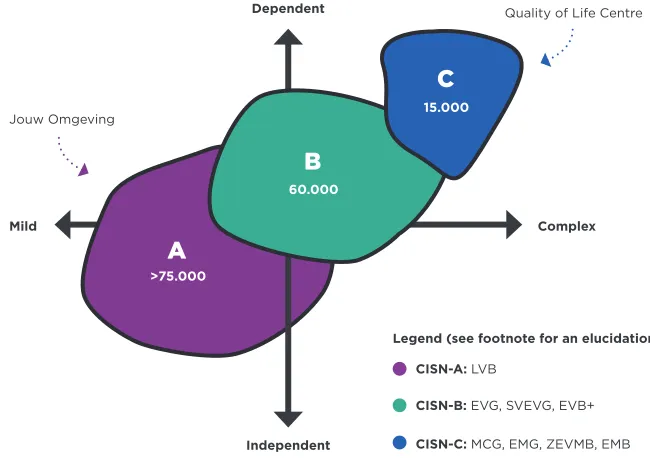
instead of their limitations or disabilities (Figure 1.2). In their daily lives, these individuals are incredibly ‘care intensive’. Compared to ‘normal peers’, they have additional support questions, are permanently dependent on the help and support of others, and often have a combination of physical and mental disorders which vary from mild to very severe (Maes et al., 2011). Consequently, this group consist of individuals that form a heterogeneous population, which makes everyone’s functioning differently. Moreover, the necessity of offering lifelong, complex care, is inevitable. It is this complexity and permanent character that asks for much commitment of all those involved. So, the vitality, well-being, and happiness of individuals with CISN are therefore mainly determined by the attitude and dedication of those involved. The initial focus of the Quality of Life Centre will lay on the most complex and dependent subgroup (CISN-C). They reason that once you can solve the key issues for this group, it will be possible to ‘scale’ a solution to the other, less complicated subgroups. Hence, to avoid confusion, in the remainder of this report the term CISN is referred to the 15.000 persons out of the most complex group.
1 Within the mental disability sector in the Netherlands, a distinction is made between different subgroups: this includes people with profound intellectual and multiple disabilities (MCG, EMG, ZEVMB, EMB), with severe mental disabilities without (EVG) or with severe behavioral problems (SVEVG), and finally, persons with a mild mental disability (LVB).
A
B
Jouw Omgeving
Quality of Life Centre
>75.000
60.000
[image:24.499.97.422.310.539.2]CISN-C: MCG, EMG, ZEVMB, EMB CISN-B: EVG, SVEVG, EVB+ CISN-A: LVB
Figure 1.2 Abstract representation of the subgroups within the disability sector in the Netherlands
Mild Complex
Legend (see footnote for an elucidation): Dependent
Independent
C
25 Formulating strategic intent The characteristics of people with CISN
In order to establish a clear understanding of the group CISN, this section will describe, on the basis of key characteristics, what it means for an individual to live with CISN. Appendix B provides a more detailed description of this subgroup. Below a summary is provided:
Key characteristics of individuals with CISN
Communication on a different level
Persons often do not possess an active or passive understanding of a language (speech, gestures or use of symbols). Frequently, they communicate through body language and use different movements that alter in frequency, intensity, and direction. Even the most basal facial expressions such as raising eyebrows or making eye contact are a means of communication. It is evident that persons with CISN have communication possibilities, but the signals are often so subtle that they require a lot of observational ability to recognise.
Health and behavior
Overall, persons are vulnerable and have a substantially increased risk of health problems. Diagnosis and treatment are difficult since a person cannot verbally express and indicate what is wrong with him or her. There is often a question of epilepsy, obstipation, and sleep problems. With the advancement in age, more health problems might come to the surface or develop. There is a chance that due to growth, abnormalities occur in the skeleton or that existing problems grow in intensity. Besides the physical limitations, there are often various behavioural problems.
Small differences, major implications
Persons with CISN differ from each other in physical condition, motorial skills, and visual and communicative possibilities. Some of them can point out things, grab objects or even say a few basic words. They can make their intentions clear, while others are not able to communicate. Some people can move independently, while other persons depend on caregivers to move. Other people have a short attention span regarding things in their immediate environment, which makes it difficult to establish contact or learn new things. These differences might seem small and irrelevant at first but often have significant consequences for direct interaction.
Small social network
Persons with CISN that live at home or in an institution often have a small social network. Their social system primarily consists of members of the family, grandparents, and the professional network that is built around the family. They have few connections and are not able to enter individually into new ones. Besides, a family member with CISN heavily influences the whole dynamic within a family. The intensity of care has a tremendous impact on the life of the members of a family since their daily tasks and activities mainly revolve around addressing the care needs of the person with CISN. Other, also important family duties and events, are often organised around the care needs, postponed, or even neglected.
26 Chapter 1 An ideal situation
In an ideal situation, actors involved in the care and education of persons with CISN should acknowledge the lifelong and complex questions that arise and facilitate opportunities for personal development. They should minimise bureaucratic processes, enhance an equal cooperation, and support parents and family as much as possible. Above all, parents should feel understood by others and experience self-government and flexibility so they can entirely focus on their well-being and that of their child.
The problem with complex care: a web of bureaucracy
Unfortunately, parents of children with CISN get astray in a web of bureaucracy (NOS, 2017) and encounter many problems during the arrangement of fitting care and education where most of the children are not even going to school. Primarily, they must deal with all sorts of troublesome ‘non-essential’ issues. There is often a case of long queues, lingering uncertainty among parents, a lack of expert knowledge and expertise at organisations, fragmented care and education, inefficient cooperation between formal and informal network, disappearing facilities, and a surplus of paperwork (Houthuijs, 2017). At this moment, even the most basic forms of care for persons with complex support needs are under severe pressure and extra care, which could improve their quality of life, is barely delivered due to a shortage of financial resources (VGN, 2017). Meanwhile, parents experience little freedom and flexibility due to exhausting bureaucratic matters and the intensive care tasks they perform every day. The amount of care has a tremendous impact on the life of the members of a family since almost all their daily tasks and activities revolve around addressing those care needs. Other, also important family duties and activities, are often organised around the care needs, postponed, or even neglected. As a result, parents are usually physically, practical, and emotionally burdened (Dautzenberg, Moonen & Wagemans, 2015).
But how does one address all these issues and realise and organise a
good life for care intensive persons and their families?
Since their foundation two years ago, the Quality of Life Centre attempts to answer this question through the development of several (integrated) products and services. Moreover, the central and key pillar of the Quality of Life Centres offering is their curriculum, which is also the central topic in this research project.
Development curriculum: towards a holistic approach
27 Formulating strategic intent
on an underlying knowledge framework which revolves around the Capability Approach (Nussbaum, 2011), the intervention ‘Floreren’ (Beernink, 2015), the Quality of Life Concepts (Schalock et al., 2002), the International ICF framework (WHO, 2002), and the principles of the UN Treaty (WHO, 2002). However, the foundation of the curriculum was the evidence-based methodological framework of Vlaskamp (Vlaskamp, 1993). This method describes a roadmap that enables parents and professionals to offer support tailored to the needs and wishes of persons with profound and multiple disabilities. The Quality of Life Centre supplemented this method with additional (sub)steps and filled it with knowledge products. Presently, these products are mainly deployed isolated and used in the care and educational practices whether appropriate or not. Therefore, the Quality of Life Centre organised and classified those products through utilising the systematic steps which were embedded in the Vlaskamp method. This process further detailed the curriculum and intends to make the Vlaskamp program more user-friendly and better accessible to parents and professionals from the care and educational field.
Intended users
As a result, the curriculum should provide parents and family with a personal guidance system which supports them in finding their way in arranging care and education for their child. Additionally, it should offer professionals in care and education with a founded prescriptive advisory and work-system. Chapter four will further detail the end user groups and elaborate which benefits they might expect during use. Subsequently, it describes how end users will use the curriculum in practice.
The missing link
The problem that the Quality of Life Centre faces, even though they already developed the curriculum, is that they are currently not able to provide it in an efficient, widespread, and convenient manner to its intended users. Presently, there is a lack of a suitable ‘medium’ that can facilitate the envisioned use. The hypothesis is that the digital infrastructure of Jouw Omgeving might be appropriate for the curriculum’s intended use. Chapter six will validate this hypothesis. In this sense, the curriculum needs to be translated from an ‘offline variant’ into an ‘online variant’. However, it is already evident that this translation process requires additional product and process development. Moreover, it is still unclear which approach this translation process should adopt to ensure that the vision and intended purpose of the curriculum is not lost in translation. Section 1.5 will address those concerns through elaborating the approach this research will adopt.
Expected results research
28 Chapter 1
The underlying rationale of this research project is the notion it can build upon an already developed product. However, the development of the curriculum was primarily based on tacit knowledge. Tacit knowledge is difficult to assess and transfer to other persons through writing or verbalising (Chugh, 2015) since it ‘lives inside’ the head of individuals. This observation inherently creates boundaries for the proposed translation. Moreover, as seen from a design perspective, this fact makes it a challenge to convey the added value of the curriculum to involved stakeholders on the one hand and to ground choices on what to develop on the other. So, the fundamental question resulting from this is:
How does one translate tacit knowledge that is embedded in the
curriculum into explicit, structured, and actionable insights?
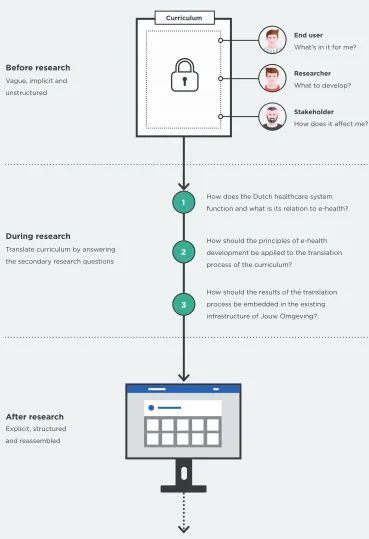
For this research project, it is argued that adopting the concept ‘reverse engineering’ can embody this concern. Essentially, reverse engineering is the process of extracting knowledge or design information out of anything human-made and reproducing something based on that extracted information (Eilam, 2005). This project intends to address the stated problem through applying reverse engineering to the curriculum. To facilitate this process, this research leveraged different concepts to structure the unknowns consequently. Eventually, it should enable the ‘reconstruction’ of the different components of the curriculum in a meaningful way (Figure 1.3). The insights resulting from this process provided the foundation for the design of a comprehensive, actionable design document that should support both the Quality of Life Centre and Jouw Omgeving during the design and operationalisation of the curriculum. More briefly put, the core of this research is captured by the following primary research question:
Primary research question
How can the curriculum of the Quality of Life Centre be translated
into an e-health application to aid a sustainable implementation in
the Dutch healthcare system?
The primary research question is further specified into three supporting research
questions to maintain a clear and coherent structure throughout this report. Each question addresses vital sub-areas, and its results should contribute to answering the main research question:
Sub research questions
1. How does the Dutch healthcare system function and what is its relation to
e-health?
2. How should the principles of e-health development be applied to the translation process of the curriculum?
3. How should the results of the translation process be embedded in the existing infrastructure of Jouw Omgeving?
29 Formulating strategic intent
Figure 1.3 High-level overview of the research approach
Before research
During research
After research
Researcher What to develop?
Stakeholder
How does it affect me? End user
What’s in it for me? Curriculum
Explicit, structured and reassembled Vague, implicit and unstructured
How does the Dutch healthcare system function and what is its relation to e-health?
How should the principles of e-health development be applied to the translation process of the curriculum?
How should the results of the translation process be embedded in the existing infrastructure of Jouw Omgeving? Translate curriculum by answering
the secondary research questions
1
2
Mapping the research environment
02
Chapter
Mapping the context of this research project to reach a more profound understanding of the Dutch healthcare system
Map
Healthcar
e
Naturally, products aren’t developed and used in a vacuum but inherently belong to a broader ecosystem. Within this environment, there will be multiple forces at play that all interact, shape the rules of what will be possible and credible, and naturally set preconditions for a successful product. For example, it is logical that products in the car industry should comply with different regulations than products in the food industry. Failing to understand these rules will lead to undesirable outcomes, even if the ‘product’ in itself is of exceptional quality. Accordingly, it is debated that it will be important to uncover changes that are happening in the field that might influence and affect this research. In this case, the environment in question is the Dutch healthcare system where the curriculum, in the form of an e-health application, will be embedded. However, without meaningful context, the relations that will form between the environment and the curriculum will be difficult to comprehend and interpret. There is a need to assess and construct the environment where this research project ‘moves through’. By placing the curriculum into the context of the Dutch healthcare system, it becomes possible to develop a greater understanding of the value of the product considering other components of the system (Kumar, 2013). In this sense, the primary aim of this chapter is to generate a certain level of understanding of the context which, in turn, enables more grounded decisions throughout this research. The gained knowledge will not only help to recognise possible opportunities and constraints but also aid in understanding system-level implications for the intended reverse-engineering process of the curriculum.
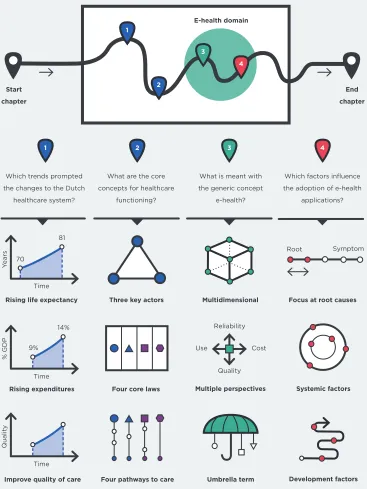
But achieving a profound understanding seems no easy task since the Dutch healthcare system is regarded as a complex system with a lot of interdependencies and a plethora of actors. For example, how does one distinguish beforehand what is valuable and non-valuable information? How does one determine what the most significant actors and concepts are? Finding answers to those questions is like walking a fine line between drowning in too much information and oversimplifying the situation. Only through exploring and processing the new information it becomes possible to question previously held assumptions and re-frame situations. However, without a defined route guiding this exploration process, it will be very easy to get astray in healthcare ever-shifting web of interacting factors. Hence, this section constructed a map (Figure 2.1) which symbolises the taken route in this chapter towards reaching a more profound understanding.
The map: a chapter overview
Universally, a map is only useful when it shows the current location, the destination, and a defined path between the two which provides enough detail so someone does not get lost along the way. In this case, our current location and beginning of this chapter is the outer border of the healthcare system where things still seem unclear and uncorrelated. Moving down the path, and into the healthcare system, our path is crossing four stops where a question represents each stop. Through systematically answering each question it should make things more understandable, reveal relationships, and bring us closer to our intended destination: a clearly constructed overview of the healthcare system and profound insight in its main building blocks. Once arrived at the destination and end of this chapter, the journey resulted in a sound knowledge foundation that enabled the selection of essential principles for e-health development in chapter three.
33 Mapping the research environment Which trends prompted
the changes to the Dutch healthcare system?
Four core laws Rising expenditures
Time
Time
Time 81
70
9% 14%
% GDP
Quality
Years
Three key actors Multidimensional Focus at root causes
Umbrella term Rising life expectancy
Four pathways to care Improve quality of care
What are the core concepts for healthcare
functioning?
As metaphor for reaching a more profound understanding
What is meant with the generic concept
e-health?
Which factors influence the adoption of e-health
applications? E-health domain
Map Dutch healthcare system
Start chapter
End chapter
1
1 2 3 4
2
3
4
Reliability
Cost Use
Quality
[image:33.499.67.434.99.588.2]Multiple perspectives
Figure 2.1 The overall structure and main conclusions of chapter two
Systemic factors
34 Chapter 2
A certainty is that everyone will, at some point in their lives, encounter healthcare. In the role of caregiver for their children and parents, or as ‘receiver’ for an own disease or limitation. Some are privileged enough to live a relatively long and healthy life where others are less fortunate and are, or become (entirely) dependent on the healthcare system for the rest of their lives. Once this happens, people expect that they receive the best support and care possible. However, the composition and preferences of the society are changing, and with it the ability of the healthcare system to deliver the best possible care on the one hand while keeping healthcare accessible to citizens on the other. For example, the overall life expectancy is rising, and more people develop chronic diseases. Mainly fuelled by these trends, there is a growing awareness that the organisation of the Dutch healthcare should change since healthcare expenditure is rising too steeply.
According to Edith Schippers (2014), […] ‘Care ought to be delivered in or near the home,
with a full range of online services and the use of smart technologies. If we can transform health care in ways like these, we will both further improve it and make it more affordable’.
However, without further background information, it will be difficult to anticipate on past and future developments and trends within the healthcare system. By researching what caused the government to change the healthcare system and how it realised those changes, more insight is gained into its functioning. Furthermore, the goal of this research project is to develop a sustainable e-health application that ‘exists in and interacts with’ this system. Hence, in-depth insight is required to create a sound understanding of the implications the healthcare system might have during the development process. Chapter five provides a visual network structure that provides a detailed overview how the curriculum interacts with the current healthcare system. But before this was possible, it was important to understand the basic ‘structural’ components of this same system. The healthcare system is regarded as a dynamic, complex and evolving field where difficulties are often composed of many interacting factors, persons and organisations. Thus, the concepts presented in this section are not assumed to be comprehensive nor meant to characterise all the interrelated components of the healthcare system. Instead, the main aim is to capture its principal actors and concepts. Eventually, this should result in an understandable overview of the structure of the Dutch healthcare system and a sound comprehension of how it functions the way it does.
2.1.1 Trends as drivers of change
The continuous trends and developments in the social domain have led to rising concerns of keeping healthcare affordable and accessible to all Dutch citizens. In 2015, the Dutch government anticipated on those concerns by implementing a significant reform in the healthcare system. On the one hand, they wanted to improve the financial sustainability of the healthcare system while increasing the quality of care on the other. This section describes the most important results of an elaborate analysis of the Dutch healthcare system (Appendix C), which is the landscape both the Quality of Life Centre and Jouw Omgeving operate in. The primary aim of this analysis was to uncover changes in the field that might influence and shape the research environment. This section will put the rising concerns into a perspective of significant historical and future developments and elaborate what prompted the changes to the Dutch healthcare system.
2.1 Dutch healthcare system - The need for change
35 Mapping the research environment Rising life expectancy and chronic diseases endanger financial sustainability
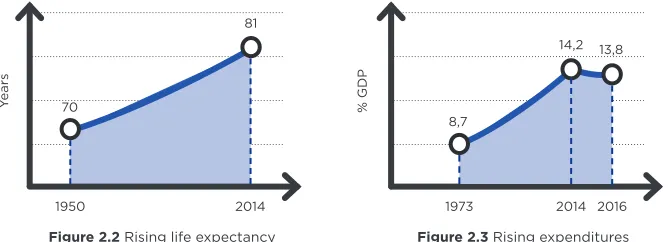
In 1950, the average life expectancy was close to seventy-one years. In the following decades, society experienced a steep increase in economic welfare and technological advancements which resulted in better overall access to healthcare services, highly improved treatments, and more emphasis of policymakers on preventive measures. Over a sixty-year period, this has led to an increase in average life expectancy by nearly eleven years, to eighty-one years in 2014 (Figure 2.2). According to recent scenarios, the life expectancy will continue to rise, but less steeply than over the last decades (Hoeymans et al., 2014). However, despite the fact people are living longer, they are also developing chronic diseases at an earlier age, and consequently, cause a relative decrease of years people live in ‘good health’. This growth is partly attributable to the ageing population but also to the improvements made to medicine and diagnostics. Diseases that were once untreatable became treatable, and besides, an early detection of a chronic illness implies that people will live longer with their condition. As with the life expectancy, the prevalence rate of chronic diseases is expected to increase.
[image:35.499.81.415.265.386.2]As a result, healthcare expenditure (Figure 2.3) grew alongside the rise in life expectancy and the number of people with a chronic disease. However, it is important to note that other demographic trends in the social domain, such as the amount of wealth and technical advances also contribute to growing cost. It is a fact that wealthier countries spent more on healthcare due to higher living standards. Furthermore, technological advancements have caused improved treatment options resulting in more accessible treatments and a lower mortality rate for diseases that were once fatal (De Vries & Kossen, 2015). In general, healthcare expenditure can be expressed in absolute terms, per capita, or as a percentage of the gross domestic product (GDP), where the latter is preferred since it factors in inflation. Between 1973 and 2014, before the policy changes, healthcare expenditures grew from 8,7% to 14,2% of GDP (CBS, 2017) More recent numbers illustrate signs of stabilisation and even a slight decline in healthcare expenditure to 13,8% of GDP in 2016 (CBS, 2017). A preliminary and cautious conclusion might be that the recent policy measures are indeed dampening the growing rate of healthcare expenditure. However, the significant dependency on a lot of unpredictable and interrelated factors make a long-term prediction of healthcare expenditures difficult. Measures meant to reverse one trend may have positive or negative effects on others. Hence, the exact scale of savings and its impact on public health challenges should become more apparent in the coming years (Hoeymans et al., 2014).
Figure 2.2 Rising life expectancy Figure 2.3 Rising expenditures
1950 2014 1973 2014 2016
81
70
8,7
14,2 13,8
36 Chapter 2
Structural changes to improve ‘quality of care’
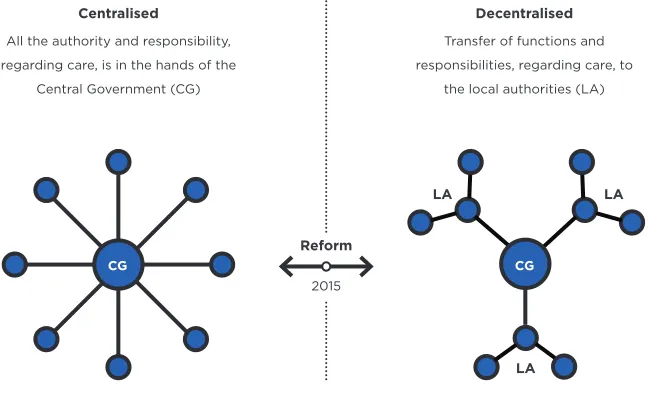
As a second reason for the reform, politicians and policymakers believed that the quality of healthcare could be further increased by, literally, bringing it closer to the people (De Vries & Kossen, 2015). However, according to Hoeymans et al. (2014), defining the notion quality of care is challenging since it can be described from four different perspectives. In this sense, quality of care is multidimensional and its interpretation dependent on societal values, norms and context of use. For the government, improving the quality of care is about better answering the individual care questions of its citizens. They attempt to achieve this through transferring functions and responsibilities from the central government to the local authorities, also known as decentralisation (Figure 2.4). In doing so, the government assumes that local authorities can offer more targeted care and better meet the individual needs against lower cost and with less bureaucracy (Rijksoverheid, 2013). The rationale is that local authorities know the different communities, its facilities, and many of its citizens much better than the government ever will.
Also, the decentralisation encourages citizens to rely more on their network and less on publicly provided care. In this context, decentralisation is considered as bilateral: there is currently a debate that decentralisation is more correlated to budget cuts than as an ‘ideological concept’ to bring care closer to the people. There is raising concern that it might cause too many regional differences resulting in situations that are contradictory to the democratic principles of justice, accessibility and solidarity (De Jong, 2016). This project will not take a stance on whether decentralisation is the right means to improve the quality of care or that it was merely implemented as a disguised budget cut. It resulted, however, in significant structural changes to the system and imposed a lot of responsibilities on local authorities generating a whole new system that delivers social services to citizens.
1 2 3 4
CG
Centralised Decentralised
All the authority and responsibility, regarding care, is in the hands of the
Central Government (CG)
Transfer of functions and responsibilities, regarding care, to
[image:36.499.87.411.259.460.2]the local authorities (LA)
Figure 2.4 Simplified network structure before (left) and after (right) the reform
2015
Reform
LA LA