http://wrap.warwick.ac.uk/
Original citation:Jarvis, Stephen A., 1970- and Nudd, G. R. (2004) Review of the e-science
demonstrators and their compatibility with the Warwick middleware project. University of Warwick. Department of Computer Science. (Department of Computer Science
Research report).
Permanent WRAP url:
http://wrap.warwick.ac.uk/61311
Copyright and reuse:
The Warwick Research Archive Portal (WRAP) makes this work by researchers of the University of Warwick available open access under the following conditions. Copyright © and all moral rights to the version of the paper presented here belong to the individual author(s) and/or other copyright owners. To the extent reasonable and practicable the material made available in WRAP has been checked for eligibility before being made available.
Copies of full items can be used for personal research or study, educational, or not-for-profit purposes without prior permission or charge. Provided that the authors, title and full bibliographic details are credited, a hyperlink and/or URL is given for the original metadata page and the content is not changed in any way.
A note on versions:
$\VERJ,
.\)' €
'/,
v4
-
m
;&o_
WATICK
Research
Report
394
Rrurw
oF
THE
r-ScrrrucE
DEMoNSTRAToRS
AND THEIR
COMPATIBILITY
WITH THE WNRWICT
MtoolewARE
Pno.rrcr
Stephen
Jaruis, Graham Nudd
WAryICK
Authors:
Date:
Review of the
e-Science
Demonstrators and
their
compatibilify with
the
Warwick
Middleware Project
SAJarvis,GRNudd
High Perfbnnance Systems Group,
Department of Computer Science, University of Warwick
31-3-2003
Abstract:
This document reports on the six month survey of the
UK
e-science demonstrator projects. Thereport details the eight project consultations in which we have engaged, and provides a summary
of the likely compatibility of these projects with the Warwick middleware research. Two of these
eight projects have been identified for further collaboration, details of which are documented. In addition,
this
consultation has been extendedto
includeUK
e-Sciencepilot
projects and theReference:
GR/S03058/01
RR394Performance-based Middleware for Grid Computing
Introduction
The
e-Science demonstrator projects providea
diverse collectionof
demonstrations andmethodologies that represent tasks which are considered pertinent to e-Science. These projects are at various stages of completion
-
some have already ended and some are in the initial stages as they rely on key infrastructural support which is currently being installed.The Warwick Middleware project aims
to
provide performance servicesfor
e-Science ande-Business applications. As part
of
the e-Science Open Call funding (GR/S03058/01), we haveagreed
to
identiff
and then deliver results of the application of these middleware performanceservices to a chosen e-Science demonstrator application.
This document reports on the six month survey of the UK e-Science demonstrator projects' The
report details the eight project consultations in which we have engaged, and provides a summary of the likely compatibility of these projects with the Warwick middleware research.
To optimize research compatibility and cooperation within the
UK
e-Science programme, thissix-month study has also included additional consultation:
The evaluation of UK e-science demonstrator projects: including the refinement of these
to one or a small subset of projects which
will
be the subject of more detailed scrutiny;An
evaluationof
a subsetof UK
e-Sciencepilot
projects:to
investigate whether themiddleware performance services might be compatible
with
some of the largerUK
e-Science projects;
An evaluation of the e-Business case studies in light of IBMs involvement in other UK
e-Science work.
ln
orderto
assess the benefit and appropriatenessof
the application of the middleware to thedemonstrators, a number of broad suitability requirements have been applied:
Will the Warwick middleware services bring added-value?
Is
the demonstrator (language, operating system etc.) compatiblewith
the Warwickmiddleware tools?
Is specialist equipment needed to run an image of the demonstrator at Warwick?
Are resources available at the partner institution to support the coliaboration?
This report contains: a list of the demonstrator consultations which have taken place during the
past six months; those demonstrator projects identified for further collaboration; a list of the pilot
project consultations which have taken place during the past six months; those
pilot
projectsidentified for further collaboration; a list of the supporting research which has been instigated to
Demonstrator Project Consultations
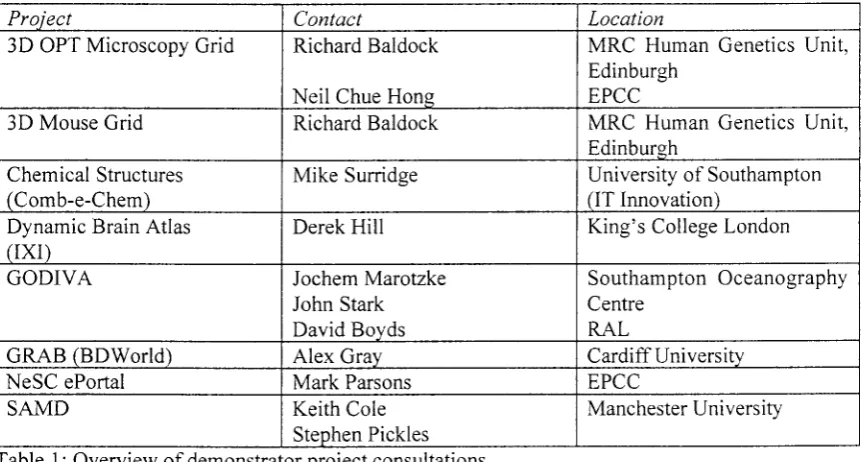
Consultations have taken place with eight
months (a summary of these projects, the
their location, are shown in Table 1).
UK e-Science demonstrator projects
main contacts with whom we have
during the past six
been involved and
Proiect Contact Location 3D OPT Microscopy Grid Richard Baldock
Neil Chue Hone
MRC Human Genetics Unit,
Edinburgh
EPCC
3D Mouse Grid Richard Baldock MRC Human Genetics Unit
Edinbureh
Chemical Structures
(Comb-e-Chem)
Mike Surridge University of Southampton
(IT Innovation) Dynamic Brain Atlas
(IXI)
Derek
Hill
King's College LondonGODIVA Jochem Marotzke John Stark
David Bovds
Southampton Oceanography
Centre
RAL
GRAB (BDWorld) Alex Grav Cardiff University
NeSC ePortal Mark Parsons EPCC
SAMD Keith Coie
Stephen Pickles
Manchester University Table
l:
Overview of demonstrator project consultationsThis
list of
projects can be partitionedin to
thosefor
which performance services are not considered important (as the project has already finished, performanceis
not
an important component of the demonstration etc.)-
including GODIVA, NeSC ePortal and SAMD-
thosewhich might benefit from the introduction of the performance services at a later date
-
including Comb-e-Chem and GODIVA-
and thosefor
which performance services are essential to thesuccess of the project
-
including Dynamic Brain Atlas and 3D OTP Microscopy Grid.Identified Demonstrator Projects for Further Collaboration
It
is
possiblethat
projects such as Comb-e-Chem andGODIVA
will
demonstrate future compatibility with our middleware research, they are however not yet at the stage where we canstart to consider how this integration might take place.
Detailed discussion and consultative visits have taken place between Warwick and Edinburgh
University (and the MRC Edinburgh)
with
regardto
the 3D OTP Microscopy Grid and alsoKing's
College Londonwith
regardto
the Dynamic Brain Atlas project.An
advantage inselecting these two demonstrators for further collaboration is that they both have a considerable
[image:5.595.82.513.177.408.2]3D OTP Microscopy Grid
The 3D OPT demonstrator on the reconstruction
of
mouse embryo data is composedof
three tasks-
data capture, transfer and parallel reconstruction. Performance is critical to this project;for example, the reconstruction of the 3D image takes about 2-5 hours with a serial version of the
algorithm, which
for
the 3-channel image means an overnight run before the biologists canreview the results and reset the parameters as necessary.
The basic algorithm takes a set of projection images, deconstructs them after some preprocessing
to sets of sinograms, and then uses these during the reconstruction process; this is equivalent to
taking an orthogonal cut through the data. The reconstruction process involves stacking the
sections generated by the back-projection processing.
A
parallel version of this algorithm has been impiemented and demonstrated. This is currently being re-engineered to run on an arrayof
Sun netras at the MRC. The code is written in C andMPI and the Sun Grid Engine is used to handle scheduling. There are plans also to use Globus to connect to remote resources. A stable version of this system is due to be complete by May 2003.
It
is likely that our middleware toolswill
directly benefit this image reconstruction process. Ourtools are currently engineered
for
C
MPl-based code andit
should be feasibleto
generateresource models for the hardware at the MRC.
While our
performance-based schedulingtools
are currently basedon a
Globus/Condor middleware stack (see below), we plan to investigate whether our performance co-scheduler canbe used alongside Sun's Grid Engine.
Dynamic Brain Atlas
Although the Dynamic Brain Atlas project has now finished, follow up research funding has been
sought, and now granted, during the past six months. We offered partner suppoft in this bid and
its success therefore means that there are now resources available at King's to be able to support
continued collaboration. The new project, known as IXI, started on the 17th February 2003.
Two work areas have been started at Warwick to facilitate collaboration with this project. The
first involves additional support from Dr Chang-Tsun
Li
(from the Image Processing Group in theDepartment of Computer Science, Warwick) who is currently working on identif,ing core image
processing kernels which
form
partof
theIXI
project. The aimof
this is
to
then test themiddleware tools on these image processing kemels, perform some in-house analysis to verify the
benefits which they offer, and then transfer these to the demonstrator later in the project.
The second work area is the integration of the performance tools with Condor
-
the preferredintra-domain scheduler use in
IXI.
This has formed one of the major areas of research over thepast six months and has involved adapting our performance scheduler (known as Titan) so that
it
can be used as a driver to Condor. By doing this the middleware tools should integrate into the
IXI
demonstrator piatform (and indeed any other that utilizes Condor at the intra-domain ievel).Pilot Project Consultations
Many
of
the
lessons learntfrom
the
prototypingof
the
demonstrator projects have beentransferred
to
the
developmentplattbrms
of
the
largerpilot
projects(e.g. SAMD
andRealityGrid). Indeed the perceived importance
of
performance services is noticeably greater atthe pilot project level than at the demonstrator project level.
This consultation has therefore been extended
to
include a subsetof
theUK
e-Science pilotprojects, whose performance requirements are somewhat compatible
(a
summaryof
theseprojects, the main contacts with whom we have been involved and their location, are shown in
Table 2).
Proiect Contact Location
RealityGrid Stephen Pickles Graham Riley
Manchester University
EDiamond Mike Brady
David Gavaghan
Steve Heisie
Oxford University
IBM
DAME Karim Diemame Leeds Universitl
Table 2: Overview of pilot project consultations
The analysis and development
of
techniquesto
address performance issues are clearly alreadyintegrated components of these pilot projects.
It
is important however to build on the researchexperience gained during the performance engineering of each of these pilot projects, and to use
this experience when considering the design and deployment of our own middleware tools.
Identified Pilot Projects for Further Collaboration
As
part
of
this
processwe
have been involvedin
collaborative meetingswith
the
Grid Infrastructure team on the eDiamond project. Through Donna Dillenberger and Steve Heisig(IBM Watson) we are looking to share experience in two specific areas:
How we define appiication/request topologies that describe the
link
between applicationcomponents. There are two aspects to this work, the language in which these application units
should be described (cunently the Open Group's ARM API) and then how these work units
can be used during the performance analysis of applications.
We are also looking into how user-level service provision can be mapped to these lower-level work units, particularly when these work units are processed across a distributed architecture.
This links with the hWLM and eWLM projects that Donna Dillenberger and Steve Heisig are
involved in at IBM and also the demonstrator for this work eDiamond.
Experience
in
this
areasis
to
be shared through conferencecall
meetings and also through [image:7.595.82.516.257.355.2]Supporting Research
Supporting image processing research
Although our research is to be tested in the context of an e-Science demonstrator project, we are
trying to avoid building dependencies that are likely to slow our work down. We have done this
by
identifying
three possible e-Science demonstrators that havesimilar
image processingcharacteristics (3D OPT Microscopy Grid,
IXi
and eDiamond). One of our academics from theImage Processing Research Group at Warwick
(Dr
Chang-TsunLi)
is
currently working onidentifying core kernel characteristics of these projects, the idea being that
if
we can test andverify our tools on these core kemels then the integration with the demonstrator/s should be made easier later in the project.
For example, the image segmentation techniques that enable low-level image analysis in projects such as the Dynamic Brain Atlas
(IXi),
have been the subject of detailed analysis at Warwick,see:
CT
Li,
Multiresolution Image Segmentation Integrating Gibbs Sampler and Region Merging Algorithm, Signal Processing, 83(1):67-78, 2003.R Wilson, CT
Li, A
Class of Discrete Multiresolution Random Fields and its Application toImage Segmentation, IEEE Trans. Pattern Analysis and Machine Intelligence,25(l):42-56,
2003.
This approach employs Markov random fields (MRF) defined in a multi-resolution structure to
partition the target image into homogeneous regions with distinctive features. By exploiting the
local characteristics, known as the Markovianity
of
theMRIs,
the technique allows the locallabeling and partitioning process to be carried out in a Grid-enabled environment.
Dr
Chang-TsunLi
is analysing this segmentation technique in the context of Grid-applications, with the aim of being able toidentif
and employ performance analyses to applications that sharethese core characteristics.
Integration with standard middleware tools
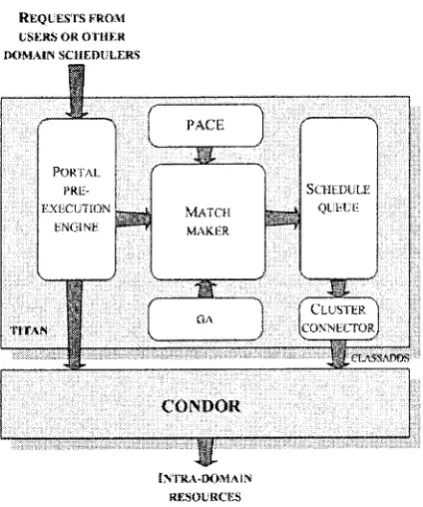
We have begun this at the intra-domain level by modifying Titan (our predictive intra-domain
scheduler) so that it now acts as a co-scheduling driver to Condor, see figure below.
The advantage of this is that
it
allows the predictive data derived from PACE to drive the jobsubmission provided
by
Condor(or
indeed any other commodity scheduler).In
the caseof
Condor this is done by auto-generating ClassAds that force Condor to run a task on a designated
"J,$iliH.
Figure 1: Integration of Warwick middleware tools with standard
Grid middleware
-
phasel:
The Titan predictive scheduler hasbeen modified so that
it
acts asa
predictive co-scheduler to Condor.We term this predictive co-scheduling, and
it
allows traditional Globus/Condor configurations toutilise performance data at the intra-domain level should it exist;
if
there is no predictive data thenthe job passes to Condor in the same way as before.
An additional advantage of the predictive co-scheduling technique described above is the ability
to
include qualityof
service criteria into Condor-based intra-domain scheduling. Asit
standsCondor has no means
of
reordering tasks or assigning deadlines so asto
improve (or indeed guarantee) the service offered to its users. We have currently implemented three metrics into theTitan co-scheduler, these are makespan (the time to completion), the average advance time (the relationship between a task's execution time and its deadline) and resource utilisation (the ability
to capture the utilisation
ofa
contributing resource).By
providing these metrics at the co-scheduler level,it
is possibleto
monitor execution andexplore execution strategies so that the overall runtime is minimised, the deadlines of tasks are
maintained or so that the resources are utilized to best effect.
We are hoping
to
extendthis
techniqueto
a multi-domain level using Globus informationBibliography
R Baxter, N Chue, Optimisation Plan for 3D OPT Microscopy Grid, EPCC-IS-3DMG-PLAN 1.0,
from EPCC Edinburgh.
R Baxter, N Chue, M Parsons, R Baldock, B Hill, J Sharpe, 3D OPT Microscopy Grid
-
Bringingthe Grid to the Biomedical Workbench, from EPCC Edinburgh.
M Brady, eDiamond: Digital Mammography, EPSRC programme GR/S20956/01,2002.
D
Dillenberger, S Heisig,A
Martin,D
Gavaghan, hWLM/GRID 2002 project proposal, from Oxford e-Science Centre, 2002.DLG
Hill,
JV Hajnal, D Rueckert, SM Smith,T
Hartkens,K
Mcleish,A
Dynamic Brain Atlas, available from [email protected]K
Mayes, GD Riley, RW Ford,M
Lujan,TL
Freeman, The designof
a performance steering system for component-based Grid applications, from Centre for Novel Computing, Universityof
Manchester, 2003.
GR Nudd, SA Jarvis, Performance-based Middleware for Grid Computing, EPSRC programme
GR/S03058/0t,2002.
D Watson, D Gavaghan, M Jirotka, B Collins,