Constructing a Textual KB from a Biology TextBook
Peter Clark, Phil Harrison
Niranjan Balasubramanian, Oren Etzioni
Vulcan Inc Turing Center, Dept CS & Engineering 505 Fifth Ave South University of Washington
Seattle, WA 98104 Seattle, WA 98195
{peterc,[email protected]} {niranjan,etzioni}@cs.washington.edu
Abstract
As part of our work on building a "knowl-edgeable textbook" about biology, we are de-veloping a textual question-answering (QA) system that can answer certain classes of biol-ogy questions posed by users. In support of that, we are building a "textual KB" - an as-sembled set of semi-structured assertions based on the book - that can be used to answer users’ queries, can be improved using global consistency constraints, and can be potentially validated and corrected by domain experts. Our approach is to view the KB as systemati-cally caching answers from a QA system, and the QA system as assembling answers from the KB, the whole process kickstarted with an initial set of textual extractions from the book text itself. Although this research is only in a preliminary stage, we summarize our progress and lessons learned to date.
1
Introduction
As part of Project Halo (Gunning et al, 2010), we are seeking to build an (iPad based) "knowledgea-ble textbook" about biology that users can not only browse, but also ask questions to and get reasoned or retrieved answers back. While our previous work has relied on a hand-crafted, formal knowledge base for question-answering, we have a new effort this year to add a textual QA module that will answer some classes of questions using textual retrieval and inference from the book itself. As well as running queries directly against the textbook, we are also constructing a "textual knowledge base" (TKB) of facts extracted from the book, and running queries against those also. The TKB can be thought of as a cache of certain classes
of QA pairs, and offers the potential advantages of allowing global constraints to refine/rescore the textual extractions, and of allowing people to re-view/correct/extend the extracted knowledge in a crowdsourcing style. As a result, we hope that QA performance will be substantially improved com-pared with querying against the book alone. Alt-hough this research is only in a preliminary stage, we summarize our progress and lessons learned to date.
There are four characteristics of our problem that make it somewhat unusual and interesting:
we have a specific target to capture, namely the knowledge in a specific textbook (although other texts can be used to help in that task)
the knowledge we want is mainly about con-cepts (cells, ribosomes, etc.) rather than named entities
we have a large formal knowledge-base avail-able that covers some of the book's material
we have a well-defined performance task for evaluation, namely answering questions from students as they read the eBook and do home-work
We describe how these characteristics have im-pacted the design of the system we are construct-ing.
2
Approach
We are approaching this task by viewing the textu-al KB as a cache of answers to certain classes of questions, subsequently processed to ensure a de-gree of overall consistency. Thus tasks of KB con-struction and question-answering are closely interwoven:
The KB is a cache of answers from a QA sys-tem
A QA system answers questions using infor-mation in the KB
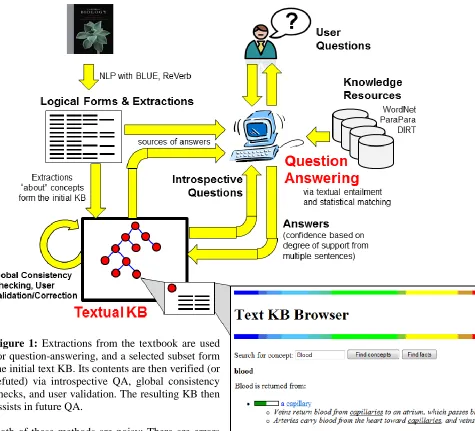
Thus this process can be bootstrapped: QA can help build the KB, and the KB can provide the evi-dence for QA. We kickstart the process by initially seeding the KB with extractions from individual sentences in the book, and then use QA over those extractions to rescore and refine the knowledge ("introspective QA").
2.1 Information Extraction
Our first step is to process the textbook text and extract semi-structured representations of its con-tent. We extract two forms of the textbook's infor-mation:
Logical Forms (LFs): A parse-based logical form (LF) representation of the book sentences using the BLUE system (Clark and Harrison, 2008), e.g., from "Metabolism sets limits on cell size" we obtain:
(S (SUBJ ("metabolism")) (V ("set"))
(SOBJ ("limit" ("on" ("size" (MOD ("cell"))))) Triples: A set of arg1-predicate-arg2 triples
ex-tracted via a chunker applied to the book sen-tences, using Univ. Washington's ReVerb system (Fader et al, 2011), e.g., from "Free ribosomes are suspended in the cytosol and synthesize pro-teins there." we obtain:
["ribosomes"] ["are suspended in"] ["the cytosol"]
These extractions are the raw material for the ini-tial textual KB.
2.2 Knowledge-Base Construction and Intro-spective Question-Answering
As the ontology for the TKB, we are using the pre-existing biology taxonomy (isa hierarchy) from the hand-build biology KB (part of the formal knowledge project). Initially, for each concept in that ontology, all the extractions "about" that con-cept are gathered together. An extraction is consid-ered "about" a concept if the concept's lexical name (also provided in the hand-built KB) is the subject or object of the verb (for the LFs), or is the arg1 or arg2 of the triple (for triples). For example ["ribosomes"] ["are suspended in"] ["the cytosol"] is an extraction about ribosomes, and also about cytosol, and so would be placed at the Ribosome and Cytosol nodes in the hierarchy.
As the extraction process is noisy, a major chal-lenge is distinguishing good and bad extractions. If we were using a Web-scale corpus, we could some function over frequency counts as a measure of reliability e.g., (Banko et al, 2007). However, giv-en the limited redundancy in a single textbook, verbatim duplication of extractions is rare, and so instead we use textual entailment technology to infer when one extraction supports (entails) anoth-er. If an extraction has strong support from other extractions, then that increases the confidence that it is indeed correct. In other words, the system per-forms a kind of "introspective question-answering" to compute a confidence about each fact X in the KB in turn, by asking whether (i.e., how likely is it that) X is true, given the KB.
To look for support for fact X in the LF database, the system searches for LFs that are subsumed by X's LF. For example, "animals are made of cells" subsumes (i.e., is supported by) "animals are made of eukaryotic cells". In the simplest case this is just structure matching, but more commonly the system explores rewrites of the sentences using four syno-nym and paraphrase resources, namely: WordNet (Fellbaum, 1998); the DIRT paraphrase database (Lin and Pantel, 2001); the ParaPara paraphrase database (from Johns Hopkins) (Chan et al, 2011); and lexical synonyms and hypernyms from the hand-coded formal KB itself (Gunning et al, 2010). For example, the (LF of the) extraction:
Channel proteins help move molecules through the membrane.
is supported (i.e., entailed) by the (LF of the) ex-traction:
Channel proteins facilitate the passage of molecules across the membrane.
using knowledge that
IF X facilitates Y THEN X helps Y (DIRT) "passage" is a nominalization of "move" (WN) "through" and "across" are synonyms (ParaPara)
Figure 1: Extractions from the textbook are used for question-answering, and a selected subset form the initial text KB. Its contents are then verified (or refuted) via introspective QA, global consistency checks, and user validation. The resulting KB then assists in future QA.
Both of these methods are noisy: There are errors in the original extractions, the synonym databases, and the paraphrase databases, not to mention over-simplifications and context-dependence in the orig-inal book sentences themselves. To assign an overall confidence to an LF-based extraction en-tailed (supported) by multiple sentences in the TKB, we use machine learning to build a confi-dence model. Each (numeric) feature in this model is a combination (max, sum, min, etc.) of the indi-vidual entailment strengths that each sentence en-tails the extraction. Each individual entailment strength is a weighted sum of the individual para-phrase and synonym strengths it uses. By using alternative functions and weights, we generate a large number of features. Each final class is a nu meric value on a 0 (wrong) to 4 (completely cor-
[image:3.612.79.554.78.509.2]2.3 Knowledge Refinement
We have a preliminary implementation of the first two steps. This third step (not implemented) is to refine the textual KB using two methods:
Global coherence constraints
User (“crowd”) verification/refinement Our goal with global coherence constraints is to detect and remove additional extractions that are globally incoherent, even if they have apparent sentence-level support, e.g., as performed by (Carl-son et al., 2010, Berant et al., 2011). Our plan here is to identify a "best" subset of the supported ex-tractions that jointly satisfies general coherence constraints such as:
transitivity: r(x,y) r(y,z) → r(x,z) reflexivity: r(x,y) ↔ r(y,x)
irreflexivity: r(x,y) ↔ ~ r(y,x)
For example, one of the (biologically incorrect) assertions in the TKB is "Cells are made up of or-ganisms". Although this assertion looks justified from the supporting sentences (including a bad paraphrase), it contradicts the strongly believed assertion "Organisms are made up of cells" stored elsewhere in the TKB. By checking for this global consistency, we hope to reduce such errors. In addition, we plan to allow our biologists to re-view and correct the extractions in the KB in a "crowd"-sourcing-style interaction, in order to both improve the TKB and provide more training data for further use.
2.4 Performance Task
We have a clear end-goal, namely to answer stu-dents' questions as they read the eBook and do homework, and we have collected a large set of such questions from a group of biologists. Ques-tions are answered using the QA methods de-scribed in step 2, only this time the questions are from the students rather than introspectively from the KB itself. The textual KB acts as a second source of evidence for generating answers to ques-tions; we plan to use standard machine learning techniques to learn the appropriate weights for combining evidence from the original book extrac-tions vs. evidence from the aggregated and refined textual assertions in the textual KB.
3. Discussion
Although preliminary, there are several interesting points of note:
1. We have been using a (pre-built) ontology of concepts, but not of relations. Thus there is a certain amount of semi-redundancy in the as-sertions about a given concept, for example the fact "Ribosomes make proteins" and "Ribo-somes produce proteins" are both the TKB as top-level assertions, and each shows the other supports it. It is unclear whether we should embrace this semi-duplication, or move to a set of predefined semantic relationships (essential-ly canonicalizing the different lexical relation-ships that can occur).
2. Our QA approach and TKB contents are large-ly geared towards "factoid" questions (i.e., with a single word/phrase answer). However, our target task requires answering other kinds of questions also, including "How..." and "Why..." questions that require a short descrip-tion (e.g., of a biological mechanism). This suggests that additional information is needed in the TKB, e.g., structures such as
because(sentence1,sentence2)
We plan to add some semantic information ex-tractors to the system to acquire some types of relationships demanded by our question cor-pus, augmenting the more factoid core of the TKB.
3. We are combining two approaches to QA, namely textual inference (with logical forms), and structure matching (with ReVerb triples), but could benefit from additional approaches. Textual inference is a "high bar" to cross - it is reasonably accurate when it works, but has low recall. Conversely, structure matching has higher coverage but lower precision. Addition-al methods that lend extra evidence for particu-lar answers would be beneficial.
4. We are in a somewhat unique position of hav-ing a formal KB at hand. We are ushav-ing it's on-tology both as a skeleton for the TKB, and to help with "isa" reasoning during word match-ing and textual inference. However, there are many more ways that it can be exploited, e.g., using it to help generate textual training data for the parts of the book which it does cover. 5. While there are numerous sources of error still
the lack of coreference resolution (which we currently do not handle), and treating each sen-tence as a stand-alone fact (ignoring its con-text). As an example of the latter, a reference to "the cell" or "cells" may only be referring to cells in that particular context (e.g., in a para-graph about eukaryotic cells), rather than cells in general.
6. We are also in the process of adding in addi-tion supporting texts to the system (namely the biology part of Wikipedia) to improve the scoring/validation of textbook-derived facts.
References
Banko, M., Cafarella, M., Soderland, S., Broadhead, M., Etzioni, O. Open Information Extraction from the Web. IJCAI 2007.
Berant, J., Dagan, I., Goldberger, J. Global Learning of Focused Entailment Graphs. ACL 2011.
Carlson, A. Betteridge, J., Wang, R.C., Hruschka, E.R., Mitchel, T.M. Coupled Semi-Supervised Learning for Information Extraction. In Proceedings of the ACM International Conference on Web Search and Data Mining (WSDM), 2010.
Chan, C., Callison-Burch, C., Van Durme, B. Reranking Bilingually Extracted Paraphrases Using Monolin-gual Distributional Similarity. In Proceedings of GE-ometrical Models of Natural Language Semantics (GEMS-2011).
Clark, P., Harrison, P. Boeing's NLP System and the Challenges of Semantic Representation. In Proc SIGSEM Symposium on Text Processing (STEP'08), 2008.
Clark, P. Harrison, P. 2009. An inference-based ap-proach to textual entailment. In Proc TAC 2009 (Text Analysis conference).
Fader, A., Soderland, S., Etzioni, O. Identifying Rela-tions for Open Information Extraction. EMNLP 2011.
Fellbaum, C. "WordNet: An Electronic Lexical Data-base." Cambridge, MA: MIT Press, 1998.
Gunning, D., et al., Project Halo Update - Progress To-ward Digital Aristotle In AI Magazine (vol 31 no 3), 2010.