to the Tánaiste, and Minister
for Enterprise, Trade and
to the Tánaiste, and Minister
for Enterprise, Trade and Employment
and the Minister for Education and
Table of Contents
Foreword by the Tánaiste and Minister for Enterprise, Trade and Employment vi Foreword by the Minister for Education and Science vii
Executive Summary 1
1. Introduction: Third Report 14
1.1 Introduction 14
1.2 New Structures to Respond to Skills Shortages 14 1.3 The Expert Group on Future Skills Needs 14
1.4 Objectives 15
1.5 Scope of the Third Report 15
2. Overview of the Labour Market 17
2.1 Introduction 17
2.2 Review of Labour Market Developments 17
2.3 Labour Force Supply 19
2.4 Outlook for 2001 21
3. Information Technology – Third Level Skills Provision 2001-2005 22
3.1 Introduction 22
3.2 Projected Demand for Graduates with IT Skills 23
3.3 Third Level Provision of Graduates with IT Skills 23
3.4 Projected Skills Gap 24
3.5 Recommendations 26
4. Researchers 31
4.1 Introduction 31
4.2 Demand for Researchers 31
4.3 Supply of PhDs 35
4.4 Development of the Research System 37
4.5 Projected Skills Gap 39
4.6 Recommendations 42
5. Life Sciences 44
5.1 Introduction 44
5.2 Updated Demand Projections 45
5.3 Updated Supply Projections 48
5.4 Projected Skills Gap 49
6. Employment and Training Needs of the Construction Industry 2001-2006 53
6.1 Introduction 53
6.2 Demand for Construction Workers 54 6.3 Supply of Construction Workers 57
6.4 Projected Skills Gap 57
6.5 Recommendations 63
7. Expert Group Work Programme 67
7.1 Introduction 67
7.2 Identification of Skill Needs 67
7.3 Developing Estimating Techniques 68 7.4 Augmenting the Supply of Skilled Labour 68
7.5 Promoting Links between the Business and
Education/Continuous Training Sector 69 7.6 Raising Awareness of Career Opportunities 71
7.7 Other Activities 72
7.8 Progress on the Implementation of Recommendations of the Expert Group 72
7.9 Conclusion 76
Appendix 1 Current Membership of Expert Group on Future Skills Needs 77 Appendix 2 Post-Graduate Student Numbers and Awards 78 Appendix 3 Projected Skills Shortages in the Construction Industry
and Construction Professionals working under the
Work Visa/Work Authorisation Scheme 80 Appendix 4 Membership of the Sub-Committees of Expert Group on
List of Tables
Table 2.1: Labour Market Trends in Ireland (ILO basis) 1998-2000 in ‘000s 18 Table 2.2: Sources of Labour Force Growth (‘000s) 19 Table 2.3: Summary of Vacancies by Occupational Grade, All Sectors in Aggregate, 1999/2000 23 Table 3.1: Annual Average Demand and Supply of Third-Level Skills in Information Technology,
2001-2005 25
Table 4.1: Post-Doctoral Researchers (Full-time and Part-time) by Field of Study in the Academic
Years 1998/1999 and 1999/2000 34
Table 4.2: PhD Graduation Rates, 1998 35
Table 4.3: Number of Registered PhD Students, 1998/99 and 1999/00 36 Table 4.4: Number of Registered Masters Research Students, 1998/99 and 1999/00 36 Table 4.5: Estimated Number proceeding directly from a Primary Degree to Postgraduate
Research Study 37
Table 4.6: Estimated Number of Post-Graduate Researchers to be supported under New Schemes,
1998-2006 39
Table 4.7: Estimated Number of Post-Doctoral Researchers to be supported under New Schemes,
1998-2006 39
Table 5.1: Original Annual Sectoral Employment Projections, 1998-2000 46 Table 5.2: Updated Annual Sectoral Employment Projections, 1999-2006 46 Table 5.3: Comparison of Original and Updated Projections for Life Sciences Graduates 47 Table 5.4: Comparison of Average Annual Demand over Projection Periods for Original Projection
(2000/01 to 2004/05) and Updated Projection (2001/02 to 2005/06) 47 Table 5.5: Update on Recommended Increases in Annual Degree Graduate Numbers from Second
Report of the Expert Group 50
Table 6.1: Planned Investment in Physical Infrastructure in the National Development Plan,
2000-2006 (£/€millions) 54
Table 6.2: Output and Employment Forecasts 2000-2006 (Base level, Second Quarter
2000 = 176,300) 55
Table 6.3: Estimated Total Requirement for Skilled Construction Workers, 2001-2006 56 Table 6.4: Estimated Requirement for Additional Skilled Construction Workers, 2001-2006 58 Table 7.1: Implementation Status of Expert Group Recommendations (as of May 2001) 73 Table A2.1: PhD Research Awards (full-time students), 1994 - 1999 78 Table A2.2: Masters Research Awards (full-time students), 1994 - 1999 78 Table A2.3: Number of Graduates Studying at Masters/Doctorate Research Level immediately
after graduation with Primary Degree 79 Table A 2.4: Proportion of Graduates Studying in Ireland or Abroad at Masters/Doctorate Research
Level immediately after graduating with Primary Degree 79 Table A 3.1: Projected Shortages of Professional Workers, 2001-2006 80 Table A 3.2: Projected Shortages of Workers with Craft Skills, 2001-2006 80 Table A3.3: Estimated Shortages of Non-Craft Skilled Workers in the Construction sector, 2000-2006 81 Table A3.4: Construction Professionals Working in Ireland Under the Working Visa/Work Authorisation
Foreword by the Tánaiste and Minister
for Enterprise, Trade and Employment
A large part of our recent employment and economic growth can be attributed to the skills and flexibility of our workforce. The Expert Group on Future Skills Needs has made a significant contribution to growth by rigorously analysing skills and labour needs and developing supply side solutions to meet them.
The challenge of growth is intensifying. Our success in creating more and better jobs has resulted in an inevitable tightening of the labour market. At the same time, demographic trends mean that there will be fewer young people entering the jobs market or going on to further education.
These challenges make the work of the Expert Group more relevant than ever. But they also imply a need for a more sophisticated and wide ranging response to the new environment. The focus of the recommendations in this third report on upskilling for those already in employment, on more flexible approaches to the delivery of education and training and on skills-based immigration reflect this are both timely and relevant.
In recognition of the key role played by the group, the Minister for Education and Science and I are issuing a new mandate to the group. The mandate positions the group as the central resource advising government on skills needs and provides for a strengthening of the group’s membership and resources to reflect the breadth and depth of its work.
I welcome the Group’s third report and look forward to the its continuing endeavours in identifying and addressing existing and emergent skills needs.
Mary Harney T.D.
Tánaiste and Minister for Enterprise, Trade and Employment
Foreword by the Minister for Education
and Science
It is widely acknowledged that Ireland’s current economic prosperity and growth has been underpinned to a large extent by the role that the education system has played in developing the knowledge base of our work force. While the massive expansion in the education sector since the 1960s has played a vital role in this regard, new challenges are now emerging.
As Ireland develops as a knowledge based economy, new sectors and new occupations are emerging which require a flexible and adaptable workforce. Today's Ireland is a bustling, high-tech, business-friendly country, driven by competitive and innovative companies experienced in international business at its leading edge. It is an economy that has strategically placed itself as a knowledge based economy. The acquisition of knowledge and the accumulation of knowledge capital is an essential part of this process, and involves many actors and linkages between them. The formal education system, industry-education links, workplace education, further education, basic and applied research all contribute to the appreciation of knowledge capital. The key challenge for the education system now is to develop the necessary mix of creativity and skills to enable us to respond to the needs of the labour market, and to continue to develop in this vein.
In responding to such a challenge, the need to provide a long term framework in which to develop our response is essential. It is here that the work of the Expert Group on Future Skills Needs comes to the fore. The challenge for the Expert Group will be to attempt to keep pace with the fast changing environment of the Irish and world economies and to develop a coherent framework for the future planning of our skills needs. It is on foot of the timely and accurate forecasts of the Expert Group that the education system must strive to ensure that the measures are put in place to ensure that we will meet the rapidly changing demands of the labour market in the years to come.
In addressing the issues and challenges which the Expert Group have highlighted we must make a commitment at every level of our education system, from the very young just entering school, to the level of postgraduate research in our institutions of higher education. In doing so we must also embrace the tenets of inclusivity and opportunity for all. It is in mobilising and educating our human capital in this way that we will ensure that Ireland continues to grow and prosper as a successful knowledge based economy.
Dr. Michael Woods T.D.
Minister for Education and Science
Executive Summary
1. Introduction
Since the publication of the Second Report of the Expert Group on Future Skills Needs (hereafter referred to as ‘the Expert Group’), three other reports have been produced by the Expert Group on In-Company Training, eBusiness Skills and Shared Services. Significant progress has been made in implementing the
recommendations made by the Expert Group and contained in these Reports.
The Irish economy continued to record very high levels of output growth in 2000 driven by a combination of strong exports and domestic demand. The international environment was positive, with a robust US economy for much of the year and stronger growth in the euro area.
However, this growth was accompanied by increasing signs of overheating. Labour shortages became more widespread, the industrial relations climate deteriorated and wage rates began to rise more rapidly. The housing market also continued to experience strong demand and there was further upward pressure on prices.
The outlook for this year is for some slowing in output growth, mainly due to a smaller contribution to growth from exports. The external environment is less benign than in 2000 with a large degree of uncertainty over developments in the U.S. economy, following a slowdown in output growth in early 2001 and some rationalisation in the technology sector. The euro recovered significantly on foreign exchange markets in the early part of this year, although it subsequently fell back somewhat. The slowdown in the U.S. economy could prove to be protracted and might impact significantly on investment and activity in the high-technology manufacturing sectors in Ireland. In addition, the agricultural sector has been affected by particular difficulties, notably Foot-and-Mouth Disease and the impact of BSE.
Given the enormous changes in the Irish economy, even since the publication of the Second Report (1999), the Expert Group believed that it was necessary to up-date previous work and to develop further projections for certain sectors. This Third Report, therefore, examines the future skills needs of the Information Technology (IT) sector, the Construction sector, and demand for and supply of Life Sciences Graduates and Researchers. Overall reviews of the labour market and of progress in the implementation of existing Expert Group recommendations were also conducted. The following summarises the key findings and
recommendations of the Report.
2. Labour Market Outlook
Introduction
The Second Report of the Expert Group included an analysis of the labour market outlook for Ireland. The Report noted the unprecedented growth of the Irish economy since the mid-1990s and the consequent rapid increase in employment. The analysis highlighted that there were both skills shortagesand more generalised
made. These showed that the Irish labour market would remain ‘tight’ throughout the decade. The Report made a number of recommendations to try to ensure that a sufficient supply of labour would be forthcoming to meet expected demand.
Review of 2000
Economic growth in 2000, at about 10% of GNP, was considerably stronger than that expected at the time the Second Report of the Expert Group was in preparation. This was due to the unanticipated strength of real domestic consumer spending and the boost to exports through the low value of the euro. This strong growth led, in turn, to more rapid employment growth than predicted in earlier forecasts.
During 2000, the numbers at work in Ireland increased to 1.69 million, representing a rise of 76,000 or 4.7% on the 1.61 million people at work in 1999.1While substantial, this growth in employment
represented a significant slowdown on the pace of job growth in 1999, when average employment increased by 95,000 or by 6.3%. Unemployment also continued to decline, reaching exceptionally low levels by late-2000. The International Labour Organisation (ILO) unemployment rate, at 4.3% in 2000, was 1.3 percentage points lower than the 5.6% rate recorded in 1999. By the final quarter of 2000, the unemployment rate had fallen to 3.9%. Long-term unemployment also fell steadily, reaching 24,200 by the final quarter of 2000 - a rate of 1.5%.
Key features of the employment situation in 2000 were: As many women as men gained employment during the year.
Most of the net addition to employment comprised full-time jobs.
In sectoral terms, absolute additions to employment were highest in the services sector, while Construction registered the biggest proportionate job gains. Farm employment fell steeply.
Occupationally, the largest employment gains were concentrated among intermediate skill groups such as operatives, personal service workers and sales staff.
Regionally, job gains were proportionately highest in the Border, Midland and Western (BMW) Region.
Labour Force Supply
Since the mid 1990’s, growth in the Irish labour force has been driven by two principal factors. First, the expansion of the labour force reflected growth in the population of working age, due to a natural increase in the domestic population and to net immigration. Second, labour force growth was augmented by rising labour force participation rates among those of working age (primarily women). Together, these factors were responsible for the large increase in the labour force between 1998 and 1999. However, almost all of the growth in the labour force between the fourth quarters of 1999 and 2000 was due to an expansion of the population of working age, i.e. those between 15 and 64 years. This contrasts with the change in the previous year, when the increased participation rates accounted for more than half of the increase. As much as one-third of the contribution of population growth to the expansion of the labour force in 2000 was attributable directly to net immigration inflows. There was a significant increase in the issue of Work Permits in 2000 to approximately 18,000, compared to 6,500 in 1999. The Government also introduced a new Work Visa system to facilitate the recruitment of suitably qualified people for designated sectors where skills shortages are particularly evident.
2 This relates to unemployment that occurs as a result of persons switching between jobs (i.e. job turnover).
Employers continued to experience difficulties in recruitment during 2000. The Economic and Social Research Institute (ESRI) undertook a survey of employer vacancies on behalf of the Expert Group in early 2000. It found that, overall, 31% of companies had vacancies compared to 27% in the previous survey. Half of the Manufacturing companies surveyed had vacancies and, in the case of Construction firms, those with vacancies rose significantly from 19% to 34%. In total, there were 77,600 vacancies compared to 64,700 in the previous survey. This represents a vacancy rate of 6.5%, compared to 5.8% in 1999.
Outlook for 2001
It is expected that Irish economic growth in 2001 will be lower than previous years due to the impact of the slowdown in the U.S. economy and the Foot-and-Mouth crisis. The June 2001 Central Bank forecast is for 6.5% growth of GNP in 2001, which is still high, both by international standards and by Irish standards prior to the 1990s. Given the existing low levels of unemployment, official forecasts for a further 3.5% rise in employment during 2001, and a projected further slowdown in labour supply growth, the domestic labour market looks set to remain tight into 2002.
Recommendations
Based on these projections, the Expert Group believes that further measures are required to augment
labour supply. These should build on existing initiatives. They include:
•Fiscal and structural supports aimed at encouraging increased participation by women in the labour
force.
•Efforts to induce older people - those aged 55 years and over - to participate in or to re-enter the
labour market on a full- or part-time basis.
•Initiatives to encourage the economically inactive who want to work to be able to do so.
•An administrative system designed to ensure a sufficient and timely supply of Work Permits and
Work Visas for immigrants in order to supplement the rate of domestic labour force growth.
•Further development of the National Employment Service, aimed at reducing ‘frictional’2
unemployment through encouraging effective and speedy matching of job seekers with available
jobs.
•Development of targeted initiatives under the Life Long Learning strategy that will allow individuals,
employed and unemployed, to train or re-train for jobs where labour is in particularly scarce supply.
3. Information Technology (IT)
Introduction
education. Combined with existing places, this was expected to lead to an average annual supply of 8,300 graduates to work in IT in the period 1996-2003. Given the fast pace of change in the industry and its importance to the Irish economy, IT skills demand and provision have been kept under review by the Expert Group.
In its report on high-level skills provision for the period 2001-2005, the Expert Group also considered the impact of the recent slowdown in the U.S. economy on demand for high-level IT skills in Ireland. Based on available evidence, the Group considers that the slowdown is unlikely to have a major impact on IT skills demand in Ireland in the medium to long-term. This is largely due to the scale of IT shortages world-wide, projected expansion of high value-added activities in Ireland and the importance of the European market to the Irish-based industry.
Demand
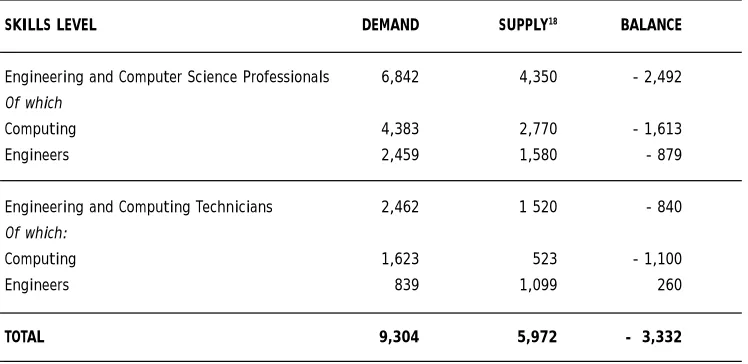
Strong growth in demand for labour during the period 2001-2005 is forecast for the software sector. It will require some 4,400 computer science professionals and 1,600 computer science technicians each year. This is based on growth projections for indigenous industry (25% per annum on average) and demand for software across the economy (10% per annum on average). The main reasons for this increased demand are: the increase in the high-level skills requirements of the IT sector; the emergence of new sectors of IT such as digital media and Internet data centres; growth in eBusiness and the increasing penetration of IT into business in the wider economy. As a result, the anticipated demand for professionals is substantially higher than was forecast in previous reports of the Expert Group.
In the hardware sector,total demand for engineers has remained more or less constant since 1998 but the composition of that demand has altered significantly. In 1998, the First Report of the Expert Group predicted an average annual demand for 2,000 engineering professionals and for 1,800 engineering technicians. Average annual demand is now forecast to be some 2,500 engineering professionals and 840 engineering technicians for the period 2001-2005. The principal catalyst for this change in demand is the increased investment and expansion by companies in high value-added activities such as Integrated Circuit (IC) design. This is driving up demand for engineering professionals from 13% (1996-2003) of the overall labour force requirement of the sector to 33% (2001-2005). Demand for technicians is expected to drop from 25.5% of the total to 14% over these periods.
Supply
On the supply-side, the key influences on student intake in the period 2001-2005 are demographic constraints and the phased introduction of new places in IT. The falling age cohort of 17-18 year olds will reduce the pool from which most entrants into third-level are drawn. This pool is expected to fall by about 15% over the period 1998-2005. While the third-level output of computer science professionals and engineering professionals is each expected to be about 150 more per annum in 2001-2005 compared to the projection period 2000-2003, this will not be sufficient to meet demand. The average annual supply of IT professionals and technicians to the labour market is now forecast to be 4,350 and 1,600 respectively for 2001-2005.
Skills Gap
There has been volatility in both the demand for and supply of techniciansin the IT industry since the late 1990s. In contrast, there has been steady growth in the demand for and supply of IT professionals. Here, the phased introduction of new IT degree places will yield graduates after 3-4 years. This should secure a steady supply of skilled IT professionals in the medium to long-term.
Recommendations
The Expert Group recommends that:
•New, additional, investment of £130m (¤165.07m) should be made in the IT area over five years.
This should be used to:
- Increase access to IT-related skills education through expanding part-time education including
company up-skilling
- Increase the provision of post-graduate conversion courses including on a part-time basis
- Improve completion rates in IT-related areas in third-level
- Renew equipment and develop state-of-the-art facilities for third-level education.
•A dedicated expert Project Team should be established within the HEA to oversee and administer
the proposed new provision of £130 million. It will also ensure that the potential of existing
programmes is realised and examine and propose a development strategy for IT-related education.
•Urgent action should be taken at second-level - in particular, a review of career guidance structures
- to ensure that future levels of intake into full-time third-level education in IT-related areas remains
constant.
•Partnerships between third-level educators and industry should be developed and promoted across
the regions. This would allow, for example, the release of company executives to lecture and create
opportunities for academics to work in industry.
•Further steps should be taken to encourage the immigration of IT professionals into Ireland. These
should include a targeted recruitment drive.
•The Expert Group should continue to monitor and review policy recommendations for the IT sector
on a regular basis.
4. Researchers
Introduction
The Expert Group examined the supply of and demand for researchers in its Second Report. It recommended that urgent action be taken to encourage careers in research and awareness of research opportunities and particularly in relation to the further development of appropriate funding of research activities and researchers. The Report proposed that the number of research students in Ireland would have to increase substantially.
scientific research and has allocated its first round of funding. The results of the second cycle of funding under the HEA’s Programme for Research in Third-Level Institutions were announced in July 2000 and a further cycle has begun. The Minister for Education and Science has announced the establishment of the Irish Research Council for Science, Engineering and Technology to complement the establishment of the Irish Research Council for the Humanities and Social Sciences.
Demand
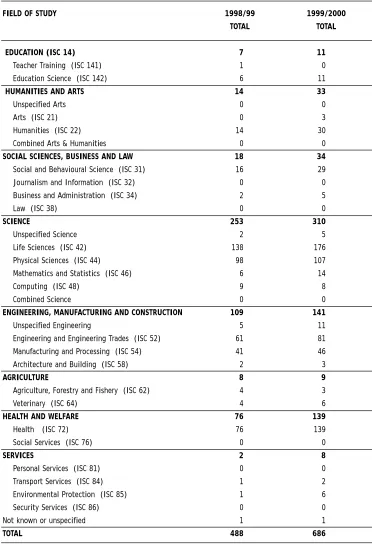
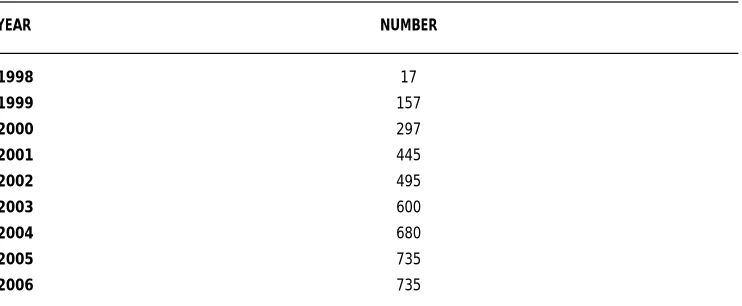
The demand for researchers in Ireland will be influenced by new support measures including those of Science Foundation Ireland, the HEA and the expansion of the research activities of industry. The number of post-doctoral researchers employed by third-level institutions has already increased by 41%, from 488 in 1998/99 to 686 in 1999/00. All areas of study show significant growth. Under the National Development Plan (NDP), significant research funding is to be made available on an increasing basis up to 2006. This will lead to new support for around 600 post-graduate and 240 post-doctoral researchers annually from 2003 onwards.
A survey of job advertisements in 1999-2000 indicated a strong growth in the number of positions that require a Masters degree or above. The number of private sector advertisements for researchers increased by 57% from 99 in 1999 to 155 in 2000. The number of public sector advertisements, however, rose more slowly from 554 in 1999 to 613 in 2000, an increase of 11%.
Supply
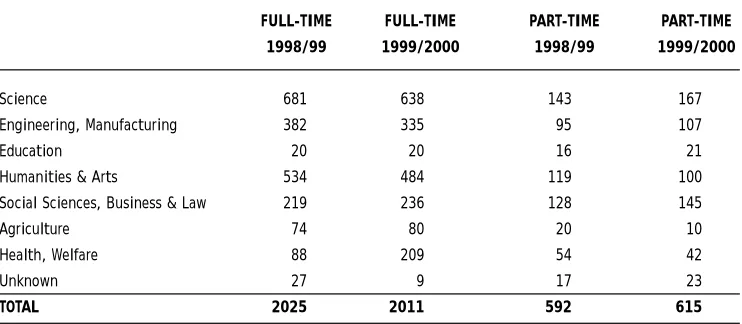
The lack of data available in the HEA database makes it difficult to provide comprehensive estimates of future supply of researchers across all disciplines. The Group had to rely heavily on data available for the academic years 1998/99 and 1999/2000. This showed that enrolments in PhD and Masters programmes have risen slightly from 1998/99 to 1999/00, to 2,315 full-time PhD students (an additional 570 are studying part-time) and 2,011 full-time Masters students (615 more are studying part-time). This is encouraging at a time when buoyant labour market conditions, combined with relatively low levels of support for post-graduate study, make continuing education financially unattractive in the short-term. The number of PhDs being awarded has also increased in recent years, but the number of Masters research awards has declined slightly. Overall, it would appear that the total number of research awards is relatively constant, averaging 800-900 per annum between 1998-2000.
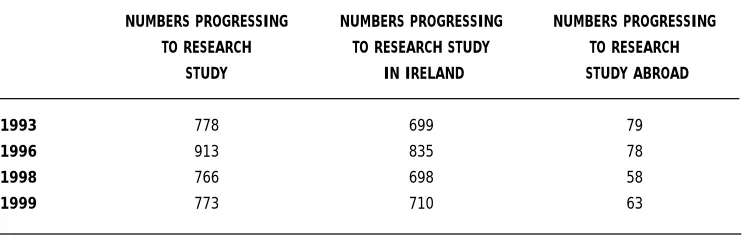
However, the general trend is for a reducing percentage of those attaining degrees following full-time study to progress immediately to research study. Since the absolute number of students attaining full-time undergraduate degrees seems likely to peak in the near future, there will be a need to increase the rate of transfer of students moving from completed undergraduate to initial postgraduate study in order to retain the existing number of research degrees or indeed increase it in line with demand trends.
Skills Gap
annual basis by 2003 (a total of 245) shows the demand which will arise from NDP activity alone will account for over half of current PhD output. Furthermore, it is estimated that by 2003 around 600 post-graduate students per annum will receive funding under the new supports (i.e. from SFI, the HEA and the two Research Councils) leading to 1,800 post-graduate students being in receipt of such funding in any given year from 2005. On this basis, the Group found that national policy should aim to increase substantially the output of doctorates, particularly in science and engineering.
Plugging the Gap from Abroad
In view of the projected skills gap between the demand for researchers with a PhD degree and the probable supply from within Ireland over the coming years, the Expert Group believes that it will become increasingly necessary to attract suitably qualified people from abroad. It therefore commissioned a benchmarking study of mechanisms and strategies which other countries use to attract researchers from abroad. This will be published by Forfás and the HEA. The study examined the situation in five leading research countries, including three small ones. It made the following policy recommendations to attract researchers from abroad to Ireland:
Build up centres of research excellence
Improve international networks and the international viability of Irish universities
Improve the status and remuneration of research students and post-doctorates
Make the move to Ireland for researchers as smooth as possible
Recommendations
The Expert Group recommends that:
•National research policy should aim to achieve a substantial increase in the output of doctorates,
particularly in science, engineering and technology by building on the newly launched funding and
support measures for research in 2000/2001.
•Measures should be taken to increase the attractiveness of research among under-graduates in
particular.
•Measures should be taken to attract researchers from abroad.
•A working group including Forfás and the HEA, as well as representing the Deans of Research in
higher education institutions and the two Irish Research Councils, should be set up to the examine
international networks and the international visibility of Irish universities and how to make the
move to Ireland of researchers as smooth as possible.
•The HEA database on research activities in third-level institutions should be further developed.
5. Life Sciences
Introduction
The Second Report of the Expert Group identified four main areas where projections of labour demand exceeded projections of supply - Chemistry degrees, Biological Sciences degrees, Chemical and Biological Sciences sub-degrees and Chemical Engineering degrees. It recommended that 200 more degree graduates per annum should be produced in the Biological Sciences; 80 more in Chemistry, and 10 more in Chemical Engineering. The Report recommended that the new places required to meet this increased output be introduced on a phased basis.
In response to the recommendations made in the Second Report, the HEA requested proposals from third-level colleges to create additional college places as a first phase response to the Expert Group’s report. The proposals accepted will lead to an increase intake of 81 students into Chemistry programmes (50 into the universities and 31 into the Institutes of Technology), and 74 into Biological Sciences programmes (50 into the universities and 24 into Institutes of Technology) for the academic year 2000/01. A proposal to increase intake into Chemical Engineering by 12 from academic year 2001/2 has also been accepted. These proposals will meet 81% of the overall projected requirement for additional Chemistry degrees; 30% of the overall projected requirement for additional Biological Sciences degrees; and the entire projected requirement for additional Chemical Engineering degrees.
Demand
Two factors have had a significant impact on the demand projections. Firstly, after another year of strong growth in the Pharmaceuticals sector, the base level of employment on which the current projections are founded is now about 10% higher than in the previous year - this increases the volume of demand projected by about 3%. This has a material impact on the projections of demand for chemists, biological scientists, chemical engineers and science technicians. Secondly, increased experience with the formation and development of indigenous Biotechnology companies has led to a more conservative view of what can optimistically be expected of the sector. There have also been many major developments in Bioinformatics3
in 2000, and a significant rise in interest from companies in the Biopharmaceutical4sector, both of which
generate demand for high-level skills. Significant growth is expected in these sectors and their specific skills needs will be reviewed by the Expert Group in the future.
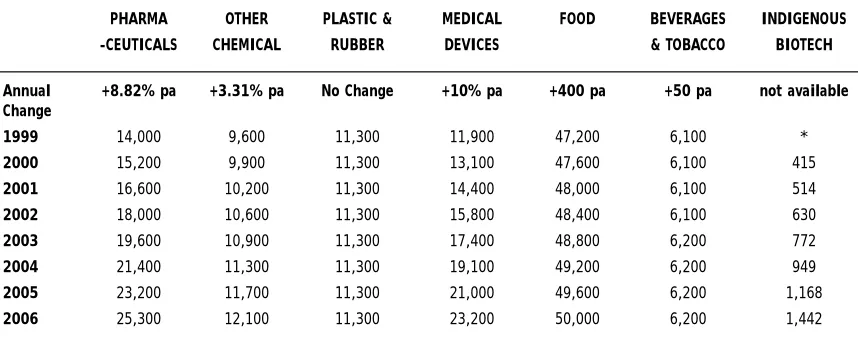
Based on the updated sectoral growth projections, the projected demand for life science graduates is for an increase in demand from the Pharmaceuticals, Chemicals, Plastics, Rubber and Medical Devices sectors from 744 graduates in 2000/01 to 1,103 by 2005/06. The corresponding increase for the Food, Drink and Tobacco sectors is from 324 to 339, with a decrease in demand for the indigenous Biotechnology sector from 68 to 181.
Supply
The number of graduates with certificatesis falling significantly in both Chemistry and Biological Sciences. This trend is expected to continue, resulting in the possible discontinuation of some courses. The numbers of graduates with certificates in Instrumentation Physics5has also been falling, but appears to have
recovered in 2000.
3 Bioinformatics is concerned the application of computer-supported data analysis to the Biological Sciences. The requirement for people with skills in this area has been increased greatly by the opportunity to make practical and commercial use of the vast amount of genetic data emerging from the Human Genome Project and related initiatives. 4 Biopharmaceuticals are defined as the production of pharmaceutical products through biotechnology rather than through
chemical synthesis.
The number of graduates with diplomashas remained steady for Chemistry and has fallen for Biological and Food Sciences in recent years. However, as rates of transfer from certificate to add-on diploma programmes are already high, diploma numbers are expected to fall in both Chemical and Biological Sciences. The fall may, however, be partially mitigated if students from the Accelerated Technician Programme and the new Institute Trainee Programme progress to further study in significant numbers after receiving certificate-level qualifications. The number of graduates with diplomas in Instrumentation Physics has also been falling in recent years, but appears to have held steady in 2000.
The supply of degreelevel Science graduates (excluding Computing) and degree holders in Instrumentation has been improving, partially due to the increased transfer rate from sub-degree courses and the addition of a new add-on degree in Instrumentation Physics in 199/00. However, the positive trend in the degree-numbers graduating from the Institutes of Technology now faces reversal. Most of the relevant degrees are one-year add-on courses whose intake depends on the supply of diploma-holders. If the supply of diploma holders falls as anticipated, this will adversely affect the intake, leading to a reduction in the number of degree graduates.
Skills Gap
The Expert Group reiterates its concern at the falling numbers of school leavers interested in studying Science at third-level, and the likely impact this will have on the numbers of graduates qualifying in Chemical and Biological Sciences in the years ahead. The situation is compounded by the fact that there is an overall decline in the number of students taking the Leaving Certificate due to demographic changes. The Expert Group welcomes the initiatives taken by the Minister for Education and Science to address the fall-off in participation in the Physical Sciences at both second-level and third-level, especially the establishment of the Task Force on the Physical Sciences.
Due to changes in industry demand and the measures already undertaken plus changes in output, no further intervention is required at present to increase places on Chemistry, Food Science, Agricultural Science or Biological Sciences degree programmes, provided that the existing output can be maintained from the universities and Institutes of Technology. A further intervention sufficient to produce at least another 24 degree graduates per annum is required in Chemical Engineering in order to meet projected future demand. The relevant industry sectors have identified a shortage of Instrumentation Physics graduates. However, the extent of the shortage has not been quantified accurately.
The Expert Group will continue to monitor skills needs in Chemical and Biological Sciences, in particular the effects of (i) any changes in demand within the overseas and indigenous Biotechnology and
Pharmaceuticals sectors and (ii) the fall in third-level applications.
Recommendations
The Expert Group recommends that:
•No additional places be introduced on Chemistry or Biological Science degree programmes,
provided that the existing output from Universities and Institutes of Technology can be maintained.
•Given the addition of a new add-on degree in 1999/00, no further increase in Instrumentation
Physics places should be made.
•Provision should be made for the supply of at least another 24 degree graduates per annum in
6. Construction Industry
Introduction
The Construction industry has grown rapidly in recent years. Output was valued at £14.2 billion (€18.03 billion) in 2000 and employment had risen to 178,100 by the end of 2000.6This represented an increase of
74% in output (volume) and 84% in employment since 1995.
In 1999, FÁS, on behalf of the Expert Group and the Construction Industry Training Committee, carried out an analysis of the employment needs of the Construction sector for the period 1999-2003.7The analysis
focused in particular on the number of craft workers that would be required by the industry in the period 1999-2003. The Expert Group has decided to update these forecasts and to extend the forecast period to 2006 and the number of occupations covered by the analysis to include professional and non-craft skilled workers.
Demand
The National Development Plan involves total investment of £22.646 billion (€28.754 billion) on physical infrastructure. Achievement of the targets in the National Development Plan will give rise to a significant increase in demand for construction workers in the following three areas: the construction of roads, social housing and environmental services. By the second quarter of 2006, the total number of construction workers in employment is forecast to be almost 220,000. This represents an increase on the estimated employment figure of 176,300 in 2000 of 43,612 or just over 7,000 per annum. This is significantly below the level of employment growth recorded in the two years immediately preceding the forecast period, when direct employment increased on average by 20,000 a year. Factors affecting future employment growth include a decline in output growth (to 8% in 2001 and declining thereafter) and positive productivity gains, partially due to the higher proportion of total expenditure allocated to civil engineering projects than to residential construction.
An employment level of 220,000 by 2006 will require recruitment of 80,000 workers, including 50,000 skilled workers while taking natural wastage into account. The composition of these 50,000 jobs is as follows: 5,101 in management/site supervision, 7,286 professionals, 31,682 craft workers and 6,891 other skilled workers (e.g. motor mechanics, accountants).
Supply
The Construction industry has significant levels of labour mobility in response to changing patterns of demand in different economies at different times. Factors that will have a major influence on the supply of skilled construction workers over the forecast period 2000-2006 are the demographic trends in the Irish labour market and emerging skill shortages in the Construction industry in the United Kingdom; the latter resulting from a major investment programme in infrastructure improvements. This could have a serious impact on the capacity of the Construction industry in Ireland to undertake the civil engineering projects envisaged by the National Development Plan.
Over the period 2001-2006, it is estimated that a total of 24,544 persons will qualify in various aspects of construction. This comprises 1,648 in management/site supervision, 3,207 professionals and 19,689 craft workers. There is little scope for an increase in the supply of workers to the industry from the unemployed or from returning Irish immigrants.
Skills Gap
The number of skilled construction workers qualifying in Ireland over the forecast period will be approximately 26,400 less than the number required to achieve the level of projected output over the period. This shortage consists of project managers/site supervisors (3,453), professionals (4,079), craft workers (11,993) and other skilled workers (6,891).
Recommendations
Management skills
The Expert Group recommends that:
•Priority should be given to increasing the current low level of provision of training programmes in
both project management and supervisory skills.
•The Department of Education and Science should consider the introduction of one more additional
full-time degree programme in construction management, to be located in Dublin.
•Increased funding amounting to £300,000 (€380,921) per annum should be made available to
grant-aid further management and supervisory training for employees.
•FÁS should commission a research study on the changing role of managers and the implications for
education and training provision.
Professional skills
The Expert Group recommends that:
•As part of the FÁS Jobs Ireland campaign, there should be a specific initiative to attract suitably
qualified construction professionals from abroad, focused on civil engineers, surveyors, planners
and architects.
•The Expert Group should undertake a study of the human resource requirements of the Engineering
sector, as the needs of this sector interact with those of the Construction sector.
•The Department of Education and Science should review current level of education and training
provision for architects, quantity surveyors and building surveyors and civil engineers.
Craft skills
The Expert Group recommends that:
•The Construction industry and FÁS should give priority to encouraging employers to increase their
current levels of sponsorship of apprentice bricklayers in particular.
•While a further small increase in carpenter and fitter apprentice intake could be justified, there
should be no further increases in intake of apprentice plumbers.
•The situation in regard to apprentice electricians should be further considered in the light of
•The issue of balancing overall apprentice intake to better match projected requirements should be
considered further.
•A ‘Fast-Track’ system of obtaining formal national craft qualifications should be developed and
introduced on a pilot basis specifically for adults who are working in the ‘wet trades’ but who are
not in receipt of a National Craft Certificate.
•Mechanisms should be put in place to ensure that the ‘Fast-Track’ system does not result in any
diminution in current standards.
•The possibility of reducing the time it takes to complete some apprenticeships should be actively
considered by the relevant interests.
•The FÁS Jobs Ireland campaign should continue to focus on attracting qualified construction craft
workers to Ireland as a matter of priority.
•The Expert Group should conduct a study to establish the total requirement of the economy for all
engineering craft workers, including electricians.
•The Expert Group commission a study to determine the level of and reasons for the apparent low
retention rates of skilled workers in the Construction industry and the development of proposals to
address this.
•FAS should promote the Construction Skills Certification Programme. It should seek to provide
training for between 5,000 and 7,000 non-craft skilled workers over the duration of the National
Development Plan.
•Training by FÁS should provide for between 4,000 and 5,000 construction operatives and
supervisors on road-construction and maintenance. This training should be made available to both
the private sector and the public sector.
•The Department of Enterprise, Trade and Employment, the Immigration and Policy Advisory
Committee (IPAC) and the Expert Group should consult and co-ordinate their policy approaches to
minimise any constraints to non-EEA contractors who wish to bring non-EEA construction
employees to Ireland for a specific period to execute specific projects.
8 This report remains unpublished for competitive reasons.
7. Expert Group Work Programme
Of the 96 recommendations made to date by the Expert Group, excluding those made in this Report, only 13 have not as yet been implemented. The 13 recommendations in question were contained mainly in the later reports on eBusiness Skills, In-Company Training and Shared Services.8
Key Responses to Expert Group Recommendations
•The First Report of the Expert Group, published in December 1998, focused on the IT sector and
resulted in significant additional investment by the Government – over £90 million (€114 million).
Substantially increased places in third-level colleges were created at undergraduate and
postgraduate levels. Training places on relevant FÁS programmes were also increased. Overall,
approximately 4,000 new training and third-level places were created.
•The Second Report, published in February 2000, analysed the labour market in general, the
availability of workers for low skills occupations, the crafts areas of the Construction industry,
Chemical and Biological Sciences graduates, researchers and IT graduates. Since its publication,
the number of apprentices in the Construction trades has risen from 4,142 at the end of 1998 to
5,473 by the end of 2000. An additional £5m (€6.35 million) was allocated for new apprenticeship
courses in 2000. The number of places on Accelerated Technician Programmes has been increased,
particularly in the areas of IT.
•The Report on In-Company Training, published in August 2000, focused on a qualitative
assessment of training needs of small-medium sized companies in the Construction and Traditional
Manufacturing sectors. Developments to-date include the provision by the Department of
Education and Science of funding for 1,000 places on a new Institute Trainee Programme for 2001.
The aim of the programme is to target skill needs identified by the Expert Group in, for example,
Construction, Pharmaceuticals and eBusiness.
•The Report on eBusiness Skills, published in August 2000, focused on the content of education and
training relevant to eBusiness covered in the third-level sector and elsewhere. Discussions are
underway to establish the eBusiness Skills Partnership recommended by the Expert Group, which
will address many of the recommendations on e Business made by the Expert Group. A third-level
Computing Forum is also being established and it will address recommendations on computer
course content and design. The Institute of Directors of third-level colleges is in the process of
developing a national programme on access to education in eBusiness for all graduates.
•The Report on Shared Services, completed in August 2000, examined the growth in this activity in
Ireland and future growth opportunities. It made recommendations on how this growth might be
capitalised upon. The National Skills Awareness Campaign is promoting the Shared Services sector
in schools. IDA Ireland has targeted overseas companies in Shared Services with a view to
attracting them to Ireland and has met with regional Institutes of Technology to discuss graduate
output for Shared Services.
1. Introduction: Third Report
1.1 Introduction
The economic climate in Ireland has changed dramatically in the 1990s. Over the decade, Irish GNP in real terms expanded by almost two-thirds9and the number at work grew by over one-third. The number of
people of working age (those aged between 16 and 64) rose, as did labour force participation rates. Net immigration became a feature of the 1990s compared to net emigration in the 1980s. Unemployment fell and an extensive range of unfilled vacancies existed across many sectors of the economy.10At the end of the
1990s, Ireland was experiencing both labour shortages and specific skill shortages.
1.2 New Structures to Respond to Skills Shortages
In 1997, the Government responded to Ireland’s growing labour and skills shortages by establishing the Business Education and Training Partnership. The Partnership comprises three key elements. These are:
The Business Education and Training Partnership Forum;
The Expert Group on Future Skills Needs; and
The Management Implementation Group.
The Business Education and Training Partnership Forum is widely representative of the highest levels of the business sector, the education and training sector, the social partners, Government departments and the development agencies. Its role is to consider strategic issues and it meets once or twice a year with the objective of achieving a consensus among all interested parties on the policies required to meet the skills needs of the economy.
The Expert Group on Future Skills Needs engages in the identification of skill needs, the promotion of education and continuous training, and raising awareness of job opportunities.
The Management Implementation Group has the responsibility to oversee the implementation of the approved recommendations on skills supply. This Group comprises senior civil servants from the Departments of Education and Science; Enterprise, Trade and Employment; and Finance and senior executives from the Higher Education Authority and Forfás.
1.3 The Expert Group on Future Skills Needs
The membership of the Expert Group is broadly based and includes business people, members of the educational community, policy makers, public servants and members of the industrial promotion agencies. Appendix 1 provides a list of its current membership. The Expert Group operates via sub-groups drawn mainly from its membership to oversee research into particular issue areas.
1.4 Objectives
The objectives of the Expert Group are to:
Identify, in a systematic way, the skills needs of different sectors and to advise on the actions needed to address them;
Develop estimating techniques that will assist in anticipating the future skills needs and requirements of the economy and the associated resource requirements;
Advise on the promotion of education/continuous training links with business at national and local levels;
Consider strategic issues in developing partnerships between business and the education/continuous training sectors in meeting the skills needs of business; and
Advise on how to improve the awareness of job seekers of sectors where there are demands for skills, of the qualifications required, and of how they can be obtained.
1.5 Scope of the Third Report
This Report provides an overview of the labour market and up-dates previous data on skills needs in four important areas of growth in the Irish economy – Information Technology (IT), Researchers, Life Sciences and Construction.
Chapter 2 contains the overview of the labour market. It concludes that, despite the slowdown in economic growth, low levels of unemployment and a further slowdown in the growth of labour supply in 2000, further measures are needed to augment the labour supply.
Chapter 3 addresses the skills needs of the Information Technology sector. Despite the current period of uncertainty in the IT industry, notably in the U.S. economy, it continues to be one of Ireland’s most important industries and remains a key driver of economic growth. Its importance to the future health of the Irish economy cannot be under-estimated and the Expert Group therefore considers that regular up-dating of forecasts on supply and demand for workers within the industry is very important. This chapter builds on the forecasts for the sector contained in the First and Second Reports of the Expert Group and identifies key skills needs for the future.
Allied to IT is the need for skilled researchers to carry out research in a range of areas from Electronics and Food to Biological and Chemical Sciences. Chapter 4 builds on the Expert Group’s initial examination of the need for Researchers contained in the Second Report. The Government has made a significant commitment to growing Ireland’s Research and Development capacity in the National Development Plan. The provision of researchers and workers with appropriate skills and experience will be a key factor in achieving the objectives set out in the National Development Plan. This chapter reviews skills needs, mechanisms to attract researchers and the likely supply of Researchers in the future.
Chapter 6 reviews the skills needs of the Construction industry. The Construction industry continues to exhibit severe labour and skills shortages. The National Development Plan involves an investment of £22.6 billion (€28.754 billion) on physical infrastructure over the period 2000-2006. Investment in roads, transport and housing are major components of this planned investment. Roads and transport account for over one-third of planned investment. The demand for labour has fuelled the growth in demand for new housing as emigrants return to Ireland and immigrants are attracted to a growing economy. Housing accounts for over one-quarter of planned investment. Other areas of physical infrastructure that will have significant expenditure over the lifetime of the National Development Plan include environmental services, health and education. This chapter up-dates the data provided in the Second Report of the Expert Group and examines the skills needs of the wider Construction industry over the timeframe for completing the National Development Plan (2000-2006).
2. Overview of the Labour Market
2.1 Introduction
The Second Report of the Expert Group included an analysis of the labour market outlook for Ireland in 2000. The Report noted the unprecedented growth of the Irish economy since the mid-1990s and the consequent rapid growth in employment. This growth in employment was facilitated by a large fall in unemployment, inflows of young persons from the school system and women from the home, reduced emigration and significantly increased immigration. Despite these various sources of additional supply, the labour market tightened considerably with many employers experiencing difficulties in recruiting suitable employees. The analysis found that there were both in the labour marketskills shortages and more generalisedlabour shortagesin Ireland. Forecasts of likely future demand for and supply of labour for the period to 2009 were made. These showed that the Irish labour market would remain tight throughout the decade. However, assuming that increases in female participation and ongoing net immigration would continue, there should be just enough labour supply to meet demand. The Report made a number of recommendations to try to ensure that a sufficient supply of labour would be forthcoming to meet expected demand. These included measures relating to tax and social welfare policy, childcare, helping the
unemployed to return to work, immigration and more flexible working arrangements. In this chapter, labour market developments in 2000 and the outlook for 2001 are reviewed.
2.2 Review of Labour Market Developments
In reviewing the year 2000, the Expert Group noted that economic growth, at about 10% of GNP, was very strong and considerably stronger than expected at the time the Second Report was being prepared (1999). This was due principally to the unanticipated strength of real domestic consumer spending and the boost to exports through the low value of the euro. This strong growth led, in turn, to more rapid employment growth than earlier forecasts.
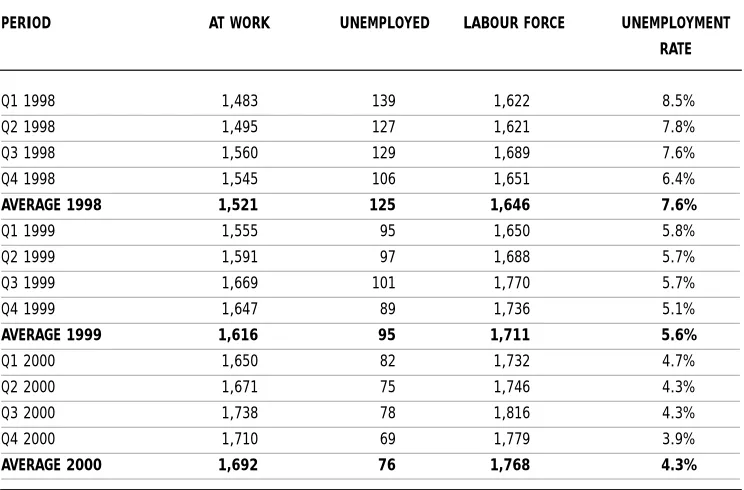
The numbers at work in Ireland increased during 2000. Unemployment also continued to decline, reaching exceptionally low levels by late-2000. Quarterly data for 2000 are presented in Table 2.1 along with comparable data for 1998 and 1999. Table 2.1 shows that average Irish employment (those ‘at work’) in 2000 stood at 1.692 million, representing an increase of 76,000 or 4.7% on the 1.616 million people at work in 1999. While substantial, the growth in employment achieved in 2000 represented a significant slowdown on the pace of job growth a year earlier, when average employment increased by 95,000 or by 6.3%.
TABLE 2.1: LABOUR MARKET TRENDS IN IRELAND (ILO BASIS) 1998-2000 (in ‘000s)
PERIOD AT WORK UNEMPLOYED LABOUR FORCE UNEMPLOYMENT RATE
Q1 1998 1,483 139 1,622 8.5%
Q2 1998 1,495 127 1,621 7.8%
Q3 1998 1,560 129 1,689 7.6%
Q4 1998 1,545 106 1,651 6.4%
AVERAGE 1998 1,521 125 1,646 7.6%
Q1 1999 1,555 95 1,650 5.8%
Q2 1999 1,591 97 1,688 5.7%
Q3 1999 1,669 101 1,770 5.7%
Q4 1999 1,647 89 1,736 5.1%
AVERAGE 1999 1,616 95 1,711 5.6%
Q1 2000 1,650 82 1,732 4.7%
Q2 2000 1,671 75 1,746 4.3%
Q3 2000 1,738 78 1,816 4.3%
Q4 2000 1,710 69 1,779 3.9%
AVERAGE 2000 1,692 76 1,768 4.3%
Sources: Quarterly National Household Surveys 1998-2000, Central Statistics Office Note: Figures have been rounded to the nearest 1,000.
Unemployment, measured on an International Labour Organisation (ILO) basis, continued to decline in 2000, averaging 76,000 or 4.3% of the labour force during the year. Average unemployment levels fell by almost 20,000 people or by more than one-fifth between 1999 and 2000. The ILO unemployment rate, at 4.3% in 2000, was 1.3 percentage points lower than the 5.6% rate recorded in 1999. By the final quarter of 2000, the unemployment rate had fallen to 3.9%, the first time in recent decades that the rate had dipped below 4%. Long-term unemployment also fell steadily, reaching 24,200 by the final quarter – a rate of 1.5%. Thus, short-term unemployment exceeded long-term unemployment by a ratio of almost two to one.
In the context of this continuing growth in employment, there are several noteworthy features in relation to employment in 2000:
As many women as men gained employment during the year.
Most of the net addition to employment comprised full-time jobs.
In sectoral terms, absolute additions to employment were highest in the Services sector while Construction sector registered the biggest proportionate job gains. Farm employment fell steeply.
Occupationally, the largest employment gains were concentrated amongst intermediately skilled groups, operatives, personal service workers and sales staff.
2.3 Labour Force Supply
It is important both in the short and long-term to examine labour force supply to see to what extent it is likely to be a brake on economic performance. During 2000 there was a very significant deceleration in labour force growth, from an annual rate of 5% in the first quarter to just 2.9% by the final quarter of the year.
Irish labour force growth since the mid-1990s has been driven by two principal factors. First, the expansion of the labour force has reflected increases in the population of working age, due both to increases in the domestic ‘natural’ population and to net immigration. Second, labour force growth has been augmented by rising labour force participation rates (LFPRs) amongst those of working age (primarily women).
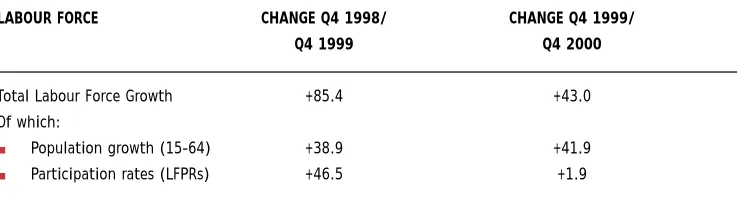
As Table 2.2 shows, both additions to the working age population and rising LFPRs were together
[image:29.595.105.474.377.480.2]responsible for the large increase in the labour force between 1998 and 1999. While the impact of domestic population growth - reinforced by net immigration - strengthened further between 1999 and 2000, the contribution of rising LFPRs to labour force growth was minimal. Increases in LFPRs in the year to the fourth quarter of 2000 added just 1,900 people to the labour force compared with a contribution of 46,500 in the preceding year.
TABLE 2.2: LABOUR FORCE GROWTH (‘000s)
LABOUR FORCE CHANGE Q4 1998/ CHANGE Q4 1999/ Q4 1999 Q4 2000
Total Labour Force Growth +85.4 +43.0 Of which:
Population growth (15-64) +38.9 +41.9 Participation rates (LFPRs) +46.5 +1.9
Source: QNHS, Q3 2000, page 2 and Table 10.
Almost all of the growth in the labour force between the fourth quarters of 1999 and 2000 was due to an expansion of the population of working age. This contrasts starkly with the change in the previous year, when increased participation rates accounted for more than half of the increase in the labour force. In turn, as much as one-third of the contribution of population growth to the expansion of the labour force over the year 2000 has been attributable directly to net immigration inflows.
A detailed analysis of labour force participation rates shows that male rates actually fell marginally in 2000 and female rates rose by a relatively small 0.8 percentage point (compared to 2.6 percentage points in the previous year). The rate for married women rose by 0.6 percentage points (compared to 2.2 percentage points in the previous year). These rates of increase are lower than might have been expected in the context of the introduction of tax individualisation from April 2000. Despite considerable increases over the last few years, female participation rates in Ireland remain several percentage points below the EU average, and if the trend in 2000 persists, they will continue to remain so. Thus, this source of labour force growth cannot be presumed to continue. This lower participation rate reflects lower participation rates in Ireland among women in older age cohorts.
A further source of potential labour supply is those persons who are not recorded as employed or
unemployed but who want to work. The Central Statistics Office’s (CSO) Quarterly National Household Survey asks a number of questions to establish persons’ interest in working and hence those ‘marginally attached to the labour force’ and others who want to work. In 2000, a total of 120,000 persons fell into these
support. Another possible source of increased labour supply is persons working part-time. While survey evidence suggests that few of these would like to work full-time, there may be potential for some of them to work more part-time hours. The Expert Group will undertake further analysis of these issues.
The Work Permit system enables employers with vacancies that they cannot fill with citizens from Ireland or from within the European Economic Area (EEA) to recruit employees from other non-EEA countries. There was a very significant increase in Work Permits issued in 2000 to a figure of about 18,000, compared to 6,500 in 1999. The Government also introduced a new Work Visa system to facilitate the recruitment of suitably qualified people for designated sectors (Information Technology, Nursing and Construction professionals) where skills shortages are particularly acute.
Employers continued to experience difficulties in recruitment during 2000. The ESRI undertook a survey of employer vacancies on behalf of the Expert Group in early 2000, replicating a survey undertaken twelve months earlier. The survey covered all private sector companies across the Manufacturing, Construction and Services sectors. It found that 31% of companies overall had vacancies compared to 27% in the previous survey. In relation to Manufacturing, half of companies had vacancies, and in the case of Construction firms, vacancies rose significantly from 19% to 34% of firms surveyed.
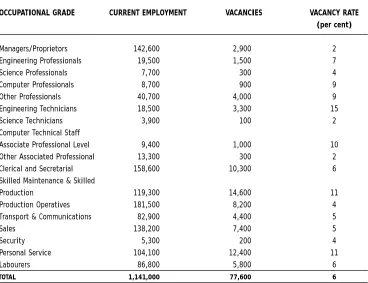
[image:30.595.147.515.467.750.2]In total, there were 77,600 vacancies compared to 64,700 in the previous survey. This represents a vacancy rate of 6% (of the total labour requirement) compared to 5.8% a year earlier. The types of occupations with the highest rates of vacancy were engineering technicians (15%), skilled maintenance and production workers (11%) and personal service workers (11%). Other key findings of the survey were the increased use of overseas sources of recruitment, the continued difficulties firms had in filling their vacancies and the increasing extent to which recruitment difficulties were experienced outside the Dublin area. Table 2.3 presents the results for each of the main occupational groups.
TABLE 2.3: SUMMARY OF VACANCIES BY OCCUPATIONAL GRADE 1999/2000 (All Sectors in Aggregate) OCCUPATIONAL GRADE CURRENT EMPLOYMENT VACANCIES VACANCY RATE
(per cent)
Managers/Proprietors 142,600 2,900 2
Engineering Professionals 19,500 1,500 7
Science Professionals 7,700 300 4
Computer Professionals 8,700 900 9
Other Professionals 40,700 4,000 9
Engineering Technicians 18,500 3,300 15
Science Technicians 3,900 100 2
Computer Technical Staff
Associate Professional Level 9,400 1,000 10 Other Associated Professional 13,300 300 2 Clerical and Secretarial 158,600 10,300 6 Skilled Maintenance & Skilled
Production 119,300 14,600 11
Production Operatives 181,500 8,200 4
Transport & Communications 82,900 4,400 5
Sales 138,200 7,400 5
Security 5,300 200 4
Personal Service 104,100 12,400 11
Labourers 86,800 5,800 6
TOTAL 1,141,000 77,600 6
2.4 Outlook for 2001
Looking to the future, the Expert Group notes the current difficulties facing the world economy because of the slowdown in the U.S. economy as well as the specific problems in Ireland due to the Foot and Mouth crisis. Irish economic growth in 2001 will undoubtedly be reduced compared to recent years. The June 2001 Central Bank forecast for economic growth is of 6.5% in GNP. Given the existing low levels of
unemployment; official forecasts for a further 3.5% rise in employment during 2001; and a projected further slowdown in labour supply growth from domestic sources, labour markets look set to remain very tight through 2001. Thus, the Expert Group believes that further measures are required to augment the labour supply. A range of micro-economic initiatives are needed, building on measures already in train. These include:
Fiscal and structural supports aimed at encouraging increased participation by women in the labour force.
Policies include the three-year tax individualisation programme and increased public spending on childcare provision. However, structural, legal and administrative difficulties continue to hamper the establishment of sufficient reasonably-priced childcare places. These should be addressed.
Efforts to induce older people - those aged 55 years and over - to participate in or to re-enter the labour market on a full- or part-time basis.
Such efforts should focus on alleviating direct taxes on the combined income older people derive from pensions and earnings. The Expert Group is currently carrying out a study on the Over 55s which is intended to lead to initiatives in this area.
Initiatives designed to encourage the economically inactive who want to work to be able to do so.
The numbers in this category are large (about 120,000 during each of the last three years) and two-thirds of them are women. More research is needed to ascertain the factors that are blocking their participation in the labour market.
An administrative system designed to ensure a sufficient and timely supply of Work Permits and Work Visas for immigrants in order to support domestic labour force growth.
However, further interventions in this sphere would have to take cognisance of the impact of greater numbers of residents on the country’s already over-burdened economic and social infrastructure.
The further development of the National Employment Service aimed at reducing ‘frictional’
unemployment through encouraging effective and speedy matching of job seekers with available jobs.
The development of targeted initiatives under the Life Long Learning strategy that will allow individuals, employed and unemployed, to train or re-train for jobs where labour is in particularly scarce supply.