Vocabulary Development To Support Information Extraction of
Substance Abuse from Psychiatry Notes
Sumithra Velupillai1,2, Danielle Mowery3, Mike Conway3, John Hurdle3 and Brent Kious4 1 School of Computer Science and Communication, KTH, Stockholm
[email protected] 2 IoPPN, King’s College London
3 Department of Biomedical Informatics, University of Utah 4Department of Psychiatry, University of Utah
Abstract
Extracting information from mental health records can be useful for large-scale clini-cal studies (e.g., to predict medication ad-herence or to understand medication ef-fects) in this clinical specialty largely un-derserved by the Natural Language Pro-cessing (NLP) community. Vocabular-ies that contain medical terms for specific clinical use-cases, such as signs, symp-toms, histories, social risk factors, are valuable resources for the development of NLP systems that aid clinicians in ex-tracting information from text. Substance abuse is an important variable for many clinical use-cases, but, to our knowledge, there are no publicly available vocabular-ies that cover these types of terms. In this study, we apply and combine three meth-ods for generating vocabularies related to substance abuse. We propose a simple and systematic method to generate highly rel-evant vocabularies and evaluate these vo-cabularies with respect to size and content, as well as coverage and relevance when applied to authentic psychiatric notes.
1 Introduction
Information about a mental health patient’s clin-ical condition is documented routinely in mental health records, mostly in the form of free-text. Ex-tracting information from these documents can be useful for large-scale clinical studies to develop new treatment alternatives, to understand disease progression and medication effects, etc. Vocabu-laries that contain relevant terms for specific clini-cal use-cases are useful resources for the develop-ment of Natural Language Processing (NLP) sys-tems that aid clinicians in extracting information
from text.
In this study, we focus on the problem of mated vocabulary generation, specifically, to auto-mate the generation of relevant synonyms and re-lated terms, focusing onsubstance abuse, an area not well-studied. Specifically, we aim to:
1. compare, assess, and combine three different automated vocabulary generation methods 2. determine vocabulary coverage and relevance
in substance abuse sections from authentic psychiatric clinical notes, and
3. generate a publicly available vocabulary with substance abuse terms
Our goal is to develop efficient vocabulary gen-eration methods that can be used in larger NLP pipelines for new clinical use-cases, where domain experts with minimal-to-no NLP background can develop tailored solutions for new problems.
1.1 Treatment Management for Acute Anxiety
Patients with depression and anxiety disorders ad-mitted for hospital care commonly receive med-ications for the management of acute anxiety on an as-needed basis (Curtis and Capp, 2003; Stein-Parbury et al., 2008). These may include benzo-diazepines, antihistamines, antipsychotic medica-tions, and others. Although these treatments can reduce a patient’s acute distress level, they often have adverse effects. Apart from class-specific side-effects (e.g., oversedation related to benzodi-azepines), as-needed anxiolytics may also impair response to psychotherapy and impede long-term recovery (Curran, 1986; Curran and Birch, 1991; Westra et al., 2004; Mystkowski et al., 2003; Otto et al., 2005).
In an effort to better understand the effect of as-needed anxiolytic medications on a patient’s abil-ity to manage their anxiety during and after
chiatric hospitalization, one of the authors (BK) has undertaken a large-scale retrospective study. The study aims to determine whether anxiolytic use correlates with poorer outcomes for psychi-atric inpatients being treated for depression and anxiety, such as prolonged hospitalization or in-creased risk of readmission. This study involves a large cohort (n=about 3000) of patients admitted to several psychiatric hospitals in the same univer-sity system. Because the effects of anxiolytic use on the outcomes of interest are likely modulated by a number of other variables, such as her history of substance use disorders, the study requires the coding of almost 30 variables for each patient, all of which must be abstracted from free-text clinical notes.
1.2 Treatment Variables from Clinical Texts
NLP approaches could accelerate the coding pro-cess for this data set, while also providing the foundation for future studies with similar aims. Although research in clinical NLP has matured over the last decades, and there are several pub-licly available clinical text processing pipelines and modules e.g., cTAKES (Savova et al., 2010), MedLee (Friedman et al., 1994), and pyConText (Chapman et al., 2011), adapting and refining these resources to fit the information needs for specific use-cases is not straightforward.
Furthermore, although there have been a few efforts in the NLP community to address men-tal health-related use-cases, e.g., understanding a patient’s suicidal ideations from suicide notes (Pestian et al., 2010) and detecting signals of post-traumatic stress disorder (PTSD), depression, bipolar disorder, and seasonal affective disorder (SAD) from tweets (Coppersmith et al., 2014), NLP for mental health is still in its early stages.
In this study, we focus on substance abuse as it relates to patients suffering from depression and anxiety disorders. As a first step toward encoding substance abuse variables from clinical text, our domain expert (BK) had manually listed a number of terms thought to be relevant to substance abuse. However, these select keywords may not identify all relevant reports due to the variable use of syn-onyms, abbreviations, acrsyn-onyms, and misspellings in clinical texts. To assist our domain expert in identifying all relevant patient reports, one initial solution involves automatically extending the ini-tial set of keywords with relevant synonyms and
related terms, also known as vocabulary expan-sion, and marking identified terms for further re-view. The domain expert (or an NLP module) must then review the report and infer the labels as-signed to each substance abuse variable, e.g., from the context of the identified mention “etoh” in the sentence “history of ETOH abuse,” assign a label
current, past, both ornone for the variable Alco-hol.
2 Related Research
The creation of useful domain-specific vocabular-ies requires a balance between identifying enough terms for adequate coverage (vocabulary expan-sion) while pruning terms with limited or no utility (vocabulary reduction).
2.1 Vocabulary Expansion
In the biomedicine domain, common vocab-ulary expansion methods include dictionary-based (e.g., using terminologies and edit-distances), rule-based (e.g., leveraging orthographic/morphological/lexico-syntactic pat-terns and grammars), machine learning/statistical-based (e.g., applying feature-engineering and transitional states to identify term boundaries), and hybrid approaches (e.g., integrating combi-nations of the former approaches) (Krauthammer and Nenadic, 2004).
keyword query for retrieving relevant texts from the United States Veteran Affair’s Corporate Data Warehouse (Zeng et al., 2012). Henrikson et al. applied a semi-automatic and language-agnostic method for identifying synonyms of SNOMED CT preferred terms using a distributional similar-ity technique and a large clinical corpus (Henriks-son et al., 2013).
2.2 Vocabulary Reduction
However, many terms from controlled vocabular-ies like the UMLS and SNOMED CT are not found in biomedical or clinical texts. Hettne et al. (2010) conducted experiments for the building of a medical lexicon using the UMLS Metathesaurus (Hettne et al., 2010). Specifically, they applied term suppression and term rewriting techniques to filter out or discard terms which are considered ir-relevant or unlikely to occur in biomedical texts. As a result, a more representative lexicon was pro-duced for medical concept recognition. Wu et al. (2012) conducted a large-scale corpus analy-sis that leveraged the UMLS Metathesaurus term characteristics to determine which terms general-ized across multiple data sources including Mayo Clinic clinical notes and i2b2/VA 2010 NLP Chal-lenge notes, resulting in a set of filtering rules that reduced significantly the size of the original Metathesaurus lexicon (Wu et al., 2012).
Similar to these studies, we aim to assess the utility of terms leveraged from a controlled vo-cabulary plus a large corpus of notes, and ap-ply various automatic learning approaches to iden-tify relevant terms specifically aimed at an under-served clinical domain. Although some NLP re-search has addressed the annotation and automatic recognition of variables for substance abuse and its subtopics including Tobacco, Alcohol, and Drug Abuse (Yetisgen et al., 2016; South et al., 2015; Uzuner et al., 2008), to our knowledge, no one has investigated the generation of substance abuse lex-icons using our particular term recognition meth-ods for utility in the psychiatric domain.
3 Methods and Materials
In this preliminary study (IRB 68896), we aimed to develop a useful methodology for expand-ing and reducexpand-ing domain-specific vocabularies to the most relevant related terms to improve man-ual patient record review. Our methodology in-cludes three approaches for vocabulary expansion:
one ontology-based and two corpus-based (one rule-based using linguistic information and one context-based using neural networks). As a base-line, we used a vocabulary of seed terms defined by a domain expert (BK). Our method also in-cludes an evaluation of characteristics to inform vocabulary reduction: 1) size and content of the generated vocabularies, and 2) coverage and rele-vance as it relates to authentic data1. For the lat-ter, we used a set of psychiatric clinical notes, de-scribed below.
3.1 Baseline vocabulary
A set of predefined terms related to substance abuse was used as the baseline vocabulary. These terms were manually generated by a domain ex-pert (psychiatrist, BK) for the purpose of iden-tifying relevant terms from psychiatry notes in relation to specific variables, e.g., term=opioids, category=Opiates, variable label={none, current,
past, both}. In total, this substance abuse vocab-ulary contains 91 terms in 8 categories including e.g.,Alcohol, CocaineandCurrent Smoking Sta-tus.2 We reference this approach as theBaseline. 3.2 Ontology-based vocabulary expansion
To identify relevant synonyms in the UMLS, we searched for each term in the Baseline vocabu-lary using Knowledge Author (KA) (Scuba et al., 2014). This approach is referenced asUMLS.
3.3 Corpus-based vocabulary expansion
Although ontology-based vocabulary expansion approaches can generate many relevant terms, most terms may not be used in practice in clini-cal texts. A corpus-based approach can be used to identify potentially missed terms and validate the use of ontology-generated synonyms. We used the free-text notes from the entire MIMIC II database (Saeed et al., 2011), which contains clinical doc-umentation for >30000 patients, for two corpus-based vocabulary expansion approaches using: 1) linguistic resources in combination with transfor-mation rules and corpus-based frequency informa-tion, and 2) contextual information from a neural network model. Only alphanumeric tokens were
1Further details and information about this work,
in-cluding evaluation script and supplementary material, is available here:http://toolfinder.chpc.utah.edu/
content/vocabulary-expansion-and-reduction-algorithms-vera.
2A subset of a larger vocabulary defined for other
used, and all words were converted to lower-case. We included both 1- and 2-token words (uni-and bi-grams) in our methods.
Linguistic and rule-based approach generates lexical variants by querying each seed term (e.g., “alcohol abuse”) in WordNet after which four steps are applied on each generated WordNet synonym: 1) term reordering (“abuse alcohol”), 2) inflection generation (“alcohol abused”), 3) abbreviation generation (“aa”) and 4) typographic error generation (“alchol abuse”). Each generated term variant was then checked against the MIMIC II corpus and candidate terms occurring >15 times were kept (Conway and Chapman, 2012). We reference this approach asWNLing.
Neural network approach leverages a word2vec (Mikolov et al., 2013) neural network bigram model for the generation of context-based related terms. We built a model using a window parameter of 5, discarded words occurring <15 times, and set the vector dimensionality to 400. Each term in the baseline vocabulary was then queried to find the most similar uni- or bigrams with a similarity score>= 0.5.3This approach is calledword2vec. 3.4 Evaluation data set
We randomly sampled 100 psychiatric clinical notes (from a total of approx. 2500) from the University Hospital, University of Utah, Salt Lake City, collected for the purpose of extracting infor-mation related toas-needed anxiolytic use. From each note, sections more likely to contain informa-tion about substance abuse (e.g., PSYCHIATRIC HISTORY AND PHYSICAL and PSYCHIATRIC H&P) were extracted for matching terms from each vocabulary.
3.5 Evaluation
We performed a quantitative evaluation from two perspectives: 1) vocabulary size and content, to understand characteristics of the generated vocab-ularies, and 2) vocabulary coverage and relevance, to understand their applicability on authentic data.
3.5.1 Vocabulary size and content
Each new vocabulary was generated from the list of terms in the Baseline vocabulary4. We
calcu-3We used the gensim package ( ˇReh˚uˇrek and Sojka, 2010)
to build this model.
4Note that some terms in the Baseline vocabulary were
not found in the generated models, Table 7 in Supplement: http://toolfinder.chpc.utah.edu/sites/ default/files/psychiatry_substance_use_
lated the number of terms in each generated vo-cabulary, the number of added terms as compared to the other vocabularies, as well as the total num-ber of all terms (set union) and the total numnum-ber of shared terms (set intersection) between the gen-erated resources. Note that the vocabularies may contain unigrams that are parts of largern-grams (multi-word tokens e.g., “alcoholics” as a part of “alcoholics anonymous”). Each unique term was counted separately.
3.5.2 Vocabulary coverage and relevance
Each term in each generated resource was matched against the evaluation data to calculate number of terms found and frequencies of occurrence. A sim-ple string matching procedure was employed in each substance abuse section using regular expres-sions, where a match was counted if a term5 was found between a word boundary (“\b”).
As this evaluation data set is not manually an-notated for substance abuse-related terms, we in-stead calculatedapproximationsfor both precision (positive predictive value) and recall (sensitivity) by comparing the terms generated from each ap-proach to terms generated by all four apap-proaches.
To calculate these versions of precision and re-call for each approach,relevant and correctterms (true positives, TP) were defined as the set union of the pairwise intersection sets between all four approaches, i.e. all terms that were found by at least two approaches. Missed terms (false neg-atives, FN) were defined as the terms not gener-ated by a specific approach but genergener-ated by one (or more) combination of other approaches. Spuri-ousterms (false positives, FP) were defined as the number of terms found by a specific approach, but not any other approaches.
Precision and recall were then calculated from these results for each approach ( preci-sion=TP/(TP+FP) and recall=TP/(TP+FN)), re-spectively. Note that this approximation ought to be analyzed with caution - it only gives results in relation to the terms that the vocabularies gener-ate (there is no knowledge about potentially rele-vant terms outside of these vocabularies). Since the vocabulary approaches are rather different, we believe that this evaluation does give a hint to-wards what could be expected to at least be rele-vant terms, and illustrates the relationship between
related_terms_supplement.pdf.
5excluding English stopwords from the nltk
the employed approaches. This evaluation also permits us to learn common terms learned by mul-tiple approaches and contemplate which combina-tions should be presented back to the domain ex-pert for expanding the initial query.
4 Results
We report characteristics of the vocabularies in terms of size and content, and we report on vo-cabulary coverage and relevance when applied to the evaluation data.
Vocabulary size
Baseline 91
UMLS 863
WNLing 1253
word2vec 1758
Table 1: Size of each vocabulary (number of unique terms).
4.1 Vocabulary size and content
[image:5.595.134.231.230.302.2]The number of terms in each vocabulary (Base-line, UMLS, WNLing and word2vec) is reported in Table 1. Excluding the Baseline, the word2vec model generated the most terms (n=1758), while UMLS generated the fewest (n=863). In total, 3661 unique terms were generated (Baseline ∪ UMLS∪WNLing∪word2vec).
Figure 1: Venn diagram: number of terms in the generated vocabularies from the three approaches: UMLS, WordNet with linguistic heuristics (WN-ling), and word2vec.
One term from the Baseline vocabulary was not found by any of the other approaches (substance use history). For the corpus-based approaches, there were also some terms in the Baseline vocab-ulary that were not present in the models generated from the MIMIC II corpus6.
Forty-three terms were shared between all four vocabularies (Baseline ∩ UMLS ∩ WNLing ∩ word2vec)7. and eleven additional terms (a total of 54) were shared between the three approaches (UMLS∩WNLing∩word2vec): addictions, al-coholic beverage,alcoholic drink,amphetamines,
beer,benzodiazepines, drug abuse,ethanol, ethyl alcohol,glass, andsubstances.
Figure 1 shows a Venn diagram with the results from the three vocabulary expansion approaches (UMLS, WNLing, word2vec). In total, 163 terms were shared between at least two approaches (182 in total when including the Baseline vocabulary). Among these 163 terms, added terms as compared to the Baseline vocabulary include misspelling variants (morpine,coccaine), inflections (smokers,
addictions) in addition to new, potentially relevant terms such asnarcotic,etoh,codeine. The propor-tion of shared terms for each pairwise vocabulary combination roughly reflects the sizes of the vo-cabularies, e.g. word2vec ∩ WNLing (n=64) >
UMLS∩WNLing (n=11).
4.2 Vocabulary coverage
Vocabulary u tot min max avg
Baseline 37 416 1 11 4
UMLS 49 536 2 11 5
WNLing 85 828 2 18 8
[image:5.595.311.524.479.552.2]word2vec 104 786 1 21 7
Table 2: Number of terms found in the evaluation data. u= number of unique terms found irrespec-tive of frequency,tot= total number of term occur-rences found,min,max,avg= minimum, maxi-mum and average number of terms per section.
The number of matched terms (unique and total) in the 100 random substance abuse sections from each vocabulary is shown in Table 2. The sections contain in total 4036 words8 (min=4, max=192, avg=40). We observed an average of 4 (Baseline) to 8 (WNLing) substance abuse terms (min: 1;
6Table 7 in Supplement. 7Table 1 in Supplement.
[image:5.595.92.279.528.662.2]max: 21) in each substance abuse section using the different vocabularies, Table 2.
The proportion of observed unique terms found in the substance abuse sections varied from about 5-7% for UMLS, WNLing, and word2vec com-pared to about 41% for the Baseline. As the size of the vocabularies increased, so did the total num-ber of term occurrences (about 7.5 to 11 fold).
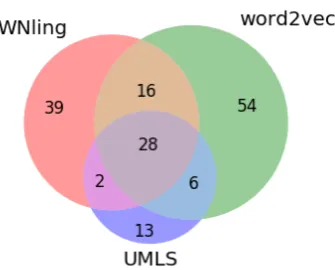
A comparison of the coverage between the gen-erated vocabularies is depicted in the Venn dia-gram in Figure 2. Overall, the number of matched terms is higher for the larger vocabularies (WN-Ling, word2vec) and the proportion of shared terms is also higher. Twenty-eight terms are shared between all three new vocabularies, and 52 terms are shared between at least two vocabularies (16+28+2+6).
[image:6.595.318.515.260.348.2]To evaluate the approximated precision and re-call, we use the union of each pairwise intersection ofallvocabularies (including the Baseline), which resulted in 57 unique terms9.
Figure 2: Venn diagram: number of unique terms from the generated vocabularies found in the eval-uation data: UMLS, WordNet with linguistic heuristics (WNling), and word2vec.
As expected, the Baseline approach resulted in the highest approximated macro-and micro-precision (0.97/0.998), Table 3. In con-trast, the vocabulary-based approaches resulted in the highest macro-and micro-recall (0.91/0.98: word2vec). The fact that the micro-results are higher for the two corpus-based approaches indi-cates that these two approaches generate term
vari-9Table 2 in Supplement.
ants that are also more frequent in the evaluation data set.
4.3 Vocabulary relevance
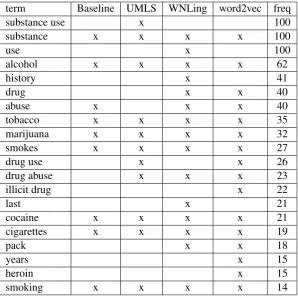
To analyze relevance, the 20 most frequent terms found by each approach is presented in Table 4, along with information about which vocabulary the term was found in. Nine of these terms were found in all vocabularies. Two terms were not clearly relevant to substance abuse (last, years). The three most frequent terms, that were found in all 100 substance abuse sections, are uni- and bi-gram variants of the same term (substance use,
substanceanduse).
Vocabulary PMacroR PMicroR
Baseline 0.97 0.63 0.998 0.67
UMLS 0.77 0.67 0.78 0.68
WNLing 0.55 0.82 0.69 0.93
[image:6.595.104.272.390.525.2]word2vec 0.5 0.91 0.77 0.98
Table 3: Results: approximated precision and re-call, macro (per unique term) and micro (per term occurrence). The number of relevant (and correct) terms is defined as the set union of all pairwise in-tersections.
The Baseline vocabulary included e.g. the term
packs but not its singular inflection pack, which turned out to be more frequent (pack freq=18 as opposed topacksfreq=610. and found by the two corpus-based approaches WNLing and word2vec. Each approach also resulted in a number of po-tentially relevant terms that were not found in any of the other approaches, e.g. amphetamine abuse (UMLS), withdrawal (WNLing), demerol
(word2vec)11.
5 Discussion and Conclusion
We present a simple and systematic approach for automated vocabulary generation (expansion and reduction) in the domain ofsubstance abuse, ap-plied and evaluated on a set of substance abuse sections from authentic psychiatric notes. Three vocabularies were generated from a set of seed terms using publicly available resources (ontolo-gies, software, and corpora) and combined to: 1) generate a substance abuse vocabulary of highly relevant terms and 2) characterize and analyze
term Baseline UMLS WNLing word2vec freq
substance use x 100
substance x x x x 100
use x 100
alcohol x x x x 62
history x 41
drug x x 40
abuse x x x 40
tobacco x x x x 35
marijuana x x x x 32
smokes x x x x 27
drug use x x 26
drug abuse x x x 23
illicit drug x 22
last x 21
cocaine x x x x 21
cigarettes x x x x 19
pack x x 18
years x 15
heroin x 15
[image:7.595.150.449.61.359.2]smoking x x x x 14
Table 4: 20 Most frequent terms from the union set of all vocabularies that were found in the evaluation data. Presence of term in each respective vocabulary is marked with ”x”. Note that unigrams could be a substring of ann-gram in each vocabulary (e.g. substanceandsubstance usein the UMLS vocabulary).
coverage and relevance in an authentic psychiatric dataset.
Through our definition of an approximated pre-cision and recall, we observed that the baseline and ontology-based approaches resulted in the highest approximated precisions, suggesting these methods are useful for identifying the most rele-vant related terms. This finding is not surprising because the list was vetted by a domain expert and core to the set of terms for all four approaches. In contrast, the vocabulary-based approaches re-sulted in the highest recalls suggesting these meth-ods are useful for identifying potentially new re-lated terms.
The denominator for calculating these results was based solely on a combination of the four generated vocabularies, which only illustrates re-lations between approaches. Interestingly, the ontology-based approach (UMLS) resulted in moderate performance for both precision and re-call. We hypothesize that this result occurs be-cause although the UMLS provides a notable num-ber of unique terms, these terms do not frequently occur in clinical text due to term characteristics
(e.g., inclusion of semantic type and special char-acters) and concept granularity (use of chemical nomenclature for specific drugs). In future work, we will apply methods to filter based on these characteristics similar to (Hettne et al., 2010; Wu et al., 2012; Demner-Fushman et al., 2010) to ad-dress these and other challenges with knowledge authoring leveraging noisy resources.
The baseline vocabulary was biased to more specific terms of substance abuse usage includ-ing terms for substances (alcohol, marijuana,
cases.
A preliminary manual analysis of the result-ing list of relevant terms (true positives) revealed that a clear majority of the resulting terms were related to substance abuse - only one term was obviously problematic (years). The false posi-tives, on the other hand, were in many cases ac-tually relevant and correct terms (e.g. ecstasy
from the word2vec model), although the WNLing model also produced a number of irrelevant terms (e.g. charges). To assess our approximated cov-erage and relevance metrics, we will conduct a manual assessment of the performance of this ap-proach with respect to true coverage, i.e. analyze which terms were missed, as well as correctness for found terms to determine how well our approx-imated precision and recall corresponds to the ac-tual precision and recall of terms from this evalua-tion data set. Moreover, we will assess the relaevalua-tion between terms and categories.
We aim to extend our vocabulary expansion and reduction methods. Most importantly, we have only performed one iteration, using domain expert curated terms, to create the final list of terms. This list could be extended by performing a number of iterations on the resulting list, thereby generat-ing a richer and more comprehensive set of terms. Moreover, we plan to utilize additional publicly available resources, e.g. relevant Wikipedia pages. Once these methods have been integrated into our NLP pipeline, we will extend our experiments to the other psychiatric variables from our data set, e.g., social risk factors of Homelessness, Educa-tion level,Abuse as a Child,Suicide attempts/Self Harm, and new clinical use-cases such as the de-tection of bleeding events associated with antico-agulant medication usage by patients with high-risk of stroke.
5.1 Limitations
Our preliminary study evaluation has several lim-itations including an evaluation using a small data set and calculation of term matches without con-sideration of term overlap (unigrams/multi-word token counts). We aim to extend our evaluation data set and calculate the effect of term matching criteria in follow up work.
Some of our vocabulary expansion methods have limitations and might be improved. Specif-ically, word2vec and similar approaches generate related terms that could be a relatedness of
se-mantic types other than synonyms (antonyms, hy-ponyms, etc.), which is well-known. However, we believe co-occurrence of these terms may correlate with variable terms and perhaps subsequent labels, e.g., alcohol occurring with smoking, which may help with extraction efforts in our NLP pipeline downstream. WNLing abbreviation methods can generate many false positives. Although we re-duced some false positives with a stopword check, we could leverage medical acronym and abbrevia-tion dicabbrevia-tionaries such as theMedilexicon12and the
STANDS4 network13 to further reduce false posi-tives. Moreover, we believe that combining these types of approaches can be a useful way of limit-ing the impact of each method’s disadvantages.
Finally, our thresholds were chosen rather ar-bitrarily; therefore, we will experiment with de-termining the effect of similarity scores and word count thresholds, as well as the use of larger n -grams.
5.2 Contribution
To our knowledge, this study is the first system-atic study of terms related to substance abuse gen-erated from publicly available resources and the combinations of these approaches, and then eval-uated on authentic psychiatric notes. The gener-ated vocabularies can be used to automate parts of the variable encoding process for the ongoing study on treatment management of hospital ad-mitted patients with depression and anxiety disor-ders, as well as other clinical use-cases where sub-stance abuse information is of importance. This work represents a first step in a larger framework to empower domain experts, in this case psychia-trists, to develop queries and apply NLP methods to identify and extract substance abuse and other variables from large clinical data sets to support mental health research.
Acknowledgments
We would like to thank the anonymous review-ers for valuable comments. This work is partly funded by the Department of Veteran Affairs (CRE 12-312), the National Library of Medicine (R00LM011393), the Patient-Centered Outcomes Research Initiatives (CDRN-1306-04912), the Swedish Research Council (2015-00359), and the
Marie Skłodowska Curie Actions, Cofund, Project INCA 600398.
References
Brian E. Chapman, Sean Lee, Hyunseok Peter Kang, and Wendy Webber Chapman. 2011. Document-level classification of CT pulmonary angiogra-phy reports based on an extension of the con-text algorithm. Journal of Biomedical Informatics, 44(5):728–737.
Mike Conway and Wendy W. Chapman. 2012. Dis-covering Lexical Instantiations of Clinical Con-cepts using Web Services, WordNet and Corpus Re-sources. In AMIA 2012 Proceedings, page 1604, Chicago, USA, November. American Medical Infor-matics Association.
Glen Coppersmith, Mark Dredze, and Craig Harman. 2014. Quantifying Mental Health Signals in Twit-ter. In Association for Computational Linguistics Workshop of Computational Linguistics and Clini-cal Psychology.
Helen V. Curran and Brian Birch. 1991. Differen-tiating the sedative, psychomotor and amnesic ef-fects of benzodiazepines: a study with midazolam and the benzodiazepine antagonist, flumazenil.
Psy-chopharmacology (Berl), 103(4):519–23.
Helen V. Curran. 1986. Tranquillising memories: a review of the effects of benzodiazepines on human memory.Biol Psychol, 23(2):179–213, Oct.
Janette Curtis and Kim Capp. 2003. Administration of ’as needed’ psychotropic medication: a retrospec-tive study. Int J Ment Health Nurs, 12(3):229–34, Sep.
Dina Demner-Fushman, James G Mork, Sonya E Shooshan, and Alan R Aronson. 2010. UMLS con-tent views appropriate for NLP processing of the biomedical literature vs. clinical text. J Biomed In-form, 43(4):587–94, Aug.
Christiane Fellbaum. 1998. WordNet: An Electronic
Lexical Database. Language, Speech and
Commu-nication. Mit Press.
Carol Friedman, Philip O. Alderson, John H. Austin, James J. Cimino, and Stephen B. Johnson. 1994. A general natural-language text processor for clinical radiology. Journal of the American Medical
Infor-matics Association : JAMIA, 1(2):161–174, March.
N. Grabar, PC. Varoutas, P. Rizand, A. Livartowski, and T. Hamon. 2009. Automatic acquisition of syn-onym resources and assessment of their impact on the enhanced search in EHRs. Methods Inf Med., 48(2).
Aron Henriksson, Mike Conway, Martin Duneld, and Wendy Webber Chapman. 2013. Identifying syn-onymy between SNOMED clinical terms of vary-ing length usvary-ing distributional analysis of electronic health records. InAMIA 2013, American Medical Informatics Association Annual Symposium,
Wash-ington, DC, USA, November 16-20, 2013.
Kristina M Hettne, Erik M van Mulligen, Martijn J Schuemie, Bob Ja Schijvenaars, and Jan A Kors. 2010. Rewriting and suppressing UMLS terms for improved biomedical term identification. J Biomed Semantics, 1(1):5.
Kuo-Chuan Huang, James Geller, Michael Halper, Yehoshua Perl, and Junchuan Xua. 2010. Using WordNet Synonym Substitution to Enhance UMLS Source Integration. Artif Intell Med., 46(2).
Michael Krauthammer and Goran Nenadic. 2004. Term identification in the biomedical literature. J
Biomed Inform, 37(6):512–26, Dec.
DA. Lindberg, BL. Humphreys, and McCray AT. 1993. The Unified Medical Language System. Methods Inf Med., 32(4):281–91.
Tomas Mikolov, Ilya Sutskever, Kai Chen, Greg Cor-rado, and Jeffrey Dean. 2013. Distributed Repre-sentations of Words and Phrases and their Composi-tionality. InProceedings of NIPS. NIPS.
Jayson L Mystkowski, Susan Mineka, Laura L Vernon, and Richard E Zinbarg. 2003. Changes in caffeine states enhance return of fear in spider phobia. J Con-sult Clin Psychol, 71(2):243–50, Apr.
Michael W Otto, Steven E Bruce, and Thilo Deck-ersbach. 2005. Benzodiazepine use, cognitive im-pairment, and cognitive-behavioral therapy for anx-iety disorders: issues in the treatment of a patient in need. J Clin Psychiatry, 66 Suppl 2:34–8.
John Pestian, Henry Nasrallah, Pawel Matykiewicz, Aurora Bennett, and Antoon Leenaars. 2010. Sui-cide note classification using natural language pro-cessing: A content analysis. Biomedical Informatics Insights, (3):1928.
Radim ˇReh˚uˇrek and Petr Sojka. 2010. Software Framework for Topic Modelling with Large Cor-pora. InProceedings of the LREC 2010 Workshop
on New Challenges for NLP Frameworks, pages
45–50, Valletta, Malta, May. ELRA. http://
is.muni.cz/publication/884893/en.
Guergana K. Savova, James J. Masanz, Philip V. Ogren, Jiaping. Zheng, Sunghwan Sohn, Karin C. Kipper-Schuler, and Christopher G. Chute. 2010. Mayo clinical text analysis and knowledge extrac-tion system (ctakes): architecture, component eval-uation and applications. Journal of the American Medical Informatics Association, 17(5):507–513. William Scuba, Melissa Tharp, Yang Tseytlin Eugene,
Liu, Frank A. Drews, and Wendy Chapman. 2014. Knowledge Author: Creating Domain Content for NLP Information Extraction. In 6th International Symposium on Semantic Mining in Biomedicine
(SMBM).
Brett R. South, Danielle Mowery, Melissa Tharp, Mar-gorie Carter, Adi Gundlapalli, Marzieh Vali, Mike Conway, Salomeh Keyhani, and Wendy W. Chap-man. 2015. Extracting social history and functional status from veteran affairs clinical documents. In
AMIA Joint Summits on Translational Science.
Jane Stein-Parbury, Kim Reid, Narelle Smith, Diane Mouhanna, and Fiona Lamont. 2008. Use of pro re nata medications in acute inpatient care. Aust N Z J Psychiatry, 42(4):283–92, Apr.
¨Ozlem Uzuner, Ira Goldstein, Yuan Luo, and Isaac S. Kohane. 2008. Viewpoint paper: Identifying pa-tient smoking status from medical discharge records. Journal of American Medical Informatics Associa-tion, 15(1):14–24.
Henny A. Westra, Sherry H. Stewart, Michael Tee-han, Karen Johl, David J. A. Dozois, and Todd Hill. 2004. Benzodiazepine Use Associated with Decreased Memory for Psychoeducation Material in Cognitive Behavioral Therapy for Panic
Disor-der. Cognitive Therapy and Research, 28(2):193–
208, April.
Stephen Tze-Inn Wu, Hongfang Liu, Dingcheng Li, Cui Tao, Mark A. Musen, Christopher G. Chute, and Nigam H. Shah. 2012. Unified medical language system term occurrences in clinical notes: a large-scale corpus analysis. Journal of Americal Medical Informatics Association, 19(e1).
Meliha Yetisgen, Elena Pellicer, David R. Crosslin, and Lucy Vanderwende. 2016. Automatic identification of lifestyle and environmental factors from social history in clinical text. InAMIA 2016 Joint Summits on Translational Science.