Generating Politically-Relevant Event Data
John Beieler
Human Language Technology Center of Excellence Johns Hopkins University
Abstract
Automatically generated political event data is an important part of the social science data ecosystem. The approaches for generating this data, though, have remained largely the same for two decades. During this time, the field of computational linguistics has pro-gressed tremendously. This paper presents an overview of political event data, including methods and ontologies, and a set of experi-ments to determine the applicability of deep neural networks to the extraction of political events from news text.
1 Introduction
Automated coding of political event data, or the record of who-did-what-to-whom within the con-text of political actions, has existed for roughly two decades. This type of data can prove highly useful for many types of studies. Since this data is inher-ently atomic, each observation is a record of a sin-gle event between a source and a target, often at the daily level, it provides a disaggregated view of polit-ical events. This means that the data enables the ex-amination of interactions below the usual monthly or yearly levels of aggregation. This approach can be used in a manner consistent with traditional hypoth-esis testing that is the norm within political science (Cederman and Gleditsch, 2009; Gleditsch, 2012; Goldstein et al., 2001). Additionally, event data has proven useful in forecasting models of conflict since the finer time resolution allows analysts to gain bet-ter leverage over the prediction problem than is pos-sible when using more highly aggregated data (Arva
et al., 2013; Brandt et al., 2014; Brandt et al., 2013; Brandt et al., 2011).
The methods used to generate this data have re-mained largely the unchanged during the past two decades, namely using parser-based methods with text dictionaries to resolve candidate noun and verb phrases to actor and event categories. The underly-ing codunderly-ing technologies have moved slowly in up-dating to reflect changes in natural language pro-cessing (NLP) technology. These NLP technologies have now advanced to such a level, and with ac-companying open-source software implementations, that their inclusion in the event-data coding process comes as an obvious advancement. Given this, this paper presents the beginnings of how modern nat-ural language processing approaches, such as deep neural networks, can work within the context of automatically generating political event data. The goal is to present a new take on generating politi-cal event data, moving from parser-based methods to classifier-based models for the identification and extraction of events. Additionally, this paper serves as an introduction to politically-relevant coding on-tologies that offer a new application domain for nat-ural language processing researchers.
2 Political Event Ontologies
Political event data has existed in various forms since the 1970s. Two of the original political event datasets were the World Event Interaction Survey (WEIS) and the Conflict and Peace Data Bank (COPDAB) (Azar, 1980; McClelland, 1976). These two datasets were eventually replaced by the projects created by Philip Schrodt and various
laborators. In general, these projects were marked by the use of the Conflict and Mediation Event Observations (CAMEO) coding ontology and auto-mated, machine-coding rather than human coding (Gerner et al., 2001; Schrodt et al., 2008). The CAMEO ontology is made up of 20 “top-level” cate-gories that encompass actions such as “Make State-ment” or “Protest.” Each of these twenty top-level categories contains finer-grained categories in a hi-erarchical manner. For example, the code14is the top-level code for “Protest” with the sub-code142
representing a general demonstration or rally. Under the code141, “Demonstrate or rally,” is code1411
which codes “demonstrate or rally for leadership change.” Thus, as one moves down the hierarchy of CAMEO, more fine-grained events are encoun-tered. All told, this hierarchical scheme contains over 200 total event classifications. This ontology has served as the basis for most of the modern event datasets such as the Integrated Crisis Early Warn-ing System (ICEWS) (O’Brien, 2010), the Global Database of Events, Language, and Tone (GDELT)1,
and the Phoenix2dataset.
The defining feature of the CAMEO ontology is the presence of a well-defined ontology consisting of verb phrases and noun phrases used in the coding of actions and actors. For each of the 200+ cate-gories of event types in CAMEO, there exists a list of verb phrases that define a given category. Sim-ilarly, the scope of what is considered a valid ac-tor within CAMEO is defined by the noun phrases contained in the actor dictionaries. Thus, CAMEO is scoped entirely by the human-defined noun and verb phrases contained within underlying text dictio-naries. The creation of these dictionaries is a mas-sively costly task in terms of human labor; to date each phrase in the dictionaries was identified, de-fined, and formatted for inclusion by a human coder.
2.1 Lower Resolution Ontologies
While the CAMEO ontology offers fine-grained coding of political events within the 20 top-level cat-egories, a small but convincing set of literature sug-gests that this level of granularity is not necessary to answer many of the questions to which event data is
1gdeltproject.org 2phoenixdata.org
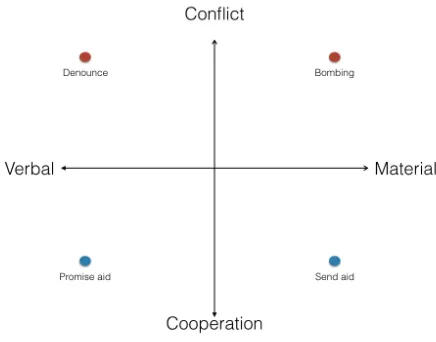
[image:2.612.331.549.284.455.2]applied. Schrodt (2006), for example, suggests that dividing the CAMEO ontology into much lower-resolution categories, known as QuadClasses, provides enough information to perform accurate out-of-sample forecasts of relevant political events. Additionally, Schein et al. (2016) indicates that it is possible to recover this latent structure from coded events. TheseQuadClassvariables, which are di-vided along conflict/cooperation and material/verbal axises, capture the information described in the above papers. As seen in Figure 1, a given event can be placed somewhere within the resultant quad-rants based on what valence the event has (conflict or cooperation) and what realm the event occurred (verbal or material).
Figure 1:QuadClass Event Quadrants
Since theseQuadClassvariables capture much of the information necessary, the methods discussed within this paper focus on this rather than the full CAMEO coding ontology.
more detailed CAMEO categories. For example, the “Protest” category of CAMEO encompasses events such as demonstrations as well as political leaders verbally protesting the actions of another entity. Be-cause of this, what seems to be a benefit of CAMEO, fine-grained differentiation between categories, be-comes a possible point of confusion. Finally, and most importantly, the broad goal of the approach outlined in this paper is to enable researchers to de-velop application-specific ontologies that allow for categories that address the needs of a particular re-search question rather than attempting to make use of an ontology imperfectly suited to the task at hand. Thus, the hope is that more ontologies will prolifer-ate to better support a researcher’s specific needs.
3 Current Approaches
The current state-of-the-art for CAMEO-coded po-litical event extraction is presented by the PE-TRARCH23 coder.4 The main features of
PE-TRARCH2 include a deep reliance on information from a constituency parse tree. The default parse comes from the Stanford CoreNLP software (Man-ning et al., 2014). The exact operational details of PETRARCH2 are beyond the scope of this paper, with a complete explanation of the algorithm avail-able in Norris (2016); it should suffice to say that this second version of PETRARCH makes extensive use of the actual structure of the parse tree to determine source-action-target event codings. This change to be more tightly coupled to the tree structure of the sentence, as compared to previous coders such as TABARI (Schrodt, 2001), allows for a clearer iden-tification of actors and the assignment of role codes to the actors, and a more accurate identification of the who and whom portions of the who-did-what-to-whom equation.
At its heart, PETRARCH2 is still software to per-form a lookup of terms in a set of text dictionaries. Given this, if the terms identified by the program are incorrect then the final event coding will also be in-correct. Additionally, if the terms identified by PE-TRARCH2 are not in the dictionaries, but would still be associated with a valid actor or event coding, then
3https://github.com/openeventdata/petrarch2
4Other coders exist, such as BBN’s ACCENT coder, but is
not currently publicly available. PETRARCH2 and ACCENT approach event coding in roughly the same manner, however.
no event is coded. This means that no matter the al-gorithmic design of the event coder, the output will remain constrained by the verb and actor dictionar-ies.
The primary issue with these methods is twofold. First, the parser-based methods rely on human-created dictionaries. As noted above, this is a labor intensive task that is not easily replicable for expan-sion into new ontologies; CAMEO has become the de-facto coding standard for political events largely owing to the existence of the text dictionaries cre-ated over the course of two decades. O’Connor et al. (2013) introduced a method that potentially solves the issue of developing verb patterns for the coding of political events. This method still does not ad-dress many of the other issues present with the cur-rent approaches to generating political event data, such as a reliance on syntactic parsers. The sec-ond issue, owing to the reliance on text dictionar-ies and parsers for the extraction of events, is the exclusively English-language nature of all available event datasets. The next section introduces an alter-native to these parser-based methods that is applica-ble across ontologies, is tune-aapplica-ble for a given prob-lem set, and is capable of working cross-lingually.
4 Statistical Approaches
In order to replace the parser-based methods for identifying an event, a new system must indentify to which of the fourQuadClassvariables, Mate-rial Conflict, MateMate-rial Cooperation, Verbal Conflict, or Verbal Cooperation, the event belongs. To ac-complish this, this paper makes use of convolutional neural nets.
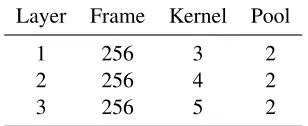
This paper considers two neural architectures to classify a political event. The first is a 1-dimensional ConvNet with pre-trained word embedding features as described in Kim (2014). In short, it is a rela-tively shallow network with three parallel convolu-tional layers and two fully-connected layers. The fully-connected layers contain 150 and 4 units each. Dropout is applied to the two fully-connected layers so meaningful connections are learned by the model. The details of the model layers are in Table 1.
mul-Layer Frame Kernel Pool
1 256 3 2
2 256 4 2
[image:4.612.110.264.63.126.2]3 256 5 2
Table 1:Word-based convolutional layers.
Layer Frame Kernel Pool
1 256 7 3
2 256 3 N/A
3 256 3 N/A
[image:4.612.333.516.78.269.2]4 256 3 3
Table 2:Character-based convolutional layers.
tiple experiments determined the full specification in Zhang et al. (2015) underperformed other spec-ifications. The architecture for the character Con-vNet consists of 3 convolutional layers and 3 fully-connected layers. The convolution layers are de-tailed in Table 2. The fully connected layers have 1024, 1024, and 4 output units, respectively.
5 Data
The datasets used in this paper are shown in Ta-ble 3. Each of the “soft-labelled” datasets has Quad-Class labels applied to them by PETRARCH2. The use of PETRARCH2 is necessary in order to gen-erate enough training samples for the various sification algorithms to gain leverage over the clas-sification task. The English corpus consists of data scraped from various online news media sites. The Arabic corpus labels are obtained via the use of a sentence-aligned English/Arabic corpus.5 Thus, if a
sentence is labelled asMaterial Conflictin the En-glish corpus, that label is transferred to the aligned sentence in the Arabic corpus. If multiple align-ments occur the label is transferred to each of the rel-evant sentences. The next dataset is the same set of labelled Arabic sentences that were run through the machine-translation softwareJoshua (Weese et al., 2011). These datasets provide information for three experiments: English-language, Arabic-language, and machine translated English.
5The specific corpus is available at
https://www.ldc.upenn.edu/collaborations/past-projects/gale/data/gale-pubs.
Dataset Sentences
Soft-labelled English 49,296 Soft-labelled Arabic 11,466 Machine-translated Arabic 3,931
Table 3:Data source type and size
Model Accuracy
Word-based models English Input 0.85 Native Arabic Input 0.25 Machine-translated Input 0.60
Character-based models English input 0.94 Arabic input 0.93
Table 4:Accuracy scores for Category Classifier
6 Experiments
Table 4 shows the results of various models for clas-sifying a sentence into one of fourQuadClasses. Across the board, it is clear that the character-based ConvNets perform much better than the word-based models. The difference is less drastic for English-language inputs, a 9% difference in accuracy. For Arabic-language inputs, however, the difference is striking. The character model is over 20% more ac-curate than the word-based model. This is likely due to issues with tokenization and morphology when dealing with the word-based models. Even more im-pressive is the ability of the Arabic-language models to perform well even with a relatively small corpus of 11,466 coded sentences. These results demon-strate that character-based ConvNets are appropri-ate and powerful models for the classification of politically-relevant events.
7 Conclusion
[image:4.612.111.262.158.235.2]on-tologies, as an example expanding beyond the limits of CAMEO to code events such as crime events in Spanish-language news sources, that will open new avenues of social science research.
While these methods are promising, there is still much work left to develop a fully operational event extraction pipeline. In terms of classifying events, there is still the issue of handling the many nuances of event coding. For example, if a meeting occurs between three actors that would typically lead to nine coded events when handling the various combi-nations of actors and binary relations. Additionally, the methods presented on this paper do not touch upon the extraction of actor information. This is an-other area for which modern NLP approaches, such as semantic role labelling, are highly applicable and will likely improve on the state-of-the-art.
Acknowledgments
This work was supported by the DARPA Quantita-tive Crisis Response program.
References
Bryan Arva, John Beieler, Ben Fisher, Gustavo Lara, Philip A. Schrodt, Wonjun Song, Marsha Sowell, and Sam Stehle. 2013. Improving forecasts of in-ternational events of interest. Paper presented at the European Political Studies Association meetings, Barcelona, June 2013.
Edward E. Azar. 1980. The conflict and peace data bank (copdab) project.Journal of Conflict Resolution, 24:143–152.
Patrick T Brandt, John R Freeman, and Philip A Schrodt. 2011. Real time, time series forecasting of inter-and intra-state political conflict. Conflict Management and Peace Science, 28(1):41–64.
Patrick T Brandt, John R Freeman, Tse min Lin, and Philip A Schrodt. 2013. Forecasting conflict in the cross-straits: Long term and short term predictions. Annual Meeting of the American Political Science As-sociation.
Patrick T Brandt, John R Freeman, and Philip A Schrodt. 2014. Evaluating forecasts of political conflict dynam-ics. International Journal of Forecasting, 30(4):944– 962.
Lars-Erik Cederman and Kristian Skrede Gleditsch. 2009. Introduction to special issue of ”disaggregating civil war”. Journal of Conflict Resolution, 24(4):590– 617.
Deborah J. Gerner, Philip A. Schrodt, Omur Yilmaz, and Rajaa Abu-Jabr. 2001. Conflict and mediation event observations (cameo): A new event data frame-work for the analysis of foreign policy interactions. American Political Science Association, Boston, Au-gust 2002.
Nils Petter Gleditsch. 2012. Whither the weather? cli-mate change and conflict: Introduction to whither the weather? climate change and conflict: Introduction to special issue.Journal of Peace Research, 49(1):3–9. Joshua S. Goldstein, Jon C. Pevehouse, Deborah J.
Gerner, and Shibley Telhami. 2001. Dynamics of middle east conflict and u.s. influence, 1979-97. Jour-nal of Conflict Resolution, 45(5):594–620.
Yoon Kim. 2014. Convolutional neural networks for sen-tence classification. InProceedings of the 2014 Con-ference on Empirical Methods in Natural Language Processing (EMNLP),, pages 1746–1751, October. Christopher D. Manning, Mihai Surdeanu, John Bauer,
Jenny Finkel, Steven J. Bethard, and David McClosky. 2014. The Stanford CoreNLP natural language pro-cessing toolkit. InProceedings of 52nd Annual Meet-ing of the Association for Computational LMeet-inguistics: System Demonstrations, pages 55–60.
Charles A. McClelland. 1976. World event/interaction survey codebook.
Sean P. O’Brien. 2010. Crisis early warning and deci-sion support: Contemporary approaches and thoughts on future research. International Studies Review, 12(1):87–104.
Brendan O’Connor, Brandon Stewart, and Noah A. Smith. 2013. Learning to extract international re-lations from political context. InProceedings of the Annual Meeting of the Association for Computational Linguistics (ACL), pages 1094–1104.
Aaron Schein, Mingyuan Zhou, David M. Blei, and Hanna Wallach. 2016. Bayesian poisson tucker de-composition for learning the structure of international relations. In Proceedings of the 33rd International Conference on Machine Learning, New York, NY, USA.
Philip A. Schrodt, Omur Yilmaz, Deborah J. Gerner, and Dennis Hermrick. 2008. Coding sub-state actors us-ing the cameo (conflict and mediation event observa-tions) actor coding framework. InInternational Stud-ies Association, San Francisco, March 2008.
Philip A. Schrodt. 2001. Automated coding of interna-tional event data using sparse parsing techniques. Pa-per presented at the International Studies Association, Chicago, 21-24 February 2001.
and Prevention, pages 161–184. Kluwer Academic Publishers, Dordrecht, Netherlands.
Jonathan Weese, Juri Ganitkevitch, Chris Callison-Burch, Matt Post, and Adam Lopez. 2011. Joshua 3.0: based machine translationjoshua 3.0: Syntax-based machine translation joshua 3.0: Syntax-Syntax-based machine translation with the thrax grammar extractor. InProceedings of the 6th Workshop on Statistical Ma-chine Translation, pages 478–484, Edinburgh, Scot-land, UK, July.