Finite Element Solution of a Stream Function-Vorticity
System and Its Application to the Navier Stokes Equations
Fattehallah Ghadi1, Vitoriano Ruas2, Mohamed Wakrim1
1Equipe Modélisation Mathématique et Simulation, Faculté des Sciences Université Ibn Zohr, Agadir, Maroc 2Institut Jean Rond d’Alembert/CNRS, UPMC Université, Paris, France
Email: [email protected], [email protected], [email protected] Received October 6,2012; revised November 28, 2012; accepted December 5, 2012
ABSTRACT
The finite element solution of a generalized Stokes system in terms of the flow variables stream function and vorticity is studied. This system results from a time discretization of the time-dependent Stokes system in stream function-vorticity formulation, or yet by the application of the characteristics method to solve the Navier-Stokes equations in the same representation. Numerical results presented for both cases illustrate the good behaviour of the adopted approach.
Keywords: Characteristics Method; Navier-Stokes; Stream Function; Vorticity
1. Introduction
Expressing the incompressible Navier-Stokes equations in terms of variables other than velocity and pressure becomes a good alternative for solving them numerically, provided one is able, not only to uncouple the new flow variables, but also to derive reliable discrete counterparts. In this respect the classical stream function and vorticity formulation of these equations in two-dimension space is a very good example. After having studied it in the sta- tionary case (cf. [1]), in this paper we generalize our re- sults [1] to the time-dependent problem.
In terms of numerical analysis this paper primarily deals with a mixed method to solve the two-dimensional generalized Stokes problem in terms of the stream func- tion and the vorticity. Such problem results for instance from the time discretization of the time-dependent Stokes system. The difficulty arising from the lack of boundary conditions for the vorticity is overcome by means of a suitable technique for uncoupling both variables follow- ing the mains lines of the well-known Glowinski-Piron- neau method [2]. Then we discretize in space the result- ing uncoupled system by means of continuous Lagrange finite elements.
In computational terms we apply the above technique to the Navier-Stokes equations. This is achieved by first performing the semi-discretization in time of these equa- tions by a classical characteristics method. Then we ap- ply the same numerical ingredients as for the generalized Stokes system. We illustrate the good performance of our approach by means of numerical results, obtained for some benchmarks problems such as cavity lid driven flow.
2. The Time-Dependent Stokes System as a
Model Problem
Given a field of volumetric forces f with f
,t L2
for any time t, and denoting by ν the kinematic viscosity of the fluid occupying a bounded simply connected do- main Ω of R2 with boundary Γ assumed to be Lipschitz continuous, we wish to find the stream function and the vorticity ω such that0 1
curl and in
and on ,
f t
g g
n
(1)
where
3 2 0 ,
g t H and
1 2 1 ,
g t H are func- tions determined from the given velocity on for every , together with an appropriate initial condition at time
t t0.
The Euler type implicit discretization in time of system (1) with time step t gives
1
0
1
curl in in
on
on
n n n n
n n
n n
n n
t f
g
g n
(2)
where t n, 1, 2,, with 0 given, and
:
,
n
F F ndt for any function F
,t .Assume that n1 is known. Then problem (2) be- comes a generalized Stokes problem.
0 1 and in and on g g g n (3)
where t and g H 1
, 32
0
g H and
1 2 1
g H are given.
3. Variational and Uncoupling Techniques
Like in [1], a suitable variational formulation of system (3) is provided by using the space
:
2
;
X L H1 . In order to un- couple the resulting system we work with the spaces
:
;
H
X X 0
0 and X
:
X
;H
.Now using standard arguments, we may uniquely write every function X
as a sum of the form0
, where 1
0 H0 is uniquely defined by 0 0
0
and X
. Then letting
, where 1
and 0 H0
X
,and recalling that
1
2
H H
and
3 2 H H H H X n (cf. [1]), the uncoupled
formulation associated with system (3) is: (see Equation (4))
where 10
1
0 ; g
H v H v g and , s de- notes the duality product between and
with
s
H
sH s R
, ,. Problem (4) has a unique solution 0
, which is such that the field
, 0
isthe unique solution of system (3).
4. Discretized Problem
The type of finite element approximation of problem (4) was first introduced in [3]. In this work we develop it in detail by referring the reader to that work for the numerical analysis of the method. Assuming that is a polygonal domain and letting
h be a quasi- uniform family of triangulations of hT
with mesh step size , we introduce the finite element spaces defined by: h
2 0 , 1 0 : ; , ; : ;: ; π on π , ;
: .
h h h K k h
h h
h
h g h h h h h
h h
Y v L v P K K T
V Y C
V v V v g g P g P P E
M V H
Here P Kk
h
E
denotes the space of polynomials of degree less than or equal to , defined in an element and is the numbered set of all the nodes used to define the degrees of freedom of that lie on
k
K
h
V .
Finally, we define
0 0 0
: , , 0, and
: , , , 0,
h
H h h h h h h
h
h h h h h h h h
X u V u v v M
X u V u v u v v M
.
Then the discrete versions of problems (4-i), (4-ii) and (4-iii) are defined as follows: (see Equation (5)).
We note that the determination of 0h, h and h requires the computation of a basis of h
H
X and another one of Xh
.
The following algorithm describes how to compute these bases and how to determine 0h, h and h.
0 1 1 0 0 10 0 0 1 0
1
0 0 1 0
0 3
2
2 1
0 1 0 0 0 0 0
Find , , such that
i , , , ,
ii , , , , ,
iii , , ,
g
H
H H H H
H X H
g H
g g X
n H H (4)
0 0 ,0 0 0 1
1
0 1 0
0 0 3
2
2
0 1 0 0 0 0
Find , , such that
i , , , ,
ii , , , , ,
iii , , ,
h
h h h
h h g
h h
h h h h
h
h h h h h H h h
H H H H
h h h h h h
h
M X H
g M
H
g g X
Algorithm Step 1
For i1, , Nh compute
h i :
, 0Find such that
, 0
i
i h
h
i h h h
V M h . N Step 2
For i1, , h compute i h, :
,
, ,
0 0
Find such that
, , 0
i
i h
i h i h
i h i h h h
V M , i h .
. h M i h Step 3
00 0 0 0 0
Find such that
, , 0 ,
h h
h h
h h h h
M g Step 4
Compute ,
1 h N h i i
by solving the linear systemAX b, with
,0
0 0 0
1
, ,1 ,
,
. h i h h
ij j h
h
h h i h
i i
i i N
A i j N
b g n X 1 i g
Step 5
0 , 0 0 0Find ,such that
, , ,
h h g
h h
h h h h h
V M
5. Numerical Experiments
In order to illustrate the performance of our approach, we
present some numerical results obtained in the framework of a problem with known solution, solved with the equal order method for k1.
We consider the stationary Stokes problem in
0,1 0,1 , whose exact solution is given by
x y, sin2
πx sin2
π
y
and
x y, 2π2 sin2
πy cos 2πx
sin2
πx cos 2π
y .
In this example de mesh is 30 × 30, and we run a
of the exact and ap
sufficient number of time steps to reach a stationary solution, with reasonable accuracy.
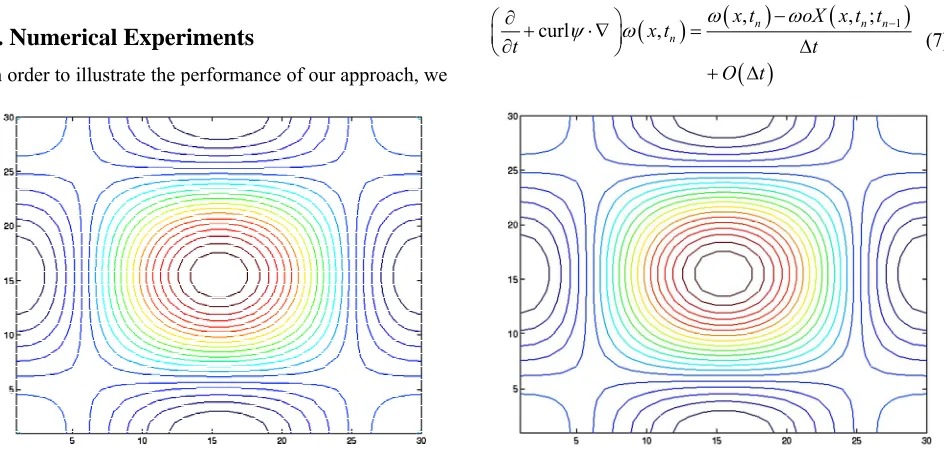
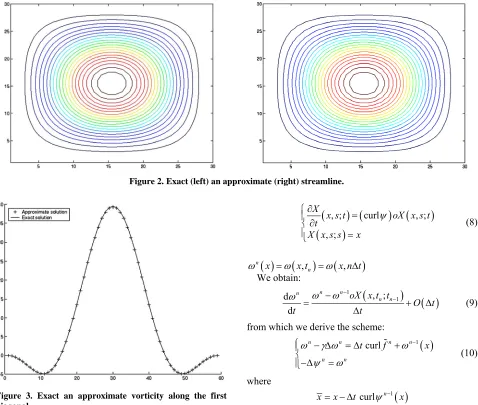
In Figure 1 we display the contours
proximate vorticity for t 0.05, respectively on the left and on the right. In Fig display the contours
of the exact and approximate streamlines for t 0.05
ure 2 we
,
respectively on the left and on the right. In Fi e
display the exact and approximate vorticity along the first diagonal. In Figure 4 we display the exact and
approximate stream function along the first diagonal.
gure 3 w
6. Extention to the Navier-Stokes Equations
Let us first recall the Navier-Stokes equations expressed in the stream function and vorticity formulation.
0 1
curl curl and in
and on f t g g n (6)
We use the method of characteristics of first order for the time-discretization of the vorticity particle derivative, namely
1
, ,
curl , n n
n
[image:3.595.69.410.66.637.2]; n x t oX x t t x t t t O t (7)
[image:3.595.59.284.76.513.2] [image:3.595.64.536.495.725.2][image:4.595.59.284.507.688.2]
Figure 2. Exact (left) an approximate (right) streamline.
Figure 3. Exact an approximate vorticity along the first diagonal.
Figure 4. Exact an approximate stream function along the first diagonal.
X is the solu
, ;
url
, ;
X x
, ;
cs t oX x s t
t
(8)
X x s s x
,
,
nn
x x t x n t
We obtain:
1
1 , ; d
dt
n n n
n n oX t t
O t t
x
(9)
from which we derive the scheme:
(10)
where
1
curl
n n t fn n x
n n
1 curl nx x t x
Syste problem
m (10) is nothing but a generalized Stokes problem of the type (3). Hence we can use the above described algorithm to solve it. Th main difficulty is
e the computation of x.
7. Numerical Tests
In order to validate ou apr proach, we present the driven
y the streamlines and vorticity cavity flow results.
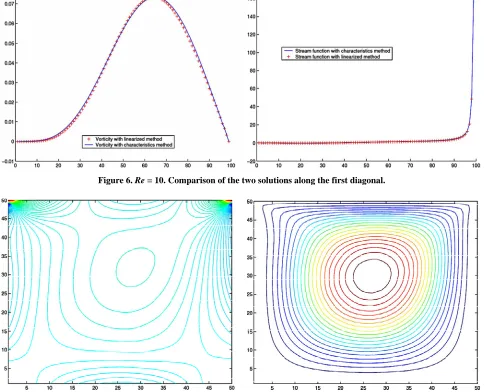
In Figure 5 we displa
contours for Re10. In Figure 6 we display the com-
parison along the first diagonal between the vorticity (r
metho
ach to solve the incompressible Navier-Stokes in tw
espectively the stream function) obtained with the characteristics d and the one obtained with the linearization method employed in [4]. In Figure 7 we
display the streamlines and vorticity contours for Re = 100.
The numerical results presented in this Section not only confirms the adequacy and economy of our appro
Figure 5. Re = 100. Vorticity computed with characteristic method, stream function computed with characteristic method.
[image:5.595.56.543.329.721.2]
Figure 6. Re = 10. Comparison of the two solutions along the first diagonal.
suitably combined with the characteristics method. How- ever the main difficulty of such combination is the choice of the time step Unfortunately when the Reynolds number increases this issue becomes critical. In this case it is advisable to use moving meshes or yet a higher order characteristics method, in order to improve the quality of the numerical results.
REFERENCES
[1] F. A. Ghadi, V. Ruas and M. Wakrim, “A Mixed Finite Element to Solve the Stokes Problem in the Stream Func-tion and Vorticity FormulaFunc-tion,” Hiroshima Mathemati-cal Journal, Vol. 28, No. 3, 1998, pp. 381-398.
[2] R. Glowinski and O. Pironneau, “Numerical Methods for the First Bi-Harmonic Equation and for the Two-Dimen- sional Stokes Problem,” SIAM Review, Vol. 21, No. 2, 1979, pp. 167-212. doi:10.1137/1021028
t
.
[3] F. A. Ghadi, V. Ruas and M. Wakrim, “A Mixed Method to Solve the Evolutionary Stokes Problem in the Stream Function and Vorticity Formulation,” Proceedings of LUXFEM, Luxemburg, 13-14 November 2003.
[4] F. A. Ghadi, V. Ruas and M. Wakrim, “Numerical Solu-tion to the Time—Dependent Incompressible Navier- Stokes Equations by Piecewise Linear Finite Elements,” Journal of Computational and Applied Mathematics, Vol. 215, No. 2, 2008, pp. 429-437.