Learning Comparable Corpora from Latent Semantic Analysis
Simplified Document Space
Ekaterina Stambolieva
euroscript Luxembourg S.à. r.l.
55, rue de Luxembourg, L-8077
Luxembourg
[email protected]
Abstract
Focusing on a systematic Latent Semantic Analysis (LSA) and Machine Learning (ML) approach, this research contributes to the de-velopment of a methodology for the automatic compilation of comparable collections of doc-uments. Its originality lies within the delinea-tion of relevant comparability characteristics of similar documents in line with an estab-lished definition of comparable corpora. These innovative characteristics are used to build a LSA vector-based representation of the texts. In accordance with this new reduced in dimen-sionality document space, an unsupervised machine learning algorithm gathers similar texts into comparable clusters. On a monolin-gual collection of less than 100 documents, the proposed approach assigns comparable docu-ments to different comparable corpora with high confidence.
1
Introduction
The problem of collecting comparable corpora is challenging and yet enchanting. Many can bene-fit from the availability of such corpora as trans-lation professionals, machine learning research-ers and computational linguistics specialists. Yet there is not an even consent about the notion covered by the term comparable corpora. The degree of similarity between comparable corpora documents has not been formalized strictly and leaves space for different interpretations of simi-larity, contributing to abundant text collections of similar and semi-similar documents. The cur-rent research endeavors to contribute to an ap-proach, which assembles a collection of
compa-rable documents that are closely related to each other on the basis of a strict definition of compa-rable corpora. The proposed approach incorpo-rates originally a Latent Semantic Analysis tech-nique in order to match similar concepts instead of words thus contributing to better automatic learning of comparability between documents.
2
Comparable Corpora Definition
Maia (2003) discusses the characteristics of comparable corpora. Nevertheless, the adopted definition of comparable corpora in this study is given by McEnery (2003):
“Comparable corpora are corpora where series of monolingual corpora are collected for a range of languages, preferably using the same sampling and frame and with similar balance and repre-sentativeness, to enable the study of those lan-guages in contrast.”
McEnery (2003) characterizes comparable corpora as “corpora where series of monolingual corpora are collected for the range of languages”. In the views of McEnery (2003), a monolingual corpus is a corpus that is not collected for a range of languages, but instead the documents selected are written in one language. In the context of the current research, a comparable corpus, a sub-language corpus, can be constructed from docu-ments in one language under the condition they are compliant with the preferred guidelines pro-vided by McEnery (2003). These preferred guidelines are similar sampling frame, balance and representativeness.
A document feature corresponding to text sampling is explicated taking into consideration the domain and genre of the documents.
tionally, similar terminology vocabulary insures genre correspondence. Therefore, the same sam-pling scheme in collecting documents is evaluat-ed considering domain and genre and viewevaluat-ed as document features.
Language is rapidly changing and evolving throughout the years (Crystal 2001). As a result, restricting the time period a document has been published increases the chances of it being com-parable to another one written during the same time frame. When events are reported in the newspaper domain, their date of publication is strong similarity evidence and is used as a filter between weakly comparable and non-comparable text articles (Skadiņa et al. 2010a).
The question of how representativeness of a corpus is decided upon is answered in different ways depending on the specific corpus purpose. For the purposes of this research, a corpus is considered representative when corresponding texts are similar in size. As reported by Manning and Schűtze (1999), a balanced corpus is one, which is assembled “as to give each subtype of text a share of the corpus that is proportional to some predetermined criterion of importance”. Skadina et al. (2010b) present a good summary of the advantages of exploiting comparable cor-pora. It is discussed that “they can draw on much richer, more available and more diverse sources which are produced every day (e.g. multilingual news feeds) and are available on the Web in large quantities for many languages and do-mains.” (Skadina et al. 2010b).
3
Related Work
The most closely-related to machine learning work that mines comparable corpora is that by Sharoff (2010). His research incorporates intelli-gent self-learning techniques to the compilation of comparable documents. Unlike other re-searchers that experiment with Cross-Lingual Information Retrieval (CLIR) techniques as in Tao and Zhai (2005), Sharoff (2010) estimates the document collection’s internal subgroup sys-tem in search for structure. The possible structure and grouping of a set of documents is most easily defined by ranked words that are representative for the subsets in the collection. Sharoff's ap-proach relies heavily on keywords and keyword estimation. One thing Sharoff (2010) does not elaborate on in details is the definition of a com-parable corpus. A possible reason for that is that unsupervised machine learning approaches pro-duce related sets of documents in an environment
where the selection process is automated and not supervised by any linguistically-dependent rules.
What is written by Goeuriot et al. (2009) is al-so an influential and relevant material to the cur-rent research. Their paper is on the compilation of comparable corpora in a specialized domain with a focus on English and Japanese. The article is significant for the reason the authors investi-gate ways of building comparable corpora using machine learning classification algorithms, namely Support Vector Machine and C4.5. The experimental setup in the work of Goeuriot et al. (2009) relies on manually labeled data, which is then fed to the machine learning algorithm core. The paper by Goeuriot et al. (2009) is directed towards building a tool to automatically compile comparable corpora in a predefined set of docu-ments and languages. The text comparability characteristics extracted, which allow compari-son between the documents, are external and in-ternal to the textual data. Goeuriot et al. (2009) emphasize on selecting ways to automatic recog-nition of useful features similar texts have and experiment with these features to test and predict their reliability. The comparability of the docu-ments defined by them is on three levels - type of discourse, topic and domain, focusing on locu-tive, ellocutive and allocutive act labels.
Bekavac et al. (2004) discuss the grounds of a methodology describing similarity comparison of under-resourced monolingual corpora. Contrary to other methodologies that exploit seed words or seed texts as a basis for search, the researchers have at their disposal two monolingual docu-ments sets from which they aim to mine compa-rable documents. The advantage of their ap-proach is that it is applicable to texts collection written in one language for the reason that they are easily mined and compiled from the available textual resources nowadays. The concept behind their research is to align comparable documents that are found in pre-collected different monolin-gual corpora. Content features are used to test the degree to which two texts are similar to each other in the sense of sharing the same infor-mation and common words. These features, composition features, need to be representative for the texts. The composition features, extracted from the data, monitor the size, the format and the time span of the documents.
re-searchers aim to generate new content based on input user queries by using context – “a body of words surrounding a user-selected phrase” (Finkelstein et al. 2001). They emphasise on the significance of using context when developing Natural Language Processing (NLP) applica-tions. The keyword extraction algorithm present-ed relies on a precisely-designpresent-ed clustering algo-rithm, different than k-means, to recursively clean clustering results and present refined statis-tical output.
With regards to evaluation metrics of compa-rable corpora, one of the main focuses of the ACCURAT Project (Skadina et al. 2010b) is to design metrics of comparability estimation be-tween texts. The ACCURAT researchers (Skadi-na et al. 2010b) concentrate on the development of comparable corpora criteria for different texts and different types of parallelism between the texts. Saralegi et al. (2008) suggest measures based on distribution of topics or time with re-gards to publication dates. Kilgariff (2001) aims to measure the level of comparability between two collections of documents. He focuses addi-tionally on the shortcoming of known corpus similarity metrics. He discusses evaluation meth-ods for corpus comparability measures, which are based on Spearman rank correlation co-efficient, perplexity and cross-entropy, χ2 and others. To his knowledge, the χ2 test performs the best when comparing two sets of documents. It is important to note that the approach adopted by Kilgariff (2001) relies on words and n-gram se-quence features. Not only does he regard the texts as bag-of-words, but also he incorporates n-gram characteristics in his evaluation metric analysis.
Mining word similarity techniques are dis-cussed in the work of Deerwester et al. (1990); Baeza-Yates and Ribeiro-Netto (1999); and Da-gan, Lee and Pereira (1999). Deerwester et al. (1990) incorporate LSA as a technique to identi-fy word relatedness. LSA “identifies a number of most prominent dimensions in the data, which are assumed to correspond to ‘latent concepts’.” (Radinsky et al. 2011). Radinsky et al. (2011) indicate that LSA vector space models are “diffi-cult to interpret”. Consequently, the current re-search focuses not only on the incorporation of LSA to mapping content, but also of the em-ployment of a machine learning technique to group projected into the two-dimensional space documents into similar clusters. Baeza-Yates and Ribeiro-Netto (1999), as Sharoff (2009) and Goeuriot et al. (2010), consider texts as
bag-of-words as the least complex word similarity ap-proaches can be incorporated. Mapping distri-butional similarity, Lee (1999) opts for similar word co-occurrence probability estimation im-provement. Dagan et al. (1999) also aim for better estimation of word co-occurrence likeli-hood not based on empirical methods, but in-stead relying on distributional similarity for the generation of language models. WordNet-based and distributional-similarity compari-sons of word similarity are presented in Agirre et al. (2009). They suggest different views of word relatedness comparison – bag-of-words, context windows and syntactic dependency approaches. They describe their findings as yielding best results on known test sets. What is important to be remarked is that their meth-odology requires minor fine-tuning in order to give good results on cross-lingual word simi-larity.
4
Methodology
The novelty of our approach is the incorpora-tion of the Latent Semantic Analysis tech-nique, which matches concepts, or information units, from one document to another instead of approximating word similarity. LSA expects and constructs a new vector-based representa-tion of the documents to be compared. A con-cept holds not only textual, but also morpho-logical information about each word present in the texts. By employing LSA, the document space is projected into the two-dimensional space in correspondence with the latent rela-tionships between the words in the texts. In the two-dimensional space, clusters of similar documents are compiled together using a sim-ple, but powerful unsupervised machine learn-ing algorithm, k-means clusterlearn-ing. Clusterlearn-ing evaluation metrics such as precision, recall and purity are employed towards automatic evalua-tion and analysis of the resulting comparable corpora.
In order to compile comparable corpora with the current settings, a set of pre-collected doc-uments is needed. From this set of docdoc-uments, two to five comparable corpora are identified and texts with similar topics, domains and fea-tures are assigned to relevant comparable cor-pora.
the latent relationships between the words in the bags-of-words. Working with information units overcomes this limitation of LSA. The information units contain additional linguistic information about the syntactic and morpho-logical relationships between words, therefore forming concepts of these words. The order of the words, or the information units, is not im-perative, therefore it is not controlled by the methodology.
LSA allows words to have only one mean-ing thus restrictmean-ing the robustness of the natu-ral languages. This limitation is tackled by suggesting different word sense candidates for words and constructing a separate information unit for each promoted word sense.
5
Data Feature Selection
The innovation of the discussed research ap-proach lays in its basic concept of perceiving texts as bags of interrelated concepts. The sur-face-form words found in the texts are en-riched with linguistic information that furnish-es better matching procedure of the concepts lying within the texts for comparison.
Unlike previous work, which regards docu-ments as bags-of-words (Sharoff 2009, Goeuriot et al. 2010) the methodology treats documents as collections of concepts, each concept containing comparable textual infor-mation. The concepts are represented by in-formation units. The process of recognizing such units happens at document level, where each document is viewed as a separate text with its own context. Each information unit is defined as the inseparable pair of lemma and its context-dependent part-of-speech (POS) tag. A lemmatization technique is applied to transform the texts into linguistically-simplified versions of the originals, where each word (infected or not) is substituted by its cor-responding lexeme.
As stated before, the information units in-corporate POS output. A POS tagger is used to process the texts before linguistically-simplifying it using lemmatization techniques. The idea of enriching the words by POS infor-mation is not new to the research of Natural Language Processing, but it is new for the re-search of compiling comparable corpora. By identifying the POS information of a sentence, lexical ambiguity is reduced. The
accompany-ing POS tag to each lemma assists the disam-biguation of the information units. For exam-ple, run as being the action of walking fast has a verb POS tag opposed to run as the period of some event happening has a noun POS tag. In this example, the POS tag provides the needed information for disambiguating the two differ-ent meanings of a word. In the currdiffer-ent research scenario, the POS tagging module1 emulates the results of a basic Word Sense Disambigua-tion technique.
Furthermore, the input set of documents is transformed into a set of lists of information units as described, where a single list of units corresponds to a single document. When com-pared, the units are matched for correspond-ence both based on the lemma's lexical catego-ry in the sentence and its base form.
Another feature, which helps build context re-lated concepts, is the identification of Noun Phrases (NP) in the texts. Noun Phrase recogni-tion is imperative since it further develops the simple word sense disambiguation method. Some words to have a different meaning when occur-ring in a chain of words such as a noun phrase. Unlike the proposed by Su and Babych (2012) approach to NP recognition, NPs are identified following linguistically-derived rules, which rep-resent common constructions of the language under consideration. When a NP is identified, it is listed as a new information unit with a corre-sponding NP POS tag. All POS annotations as well as lemma information of its constituent words are removed from the documents' list of information units.
6
Experiments
6.1 Experimental Corpus
A pre-collected corpus of documents, part of the NPs for Events (NP4E) corpus (Hasler et al. 2006), is used for experimenting. The NP4E cor-pus is collected for the special purpose of ex-tracting coreference resolution in English. Never-theless, the structure and the organization of the corpus are suitable for the needs of acquisition of a test corpus for the current study. The NP4E corpus contains five different groups of news articles based on topic gathered from the Reuters. The news articles are collected in the time frame
of two years – 1996 and 1997 (Rose, Stevenson and Whitehead 2002). Four of the five NP4E news article groups are used to compile an exper-imental corpus containing roughly 40000 words or 520 words per text. The chosen experimental collection consists of sub-corpora that have documents comparable to the others in their sub-corpora based on domain. The domain of these comparable corpora is terrorism, and the four distinct topics are connected with terrorism, bombing and suicide respectively for events in Israel, Tajikistan, China and Peru. In total, the experimental corpus consists of 77 newswire ar-ticles. The distribution of the documents in this selected corpus is 20 on Israel topic, 19 on Tajik-istan topic, 19 for China topic and 19 on Peru topic. These sub-corpora are referred to as Israel (I), Tajikistan (T), China (C) and Peru (P) on-wards.
6.2 Experimental Set-up
The experimental set-up is structured as a chain of two simple procedures. They are respectively an experimental setup data selection and experimental setup clustering distribution.
6.2.1 Data Selection Frame
The data selection frame describes how docu-ment features are selected. The docudocu-ments are afterwards preprocessed in order to extract all underlying text features and binary vectors are constructed to represent each separate document. The document features on focus consist of all identified information units enriched with the noun phrases that were recognized in the texts. The binary vectors then are used as an input to the LSA algorithm.
6.2.2 Cluster Distribution
The number of resulting clusters, or comparable corpora, should be set in advance for unsuper-vised machine learning algorithms. An experi-ments with k, k is in the range of 2 to 5, are con-ducted. Testing with number of clusters greater or equal to two comes logical. In the case of ex-pecting two resulting clusters, the methodology groups all similar documents in one comparable corpus, and withdraws the non-similar docu-ments to the second collection. When k is chosen to be 2 or 3, the resulting comparable corpora tend to be weakly-comparable (Skadiņa et al. 2010a) for the reason the algorithms are forced to gather documents with four distinct topics into only two or three comparable collections. It is interesting to analyze the research
methodolo-gy’s performance in the case four output compa-rable corpora are expected, meaning when the learning algorithm is asked to suggest four com-parable sets of documents.
To evaluate clustering performance in terms of forcing the system to split the document collec-tion into more comparable corpora than present,
k equals to 5 is also used in the experiments. Consequently, the number of clusters varies be-tween 2 and 5.
6.2.3
Evaluation MetricsThree metrics are chosen to evaluate results - the standard precision and recall, and additionally - purity. Precision shows how many documents in the resulting collections are identified correctly as comparable to the majority of documents on a specific topic in the cluster. For example, when 16 out of 19 documents are recognized to be comparable to each other, the precision of this clustering result is 0.84. Recall shows how many false negatives are identified as comparable to a certain topic-related collection of texts. The false negatives are the documents on a different topic, which the machine learning algorithm falsely lists to be comparable to documents on another topic. When 21 documents are grouped in one similarity cluster, 19 of them being on a related topic, 3 of them being on another topic, the recall of the learning performance is 0.86.
Purity is an evaluation metric used to estimate the purity of the resulting clusters (Figure 1.). A cluster is recognized as pure when it contains a number of documents with the same label (mean-ing they are listed to be comparable to each other by a human evaluator) and as less as possible documents that have a different label from the dominant label (Manning et al. 2008):
Figure 1. Purity score formula
where nomcluster i is the number of the majority
class members in each resulting cluster i, and noclustrers is the number of resulting clusters, or k.
The other metrics for measuring the comparability between documents that are chosen for exploitation in the current research, are Mutual Infromation (MI) and Normalized Mutual Infroamtion (NMI). The formula for NMI is as follows and shown in Figure 2.:
Figure 2. NMI score formula
MI is explained in details in Kalgariff (2001) and (Manning et al. 2008). Manning et al. (2008) discuss additionally the formula for the entropy H, and NMI. Ω is the group of clusters addressed in the experiments, and C is the group of labels – namely the different characteristics of the com-parable corpora.
In the current scenario, no human evaluation is performed. Rather than that the corpus is pre-designed in a way to contain four different com-parable corpora that need not to be manually la-beled
6.3 Evaluation
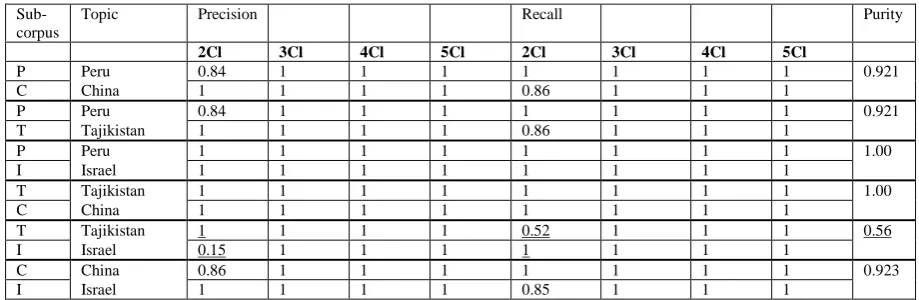
Results are obtained after conducting different set-up experiments. One set-up focuses on evalu-ating comparable corpus collection having as an input part of the experimental corpus. This part contains documents on two out of the four differ-ent topics. The two-topic collections are com-piled by combining all combinations possible of two topic-based sets together from the four dis-tinct topic sub-corpora. In this experimental sce-nario, the total of different corpora for evaluation
is 6 (according to the combination’s formula ) - Peru and China, Peru and Tajikistan, Peru and Israel, Tajikistan and China, Tajikistan and Isra-el, China and Israel. Table 1 shows the results of running LSA with k-means clustering on the dis-
cussed sub-groups. As seen on Table 1. the learn-ing algorithm performance is excellent when the number of comparable corpora that are expected is greater than two. When three or more compa-rable clusters are elected, each similar by topic document is grouped with all other documents that are comparable to it in the same resulting comparable corpus. In the case of expecting three comparable corpora with Precision and Recall equal to 1.0, one of these corpora contains all documents of two different sub-corpora and the rest contain all documents of one of the pre-defined experimental sub-corpora. In the case of expecting five comparable corpora with Preci-sion and Recall equal to 1.0, one sub-corpus is split into two comparable clusters, these clusters containing documents on the same topic. What is interesting in this experimental set-up are the results the learning algorithm obtains when it aims to produce only two comparable clusters. For three of the test sets - China and Israel, Peru and China and Tajikistan and Israel, grouping of documents on different topics into the same simi-lar collection is seen. The lowest results obtained are for the test set Tajikistan and Israel, where 3 of the 19 documents on an Israel topic are grouped together with the texts on the Tajikistan topic. The reason behind this automatic learning confusion originates from the fact the Tajikistan and Israel topic documents contain many similar concepts, which make good clustering harder to achieve.
The purity of the resulting corpora is very high, above 0.9, indicating that comparable doc-uments are identified correctly with high rele-vance. The only exception is the results on the Tajikistan and Israel test set with purity 0.56. This exception occurs because of poor clustering results, which have been discussed.
Sub-corpus
Topic Precision Recall Purity
2Cl 3Cl 4Cl 5Cl 2Cl 3Cl 4Cl 5Cl
P Peru 0.84 1 1 1 1 1 1 1 0.921
C China 1 1 1 1 0.86 1 1 1
P Peru 0.84 1 1 1 1 1 1 1 0.921
T Tajikistan 1 1 1 1 0.86 1 1 1
P Peru 1 1 1 1 1 1 1 1 1.00
I Israel 1 1 1 1 1 1 1 1
T Tajikistan 1 1 1 1 1 1 1 1 1.00
C China 1 1 1 1 1 1 1 1
T Tajikistan 1 1 1 1 0.52 1 1 1 0.56
I Israel 0.15 1 1 1 1 1 1 1
C China 0.86 1 1 1 1 1 1 1 0.923
[image:6.595.68.528.608.758.2]I Israel 1 1 1 1 0.85 1 1 1
Another set-up focuses on the analysis and evaluation of the results on clusters containing documents on three of the four different topics. The same way as the two-topic collections are constructed, combining three topic sub-corpora into one results in the development of the input for the LSA and k-means clustering algorithms. In this experimental scenario, a total of 4 distinct input collections are compiled -Tajikistan, Israel and China; Tajikistan, Israel and Peru; Peru, China and Israel; and Tajikistan, China and Peru.
The results of the learning comparable corpora from them are listed in Table 2. As it can be easi-ly seen, the clustering performance is impecca-ble. Therefore, providing more documents, more data features, helps identifying better similar documents applying the proposed research ap-proach.
Precision Recall Purity
2cl 3cl 4cL 5cl 2cl 3cl 4cl 5cl
T 1 1 1 1 1 1 1 1
C 1 1 1 1 1 1 1 1 1.00
I 1 1 1 1 1 1 1 1
P 1 1 1 1 1 1 1 1
Table 3. Clustering results on the whole experi-mental corpus
Mutual Information
H(Ω) H(C) NMI
2CL 2CL 2CL 2Cl
Peru China
0.6866 0.9927 1 0.6916
Peru Tajikistan
0.6866 0.9927 1 0.6916
Peru Israel
1.0230 1.0074 1.0074 0.9522
Tajikistan China
1 1 1 1
Tajikistan Israel
0.0844 0.3912 1.0074 0.1262
China Israel
[image:7.595.66.527.311.460.2]0.6855 0.9744 1.0074 0.6917
Table 4. MI and NMI scores results for test sets of combinations of two topic sub-corpora
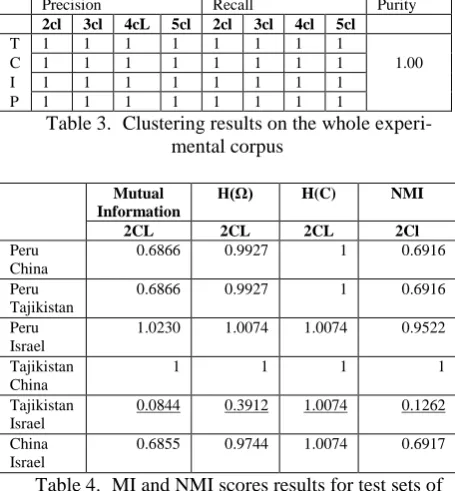
Table 3. Shows the clustering results when all texts of the experimental corpus are suggested as an input. The algorithms once more do not have problems collecting the similar documents into comparable corpora with high precision and re-call.
MI and NMI are computed only for the results presented in Table 1. The reasoning behind is that Table 2. And Table 3. show perfect cluster-ing results of comparable corpora obtained on the whole set of input documents described in Section 6.1.
The results of the comparable texts grouping are estimated using a clustering quality trade-off metric, NMI. Table 4. shows the NMI results of the clustering performance on the two-topic col-lections described in the first experimental set-up at the beginning of Section 6.3.
Consequently, the results shown on Table 4. are obtained with respects to the precision, recall and purity scores presented in Table 1. The NMI score is evidence of the identified comparable corpora quality. As seen on Table 4., the lowest NMI score correspond to the clustering results on the Peru- and China- topic texts. As shown on Table 1., the proposed approach is not confident when grouping the Peru- and China- topic texts into comparable collections. The results of the NMI metric shown on Table 4. only confirm this conclusion. The best results obtained according to the NMI score are NMI is dependent on the mutual information and the entropy the texts to be clustered share. MI is a metric, which esti-mates how the amount of information presented in the documents affect the clustering output. When the MI score is low, as in the example of grouping the Tajikistan- and Israel- topic texts, the information contained in the documents does not contribute to highly-comparable clusters of corpora. When the MI score obtained is high, as
Sub-corpus
Topic Precision Recall Purity
2Cl 3Cl 4CL 5Cl 2Cl 3Cl 4Cl 5Cl
T Tajikistan 1 1 1 1 1 1 1 1
I Israel 1 1 1 1 1 1 1 1 1.00
C China 1 1 1 1 1 1 1 1
T Tajikistan 1 1 1 1 1 1 1 1
I Israel 1 1 1 1 1 1 1 1 1.00
P Peru 1 1 1 1 1 1 1 1
P Peru 1 1 1 1 1 1 1 1
C China 1 1 1 1 1 1 1 1 1.00
I Israel 1 1 1 1 1 1 1 1
T Tajikistan 1 1 1 1 1 1 1 1
C China 1 1 1 1 1 1 1 1 1.00
P Peru 1 1 1 1 1 1 1 1
[image:7.595.66.294.499.745.2]in the Tajikistan- and China- topic documents experiment, the information in these documents is a strong evidence of the text relatedness. Table 4. lists the intermediate calculations of the entro-py based on the available labels H(C) and the resulting clusters H(Ω).
7
Remarks
The problems identified in the current methodol-ogy are classified into two different groups: text processing resources errors and clustering output errors. The processing resources are taken as off-the-shelf modules and the development focus of the study in not concentrating on improving their performance. The second type of errors is the clustering errors. Their size can be reduced by improving the performance of the text prepro-cessing resources. Additionally, enhanced clus-tering output evaluation metrics can reveal learn-ing algorithm’s weaknesses and suggest ways for improvement.
8
Future Work
More can be done in the future to improve the proposed methodology. One idea for further in-vestigation is experimenting with larger collec-tions of data. The results on the experimental corpus are promising, but the document collec-tion is not big and contains less than 80 texts. It would be interesting to experiment with corpora that consist of hundreds of documents to test clustering performance. Additionally, a new ex-perimental collection of documents is being compiled. It contains psycholinguistics texts both in Spanish and English. As the collection of this document set is still in progress, the results ob-tained on it are not presented in the current pa-per. These results will be reported in future work publications.
Furthermore, a new translation equivalent source can be added. In the case of compiling specialized collections of comparable docu-ments, a specialized bilingual or multilingual dictionary can prove to be a valuable resource. An untested interesting experimental setup can be investigating the resulting clustering perfor-mance when more than 50% or more of the most relevant lemmas (with noun phrases) are selected as document features. A Named Entity Recog-nizer (NER) and a synonymy suggestion module have the possibility to serve as good text pro-cessing resources and further improve grouping outcomes. In connection with NER, it is interest-ing additionally to investigate if the test corpus
contains local names, which make clustering bet-ter easier. Lastly, potential source for further de-velopment is the automatic recognition of diasys-tematic text features, such as diachronic, diatopic or diatechnic information.
Clustering results of comparable corpora are obtained when the document characteristics are filtered by best keyword estimation metric - TF.BM25, explained in Pérez-Iglesias et al. (2009). The results show decrease in good clus-tering performance. A future work aspect is to investigate the cause this lower performance.
9
Conclusion
An innovative approach to the problem of compilation of comparable corpora is described. The approach suggests guidelines to textual characteristics selection scheme. Additionally, the approach incorporates LSA and unsupervised ML techniques. Different evaluation metrics, such as precision, purity and normalized mutual information, are employed to estimate compara-ble corpus clustering results. These metrics show good results when evaluating comparable clus-ters from a predefined set of less than 100 docu-ments. The methodology suggested is applied for monolingual selection of documents; nonetheless it is readily extendable to more languages.
References
Agirre, Eneko, Alfonseca, Enrique, Hall, Keith, Kravalova, Jana, Paşca, Marius and Soroa, Ai-tor.2009. A study of Similarity and Relatedness Using Distributional and WordNet-based ap-proaches. In NAACL ’09
, pages 19-27.
Baeza-Yates, Ricardo and Ribeiro-Neto, Betrhier. 1999. Modern Infromation Retieval
,
Addison Wesley.Bekavac, Božo, Osenova, Petya, Simov, Kiril and Tadic, Marco.2004. Making Monolingual Corpora Comparable: a Case Study of Bulgarian and Croa-tian. In Proceedings of LREC2004
, pages
1187-1190, Lisbon.Crystal, David. 2001. Language and the Internet. Cambidge University, Press. Cambidge.UK, pages 91-93.
Dagan, Igo, Lee, Lillian and Pereira, Fernando.1999. Similarity-based models of word co-occurrence probabilities. Machine Learning. 34(1-3), pages 43-69.
the Americal Society for Information Science. 41(6), pages 391-407.
Finkelstein, Lev, Gabrilovich, Evgeniy, Matias, Yos-si, Rivlin, Ehud, Solan, Zach, Wolfman, Gadi and Ruppin, Eytan. 2001. Placing Search in Context: The Concept Revisited. In WWW’01, pages 406-414.
Goeuriot, Lorraine, Emmanuel Morin and Béatrice Daille. 2009. Compilation of specialized compara-ble corpora in French and Japanese. In
Proceed-ings of the 2nd workshop on Building and
Us-ing Comparable Corpora: from Parallel to
Non-parallel Corpora, August 06, 2009, Suntec,
Singapore.
Hasler, Laura, Constantin Orasan and Karin Nau-mann. 2006. NPs for Events: Experiments in Con-ference Annotation. In Proceedings of the 5th edition of the International Conference on
Language Resources and Evaluation
(LREC2006),pages 1167-1172, 24-26 May 2006,
Genoa, Italy.
Ion, Radu, Dan Tufiş, Tiberiu Boroş, Ru Ceauşu and Dan Ştefănescu. 2010. On-line Compilation of Comparable Corpora and Their Evaluation. In
Proceedingds of the 7th International
Confer-ence of Formal Approaches to South Slavic
and Balkan Languages (FASSBL7), pages
29-34, Dubrovnic, Croatia.
Kilgarriff, Adam. 2001. Comparing corpora.
Interna-tional Journal of Corpus Lingusitics, 6(1),
pag-es 97-133.
Lee, Lillian.1999. Measures of distributional
similari-ty. Proceedings of ACL 1999, pages 25-32.
Maia, Belinda.2003. What are Comparable Corpora?
Electronic resource:
http://web.letras.up.pt/bhsmaia/
belinda/pubs/CL2003%20workshop.doc.
Manning, Christopher D. and Hinrich Schűtze. 1999.
Introduction to Information Retrieval.
Cam-bridge University Press, CamCam-bridge, UK.
Manning, Christopher D., Prabhakan Raghavan, and Hinrich Schűtze. 2008. Introduction to
Infor-mation Retrieval, Cambridge University Press,
pages 356-358.
McEnery, Tony. 2003. Corpus Linguistics. In Ruslan Mitkov, editor, The Handbook of
Computation-al Lingustics. Oxford University Press, Oxford,
UK, pages 448-464.
Radinsky, Kira, Agichtein, Eugene, Gabrilovich, Evgeniy and Markovitch, Shaul. 2011. A word at a time: Computing Word Relatedness using
Tem-poral Semantic Analysis. In WWW’11, pages 337-346.
Pérez-Iglesias, Joaquín, Pérez-Agüera, José, Fresno, Víctor and Feinstein, Yuval. 2009. Integrating the probabilistic model BM25/BM25F into Lucene. In
CoRR, abs/0911.5046.
Rose, Tony, Mark Stevenson and Miles Whitehead. 2002. The Reuters Corpus Volume 1 – from Yes-terday’s News to Tomorrow’s Language Resource.
In Proceedings of LREC2002, pages 827-833.
Sarageli, Xabier., San Vincente, Inaki, Gurrutxaga. Antton 2002.Automatic Extraction of bilingual terms from comparable corpora in a popular sci-ence domain. In Proceedings of the workshop
on Comparable Corpora, LREC’08.
Sharoff, Serge. 2010. Analysing similarities and dif-ferences between corpora. In Proceedings of the
7th Conference of Language Technologies
(Jezikovne Tehnologije), pages 5-11,
Ljubljiana. Slovenia.
Skadiņa, Inguna, Ahmet Aker, Voula Giouli, Dan Tufis, Robert Gaizauskas, Madara Mieriņa and Ni-kos Mastropavlos.2010a. A Collection of Compa-rable Corpora for Under-Resourced Languages. In Inguna Skadiņa and Dan Tufis, editors, Human Language Technologies. The Baltic Perspec-tive. Proceedings of the 4th International
Con-ference Baltic HLT 2010, pages 161-168.
Skadiņa, Inguna, Vasiljeiv, Andrejs, Skadiņš, Raivis, Gaizauskas, Robert, Tufiş, Dan and Gornostay, Tatiana.2010b. Analysis and Evaluation of Com-poarable Corpora for Under Resourced Areas of Machine Translation. In Proceedings of the 3rd Workshop on Building and Using Comparable Corpora. Applications of Parallel and Com-parable Corpora in Natural Language
PEngi-neering and the Humanities, pages 6-14.
Su, Fangzhoung and Bogdan Babych. 2012. Measur-ing Comparability of Documents in Non-Parallel Corpora for Efficient Extraction of (Semi-)Parallel Translation Equivalents. In Proceedings of the Joint Workshop on Exploiting Synergies be-tween Information Retrieval and Machine Translation (ESIRMT) and Hybrid
Approach-es to Machine Translation (HyTra), pages
10-19, Avignon, France.
Tao, Tao and Cheng Xiang Zhai. 2005. Mining Com-parable Bilingual Text Corpora for
Cross-Language Information Integration. In Proceedings of the eleventh ACM SIGKDD international conference on Knowledge discovery in data