Dimensionality reduction in the bag-of-words vector space document representation model has been widely studied for the purposes of improving accuracy and reducing computational load of document retrieval tasks. These techniques, however, have not been studied to the same degree with regard to document clustering tasks. This study evaluates the effectiveness of two popular dimensionality reduction techniques for clustering, and their effect on discovering accurate and understandable topical groupings of documents. The two techniques studied are Latent Semantic Analysis and
Independent Component Analysis, each of which have been shown to be effective in the past for retrieval purposes.
Headings:
Information Retrieval
by
Jonathan L. Elsas
A Master’s paper submitted to the faculty of the School of Information and Library Science of the University of North Carolina at Chapel Hill
in partial fulfillment of the requirements for the degree of Master of Science in
Information Science.
Chapel Hill, North Carolina July 2005
Approved by
INTRODUCTION
Document clustering has long been an important problem in text processing systems, dating back to Salton’s SMART information retrieval system (Salton & McGill, 1983), and recently becoming popular in internet search engines such as Vivisimo
(http://vivisimo.com) and MetaCrawler (http://www.metacrawler.com/). The goal in most of these document clustering systems is to automatically discover, in the absence of metadata or a pre-existing categorization, sensible topical organizations of the
documents. This clustering task, like many text processing tasks, is made difficult by the extremely sparse and high-dimensional nature of text data. For this reason,
dimensionality reduction and term-space projection techniques have been proposed to alleviate this curse of dimensionality and make a variety of automatic text processing tasks more tractable. Dimensionality reduction techniques have been studied in great depth in document retrieval systems (Bingham & Mannila, 2001; Deerwester et al., 1990; Efron, 2002; Isbell & Viola, 1999), but there is a dearth of information on how
dimensionality reduction relates to document clustering. This study will begin to address this question by empirically evaluating the effect on document clustering of two popular dimensionality reduction techniques: latent semantic analysis and independent
DOCUMENT CLUSTERING
Document clustering has been used widely in text processing systems. The goal of document clustering is to identify groups of documents, or clusters, so that documents within a cluster are similar and documents in different clusters are dissimilar. This goal is commonly phrased as maximizing intra-cluster document similarity while minimizing inter-cluster similarity (Zhao & Karypis, 2001). The organization of the clusters from a clustering algorithm can take several different forms: hierarchical clustering produces clusters that are related to each other in a tree-like hierarchy; probabilistic clustering produces a “soft” partitioning of documents, where each document has a probability of belonging to each cluster; and partitioning clustering produces mutually exclusive sets of documents. Many clustering algorithms have been proposed, the most popular being k-means (partitioning), expectation maximization (EM, probabilistic) and complete link (hierarchical). The reader is directed to (Jain et al., 1999) for a review of data clustering methods and a variety of applications. The current study will limit its scope to
probabilistic and partitional algorithms.
when a query is received in the system, the best cluster (or clusters) must be chosen based on the query, and then relevant documents are retrieved from within that cluster.
In retrieval applications such as these, clustering is used solely as a back-end
preprocessing step to improve retrieval performance. Clustering has also been used as a tool to organize large document collections, attempting to automatically provide a sensible grouping of the documents. In this realm, clustering is often referred to as analogous to the table of contents in a book, whereas standard retrieval systems are analogous to a book’s index (Dhillon & Modha, 2001). Towards this goal, document clustering systems must reflect the topical organizations of the documents in the
collection, rather than the more abstract idea of documents being mutually relevant to the same query. These techniques have been used to organize large sets of retrieval results (Hearst & Pedersen, 1996; Zamir et al., 1997) and document collections as a whole outside of the retrieval context (Cutting et al., 1992; Efron et al., 2004).
interesting clusters instead of a ranked list of retrieval results. This type of presentation has been shown to improve retrieval performance (Leuski, 2001), and the presentation of clustered retrieval results has recently become a popular feature on large-scale web search engines such as Vivisimo (http://vivisimo.com) and MetaCrawler
(http://metacrawler.com).
In addition to clustering for document organization, whether for retrieval or browsing, clustering has also been applied to document collections for the purposes of discovering latent factors. Similar to LSI, clustering for factor discovery aims to simultaneously reduce the dimensionality of the document representations and uncover hidden
“concepts” or “topics” in the document collection. Instead of representing documents by vectors of term weights, in this model documents are represented by linear combinations of topic-clusters representing the document’s strength of association to those topics. Noteworthy applications of clustering for latent factor discovery include Probabilistic Latent Semantic Analysis (Hofmann, 1999) and concept decomposition (Dhillon & Modha, 2001). In both of these methods, documents are represented by their degree of association with a small number of latent variables, and these latent variables are derived through a process of document-clustering.
A brief overview of clustering algorithms
Corne, 2002; Steinback et al., 2000) and expectation maximization (EM) (Dasgupta, 1999, 2000; Hofmann, 1999). K-means creates a hard partitioning of the document collection by alternating between assignment of documents to the nearest cluster center (or centroid), and re-computing those centroids based on the newly assigned documents. The EM algorithm is an algorithm for probabilistically discovering an hidden,
unobserved categorical variable; but is often used as a soft partitioning algorithm that creates a probabilistic clustering of documents. When used for clustering, the hidden variable is interpreted as defining the cluster membership. This is done by estimating a normal distribution (either multiple univariate normals or a single multivariate normal) for each category of the variable, or cluster, and assigning probabilities based on the likelihood of generating a particular document relative to each category’s, or cluster’s, distribution. Similar to k-means, this algorithm alternates between two states: an expectation step in which each document is assigned to a distribution based on the highest probability, and a maximization step in which the parameter estimates for each distribution are updated to that maximize the model likelihood based on the assigned documents. Both of these algorithms are typically initialized with a random
configuration and converge when the either stability is achieved, in the case of k-means, or the likelihood function ceases to increase, in the case of EM. They are both
The EM algorithm will be used in the experiments presented in this paper, and further exploration of some limitation of this algorithm will be elaborated on below.
NOISE, DIMENSIONALITY REDUCTION & LATENT FACTORS IN TEXT
A widely held tenet in the text processing literature is that textual data is extremely noisy. This noisiness is often thought of taking two forms: polysemy, or a single word having multiple meanings; synonymy, or multiple words having equivalent meanings.
Additionally, the richness of human language and the variety of writing styles inevitably lead to imprecision when translating unstructured text into a highly structured machine understandable representation. This noise can be thought of as sampling error in the data: an underlying meaning is present, however through word choice and other stylistic
factors some degree of random error is introduced into the document representations.
This noisiness coupled with the extreme high dimensionality of the bag-of-words vector-space document representation scheme poses many challenges to automatic text
processing systems. In particular, clustering algorithms such as EM and k-means not only suffer from extended running times, but also frequently over-fit noisy
high-dimensional data. As stated above, the EM algorithm converges to some locally optimal solution, and as the number of dimensions increase the number of locally optimal
transforming the data in such a way that clusters are easier to discover (Dasgupta, 1999, 2000).
Many dimensionality reduction techniques have been proposed for text processing systems. Several, such as using stop-word lists and term frequency cutoffs rely solely on culling terms from the indexing vocabulary. Linear algebraic techniques, such as
projections, have also been used extensively. A projection is a method of reducing the dimensionality of a data matrix through matrix multiplication, or linearly transforming the existing data matrix. Projections can arbitrarily reduce the dimensionality of any data matrix. A common way to visualize a simple projection is to envision a shadow cast by a three-dimensional object onto a flat surface. In this case, the three dimensions of the original object are projected onto two dimensions of the flat surface.
Among the recent favorites for term-space projections are Latent Semantic Analysis (LSA) and Independent Component Analysis (ICA). These techniques rely on statistical and linear algebraic techniques to project the document-term matrix onto a matrix of lower dimensions. In addition to reducing the dimensionality, it has been claimed that these techniques reduce or eliminate noise in the data, thereby revealing a level of latent semantic structure inaccessible in the original document representations (Deerwester et al., 1990; Isbell & Viola, 1999; Kolenda & Hansen, 1999). This latent semantic structure is discovered by utilizing the term and document co-occurrence structure, and
are often thought of as approximating human-like knowledge or modeling topical concepts.
Latent Semantic Analysis
Latent Semantic Analysis (LSA) is the application of a linear algebraic technique, the singular value decomposition (SVD), to the document term matrix. Commonly in the document retrieval context, LSA is referred to as Latent Semantic Indexing (LSI), however the mathematical techniques behind both LSA and LSI are identical in general. The SVD is a matrix factorization given by (Deerwester et al., 1990; Strang, 1993)
A = U ! VT,
where A is the original data matrix, U and V are orthonormal matrices containing the left and right singular vectors of A and ! is a diagonal matrix containing the singular values of A. From the SVD of a matrix, a lower-dimensional matrix approximation can be derived by truncating the columns of the matrices U, V and both the rows and columns of
! to the first p (largest) singular values:
A " AP = UP !P VPT.
vectors represent random sampling error and can therefore safely be eliminated. The matrix approximation using the SVD is the best approximation of the original matrix in the least-squares sense and retains the maximum amount of variance from the original matrix (Strang, 1993).
In order to operate on the dimension-reduced version of A, a matrix projection must be derived that projects the full matrix A into the left singular values, UP. This projection is given by
VP !P-1,
and when applied to A, gives the p-column truncation of U. (This projection assumes the documents are on the rows of A and terms are on the columns. If the converse is the case, this projection can be reversed to give the p-column truncation of V.)
very little difference in clustering effectiveness between an LSI-based projection and a simple method of truncating the document vectors.
Independent Component Analysis
Independent Component Analysis (ICA) is a projection pursuit technique originally developed for separation of mixed signals from unseen sources (Hyvarinen et al., 2001). Projection pursuit is the seeking of dimensions in data that are “interesting” in that they exhibit some sort of structure not visible in the original data. LSI can be thought of a form of projection pursuit if interestingness is defined as the dimensions that capture the maximal variance. However, maximal variance is not typically considered an interesting aspect of the data; more often it is measured as conforming to some structural pattern or diverging from a given distribution (Hand et al., 2001). ICA defines interestingness in terms of the directions that are statistically independent and least normally distributed. Departure from a normal distribution in this case judged in terms of the information-theoretic measure of entropy: a normal (Gaussian) distribution has maximal entropy and entropy decreases as the distribution of the data departs further from a normal
distribution. Entropy is often thought of as a measure of randomness or lack of
In ICA, the original data matrix A is decomposed into a mixing matrix, M, and a matrix of sources, X, representing the independent components:
A = X M.
And the independent components can be retrieved by inverting M thus creating an un-mixing matrix to recover the independent components:
X = A M-1.
Typically, the data matrix A is “whitened”, or transformed so that the columns are
uncorrelated. This can be done with SVD along with dimensionality reduction, explained above:
X = A VP !P-1 M-1 .
And thus the projection matrix for ICA is:
VP !P-1 M-1.
When used with text processing, the independent components discovered in ICA are often interpreted as meaningful concepts (Isbell & Viola, 1999; Kolenda & Hansen, 1999). This offers an distinct advantage over LSA where the dimensions have so far eluded human interpretation. Although this may not be an essential feature when these projections are used in the back-end of a text processing system, it nonetheless makes ICA an appealing technique for dimensionality reduction and latent topic discovery.
ICA has been applied to text data in a variety of ways and yields some intuitively appealing results. This technique has been used in analogous ways to LSA in document retrieval (Isbell & Viola, 1999), for topic discovery in temporal text (Bingham et al., 2003), and unsupervised identification of linguistic features such as parts of speech (Honkela & Hyvarinen, 2003).
METHODOLOGY
The experiments presented in this paper aim to compare the effectiveness of two different document projection techniques when used as a preprocessing step for topical
segmentation of a document collection through clustering. The data used for these experiments comes from a real-world collection of web documents from several online directories.
associated with one of four broader themes, creating a shallow hierarchy of topics. Some of these categories are “Commercial Banks” and “Insurance Agencies” in the “Banking & Finance” theme and “Java” and “Visual Basic” in the “Programming Languages” theme. This hierarchical organization allows for the selection of documents in closely related categories such as “Java” and “Visual Basic”, or documents in unrelated topics such as “Java” and “Commercial Banks”. In this study several subsets of this collection will be used in order to approximate a easier and harder topical segmentation tasks. These subsets are WEB-JC including the documents from the Java and Commercial
Banks classes and WEB-JV including documents from the Java and Visual Basic classes.
As in every document processing system, many decisions must be made during document preprocessing and conversion from unstructured text data to a numerical representation. In these experiments, the following decisions were made when building the bag-of-words document representations: all non-alpha characters were discarded; word boundaries were considered to be any white-space or punctuation; all words were converted to lower case and stemmed using Porter’s stemmer (Porter, 1980); stop-words were removed using a standard IR stop list1; and infrequent terms that occurred in less than five documents were removed. A standard bag-of-words document representation scheme will be used, with term frequency (TF) term weighting. Previous studies have shown that no benefit is realized by using alternate weighting schemes such as TF-IDF in clustering experiments (Schutze & Silverstein, 1997; Sinka & Corne, 2002).
The choice of clustering algorithm is also a critical component in the experimental setup, and many clustering algorithms have been applied to text data. For these experiments the expectation maximization (EM) algorithm will be used, which estimates a normal
distribution on each dimension for each cluster. This method has been explored
extensively for document clustering (Dasgupta, 1999, 2000) and been used with text for latent factor discovery (Hofmann, 1999). Rather than a strict partitioning of documents, the output of the EM algorithm is a soft, probabilistic clustering where each document has a non-zero probability of membership to each cluster. In preliminary experiments, for the majority of documents the EM algorithm assigned a near-one probability to one cluster and a near-zero probability to all other clusters, thus essentially creating a hard partitioning. For this reason, the results reported below will treat the EM output as a partitioning rather than a soft clustering: each document is assigned to the one cluster with the highest probability of membership. This simplifying assumption, in addition to reflecting the tendency of EM to assign extreme probabilities, makes comparison to existing (hard) document classifications more straightforward.
As stated above, the goal of this study is to evaluate two dimensionality reduction (or term-space projection) techniques for use in document clustering. A series of
experiments will be conducted to host this comparison, evaluating the techniques across several different parameterizations. For the three document collections described above (WEB-JC and WEB-JV), the dimensionality will be reduced to 10, 50, 100 and 150
dimensions, and each of these reduced-dimensionality matrices will be clustered into 5, 10, 15 and 20 clusters as in (Zhao & Karypis, 2001). This yields 2 ! 4 ! 4 ! 10 = 320
total clusterings for both LSA and ICA with 32 different pairs of clustering solutions to compare.
Evaluation of any clustering output is a difficult task with no widely accepted standard. In many cases, clustering output is evaluated against internal distance- or variance-based criteria such as the scattering and separation of clusters (He et al., 2002). These
measurements do not truly reflect the quality of the output when there is an explicit goal of the clustering such as reflecting a topical organization: they do not offer any
documents is evaluated, not just the dominant class; this measure allows the numbers of classes and clusters to vary independently; and it is not biased towards clustering solutions with more clusters (Zhong & Ghosh, 2003). NMI is defined as follows:
,
where n is the total number of documents, nij is number of documents in cluster i and class j, n•j is the number of documents in class j, and ni• is the number of documents in cluster i. NMI is normalized to the range [0,1] and a value of zero indicates a random association between the clustering and gold-standard classification while higher values indicate the clustering solution is more informative of the original classification. A higher NMI value would indicate that the hidden variable discovered by the clustering is more informative of, or more useful in recovering, the original classification. It does not necessarily mean that the clustering mirrors the original classification, although this would certainly result in a high NMI value.
RESULTS & ANALYSIS
This section presents the results of the experiments described above. All the tests in this study were run on a Sun 280R SunFire server with dual 770 Sparc III processors and 4GB of ram. The tests were conducted with custom software utilizing the
(Whitten & Frank, 2000). The R toolkit2 was used for implementations of the ICA and SVD algorithms, using the fastICA3 and Rserve4 packages. The complete result set is available in Appendix A.
Several questions will be addressed in the following analysis in addition to the explicit goal of this evaluation. First, a validation of the approach will be presented,
demonstrating that the clustering process does indeed discover topical groupings of documents and how documents within an individual clusters can be interpreted as belonging to a single understandable topic. Next, an exploration of the effect of varying the number of dimensions retained in the preprocessing step will be presented. The question of how many dimensions to retain in any dimensionality reduction technique is of keen interest in the tuning of a clustering system. Finally, the evaluation of the difference between Latent Semantic Analysis and Independent Component Analysis as preprocessing techniques will be presented, with an exploration of some of the
circumstances when each preprocessing technique may be a better choice for clustering.
Validation of the Clustering Techniques
Several methods will be employed to validate the clustering techniques used in this study. The first of these is an evaluation of the ease of clustering similar groups of documents (the WEB-JV collection) as compared to dissimilar documents (the WEB-JC collection).
2
http://www.r-project.org
Because there is likely to be a higher degree of overlap in the language used in documents about “Java” and “Visual Basic” than in documents about “Java” and
“Commercial Banks”, it is anticipated that the clustering of the WEB-JC collection should
more effectively separate the two classes of documents than the clustering of the WEB-JV
collection. If this is the case, it serves as a validation of the clustering techniques used: if sets of documents with very little topical overlap can be more easily separated than sets of documents with considerable topical overlap, then the clustering techniques are achieving at least some degree of topical grouping.
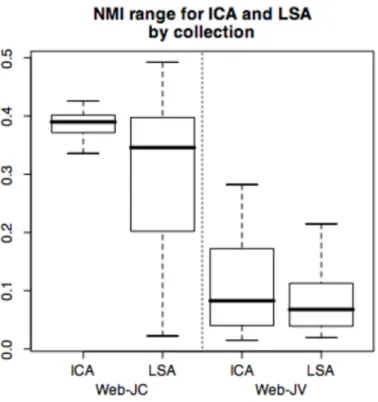
This theory is borne out in analysis of the results and illustrated in Figure 1. In this Figure, it is clear that the NMI values are considerably higher on average for the WEB-JC
collection than the WEB-JV collection, which gives a clear indication that the documents
Figure 1 NMI range for ICA and LSA. NMI is significantly higher for WEB-JC collection than the WEB-JV collection, indicating the first is easier to cluster than
the second. NMI ranges for ICA and LSA overlap, indicating no clear winner.
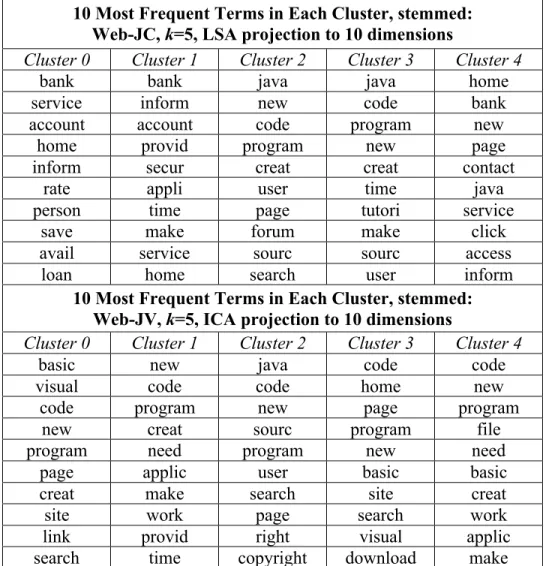
As an additional validation measure, looking at confusion matrices and most frequent terms in each cluster can give a good sense of what a cluster is “about”. Table 1 shows the confusion matrices for the best clusterings at k equal to 5 for both the WEB-JC and
WEB-JV collections, and Table 2 shows the ten most frequent terms in each of those
Confusion Matrix:
Web-JC, k=5, LSA projection to 10 dimensions
topic cluster 0 1 2 3 4
Java 3 4 520 314 159
Commercial Banks 619 157 6 13 205
Confusion Matrix:
Web-JV, k=5, ICA projection to 10 dimensions
topic cluster 0 1 2 3 4
Java 96 206 349 306 43
Visual Basic 448 143 3 379 27
Table 1 Confusion matrices for best clustering solutions, k=5. This shows a clear tendency for similar documents from the same topic to cluster together.
10 Most Frequent Terms in Each Cluster, stemmed: Web-JC, k=5, LSA projection to 10 dimensions
Cluster 0 Cluster 1 Cluster 2 Cluster 3 Cluster 4
bank bank java java home
service inform new code bank
account account code program new
home provid program new page
inform secur creat creat contact
rate appli user time java
person time page tutori service
save make forum make click
avail service sourc sourc access
loan home search user inform
10 Most Frequent Terms in Each Cluster, stemmed: Web-JV, k=5, ICA projection to 10 dimensions
Cluster 0 Cluster 1 Cluster 2 Cluster 3 Cluster 4
basic new java code code
visual code code home new
code program new page program
new creat sourc program file
program need program new need
page applic user basic basic
creat make search site creat
site work page search work
link provid right visual applic
search time copyright download make
Examination of the frequent terms in each cluster show clear correspondence to the topics in the collection. In the WEB-JC clustering with five clusters using the LSA projection
onto ten dimensions, the top half of Table 2, the top terms from the first two clusters clearly show an association with the “Commercial Banks” topic. Terms such as “bank”, “account” and “loan” are quite frequent in these clusters, and terms associated with “Java” or programming in general are completely absent. These clusters are comprised of 99% and 97% of documents from the “Commercial Banks” topic. Likewise, the most frequent terms from clusters 2 and 3 show a similarly strong association with the “Java” topic, containing terms such as “java”, “code” and “program”. The last cluster, cluster 4, shows some interesting characteristics. The document distribution in this cluster is almost equal from each topic, with 44% of the terms from the “Java” topic and 56% from the “Commercial Banks” topic. The frequent terms also seem to be a strange mix, with “home” being the most frequent, and both “java” and “bank” occurring in the ten most frequent terms. An attempt to interpret the “topic” of this cluster is difficult, but several possibilities exist: this cluster could contain documents that didn’t fit easily into the first four clusters, thus indicating an “other” topic; or this cluster may contain general
strongly identify with one of the two pre-existing topics, it is entirely possible that this cluster does represent a coherent topic – a topic that is not isolated to a subset of the “Java” or “Commercial Banks” documents in the collection.
Clustering Performance and Dimensions Retained
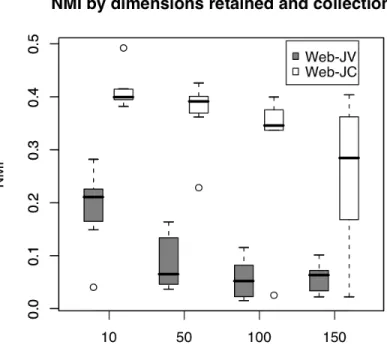
Another question that can be evaluated is the effect on clustering performance of the number of dimensions retained, either with ICA or LSA. There are obvious
computational advantages to reducing the dimensionality as much as possible, but it is expected that this may be at the expense of the quality of the clustering solution. The optimal dimensionality for document retrieval using LSA is still an open question, although a considerable amount of research has been devoted to this topic (Deerwester et al., 1990; Efron, 2002). This research has generally found that the optimal
computational requirements reduce with the number of dimensions, but the cluster quality actually increases.
Figure 2 NMI by dimensions retained. A clear negative trend in the NMI values is visible as the number of dimensions increase.
This result, although initially surprising, may make sense when considering the differences between document clustering and retrieval. In a retrieval task, highly nuanced measurements of the degree of similarity between documents and queries must be calculated. In clustering, especially in experiments such as these where the number of clusters is relatively small, a much more general degree of document similarity is
indication that the higher-ranked dimensions in the case of clustering only add noise to the data and therefore degrade performance.
Clustering Performance and Dimensionality Reduction Technique
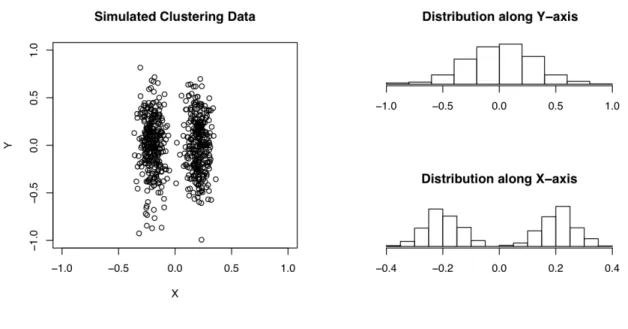
Figure 3 Simulated Clustering Data
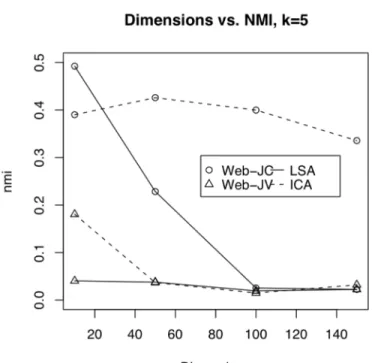
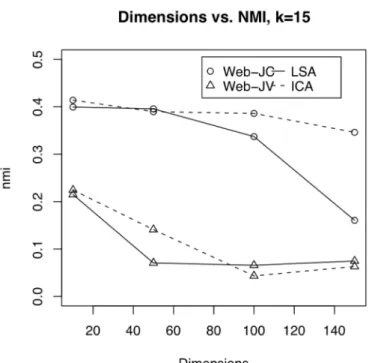
Contrary to the indication given by the above admittedly simple example, the test results do not support the hypothesis that ICA generally outperforms LSA for clustering. In fact, the best result from all the test occurred when the LSA projection was used. The range of NMI scores for LSA and ICA can be seen in Figure 1, above. In that Figure it is clear that ICA provides no advantage over LSA in general. Upon closer examination, there are some cases in which ICA does seem to clearly outperform LSA. The following Figures, 4-7 below, show that LSA (the solid lines) and ICA (the dashed lines) perform at
Figure 4 Dimensions vs. NMI, k=5. Higher NMI indicates a better clustering.
Figure 6 Dimensions vs. NMI, k=15. Higher NMI indicates a better clustering.
These Figures not only show the neck-and-neck performance of ICA and LSA at lower dimensions, but also illustrate the degradation in performance of both ICA and LSA as the number of dimensions increase. In some cases, ICA does not appear to suffer from that problem to the same degree as LSA. In particular, when using the WEB-JC
collection, ICA performance appears to be relatively stable as the number of dimensions increase. As stated above, a low NMI value indicates the clustering solution and the original classification have only a random association, whereas a higher value indicates the clustering and the classification are mutually informative. It is clear that LSA outperforms ICA in many cases, and no general statement of the superiority of ICA over LSA can be made.
It is important to note that the performance analysis shown in the above Figures cannot be considered conclusive. Although in some cases there appear to be clear performance trends, these results are based on a very small sample of data. As with many clustering algorithms, the initial random configuration of data used to initialize the EM algorithm can have a strong effect on the final outcome. It is possible to choose a particularly “lucky” (or “unlucky”) initial configuration in some of the experiments, and therefore skew the test results dramatically. In order to perform a more rigorous analysis and derive conclusive results, it may be necessary to run a series of tests varying the random configuration to come up with more accurate estimates for each data point.
CONCLUSION
The experiments conducted for this study attempted to compare the performance of LSA and ICA as dimensionality-reduction techniques for document clustering. Although no definitive answer was reached as to which projection technique performs better, the results do hint at some interesting performance trends. When reduced to 10 dimensions, LSA and ICA appear to perform comparably. At higher dimensions, however, ICA appears to regularly outperform LSA.
BIBLIOGRAPHY
Bingham, E., Kab, A., & Girolami, M. (2003). Topic identification in dynamical text by complexity pursuit. Neural Process. Lett., 17(1), 69-83.
Bingham, E., & Mannila, H. (2001). Random projection in dimensionality reduction: Applications to image and text data. Paper presented at the ACM SIGKDD international conference on Knowledge discovery and data mining, San Francisco, California.
Cutting, D., Pedersen, J., Karger, D., & Tukey, J. (1992). Scatter/gather: A cluster-based approach to browsing large document collections. Paper presented at the
Fifteenth Annual International ACM SIGIR Conference on Research and Development in Information Retrieval.
Dasgupta, S. (1999). Learning mixtures of gaussians. Paper presented at the 40th Annual Symposium on Foundations of Computer Science.
Dasgupta, S. (2000). Experiments with random projection. Paper presented at the 16th Conference on Uncertainty in Artificial Intelligence.
Deerwester, S., Dumais, S., Landauer, T., Furnas, G., & Harshman, R. (1990). Indexing by latent semantic analysis. Journal of the American Society of Information Science, 41(6), 407.
Dhillon, I., & Modha, D. (2001). Concept decompositions for large sparse text data using clustering. Machine Learning, 42(1/2), 175.
Efron, M. (2002). Eigenvalue-based estimators for optimal dimensionality reduction in information retrieval. Unpublished Doctoral Dissertation, University of North Carolina, Chapel Hill.
Efron, M., Elsas, J., Marchionini, G., & Zhang, J. (2004). Machine learning for
information architecture in a large governmental website. Paper presented at the 4th ACM/IEEE-CS joint conference on Digital libraries, Tuscon, AZ, USA. Ghosh, J., & Ye, N. (2003). Scalable clustering methods for data mining. In Handbook of
data mining (pp. 277).
Hand, D., Mannila, H., & Smyth, P. (2001). Principles of data mining (adaptive computation and machine learning).
Hastie, T., Tibshirani, R., & Friedman, J. H. (2001). The elements of statistical learning. He, J., Tan, A.-H., & Tan, C.-L. (2002). Art-c: A neural architecture for self-organization
under constraints. Paper presented at the 2002 International Joint Conference on Neural Networks, Hawaii, USA.
Hearst, M. A., & Pedersen, J. O. (1996). Reexamining the cluster hypothesis:
Hofmann, T. (1999). Probabilistic latent semantic indexing. Paper presented at the 22nd annual international ACM SIGIR conference on Research and development in information retrieval.
Honkela, T., & Hyvarinen, A. (2003). Linguistic feature extraction using independent component analysis. Paper presented at the International Joint Conference on Neural Networks, Budapest, Hungary.
Hyvarinen, A., Karhunen, J., & Oja, E. (2001). Independent component analysis.
Isbell, C. L., & Viola, P. (1999). Restructuring sparse high dimensional data for effective retrieval. Paper presented at the 1998 conference on Advances in neural
information processing systems II.
Jain, A. K., Murty, M. N., & Flynn, P. J. (1999). Data clustering: A review. ACM Computing Surveys, 31(3), 323.
Kolenda, T., & Hansen, L. (1999). Independent components in text.
Leuski, A. (2001). Evaluating document clustering for interactive information retrieval. Paper presented at the Tenth international conference on Information and
knowledge management.
Porter, M. F. (1980). An algorithm for suffix stripping. Program, 14(3), 130-137. Salton, G., & McGill, M. J. (1983). Introduction to modern information retrieval. USA:
McGraw-Hill.
Schutze, H., & Silverstein, H. (1997). Projections for efficient document clustering. Paper presented at the 20th annual international ACM SIGIR conference on Research and development in information retrieval, Philadelphia, Pennsylvania.
Sinka, M. P., & Corne, D. W. (2002). A large benchmark dataset for web document clustering. Paper presented at the 2nd Hybrid Intelligence Conference, Santiago, Chile.
Steinback, M., Karypis, G., & Kumar, V. (2000). A comparison of document clustering techniques. Paper presented at the KDD workshop on Text Mining.
Strang, G. (1993). Introduction to linear algebra. Wellesley, MA: Wellesley-Cambridge Press.
van Risjbergen, C. J. (1979). Information retrieval: Butterworth.
Whitten, I. H., & Frank, E. (2000). Data mining. San Diego, CA: Morgan Kaufmann. Zamir, O., Etzioni, O., Madani, O., & Karp, R. (1997). Fast and intuitive clustering of
web documents. Paper presented at the Knowledge Discovery and Data Mining. Zhao, Y., & Karypis, G. (2001). Criterion functions for document clustering:
Experiments and analysis (Technical Report No. TR #01--40). Minneapolis, MN: Department of Computer Science, University of Minnesota.
Appendix A: Complete Test Results
NMI values for Web-JC collection Clusters (k)
Projection Dimensions 5 10 15 20
LSA 10 0.492 0.415 0.399 0.399
50 0.228 0.362 0.396 0.376
100 0.025 0.349 0.337 0.341
150 0.022 0.176 0.161 0.233
ICA 10 0.390 0.381 0.413 0.399
50 0.425 0.406 0.390 0.393
100 0.400 0.337 0.386 0.365
150 0.336 0.404 0.346 0.378
NMI values for Web-JV collection Clusters (k)
Projection Dimensions 5 10 15 20
LSA 10 0.040 0.149 0.215 0.207
50 0.038 0.054 0.071 0.127
100 0.019 0.061 0.066 0.099
150 0.022 0.035 0.075 0.070
ICA 10 0.180 0.227 0.224 0.282
50 0.037 0.060 0.140 0.164
100 0.015 0.026 0.043 0.115