Referential Translation Machines for Quality Estimation
Ergun Bic¸ici
Centre for Next Generation Localisation, Dublin City University, Dublin, Ireland. [email protected]
Abstract
We introduce referential translation ma-chines (RTM) for quality estimation of translation outputs. RTMs are a computa-tional model for identifying the translation acts between any two data sets with re-spect to a reference corpus selected in the same domain, which can be used for esti-mating the quality of translation outputs, judging the semantic similarity between text, and evaluating the quality of student answers. RTMs achieve top performance in automatic, accurate, and language inde-pendent prediction of sentence-level and word-level statistical machine translation (SMT) quality. RTMs remove the need to access any SMT system specific informa-tion or prior knowledge of the training data or models used when generating the trans-lations. We develop novel techniques for solving all subtasks in the WMT13 qual-ity estimation (QE) task (QET 2013) based on individual RTM models. Our results achieve improvements over last year’s QE task results (QET 2012), as well as our previous results, provide new features and techniques for QE, and rank1st or2nd in all of the subtasks.
1 Introduction
Quality Estimation Task (QET) (Callison-Burch et al., 2012; Callison-Burch et al., 2013) aims to de-velop quality indicators for translations and pre-dictors without access to the references. Predic-tion of translaPredic-tion quality is important because the expected translation performance can help in esti-mating the effort required for correcting the trans-lations during post-editing by human translators.
Bicici et al. (2013) develop the Machine Trans-lation Performance Predictor (MTPP), a state-of-the-art, language independent, and SMT system
extrinsic machine translation performance predic-tor, which achieves better performance than the competitive QET baseline system (Callison-Burch et al., 2012) by just looking at the test source sen-tences and becomes the2nd overall after also look-ing at the translation outputs in QET 2012.
In this work, we introduce referential translation machines (RTM) for quality estimation of transla-tion outputs, which is a computatransla-tional model for identifying the acts of translation for translating between any given two data sets with respect to a reference corpus selected in the same domain. RTMs reduce our dependence on any task depen-dent resource. In particular, we do not use the baseline software or the SMT resources provided with the QET 2013 challenge. We believe having access to glass-box features such as the phrase ta-ble or the n-best lists is not realistic especially for use-cases where translations may be provided by different MT vendors (not necessarily from SMT products) or by human translators. Even the prior knowledge of the training corpora used for build-ing the SMT models or any other model used when generating the translations diverges from the goal of independent and unbiased prediction of trans-lation quality. Our results show that we do not need to use any SMT system dependent informa-tion to achieve the top performance when predict-ing translation output quality.
2 Referential Translation Machine (RTM)
Referential translation machines (RTMs) provide a computational model for quality and seman-tic similarity judgments using retrieval of rele-vant training data (Bic¸ici and Yuret, 2011a; Bic¸ici, 2011) as interpretants for reaching shared seman-tics (Bic¸ici, 2008). RTMs achieve very good per-formance in judging the semantic similarity of sentences (Bic¸ici and van Genabith, 2013a) and we can also use RTMs to automatically assess the
correctness of student answers to obtain better re-sults (Bic¸ici and van Genabith, 2013b) than the state-of-the-art (Dzikovska et al., 2012).
RTM is a computational model for identifying the acts of translation for translating between any given two data sets with respect to a reference cor-pus selected in the same domain. RTM can be used for predicting the quality of translation out-puts. An RTM model is based on the selection of common training data relevant and close to both the training set and the test set of the task where the selected relevant set of instances are called the interpretants. Interpretants allow shared semantics to be possible by behaving as a reference point for similarity judgments and providing the context. In semiotics, an interpretant I interprets the signs used to refer to the real objects (Bic¸ici, 2008). RTMs provide a model for computational seman-tics using interpretants as a reference according to which semantic judgments with translation acts are made. Each RTM model is a data translation model between the instances in the training set and the test set. We use the FDA (Feature De-cay Algorithms) instance selection model for se-lecting the interpretants (Bic¸ici and Yuret, 2011a) from a given corpus, which can be monolingual when modeling paraphrasing acts, in which case the MTPP model (Section 2.1) is built using the interpretants themselves as both the source and the target side of the parallel corpus. RTMs map the training and test data to a space where translation acts can be identified. We view that acts of transla-tion are ubiquitously used during communicatransla-tion:
Every act of communication is an act of translation(Bliss, 2012).
Translation need not be between different lan-guages and paraphrasing or communication also contain acts of translation. When creating sen-tences, we use our background knowledge and translate information content according to the cur-rent context. Given a training set train, a test settest, and some monolingual corpusC,
prefer-ably in the same domain as the training and test sets, the RTM steps are:
1. T =train∪test. 2. select(T,C)→ I
3. MTPP(I,train)→ Ftrain 4. MTPP(I,test)→ Ftest 5. learn(M,Ftrain)→ M 6. predict(M,Ftest)→qˆ
Step 2 selects the interpretants, I, relevant to the instances in the combined training and test data. Steps 3 and 4 use I to map train and test
to a new space where similarities between transla-tion acts can be derived more easily. Step 5 trains a learning model M over the training features,
Ftrain, and Step 6 obtains the predictions. RTM
relies on the representativeness ofI as a medium for building translation models for translating be-tweentrainandtest.
Our encouraging results in the QET challenge provides a greater understanding of the acts of translation we ubiquitously use when communi-cating and how they can be used to predict the performance of translation, judging the semantic similarity between text, and evaluating the qual-ity of student answers. RTM and MTPP models are not data or language specific and their mod-eling power and good performance are applicable across different domains and tasks. RTM expands the applicability of MTPP by making it feasible when making monolingual quality and similarity judgments and it enhances the computational scal-ability by building models over smaller but more relevant training data as interpretants.
2.1 The Machine Translation Performance Predictor (MTPP)
In machine translation (MT), pairs of source and target sentences are used for training statistical MT (SMT) models. SMT system performance is affected by the amount of training data used as well as theclosenessof the test set to the training set. MTPP (Bic¸ici et al., 2013) is a state-of-the-art and top performing machine translation per-formance predictor, which uses machine learning models over features measuring how well the test set matches the training set to predict the quality of a translation without using a reference trans-lation. MTPP measures the coverage of individ-ual test sentence features and syntactic structures found in the training set and derives feature func-tions measuring the closeness of test sentences to the available training data, the difficulty of trans-lating the sentence, and the presence of acts of translation for data transformation.
2.2 MTPP Features for Translation Acts
parsing with CCL extracts links from base words to head words, resulting in structures represent-ing the grammatical information instantiated in the training and test data. Feature functions use statis-tics involving the training set and the test sen-tences to determine their closeness. Since they are language independent, MTPP allows quality esti-mation to be performed extrinsically.
We extend MTPP (Bic¸ici et al., 2013) in its learning module, the features included, and their representations. Categories for the 308 features (S for source, T for target) used are listed below where the number of features are given in{#}and the detailed descriptions for some of the features are presented in (Bic¸ici et al., 2013).
• Coverage {110}: Measures the degree to which the test features are found in the train-ing set for both S ({56}) and T ({54}). • Synthetic Translation Performance{6}:
Cal-culates translation scores achievable accord-ing to then-gram coverage.
• Length{7}: Calculates the number of words
and characters for S and T and their average token lengths and their ratios.
• Feature Vector Similarity {16}: Calculates similarities between vector representations.
• Perplexity {90}: Measures the fluency of
the sentences according to language models (LM). We use both forward ({30}) and
back-ward ({15}) LM features for S and T. • Entropy {9}: Calculates the distributional
similarity of test sentences to the training set over top N retrieved sentences.
• Retrieval Closeness{24}: Measures the
de-gree to which sentences close to the test set are found in the selected training set,I, us-ing FDA (Bic¸ici and Yuret, 2011a).
• Diversity{6}: Measures the diversity of co-occurring features in the training set.
• IBM1 Translation Probability {16}: Cal-culates the translation probability of test sentences using the selected training set,
I, (Brown et al., 1993).
• IBM2 Alignment Features {11}: Calculates
the sum of the entropy of the distribution of alignment probabilities for S (Ps∈S−plogp forp =p(t|s)wheresandtare tokens) and T, their average for S and T, the number of en-tries withp≥0.2andp≥0.01, the entropy of the word alignment between S and T and its average, and word alignmentlog probabil-ity and its value in terms of bits per word.
• Minimum Bayes Retrieval Risk{4}: Calcu-lates the translation probability for the trans-lation having the minimum Bayes risk among the retrieved training instances.
• Sentence Translation Performance{3}: Cal-culates translation scores obtained accord-ing to q(T, R) using BLEU (Papineni et al., 2002), NIST (Doddington, 2002), or F1(Bic¸ici and Yuret, 2011b) forq.
• Character n-grams {4}: Calculates cosine between character n-grams (for n=2,3,4,5) obtained for S and T (B¨ar et al., 2012).
• LIX {2}: Calculates the LIX readability score (Wikipedia, 2013; Bj¨ornsson, 1968) for S and T. 1
For retrieval closeness, we use FDA instead of dice for sentence selection. We also improve FDA’s instance selection score by scaling with the length of the sentence (Bic¸ici and Yuret, 2011a). IBM2 alignments and their probabilities are ob-tained by first obtaining IBM1 alignments and probabilities, which become the starting point for the IBM2 model. Both models are trained for25 to75iterations or until convergence.
3 Quality Estimation Task Results
We participate in all of the four challenges of the quality estimation task (QET) (Callison-Burch et al., 2013), which include English to Spanish (en-es) and German to English translation direc-tions. There are two main categories of chal-lenges: sentence-level prediction (Task 1.*) and word-level prediction (Task 2). Task 1.1 is about predicting post-editing effort (PEE), Task 1.2 is about ranking translations from different systems, Task 1.3 is about predicting post-editing time (PET), and Task 2 is about binary or multi-class classification of word-level quality.
For each task, we develop RTM mod-els using the parallel corpora and the LM corpora distributed by the translation task (WMT13) (Callison-Burch et al., 2013) and the LM corpora provided by LDC for English and Spanish 2. The parallel corpora contain 4.3M
sentences for de-en with 106M words for de and 111M words for en and 15M sentences for en-es with 406M words for en and 455M words for
1LIX=A B +C
100
A , where A is the number of words, C is
words longer than 6 characters, B is words that start or end with any of “.”, “:”, “!”, “?” similar to (Hagstr¨om, 2012).
es. We do not use any resources provided by QET including data, software, or baseline features since they are SMT system dependent or language specific. Instance selection for the training set and the language model (LM) corpus is handled by a parallel implementation of FDA (Bic¸ici, 2013). We tokenize and true-case all of the corpora. The true-caser is trained on all of the training corpus using Moses (Koehn et al., 2007). We prepare the corpora by following this procedure: tokenize→
train the true-caser→true-case. Table 1 lists the statistics of the data used in the training and test sets for the tasks.
Task 1.1 1.2 (de-en) 1.2 (en-es) 1.3 & 2 Trainsentswords 63K (en) 762K (de) 528K (en) 18K (en)2254 32730 22338 803
67K (es) 786K (en) 559K (es) 20K (es)
[image:4.595.305.532.100.270.2]Test sents 500 1810 1315 284
Table 1: Data statistics for different tasks. The number of words is listed after tokenization.
Since we do not know the best training set size that will maximize the performance, we rely on previous SMT experiments (Bic¸ici and Yuret, 2011a; Bic¸ici and Yuret, 2011b) and quality es-timation challenges (Bic¸ici and van Genabith, 2013a; Bic¸ici and van Genabith, 2013b) to select the proper training set size. For each training and test sentence provided in each subtask, we choose between 65 and 600 sentences from the parallel training corpora to be added to the training set, which creates roughly 400K sentences for train-ing. We add the selected training set to the8 mil-lion sentences selected for each LM corpus. The statistics of the training data selected by the par-allel FDA and used as interpretants in the RTM models is given in Table 2.
Task 1.1 1.2 (de-en) 1.2 (en-es) 1.3 2
sents 406K 318K 299K 398K 397K
words 6.3M (en) 4.8M (de) 4.3M (en) 6.6M (en) 6.6M (en)6.9M (es) 4.9M (en) 4.6M (es) 7.2M (es) 7.2M (es)
Table 2: Statistics of the training data used as in-terpretants in the RTM models in thousands (K) of sentences or millions (M) of words.
3.1 Evaluation
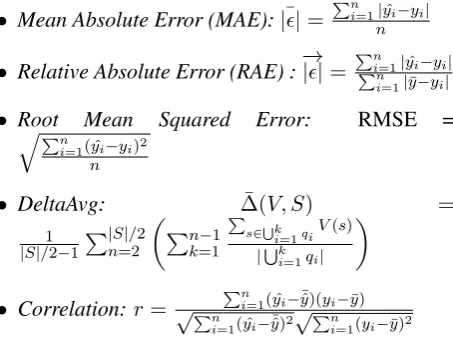
In this section, we describe the metrics we use to evaluate the learning performance. Letyi
repre-sent the actual target value for instance i, y¯ the mean of the actual target values, yˆi the value
es-timated by the learning model, andy¯ˆthe mean of
the estimated target values, then we use the fol-lowing metrics to evaluate the learning models:
• Mean Absolute Error (MAE):|¯|=
Pn
i=1|yˆi−yi|
n
• Relative Absolute Error (RAE) :−→||=
Pn
i=1|yˆi−yi|
Pn
i=1|y−y¯ i| • Root Mean Squared Error:q RMSE =
Pn
i=1( ˆyi−yi)2
n
• DeltaAvg: ∆(¯ V, S) =
1
|S|/2−1 P|S|/2
n=2
Pn−1
k=1
P
s∈Ski=1qiV(s)
|Ski=1qi|
• Correlation:r= √ Pni=1( ˆyi−yˆ¯)(yi−y¯)
Pn
i=1( ˆyi−y¯ˆ)2√Pni=1(yi−y¯)2
DeltaAvg (Callison-Burch et al., 2012) calculates the average quality difference between the scores for the topn−1quartiles and the overall quality for the test set. Relative absolute error measures the error relative to the error when predicting the actual mean. We use the coefficient of determina-tion,R2 = 1−Pn
i=1( ˆyi−yi)2/ Pn
i=1(¯y−yi)2, during optimization where the models are regression based and higherR2values are better.
3.2 Task 1: Sentence-level Prediction of Quality
In this subsection, we develop techniques for the prediction of quality at the sentence-level. We first discuss the learning models we use and how we optimize them and then provide the results for the individual subtasks and the settings used.
3.2.1 Learning Models and Optimization
the learning parameters, the number of features to select, and the number of dimensions used for PLS. More detailed description of the optimiza-tion process is given in (Bic¸ici et al., 2013). In our submissions, we only used the results we ob-tained from SVR and SVR after PLS (SVRPLS) since they perform the best during training.
Optimization can be a challenge for SVR due to the large number of parameter settings to search. In this work, we decrease the search space by se-lectingεclose to the theoretically optimal values. We selectεclose to the standard deviation of the noise in the training set since the optimal value for ε is shown to have linear dependence to the noise level for different noise models (Smola et al., 1998). We use RMSE of RR on the training set as an estimate for the noise level (σof noise) and the following formulas to obtain theεwithτ = 3:
ε=τ σ r
lnn
n (1)
and the C (Cherkassky and Ma, 2004; Chal-imourda et al., 2004):
C = max(|y¯+ 3σy|,|y¯−3σy|) (2)
Since theC obtained could be low (Chalimourda et al., 2004), we use a range of C values in ad-dition to the obtainedC value includingCvalues with a couple ofσy values larger.
[image:5.595.313.524.184.237.2]Table 3 lists the RMSE of the RR model on the training set and the corresponding ε and C val-ues for different subtasks. We also present the op-timized parameter values for SVR and SVRPLS. Table 3 shows that, empirically, Equation 1 and Equation 2 gives results close to the best parame-ters found after optimization.
Task 1.1 1.2 (de-en) 1.2 (en-es) 1.3
RMSE RR .1397 .1169 .1569 68.06
ε .0245 .0062 .01 18.64
C .8398 .8713 1.02 371.28
ˆ
C(SVR) .8398 .5 .5 100
γ(SVR) .0005 .001 .0001 .0005
ˆ
C(SVRPLS) 1.5 .8713 1.02 100
γ(SVRPLS) .0001 .0001 .0001 .001
# dim (SVRPLS) 60 60 60 60
Table 3: Optimal parameters predicted by Equa-tion 1 and EquaEqua-tion 2 and the optimized parame-ter values,Cˆandγ for SVR and SVRPLS and the number of dimensions (# dim) for SVRPLS.
3.2.2 Task 1.1: Scoring and Ranking for Post-Editing Effort
Task 1.1 involves the prediction of the case insen-sitive translation edit rate (TER) scores obtained by TERp (Snover et al., 2009) and their ranking. In contrast, we derive features over sentences that are true-cased. We obtain the rankings by sorting according to the predicted TER scores.
Task 1.1 R2 r RMSE MAE RAE
RR 0.3510 0.5965 0.1393 0.1086 0.7888 RR PLS 0.4232 0.6509 0.1313 0.1023 0.7430 SVR 0.4394 0.6647 0.1295 0.0967 0.7023 SVR PLS 0.4305 0.6569 0.1305 0.1003 0.7284 Table 4: Task1.1 results on the training set.
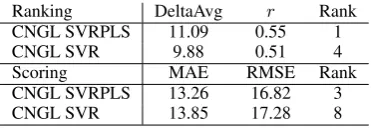
Table 4 presents the learning performance on the training set using the optimized parameters. We are able to significantly improve the results when compared with the QET 2012 (Callison-Burch et al., 2012) and our previous results (Bic¸ici et al., 2013) especially in terms of MAE and RAE. The results on the test set are given in Table 5. Rank lists the overall ranking in the task. RTMs with SVR PLS learning is able to achieve the top rank in this task.
Ranking DeltaAvg r Rank
CNGL SVRPLS 11.09 0.55 1
CNGL SVR 9.88 0.51 4
Scoring MAE RMSE Rank
CNGL SVRPLS 13.26 16.82 3
[image:5.595.324.510.414.479.2]CNGL SVR 13.85 17.28 8
Table 5: Task1.1 results on the test set.
3.2.3 Task 1.2: Ranking Translations from Different Systems
Task 1.2 involves the prediction of the ranking among up to5translation outputs produced by dif-ferent MT systems. Evaluation is done against the human rankings using the Kendall’sτ corre-lation (Callison-Burch et al., 2013): τ = (c − d)/n(n2−1) = c−dc+dwhere a pair is concordant,c, if the ordering agrees, discordant,d, if their ordering disagrees, and neither concordant nor discordant if their rankings are equal.
[image:5.595.72.293.593.690.2]training set (0.2040) is better than BLEU (Pap-ineni et al., 2002) (0.1780) and NIST (Dodding-ton, 2002) (0.1907) for de-en. Table 6 presents the learning performance on the training set using the optimized parameters. Learning F1 becomes an easier task than learning TER as observed from the results but we have significantly more training in-stances. We use the SVR model for predicting the F1scores on the training set and the test set. MAE is a more important performance metric here since we want to be as precise as possible when predict-ing the actual performance.
Task 1.2 R2 r RMSE MAE RAE
[image:6.595.328.502.62.112.2]de-en SVRRR 0.6320 0.7953 0.1169 0.0733 0.55350.7528 0.8692 0.0958 0.0463 0.3494 en-es SVRRR 0.5101 0.7146 0.1569 0.1047 0.63230.4819 0.7018 0.1613 0.0973 0.5873
Table 6: Task1.2 results on the training set.
Our next goal is to learn a threshold for judg-ing if two translations are equal over the predicted F1 scores. This threshold is used to determine whether we need to alter the ranking. We try to mimic the human decision process when de-termining whether two translations are equivalent. On some occasions where the sentences are close enough, humans give them equal ranking. This is also related to the granularity of the differences visible with a 1 to 5 ranking schema.
We compared different threshold formulations and used the following condition in our submis-sions to decide whether the ranking of itemiin a setSof translations,i∈S, should be different:
X
j6=i
F1(j)−F1(i)
|j−i| /|S|> t, (3)
wheretis the optimized threshold minimizing the following loss forntraining instances:
n
X
i=1
τ(f(t, qi), ri) (4)
where f(t, qi) is a function returning rankings
based on the thresholdtand the quality scores for instancei, qi andτ(rj, ri) calculates theτ score
based on the rankingsrjandri.
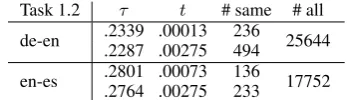
For both de-en and en-es subtasks, we found the thresholds obtained to be very similar or the same. The optimized values are given in Table 7. On the test set, we used the same threshold,t = 0.00275 for both de-en and en-es, which is a little higher than the optimaltto prevent overfitting.
[image:6.595.316.521.297.403.2]Task 1.2 τ t # same # all de-en .2339 .00013.2287 .00275 236494 25644 en-es .2801 .00073.2764 .00275 136233 17752
Table 7: Task1.2 optimized thresholds and the corresponding comparisons that were found to be equal (# same) over all comparisons (# all).
We believe that human judgments of linguis-tic equality and the corresponding thresholds we learned in this work can be useful for developing better automatic evaluation metrics and can im-prove the correlation of the scores obtained with human judgments (as we did here). The results on the test set are given in Table 8. We are also able to achieve the top ranking in this task.
Ties penalized model τ Rank
de-en CNGL SVRPLSF1 0.17 3
CNGL SVRF1 0.17 4
en-es CNGL SVRPLSF1 0.15 1
CNGL SVRF1 0.13 2
Ties ignored model τ Rank
de-en CNGL SVRPLSF1 0.17 3
CNGL SVRF1 0.17 4
en-es CNGL SVRPLSF1 0.16 2
CNGL SVRF1 0.13 3
Table 8: Task1.2 results on the test set.
3.2.4 Task 1.3: Predicting Post-Editing Time
Task 1.3 involves the prediction of the post-editing time (PET) for a translator to post-edit the MT out-put. Table 9 presents the learning performance on the training set using the optimized parameters.
Task 1.3 R2 r RMSE MAE RAE
RR 0.4463 0.6702 68.0628 39.5250 0.6694 RR PLS 0.5917 0.7716 58.4464 35.8759 0.6076 SVR 0.4062 0.6753 70.4853 36.5132 0.6184 SVR PLS 0.5316 0.7604 62.6031 33.5490 0.5682
Table 9: Task1.3 results on the training set.
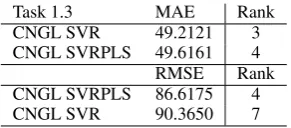
The results on the test set are given in Table 10. We are able to become the2nd best system accord-ing to MAE in this task.
3.3 Task 2: Word-level Prediction of Quality
[image:6.595.308.526.518.573.2]Task 1.3 MAE Rank
CNGL SVR 49.2121 3
CNGL SVRPLS 49.6161 4
RMSE Rank
CNGL SVRPLS 86.6175 4
[image:7.595.109.255.61.125.2]CNGL SVR 90.3650 7
Table 10: Task1.3 results on the test set.
the word-level features we use, and then present our results on the test set.
3.3.1 Global Linear Models with Dynamic Learning (GLMd)
Collins (2002) develops global learning models (GLM), which rely on Viterbi decoding, percep-tron learning, and flexible feature definitions. We extend the GLM framework by parallel percep-tron training (McDonald et al., 2010) and dynamic learning with adaptive weight updates in the per-ceptron learning algorithm:
w=w+α(Φ(xi,yi)−Φ(xi,ˆy)), (5)
where Φ returns a global representation for in-stance i and the weights are updated by α = exp(log10(3−1/0))with−1and0representing the error of the previous and first iteration respec-tively. αdecays the amount of the change during weight updates at later stages and prevents large fluctuations with updates. We used both the GLM model and the GMLd models in our submissions.
3.3.2 Word-level Features
We introduce a number of novel features for the prediction of word-level translation quality. In broad categories, these word-level features are:
• CCL:Uses CCL links.
• Word context:Surrounding words.
• Word alignments: Alignments, their probabili-ties, source and target word contexts.
• Length:Word lengths,n-grams over them. • Location:Location of the words.
• Prefix and Suffix:Word prefixes, suffixes.
[image:7.595.309.524.63.238.2]• Form:Capital, contains digit or punctuation. We found that CCL links are the most discrimi-native feature among these. In total, we used 511K features for binary and 637K for multi-class clas-sification. The learning curve is given in Figure 1. The results on the test set are given in Table 11. P, R, and A stand for precision, recall, and accu-racy respectively. We are able to become the2nd according to A in this task.
Figure 1: Learning curve with the parallel GLM and GLMd models.
Binary A P R F1 Rank (A)
CNGL dGLM .7146 .7392 .9261 .8222 2 CNGL GLM .7010 .7554 .8581 .8035 5 Multi-class A Rank
CNGL dGLM .7162 3 CNGL GLM .7116 4
Table 11: Task 2 results on the test set.
4 Contributions
Referential translation machines achieve top per-formance in automatic, accurate, and language in-dependent prediction of sentence-level and word-level statistical machine translation (SMT) qual-ity. RTMs remove the need to access any SMT system specific information or prior knowledge of the training data or models used when generating the translations. We develop novel techniques for solving all subtasks in the quality estimation (QE) task (QET 2013) based on individual RTM mod-els. Our results achieve improvements over last year’s QE task results (QET 2012), as well as our previous results, provide new features and tech-niques for QE, and rank 1st or 2nd in all of the subtasks.
Acknowledgments
[image:7.595.307.526.284.348.2]References
Daniel B¨ar, Chris Biemann, Iryna Gurevych, and Torsten Zesch. 2012. Ukp: Computing seman-tic textual similarity by combining multiple content similarity measures. In*SEM 2012: The First Joint Conference on Lexical and Computational Seman-tics – Volume 1: Proceedings of the main conference and the shared task, and Volume 2: Proceedings of the Sixth International Workshop on Semantic Eval-uation (SemEval 2012), pages 435–440, Montr´eal, Canada, 7-8 June. Association for Computational Linguistics.
Ergun Bic¸ici and Josef van Genabith. 2013a. CNGL-CORE: Referential translation machines for measur-ing semantic similarity. In*SEM 2013: The Second Joint Conference on Lexical and Computational Se-mantics, Atlanta, Georgia, USA, 13-14 June. Asso-ciation for Computational Linguistics.
Ergun Bic¸ici and Josef van Genabith. 2013b. CNGL: Grading student answers by acts of translation. In *SEM 2013: The Second Joint Conference on Lex-ical and Computational Semantics and Proceedings of the Seventh International Workshop on Semantic Evaluation (SemEval 2013), Atlanta, Georgia, USA, 14-15 June. Association for Computational Linguis-tics.
Ergun Bic¸ici and Deniz Yuret. 2011a. Instance se-lection for machine translation using feature decay algorithms. In Proceedings of the Sixth Workshop on Statistical Machine Translation, pages 272–283, Edinburgh, Scotland, July. Association for Compu-tational Linguistics.
Ergun Bic¸ici and Deniz Yuret. 2011b. RegMT system for machine translation, system combination, and evaluation. In Proceedings of the Sixth Workshop on Statistical Machine Translation, pages 323–329, Edinburgh, Scotland, July. Association for Compu-tational Linguistics.
Ergun Bic¸ici, Declan Groves, and Josef van Genabith. 2013. Predicting sentence translation quality using extrinsic and language independent features. Ma-chine Translation.
Ergun Bic¸ici. 2011. The Regression Model of Machine Translation. Ph.D. thesis, Koc¸ University. Supervi-sor: Deniz Yuret.
Ergun Bic¸ici. 2013. Feature decay algorithms for fast deployment of accurate statistical machine transla-tion systems. InProceedings of the Eighth Work-shop on Statistical Machine Translation, Sofia, Bul-garia, August. Association for Computational Lin-guistics.
Ergun Bic¸ici. 2008. Consensus ontologies in socially interacting multiagent systems. Journal of Multia-gent and Grid Systems.
Carl Hugo Bj¨ornsson. 1968.L¨asbarhet. Liber.
Chris Bliss. 2012. Comedy is transla-tion, February. http://www.ted.com/talks/ chris bliss comedy is translation.html.
Peter F. Brown, Stephen A. Della Pietra, Vincent J. Della Pietra, and Robert L. Mercer. 1993. The mathematics of statistical machine translation: Parameter estimation. Computational Linguistics, 19(2):263–311, June.
Chris Callison-Burch, Philipp Koehn, Christof Monz, and Omer F. Zaidan. 2011. Findings of the 2011 Workshop on Statistical Machine Translation. In Proceedings of the Sixth Workshop on Statistical Machine Translation, Edinburgh, England, July. As-sociation for Computational Linguistics.
Chris Callison-Burch, Philipp Koehn, Christof Monz, Matt Post, Radu Soricut, and Lucia Specia. 2012. Findings of the 2012 workshop on statistical ma-chine translation. In Proceedings of the Seventh Workshop on Statistical Machine Translation, pages 10–51, Montr´eal, Canada, June. Association for Computational Linguistics.
Chris Callison-Burch, Philipp Koehn, Christof Monz, Matt Post, Radu Soricut, and Lucia Specia. 2013. Findings of the 2013 workshop on statistical ma-chine translation. In Proceedings of the Eighth Workshop on Statistical Machine Translation, pages 10–51. Association for Computational Linguistics, August.
Athanassia Chalimourda, Bernhard Sch¨olkopf, and Alex J. Smola. 2004. Experimentally optimal
ν in support vector regression for different noise
models and parameter settings. Neural Networks, 17(1):127–141, January.
Vladimir Cherkassky and Yunqian Ma. 2004. Practical selection of svm parameters and noise estimation for svm regression. Neural Netw., 17(1):113–126, Jan-uary.
Michael Collins. 2002. Discriminative training meth-ods for hidden markov models: theory and experi-ments with perceptron algorithms. InProceedings of the ACL-02 conference on Empirical methods in natural language processing - Volume 10, EMNLP ’02, pages 1–8, Stroudsburg, PA, USA. Association for Computational Linguistics.
George Doddington. 2002. Automatic evaluation of machine translation quality using n-gram co-occurrence statistics. InProceedings of the second international conference on Human Language Tech-nology Research, pages 138–145, San Francisco, CA, USA. Morgan Kaufmann Publishers Inc.
Computational Linguistics: Human Language Tech-nologies, pages 200–210, Montr´eal, Canada, June. Association for Computational Linguistics.
Isabelle Guyon, Jason Weston, Stephen Barnhill, and Vladimir Vapnik. 2002. Gene selection for cancer classification using support vector machines. Ma-chine Learning, 46(1-3):389–422.
Kenth Hagstr¨om. 2012. Swedish readabil-ity calculator. https://github.com/keha76/Swedish-Readability-Calculator.
Philipp Koehn, Hieu Hoang, Alexandra Birch, Chris Callison-Burch, Marcello Federico, Nicola Bertoldi, Brooke Cowan, Wade Shen, Christine Moran, Richard Zens, Chris Dyer, Ondrej Bojar, Alexan-dra Constantin, and Evan Herbst. 2007. Moses: Open source toolkit for statistical machine transla-tion. In Annual Meeting of the Assoc. for Compu-tational Linguistics, pages 177–180, Prague, Czech Republic, June.
Ryan McDonald, Keith Hall, and Gideon Mann. 2010. Distributed training strategies for the structured per-ceptron. In Human Language Technologies: The 2010 Annual Conference of the North American Chapter of the Association for Computational Lin-guistics, pages 456–464, Los Angeles, California, June. Association for Computational Linguistics.
Kishore Papineni, Salim Roukos, Todd Ward, and Wei-Jing Zhu. 2002. BLEU: a method for automatic evaluation of machine translation. In Proceedings of 40th Annual Meeting of the Association for Com-putational Linguistics, pages 311–318, Philadelphia, Pennsylvania, USA, July. Association for Computa-tional Linguistics.
Yoav Seginer. 2007. Learning Syntactic Structure. Ph.D. thesis, Universiteit van Amsterdam.
Alex J. Smola and Bernhard Sch¨olkopf. 2004. A tu-torial on support vector regression. Statistics and Computing, 14(3):199–222, August.
A. J. Smola, N. Murata, B. Sch¨olkopf, and K.-R. M¨uller. 1998. Asymptotically optimal choice of
ε-loss for support vector machines. In L.
Niklas-son, M. Boden, and T. Ziemke, editors,Proceedings of the International Conference on Artificial Neural Networks, Perspectives in Neural Computing, pages 105–110, Berlin. Springer.
Matthew Snover, Nitin Madnani, Bonnie J. Dorr, and Richard Schwartz. 2009. Fluency, adequacy, or hter?: exploring different human judgments with a tunable mt metric. In Proceedings of the Fourth Workshop on Statistical Machine Transla-tion, StatMT ’09, pages 259–268, Stroudsburg, PA, USA. Association for Computational Linguistics.
Lucia Specia, Nicola Cancedda, Marc Dymetman, Marco Turchi, and Nello Cristianini. 2009. Estimat-ing the sentence-level quality of machine translation
systems. InProceedings of the 13th Annual Con-ference of the European Association for Machine Translation (EAMT), pages 28–35, Barcelona, May. EAMT.
Wikipedia. 2013. Lix.