Stance Classification in Online Debates by Recognizing Users’ Intentions
Sarvesh Ranade, Rajeev Sangal, Radhika Mamidi Language Technologies Research Centre International Institute of Information Technology
Hyderabad, India
[email protected], {sangal, radhika.mamidi}@iiit.ac.in
Abstract
Online debate forums provide a rich col-lection of differing opinions on vari-ous topics. In dual-sided debates, users present their opinions or judge other’s opinions to support their stance. In this paper, we examine the use of users’ inten-tions and debate structure for stance clas-sification of the debate posts. We propose a domain independent approach to capture users’ intent at sentence level using its de-pendency parse and sentiWordNet and to build the intention structure of the post to identify its stance. To aid the task of clas-sification, we define the health of the de-bate structure and show that maximizing its value leads to better stance classifica-tion accuracies.
1 Introduction
Online debate forums provide Internet users a plat-form to discuss popular ideological debates. De-bate in essence is a method of interactive and rep-resentational arguments. In an online debate, users make assertions with superior content to support their stance. Factual accuracy and emotional ap-peal are important features used to persuade the readers. It is easy to observe that personal opin-ions are important in ideological stance taking (Somasundaran and Wiebe, 2009). Because of the availability of Internet resources and time, people intelligently use the factual data to support their opinions.
Online debates differ from public debates in terms of logical consistency. In online debates, users assert their opinion towards either side, sometimes ignoring discourse coherence required for logical soundness of the post. Generally they use strong degree of sentiment words including in-sulting or sarcastic remarks for greater emphasis
of their point. Apart from supporting/opposing a side, users make factual statements such as “Stan lee once said Superman is superior than batman in all areas.” to strengthen their stance.
We collected debate posts from an online site called‘convinceme.net’which allows users to in-stantiate debates on questions of their choice. The debates are held between two topics. To gener-alize the debate scenarios, we refer to these top-ics as Topic A and B. When users participate
in the debate, they support their stance by post-ing on the appropriate side, thus self-labelpost-ing their stance. Users’stanceis determined by the debate topic they are supporting and we refer to each in-stance of users’ opinion as apost. Eachpost can have multiple utterances which are the smallest discourse units. This site has an option to rebut another post, thus enabling users to comment on others’ opinion.
A post with most of its utterances supporting a debate topic most likely supports that topic. This shows that users’ intentions play an important role in supporting their stance. In this paper, we em-ploy topic directed sentiment analysis based ap-proach to capture utterance level intentions. We have designed debate specific utterance level in-tentions which denote users’ attitude of support-ing/opposing a specific debate topic or stating a known fact.
Message level intention is denoted by the stance users are taking in the debate. We build posts’ in-tention structure and calculate posts’ debate topics related sentiment scores to classify their stance in ideological debates. Intuitively, posts by same au-thor support same stance and rebutting posts have opposite stances. This inter-post information pre-sented by debates’ structure is also used to revise posts’ stance. As mentioned earlier, we use the de-bate data collected from‘convinceme.net’to eval-uate our approach on stance classification task and it beats baseline systems and a previous approach
by significant margin and achieves overall accu-racy of74.4%.
The rest of the paper is organized as follows: Section 2 presents previous approaches to stance classification and sentiment analysis. Section 3 highlights the importance of users’ intentions in ideological debates and presents our algorithm to capture utterance intentions using topic directed sentiment analysis. In Section 4, we describe the use the utterance level intentions to capture inten-tion of the entire post. We explain our stance clas-sification method using post content features and post intention structure in this section. Section 5 describes the use of the dialogue structure of the debate and presents a gradient ascent method for re-evaluating posts’ stance. We present experi-ments and results on capturing users’ intentions and stance classification in Section 6. This is fol-lowed by conclusions in Section 7.
2 Related Work
To classify posts’ stance in dual-sided debates, previous approaches have used probabilistic (So-masundaran and Wiebe, 2009) as well as machine learning techniques (Anand et al., 2011; Somasun-daran and Wiebe, 2010). Some approaches exten-sively used the dialogue structure to identify posts’ stance (Walker et al., 2012) whereas others consid-ered opinion expressions and their targets essen-tial to capture sentiment in the posts towards de-bate topics (Somasundaran and Wiebe, 2009; So-masundaran and Wiebe, 2010).
Pure machine learning approaches (Anand et al., 2011) have extracted lexical and contextual features of debate posts to classify their stance. Walker et al. (2012) partitioned the debate posts based on the dialogue structure of the debate and assigned stance to a partition using lexical features of candidate posts. This approach has a disadvan-tage that it loses post’s individuality because it as-signs stance based on the entire partitions whereas our approach treats each post individually.
To extract opinion expressions, Somasundaran and Wiebe (2009) used the Subjectivity lexicon and Somasundaran and Wiebe (2010) used the MPQA opinion corpus (Wiebe et al., 2005). These opinion expressions were attached to the target words using different techniques. Somasundaran and Wiebe (2009) attached opinion expressions to all plausible sentence words whereas Somasun-daran and Wiebe (2010) attached opinion
expres-sions to the debate topic closest to them. Proba-bilistic association learning of target-opinion pair and the debate topic was used by Somasundaran and Wiebe (2010) as an integer linear program-ming problem to classify posts’ stance. Even though opinions might not be directed towards de-bate topics, these approaches attach the opinions to debate topics based only on their context co-occurrence. Our approach finds the target word for an opinion expression by analyzing the full de-pendency parse of the utterance.
There has also been a lot of work done in social media on target directed sentiment analysis (Agar-wal et al., 2011; O’Hare et al., 2009; Mukher-jee and Bhattacharyya, 2012) which we incorpo-rate for capturing users’ intentions. Agarwal et al. (2011) used syntactic features as target de-pendent features to differentiate sentiment’s ef-fect on different targets in a tweet. O’Hare et al. (2009) employed a word-based approach to deter-mine sentiments directed towards companies and their stocks from financial blogs. Mukherjee and Bhattacharyya (2012) applied clustering to extract feature specific opinions and calculated the overall feature sentiment using subjectivity lexicon.
Discourse markers cues were used by Sood (2013) to prioritize the conversational sentences and by Yelati and Sangal (2011) to identify users’ intentions in help desk emails. Most of the course analysis theories defined their own dis-course segment tagging schema to understand the meaning of each utterance. Yelati and San-gal (2011) devised a help desk specific tagging schema to capture the queries and build email structure in help desk emails. Lampert et al. (2006) used verbal response modes to understand the client/therapist conversations. We incorporate target directed sentiment analysis to capture utter-ance level intentions using a sentiment lexicon and dependency parses as described in the following section.
3 Capturing User Intentions
Users’ intention at the utterance level plays a vital role in overall stance taking. We define a set of intentions each utterance can hold. The proposed topic directed sentiment analysis based approach will automatically identify users’ intention behind each utterance.
data before analyzing it further for users’ inten-tions.
3.1 Preprocessing
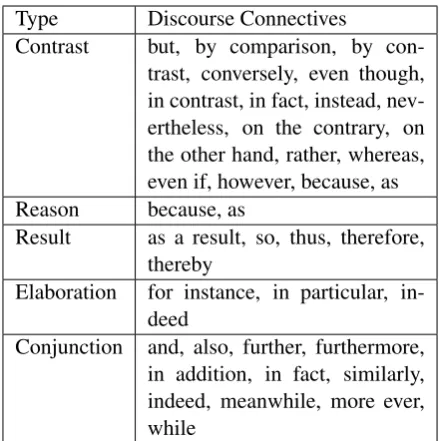
[image:3.595.306.526.60.281.2]The posts data is split into utterances, i.e. smallest discourse units, based on sentence ending mark-ers and a few specific Penn Discourse Tree Bank (PDTB) (Prasad et al., 2008) discourse markers listed in Table 2. Merged words like ‘mindbog-gling’, ‘super-awesome’, etc. are split based on the default Unix dictionary and special charac-ter delimicharac-ters. Once the debate posts are broken into utterances, we identify the intention behind each utterance in the post to compute entire post’s stance.
Table 1 presents the statistics of the debate data collected from‘convinceme.net’.
Debates Posts Author P/A Utterances 28 2040 1333 1.53 12438
Table 1: Debate Data Statistics
3.2 Debate Intention Tagging Schema
Based on the intent each utterance can have, we have devised a debate specific intention tagging schema. In debates, users either express their opinion or state a known fact.
For a dual-sided debate between topic A and
topicB, our tagging schema includes the
follow-ing intention tags:
1. A+andB+: These tags capture users’ in-tent to support topic A orB. For example,
in utterance “Superman is very nearly inde-structible.” the user is supporting Superman’s indestructibility in the debate between Super-man and BatSuper-man.
2. A−andB−: These tags capture users’
in-tent to oppose topicA orB. For example,
“Superman is a stupid person who has an ob-vious weakness, like cyclops.” the user is op-posing Superman by pointing out his weak-ness.
3. N I: This category includes utterances which
hold no sentiment towards the debate topics or can utter about non-debate topic entities, In utterance “We are voting for who will win in a battle between these two.” is neither praising nor opposing either of the sides.
Type Discourse Connectives
Contrast but, by comparison, by con-trast, conversely, even though, in contrast, in fact, instead, nev-ertheless, on the contrary, on the other hand, rather, whereas, even if, however, because, as Reason because, as
Result as a result, so, thus, therefore, thereby
Elaboration for instance, in particular, in-deed
Conjunction and, also, further, furthermore, in addition, in fact, similarly, indeed, meanwhile, more ever, while
Table 2: PDTB Discourse Markers List
Evaluation data was created by five linguists who were provided with a complete set of instruc-tions along with the sample annotated data. Each utterance was annotated with its intention tag by2
linguists and the inter-annotator agreement for the evaluation data was 81.4%.
Table 3 gives a quantitative overview of the an-notations in the corpus. There are total12438 ut-terances spread over2420debate posts.
Tag A+ A− B+ B− N I
Corpus% 20.8 18.4 16.7 21.8 22.3
Table 3: Utterance Annotation Statistics
parentScore=sign(parentScore)×(|parentScore|+updateScore(childScore)) (1)
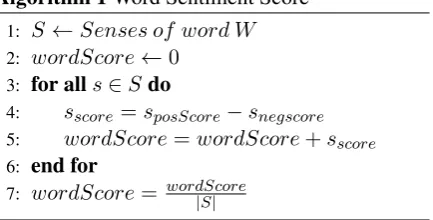
utterance word is looked in thesentiWordNetand the sentiment score calculated using Algorithm 1 is stored in the word’s tree node. For words missing from sentiWordNet, average of sentiment scores of its synset member words is stored in the word’s tree node, otherwise a zero sentiment score is stored. If words are modified by negation words like {’never’,’not’,’nonetheless’,etc.}, their senti-ment scores are negated.
Algorithm 1Word Sentiment Score
1: S←Senses of word W
2: wordScore←0 3: for alls∈Sdo
4: sscore =sposScore−snegscore 5: wordScore=wordScore+sscore 6: end for
7: wordScore= wordScore|S|
In noun phrases such as ‘great warrior’, ‘cruel person’, etc., the first word being the adjective of the latter, it influences its sentiment score. Thus, based on the semantic significance of the depen-dency relation each edge holds, sentiment score of parent nodes are updated with that of child nodes using Equation 1. Tree structure and recursive na-ture of Equation 1 ensures that sentiment scores of child nodes are updated before updating their parents’ sentiment scores. Table 4 lists the seman-tically significant dependency relations used to up-date parent node scores.
Type Dependency Relations Noun Modifying nn, amod, appos, abbrev,
infmod, poss, rcmod, rel, prep
[image:4.595.75.292.261.371.2]Verb Modifying advmod, acomp, ad-vcl, ccomp, prt, purpcl, xcomp, parataxis, prep
Table 4: List of Dependency Relations
In a sentence, “Batman killed a bad guy.”, sen-timent score of word ‘Batman’ is affected by ac-tion ‘kill’ and thus for verb-predicate relaac-tions like ‘nsubj’,‘dobj’,‘cobj’,‘iobj’,etc., predicate sen-timent scores are updated with that of verb scores using Equation 1.
Extended targets (extendedTargets) are the en-tities closely related to debate topics. For exam-ple, ‘Joker’,‘Clarke Kent’ are related to ‘Batman’ and ‘Darth Vader’, ‘Yoda’ to ‘Star Wars’. To ex-tract the extended targets, we capture named enti-ties (NE) from the Wikipedia page of the debate topic (fetched using jsoup java library) using the Stanford Named Entity Recognizer (Finkel et al., 2005) and sort them based on their page occur-rence count. Out oftop-k(k= 20) NEs, some can belong to both of the debate topics. For example, ‘DC Comics’ is common between ‘Superman’ and ‘Batman’. We remove these NEs from individual lists and the remaining NEs are treated as extended targets (extendedTargets) of the debate topics.
Debate topic directed sentiment scores are cal-culated by adding the sentiment scores of the utter-ance words which belong to the extended targets list of each debate topic. We refer to these scores asAScoreandBScorerepresenting scores directed towards topics A andB. We also count the
oc-currences of each debate topic in the utterance by checking word with topics’ extended targets.
We use these topic sentiment scores along with utterance lexical features mentioned in Table 5 to classify utterance intentions into one of the pro-posed5intention tags.
Set Description/Example Unigrams,
Bigrams Word and word pair frequen-cies Cue Words Sentece beginning unigrams
and bigrams
Verb Frame Opinion, action or statement verb
Sentiment
Count count of subjective adjectivesand adverbs topic Count count of words representing
debate topics
Table 5: Lexical Features for Intention Capturing
[image:4.595.71.287.553.651.2]P ost Sentiment Score=X A
(A Score)where A ∈ Argument Structure (2)
4 Argument Structure and Post Sentiment Score
Arguments are the basis of persuasive communi-cation. An argument is a set of statements of which one (conclusion) is supported by others (premises). In our debate data, the implicit con-clusion is to support/oppose the debate topics and premises are users’ opinion/knowledge about the topics. Thus, neighboring utterances with same in-tentions are merged into single argument forming the argument structure for debate posts.Argument structure, also referred to as‘Intention Structure’, may contain multiple arguments with different in-tentions. But to identify the intention behind the entire post, we need to consider sentiment strength and correlation of each argument.
Sentiment Strength: Sentiment strength of ar-guments with different intentions are compared to compute intention behind entire post. Algorithm 2 the computes sentiment strength of an argument from its constituent utterances.
Algorithm 2Argument Sentiment Score
1: U ←Argument U tterances
2: for allu∈U do
3: uscore =uAScore−uBscore 4: end for
5: Argument Score=Pu∈U(uscore)
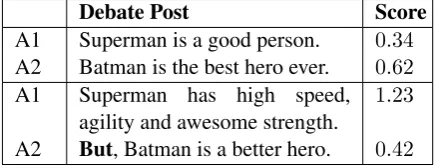
First example in Table 6 shows two utterances one of which praising ‘Superman’ and other prais-ing ‘Batman’. Our argument structure has two ar-guments containing an utterance each. Comparing the sentiment strength of the2arguments, we can
conclude that author supports ‘Batman’ in this ex-ample.
Debate Post Score
A1 Superman is a good person. 0.34
A2 Batman is the best hero ever. 0.62
A1 Superman has high speed, agility and awesome strength.
1.23
[image:5.595.71.291.657.741.2]A2 But, Batman is a better hero. 0.42
Table 6: Argument Structure Examples
Correlation Between Arguments: The Second example in Table 6 shows that though the first ar-gument has a higher sentiment strength, the con-trasting discourse marker ‘but’ nullifies it, result-ing in an overall stance supportresult-ing ‘Batman’. Dis-course markers listed in the first row of Table 2 are used to identify ‘contrast’ between two utterances out of which sentiment strength of the former ut-terance is nullified.
Algorithm 3Utterance Level Sentiment Score
1: U ←P ost U tterances
2: postScore←0 3: foru∈U do
4: uscore=uAScore−uBscore 5: uweight=||U2|−uposition|
6: postScore=postScore+uscore∗uweight 7: end for
4.1 Calculating Post Sentiment Score
To calculate sentiment score of the entire post, three different approaches mentioned below are tried out:
1. uttrScore(Utterance Level): Given two utter-ances connected by a contrasting discourse markers from Table 2, sentiment score of the former is nullified. The posts’ sentiment scores are calculated using Algorithm 3. In this algorithm, the utterance score is multi-plied by function of its position (line 5) which gives more importance to the initial and end-ing utterances than to those in the middle.
2. argScore (Argument Level): First, the sen-timent score of each argument is calculated using Algorithm 2. As in the above method, sentiment score of the former argument con-nected with contrast discourse marker is nul-lified and then posts’ sentiment scores are calculated using Equation 2.
Count of each debate topic entities in the posts and of each intention type are used as post features along with the posts’ sentiment scores to classify their stance, the results of which are discussed in Subsection 6.2.
5 Gradient Ascent Method
In the previous section, sentiment score and inten-tion of the utterances were used to calculate the posts’ sentiment scores. In this section, we focus on the use of the dialogue structure of the debate to improve stance classification. convinceme.net stores user information for posts and also provides an option to rebut another posts. Intuitively, the rebutting posts should have opposite stances and same author posts should support the same stance. Walker et al. (2012) uses the same intuition to split the debate posts in two partitions using a max-cut algorithm. This approach loses the post’s indi-viduality because it assigns the same stance to all posts belonging to a partition. Our approach de-scribed below uses the debate structure to refine posts sentiment scores, calculated in the previous section, thus maintaining post individuality.
If two posts by same author P1 and P2 have
sentiment scores −0.1 and 0.7, the previous ap-proach would classify postP1as supporting topic B and P2 as supporting A, even if they are by
same author and supporting the same stance. What if an error crept in while calculating post senti-ment or utterance sentisenti-ment score? Can we use the debate structure to refine posts’ sentiment scores such that same author posts support same stance and rebuttal author posts support opposite stance? We use a gradient ascent method to accomplish this task.
Gradient ascent is a greedy, hill-climbing ap-proach used to find the local maxima of a function. It maximizes a health/cost function by taking steps proportional to gradient of the health function at a given point. In our case, the dialogue structure of the debate is represented by a GraphG(V, E)
us-ing rebuttal and same author links. Nodes (v∈V)
of graph represents debate posts with their senti-ment score, and edges (e ∈ E) represent the
di-alogue information between two posts with value ‘1’ denoting same author posts and ‘−1’ rebutting
participant posts.
We formulate the health function H(G)which
measures the health of the given graph G(V, E)
in Algorithm 4. This health function signifies the
health or correctness of each edge in the debate structure.
Algorithm 4Debate Health Function Require: Debate Graph G(V,E)
1: H(G)←0 2: for alleij ∈Edo 3: ifeij = 1then
4: ifVi∗Vj >0then 5: H(G) =H(G) + 1
6: else
7: H(G) =H(G) + (1− |Vi−2Vj|)
8: end if
9: else
10: ifVi∗Vj <0then 11: H(G) =H(G) + 1
12: else
13: H(G) =H(G) +|Vi−Vj| 14: end if
15: end if 16: end for
Return H(G)
It calculates health of each edge based on dia-logue information it holds and participating nodes’ scores. A perfect score of 1 is assigned to each edge if participating nodes satisfy edge criteria (line4–5,10–11). If not, difference of nodes’
sen-timent scores are used to calculate edges’ health. (line6–7,12–13)
For an imperfect edge, updating sentiment scores of its connecting nodes will increase its health thus improving health of the graph. Thus we aim to increase the health of the graph by grad-ually modifying posts’ sentiment scores.
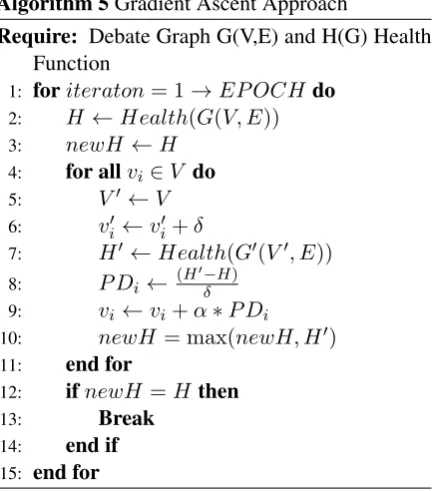
Gradient Ascent algorithm (Algorithm 5) is fed with parameters set to (EP OCH = 1000, δ = 0.01 and α = 0.05). For each iteration, let G(V, E) represent the current state of the graph and H its health. For each node, the sentiment
score is updated by adding partial derivative of health function with respect to given node at the current state (line 9). Partial derivative of the Health function with respect to current node is de-fined in line 8. This continues (line1−15) untill
Algorithm 5Gradient Ascent Approach
Require: Debate Graph G(V,E) and H(G) Health Function
1: foriteraton= 1→EP OCH do
2: H ←Health(G(V, E))
3: newH ←H
4: for allvi∈V do
5: V0 ←V
6: v0i←vi0+δ
7: H0 ←Health(G0(V0, E))
8: P Di ← (H
0−H) δ 9: vi←vi+α∗P Di
10: newH = max(newH, H0) 11: end for
12: ifnewH =Hthen
13: Break
[image:7.595.74.292.68.314.2]14: end if 15: end for
Figure 1 gives a working example of our ap-proach. It clearly shows improving health of the graph using the gradient ascent method helps in rectifying postP1’s stance.
Figure 1: Working Example of Gradient Ascent
6 Experiments and Results
This section highlights experiments, results, ad-vantages and shortcomings of our approach on in-tention capturing and posts’ stance classification tasks.
6.1 Capturing User Intentions
Experiments on debate posts from following de-bates are carried out: Superman vs Batman, Fire-fox vs Internet Explorer, Cats vs Dogs, Ninja vs Pirates and Star Wars vs Lord Of The Rings. Our experimental data for utterances’ intention captur-ing includes1928posts and9015utterances from 5 debates with equal intention class distribution
for each domain. Thus our data has1803correctly
annotated utterances belonging to each intention class. The first task focuses on classifying each utterance into one of the proposed intention tags.
Our first baseline is a Unigram system which uses unigram content information of the utter-ances. Unigram systems are proved reliable in sentiment analysis (Mullen and Collier, 2004; Pang and Lee, 2004). The second baseline sys-tem LexFeatures uses the lexical features (Table 5). This baseline system is a strong baseline for the evaluation because it captures sentiment as well as pragmatic information of the utterances. We con-struct two systems to capture intentions: a Topic-Score system which uses the topic directed sen-timent scores (described in Subsection 3.3) and topic occurrence counts to capture utterance in-tentions, and a TopicScore+LexFeatures system which uses topic sentiment scores (described in Subsection 3.3) along with lexical features in Ta-ble 5. All systems are implemented using the Weka toolkit with its standard SVM implementa-tion. Table 7 shows the accuracies of classifying utterance intentions for each of described baseline and proposed systems.
Accuracy Total A+ A− B+ B− N I
Unigram 64.2 63.2 65.4 60.3 66.5 65.6
LexFeatures 62.7 64.3 60.7 64.2 61.9 62.4
TopicScore 68.4 68.1 68.7 67.2 68.7 69.3
TopicScore+
[image:7.595.309.527.357.422.2]LexFeatures 74.3 73.9 74.8 75.1 73.6 74.1
Table 7: Accuracy of Utterance Intention Classifi-cation
Overall we notice that the proposed approaches perform better than baseline systems, with Top-icScore+LexFeatures outperforming all systems. This shows that topic directed sentiment score helps in capturing users’ intentions better than the word level sentiment analysis. We can also con-clude that theUnigramsystem achieves higher ac-curacies than thelexFeaturessystem, showing that what the user says is a better indicator of user’s intentions than his sentiments and thus confirm-ing previous research results (Somasundaran and Wiebe, 2010; Pang and Lee, 2008). TopicScore performs lower in capturing ‘NI’ tag than the base-line systems, denoting thatTopicScoreis not cap-turing debate topics and their sentiments correctly. Thus it assigns non-NI tagged utterances an ‘N I’
tag, lowering its accuracy.
[image:7.595.78.282.406.461.2]of extended targets in calculating debate topic di-rected sentiment analysis.
6.2 Post Stance Classification
Experiment data covers 2040 posts with equal
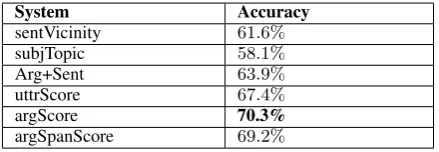
topic stance distribution from each of the follow-ing domains: Superman vs Batman, Firefox vs Internet Explorer, Cats vs Dogs, Ninja vs Pirates and Star Wars vs Lord Of The Rings. Two base-line systems are designed for this task of debate post’s stance classification. The first baseline, sentVicinity, assigns each word’s sentiment score to the closest debate topic entity. Then, the senti-ment score of the debate topics over an entire post is compared to classify post stance. The second baseline,subjTopic, counts the number of subjec-tive words in each utterance of the post and assigns them to debate topic related entity if present in the utterance. It compares overall subjective pos-itivity of debate topics to assign post stance. We also compared our approach with the (Arg+Sent) method proposed by Somasundaran and Wiebe (2010).
Three systems described in Subsection 4.1 are used to compute post’s sentiment score by ana-lyzing its content namely,uttrScore,argScoreand argSpanScore. Post sentiment scores from these three techniques along with post features (topic Count and intention type count) are used to clas-sify post stance and results are compared in Table 8. Table 8 shows that the second approach of cal-culating posts’ sentiment scores using their argu-ment structure outperforms the other approaches.
System Accuracy
sentVicinity 61.6%
subjTopic 58.1%
Arg+Sent 63.9%
uttrScore 67.4%
argScore 70.3%
[image:8.595.309.520.196.250.2]argSpanScore 69.2%
Table 8: Stance Classification Using Post Content
Our approach perform better than Somasun-daran and Wiebe (2010)’s approach signifying the importance of identifying target-opinion depen-dency relation as opposed to assigning the opin-ion words to each content word in the sentence. It is important to notice that the argSpanScore method which multiplies argument score by its span doesn’t perform as well as argScore alone. This shows the utterance sentiment strength mat-ters more than neighboring same intention
utter-ance. This supports our hypothesis that online de-bate posts focus more on sentiments rather than discourse coherence.
We experiment with gradient ascent approach and study how refining posts’ sentiment scores based on the dialogue structure of the debate helps improving stance classification. Table 9 gives the classification accuracies between argScore tech-nique and gradient ascent method.
System Total DialogueAccuracyNon-dialogue argScore 70.3% 70.5% 70.1%
argScore +
[image:8.595.71.291.520.596.2]gra-dientAscent 74.4% 80.1% 70.1%
Table 9: Stance Classification: Dialogue Structure
The dialogue column in Table 9 shows accura-cies for posts participating in dialogue structure i.e., those linked to other post with same author or rebutting links. It shows a remarkable improve-ment (10% gain) which clearly signifies
impor-tance of the dialogue structure. The non-dialogue column shows the accuracies for posts not in-volved in dialogue structure. As health function for debate graph is a function of dialogue partici-pating posts, it does not affect stance classification accuracy for non-dialogue participating posts. Di-alogue participating posts cover41%of the exper-iment data giving4%accuracy improvement over
argScoresystem on complete dataset.
7 Conclusions
In this paper, We designed debate specific utter-ance level intention tags and described a topic directed sentiment analysis approach to capture these intentions. We proposed a novel approach to capture the posts’ intention structure. Our results validate our hypothesis that capturing user inten-tions and post intention structure helps in classi-fying posts’ stance. It also emphasizes the impor-tance of building the intention structure rather than just aggregating utterances’ sentiment scores.
References
Apoorv Agarwal, Boyi Xie, Ilia Vovsha, Owen Ram-bow, and Rebecca Passonneau. 2011. Sentiment analysis of twitter data. InProceedings of the
Work-shop on Languages in Social Media, pages 30–38.
Association for Computational Linguistics.
P. Anand, M. Walker, R. Abbott, J.E.F. Tree, R. Bow-mani, and M. Minor. 2011. Cats rule and dogs drool!: Classifying stance in online debate. In Pro-ceedings of the 2nd Workshop on Computational Approaches to Subjectivity and Sentiment Analysis
(WASSA 2.011), pages 1–9.
S. Baccianella, A. Esuli, and F. Sebastiani. 2010. Sen-tiwordnet 3.0: An enhanced lexical resource for sen-timent analysis and opinion mining. In Proceed-ings of the Seventh conference on International Lan-guage Resources and Evaluation (LREC10), Val-letta, Malta, May. European Language Resources
Association (ELRA).
M.C. De Marneffe, B. MacCartney, and C.D. Manning. 2006. Generating typed dependency parses from phrase structure parses. In Proceedings of LREC, volume 6, pages 449–454.
Christiane Fellbaum. 2010. WordNet. Springer. Jenny Rose Finkel, Trond Grenager, and Christopher
Manning. 2005. Incorporating non-local informa-tion into informainforma-tion extracinforma-tion systems by gibbs sampling. InProceedings of the 43rd Annual
Meet-ing on Association for Computational LMeet-inguistics,
pages 363–370. Association for Computational Lin-guistics.
A. Lampert, R. Dale, and C. Paris. 2006. Classifying speech acts using verbal response modes. In
Aus-tralasian Language Technology Workshop, page 34.
Heeyoung Lee, Yves Peirsman, Angel Chang, Nathanael Chambers, Mihai Surdeanu, and Dan Ju-rafsky. 2011. Stanford’s multi-pass sieve coref-erence resolution system at the conll-2011 shared task. InProceedings of the Fifteenth Conference on Computational Natural Language Learning: Shared Task, pages 28–34. Association for Computational Linguistics.
Subhabrata Mukherjee and Pushpak Bhattacharyya. 2012. Feature specific sentiment analysis for prod-uct reviews. In Computational Linguistics and
In-telligent Text Processing, pages 475–487. Springer.
Tony Mullen and Nigel Collier. 2004. Sentiment anal-ysis using support vector machines with diverse in-formation sources. InProceedings of EMNLP, vol-ume 4, pages 412–418.
Neil O’Hare, Michael Davy, Adam Bermingham, Paul Ferguson, P´araic Sheridan, Cathal Gurrin, and Alan F Smeaton. 2009. Topic-dependent sentiment analysis of financial blogs. InProceedings of the 1st international CIKM workshop on Topic-sentiment
analysis for mass opinion, pages 9–16. ACM.
Bo Pang and Lillian Lee. 2004. A sentimental educa-tion: Sentiment analysis using subjectivity summa-rization based on minimum cuts. InProceedings of the 42nd annual meeting on Association for
Compu-tational Linguistics, page 271. Association for
Com-putational Linguistics.
Bo Pang and Lillian Lee. 2008. Opinion mining and sentiment analysis. Foundations and trends in
infor-mation retrieval, 2(1-2):1–135.
Rashmi Prasad, Nikhil Dinesh, Alan Lee, Eleni Milt-sakaki, Livio Robaldo, Aravind K Joshi, and Bon-nie L Webber. 2008. The penn discourse treebank 2.0. InLREC. Citeseer.
S. Somasundaran and J. Wiebe. 2009. Recognizing stances in online debates. In Proceedings of the Joint Conference of the 47th Annual Meeting of the ACL and the 4th International Joint Conference on Natural Language Processing of the AFNLP:
Vol-ume 1-VolVol-ume 1, pages 226–234. Association for
Computational Linguistics.
S. Somasundaran and J. Wiebe. 2010. Recognizing stances in ideological on-line debates. In Proceed-ings of the NAACL HLT 2010 Workshop on Com-putational Approaches to Analysis and Generation
of Emotion in Text, pages 116–124. Association for
Computational Linguistics.
Arpit Sood, Thanvir P Mohamed, and Vasudeva Varma. 2013. Topic-focused summarization of chat conver-sations. InAdvances in Information Retrieval, pages 800–803. Springer.
M.A. Walker, P. Anand, R. Abbott, and R. Grant. 2012. Stance classification using dialogic proper-ties of persuasion. Proceedings of the 2012 Con-ference of the North American Chapter of the As-sociaotion for Computational Linguistics: Human
Language Technologies, pages 592–596.
J. Wiebe, T. Wilson, and C. Cardie. 2005. Annotating expressions of opinions and emotions in language.
Language Resources and Evaluation, 39(2):165–
210.
S. Yelati and R. Sangal. 2011. Novel approach for tagging of discourse segments in help-desk e-mails.
In Proceedings of the 2011 IEEE/WIC/ACM
Inter-national Conferences on Web Intelligence and
Intel-ligent Agent Technology-Volume 03, pages 369–372.