Abu-MaTran at WMT 2015 Translation Task:
Morphological Segmentation and Web Crawling
Raphael Rubino?, Tommi Pirinen†, Miquel Espl`a-Gomis‡, Nikola Ljubeˇsi´cγ,
Sergio Ortiz-Rojas?, Vassilis Papavassiliou\, Prokopis Prokopidis\, Antonio Toral† ? Prompsit Language Engineering, S.L., Elche, Spain
{rrubino,sortiz}@prompsit.com
†NCLT, School of Computing, Dublin City University, Ireland
{atoral,tpirinen}@computing.dcu.ie
‡Dep. Llenguatges i Sistemes Inform`atics, Universitat d’Alacant, Spain [email protected]
γDepartment of Information and Communication Sciences, University of Zagreb, Croatia [email protected]
\Institute for Language and Speech Processing, Athena Research and Innovation Center, Greece
{vpapa, prokopis}@ilsp.gr
Abstract
This paper presents the machine transla-tion systems submitted by the Abu-MaTran project for the Finnish–English language pair at the WMT 2015 translation task. We tackle the lack of resources and complex morphology of the Finnish language by (i) crawling parallel and monolingual data from the Web and (ii) applying rule-based and unsupervised methods for morpholog-ical segmentation. Several statistmorpholog-ical ma-chine translation approaches are evaluated and then combined to obtain our final sub-missions, which are the top performing English-to-Finnish unconstrained (all au-tomatic metrics) and constrained (BLEU), and Finnish-to-English constrained (TER) systems.
1 Introduction
This paper presents the statistical machine transla-tion (SMT) systems submitted by the Abu-MaTran project for the WMT 2015 translation task. The language pair concerned is Finnish–English with a strong focus on the English-to-Finnish direction. The Finnish language is newly introduced this year as a particular translation challenge due to its rich morphology and to the lack of resources available, compared to e.g. English or French.
Morphologically rich languages, and especially Finnish, are known to be difficult to translate us-ing phrase-based SMT systems mainly because of the large diversity of word forms leading to data scarcity (Koehn, 2005). We assume that data
acqui-sition and morphological segmentation should con-tribute to decrease the out-of-vocabulary rate and thus improve the performance of SMT. To gather additional data, we decide to build on previous work conducted in the Abu-MaTran project and crawl the Web looking for monolingual and paral-lel corpora (Toral et al., 2014). In addition, mor-phological segmentation of Finnish is used in our systems as pre- and post-processing steps. Four segmentation methods are proposed in this paper, two unsupervised and two rule-based.
Both constrained and unconstrained translation systems are submitted for the shared task. The former ones are trained on the data provided by the shared task, while the latter ones benefit from crawled data. For both settings, we evaluate the im-pact of the different SMT approaches and morpho-logical segmentation methods. Finally, the outputs of individually trained systems are combined to obtain our primary submissions for the translation tasks.
This paper is structured as follows: the methods for data acquisition from the Web are described in Section 2. Morphological segmentation is pre-sented in Section 3. The data and tools used in our experiments are detailed in Section 4. Finally, the results of our experiments are shown in Section 5, followed by a conclusion in Section 6.
2 Web Crawling
In this section we describe the process we followed to collect monolingual and parallel data through Web crawling. Both types of corpora are gathered through one web crawl of the Finnish (.fi) top-level
domain (TLD) with the SPIDERLINGcrawler1 (Su-chomel and Pomik´alek, 2012). This crawler per-forms language identification during the crawling process and thus allows simultaneous multilingual crawling. The whole unconstrained dataset gath-ered from the Web is built in 40 days using 16 threads. Documents written in Finnish and English are collected during the crawl.
2.1 Monolingual Data
The Finnish and English data collected during the crawl amounts to5.6M and3.9M documents, containing1.7Band2.0Bwords for Finnish and English respectively (after processing, which in-cludes removing near-duplicates). Interestingly, the amount of Finnish and English data on the Finnish TLD is quite similar. For comparison, on the Croa-tian domain only 10% of the data is written in English (Ljubeˇsi´c and Klubiˇcka, 2014). While the Finnish data is used in further steps for building the target-language model, both datasets are used in the task of searching for parallel data described in the next subsection.
2.2 Parallel Data
In our experiments, we adapt the BITEXTOR2 tool to detect parallel documents from a collec-tion of downloaded and pre-processed websites. The pre-processing performed by SPIDERLING in-cludes language detection, boilerplate removal, and HTML format cleaning. Therefore, the only mod-ules of BITEXTORused for this task are those per-forming document and segment alignment, relying onHUNALIGN3(Varga et al., 2005) and an English– Finnish bilingual lexicon.4Confidence scores for aligned segments are computed thanks to these two resources.
From a total of12.2Kweb domains containing both Finnish and English documents, BITEXTOR is able to identify possible parallel data on10.7k domains (87.5%). From these domains,2.1M seg-ment pairs are extracted without any additional restrictions, and1.2M when additional restrictions on the document pairing are set. Namely, these restrictions discard (i) document pairs where less than 5 segments are aligned; and (ii) those with an alignment score lower than 0.2 according to
1http://nlp.fi.muni.cz/trac/spiderling 2http://sf.net/p/bitextor/
3http://mokk.bme.hu/resources/hunalign 4http://sf.net/p/bitextor/files/ bitextor/bitextor-4.1/dictionaries/
HUNALIGN. The first collection can be consid-ered recall-oriented and the second one precision-oriented.
In this first step, a large amount of potentially parallel data is obtained by post-processing data collected with a TLD crawl, which is not primar-ily aimed at finding parallel data. To make use of this resource in a more efficient way, we re-crawl some of the most promising web sites (we call them
multilingual hotspots) with the ILSP-FC crawler specialised in locating parallel documents during crawling. According to Espl`a-Gomis et al. (2014), BITEXTORand ILSP-FC have shown to be com-plementary, and combining both tools leads to a larger amount of parallel data.
ILSP-FC (Papavassiliou et al., 2013) is a mod-ular crawling system allowing to easily acquire domain-specific and generic corpora from the Web.5 This crawler includes a de-duplicator which checks all documents in a pairwise manner to iden-tify near-duplicates. This is achieved by comparing the quantised word frequencies and the paragraphs of each pair of candidate duplicate documents. A document-pair detector also examines each docu-ment in the same manner and identifies pairs of documents that could be considered parallel. The main methods used by the pair detector are URL similarity, co-occurrences of images with the same filename in two documents, and the documents’ structural similarity.
In order to identify themultilingual hotspots, we process the output of the Finnish TLD and generate a list containing the websites which have already been crawled and the number of stored English and Finnish webpages for each website. Assuming that a website with comparable numbers of webpages for each language is likely to contain bitexts of good quality, we keep the websites with Finnish to English ratio over 0.9. Then, ILSP-FC pro-cesses the1,000largest such websites, considered the most bitext-productive multilingual websites, in order to detect parallel documents. We identify a to-tal of58,839document pairs (8,936,17,288and
32,615based on URL similarity, co-occurrences of images and structural similarity, respectively). Finally, HUNALIGNis applied on these document pairs, resulting in1.2Msegment pairs after dupli-cate removal. The parallel corpus used in our exper-iments is the union without duplicates of the largest
corpora collected with BITEXTORand ILSP-FC, leading to2.8M segment pairs.
3 Morphological Segmentation
Morphological segmentation is a method of analy-sis of word-forms in order to reduce morphological complexity. There are few variations on how to de-fine morphological segmentation, we use the most simple definition: a morphological segmentation of a word is defined by 0 or more segmentation points from where the word can be split into seg-ments. The letter sequences between segmentation points are not modified, i.e. no lemmatisation or segment analysis is performed (or retained) in the actual SMT data. An example of a linguistically derived morphological segmentation of an English word-formcatswould becat→ ←s, where→ ←denotes the segmentation point,6andcatand
sare the segments.
We use four segmentation approaches that can be divided in two categories: (i) rule-based, based on morphological dictionaries and weighted finite-state technology HFST (Lind´en et al., 2009)7, fur-ther detailed in subsection 3.1, and (ii) statistical, based on unsupervised learning of morphologies, further detailed in subsection 3.2. All segments are used as described in subsection 3.3.
3.1 Rule-based Segmentation
Rule-based morphological segmentation is based on linguistically motivated computational descriptions of the morphology by dividing the word-forms into morphs (minimal segments carrying semantic or syntactic meaning). The rule-based approach to morphological segmen-tation uses a morphological dictionary of words and an implementation of the morphological grammar to analyse word-forms. In our case, we useOMORFI(Pirinen, 2015), an open-source imple-mentation of the Finnish morphology.8 OMORFI’s segmentation produces named segment boundaries: stem, inflection, derivation, compound-word and other etymological. The two variants of rule-based segmentation we use are based on selection of the boundary points: compound segmentation
uses compound segments and discards the rest (referred in tables and figures to asHFST Comp), and morph segmentation uses compound and
6we follow this arrow notation throughout the paper as well as in the actual implementation
7http://hfst.sf.net
8http://github.com/flammie/omorfi/
inflectional morph segments (HFST Morph
in tables and figures). In cases of ambiguous segments, the weighted finite-state automata 1-best search is used with default weights.9 For example, the wordskuntaliitoksen selvitt¨amisess¨a (“exam-ining annexation”) is segmented byhfst-comp
as ‘kunta→←liitoksen selvitt¨amisess¨a’ and
hfst-morph as ‘kunta→←liitokse→←n selvitt¨amise→←ss¨a’.
3.2 Unsupervised Segmentation
Unsupervised morphological segmentation is based on a statistical model trained by minimising the number of different character sequences observed in a training corpus. We use two different algorithms: MORFESSOR Baseline 2.0 (Virpioja et al., 2013) and FLATCAT (Gr¨onroos et al., 2014). The segmentation models are trained using the Europarl v8 corpus. Both systems are used with default settings. However, with FLATCAT we discard the non-morph boundaries and we have not used semi-supervised features. For example, the phrase given in previous sub-section: morfessor produces 1-best segmentation: and ‘Kun→←ta→←liito→←ksen
selvitt¨a→←misess¨a’ and flatcat
‘Kun→←tali→←itoksen selvitt¨amis→←ess¨a’
3.3 Segments in the SMT Pipeline
The segmented data is used exactly as the word-form-based data during training, tuning and test-ing of the SMT systems,10except during the processing and post-processing steps. For pre-processing, the Finnish side is segmented prior to use. For the post-processing of segmented-Finnish-to-English, boundary markers are removed. For the other direction, two types of tokens with boundary markers are observed:matchingarrowsa→ ←b
andstrayarrowsa→ xorx ←b. Formatching
arrows, an empty string is used to join the morphs, while the morphs withstrayarrows are deleted.
4 Datasets and Tools
This section presents the tools, the monolingual and parallel data used to train our SMT systems. All the corpora are pre-processed prior to training the
9For details of implementation and reproducibility, the code is available in form of automake scriptlets athttp:// github.com/flammie/autostuff-moses-smt/.
language and translation models. We rely on the scripts included in the MOSEStoolkit (Koehn et al., 2007) and perform the following operations: punc-tuation normalisation, tokenisation, true-casing and escaping of problematic characters. The truecaser is lexicon-based, trained on all the monolingual and parallel data. In addition, we remove sentence pairs from the parallel corpora where either side is longer than80tokens.
4.1 Translation Models
We empirically evaluate several types of SMT sys-tems: phrase-based SMT (Och and Ney, 2004) trained on word forms or morphs as described in Section 3, Factored Models (Koehn and Hoang, 2007) including morphological and suffix informa-tion as provided byOMORFI,11 in addition to sur-face forms, and finally hierarchical phrase-based SMT (Chiang, 2005) as an unsupervised tree-based model. All the systems are trained with MOSES, re-lying on MGIZA (Gao and Vogel, 2008) for word alignment and MIRA (Watanabe et al., 2007) for tuning. This tuning algorithm was shown to be faster and as efficient as MERT for model core features, as well as a better stability with larger numbers of features (Hasler et al., 2011).
In order to compare the individually trained SMT systems, we use the same parallel data for each model, as well as the provided development set to tune the systems. The phrase-based SMT system is augmented with additional features: an Operation Sequence Model (OSM) (Durrani et al., 2011) and a Bilingual Neural Language Model (BiNLM) (De-vlin et al., 2014), both trained on the parallel data used to learn the phrase-table. All the translation systems also benefit from two additional reorder-ing models, namely a phrase-based model with three different orientations (monotone, swap and discontinuous) and a hierarchical model with four orientations (non merged discontinuous left and right orientations), both trained in a bidirectional way (Koehn et al., 2005; Galley and Manning, 2008).
Our constrained systems are trained on the data available for the shared task, while unconstrained systems are trained with two additional sets of par-allel data, the FIENWAC crawled dataset (cf. Sec-tion 2.2) and Open Subtitles, henceforthOSUBS.12 The details about the corpora used to train the
trans-11using the scriptomorfi-factorise.py 12http://opus.lingfil.uu.se/
news shuffled 2014 europarl
0.0 0.1 0.2 0.3 0.4 0.5 0.6 0.7 0.8 0.9
1.0 words flatcat hfst comp hfst morph morfessor
Corpora
U
ni
qu
e
T
ok
en
s
(M
[image:4.595.309.524.65.174.2])
Figure 1: Effects of segmentation on unique token counts for Finnish.
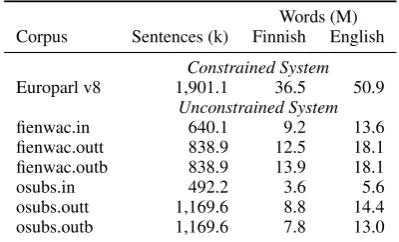
Words (M) Corpus Sentences (k) Finnish English
Constrained System Europarl v8 1,901.1 36.5 50.9
Unconstrained System
fienwac.in 640.1 9.2 13.6
fienwac.outt 838.9 12.5 18.1 fienwac.outb 838.9 13.9 18.1
osubs.in 492.2 3.6 5.6
osubs.outt 1,169.6 8.8 14.4
osubs.outb 1,169.6 7.8 13.0
Table 1: Parallel data used to train the translation models, after pre-processing.
lation models are presented in Table 1. Figure 1 shows how different segmentation methods affect the vocabulary size; given that linguistic segmen-tation have larger vocabularies as statistical their contribution to translation models may be at least partially complementary.
The two unconstrained parallel datasets are split into three subsets: pseudo in-domain, pseudo out-of-domain top and pseudo out-out-of-domain bottom, henceforthin,outtandoutb. We rank the sen-tence pairs according to bilingual cross-entropy dif-ference on the devset (Axelrod et al., 2011) and cal-culate the perplexity on the devset of LMs trained on different portions of the top ranked sentences (the top 1/64, 1/32 and so on). The subset for which we obtain the lowest perplexities is kept asin(this was 1/4 for fienwac (403.89 and 3610.95 for English and Finnish, respectively), and 1/16 for
osubs(702.45 and 7032.2). The remaining part of each dataset is split in two sequential parts in ranking order of same number of lines, which are kept asouttandoutb.
[image:4.595.316.516.217.338.2]Corpus Sentences (k) Words (M)
Europarl v8 2,218.2 59.9
News Commentary v10 344.9 8.6
News Shuffled
2007 3 782.5 90.2
2008 12 954.5 308.1
2009 14 680.0 347.0
2010 6 797.2 157.8
2011 15 437.7 358.1
2012 14 869.7 345.5
2013 21 688.4 495.2
2014 28 221.3 636.6
Gigaword 5th 28,178.1 4,831.5
Table 2: English monolingual data, after pre-processing, used to train the constrained language model.
and filter out those for which we have seen already each 1-gram at least 10 times. This results in a reduction of 3.2x on the number of sentence pairs (from7.3M to2.3M) and 2.6x on the number of words (from114M to44M).
The resulting parallel datasets (7 in total: Eu-roparl and 3 sets for eachfienwacandosubs) are used individually to train translation and re-ordering models before being combined by linear interpolation based on perplexity minimisation on the development set. (Sennrich, 2012)
4.2 Language Models
All the Language Models (LM) used in our experi-ments are5-grams modified Kneser-Ney smoothed LMs trained using KenLM (Heafield et al., 2013). For the constrained setup, the Finnish and the En-glish LMs are trained following two different ap-proaches. The English LM is trained on the con-catenation of all available corpora while the Finnish LM is obtained by linearly interpolating individ-ually trained LMs based on each corpus. The weights given to each individual LM is calculated by minimising the perplexity obtained on the de-velopment set. For the unconstrained setup, the Finnish LM is trained on the concatenation of all constrained data plus the additional monolingual crawled corpora (notedFiWaC). The data used to train the English and Finnish LMs are presented in Table 2 and Table 3 respectively.
5 Results
We tackle the English-to-Finnish direction in the unconstrained task, while both directions are pre-sented for the constrained task. Systems’ outputs are combined using MEMT (Heafield and Lavie,
Corpus Sentences (k) Words (M) Constrained System
News Shuffle 2014 1,378.8 16.5 Unconstrained System
FiWaC 146,557.4 1,996.3
Table 3: Finnish monolingual data, after pre-processing, used to train the language models.
Dev Test
System BLEU TER BLEU TER
Phrase-Based 13.51 0.827 12.33 0.843 Factored Model 13.08 0.827 11.89 0.847 Hierarchical 13.05 0.822 12.11 0.830 HFST Comp 13.57 0.814 12.66 0.828 HFST Morph 13.19 0.818 12.77 0.819
[image:5.595.319.515.63.124.2]Morfessor 12.21 0.860 11.58 0.864 Flatcat 12.67 0.844 12.05 0.849 Combination 14.61 0.786 13.54 0.801
Table 4: Results obtained on the development and test sets for the constrained English-to-Finnish translation task. Best individual system in bold.
2010) using default settings, except for the beam size (set to1,500) and radius (5 for Finnish and 7 for English), following empirical results obtained on the development set.
5.1 Constrained Results
Individual systems trained on the provided data are evaluated before being combined. The results obtained for the English-to-Finnish direction are presented in Table 4.13 The BLEU (Papineni et al., 2002) and TER (Snover et al., 2006) scores obtained by the system trained on compound-segmented data (HFST Comp) show a positive im-pact of this method on SMT according to the de-velopment set, compared to the other individual systems. The unsupervised segmentation methods do not improve over phrase-based SMT, while the hierarchical model shows an interesting reduction of the TER score compared to a classic phrase-based approach. On the test set, the use of in-flectional morph segments as well as compounds (HFST Morph) leads to the best results for the in-dividual systems on both evaluation metrics. The combination of these7systems improves substan-tially over the best individual system for the devel-opment and the test sets.
The results for the other translation direction (Finnish to English) are shown in Table 5 and
Dev Test
System BLEU TER BLEU TER
Phrase-Based 17.19 0.762 16.90 0.759 Hierarchical 16.98 0.768 15.93 0.773 HFST Comp 17.87 0.748 16.68 0.753 HFST Morph 18.64 0.735 17.22 0.752 Morfessor 16.83 0.769 15.96 0.756 Flatcat 16.78 0.766 17.33 0.741
Combination 19.66 0.719 18.77 0.726
Table 5: Results obtained on the development and test sets for the constrained Finnish-to-English translation task. Best individual system in bold.
follow the same trend as observed with Finnish as target: the morphologically segmented data helps improving over classic SMT approaches. The two metrics indicate better performances of
HFST Morphon the development set, while Flat-catreaches the best scores on the test set. The re-sults obtained with the segmented data on the two translation directions and the different segmenta-tion approaches are fluctuating and do not indicate which method is the best. Again, the combination of all the systems results in a substantial improve-ment over the best individual system across both evaluation metrics. The top3systems presented in Table 5, namelyCombination, HFST Morphand
Phrase-Basedcorrelates with the results reported by the manual evaluation.14
5.2 Unconstrained Results
We present the results obtained on the uncon-strained English-to-Finnish translation task in Ta-ble 6. Two individual systems are evaluated, using word-forms and compound-based data, and show that the segmented data leads to lower TER scores, while higher BLEU are reached by the word-based system. The combination of these two systems in addition to the constrained outputs of the remain-ing systems (hierarchical, factored model, HFST Morph, Morfessor and Flatcat) is evaluated in the last row of the table, and shows.3pt BLEU gain on the test set over the phrase-based approach using word forms.
The human evaluation conducted on the English– Finnish translation direction shows interesting re-sults. While our unconstrainedCombination sys-tem outperforms our other manually evaluated systems, the quality of the unconstrained Phrase-Basedoutput is lower than the constrained
Combi-14http://www.statmt.org/wmt15/results. html
Dev Test
System BLEU TER BLEU TER
Phrase-Based 16.16 0.804 16.07 0.801 HFST Comp 15.80 0.796 15.06 0.800
[image:6.595.81.283.64.170.2]Combination 17.25 0.776 16.38 0.779
Table 6: Results obtained on the development and test sets for the unconstrained English-to-Finnish translation task. Best individual system in bold.
nationone. The opposite is observed on the auto-matic metrics, with a difference of2.5pts BLEU and.2ptTER.
6 Conclusion
Our participation in WMT15’s translation task fo-cus on investigating the use of several morpholog-ical segmentation methods and Web data acquisi-tion in order to handle the data scarcity and the rich morphology of Finnish. We evaluate several SMT approaches, showing the usefulness of morpholog-ical segmentation for Finnish SMT. In particular, the rule-based methods lead to the best results on the constrained English–Finnish task compared to our other individual systems.
In addition, the manual evaluation results indi-cate that combining diverse SMT systems’ outputs, including morphologically segmented ones, can outperform a classic phrase-based approach trained on larger parallel and monolingual corpora. The combination of the different SMT systems leads to the best results for both translation directions, as shown by automatic metrics and manual evalua-tion. Finally, the acquisition of additional training data improves over the constrained systems and is a successful example of the Abu-MaTran crawling pipeline. However, the discrepancy observed on the results using the different segmentation meth-ods requires a deeper analysis of the SMT output, which is planned as future work.
Acknowledgments
References
Amittai Axelrod, Xiaodong He, and Jianfeng Gao. 2011. Domain adaptation via pseudo in-domain data selection. InProceedings of the Conference on Em-pirical Methods in Natural Language Processing, pages 355–362. Association for Computational Lin-guistics.
David Chiang. 2005. A Hierarchical Phrase-based Model for Statistical Machine Translation. In Pro-ceedings of ACL, pages 263–270.
Jacob Devlin, Rabih Zbib, Zhongqiang Huang, Thomas Lamar, Richard Schwartz, and John Makhoul. 2014. Fast and Robust Neural Network Joint Models for Statistical Machine Translation. In Proceedings of ACL, pages 1370–1380.
Nadir Durrani, Helmut Schmid, and Alexander Fraser. 2011. A Joint Sequence Translation Model with In-tegrated Reordering. In Proceedings of ACL/HLT, pages 1045–1054.
Miquel Espl`a-Gomis, Filip Klubiˇcka, Nikola Ljubeˇsi´c, Sergio Ortiz-Rojas, Vassilis Papavassiliou, and Prokopis Prokopidis. 2014. Comparing two acqui-sition systems for automatically building an english-croatian parallel corpus from multilingual websites. In Proceedings of the 9th International Conference on Language Resources and Evaluation, LREC’14, Reykjavik, Iceland.
Michel Galley and Christopher D Manning. 2008. A simple and effective hierarchical phrase reordering model. In Proceedings of the Conference on Em-pirical Methods in Natural Language Processing, pages 848–856. Association for Computational Lin-guistics.
Qin Gao and Stephan Vogel. 2008. Parallel Implemen-tations of Word Alignment Tool. InSoftware Engi-neering, Testing, and Quality Assurance for Natural Language Processing, pages 49–57.
Stig-Arne Gr¨onroos, Sami Virpioja, Peter Smit, and Mikko Kurimo. 2014. Morfessor flatcat: An hmm-based method for unsupervised and semi-supervised learning of morphology. InProceedings of COLING 2014, the 25th International Conference on Compu-tational Linguistics, pages 1177–1185.
Eva Hasler, Barry Haddow, and Philipp Koehn. 2011. Margin Infused Relaxed Algorithm for Moses. The Prague Bulletin of Mathematical Linguistics, 96:69– 78.
Kenneth Heafield and Alon Lavie. 2010. Combining machine translation output with open source: The carnegie mellon multi-engine machine translation scheme. The Prague Bulletin of Mathematical Lin-guistics, 93:27–36.
Kenneth Heafield, Ivan Pouzyrevsky, Jonathan H. Clark, and Philipp Koehn. 2013. Scalable Mod-ified Kneser-Ney Language Model Estimation. In Proceedings of ACL, pages 690–696.
Philipp Koehn and Hieu Hoang. 2007. Factored Trans-lation Models. In Proceedings of EMNLP-CoNLL, pages 868–876.
Philipp Koehn, Amittai Axelrod, Alexandra Birch, Chris Callison-Burch, Miles Osborne, David Talbot, and Michael White. 2005. Edinburgh system de-scription for the 2005 iwslt speech translation evalu-ation. InIWSLT, pages 68–75.
Philipp Koehn, Hieu Hoang, Alexandra Birch, Chris Callison-Burch, Marcello Federico, Nicola Bertoldi, Brooke Cowan, Wade Shen, Christine Moran, Richard Zens, et al. 2007. Moses: Open Source Toolkit for Statistical Machine Translation. In Pro-ceedings of ACL, pages 177–180.
Philipp Koehn. 2005. Europarl: A Parallel Corpus for Statistical Machine Translation. InMT summit, volume 5, pages 79–86.
William D Lewis and Sauleh Eetemadi. 2013. Dramat-ically reducing training data size through vocabulary saturation. InProceedings of the Eighth Workshop on Statistical Machine Translation, pages 281–291. Krister Lind´en, Miikka Silfverberg, and Tommi
Piri-nen. 2009. Hfst tools for morphology–an efficient open-source package for construction of morpholog-ical analyzers. InState of the Art in Computational Morphology, pages 28–47. Springer.
Nikola Ljubeˇsi´c and Filip Klubiˇcka. 2014. {bs,hr,sr}WaC – web corpora of Bosnian, Croatian and Serbian. InProceedings of the 9th Web as Cor-pus Workshop (WaC-9), pages 29–35, Gothenburg, Sweden. Association for Computational Linguistics. Franz Josef Och and Hermann Ney. 2004. The Align-ment Template Approach to Statistical Machine Translation. Computational linguistics, 30(4):417– 449.
Vassilis Papavassiliou, Prokopis Prokopidis, and Gre-gor Thurmair. 2013. A modular open-source fo-cused crawler for mining monolingual and bilingual corpora from the web. In Proceedings of the Sixth Workshop on Building and Using Comparable Cor-pora, pages 43–51, Sofia, Bulgaria, August. Associ-ation for ComputAssoci-ational Linguistics.
Kishore Papineni, Salim Roukos, Todd Ward, and Wei-Jing Zhu. 2002. BLEU: A Method for Automatic Evaluation of Machine Translation. InProceedings of ACL, pages 311–318.
Tommi A Pirinen. 2015. Omorfi—free and open source morphological lexical database for Finnish. InNordic Conference of Computational Linguistics NODALIDA 2015, pages 313–317.
and rbmt-style synthetic rules. InProceedings of the Ninth Workshop on Statistical Machine Translation, pages 171–177, Baltimore, Maryland, USA, June. Association for Computational Linguistics.
Rico Sennrich. 2012. Perplexity minimization for translation model domain adaptation in statistical machine translation. InProceedings of the 13th Con-ference of the European Chapter of the Association for Computational Linguistics, pages 539–549. As-sociation for Computational Linguistics.
Matthew Snover, Bonnie Dorr, Richard Schwartz, Lin-nea Micciulla, and John Makhoul. 2006. A Study of Translation Edit Rate with Targeted Human Annota-tion. InProceedings of AMTA, pages 223–231. V´ıt Suchomel and Jan Pomik´alek. 2012. Efficient web
crawling for large text corpora. InProceedings of the 7th Web as Corpus Workshop, WAC7, pages 39– 43, Lyon, France.
Antonio Toral, Raphael Rubino, Miquel Espl`a-Gomis, Tommi Pirinen, Andy Way, and Gema Ramirez-Sanchez. 2014. Extrinsic evaluation of web-crawlers in machine translation: a case study on croatian–english for the tourism domain. In Pro-ceedings of EAMT, pages 221–224.
D´aniel Varga, L´aszl´o N´emeth, P´eter Hal´acsy, Andr´as Kornai, Viktor Tr´on, and Viktor Nagy. 2005. Paral-lel corpora for medium density languages. InRecent Advances in Natural Language Processing, pages 590–596, Borovets, Bulgaria.
Sami Virpioja, Peter Smit, Stig-Arne Gr¨onroos, Mikko Kurimo, et al. 2013. Morfessor 2.0: Python imple-mentation and extensions for morfessor baseline. Taro Watanabe, Jun Suzuki, Hajime Tsukada, and